The HOA Cut Down Seven 40-Year-Old Oaks on My Lakefront Ranch for a Better View—So I Put a Hog Farm Exactly Where They Cleared Them.
PART2:
That tree had been a sapling when my daughter was learning to walk. She used to sit on one of its low limbs with a peanut butter sandwich in one hand and tell me she was queen of the lake. That limb was now lying in sections near the truck bed like butchered memory.
I crouched beside the stump and touched the pale center of the wood.
Then I stood.
“Do you have the county instrument number?”
Patricia blinked.
Not dramatically.
Just enough.
“The what?”
“The recorded easement,” I said. “You said view easement. Easements are recorded. Give me the instrument number.”
Her shoulders squared.
“Our attorney has reviewed the governing documents and confirmed the board’s authority.”
“That isn’t what I asked.”
She tapped the clipboard against her palm.
Tap.
That little gesture was something Patricia did whenever she wanted a conversation to end.
I had seen it at meetings.
At fence lines.
In driveways.
Tap.
Decision made.
Tap.
Complaint closed.
Tap.
You no longer exist in the conversation.
I pointed toward the stumps.
“You said view easement.”
“That’s correct.”
“Then give me the recorded document number.”
“Our legal counsel has reviewed—”
“Patricia.”
She paused.
“I am asking for the document number.”
One of the two workers near the truck stopped moving for half a second.
Patricia noticed.
Her expression hardened.
“You will receive all relevant information through the formal compliance process.”
“So you don’t have it.”
“I did not say that.”
“You didn’t give it.”
Her smile thinned into something sharper.
“Mr. Calhoun, the board has already executed the maintenance action. This matter is complete.”
I looked past her.
Seven stumps.
All white oak.
Average age around forty years.
Some older.
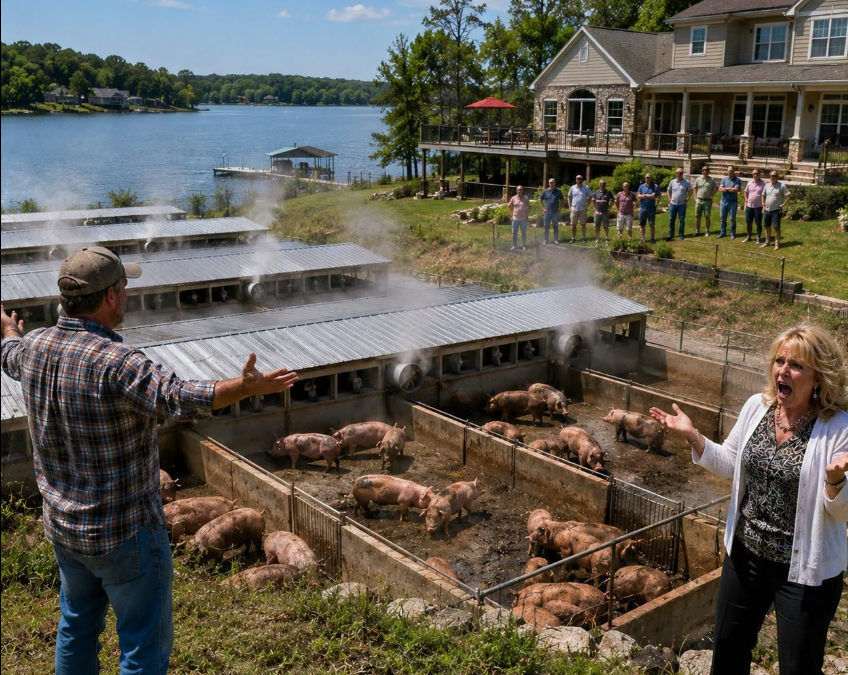
The cleared strip ran approximately forty feet wide and two hundred feet deep, flat as a table, running from the county road toward the lake. It sat directly along the eastern edge of my sixty-one acres, perfectly aligned with the rear windows and raised decks of twelve lake-facing houses in Lake View Pines.
Including Patricia’s.
For years, those oaks had broken the sightline. Not blocked the lake entirely. Just filtered it. Made it something glimpsed through branches and shade instead of displayed like a painting bought and hung for private enjoyment.
Now the lake shone straight through.
Morning light crossed the grass where shade had been the day before.
I could see why Patricia liked it.
What she saw was an unobstructed lake view.
What I saw was a rectangular piece of agricultural ground that had just been professionally cleared, graded, opened, and made accessible from the county road.
For free.
Across the fence, my neighbor Frank Mercer stood in his bathrobe and boots, watching from his side of Lake View Pines.
Seventy-one years old.
Retired schoolteacher.
Widower.
Eleven HOA fines in four years.
Wind chimes.
Mailbox color.
Garden hose.
Holiday lights.
A motion-sensor porch light supposedly aimed two degrees outside the association’s approved angle.
Frank did not wave.
He just met my eyes and shook his head.
Slowly.
The way a witness does when there is nothing left to say.
Patricia walked toward the HOA truck.
Before getting in, she turned.
“You’re going to appreciate this once the view opens up,” she said.
I said nothing.
She looked toward the lake.
“The whole community benefits.”
Still nothing.
Then she smiled.
“That’s what community living is about.”
The truck pulled away with pieces of my trees in the back.
The gate clicked shut.
I stood alone in the sawdust.
For almost a minute, I looked at the space where the trees had been. I listened to the sudden openness. Birds that used to gather in those branches had gone silent. The wind moved differently over the strip now, too direct, too bright, too naked.
Then I went inside.
I poured coffee.
I opened my laptop.
I pulled up the county assessor’s website and typed the parcel number I had known by memory since 1987.
The record appeared.
Agricultural classification.
Sixty-one acres.
No subdivision incorporation.
No recorded view easement.
No scenic corridor.
No vegetation maintenance agreement.
No HOA covenant attached to the ranch land.
Nothing.
I already knew most of that.
But when somebody walks onto your property with chainsaws and confidence, it is worth checking whether reality changed while you were asleep.
It had not.
I opened the fire safe in my office.
Inside was my original deed.
County seal.
Clean title.
I set it on the desk beside my coffee.
Then I looked through the back window toward the forty-by-two-hundred-foot strip Patricia had just handed me.
Somewhere in that moment, anger became planning.
And planning is much more useful.
My name is Wade Calhoun.
I bought those sixty-one acres beside Lake Hartwell in 1987, twelve years before anybody poured the first foundation for what eventually became Lake View Pines.
That number matters.
Twelve years.
My land was not some forgotten scrap accidentally left between subdivision lots. It was not a decorative buffer. It was not common area. It was not a neighborhood amenity. I was there before the entrance sign, before the private roads, before the architectural review committee, before the community forum, before anybody got fined because their trash can had spent an extra night near the curb.
Back then, there was a county road.
A lake.
Scrub timber.
A drainage cut that flooded every spring.
And enough land for me to build a life without asking anyone whether the color of my mailbox matched an approved palette.
I raised cattle for years. Ran hay when my knees were better. Fixed fence in weather that would make a sensible man question his choices. I buried two good dogs under a pecan tree. I taught my daughter to fish off the south bank. I watched my wife, Ellen, drink coffee every morning on our back porch until cancer made coffee taste like pennies and mornings became harder to trust.
Ellen died in 2014.
After that, the ranch became quieter.
Not empty.
Land is never empty if you listen.
But quiet in the human places.
My daughter, Sarah, lived in Greenville by then with a husband, two sons, and a life that did not need daily ranch problems. She visited when she could. Called every Sunday. Told me constantly that I did not have to handle everything alone.
I told her I knew.
We both understood I was lying.
The first twelve years I lived there, Lake View Pines did not exist.
The developer bought acreage east of my ranch in 1998. The plat was filed in 1999.
Ninety-four homes.
Walking trail.
Small clubhouse.
Private streets.
Decorative stone entrance.
An HOA incorporated to maintain common property.
My sixty-one acres remained outside the recorded residential plat.
That point would later become more important than every speech Patricia ever gave.
At the time, none of us cared much. The original board was practical. They treated me as what they called a non-standard parcel for limited administrative purposes because one corner of my driveway shared a short stretch of road maintenance. I received meeting notices. I paid a reduced annual assessment tied to that shared access.
But my actual ranch remained agricultural land under county classification.
The covenants governing residential parcels did not magically swallow sixty-one acres because houses had been built beside them.
For the first five years, the HOA behaved like a normal HOA.
Streetlights.
Common landscaping.
Pool maintenance.
A newsletter nobody read.
I attended maybe two meetings.
My trees never came up.
My fences never came up.
My cattle never came up.
Then Patricia Holloway became president.
She won by six votes.
The previous president, a retired civil engineer named Howard Hobbes, congratulated her, packed his binders, and disappeared into peaceful retirement so quickly I sometimes wondered whether he had seen the future.
Patricia did not inherit the role.
She occupied it.
Within eight months, she hired Lake View Pines’ first full-time compliance officer.
Dale Whitmore.
Sixty-three.
Retired mall security.
Dale received a golf cart, magnetic HOA logos, a camera, a clipboard, and, apparently, the feeling that he had finally been given the authority previous employers had cruelly denied him.
He drove through Lake View Pines photographing violations.
Grass.
Cars.
Flags.
Mailboxes.
Decorations.
Garden equipment.
For Patricia, enforcement became revenue.
Before her first year was over, fines totaled roughly thirty-four thousand dollars.
Second year?
Around sixty-one thousand.
Ninety-four households.
Think about that.
More than six hundred dollars per home on average if distributed evenly.
It was not evenly distributed.
Patricia had a pattern.
People least likely to fight.
Widows.
Retirees.
Families dealing with medical problems.
People with job losses.
People going through divorces.
Residents too busy surviving bigger things to hire an attorney over a garden hose.
Eleanor Marsh was seventy-four when Dale photographed the American flag in her front garden. Her husband had died two years earlier. She placed the flag on a shepherd’s hook during the week of July Fourth.
Wrong placement.
Wrong dimensions.
Wrong relationship to the property line under an amendment Patricia had pushed through months earlier.
By the time Eleanor called the management office to ask what she needed to change, accumulated daily penalties had reached fourteen hundred dollars.
She paid.
Why?
Because Patricia’s genius was not creating unbeatable fines.
It was creating fines cheaper than resistance.
Attorney?
Two thousand dollars.
Fine?
Four hundred.
Pay the fine.
Move on.
The HOA learned every time somebody surrendered.
A man on Crest View left his son’s boat trailer in the driveway for two days.
Three hundred dollars.
A family on Maple Run planted the wrong color perennial.
Six hundred fifty.
Frank Mercer?
Eleven notices.
Every one paid.
But Frank kept copies.
That mattered later.
Patricia also directed money toward the side of Lake View Pines where she lived.
Walking path resurfacing.
New entrance lighting.
Decorative monument signs.
Landscaping improvements.
All perfectly legal by themselves.
But the concentration was obvious if you stepped back.
The lake-facing properties received the most visible upgrades.
Those homes were worth more.
Patricia owned one.
And those same homes had one persistent complaint.
My trees.
Seven mature oaks along my eastern boundary blocked portions of the lake view. Not the whole lake. Not even most of it. Just enough that certain upstairs windows looked at branches instead of uninterrupted blue water.
For years, nobody had a legal reason to care.
Then Patricia invented one.
I learned that three days after the cutting, when Frank Mercer knocked on my door holding a Nike shoe box under one arm and wearing the expression of a man who had been waiting years for someone else to get angry enough.
“I’ve been collecting,” he said.
“Collecting what?”
He raised the shoe box.
“Receipts.”
I let him in.
We sat at my kitchen table, and Frank opened the box like a preacher opening scripture.
Documents.
Stacks.
Monthly sections.
Fine notices.
Board minutes.
Letters.
Screenshots.
Frank had collected everything.
He had even filed two complaints with the county HOA oversight office. Both acknowledged. Neither acted upon in any meaningful way because nobody else supported him.
“Why keep going?” I asked.
Frank looked at me over his glasses.
“I taught history.”
“So?”
“Records are how people lie less successfully.”
Good answer.
He had cross-referenced twenty-three fines across eight homeowners. Seven of his eleven penalties had no valid bylaw behind them. Not vague rules. No rule. Patricia had sometimes applied new amendments to behavior that occurred before the amendment.
Retroactive enforcement.
Frank showed me Eleanor’s flag penalty.
The boat trailer.
The garden hose.
The porch light.
A cancer patient on Birch Court who accumulated fines while going through chemotherapy because his lawn service missed two cuts.
Then Frank showed me where the money went.
Lake-facing upgrades.
Patricia’s side.
“Do you think she targeted people intentionally?” I asked.
Frank thought about it.
“I think she targeted resistance levels.”
“What does that mean?”
He tapped one notice.
“Widow.”
Another.
“Job loss.”
Another.
“Cancer.”
He leaned back.
“People with bigger problems.”
That sat badly with me.
Then he pulled out his phone.
“I filmed the tree crew.”
My coffee stopped halfway to my mouth.
“When?”
“The morning they cut.”
He opened the video.
Forty-one seconds.
Unsteady.
Shot from his property.
But clear.
HOA truck.
Workers.
Chainsaw.
Patricia.
On my land.
Not near it.
Past the posts.
Past the fence.
Pointing toward the trees.
Timestamp: 6:47 a.m.
Two hours before I stepped outside and saw the finished work.
I watched it twice.
Frank sent me the file.
“Anything else?” I asked.
He nodded.
From the shoe box, he pulled an attorney invoice.
Garfield & Pike.
The HOA’s law firm.
Obtained through an earlier records request.
Matter: Calhoun parcel boundary vegetation.
Billing: verbal consultation, 0.4 hours.
Twenty-four minutes if billed exactly.
Maybe less if rounded.
No title review.
No easement analysis.
No written legal opinion.
No recorded-instrument search.
Patricia had told the board counsel reviewed the matter.
Technically, counsel had spoken to her.
That was not the same thing.
“Where did you get this?” I asked.
“Records request.”
“You were investigating my trees before they cut them?”
“I was investigating Patricia.”
Fair.
That invoice changed the case.
The board thought they had legal confirmation.
Patricia had a phone call.
What did Garfield actually tell her?
Unknown.
But the paper trail no longer matched the confidence.
“What are you going to do?” Frank asked.
I looked through the window at the cleared strip.
The light crossed it differently without trees.
“I’m going to use my land.”
“For?”
“Agriculture.”
“What kind?”
“Still deciding.”
Frank studied me.
Then slowly nodded.
He did not ask again.
The morning after the removal, I called an arborist.
Gerald Pruitt.
Thirty-one years evaluating trees for insurers, county disputes, utility claims, and property-damage lawsuits.
Gerald was not sentimental. That was why I hired him. He did not stand beside my stumps and say what a shame in that vague way people do when they don’t know how to measure loss. He walked the strip with a clipboard of his own, but unlike Patricia’s, his contained facts.
He measured the stumps.
Inspected roots.
Took photographs.
Noted species.
Estimated age.
Checked health markers.
Asked whether any tree had been diseased.
“No.”
“Storm damaged?”
“No.”
“Utility notice?”
“No.”
“Any safety issue?”
“No.”
“Why were they cut?”
“View.”
He stopped writing.
“View?”
“HOA.”
He looked toward Lake View Pines.
Then back at the stumps.
“All seven?”
“Yes.”
He shook his head.
“Expensive view.”
Two days later, his preliminary valuation came in.
Seven mature white oaks.
Average age approximately thirty-eight years.
Replacement-value assessment: fifty-two thousand dollars.
That number did not bring back shade.
It did not bring back the branch where Sarah used to sit.
It did not bring back birds.
But it turned anger into damages.
I wrote Patricia a three-paragraph certified letter.
First paragraph: date, tree species, location, HOA crew, no prior notice.
Second paragraph: produce the county-recorded instrument number for the alleged view easement within ten business days.
Third paragraph: if the easement could not be produced, Gerald’s fifty-two-thousand-dollar valuation would form the basis of a property-damage claim.
No insults.
No threats.
No references to hogs.
Not yet.
Patricia signed for the letter Thursday at 9:14 a.m.
I kept the green card.
Her answer arrived as an HOA fine.
Two hundred dollars.
Infraction: unauthorized vegetation complaint filing — violation of board communication protocol.
I read it three times.
Not because I misunderstood.
Because I had never seen a governing body fine somebody for asking it to prove its authority.
I pulled the original bylaws.
No such violation.
Checked amendment one.
Two.
Three.
Four.
Nothing.
Patricia had created a penalty for the act of challenging Patricia.
Dale delivered it personally.
He arrived at ten on Tuesday morning in a polo shirt, khakis, camera, clipboard, and the smile of a man who had spent his adult life waiting to say on behalf of the board.
“Mr. Calhoun.”
“Dale.”
“The board asked me to deliver this.”
He handed over the notice.
I read it.
He added, “The matter is considered resolved from the association’s perspective.”
“Is it?”
“They hope you’ll take a more neighborly path going forward.”
I looked toward the stumps.
“Neighborly.”
“Yes.”
I smiled.
“Thank you, Dale.”
His face shifted.
He had expected confrontation.
I closed the door.
Placed the fine beside Gerald’s report.
Then wrote on a manila folder:
HOA — CALHOUN PARCEL.
Five days later, the HOA attorney wrote me.
Mr. Garfield.
His firm represented several associations in the county, mostly the sort that wanted letters printed on thick paper so ordinary people would feel poor before they reached the second paragraph.
According to him, my continued dispute of “properly authorized board action” constituted interference with community governance.
If I failed to acknowledge HOA authority over boundary maintenance, the association could lien my property for tree-removal costs, attorney expenses, compliance officer time, accumulated fines, and Patricia’s invented penalty.
I read the letter twice.
Then I called Margaret Osay.
Land-use attorney.
Nineteen years in county property work.
Sharp mind.
Calm voice.
Reputation for treating nonsense like an invasive species.
I scheduled a consultation for ninety minutes.
Then I made a second call to the county assessor.
The woman on the phone pulled my parcel.
“Agricultural classification,” she said.
“Yes.”
“Active since 1987.”
“Yes.”
“No change-of-use filings.”
“Correct.”
“Any HOA plat incorporation?”
She paused.
“No.”
“Any scenic easement?”
“No.”
“View easement?”
“No.”
“Recorded restrictive covenant?”
“Not against the agricultural parcel.”
“Thank you.”
That evening, I read every HOA document I owned.
Original covenants.
Amendments.
Appendices.
Highlighter in hand.
I found the sentence in Appendix C, buried between satellite-dish rules and holiday lighting.
These covenants apply to residential parcels within the recorded plat.
My ranch was not inside the recorded plat.
Never had been.
The HOA collected limited dues from me under an old administrative arrangement, but their residential covenant authority stopped at the subdivision boundary.
My fence.
I underlined the sentence.
Then looked outside.
Forty feet wide.
Two hundred deep.
Level ground.
Seven stumps.
Perfect access from the county road.
I opened Google and typed county agricultural operation permit.
Not because I had decided anything.
I was just reading.
That is how most expensive ideas begin.
The planning office was almost disappointingly easy.
I expected forms.
Questions.
Maybe a zoning hearing.
The woman at the counter entered my parcel number and looked at the screen.
“AG classification.”
“Yes.”
“Since 1987.”
“Yes.”
“What are you considering?”
“Livestock facility.”
“What species?”
“Not sure yet.”
She handed me the agricultural-use permit packet.
“Your parcel predates the current subdivision ordinance.”
“So?”
“So if you meet health, setback, waste-management, and water requirements, residential covenants next door don’t change the county classification.”
“What about HOA objections?”
She looked over her glasses.
“Is your land in their residential plat?”
“No.”
“Then their covenants do not govern this parcel.”
I almost smiled.
“What does?”
“County agricultural code. State law. Environmental rules.”
“Right-to-farm statute?”
“That too.”
I took the packet.
Back home, I spread everything on my dining table.
Deed.
Plat.
Appendix C.
Arborist report.
Frank’s video.
Garfield letter.
Fake fine.
County packet.
There was a strange calm in seeing it all together. Patricia had power in meetings because she controlled the agenda. She controlled when people spoke, what documents appeared, what language got used. She made ordinary residents feel like they had stumbled into a legal system where she was judge, clerk, bailiff, and weather.
But at my table, she was just paper.
And paper can be compared.
The lien appeared online on a Tuesday.
No knock.
No certified warning first.
County title system updated.
Lake View Pines HOA versus Wade Calhoun.
Amount: $8,400.
Tree-removal contractor cost.
Attorney fees.
Dale’s compliance work.
Accumulated penalties.
Including the fake two-hundred-dollar fine for filing a complaint.
The HOA had cut down my trees.
Then attached the cost of cutting them to my title.
I sat at the computer looking at the lien.
There is something uniquely unpleasant about seeing somebody else’s confidence become a public record against your property.
A lien does not take land instantly.
It does something quieter.
Makes refinancing difficult.
Complicates sale.
Clouds title.
Interferes with transfer.
It reaches forward.
Patricia had used that weapon before.
It worked because people panicked.
I printed the filing.
Put it in the folder.
Then went to Margaret Osay.
I carried a box.
Deed.
County record.
Appendix C.
Arborist report.
Frank’s documents.
Lien.
Garfield letter.
Certified receipt.
Video.
Attorney invoice.
Margaret read in silence for twenty minutes.
That impressed me.
People who talk before they read usually want to sell you confidence.
Margaret wanted facts.
She aligned the papers before speaking.
“They don’t have a valid lien.”
“Explain.”
“They had no authority to perform the underlying work.”
She tapped my deed.
“No easement.”
Then the plat.
“Outside residential boundary.”
Then Appendix C.
“Their covenants admit it.”
Then the lien.
“So they entered private land, removed timber, charged you for their trespass, and secured the charge against your title.”
“Pretty much.”
She leaned back.
“That’s aggressive.”
“Patricia specializes.”
Margaret asked, “County agricultural status?”
“Active.”
“Right-to-farm protection?”
“Yes.”
She nodded.
“That’s your second wall.”
“Second?”
“First wall is jurisdiction. HOA covenants don’t apply because your parcel isn’t in the plat.”
“And second?”
“Even if they did, agricultural operations on pre-existing agricultural property get separate protection under the state right-to-farm framework.”
“So if I operate agriculture on that cleared strip?”
“If permitted, the HOA cannot regulate it through residential aesthetics.”
I looked at her.
She noticed.
“What are you planning?”
“Permit pending.”
“For?”
“Confined livestock.”
Margaret’s expression remained professional.
“Species?”
“Hogs are authorized.”
She stared at me for two seconds.
Then looked down at the photo of the cleared strip.
Then back at me.
“They cut the trees for the view.”
“Yes.”
“And the strip faces the lake homes.”
“Yes.”
“Wade.”
“What?”
“I am your attorney.”
“Not yet.”
“You’re about to be.”
“Probably.”
“As your about-to-be attorney, I am advising you to make agricultural decisions for legitimate agricultural reasons.”
“Of course.”
“Not revenge.”
“Of course.”
She pointed a pen at me.
“Say it convincingly.”
“I have been considering diversification.”
“That is better.”
“It’s true.”
Was it?
Mostly.
I had discussed hogs with a farmer friend years earlier. Never had the cleared space or motivation to build pens. Cattle took more pasture. Hay prices had become annoying. My knees disliked fence work more every season. Hogs were compact, useful, marketable, and already allowed on my land if managed correctly.
Now I had the site.
And motivation.
Margaret drafted a response to Garfield.
But I asked her not to send it yet.
“I want it ready,” I said.
“For what?”
“The right moment.”
She sighed.
“You and Patricia may have more in common than you think.”
I almost walked out.
Four days later, the agricultural permit arrived.
County Planning Department.
Approved.
Confined livestock operation.
Water.
Waste.
Setbacks.
Species list.
Hogs.
I put the permit beside the $8,400 lien.
Then called Curtis Bowman.
Curtis ran a two-hundred-head hog farm two counties north. We had met through an agricultural board. He knew livestock better than most men knew their own children.
I explained the site.
“Size?” he asked.
“Forty by two hundred.”
“Water?”
“Well line available.”
“Access?”
“County road.”
“Drainage?”
“Good.”
“Permit?”
“Approved.”
“How many head?”
I looked at the strip.
Seven stump positions.
Evenly spaced.
“Forty to start.”
Curtis paused.
“That’s manageable.”
“How fast?”
“Pens ready?”
“Not yet.”
“Three days if you work.”
“Delivery?”
“Friday.”
Today was Monday.
“Friday works,” I said.
Wednesday, an HOA emergency-meeting notice arrived.
Thursday.
7:00 p.m.
Attendance strongly encouraged.
I attended.
Sixty people packed the community room.
Frank sat in the middle row, arms crossed, shoe box under the chair in front of him like ammunition.
Eleanor Marsh sat near the front, small and upright, wearing a navy cardigan and a face that said she had paid fourteen hundred dollars for a flag and had not forgotten one penny.
Patricia sat at the folding table with Dale beside her and four other board members arranged like reluctant jurors. Three had approved the tree removal. Two had dissented.
Patricia started at 7:04.
Prepared statement.
My refusal to acknowledge HOA governance.
Breach of community obligations.
Interference with lawful maintenance.
Defamation of board authority.
That phrase nearly made me smile.
She announced the board planned to authorize litigation.
Then they voted.
Three to two.
Same split.
She opened questions.
A woman asked whether insurance covered legal costs.
Patricia gave a non-answer about prudent management.
A man asked whether counsel had confirmed their position.
“Yes,” Patricia said.
Full confidence.
Then Harris, a neighbor near Frank, asked, “What is the legal basis for the tree removal?”
Patricia lifted her clipboard.
“Community view easement authority.”
“Recorded where?”
“Our attorney has confirmed the board’s governing rights.”
“County instrument number?”
“The relevant documentation is on file.”
Harris sat.
People accepted it.
That fascinated me.
Not because they believed Patricia completely.
Because challenging her had historically been expensive.
Fear changes how people hear vague answers.
I raised my hand.
Patricia looked directly at me.
“Mr. Calhoun.”
I stood.
“Before the board files suit, has anyone verified whether my parcel sits within the recorded subdivision plat?”
A small shift moved through the room.
I continued.
“Appendix C of your own covenants limits application to residential parcels inside that plat.”
Patricia did not look at any document.
“Our attorney reviewed the relevant records.”
“Is my parcel inside the plat?”
“It falls within HOA jurisdiction.”
“Recorded plat?”
“Mr. Calhoun, we appreciate the question.”
That was her closing language.
I sat.
On my notepad, I wrote:
Our attorney reviewed the relevant records. Your property is within our jurisdiction. — Patricia Holloway, emergency meeting, approximately sixty witnesses.
I underlined it.
Patricia moved to entrance lighting.
Holiday-decoration deadlines.
The meeting ended at 8:47.
Frank found me in the parking lot.
“What now?”
“I build.”
“What?”
“Something agricultural.”
He stared.
I got into my truck.
In my glove compartment: agricultural permit.
In Margaret Osay’s office: draft legal response.
On Curtis Bowman’s calendar: forty hogs arriving Friday.
Patricia had just told sixty witnesses her lawyer checked everything.
That statement was now valuable.
I drove home and parked near the cleared strip.
Flashlight.
Survey flags.
Forty feet.
Two hundred.
I marked corners.
Seven stumps created natural anchor points.
Patricia’s crew had practically laid out the pen line.
I stood at the far end and looked toward the lake-facing houses.
Windows.
Decks.
Patricia’s house among them.
The gap gave them exactly what they wanted.
An unobstructed view.
I intended not to obstruct it with trees.
For the next three days, I worked harder than my knees appreciated.
Posts.
Wire panel.
Water line.
Feeders.
Shelter.
Drainage.
I hired help where sense required it and did the rest myself because anger, when properly managed, is an excellent energy source.
Everything permitted.
Everything agricultural.
Everything on my side.
Dale photographed construction daily from the HOA side.
He never crossed the fence.
Apparently someone had finally explained trespass.
Friday at seven, Curtis’s livestock trailer came down the county road.
Diesel engine low.
Forty hogs inside.
I was waiting.
Curtis got out, looked toward Lake View Pines, then at the pens.
“So this is the place.”
“This is it.”
He looked at the stumps.
“They clear this?”
“HOA.”
“For you?”
“Not intentionally.”
Curtis laughed.
Then we unloaded.
Forty hogs.
Calm.
Snorting.
Curious.
Solid animals, market stock, not pets but not mistreated either. They stepped into the new pen, tested the ground, found the water, discovered feed, and began conducting hog business with the solemn efficiency of creatures that have no interest in human property disputes.
By midmorning, the operation was functioning.
And yes.
It smelled like a hog farm.
No poetic way around it.
Cattle smell like cattle.
Horses smell like horses.
Hogs have their own atmosphere.
It does not respect property-value projections.
The prevailing breeze usually came from the southwest.
The lake-facing homes sat northeast of the strip.
I knew that when applying.
I also knew county setbacks.
We exceeded them.
Patricia filed an emergency cease-and-desist with planning on Monday.
County denied Wednesday.
Reason: agriculturally zoned parcel, valid permit, no basis for HOA restriction.
Thursday, Garfield filed for an emergency injunction.
Margaret Osay responded Friday.
Permit.
Right-to-farm statute.
Appendix C.
County plat.
Frank’s video of Patricia trespassing at 6:47 a.m.
Arborist valuation.
Counterclaim: fifty-two thousand dollars.
Hearing Tuesday.
Judge Whitfield.
Garfield stood for the HOA.
Patricia sat at the table in a cream blazer with a color-tabbed presentation folder she clearly expected to use like a weapon.
Margaret sat beside me.
Judge Whitfield read our filing for eight minutes.
Then he looked at Garfield.
“Counsel, is Mr. Calhoun’s parcel within the recorded plat of Lake View Pines?”
Garfield began, “Your Honor, the association’s position is that jurisdiction extends—”
Judge Whitfield interrupted.
“I asked whether it is inside the recorded plat.”
Garfield looked down.
“We believe the governing authority—”
“Counsel.”
The courtroom went very still.
Judge Whitfield asked the clerk for the county map.
It appeared on the screen.
Subdivision polygon.
My ranch outside.
Clear as daylight.
Judge Whitfield looked at Garfield.
“Adjacent is not within.”
Silence.
“Injunction denied.”
Patricia did not move.
The judge continued.
“Right-to-farm statute entered into record. Counsel may wish to discuss the property-damage claim with your client.”
Patricia’s presentation folder never opened.
Outside the courthouse, Margaret said, “Do not say anything.”
“I wasn’t.”
“You were thinking something.”
“Always.”
“Don’t.”
I kept quiet.
Four days later, the wind shifted southwest.
Steady.
Frank texted me at 9:14.
All twelve lake-side windows closed.
At 10:03:
Patricia on porch. Bandana over face.
I called him.
“Frank.”
“What?”
“Stop monitoring her windows.”
“I’m conducting observational research.”
“You’re retired.”
“Exactly. I have time.”
I laughed for the first time since the trees came down.
Then I went back to work.
Second wind day, the community forum lit up.
A homeowner named Delgado asked:
Does the board have any remaining legal options regarding the Calhoun agricultural operation?
Patricia replied:
Our attorney is reviewing all available remedies.
Seven residents responded.
Not support.
Questions.
What legal authority justified tree removal?
Was there a recorded view easement?
Did anyone verify Wade’s parcel?
Had the board seen Appendix C?
Why did the county deny the cease-and-desist?
Frank sent screenshots.
Did not comment.
He had waited four years.
He understood patience.
Two days later, one dissenting board member resigned.
Public statement.
She had opposed tree removal.
Raised legal concerns.
Was overruled.
Believed the HOA owed me apology and restitution.
Forty-three likes in the first hour.
Sixty-one by morning.
Harris commented:
I asked about the recorded easement at the emergency meeting. We were told it was on file.
Nobody needed to answer.
The questions had become evidence.
The HOA lawsuit lasted six more weeks.
Then it was dismissed with prejudice.
Garfield apparently advised Patricia that suing me for interference with community governance, defamation of board authority, and refusal to comply while my land was outside the HOA plat, my agricultural permit was valid, state law protected farming, the tree-removal easement did not exist, and a fifty-two-thousand-dollar counterclaim sat on the docket was not a winning position.
Margaret filed for attorney fees under the frivolous-action statute.
Granted.
Fourteen thousand two hundred dollars.
Lake View Pines operating account paid.
The lien was vacated.
My title cleared.
I pulled the county page online that evening.
Same parcel.
Agricultural.
No encumbrance.
There is a peculiar relief in seeing a public record return to boring.
Property damage settled separately.
Gerald’s valuation: fifty-two thousand dollars.
The HOA insurer reviewed board minutes, no recorded easement, Frank’s video, Patricia on my land, Garfield’s invoice showing a 0.4-hour verbal consultation, and Patricia’s public statement claiming full legal review in front of sixty witnesses.
Insurance carrier did not want that in court.
Settlement: forty-one thousand dollars.
I accepted.
No amount replaces mature oaks quickly.
You can plant trees.
You cannot plant forty years.
I spent twenty thousand dollars on a solid perimeter fence.
Eight feet high.
Steel posts.
Full two hundred feet.
Gray panels.
On the HOA side: wall.
On mine: boundary.
The contractor finished in four days.
I walked the length.
Straight.
Strong.
Private.
Patricia resigned twenty-eight days after the injunction denial.
Personal reasons.
No community post.
No farewell speech.
No apology.
Dale Whitmore’s compliance position was eliminated at the next board meeting.
Four to one.
Golf cart returned.
Magnetic HOA seal removed.
Frank told me it sat in a storage bin.
I hope that is true.
Two tree-removal board members declined reelection.
The third ran.
Lost badly.
The new board’s first action was to retract all eleven of Frank’s fines.
Refund: $2,200.
Frank showed me the check like it was a diploma.
“What are you buying?” I asked.
“Wind chimes.”
“The audible kind?”
“The loudest legal kind.”
“Good.”
An independent fine audit followed.
Thirty-one additional unsupported notices.
Nineteen homeowners.
Restitution.
Reserve fund survived.
Barely.
Patricia’s proposed walking-path resurfacing vanished from the budget.
Four lake-facing homeowners listed their homes within eight months.
Two sold.
Listings said: community transition.
Accurate.
The hog operation stayed.
That needs emphasis.
I did not build it as a temporary stunt.
Not a weekend prank.
Not negotiating leverage.
I had a legitimate agricultural permit.
Legitimate livestock operation.
I invested in infrastructure.
Water.
Pens.
Feed.
Waste management.
Veterinary care.
Forty hogs created actual income.
Later, I added a second smaller pen.
Not aggressive expansion.
Just operation.
The land Patricia cleared became useful agricultural ground.
Exactly what county zoning allowed.
Did I enjoy the irony?
Yes.
Anyone claiming otherwise would be lying.
But enjoyment and illegitimacy are different.
A farmer can enjoy a legal business decision.
Especially when somebody else paid to clear the site.
Six months after the trees came down, I stood outside at dawn.
Same hour.
Coffee.
Cold October.
But the landscape had changed.
Eight-foot gray steel fence.
Two hundred feet.
Seven pen posts positioned near where seven stumps had been.
Hogs quiet in morning cold.
Lake visible from my side.
Still beautiful.
Always had been.
I walked to the nearest post and ran my boot toe along the base, the same gesture I had made against the raw stump that first morning.
The stump was gone now.
Post sunk two feet.
Solid.
I looked toward Lake View Pines.
Could not see Patricia’s house.
That was the point.
The fence did not smell.
The hogs did.
Wind southwest.
I noted it automatically.
Farmers note weather.
On the other side, somewhere, another lake-facing house had a real estate sign. I had seen it from the county road.
I did not feel triumphant.
That surprised me.
People imagine revenge creates a great emotional release.
Mostly paperwork had done the work.
Permit.
Deed.
Plat.
Statute.
Invoice.
Video.
Arborist report.
Court order.
Checks.
No dramatic final argument.
No Patricia standing at my gate begging.
No crowd applauding.
The world simply corrected.
One document at a time.
And that was better.
Arguments leave you replaying them.
Did I say too much?
Too little?
Should I have shouted?
Should I have walked away?
Documents do not care.
They sit.
They say what they say.
County map showed boundary.
Appendix C showed covenant limit.
Permit showed agricultural right.
Video showed trespass.
Invoice showed legal consultation was not what Patricia represented.
Gerald showed value.
Court showed lien invalid.
Done.
I drank coffee.
Hogs began moving.
One feeder rattled.
Lake brightened.
I thought about Patricia’s first sentence.
Your trees were obstructing the community’s aesthetic access to the lake.
She had been right about one thing.
The trees did obstruct something.
They obstructed what she wanted.
That is not the same as violating a right.
Patricia never learned the difference until it cost the HOA almost everything.
The strangest part came later.
The new HOA president was one of the dissenting members.
Her name was Laura Jensen.
She called me three months after Patricia resigned.
“Mr. Calhoun.”
“Wade.”
“Wade.”
Pause.
“I’d like to discuss the reduced-dues arrangement.”
I laughed.
“Here we go.”
“No,” she said quickly. “Opposite.”
“What do you mean?”
“Our attorney reviewed it.”
“Actually reviewed?”
She sighed.
“I deserved that.”
“Yes.”
“The old administrative arrangement includes your ranch in mailing and certain road-sharing costs, but not covenant enforcement.”
“I know.”
“We want that clarified in writing.”
“Good.”
“We also want a formal acknowledgment that the association has no vegetation authority over your parcel.”
“Better.”
“And an apology.”
Silence.
“From who?” I asked.
“The board.”
“Current board didn’t cut my trees.”
“The association did.”
Fair.
We met at the community room Patricia used to rule like a courthouse.
No clipboard theatrics.
Laura.
Two directors.
Actual attorney.
Margaret.
Me.
They drafted acknowledgment.
Ranch outside residential plat.
No scenic easement.
No view right.
No vegetation-control authority.
Agricultural rights recognized.
Boundary confirmed.
Signed.
Recorded.
Then Laura pushed a separate envelope across the table.
“What’s this?”
“Formal apology.”
I read it.
Plain language.
No legal hedging.
Unauthorized entry.
Improper removal.
Invalid enforcement.
Improper lien.
Harm.
Regret.
I folded it.
“Thank you.”
Laura nodded.
Then she looked through the window toward the hog pens.
“Can I ask something off record?”
“Sure.”
“Did you pick hogs because of the smell?”
Margaret immediately said, “Do not answer that.”
I smiled.
Laura laughed.
“Understood.”
I gave the truthful version.
“I had considered hogs before.”
“Before the trees?”
“Years.”
“Would you have built there if the trees remained?”
“Probably not.”
She shook her head.
“So Patricia chose the site.”
“Essentially.”
“Unbelievable.”
Margaret said, “Very believable at this point.”
Frank became almost cheerful after Patricia resigned.
He started attending meetings again.
Not because he enjoyed them.
Because he enjoyed asking for citations.
At one meeting, the board discussed landscaping restrictions.
Frank raised his hand.
“What section?”
Laura named it.
Frank smiled.
Progress.
Eleanor Marsh rehung her flag.
Correctly or incorrectly, I never asked.
Nobody fined her.
The family on Maple Run replanted whatever color perennial they liked.
No crisis.
Property values survived.
The world did not end because a garden hose existed on a driveway for a weekend.
The new board eliminated daily fines without grace periods.
Warnings first.
Hearing.
Documentation.
Liens required independent counsel.
Amazing what happens when rules are used to solve problems instead of manufacture obedience.
One afternoon, Frank came over and stood near the hog pen.
“They’re bigger,” he said.
“That happens.”
“Smell worse?”
“Depends on wind.”
He smiled toward the subdivision.
“Southwest tomorrow.”
“You checking weather just for that?”
“I’m a retired educator. I value science.”
I shook my head.
Frank looked at the fence.
“Miss the trees?”
“Yes.”
He stopped joking.
“So do I.”
That mattered.
Because the hog farm story got attention.
People laughed.
HOA cuts trees.
Rancher builds hog farm.
View ruined.
Air ruined.
Funny.
But those trees were not props.
I missed them.
Shade.
Birds.
The way morning light broke through branches.
One oak had a low limb where my daughter used to sit as a child.
No settlement replaces that.
No hog operation replaces it.
I planted new oaks elsewhere.
Seven.
Same species.
Not in the same strip.
Fence and pens were there now.
I put the young trees along the western water line.
Gerald helped choose them.
“Forty years,” he said.
“What?”
“To look like what you lost.”
“I know.”
“You may not see them mature.”
“I know.”
“Still planting?”
“Yes.”
He smiled.
“Good.”
That is landownership too.
Doing work for someone after you.
My grandfather planted things he never sat under.
I had benefited.
My turn.
Patricia stayed in her house another year.
Then listed.
Frank sent me the listing immediately.
“Stop sending me real estate updates,” I told him.
“Lake view,” he said.
“Frank.”
“Reduced obstruction.”
“Frank.”
“Community transition.”
I laughed.
She sold eventually.
I did not track the price.
People told me.
I stopped them.
Her house had occupied enough of my attention.
One morning, before the sale closed, Patricia walked to the fence.
Not the eight-foot section.
The south end where the road and ranch boundary met.
She stayed on the HOA side.
First smart property decision I had seen from her.
I was checking a water line.
“Wade.”
I looked up.
“Patricia.”
She looked older.
Not much.
Just tired.
“I’m moving.”
“Heard.”
“Of course Frank told you.”
“Probably.”
Silence.
Then she looked toward the hog operation.
“Still running.”
“Yes.”
“You could shut it down now.”
“Why?”
“The point has been made.”
That sentence told me she still did not understand.
“It wasn’t a point.”
She stared.
“Come on.”
“It’s agriculture.”
“You chose hogs after the trees.”
“Yes.”
“Because of us.”
“Because the county approved it and the site was useful.”
She laughed once.
Bitter.
“Useful.”
“It is.”
“You knew what the wind would do.”
“I’ve lived here since 1987.”
“So yes.”
“I know wind.”
She shook her head.
“You cost people money.”
I put the wrench down.
“Patricia.”
“What?”
“You cut seven trees on land you didn’t own.”
“I believed—”
“You filed a lien against my title.”
“The board—”
“You sued me.”
“You counter-sued.”
“After.”
She looked away.
I continued.
“You had at least five chances to stop before the first hog arrived.”
“What chances?”
“Ask the county. Read the plat. Find the easement. Read Appendix C. Listen to dissenting board members.”
Silence.
“You chose none.”
She said, “I thought counsel had confirmed it.”
“No. Garfield told you there was an argument. There is an argument for almost anything.”
“He did not tell me we were clearly wrong.”
“Did he tell you clearly right?”
Patricia did not answer.
There it was.
Confidence had filled the space certainty had never occupied.
She looked toward the lake.
“I wanted homeowners to have the view.”
“Then buy the land.”
“That wasn’t realistic.”
“Exactly.”
She turned back to me.
“Do you hate me?”
The question surprised me.
“No.”
She seemed almost offended.
“You don’t?”
“No.”
“After everything?”
“Hate takes maintenance.”
She looked toward the hog pen.
“You’re funny.”
“Sometimes.”
Patricia sighed.
“I am sorry about the trees.”
That was the first apology from her.
Not the board.
Her.
I believed some part of it.
“Thank you,” I said.
She waited.
Maybe she expected more.
I had none.
Then she said, “I still hate the hogs.”
I smiled.
“They don’t care.”
She almost smiled back.
Then she walked away.
Last conversation.
Years later, people still ask whether what I did was revenge.
Depends on definition.
If revenge means breaking laws, trespassing, sabotaging homes, poisoning air deliberately, harassing neighbors?
No.
Never.
If revenge means taking the lawful use of my own land more seriously after somebody violated it?
Maybe.
I prefer consequence.
Patricia wanted the oaks gone because they blocked her view.
The oaks were mine.
She removed them.
That changed my land physically.
A new use became practical.
I pursued a permit.
County approved.
I built a legitimate livestock operation.
Those are consequences.
Would I have enjoyed a lavender farm as much?
Probably not.
But lavender was not on my agricultural plan.
Hogs made economic sense.
Market.
Infrastructure.
Curtis connection.
Water.
Strip dimension.
And yes, the fact that residential covenants could not shut them down made the operation especially resilient.
Land next to subdivisions has value precisely because agricultural protection matters.
Right-to-farm laws exist because development moves toward farms, then new residents complain about what farms do.
Noise.
Dust.
Odor.
Equipment.
Animals.
You cannot build houses around agriculture and then act shocked that agriculture continues.
Patricia’s deeper mistake was believing suburban aesthetics were naturally superior to whatever had existed before.
My ranch was older.
Agricultural status older.
Trees older.
She treated them like visual clutter obstructing her newer neighborhood.
Then the older land reminded her it had its own rules.
The hog operation eventually expanded from forty to sixty head during peak cycles.
Still well under permit capacity.
I improved drainage.
Added roofed shelter.
Upgraded water.
Installed a vegetative buffer on my side where it did not interfere with operation.
Not because the HOA demanded it.
Because good farming matters.
Odor management too.
Right-to-farm does not mean act like a bad neighbor.
That distinction matters.
I complied with every environmental requirement.
Manure handling.
Runoff.
Feed storage.
Pest management.
County inspections passed.
When the new board asked whether we could discuss odor, I did.
Laura came over.
No demands.
No fake easement.
Just, “Can we talk?”
“Yes.”
“Some residents are asking about management.”
“Fair.”
We reviewed what I was doing. I added a couple practices recommended by the extension office.
Not because I was forced.
Because she asked like a neighbor.
That was the irony.
Patricia thought coercion was efficient.
A simple respectful conversation achieved more.
Laura later said, “I wish we’d started this way.”
“So do I.”
“Would the trees still be there?”
“Yes.”
She looked toward the fence.
“Then I really wish we had.”
Frank bought four wind chimes.
Audible.
Different pitches.
Hung them under his porch.
Dale Whitmore, former compliance officer, drove past once after his contract ended. Frank told me he slowed, looked, and kept driving.
No camera.
No clipboard.
Frank considered that one of life’s great moments.
Eleanor used part of her restitution to fix her porch.
The Okafors held a graduation party with a boat trailer in the driveway for two days.
No fine.
You could almost hear civilization collapsing.
Except it did not.
Lake View Pines remained one of the nicer neighborhoods around the lake.
Maybe nicer after people stopped treating each other like enforcement targets.
The reserve fund recovered gradually.
Entrance-lighting project delayed.
Walking-path resurfacing postponed.
Nobody died.
Residents learned that fancy projects funded partly by punitive fines were not free.
Someone always pays.
For years, Patricia made that someone whoever had the least energy to object.
After the audit, the board returned money.
That mattered more than plaques.
I keep Patricia’s fake two-hundred-dollar notice.
Still in the folder.
Unauthorized vegetation complaint filing.
Sometimes I show it to people who ask how ridiculous the HOA dispute became.
Most laugh.
I don’t.
That document represents something important.
Institutions become dangerous when challenging authority becomes its own violation.
The moment a board can punish you merely for asking, “Show me the rule,” something is wrong.
Good authority tolerates questions.
Real law survives being read.
A real easement has an instrument number.
A real covenant has text.
A real boundary appears on a map.
Patricia relied on the opposite.
Vagueness.
Confidence.
Process.
She assumed nobody would keep asking.
I kept asking.
Then stopped asking her and asked the county instead.
That is usually better.
Years after, Laura told me something I did not know.
At the tree-removal vote, one dissenting member asked Patricia, “What if Calhoun sues?”
Patricia answered, “He won’t.”
Why?
Because I had never challenged the board before.
Never complained.
Paid reduced dues.
Attended few meetings.
Quiet.
She read quiet as weakness.
Just like she read Eleanor’s grief.
Frank’s age.
The cancer patient’s exhaustion.
Karen-style leaders depend on predictable surrender.
My mistake was giving her data supporting the assumption.
Then one morning, seven trees were gone.
Assumption ended.
Sometimes I imagine Patricia at 6:47 that morning, before I came outside. Frank’s video shows her pointing calmly while the crew cut. She probably felt productive.
One more problem handled.
She had no idea each stump would become future pen geometry.
No idea her truck path would become livestock access.
No idea her fake easement claim would lead me to Appendix C.
No idea her $8,400 lien would make Margaret file for frivolous-action fees.
No idea Garfield’s short phone call would become evidence against the board’s claim of full legal review.
No idea Frank had a camera.
People rarely know which small arrogant act becomes the one that makes everyone else finally compare notes.
For Patricia, it was trees.
For the neighborhood, hogs made it visible.
I still have one photograph from before.
Seven oaks.
Taken maybe ten years before the cutting.
My daughter standing by the fence.
Lake visible in pieces between trunks.
Beautiful.
I framed it.
Not as evidence.
Memory.
On the opposite wall hangs the county plat.
That one is evidence.
Two kinds of records.
Both matter.
Last fall, I took coffee outside at exactly 6:47.
Not intentionally.
I looked at my phone.
Time.
I smiled.
Hogs quiet.
Fence wet with dew.
Lake light.
Replacement oaks on the west side taller now.
I walked to the first pen post and touched the steel.
Then looked toward where Patricia used to stand.
Empty.
I remembered her words.
You’re going to appreciate it.
No.
I never appreciated the trees being gone.
But I appreciate what came after.
Clean title.
Clear boundary.
Neighbors who read rules.
Frank reimbursed.
Eleanor respected.
Bad fines reversed.
A functioning agricultural business.
A board that asks questions.
Those were worth something.
Not seven oaks.
Nothing is an equal trade.
But life rarely returns the exact thing taken.
It gives you what you build afterward.
I built pens.
Fence.
Records.
New trees.
Quiet.
The wind picked up from the southwest.
I could hear hogs moving.
Somewhere on the other side of the gray panels, morning started in Lake View Pines.
Coffee makers.
Garage doors.
People getting ready for work.
They could not see my lake.
They could not see my hogs.
The fence blocked both.
Patricia had wanted unobstructed aesthetic access.
Instead, the association’s own settlement money helped fund a permanent boundary.
If someone had told me that first morning, I would have thought they were joking.
But property disputes are like that.
A person thinks they are taking one thing.
Sometimes they hand you something else.
Patricia took my trees.
She handed me a cleared agricultural strip.
She took my shade.
She handed me access.
She claimed a fake easement.
She forced a real title review.
She filed an invalid lien.
She paid for my legal fees.
She wanted a better view.
She helped finance the fence that ended it.
And all because she believed a board vote could create rights that had never existed.
I finished my coffee.
Checked water pressure.
Opened the feeder.
Walked back toward the ranch house.
Before going inside, I stopped and looked at the lake.
Still there.
Same water.
Same light.
The HOA had never owned that view.
Views are funny.
People buy a house facing something and slowly begin believing the thing they see belongs to them.
Lake.
Mountain.
Pasture.
Trees.
But seeing is not owning.
Wanting is not owning.
Voting is not owning.
A clipboard is not owning.
A lawyer’s vague phone call is not owning.
Owning is owning.
Deed.
Boundary.
Record.
That distinction cost Patricia six years of authority.
It cost the HOA tens of thousands.
It cost me seven trees.
But nobody in Lake View Pines ever forgot it again.
And on certain mornings, when the wind comes from the southwest and the hogs are awake before sunrise, I suspect they remember it before they even open their curtains.