The HOA Cut Down 11 Trees on My Private Land for a Better View—So I Built Something in Their Place That Ruined That View Forever.
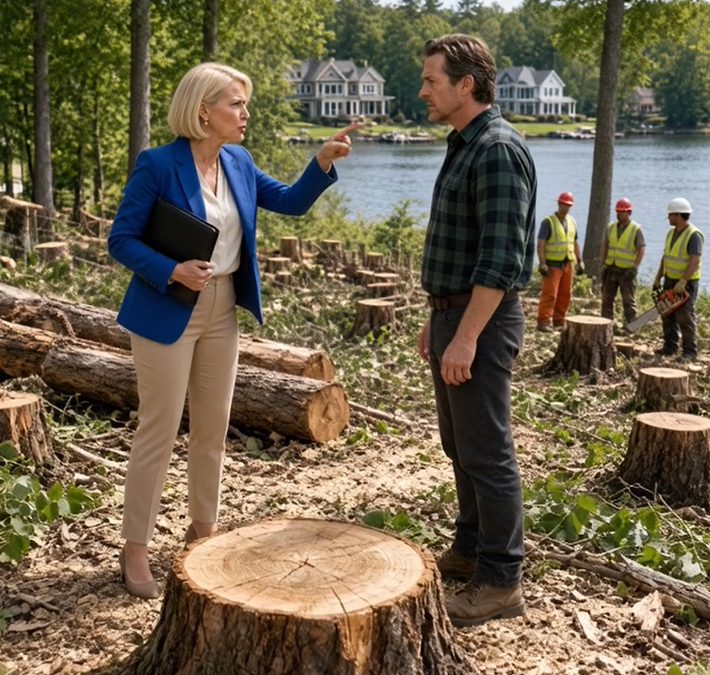
The HOA Cut Down 11 Trees on My Private Land for a Better View—So I Built Something in Their Place That Ruined That View Forever.
They cut down eleven of my trees while I slept, then stood on their new deck admiring the sunset they had stolen.
They thought an old fence, a quiet neighbor, and a few missing maples would never become a courtroom disaster.
But when the arborist finished counting the rings, the judge ordered them to pay for the one thing they hated most: a view they would never see again.
They cut down eleven of my trees without asking.
Not trimmed.
Not pruned.
Not damaged by accident.
Cut down.
Eleven mature paper birch and red maple trees that had stood along the eastern side of my property for decades were reduced to fresh stumps while I slept less than two hundred yards away.
Whoever did it had brought chainsaws, a trailer, and enough people to finish the work quickly. They took the logs. They dragged most of the brush away. They even raked part of the ground afterward.
If not for the pale circles of exposed wood and the smell of fresh-cut maple hanging in the cold March air, you might have thought the trees had never been there at all.
The reason was simple.
My neighbors wanted a better view of the lake.
They believed the trees stood between their expensive new deck and the western sunset. They also believed, apparently, that wanting the view badly enough gave them some right to create it.
They were wrong.
What followed took almost two years.
Three attorneys were involved at different stages. There was a county inspection, a new boundary survey, an arborist assessment, a civil case, a failed mediation, and eventually a landscaping project that my neighbors will probably look at for as long as they own that house.
I did not plan the ending when this began.
For the first ten minutes, I could barely understand what I was looking at.
My name is Daniel Mercer.
I was fifty-two when the trees came down.
I own 4.2 acres in a rural county in the upper Midwest, not far from a private lake covering a little more than forty acres. My property has been connected to my family for most of my life.
My uncle Raymond bought the acreage when I was a teenager. Back then there was little on it except a modest house, an old detached garage, two collapsing sheds, pasture grass, and a stand of mixed hardwoods along the eastern boundary.
When I was young, I spent summers there helping Uncle Ray repair things.
Fence posts.
Deck boards.
A leaking shed roof.
A rusted trailer.
He believed children should understand tools even if they eventually chose jobs that required none.
I did choose a job that required almost no tools.
My adult work could not have been more different. I became a supply-chain and inventory consultant. I helped small manufacturers understand why materials disappeared, why orders arrived late, why warehouses carried too much of the wrong item and never enough of the right one.
Most of my job involved spreadsheets, production schedules, freight invoices, and conversations with tired operations managers.
Quiet work.
Detailed work.
Work built around records.
It suited me.
When Uncle Ray decided to move south eleven years before the dispute, he offered to sell me the property.
Not give it.
Sell it.
He insisted.
“You’ll take better care of something you paid for,” he said.
I told him that sounded like something people said to justify charging relatives money.
He laughed.
Then charged me a fair market price.
I took out a mortgage, recorded the deed, paid the taxes, improved the house slowly, replaced the roof, updated the well, rebuilt one shed, removed the other, and added a porch facing the lake side.
The land remained mostly the way Uncle Ray had kept it.
Especially the trees.
Eleven of them grew in a loose natural line near the eastern boundary.
Seven red maple.
Four paper birch.
The biggest maple was nearly twenty-eight inches across at chest height. The tallest trees reached well above the roofline. Some were probably older than Uncle Ray.
He used to joke that they were the only residents of the property who had never once complained about taxes.
In October, they turned brilliant.
PART2:
The maples went deep red and orange. The birch became pale yellow against white bark. Morning sun came through them in strips. Their leaves covered half the eastern yard by November, and every year I complained while raking them.
Every year I was secretly glad there were so many.
They gave the property privacy.
Shade.
Bird habitat.
Wind protection.
But I never thought of them primarily as a screen.
They were simply part of the place.
That changed when Gary and Sandra Warner bought the neighboring parcel.
The Warners arrived four years before the trees were cut.
Their lot was slightly smaller than mine but positioned higher. The previous house had been an unremarkable ranch-style structure built in the 1970s. They demolished most of it and built something much larger.
Two stories.
Stone facade.
Three-car garage.
Large west-facing deck.
Walls of glass oriented toward the lake.
It was expensive.
Not grotesque.
Just clearly designed by people who expected the scenery outside to become part of the architecture.
I had no objection.
It was their land.
Their money.
Their house.
We got along normally at first. Gary was in his mid-fifties, broad-shouldered, confident, and from commercial real estate. He was the kind of person who could turn a casual conversation beside a mailbox into a description of three office developments he had financed.
Sandra was quieter. More polished socially. She remembered names, sent Christmas cards, and once brought me banana bread after learning I had pneumonia.
They had a golden retriever named Murphy who escaped their yard twice.
Both times I walked him home.
We waved on the shared access road. Sometimes we talked about snow, lake levels, county taxes, and whether the power would go out during ice storms.
Nothing suggested future litigation.
The first clue came approximately two years after they moved in.
Gary stopped me beside the road one evening.
“Those maples of yours really fill in during summer,” he said.
“They do.”
“You ever think about thinning them?”
“Not particularly.”
He looked through the branches toward the lake.
“They block a lot of western light from our deck.”
I shrugged.
“They’ve been blocking western light for about sixty years.”
He laughed.
I thought that was the end of it.
Several months later, Sandra mentioned the same thing while we were both getting mail.
“We would have such an incredible sunset view if that tree line were lighter,” she said.
I answered, “It is a good tree line.”
She smiled.
“You’re attached to them?”
“Yes.”
That should have clarified things.
Then came the text message.
October.
Two months before winter set in.
Gary wrote:
Hey Daniel. At some point I’d like to discuss vegetation along our shared boundary. Nothing urgent. Some trees/branches affect our light and view. Let me know when you have time.
I was in the middle of a client implementation, working twelve-hour days.
I replied:
Busy the next few weeks. Let’s talk in spring when weather improves.
He reacted with a thumbs-up.
No follow-up.
No dispute.
No request to enter.
No proposed trimming.
Nothing.
That autumn happened to be one of the best color seasons in years. Cold nights. Bright days. The maples changed almost all at once.
On the second Saturday in October, I took my coffee outside just after sunrise. The eastern trees were lit from behind, red, orange, and yellow glowing against the gray lake. I took six photographs with my phone. One wide shot from the porch. Two from the yard. One near the fence. A close photograph of the biggest maple. Another showing the birches against the Warner house in the background.
I did not take them for documentation.
I took them because they looked beautiful.
Five months later, those photographs became some of the clearest before-images in my case.
Winter came.
Snow.
Ice.
The lake froze.
I barely saw the Warners except from a distance.
Then, late March, after several days of thawing temperatures, I went to inspect the fence.
I usually walked the property after winter. Snow load breaks branches. Deer loosen wire. Freeze-thaw shifts posts. The eastern fence was old, four strands of barbed wire, mostly left from Uncle Ray’s days. I planned to replace it eventually but had never needed to.
I carried pliers, gloves, and a small coil of repair wire.
I came around the back side of the garage.
Walked downhill.
Then stopped.
The first thing I noticed was space.
Too much of it.
For eleven years, my eye had been trained to see trunks along that boundary.
Vertical lines.
Now there was open sky.
The lake was visible between my yard and the Warner deck in a way it had never been.
I stood motionless.
Then I saw the stumps.
One.
Two.
Three.
I began counting.
By the time I reached eleven, I knew exactly what had happened.
Every mature tree in the central section was gone.
Fresh chainsaw cuts.
Pale wood.
Some damp with sap.
Sawdust still caught in wet grass.
The smallest stump was perhaps sixteen inches across.
The largest was close to thirty.
The logs were gone.
Most branch debris had been removed.
A rough pile remained near the eastern fence.
I remember touching one maple stump.
Not for evidence.
Not yet.
Just instinct.
The surface was smooth, cold, and still smelled sweet.
Then I looked toward the Warner house.
Gary was standing on his deck.
He had a coffee mug in one hand.
Beside him, Sandra leaned against the railing.
From where they stood, the lake opened wide behind my property. The line of trees that had once interrupted their view was gone. Their deck finally had the western vista they had talked around for two years.
Gary saw me.
He lifted one hand.
Not a guilty wave.
Not even an awkward one.
A neighbor wave.
As if we were both admiring the same improvement.
I did not wave back.
I walked the length of the cut area slowly, taking photographs as my hands stopped shaking. Every stump. Every track. Every drag mark. Every broken branch. I photographed the trailer tire marks leading toward the Warners’ driveway. I photographed sawdust sitting on top of thawed mud. I photographed my old fence, now bent and broken where someone had stepped or dragged limbs across it.
By then, I understood one thing very clearly.
This had not been a mistake.
Nobody accidentally cuts down eleven mature trees in a straight section along a disputed view corridor.
Nobody accidentally takes the logs.
Nobody accidentally rakes the ground.
At 9:14 a.m., I called the sheriff’s non-emergency line.
At 9:22, I called my attorney.
Her name was Elise Hartwell.
She had handled a contract dispute for my consulting business years earlier and had the calmest voice of anyone I knew. She could make being sued sound like scheduling a dentist appointment.
“Elise,” I said when she answered, “my neighbors cut down eleven of my trees.”
There was a pause.
“On your property?”
“Yes.”
“Mature trees?”
“Yes.”
“Did you authorize any work?”
“No.”
“Take photographs before anyone touches anything. Do not confront them alone. Do not clean up. Do not move brush. Do not let anyone tell you this is a misunderstanding.”
“I already called the sheriff.”
“Good.”
Then she said something that stayed with me.
“Trees make people irrational because they think trees are scenery until the bill arrives.”
Deputy Frank Coyle arrived forty minutes later. He was in his late thirties, polite, heavyset, and unhappy to be walking through mud in polished boots.
He looked at the stumps.
Then at me.
Then toward the Warner deck.
“Any chance these were on their side?”
“No.”
“You have a survey?”
“I have the old one from when I bought the property.”
“We’ll need the line confirmed.”
“I know.”
He photographed the stumps and took my statement. Then he walked toward the Warners’ house.
I stayed where I was because Elise had told me not to confront them, and I am good at following instructions when they involve not going to jail.
Gary met the deputy halfway down his lawn.
From a distance, I could not hear every word, but I heard enough.
“…understanding with Daniel…”
“…shared boundary…”
“…dangerous limbs…”
“…improving light…”
Then Gary gestured toward the lake.
Deputy Coyle listened, wrote notes, and looked back at the stumps several times.
Sandra came out halfway through, wearing a cream sweater and boots that did not touch mud. She hugged herself against the cold and looked in my direction once.
I could not read her face.
At the time, I told myself she looked sorry.
Later, after discovery, I understood she looked worried.
There is a difference.
Deputy Coyle came back twenty minutes later.
“Mr. Warner says you had discussed thinning the tree line.”
“We discussed nothing. He texted in October asking to talk. I said spring.”
“Any written permission?”
“No.”
“He says some of the trunks were near the boundary and potentially diseased.”
I looked at the fresh maple stumps.
“Does he have an arborist report?”
The deputy’s mouth twitched.
“He did not mention one.”
“Did he say who cut them?”
“He said a landscaping crew.”
“What company?”
“He was not eager to provide that.”
“Can you make him?”
“This may be a civil matter unless intent and property line are established.”
I knew enough to know that sentence meant the sheriff’s office might not be the road to justice.
So I took the other road.
The records road.
By noon, Elise had given me a list.
Surveyor.
Certified arborist.
Tree appraiser.
County zoning office.
Property insurer.
Every photograph backed up in three places.
Every prior text preserved.
Every conversation documented.
“Do not guess,” she said. “Do not embellish. Do not call them thieves in writing yet. Just build the file.”
That suited me.
Quiet work.
Detailed work.
Work built around records.
The surveyor came two days later.
His name was Paul Sutter, and he had the dry humor of a man who had spent thirty years watching neighbors ruin relationships over six inches of dirt. He carried equipment worth more than my truck and spoke mostly to orange flags.
He found the original iron pins beneath leaf litter and frost-heaved soil. He located the property line. He checked it twice. Then he walked the cut area with me, placing small flags.
Every stump was on my property.
Not barely.
Not arguably.
Not “shared boundary.”
The closest one stood four feet inside my line.
The largest maple stood nearly nine feet inside.
Paul looked toward the Warner deck.
“They knew,” he said.
“You can tell that from survey equipment?”
“No,” he said. “I can tell that from where they stopped cutting.”
He was right.
They had cut every tree that opened their view.
They had not cut one tree beyond that view.
Not one.
The arborist came the following Monday.
Dr. Miriam Voss was short, severe, and carried a clipboard like she intended to use it as a weapon if necessary. She had gray hair, waterproof boots, and no patience for people who referred to living trees as “vegetation.”
She examined each stump. Measured diameter. Identified species. Evaluated visible health. Counted growth rings on two smaller sections left behind. Studied my October photographs. Compared canopy spread. Noted site function: privacy, shade, windbreak, erosion control, wildlife habitat, and aesthetic contribution.
At the largest maple, she knelt and placed one hand lightly on the stump.
“This was a magnificent tree,” she said.
For some reason, that nearly broke me.
Not because I loved that maple more than anything else. Not because the tree was a person. But because for days people had been talking around the loss in practical language: boundary, evidence, damages, dispute.
Miriam was the first person to stand there and say plainly that something beautiful had been destroyed.
“Yes,” I said. “It was.”
She looked toward the Warner house.
“View cut?”
“That’s my assumption.”
“It is rarely subtle.”
Two weeks later, her report arrived.
Forty-two pages.
Species.
Measurements.
Health analysis.
Replacement estimates.
Landscape value.
Loss of privacy.
Loss of screening.
Restoration recommendations.
Photos.
Maps.
The number at the end made me sit down.
Between appraised tree value, restoration costs, site repair, fencing, monitoring, and loss of landscape function, Miriam estimated damages between $142,000 and $188,000, depending on the legal measure accepted by the court. That number did not include any statutory multiplier that might apply to wrongful tree cutting.
I sent the report to Elise.
She called me ten minutes later.
“Daniel,” she said, “this is no longer a neighbor conversation.”
“It stopped being that when the chainsaws started.”
“Yes. But now we can prove it.”
The Warners’ first attorney sent a letter the following week.
It was exactly the kind of letter I expected from people who thought confidence could replace facts.
It claimed there had been a “mutual understanding” that tree work would occur.
It claimed the trees were “dead, diseased, hazardous, or encroaching.”
It claimed any cutting had been performed “in good faith along an uncertain boundary.”
It claimed the Warners had “substantially improved lake visibility for both properties.”
That last line was the one that made Elise laugh out loud.
“They improved your view by destroying your trees,” she said. “That is generous of them.”
My response, through Elise, was short.
No permission was granted. The boundary was not uncertain. The trees were not dead or diseased. All eleven stumps are on Mr. Mercer’s property. Preserve all communications, invoices, photographs, contracts, text messages, emails, and records concerning the tree removal.
Then we waited.
People think waiting is passive.
It is not.
Waiting is work when you are building a case.
I filed an insurance notice. I contacted the county. I obtained my own copies of the Warners’ building plans from the permit office. Their deck plans had a notation written by the architect two years earlier:
Potential western view obstruction from adjacent tree line.
Adjacent tree line.
Not shared.
Adjacent.
Elise loved that.
Then the county inspector found something else.
The Warners had obtained a minor landscaping permit months before the cutting. It was for “deadfall removal and ornamental clearing within owner parcel.” Attached was a rough sketch showing work near their western boundary.
My trees were not shown.
My property was not included.
But buried in the permit file was an email from Gary to the county clerk.
We want to open the lake view but will keep work within our own lot unless neighbor agrees to additional thinning.
Unless neighbor agrees.
I had not agreed.
Elise loved that even more.
Then came the landscaper.
His name was Brent Keller, owner of Keller Outdoor Services. He had a small business, two trucks, and apparently poor instincts about wealthy clients. At first, he ignored Elise’s preservation letter. Then, after she subpoenaed his records, his attorney appeared and began cooperating with the caution of a man backing away from a cliff.
Brent’s invoice described the job as:
Boundary view clearing. Remove marked trees. Haul logs. Clean site.
The invoice was billed to Gary Warner.
The amount was $6,700.
Attached were photographs taken before the work.
In those photographs, several tree trunks had orange paint marks at the base.
On my side.
Gary had marked my trees.
The final piece was a text thread.
Brent to Gary, two nights before cutting:
Are you sure neighbor signed off? Some of these look past fence line.
Gary to Brent:
Fence is old and not accurate. We discussed it. He won’t care once it’s done. Just stay efficient.
Brent:
Prefer written approval.
Gary:
I’m approving. It’s our view corridor. We’ll handle Daniel.
I read that thread three times.
We’ll handle Daniel.
I did not feel anger immediately.
I felt something colder.
For months, Gary had waved at me, returned small talk, accepted my help walking his dog back home, and stood on his deck above my property while planning to remove trees he knew were mine.
He had not misunderstood.
He had calculated.
That realization changed the entire shape of the case for me.
Until then, part of me had kept room for a mistake. A bad assumption. A contractor gone too far. A boundary confusion that got out of hand.
The text closed that room.
Elise filed the civil complaint in June.
Trespass.
Timber trespass.
Conversion.
Damage to real property.
Negligence.
Nuisance.
Civil conspiracy between the Warners and the contractor.
We sought damages, restoration costs, attorney fees where available, and injunctive relief preventing further interference with my land.
Gary stopped waving.
Sandra stopped sending Christmas cards.
Murphy, the golden retriever, still escaped once that summer and came to my porch.
I walked him back because dogs should not suffer for human arrogance.
Sandra opened the door.
For a moment, neither of us said anything.
Murphy wagged his tail between us, unaware he had entered a litigation zone.
“Thank you,” Sandra said quietly.
“You’re welcome.”
She looked tired.
I almost asked why they did it.
But Elise had warned me.
“No hallway conversations. No driveway confessions. No emotional ambushes. If they want to talk, they can talk through counsel.”
So I handed over the leash and walked home.
That evening, I sat on my porch and looked at the gap where the trees had been.
The sunset was clear now.
Too clear.
The lake reflected orange and pink. The Warner deck caught the light. Their glass walls glowed.
It was beautiful.
That was the worst part.
The stolen view was beautiful.
Every evening, I had to watch them enjoy what they had taken.
That summer changed my relationship with my own land.
Before, I had moved through it easily. I trimmed where needed, mowed when necessary, repaired fences reluctantly. After the cutting, every open space felt exposed. I could see the Warners’ deck from my kitchen window. At night, their outdoor lights crossed my yard. Voices carried where leaves had once absorbed them.
Privacy is one of those things people undervalue until it is gone.
So is trust.
Mediation happened in September.
It took place in a conference room at a law office forty minutes away. I sat on one side of a long table with Elise. Gary and Sandra sat on the other with their attorney, a man named Martin Vale who wore expensive glasses and seemed personally offended by facts.
The mediator was a retired judge named Helen Croft. She began by saying neighbor disputes were painful and that litigation rarely restored relationships.
Gary nodded solemnly as if he had not paid someone $6,700 to cut down my trees.
Martin Vale opened with the Warners’ position.
They were willing, without admitting liability, to contribute $12,000 toward “reasonable replacement plantings” and execute a mutual release.
I looked at Elise.
She did not look surprised.
She simply wrote something on her legal pad, then slid it toward me.
Do not laugh.
So I did not.
Elise responded with our demand.
Full appraised damages, restoration costs, attorney fees, payment for survey and experts, replacement with large-caliper trees and evergreen screening, deeded landscape protection, and a written admission that the trees had been cut without permission.
Gary’s face reddened.
“This is extortion,” he said.
I looked at him for the first time that day.
“No,” I said. “Extortion is threatening someone for money. This is a bill.”
Sandra flinched slightly.
Gary leaned forward.
“Daniel, come on. We had talked about thinning them.”
“We talked about talking.”
“You knew they were a problem.”
“They were not a problem for me.”
“They were overgrown.”
“They were trees.”
“They blocked the lake.”
“They were on my land.”
That ended the direct conversation.
The mediator separated us into different rooms.
For five hours, offers moved back and forth, each one wearing more frustration than progress.
$20,000.
$35,000.
No admission.
No attorney fees.
Small replacement trees only.
No injunctive restrictions.
Elise finally closed her folder.
“Judge Croft,” she said when the mediator returned, “we are done unless they become serious.”
The mediator looked at me.
“Mr. Mercer, trial is expensive.”
“So is stealing eleven mature trees.”
She nodded once.
Mediation failed.
The months after that were ugly.
Gary countersued, claiming I had allowed dangerous trees to threaten his property, that I had failed to maintain the boundary, that the old fence misled him, and that I was trying to profit from an honest mistake.
Elise called the countersuit “a flare fired by a sinking boat.”
Still, it hurt.
Even when you know accusations are false, seeing them in legal language gives them weight. Gary was not just defending himself. He was trying to make me responsible for the loss he caused.
That winter, Uncle Ray called after hearing about the dispute from my cousin.
He was eighty-three then, living in Tennessee, still stubborn enough to refuse hearing aids while accusing everyone else of mumbling.
“Heard some fool cut the maples,” he said.
“Yes.”
“You suing?”
“Yes.”
“Good.”
Then he was quiet for a while.
“I planted two of those birches with your aunt,” he said.
I had not known that.
“When?”
“First year we had the place. She said the yard needed white bark in winter. I told her trees don’t care what color she wanted them to be. She planted them anyway.”
His voice softened.
“Your aunt liked being right.”
I looked toward the gap beyond my window.
“I’m sorry, Ray.”
“Not your fault.”
“I should have replaced the fence.”
He snorted.
“A fence doesn’t stop a man who’s decided wanting is the same as owning.”
I wrote that sentence down after we hung up.
It became part of my trial testimony.
The trial began the following April, just over a year after the cutting.
By then, the stumps had weathered gray. Grass had grown around them. Small shoots emerged from two maple roots, weak and hopeful. The gap remained, wider than ever because the surrounding trees had leafed out and made the absence more obvious.
The courtroom was small, wood-paneled, and colder than necessary. Gary arrived in a navy suit. Sandra wore gray. Brent Keller, the landscaper, sat with his attorney in the back. Uncle Ray insisted on coming for the first day, leaning on a cane and complaining about courthouse coffee.
Elise presented the case like she had built a machine.
First, the deed.
Then the survey.
Then the old property line.
Then the photographs from October.
Then the March photographs.
Then Dr. Miriam Voss.
Miriam was devastating.
Not emotional.
Not theatrical.
Worse.
Precise.
She explained species, age, health, canopy spread, landscape function, and replacement difficulty. She showed the court how mature trees cannot simply be replaced with saplings and a hopeful attitude. She explained that even large nursery replacements would take many years to approximate the privacy, shade, and visual mass that had been destroyed.
Gary’s attorney tried to suggest the trees were ordinary.
Miriam looked at him.
“Ordinary mature trees are still mature trees.”
He tried to suggest they were unhealthy.
She pointed to stump condition, growth rings, canopy photographs, and lack of decay.
He tried to suggest their value was inflated.
She replied, “Their value was apparently high enough for someone to cut them down illegally in order to obtain the view they blocked.”
The judge wrote something down.
I liked Miriam very much.
Then came Paul Sutter, the surveyor.
He testified that every stump was on my property. He identified distances from the boundary. He explained the old fence did not define ownership and that several stumps were far enough inside my line that no reasonable person could believe they were boundary trees if they looked at the site carefully.
Then came the county permit records.
Then the architect notation.
Then the landscaper invoice.
Then the text thread.
Gary’s attorney fought hardest to keep out the text.
He lost.
The court read:
He won’t care once it’s done. Just stay efficient.
And:
It’s our view corridor. We’ll handle Daniel.
I watched Gary while those words were read aloud.
He stared straight ahead.
Sandra closed her eyes.
When it was my turn to testify, Elise started simply.
“How long have you owned the property?”
“Eleven years.”
“What did the trees mean to you?”
Gary’s attorney objected.
The judge allowed it.
I looked at the photographs on the screen.
“They were part of the place,” I said. “I know that sounds vague, but it’s true. They were there when my uncle owned it. Two birches were planted by my aunt. The maples shaded the yard. They blocked wind. They held birds. They gave privacy. In autumn, they were the best thing on the property.”
Elise asked, “Had you granted Gary or Sandra Warner permission to cut them?”
“No.”
“Had you agreed they could thin them?”
“No.”
“Had you agreed to discuss it?”
“In spring. Discussion only.”
She showed me the text.
“Is this your response?”
“Yes.”
“Did any further agreement occur?”
“No.”
Then she asked the question I had dreaded.
“What did you feel when you found the trees gone?”
I looked toward the Warners’ table.
Gary would not look at me.
Sandra did.
“I felt stupid,” I said.
Elise tilted her head slightly.
“Why?”
“Because I had waved at them. Brought their dog home. Accepted banana bread. Talked about snow and taxes. I thought we were neighbors. Then I stood there looking at eleven stumps and realized they had looked at my land and seen an obstacle. Not mine. Just in their way.”
The courtroom was quiet.
I continued.
“For the first ten minutes, I wasn’t angry. I was confused. There had always been trees there. My mind kept trying to put them back.”
Elise paused long enough for that to land.
Then she sat down.
Gary testified the next day.
He was confident at first. He said he believed the trees were near the boundary. He said I had been “open to thinning.” He said the old fence created confusion. He said the trees were “visually and structurally problematic.” He said he had never intended harm.
Then Elise cross-examined him.
She was polite.
That made it worse.
“Mr. Warner, you are in commercial real estate?”
“Yes.”
“You have dealt with property boundaries before?”
“Yes.”
“You understand surveys?”
“In general.”
“You understand a fence is not always a property line?”
“Yes.”
“You obtained a permit for work within your own parcel?”
“Yes.”
“You emailed the county saying additional thinning would require neighbor agreement?”
“I don’t recall the exact wording.”
Elise displayed the email.
He recalled it then.
“You texted Mr. Mercer in October requesting a discussion?”
“Yes.”
“He replied that you could talk in spring?”
“Yes.”
“Did you talk in spring before cutting?”
“No.”
“Did you obtain written permission?”
“No.”
“Did you obtain verbal permission?”
“I believed we had an understanding.”
“Please answer yes or no.”
“No.”
Then she displayed the text to Brent.
He won’t care once it’s done.
Elise let the room sit with it.
Then she asked, “If you believed Mr. Mercer had agreed, why would you write that he would not care once it was done?”
Gary shifted.
“That was casual language.”
“It was accurate language, wasn’t it?”
“No.”
“You knew he had not agreed.”
“I knew he had not signed anything.”
“That was not my question.”
Gary’s jaw tightened.
Elise asked again.
“You knew he had not agreed.”
Gary looked at the judge, then at Elise.
“I knew he had delayed the conversation.”
“And you decided to cut before that conversation could happen.”
“I decided to address a problem.”
“Your view.”
“Our property enjoyment.”
“Your view.”
He did not answer.
Elise displayed a before-and-after image from his deck. We had obtained it from discovery. Gary had taken the after photo at sunset two days after the cutting and texted it to Sandra.
Finally.
That was the caption.
Elise read it aloud.
The word sounded small in the courtroom.
Finally.
As though the trees had been a burden he had heroically endured.
As though the land had been waiting for him to correct it.
Sandra testified last.
I expected her to defend him completely.
She tried.
At first.
She said she believed Gary had handled the neighbor discussion. She said she did not know the exact boundary. She said she regretted the conflict. She said she had not personally marked the trees.
Elise showed her a text she had sent to Gary the night before the cutting.
Do it before Daniel comes back from his client trip. Less drama.
I had not known about that one until discovery.
I remembered that week. I had been in Ohio for a warehouse assessment from Monday to Thursday. The cutting happened early Friday morning, less than twelve hours after I got home.
Sandra lowered her eyes.
Elise asked, “What did you mean by less drama?”
Sandra’s voice was barely audible.
“I meant it would be easier if it was already finished.”
“Easier for whom?”
Sandra did not answer.
The judge eventually said, “Mrs. Warner?”
She looked toward me.
“For us,” she said.
That was the closest thing to honesty I heard from either of them.
The judge issued the decision six weeks later.
I read it at my kitchen table, the same place I had read Gary’s first letter and Miriam’s report.
The court found that the Warners knowingly caused the removal of eleven trees from my property without permission. It found the boundary was not reasonably uncertain. It found the old fence did not excuse the cutting. It found the evidence showed intentional conduct motivated by improving the lake view from the Warner residence.
Damages were awarded based on appraised value, restoration costs, survey and expert expenses, and attorney fees where permitted. Because of the intentional nature of the cutting, the court applied an enhanced damages provision under state law.
The final number was larger than I expected.
Large enough that I sat back and stared at the wall.
Large enough that Gary’s lake view had become the most expensive sunset he would ever buy.
But money was not the part that mattered most.
The injunction mattered.
The court ordered a restoration plan prepared by Dr. Miriam Voss and a landscape architect, funded by the Warners, and subject to my approval and county review. It also permanently barred the Warners from cutting, trimming, poisoning, topping, damaging, or interfering with any tree, shrub, planting, fence, or landscape feature on my property.
And because the removal had destroyed a privacy screen, the court allowed restoration designed to replace that screen.
That was where the ending began.
Miriam and the landscape architect, a quiet man named Owen Bell, came to my property in August.
We stood at the stumps.
Owen looked toward the Warner deck.
“They wanted a view,” he said.
“Yes.”
“You want privacy restored.”
“Yes.”
“How much?”
I thought about that.
Before all this, I had never wanted to punish anyone with landscaping. I had just wanted my trees back. But mature trees do not come back because a judge says they should. You can plant replacements. You can restore habitat. You can wait.
You cannot rewind a chainsaw.
I looked at the Warner house, at the glass walls facing my yard, at the deck built like a theater balcony over the gap they had created.
“As much as the law allows,” I said.
Owen nodded.
“Then we build a living wall.”
The plan was beautiful.
That surprised me.
I had expected spite to look ugly.
Instead, Owen designed something Uncle Ray would have liked.
A staggered natural screen of large evergreens, river birch, red maple, serviceberry, and native understory shrubs. Not a straight suburban hedge. A layered woodland edge. Tall conifers placed where the view corridor had opened. Fast-growing but appropriate species to restore vertical mass. Larger transplanted trees where feasible. Wildlife-friendly plantings. A split-rail fence inside the old line. Native grasses to control erosion. A small rain garden where equipment had scarred the soil.
And along the central section, exactly where the Warners’ sunset view had opened, Owen specified a dense row of mature white pine and spruce, tall enough at installation to block the lower half of their view and guaranteed to block the rest within a few growing seasons.
Miriam approved it.
The county approved it.
The judge approved it.
Gary objected.
Of course he did.
His attorney filed a motion arguing the restoration plan was “punitive, excessive, and intentionally designed to obstruct scenic enjoyment.”
Elise’s response was only twelve pages, but I remember the first line.
The scenic enjoyment at issue was created by intentional trespass.
The judge denied Gary’s motion in three paragraphs.
The planting began in October, nearly nineteen months after the trees were cut.
The crew arrived with trucks, equipment, root balls wrapped in burlap, and a crane for the largest evergreens. Owen oversaw the layout. Miriam inspected root depth and spacing. I made coffee for everyone because Uncle Ray taught me that any crew on your land should be offered coffee even if they are there because of litigation.
Gary and Sandra watched from their deck.
At first.
Then, when the first large spruce rose from the flatbed and swung slowly into position directly across their new lake view, Gary came down the hill.
He stopped at the property line because the injunction had taught him at least one thing.
“This is ridiculous,” he called.
Owen looked at me.
Elise, who had come for the first morning because she said she “wanted to see horticultural justice,” lifted her eyebrows.
I walked to my side of the line.
“Gary.”
“You’re making it worse than it was before.”
“No,” I said. “You made it worse. We’re making it private.”
“This is vindictive.”
I looked at the spruce hanging from the crane.
Then back at him.
“That tree is court-approved.”
“You’re enjoying this.”
I thought about lying.
I did not.
“Parts of it.”
His face flushed.
Sandra appeared behind him, arms wrapped around herself like she was cold.
Gary pointed toward the crew.
“We paid you. You won. What more do you want?”
That was the first time he had used the word won.
As if I had entered a contest when he picked up the saw.
I looked past him to the deck, the glass, the open line to the lake, the sunset view he had stolen and renamed improvement.
“I wanted my trees,” I said.
For once, Gary had no reply.
The spruce went into the ground.
Then another.
Then another.
By the end of the day, the view corridor had narrowed dramatically. By the end of the week, it was gone from the Warner deck unless they stood at the far corner and leaned.
By the following spring, new growth softened the edges. Birds returned first. Then rabbits. Then deer, who began nibbling things they were not supposed to nibble because nature respects no court order.
Uncle Ray came to see it in June.
He was moving slower by then. I drove him down to the eastern boundary in my utility cart. He sat there a long time, looking at the new trees.
“Not the same,” he said.
“No.”
“Good, though.”
“Yes.”
He pointed with his cane at a young red maple.
“That one will be something.”
“In twenty years.”
He laughed.
“You planning to go somewhere?”
I looked toward the Warner house. Only pieces of it were visible now through the layered green. Their deck no longer looked like a stage. Their glass walls reflected trees instead of claiming lake.
“No,” I said. “I think I’ll stay.”
He nodded.
“Then twenty years is fine.”
The Warners listed their house that autumn.
The real estate photos were careful.
Lots of kitchen shots.
Lots of stone facade.
Lots of deck furniture.
No clear west-facing sunset photo.
The listing said “filtered seasonal lake glimpses.”
I printed that phrase and put it on my refrigerator.
Filtered seasonal lake glimpses.
That was one way to describe justice.
They did not sell quickly.
At least twice, I saw prospective buyers standing on the deck, looking toward my new tree screen while Gary gestured broadly. Once, a man in a blazer pointed directly at the spruce line and said something that made Gary’s shoulders stiffen.
I did not gloat publicly.
Privately, I made coffee and enjoyed the filtered seasonal moment.
Sandra came to my house one afternoon before they moved.
She knocked, which surprised me.
I opened the door but did not invite her in.
She looked older than she had two years before. Tired in a way that expensive sweaters cannot hide.
“Daniel,” she said.
“Sandra.”
“I wanted to say I’m sorry.”
I waited.
Not because I wanted to be cruel.
Because I had learned that silence makes people decide whether they are apologizing or performing.
She looked down at her hands.
“I knew Gary was pushing too hard. I knew we didn’t have permission. I told myself it was just trees, and that you were being unreasonable because you wouldn’t even talk about them.”
I said nothing.
She continued.
“Then at trial, when your uncle said his wife planted the birches, I felt…”
Her voice caught.
“I felt ashamed.”
That was the first honest apology I had heard from either of them.
I did not know what to do with it.
So I told the truth.
“I appreciate you saying that.”
“Can you forgive us?”
That question was harder.
People ask for forgiveness like it is a key you can hand over once and be done with it. But sometimes forgiveness is not a door. Sometimes it is a field you cross slowly, and some days you realize you have walked backward.
“I don’t know,” I said.
She nodded.
“I suppose that is fair.”
Then she turned to leave.
“Sandra.”
She looked back.
“Murphy can still come over if he gets loose.”
She smiled sadly.
“He would like that.”
They moved three months later.
The new owners were a retired couple from Madison named Frank and Elaine Porter. Before closing, they came over with their agent and asked whether there was anything they should know about the property line.
That made me laugh so hard Elaine looked concerned.
I told them the short version.
Frank listened carefully, looked toward the tree screen, and said, “So we should not cut your trees.”
“That would be my preference.”
Elaine smiled.
“We like trees.”
They turned out to mean it.
The first spring they lived there, they planted two crabapples on their own side and asked Owen Bell to help them choose native shrubs. They kept Murphy, by the way. The Warners had planned to take him, but the old dog had become attached to the property, and the Porters offered to keep him. That may have been the kindest decision anyone made in the whole affair.
Murphy continued to escape occasionally.
I continued to walk him home.
The eastern boundary changed over the years.
The evergreens thickened. The red maples took hold. The birches brightened in winter. Serviceberries bloomed white in spring. Birds nested in the shrubs. Leaves returned to the part of the yard that had felt wounded and too open.
It was not the same as before.
It could never be the same.
But it became whole in a different way.
Three years after the planting, Uncle Ray died in Tennessee.
He left me his old toolbox and a note in shaky handwriting.
Daniel,
Keep the place stubborn.
Ray
I put the note in a frame and hung it in the garage.
That autumn, the new maples turned red for the first time in a way that felt like a promise rather than a memory. I stood on the porch with coffee at sunrise, the same place I had taken the photographs years earlier.
The eastern trees were smaller than the old ones but growing.
Light came through them in strips.
Behind them, the Porter house was barely visible.
Beyond that, somewhere through the green, the lake reflected morning sky.
I took six photographs.
One wide shot from the porch.
Two from the yard.
One near the fence.
A close photograph of the largest new maple.
Another showing the birches against the hidden house in the background.
This time I did take them for documentation.
Not for court.
For myself.
Proof that destruction is not the final version of a place unless you let it be.
People sometimes ask whether ruining the Warners’ view made me feel better.
The honest answer is complicated.
It did not bring back the eleven trees.
It did not erase the morning I found the stumps.
It did not undo the betrayal of watching neighbors treat my land like scenery they could edit.
But yes, when that first spruce rose into place and blocked the exact opening they had stolen, something in me settled.
Not because I wanted to be cruel.
Because consequences should fit the wound.
They cut trees for a view.
They paid to plant trees that took it away.
There was a symmetry to that even Uncle Ray would have appreciated.
The final lesson was not about revenge.
Not really.
It was about ownership, patience, and the quiet dignity of refusing to let someone else’s greed become your new normal.
Gary and Sandra looked at my trees and saw obstruction.
The court looked at the evidence and saw trespass.
Miriam looked at the stumps and saw value.
Uncle Ray looked at the new plantings and saw time.
And eventually, I learned to look at that boundary without seeing only what had been taken.
I saw what had been defended.
Land is not just dirt.
Trees are not just scenery.
A view is not worth more because rich people want it.
And a quiet neighbor is not the same thing as an easy victim.
Those eleven trees stood for decades before someone decided they were in the way.
Then they were gone in one morning.
But the line they stood on remained.
And once I understood that, I stopped wishing I had shouted sooner.
I did something better.
I kept records.
I hired experts.
I told the truth.
Then I planted the wall they would have to stare at forever.