The HOA Called the Police to Remove Me From the Lake I Had Just Bought—Then One Recorded Easement Filing at the County Courthouse Changed Who Could Use It Forever.
PART2:
I had brought the documents that morning for the same reason a man takes an umbrella when the clouds look wrong.
Three weeks of ownership had already taught me that Millbrook Estates was going to be interesting.
I handed the deputy my license.
“This is my property.”
Renata gave a short laugh.
I continued.
“I closed three weeks ago.”
“A purchase contract does not override twenty-two years of community use.”
Her answer came immediately.
Rehearsed.
Flat.
Certain.
“This lake belongs to this community.”
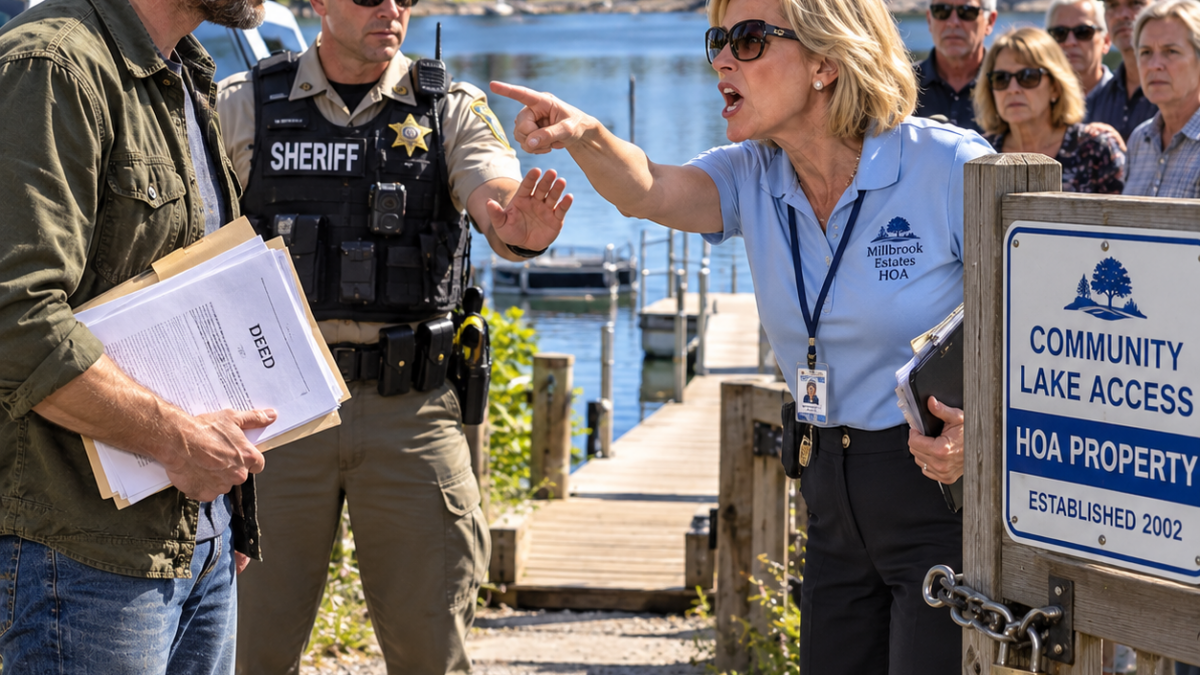
She pointed toward the gate.
Bolted to one of the wooden posts was a white laminated sign.
Blue lettering.
HOA crest.
COMMUNITY LAKE ACCESS
HOA PROPERTY
ESTABLISHED 2002
“That sign has been there since before half our residents moved in,” Renata said.
Then she looked directly at me.
“A piece of paper does not change that.”
I nearly laughed.
My deed was apparently a piece of paper.
Her laminated sign was constitutional law.
Interesting hierarchy.
The deputy asked:
“Sir, would you mind stepping back from the dock until I run the parcel?”
“Not at all.”
I set down the tape measure.
Walked toward the truck.
Opened the passenger door.
Held up the envelope.
PART3:
“I have the recorded deed.”
The deputy nodded.
“I’ll take a look.”
I handed him the parcel number.
Renata folded her arms.
I looked at her.
“I would strongly recommend your board attorney pull the county index for this parcel before anybody takes another legal step.”
Her eyes went briefly to the envelope.
She looked at it the way a person looks at a restaurant menu printed in a language they cannot read.
Then she dismissed it.
“Whatever you filed doesn’t matter.”
I said nothing.
“What matters is that sign.”
She pointed again.
“Twenty-two years.”
Pause.
“That’s the law.”
My name is Luke Hensley.
I was forty-six when I bought Willowmere Lake.
And unlike Renata Voss, I had spent enough of my life around land records to know that twenty-two years is not a magic spell.
For eighteen years I had worked in right-of-way surveying and civil site development.
Not as an attorney.
Not as a title examiner.
But close enough to property disputes that I developed one habit stronger than almost any other:
Read what was recorded.
Not what the seller remembers.
Not what the neighbor believes.
Not what the real-estate listing says.
Not what a laminated sign claims.
Read the deed.
Read the plat.
Read every easement.
Read the exceptions.
Then read the old document the exception refers to.
Land has an excellent memory if somebody bothered to file the paperwork.
My father taught me the other half of that lesson.
His name was Raymond Hensley.
He spent thirty-seven years as a county surveyor.
When I was twelve, he showed me an iron property pin buried beneath blackberry vines and said:
“That little rod can outlive every argument two neighbors will ever have.”
At twelve, I thought that sounded boring.
At forty-six, standing beside a sheriff’s cruiser while an HOA president announced that her sign outranked my deed, I missed him badly.
Dad had died fourteen months earlier.
Nothing dramatic.
A stroke in his kitchen.
One ordinary Tuesday.
My mother found him before dinner.
He had apparently been reaching for a coffee mug.
That bothered me more than it should have.
Not dying.
The coffee mug.
Death interrupting something so normal.
Afterward, I spent almost a year handling his estate.
Boxes of survey notes.
Old county maps.
Boundary photographs.
Plats drawn by hand.
He had kept everything.
I found a note inside one field book that read:
If everyone says a boundary is obvious, measure it twice.
That was Dad.
Suspicious of certainty.
Willowmere Lake appeared in my life six months later.
The property was small by rural standards.
A four-acre spring-fed lake surrounded by another seven acres of mixed woods and meadow.
One cabin.
One dock.
One gravel access road.
Twenty minutes outside Greenville.
Across the northern boundary sat Millbrook Estates.
Two hundred and six homes.
Built in phases between 2001 and 2016.
Big entrance monument.
Stone columns.
Decorative lighting.
Community pool.
Clubhouse.
Walking paths.
The kind of subdivision whose website used words like lifestyle and curated.
The lake was not inside it.
That mattered.
Willowmere belonged to an eighty-one-year-old widow named Martha Bell.
Her husband, Harold, had died six years earlier.
They had owned the lake parcel since 1987.
Martha lived in town by then.
The cabin had mostly sat empty.
She listed the property because, as she told me during our first meeting:
“I am too old to keep paying taxes on a place ducks enjoy more than I do.”
I liked her immediately.
She was small.
Silver hair.
Sharp blue eyes.
Walked with a cane she mostly used to point at things.
The first time we toured the lake she tapped a leaning pine with it.
“That one is coming down in the next storm.”
I said:
“Probably.”
“You know trees?”
“No.”
“Good. Men who don’t know something are usually safer if they admit it.”
Also liked her.
She showed me the cabin.
Dock.
Old rowboat.
Spring box.
Southern meadow.
Then the gate on the northeast side connecting a narrow footpath to Millbrook Estates.
The HOA sign was already there.
COMMUNITY LAKE ACCESS.
I asked:
“What is that?”
Martha’s expression changed.
“Harold’s mistake.”
Not a promising phrase.
She explained.
When Millbrook’s first phase opened in 2002, the developer wanted a lake amenity.
But there was no lake in Millbrook.
Willowmere sat beside it.
Harold and Martha refused to sell.
The developer kept asking.
Eventually Harold agreed to let residents walk through a side gate and use one designated shoreline area for fishing and picnics.
No swimming after dark.
No boats except canoes.
No docks beyond the existing platform.
No parties.
No vehicles.
The HOA agreed to maintain the path, carry insurance, pick up trash, and pay the Bells one dollar annually.
I asked:
“Easement?”
Martha gave me a look.
“That’s what they called it.”
“What do you call it?”
“Twenty-two years of aggravation.”
She pointed toward the northern shoreline.
“They were polite the first ten.”
Then HOA leadership changed.
More signs appeared.
Benches.
A grill station.
Kayak rack.
Martha objected.
They said residents had always used them.
One board president called Willowmere “our community lake” in a newsletter.
Harold complained.
Things calmed.
Then Harold died.
Renata Voss became president two years later.
And according to Martha:
“That woman can turn permission into ownership before breakfast.”
I asked for the recorded easement.
My real-estate agent looked surprised.
Martha did not.
She smiled.
“You really are a surveyor’s son.”
The title commitment listed it:
Exception 7:
Conditional Lake Access Easement and Maintenance Agreement dated May 3, 2002, recorded Instrument 2002-041771.
Most buyers see an easement exception and think:
Okay, neighbors can use the path.
I ordered the actual instrument.
Nine pages.
I read it that night.
Then again in the morning.
The first six pages were ordinary.
Grantor:
Harold and Martha Bell.
Grantee:
Millbrook Estates Homeowners Association.
Nonexclusive pedestrian access over a twelve-foot strip.
Use of approximately one-half acre of shoreline.
Fishing.
Picnicking.
Daylight hours.
Maintenance obligations.
Insurance.
No assignment to third parties.
No commercial activity.
No expansion without written consent.
Then I reached paragraph eleven.
That paragraph changed the purchase.
The agreement did not create a perpetual easement.
It created what the document itself called:
a conditional access easement personal to the named grantee and determinable upon transfer of the burdened estate.
Plain English:
If the Bells sold Willowmere, the HOA did not automatically keep access forever.
Instead, the agreement said the easement terminated upon conveyance unless the new owner affirmatively elected to continue it by signing and recording a written assumption within thirty days.
Then paragraph twelve added:
Upon conveyance, grantor or successor owner may record a Certificate of Termination referencing this instrument, and such certificate shall constitute conclusive notice that access rights have ceased.
I read it three times.
Then called a property attorney.
Her name was Erin Calloway.
Late forties.
Office above a pharmacy.
No patience for dramatic clients.
I liked her too.
I placed the easement on her desk.
“Tell me I’m reading paragraph eleven correctly.”
She did.
Then paragraph twelve.
Then title commitment.
Then the original plat.
Finally:
“You are reading it correctly.”
“So when Martha sells—”
“Access terminates unless you choose to continue it.”
“Why did they structure it this way?”
“Probably because Harold Bell refused a perpetual easement.”
That sounded right.
“Could the HOA claim twenty-two years created some other right?”
Erin leaned back.
“They can claim almost anything if they pay a filing fee.”
“Winning?”
“Different question.”
She tapped the agreement.
“They used the lake pursuant to express permission for twenty-two years.”
“Yes.”
“That is not ordinarily the factual posture you want if you’re trying to prove use was hostile or adverse.”
Prescriptive easement.
I knew enough to understand.
Long-term use can sometimes create rights if statutory elements are satisfied.
But the use typically must be adverse, not permissive.
Millbrook residents had not been sneaking onto the property under a claim of right.
They had entered because Harold Bell signed a recorded document saying they could.
Permission has a legal consequence beyond politeness.
“What about reliance?” I asked.
“They built amenities.”
“On Bell property?”
“Some.”
“Authorized?”
“Depends.”
She flipped pages.
“Even if they spent money, the termination clause is recorded.”
“Anyone checking title could read it.”
“Exactly.”
I looked at her.
“If I buy, I don’t want the easement.”
“Then do not assume it.”
“And paragraph twelve?”
“I would record the termination certificate immediately after the deed.”
“Immediately how immediate?”
She smiled slightly.
“You really are a surveyor.”
Three days after closing, we did exactly that.
The deed recorded Monday.
Thursday morning I went to the county recorder.
One page.
CERTIFICATE AND NOTICE OF TERMINATION OF CONDITIONAL LAKE ACCESS EASEMENT.
It identified:
My deed.
The 2002 instrument.
The parcel.
Paragraph eleven.
Paragraph twelve.
I stated that I had acquired title, did not elect continuation, and that the conditional access right had terminated under its recorded terms.
Not magic.
Not some trick document I invented.
The termination came from the old agreement itself.
My filing put that termination into the public record.
The clerk stamped it.
10:14 a.m.
Instrument 2026-118903.
I made copies.
Then Erin sent one certified to Millbrook Estates HOA and one to their registered management company.
Delivery confirmed the next afternoon.
That was two weeks before Renata called the sheriff.
I did not lock anyone out secretly.
I sent written notice.
Posted private-property signs.
Gave the HOA ten days to remove its benches, kayak rack, grill, and laminated “HOA PROPERTY” signs.
I even offered supervised access for removal.
Their answer arrived by email.
Renata herself.
Mr. Hensley,
The Board rejects your purported termination.
Millbrook Estates has possessed continuous lake access for twenty-two years and considers the lake a permanent community amenity.
Any attempt to obstruct resident access will be treated as interference with established easement rights.
Regards,
Renata Voss
President
Millbrook Estates HOA
I forwarded it to Erin.
Her response contained four words:
Well, that’s very helpful.
That was when I bought the lock.
Not because I wanted a confrontation.
Because after receiving formal notice that permission had ended, Renata announced she intended to ignore it.
So that Saturday morning I drove to Willowmere to inspect the dock.
Forty minutes later, Deputy Aaron Mills arrived.
Now he sat in his cruiser with my parcel number on his computer.
Renata remained beside the gate talking.
“Deputy, this is simple.”
Mills held up one finger.
“Ma’am.”
She stopped.
He looked at me.
“Mr. Hensley, you said you have recorded documents?”
“Yes.”
I handed him the deed first.
Then the termination certificate.
He read the deed.
Compared parcel number.
Read the one-page certificate.
His eyebrows moved slightly.
Renata saw.
“What is that?”
I said nothing.
Mills asked:
“This was recorded when?”
“Three days after closing.”
He checked stamp.
Then:
“You sent notice to the HOA?”
“Yes.”
“Certified.”
“Yes.”
“Receipt?”
I had it.
Of course I had it.
Dad raised me.
Mills looked toward Renata.
“Ma’am, when did you receive this?”
She barely glanced at the copy.
“This document is invalid.”
“That wasn’t my question.”
“Our attorney has advised—”
“When did the HOA receive notice?”
Her mouth tightened.
“Approximately two weeks ago.”
Mills nodded.
Then turned toward me.
“Did you threaten anyone?”
“No.”
“Damage property?”
“No.”
“Prevent anyone from retrieving personal belongings?”
“No.”
“I offered access for removal of HOA property.”
Renata interrupted.
“You cannot remove our access.”
Mills said:
“Ma’am.”
“This is a civil land dispute.”
“No.”
Her voice rose.
“It is trespassing.”
She pointed at me.
“He is trespassing.”
On my parcel.
Mills closed his eyes for perhaps half a second.
Then:
“The county parcel system currently shows Mr. Hensley as owner.”
“That doesn’t cancel our easement.”
“He has a recorded termination notice referencing an older agreement.”
“Which is invalid.”
“That is something your attorney can challenge in court.”
“So you’re doing nothing?”
Mills looked at her.
“I am not arresting the record owner because you disagree with his interpretation of a deed restriction.”
“He changed the lock.”
“On a gate located where?”
Silence.
Mills checked map.
“Mr. Hensley’s parcel.”
Renata said:
“We installed that gate.”
I answered:
“Harold Bell installed the gate.”
That came from Martha.
Renata ignored me.
“The HOA has maintained it.”
Mills sighed.
“Maintenance isn’t ownership.”
I almost smiled.
Renata did not.
She stepped closer to him.
“Deputy, two hundred families rely on this lake.”
“For what?”
That caught her off guard.
“Recreation.”
“So not emergency access?”
“No.”
“Utilities?”
“No.”
“Road access?”
“No.”
Mills nodded.
“Then nobody is in immediate danger.”
He gave me back my documents.
“This needs attorneys.”
Renata pointed at my private-property sign.
“People are going to ignore that.”
Mills looked at her.
“I would advise them not to.”
That sentence mattered.
Not legally.
Psychologically.
For the first time all morning, Renata’s certainty cracked.
Then she recovered.
“Fine.”
She pulled out her phone.
“We’ll handle it properly.”
I should have known her definition of properly would be creative.
The first HOA violation arrived Monday.
Yes.
The HOA sent me an HOA violation.
I did not live in Millbrook Estates.
Willowmere Lake was not subject to Millbrook’s declaration.
My parcel had its own tax identification number.
Separate access.
Separate chain of title.
No covenant submission.
Still:
VIOLATION: Unauthorized gate modification.
Fine:
$250.
Second:
Removal of community-access signage.
$500.
Third:
Interference with common amenity.
$1,000.
Fourth:
Failure to obtain architectural approval for private-property signage.
I printed them.
Drove to Erin’s office.
Set them down.
She read the top page.
Then looked at me.
“Are they serious?”
“I think so.”
She read the parcel number.
“That’s not even inside their declaration.”
“I know.”
She looked delighted.
Lawyers worry me when they look delighted.
“We’ll answer once.”
Her letter was seven pages.
The first paragraph basically said:
You have no enforcement jurisdiction over this property.
The remaining six pages said it with citations.
Renata responded with a neighborhood email.
I know because three residents forwarded it to me.
Subject:
URGENT — THREAT TO MILLBROOK COMMUNITY LAKE.
She wrote that an outside investor had purchased “the parcel adjacent to our historic lake amenity” and was attempting to revoke rights “families have enjoyed continuously since our community’s founding.”
Outside investor.
I owned one rental duplex and a pickup with 180,000 miles.
Very sophisticated empire.
She continued:
The Board will not allow one individual to erase twenty-two years of community heritage through a courthouse technicality.
Technicality.
Another interesting word for the actual recorded agreement.
Then came:
Residents should continue enjoying all amenities as normal unless advised otherwise by the Board.
I read that twice.
Then installed cameras.
Gate.
Dock.
Shoreline.
Trail.
Not hidden.
Not aggressive.
Clearly visible.
Within forty-eight hours, the first residents arrived.
A retired couple.
Fishing poles.
They saw the lock.
Called someone.
Left.
Next:
Mother and two children.
They read sign.
Turned around.
Then Saturday arrived.
At 8:13 a.m., camera recorded an HOA maintenance pickup.
Two men.
Bolt cutters.
I drove there.
By the time I arrived, the chain lay on the ground.
Gate open.
About thirty residents were inside.
Children fishing.
People on benches.
One man had launched a kayak.
Renata stood near the old picnic area.
Of course.
She saw my truck.
Walked toward me.
“Good morning.”
I looked at the cut chain.
“Who cut that?”
“Maintenance restored access.”
I took out my phone.
“You instructed them?”
“The HOA owns the access infrastructure.”
“Did you instruct them to cut my lock?”
“Your lock interfered with our easement.”
I hit record.
“Say that again.”
Her expression changed.
“You’re recording me?”
“Yes.”
“Without permission?”
“We’re standing outside.”
She folded her arms.
“Do what you want.”
“I want you to answer.”
“Did you order HOA maintenance to cut the lock after receiving written notice the easement had terminated?”
She smiled.
“I ordered restoration of community access.”
Good enough.
I called the sheriff.
Same deputy arrived.
Aaron Mills stepped from his cruiser.
Saw chain.
Saw thirty people.
Saw Renata.
His face said he regretted choosing law enforcement as a career.
“Ms. Voss.”
“Deputy.”
“Did your people cut this lock?”
“We restored access.”
He looked at me.
I held up the broken chain.
Then camera footage on my phone.
Mills watched.
Maintenance employee using bolt cutters.
Clear face.
HOA truck.
Time.
He turned toward Renata.
“I advised you not to do this.”
“You advised residents not to trespass.”
“They are not trespassing.”
“Your lawyer obtain a court order?”
“Not yet.”
“Then why are you cutting locks?”
“Because our easement remains valid.”
Mills’s voice became firmer.
“That is not for you to enforce with bolt cutters.”
Residents had begun listening.
Renata noticed.
She changed tone.
“Deputy, nobody wants conflict.”
I looked at the chain.
“Interesting approach.”
Mills asked everyone to leave while the property dispute was unresolved.
Some complained.
Most didn’t.
One man approached me before leaving.
He looked embarrassed.
“Is it really your lake?”
“The deed says it is.”
“We’ve been told HOA owns it since I moved here.”
“How long?”
“Nine years.”
“Did anybody show you a deed?”
He thought.
“No.”
That became a pattern.
People believed the HOA owned Willowmere because the HOA behaved as though it did.
Signs.
Newsletter.
Amenity maps.
Real-estate listings.
Welcome packets.
Nobody checked.
Why would they?
They paid dues.
HOA said lake.
There was lake.
Human beings are practical.
The title chain is invisible until conflict makes it visible.
The maintenance employees who cut the lock were cited in connection with property damage after giving statements that Renata instructed them.
Not arrested.
No dramatic handcuffs.
Just reports.
The HOA’s insurance carrier received notice.
Then, finally, their attorney filed suit.
Millbrook Estates HOA v. Luke Hensley.
Declaratory judgment.
Injunction.
Prescriptive easement.
Easement by estoppel.
Implied easement.
Equitable reliance.
They threw in everything.
Their filing described Willowmere as:
A community recreational facility continuously integrated into Millbrook Estates for more than two decades.
They attached photographs.
Fourth of July fishing contest.
HOA picnic.
Children’s derby.
Yoga near shoreline.
A wedding proposal.
Twenty-two years of memories.
Emotionally powerful.
Legally incomplete.
Erin read the complaint.
Then slid it across the conference table.
“They have one problem.”
“Only one?”
“Their entire prescriptive claim begins by proving your best fact.”
“What?”
“That they used it for twenty-two years under the 2002 agreement.”
I smiled.
Permission.
Exactly.
The HOA wanted to say:
We used this openly for twenty-two years, therefore we earned rights.
Our answer was:
Yes.
You used it openly because the owner gave you permission in a recorded conditional easement whose termination clause you also had twenty-two years to read.
Permissive use does not magically become hostile merely because permission lasts a long time.
At least not without facts showing a clear repudiation or adverse claim under applicable law.
Renata had a second problem.
The agreement required Millbrook to provide an annual certificate of liability insurance naming the Bell family as additional insureds.
Martha gave me a cardboard file box.
Inside were certificates through 2018.
Then nothing.
“Harold stopped getting them,” she said.
“Did he complain?”
She opened another folder.
Letters.
Each requested updated insurance.
HOA responses promised follow-up.
Never delivered.
Then a 2022 letter from Harold.
If required insurance documentation is not provided, all lake access will be suspended.
A week later, the HOA supplied a certificate.
So not continuous default.
But more important:
It proved the HOA knew the Bells remained owners.
Knew access came from agreement.
Knew Harold could suspend it.
That damaged Renata’s story that Millbrook had long treated access as ownership independent of permission.
Then Martha handed me the best document in the box.
A 2002 letter from the original developer.
Dear Harold,
Thank you for agreeing to this temporary access arrangement. As discussed, the Association understands that any future owner of Willowmere may elect not to continue lake access following a sale.
I stared.
“Martha.”
“What?”
“Did Renata know about this?”
“She should.”
“Why?”
“Harold sent her a copy.”
“When?”
Martha smiled.
“The first time she called it their lake.”
She had a certified mail receipt.
Of course.
I almost hugged her.
Instead she tapped my arm with the cane.
“Don’t get excited.”
“Why?”
“People get stupid when they think they have won.”
Dad would have liked Martha.
Discovery began.
The HOA had to produce documents.
Board minutes.
Newsletters.
Insurance.
Maps.
Emails.
Welcome packets.
Then we found the thing Renata should have feared most:
Her own real-estate disclosure template.
When homes in Millbrook sold, the HOA issued resale certificates listing amenities.
Pool.
Clubhouse.
Playground.
Walking paths.
Lake Access — pursuant to recorded access agreement with neighboring owner.
Pursuant to recorded access agreement.
Not owned.
Not permanent.
Recorded agreement.
For years.
Then, three years after Renata became president, the wording changed.
Lake — HOA community amenity.
No mention of neighboring owner.
No board vote explaining the change.
No deed.
No acquisition.
Just different words.
Erin held the documents side by side.
“This is how myths start.”
One line at a time.
The HOA’s attorney, Martin Keane, was competent.
That helped.
Bad lawyers escalate bad cases.
Good lawyers eventually tell clients when the ground is disappearing.
During my deposition, Keane asked:
“Mr. Hensley, when you purchased Willowmere, you knew residents had used the lake for twenty-two years?”
“Yes.”
“You knew the lake was marketed as an amenity?”
“I knew the HOA used it.”
“You knew families had expectations?”
“I knew there was a recorded agreement.”
“You intentionally terminated access?”
“Yes.”
“Why?”
“Because I did not want two hundred households using my property.”
“So this was personal preference.”
“Yes.”
He paused.
Maybe he expected me to deny it.
I continued.
“The 2002 agreement gave the successor owner that choice.”
“Do you consider community reliance irrelevant?”
“No.”
“But you ended access anyway.”
“Yes.”
“Despite knowing some residents purchased homes believing lake access was included?”
“I didn’t make those representations.”
“Millbrook did.”
He changed direction.
“You never attempted compromise.”
“I gave the HOA ten days to retrieve its property.”
“That’s not compromise.”
“What compromise do you mean?”
“Continued access under revised terms.”
“No.”
“Why not?”
“Because before I even occupied the property, Ms. Voss told me the HOA would reject termination.”
Keane looked at Renata.
She sat beside him.
I continued.
“Then she called police.”
“Then the HOA fined property outside its jurisdiction.”
“Then maintenance cut my lock.”
“Then residents were encouraged to continue entering.”
I looked at him.
“What part of that suggested the HOA would respect revised terms?”
No answer.
Renata’s deposition went worse.
Erin asked calmly.
“You have described Willowmere as HOA property?”
“Yes.”
“Show me the deed.”
“Our claim is based on easement rights.”
“So the HOA does not own fee title?”
“No.”
“Then why did signs say HOA PROPERTY?”
“Common terminology.”
“Common to whom?”
“Our community.”
“Did Martha Bell approve those signs?”
“I don’t know.”
“She objected in writing.”
Renata looked at her lawyer.
He already knew.
Erin placed a letter in front of her.
“Do you recognize this?”
“Yes.”
“Mrs. Bell wrote: ‘Please remove signs falsely identifying our lake as HOA property.’”
“Yes.”
“What did you do?”
“We updated some signage.”
“Did you remove the sign at the gate?”
“I don’t recall.”
Camera photograph showed same sign later.
Then Erin reached paragraph eleven.
“Did you read the easement before Mr. Hensley purchased Willowmere?”
“Yes.”
“When?”
“I don’t remember.”
“Before or after he sent termination notice?”
Pause.
“Probably after.”
That answer mattered.
Twenty-two years of “law,” but the HOA president had not read the document creating the right until after the new owner terminated it.
Erin continued.
“When Mr. Hensley advised Deputy Mills that he recorded a termination certificate, you said, ‘Whatever you filed doesn’t matter.’ Correct?”
Renata stared.
“Did I?”
Body camera.
The sheriff’s department had produced it.
Erin played the clip.
Renata’s own voice:
Whatever you filed doesn’t matter.
What matters is that sign.
Twenty-two years.
That’s the law.
The room stayed silent when the video stopped.
Erin asked:
“Are you an attorney?”
“No.”
“Surveyor?”
“No.”
“Title examiner?”
“No.”
“Did your attorney tell you a laminated sign controls title?”
“No.”
“Then what legal authority were you relying on when you told a sheriff’s deputy that Mr. Hensley should be removed from his own parcel?”
Keane objected.
Argumentative.
Fair objection.
But the damage remained.
The one-page filing became central when the HOA tried claiming I had fabricated the termination theory after conflict began.
They suggested I bought the property expecting a fight.
That I was hostile.
That I engineered confrontation.
The recorder stamp ended that.
2026-118903.
10:14 a.m.
Three days after closing.
Almost two weeks before Renata summoned law enforcement.
Before the first fine.
Before the lock was cut.
Before litigation.
My decision was already public record.
Then came certified delivery.
Signed by Millbrook management.
Before police.
That timeline destroyed the idea that the certificate was retaliation.
The hearing on preliminary injunction happened four months after I bought Willowmere.
County courthouse.
Small courtroom.
Wood benches.
No dramatic television lighting.
Residents filled most seats.
Renata sat behind her lawyers.
Martha attended with her cane.
Deputy Mills sat near the back because he had been subpoenaed as a witness.
Judge Patricia Monroe had been on the bench nineteen years.
She looked like a woman who disliked wasting words.
Keane argued first.
Twenty-two years.
Community reliance.
Property values.
Tradition.
Maintenance expenditures.
Children.
Families.
The shoreline had become functionally integrated into Millbrook.
He argued that terminating access would create irreparable harm to the association and its homeowners.
He was good.
I could see residents nodding.
Then Judge Monroe asked:
“Counsel, what is your strongest legal basis for continued access after conveyance?”
Keane answered:
“The Association contends the recorded easement should be construed as running with the land notwithstanding the purported termination language, alternatively that long-standing use established independent equitable or prescriptive rights.”
The judge opened a binder.
“Paragraph eleven appears unusually explicit.”
Keane acknowledged.
“We believe its enforcement would be inequitable under the circumstances.”
“Because?”
“Two decades of reliance.”
Judge looked at him.
“Reliance on what?”
“Our access.”
“Granted by the agreement?”
“Yes.”
“So the Association relied for twenty-two years on a document that stated what would happen upon conveyance.”
Silence.
Keane tried another route.
“The community’s use became broader than the written agreement.”
That was risky.
Judge Monroe noticed.
“Broader how?”
“Community events.”
“Additional recreational uses.”
“Some structures.”
“Authorized?”
“Some informally.”
“So your alternative theory is that the Association acquired stronger rights by exceeding the permission it had?”
Keane stopped.
Good lawyer.
He did not walk deeper.
“We contend the factual record requires trial.”
Reasonable fallback.
Then Erin stood.
She did not make a speech about greedy HOAs.
Thank God.
She walked through the chain.
1987 deed.
2002 agreement.
Paragraph eleven.
Paragraph twelve.
2026 deed.
Recorded termination certificate.
Certified notice.
My non-assumption.
Then the legal principle.
For twenty-two years Millbrook’s access was acknowledged as permissive.
Their own resale certificates said:
pursuant to recorded access agreement.
Their annual insurance obligations acknowledged the agreement.
Their letters to Harold acknowledged the agreement.
The original developer acknowledged termination upon sale.
Renata received notice before the police call.
“There is no mystery,” Erin said.
“The Association had a valuable permission for twenty-two years.”
“Mr. Hensley purchased the burdened estate.”
“The instrument gave him a choice.”
“He chose not to continue it.”
“The Association dislikes that choice.”
“Dislike is not a property interest.”
Judge Monroe wrote something.
Then asked:
“Mr. Keane, what about prescription?”
Keane stood.
“We maintain the evidence may establish adverse use beyond the agreement.”
Judge:
“When did permissive use become adverse?”
Long pause.
“We believe at least when the Bells objected to certain expansions.”
That was the best argument they had.
But it carried a fatal complication.
When Harold objected to new uses, the HOA did not tell him:
We have a right independent of you.
Instead they removed some equipment and renewed insurance.
In other words, they behaved like a permission holder responding to an owner.
Judge Monroe noticed that too.
Her temporary ruling came that afternoon.
Millbrook did not receive its injunction.
The HOA was barred from entering Willowmere pending final determination except for one supervised day to remove personal property.
The court found that I had demonstrated a substantial likelihood that the conditional easement terminated according to its recorded language.
The court also found Millbrook had not shown a sufficiently clear independent prescriptive right at that stage.
Not final victory.
But access stopped.
Legally.
No more locks cut.
No residents sent through.
No HOA fishing events.
Renata left the courthouse without speaking to me.
Martha tapped my shoe with her cane.
“Don’t get stupid.”
“I remember.”
“Good.”
The HOA’s insurance carrier did not share Renata’s confidence.
Neither did the board once legal invoices crossed $70,000.
Residents began requesting documents.
Then someone discovered the HOA had spent almost $19,000 over the prior five years maintaining property it did not own.
Benches.
Gravel.
Kayak rack.
Signs.
Landscaping.
Renata defended it.
“We were obligated to maintain the easement.”
That was true.
Residents responded:
“Then why did you tell us we owned it?”
Less comfortable.
Real-estate agents got nervous.
Homeowners who had purchased after seeing “community lake” in marketing material started asking who made those representations.
That shifted pressure.
Renata had built her moral argument around protecting homeowners.
Now homeowners wanted to know whether she had misled them.
The board called an emergency session.
I did not attend.
Not my association.
A resident named Carlos Medina called me afterward.
We had met once at the gate.
He had lived in Millbrook eleven years.
“Renata nearly got removed.”
“Nearly?”
“Three-two vote.”
“She survived?”
“For now.”
“What do you want from me?”
“Nothing.”
He hesitated.
“Actually, maybe one thing.”
“What?”
“Would you ever let residents use the lake again?”
There it was.
Not legally.
Personally.
I looked out my kitchen window.
Willowmere was quiet.
For the first time since closing, actually quiet.
No strangers on the dock.
No HOA signs.
No maintenance truck.
Just wind.
“I don’t know.”
“Fair.”
“Why did you buy there?”
I asked.
Carlos laughed.
“Not the lake.”
“Good answer.”
“My wife liked the school district.”
Then:
“But my son learned to fish there.”
I understood.
That complicated things.
Property conflicts become easy when everyone on the other side is an abstraction.
Two hundred entitled homeowners.
Simple.
Then one father says:
My son learned to fish there.
Not simple.
A week later I met Martha for lunch.
I told her.
She ate half a chicken salad sandwich and listened.
“You feel guilty.”
“No.”
“You’re a bad liar.”
“Okay.”
“Yes.”
“Should I?”
“No.”
She took another bite.
“Harold liked the children.”
“You said he hated the access.”
“He hated the board.”
Difference.
“He let them fish because he wanted to.”
I nodded.
“That is the part Renata doesn’t understand.”
“What?”
“The difference between generosity and entitlement.”
Martha smiled.
“Exactly.”
The lawsuit continued another six months.
Discovery cost everyone money.
The HOA’s implied easement claim weakened because Millbrook had another public park, pool, and recreational facilities.
Lake access was convenient.
Valuable.
Not necessary for access to any landlocked parcel.
The estoppel claim weakened because the termination clause was public record from 2002.
Anyone buying a Millbrook house could have found it.
Not practical for ordinary buyers, maybe.
But legally available.
The prescriptive claim remained the largest issue.
Then we found one final set of minutes from 2015.
HOA Board Meeting.
Motion:
Request renewal or extension of lake access agreement from Harold Bell to ensure continuity in event of future sale.
The motion passed.
A letter was sent.
Harold’s answer:
No.
Current agreement is sufficient.
Any future owner should decide whether he or she wishes to continue access.
That sentence was devastating.
Why?
Because in 2015 the HOA itself acknowledged that a future sale could end access.
Renata had been vice president that year.
Her name was in the minutes.
Present.
I read it twice.
Then called Erin.
She said nothing for several seconds.
Finally:
“This may be the settlement document.”
It was.
Millbrook’s attorney requested mediation.
Renata opposed settlement at first.
The rest of the board did not.
By then legal fees approached six figures.
Their insurer had reserved rights on part of the claim because intentional property damage—the cut lock—was not neatly covered.
Residents were angry.
Several home sellers faced disclosure questions about the lake.
Mediation lasted nine hours.
I sat in one room.
HOA in another.
Numbers went back and forth.
But the central question was not money.
It was access.
Their first proposal:
Restore permanent pedestrian and fishing easement with reduced hours.
No.
Second:
Fifteen-year easement.
No.
Third:
Five-year license.
No.
Erin asked me:
“Are you sure?”
“Yes.”
“Why?”
“Because their board already demonstrated what happens when temporary permission becomes cultural ownership.”
She nodded.
Reasonable.
My counterproposal surprised them.
No HOA easement.
No HOA property right.
No right attached to Millbrook lots.
No representation in resale packages that Willowmere is a Millbrook amenity.
Permanent removal of HOA signage.
Reimbursement for lock and property damage.
Each party bears most legal fees, with the HOA paying a negotiated portion tied to enforcement conduct.
But:
I would create a separate annual community fishing program administered by a local conservation nonprofit.
Not Millbrook.
Not transferable.
Not guaranteed.
Not an easement.
Four Saturday mornings per year.
Children under sixteen.
Catch-and-release.
Pre-registration.
Insurance through the nonprofit.
Revocable by me.
Martha smiled when I told her.
“That sounds like Harold.”
“I’ll take that.”
Renata hated it.
I know because she insisted on entering our mediation room before attorneys stopped her.
“This is punishment.”
I looked at her.
“No.”
“You’re taking the lake from two hundred families and then offering charity.”
“No.”
“This community has used that lake for twenty-two years.”
“With permission.”
“There you go again.”
“Yes.”
I leaned forward.
“Because that is the word you keep removing.”
She stared.
I continued.
“Permission meant Harold could say yes.”
“It also meant I could say no.”
“You treated yes like surrender.”
Her expression hardened.
“You don’t understand community.”
“And you don’t understand ownership.”
She stood.
“Those families built traditions there.”
“I know.”
“Children grew up there.”
“I know.”
“People scattered ashes there.”
That one stopped me.
I had not known.
She saw it.
Pressed.
“You think one filing erases that?”
“No.”
I shook my head.
“It erased the easement.”
“Not memories.”
“Not feelings.”
“Not history.”
“Those are real.”
“But none of them are deeds.”
Renata said:
“You sound heartless.”
Maybe.
So I told her the truth.
“My father spent thirty-seven years resolving boundary disputes.”
“He taught me something.”
“What?”
“People become cruel when they start believing their memories require somebody else to surrender a boundary.”
She said nothing.
“Your residents can remember Willowmere.”
“They can miss it.”
“They can be angry.”
“But you do not get to convert emotion into title.”
That was the last private conversation Renata Voss and I ever had.
The settlement was signed three days later.
Millbrook Estates formally acknowledged that the 2002 conditional lake-access easement had terminated upon conveyance and that my recorded certificate provided public notice of termination.
The HOA released all claims of easement, prescription, estoppel, and implied access.
All invented fines were rescinded.
Obviously.
The association paid for the broken lock, damaged gate hardware, removal of signs, and a portion of my attorney fees.
More important:
The settlement required Millbrook to amend its governing materials and resale disclosures.
Willowmere Lake is privately owned and is not an HOA common element, amenity, or property right.
That sentence mattered.
Because myths spread through paperwork too.
We corrected the paperwork.
The HOA board then held a recall vote.
Renata lost.
Sixty-eight percent.
Not unanimous.
She still had supporters.
Some thought she had fought for the community.
Maybe she had, from her perspective.
That is the uncomfortable thing about entitlement.
It often feels like stewardship from the inside.
Carlos Medina called after the vote.
“It’s done.”
“I heard.”
“You coming to celebrate?”
“No.”
“Why not?”
“Not my HOA.”
He laughed.
“Fair.”
Then:
“Fishing program still happening?”
“Yes.”
His son attended the first one.
So did thirty-one other children.
The nonprofit brought rods.
Volunteers.
Life jackets.
A fisheries biologist taught them how to handle bass without damaging gills.
No Millbrook banner.
No HOA sign.
No president giving speeches.
Just kids.
Martha came.
She sat beneath an oak with her cane across her knees.
One little girl caught a bluegill barely larger than her hand.
She screamed as if she’d landed a marlin.
Martha laughed.
“Harold would’ve liked this.”
I sat beside her.
“You think?”
“He liked children.”
“You keep saying that.”
“Because you keep thinking boundaries require bitterness.”
I looked at her.
“That sounds like something my father would’ve said.”
“Smart man?”
“Annoyingly.”
We watched the lake.
By then I had repaired the south piling.
Replaced two dock boards.
Removed the HOA grill.
Restored shoreline where excessive foot traffic had exposed roots.
The white HOA sign was gone.
I kept it.
Why?
I don’t know.
Maybe because it amused me.
It hangs inside the shed now.
HOA PROPERTY.
ESTABLISHED 2002.
Beside it I framed a copy of my one-page termination certificate.
Not because I needed to gloat.
Okay.
Maybe five percent gloat.
Mostly because the two documents tell the whole story.
One was laminated confidence.
The other was recorded reality.
Months later Deputy Mills stopped by while patrolling the area.
No emergency.
He saw me rebuilding a section of railing.
“Still yours?”
I looked around theatrically.
“For now.”
He laughed.
“Ms. Voss ever apologize?”
“No.”
“Didn’t think so.”
He looked toward the lake.
“My daughter used to fish here.”
“Millbrook?”
“No.”
“Her friend’s family.”
“Small world.”
“Everything is around here.”
He paused.
“You handled that day better than some people would.”
“I had coffee.”
“Good coffee?”
“No.”
“That explains your attitude.”
Then he became serious.
“For what it’s worth, I’m glad you brought documents.”
“Why?”
“Property calls are awful.”
I laughed.
He continued.
“Everyone has a story.”
“Usually both people believe it.”
“Paper helps.”
Dad again.
Paper helps.
A year after the settlement, I sold none of Willowmere.
That surprised Renata’s supporters.
One rumor had claimed I bought it to subdivide.
Another said luxury cabins.
Another said corporate retreat.
No.
I restored the cabin.
Replaced roof.
Added insulation.
Kept the old stone fireplace.
I moved there permanently the following spring.
My daughter Emily visited during college breaks.
She was twenty.
Studying environmental science.
She stood on the dock one evening and said:
“You really bought a whole lake because Grandpa died.”
“I bought property.”
“With a lake.”
“Yes.”
“Because Grandpa died.”
“That isn’t how real estate works.”
“That is exactly how grief works.”
Children become dangerous when educated.
I asked:
“What do you mean?”
She sat on the railing.
“You spent a year sorting his maps.”
“Then you bought the most map-heavy property imaginable.”
“That is not a thing.”
“It is now.”
I considered.
Maybe she was right.
Willowmere gave me something Dad’s house no longer could.
A place to apply what he’d taught me without living inside his absence.
Measure.
Read.
Record.
Respect the line.
But another lesson emerged too.
Dad believed boundaries prevented conflict.
Mostly.
I learned good boundaries can also preserve generosity.
The children’s fishing program worked because everybody understood it did not create ownership.
Every year the nonprofit signed a license.
One page.
Dates.
Rules.
Insurance.
Revocable.
No permanent rights.
Some people laughed at the paperwork.
I didn’t.
Clarity is kindness when memory gets involved.
Three years later, Carlos’s son was sixteen.
Too old for the youth program.
He emailed me.
Not his father.
Mr. Hensley,
Would you consider letting me help volunteer? Willowmere is where my dad taught me fishing. I know it isn’t ours. I just don’t want to stop coming.
That sentence affected me.
I know it isn’t ours.
Respect changes things.
I replied:
Yes.
His name was Mateo.
He became one of the best volunteers.
Patient with younger kids.
Good knots.
Terrible jokes.
Eventually Emily hired him for a summer shoreline study.
Life continues through strange legal settlements.
Renata moved out of Millbrook two years after losing the recall.
Her house sold.
I saw the listing.
No mention of lake access.
That made me smile.
She sent one final letter before leaving.
Not apology.
More complicated.
Luke,
I still believe the community lost something valuable.
But I understand now that the Board should have addressed the 2002 agreement long before your purchase instead of assuming longevity created permanence.
I disagree with many of your decisions, but I acknowledge the association did not hold title to Willowmere.
Renata
I read it twice.
Then filed it.
Not framed.
Progress deserves recognition even when it arrives without affection.
Millbrook changed after she left.
New board president was Carlos.
I told him he had terrible judgment accepting the job.
He agreed.
The board became boring.
That is the highest praise available for an HOA.
Meetings lasted forty-five minutes.
Budgets published.
Pool repairs discussed.
Nobody called police over fishing.
The subdivision eventually built a small retention pond near its park.
Not a four-acre lake.
Enough for landscaping and stormwater.
Residents called it Lake Renata for about six months.
Unofficially.
Cruel.
Funny.
Probably both.
Willowmere remained private.
That phrase sometimes sounded selfish to people.
Private.
But private did not mean sealed.
I let a local birding group visit twice a year.
School biology class sampled water each spring.
Youth fishing.
Martha visited whenever she wanted.
That was written into my purchase agreement even though she insisted it wasn’t necessary.
“It is,” I told her.
“Why?”
“Because promises should survive bad moods.”
She laughed.
“There is your father.”
Martha died at eighty-six.
Her niece called me.
Peacefully.
Hospice.
I attended the service.
Afterward, her niece handed me Martha’s cane.
“She said you were supposed to get this.”
“Why?”
“No idea.”
I did.
The cane now hangs beside the HOA sign.
I use it occasionally to point at trees I know nothing about.
Tradition.
The original conditional easement remains in the county record.
So does my termination certificate.
Neither disappeared because the lawsuit ended.
Anyone searching title today can see the story.
2002:
Permission granted.
2026:
Property conveyed.
2026:
Access terminated.
That sequence comforts me.
Simple.
Not because the human story was simple.
It wasn’t.
People had real expectations.
Children had memories.
Home values may have been marketed partly on lake access.
Boards made errors.
Martha and Harold tolerated uses beyond what they originally intended.
Renata turned cultural expectation into legal certainty without doing the work required to prove it.
Then I arrived and ended something people believed permanent.
Nobody in that story is completely abstract.
But property law exists partly because memory and fairness become unstable when generations change.
Recorded instruments give strangers a common starting point.
Not always the final answer.
But a starting point.
The most common question people ask when they hear the story is:
“How could an HOA use someone else’s lake for twenty-two years and not own any right to keep using it?”
The answer is almost disappointingly simple.
Because they had permission.
That is what made the use legitimate.
And that is also what prevented the mere passage of time from automatically transforming permission into ownership under the theory they later tried to assert.
Harold Bell did not ignore trespass for twenty-two years.
He granted access under defined terms.
Millbrook did not conquer Willowmere through continuous hostile possession.
It sent insurance certificates.
Maintained a path.
Paid one dollar.
Asked for renewals.
Responded when Harold objected.
Every one of those acts acknowledged the relationship.
Owner.
Permission holder.
Then the property sold.
The agreement said what happened.
I did what it allowed.
One page made that fact visible to everyone searching the public record.
Renata’s greatest mistake was not misunderstanding paragraph eleven.
People misunderstand contracts.
Her mistake was believing twenty-two years of repetition had made reading unnecessary.
The gate had been open for decades.
So it would always be open.
Residents called it our lake.
So it became theirs.
Signs said HOA PROPERTY.
So ownership existed.
That is how confidence replaces evidence.
My father hated that.
One of his old field notes said:
Never measure from a fence until you know why the fence is there.
A fence can be wrong.
So can a sign.
So can a tradition.
So can two hundred people repeating the same story.
The first Saturday after the final settlement, I took the laminated HOA sign down myself.
Four screws.
It left pale rectangles in the wood where sunlight had not reached.
Mateo’s father, Carlos, happened to be there.
He watched.
“Feels weird.”
“Yes.”
“I’ve seen that sign eleven years.”
“I’ve owned this place less than two.”
“That’s what I mean.”
I handed him the sign.
He read it.
HOA PROPERTY.
Then laughed softly.
“We really believed it.”
“Why wouldn’t you?”
“Because apparently somebody should’ve checked.”
“Not homeowners.”
“Board, maybe.”
“Yes.”
He handed it back.
“What are you putting there?”
I had ordered a new sign.
Small.
Green.
No threats.
PRIVATE PROPERTY
ACCESS BY PERMISSION ONLY
PLEASE RESPECT WILLOWMERE
Carlos read it.
“Less dramatic.”
“Good.”
Then:
“Permission only.”
“Yes.”
He looked at me.
“That word really got under Renata’s skin.”
“I noticed.”
“Why do you think?”
I tightened the final screw.
“Because permission means somebody else gets to say no.”
He nodded.
We stood there a while.
That may be the entire conflict in one sentence.
People love permission when the answer is yes.
The real test is what happens when the answer becomes no.
Years have passed now.
The dock still leans slightly north.
I fixed the rotten piling.
Did not replace the whole thing.
The cabin roof no longer leaks.
Emily finished school.
She works in watershed restoration two counties away.
Mateo is in college.
Carlos remains HOA president despite repeated threats to resign.
Deputy Mills made sergeant.
I see him occasionally.
Millbrook families no longer have an HOA right to Willowmere.
That access ended for good.
Exactly as the recorded agreement allowed.
But on four spring Saturdays, children still line the southern bank with fishing rods.
Not because a sign says they own it.
Because I said yes.
That difference matters to me more than I expected.
Sometimes I walk to the gate after everyone leaves.
Pick up forgotten bait cups.
Fishing line.
Snack wrappers.
Normal evidence of children.
Then I lock it.
Not angrily.
Not victoriously.
Just because the day is over.
A boundary is not an insult.
A locked gate is not hatred.
Ownership is not automatically selfish.
And sharing something does not require pretending it belongs to everyone.
My father spent thirty-seven years placing little iron pins in the ground so people could know where one promise ended and another began.
As a boy, I thought boundaries were about keeping people apart.
Now I think they are also about allowing people to come together honestly.
You can stand on my land if I invite you.
You can fish my lake if I permit it.
You can enjoy something without claiming it.
You can build memories without converting them into title.
That was what Millbrook forgot.
And what it eventually learned.
The morning Renata Voss called the sheriff, she pointed at a laminated sign and told him:
“Twenty-two years. That’s the law.”
She was wrong.
Twenty-two years was history.
The law was in the document nobody on her board had bothered to reread.
And three days after I became the owner, I had already walked into the county courthouse, signed one page, paid the recording fee, and made sure the public record said exactly what the old agreement had promised from the beginning.
Permission had ended.
The lake was mine.
Not because I shouted louder.
Not because the deputy took my side.
Not because I hated an HOA.
Because Harold and Martha Bell had preserved the choice in 2002.
Because my deed conveyed that choice.
Because I exercised it.
And because when Renata tried to replace recorded language with repetition, signs, fines, police calls, and two hundred people’s expectations, the one thing she could not change was the timeline sitting in the county index.
Deed.
Termination.
Notice.
Then conflict.
In that order.
Dad would have appreciated that.
A clean line.
Measured twice.