The HOA Called the Cops and Fined Me for Fishing in “Their” Lake—Four Months Later, I Owned the Entire 12 Acres and They Had to Ask Me for Permission.
PART2:
Gentle until you deserved accuracy.
We were married forty-one years.
When she died in late 2021, the house became unbearable in a way I had not expected.
It wasn’t dramatic.
Nothing haunted me.
Nothing moved.
The problem was that everything stayed exactly where it had been.
Her coffee cup.
Her gardening gloves.
The indentation in the couch cushion where she sat.
The blue blanket she always pulled over her legs on the porch.
Silence became physical.
I could hear the refrigerator compressor cycle on from the bedroom.
I could hear my own fork hit a plate.
I started waking before six because sleeping late made the days longer somehow.
One morning I found an old fishing rod in the garage.
Linda had bought it for me ten years earlier during a vacation in Georgia.
I had used it twice.
PART3:
The next day, I bought a small plastic kayak for one hundred twenty dollars and carried it down to the neighborhood lake.
I launched at dawn.
Nobody stopped me.
I paddled out.
Cast.
Missed.
Cast again.
Caught nothing.
And for the first time in months, two hours passed without me thinking about the exact room in the hospital where Linda died.
That was enough.
Fishing became my routine.
Six in the morning.
Coffee in a stainless cup.
Kayak down the path.
Catch and release.
Most mornings I caught one or two bass.
Sometimes none.
I didn’t care.
I liked the mechanics.
Tie the knot.
Check the line.
Cast.
Wait.
Feel the strike.
Set the hook.
Reel slowly.
Hold the fish long enough to admire it.
Let it go.
Simple things are useful when your life has recently become complicated.
For nearly a year, nobody cared.
Neighbors waved from the trail.
A few asked what I caught.
One old man named Earl started joining me from shore.
Kids watched me release fish.
The HOA never said a word.
Then Brenda Kowalsski became president.
Brenda was fifty-eight.
Former commercial-property manager.
Widowed.
Two grown sons.
Perfectly maintained silver SUV.
Perfectly maintained blond hair.
Perfectly maintained belief that rules became more legitimate when spoken slowly.
She had lived in Silverbrook almost twenty years.
She had been on the board in one position or another for eleven.
Treasurer.
Secretary.
Architectural committee.
Vice president.
Then president.
People liked her at first.
She got contractors to return calls.
Negotiated better pool service.
Forced landscaping company to replace dead shrubs.
She was competent.
Competence is useful.
It is also dangerous when somebody starts believing success in one category proves authority in every category.
My first problem with Brenda involved the kayak.
She stopped me near the walking path one morning.
“Marcus.”
“Morning.”
She glanced toward the kayak.
“You know personal watercraft aren’t permitted.”
I looked at my twelve-foot plastic kayak.
“This?”
“Yes.”
“It’s a kayak.”
“Exactly.”
“Kayaks aren’t usually called personal watercraft.”
“The rules prohibit privately owned recreational vessels.”
That sounded more plausible.
“Which rule?”
She smiled.
“Lake-use policy.”
“I haven’t seen one.”
“It was adopted years ago.”
“Can you send me a copy?”
“You should already have it.”
“I don’t.”
Her smile cooled.
“I’ll have management email it.”
“Thank you.”
She did.
Four pages.
SILVERBROOK ESTATES LAKE USE AND RECREATIONAL CONTROL POLICY.
No adoption date.
No board resolution number.
No recorded attachment.
It prohibited:
Boats.
Kayaks.
Canoes.
Swimming.
Fishing from anywhere except two designated shoreline areas.
Use before 7 a.m.
Use after dusk.
Nonresident guests without an owner present.
Feeding ducks.
Launching any device.
Removing fish.
Using live bait.
Standing on drainage structures.
Most of that was reasonable.
A stormwater lake is not a public recreation park.
But the document’s first sentence interested me.
The Silverbrook Estates Homeowners Association, as owner of Silverbrook Lake and all associated shoreline property, hereby establishes the following rules.
Owner.
I had spent forty years reading land records.
Words like “owner” were not decorative.
I emailed Brenda.
Please provide recording reference for HOA ownership of lake parcel.
She replied three hours later.
The association has controlled and maintained the lake for more than thirty years. Ownership is not in question.
That was not what I asked.
I wrote:
Book and page? Parcel ID?
No response.
I stopped kayaking temporarily.
Not because I thought Brenda was right.
Because I wanted facts first.
County GIS showed the lake as one parcel.
Parcel 17-B.
Owner field:
SILVERBROOK DEVELOPMENT COMPANY, INC.
That company had been dissolved in 1994.
Interesting.
GIS data can be stale.
I checked tax office.
Same owner.
Mailing address outdated.
Taxes?
Strange.
Parcel classified as stormwater/open-space tract.
Nominal assessed value.
Tax bills had been going to an old post-office box for years.
Some paid.
Some adjusted.
Several marked through bulk settlement.
No HOA name.
Very interesting.
I pulled original subdivision plat.
Silverbrook Phase I.
There was lake.
Label:
TRACT B — PRIVATE LAKE / DRAINAGE RESERVOIR — NOT DEDICATED TO PUBLIC USE.
Private.
Not necessarily HOA.
Then declaration.
Recorded covenants.
The HOA was established.
Common elements listed:
Clubhouse parcel.
Pool parcel.
Entry monument.
Certain landscape islands.
Walking path easements.
The lake?
Not listed as common property.
Instead:
Developer reserves fee ownership of Tract B subject to drainage, maintenance, and recreational easements as may be separately granted.
That was the first moment I felt something familiar.
Not excitement.
Professional itch.
Something did not line up.
I pulled the next document.
Drainage easement.
Developer granted county permanent stormwater access.
No ownership transfer.
Shoreline pedestrian easement to HOA and lot owners.
It allowed passage along designated path and limited lake access “subject to regulations established by fee owner.”
Still no conveyance.
Development agreement.
Developer committed to maintain lake until “turnover event.”
Then HOA would assume certain maintenance obligations.
It did not say title automatically transferred.
Board minutes referenced “future conveyance of lake.”
Letter from developer attorney:
Deed to Tract B will be prepared upon completion of Phase IV.
Phase IV completed.
Silverbrook Development Company dissolved.
No deed.
At least none I could find.
I sat in county records office staring at screen.
Thirty-two years.
Somebody forgot to sign and record a deed.
That alone didn’t mean simple answer.
Corporate dissolution.
Successor interests.
Potential mergers.
Adverse possession.
Tax issues.
Maintenance rights.
Easements.
Maybe deed existed under different description.
Maybe lake conveyed through blanket instrument.
Maybe title insurer had records county index missed.
Property is rarely as simple as a missing page.
So I kept looking.
Then Brenda called the police on me.
Or sheriff.
Technically.
It happened on a Tuesday.
I had resumed fishing from shore while I researched.
Not kayaking.
I stood on one of the two areas even Brenda’s policy said permitted.
Six-ten in the morning.
Caught a largemouth bass maybe three pounds.
Good fish.
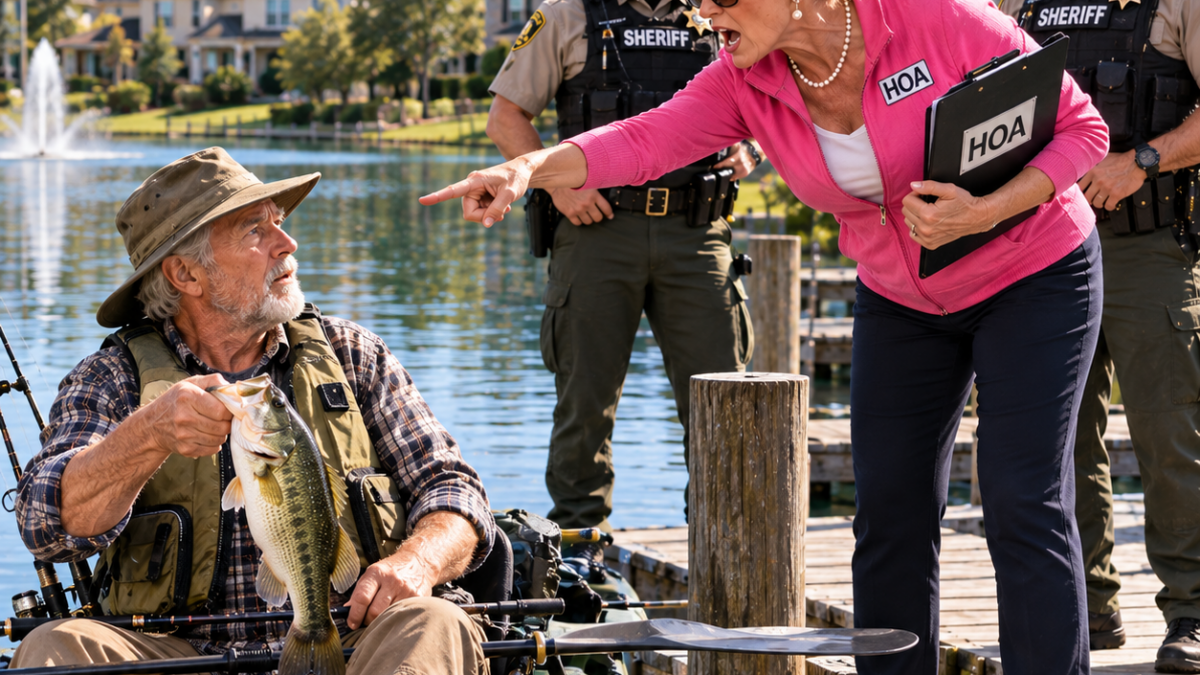
I was kneeling at water’s edge removing hook when golf cart rolled up.
Brenda.
HOA property manager, Craig Benson.
And behind them a county sheriff cruiser.
Two deputies.
I remember thinking Linda would have loved this.
Brenda got out first.
“There he is.”
One deputy, mid-thirties, looked at me.
Then fish.
Then Brenda.
“What’s going on?”
Brenda pointed.
“He’s been repeatedly trespassing on private HOA recreational property after written notice.”
I looked down.
I was standing on path-access easement adjacent to water.
“Morning, Deputy.”
He recognized me vaguely.
County employee for forty years leaves faces.
“Sir, are you resident?”
“Yes. 142 Silverbrook Lane.”
Brenda interrupted.
“Residence does not authorize fishing.”
Deputy:
“Ma’am, let me talk to him.”
She folded arms.
That did not make her happy.
Deputy asked:
“Have you been told not to fish here?”
“I’ve been told HOA policy restricts fishing.”
“Did you violate it?”
“Today? No.”
Brenda laughed.
“He is fishing.”
“Your policy permits fishing from this section between seven and seven.”
I checked watch.
6:18.
Ah.
I had violated time by forty-two minutes.
Brenda smiled.
“There.”
Deputy looked tired already.
“So this is an HOA-rule issue?”
“It is trespassing.”
I said:
“I’m homeowner with recorded pedestrian and shoreline-access easement.”
Brenda:
“No. The HOA owns lake.”
I looked at her.
“Can you prove that?”
“Marcus, do not start.”
Deputy asked:
“Who owns parcel?”
Brenda:
“Association.”
I answered:
“County record says Silverbrook Development Company.”
She turned.
“What?”
That was first time I said it aloud.
Deputy looked between us.
“Is that current?”
“I’m researching.”
Brenda’s face changed.
“That’s an old developer name. The lake transferred decades ago.”
“Maybe.”
“Not maybe.”
“Show me deed.”
She stepped closer.
“You have been warned repeatedly. You cannot use HOA property whenever you feel like it.”
The bass moved in my hand.
I remembered it.
Poor thing.
I put it back.
It swam away.
Smartest participant.
The deputies did not arrest me.
Of course they didn’t.
They told Brenda ownership dispute and HOA rules were civil unless clear trespass after lawful exclusion from property not covered by resident easement.
They advised me to stop fishing temporarily to avoid escalation.
Reasonable.
I agreed.
Brenda hated outcome.
“You’re not going to cite him?”
Deputy:
“For what?”
“Criminal trespass.”
“Ma’am, he lives here, there’s an access easement, and I don’t have documentation establishing he’s unlawfully present.”
“He is violating rules.”
“That’s HOA enforcement.”
She pointed toward me.
“This is exactly why people stop respecting community standards.”
I almost answered.
Didn’t.
The deputies left.
Brenda handed me violation notice.
$500.
Unauthorized fishing.
Unauthorized access before permitted hours.
Repeated noncompliance.
Then another $250 because my kayak had allegedly been “stored in visible preparation for unauthorized launch.”
It was in my garage.
She had seen it when door was open.
That one almost impressed me.
I appealed both.
Board hearing.
Brenda chaired.
Conflict obvious.
I asked her to recuse.
She refused.
“The board president presides.”
“You’re complainant.”
“I enforce rules.”
“You called sheriff.”
“That does not create conflict.”
Other board members avoided eye contact.
I presented county record.
Parcel owner not HOA.
Brenda smiled like teacher correcting child.
“Marcus, county records often retain original developer names on common parcels.”
“Sometimes.”
“Exactly.”
“Where is deed?”
“Our attorney has documentation.”
“Can I see?”
“No.”
“Why?”
“Privileged.”
Ownership deed is not privileged.
I said that.
She fined me anyway.
$750.
Then added legal-review fee.
$185.
I paid nothing.
Instead, I hired title attorney.
Her name was Evelyn Park.
Sixty-two.
Tiny office over bank.
Sharp enough to frighten surveyors.
I had known her professionally for decades but never hired personally.
She listened.
Then said:
“You called me over fishing?”
“Ownership.”
“Better.”
I gave documents.
She read for forty minutes.
Finally:
“You may actually have something weird.”
“Thank you.”
“Not compliment.”
She ordered forty-year title search.
Search took two weeks.
Result:
No deed from Silverbrook Development Company to HOA.
No blanket transfer.
No merger.
No receivership conveyance.
Developer corporation dissolved voluntarily.
Under corporate documents, remaining assets passed through liquidation to two shareholders.
One was founder, Charles Wexler.
The other Wexler Land Ventures.
Charles died in 2006.
Wexler Land Ventures merged into WLV Holdings LLC.
That company still existed.
Barely.
Owned scattered mineral interests and forgotten strips.
Tract B apparently one of them.
Evelyn said:
“So fee title likely descended to WLV Holdings.”
“Likely?”
“Until title company insures, everything is likely.”
“What about HOA?”
“Maintenance and recreational easements. Possibly prescriptive claims depending use.”
“Ownership?”
“I don’t see deed.”
“Could they claim adverse possession?”
“Maybe they’d try. But that’s complicated. Their use was originally permissive under recorded easements. Permissive possession generally doesn’t become hostile just because everyone forgets who owns fee.”
“And taxes?”
“HOA never paid parcel tax directly.”
“Developer successor?”
“Some years through consolidated company accounts.”
She looked at me.
“Why are you smiling?”
“I’m not.”
“You are.”
I wasn’t thinking revenge.
Not yet.
I was thinking about Linda.
The lake.
About a company somewhere owning water it had forgotten.
I asked:
“Can it be bought?”
Evelyn leaned back.
“Everything can be bought from somebody.”
We found WLV Holdings’ registered agent in another state.
Eventually reached managing member.
Charles Wexler’s grandson, Aaron.
Forty-one.
Commercial real-estate attorney.
He thought I was scammer.
“You’re telling me my family owns a lake in Silverbrook?”
“Possibly.”
“I grew up visiting Silverbrook.”
“You knew development?”
“My grandfather built it.”
“Did you know lake never conveyed?”
“No.”
I emailed documents.
Three days later he called.
“I’ll be damned.”
That phrase from lawyer is expensive.
WLV commissioned own title search.
Same result.
Fee interest remained.
But there were encumbrances:
County drainage easement.
Resident shoreline access.
HOA maintenance obligations.
Utility easement.
Recreational rights language ambiguous.
The lake had little development value.
You couldn’t fill it.
Couldn’t build on it.
Couldn’t block stormwater.
Couldn’t eliminate existing access.
But fee title still mattered.
Fishing rights.
Boating.
Lakebed.
Water-surface rules subject to easements and regulations.
Liability.
Maintenance coordination.
Aaron asked:
“Why do you want it?”
I told him.
Not Karen story first.
Linda.
Fishing.
Quiet.
Then Karen.
He laughed for a long time.
“My grandfather hated HOAs.”
“He created one.”
“Exactly why.”
His family did not want lake.
They wanted clean title.
We negotiated.
Price was not dramatic.
$68,000 plus I accepted certain ongoing obligations and indemnity structure.
People later claimed I paid a million to spite HOA.
No.
I am retired engineer, not Bond villain.
Sixty-eight thousand was still real money.
Linda and I had savings.
Life insurance.
Pension.
I could afford.
But before purchase, Evelyn made me understand responsibility.
Stormwater lake can be expensive.
Dam inspections.
Erosion.
Sediment.
Insurance.
Fish management.
Trees.
Drainage structures.
“If you buy because angry, don’t.”
I said:
“I’m not.”
“Good.”
“I’m buying because I like lake.”
She stared.
“And?”
“And I dislike Brenda.”
“Better. At least honest.”
I formed Webb Lake Holdings LLC.
Not secret.
Liability separation.
Title company insured.
Survey updated.
Boundary monumented.
County drainage easements acknowledged.
Existing pedestrian rights preserved.
HOA maintenance agreement reviewed.
Then deed recorded.
Parcel 17-B.
Twelve-point-three acres.
Fee owner:
Webb Lake Holdings LLC.
Manager:
Marcus Webb.
I did not tell Brenda first.
County records did.
She discovered eleven days after recording when property manager tried to send me another fishing violation.
Craig called.
His voice strange.
“Marcus.”
“Craig.”
“Did you purchase lake?”
“Yes.”
Long silence.
“All of it?”
“The parcel.”
“The water?”
“Fee title includes lakebed and tract subject to easements.”
“Does Brenda know?”
“Apparently about to.”
He actually laughed.
Then caught himself.
“I need call attorney.”
“You should.”
That evening Brenda appeared at my door.
No golf cart.
No clipboard.
A folder.
“Tell me this isn’t what it looks like.”
“What does it look like?”
“You bought common property.”
“No.”
“You cannot buy common property.”
“Correct.”
“So deed is invalid.”
“No.”
She looked furious.
“The lake belongs to Silverbrook.”
“It has access easements benefiting Silverbrook.”
“Same thing.”
“No.”
“You knew community considered it common.”
“I knew community used it.”
“Thirty-two years.”
“Yes.”
“You exploited clerical error.”
I thought.
“No.”
“Then what do you call this?”
“A sale by record owner.”
“The developer intended to convey it.”
“Probably.”
“That means HOA owns equitable interest.”
“Maybe tell lawyer.”
“I will.”
“Good.”
Her voice sharpened.
“You think this is funny?”
“No.”
“You did this because of fine.”
“I started researching because of fine.”
“Exactly.”
“But I bought because title existed.”
She stepped closer.
“You cannot restrict residents.”
“Depends what rights they have.”
“We have unrestricted lake rights.”
“Show me.”
She hated that sentence now.
“Marcus.”
“Recorded easement allows shoreline pedestrian access and drainage. Recreational use subject to fee owner regulation.”
“That is thirty-year-old language.”
“Yes. Recorded language ages remarkably well.”
She left.
The next morning I went fishing.
Seven o’clock.
Kayak.
Brenda stood on path.
She did not call sheriff.
Progress.
I waved.
She did not.
Three days later HOA counsel sent letter.
They asserted:
HOA had acquired ownership by adverse possession.
Or equitable title.
Or implied conveyance.
Or estoppel.
Or prescriptive rights.
Or fiduciary obligation from developer successor.
Lawyers plead alternatives.
I respected.
Evelyn replied.
Then HOA sued.
Silverbrook Estates HOA v. Webb Lake Holdings LLC.
Homeowners received notice their association was suing a resident because he bought the lake association claimed to own.
That did not go well.
Especially after special assessment.
$225 per household for legal defense fund.
Three hundred forty homes.
People did math.
$76,500.
Over a lake nobody had known wasn’t theirs.
Clubhouse meeting became chaos.
I attended.
Not because required.
Because I owned lake they were discussing.
Brenda sat front.
“Mr. Webb’s action threatens every homeowner’s property value.”
A resident shouted:
“Did we own lake or not?”
Brenda:
“Our attorneys believe association has strong ownership claims.”
Another:
“Where’s deed?”
Silence.
I almost smiled.
Mark Feldman, retired accountant, stood.
“We have been paying lake-maintenance assessments for years. To whom?”
Brenda:
“Association maintains lake.”
“Are we paying taxes?”
“Taxes are minimal.”
“That wasn’t question.”
She looked at treasurer.
Treasurer looked at management.
Craig looked like he wanted disappear.
Brenda said:
“Maintenance includes shoreline mowing, algae treatment, fountains, inspections—”
Mark:
“Fine. But if we didn’t own lake, why have financial statements called it HOA asset?”
There.
Financial statements.
I had not thought about that.
Neither had Evelyn.
After meeting, Mark came to me.
“Can I ask question?”
“Sure.”
“Are you going to close lake?”
“No.”
“Charge everyone?”
“Not decided.”
“My wife walks there every day.”
“Her recorded walking rights remain.”
His shoulders dropped.
“Brenda says you’re going to fence it.”
“I can’t legally block easement even if I wanted.”
He stared.
“Why didn’t she say that?”
“Ask her.”
He laughed without humor.
Homeowners started requesting records.
They had right under bylaws and state nonprofit law.
Minutes.
Invoices.
Budgets.
Lake assessments.
That’s when thirty-two years came loose.
Silverbrook had charged some version of lake fee since 1991.
At first $18 annually.
Then $35.
Then included in general dues.
Then separate “Lake Preservation Reserve.”
Over decades, total collected attributable to lake maintenance exceeded $1.3 million.
That alone wasn’t scandal.
HOA did spend money maintaining shoreline and fountains under easement obligations.
But accounting assumed ownership.
Depreciation schedules listed lake improvements as association assets.
Insurance included lake.
Legal filings described common property.
Nobody had checked title.
A mistake.
Embarrassing.
Not necessarily corrupt.
Then Mark found consulting payments.
For seven years, HOA had paid Kowalsski Community Strategies LLC.
$2,250 per month.
Then $3,500.
Services:
Vendor coordination.
Compliance consulting.
Lake-amenity planning.
President Brenda Kowalsski owned company.
Was that automatically illegal?
No.
Boards can contract with members if disclosed and properly approved.
Was it properly disclosed?
Apparently not well.
Minutes called vendor KCS Consulting.
Brenda had recused from some votes.
Not all.
One year, payments exceeded $41,000.
Residents had no idea KCS was hers.
Then lake-vendor contract.
Algae treatment company paid referral consulting to KCS.
Small but real.
Then fishing fines.
Over eight years, thirty-seven homeowners had been fined for lake-use violations.
Unauthorized fishing.
Guest fishing.
Kayaks.
Model boats.
Swimming.
Some paid.
Some appealed.
Fine revenue went HOA.
But authority came from policy stating association owned lake.
Could association regulate recreational access under easement even without ownership?
Possibly some.
Depends documents.
But board had presented ownership as fact.
More disturbing:
Fine patterns.
People who challenged Brenda elsewhere received lake violations at much higher rates.
Mark had once disputed roof assessment.
Three weeks later:
Guest fishing fine.
Mrs. Patel questioned KCS contract.
Then received $300 penalty because grandson used inflatable paddleboard.
Retired teacher named Jim Owens ran for board against Brenda.
Then fined for “unauthorized shoreline chair.”
Patterns.
Not proof of crime.
Governance problem.
Homeowners demanded independent audit.
Board voted.
Brenda voted no.
Lost four to one.
Then she resigned presidency.
Not board.
Her resignation letter blamed me.
Mr. Webb’s predatory acquisition has destabilized community governance.
I read it twice.
Predatory.
I had bought parcel from record owner after she sent police to remove me.
Linda would have loved that.
Lawsuit continued even without Brenda as president.
This was important.
New board inherited obligation.
Their counsel couldn’t simply abandon claim without review because if HOA truly had ownership rights, board had duty protect them.
I respected that.
We entered mediation.
Retired judge.
Long table.
Coffee.
Lawyers.
Board representatives.
No Brenda.
Mediator asked me:
“What do you actually want?”
“Clear title recognized.”
“Anything else?”
“Reasonable recreational system.”
“Fees?”
“No profit necessary.”
“Then why fight?”
I looked at him.
“Because they sued.”
He smiled.
“Fair.”
HOA wanted ownership or permanent broad recreational easement.
I would not transfer title immediately.
Why?
Trust.
The same board structure had abused lake rules.
I proposed:
Residents receive no-cost annual recreational permits for catch-and-release fishing and nonmotorized small craft.
Hours.
Safety rules.
Guests with residents.
No swimming near drainage structures.
No gasoline motors.
No litter.
No commercial guiding.
Existing path open per easement.
HOA contributes fixed annual amount toward shoreline maintenance already obligated under agreement.
I maintain lake insurance and coordinate fish management.
Nobody pays me personally.
Permit simply acknowledges rules and liability terms.
In other words:
Ask permission.
Not beg.
Not pay me.
Ask.
That phrase became headline.
MAN BUYS HOA LAKE, MAKES NEIGHBORS ASK PERMISSION TO FISH.
True.
But missing point.
Before, Brenda fined people based on rules she claimed came from ownership.
Now actual owner issued transparent rules equally.
One resident asked:
“Why permits at all?”
“Liability and fish management.”
“Brenda didn’t require permits.”
“She required permission through HOA.”
“But we’re homeowners.”
“You have access rights. Recreation rights are limited by recorded documents.”
He didn’t like answer.
I didn’t blame.
For thirty years they were told:
This is yours.
Now:
Not exactly.
Hard.
Some residents were angry at me.
One put sign:
GIVE OUR LAKE BACK.
I didn’t take personally.
Another spray-painted cardboard:
MARCUS WEBB STOLE SILVERBROOK.
Technically poor land-record analysis.
I ignored.
Then Brenda returned to public fight.
Local TV.
She stood by lake.
“An elderly widower has exploited paperwork technicality to privatize community resource.”
That hurt.
Not elderly.
Sixty-seven.
Borderline.
More importantly:
Widower.
She dragged Linda-adjacent identity into public.
I nearly responded emotionally.
Evelyn stopped.
“Don’t.”
“She called me—”
“I heard.”
“She knows why I fish.”
“Doesn’t matter legally.”
“I know.”
“Then don’t let her make personal.”
I didn’t interview.
Good.
Instead new board president, Mark Feldman, did.
Yes, accountant became president after special election.
He told reporter:
“We are reviewing title and prior governance. Residents will retain walking access. Mr. Webb has offered no-cost recreation permits. Claims that residents are being excluded are inaccurate.”
Brenda hated him next.
Welcome.
Discovery in lawsuit produced the 1987 mistake.
Original closing binder from developer.
One unsigned deed.
There it was.
Special Warranty Deed, Tract B, Silverbrook Development Company to Silverbrook Estates Homeowners Association.
Prepared.
Never signed.
Never notarized.
Never recorded.
Attached sticky note in lawyer’s handwriting:
Hold until drainage punch list accepted.
County accepted punch list months later.
Somebody never returned.
Company dissolved next year.
One forgotten deed.
Thirty-two years.
HOA counsel saw.
Called Evelyn.
Case shifted.
Adverse possession claim weakened because HOA’s occupancy was based on express easements and maintenance agreement, not hostile exclusive possession.
Equitable-title theory possible but difficult because unsigned deed and corporate successor sale.
Statutes.
Laches.
Reliance.
Complicated.
But title insurer defended.
Mediator pushed.
Meanwhile forensic audit report hit homeowners.
KCS payments properly entered but inadequately disclosed.
Conflict policies weak.
Some payments lacked detailed deliverables.
$27,400 categorized as lake strategy consulting had no written work product.
Algae vendor referral payments to Brenda’s company not disclosed to board.
Retaliatory fine pattern “statistically unusual” but auditor would not infer motive.
Lake reserve had been used partly for general landscaping during two years despite budget labels.
Again:
Not all theft.
Not all fraud.
Some sloppy.
Some conflicted.
Some troubling.
Residents filed separate civil action against Brenda regarding fiduciary duties and undisclosed payments.
I was not plaintiff.
Didn’t need.
Brenda’s attorney sent me cease-and-desist about public claims.
I had made none.
Evelyn replied:
“Our client has not publicly accused Ms. Kowalsski of financial misconduct.”
True.
Let records talk.
The sheriff deputies from first morning eventually learned I bought lake.
One, Deputy Collins, stopped me at grocery store.
“Mr. Webb.”
“Deputy.”
“Still fishing?”
“Yes.”
“Need permit?”
I looked at him.
He grinned.
“Sorry.”
“You’re banned.”
“From lake?”
“No. Conversation.”
He laughed.
Then serious.
“Did we handle that okay?”
“Yes.”
“We didn’t know ownership.”
“Neither did I yet.”
“Brenda sure did.”
“She thought she did.”
That’s entire story.
Confidence isn’t title.
Mediation settlement came four months and eleven days after deed recording.
HOA recognized Webb Lake Holdings as fee owner.
I recognized all existing recorded easements.
Residents received broad nonexclusive recreational license under annual permit system for at least ten years, renewable.
No permit fee for Silverbrook homeowners or tenants.
Guest rules simple.
HOA paid no damages to me.
Each side initially own legal fees, though title insurer covered much of mine.
HOA discontinued ownership-based fines.
Prior unpaid lake fines canceled.
Homeowners who had paid certain disputed lake fines in preceding years received credits against future dues from a settlement reserve.
KCS no longer eligible vendor without full conflict disclosure.
Independent audit recommendations adopted.
The biggest argument was name.
Brenda had renamed water Lake Silverbrook in newsletters years ago.
Original plat called it Tract B Reservoir.
Residents liked lake.
I did too.
We left Lake Silverbrook.
Ownership does not require renaming everything after yourself.
Mark asked:
“You aren’t going to call it Linda Lake?”
I went quiet.
He realized.
“Sorry.”
“No.”
I looked toward water.
“She would’ve hated that.”
“Why?”
“She didn’t like things named after dead people while living people have to explain.”
Mark smiled.
“Sounds like her.”
Instead I put one small bench on shoreline near my house.
County-approved location outside drainage path.
Plaque:
FOR LINDA
SIT A WHILE. THE WATER CAN WAIT.
No surname.
No dates.
Enough.
The first day permit system opened, seventy-three applications came.
Online form.
Name.
Address.
Emergency contact.
Acknowledge catch-and-release bass over certain size.
Life jacket for boats.
No motors.
No entry into spillway structures.
Thirty seconds.
Mark got permit number 001.
I did not choose.
System did.
He bragged.
Mrs. Patel got paddleboard permission for grandson.
Jim Owens brought shoreline chair.
I removed chair rule entirely.
People deserve chairs.
Earl, my fishing friend, didn’t own home.
He rented.
Still eligible.
We fished first Saturday.
He said:
“So you’re lake baron now.”
“No.”
“Water king.”
“No.”
“Admiral?”
“Stop.”
He cast.
“Brenda would hate this.”
I looked at him.
“Don’t make morning about Brenda.”
He nodded.
“Right.”
We caught two bass.
Released.
Quiet.
That was what I wanted.
The lawsuit didn’t make grief disappear.
Buying lake didn’t fix Linda’s absence.
That’s important.
Viral stories like revenge because revenge pretends external victory repairs internal loss.
It doesn’t.
I still went home to empty chair.
Still reached for second coffee cup sometimes.
Still woke thinking I heard her coughing.
But lake helped.
Not because I owned it.
Because I could sit.
Fish.
Remember without drowning in remembering.
Ownership gave me control over access rules.
It did not give back wife.
Nothing does.
Six months after settlement, Brenda sold her house.
Before moving, she came to my door.
Unexpected.
I almost didn’t open.
She stood without clipboard.
First time.
“Marcus.”
“Brenda.”
“I wanted to speak before leaving.”
“Okay.”
She looked older.
Not because evil punished.
Stress ages people.
She said:
“You made me look corrupt.”
“No.”
Her eyes hardened.
“You released records.”
“I did not.”
“Your friends did.”
“Homeowners requested their association records.”
“You encouraged them.”
“I answered questions.”
She folded arms, old posture.
“The HOA maintained that lake for decades.”
“Yes.”
“Paid for it.”
“Yes.”
“Protected it.”
“Sometimes.”
“Then you came in and took advantage of missing signature.”
I let her finish.
She said:
“You know it was meant to be ours.”
“Yes.”
That surprised.
“Then how can you justify it?”
I thought.
Because legally title wasn’t theirs.
True.
But she was asking moral.
So I answered moral.
“Why did you call sheriff on me?”
She blinked.
“What?”
“Before I bought anything. Why did you call deputies over fishing?”
“You violated rules.”
“Why $750?”
“You had been warned.”
“Why did you refuse to show deed?”
“I believed we owned it.”
“Why did you fine people who challenged you?”
Her jaw tightened.
“I enforced consistently.”
“No.”
“You don’t know—”
“I read audit.”
“That report was biased.”
“Why did your company receive lake consulting fees?”
“I worked.”
“Did homeowners know?”
“Board did.”
“Some didn’t.”
She looked away.
I continued:
“If you had approached me after title discovery and said, Marcus, this lake was intended to belong to community, let’s fix chain, maybe we’d be having different conversation.”
“But you bought it.”
“Yes.”
“Before telling us.”
“You had already fined me and sent sheriff.”
Silence.
Then:
“You wanted revenge.”
Did I?
Partly?
Maybe.
People are rarely pure.
I said:
“At first I wanted answer.”
“And then?”
“I wanted to make sure nobody could use lake rules that way again.”
She laughed bitterly.
“So you made yourself ruler.”
“No.”
“Everyone needs your permission.”
“Yes.”
“There.”
I nodded.
“Difference is my authority is recorded, rules published, permits equal, and nobody gets fined because they criticized me.”
She had no response.
Then she said something I did not expect.
“I loved this community.”
“I believe you.”
She looked at me.
“Really?”
“Yes.”
That seemed to hurt more.
Because loving something doesn’t prevent harming it.
Sometimes love becomes ownership in people’s minds.
She whispered:
“I thought if I let one person ignore rules, everything would unravel.”
I understood.
Civil engineer.
Systems.
Standards.
Precedent.
“But you stopped asking whether rule was valid.”
She looked at lake.
Maybe first time someone said it plainly.
“Goodbye, Marcus.”
“Goodbye, Brenda.”
She moved.
I never saw her again.
Homeowners’ civil case against her settled privately.
I heard she repaid some consulting amounts.
I don’t know exact.
Not my business.
Silverbrook moved on.
That matters.
Mark served two years as president.
Then term limits adopted.
Good rule.
Maximum two consecutive terms.
Conflict disclosures posted.
Vendor relationships disclosed.
Financial statements clearer.
Every parcel the HOA claimed to own was title-verified.
That exercise found another mistake.
Tiny landscape strip at entrance still owned by developer successor.
They fixed by deed.
Nobody bought it first.
Mark thanked me sarcastically.
“You’ve made us all paranoid.”
“Documentation-aware.”
“Same thing in retired engineer language.”
Maybe.
The lake itself improved.
I hired fisheries biologist.
Bass population overabundant in small size.
Bluegill imbalance.
We adjusted catch policy.
Added habitat structures where safe.
HOA continued algae treatments under shared maintenance agreement.
County inspected outlet.
One culvert needed repair.
My responsibility partly.
Owning things costs money.
Residents who had cheered when I “beat Brenda” became less excited when I closed one shoreline section for dam maintenance.
“Why is trail closed?”
“Excavator.”
“We have easement.”
“Safe access temporarily rerouted.”
People don’t stop being people because villain gone.
That’s okay.
Authority receives complaints.
The difference is respond with reasons.
One resident challenged permit requirement legally.
His attorney argued recorded recreational easement broader than I claimed.
We reviewed.
Evelyn said he had point about shoreline fishing.
The 1989 instrument granted residents right to “reasonable passive recreational use along designated shoreline.”
Fishing likely included.
So I changed permit.
Shore fishing no permit for residents.
Boating still permit because lake-surface use subject fee-owner control.
Did I enjoy being corrected?
No.
Did I change?
Yes.
That’s governance.
Brenda’s failure taught me not to become Brenda.
Important.
My granddaughter Sophie visited one summer.
Twelve.
She saw deed in office.
“You own a lake?”
“Yes.”
“Like whole lake?”
“Subject to easements.”
She stared.
“Normal people say yes.”
“Yes.”
“Can I name an island?”
“There is no island.”
“Can we build one?”
“No.”
“Then what is point?”
Fishing.
Drainage.
Responsibility.
She wasn’t impressed.
We paddled.
She caught bluegill.
Screamed.
Then refused touch.
I released.
She asked:
“Why did you buy lake?”
I almost gave legal story.
Instead:
“Because your grandma liked it.”
That was truest.
Years later, I considered selling.
Not because burden.
Age.
Knees worse.
Kayak harder.
Webb Lake Holdings could eventually be transferred to trust or HOA under safeguards.
Mark asked:
“Would you ever deed it to association?”
“Yes.”
He nearly fell out chair.
“What?”
“If governance stays healthy.”
“Free?”
“Maybe.”
“Marcus, are you serious?”
“Developer intended community ownership originally.”
He stared.
“Then why not now?”
“Because systems should earn trust.”
That sounded pompous.
But true.
I worked with attorney on future transfer option.
Conditions:
Independent title.
Permanent preservation.
Recorded recreational rights.
Conflict rules.
No unilateral fines.
County drainage protections.
No development.
No sale without supermajority and county consent.
Maybe after death.
Maybe before.
I had no desire to be lake king forever.
Ownership was correction phase.
Not identity.
Linda would have mocked me mercilessly if I put “lake owner” on anything.
She once said men retire and immediately invent tiny kingdoms to manage.
She meant garden sheds.
I accidentally acquired twelve acres of water.
Close enough.
At seventy-one, I stopped kayaking alone.
Doctor advice.
Balance.
I bought small stable fishing boat with electric trolling motor.
Yes, technically motor.
My rules prohibited gasoline, not electric.
Earl accused me of writing loophole.
I amended rules before purchase to permit low-speed electric motors for mobility-access reasons.
Transparent.
Board reviewed.
No secret exception.
Again:
Don’t become Brenda.
Deputy Collins came fishing once.
He got permit.
He held it up.
“Feels weird asking man we almost cited.”
“You didn’t almost cite.”
“She wanted.”
“True.”
We laughed.
He caught nothing.
I caught three.
Justice.
One morning at 6:45, new resident approached dock.
Young guy.
Maybe thirty-five.
Kayak.
“Sir, do I need HOA permission?”
I smiled.
“No.”
He looked confused.
“Neighbor says Mr. Webb owns lake.”
“I’m Webb.”
His face changed.
“Oh.”
“Fill boat permit online.”
“Does it cost?”
“No.”
“HOA told us lake was theirs when we bought.”
“They have access rights.”
“That’s not what realtor said.”
“Ask for documents.”
He laughed.
“You serious?”
“Always.”
He pulled phone.
“What’s website?”
I gave.
Two minutes.
Approved automatically.
He launched.
No drama.
That is how permission should feel when goal safety, not submission.
One resident once said:
“You made entire neighborhood ask permission just to prove point.”
Maybe partly.
But permission clarifies responsibility.
Before, nobody knew who had authority.
HOA thought owner.
Developer successor forgot.
County had drainage rights.
Residents assumed everything.
Ambiguity let Brenda weaponize.
After:
Fee owner: Webb Lake Holdings.
County: drainage easement.
Residents: shoreline access.
HOA: maintenance obligations.
Boating: owner permit.
Fishing: resident access rules.
Clear.
Boring.
Safe.
Engineers like boring.
The biggest surprise from all of it was thirty-two years of collective assumption.
Not fraud at beginning.
A missing signature.
One sticky note.
One company dissolved.
Then people behaved as if intended deed had happened.
New boards inherited belief.
Property managers copied old documents.
Insurance repeated.
Budgets repeated.
Real estate listings repeated.
After enough years, repetition feels like proof.
It isn’t.
That scared me more than Brenda.
Systems can be wrong politely for decades.
Nobody malicious.
Everyone copying last file.
Then one conflict forces original record.
That is why title work matters.
Why surveys matter.
Why old documents matter.
Not romantic.
Essential.
The consulting-payment issue was separate.
People like tying everything into one conspiracy.
I don’t.
The lake title error did not prove Brenda’s consulting conflicts.
Audit did.
Her fines did not prove title error.
Deed records did.
Keep evidence lanes separate.
Otherwise stories become satisfying and unreliable.
I spent career warning younger engineers:
Don’t make drawing say more than survey supports.
Same principle life.
Brenda overreached.
The title mistake predated her by decades.
She didn’t create it.
She exploited authority built upon it without checking.
That’s fair description.
Residents sometimes ask if I hate HOA.
No.
I hate unverified authority.
HOA can maintain pool better than 340 individual contracts.
Can mow common land.
Can manage reserves.
Can coordinate drainage.
Useful.
But useful institutions need boundaries.
When Silverbrook adopted new governance rules, I supported.
Even paid dues happily.
Mostly.
Annual increase still annoys me.
Retirement has not removed hypocrisy.
The old $750 fishing fine?
Canceled during settlement.
I framed copy.
Linda’s photo beside.
Not as trophy.
Reminder.
At bottom I wrote:
CHECK THE DEED.
Sophie saw.
“Grandpa, this is such an old-man decoration.”
“Accurate.”
“Normal people frame fish.”
“I released fish.”
“Frame picture.”
“No picture.”
“Exactly.”
Youth lacks appreciation for documents.
One evening, sitting on Linda’s bench, I thought about first morning.
Bass.
Deputies.
Brenda pointing.
If she had simply said:
Marcus, rules say fishing after seven.
I would have checked watch.
Apologized.
Waited forty minutes.
Maybe none of story.
If I hadn’t asked ownership question, no title search.
No purchase.
No lawsuit.
No audit.
No consulting revelations.
No canceled fines.
Strange how little doors open big rooms.
But careful.
Does that mean Brenda “caused her own downfall”?
Too dramatic.
She created conflict that exposed neglected records.
Her choices after exposure deepened.
That’s enough.
I no longer fish every morning.
Maybe twice week.
Sometimes I just sit.
Water still does what Linda said.
Makes everything feel farther away.
Even grief?
No.
Not really.
But softer.
Distance isn’t disappearance.
When wind stops and sunset reflects, I can almost hear her:
“Did you really buy a lake because a woman fined you for fishing?”
I would say:
“No.”
She’d look.
Then:
“Mostly no.”
That would earn laugh.
Maybe.
I miss laugh.
The lake cannot replace it.
But memory lives better there than hospital room.
That was worth more than deed.
A few years after everything, Silverbrook held community picnic on shoreline.
Kids.
Music.
Food trucks.
Fishing clinic.
Mark asked me to say something.
I refused.
He handed microphone anyway.
I said:
“Please don’t litter.”
Everyone laughed.
Then I added:
“And if somebody tells you association owns something, ask for parcel number.”
Bigger laugh.
Brenda wasn’t there.
Good.
Not her story anymore.
I looked at families.
People who had once been angry.
Some still thought I should transfer lake.
Some didn’t care.
Kids cast fishing lines.
Mrs. Patel’s grandson paddleboarded.
Earl slept in chair.
Normal.
I said:
“This lake was supposed to bring people together before paperwork got confused.”
Pause.
“Let’s let it do that.”
Then handed microphone back.
That’s closest I came speech.
After picnic Mark sat.
“You gonna deed it to us?”
“Not today.”
“You ruined moment.”
“Good.”
He laughed.
At seventy-three, I signed conditional transfer instrument into estate plan.
Upon my death, Silverbrook HOA gets first option to receive lake for nominal consideration if governance conditions maintained.
Otherwise conservation trust receives.
Sophie disappointed.
“You’re not leaving me lake?”
“No.”
“What about boat?”
“Yes.”
“Better.”
Practical child.
Evelyn reviewed instrument.
“You’ve come full circle.”
“No.”
“Pretty much.”
“Association still has to ask.”
She smiled.
“You really like that.”
Maybe I do.
Because permission is not humiliation.
It’s recognition that other people exist.
Property rights are less about saying mine than acknowledging not yours without consent.
Brenda skipped that.
She treated association control as fact.
Then treated my grief routine as violation.
Then police.
Then fines.
Maybe if she had once asked:
Marcus, why are you fishing?
I would have told Linda.
Maybe still rules.
But human first.
Instead she pointed.
Institutions fail when labels replace people.
Violator.
Problem homeowner.
Noncompliant resident.
Trespasser.
I was widower with kayak.
She couldn’t see.
Later I risked reverse.
Karen.
Corrupt president.
Villain.
She was person too.
Wrong.
Conflicted.
Controlling.
But human.
Holding both truths keeps you from becoming cruel.
I don’t forgive every action.
I don’t need to.
I just don’t need her trapped in my head.
The lake belongs on deed.
Brenda doesn’t.
That might be retirement wisdom.
One morning, shortly after I turned seventy-four, I stood on dock with coffee.
No rod.
Fog.
A young mother walked path with stroller.
She stopped.
“Mr. Webb?”
“Yes.”
“My husband says you’re the man who owns lake.”
“Technically LLC.”
She smiled politely.
“Can we have family photos by water Saturday?”
I almost laughed.
“Of course.”
“Do we need permission?”
“Path is resident access.”
“What about little dock?”
“My dock. But yes.”
She took out phone.
“Do I sign something?”
“No.”
She looked surprised.
“That’s it?”
“Yes.”
“Thank you.”
She walked away.
I watched.
Entire neighborhood asks permission.
Title version sounds triumphant.
Reality?
Most permission takes ten seconds.
Yes.
No drama.
That’s the point.
Authority does not need theater.
If you actually have right to decide, you can say yes quietly.
Brenda had clipboard.
Deputies.
Fines.
Board letters.
I ended with deed.
Yet the deed’s best use was letting people fish.
That’s irony I like.
Sometimes real control means not controlling more than necessary.
The original HOA lake-use policy is gone.
Current rules fit one page.
No swimming near outlet.
No gas motors.
Life jackets.
Respect wildlife.
Clean up.
No fishing during maintenance closures.
Resident shore fishing open dawn to dusk.
Boat permit free.
Simple.
One day Mark complained:
“Where are architectural standards for kayaks?”
I stared.
He grinned.
I threw napkin.
Silverbrook is quieter now.
Still complaints.
Mulch.
Mailboxes.
Pool hours.
Normal suburban life.
The biggest difference is people ask more questions.
Good.
At meetings, if board president says counsel advised something, somebody asks:
“Can we see written opinion summary?”
If management says HOA owns parcel, Mark says:
“Parcel number?”
My fault.
I’m proud.
One missing deed taught 340 homes.
That’s decent return on $68,000.
Would I do again?
Probably.
Evelyn says no because I am older and should stop buying infrastructure.
She’s right.
Mostly.
I considered buying drainage pond behind grocery store once.
She threatened call Sophie.
I stopped.
Retirement needs supervision.
If there is one thing I wish people understood about entire story, it’s that I didn’t “steal” lake through loophole.
A record owner sold property.
The HOA had easements and maintenance obligations, not fee title.
I bought subject to those rights.
Then courts and settlement clarified.
Nobody lost their ability to walk shoreline.
Nobody had home value destroyed.
Nobody had to pay me entrance fee.
The only thing neighborhood lost was fiction that HOA owned what it never received.
Sometimes truth feels like loss because assumption felt comfortable.
Still truth.
And one more thing:
I didn’t buy lake to make residents beg.
I made users ask permission because no one should again be able to say:
“We’ve always done it, therefore we own it.”
Permission documents relationship.
Today yes.
Tomorrow yes under rules.
Rights where recorded.
License where not.
Clear.
After forty years civil engineering, clarity is love language.
Linda would roll eyes.
But she chose engineer.
Her fault.
The bass from first morning?
Obviously I don’t know.
Fish doesn’t remember litigation.
I like imagine still there.
Bigger.
Avoiding hooks.
If I catch one around five pounds, I sometimes say:
“You look familiar.”
Earl says I’m losing it.
Maybe.
Age.
Still release.
Some things are better not possessed just because you can.
That applies to fish.
Power.
Grudges.
Maybe lakes too.
One day lake won’t be mine.
Good.
Stewardship should end.
For now, I keep deed safe.
Permit site running.
Insurance paid.
Outlet clear.
Fish healthy.
Bench maintained.
And every morning when light hits water, I remember how absurd first scene was.
Sixty-seven-year-old widower.
Plastic kayak.
Bass.
Two deputies.
One HOA president pointing like I was robbing a bank.
Brenda thought conflict was about rule.
I thought it was about fishing.
Neither of us knew it was about a missing signature from 1987.
That is the thing about property.
Land remembers what people forget.
County books remember.
Plats remember.
Easements remember.
Deeds remember.
Human confidence doesn’t rewrite them.
Thirty-two years of newsletters couldn’t create conveyance.
Thirty-two years of budgets couldn’t sign deed.
Thirty-two years of calling something “our lake” couldn’t replace recorded title.
The paperwork was boring.
Until it wasn’t.
And that is how I went from being fined for fishing to owning the water I was supposedly trespassing on.
Not because I was richer.
Not because I outsmarted everybody.
Not because I had secret legal weapon.
Because I asked the oldest and simplest property question there is:
“Who actually owns this?”
Brenda answered from habit.
I answered from records.
Only one held up.
These days, if a new resident asks me whether HOA owns lake, I don’t give history.
I point toward county-record website and say:
“Look it up.”
Sometimes they laugh.
I don’t.
Documentation is freedom.
And if they want to take a kayak out afterward?
They ask.
I usually say yes.
That may not be the revenge story people want.
It is better.
Because Brenda spent years believing authority meant the power to say no.
The lake taught me the opposite.
Sometimes the clearest proof something is yours is that you can say yes without being afraid of losing control.