The HOA Burned 300 Acres of My Wheat and Toasted to the View—They Never Asked Who Still Controlled the Floodgate Above Their Country Club.
The HOA Burned 300 Acres of My Wheat and Toasted to the View—They Never Asked Who Still Controlled the Floodgate Above Their Country Club.
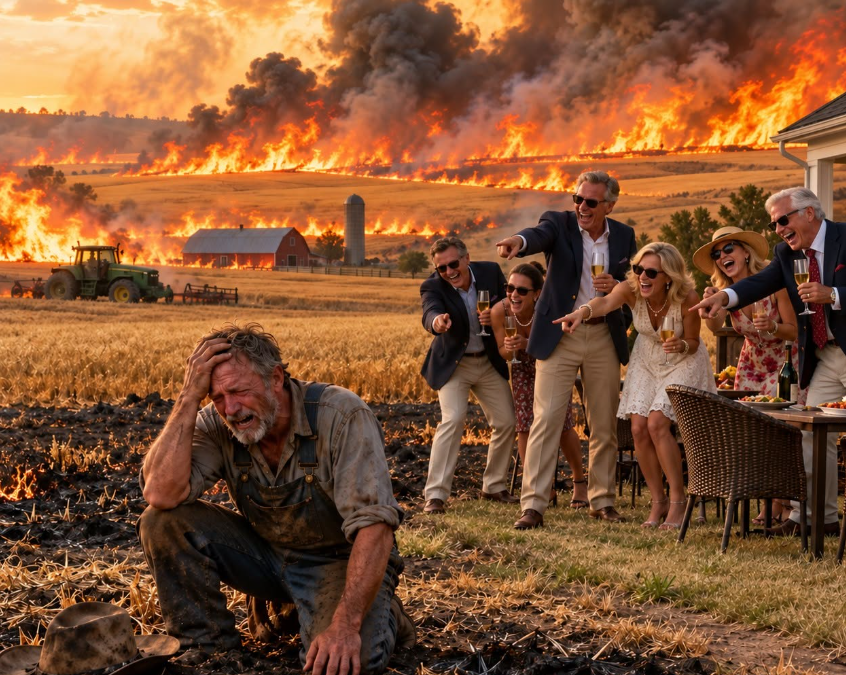
Smoke was still rising from three hundred acres of my blackened wheat when HOA president Victoria Hayes stood on the country club terrace with a glass of wine and told her friends the neighborhood finally looked better without my farm ruining the view.
She thought burning my harvest would force me to sell.
She thought fire could do what her lawyers, complaints, threats, and million-dollar offers had failed to do.
But she had never bothered to learn why her clubhouse had stayed dry for twenty years.
She had never asked who controlled the old floodgate upstream.
And she had never understood that water remembers what people choose to forget.
My name is Ethan Walker.
Before anyone started calling me the farmer who flooded a country club, I spent most of my adult life trying to keep water away from places where it could hurt people.
That distinction matters.
I did not dynamite a levee.
I did not cut an embankment in the dark.
I did not sabotage drainage equipment or sneak onto land that belonged to someone else.
What I did was open a flood-control gate that sat entirely on my property, under an agreement my father had signed twenty-five years earlier, during the largest rain event our county had seen in two decades.
I operated it exactly the way it had been designed to operate.
The water did the rest.
To understand why that mattered, you have to understand what my farm looked like before the fire.
Six hundred acres in eastern Kansas.
Wheat country.
Flat enough in some places to make the horizon seem impossibly far away, but not truly flat if you knew what you were looking at.
The land rolled.
Barely.
A few feet of elevation here.
A shallow depression there.
An old drainage swale running east after a storm.
A low ridge protecting the house.
A forgotten cut where floodwater had crossed back in 1986.
Most people saw wheat.
I saw contours.
That was because I had lived on that ground most of my life.
And because before I came home to farm full-time, I had spent eleven years as a civil engineer specializing in flood control.
My father used to joke that I had gone to college to learn what water had already been teaching our family for generations.
He was not entirely wrong.
Water is honest.
People call floods unpredictable, but most water is extraordinarily predictable.
It seeks grade.
It exploits weakness.
It fills low places.
It follows paths older than roads, fences, driveways, parking lots, and property lines.
Ignore that long enough and water eventually reminds you.
PART2
My grandfather bought the first piece of the Walker farm after World War II.
My father expanded it.
By the time I was a boy, wheat stretched from the county road nearly to the river corridor. We kept cattle for a while, then my father sold them and focused on grain.
By fourteen, I could run an old tractor.
By sixteen, I could repair most of what I broke.
By eighteen, I thought I wanted nothing to do with farming.
That is how young men often feel about the thing they know best.
I wanted cities.
Engineering.
Large projects.
Concrete.
Steel.
Systems.
So I left.
University first.
Then engineering work.
Three states.
Flood-control channels.
Stormwater management.
Retention basins.
Levees.
River restoration.
I was good at it.
Not brilliant.
I never thought of myself that way.
But I understood water.
In the late 1990s, I came back to Kansas for a county flood-control project.
The eastern half of our county had suffered a series of hard spring floods. Farms had gone underwater. Roads washed out. Several neighborhoods had come close to evacuation.
The county hired a consulting team to redesign part of the drainage network.
I was one of the engineers assigned.
PART3:
For three years, I worked almost within sight of the farm where I had grown up.
We mapped runoff.
Modeled flood events.
Surveyed channels.
Designed levees and relief structures.
One of those structures was Gate 7.
At the time, it was nothing impressive.
Concrete box.
Steel gate.
Manual crank.
It sat on land my father owned near the northern edge of our acreage.
Its purpose was simple.
During significant high-water events, Gate 7 could be opened to divert overflow from the upper watershed into a secondary flood channel.
That channel crossed agricultural low ground before reconnecting downstream.
It reduced pressure on the main levee.
It also kept uncontrolled water away from more populated areas.
The county could have purchased the land around the gate.
It did not.
Budget constraints.
Paperwork.
My father’s willingness.
The maintenance agreement left several structures under adjoining private ownership.
Gate 7 stayed ours.
The county retained inspection access.
My father retained ownership and operating responsibility.
I helped draft part of the technical plan.
At the time, none of us considered it especially important.
There was no country club nearby.
No gated development.
No million-dollar homes.
No event pavilion with white columns and a wine list.
Just fields.
Drainage.
Water.
Then life changed.
My father got older.
I got tired of hotels, rental apartments, and waking up in cities where I knew no one well enough to borrow a ladder.
My marriage had been failing quietly for years.
There was no dramatic betrayal.
No screaming.
We simply became two people who had spent too much time building separate lives.
When my father called one autumn and admitted he was having trouble running the combine alone, I came home.
At first, I told myself it was temporary.
It was not.
I left engineering.
My wife moved back to Wichita.
We remained civil.
That is about all there is to say.
The farm became my life again.
And to my surprise, I liked it.
Engineering teaches you how to control complexity.
Farming teaches you to accept it.
Weather.
Markets.
Equipment.
Soil.
Nothing cares about your schedule.
You prepare.
Then you adapt.
For years, life settled into something quiet.
Until the country club arrived.
It started with roads and model homes.
Then more houses.
Brick.
Stone.
Large garages.
Decorative ponds.
Manicured lawns.
Eventually, the development built a clubhouse.
Then a golf course.
Then tennis courts.
Then an event pavilion.
At the center of it all sat an HOA whose authority grew so slowly that some residents seemed to forget land had existed there before their entrance sign.
Victoria Hayes became HOA president about ten years before the fire.
She had moved from a larger city with her husband, who had money and a sales background, as far as I could tell. She joined the landscaping committee first. Then became treasurer. Then president.
At first, I barely noticed.
The country club was on its side of the fence.
I was on mine.
That is how neighbors should work.
The problem was that Victoria hated the farm.
Not privately.
Openly.
She thought agriculture lowered property values.
Her exact words at one meeting, according to someone who attended, were that “working-land aesthetics were incompatible with the premium residential identity of the community.”
That meant wheat.
Dust.
Equipment.
Trucks.
Fertilizer.
Real life.
Victoria preferred controlled life.
Lawns at the correct height.
Mulch the correct color.
Pool furniture aligned.
Flower beds coordinated.
The first complaint against me was fertilizer smell.
The second was combine noise.
Then grain trucks.
Then dust.
Then diesel exhaust.
Every complaint died at the county because my farm was properly zoned and predated the development.
Kansas agricultural protections existed for a reason.
You cannot build a subdivision beside farmland and then complain that farming occurs.
Victoria seemed determined to test that principle anyway.
She kept a folder.
Copies of complaints.
Photographs.
Letters.
Notes.
She referred to it once as the Walker file.
I thought that was funny.
Until it stopped being funny.
Richard Nolan owned the country club and sat on the HOA board.
Richard was different from Victoria.
Less ideological.
More commercial.
He did not hate the farm.
He wanted it.
That can be more dangerous.
He started making offers about eight years before the fire.
The first was large.
The next larger.
Each time, I said no.
The land was not for sale.
Not because I hated money.
Farmers understand money painfully well.
But I knew what six hundred acres adjoining a watershed meant.
I knew the zoning.
Water rights.
Drainage rights.
Soil.
I also knew once land like that disappeared under roads and foundations, it did not become farmland again.
Richard’s final offer came that spring.
He met me at the diner while I was eating eggs and sat down without asking.
He placed a leather folder on the table.
“Last offer.”
I kept eating.
“You said that two offers ago.”
“This is different.”
“Why?”
He slid the folder toward me.
I opened it.
The number was enough that a younger version of me might have stared longer.
Enough to retire.
More than ten years of strong harvests.
More money than I needed.
I closed the folder and pushed it back.
“No.”
Richard leaned back.
“You didn’t think.”
“I’ve had eight years.”
“You’re sixty.”
“Fifty-eight.”
“Close enough.”
“Not to me.”
He smiled.
“You could buy another farm.”
“I have one.”
“You could buy a better one.”
“That depends on how you define better.”
“Ethan, be realistic. The association wants expansion.”
“Not my problem.”
“We’re planning another nine holes.”
“Plan somewhere else.”
His voice lowered.
“The community has outgrown the current footprint.”
“Then stop growing.”
He stared at me.
People who live in development often treat growth as weather.
Inevitable.
But development is a choice.
So is refusal.
“The offer expires Friday,” he said.
“It expired when you printed it.”
I finished my coffee.
Richard took the folder.
“You’re making a mistake.”
“Probably not my first.”
Two days later, Victoria found me at the fence separating my northern wheat field from the club’s back nine.
It was cloudy.
She wore sunglasses anyway.
Her arms were folded.
I was repairing a section of wire.
“Richard says you refused again.”
“Yes.”
“You understand the offer was generous.”
“Yes.”
“Then why?”
“Because I’m not selling.”
“That isn’t an answer.”
“It’s the only one you need.”
She looked beyond me.
Three hundred acres of wheat, still green then, moving in the wind.
“You’re wasting this land.”
“No.”
“You grow grain.”
“Yes.”
“Beside homes worth more than a million dollars.”
“Wheat doesn’t check Zillow.”
She disliked that.
“You think this is funny.”
“No.”
“Property owners have invested their life savings here.”
“So have I.”
“They have a right to protect their values.”
“On their property.”
Her lips tightened.
“You cause dust.”
“I farm.”
“Noise.”
“I farm.”
“Smells.”
“I farm.”
“Traffic.”
“I farm.”
Every complaint returned to the same answer.
Victoria stepped closer.
“Men who stand in the way of progress usually regret it.”
I stopped working and looked at her.
“Is that supposed to mean something?”
“I’m telling you the county is changing.”
“So?”
“You can change with it.”
“I have.”
“Not enough.”
I let the silence sit.
Then she said it quietly.
“If you won’t sell, you’ll regret it.”
Not shouted.
No visible anger.
Almost gentle.
That made it worse.
She turned and walked back across the cart path.
I watched her go.
The threat stayed with me.
But I did nothing.
What could I do?
Call the sheriff because an HOA president said I would regret refusing millions of dollars?
It was not enough.
So I worked.
The complaints increased.
Odor.
Diesel exhaust.
Harvest hours.
Dust control.
Victoria’s lawyer started sending letters.
A young associate from a firm two counties away wrote them in polished language, referencing nuisance codes, proposed mitigation, threats of injunction.
I hired Carol Simmons.
Carol had represented farmers for almost thirty years.
She read the stack at my kitchen table, turned pages, made small sounds of annoyance, then dropped the final letter.
“They have nothing.”
“That’s what I thought.”
“They know it.”
“Then why send this?”
“To make you tired.”
“That seems expensive.”
“Not to people who think exhaustion has a return on investment.”
She pointed toward the drawer.
“Keep everything.”
“I do.”
“Don’t respond directly.”
“I don’t.”
“Don’t threaten.”
“I haven’t.”
“Don’t lose your temper.”
“I’m too old.”
She smiled.
“Good.”
Around that time, country club maintenance workers started appearing near the tree line.
Cody noticed first.
Cody was twenty-six. He had worked seasonal jobs around the county before I hired him regularly.
Good kid.
Hard worker.
One afternoon, he pointed toward the fence.
“Those guys measuring something?”
Three men from the grounds crew stood near the tree line.
Green polos.
Club logo.
One held what looked like a range finder.
“Probably irrigation,” I said.
“They’ve been out there three times.”
“Ignore them.”
“You sure?”
“No.”
But I was tired of living like every action on the other side of the fence meant something.
So we ignored them.
Then came the fire.
Tuesday.
Dry.
No wind at sunset.
The wheat was almost ready.
A week, maybe less.
Harvest season carries tension even in good years. You spend months watching something grow, and then everything you earn depends on getting it cut before weather ruins it.
I went to bed early.
Around midnight, I woke smelling smoke.
At first, my mind tried to explain it away.
Neighbor burning brush.
Truck exhaust.
Something electrical.
Then I saw orange through the bedroom window.
I was out of bed before I understood I had moved.
Boots.
Shirt open.
Phone.
Outside.
Flames were running through the northern field.
Not tall like a forest fire.
Low.
Fast.
Wheat burns with terrifying efficiency when dry.
Fire moved across the heads and stubble like something alive.
I called the volunteer department.
Then Cody.
Then drove toward the field until heat stopped me.
There is helplessness in watching a crop burn that people outside farming may never understand.
They see plants.
A farmer sees months.
Seed.
Diesel.
Fertilizer.
Repairs.
Weather risk.
Loan payments.
Labor.
Every pass across every acre.
All of it disappearing in flame.
Volunteer trucks arrived.
Then more.
They fought it.
Cut lines.
Protected buildings.
By dawn, around three hundred acres were gone.
Half my crop.
Black.
Smoke curled from the ground.
A fire captain asked whether I knew how it started.
“No.”
“Lightning?”
“No storm.”
“Equipment?”
“Everything was shut down hours ago.”
“Cigarette?”
“Possible.”
But the fire’s origin looked close to the northern line.
Near the club.
I said nothing.
After the trucks left, I walked alone through ash.
The field looked unreal.
A black plain.
I stopped where the wheat had burned hottest and touched the soil.
Still warm.
Cody found me around seven.
“Ethan.”
I looked up.
His face was pale.
“What?”
“You need to see something.”
We went to the barn.
He opened the security system.
The equipment shed camera covered the northern access road.
Timestamp.
9:48 p.m.
White utility truck.
Green emblem on the door.
Country club grounds crew.
It drove slowly toward the tree line and disappeared from frame.
Less than twenty minutes later, glow appeared on the horizon.
Cody looked at me.
“What do we do?”
“Make a copy.”
“I already did.”
“Make another.”
He nodded.
“Do not edit the original.”
“I won’t.”
“Cloud backup.”
“Already uploading.”
Good kid.
I watched the video again.
Couldn’t read the plate.
Didn’t matter.
The truck was unmistakable.
I closed the laptop.
“Call nobody.”
“Victoria?”
“Especially Victoria.”
I drove straight to the sheriff’s office.
Mason Cole had known me since high school.
We were never best friends, but in a small county, decades create a kind of trust.
He watched the video.
Then again.
“Club truck.”
“Yes.”
“Any reason it should be there?”
“No.”
“Did you ask them?”
“No.”
“Good.”
He looked at me.
“You think Victoria ordered this?”
“I think she threatened me.”
“When?”
I told him.
He wrote it down.
“That’s not proof.”
“I know.”
“I’ll open an investigation.”
“Good.”
“Ethan.”
“Yes?”
“Don’t do anything stupid.”
“I’m not twenty.”
“That isn’t what I asked.”
I looked at him.
“I won’t.”
News of the fire spread fast.
Farm counties have information networks faster than the internet.
Feed store.
Diner.
Church.
Elevator.
By noon, everyone knew.
Most people were sympathetic.
Some brought food.
One neighbor offered seed credit.
Another offered equipment if I needed it.
But whispers came too.
Should have sold.
He brought it on himself.
That club offered him millions.
Hard man.
Stubborn man.
Victoria corrected none of it.
Later, I learned she did something worse.
Two weeks after the fire, during the club’s annual summer invitational, she stood on the terrace with wine and told friends the view looked better without “that ugly field.”
I did not hear it myself.
Three people eventually repeated it under oath.
At the time, I knew only that she never called.
No condolences.
No board statement.
Nothing.
Mason requested the country club’s camera footage.
Victoria welcomed him into the lobby.
Smiled.
Cooperation.
Concern.
Terrible accident.
She suggested maybe a smoker had tossed a cigarette.
Mason asked for exterior video.
A week later, the club’s technical contractor reported a hard-drive malfunction.
Six hours of footage missing.
Exactly the relevant six hours.
Mason told me at the diner.
“Convenient,” I said.
“Yes.”
“Can you prove they erased it?”
“Not yet.”
Grounds workers were interviewed.
Two said they were elsewhere.
A younger employee named Travis had apparently told someone privately that a supervisor used a utility truck that night.
When deputies questioned him, he changed his story.
Couldn’t remember.
Wrong time.
Wrong truck.
Mason recognized fear.
But fear is not testimony.
My crop insurance company put the claim under review.
Cause undetermined.
Responsible party unknown.
No payout yet.
That letter did something the fire had not.
The night of the fire, I was reacting.
Moving.
Calling people.
Watching flames.
Days afterward, the investigation kept me occupied.
But standing in my kitchen reading the insurance delay, the loss finally became quiet enough to feel.
Three hundred acres.
A season.
Maybe more if cash flow disrupted planting.
I drove to the burned field at sunset and stood there until dark.
Then I went upstairs to my father’s old office.
There was a banker’s box in the closet I had not opened in fifteen years.
Inside were blueprints.
Survey maps.
Hydraulic calculations.
Water-rights documents.
Maintenance agreements.
Old county reports.
My previous life.
I spread them across the desk.
Original flood-control plan.
Main levee.
Overflow channels.
Control structures.
Gate 7.
I traced the lines.
Something bothered me.
The country club had expanded considerably since these maps.
I pulled current satellite images online.
Clubhouse wing.
Pavilion.
Parking structure.
Tennis courts.
All sitting where the old drawings showed low ground.
Natural floodway.
I stared at the map.
“No.”
I got a ruler.
Scaled.
Checked again.
Then again.
The club had built into the overflow corridor.
Not all of it.
Enough.
That night, I slept badly for a different reason.
The next morning, I drove to the county archive.
Dorothy Ellison still worked records.
She remembered me.
“Ethan Walker.”
“Dorothy.”
“I thought you escaped engineering.”
“I did.”
“And now?”
“I need it back.”
She smiled.
“That sounds expensive.”
“It might be.”
For three days, we pulled records.
Drainage easements.
Levee maintenance.
Permits.
Environmental reviews.
Floodplain maps.
Club construction.
What emerged was worse than I expected.
Over fifteen years, the country club had expanded repeatedly.
Second clubhouse wing.
Outdoor pavilion.
New parking.
Tennis courts.
Some permits had been granted using newer flood maps that did not fully account for the original secondary channel.
Other projects appeared to have received limited environmental review.
The natural overflow route had been treated as if it no longer mattered.
Then Dorothy found the 1999 maintenance agreement.
Gate 7.
Parcel ownership: Walker.
Maintenance responsibility: Walker family, subject to county inspection access.
No transfer.
No amendment.
No abandonment.
Still legally mine.
I read it twice.
Then a third time.
Dorothy watched me.
“That important?”
“Yes.”
“What does it do?”
“Controls overflow into the old relief channel.”
She looked toward the map.
“The one through the country club?”
“It wasn’t a country club then.”
“Oh.”
Exactly.
I made certified copies of every page.
I want to be very clear about what I was thinking.
People later said I planned revenge.
Victoria’s attorney used that word repeatedly.
Revenge.
It makes a simple story.
Farmer loses wheat.
Farmer finds floodgate.
Farmer floods rich neighbors.
But engineers do not think that way when storm systems are involved.
I saw a flood-control system.
A private control structure.
A storm season approaching.
And new construction placed where floodwater had historically been designed to move.
I also saw risk.
If Gate 7 remained closed during an extreme event, pressure would accumulate elsewhere.
Old levees are not immortal.
Twenty-five years of settling.
Animal burrows.
Vegetation.
Deferred maintenance.
A failure downstream could be catastrophic.
Homes.
County roads.
Maybe lives.
So I called Mason.
Not to confess some plan.
To confirm ownership.
“Gate 7,” I said.
“I remember.”
“Check county records. Any transfer since 1999.”
He paused.
“Ethan.”
“Just check.”
He called back an hour later.
“You own it.”
“Completely?”
“Yes.”
“Operating restrictions?”
“Nothing beyond the original flood-control plan and safety requirements.”
“So during qualifying high-water conditions?”
“You can operate it.”
His voice changed.
“What are you considering?”
“I’m considering maintaining my property.”
“Ethan.”
“Mason, I’m not breaking anything.”
“I know you.”
“Then you know I won’t.”
He sighed.
“Document everything.”
That was the same advice Carol gave me later.
So I did.
I had Gate 7 inspected.
Photographed.
Mechanism condition documented.
Original design criteria copied.
Weather data.
Gauge levels.
Operating thresholds.
If I ever touched that gate, there would be no argument that I had acted in darkness.
Meanwhile, Victoria celebrated.
The annual golf invitational went ahead.
White tents.
Live music.
Champagne.
Richard circulated brochures for a third nine-hole expansion.
More land.
More construction.
Closer to my boundary.
Someone later testified that he referred to my burned field as a “development opportunity.”
Another witness remembered Victoria looking across the blackened acreage and saying, “Honestly, it finally looks cleaner.”
That sentence stayed with me.
Not because it hurt.
Because it revealed motive.
I spent that same Saturday clearing brush around Gate 7.
The concrete structure was half hidden.
The crank was rusted.
Still functional.
I lubricated the mechanism.
Tested a small movement.
Closed it again.
Took notes.
Then I checked the forecast.
A major storm system was building west.
Meteorologists were using language farmers pay attention to.
Training thunderstorms.
High precipitable moisture.
Potential twenty-year rainfall event.
Flood watch likely.
I watched the radar.
Purple.
Red.
A huge mass moving east.
By Sunday, clouds stacked along the horizon.
Wind came first.
Then lightning.
Then rain.
Not a summer shower.
A wall.
Within an hour, ditches filled.
After six, creeks ran.
After twelve, fields ponded.
It kept raining.
Twenty-four hours.
Then thirty.
By Monday afternoon, upstream runoff was pouring into the system.
I drove the farm in a rain slicker.
Checked gauges.
Took photographs.
Water climbed past old reference marks my father had painted years earlier.
I called the county engineering office.
Reported levels.
Reviewed Gate 7 criteria.
Everything was documented.
Then I walked to the structure.
Rain hammered my hood.
The channel above it was full.
Pressure rising.
I stood beside the crank.
For years, the system had functioned partly because storms never exceeded certain thresholds.
This one had.
Gate 7 existed for that moment.
I turned the crank.
Slowly.
Steel resisted.
Then moved.
The gate lifted.
Water surged.
Brown.
Fast.
Into the secondary channel.
The route we had designed decades earlier.
No explosion.
No dramatic wall of water.
Just flow.
Gravity.
Hydraulics.
The most patient force on earth.
Water moved away from the stressed main levee and down the old overflow path.
Toward land that had once been open.
Then newer grading picked it up.
Golf-course swales.
Low fairways.
Parking depressions.
The club.
I returned to the house and kept monitoring.
Victoria’s first call to anyone official came that evening.
I know because Mason later told me.
She was already at the club.
Water ankle-deep in the lower lot.
Rain pouring.
Golf course turning into a shallow brown lake.
By midnight, the back nine disappeared.
Parking flooded.
The pavilion was surrounded.
By morning, water had entered low sections of the clubhouse.
Ground-floor storage.
Ballroom.
Service corridor.
Several luxury homes built nearest the floodway took water too.
Golf carts floated against fences.
Furniture shifted.
Mulch washed across roads.
Victoria stood in mud staring at the destruction.
She called it sabotage immediately.
Within twenty-four hours, she filed a sheriff’s complaint accusing me of intentionally flooding the club in retaliation for the wheat fire.
Her lawyer filed an emergency motion.
Criminal investigation requested.
Injunction.
Damages.
The same people who had spent months telling me county regulations did not protect my agricultural operation suddenly discovered deep respect for law.
Mason called me.
“Complaint filed.”
“I expected it.”
“You have your documents?”
“Yes.”
“All of them?”
“Yes.”
“Don’t talk to Victoria.”
“I have no desire.”
“Her attorney?”
“Carol handles it.”
“Good.”
County investigators came.
I walked them through Gate 7.
Ownership documents.
Operating plan.
Water levels.
Time of opening.
Weather data.
Photographs.
Phone records.
Everything.
An independent civil engineer was retained.
Not someone I knew.
That mattered.
He reviewed the system.
Surveyed levee condition.
Modeled the storm.
Inspected club development.
Read the original design.
His report came two weeks later.
I sat with Carol in her office when she read it.
She got halfway down the second page and looked up.
“This is very good.”
“How good?”
She handed it over.
The conclusion was clear.
Given rainfall volume and upstream accumulation, some overflow intervention was necessary.
Gate 7 was legally owned and designed specifically for controlled release.
Opening it had reduced hydraulic pressure on older downstream levee segments.
Had the gate remained closed, the probability of uncontrolled overtopping or breach elsewhere would have increased significantly.
Potential consequences:
Wider residential flooding.
Road damage.
Risk to life.
Then came the line Victoria’s attorney hated most.
Flooding at the country club was attributable not to improper operation of Gate 7, but to construction within the historic natural floodway and loss of functional overflow capacity due to subsequent land development.
I read it twice.
Carol leaned back.
“You didn’t flood them.”
“I opened the gate.”
“You operated flood infrastructure.”
“Water went to their club.”
“Because they built in the floodway.”
I nodded.
She pointed at me.
“Remember that distinction.”
“I do.”
While Victoria’s lawyers tried to turn me into a maniac with a crank, Mason kept investigating the fire.
The country club had deleted its own security footage.
That slowed him.
It did not stop him.
Investigators canvassed nearby roads.
Businesses.
Private cameras.
Traffic systems.
A gas station three miles away had video.
White utility truck.
Green country club emblem.
Fueling shortly before ten.
Timestamp.
A county traffic camera caught the same truck turning toward my road at 9:51.
Mason obtained a warrant for relevant phone-location data.
A phone registered to the club’s head grounds supervisor hit the same area.
His name was Daniel Mercer.
Forty-three.
Married.
Two children.
Had worked at the club eleven years.
He denied everything initially.
Routine maintenance.
Wrong truck.
Coincidence.
Investigators laid out the timeline.
Gas station.
Traffic camera.
My camera.
Phone location.
Deleted club footage.
Witness statements.
Daniel lasted less than twenty minutes.
Then he asked whether cooperating would help him.
That was the collapse.
He admitted he and two crew members drove to my field.
He admitted they entered near the tree row.
He admitted the fire was no accident.
I learned the details from Mason later.
I wish I had not.
There is something worse about hearing how simple destruction can be.
Months of work reduced to a few minutes of cruelty.
Daniel said Victoria had spoken with him privately.
Not in front of the full board.
She did not say, at least at first, “Burn Ethan Walker’s crop.”
She complained that my wheat needed to disappear.
Said an “accident” could solve multiple problems.
Asked whether dry wheat would burn quickly.
Then became more explicit.
Suggested timing.
Assured him cameras near the maintenance yard could be handled.
Richard Nolan, Daniel said, knew generally that something was being planned to pressure me, but had not participated directly in the ignition plan.
Daniel also admitted he feared losing his job.
Victoria had influence over grounds budgeting, contracts, and staffing.
She understood how to make a request sound voluntary when refusal clearly carried consequences.
Within a week, Victoria Hayes was charged.
Arson.
Conspiracy.
Agricultural property destruction.
The news spread before the formal press release.
Richard was not charged with arson.
But the investigation into missing video exposed him to civil liability.
There were emails.
A request to replace the damaged storage drive unusually quickly.
Instructions to discard backup equipment.
His claim that he knew nothing became difficult.
For the first time since I met Victoria at the fence, she was not the person sending letters.
She was receiving them.
Subpoenas.
Charging documents.
Civil complaints.
Insurance reservations.
Board demands.
Her presidency collapsed almost immediately.
Members who had tolerated her because she protected property values suddenly faced flooded homes, ruined club facilities, legal exposure, and an arson scandal.
They removed her.
Richard tried to hold the club together.
He could not.
The court proceedings began in September.
By then, my field was still black in sections.
Volunteer weeds had started appearing.
Fireweed.
Ragweed.
Little green things pushing through ash.
That helped more than I expected.
Land does not spend much time feeling sorry for itself.
It starts again.
The courtroom was packed.
Farmers.
Club members.
Reporters.
Neighbors.
People I had not seen in years.
Victoria sat with her attorney.
No wine.
No sunglasses.
No HOA binder.
Richard sat separately with counsel.
Carol represented me in the civil portion.
The defense strategy was obvious.
Turn me into the villain.
Victoria’s attorney stood before the court and described me as a technically sophisticated former engineer who deliberately waited for the perfect weather event to exact disproportionate revenge.
He used phrases like:
Calculated hydrological retaliation.
Weaponization of infrastructure.
Premeditated flooding.
At one point, I almost admired the wording.
Carol did not.
She leaned toward me.
“Don’t react.”
“I’m not.”
“You’re smiling.”
“I like ‘hydrological retaliation.’”
“Stop.”
The argument had emotional power.
My field burned.
Then their club flooded.
Cause and effect seemed obvious if you ignored everything between.
Several people looked uneasy.
Then Carol presented documents.
The 1999 maintenance agreement.
Gate ownership.
Original flood plan.
Engineering drawings.
Operating thresholds.
Rainfall totals.
Gauge readings.
Independent report.
She called the civil engineer.
He explained hydraulic head.
Levee pressure.
Secondary floodways.
Not dramatically.
That was useful.
Facts sound stronger when not performed.
He pointed to the map.
“If Gate 7 remained closed, where does pressure go?”
“Downstream.”
“What was the condition of the downstream levee?”
“Aging.”
“Failure risk?”
“Material under this event.”
“What would a breach have done?”
He displayed the inundation model.
Hundreds of additional acres.
Public roads.
Residential areas.
Potential evacuation zone.
Carol asked, “Was opening Gate 7 consistent with the structure’s design?”
“Yes.”
“Was Mr. Walker legally authorized to operate it?”
“Yes.”
“Did he alter the channel?”
“No.”
“Damage the gate?”
“No.”
“Create a new flow path?”
“No.”
“What caused water to enter the club property?”
The engineer looked toward Victoria’s table.
“The club expanded permanent structures into a known historical floodway.”
Silence.
Carol let it sit.
Then came the fire evidence.
Gas station video.
Traffic camera.
My security footage.
Cell data.
Daniel’s confession.
His recorded interview played in court.
Victoria sat rigid.
Daniel described her instructions.
Her lawyer objected repeatedly.
Overruled.
Then came emails regarding the club security system.
Deleted footage.
Richard’s involvement.
Piece by piece, the story changed.
Not farmer burns with anger and floods neighbors.
HOA pressures farmer.
Threatens him.
Farm burns.
Club vehicle at scene.
Evidence deleted.
Supervisor confesses.
HOA president implicated.
Major storm arrives.
Farmer operates legally owned flood structure.
Independent engineer says action prevented worse disaster.
Club floods because it was built where water historically goes.
That was the real sequence.
Judge Eleanor Brooks delivered the civil ruling with almost no emotion.
That made it stronger.
She found my operation of Gate 7 lawful.
Necessary under the circumstances.
Consistent with the original flood-control design.
She rejected the claim that opening the gate constituted unlawful retaliation.
Then she addressed the fire.
Deliberate.
Calculated.
Criminally orchestrated.
My crop losses were compensable.
So were legal expenses connected to the harassment campaign.
The association and relevant insurers were ordered to make restitution.
Victoria was held civilly responsible for damages connected to her actions and remained subject to separate criminal prosecution.
Richard was found liable for his role in destroying or concealing evidence and for related losses.
The judgment was large enough that he eventually lost control of the country club.
I did not smile when the ruling was read.
People later told me I looked almost disappointed.
I was not.
I was exhausted.
Justice is satisfying from a distance.
Up close, it is paperwork.
Depositions.
Bills.
Waiting rooms.
Phone calls.
Sleepless nights.
Watching people lie about you.
Watching your burned field through the kitchen window.
I wanted it finished.
Victoria’s criminal case moved separately.
She eventually accepted a plea rather than gamble on trial after Daniel agreed to testify.
Serious penalties followed.
Probation terms.
Financial restitution.
Community service.
Restrictions.
The exact sentence mattered less to me than the admission.
The fire had not been accidental.
I had not imagined the threat.
The pressure campaign had been real.
That was enough.
Richard’s financial situation deteriorated.
Legal fees.
Insurance disputes.
Membership cancellations.
Repair costs.
County compliance orders.
Eventually, the club went up for sale.
Before that happened, inspectors descended on the property.
Once the floodway issue became public, the county had no choice.
Every addition built over fifteen years was reviewed.
Pavilion.
Parking.
Tennis courts.
Clubhouse wing.
Drainage modifications.
Several structures lacked proper floodway approval.
Some could remain with mitigation.
Others could not.
The pavilion Richard had bragged about came down.
Part of the parking area was removed.
Low ground was regraded.
Drainage restored.
The back nine was redesigned.
Several luxury homeowners sued developers and prior board members.
It became expensive.
Very expensive.
Some people blamed me.
That was inevitable.
They said if I had kept Gate 7 closed, none of the club damage would have happened.
Maybe not that night.
But the independent model answered the rest.
Water was coming.
If not there, somewhere else.
That is what people misunderstand about floodplains.
You can move risk.
You cannot negotiate it out of existence.
Build over a channel and the channel does not sign a waiver.
Raise one lot and water shifts to another.
Narrow a drainage path and velocity rises.
Block an overflow and pressure accumulates.
Victoria treated the landscape like a board meeting.
She believed enough persistence could force reality to cooperate.
Reality does not attend meetings.
The settlement arrived in October.
Large enough to replace what I lost and stabilize the farm.
I left the check on my kitchen table for two days.
Cody saw it.
“You going to buy a new combine?”
“No.”
“New truck?”
“No.”
“Vacation?”
“No.”
He stared.
“You’re terrible at money.”
“I was an engineer.”
“That explains it.”
I used the first portion to rebuild.
Soil tests.
Erosion work.
Seed.
Firebreak.
Modern suppression along the northern tree line.
Sensors.
Better cameras.
I hired Cody full-time.
Then two more hands from local families who needed work.
The next decision surprised everyone.
I paid for a complete engineering survey of the county levee and drainage system around my property.
Not just Gate 7.
The whole section I had helped design.
Time had changed it.
Vegetation.
Sediment.
Deferred maintenance.
Development.
The county contributed staff.
I covered significant survey costs.
We re-established elevations.
Cleared channels.
Serviced gates.
Documented ownership.
Updated emergency operating plans.
Mason came by while crews worked.
“You know the county should probably be paying you.”
“It is.”
“Not enough.”
“Never does.”
He looked toward Gate 7.
“You planned all this?”
“Not twenty-five years ago.”
“I mean after the fire.”
“No.”
“People think you planned everything.”
“People like better stories.”
He nodded.
“The story where farmer secretly destroys rich club sells.”
“Better than drainage maintenance.”
“Much.”
Then he said, “You did one thing right.”
“One?”
“You waited.”
“For what?”
“For evidence.”
I looked toward the field.
“Wasn’t easy.”
“No.”
“If you had confronted Victoria after the truck footage?”
“She would have destroyed more.”
“Probably.”
“Fired Daniel.”
“Probably.”
“Lawyered everyone up.”
“Yes.”
I nodded.
Patience again.
I had spent my engineering career telling communities that flood preparation must happen before the water rises.
The same principle applied to legal fights.
Build the record before crisis.
My old engineering colleagues heard about the case.
One man I had not spoken with in twelve years laughed for almost a full minute when I told him the club attorney accused me of weaponizing hydrology.
“You always wanted water to get more respect.”
“Not like this.”
“Did they seriously build the pavilion in that swale?”
“Yes.”
“We marked that in 1999.”
“I know.”
“Bright red.”
“I know.”
“NO PERMANENT STRUCTURES.”
“Yes.”
“Idiots.”
Engineers can be blunt.
He asked whether I felt guilty.
That question came often.
About the club.
The homes.
People who had not burned my crop.
Yes.
I felt bad for them.
Especially homeowners who trusted developers.
Their mistake was buying a house without understanding drainage.
That is not a crime.
Some lost furniture.
Flooring.
Cars.
Memories.
I never celebrated that.
But guilt is different.
Had I kept the gate closed solely to protect the club, I would have shifted risk toward people downstream who had no warning at all.
The engineer’s report made that clear.
Open Gate 7:
Controlled overflow into known floodway.
Close Gate 7:
Higher probability of uncontrolled failure.
My duty was not to protect the most expensive building.
It was to operate the system safely.
That is what I did.
The fact that Victoria’s country club occupied the safe overflow path was not something I created.
It was something her development had ignored.
There is an old engineering saying.
Water has no memory, but geography does.
I never knew who first said it.
Maybe nobody.
Maybe engineers simply reinvent it.
But it is true.
You can pave a creek.
Fill a wetland.
Straighten a channel.
Build walls.
Change maps.
Eventually enough rain falls and the landscape remembers.
My field remembered fire too.
That first spring after replanting, I walked the northern acreage almost every evening.
New wheat.
Short.
Green.
Wind moving through it.
Where black ash had been, roots now held soil.
The crop did well.
Not record-breaking.
Good enough.
By August, gold returned.
The first harvest after the fire affected me more than I expected.
Cody drove one combine.
I rode another.
Grain tank filled.
Dust rose behind us.
Normal harvest sounds.
At sunset, I stopped near the levee and climbed the low embankment.
From there, I could see what the country club had become.
The new owners had begun redesign.
A regional hospitality company bought the property after Richard sold.
To their credit, they hired competent engineers.
The floodway became open space.
Part of the old golf course was converted to low-impact recreational ground.
No permanent structures in the deepest corridor.
Drainage channels restored.
The clubhouse footprint reduced.
I met their engineer once.
Priya Desai.
Young.
Sharp.
Carrying plans.
“Mr. Walker?”
“Ethan.”
“I’ve studied your 1999 drawings.”
“My condolences.”
She laughed.
“I have questions.”
“Good.”
She spread plans across the hood of my truck.
Everything about the new design respected grade.
Storage.
Overflow.
Emergency access.
She pointed to Gate 7.
“We want to coordinate operations.”
“Put it in writing.”
“Already drafted.”
I liked her immediately.
She asked something Victoria never had.
“What does the land need?”
Not: What can we force the land to do?
That question is the difference between development and arrogance.
The new owners kept a smaller country club.
Different name eventually.
Some original members stayed.
Others left.
Victoria’s influence disappeared.
Her name remained attached to scandal.
I heard she moved after the criminal case.
I never saw her again.
Richard left the county too.
For years, they had treated my farm as outdated.
Then the club was forced to redesign itself around the same flood maps we had drawn decades earlier.
That gave me some satisfaction.
Not because expensive people lost.
Because physics won.
The county eventually declared part of the old club ground a protected floodway.
Permanent structures prohibited.
That may be the most durable result of everything.
Long after Victoria is forgotten, the ground will remain open.
Water will have room.
The next storm will be less dangerous.
That matters.
I think about the phrase she used.
Ugly field.
My wheat was ugly to her.
A nuisance.
Something blocking a premium view.
But that same agricultural land absorbed runoff.
Provided overflow space.
Reduced downstream risk.
Produced food.
Paid taxes.
Employed people.
Beauty is a poor measurement of usefulness.
Engineers know that.
Farmers know that.
HOA presidents should learn it.
Sometimes the things that look least elegant are keeping everything else alive.
Ditches.
Levees.
Retention basins.
Fields.
Wetlands.
Concrete gates hidden under brush.
The club had white columns.
My floodgate had rust.
Guess which one mattered more during thirty-six hours of rain.
Years later, I heard someone at the diner telling a stranger the story.
He exaggerated badly.
Said I waited until Victoria’s biggest gala and “pulled a lever” while laughing.
Said water hit the clubhouse in twenty minutes.
Said Victoria climbed onto the roof.
None of that happened.
I let him finish.
The stranger noticed me.
“Isn’t that Ethan?”
The storyteller froze.
I drank coffee.
He cleared his throat.
“Maybe I got some details wrong.”
“Several.”
“What really happened?”
I looked at him.
“It rained.”
He waited.
“And?”
“I opened a floodgate.”
“And the club?”
“Was in a floodway.”
“That’s it?”
“That’s it.”
He looked disappointed.
People always want more.
But water stories rarely need more.
Rain falls.
Gravity works.
Maps matter.
Someone ignores them.
Consequences arrive.
That is the whole thing.
The only truly extraordinary part was the fire.
A woman with power decided another person’s property could be destroyed because he refused to sell.
Everything afterward was ordinary systems working the way they should.
Cameras.
Sheriff.
Records.
Engineering.
Court.
Rain.
The county engineer once told me I should lecture about the case.
“On what?”
“Floodplain management.”
“Nobody wants to hear about floodplain management.”
“They might if you include arson.”
“I’m not using felony conduct to improve attendance.”
Still, I spoke once at a regional water conference.
Not about Victoria.
About institutional memory.
I showed the original 1999 map.
Then modern development.
Then storm inundation.
My point was simple.
Infrastructure knowledge disappears faster than infrastructure.
Engineers retire.
Files move.
Maps digitize badly.
Developers change.
Counties reorganize.
But the physical system remains.
Someone needs to remember why a channel exists.
Why land was left open.
Why a gate was installed.
Gate 7 had almost become an artifact no one understood.
Then the storm arrived.
Afterward, a young engineer approached me.
“Did you know the club would flood when you opened the gate?”
“Yes.”
She looked uncomfortable.
“Then how did you decide?”
“By comparing risks.”
“Did the fire influence you?”
“I was angry.”
“That’s not what I asked.”
Smart woman.
I thought about it.
“Yes,” I said.
She waited.
“It made me more careful.”
That surprised her.
“Not more aggressive?”
“No.”
“Why?”
“When your motives can be questioned, your process has to be cleaner.”
She wrote that down.
I hope she remembered it.
The fire meant every decision I made afterward would be interpreted through revenge.
So I documented more.
Called people.
Verified ownership.
Confirmed thresholds.
Used the original design.
Stayed inside the law.
Anger is not disqualifying.
Uncontrolled anger is.
The clean process protected me.
That became one of the most useful lessons of my life.
If someone harms you, do not give them the gift of making your next action sloppy.
Slow down.
Build the record.
Understand your rights.
Understand your risks.
Then act only where facts support you.
Victoria expected fury.
She got paperwork.
That was much worse for her.
She knew how to fight anger.
She could call it unstable.
Vindictive.
Dangerous.
What could she call a certified 1999 maintenance agreement?
What could she call rainfall data?
What could she call an independent engineer’s hydraulic model?
She tried revenge.
The judge called it lawful flood management.
Facts took away her language.
I suspect that frustrated her more than anything.
The country club still exists today, though smaller.
Different ownership.
Different board.
I occasionally see golfers beyond the fence.
They wave.
I wave.
No hostility.
One new HOA president visited me once.
Her name was Karen Whitfield.
She came in work boots.
That earned immediate points.
“I wanted to introduce myself.”
“Ethan.”
“I know.”
“That’s concerning.”
She laughed.
“We reviewed the whole history before I accepted the position.”
“Smart.”
“I have one promise.”
“What?”
“We are never filing an odor complaint against wheat.”
“Good start.”
“And if we ever need something from you, we ask.”
“Better.”
She looked toward the field.
“I’m sorry about what happened.”
“You weren’t here.”
“No.”
“Then don’t carry it.”
She nodded.
That was enough.
The boundary settled.
That is what I had wanted originally.
Stay on your side.
I stay on mine.
Maybe wave.
Maybe cooperate on drainage.
No kingdoms.
No war.
No one trying to decide whether the other person’s land should exist.
There is one photograph from the fire I kept.
Not flames.
Not the burned field.
A photograph Cody took the following spring.
One green wheat shoot pushing through a patch of charred soil.
He sent it to me with one caption:
STUBBORN.
I printed it.
Framed it.
It sits beside my old engineering license.
People assume the photo represents me.
Maybe.
I think it represents land.
Burn it.
Flood it.
Pave part of it.
Ignore what it does.
Eventually the ground tells you what survives.
Victoria thought she had erased my field.
The next year, it grew back.
The club thought it had erased the floodway.
The storm brought it back.
That symmetry is more powerful than anything I could have planned.
The morning I am writing this, Gate 7 is closed.
River normal.
Channel dry except for a little standing water after last week’s rain.
Wheat is up.
About six inches.
The new crop looks good.
Cody says we need more rain next month.
Farmers always need rain until we have too much.
That contradiction never changes.
I walked out early with coffee in hand.
Checked the gate.
Habit.
Then stood on the levee.
Sunrise.
Country club in the distance.
Quiet.
No smoke.
No floodwater.
No lawyers.
That is how I prefer it.
People still introduce me sometimes as “the guy who flooded the country club.”
I correct them when I feel patient.
“I operated a floodgate.”
They smile.
Same thing, they think.
It is not.
Words matter.
Cause matters.
Law matters.
That country club flooded because people built it in a place designed to flood.
I did not create the low ground.
I did not create the storm.
I did not create the watershed.
I did not erase the environmental review.
I did not burn my field.
I simply refused to let someone else’s expensive mistake force me to operate infrastructure irresponsibly.
Victoria burned my wheat because she wanted control.
The flood reminded her there were still things outside her control.
Water was one.
Law was another.
Truth was the third.
She tried to erase evidence.
Cameras found more.
She tried to turn me into a nuisance.
Property records protected me.
She tried to portray herself as the victim.
Her own employee confessed.
She tried to force the land into her vision.
The storm restored the old map.
Every move she made was about imposing a story on reality.
Reality kept answering no.
That may be why I never felt the need to shout.
What could I add?
Water was already making the argument.
So were the documents.
So was the wheat when it grew again.
By late summer, the northern field returned to gold.
I stood there one evening as the last combine finished.
The light caught thousands of wheat heads until they almost looked like water.
Wind moved through them in waves.
I thought about the black field from a year before.
Then about Victoria’s terrace.
Her glass of wine.
Her friends.
“The ugly field is finally gone.”
No.
It was not.
A field is more than one crop.
A farm is more than one season.
A man is more than one loss.
She mistook destruction for permanence.
That was another thing she failed to understand.
The wheat returned.
The floodway returned.
The truth returned.
The only thing that never returned was the authority she had abused.
And I think that is exactly as it should have been.
I rested my hands on the old wooden railing my father built when I was still an engineer.
At some point, I will replace it.
Not yet.
Below me, Gate 7 sat quiet.
Ready.
Beyond it, the new flood corridor stretched through open land where the old pavilion once stood.
Farther east, the clubhouse had been rebuilt on slightly higher ground.
Smaller.
Safer.
Someone had finally listened to the contours.
Cody shut down the combine.
The engine wound down.
Silence came slowly across the field.
Birds returned.
Wind.
Grasshoppers.
Ordinary sounds.
I stayed until sunset.
There was no triumph in me.
Triumph is loud.
This was something steadier.
The knowledge that the farm remained.
That the system worked.
That the people who had tried to burn me out had failed.
That the county was safer than before.
That somewhere beneath the drama, the truth had been simple from the beginning.
You can ignore a property line.
You can ignore an easement.
You can ignore a farmer.
You can ignore an engineer.
You can even ignore an old flood map for twenty-five years.
But you cannot ignore gravity forever.
Victoria burned three hundred acres because she thought fire would erase my leverage.
She forgot that the most important thing on my land was never the wheat.
It was the knowledge beneath it.
The maps.
The water.
The gate.
And when the rain finally came, I did not have to chase revenge.
I only had to turn one legal crank and let the landscape remember what everyone else had chosen to forget.
The water went exactly where it had always been meant to go.