The HOA Bulldozed My Father’s Farm for a $15 Million Mall—Then One Forgotten Document Turned Every Dollar They Spent Into Evidence Against Them
PART3:
I did not know about the document in my father’s old filing cabinet.
I did not know what Meridian Development had already spent.
I did not know Brenda’s husband had tried to influence county records.
I did not know every new dollar they poured into my field after that day would make their legal position harder, uglier, and more expensive.
I knew one thing.
Someone had destroyed thirty acres of my land.
And if they were stupid enough to explain why while standing on camera, I was going to let them.
Brenda noticed the phone.
Her expression tightened.
“Are you recording me?”
“Yes.”
“You do not have my consent.”
“We’re outside.”
“This is a private construction site.”
“No,” I said.
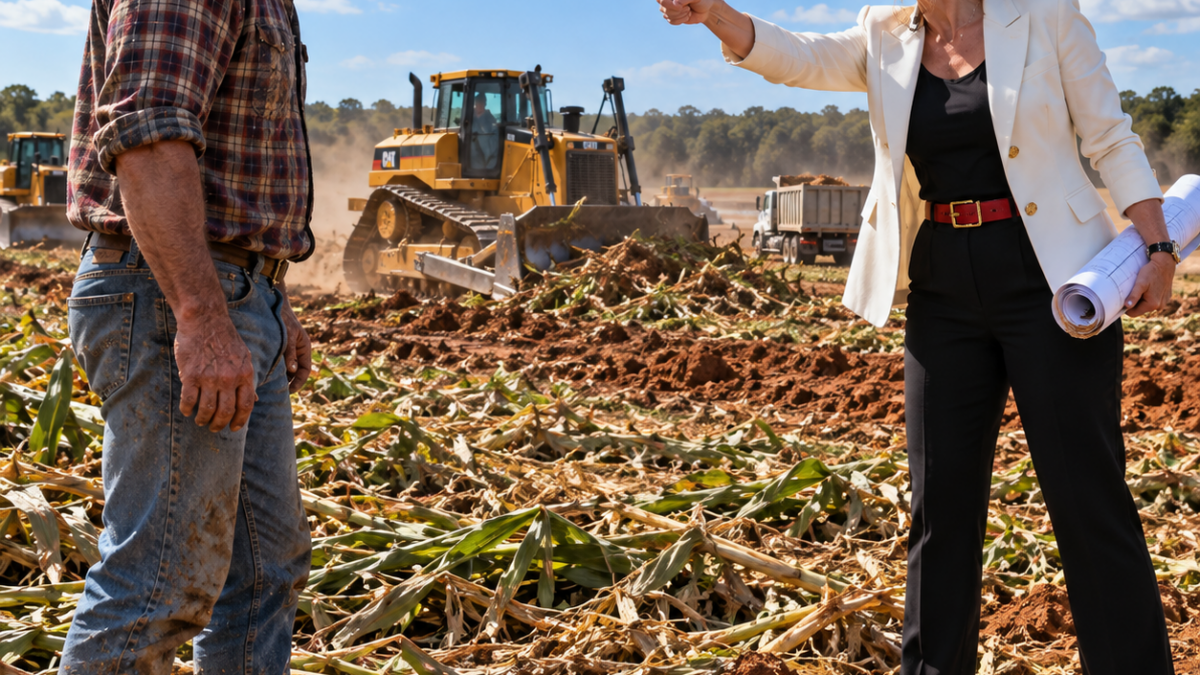
I moved the camera slowly across the field.
Bulldozers.
Workers.
Dump truck.
Grading equipment.
Temporary site trailer.
Steel stakes.
The crushed line where corn became dirt.
Then back to Brenda.
“This is my farm.”
Her lips tightened.
“You’re trespassing on an active work site.”
I nearly laughed.
Instead, I said, “Show me the permit.”
That irritated her.
She unrolled the blueprint with an exaggerated snap, as if paper could become authority if you handled it sharply enough.
“Right here.”
Across the top, in bold lettering, were the words STONEBRIDGE CROSSING — PHASE 3.
Below that: MERIDIAN MALL.
Retail center.
Parking.
Access roads.
Service corridor.
Fifteen-million-dollar projected development.
Meridian Development Group logo in the corner.
Her husband Dale Whitfield’s company.
I looked lower.
County construction permit.
Signed.
Stamped.
Approved.
Then I saw the property map.
My stomach dropped.
The western boundary of Stonebridge Crossing had been moved.
Not a few feet.
Around two hundred feet.
According to the map in Brenda’s hands, thirty acres that had belonged to my family for generations were suddenly inside Stonebridge’s development footprint.
“That survey is false,” I said.
She rolled it closed.
“The county disagrees.”
“My deed doesn’t.”
“The county approved it.”
“Who prepared the survey?”
“You’re getting emotional.”
“Who prepared it?”
She looked toward a site supervisor instead of answering.
“Mr. Callaway, you are interfering with a multimillion-dollar commercial project.”
I pointed at the plywood beneath her shoes.
“You are standing on land my family bought before you were born.”
She smiled.
“Not anymore.”
I called 911.
That irritated her more than anything else.
She walked away while I gave the address to the dispatcher. I could feel the heat rising in my face, but my voice stayed even. That was my father in me. Earl Callaway was not a loud man. When machinery broke, he did not curse at it for twenty minutes. He shut it down, found the problem, fixed the problem, and started again.
So I gave the address.
I gave my name.
I said there was active trespass, destruction of crops, possible fraudulent permitting, and heavy machinery operating on private agricultural land.
The dispatcher paused after that, like she had expected a simpler call.
“Sir, are you in danger?”
I looked at the bulldozers chewing through my field.
“Yes,” I said. “But not the way you mean.”
Twenty minutes later, Deputy Wade Prescott arrived.
He knew me.
Not well.
Enough.
Farm county. People know names, even when they do not know stories.
He stepped from his cruiser, looked across the site, then looked at me.
“Garrett.”
“Wade.”
“What happened?”
“They bulldozed thirty acres.”
He stared at me.
“All today?”
“I was in Knoxville.”
“Who authorized it?”
I pointed toward Brenda.
He walked over.
She immediately called an attorney.
Of course she did.
By the time Wade returned, he looked different. More careful. The kind of careful men get when they realize every word they say may one day be read aloud in a room full of lawyers.
“She declined a formal statement,” he said.
“Did you see the survey?”
“Yes.”
“It’s wrong.”
“I need your recorded deed and prior plat.”
“I have them.”
“Get copies.”
He photographed everything.
Damage.
Permit.
Boundary stakes.
Construction equipment.
My irrigation.
The crop line where the untouched corn still stood like witnesses waiting to testify.
Then Wade pulled me aside.
“Garrett.”
“Yeah?”
“Don’t touch their equipment.”
“They’re on my land.”
“I understand.”
“Do you?”
He lowered his voice.
“Yes. But you’ll do better if you let the paper catch up.”
That turned out to be the right advice.
At the time, I hated it.
Every muscle in my body wanted to climb into one of those bulldozers and throw the keys into the creek. I wanted to stand in front of the blade and make them move me. I wanted Brenda to understand the field was not just dirt and stalks. It was my father’s hands. My grandfather’s back. My son’s Saturdays. My mother’s canning jars. Mortgage payments. Drought years. Flood years. Birthdays missed because harvest came first. Funerals attended in boots because there was no time to change.
But Wade was right.
The paper had to catch up.
So I watched the machines for another hour.
Then I drove home with red clay on my boots and my father’s voice in my head.
Don’t ever let them pave that dirt.
My name is Garrett Callaway.
My family farm sits in Williamson County, about forty minutes south of Nashville. Eighty-five acres of low valley, two ridges, red dirt, morning mist, and rows that look ordinary to people who do not know how to read them.
My grandfather bought the land in 1961.
My father Earl inherited it.
Then me.
Dad taught me dirt before he taught me machinery.
I was nine the first time he handed me a soil sample kit. We were standing in the eastern field, the same field Brenda would later call an eyesore, and he crouched down, scooped red clay into his palm, and smelled it.
I laughed.
“Why are you smelling dirt?”
“Because it talks.”
“Dirt doesn’t talk.”
“It tells you everything.”
“How?”
He held out the clay to me.
“Learn its language.”
At nine, I thought that was one of those mysterious father sayings meant to impress a kid.
It wasn’t.
Moisture.
Texture.
Organic matter.
Smell.
Color.
Compaction.
Drainage.
You learned to read them.
By sixteen, I could tell where we had overworked a section just by digging into it. I could tell which low spots would hold water after three days of rain. I could tell which rows would suffer first in July heat. I could fix a pump, rebuild a small engine, splice irrigation line, and calculate fertilizer needs while my friends were worrying about football practice and prom dates.
I went to college for agricultural engineering.
Then I came home.
There was never a serious question about where I would end up.
Dad got sick three years before the Stonebridge fight reached its worst point.
Cancer.
Fast enough to scare us.
Slow enough to give us time to know what was happening.
That may be worse.
The last conversation I had with him about the farm took place in the hospital. His hand felt small around my wrist. Not weak exactly. Just lighter than it had ever been.
“Garrett.”
“I’m here.”
“Don’t ever let them pave that dirt.”
At the time, I thought it was grief talking.
Developers had been buying land all over Williamson County. Nashville’s growth kept pushing south. Places that had been cattle pastures when I was a kid had become subdivisions with stone entrances, clubhouse pools, and walking trails named after trees that had been cut down to build them.
Dad watched it happen.
“I won’t,” I told him.
“Not for any price.”
“I said I won’t.”
He tightened his grip.
“Promise.”
“I promise.”
That was enough.
He let go.
He died not long afterward.
What he did not tell me was that he had already made good on the promise himself.
My son Tucker was twelve when all this happened. Brown hair, rough hands from irrigation work, and a love for the tractor that bordered on religious devotion.
Every Saturday morning, he walked the rows with me.
Counted ears.
Measured stalks.
Asked too many questions.
Exactly the way I had.
We were doing fine.
Not rich.
Not poor.
Fine.
Then Stonebridge Crossing appeared.
The development began east of us about a decade earlier. Three hundred acres of old farmland became four hundred homes, a clubhouse, a pool, walking trails, a monument sign, beige stucco, three-car garages, and marketing slogans about living beautifully.
Nothing wrong with houses.
People need places to live.
What bothered me was what came after.
Stonebridge’s HOA began acting as though everything visible from a Stonebridge kitchen window belonged to Stonebridge.
Especially my farm.
Brenda Whitfield became the face of that attitude.
The first time I saw her, she drove a white Cadillac Escalade down our dirt road with dust billowing behind her like she had declared war on air itself. She stepped out dressed like she had accidentally taken a wrong turn on the way to a country club.
Cream blazer.
Designer sunglasses.
Red belt.
Hair that refused to move in the wind.
She looked across my corn and said, “This situation can’t continue.”
“What situation?”
“The agricultural activity.”
I actually looked behind me.
“You mean farming?”
“Your tractors. The odor. The visual impact.”
That one made me smile.
“The corn?”
“Residents did not purchase half-million-dollar homes to look at dirt.”
I looked toward Stonebridge.
“They bought next to an eighty-five-acre farm.”
She lowered her glasses.
“Everyone has a price, Mr. Callaway.”
“Not everybody.”
That was the beginning.
A week later, three HOA notices arrived.
Noise.
Odor.
Visual obstruction.
The last alleged my corn was interfering with community sightlines.
My corn.
On land that had never joined Stonebridge.
I scanned everything. Saved originals. Logged dates. Dad had taught me documentation the same way he taught soil.
Keep records completely.
Never rely on memory if paper can remember for you.
Stonebridge had no jurisdiction over my farm.
I wrote that down.
Then did nothing else.
Two weeks later, the formal letter came.
Heavy cream paper.
Gold embossed heading.
STONEBRIDGE LEGAL COUNCIL.
Cease agricultural operations within thirty days.
Environmental hazard.
Community health concerns.
Potential litigation.
The return address was the Stonebridge clubhouse.
The attorney was real. Preston Hargrove. I checked.
But legal stationery does not create jurisdiction.
I sent a response.
Short.
Professional.
Then I started looking into Brenda.
That was when Hank Jessup told me his story.
Hank lived a mile north. Sixty-eight years old, retired farmer, bow-legged, sunburned in every season. He had once owned forty acres.
Stonebridge owned them now.
When I asked why he sold, he got quiet.
“She sent me those letters.”
“What letters?”
“Same kind you’re getting.”
“Noise?”
He nodded.
“Odor?”
“Water quality.”
“Did they find anything?”
“No.”
“Then why sell?”
He rubbed his hands together and looked toward the land that used to be his.
“I got tired.”
That answer scared me more than any legal threat.
“They offered one-ten,” he said.
“For forty acres?”
“Yes.”
“That land was worth four times that.”
“I know.”
“Hank.”
“I know.”
He looked at me then, and I saw shame in a man who had no reason to carry it.
“Don’t be me,” he said.
That was when I began counting.
Brenda had targeted other farms.
At least four.
Three owners sold.
One moved.
Same pattern every time.
Letters.
Complaints.
Low offers.
Pressure.
Public embarrassment.
Regulatory headaches.
I still did not understand why she cared so much about removing farms.
Then came the community health forum.
Protecting Our Families from Agricultural Toxins.
I attended quietly and sat in the back row of the Stonebridge clubhouse while Brenda gave a presentation built on stock photographs, unsourced graphs, emotional language, and numbers with no meaningful citation.
One slide had huge red letters.
YOUR CHILDREN ARE AT RISK.
Underneath was a sad toddler staring out a window.
A woman near the front gasped.
I photographed every page.
Two days later, I sent a certified package to the actual HOA board.
Original 1961 plat.
My property lines.
A letter from University of Tennessee Extension confirming our organic methods and zero synthetic pesticide use.
A polite warning that false public health claims could become a legal issue.
Brenda tore the letter in half.
I learned that from the HOA secretary, a woman named Marlene who called me from her car after work.
“She didn’t read it?” I asked.
“She said she doesn’t read letters from dirt farmers.”
There was a pause.
Then Marlene said, “I’m updating my résumé.”
Smart woman.
Brenda shifted tactics.
County complaints.
Her husband Dale Whitfield had relationships locally.
Golf.
Business.
Development.
What I did not yet know was that Dale was tied directly to Meridian Development Group, and my property was central to their expansion plans.
A county inspector shut down an irrigation upgrade after a groundwater contamination complaint bearing forty-seven Stonebridge signatures.
The pump stopped.
July heat hit.
Corn dried.
I pulled the complaint.
Visited five signatories.
Four denied signing.
A kindergarten teacher named Donna stared at the signature beside her name.
“That isn’t mine,” she said.
“You didn’t sign?”
“I’ve never seen this.”
I asked her to write her name on a piece of paper.
Not similar.
Not close.
Forged signatures on a government filing.
That moved things into criminal territory.
I documented each conversation. Photographed signatures. Made copies. The county eventually lifted the stop order after independent water testing found our creek and well samples clean.
Pristine, according to the lab.
The irrigation restarted barely in time.
Outer rows yellowed.
Some damage.
But the crop survived.
I thought Brenda might stop.
She didn’t.
Later, discovery revealed a call between her and Dale.
“Fine,” she said. “We’ll do this the expensive way.”
At the time, I didn’t know what expensive meant.
Soon I did.
I went to Knoxville for an agricultural engineering conference.
Three days.
Soil conservation.
Drone crop monitoring.
Irrigation technology.
Tucker stayed with Hank.
I was sitting in a session about precision water management when my phone vibrated.
Tucker.
I stepped into the hallway and answered.
“Dad.”
The tone got me out of the building before he finished the next sentence.
“What happened?”
“There are machines in the field.”
“What machines?”
“Really big.”
My chest tightened.
“Where?”
“East side.”
“Is Hank there?”
“Yes.”
“And there’s a lady.”
“Brenda?”
“I think so.”
I was already running toward the parking lot.
“Stay away from the machines.”
“But Dad—”
“Listen to me. Stay with Hank.”
Silence.
“Okay.”
Knoxville to Williamson County should have been around three hours.
I made it in two and a half.
Then came the field.
Then Brenda.
Then the fraudulent survey.
Then the 911 call.
Then Dad’s workshop.
I walked into it late that night after Tucker finally fell asleep.
The smell hit first.
Oil.
Wood dust.
Old steel.
The room still felt like him.
His filing cabinet sat behind the bench. Olive green. Dented. Heavy enough that two men had cursed moving it into place twenty years earlier.
A label on the second drawer was written in Dad’s blocky handwriting.
LAND DOCS — DO NOT THROW AWAY.
I had seen that label a hundred times.
Never opened it.
The deed was with our attorney.
Tax paperwork was elsewhere.
I assumed the cabinet held old receipts, obsolete maps, equipment manuals, maybe crop records from years before I was born.
I pulled the drawer.
Manila folders filled it from front to back. Years written neatly across the tabs. Every folder in Dad’s handwriting.
I found 2008.
Opened it.
USDA.
Natural Resources Conservation Service.
The document title made me sit down on the concrete floor.
Agricultural Conservation Easement.
Recorded deed of easement.
Earl Callaway.
All eighty-five acres.
Permanent.
October 2008.
I read the restrictions once.
Then again.
No commercial development.
No industrial development.
No residential subdivision.
Agricultural use in perpetuity.
Recorded with Williamson County.
Recorded federally.
Runs with the land.
Mandatory restoration for violations.
Additional damages for willful violations.
I sat on the workshop floor holding the document in both hands.
Dad never told me.
Not once.
Not when he signed it.
Not when I came home from college.
Not when he got sick.
Not even in that hospital room when he made me promise.
He simply said, Don’t ever let them pave that dirt.
The old man had made sure they couldn’t.
I started laughing.
Not loudly.
A tired, disbelieving laugh that came from somewhere deep and cracked.
Then I cried.
It was the first time since the funeral that thinking about Dad felt good.
He had known development was coming. He had seen the subdivisions, the survey flags, the men in polos standing at fence lines and calling farmland “underutilized.” He had listened to offers. He had watched neighbors sell under pressure. He had understood, long before I did, that saying no was not enough if the other side had money, lawyers, and patience.
He had not left me just an instruction.
He had left me protection.
I checked county records online.
There it was.
Book.
Page.
Instrument number.
Public.
Permanent.
Recorded.
Meridian’s new survey had omitted it entirely.
That was no innocent oversight.
The easement affected the entire property. Any title review worth the paper it was printed on should have found it. Any honest development application should have disclosed it. Any county review should have caught it.
And yet bulldozers had already destroyed protected agricultural land.
I checked Meridian’s public development filings.
Site preparation budget.
Millions.
Four-point-two million already committed to work connected with Phase 3.
And they were still building.
I woke Tucker.
“Come to the shop.”
He arrived in pajama pants and an old farm T-shirt, hair sticking up on one side.
“Am I in trouble?”
“No.”
I handed him the easement.
He read slowly. Legal words are hard at twelve.
Finally, he looked up.
“So Grandpa saved the farm?”
I smiled.
“Yeah.”
“How?”
“He made it so nobody can legally develop it.”
“Ever?”
“Ever.”
Tucker looked toward the dark field.
“So they have to leave?”
“Yes.”
“And fix it?”
I read the clauses again.
“They’re going to fix a lot more than they understand.”
The next morning, I drove to Franklin.
Attorney Klay Thornton had an office over a barber shop. Land use. Conservation easements. Property disputes. Thin man. Dry face. Not much wasted expression.
I placed Dad’s document on his desk.
He read it.
Then read it again.
Then he leaned back and looked at me.
“How much have they spent?”
“About four-point-two million.”
“And construction continues?”
“Yes.”
For the first time, I saw him almost smile.
“Mr. Callaway.”
“Garrett.”
“Garrett.” He tapped the easement. “They have a serious problem.”
“How serious?”
“Every dollar they spend after actual notice gets harder to explain.”
I leaned forward.
“Can we stop construction?”
“Yes.”
“Today?”
“We can seek that.”
“Then do it.”
He held up a hand.
“We also preserve the damages claim.”
“Meaning?”
“If they destroyed protected agricultural land, they’ll face restoration obligations, crop losses, infrastructure damage, legal exposure, and potentially enhanced damages depending on findings and intent.”
I thought about Brenda’s words.
Fifteen million dollars.
I thought about her standing on plywood over my father’s dirt.
“How much?” I asked.
“Too early.”
“Klay.”
He shook his head.
“Do not fall in love with a number before we build the case.”
Fair.
We started with three tracks.
Civil claim.
USDA and NRCS enforcement.
Criminal referral around the survey.
Then documentation.
I installed trail cameras.
Four obvious.
Two hidden backups later.
I programmed my drone for timestamped survey flights every forty-eight hours. Same route. Same altitude. Same photos.
Construction progress.
Concrete.
Grading.
Steel.
Parking surfaces.
Utility work.
Every new scar.
I preserved everything.
Original plat.
Forgery evidence from the water complaint.
HOA notices.
Brenda’s public health presentation.
County stop-work order from the irrigation complaint.
Lab reports.
The easement.
Photos.
Video from bulldozing day.
Copies went to me, Klay, and Hank.
Then Klay sent the preservation notice.
Clear.
Professional.
The site was protected by permanent federal agricultural conservation easement.
Further construction risked additional liability.
Stop work.
Preserve records.
Do not destroy documents.
Dale received it.
And told Brenda they needed to stop.
We learned that later.
She refused.
According to deposition testimony, she was at a spa when Dale called. She did not even open her eyes.
“We’ve already spent four million,” she said.
Dale told her continuing was dangerous.
Her response was simple.
“Keep building.”
That decision probably cost them more than anything else.
The number kept climbing.
Four-point-two million.
Four-point-five.
Five.
More.
Brenda responded with a nuisance lawsuit.
Farm harming property values.
Air quality.
Children.
Twelve pages.
No mention that her husband was building a mall over my crops.
Then came the buyout.
A man in an expensive suit arrived at my kitchen table with a cashier’s check for two hundred thousand dollars.
Tucker was baking cornbread.
The check looked absurd against the old oak wood.
“Very generous,” the man said.
“No.”
“Mr. Callaway, people in your position don’t often see liquidity like this.”
I looked at him.
“My position?”
He realized too late how that sounded.
“This is an extraordinary offer.”
“For eighty-five acres?”
“Yes.”
“The land alone is worth millions.”
“The easement affects marketability.”
I smiled.
“Good.”
He frowned.
“Good?”
“Means you don’t need it.”
I pushed the check back.
“You’re making a mistake,” he said.
“The only mistake happened when your people started bulldozing.”
He left.
Tucker watched the door close.
“Dad?”
“Yeah?”
“Was that really two hundred thousand dollars?”
“Yes.”
“That’s a lot.”
“It is.”
“Why not take it?”
“Because they’re not buying corn.”
He waited.
“They’re buying control of the land.”
“And Grandpa said no.”
“Exactly.”
Brenda then attacked the agricultural tax exemption.
If successful, my annual property taxes could have risen from around four thousand to roughly thirty-two.
That wasn’t a policy dispute.
That was financial pressure designed to make holding the farm harder.
Three HOA board members signed the petition.
Two were Meridian employees.
Klay nearly smiled again when he found that.
“Conflict doesn’t get cleaner than this.”
He filed.
The nuisance case moved toward dismissal.
State governance complaints followed.
Then Brenda tried to annex my farm into Stonebridge’s HOA boundary.
Emergency meeting.
Needed two-thirds.
I attended.
Back row.
Said nothing.
She gave twenty minutes about community vision, responsible growth, property values, incompatible land use, and the need for Stonebridge to “protect its borders.”
She never said Meridian Development Group.
Never said my husband.
Never said mall.
The vote came back fifty-eight percent.
Not enough.
She needed sixty-seven.
For the first time, I watched Brenda lose something publicly.
Her jaw tightened.
She thanked everyone.
Packed her materials.
Outside, she found me beside my truck.
“You think this is over?”
“No.”
That answer surprised her.
She stepped closer.
“I’ll bury you in that cornfield.”
I stayed quiet.
“No bank in this county will touch you.”
Nothing.
“No store will buy your crop.”
I opened my truck door.
“You’ll be a joke.”
I got inside.
Seat belt.
Started the engine.
She hated the silence more than any argument.
I drove away.
Construction accelerated.
By October, Meridian had sunk around $8.7 million into the site.
Foundations.
Steel framing.
Parking surfaces.
Utility work.
From my porch, the mall skeleton rose where Dad’s corn had stood.
Every forty-eight hours, the drone documented it.
Klay’s damages spreadsheet grew.
Then Dale made a mistake so reckless even Brenda couldn’t spin it.
Waffle House.
County surveyor Ronnie Skaggs.
Twenty-five thousand dollars in cash.
Dale wanted him to move my property boundary officially two hundred feet west.
Make the fraudulent map become reality.
Ronnie left the envelope.
Left the coffee.
Went straight to the district attorney.
When he told me later, I asked, “Did he actually say move the line?”
“Plain English.”
“And gave you twenty-five?”
“In an envelope.”
“What did you say?”
“Nothing.”
“You just left?”
“Best thing I’ve done in a restaurant.”
Three nights later, someone attacked my cameras.
Two in the morning.
Crowbar.
Three visible trail cameras smashed.
One thrown into drainage.
What the man didn’t know was that I had installed backups.
One inside an old bluebird nesting box.
One inside a utility junction enclosure.
Both caught his face.
HOA board member.
Meridian employee.
Same man tied to several votes against the farm.
I sent everything to Deputy Prescott.
He watched the footage, then sighed.
“These people really don’t learn.”
“No.”
USDA NRCS investigators arrived soon after.
Three-person team.
Two days.
Soil disturbance.
Core samples.
Photos.
Foreman interviews.
Construction footprint.
Documentation.
Their preliminary conclusion was exactly what Dad’s paper said.
Violation.
Clear.
Federal.
Protected land had been commercially developed.
Klay updated damages.
Construction costs.
Crop losses.
Irrigation destruction.
Restoration.
Enhanced damages exposure.
Insurance issues.
Everything getting worse.
Brenda was subpoenaed at a nail salon.
I wasn’t there, but everyone in Williamson County heard the story within forty-eight hours. The process server approached while she had one hand under a UV curing lamp.
She reportedly asked, “Do you know who I am?”
His answer became local legend.
“Federal court doesn’t care about your manicure.”
I didn’t celebrate.
That night, I cooked spaghetti for Tucker. We talked about his science project. Baking soda volcano. Some nights, being a father was the only thing that kept the case from swallowing the farm entirely.
Then Klay called.
“Tuesday.”
“What Tuesday?”
“County Board special session.”
“Why?”
“Everything is ready.”
“What do I bring?”
“Tucker.”
The Williamson County meeting room held eighty.
Around one hundred forty arrived.
People stood in the hallway.
Doors propped open.
Burned coffee smell.
Fluorescent lights.
Local reporters.
Stonebridge residents.
Farmers.
County officials who suddenly found their shoes interesting.
Brenda entered late in a red blazer, cream blouse, Chanel bag, and perfect hair.
Dale sat behind her looking like a man who had recently discovered federal sentencing calculators online.
Klay walked to the podium.
No theatrics.
No raised voice.
First exhibit: 1961 plat.
Second exhibit: Meridian’s new survey.
The two property lines were projected side by side.
Two hundred feet of land disappeared between them.
Murmurs moved through the room.
Then Dad’s easement.
USDA.
Recorded.
Permanent agricultural use.
Klay read the operative language.
No commercial development.
No industrial development.
No residential subdivision.
In perpetuity.
The room went quiet.
Third exhibit: construction permits.
Easement omitted.
Fourth: drone time-lapse.
Thirty acres of corn.
Then bare soil.
Then grading.
Then concrete.
Then steel.
Then parking surfaces.
Twelve weeks of destruction reduced to ninety seconds.
I hated watching it.
Tucker sat beside me.
His hand tightened around mine.
Fifth exhibit: camera footage.
The HOA board member smashing evidence.
People turned toward the man’s empty chair.
Sixth exhibit: Brenda’s own email.
Three weeks before bulldozers.
Klay read it slowly.
“Just build it.”
Pause.
“The farmer won’t fight.”
Pause.
“They never do.”
No one moved.
That sentence hurt more than the insults.
Not because she was talking about me.
Because she was talking about Hank.
Glenn.
Dwight.
The families who had folded because they were exhausted.
Farmers she had learned to view as predictable.
Pressure them.
Threaten them.
Wait.
They give up.
She had built a business strategy around fatigue.
Klay stepped away.
Then Colleen Burke from NRCS took the microphone.
Federal career employee.
Twenty-two years.
No decoration in her voice.
“The Callaway easement is valid.”
Pause.
“Recorded.”
Pause.
“Federally protected.”
She looked toward county officials.
“Commercial development on the protected acreage is prohibited. Our findings have been forwarded for federal review and enforcement.”
The county attorney looked ill.
Then he announced immediate revocation of development permits for Phase 3.
Construction would cease the next morning.
That should have been the big moment.
It wasn’t.
Klay came back to the podium.
He opened a folder.
“My client’s present civil damages claim stands at approximately fifteen-point-two million dollars.”
Someone gasped.
Brenda looked at him.
Klay continued.
“Construction expenditures on protected land. Crop and infrastructure losses. Restoration. Associated claims.”
He paused.
Then said the line that would later become the headline.
“They did not build Mr. Callaway a mall.”
He looked toward Meridian’s attorneys.
“They built him a damages claim.”
The room erupted in whispering.
Not cheering.
Shock.
Dale stood.
Klay turned his head.
“Mr. Whitfield.”
Dale froze.
“I strongly recommend you consult criminal counsel before addressing the board.”
Dale sat.
Brenda opened her mouth.
For once, nothing came out.
The remaining HOA board members asked for an emergency vote.
Removal of Brenda Whitfield as president.
Unanimous.
She gathered her bag and walked toward the doors.
Outside, one heel caught a crack in the pavement.
It snapped.
She stumbled.
A newspaper photographer captured it.
The next morning, the headline read:
HOA PRESIDENT REMOVED AFTER $15 MILLION FARM DEVELOPMENT FRAUD EXPOSED.
I was at the far end of the parking lot with Tucker when that photograph was taken.
We didn’t laugh.
Didn’t celebrate.
My corn was still gone.
The field still looked wounded.
That is the part people forget.
Money does not make destroyed land instantly whole.
Victory does not reconstruct roots.
My father had planted those rows.
Tucker had counted ears.
Now there was concrete.
That does not vanish because your lawyer says fifteen million dollars.
I put my hand on Tucker’s shoulder.
He asked, “Did we win?”
“Not yet.”
“Then what happened?”
“They finally stopped digging.”
Four months later, the settlement arrived.
Fourteen-point-eight million dollars.
Even saying the number felt unreal.
Meridian was facing too much risk.
Civil claims.
Federal conservation enforcement.
Restoration.
The survey issue.
The bribery case.
Investor panic.
Insurance complications.
Bad press.
Settlement became rational.
I signed only after Klay confirmed restoration requirements were enforceable.
That mattered more than the money.
Dale was indicted separately.
Bribery of a public official.
Conspiracy tied to the land-protection matter.
Falsification issues.
His case eventually resolved through a plea.
Eighteen months in federal custody.
Permanent bar from real estate development work in Tennessee.
Brenda faced civil action from Stonebridge residents. Hundreds of them. They discovered their HOA dues had financed legal pressure that directly benefited the Whitfields’ private development interests.
That fight belonged to them.
Mine was the soil.
Restoration started in rain.
Soft morning.
Different crew.
Legitimate contractors.
Four thousand cubic yards of clean topsoil.
New drainage.
New irrigation.
The first dump truck tipped soil onto the scarred field.
I stood under a rain jacket.
Tucker beside me.
The smell was incredible.
Wet soil.
Clean.
Heavy.
Alive.
For months that field had smelled like diesel, concrete, crushed plants, construction dust.
Now it smelled like farming again.
That was the first time the settlement felt real.
Not when the transfer cleared.
Not when the papers were signed.
When dirt went back onto dirt.
I used the money carefully.
Restored all eighty-five acres.
Improved irrigation.
Cover crop rotation.
Soil rebuilding.
Drainage.
Equipment.
Then I created the Callaway Agricultural Heritage Trust.
Legal assistance.
Financial support.
Family farmers facing development pressure.
HOA intimidation.
Forced buyouts.
Klay agreed to help pro bono.
Hank Jessup joined the advisory board.
So did Glenn Tate.
Dwight Sumner.
Men who understood what pressure did.
One afternoon, Hank came to the farm while the restoration crew was still working. He stood at the field edge with his cap in his hand.
“You really made a fund?”
“Yes.”
“For farmers?”
“Yes.”
He stared across the soil.
Then looked down.
“If somebody had that when Brenda came after me…”
He stopped.
“I know,” I said.
“No.”
He shook his head.
“You don’t.”
I stayed quiet.
“I would’ve kept my place.”
His voice cracked.
That time, I did know.
He wiped his face with one hand.
“Don’t let anybody else sell because they’re tired.”
“That is exactly the point.”
The trust restored something I had not expected.
Not land.
Dignity.
Hank had spent years thinking he had been weak because he sold.
I told him, “You were targeted.”
He said, “Same thing.”
“No.”
“Feels like it.”
Eventually, the trust helped him see the difference.
He started telling younger farmers, “Ask for help before you’re tired.”
That might be the best line to come out of all of it.
Pressure works by isolation.
Developers know that.
HOAs know it.
Banks know it.
People get overwhelmed.
Letters stack.
Inspections.
Fines.
Legal costs.
Eventually selling feels like relief.
The trust’s job was to make sure relief had another form.
Lawyer.
Surveyor.
Temporary loan.
Expert.
Someone standing beside you.
Brenda’s model depended on every farmer thinking he stood alone.
Ours broke that model.
Then came the Earl Callaway Memorial Scholarship.
Full agricultural science scholarship for one Williamson County senior each year.
Dad never went to college. He always pretended that did not bother him.
I knew better.
He had wanted education for me.
Now his name would pay for somebody else’s.
When I told Mom’s old church group about it, one woman cried and said Dad would have hated a scholarship named after him.
Probably true.
He also would have secretly kept every thank-you letter.
Stonebridge changed too.
New HOA board.
Financial records published.
Agricultural-targeting resolutions rescinded.
They planted native Tennessee wildflowers along our shared boundary.
Not a privacy wall.
Not a compliance buffer.
Wildflowers.
A gesture.
I appreciated that.
One of the new board members came to the farm before planting.
“Garrett.”
“Yes?”
“We want your input.”
“On flowers?”
“On location.”
That word mattered.
Input.
They asked.
We walked the line together.
Simple.
No lawyers.
No cream stationery.
No threats.
We picked a strip that would not interfere with farm access.
Done in thirty minutes.
That is how the entire relationship could have worked from the beginning.
The new Stonebridge board invited me to speak once.
I almost declined.
Then went.
Same clubhouse where Brenda had once warned parents that my farm was poisoning their children.
They asked me what rule changes mattered.
I said, “Conflict disclosures.”
They wrote it down.
“Independent counsel.”
More notes.
“No HOA action against property outside your recorded jurisdiction.”
Someone laughed nervously.
I didn’t.
“Recorded votes. Member access to contracts. Competitive bids. Document retention.”
A board member asked, “What about relationships with neighboring farms?”
I thought about it.
“Ask before assuming.”
Simple.
They adopted most of it.
Not because I’m brilliant.
Because after fifteen million dollars of consequences, obvious things become easier to see.
One resident raised his hand.
“Mr. Callaway.”
“Garrett.”
“Do you hate Stonebridge?”
“No.”
He looked surprised.
“Why not?”
“Houses aren’t people,” I said. “Boards aren’t permanent. Neighbors are whoever is there tomorrow.”
That was Dad talking through me.
Maybe.
Or age.
Same thing sometimes.
The wildflower strip along the boundary bloomed the following spring.
Purple coneflower.
Black-eyed Susan.
Bee balm.
Tucker complained that bees made fence work annoying.
Then he started photographing monarch butterflies.
I did not tease him.
Much.
One evening, we stood at the edge of the field.
Stonebridge houses beyond the flowers.
Corn on our side.
A little girl from the subdivision waved.
Tucker waved back.
No wall.
No battle.
Boundary.
Respect.
That was enough.
The old Meridian site infrastructure was removed in stages.
Concrete broken.
Steel hauled.
Subgrade repaired.
It was expensive.
Watching demolition was strange.
For months, bulldozers had represented loss.
Now machines were repairing.
Same type of equipment.
Different authority.
Different purpose.
One operator stopped and asked, “You the owner?”
“Yes.”
“Hell of a mess.”
“Yes.”
He looked toward a foundation slab.
“They really thought this was staying?”
“Yes.”
He shook his head.
“Title guys asleep?”
“Something like that.”
He climbed back into the cab and crushed another piece of illegal concrete.
I stood there until sunset.
The last big foundation section came out weeks later.
Tucker skipped school half a day to watch.
I wrote the excuse.
Family agricultural restoration.
Technically true.
When the excavator lifted the final concrete chunk, Tucker cheered.
I did too.
That was the closest I came to celebrating.
Not Brenda losing office.
Not Dale’s plea.
Not the settlement.
Concrete leaving.
The first season we harvested corn again from that ground, I saved one ear.
Dried it.
Put it in Dad’s workshop beside the bent irrigation pipe and the easement folder.
Tucker noticed.
“Now the shelf is weird.”
“History.”
“It looks like trash and corn.”
“History usually does.”
Years from now, when he owns the farm, maybe he will clean the shelf and throw both away.
I hope not.
But it is his choice.
The easement won’t be.
Dad took that choice from all of us.
And I am grateful.
There is something comforting about one question already answered forever.
No mall.
No industrial park.
No subdivision.
Food.
Soil.
Rain.
Sun.
Whatever agriculture looks like fifty years from now.
That is what belongs there.
The first full corn season after restoration was not our best.
Soil takes time.
Some compacted areas needed work.
Organic structure had been disrupted.
Drainage behaved differently.
Yield was uneven.
Tucker was disappointed.
“I thought it was fixed.”
I handed him a soil probe.
“Fixed doesn’t mean finished.”
He looked annoyed.
“That’s one of your sayings.”
“It’s agriculture.”
We took samples.
Adjusted cover rotation.
Added organic matter.
Second season was better.
Third better again.
By then the scars were harder to see.
That is another thing people get wrong about settlements.
Money can pay for restoration.
It cannot replace time.
Time is part of land.
You can bring topsoil.
Install drainage.
Seed cover crops.
But biology works on its own schedule.
Dad understood that.
That is why the easement said perpetuity.
Not ten years.
Not twenty.
Forever.
Farm thinking.
Long time horizons.
Developers think in project cycles.
Quarterly numbers.
Construction milestones.
Opening dates.
Dad thought in generations.
That difference beat them.
A few years later, the Callaway Agricultural Heritage Trust handled its first major case.
Older couple.
Forty-two acres.
Developer claimed an access agreement allowed a road expansion.
It didn’t.
They were scared.
Legal fees.
Letters.
Deadlines.
The trust paid for counsel, survey, title work.
They kept their land.
The husband came to see me afterward. He took off his cap and held it in both hands.
“Garrett.”
“Yes?”
“We would’ve sold.”
I knew exactly what he meant.
“Don’t thank me.”
“I am.”
“Thank Hank.”
“Hank?”
“He’s why the fund exists.”
Hank cried when I told him.
Pretended he had dust in his eye.
We were inside.
No dust.
The scholarship grew too.
First recipient studied agronomy.
Second veterinary science.
Third agricultural economics.
Every year we invited the recipient to the farm.
Tucker helped show them around.
One asked why the scholarship existed.
I pointed toward the restored field.
“Because somebody tried to build a mall there.”
They laughed.
Then realized I wasn’t joking.
The story became local history.
Not famous.
Local.
That suited me.
Williamson County people would sometimes drive by and point.
“That’s the fifteen-million-dollar cornfield.”
I hated that name at first.
Then stopped caring.
It was still corn.
That was what mattered.
One afternoon, Donna—the kindergarten teacher whose name had been forged on the groundwater complaint—walked down our drive carrying a peach pie.
People in Tennessee solve complicated civic emotions with baked goods.
She looked embarrassed.
“I should’ve noticed sooner.”
“Not your job.”
“My name was on that petition.”
“Without your permission.”
“I still feel…”
“Don’t.”
She looked toward the farm.
“My husband and I voted for Brenda twice.”
I shrugged.
“You voted based on what you knew.”
“We should’ve known more.”
“Now you do.”
She nodded.
Then held up the pie.
“Peach.”
“That helps.”
We ate some on the porch and talked about everything except the lawsuit.
That is how communities heal.
Not through one giant symbolic moment.
Small normal interactions.
Stonebridge children started riding bikes near the farm boundary.
Wildflowers grew.
Residents bought produce at our roadside stand.
One family asked whether Tucker could show their son the tractor.
He did.
No resentment.
Dad’s phrase came back to me often.
Dirt tells you everything.
So do people, eventually.
Brenda believed my farm was backward.
Dirty.
Poor use of land.
An obstacle.
Her $15 million mall was supposed to represent progress.
But after everything, the mall never opened.
The farm still produces.
That is an interesting definition of progress.
One leaves concrete that has to be removed.
The other leaves corn.
Soybeans.
Cover crops.
Soil getting better.
I know which one Dad would have chosen.
A reporter asked me once whether the settlement made me rich.
I said, “The farm made me rich.”
She smiled like I was being poetic.
I wasn’t.
Money is useful.
Land that carries five generations of memory is something else.
Being able to walk the same field where Dad taught me soil pH?
Useful in a way money cannot imitate.
Watching Tucker kneel beside new corn?
Same.
The settlement protected options.
The easement protected meaning.
Different things.
One October evening, years after the bulldozers, I walked the eastern thirty acres alone.
Harvest was nearly finished.
Sunset orange.
Air cool.
Stubble under boots.
If you knew where to look, you could still see subtle changes where construction had compacted the soil.
Not obvious.
I saw them.
Farmers notice.
I stopped where Brenda had stood on plywood.
There was no marker.
No plaque.
Nothing dramatic.
Just field.
I tried to remember her exact words.
Your father is dead.
His pathetic cornfield got scraped off the earth.
At one time, those words felt enormous.
Now they felt small.
Dad was dead.
She was right about that.
But his decision still governed the land.
His signature still carried legal force.
His promise still shaped Tucker’s future.
Death did not make him irrelevant.
If anything, it revealed how far ahead he had thought.
I knelt.
Picked up a handful of red soil.
Smelled it.
Tucker happened to drive up in the utility vehicle.
He laughed.
“You’re doing the Grandpa thing.”
“What Grandpa thing?”
“Smelling dirt.”
I stood.
“He was right.”
“About what?”
“It tells you everything.”
Tucker parked, got out, scooped some soil, and smelled it dramatically.
“Yep.”
“What?”
“Dirt.”
I shook my head.
Teenager.
He smiled.
Then asked, “What does it tell you?”
I looked across the field.
“That we’re still here.”
That answer satisfied both of us.
The story people like is that every dollar Meridian spent became my settlement check.
It is a strong line.
And in a broad sense, their recklessness did exactly that. The more they invested after being warned, the larger and uglier their exposure became.
But the real victory was not converting construction invoices into money.
The real victory was forcing the land back to its intended use.
If they had handed me fourteen-point-eight million and kept the mall, I would have considered that a loss.
Dad’s instruction was not get paid if they pave it.
It was don’t let them pave it.
That is why I cared about restoration clauses.
That is why Klay wrote them carefully.
The money mattered because rebuilding costs money.
The land mattered more.
At one point during negotiations, Meridian floated an alternative.
Larger cash payment.
Partial development rights.
Smaller protected acreage.
Klay brought it to me because legally he had to.
“How much?” I asked.
He told me.
More than the eventual settlement.
“Answer is no.”
“You haven’t heard the full structure.”
“No.”
“Garrett.”
“My father put eighty-five acres under easement.”
“Yes.”
“Not fifty-five.”
“Yes.”
“Then no.”
Klay looked at me.
“You’re sure?”
“I promised.”
He nodded.
“Then we’re done with that proposal.”
People think money solves conviction.
Sometimes money clarifies it.
When the number got bigger and I still didn’t want the mall, I finally understood Dad’s words the way he meant them.
Not for any price.
Tucker eventually asked what would happen when I died.
He was fourteen then. We were fixing an irrigation controller.
“Does the easement stay?”
“Yes.”
“Even if you leave me the farm?”
“Yes.”
“What if I want to sell?”
“You can.”
“To anybody?”
“Within the legal terms.”
“They still can’t build a mall?”
“No.”
“What if somebody offers me fifty million?”
I looked at him.
“Still no mall.”
“That’s kind of crazy.”
“Your grandfather liked permanent answers.”
He considered that.
“Do you?”
“More every year.”
He nodded, then went back to wiring.
I never told him he had to farm.
That matters.
Dad never forced me.
The conservation easement protects the land use.
It does not dictate Tucker’s entire life.
Maybe he will farm.
Maybe he will study engineering.
Maybe something else.
The land stays land.
That is enough.
The settlement money changed our financial situation.
Obviously.
I won’t pretend fourteen-point-eight million dollars does not alter a family’s options.
But I refused to let it change the farm into something Dad would not recognize.
No mansion.
No ridiculous truck.
No private plane.
I did replace one tractor.
The old one deserved retirement.
Tucker argued for a much more expensive model.
I said no.
He said, “We’re multimillionaires.”
I said, “We’re farmers with a settlement.”
He rolled his eyes.
Sad to report money did not improve his negotiating skills.
I paid taxes.
Funded the trust.
Funded the scholarship.
Restored the land.
Built a farm reserve.
Invested in long-term soil work.
Set aside legal contingency money.
Helped Mom’s old church replace a leaking roof anonymously.
Klay knew.
Nobody else did for a while.
Hank eventually guessed.
“You did that roof.”
“No.”
“Liar.”
“Prove it.”
He smiled.
I liked having enough money to solve useful problems quietly.
That felt like something Dad would understand.
Brenda’s life moved in another direction.
Civil litigation.
Household financial pressure.
Stonebridge residents furious.
She stopped being the center of local events.
Good.
I did not need her destroyed.
I needed her away from my farm.
People asked whether I wanted an apology.
No.
An apology would have been interesting.
Not necessary.
Restoration order was better.
Deed enforcement was better.
A new HOA board respecting boundaries was better.
Sometimes consequences communicate more clearly than apologies.
Dale’s case ended.
His development career ended with it.
The county tightened parts of its review process afterward. Recorded conservation restrictions received additional cross-checking during permitting. Survey review improved.
That mattered.
Because systems should learn too.
It would be easy to tell the story as one evil HOA president against one stubborn farmer.
That misses half the problem.
Brenda needed systems willing to accept paperwork without checking deeply enough.
A forged petition.
A boundary map.
A development permit.
Board conflicts.
Those things passed through people and offices.
Some failed.
Some corrected.
Ronnie Skaggs did the right thing immediately when the bribe appeared.
Deputy Prescott documented.
NRCS acted.
County eventually revoked.
Klay built the case.
No single hero.
No single villain.
Just choices.
Still, I will never forget that afternoon in the field.
Brenda on plywood.
Latte.
Blueprint.
You should be thanking me.
When restoration finished, I kept one thing from the destroyed site.
A small piece of bent irrigation pipe.
Bulldozer crushed it.
I cut a twelve-inch section, cleaned it, and put it on the shelf in Dad’s workshop beside the easement folder.
Tucker asked, “Why keep trash?”
“Reminder.”
“Of Brenda?”
“No.”
“Then what?”
“That paper and dirt can both look weak until somebody tests them.”
He gave me the expression teenagers reserve for fathers saying things that are trying too hard to be meaningful.
I deserved it.
Still true.
The Callaway trust eventually created a document clinic.
Once a year, farm families bring deeds, easements, old surveys, boxes of old records, and anything that looks official but nobody has opened in decades. Law students and attorneys help organize. Surveyors volunteer. Klay supervises with the expression of a man who regrets agreeing to be useful.
One farmer brought a box of papers in a feed sack.
Another carried a metal cookie tin.
A widow had everything in her late husband’s desk drawer.
Exactly the kind of hidden paperwork Dad kept.
We found old rights-of-way.
Conservation restrictions.
Mineral reservations.
Boundary agreements.
Not every document was useful.
But every family left knowing more than when they arrived.
I called the program Earl’s Drawer.
Klay hated the name.
I loved it.
“Sounds like furniture,” he said.
“Good.”
“It needs something professional.”
“No.”
“Callaway Land Records Initiative.”
“Absolutely not.”
We settled on Earl’s Drawer as the unofficial name.
The first year, seventy-three families came.
Dad would have hated the attention.
He also would have spent all day helping people sort paper.
Tucker went to college eventually.
Agricultural engineering.
I pretended not to influence him.
He pretended not to notice.
Before leaving, he walked the restored field alone. I saw him from the porch. Same route we took when he was twelve. He came back with red dirt on his boots.
“You good?” I asked.
“Yes.”
“You don’t have to come back here after school.”
“I know.”
“I mean it.”
He looked at me.
“Dad.”
“What?”
“You came back.”
“That doesn’t mean you have to.”
“I know.”
Then he smiled.
“But I probably will.”
That was enough.
I did not tell him Dad would have been happy.
He knew.
The first fall after Tucker left for school, the farm felt quieter.
I walked the eastern rows alone.
Corn rustled.
Wind moved through the stalks.
Field breathing.
The sound I had missed after the bulldozers.
I stopped and closed my eyes.
For a second, I was nine again.
Dad beside me.
Soil in his hand.
Learn its language.
I understood something new then.
Land speaks in consequences too.
Treat it well, and it can feed families for generations.
Treat it like blank space on a development map, and eventually reality reminds you that paper lines, water, soil, history, and law all exist whether you respect them or not.
Meridian thought our farm was an obstacle.
Brenda thought it was ugly.
Dad thought it was permanent.
He was the only one who understood what he was looking at.
The $14.8 million is real.
The settlement papers sit in a safe.
The trust reports its grants.
The scholarship sends tuition.
All of that matters.
But none of it is what I see first when I look east.
I see corn.
That is the victory.
I see Tucker’s footprints between rows.
I see irrigation running.
I see wildflowers along the boundary.
I see no mall.
No parking lot.
No steel frame.
No giant sign announcing retail opening soon.
Just field.
My father did not need to see the court filings.
He already knew the ending he wanted.
Don’t ever let them pave this dirt.
They tried.
For twelve weeks, they spent millions pretending concrete could turn a lie into ownership.
They moved a line on a survey.
They erased an easement from an application.
They destroyed crops.
They pressured officials.
They kept spending after written warning.
Every truckload of material was supposed to make their project harder to reverse.
Instead, it made the cost of reversing it larger.
That is what Brenda never understood.
Money cannot cure bad title.
Concrete cannot erase a recorded easement.
A mall does not become legal because it is expensive.
And somebody else’s land does not become yours just because your blueprint says it should.
Last spring, I opened Dad’s old filing cabinet again.
The easement folder is still there.
I replaced the yellowing manila folder with an archival sleeve.
Kept Dad’s handwritten label.
Inside is the original copy.
I ran my thumb over his signature.
Earl Callaway.
Simple.
No fancy flourish.
A farmer’s signature.
That signature outlasted Brenda’s presidency.
Outlasted Meridian’s Phase 3.
Outlasted the fraudulent survey.
Outlasted millions of dollars of concrete.
It will outlast me too.
Tucker came into the workshop.
“What are you doing?”
“Nothing.”
“You’re staring at Grandpa’s paperwork again.”
“Yes.”
“You’re getting sentimental.”
“No.”
“You definitely are.”
I put the document away.
He looked at the filing cabinet.
Then smiled.
“Do not throw away.”
“Correct.”
He tapped the label.
“Maybe that’s the whole lesson.”
“What?”
“Don’t throw away old farm paperwork.”
I laughed.
“That’s one lesson.”
“What’s the other?”
I closed the drawer.
“If somebody tells you fifteen million dollars makes them right…”
He waited.
“Check the deed.”
Tucker laughed.
We walked outside.
Sun was low.
Corn beyond us.
The rows moved in the evening wind.
Breathing.
Exactly the way Dad remembered.
Exactly the way Brenda had once tried to erase.