The HOA Bulldozed a Pipeline Across My Farm Without Permission—Then They Discovered the Lake Feeding Their Entire Development Was Mine.
PART3:
Deputy Holloway arrived that afternoon.
He was younger than me, but not by much, with the tired look of somebody who had learned that most disputes start small and become complicated because people refuse to stop when they should.
He walked the field with me.
Read the flags.
Took photographs.
Made several phone calls.
Eventually he lowered his phone and frowned.
“Looks like this is connected to a High Ridge Meadows infrastructure project.”
“What infrastructure?”
“Water or sewer. Maybe both. Their Phase Two expansion.”
I looked at him.
“And what does that have to do with my farm?”
“That’s what I’m trying to figure out.”
He studied the map on his screen.
“They apparently have an approved utility project.”
“Through their land?”
“That’s the question.”
“My property isn’t in their HOA.”
“I know.”
“Then what’s the question?”
He gave me a look.
“Frank, I’m trying to help you.”
I exhaled.
“My apologies.”
He nodded.
“I’d document everything.”
“I already am.”
“Good. Don’t remove anything else if you can avoid it.”
I looked at the plastic marker still in my hand.
“A little late for that.”
He almost smiled.
Then his expression became serious again.
“If crews show up, call us.”
“They shouldn’t show up.”
“No.”
He glanced toward the subdivision.
“But something tells me they might.”
He was right.
By Thursday, there were more flags.
Metal stakes now marked deeper points.
Blue and red paint cut across the ryegrass.
Someone had returned after Deputy Holloway’s report.
Not only returned.
Escalated.
I posted PRIVATE PROPERTY and NO TRESPASSING signs every hundred feet along the vulnerable side of the farm.
Then I mounted a game camera near the route.
I photographed every marker.
Every tire track.
Every spray-painted line.
By Thursday night, I had a folder on my kitchen table containing more evidence than any person should need to prove that strangers should not be building things on land they did not own.
Friday morning, I heard diesel engines.
Scout began barking from the porch.
I stepped outside.
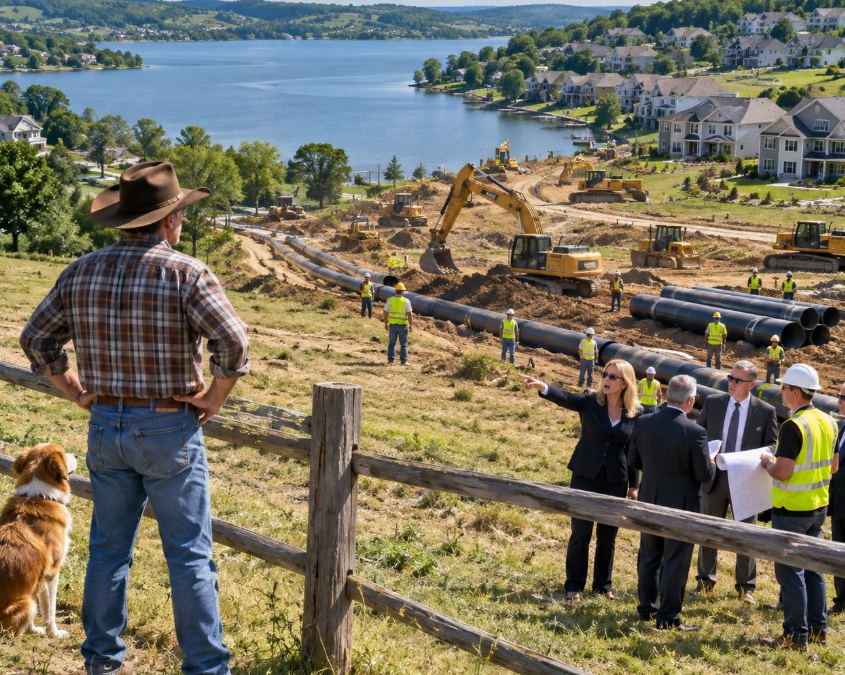
Two bulldozers were coming across the access lane.
Behind them was a white pickup truck.
High Ridge Meadows Development Committee.
The name was printed on the door.
For a few seconds, I honestly could not believe what I was seeing.
You spend your whole life assuming certain rules are obvious.
Do not enter somebody else’s house without permission.
Do not take what is not yours.
Do not drive a bulldozer into another man’s farm after a sheriff has already documented the dispute.
Apparently, High Ridge Meadows required written clarification.
I got into my truck.
Drove across the pasture.
Stopped directly in front of the machines.
The engines idled.
A foreman climbed out of the HOA pickup.
Thin.
Sunglasses.
Clipboard.
He approached my window.
I lowered it.
“You need to turn those machines around.”
“Sir, we’ve been authorized to begin trenching.”
“By who?”
“The project owner.”
“Who is not the landowner.”
He shifted his weight.
“The easements have been filed through municipal planning.”
“No, they haven’t.”
“I don’t handle legal.”
“Then get whoever does on the phone.”
“Sir.”
“This is private property.”
“We have a work order.”
“I don’t care if you have a letter from the president. You do not have an easement across this land.”
His expression hardened.
“You’ll need to address that with the board.”
“Call them.”
He stared at me.
“Now.”
He walked away.
The bulldozers continued idling.
Scout sat beside my truck, watching the machines like they were strange metal animals that had wandered somewhere they did not belong.
Ten minutes later, the foreman returned.
“They say everything has been approved.”
“Show me.”
“I don’t have the filings.”
“Then you don’t dig.”
“If you interfere with scheduled work, you may be liable for delays.”
I actually laughed.
It was not a happy laugh.
It was the kind that comes out when somebody says something so absurd that anger momentarily loses its grip.
“Let me make something very clear.”
I opened the truck door and stepped out.
“You put one blade into my soil and the delay will be the least of your problems.”
He crossed his arms.
“Are you threatening me?”
“No.”
I pointed toward the fence.
“I’m telling you where your job site ends.”
We stared at each other.
Finally, he turned toward the machines and waved.
The operators backed away.
I watched every vehicle leave.
That should have been the end of it.
A sane organization would have paused.
Checked records.
Called an attorney.
Contacted the property owner.
High Ridge Meadows did none of those things.
That night, I sat on the porch long after dark.
Coffee went cold in my hand.
The survey flags moved in the wind.
Scout lay beside my boots.
Something bothered me beyond the obvious trespassing.
I had spent nearly thirty years with the fire department.
You learn to trust pressure.
Not emotional pressure.
Physical pressure.
Heat behind a door.
Smoke moving the wrong direction.
A floor that feels too warm under your boots.
Small signals telling you something bigger is happening where you cannot see it yet.
The flags were that signal.
This was too organized to be a simple surveying mistake.
They had machinery.
Contractors.
Pipe.
Funding.
Schedules.
Somebody had made decisions.
Somebody had looked at a map and decided my ownership was either inconvenient or irrelevant.
I went inside around midnight.
I slept badly.
At dawn, the sound woke me.
Metal grinding.
A diesel engine.
Then a deep ripping noise that traveled through the old farmhouse.
Scout exploded into barking.
I was out of bed before I fully understood what was happening.
Jeans.
Boots.
Phone.
I ran outside.
For one second, I stopped on the porch.
A bulldozer was in the middle of my alfalfa field.
Not near it.
Not approaching.
In it.
The blade had opened a trench through rows that had been weeks from harvest.
Green plants lay crushed beneath tracks.
Fresh soil rolled up in dark piles.
Another machine followed behind.
The scene hit me harder than I expected.
I had watched houses burn.
I had stood in streets while families lost everything.
I had seen roofs collapse and firefighters injured.
But watching somebody deliberately tear open land my family had cared for since the 1950s did something different to me.
There was no emergency.
No necessity.
No accident.
They had chosen this.
I ran to the truck.
Drove straight into the field.
Mud and torn plants hit the wheel wells.
I parked directly in front of the lead bulldozer.
The operator stopped.
The engine shut down.
Dust drifted across the windshield.
Then the white HOA pickup appeared.
The foreman got out.
This time he had company.
A woman stepped from the passenger side.
Red blazer.
Dark pants.
A laminated badge clipped near her collar.
She walked toward me as though she were arriving for a scheduled meeting.
I knew her name before she introduced herself.
Candace Willoughby.
President of the High Ridge Meadows HOA.
“Mr. Mallerie.”
I stepped out of my truck.
“You need to get those machines off my land.”
She tilted her head.
“You were informed about the easement filings.”
“No, I wasn’t.”
“Your refusal to acknowledge them does not change their legal standing.”
“There is no legal standing.”
“This infrastructure is critical to our community’s water distribution.”
I pointed toward the trench.
“That is my crop.”
“We understand there will be temporary disruption.”
“Temporary?”
My voice rose despite my effort to control it.
“You just destroyed a section of my field.”
“Compensation mechanisms exist.”
“Stop talking like you’re reading a brochure.”
Her face tightened.
“This area has been designated as a utility corridor under municipal expansion code.”
“No, it hasn’t.”
“Section B14.”
“Show me the recorded easement.”
“You can obtain copies from planning.”
“I spoke to planning.”
That changed her expression.
Barely.
But I caught it.
“They don’t have an easement across this property.”
“Conditional approvals sometimes precede final recording.”
“That’s a nice way of saying you don’t have one.”
Her heels sank slightly into the torn soil.
She glanced down.
Then back at me.
“Our contractors have been instructed to complete the work.”
“Then your contractors have been instructed to trespass.”
“Mr. Mallerie, if you obstruct this project, the association may seek damages.”
“Do it.”
She paused.
“Excuse me?”
“File whatever you want.”
I stepped closer.
“But if one more machine moves forward, I’m filing for an emergency injunction and naming every contractor on this site.”
Scout came up beside me.
He growled.
I rested one hand on his head.
Candace looked at the dog.
Then at me.
“You are being unnecessarily confrontational.”
I looked past her toward the trench.
“My field disagrees.”
She folded her arms.
“This project benefits hundreds of families.”
“My deed benefits me.”
Her jaw tightened.
“You want a fight?”
“No.”
I pointed at the torn field.
“You brought one.”
By noon, I had Russell Drake on the phone.
Russell was a land-use attorney in Helena.
He had helped my father years earlier when a mining company tried diverting runoff through our property.
We had not spoken in a long time.
He remembered everything.
When I sent photographs, survey coordinates, deed copies, and the route the HOA had marked, he became quiet.
“How far are they onto your parcel?”
“About six hundred feet according to my measurements.”
“No recorded easement?”
“None.”
“No eminent domain order?”
“No.”
“No utility condemnation?”
“No.”
He exhaled.
“They’re in deep trouble.”
“Good.”
“Frank, don’t get ahead of me.”
“They’re digging.”
“I know.”
“I want them gone.”
“And that’s what we’re going to work toward.”
He paused.
“First, I need everything.”
“You have the photos.”
“I mean everything. Property deed. Survey. Water records. Previous correspondence. Sheriff’s report. Camera footage.”
“You think the water records matter?”
“I don’t know yet.”
“They’re building a water line.”
That made him stop.
“Where does the planned line connect?”
“I haven’t confirmed.”
“Find out.”
I looked through the kitchen window toward the ridge.
The lake sat beyond it.
An uncomfortable thought formed.
“Russell.”
“What?”
“What if they’re connecting to my lake?”
Silence.
“That would be very stupid.”
“They’ve already demonstrated a talent for that.”
“Find out.”
He began preparing an emergency injunction.
I spent the rest of the day documenting damage.
Flattened alfalfa.
Broken irrigation line.
Fence damage.
Soil disturbance.
I measured the trench.
Photographed every section.
Saved the game camera footage.
At sunset, I stood beside the excavation.
Mist rose from exposed earth.
Destroyed plants lay along the edges.
My father used to walk these fields with me.
Sometimes he talked.
Sometimes we went an hour without saying anything.
The silence had never been empty.
It was the silence of being somewhere you belonged.
Now I looked at the trench and felt invaded.
My grandfather had worked this property.
My father had improved it.
I came back after a lifetime of fighting fires because I wanted to preserve it.
I had not returned to become a celebrity farmer.
I wanted quiet.
Fence repairs.
Harvest schedules.
Weather.
Coffee on the porch.
Scout following me from barn to field.
The HOA had taken something simple and made it complicated.
I walked toward the lake.
Moonlight stretched across the surface.
The valve house stood near the southern bank.
Concrete.
Old metal wheel.
A short section of chain-link fence.
Nothing impressive.
But the water passing through it supplied my lower irrigation system.
And continued downstream.
Toward High Ridge Meadows.
I suddenly remembered something my father had told me decades earlier.
“Everybody notices water when they don’t have it.”
At the time, he had been talking about drought.
Standing there that night, the sentence felt different.
The next morning, Russell called.
“I found their infrastructure plan.”
“How?”
“Municipal filing database.”
“And?”
“Their Phase Two system appears to rely on a feeder connection coming through your parcel.”
“To where?”
“Upstream source.”
I looked at the lake.
“They’re trying to pull from my water.”
“That’s what it looks like.”
“They don’t own it.”
“I know.”
“They didn’t ask.”
“I know.”
“What the hell are they thinking?”
“They may believe it’s part of a regional watershed.”
“It’s a private spring-fed lake.”
“Do you have documentation?”
I laughed.
“Enough to bury them.”
“Good. Don’t bury anybody yet. Send it.”
I went to my filing cabinet.
My father had been obsessive about records.
At times, I used to tease him for it.
Now I silently apologized.
Original plat maps.
Water-use records.
Irrigation documentation.
A 1987 court ruling from a dispute over county annexation.
The decision recognized private control over the lake and its associated water system.
I scanned everything.
Sent it to Russell.
Twenty minutes later, he called.
“They have a problem.”
“How big?”
“Very.”
I looked at the lake again.
“Can I close the valve?”
“Legally, based on what I’m reading, you control the source.”
“That wasn’t my question.”
“I’m answering carefully because they’re going to accuse you of sabotage.”
“Can I shut off my own water?”
“Yes.”
I waited.
He added, “Do it slowly. Document the valve position. Give notice. Make sure you’re not creating unsafe pressure.”
That was enough.
First, though, we sent the cease and desist.
Russell drafted it over the weekend.
Private property law.
Water rights.
Recorded parcel boundaries.
No easement.
No municipal authority.
No permission.
The trench line was shown on an overlay crossing straight through my field.
Monday morning, a courier delivered it to High Ridge Meadows.
By noon, I drove to the HOA office myself.
The administration building looked like a corporate resort.
Glass.
Slate.
Perfect shrubs.
Fake waterfall.
I walked inside wearing work boots still carrying dirt from the trench.
A young employee looked up from the desk.
“Can I help you?”
“I’m Frank Mallerie.”
His expression changed.
Apparently, my name had reached the building before I did.
“Ms. Willoughby is in a meeting.”
I placed an envelope on the counter.
“Give her that.”
“What is it?”
“Her last warning.”
His eyes widened.
“Tell her she has twenty-four hours to remove every piece of equipment from my property.”
“I’ll let her know.”
“And tell her the next conversation may happen through the sheriff.”
He took the envelope.
I left.
The next morning, they sent drilling equipment.
That was the moment I understood I was not dealing with misunderstanding.
They knew.
They had received notice.
They had seen the property maps.
They had been warned personally.
And they moved forward anyway.
A narrow rig followed the trench.
Workers began positioning blue pipe.
I walked out carrying printed copies of the court filing.
The foreman saw me.
His shoulders sagged.
“You again.”
“Yes. Me again. On my land again.”
“We’ve been told to continue.”
“By the HOA?”
“Yes.”
“You’ve received the cease and desist?”
“Company legal has it.”
“Then stop.”
“I don’t have authority.”
“You have authority over whether your machine moves.”
He looked annoyed.
“Until a judge says otherwise, we’re working.”
I held up the filing.
“A judge is being asked right now.”
“Then when we get an order, we’ll stop.”
“You understand there’s no easement?”
“I understand I’m not an attorney.”
“You don’t need law school to understand a fence.”
He walked away.
Later that afternoon, Candace called.
“Mr. Mallerie.”
Her voice was crisp.
Controlled.
“I understand you’re continuing to interfere with an approved public infrastructure project.”
“Public?”
“Water service expansion.”
“You’re an HOA.”
“We’re coordinating with municipal authorities.”
“No, you’re not.”
“We have conditional consent.”
“For your property.”
“This line may temporarily cross adjacent rural plots.”
I laughed.
“Temporarily cross?”
“Yes.”
“You’ve opened a six-hundred-foot trench and you’re burying permanent pipe.”
She went quiet.
I continued.
“You destroyed crops. You broke irrigation. You damaged fencing. That’s not temporary.”
“You are obstructing infrastructure serving hundreds of homes.”
“Stop.”
“Excuse me?”
“Don’t do that.”
“Do what?”
“Turn trespassing into a moral lecture.”
Her tone hardened.
“These services benefit families. Children. Seniors.”
“There it is.”
“What?”
“The guilt trip.”
“I am stating facts.”
“So am I.”
I walked toward the window and looked at the lake in the distance.
“You’re building a pipeline to water you don’t own.”
There was a pause.
“I don’t know what you’re referring to.”
“Yes, you do.”
“The planned feeder source is part of the regional watershed.”
“No.”
Another pause.
“That little pond?”
My hand tightened around the phone.
“What did you call it?”
“The pond adjacent to your property.”
“It is entirely on my property.”
“Our consultants indicate that—”
“Your consultants are wrong.”
She sighed.
“Mr. Mallerie, water rights are more complicated than you seem to believe.”
That almost made me smile.
“My father fought that exact issue in court in 1987.”
Silence.
“I have the ruling.”
Nothing.
“The lake is private.”
I continued.
“The spring is private. The control structure is private. And the valve supplying downstream flow is private.”
When she spoke again, some of the confidence had disappeared.
“What are you suggesting?”
“I’m not suggesting anything.”
I looked toward the valve house.
“I’m telling you the source you’re planning to use belongs to me.”
“You cannot interfere with a public utility.”
“You don’t have a public utility.”
“Do not take hostile action.”
“Get your crews off my land.”
“Mr. Mallerie.”
“You have twenty-four hours.”
“Is that a threat?”
“No.”
I paused.
“It’s a deadline.”
That evening, I walked around the lake.
The water was still.
Stars reflected on the surface.
I stopped beside the valve.
The wheel was older than I wanted to admit.
Rust around the edges.
Condensation on the metal.
My father had built the concrete housing.
As a kid, I had helped repaint it.
As an adult, I had repaired it more times than I could remember.
The system controlled flow from the spring-fed lake into channels feeding the lower property.
It also influenced downstream supply.
I placed one hand on the wheel.
For the first time since the bulldozers arrived, I felt real leverage.
That feeling scared me a little.
Power can make a reasonable man reckless.
I had seen it in emergencies.
Firefighters who stopped respecting fire got hurt.
People who believed they controlled a dangerous situation completely were usually the ones surprised when it changed.
Water was no different.
I did not want revenge.
At least that was what I told myself.
But part of me wanted Candace to feel helpless.
I had to admit that.
Then I had to make sure it did not make the decision.
I called Russell again.
“They didn’t leave.”
“I assumed they wouldn’t.”
“I’m closing the valve.”
“Wait.”
“I thought you said I could.”
“You can. I want you to understand the risk.”
“Legal?”
“Mostly optics.”
“Meaning?”
“They’ll say you intentionally cut water to families.”
“They aren’t connected yet.”
“Exactly. That’s your defense. You’re stopping unauthorized withdrawal from a private source during construction.”
“What about pressure?”
“Do it gradually. Photograph the gauges if you have them. Notify the state water office immediately afterward.”
I nodded even though he could not see me.
“Frank.”
“Yeah?”
“Don’t touch their equipment.”
“I won’t.”
“Don’t damage the pipe.”
“I won’t.”
“Don’t threaten anybody.”
“I won’t.”
“Just control your own water.”
“That I can do.”
At dawn the next morning, fog covered the lake.
The path felt familiar under my boots.
I had walked it as a child.
Walked it with my father.
Walked it after his funeral.
Walked it on the first morning after retiring from the fire department, when I finally understood I was home for good.
Now I walked it because strangers had mistaken familiarity for weakness.
I reached the valve chamber.
Unlocked it.
Checked the mechanism.
Then I hesitated.
Not because Candace had frightened me.
Because I understood consequence.
If the HOA project collapsed, people would spend money.
Contractors would lose time.
Lawsuits would begin.
Neighbors would be told I was responsible.
My name would become part of something public.
I did not want any of that.
I wanted Tuesday morning back.
Before the first flag.
Before the trench.
Before Candace stepped onto my field and explained my rights to me.
But that morning was gone.
I gripped the wheel.
Turned slowly.
Metal groaned.
The resistance increased.
Water pressure changed beneath the chamber.
I kept turning until the flow was closed.
Then I stopped.
The silence afterward felt enormous.
I photographed the valve.
Recorded the time.
Sent the notice.
Then I walked home.
By noon, my phone rang.
“This is Brian from Ridge Infrastructure.”
I did not know Brian.
He sounded stressed.
“We’re having a supply issue.”
“I know.”
“You shut down the feeder?”
“I closed my valve.”
“Why?”
“Because it’s my water.”
Silence.
“Sir, we’ve got crews here trying to pressure-test a main line.”
“Then your client should have secured water rights before hiring you.”
“We were told the source was approved.”
“You were told wrong.”
“Can you temporarily reopen it?”
“No.”
“We’ve got rented equipment and thirty workers on the clock.”
“I sympathize.”
His voice sharpened.
“If we can’t flush the system, there could be backflow issues.”
“Then isolate your system.”
“We need source pressure.”
“You don’t have a source.”
He paused.
“Are you the property owner?”
“Yes.”
“The one disputing the easement?”
“Yes.”
He swore quietly.
“Call your client,” I said.
Then I hung up.
An hour later, Candace called.
This time there was no polished tone.
“Mr. Mallerie, we have a serious problem.”
“Yes.”
“The feeder line has no pressure.”
“Yes.”
“I need you to reopen the valve.”
“No.”
“This is not a game.”
“I agree.”
“We have a major development schedule.”
“Not my problem.”
“Nearly five hundred homes are tied to Phase Two planning.”
“Then maybe somebody should have checked where the water was coming from.”
“The board understood the lake to be part of the watershed.”
“The board was wrong.”
“We can resolve the ownership question later.”
“No.”
“We need temporary flow.”
“No.”
She exhaled.
“You are intentionally causing economic harm.”
“You intentionally built through my farm after receiving legal notice.”
“That is disputed.”
“Not by my deed.”
“You’re escalating this.”
“No.”
I looked out at the trench.
“You escalated it the moment you decided my permission didn’t matter.”
“You will hear from our attorneys.”
“I already have an attorney.”
“The association has resources.”
“So do I.”
“You’re one landowner.”
“And you built your entire pipeline toward his lake.”
That ended the conversation.
The following morning, news trucks appeared near the pasture.
I still don’t know who called them.
Maybe a contractor.
Maybe somebody at the county.
Maybe somebody inside the HOA who had begun realizing the board had made an expensive mistake.
A reporter approached the fence.
“Mr. Mallerie?”
“Yes.”
“Is it true you shut off water to High Ridge Meadows?”
“No.”
She blinked.
“We were told—”
“I shut off water from my private lake.”
“Isn’t that supplying the development?”
“They were trying to make it supply the development.”
“Without permission?”
“Exactly.”
She raised the microphone.
“Why did you close it?”
“Because they bulldozed through my property, began installing pipe without an easement, and attempted to connect to a private water source.”
“Did you warn them?”
“Repeatedly.”
“Are residents going without water?”
“Existing residents have municipal service.”
“So this concerns new construction?”
“Yes.”
She looked toward the trench.
“What do you want?”
“My land restored.”
“Money?”
“No.”
“What then?”
“The pipeline removed.”
That clip ran that night.
The next day, messages arrived.
Farmers.
Ranchers.
Neighbors.
People I had not spoken to in years.
Most were short.
Stand your ground.
Good for you.
Don’t let them take an inch.
A few were angry.
One person accused me of endangering families.
Another called me selfish.
I read everything.
Then I turned off my phone.
I was not trying to become a symbol.
I wanted my farm back.
Russell reminded me of that.
“Media attention helps pressure them,” he said.
“I don’t care about pressure.”
“You should.”
“I care about the injunction.”
“That too.”
We filed everything.
Deed.
Survey.
Sheriff’s report.
Photographs.
Drone footage.
Water records.
The 1987 ruling.
Witness statements.
The trench coordinates.
The next afternoon, the court granted the temporary injunction.
A deputy served it directly to the HOA.
Russell happened to be there.
He called me afterward.
“How’d Candace take it?” I asked.
“Like someone who just discovered judges don’t report to HOA presidents.”
I laughed.
“What happens now?”
“They stop construction.”
“And removal?”
“We’re requesting it.”
“I don’t want that pipe staying.”
“I know.”
That evening, I replaced the old chain around the valve enclosure.
New stainless steel.
Two locks.
Not because I believed contractors would tamper with it.
Because trust had been used up.
I also sent complete documentation to the state water authorities.
The response came faster than I expected.
The lake was recognized as a private water body tied to historic records.
No automatic downstream utility obligation.
No HOA authority to draw from it.
I read the confirmation three times.
The official file used a name I had not heard before.
Lake Mallerie.
My father never called it that.
To us, it was always simply the lake.
Seeing our family name attached to it in a government record affected me more than I expected.
I thought about my father standing waist-deep near the bank when I was a teenager, directing me to move stone.
“Not there.”
“Why?”
“Because water will push through.”
“It looks fine.”
“Water doesn’t care how it looks.”
He had been right about more than the shoreline.
Two days later, Candace arrived at my farm.
Not by phone.
Not through lawyers.
In person.
Scout barked before the car stopped.
A black Mercedes parked along the drive.
Candace stepped out.
She was wearing heels again.
I almost admired the commitment.
She carried a folder.
“Mr. Mallerie.”
“Candace.”
“I’d like to discuss a resolution.”
“Good.”
She looked hopeful for half a second.
“Remove the pipe.”
The hope disappeared.
“We’re prepared to compensate you.”
“No.”
“You haven’t heard the figure.”
“No.”
“Twenty thousand dollars for a permanent easement, plus documented crop and fence repairs.”
I stared at her.
“Twenty thousand.”
“Yes.”
I laughed.
She didn’t.
“You destroyed four acres of crop.”
“We’re compensating for that.”
“You trenched through irrigation.”
“Covered.”
“You damaged fencing.”
“Covered.”
“You entered after I told your crews to leave.”
“The easement issue remains contested.”
“No, it doesn’t.”
“The board believes—”
“The board also believed it owned my water.”
Her jaw tightened.
“This could have been handled quietly.”
I looked at her.
“You’re right.”
That surprised her.
“You could have knocked on my door.”
She said nothing.
“You could have asked about the route.”
Nothing.
“You could have offered an easement before sending bulldozers.”
Nothing.
“You could have rerouted.”
Her eyes moved toward the field.
I continued.
“You had every chance to handle this quietly.”
I pointed at the trench.
“You chose that.”
She changed tactics.
“If this project fails, families may face delayed water access.”
“No.”
“Children and elderly residents—”
“Stop.”
“It’s true.”
“No. What is true is that your board committed to a development plan before securing the land and water rights required to build it.”
She stared at me.
“You want residents to blame me?”
“They already do.”
“I don’t care.”
“You will.”
“Candace.”
I stepped closer to the fence.
“You still think this is about leverage.”
Her face remained still.
“It’s about a boundary.”
She looked past me.
“So there’s no deal?”
“There was a deal.”
“What?”
“Ask before taking.”
I pointed toward the road.
“You missed it.”
She left.
An hour later, Russell called.
“You’re going to enjoy this.”
“What?”
“The injunction was extended.”
I sat down.
“What does that mean?”
“No construction across your property. Seventy-two hours to remove installed pipe and equipment or daily sanctions begin.”
“How much?”
“Two thousand a day initially.”
I leaned back.
“And if they ignore it?”
“It increases.”
I looked toward the field.
For the first time since Tuesday morning, the pressure in my chest eased.
But I did not celebrate.
I had spent too much of my career watching people celebrate before an emergency was actually over.
The HOA had ignored logic.
Ignored ownership.
Ignored warnings.
I was not going to assume they had suddenly discovered humility.
The next morning, trucks were still near the field.
I walked toward the lake just before sunrise.
The injunction was active.
The valve remained closed.
I checked the locks.
Everything intact.
Then I heard engines.
Back near the pipeline route, workers had gathered around an exposed section.
A pressure gauge was being passed between them.
One man shook his head.
I moved closer but stayed inside my boundary.
I heard fragments.
“No draw.”
“Check valve.”
“Still dry.”
“Whole line’s dead.”
Then Candace appeared.
She was not wearing the red blazer.
For once, she had chosen boots.
She saw me.
Walked toward the fence.
“You’ve made your point.”
“This isn’t a point.”
“What is it then?”
“A boundary.”
She looked tired.
“The development is going to suffer.”
“You built it around resources you didn’t control.”
“We relied on professional guidance.”
“Then sue your professionals.”
Her lips tightened.
“You really think you’ve won.”
“I think the judge told you to remove the pipe.”
She looked back toward her workers.
I continued.
“You have a deadline.”
She stared at me for a long time.
Then turned around.
By late afternoon, the first pipe sections came out.
Workers cut connections.
Excavators lifted sections from the trench.
Flatbeds were loaded.
The equipment that had arrived so confidently now left in pieces.
I stood beside the fence.
Watched them reverse across the route.
Part of me expected satisfaction.
Instead, I mostly felt tired.
The trench remained.
The crop remained destroyed.
The fence was still damaged.
Winning a boundary dispute did not magically put the land back together.
Russell called after dark.
“They’re complying?”
“Looks like it.”
“Good.”
“They’re making a mess leaving.”
“Photograph it.”
“Already did.”
He laughed.
“You’ve learned.”
“My father would be proud.”
“Your father would probably have had six file folders and an index.”
“Seven.”
Russell became serious.
“Candace tried appealing the injunction.”
“And?”
“Denied.”
I smiled.
“Restoration deadline remains.”
“They’ll miss it.”
“Then we’ll pursue damages.”
After the trucks left, I walked to the lake.
The moon was high.
I sat on the stone bench my father had built near the bank.
It was nothing fancy.
One flat stone resting across two supports.
We had eaten sandwiches there.
Cleaned fishing gear there.
Argued there.
After he died, I sometimes sat there because it was one of the places I could still hear his voice clearly in my head.
I looked at the valve house.
That wheel had become the center of a fight my father never could have predicted.
Yet the reason I had been able to use it was not cleverness.
It was preparation.
He had protected the water legally.
He had preserved records.
He had understood that land needed more than fences.
It needed paper.
The next morning, a letter arrived from the city attorney.
I expected another attack.
It was the opposite.
The city clarified that the High Ridge Meadows pipeline had not been authorized as a municipal water utility connection.
The HOA did not possess authority to tap a private lake.
The city was opening an investigation into permitting and the use of municipal-style branding associated with the project.
I read the letter twice.
Then laughed.
Not because the situation was funny.
Because for weeks, Candace had kept saying municipal as though repetition could turn an HOA into a government agency.
Apparently, the government disagreed.
The lawsuit arrived three days later.
Seventy-six pages.
High Ridge Meadows HOA versus Frank Mallerie.
Obstruction of public infrastructure.
Intentional economic harm.
Willful sabotage.
I sat at the kitchen table reading every page.
Scout slept under the window.
Some of the claims were extraordinary.
I had supposedly endangered hundreds of residents.
Destroyed a multimillion-dollar development plan.
Interfered with public services.
They included maps that made the pipeline appear to run beside my parcel instead of through it.
I called Russell.
“I’ve been served.”
“I know.”
“You already know?”
“Electronic docket.”
“They’re calling the pipeline public infrastructure.”
“I saw.”
“It isn’t.”
“I know.”
“They altered the route map.”
“I saw that too.”
“What happens now?”
“We answer.”
“You sound happy.”
“I am.”
“Why?”
“Because they put their story in writing.”
That was a lawyer’s answer.
He continued.
“Frank, allegations are easy during press conferences. Court filings are different.”
“You think this helps?”
“I think Candace just gave us seventy-six pages to disprove.”
Then he said something I did not expect.
“And I found another document.”
Two days later, Russell drove to the farm.
He carried an old leather folder.
The moment I saw it, I knew it was not ordinary paperwork.
“You recognize this?”
“No.”
He opened it.
The paper inside was yellowed.
Handwriting faded.
A seal remained visible near the bottom.
“1924 land grant.”
I looked at him.
“For this property?”
“For part of the original family parcel.”
I carefully lifted the first page.
My great-grandfather’s name appeared.
Thomas Mallerie.
The grant documented land boundaries and associated water rights.
Then Russell showed me another section.
“What am I looking at?”
“Protected lake perimeter.”
I read the language.
It was dense.
Old.
Formal.
Russell translated.
“No public or private infrastructure within two hundred feet of the lake’s natural perimeter without express landowner consent.”
I looked up.
“They trenched inside that.”
“Dead center.”
“How did we not have this?”
“It was referenced in your father’s 1987 case but not attached to your family copy. I had the county archives search the old file.”
“And it still stands?”
“Unless revoked.”
“Was it?”
“No.”
I sat back.
Russell smiled.
“They didn’t just cross property without an easement.”
“They crossed protected land.”
“Exactly.”
I laughed slowly.
“They picked the wrong field.”
Russell shook his head.
“No, Frank.”
He tapped the document.
“They picked the wrong family.”
Our counterclaim went out the next morning.
Crop damage.
Soil damage.
Fence repair.
Trespass.
Unauthorized infrastructure.
Attempted use of a private water source.
Legal fees.
Additional claims tied to false representations.
Russell also sent information to the relevant licensing authorities regarding the engineering and permitting process.
The city continued its own investigation.
Then the press became interested again.
An investigative reporter from a regional paper called.
Normally, I would have declined.
Instead, I spoke with her.
Not because I wanted fame.
Because I was tired of hearing the story described as one stubborn farmer refusing water to families.
I told her how it started.
Tuesday morning.
Flags.
No notice.
Deputy Holloway.
Bulldozers.
The trench.
Candace standing in my field telling me I had no choice.
I told her about my father.
The lake.
The valve.
The water rights.
The lawsuit.
She asked one question that stayed with me.
“When did you become angry?”
I laughed.
“When the bulldozer started.”
“No.”
She paused.
“When did it become personal?”
I looked outside.
The trench still cut through the field.
“When she told me resistance had been noted.”
“Why?”
“Because that’s when I understood she didn’t see me as the owner.”
“What did she see you as?”
“An obstacle.”
The article appeared days later.
The headline described me as the farmer who shut off the suburbs.
I thought it was ridiculous.
Apparently, everyone else loved it.
The story spread.
Emails arrived from across the state.
Then other states.
People described their own disputes with HOAs.
Fines.
Fence fights.
Easements.
Trees.
Driveways.
Drainage.
I could not answer all of them.
I tried to answer a few.
Most wanted the same thing.
Hope.
Not legal advice.
Just evidence that saying no could still mean something.
Candace responded with a press conference.
She stood outside the clubhouse.
Perfect lawn behind her.
Microphones in front.
She called me uncooperative.
Extreme.
A threat to infrastructure planning.
She claimed I had intimidated workers.
That one made me angry enough to stand up from my chair.
Scout looked at me.
“No,” I said.
He tilted his head.
“She doesn’t get to lie about that.”
Russell told me not to respond emotionally.
So we responded with documents.
Video.
Witnesses.
Contractor records.
The city issued a statement.
No municipal authority had been granted for taking water from my lake.
The state continued reviewing the dispute.
The court scheduled a full evidentiary hearing.
Three weeks later, I walked into the courtroom.
I had imagined something grand.
Dark wood.
Marble.
Tall ceilings.
Instead, the carpet was brown.
Fluorescent lights hummed.
The room smelled faintly of disinfectant and old paper.
Judge Halverson looked like he would rather be fishing.
I liked him immediately.
Russell sat beside me.
Across the room, the HOA had three attorneys.
Candace sat behind them.
Red blazer.
Of course.
She caught my eye.
For one second, I saw the same expression she had worn in my field.
Impatience.
As though this entire process existed because I had refused to behave conveniently.
Then the hearing began.
Russell started simple.
Property deed.
Survey.
Aerial photographs.
Trench location.
Sheriff’s report.
Witnesses.
Game camera footage.
No easement.
No signature.
No permission.
The HOA attorneys argued conditional municipal planning.
Russell produced the city letter.
That disappeared.
They argued the water body functioned as part of a regional system.
Russell produced the 1987 ruling.
That disappeared.
Then he brought out the 1924 grant.
He placed it in front of the judge.
“This is the original land grant covering the northern parcel and associated lake rights.”
The judge adjusted his glasses.
Russell continued.
“It also includes a protected perimeter provision requiring express landowner consent for infrastructure within two hundred feet of the lake.”
The judge looked toward the HOA attorneys.
“Was consent obtained?”
One attorney stood.
“Your Honor, we dispute whether such an old provision can reasonably control modern utility planning.”
The judge looked back at the document.
“That was not my question.”
Silence.
“Was consent obtained?”
“No, Your Honor.”
“Was the provision revoked?”
“Not to our knowledge.”
“Modified?”
“No.”
“Condemned through eminent domain?”
“No.”
“Is High Ridge Meadows a municipal authority?”
The attorney hesitated.
“It coordinates certain services—”
“Yes or no.”
“No.”
The judge removed his glasses.
“Then I’m struggling to understand the association’s theory.”
Candace shifted behind the lawyers.
Russell continued.
“The HOA was also formally notified before portions of the installation proceeded.”
He produced the cease and desist.
“Construction continued.”
The judge read.
Then looked toward the defense.
“You received this?”
The attorney leaned toward Candace.
She whispered something.
“Yes, Your Honor.”
“And continued work?”
“There was a belief the project approvals superseded—”
“Which approval?”
The attorney paused.
The judge waited.
There was no answer.
That silence was louder than anything Russell could have said.
Later, Candace was allowed to speak.
She stood.
Straightened her blazer.
“Your Honor, the board acted in good faith.”
I felt my jaw tighten.
She continued.
“We believed the water source was unregulated and that the corridor fell under municipal expansion planning.”
Judge Halverson interrupted.
“After receiving contrary documentation?”
“We needed time to verify.”
“But construction continued.”
“Our project schedule—”
“Ms. Willoughby.”
His voice remained calm.
“Project schedules do not create property rights.”
The courtroom became completely still.
Candace sat down.
I did not look at her again.
The preliminary ruling favored me.
The court found the HOA responsible for unauthorized entry, property damage, and unlawful continuation of work after notice.
Damages and restoration obligations followed.
The amount ordered was substantial enough to cover land repair, crop loss, legal costs, and related claims.
The judge also referred questions surrounding the permit representations for further review.
When it ended, Russell leaned toward me.
“It’s done.”
I looked at the table.
“No.”
He waited.
“The land still looks like hell.”
He smiled slightly.
“Then go fix it.”
Outside, reporters waited on the courthouse steps.
I did not give them the victory speech they wanted.
Someone shouted, “How does it feel to beat the HOA?”
I stopped.
Thought about it.
Then said, “I didn’t beat anybody. They were told to get off land that wasn’t theirs.”
That was enough.
I drove home.
No radio.
No phone.
Just tires on asphalt, then gravel.
The trench looked different when I arrived.
Not smaller.
Not less ugly.
But temporary.
For weeks it had looked like something being taken.
Now it looked like something waiting to be repaired.
Before dark, I walked to the lake.
Unlocked the valve enclosure.
Placed both hands on the wheel.
Turned it counterclockwise.
Slowly.
Water moved back into the irrigation channels.
The sound filled the concrete chamber.
A hiss.
Then flow.
Not toward the HOA pipe.
That was gone.
Toward my fields.
Where it belonged.
Scout lay beside the entrance.
His tail struck the concrete once.
I stood there listening.
It did not feel like revenge.
It felt like restoration.
The consequences for High Ridge Meadows continued.
The court’s written order became public.
The city reviewed the HOA’s permitting process.
Questions emerged about how municipal branding had been used.
Budget records were examined.
Dates were compared.
The pressure moved from my farm into their boardroom.
The HOA missed part of its restoration deadline.
Daily penalties began accumulating.
Residents started demanding answers.
That was what finally broke Candace.
Not me.
Not the lake.
Her own residents.
People who had trusted the board began asking why they had never been told the pipeline crossed private property.
Why no easement existed.
Why the water source was not secured.
Why construction continued after legal notice.
Why legal fees were now being paid from association funds.
Candace resigned.
Her statement blamed public pressure and distorted media coverage.
I read it once.
Then threw it away.
Half the board stepped down within the month.
New elections were called.
I did not attend.
I was not a member.
That fact had started the entire problem.
I had no interest in becoming part of their solution.
Some residents visited me afterward.
One man came carrying a clipboard.
I saw it and almost laughed.
He noticed.
“Bad choice?”
“Depends what’s on it.”
“Nothing official.”
“Then we’re already doing better.”
He looked embarrassed.
“I wanted to apologize.”
“For what?”
“We didn’t know.”
“About the pipeline?”
“How far it went. The water rights. Any of it.”
I leaned against the porch railing.
“We trusted the board.”
“That was your choice.”
“I know.”
He nodded.
“We were wrong.”
I studied him.
Months earlier, I might have given him a speech.
Now I was tired of speeches.
“Apology accepted.”
Relief crossed his face.
“But trust takes time.”
“I understand.”
That weekend, some friends suggested a bonfire.
At first, I imagined five or six people.
By Saturday evening, more than forty showed up.
Farmers.
Neighbors.
A few High Ridge residents.
Russell arrived with a cooler.
Somebody brought a guitar.
Then an entire bluegrass group appeared.
Kids ran through the pasture.
For the first time in months, the field contained noise that did not come from machinery.
I stood near the fire with a beer.
Russell handed me another court document.
“What now?”
“You’ll like this.”
I read part of it.
“Our case was cited?”
“In two other filings.”
I looked at him.
“Already?”
“Already.”
“That seems fast.”
“Lawyers are vultures.”
“I thought you were a lawyer.”
“Exactly.”
We clinked bottles.
Later, after most people left, I walked toward the lake.
Scout came with me.
The fire behind us had collapsed into red embers.
I rested my hand on the valve wheel.
I did not need to move it.
The flow was steady.
For the first time since the survey flags appeared, I realized my shoulders were not tense.
I was not listening for engines.
I was not checking the driveway.
I was not wondering what letter would arrive next.
The fight had taken something from me.
Not just money.
Not just crop yield.
Peace.
Now it was slowly coming back.
A week later, another envelope arrived.
This one was from the state agriculture department.
I assumed it was administrative.
Instead, it acknowledged the land rights dispute and the importance of protecting generational farmland from unauthorized encroachment.
I read the letter.
Then read it again.
I framed it.
Not because I needed praise.
Because the whole conflict had been fought with paper.
Candace had waved paper at me.
Easements that did not exist.
Approvals that did not apply.
Legal threats.
Lawsuits.
My family had answered with different paper.
Deeds.
Water rights.
Court rulings.
Property maps.
A land grant signed decades before High Ridge Meadows existed.
Paper is not automatically authority.
Truth gives paper authority.
By spring, the trench was gone.
I hired a local crew.
Young men from ranching families.
They showed up in work clothes, not HOA-branded trucks.
Before moving equipment, the crew leader asked me one question.
“Where do you want us to start?”
That should not have meant as much as it did.
“Let me show you.”
We walked the route.
He listened.
Asked about irrigation.
Asked about the soil.
Asked where I wanted equipment crossing.
Nobody assumed.
Nobody told me.
They asked.
That was the difference.
We filled the scar.
Compacted soil.
Regraded.
Repaired drainage.
Reseeded.
By April, grass appeared.
By May, the fence was rebuilt.
By June, a person who did not know what happened would have struggled to find the old trench.
I could still find it.
Of course I could.
Landowners notice scars other people miss.
But it was healing.
I repaired the lake valve housing too.
Removed rust.
Repainted the gate.
Replaced worn hardware.
Then I found an old wooden sign my father had made.
PRIVATE WATERS.
MALLERIE PROPERTY.
The letters were faded.
I cleaned the board carefully and rehung it near the lake.
Not as a threat.
As a fact.
Some mornings, I sat on the stone bench with coffee.
Scout at my feet.
Mist rising.
Nothing moving but birds and water.
Those mornings felt expensive.
Not in money.
In what it had taken to get them back.
Months passed.
People continued contacting me.
A politician’s office asked if I would speak about property rights.
A professor wanted to use the dispute in a property law class.
A podcast offered to tell the story.
I declined most of it.
I had already spent too many months reliving the fight.
There comes a point when defending peace requires returning to it.
I planted a new orchard near the field that had been torn open.
Apple.
Pear.
Plum.
Small trees.
Thin trunks.
Nothing impressive yet.
It would take years before they produced much fruit.
That was why I liked them.
The HOA had represented impatience.
Expansion.
Quarterly deadlines.
Build first.
Ask later.
The orchard represented the opposite.
Plant.
Wait.
Care for something.
Accept that growth takes time.
Scout stayed with me through the first planting season.
Then age caught up with him.
Fourteen years.
His hips weakened.
He slept more.
One morning, he did not want breakfast.
I knew.
You spend enough time around life and death, you recognize when somebody is tired.
I sat with him near the porch.
He rested his head against my boot.
For years, he had been beside me.
Survey flags.
Bulldozers.
Lawyers arriving.
Reporters.
The lake.
The restored field.
He had barked at every stranger and welcomed every friend.
When he died, I buried him beneath the old oak near the lake.
I chose a flat stone.
Carved three words.
Faithful.
Fierce.
Free.
That loss hurt more than the lawsuit ever had.
For weeks, I still expected to hear his nails against the porch boards.
Sometimes I caught myself looking toward the field for him.
Grief is another kind of boundary.
You cannot argue with it.
Cannot sue it.
Cannot turn a valve and stop it.
You live with it until the edges soften.
The orchard grew.
The grass grew.
The lake remained steady.
High Ridge Meadows elected a new board.
Quiet people.
At least from what I heard.
They stayed on their side of the property line.
No letters.
No trucks.
No surveys.
No one asking for water.
That silence became the best settlement I received.
Years from now, somebody may buy one of those High Ridge homes and never know what happened.
They may walk near the eastern boundary and see my orchard.
They may notice the old sign by the lake.
They may wonder why the development’s utility line takes a longer route around the farm instead of going straight through.
Maybe somebody will tell them.
Maybe not.
It does not matter.
I know.
Every morning I walk past the place where the first orange flag stood.
I can still picture it.
SECTION 3.
PIPE ROUTE.
A small piece of plastic announcing a decision somebody thought had already been made for me.
That is what bothered me most in the end.
Not the money.
Not Candace.
Not even the trench.
The assumption.
The belief that my permission was an administrative inconvenience.
The belief that a board could look at somebody else’s land and decide access was inevitable.
The belief that being organized, funded, and confident made them entitled.
They were wrong.
I did not win because I was louder.
I was not richer.
I did not have a board.
I did not have a development company.
I had thirty-six acres.
A file cabinet.
A stubborn attorney.
A family history.
And an old valve beside a lake they had never bothered to understand.
That was enough.
My father used to tell me property was not about possession.
It was about responsibility.
I misunderstood him when I was younger.
I thought he meant maintenance.
Fence repairs.
Taxes.
Clearing brush.
Keeping the lake healthy.
He meant more than that.
Responsibility includes knowing when to say no.
Because every generation inherits certain things from the one before it.
Land.
Water.
Stories.
Mistakes.
Rights.
Obligations.
You do not preserve those things by assuming somebody else will protect them.
My great-grandfather signed papers in 1924 because he understood that.
My father fought the county decades later because he understood that.
I fought High Ridge Meadows because eventually I had to understand it too.
One evening near the end of summer, I walked to the lake alone.
No Scout beside me.
That still felt wrong.
The orchard behind me was beginning to fill out.
The restored field moved in the breeze.
I sat on the stone bench.
The sun lowered toward the mountains.
Water reflected orange and gold.
For months during the fight, I had imagined victory as a dramatic moment.
Candace defeated.
A judge ruling.
Bulldozers leaving.
The pipeline coming out.
The valve turning.
None of those turned out to be the moment.
This was.
Sitting alone.
Nothing happening.
No phone ringing.
No machine moving.
No stranger explaining my land to me.
Just water.
Wind.
Home.
I looked at the valve house.
It had become famous for a while.
Reporters loved it.
A rusty wheel that stopped an HOA project made a good visual.
To me, it had become ordinary again.
Exactly the way I wanted it.
I stood.
Walked to the water’s edge.
My father’s old sign was visible through the trees.
PRIVATE WATERS.
MALLERIE PROPERTY.
I ran one hand over the weathered letters.
Then I looked across the lake.
“You were right, Dad.”
Nobody answered.
Of course.
Still, saying it felt good.
High Ridge Meadows had believed the lake was just another resource on a planning map.
They saw water.
Potential.
Capacity.
Infrastructure.
I saw my father waist-deep near the shoreline.
My grandfather digging channels.
My own hands turning the valve.
Scout drinking from the edge after a long walk.
A place where my life connected to theirs.
That difference was why Candace never understood me.
She thought everything had a price.
Twenty thousand dollars for an easement.
Repair costs.
Settlement.
Development value.
But some things become valuable precisely because you refuse to sell them.
The orchard is still there.
The lake is still there.
So is the farm.
When people ask me now what happened, they usually focus on the valve.
“Is it true you shut off the water?”
Yes.
But that is not really the story.
The story started long before I touched the wheel.
It started when someone planted a survey flag in soil they did not own.
Then another.
Then another.
It continued when people mistook paperwork for permission.
Then when they mistook patience for weakness.
Then when they mistook a private lake for a free resource.
The valve only exposed every mistake they had already made.
If High Ridge Meadows had asked first, the entire story could have been different.
Maybe I would have said no.
Probably.
Maybe a different route could have been negotiated.
Maybe a lawful arrangement existed.
We will never know.
Because they decided my answer did not matter.
That was the decision that cost them.
Not mine.
I keep the old orange flag now.
The first one.
SECTION 3.
PIPE ROUTE.
It sits in a drawer beside copies of the court ruling.
Sometimes I take it out.
Not because I am angry.
Because it is a reminder.
Big conflicts do not always announce themselves with sirens.
Sometimes they begin as something small enough to flutter in the wind.
You pull it from the ground.
Read three words.
And realize somebody you have never met has already made plans for what belongs to you.
What happens next depends on whether you believe them.
I did not.
And when they brought bulldozers, I did not.
When Candace threatened delays, I did not.
When she called the pipeline public infrastructure, I did not.
When the HOA sued me, I did not.
When their lawyers filled seventy-six pages with accusations, I did not.
I checked the records.
I called my attorney.
I documented damage.
I locked the valve.
I stood where my family had stood before me.
Then I let the law catch up.
That was the lesson.
Not that one farmer can destroy an HOA.
Not that water should be used as revenge.
Not even that old land grants can save you.
The lesson was simpler.
Know what is yours.
Know what protects it.
And never assume someone else’s confidence means they are right.
High Ridge Meadows arrived with machines, consultants, lawyers, and a schedule.
I had history.
They had a pipeline.
I had the source.
They had plans.
I had the boundary.
And in the end, that was the part they never understood until it was too late.
You can bulldoze dirt.
You can flatten crops.
You can drive stakes into somebody else’s field.
You can print maps until your boardroom table disappears beneath them.
But none of those things create ownership.
None create permission.
And none make stolen water yours.
The lake still feeds my fields today.
Not theirs.
Mine.
The valve still turns.
The orchard keeps growing.
And when the wind moves across the property at night, I can almost hear Scout barking somewhere beyond the trees, warning strangers away from a boundary everyone finally learned to respect.
That is enough for me.
I did not need their apology.
I did not need the headlines.
I did not need to become a symbol.
I needed my land back.
I got it.
I needed my water protected.
It is.
I needed the people who crossed my boundary to understand there was a boundary.
Now they do.
And every time I walk past the lake and see my father’s old sign standing beside the shore, I remember the morning High Ridge Meadows sent bulldozers onto my farm believing I was the weakest part of their plan.
They never understood the truth.
I was not standing between them and their water.
I was standing beside my water.
There is a difference.