The HOA Built a Fence 37 Feet Inside My Property and Called the Land Theirs—They Had No Idea I Was the Surveyor Who Drew the Official Boundary.
PART2:
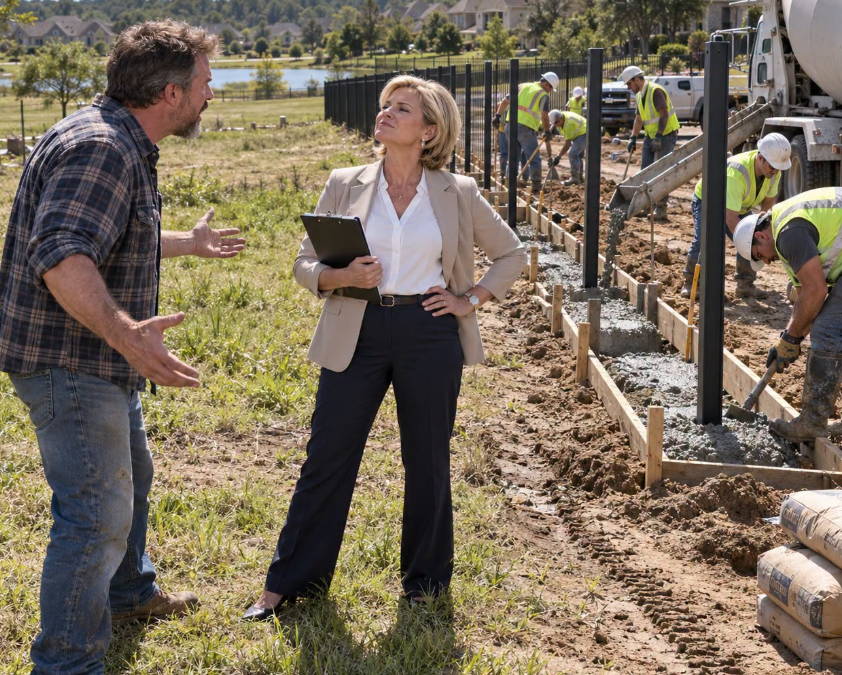
“Actually, that will need to be removed.”
I stared at her.
She continued.
“Article Nine, Section C prohibits unapproved agricultural use in visible common areas.”
“Common areas.”
“Yes.”
“You think my garden is HOA common area.”
“Yes.”
“My driveway?”
“Yes.”
“My rose garden?”
“The association intends to install petunias along the fence.”
I could not immediately find words for that.
Karen mistook silence for defeat.
She pointed at my truck.
“That vehicle is also currently parked on community property. You have twenty-four hours to relocate it.”
“Relocate it where?”
“That isn’t the association’s concern.”
“It’s parked beside my house.”
“On common property.”
“According to you.”
“According to the approved plat.”
She tapped the clipboard.
“If the vehicle is not removed within twenty-four hours, the association may have it towed at your expense. There will also be a fifty-dollar-per-day violation assessment.”
That was the moment I stopped thinking this might be a mistake.
Mistakes sound different.
People confronted with a possible surveying error usually hesitate.
They ask questions.
They compare deeds.
They request a second look.
Karen didn’t hesitate.
She was issuing fines.
Claiming land.
Threatening to tow my truck.
Her confidence told me she had not come to determine where the boundary was.
She had come to tell me where she wanted it to be.
I took one slow breath.
The smell of diesel and wet concrete filled the air.
“Karen.”
“Yes?”
“Call your crew off my land.”
“They work for the HOA.”
“They are trespassing.”
“No, they are not.”
“You have one hour.”
Her eyebrows rose.
“One hour for what?”
“To remove the crew, the materials, and every piece of equipment from my property.”
She actually laughed.
It was short and dismissive.
“You’re not a member of Whispering Pines, Mr. Thorne. You don’t have standing to interfere with an HOA capital project.”
I looked at the fence.
Then back at her.
“I don’t need to belong to your HOA to own land next to it.”
“We have documentation.”
“So do I.”
“Our survey is current.”
“Then your survey is wrong.”
She stepped closer.
“You seem to misunderstand the situation.”
“No.”
My voice dropped.
“I understand it perfectly.”
The workers had slowed.
They were listening now.
I looked toward them.
“Gentlemen, I’m putting you on notice that this is private property.”
One of the workers glanced at Karen.
She snapped, “Continue working.”
The auger started again.
That machine turning back on changed something in me.
Not because it was loud.
Because it was deliberate.
Karen had heard me.
She had been told.
And she had ordered them forward anyway.
I watched another hole appear in my land.
Then I looked toward the old oak.
The fence was going to pass less than twenty feet from Sarah’s grave.
My anger became cold.
That was useful.
Hot anger makes mistakes.
Cold anger makes plans.
I turned back to Karen.
“You’re sure about this?”
“Absolutely.”
“Completely sure?”
“The board has reviewed the matter.”
“And you’re willing to put that in writing?”
She lifted the clipboard.
“It already is.”
“Good.”
Her smile faded slightly.
“Good?”
“Yes.”
I stepped away.
Karen called after me.
“Remember, your truck must be moved by tomorrow.”
I didn’t answer.
I walked toward the house.
Behind me, the auger continued chewing into the ground.
Sarah and I had bought those ten acres twenty-five years earlier.
Back then, there was no Whispering Pines Estates.
No clubhouse.
No decorative stone entrance.
No HOA president patrolling grass height with a tape measure.
There was only an old farm tract outside the city, rolling ground, thick brush, oak trees, and a narrow creek cutting across the far side.
I was still on active duty when we found it.
Sarah fell in love with the land before I did.
I saw work.
She saw home.
We stood beneath the old white oak during our first walk of the property.
Its trunk was broad enough that I could barely wrap both arms around half of it.
Sarah put her palm against the bark.
“It has good bones.”
“The tree?”
“The place.”
I laughed.
“There’s no house.”
“Yet.”
“There’s barely a road.”
“We can build one.”
“The brush is chest high.”
“We can clear it.”
“You make this sound easy.”
She looked at me.
“I didn’t say easy.”
That was Sarah.
She rarely confused worth doing with easy.
We bought the property with nearly everything we had saved.
For years, our vacations involved work gloves.
We cleared brush.
Improved the driveway.
Planted fruit trees.
Fenced a small garden.
Eventually we built the house.
Not a mansion.
A sturdy craftsman-style home with a deep porch, stone fireplace, oak floors, and windows facing the fields.
Every part of it carried our fingerprints.
I laid the hearthstone.
Sarah chose the porch columns.
We fought for three weeks over kitchen cabinets and then forgot what the argument had been about.
The old oak remained the heart of the property.
When Whispering Pines was still only farmland owned by a developer, I had already left active duty and gone to work for the county.
Surveying suited me.
I liked precision.
Surveying is the art of turning uncertainty into coordinates.
You do not care who is loudest.
You care where the monument is.
You care about bearings.
Distances.
Recorded deeds.
Established corners.
Prior surveys.
Easements.
Control points.
A property line is not whatever someone believes after staring at a blurry printout.
It exists because it has been legally established and can be reproduced in the field.
Fifteen years earlier, Blackwood Development bought the tract bordering my western boundary and submitted plans for a residential subdivision.
Whispering Pines Estates.
I was the senior county surveyor assigned to review and establish several of the parcel controls.
I knew the ground intimately.
Better than most people knew their own backyards.
I personally verified the shared line between the subdivision and our property.
I had driven stakes.
Checked monuments.
Recorded bearings.
Prepared the official plat.
Then signed it.
My seal was in the lower corner.
The original property line ran well east of Karen’s new fence.
There was no ambiguity.
None.
Years later, Sarah became sick.
The land changed meaning again.
What had been our project became her refuge.
When walking became difficult, I drove her around the property in an old golf cart.
She loved the orchard at sunset.
But the oak was always her favorite.
She would sit beneath it while I pretended not to notice how tired she was getting.
One evening, near the end, she said, “I want to stay here.”
I knew what she meant.
“Sarah.”
“Don’t make it complicated.”
“I’m not.”
“Yes, you are. I know your face.”
She took my hand.
“When the time comes, put me on the rise near the oak.”
I looked away.
She squeezed my fingers.
“That’s home.”
Three years later, her stone marker stood there.
Simple.
Her name.
Her dates.
One sentence I chose from a line she had written in an anniversary card:
Still growing roots.
The fence Karen had ordered installed ran less than twenty feet away.
That was why I did not shout.
If I had let myself feel everything at once, I might have done something stupid.
Instead, I went into my office.
Maps lined one wall.
Old survey instruments sat on a shelf.
A drafting table occupied the center.
In the corner was a flat-file cabinet.
I pulled open the drawer labeled THORNE PROPERTY.
My deed was exactly where I had left it.
So was the survey from when Sarah and I purchased the property.
Then I opened another cabinet.
BLACKWOOD DEVELOPMENT—PHASE I.
I slid out a Mylar copy of the recorded subdivision plat.
There it was.
Whispering Pines Estates.
Roads.
Lots.
Utility easements.
Common areas.
And the western boundary.
I followed it with my finger.
Then I looked at the signature block.
Marcus Thorne, PLS.
My old license number.
My seal.
I found the reference near the oak.
Fifty feet inside the Thorne property.
Exactly as I remembered.
I checked the bearing.
Checked the distance.
Checked the control monument.
Then checked them again.
Karen’s fence wasn’t a little wrong.
It wasn’t off by inches.
It wasn’t even off by five feet.
Her line was fiction.
I sat at my desk.
Opened a legal pad.
And began writing.
My first response was professional.
Deliberately professional.
I cited the deed book and page number.
Included the legal description.
Attached my property survey.
Attached the officially recorded Whispering Pines plat.
Highlighted the true shared boundary.
I wrote that current construction appeared to encroach approximately thirty-seven feet onto my private property at the southern end.
I formally demanded an immediate stop-work order.
I requested removal of all posts and concrete.
I offered to meet their licensed surveyor on site.
I gave them forty-eight hours.
No insults.
No accusations.
Just facts.
I mailed one copy certified to the HOA’s registered address.
Hand-delivered another to the guardhouse.
Received a signed receipt.
Then I waited.
I genuinely believed one of the other board members would intervene.
That was my mistake.
I assumed adults confronted with undeniable evidence would prefer fixing an embarrassing mistake over making it worse.
One week later, a white envelope appeared in my mailbox.
Whispering Pines letterhead.
FINAL NOTICE OF VIOLATION AND IMPOSED FINE.
I read it twice.
The HOA had “reviewed my unsolicited correspondence” and determined it was “without merit.”
Their contracted survey remained controlling.
The fence project would proceed.
Then came the fine.
Five hundred dollars.
Two hundred fifty for an unauthorized structure on HOA common area.
Apparently my mailbox.
Another two hundred fifty for failure to maintain HOA landscaping standards.
Apparently the dandelions near Sarah’s roses.
I laughed once.
A short, disbelieving sound.
Then stopped.
The letter was signed:
Karen Miller
President
Whispering Pines Homeowners Association
She had taken my evidence and used it as an excuse to fine me.
Two days later, certified mail arrived.
A law firm.
Three pages.
Cease and desist.
Harassment.
Interference with sanctioned community improvements.
Unauthorized obstruction of HOA contractors.
They demanded that I stop contacting Karen and the board.
Any attempt to challenge the boundary could result in litigation and a restraining order.
I placed the lawyer’s letter beside my deed.
There are moments in a conflict when the nature of the fight becomes clear.
This was one.
Karen was not trying to prove she owned the land.
She was trying to make resisting too expensive.
That works surprisingly often.
People receive a threatening letter from an attorney and immediately imagine thousands of dollars in legal bills.
Court dates.
Stress.
Lost sleep.
They decide surrender is cheaper.
Karen was counting on that.
But I was not guessing about the boundary.
I knew it.
I had established it.
And more importantly, I knew how property records actually worked.
I called my attorney.
Not because I needed him to explain where my property ended.
I needed him to tell me how far I could push without giving Karen something useful to use against me.
When he finished reading the documents, he said, “Marcus, this is insane.”
“That is not a legal term.”
“It should be.”
“What would you do?”
“If your survey is what you say it is?”
“It is.”
“And you were county surveyor?”
“Yes.”
He was silent.
Then laughed.
“She really chose the wrong property.”
“I’m beginning to think so.”
“Don’t touch the fence yet.”
“I was wondering when you’d say that.”
“Document first. Give them enough rope.”
“I intend to.”
“What do you want?”
“My land back.”
“That’s easy.”
“No.”
I looked through the office window toward the fence.
“I want this to stop happening.”
He understood.
“You think she’s doing this to other people.”
“I know she is.”
The next morning, I started requesting records.
HOA bylaws.
Board minutes.
Financial statements.
Contracts.
Capital-project documentation.
Vendor invoices.
And the survey they claimed justified taking my land.
Every request went certified mail.
Copies went to legal counsel.
I began a log.
Date.
Time.
Document.
Recipient.
Delivery confirmation.
Response.
Karen liked paperwork.
So did I.
The difference was that I understood what paperwork was supposed to prove.
The HOA eventually sent a thick packet.
I spent the weekend reading.
The bylaws were dense but ordinary.
The meeting minutes were more interesting.
Karen’s fingerprints were everywhere.
Mailbox approvals.
Exterior paint disputes.
Driveway restrictions.
Holiday decorations.
Lawn height.
Play structures.
Garbage cans.
Bird feeders.
The association apparently had an opinion about every visible object within its gates.
Financial records were worse.
Consultants.
Legal retainers.
“Executive community engagement.”
“Presidential discretionary expenses.”
Catered lunches.
Decorative projects.
Meanwhile, actual drainage repairs had been postponed twice.
Then I found the fence.
Boundary Integrity Initiative.
Thirty thousand dollars.
Thirty thousand dollars of homeowner money to construct a chain-link fence on land the HOA did not own.
I continued digging.
Finally I found the survey.
One sheet.
Low-resolution.
Black-and-white.
Quick Line Surveys, Inc.
My first reaction was professional embarrassment.
The drawing was terrible.
Heavy lines.
Weak references.
No reliable monument ties that I could see.
Street corners used where proper control should have been noted.
A fire hydrant as a reference.
I looked at the signature block.
Name.
License number.
I went to the state licensing database.
Typed the number.
Expired.
More than a year earlier.
I leaned back.
That changed things.
Even if the measurements had been good, the HOA was relying on a survey produced under credentials that were no longer valid.
And the measurements were not good.
Not remotely.
I printed the licensing record.
Added it to my folder.
Then I went looking for older maps.
That was mostly instinct.
Boundary problems often become clearer when you stop looking at the newest document and start going backward.
Deeds lead to older deeds.
Plats lead to parent tracts.
Parent tracts lead to grants, easements, abandoned roads, utility corridors, rights-of-way.
I searched county archives.
Pulled digitized maps.
Then found a hand-drawn map nearly a century old.
Beautiful work.
Ink lines.
Cursive notes.
Creek crossings.
Original grants.
And one annotation caught my attention.
County access right-of-way to Blackwood Creek.
Twenty feet wide.
I sat forward.
The route began at the main road.
Crossed the tract that eventually became Whispering Pines.
Ended near the creek beside my property.
I pulled the recorded easement book.
Book 4.
Page 112.
Still there.
No release.
No extinguishment.
No vacation order.
Nothing showing it had ever been legally terminated.
I opened my own recorded subdivision plat.
Zoomed in.
And felt a slow smile spread across my face.
I had noted it.
Fifteen years earlier.
A faint dotted line.
EXISTING 20′ COUNTY ACCESS EASEMENT
BOOK 4, PAGE 112
The developer had apparently built around and over it without ever formally resolving it.
Houses did not appear to sit directly on the central route, but lawns did.
Landscaping did.
And Karen’s new gazebo—the expensive centerpiece she had recently praised in the newsletter—sat directly across it.
I stood.
Walked around the office.
Then looked back at the map.
There are few things more dangerous to an arrogant person than forgotten paperwork.
Karen had spent weeks insisting recorded boundaries mattered only when she said they did.
Now recorded boundaries were about to matter everywhere.
I called county public works.
A man answered.
“Public Works.”
“My name is Marcus Thorne.”
“Yes, sir.”
“I’m calling regarding an obstruction of a recorded county access easement.”
Pause.
“What location?”
“Whispering Pines Estates. Blackwood Creek access. Book 4, page 112.”
Another pause.
Longer.
“Could you repeat that book number?”
I did.
Keyboard clicks.
Then silence.
“Well,” he said.
“Yes?”
“We’re going to need to look at this.”
“I thought you might.”
“What’s obstructing it?”
“Landscaping. Private lawns. And an HOA gazebo.”
“How large a gazebo?”
“Large enough that you’ll notice it.”
I could hear him exhale.
“Send us everything you have.”
“I already prepared a packet.”
“You used to work here, didn’t you?”
“Long time ago.”
He laughed quietly.
“I thought I recognized the name.”
I mailed the packet that afternoon.
But documents alone would not remove Karen.
People would.
I needed residents to stop seeing my dispute as the angry farmer next door fighting their HOA.
They needed to understand Karen’s behavior was costing them money.
I got the opportunity one Saturday.
I was replacing a post near the road when I saw Karen inside Whispering Pines.
She stood in front of a young couple’s house.
Tape measure in one hand.
Clipboard in the other.
The homeowner stood on the porch.
His wife held a toddler.
Karen bent down.
Measured their grass.
Then announced loudly enough for me to hear from the road:
“Three and one-half inches.”
The homeowner said, “My mower broke.”
“The standard is three.”
“I ordered the part.”
“This is your second notice.”
“I told you that last week.”
“You were given time to correct it.”
“I can’t make UPS deliver faster.”
“That is not the association’s problem.”
She handed him a violation slip.
The wife looked close to tears.
Karen walked away.
That afternoon I knocked on their door.
The man answered.
“Can I help you?”
“I’m Marcus Thorne.”
Recognition crossed his face.
“The property beside the subdivision?”
“That’s me.”
“I’m David Garcia.”
We shook hands.
His wife joined us.
Elena.
Their daughter Sophia watched from behind her leg.
“I saw Karen this morning,” I said.
David laughed bitterly.
“Everybody sees Karen eventually.”
“She fine you?”
“Again.”
“For grass.”
“This time.”
Elena folded her arms.
“Last month it was the trash cans.”
David said, “Two hours.”
I frowned.
“What?”
“They were visible for two hours after pickup.”
Elena continued.
“Before that, Sophia’s tricycle.”
David pointed toward the backyard.
“And last week the sandbox.”
“Sandbox?”
“Unapproved play structure.”
I looked at them.
“You know she built a fence thirty-seven feet onto my property?”
David blinked.
“What?”
I opened my folder.
“Come look.”
We spread maps across their patio table.
I showed them the official plat.
My deed.
The new fence.
The expired Quick Line license.
David stared at the documents.
“That fence by the entrance is yours?”
“The land underneath it is.”
Elena looked toward the road.
“She told people that was HOA property.”
“I know.”
“How much did it cost?”
“Thirty thousand.”
David looked up sharply.
“Thirty thousand dollars?”
“According to your association’s financial records.”
Elena sat down.
“That’s our money.”
“Yes.”
Something changed.
Until that moment, my fight had been abstract to them.
A property-line dispute.
Now it had a price tag.
Thirty thousand dollars.
Dues.
Assessments.
Their money.
I showed them the gazebo easement.
David stared.
“You’re telling me the gazebo is illegal too?”
“I’m telling you it sits on an active county right-of-way.”
“What happens?”
“Public works will decide.”
“But they could make us remove it.”
“Yes.”
“Who pays?”
“The landowner.”
He looked toward the subdivision.
“The HOA.”
“Yes.”
“Meaning us.”
“Yes.”
Elena became angry.
Not loud.
Focused.
“She’s fining us over a sandbox while wasting thirty thousand dollars on a fence she doesn’t own.”
“That appears to be what happened.”
David shook his head.
“What can we do?”
“Talk.”
“To who?”
“Everybody.”
He laughed.
“That simple?”
“No.”
I closed the folder.
“But it starts there.”
I gave them copies.
By evening, David was knocking on doors.
The couple with the basketball hoop.
The retired teacher fined over a bird feeder.
A man warned for washing his truck.
A family cited because their Christmas lights remained up too long.
Karen had created something I could never have created myself.
A community full of people who already had reasons to be angry with her.
They had simply never compared notes.
That changed.
Meanwhile, I increased the pressure.
Every board member received a notice of impending litigation.
Not just Karen.
All of them.
The letter explained the trespass.
The invalid survey.
The thirty-thousand-dollar expenditure.
Potential liability.
Property damage.
Fiduciary duty.
Most importantly, it made clear that continuing to authorize the project after receiving verified notice could expose individual directors to claims beyond simple association liability.
I wanted them asking themselves a question:
Was Karen worth risking my own money?
People become brave very quickly when personal liability appears.
I filed a formal state-level HOA complaint.
Then a petition with the county surveyor for an official boundary determination.
That was the center of everything.
Karen could ignore my survey.
She could insult my deed.
She could pay a lawyer to send letters.
But once the county initiated a boundary determination, her performance had an audience she could not control.
I included the Quick Line drawing as the document she claimed established HOA ownership.
I included a sworn statement describing how she presented it to me.
I included my original plat.
The county scheduled the survey.
Then I sent public works the right-of-way notice.
After that came silence.
Two weeks.
No letters from Karen.
No smug visits.
No fines.
Nothing.
Some people mistake silence for inactivity.
Surveyors don’t.
Silence often means measurements are being taken somewhere you cannot see.
Lawyers are reading.
Board members are calling each other.
Officials are checking records.
People are discovering that a problem is larger than the person who created it.
David called me three days before the county survey.
“You’ve started a war.”
“No.”
I stood at the kitchen counter.
“She started it.”
“People are furious.”
“How many?”
“Enough.”
“About the fines?”
“About everything.”
He lowered his voice.
“The thirty-thousand-dollar fence made people lose their minds.”
“I suspected it might.”
“And the gazebo.”
“Yes.”
“Half the neighborhood thinks she should resign.”
“What does the other half think?”
“That she should be fired before she can resign.”
I laughed.
“Meeting’s next week,” he said.
“I know.”
“You coming?”
“If invited.”
“You will be.”
The official survey took place on a crisp morning.
Nine o’clock exactly.
County vehicle.
White Ford Explorer.
Two surveyors.
I recognized both.
Tom Bradley stepped out first.
I had trained him years ago.
Good man.
Precise.
Careful.
He walked toward me.
“Marcus.”
“Tom.”
We shook hands.
“Interesting petition.”
“Interesting fence.”
His assistant unloaded the total station.
They were setting up when Karen arrived in a golf cart.
Turquoise tracksuit.
Two board members beside her.
She approached smiling.
“Good morning, gentlemen.”
Tom looked up.
“I’m Karen Miller, president of Whispering Pines.”
“I know.”
“We appreciate the county coming out to finally validate our survey.”
Tom’s expression did not move.
Karen extended the Quick Line map.
“This is our official boundary document.”
Tom glanced at it.
Then handed it back.
“We’ll be working from the recorded county plats and monuments.”
The first crack appeared.
“But that is our survey.”
“We have it in the file.”
“Our attorney reviewed it.”
“That’s fine.”
Karen looked at me.
I drank coffee from my thermos.
Tom asked, “Marcus, your petition indicates both primary monuments remain identifiable.”
“Yes.”
“Location?”
“Five-eighths rebar, yellow LS4822 cap, five feet east of the oak. Secondary monument roughly three hundred fifty feet north near the stone wall.”
Karen looked from him to me.
“How does he know exactly where they are?”
Tom almost smiled.
“He placed them.”
Karen said nothing.
The survey began.
There is something satisfying about watching good survey work.
No drama.
No argument.
Just process.
Tripod leveled.
Instrument mounted.
Known monument occupied.
Control verified.
Prism moved.
Readings taken.
Coordinates checked.
Karen became less comfortable with each minute.
“Why aren’t you using our reference point?” she asked.
Tom didn’t look away from the data collector.
“Because hydrants are not controlling boundary monuments.”
“Our surveyor used it.”
“That was his decision.”
“Are you suggesting he was incompetent?”
“I haven’t said anything about him.”
That answer irritated her more.
They moved toward the oak.
Tom’s assistant scraped leaves aside.
Then dirt.
Metal appeared.
He brushed the cap.
“Got it.”
Tom asked, “Marking?”
“LS4822.”
I took another drink of coffee.
Karen stared.
The assistant set the prism.
Tom took the shot.
Entered the reading.
Checked against the recorded plat.
Then asked the assistant to occupy the northern control.
They repeated the process.
Another match.
Tom stood behind the total station.
Checked the line.
Then looked toward the fence.
His face told me the result before he spoke.
The assistant marked the official line.
It ran nearly forty feet east of Karen’s construction.
Her fence was not close.
It was not arguable.
It was catastrophically wrong.
Tom pointed.
“The recorded boundary is here.”
Karen frowned.
“No.”
Tom looked at her.
“Excuse me?”
“That can’t be right.”
“It is.”
“You’re saying the fence is wrong?”
“Yes.”
“How far?”
Tom checked the data.
“Thirty-seven point four feet at the southern road-side position.”
The nervous board member beside her whispered something.
Tom continued.
“Approximately forty-two point eight feet at the northernmost installed post.”
Karen’s face lost color.
“That’s impossible.”
“No, ma’am.”
“Our survey shows—”
Tom held up one hand.
“The county’s determination is based on the recorded subdivision plat, existing monuments, established control, and field measurements.”
“Our map was prepared by a professional.”
“That is not relevant to the location of the controlling monuments.”
Karen pointed at the total station.
“Your machine could be wrong.”
Tom finally looked irritated.
“This instrument is calibrated weekly.”
“What if the marker moved?”
“Both markers would have to move in exact mathematical relationship while matching the recorded bearings and distances.”
Karen opened her mouth.
Tom added, “They didn’t.”
Silence.
The wind moved through the oak.
For weeks Karen had been able to argue because the truth existed on paper.
Now the truth existed in the ground.
Steel fence posts on one side.
Legal boundary on the other.
Thirty-seven feet between them.
Tom closed the data collector.
“Our formal report will be filed today.”
Karen’s voice sharpened.
“I want to speak to your supervisor.”
“The county administrator has already reviewed the petition.”
“This is unacceptable.”
“The boundary is where we marked it.”
“We have attorneys.”
“You should probably speak with them.”
He turned toward me.
“Marcus.”
“Tom.”
They packed their equipment.
Drove away.
Karen remained.
She looked at the fence.
Then at me.
I said nothing.
She expected triumph.
Mockery.
Some speech.
I gave her none.
The facts were humiliating enough.
The HOA meeting took place the following week.
Whispering Pines had a beige clubhouse that looked as though it had been designed by a committee terrified of personality.
I had never attended one of their meetings.
That night there were more than fifty people inside.
Standing room only.
Some held violation letters.
Others carried financial printouts.
David had done excellent work.
So had Karen, in her own way.
Every fine she had ever issued had created another potential witness.
She sat behind a long table with the remaining board.
Black pantsuit.
No tracksuit.
No smile.
Gavel in front of her.
She struck it.
“This meeting will come to order.”
The conversations continued.
She struck it again.
“We will follow the published agenda.”
Someone called from the back.
“Talk about the fence!”
A woman added, “The thirty-thousand-dollar fence!”
Karen’s jaw tightened.
“The boundary project is currently under legal review and is not on tonight’s agenda.”
David stood.
“Then I move to add it.”
Karen’s eyes snapped toward him.
“You cannot simply—”
“Yes, he can,” someone said.
David held up a printed copy of the bylaws.
“Article Three, Section Four allows a member motion to amend the agenda by majority vote.”
Karen stared.
Elena stood.
“I second.”
The room changed instantly.
Karen tried to recover.
“This is highly irregular.”
David said, “Call the vote.”
“You do not chair this meeting.”
“No. But you still have to follow the bylaws.”
That line drew laughter.
Karen flushed.
“All in favor?”
Hands rose.
Almost every hand.
“All opposed?”
Karen.
One woman beside her.
Two board members did not vote.
The motion passed.
David looked at me.
“Mr. Thorne.”
I carried my laptop and projector forward.
I plugged in.
The first image appeared on the wall.
Aerial photograph.
My property.
Whispering Pines.
True boundary marked red.
HOA fence marked yellow.
I faced the room.
“My name is Marcus Thorne.”
People quieted.
“I have lived on the property west of Whispering Pines for almost thirty years.”
I pointed toward the image.
“A little over a month ago, your HOA entered my property and began constructing this fence.”
Click.
Closer image.
Fence.
Driveway.
Rose garden.
“The yellow line is where the association built.”
Click.
Official plat.
“The red line is the recorded legal boundary.”
Karen said, “That is your interpretation.”
I turned to her.
“No.”
Then back to the room.
“It is the county’s.”
I displayed the county survey report.
“The county conducted a formal boundary determination last week.”
The room went completely silent.
“At the road, the fence encroaches thirty-seven point four feet onto my property.”
Murmurs.
“At the northernmost installed post, forty-two point eight feet.”
Someone swore.
Karen interrupted.
“The matter is being appealed.”
“By whom?”
She hesitated.
“Our counsel is reviewing options.”
I nodded.
“Then your counsel can review the monuments too.”
I changed slides.
Official plat on the left.
Quick Line survey on the right.
“This is the recorded subdivision plat.”
I pointed at my signature.
“I prepared and sealed portions of this boundary work fifteen years ago while serving as senior county surveyor.”
Now people looked from the screen to me.
Karen stared at the table.
“This document is recorded in county records.”
I indicated the other map.
“This is the document your HOA president used to justify the fence.”
A man asked, “What’s wrong with it?”
“Where would you like me to start?”
Laughter.
I kept my expression neutral.
“The company listed here used a surveyor license that had expired more than a year before the HOA relied on this drawing.”
The crowd became louder.
I displayed the licensing lookup.
Expiration date.
“Your president authorized a thirty-thousand-dollar capital project based on a map that contradicts the recorded plat and was associated with expired professional credentials.”
Someone shouted, “Thirty thousand?”
Another voice: “That money came from us!”
“Yes,” I said.
I clicked again.
Invoice.
Boundary Integrity Initiative: $30,000.
Karen stood.
“This presentation is defamatory.”
I looked at her.
“Which number is false?”
She said nothing.
“The county report?”
Silence.
“The invoice?”
Silence.
“The license expiration?”
Silence.
I turned back to the residents.
“The HOA is now responsible for removing every foot of fence from my property and restoring the damage.”
An elderly woman near the front asked, “How much will that cost?”
“I don’t know yet.”
Someone behind her answered, “Too much.”
Voices rose.
Karen pounded the gavel.
“Order!”
Nobody stopped.
She pounded again.
“Order!”
I waited.
Eventually the room quieted enough.
“I have one more issue.”
Karen looked at me.
For the first time that night, she looked afraid.
I brought up the old county map.
Blackwood Creek.
The historic access route highlighted.
“This is a recorded county easement.”
Several people leaned forward.
“It is twenty feet wide.”
I zoomed.
“It was created roughly a century ago to preserve county access to Blackwood Creek.”
Click.
The easement overlaid on modern subdivision imagery.
The route crossed landscaped areas.
Then common ground.
Then—
The gazebo.
Someone whispered, “Oh my God.”
I pointed.
“The easement was never extinguished.”
Karen shook her head.
“No.”
“It remains recorded.”
“That’s impossible.”
I almost laughed at the familiarity of that sentence.
“It is also shown on the subdivision plat.”
I displayed the notation.
BOOK 4, PAGE 112.
“The developer appears never to have cleared the right-of-way properly.”
A homeowner asked, “What does that mean?”
“It means the county retains access rights.”
Another asked, “What happens to the gazebo?”
“I notified public works.”
The room went still.
Karen stood.
“You did what?”
I looked at her.
“I notified the property-right holder that its easement was obstructed.”
“You had no right.”
A man near the back laughed.
“You built a fence on his land!”
People erupted again.
I raised my voice just enough.
“The county will determine the required remedy.”
I paused.
“But yes. The gazebo sits directly within the recorded access corridor.”
A woman shouted, “We just paid for that thing!”
Another voice: “How much?”
Someone near the treasurer yelled, “Twenty-four thousand!”
Then everything broke loose.
Residents were on their feet.
Thirty thousand for the fence.
Thousands for the gazebo.
Legal fees.
Petty fines.
Karen hammered the gavel.
Nobody listened.
David climbed onto a chair.
“I move for an immediate vote of no confidence in Karen Miller!”
The room roared.
“And an independent audit of HOA finances!”
Louder.
Karen’s face went pale.
“This is not procedurally valid!”
David held up the bylaws again.
“Then let’s schedule the valid procedure tonight!”
Another homeowner shouted, “Recall the whole board!”
A third yelled, “Where did our money go?”
Karen tried to speak.
Her microphone had not failed.
Her authority had.
That difference mattered.
For years, she had assumed authority came from the chair at the head of the room.
The gavel.
The title.
The letterhead.
But authority based on fear survives only while everyone agrees to be afraid.
That agreement had ended.
I unplugged my projector.
My work was done.
The other board members began distancing themselves almost immediately.
One claimed he had not understood the survey problem.
Another insisted Karen had represented the boundary as verified.
The treasurer said she had questioned the fence cost.
Karen accused everyone of betraying her.
The meeting dissolved into chaos.
I went home.
The next evening, my phone rang.
HOA counsel.
His voice had changed dramatically since the cease-and-desist letter.
“Mr. Thorne.”
“Yes.”
“I’m calling on behalf of the Whispering Pines board.”
“Which version of the board?”
Pause.
“The currently constituted board.”
“All right.”
“They would like to resolve the boundary matter amicably.”
I looked out the window at the fence.
“Interesting.”
“We believe there has been an unfortunate misunderstanding.”
“No.”
“Excuse me?”
“There has been no misunderstanding.”
I spoke slowly.
“Your client entered my land after receiving evidence that it was my land. She continued construction. She fined me. Then your firm threatened me when I objected.”
Silence.
“That is not a misunderstanding.”
He cleared his throat.
“The board has reviewed the county findings.”
“I imagine so.”
“They have voted to remove the fence.”
“Good.”
“At association expense.”
“Obviously.”
“And restore your property.”
“Yes.”
“They have also rescinded the fines issued against you.”
“I never intended to pay them.”
Another pause.
“Additionally, Ms. Miller has resigned from the board effective immediately.”
I closed my eyes for a moment.
Not satisfaction exactly.
Relief.
“What are you proposing?”
“We hire a contractor to remove the fence and repair the grounds.”
“Here are my terms.”
He went quiet.
“Ten calendar days.”
“For removal?”
“Complete removal.”
I looked toward the steel posts.
“That includes the concrete footings.”
“Understood.”
“I choose the landscaping contractor.”
“We can discuss—”
“No.”
Silence.
“I choose the contractor.”
“All right.”
“The HOA pays the invoice directly.”
“Fine.”
“Five thousand dollars for legal consultation, property disruption, and damages.”
“That number seems excessive.”
“You spent thirty thousand trespassing.”
He said nothing.
“Five thousand is restrained.”
“We would need board approval.”
“Get it.”
I continued.
“If all terms are not completed within ten days, my attorney files suit on day eleven.”
“Against the association?”
“And any board member who continued authorizing the encroachment after receiving formal notice.”
He inhaled.
“Mr. Thorne—”
“You sent me a threat for standing on my own land.”
I kept my voice calm.
“You don’t get to complain that my response is firm.”
Long pause.
Then:
“I believe we can agree.”
“Put it in writing.”
He did.
A week later, a removal crew arrived.
Hydraulic post puller.
Flatbed.
Concrete breakers.
Shovels.
They worked carefully.
The first steel post came out with a wet crack as the concrete footing lifted from the soil.
Then another.
Then another.
For the first time in weeks, the line through my property began disappearing.
I sat on the porch with coffee.
The crew reached the driveway by noon.
By afternoon they were near Sarah’s roses.
The foreman approached me.
“We can remove these two manually.”
“Why?”
“Roots.”
He pointed toward the rose bed.
“Machine might tear things up.”
“Thank you.”
They dug by hand.
I appreciated that more than he knew.
Around three, a golf cart appeared.
Karen.
Gray sweatpants.
Faded shirt.
No clipboard.
No makeup that I could see.
No audience.
She parked beside the road.
Correct side of the boundary this time.
She watched.
No one spoke to her.
The last post came free.
I stood.
Walked toward the lawn.
Karen looked at me.
Her eyes were red.
“You ruined everything.”
The sentence surprised me.
Not because it was cruel.
Because it was pathetic.
I stopped a few yards away.
“No.”
She shook her head.
“You humiliated me.”
“I showed people a map.”
“You turned everyone against me.”
“You spent their money trespassing.”
“I was trying to improve the neighborhood.”
“On land that wasn’t yours.”
“We had a survey.”
“You had a bad piece of paper.”
“We relied on professionals.”
“I gave you the official plat.”
“You could have handled this privately.”
I stared at her.
“I tried.”
She looked away.
I continued.
“I sent you the deed.”
Silence.
“The recorded survey.”
Silence.
“The plat.”
Silence.
“I offered to meet your surveyor at the boundary.”
“You threatened me.”
“I told you to stop entering my property.”
“You went after the gazebo.”
“You ignored recorded lines when they inconvenienced you.”
I pointed toward Whispering Pines.
“Then you discovered recorded lines can inconvenience you too.”
Her face tightened.
“That’s vindictive.”
“No.”
I looked toward the oak.
“It’s consistent.”
She started to say something.
I stopped her.
“You still don’t understand.”
Her eyes returned to mine.
“This was never just dirt.”
I pointed toward Sarah’s roses.
“My wife planted those.”
Then toward the oak.
“She’s buried up there.”
Karen’s face changed.
I had never told her that.
“Your fence came within twenty feet of her grave.”
For once, she had no response.
“You stood on my property and told me I had no say because I wasn’t part of your community.”
I shook my head.
“That is exactly the problem.”
“What?”
“You think boundaries are about exclusion.”
She frowned.
“They aren’t.”
I looked toward the now-open lawn.
“They are agreements.”
“Agreements?”
“They tell you where your authority ends.”
I stepped closer.
“You crossed a line because you decided your title gave you the right to.”
She swallowed.
“But titles don’t move monuments.”
I pointed toward the road.
“Clipboards don’t move deeds.”
Then toward the empty post holes.
“And arrogance doesn’t move property lines.”
Karen’s shoulders dropped.
“You destroyed my reputation.”
“No.”
My voice softened.
“You did.”
She looked at me.
“You picked a fight over a line on a map without understanding what that line meant.”
I turned away.
Behind me, the crew loaded the last section of chain-link onto the truck.
I did not look back.
The restoration crew arrived two days later.
They removed broken concrete.
Filled holes.
Regraded the driveway edge.
Reseeded damaged areas.
A horticulturist inspected Sarah’s roses.
Two bushes had root disturbance.
Both survived.
That mattered more to me than the five-thousand-dollar check that arrived by courier.
The HOA letter came with it.
Formal apology.
Unauthorized encroachment.
Improper enforcement.
Rescinded fines.
Commitment to revised governance.
I put the letter in my property file.
Not because I wanted a trophy.
Because records matter.
Whispering Pines changed quickly after Karen left.
The replacement board chairman was a retired accountant named Harold Benton.
The first thing he did was freeze discretionary spending.
The second was order an independent audit.
The third was hold an open meeting where residents were allowed to speak without being treated as suspects.
Dozens of petty fines were reviewed.
Many were rescinded.
David Garcia was elected vice president.
Elena joked that Karen’s grass citation had accidentally launched his political career.
David’s first proposal required a membership vote for any capital expenditure above five thousand dollars.
Passed overwhelmingly.
Another rule required licensed professional documentation for any project affecting subdivision boundaries, easements, or neighboring property.
That one also passed.
The gazebo took longer.
Public works sent an official notice.
The twenty-foot access easement had to be cleared within ninety days.
The HOA hired its own attorney to challenge the requirement.
The attorney came back with the same conclusion I had.
The easement was valid.
The gazebo had to move.
Residents were furious about the cost.
I understood.
They were paying for Karen’s mistake.
But that was also why governance mattered.
Money spent badly does not become less real because the person who approved it resigns.
The gazebo was dismantled.
Some materials were salvaged.
The remainder came down piece by piece.
For weeks there was a raw strip of disturbed ground through the common area.
A physical reminder that paper records have consequences.
Eventually, the county allowed portions of the access corridor to remain landscaped provided they could be cleared when needed.
No permanent structures.
No obstructions.
No fiction about ownership.
Months passed.
Grass grew over the scars in my lawn.
The holes disappeared.
Sarah’s roses bloomed again.
The fence became something people referenced in conversation.
“Remember the fence?”
Usually followed by laughter.
For me, it was harder to laugh.
Not because I remained angry.
Because I understood how close I had come to losing something nobody else could see.
Thirty-seven feet sounds abstract.
If you tell someone an HOA encroached thirty-seven feet onto your land, they picture grass.
Dirt.
Maybe a tree.
But property is rarely just acreage to the person who lives on it.
Thirty-seven feet can contain a garden your wife planted.
The path your daughter walked as a child.
A porch view.
A grave.
A promise.
A piece of your life that cannot be moved simply because someone produces a clipboard.
One evening in late fall, I walked the boundary.
The air was cold enough that my breath showed.
I started at the road.
Passed the location of the old fence.
The repaired soil had settled.
Fresh grass was coming in.
I continued north.
Past the garden.
Past the orchard.
Toward the oak.
Sarah’s marker stood beneath the branches.
I brushed a few leaves away.
Then sat on the ground beside her.
“You would have hated Karen,” I said.
Wind moved through the tree.
I smiled.
“No. That’s not true.”
Sarah rarely hated anyone.
“You would have invited her for coffee first.”
I looked toward the distant subdivision.
“Then you would have destroyed her with questions.”
I could almost hear Sarah laughing.
The sun lowered.
Orange light moved through the branches.
For the first time since the fence appeared, the land felt whole again.
That surprised me.
I had known, intellectually, that the survey would vindicate me.
I knew the monuments.
Knew the plat.
Knew the law.
But being correct does not mean a fight costs nothing.
There had been mornings when I woke at four thinking about lawsuits.
Nights when I reread deeds I had already read twenty times.
Moments when I wondered whether Karen might somehow force the situation into years of litigation simply because she could.
People underestimate how exhausting it is to defend something that should never have been challenged.
The burden always falls partly on the person being wronged.
You still have to document.
Respond.
Pay an attorney.
Make calls.
Show up.
Stay calm.
Prove what was already true.
Karen’s greatest mistake was assuming my patience meant weakness.
It didn’t.
Patience was training.
In the Army Corps, we worked on projects where one bad measurement could affect millions of dollars.
You learned not to guess.
You learned that emotion did not alter geometry.
If a bridge abutment was wrong, yelling did not fix it.
If a contour was wrong, confidence did not fix it.
If a property monument sat at a coordinate, a board vote could not relocate it.
The truth did not need to be loud.
It needed to be reproducible.
That was what Karen never understood.
She believed authority created truth.
I knew truth was supposed to constrain authority.
That difference destroyed her presidency.
A few days later, David stopped by.
He parked at the edge of the drive.
“Got a minute?”
“Sure.”
He held two coffees.
I accepted one.
“How’s HOA life?”
He groaned.
“Terrible.”
“That’s encouraging.”
“No one told me everybody has an opinion about mulch.”
“I could have warned you.”
“Three-hour meeting.”
“About mulch?”
“Forty-five minutes.”
I laughed.
He leaned against the porch rail.
“Seriously, though.”
His expression changed.
“Things are better.”
“Good.”
“People actually show up now.”
“That can be inconvenient.”
“It is.”
“But healthier.”
He nodded.
“Harold says we’re going to finish the year under budget.”
“That sounds suspiciously competent.”
“He found twelve thousand dollars in subscriptions and consultant contracts nobody could explain.”
“Karen?”
“Most were approved under her.”
“What happens?”
“Audit’s still going.”
I took a drink.
David looked toward the oak.
“I wanted to thank you.”
“For what?”
“If you hadn’t pushed back, none of us would have.”
“You pushed back.”
“After you showed us how.”
I shook my head.
“You were already angry.”
“Angry and scared are not opposites.”
That was a good line.
I looked at him.
“No.”
He continued.
“We all thought she had more power than she did.”
“That happens.”
“Why?”
“Because most people are busy.”
He waited.
“They have jobs. Kids. Mortgages. Parents. Medical bills. They don’t want a second career studying bylaws.”
David laughed.
“True.”
“So when someone says, ‘The rules say this,’ people assume they checked.”
“And she counted on that.”
“Yes.”
“Then what stops the next Karen?”
I looked toward Whispering Pines.
“You.”
“Me?”
“You and fifty other people paying attention.”
He frowned.
“That sounds exhausting.”
“It is.”
I smiled.
“Democracy usually is.”
He laughed.
Then looked down at his coffee.
“One other thing.”
“What?”
“Elena wants to invite you to Sophia’s birthday party.”
“Why?”
“Because Sophia calls you Mr. Map.”
I stared at him.
“Mr. Map?”
“You’re famous.”
“I regret everything.”
He laughed all the way to his truck.
Winter came.
Then spring.
The rose bushes leafed out.
One morning I found the first bloom on Sarah’s favorite plant.
Deep red.
I cut it carefully.
Placed it beside her stone.
There were no fence posts.
No concrete.
No survey flags.
Just grass.
A tree.
The orchard beyond.
I stood there for a long time.
The fight had started because Karen believed thirty-seven feet could be taken simply by labeling it common area.
She thought the word official carried magic.
Official HOA plat.
Official project.
Official violation.
Official fine.
But words acquire authority from the systems behind them.
A map becomes authoritative because trained people establish it through evidence, measurement, law, and record.
A board becomes legitimate because members consent to rules and leaders exercise them responsibly.
When people skip those foundations, what remains is theater.
Clipboards.
Gavels.
Letterhead.
Threats.
Karen had built an entire identity around the theater of authority.
When real authority arrived carrying calibrated equipment and recorded documents, hers vanished almost instantly.
That was the part I found most satisfying.
Not watching her lose.
Watching facts become visible.
The county surveyor did not insult her.
He did not debate.
He did not need to.
He located two monuments.
Set an instrument.
Measured.
Thirty-seven point four feet.
Forty-two point eight.
Case closed.
For a man like me, there was almost poetry in that.
I returned to the house.
My office looked the same as it had before all of this.
Maps.
Books.
Old instruments.
Flat files.
On the wall hung a framed photograph of Sarah and me taken the year we finished the house.
We were standing beneath the oak.
Twenty years younger.
Covered in dirt.
Exhausted.
Happy.
I opened the property drawer.
Inside were the deed.
My old survey.
The Whispering Pines plat.
Karen’s fine.
The lawyer’s threat.
County determination.
HOA apology.
Five-thousand-dollar settlement copy.
I considered throwing Karen’s papers away.
Then decided not to.
Not because I needed to remember her.
Because someday someone else might own this property.
Rachel.
A grandchild.
Someone not yet born.
And if another person ever tried moving that boundary, I wanted the answer waiting.
Land remembers poorly unless people keep records.
I slid the drawer closed.
Then went outside.
The Ford was parked exactly where it had always been.
Beside my house.
On my property.
No tow truck came.
No fifty-dollar daily fine accumulated.
No petunia bed replaced Sarah’s roses.
The garden stayed.
The oak stayed.
Her grave stayed undisturbed.
And the line Karen tried to erase remained precisely where it had always been.
A boundary is a strange thing.
Most of the time, you cannot see it.
There is no painted stripe across the grass.
No wall.
No glowing laser.
People live peacefully beside invisible lines because they respect the principle behind them.
This is mine.
That is yours.
We can be neighbors because both of us understand the difference.
Karen forgot that.
She believed a boundary was simply an obstacle to her plan.
Something a committee could redraw.
Something money could move.
Something confidence could overwrite.
But a boundary is also a warning.
Not hostile.
Necessary.
It says:
You may govern your side.
You may improve your side.
You may make rules on your side.
But when you cross onto mine, your authority ends.
Karen crossed that line with steel posts, concrete, lawyers, fines, and threats.
I answered with deeds, monuments, records, easements, and the truth.
In the end, truth proved heavier.
Standing beneath the oak that evening, I looked toward Whispering Pines.
From there, I could see a few rooftops through the trees.
No gazebo.
No fence.
No Karen patrolling with her clipboard.
Just houses.
People.
A neighborhood learning, hopefully, how to govern itself without turning rules into weapons.
I touched Sarah’s stone.
“We’re okay,” I said.
The words caught slightly in my throat.
“We’re still here.”
The wind moved through the branches.
Leaves whispered above me.
I looked across the ten acres we had built together.
Nothing had changed.
And everything had.
The land was mine before Karen arrived.
It remained mine after she left.
The difference was that now fifty homeowners next door understood exactly where their neighborhood ended.
Not because I shouted.
Not because I threatened them.
Not because I had a bigger title.
Because one morning, a county survey crew placed an instrument on a tripod, found the monuments I had set fifteen years earlier, and allowed the ground itself to answer.
Thirty-seven feet.
That was all Karen had tried to take.
Thirty-seven feet of grass.
A driveway.
A garden.
A few rose bushes.
Space beneath an old tree.
On paper, it wasn’t much.
To me, it was home.
And there are some lines a man can compromise over.
There are some disputes worth settling quietly.
There are some insults you can walk away from because peace costs less than pride.
But when somebody stands beside your wife’s roses, points at the ground you built a life on, and says it belongs to them because they printed it on a piece of paper, there comes a moment when walking away becomes surrender.
I had spent most of my career drawing lines for other people.
That month, for the first time, I had to defend one of my own.
I did not defend it with anger.
I defended it the way I had been trained.
Measure.
Verify.
Document.
Record.
Then measure again.
Karen brought a clipboard.
I brought the map.
She brought a fence.
I brought the monuments.
She brought threats.
I brought the county.
And when it was finally over, the last chain-link panel disappeared down the road on a flatbed truck, the holes were filled, Sarah’s roses came back into bloom, and the only line left between my land and Whispering Pines was the one that had always mattered.