The HOA Built a $400,000 Pool on My Land While I Was Deployed—Then I Came Home and Put Something Beside It They Never Saw Coming.
PART3:
Two weeks later, Tammy Breenidge arrived at my house.
I didn’t know that until much later.
Lee told me after I came home.
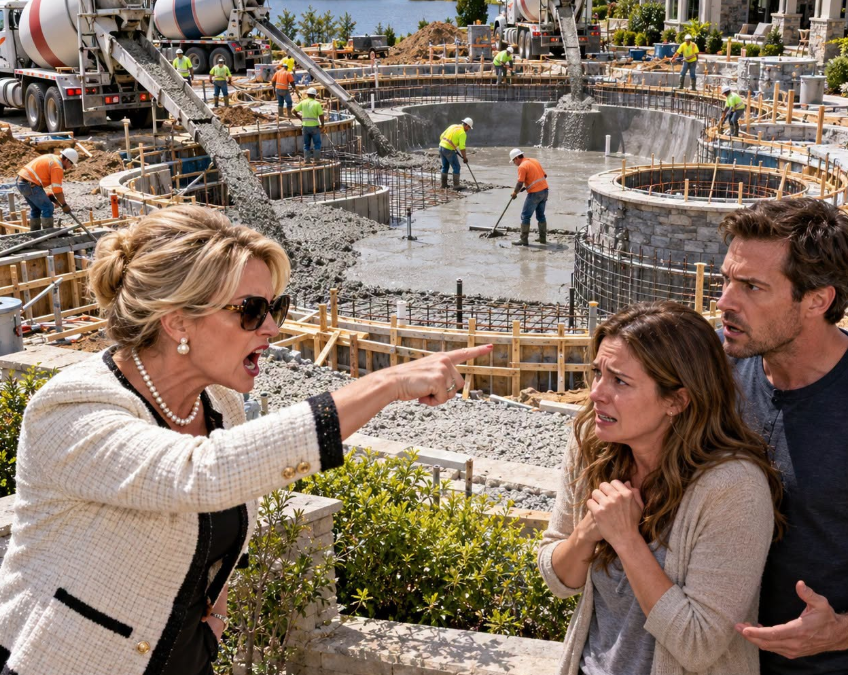
Tammy was the president of the Creekstone Estates HOA. She had held that position for years and behaved as if Creekstone had been granted to her by royal charter. She wore linen blazers when everyone else wore T-shirts. She carried a clipboard like a judge carried a gavel.
Her husband, Wade Breenidge, owned the development company that had built Creekstone.
That relationship should have made homeowners pay closer attention.
It didn’t.
Not yet.
According to Lee, Tammy pulled her white Escalade down our gravel driveway shortly after nine one morning and parked beside my old Silverado.
Then she knocked.
Lee opened the door.
Colton was eating cereal in the kitchen.
Tammy gave her a polished smile.
“Good morning, Lee.”
“Morning.”
“I wanted to speak to you about a few community concerns.”
Lee looked past her toward the road.
“We’re not part of Creekstone.”
Tammy laughed softly.
Not because anything was funny.
Because she wanted Lee to know she considered the objection childish.
“Technically, no,” she said. “But your property directly affects the neighborhood.”
“Technically?”
“You’re adjacent to us. What you do impacts property values.”
Lee folded her arms.
“What exactly are you talking about?”
Tammy glanced toward Colton’s sandbox.
“The toys.”
Lee actually thought she had misheard her.
“What toys?”
“The plastic slide. The sandbox. Things visible from the road.”
“My son plays with them.”
“I understand that. But we’ve received complaints.”
“From who?”
“I don’t disclose residents who raise concerns.”
There had been no complaints.
That much became obvious later.
But Tammy knew something important.
I was gone.
Lee was alone.
And people who enjoy controlling others have a talent for recognizing moments when resistance seems inconvenient.
That was week two.
By week three, Tammy had escalated.
A code enforcement officer showed up because somebody had reported an abandoned vehicle.
The abandoned vehicle was my 2004 Chevrolet Silverado.
It was inspected.
It started immediately.
Registration current.
Insurance current.
Nothing wrong with it except age, scratches, and the fact that Tammy apparently didn’t like looking at it.
A few days later, she cornered Lee near the mailbox.
“You really should consider parking that truck behind the barn.”
“Why?”
“It doesn’t fit the neighborhood aesthetic.”
“My husband likes that truck.”
“Your husband isn’t here.”
Lee stared at her.
Tammy smiled.
That sentence would stay with Lee for months.
Your husband isn’t here.
Not deployed.
Not serving.
Not working.
Not coming home eventually.
Just absent.
As though my absence had created an opening.
By week five, Tammy had moved beyond complaints about our property.
She started attacking Lee personally.
A woman from the Creekstone book club stopped Lee near a grocery store and awkwardly asked whether everything was okay at home.
Lee didn’t understand.
The woman hesitated.
Apparently, Tammy had mentioned that “different men” had been seen coming and going from my house after dark.
There had been one man.
Lee’s brother.
He had come over twice.
Once to replace a porch light.
Once to help move a broken washing machine.
That became a rumor.
The rumor became gossip.
The gossip spread because gossip always moves faster when people can pretend they are merely concerned.
Lee stopped being invited to neighborhood gatherings she had attended before my deployment. Mothers became strangely unavailable when she suggested playdates for Colton. People who had waved at her suddenly checked their phones when she walked past.
Then came the complaint that changed everything.
Child Protective Services.
Anonymous allegation.
Child neglect.
Someone claimed Colton had been left alone outside without supervision.
The truth was that he had been playing in our fenced backyard while Lee folded laundry inside the kitchen.
Twelve minutes.
She could see him through the window.
CPS still had to follow up.
That was their job.
The investigator found nothing.
House clean.
Food stocked.
Colton healthy.
No safety concerns.
Case closed.
But that wasn’t the point.
The point was fear.
The point was to make Lee feel watched inside her own home.
I learned later that she nearly called me at two in the morning after the CPS visit.
She sat on our bed with the phone in her hand.
My number on the screen.
She had been crying.
Then she saw a news alert about activity near our area of operations.
She imagined my phone vibrating while I was doing something dangerous.
She imagined me worrying about her when I needed to pay attention to the men beside me.
So she put the phone down.
She told herself she could handle it.
For nine months, she handled it.
And while Tammy kept her distracted with complaints, rumors, inspections, and fear, heavy machinery appeared behind the tree line.
Backhoes.
Dump trucks.
Concrete mixers.
Excavators.
Crews started arriving before seven in the morning. The reverse alarms woke Colton. Dust drifted across the pasture.
Lee assumed the work was happening on HOA common property.
Why wouldn’t she?
Nobody had notified her that the HOA had decided to build a resort-style pool complex on land belonging to us.
Nobody came to the door with a survey.
Nobody asked permission.
Nobody showed her plans.
Nobody said they intended to move a property line that had existed for six decades.
Tammy counted on Lee being overwhelmed.
She counted on me being overseas.
And she counted on nobody checking.
I came home in December.
Nine months after I left.
When the bus pulled into Fort Liberty, Colton spotted me before I found him.
He ran.
I barely had time to drop my bag before he hit me around the waist.
I lifted him.
He wrapped himself around me.
His hair smelled like shampoo.
His jacket smelled faintly like peanut butter.
After months of sand, fuel, sweat, hot metal, and dust, those ordinary smells nearly broke me.
Then I looked at Lee.
She was smiling.
But something was wrong.
She had lost weight.
A lot of it.
There were dark circles beneath her eyes. Her shoulders stayed slightly raised, like she was expecting someone to say her name sharply from behind.
I hugged her.
She held on longer than usual.
“You okay?” I whispered.
“Now I am.”
I assumed the deployment had simply been hard.
I had no idea how hard.
We put my bags in the truck.
Colton talked almost the entire drive home.
School.
A science project.
A kid named Mason who cheated at kickball.
A bird’s nest behind the shed.
Important six-year-old intelligence.
Lee was quieter.
I reached across the center console and squeezed her hand.
Then we turned onto our road.
I saw blue water through the trees.
At first, my brain rejected what my eyes were showing me.
There was a pool.
Not somebody’s backyard pool.
A full resort complex.
Large concrete deck.
Black wrought-iron fencing.
Rows of lounge chairs.
A pump house.
Landscaping.
A small clubhouse structure.
Stonework.
Lighting.
The kind of amenity developers put in brochures under phrases like luxury community living.
Except it was sitting where my grandfather’s pasture had been.
I slowed down.
Lee stopped talking.
I pulled onto the shoulder.
For maybe ten seconds, I didn’t move.
The winter sunlight reflected off the water.
Turquoise against brown December grass.
My grandfather’s old fence line was behind the pool now.
Not beside it.
Behind it.
I knew that fence.
I had replaced posts along it with him when I was twelve.
I knew where the corner marker sat beneath a loblolly pine.
I knew exactly how far that marker was from the creek.
And I knew exactly what I was looking at.
“Lee.”
Her hands folded in her lap.
“Yeah.”
“That’s our land.”
She nodded.
I looked again.
“That’s not close to our land.”
“I know.”
“That’s on it.”
“I know.”
I turned toward her.
She had already started crying.
Not dramatic crying.
No sobbing.
Just tears running down a face that looked exhausted from holding them back too long.
Then nine months came out of her in twenty minutes.
The complaints.
The truck.
The toys.
The rumors.
Her brother.
The CPS report.
The cancelled playdates.
The women who stopped speaking to her.
Tammy showing up.
Tammy warning her.
Tammy telling her I wasn’t there.
The construction.
Everything.
I listened.
Colton had fallen asleep in the back seat.
At one point, Lee said, “I didn’t want you worrying about this over there.”
I stared at the pool.
Families were not using it because it was December, but the pumps were running. Water moved through filters on my grandfather’s land. Concrete covered the place where he used to graze cattle.
Lee wiped her face.
“I thought it was their side.”
“Why wouldn’t you?”
“I should’ve checked.”
“No.”
“I should’ve—”
“No.”
She looked at me.
“You had enough.”
That was when she told me about Colton asking why kids didn’t come to our house anymore.
Something inside me changed.
Not exploded.
Settled.
There is a difference.
People sometimes assume anger means shouting.
Mine usually doesn’t.
The angrier I get, the quieter I become.
Because volume wastes energy.
Planning doesn’t.
At seven the following morning, I drove to the HOA office.
It had been converted from the original Creekstone model home.
Beige siding.
Decorative shutters.
American flag.
A brass sign near the door identifying it as the Community Management Center.
Tammy was behind the front desk.
She looked up.
For half a second, she looked surprised.
Then the expression vanished.
“Oh,” she said brightly. “Garrett. Welcome home.”
I walked to the desk.
“Thank you for your service.”
She extended her hand.
I left mine at my side.
“The pool.”
Her smile tightened slightly.
“What about it?”
“It’s on my property.”
“The community approved the pool last spring.”
“I didn’t ask who approved it.”
I leaned forward slightly.
“I said it’s on my property.”
She sat straighter.
“The association followed the proper procedures.”
“Who gave you permission to build on Sutton property?”
“Your wife.”
I stared at her.
Tammy opened a filing cabinet.
She didn’t search.
She knew exactly where the document was.
That interested me.
She pulled out one page and slid it across the desk.
There was Lee’s name.
There was a signature.
There was a date.
April 14.
There was a notary seal.
For a moment, I said nothing.
Then I noticed the first problem.
My wife dotted the letter i in her name with a little circle.
She had done it since high school.
Birthday cards.
Checks.
School forms.
Mortgage documents.
Grocery lists.
Didn’t matter.
A tiny circle.
The signature in front of me had a normal dot.
Then I saw the angle.
Wrong.
Pressure.
Wrong.
The capital L.
Wrong.
I tapped the page.
“This isn’t my wife’s signature.”
Tammy leaned back.
“It was notarized.”
“I can see the stamp.”
“The board relied on a properly executed consent form.”
“She didn’t sign this.”
Tammy crossed her arms.
“Then perhaps you should discuss that with her.”
I looked at her.
She knew.
I could see it.
Not guilt.
Confidence.
There are people who lie nervously.
Then there are people who have lied successfully for so long they consider your disbelief a character flaw.
Tammy belonged to the second category.
“The pool is coming off my land.”
For the first time, the smile disappeared.
“The board approved a substantial capital improvement based on this consent.”
“You can call it whatever you want.”
“You need to understand something, Sergeant Sutton.”
The use of my rank wasn’t respectful.
It was deliberate.
“You’ve been away. The community has continued developing. Property interests become complicated.”
“My property line isn’t complicated.”
“You may want to speak with an attorney before you start making demands.”
“I intend to.”
“Good.”
She put the document back on her desk.
“This community has significant resources. We protect our investments.”
I took my phone from my pocket.
Photographed the entire form.
Front.
Back.
Notary information.
Date.
Signature.
Then I looked at Tammy.
“Thank you, ma’am.”
That bothered her more than yelling would have.
I walked out.
From my truck, I called an Army friend named Ethan who worked as a paralegal.
“I need a property lawyer.”
“How bad?”
“Somebody built a four-hundred-thousand-dollar pool on my land while I was deployed.”
Silence.
Then, “You’re serious.”
“Completely.”
“Okay.”
“I also need somebody who doesn’t scare easily.”
“That part I can solve.”
His name was Daniel Kraton.
Sixty-two.
Former Army JAG.
Shaved head.
Reading glasses he seemed to look over more often than through.
His office smelled like paper, old wood, and coffee that had been sitting on the warmer since sunrise.
I gave him the deed.
Subdivision plat.
Photographs.
The forged consent.
Lee’s timeline.
He listened for less than ten minutes before removing his glasses.
“Let me make sure I understand this.”
I nodded.
“You’re outside the HOA.”
“Correct.”
“Your family has held title since 1962.”
“Correct.”
“You deployed.”
“Yes.”
“During that deployment, the HOA president repeatedly harassed your wife.”
“Yes.”
“Then her husband’s company constructed a roughly four-hundred-thousand-dollar swimming complex on your land using a consent document your wife says she did not sign.”
“Yes.”
He stared at me.
“Son, this isn’t an HOA dispute.”
“What is it?”
“A crime scene with landscaping.”
That was the first time I laughed since coming home.
Within a week, Kraton sent a formal demand. The HOA was instructed to stop further activity on my property and remove unauthorized improvements.
Tammy responded within forty-eight hours.
Not by negotiating.
By attacking.
Two sheriff’s deputies arrived at my house because she claimed I had threatened her.
I invited them inside.
Lee sat at the kitchen table.
I played the audio recording from my visit.
North Carolina permits one-party recording.
My voice was calm.
No threat.
No raised voice.
No profanity.
One deputy looked at the other.
Then at me.
“That’s the whole conversation?”
“Yes, sir.”
They left.
No charge.
Next came a letter from the HOA attorney, Phil Driscoll. He accused me of intimidating board members through “aggressive legal threats.”
Kraton read it once.
Then placed it on his desk.
“What exactly do they think a demand letter is?”
I shrugged.
“Apparently emotional violence.”
He almost smiled.
Then Tammy did something I could not laugh about.
She posted on the private Creekstone Facebook group.
A neighbor sent Lee a screenshot.
Tammy wrote about respecting “our brave troops,” followed by a warning about PTSD and how some veterans returned from deployments “changed.” Residents were encouraged to report concerning behavior near the Sutton property.
I read the post twice.
Then handed the phone back to Lee.
She watched me carefully.
“Garrett.”
“I’m fine.”
“No, you’re furious.”
“Yes.”
Using my military service to turn neighbors against me was bad enough.
Using PTSD as shorthand for dangerous was worse.
There were men I had served with who carried injuries nobody could see.
Good men.
Stable men.
Men who had done everything asked of them and then struggled when they came home.
Tammy had turned that into a neighborhood scare tactic.
Within days, people started avoiding us.
One mother cancelled a playdate with Colton.
Then cancelled another.
Then simply stopped answering.
One Thursday morning, Lee found folded notebook paper in our mailbox.
Purple ink.
Four words.
JUST MOVE. IT’S EASIER.
She placed it on the kitchen counter.
I found her staring at it.
“Where’d this come from?”
“Mailbox.”
“Camera catch anybody?”
“Not yet.”
I picked up the note carefully by the edge.
Lee poured coffee.
Her hand was steady.
That worried me more than shaking would have.
“They want us gone,” she said.
“No.”
“What?”
“They want us tired.”
She looked at me.
“There’s a difference.”
The HOA held an emergency meeting.
I wasn’t invited.
Technically, I wasn’t entitled to attend because I wasn’t a member.
At that meeting, Tammy convinced the board to authorize legal spending to “protect community assets.”
Community assets.
Meaning the pool built on my property.
They were going to spend homeowners’ dues fighting the owner of the land they had occupied.
Then Tammy called my chain of command.
My first sergeant, Dwight Patterson, summoned me.
I walked into his office.
He shut the door.
“Sutton.”
“First Sergeant.”
“You know somebody named Tammy Breenidge?”
“Yes.”
“She called battalion.”
I closed my eyes for a second.
“What’d she say?”
“That you’re threatening civilian women.”
“Of course.”
“She suggested the Army intervene before you become violent.”
He watched my face.
“Want to explain?”
I handed him a folder.
Property deed.
Consent form.
Survey photos.
Lee’s written chronology.
Tammy’s Facebook post.
He read everything.
Slowly.
Then he leaned back.
“Let me make sure I’ve got this straight.”
I waited.
“She built a pool on your land while you were deployed.”
“Yes.”
“Your wife says her signature was forged.”
“Yes.”
“This woman harassed your family for nine months.”
“Yes.”
“And now she’s calling your chain of command claiming you’re dangerous.”
“Correct.”
He closed the folder.
“Handle your business.”
“I intend to.”
“Legally.”
“Always.”
“If she calls here again, that end becomes my problem.”
That evening, I sat outside.
From the porch, I could see lights from the pool glowing blue through the trees. Even in the cold, they kept the pumps running.
Lee came out wearing a sweatshirt and sat beside me.
For a while, neither of us spoke.
Then she said, “Maybe we should sell.”
I turned toward her.
She kept looking at the lights.
“We could move.”
“Do you want to?”
“I want this to stop.”
That was different.
I looked toward one of my grandfather’s markers near the tree line.
SUTTON 1962.
“No.”
She looked at me.
“This is our home.”
“I know.”
“It’s our land.”
“I know.”
“And you didn’t do anything wrong.”
She swallowed.
“I know.”
“Then we’re not leaving because somebody decided bullying you would be easier than asking permission.”
She took my hand.
The next morning, I hired a surveyor.
Tom Caldwell had been licensed for three decades. He arrived with modern GPS equipment, a total station, survey stakes, and copies of the original 1962 plat.
He spent two days walking the property.
I watched him from a distance.
On the second afternoon, he called.
“Mr. Sutton, you need to see this.”
He had maps spread across his tailgate. The wind kept lifting the corners. He placed a thermos on one side and a box of stakes on the other.
Then he pointed.
“The pool isn’t partially encroaching.”
“How much?”
He looked at me.
“All of it.”
I thought I had misunderstood him.
“What do you mean, all?”
“The basin.”
His finger traced the outline.
“The deck.”
Another line.
“Pump house.”
Another.
“Half the parking area.”
He looked up.
“Every square foot of the pool facility itself is inside your parcel.”
I stared at the map.
“How far?”
“The encroachment occupies roughly point-four acres. Around seventeen thousand four hundred square feet.”
I looked toward the pool.
Tom shook his head.
“I’ve been doing this thirty years.”
“Ever seen anything like it?”
“Not remotely.”
He tapped the survey.
“This is either extraordinary incompetence or extraordinary arrogance.”
“I’m leaning toward arrogance.”
“So am I.”
I had the survey certified and recorded.
A copy went to Driscoll.
His response was desperate.
First, the HOA claimed a prescriptive easement.
Kraton read the argument and stared at the ceiling.
“They need twenty years.”
“How old’s the pool?”
“Six months.”
He drafted a one-paragraph response explaining exactly that.
Then Driscoll suggested the HOA might acquire rights through eminent domain.
That time Kraton laughed.
“A homeowners association thinks it has eminent domain authority.”
“I assume it doesn’t.”
“It absolutely does not.”
His reply warned that continued frivolous arguments could be forwarded to the State Bar.
I thought Tammy had reached the limit of absurdity.
I was wrong.
A week later, I received notice of a lien.
Forty-seven thousand dollars.
The Creekstone Estates HOA claimed I owed special assessments related to the pool because the amenity “benefited” my property as an adjacent parcel.
I stood in the kitchen reading the letter.
Then I started laughing.
Lee walked in.
“What?”
I handed it to her.
She read.
Her mouth opened.
“They built a pool on our property without permission.”
“Yes.”
“And now they’re billing us for it.”
“Forty-seven thousand.”
“Are they insane?”
“Possibly.”
Kraton was less amused.
“This matters.”
“How?”
“False lien. Slander of title. If we discharge it and show they had no legal basis, damages become significantly more serious.”
He explained the exposure.
Attorney fees.
Compensatory damages.
Potential enhanced damages depending on the claims and evidence.
Every time Tammy tried to tighten the pressure, she created another document.
Another record.
Another witness.
Another problem for herself.
That afternoon, something clicked.
For two months, I had been reacting.
Letter arrives.
We respond.
Complaint filed.
We respond.
Rumor spreads.
We defend.
That was not how I had been trained.
Engineers don’t simply stare at a bad problem and complain that somebody else created it.
We change the terrain.
That night, I opened a notebook.
At the top of the first page, I wrote three words.
INTELLIGENCE.
PREPARATION.
EXECUTION.
Lee read it over my shoulder.
“What are you doing?”
“Stopping.”
“Stopping what?”
“Playing defense.”
The first thing I needed was information.
I hired Sandra Whitfield.
Forensic accountant.
Fifteen years investigating nonprofit and HOA finances.
Gray hair.
Reading glasses on a beaded chain.
Quiet voice.
Zero patience for financial nonsense.
I explained the situation.
She listened.
Then she asked, “Can we access the association’s books?”
“I’m not a member.”
“One of the homeowners can request them.”
A retired teacher named Dorothy Haynes had privately reached out after Tammy’s PTSD post. She had lived in Creekstone for years. She wasn’t loud. Didn’t like confrontation.
But she hated dishonesty.
When we explained what Sandra needed, Dorothy didn’t hesitate.
“I’ll request everything.”
Tammy tried to delay.
Kraton sent a statutory records-demand letter.
The HOA produced the documents on the ninth day.
Sandra disappeared into them.
Three weeks later, she called us into her office.
She had organized everything in binders.
“I found problems.”
Kraton leaned forward.
“How many?”
Sandra looked at him over her glasses.
“How much time do you have?”
The first problem was the pool itself.
No building permit.
No county plan review.
No electrical inspection.
No plumbing inspection.
No certificate of occupancy.
Nothing.
A commercial-scale swimming facility had been built and opened to residents without the required county process.
The second problem was worse.
The HOA reserve fund had held approximately six hundred eighty thousand dollars.
Four hundred thousand had been approved for the pool.
But Sandra traced actual construction payments.
Roughly one hundred eighty thousand dollars had reached legitimate subcontractors.
The remaining two hundred twenty thousand had gone elsewhere.
Three companies.
All shells.
All connected to Wade Breenidge.
One shared an address with his mother’s house.
Another used a post office box linked to his personal accounts.
The money had moved in circles until it ended up under his control.
I stared at the numbers.
“Two hundred twenty thousand.”
Sandra nodded.
“Approximately.”
“Homeowners’ money.”
“Yes.”
Kraton asked, “Can you document the flow?”
Sandra gave him a look that almost seemed offended.
“I already did.”
Then she opened another folder.
“This is the part you need to see.”
The forged consent form lay inside a protective sleeve.
She pointed at the notary seal.
Helen Avery.
Sandra had checked the commission.
Then she checked county records.
Then the obituary archive.
Helen Avery had died of pancreatic cancer twenty-six months before the date on the supposed consent form.
I felt my jaw tighten.
“You’re sure?”
Sandra turned the death certificate toward me.
“Completely.”
Someone had used a dead woman’s notary stamp to authenticate my wife’s forged signature.
It was no longer merely a property dispute.
It was forgery.
Fraud.
Potential embezzlement.
Tampering with legal documents.
Kraton looked at me.
“We can take this to the district attorney.”
“Not yet.”
He frowned.
“You have enough.”
“I know.”
“Then why wait?”
I looked at the photograph of Tammy’s pool.
Because by then, I had another idea.
“What kind of land is mine zoned?”
“Agricultural.”
“Still?”
“As far as I know.”
I smiled.
Kraton stared at me for several seconds.
Then his eyes narrowed.
“What are you planning?”
“Something agricultural.”
For the next three days, I spent hours at the county agricultural extension office.
I studied land-use rules.
Waste management requirements.
Setbacks.
Farm registration.
Environmental compliance.
North Carolina’s right-to-farm protections.
My twelve acres had been agricultural land since my grandfather owned them. That classification had never been changed.
Legitimate agricultural operations were protected from certain nuisance claims by neighboring residential development.
Which made sense.
You cannot build houses beside a farm and then demand that the farm stop behaving like a farm because dirt, animals, tractors, flies, or manure offend your landscaping preferences.
I kept reading.
Then I found what I needed.
Livestock waste management.
A properly designed agricultural lagoon.
Permitted.
Regulated.
Legal.
Lee found me at the kitchen table surrounded by paperwork.
She picked up one brochure.
“No.”
I looked at her.
“You don’t even know what I’m thinking.”
“I married you.”
“Fair.”
She read the heading.
“A manure lagoon?”
“Waste management lagoon.”
“Garrett.”
“Official terminology matters.”
She tried not to smile.
Failed.
“You are not putting a manure pond next to that pool.”
“No.”
“Good.”
“I’m putting a properly engineered agricultural waste management facility near my livestock operation.”
She stared at me.
“You’re enjoying this.”
“A little.”
I bought four cattle.
Two Hereford cows.
One Angus bull.
And a calf.
Colton named the calf Biscuit before it had been on our property fifteen minutes.
“Why Biscuit?”
“Because he looks like a Biscuit.”
There was no argument against that level of six-year-old certainty.
I registered the operation.
Sutton Heritage Farm.
Twelve acres.
Beef cattle.
Then I submitted plans for a waste lagoon.
I did not hide anything.
I did not cut corners.
I did not falsify paperwork.
I did not need to.
The proposed location was on the southeast portion of my property.
About fifty feet from the pool fence.
Far beyond the required setback from any residence.
The pool was not a residence.
It was also, according to county records, an unpermitted structure on land I owned.
The permit was approved.
Next came cameras.
Eight weatherproof units.
Doorbell camera.
Trail cameras.
Infrared.
Cloud backup.
Every approach.
Every fence line.
Every relevant angle.
Lee watched me mount one high in a tree.
“Expecting trouble?”
“I already have trouble.”
Then I met with Assistant District Attorney Jennifer Holt.
I delivered the forensic accounting report.
The consent form.
Notary evidence.
Permit records.
Survey.
Lien documents.
She read quietly.
When she finished, she closed the folder.
“This is substantial.”
“Yes, ma’am.”
“Forgery is obvious. Financial fraud appears supportable. Embezzlement may depend on additional records, but the accounting is strong.”
“I understand.”
“We can begin immediately.”
“Please do.”
She looked at me.
“But?”
“I’d like sixty days.”
“Why?”
“I want them comfortable.”
She leaned back.
“That isn’t how victims usually talk.”
“I’m an engineer.”
“That does not answer my question.”
“I want them to believe they’re still controlling the situation.”
She studied me.
“If they start destroying evidence, we act.”
“Absolutely.”
“If anyone attempts to flee, we act.”
“Agreed.”
“Sixty days.”
“Thank you.”
My next call was to Beth Anne Crawford, an investigative reporter who had previously written about HOA abuse.
I gave her the background.
Off the record.
Not ready for publication.
She listened.
Then said, “This is enormous.”
“Eventually.”
“When?”
“I’ll call.”
The following Saturday, an excavator arrived.
Lee stood at the kitchen window.
Colton ran outside in rubber boots.
“Dad!”
I shut down the machine.
“What?”
“Are we getting more cows?”
“Not today.”
“What are you digging?”
“A lagoon.”
“For swimming?”
I looked toward the HOA pool.
“Definitely not.”
He nodded as if that made perfect sense.
The excavation took two weekends.
Forty feet by sixty.
Eight feet deep.
Compacted liner.
Correct grading.
Drainage.
Proper berms.
I built it the same way I built anything that carried consequences.
Correctly.
By early April, the cattle were settled.
The waste system was functional.
Spring temperatures began climbing.
And biology started doing exactly what biology does.
Four cattle produce a remarkable amount of manure.
In cool weather, the smell was manageable.
Once Carolina temperatures rose past eighty degrees, things became more expressive.
The pool sat fifty feet away.
I knew the exact moment Tammy discovered the lagoon.
I was grading an access strip when her Escalade stopped so abruptly on the subdivision road that dust rolled past the rear bumper.
The door flew open.
Tammy got out.
Linen blazer.
Large sunglasses.
Anger radiating off her hard enough to power a small appliance.
She marched to the boundary.
“What the hell are you doing?”
I shut down the machine.
Climbed out.
Took off my gloves.
“Good morning, Tammy.”
“What is that?”
“An agricultural waste management lagoon.”
“You built a sewage pit beside our pool?”
“No.”
“Yes, you did!”
“No. Sewage generally refers to human wastewater. This is livestock waste.”
Her face changed.
“That is disgusting.”
I pointed toward the cattle.
“Farm animals produce manure.”
“You did this deliberately.”
“I filed plans deliberately.”
“You cannot put that next to a children’s pool!”
“It meets the approved setback.”
“I will have this shut down.”
“You’re welcome to contact the county.”
“I already will.”
“Good.”
I started climbing back into the machine.
She shouted, “You think this is funny?”
I turned.
“No.”
For the first time, I let her see exactly how angry I still was.
“I think you harassed my wife while I was deployed. I think you dragged my son into it. I think you built a pool on land your organization never owned. I think you showed me a document my wife didn’t sign. And I think every time you’ve had an opportunity to fix this, you’ve chosen to make it worse.”
Her mouth tightened.
“You’re threatening me again.”
“No.”
I climbed into the cab.
“I’m explaining the situation.”
Within twenty-four hours, the complaints started.
HOA cease-and-desist.
County health department.
Environmental regulators.
State agencies.
Even a federal environmental hotline.
Inspectors arrived.
I greeted every one of them.
Showed permits.
Farm registration.
Design specifications.
Setbacks.
Livestock records.
Maintenance plan.
No hidden pipes.
No illegal discharge.
No contamination of neighboring waterways.
One inspector stood near the lagoon studying the berm.
“You build this yourself?”
“Yes.”
“What do you do?”
“Army combat engineer.”
He nodded.
“That explains the compaction.”
He left without citing anything.
So did the others.
Tammy was learning an unpleasant lesson.
Regulations are difficult to weaponize against someone who actually follows them.
Then somebody cut my fence.
The trail camera activated at 2:37 in the morning. A hooded figure approached the southeast boundary carrying bolt cutters.
Three cuts.
Twenty feet of wire fell.
The person’s face wasn’t clear.
But pale hair slipped from beneath the hood.
Another camera caught a white Escalade parked farther down the road.
Chrome wheels reflected moonlight.
I did not drive to Tammy’s house.
I did not knock on her door.
I did not shout.
I saved the footage.
Three cloud backups.
Then I called law enforcement.
Report filed.
Fence repaired.
More cameras installed.
A week later, the HOA requested an emergency temporary restraining order against my farm.
Judge Patricia Stokes heard the motion.
Driscoll stood before the court describing my lagoon as a public health threat.
Children.
Odors.
Biological hazards.
Property values.
When he finished, Kraton stood.
He introduced the farm registration.
County approval.
Engineering documents.
Setback measurements.
Inspection reports.
Then the certified survey showing where the pool sat.
Judge Stokes read silently.
Finally, she looked at Driscoll.
“Counselor.”
“Yes, Your Honor.”
“Your client constructed a swimming pool on Mr. Sutton’s land.”
“We dispute certain aspects—”
“The certified survey appears fairly clear.”
“Yes, but—”
“Without his consent.”
“The association relied upon a consent document.”
“Which is itself disputed.”
“Yes.”
“And the pool was constructed without a county permit?”
Driscoll hesitated.
“That is an administrative issue.”
The judge looked over her glasses.
“And now your client wants this court to prevent Mr. Sutton from conducting a permitted agricultural activity on his own agricultural property because it interferes with an unpermitted pool your client constructed on his land.”
Silence.
Driscoll shifted his papers.
“Your Honor, the health implications—”
“Have regulators cited the farm?”
“No.”
“Have inspectors found violations?”
“No.”
“Has the lagoon been permitted?”
“Yes.”
“Motion denied.”
Kraton did not look at me.
He didn’t have to.
As we walked out, he whispered, “Try not to smile until we’re outside.”
By late April, nobody used the pool.
The smell became strongest on hot afternoons.
Someone posted in the HOA Facebook group asking whether something was wrong with the pool water.
Another resident responded:
No. That’s the cattle lagoon fifty feet away.
Tammy deleted the thread.
Screenshots survived.
Around the same time, cracks began forming inside the Breenidge household.
Dorothy lived close enough to hear arguments from their backyard.
She didn’t intentionally spy.
They simply stopped speaking quietly.
Wade wanted to settle.
Tammy refused.
According to Dorothy, Wade shouted one evening, “Offer him two hundred thousand! Offer him an easement! Offer him anything!”
Tammy’s reply was louder.
“I don’t settle.”
That sentence told me everything.
People like Tammy don’t necessarily believe they are right.
Sometimes they simply believe they cannot be challenged.
For years, compliance had looked like proof of authority.
People paid fines.
People changed paint colors.
People moved trash cans.
People apologized.
People learned that arguing cost more energy than surrendering.
Eventually, Tammy mistook exhaustion for consent.
But my situation was different.
She wasn’t telling me to repaint a mailbox.
She had taken land.
She had forged paperwork.
And she had targeted my family during deployment because she assumed my absence made them vulnerable.
Wade understood the stakes before Tammy did.
Later, prosecutors recovered search history showing that he had looked up felony sentencing ranges.
Embezzlement.
Forgery.
Fraud.
Conspiracy.
He knew.
Tammy responded by going door to door.
Two hundred eighteen homes.
She carried a petition demanding that county officials remove the “agricultural health hazard.” She described me as a disturbed veteran. She claimed I was exploiting agricultural rules to intimidate children.
Eighty-seven homeowners signed.
The petition went to county commissioners.
The county reviewed my permits.
Registration.
Inspection reports.
Zoning.
Then issued a short response.
My operation was lawful.
The county had no authority to revoke a permitted agricultural use simply because nearby residents disliked it.
Case closed.
Tammy still wasn’t finished.
She called a Raleigh television station.
A reporter arrived.
Tammy stood near the Creekstone entrance giving an interview about children being exposed to a “sewage pit.” She spoke with the confidence of someone expecting the story to end where she wanted it to end.
What she didn’t know was that journalists talk.
Beth Anne Crawford already knew the background.
The television reporter had context before the camera ever turned on.
That evening, Lee and I watched the segment.
Tammy appeared first.
She talked about safety.
Children.
Property values.
An unstable neighboring landowner.
Then the reporter pivoted.
County records, she explained, showed that the pool itself had no recorded building permit. A certified survey identified the land beneath the pool as belonging to me. My agricultural operation had valid approval. The district attorney’s office declined to discuss an ongoing investigation involving HOA finances.
Then came the interview that destroyed Tammy’s narrative.
The reporter asked her directly about the construction permit.
Tammy blinked.
“Well, the board approved the project.”
“That wasn’t my question.”
“The community voted.”
“Did the county issue a building permit?”
“Our contractor handled—”
The segment cut to a county official.
No permit had been issued.
Lee handed me a beer.
We watched Tammy’s face freeze on television.
For the first time since I had returned, Lee laughed.
Not politely.
Actually laughed.
I had forgotten how much I missed that sound.
Tammy’s final administrative attack came days later.
She challenged my agricultural tax status.
Claimed Sutton Heritage Farm wasn’t legitimate.
Tax officials reviewed the file.
Registered cattle.
Feed receipts.
Veterinary records.
Fencing.
Farm registration.
Waste management plan.
Equipment.
Agricultural zoning.
Challenge denied.
Six business days.
Then Jennifer Holt called.
“Mr. Sutton.”
“Yes, ma’am.”
“The grand jury returned indictments.”
I stopped what I was doing.
“For both?”
“Yes.”
She listed them.
Forgery.
Fraud-related offenses.
Embezzlement.
Conspiracy.
Vandalism.
Additional charges remained possible depending on final evidence.
“We’re ready to execute warrants.”
“When?”
“That can be arranged.”
I thought about the HOA.
About the homeowners whose money had been stolen.
About the people who had believed Tammy because she controlled the information.
About Lee sitting alone after the CPS complaint.
About Colton asking why his friends stopped coming over.
“There is an HOA meeting Thursday.”
Silence.
“Seven o’clock,” I added.
Another pause.
“You want arrests made at the meeting.”
“I want every homeowner whose money funded that pool to understand what happened.”
“Mr. Sutton—”
“They deserve to see the evidence before rumors take over.”
She considered it.
“I’ll speak to the sheriff.”
Thursday evening, Creekstone’s clubhouse was packed.
Approximately one hundred forty residents came.
People stood along walls.
Some remained in the hallway.
Others brought folding lawn chairs and sat outside.
Something had spread through the neighborhood.
Nobody knew exactly what.
Tammy sat behind the front table.
Perfect hair.
Pearl earrings.
Linen blazer.
Wade sat beside her wearing a navy polo shirt.
He looked terrible.
Thinner.
Sweat visible between his shoulders.
His knee bounced beneath the table.
Near the back sat Sheriff Randall Tate and Deputy Owens.
Plain clothes.
Badges hidden.
Watching.
I sat near the rear with Lee.
She squeezed my hand once.
Tammy called the meeting to order.
Then spoke for nearly fifteen minutes.
Community standards.
Threats to property values.
Children’s health.
The “aggressive agricultural operation” next door.
Legal options.
Emergency litigation.
She had printed photographs of my lagoon.
When she proposed a vote authorizing additional legal expenses against me, I stood.
“Before you spend more of these people’s money, I’d like to show them what they’re paying for.”
Heads turned.
Tammy’s face tightened.
“This is an HOA meeting, Mr. Sutton.”
“Yes.”
“You are not a member.”
“No.”
“Then you do not have the floor.”
I looked at the homeowners.
“Your association built a four-hundred-thousand-dollar structure on my property and is proposing to use your money to defend it. I think you deserve to know what happened.”
Someone near the front said, “Let him speak.”
Another voice joined.
“Yeah.”
“Let him talk.”
Tammy struck the gavel.
“This meeting will remain orderly.”
I walked toward the front.
Lee handed me a roll of masking tape.
I unfolded the certified survey.
Three feet wide.
Taped it to the wall.
“This is the original Sutton parcel.”
I pointed.
“My grandfather purchased it in 1962.”
Then the pool outline.
“This is your community pool.”
The room went quiet.
“The pool is not partially over the line.”
I traced the survey.
“The entire basin is on Sutton property.”
Murmurs started.
“The deck is on Sutton property.”
Louder.
“The pump house is on Sutton property.”
Someone stood.
“The pool parking area extends onto it too.”
A man near the aisle shouted, “How the hell did that happen?”
Tammy hit the gavel.
“This survey is contested.”
“No, it isn’t.”
I held up the recorded certification.
“It was completed by a licensed surveyor and filed with the county.”
Wade looked down.
I reached into my folder.
“But that’s not the worst part.”
I held up the consent form.
“This is the document the board says authorized construction.”
Tammy’s jaw tightened.
“My wife’s name appears here.”
I held up copies of our mortgage paperwork.
“This is Lee’s actual signature.”
I placed them side by side.
“You can compare them yourself.”
People leaned forward.
“But the signature isn’t even the biggest problem.”
I pointed at the seal.
“This document was supposedly notarized by Helen Avery.”
Someone whispered the name.
I looked around the room.
“Helen Avery died twenty-six months before the date on this consent.”
The room stopped breathing.
It felt that quiet.
“Someone used the stamp of a dead notary to authenticate a document my wife never signed.”
Tammy stood.
“This is defamatory!”
I ignored her.
“Now let’s talk about the four hundred thousand dollars.”
That got everyone’s attention.
I lifted Sandra’s audit summary.
“Your reserve fund held roughly six hundred eighty thousand dollars.”
A homeowner shouted, “We know that.”
“Four hundred thousand was approved for the pool.”
“Yes.”
“Actual construction payments totaled approximately one hundred eighty thousand.”
The room changed.
People looked at each other.
I let the number sit.
“One hundred eighty thousand.”
Then I raised the report.
“The remaining approximately two hundred twenty thousand dollars went to three companies connected to Wade Breenidge.”
Wade stopped bouncing his leg.
“Shell companies.”
Someone cursed.
“One registered to an address linked to his family. Another connected through a post office box used for personal business.”
People stood.
Voices rose.
I continued.
“That’s roughly eleven hundred dollars from every household represented by this association.”
Chaos.
“You stole from us!”
“Where’s the money?”
“Tammy!”
“Wade!”
Tammy shouted over everyone.
“These are lies!”
I looked at Lee.
She nodded.
I connected my phone to the projector.
The screen changed.
Black-and-white infrared footage.
Timestamp visible.
2:37 A.M.
A hooded person walked toward my fence.
Bolt cutters opened.
Closed.
Wire dropped.
The figure moved.
A strand of light hair escaped the hood.
Then the next camera angle showed a vehicle farther down the street.
White Escalade.
Chrome wheels.
I paused the image.
“This is security footage from my property.”
Tammy’s face went white.
“The person in this video cut my fence.”
Nobody spoke.
Sheriff Tate stood.
He opened his shirt enough for the badge to show.
“Wade Breenidge.”
Wade didn’t move.
The sheriff repeated his name.
“Stand up.”
Deputy Owens stepped closer.
Wade’s chair scraped against the floor.
His hands shook.
“Mr. Breenidge, you are under arrest.”
Tammy screamed.
“What?”
“Forgery, fraud, and embezzlement.”
“This is insane!”
Owens turned Wade around.
Handcuffs closed.
Tammy started pushing away from the table.
Sheriff Tate faced her.
“Mrs. Breenidge.”
“No.”
“Please stand.”
“You cannot do this.”
“Stand.”
“I will sue you.”
“Mrs. Breenidge.”
She pointed at me.
“He set this up! This is entrapment!”
I said nothing.
She looked around the room for support.
For eight years, those homeowners had watched her command meetings.
Issue violations.
Fine neighbors.
Control committees.
Decide what color doors could be painted.
Decide whose landscaping was acceptable.
Decide who belonged.
Now nobody moved to help her.
The sheriff said, “You are under arrest for conspiracy-related offenses and felony vandalism.”
The second set of cuffs closed.
The sound was small.
Metal against metal.
Yet in that room, it seemed louder than every argument of the previous year.
As deputies began escorting them toward the door, Kraton stood.
“One additional matter.”
People turned.
He held a county notice.
“The building inspector has issued an order concerning the unpermitted swimming pool.”
Tammy stopped walking.
“The structure must be removed.”
The room erupted again.
This time, she had nothing left to say.
The legal process took months.
It was slower and less dramatic than the arrests.
Real consequences usually are.
Wade eventually pleaded guilty to serious forgery and embezzlement charges. He received a custodial sentence. Assets connected to the fraud were traced. Shell companies were dissolved. Recoverable funds were returned to the association.
Tammy resolved her criminal case separately. She received probation, community service, and restitution obligations connected to what had been done to my property.
But prison time was not the only consequence.
For Tammy, losing control may have hurt more.
She was removed from every position.
No presidency.
No committee.
No authority.
No microphone.
No gavel.
No people waiting for her approval.
The remaining board members resigned soon after.
Creekstone held new elections.
Dorothy Haynes was elected.
Her first request at the first meeting was simple.
“Can we start acting like neighbors instead of a government?”
Apparently, everybody agreed.
The new board cancelled every bogus fine that had been issued against Lee. They hired outside professional management. Independent accounting controls were established. Recovered money was distributed back to homeowners where possible.
Approximately eleven hundred dollars per household was ultimately associated with the funds taken through the fraudulent pool scheme.
Then came the pool.
Ninety days after the order, demolition equipment rolled onto my property.
I stood near the barn with Lee.
A hydraulic breaker smashed through the concrete deck.
Pieces fell inward.
The wrought-iron fence came down.
Lounge chairs disappeared.
The pump house was removed.
Then the pool shell cracked.
For months, that blue water had felt like an insult visible from my kitchen window.
Now concrete shattered into manageable pieces.
Truckloads left.
Red clay returned.
The hole was filled.
Compacted.
Graded.
Seeded.
Lee brought me coffee.
We stood together without saying much.
There was no cheering.
No speech.
No victory pose.
Just relief.
She leaned against me.
“You okay?” she asked.
I watched another bucket of broken concrete disappear into a dump truck.
“Yeah.”
“You don’t look happy.”
“I am.”
“Could’ve fooled me.”
I looked at her.
“I just keep thinking about you sitting here alone while I was gone.”
Her expression changed.
“I survived.”
“I know.”
“So did you.”
I nodded.
“I should’ve called you.”
“No.”
“I should have.”
“You made the decision you thought kept me safe.”
She looked toward the flattened pool site.
“And look how that worked out.”
I laughed quietly.
She smiled.
That mattered more to me than the demolition.
The civil case eventually settled for two hundred eighty-five thousand dollars.
Property damage.
Trespass.
Legal expenses.
Claims connected to the harassment and emotional harm Lee endured.
Insurance covered much of the settlement under the association’s applicable policy structure.
By then, however, money was almost secondary.
I wanted the land restored.
I wanted the forged documents exposed.
I wanted Lee to stop checking through the curtains every time a car slowed near our driveway.
I wanted Colton to stop wondering why adults he barely knew seemed angry at his family.
Most of all, I wanted the message to be clear.
Deployment was not abandonment.
A service member leaving home to do his job does not create an invitation for somebody else to take his property.
Sutton Heritage Farm remained operational.
That part surprised even me.
Originally, the cattle had been part of the strategy.
Legal agriculture on agricultural land.
A reminder that Tammy did not get to transform my grandfather’s property into whatever amenity she preferred.
But I liked having cattle again.
It reminded me of my grandfather.
So I bought two more.
Colton became obsessed.
He wanted to help feed them before school.
Biscuit followed him along the fence.
On Saturdays, we began selling beef at the local farmers market.
Lee developed a beef jerky recipe people kept coming back for.
Our booth started small.
Coolers.
Folding table.
Handwritten price signs.
Then regular customers appeared.
The lagoon stayed.
Properly maintained.
Properly regulated.
No longer fifty feet from an HOA swimming pool because there was no pool anymore.
It had served two purposes.
Agriculture.
And education.
Lee changed too.
Not instantly.
Recovery doesn’t work like that.
For months, certain things still bothered her.
Unexpected knocks.
Official envelopes.
Unknown phone numbers.
She had spent almost a year being taught that every normal part of life might become evidence against her.
A toy in the yard.
A truck.
A relative visiting.
Her son playing outside.
That kind of stress rewires your sense of safety.
She eventually joined a military spouse support group at Fort Liberty.
At first, she barely talked about what happened.
Then another spouse mentioned an HOA threatening fines while her husband was deployed.
Lee leaned forward.
That became the beginning.
She helped develop a simple guide for military families.
How to document harassment.
How to preserve notices.
When to contact legal assistance.
How to understand the difference between HOA authority and private-property rights.
Why spouses shouldn’t assume every official-looking letter is legally valid.
The guide circulated through family readiness channels.
Thousands downloaded it.
I watched her become the person she had needed during those nine months.
That was one of the few good things Tammy created without intending to.
I used fifty thousand dollars from the settlement to help establish the Homefront Legal Defense Fund.
The goal was straightforward.
Free initial legal assistance for military families dealing with abusive HOA actions, predatory fines, or property disputes during deployments.
We coordinated with lawyers willing to donate hours. Military legal offices helped point families toward appropriate resources.
During the first year, we helped twenty-three families across North Carolina.
Some cases were minor.
Bad fines.
Overreaching letters.
Selective enforcement.
Others were not.
Three ultimately contributed to board removals.
One involved a deployed Marine whose HOA was moving toward foreclosure over several thousand dollars in accumulated penalties while he was stationed in the Pacific.
That case stayed with me.
Because I knew how easily a stack of paper can become a weapon when the person supposed to defend the home is thousands of miles away.
Military families become experts at absence.
Birthdays missed.
Anniversaries delayed.
Broken appliances handled over video calls.
Children getting sick while one parent is unreachable.
Cars refusing to start.
Roofs leaking.
School problems.
Everything still happens.
Deployment doesn’t pause ordinary life.
It simply removes one person from the household and tells everybody remaining to carry more weight.
Tammy understood that vulnerability.
She just misunderstood what it meant.
She saw Lee alone and thought defenseless.
She saw me deployed and thought irrelevant.
She saw old farmland beside a new subdivision and thought available.
She saw a forged signature and thought official-looking paper could replace consent.
She saw HOA money and thought homeowners would never ask where it went.
She saw my uniform and later thought she could turn the stereotype of an unstable veteran against me.
Every calculation depended on the same assumption.
Nobody would check.
But I checked.
The surveyor checked the land.
Sandra checked the money.
The county checked the permits.
The state checked the farm.
The judge checked the law.
The district attorney checked the evidence.
The homeowners finally checked the people they had trusted.
And once that happened, Tammy’s power vanished remarkably fast.
People like her depend on confusion.
They need neighbors unsure of their rights.
Boards unsure of finances.
Residents afraid of legal fees.
Families too tired to fight.
Documents nobody reads carefully.
Meetings nobody attends.
Questions nobody asks.
The moment everyone begins checking, the illusion becomes difficult to maintain.
Sunday mornings became my favorite again.
No convoy schedules.
No attorneys.
No certified letters.
No HOA meetings.
Just home.
I would sit on the porch with Lee while the sun came over the tree line.
Colton usually didn’t sit long.
Six-year-olds consider sitting a design flaw.
He would run toward the pasture with feed.
Biscuit would come over.
The other cattle followed.
The creek caught the morning light along the western edge.
The old barn still leaned slightly to the left no matter how many times I repaired it.
The concrete boundary markers remained where my grandfather put them.
SUTTON 1962.
The lagoon gradually looked less dramatic. Duckweed formed over parts of the surface. Grass grew around the berm. From a distance, it became just another piece of farm infrastructure.
Where the pool had stood, there was eventually nothing but grass.
The first time Colton noticed how completely it had disappeared, he stopped beside me.
“Dad?”
“Yeah?”
“Where was the pool?”
I pointed.
“Right there.”
He squinted.
“Really?”
“Really.”
“It looked bigger.”
“It was.”
He stood quietly.
Then asked the question I knew would come eventually.
“Why did that lady build it here?”
I looked at him.
There are answers adults give children because children are too young to understand complexity.
Then there are moments when the simplest answer is also the most accurate.
“She thought she could take something that wasn’t hers.”
“Why?”
“Because I was far away.”
He frowned.
“But Mom was here.”
“I know.”
“She should’ve asked Mom.”
“Yes.”
“And Mom would’ve said no.”
“Exactly.”
He thought about that.
“Then why didn’t she listen?”
I looked toward the place where the pool had been.
“Because some people get used to hearing yes.”
Colton kicked at the grass.
“So what happens when you tell them no?”
I smiled.
“Sometimes they learn.”
“Did she?”
I considered that.
“I hope so.”
He looked toward the cattle.
Then back at me.
“Did we win?”
Lee was standing on the porch behind us.
I knew she could hear.
I thought about the arrests.
The settlement.
The demolished pool.
The returned money.
The cattle.
The legal fund.
All the obvious things that looked like winning.
Then I thought about nine months Lee would never get back.
The nights she cried without calling me.
The CPS investigator in our house.
The mothers who cancelled playdates.
The fear every time somebody drove slowly past.
There are victories that repair damage.
There are none that erase it.
So I crouched beside him.
“We kept our home.”
He nodded.
“We kept our land.”
Another nod.
“And we’re together.”
He smiled.
“Then yeah,” I said. “We won.”
He ran toward Biscuit.
Lee came down the porch steps.
She slipped her hand into mine.
For a while, we stood there watching him.
Behind us, the screen door tapped softly in the breeze.
Cattle moved through the pasture.
Pine branches shifted overhead.
The morning smelled like grass, soil, livestock, and coffee.
Nothing luxurious.
Nothing designed by a developer.
Nothing approved by an HOA board.
Just twelve acres my grandfather bought in 1962.
Twelve acres somebody had decided she could take because the man who owned them happened to be serving his country somewhere else.
She had expected intimidation to work.
She expected Lee to stay quiet.
She expected me to come home tired.
She expected a forged sheet of paper to end the argument.
She expected homeowners to trust her.
She expected authorities to accept her version first.
She expected money and position to make resistance too expensive.
What she never expected was patience.
I didn’t tear down her pool in the middle of the night.
I didn’t threaten her.
I didn’t ram a bulldozer through the clubhouse.
I didn’t give her the unstable veteran she tried so hard to invent.
I documented.
I surveyed.
I audited.
I permitted.
I recorded.
I waited.
Then I let every decision she had made become evidence against her.
That is what she misunderstood about engineers.
Our job isn’t simply destroying obstacles.
Most of the time, our job is understanding systems.
Loads.
Pressure.
Weak points.
Consequences.
Tammy had built her power like a badly designed bridge.
Too much weight concentrated on too little integrity.
For years, it stood because nobody tested it.
Then she put one more load on it.
My land.
My wife.
My son.
That was the load the structure couldn’t carry.
People sometimes ask whether the lagoon was revenge.
Maybe part of it was.
I’d be lying if I claimed otherwise.
I knew exactly where that pool sat.
I knew exactly what Carolina heat would do.
I knew Tammy would despise every second of it.
But it was also legal.
Permitted.
Functional.
Useful.
The lagoon didn’t destroy Tammy.
She did that herself.
The forged signature did more damage than manure ever could.
The dead notary’s seal did more damage.
The missing permits did more damage.
The stolen two hundred twenty thousand dollars did more damage.
The false lien.
The fabricated complaints.
The vandalized fence.
The attempt to weaponize my chain of command.
The petition.
The television interview.
Every one of those choices belonged to her.
I simply stopped protecting her from the consequences.
Years later, I still pass those concrete markers sometimes.
The lettering isn’t as sharp now.
Weather softens everything eventually.
But you can still read it.
SUTTON 1962.
Whenever I see those words, I think about my grandfather.
About the rule he taught me when I was a kid.
This side is ours.
That side belongs to somebody else.
Respect both.
Tammy could have avoided everything by following that one rule.
Instead, she spent four hundred thousand dollars building a monument to the belief that other people’s boundaries mattered only when she approved of them.
For less than the cost of one survey, she could have known.
For one honest conversation, she could have stopped.
For one apology, early enough, she might even have found a reasonable solution.
Instead, she forged consent.
Then defended the forgery.
Then lied.
Then threatened.
Then retaliated.
Then kept going after every exit was clearly marked.
So when people hear the story and laugh about the cattle lagoon beside the luxury pool, I understand why.
There is something almost poetic about it.
A woman built a resort on agricultural land she didn’t own.
The agricultural land responded by becoming agricultural again.
But the smell was never the real lesson.
The real lesson was sitting beneath everything.
Property lines are not suggestions.
Consent is not paperwork you manufacture after the fact.
A deployed soldier’s family is not an easy target.
And authority borrowed from people who trust you disappears the moment they discover what you’ve done with it.
Tammy thought the most powerful thing in Creekstone Estates was the HOA presidency.
She was wrong.
The most powerful thing was the truth sitting quietly in a courthouse record since 1962.
The land had always been ours.
All I had to do was prove it.