The HOA Broke Into My Private Warehouse While I Was Out of Town—Then They Went Pale When They Learned Who Actually Owned It.
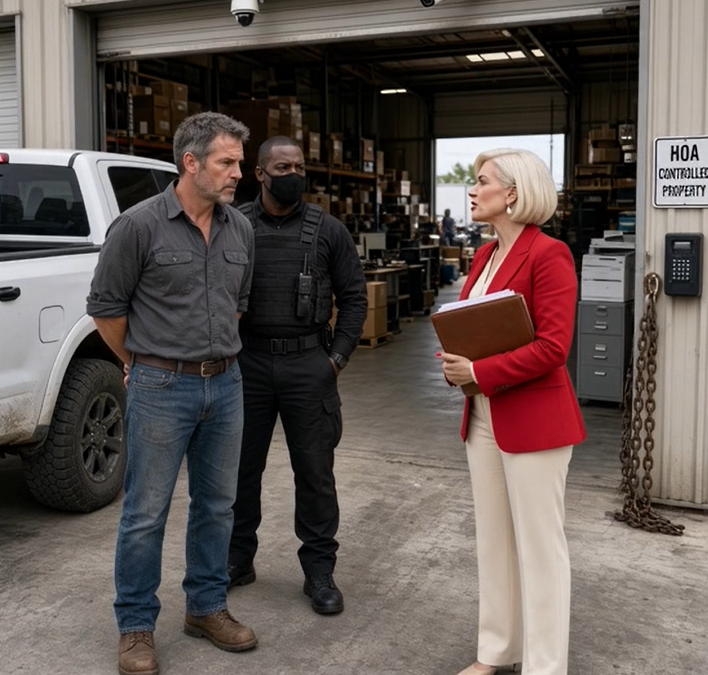
The HOA Broke Into My Private Warehouse While I Was Out of Town—Then They Went Pale When They Learned Who Actually Owned It.
Marissa Crowley thought she could steal a warehouse with fake paperwork, private guards, and enough confidence to scare a quiet man into surrendering.
She did not know the man she zip-tied against his own truck had spent seventeen years hunting fugitives who lied better than she did.
By sunset, the HOA president who had drilled her sign into his brick wall was begging deputies not to open the back room where her whole scheme finally came apart.
Marissa Crowley thought the warehouse was an easy target.
For four days, Duncan Vale had been out of town.
No truck in his usual parking space.
No lights in the upstairs office after midnight.
No one walking the fence line every morning with a mug of coffee.
To Marissa, the timing looked perfect.
So on the second morning of Duncan’s absence, a private security crew arrived outside the eighteen-thousand-square-foot warehouse on the western edge of Stonebridge Ridge.
They did not knock.
They did not call.
They did not wait for a judge.
One of them cut the heavy chain Duncan had used on that gate for eleven years.
A locksmith replaced the front locks.
A crew drilled a new sign into the brick beside the loading bay.
STONEBRIDGE RIDGE HOMEOWNERS ASSOCIATION
AUTHORIZED PERSONNEL ONLY
By the fourth afternoon, Marissa had moved filing cabinets, laptops, folding tables, boxes of association records, bottled water, two printers, three plastic storage shelves, and two private security teams into a building that had never belonged to her.
She thought possession would create reality.
If she could occupy the warehouse before Duncan returned, if she could fill it with her people, change the locks, hang the signs, and generate enough official-looking paperwork afterward, maybe the question of ownership would become confusing enough to force him into a settlement.
That was the gamble.
It almost worked for six hours.
Then Duncan came home.
At 3:42 on a gray Thursday afternoon, his dark blue pickup rolled off County Road 18 and turned toward the warehouse.
Duncan immediately slowed.
Something was wrong.
He had owned the property long enough that he noticed small changes instinctively.
A delivery trailer parked ten feet farther north than usual.
A gate left open when it should have been closed.
A light switched on in a room nobody used.
This was not small.
His gate carried a lock he had never seen before.
A white box truck sat backed into his loading dock.
Three black SUVs were parked along the fence.
Two men in matching jackets stood outside the open bay door.
And above them, where a weathered metal plaque reading VALE INDUSTRIAL SUPPLY had hung since Duncan bought the building, someone had bolted a new association sign into the wall.
He stopped his pickup.
For nearly a minute, he remained behind the wheel.
He did not get angry first.
Training had taught him better.
Duncan Vale was forty-seven years old, broad through the shoulders, with closely cropped dark hair going gray above the ears and the deliberate movements of someone accustomed to entering situations in which the first person who lost emotional control usually lost more than the argument.
For seventeen years, he had worked for the United States Marshals Service.
For the last four, he had served as a supervisory deputy overseeing a regional fugitive task force.
Most people in Stonebridge Ridge did not know that.
Duncan preferred it that way.
The warehouse was separate from his federal career.
He had bought the property eleven years earlier with his older brother, Aaron, intending to build a small commercial supply company as a retirement plan.
Aaron died five years later from a sudden heart condition, and Duncan kept the company operating with a full-time manager and three employees.
Vale Industrial Supply distributed specialty hardware, generator parts, trailer components, electrical enclosures, job-site equipment, and replacement components to contractors across three counties.
Duncan did not work the warehouse every day.
But it was his.
He knew every inch of it.
The loading dock Aaron had rebuilt himself.
The bent steel column where a delivery driver misjudged a turn in 2018.
The cracked upper office window Duncan kept promising to replace.
The faded yellow line his nephew painted across the floor one summer.
PART2:
The small framed photograph of Aaron taped inside the office cabinet, smiling with a coffee cup in one hand and a pencil tucked behind his ear.
Seeing strangers inside was more unsettling than seeing a broken window would have been.
This was organized.
Procedural.
Deliberate.
Duncan took out his phone.
Photographed the new lock.
The sign.
The SUVs.
The security men.
Then he pulled forward and parked beside his own fence.
One guard stepped toward him.
“Can I help you?”
Duncan looked at him.
“I own the building.”
The guard blinked.
Behind him, another man spoke into a radio.
Duncan walked toward the gate.
“Sir, stop there.”
“No.”
“This property is controlled by Stonebridge Ridge Homeowners Association.”
Duncan stopped.
He looked at the building.
Then at the guard.
“No, it isn’t.”
The guard touched his earpiece.
Within thirty seconds, Marissa Crowley appeared inside the loading bay.
She walked toward Duncan holding a leather folder against one hip.
Marissa was fifty-one, tall, carefully dressed, with dark auburn hair cut into a precise shoulder-length style and the posture of someone who considered hesitation a weakness other people suffered from.
For nearly six years, she had served as president of Stonebridge Ridge.
To many homeowners, she was efficient.
Assessments went out on time.
Landscaping contractors arrived when scheduled.
People who ignored dues received letters immediately.
Unapproved sheds disappeared quickly.
The pool stayed clean.
The gates worked.
Marissa liked results.
She liked the authority required to produce them even more.
When she saw Duncan standing by the gate, she smiled.
Not warmly.
“You’re back early.”
That sentence told him something.
She had known he was away.
Duncan said nothing.
Marissa continued.
“There have been some developments regarding the property.”
“I can see that.”
“We’ve completed the association’s recovery process.”
“My what?”
“Recovery process.”
Duncan looked past her.
Two people were carrying boxes into his warehouse.
“Tell them to stop.”
Marissa opened the leather folder.
“You have been in default on assessments, road maintenance obligations, and association-related legal expenses for an extended period.”
“I’m not in your association.”
“That question has been resolved.”
“By whom?”
“The board.”
Duncan almost smiled.
“The board can’t resolve ownership of land it doesn’t own.”
Marissa extended a thick packet toward him.
It contained notarized statements, assessment histories, an alleged lien summary, a notice of possession, several maps, and a document bearing language designed to resemble a court authorization.
Duncan took it.
He read the first page.
Then the second.
He did not argue.
That unsettled Marissa.
She expected outrage.
People were easier to control when they were outraged.
Instead, Duncan looked up.
“When did Stonebridge Ridge purchase this property?”
Marissa’s mouth tightened.
“It wasn’t necessary to purchase it.”
“Then what deed transferred ownership?”
“This is an enforcement action.”
“Filed in which court?”
“The association followed its legal remedies.”
“Case number?”
“You can have your attorney contact ours.”
Duncan folded the packet.
“Tell your people to get out.”
“Duncan—”
“This warehouse has never belonged to Stonebridge Ridge. You have no permission to be inside it. You have no permission to change the locks. You have no permission to move anything.”
Marissa turned toward the largest guard.
“Trent.”
Trent Barlo stepped forward.
He was a thick-necked man in his early forties wearing a black jacket marked BARLO PROTECTIVE SERVICES.
“Escort Mr. Vale off association-controlled property.”
Duncan looked directly at him.
“Before you touch me, I want to make this very clear.”
Trent stopped.
“This is privately owned property. I am the recorded owner. I have instructed all of you to leave.”
Marissa rolled her eyes.
“Enough.”
Duncan continued.
“If you physically detain me after that warning, this stops being a civil disagreement.”
Trent laughed.
“Everybody’s a lawyer when they don’t get their way.”
“I’m not a lawyer.”
“Then move.”
Duncan did not.
Trent reached for his arm.
Duncan shifted slightly, not resisting, merely keeping his balance.
Another guard approached from the side.
Duncan raised his voice just enough to be clearly heard.
“I am not consenting to physical contact. I am not resisting. I am asking you to leave my property.”
Marissa said, “Detain him until local police arrive.”
Trent took Duncan’s phone.
Duncan let him.
Then plastic restraints closed around Duncan’s wrists.
The younger guard hesitated.
“Trent, maybe we should just call—”
“We are calling.”
Duncan was pushed against the side of his own pickup.
Not violently enough to injure him badly, but hard enough that his shoulder struck metal.
He looked toward Marissa.
She smiled.
“This could have been much easier.”
Duncan’s voice remained flat.
“For you, maybe.”
To understand how an HOA president reached the point where she thought zip-tying a property owner inside his own warehouse was reasonable, the story had to begin three months earlier.
Stonebridge Ridge had always been a neighborhood with ambitions larger than its boundaries.
It sat on the eastern edge of Willow County, tucked between old industrial land, renovated farmland, and the kind of new development that used words like “heritage” and “exclusive” to describe roads that had existed before any brochure designer ever saw them.
The subdivision had begun as a luxury residential project fifteen years earlier.
Large brick homes.
Gated entrance.
Clubhouse.
Pool.
Tennis courts.
A pond with a fountain.
Artificial stone monuments on both sides of the main road.
Everything designed to say: We are private, we are orderly, we are above whatever mess exists beyond the gates.
Except the warehouse had existed before the gates.
Vale Industrial Supply sat on a rectangular three-acre parcel just west of the neighborhood, fronting County Road 18. It had been built in the late 1980s by a regional plumbing distributor, then sold twice, then sat partially vacant until Duncan and Aaron bought it.
When Stonebridge Ridge was developed, the warehouse parcel was specifically excluded from the subdivision covenants.
The developer needed the old service road beside Duncan’s property to access a stormwater easement, so a legal agreement was drafted. Stonebridge had limited rights to maintain drainage infrastructure along the western edge. Nothing more.
No ownership.
No HOA control.
No architectural authority.
No right to park vehicles.
No right to store records.
No right to change locks.
Duncan had the paperwork.
Recorded deed.
Survey.
Exclusion language.
Easement agreement.
Title policy.
County tax records.
Everything.
He kept copies in his office, at home, with his attorney, and digitally backed up in three places because Duncan had spent too many years watching people invent stories where paper was missing.
For nearly a decade, nobody cared.
Stonebridge homeowners drove past the warehouse on their way to the back gate. Some thought it was ugly. Some thought it was useful because contractors could pick up supplies nearby. Most did not think about it at all.
Then Marissa Crowley became HOA president.
Marissa had moved into Stonebridge seven years earlier after selling a regional insurance brokerage she had built with her ex-husband. People described her as impressive before they described her as kind. She carried herself like a woman who had spent her life learning that if she entered a room already certain, uncertain people would rearrange themselves around her.
She was not poor.
She was not stupid.
She was not desperate in any ordinary way.
That made her more dangerous.
Desperate people take risks because they feel they have no options.
Marissa took risks because she believed rules were tools and tools belonged in the hands of competent people.
She considered herself competent.
She won the HOA presidency after a storm damaged the clubhouse roof and the previous board spent eight months arguing over bids. Marissa stepped in, reorganized the repair process, negotiated a contractor down twelve percent, and had the roof finished before Thanksgiving.
Homeowners loved her then.
She was decisive.
She was efficient.
She made things happen.
After that, they stopped questioning how.
The first conflict between Duncan and Marissa came over the service road.
Stonebridge’s drainage easement allowed the association to maintain a gravel access lane that crossed a narrow strip near Duncan’s western fence. The easement was limited to stormwater work. It did not allow general traffic.
One Monday morning, Duncan found a landscaping crew using the lane to bring mulch to Stonebridge’s common area.
He blocked the road with his truck.
The crew foreman showed him a work order.
Authorized by Stonebridge Ridge HOA.
Duncan called Marissa.
She arrived twenty minutes later in a black Lexus, stepped out in heeled boots, and looked at Duncan’s truck like it had personally disappointed her.
“Move your vehicle.”
“No.”
“You’re blocking an HOA contractor.”
“He’s on my property outside the drainage easement purpose.”
“The association has access rights.”
“For drainage maintenance.”
“This is maintenance of common areas.”
“Not drainage.”
Marissa exhaled.
“Mr. Vale, this is a private community with operational needs. Your warehouse parcel benefits from our roads, security presence, and maintained surroundings. Cooperation is expected.”
“My warehouse predates your community.”
“That doesn’t make it independent of community impact.”
“It makes it legally independent.”
She smiled thinly.
“You federal people always think legal language solves everything.”
Duncan did not react.
That was the first time she hinted she knew his job.
Not from him.
Probably from gossip.
Maybe a homeowner who worked at the courthouse.
Maybe someone who had looked him up after seeing government plates outside the warehouse years ago, back when he still drove an issued vehicle.
He had learned long ago that privacy was never absolute.
“Legal language prevents people from pretending convenience is ownership,” he said.
Marissa’s eyes cooled.
The landscaping crew turned around.
That should have ended it.
It did not.
A week later, Duncan received a letter from Stonebridge Ridge HOA notifying him that Vale Industrial Supply was “adjacent commercial property subject to community impact assessments.”
He read the phrase twice.
Community impact assessments.
He called his attorney, Claire Benitez, a former title litigator with a voice like a locked door.
Claire read the letter and laughed once.
Not because it was funny.
Because some things are so legally ridiculous they briefly become entertainment.
“They are trying to create authority by describing it,” Claire said.
“That’s what I thought.”
“I’ll send a response.”
Her response was direct.
Vale Industrial Supply is not a lot within Stonebridge Ridge, is not subject to its declaration, owes no assessments to the association, and has not consented to any community impact fee structure. Any further assertion of assessment authority should be directed to this office.
For two weeks, silence.
Then came the second letter.
It included an invoice.
Road maintenance allocation.
Security benefit assessment.
Gate adjacency contribution.
Administrative reconciliation fee.
Total due: $18,740.
Duncan stared at the number, then at the phrase “gate adjacency contribution.”
He pictured Aaron reading it and laughing until he coughed.
Aaron had been good at that.
Finding absurdity before anger.
Duncan missed that most on days like this.
He missed the person who could look at a ridiculous thing and make it smaller by refusing to take it seriously.
Duncan had become worse at that after Aaron died.
Not humorless.
Just heavier.
He forwarded the invoice to Claire.
Her reply came in four words.
Absolutely not. Calling now.
Claire sent another letter.
Stonebridge responded with late fees.
Claire sent a demand to cease false billing.
Stonebridge sent a “notice of continuing noncompliance.”
Duncan ignored Marissa when she drove slowly past the warehouse one afternoon, photographing the loading dock.
He ignored the drone that hovered over the yard until he stepped outside and stared at it long enough that whoever operated it pulled away.
He ignored the social media post from a Stonebridge resident complaining about “industrial blight adjacent to premium homes.”
He ignored everything until Marissa called a public HOA meeting and put the warehouse on the agenda.
Duncan attended.
Not because he expected reason.
Because he believed in witnessing threats early.
The clubhouse was full. Stonebridge residents sat in padded folding chairs beneath chandeliers that looked too fancy for a room where people argued about pool key fobs. Marissa stood at the front beside a screen displaying a map of the neighborhood.
Duncan’s warehouse parcel was shaded red.
He noticed that immediately.
The color choice was intentional.
Red meant problem.
Marissa began with a speech about Stonebridge’s long-term vision. She spoke of safety, aesthetics, infrastructure, property values, and “external parcels that affect internal community life.”
Then she clicked to the next slide.
A photograph of Duncan’s warehouse filled the screen.
Someone had taken it from the most unflattering angle possible.
Trash bins visible.
Rust stains near the old gutter.
A delivery pallet temporarily stacked near the bay door.
The room murmured.
Duncan sat in the back row with his arms folded.
Marissa said, “For years, this structure has benefited from proximity to Stonebridge Ridge without contributing to our maintenance, security, or community costs.”
A man near the front raised his hand.
“Is it actually part of the HOA?”
Marissa smiled.
“The legal status is more complicated than residents were previously led to believe.”
Duncan stood.
“No, it isn’t.”
Everyone turned.
Marissa’s smile froze.
Duncan walked to the aisle.
“The warehouse parcel is excluded from Stonebridge Ridge. It is not bound by your declaration. It owes no assessments. Your drainage easement does not authorize fees, control, possession, or access beyond stormwater maintenance. The legal status is not complicated. It’s inconvenient to your presentation.”
A few residents shifted in their chairs.
Marissa’s jaw tightened.
“This is a homeowner meeting, Mr. Vale.”
“I’m here because you put my property on a slide.”
“You will have an opportunity to submit your position through counsel.”
“I already did.”
She lifted her chin.
“The board is reviewing all available remedies.”
“Review carefully.”
He left after that.
He did not slam the door.
He did not raise his voice.
He did not give her the scene she wanted.
That made her angrier than an outburst would have.
Two days later, a Stonebridge resident Duncan barely knew came by the warehouse.
His name was Peter Walsh. Retired accountant. Lot 82. Duncan had sold him a generator transfer switch once during a winter storm.
Peter looked uncomfortable as he stood in the office doorway.
“Mr. Vale, may I speak with you?”
“Sure.”
Peter closed the door behind him.
“I’m on the finance committee.”
Duncan waited.
“I don’t like what’s happening.”
“That makes two of us.”
Peter removed a folded paper from his jacket.
“I shouldn’t have this.”
“That’s always a strong opening.”
Peter handed it over.
It was an internal HOA memo.
Subject: External Parcel Recovery Strategy.
Duncan read the first paragraph.
Then the second.
The memo described the warehouse parcel as “functionally integrated” with Stonebridge’s security perimeter and “historically subject to shared use expectations.” It proposed escalating assessments, filing an HOA lien, pursuing possession through “nonjudicial enforcement,” and using the property as an “association operations and records center” once recovered.
Recovered.
Duncan looked up.
“Where did this come from?”
“Board packet,” Peter said. “Executive session.”
“Who drafted it?”
“Marissa, I think. Maybe their attorney. Though I’m not sure the attorney actually wrote it.”
“Why bring it to me?”
Peter looked at the floor.
“Because my wife says I joined the finance committee to prevent foolish spending, not bless theft with spreadsheets.”
Duncan almost smiled.
“She sounds wise.”
“She is. Loudly.”
Duncan copied the memo and returned the original.
“Thank you.”
Peter hesitated.
“You didn’t get this from me.”
“I understand.”
“I mean it. Marissa can be… difficult.”
Duncan looked at him carefully.
“Difficult isn’t illegal. This may become illegal.”
Peter swallowed.
“I know.”
The memo changed Duncan’s approach.
He stopped treating Marissa’s letters as nuisance paper.
He began documenting everything like a case.
Timeline.
Photos.
Invoices.
Board meeting statements.
Drone footage.
Witnesses.
County records.
Title documents.
He was not acting as a federal officer.
He knew that line clearly.
This was personal property, not a federal investigation.
But habits do not disappear when jurisdiction changes.
Duncan knew how people built false narratives.
First, they blurred language.
Then they created paper.
Then they pressured witnesses.
Then they moved fast and dared everyone else to catch up.
Marissa was already on step three.
Step four was coming.
Duncan warned Claire.
She filed a formal notice with the HOA’s attorney and copied the county recorder, the sheriff’s civil division, and Stonebridge’s management company. It stated plainly that any attempt to enter, possess, lien, alter, secure, occupy, or interfere with Vale Industrial Supply would be considered trespass and conversion and would be met with immediate legal action.
That should have stopped any competent board.
But Marissa had begun believing her own vocabulary.
By then, she no longer said she wanted the warehouse.
She said the association needed to regularize control.
She no longer said Duncan refused to pay fees he did not owe.
She said he was exploiting community services.
She no longer said the board had no deed.
She said deed formalities had failed to reflect operational reality.
Operational reality.
That phrase appeared in three letters.
Claire underlined it and wrote beside it:
Nonsense with shoes on.
Then Duncan had to leave town.
A fugitive task force operation had been building for weeks. He could not discuss details, not with Marissa, not with Stonebridge, not even with his employees beyond telling them he would be gone several days and reachable only through secure channels if something urgent happened.
His warehouse manager, Luis Ortega, had the week off for his daughter’s wedding.
Two employees were scheduled only half-days because inventory was light.
Duncan locked the gate himself before leaving.
He wrapped the chain twice, pulled the heavy padlock through, and tugged it hard.
Something in his gut told him to install extra cameras.
He did.
Two temporary cellular cameras facing the gate and loading dock.
But on the second morning of his absence, those cameras went dark.
Later, investigators found their antennas crushed.
By the time Duncan returned on Thursday afternoon, Marissa had already spent two days pretending trespass was administration.
Now he stood zip-tied beside his own pickup while private guards treated him like the intruder.
He stayed calm because calm was useful.
He cataloged everything.
Trent Barlo had taken his phone and placed it on the hood of a security SUV.
The younger guard kept glancing at the restraints, uncomfortable.
Marissa stood near the loading bay with the folder still pressed against her hip.
Two Stonebridge board members were inside the warehouse: Carl Everson, a retired school administrator who looked terrified of conflict, and Diane Mercer, a real estate agent with a permanent smile that had finally failed her.
A locksmith’s van sat behind the white box truck.
The new HOA sign had been drilled directly into old brick, four anchors through the mortar line Aaron had once repointed by hand.
That angered Duncan more than the zip ties.
Not visibly.
But deep.
He looked at the bay door and saw two volunteers carrying a gray filing cabinet across the floor where Aaron used to mark shipping zones with painter’s tape.
That was the hardest part.
Not the legal arrogance.
Not the fake packet.
Not even the restraint cutting into his wrists.
The violation of ordinary memory.
People think property is dirt and walls and ownership documents.
Sometimes it is.
But sometimes property is your brother saying, “Hold this level steady,” while both of you work in August heat trying not to admit you are too old to be doing masonry at midnight.
Sometimes property is a dented loading dock because a man you loved cursed for ten minutes, then laughed for twenty.
Sometimes property is a building that kept part of him alive after his heart stopped.
Marissa had walked into that like it was vacant space.
A local police cruiser arrived twelve minutes after Trent called.
Then a second.
Officer Nathan Bell stepped out first, hand resting near his belt, eyes moving across the scene.
He saw the zip ties.
The security guards.
The sign.
Duncan.
Marissa stepped forward immediately.
“Officer, thank goodness. This man is trespassing on association-controlled property and became confrontational with our security contractor.”
Officer Bell looked at Duncan.
“Sir, is that accurate?”
“No.”
Marissa made an impatient sound.
“He claims to own the property, but the association has initiated recovery action.”
Officer Bell looked at the warehouse.
“This is Vale Industrial Supply.”
“It was,” Marissa said.
That was a mistake.
Duncan saw Bell catch it.
Was.
Officer Bell approached Duncan.
“Your name?”
“Duncan Vale.”
Bell paused.
Not long.
Long enough.
Duncan saw recognition land.
“Duncan Vale?” Bell repeated.
“Yes.”
The second officer, a younger woman named Harris, looked up from her notebook.
Duncan kept his voice steady.
“My wallet is in my right back pocket. My phone is on that SUV hood. These men took it. I own this property. I am not consenting to detention. I am requesting removal of trespassers.”
Marissa stepped in.
“He is misrepresenting a civil enforcement issue.”
Duncan looked at Officer Bell.
“My attorney’s cease-and-desist letter was sent to the HOA, the management company, and your department’s civil division two weeks ago. It should be on file.”
Bell’s expression changed again.
“Take those off him,” he said.
Trent frowned.
“We detained him for your arrival.”
Bell turned slowly.
“Take. Them. Off.”
Trent hesitated.
The younger guard moved first, pulling a small cutter from his belt.
The zip tie snapped.
Duncan brought his hands forward.
Red marks circled both wrists.
Officer Harris noticed.
“Do you need medical attention?”
“No.”
Marissa said, “This is unnecessary. He was being disruptive.”
Duncan rubbed his wrist once, then stopped.
“Officer Bell, I am a supervisory deputy with the United States Marshals Service. I am not acting in that capacity here. This is my private property. But I am identifying myself because these men detained me, took my phone, and restricted my movement after I identified myself as the owner.”
The younger guard went pale.
Trent did not.
Not yet.
Marissa’s face changed.
For the first time that afternoon, confidence slipped.
She looked from Duncan to Officer Bell.
“You’re a marshal?”
Duncan did not answer her.
Officer Bell did.
“Yes, ma’am. He is.”
That was when Trent’s expression finally shifted.
Everybody likes to act tough when they think the person in front of them is just a stubborn property owner.
It feels different when the stubborn property owner turns out to understand unlawful detention better than the men holding the zip ties.
Marissa recovered quickly.
“This is exactly why we did not want to escalate. Mr. Vale uses intimidation when community accountability is requested.”
Duncan almost admired the speed.
Almost.
Officer Bell held up one hand.
“Everyone stop talking for a second.”
No one did.
Marissa continued.
“I have documents.”
Duncan said, “None issued by a court.”
Trent said, “We were contracted legally.”
Carl Everson emerged from inside and said, “Marissa, maybe we should pause.”
Diane Mercer whispered, “Oh God.”
Officer Bell raised his voice.
“Enough.”
The loading bay went quiet.
Bell turned to Duncan.
“Can you prove ownership?”
“Yes.”
“My title documents are in the upstairs office. They may have moved them.”
Bell looked at Officer Harris.
“Go with him.”
Marissa stepped forward.
“I object to him entering association records space unsupervised.”
Officer Bell looked at her for a long moment.
“Ma’am, that sentence did not help you.”
Duncan walked into his warehouse.
The smell hit him first.
Dust.
Cardboard.
Old metal shelving.
Oil from the forklift.
And something new.
Perfume.
Printer toner.
Takeout coffee.
Occupation has a smell.
It smells like people convincing themselves they belong.
The warehouse floor had been rearranged.
Several pallets had been pushed aside. Boxes from Stonebridge Ridge HOA sat stacked near aisle three. Folding tables occupied the open bay. A printer hummed where a packing scale used to sit. Someone had taped temporary signs to the wall.
RECORDS INTAKE
SECURITY STAGING
BOARD WORKSPACE
The Vale Industrial Supply sign-in board had been removed.
Aaron’s old whiteboard was turned around.
Duncan stopped.
Officer Harris watched him.
“You okay?”
He nodded once.
But he was not.
At the far wall, the door to the locked cage was still closed.
That mattered.
Inside that cage, Duncan kept restricted high-value inventory: generator transfer switches, contractor-grade electrical enclosures, specialty locksets, and several sealed orders waiting for pickup by county facilities.
Nothing illegal.
Nothing dramatic.
But expensive.
And documented.
If Marissa’s people had touched that cage, the civil case would become something larger.
The upstairs office was worse.
Someone had used his desk.
His chair had been moved.
The framed photograph of Aaron was face down on the credenza, probably knocked over while they moved association boxes.
Duncan picked it up.
For one second, his composure almost failed.
Aaron was smiling in the picture, wearing an old company polo and holding a ridiculous oversized pair of scissors from the day they opened the front office.
Duncan set the frame upright.
Officer Harris looked away, giving him privacy without saying so.
He opened the fireproof file cabinet.
The title folder was still there.
So was the survey.
So was the recorded exclusion from Stonebridge covenants.
Marissa had not found the right drawer, or had not understood what mattered.
Duncan handed copies to Officer Harris.
“I also have digital versions.”
She read the first page, then the second.
Her eyebrows lifted.
“Pretty clear.”
“Yes.”
Downstairs, the scene had grown larger.
Two more cruisers had arrived.
So had a county deputy.
So had Claire Benitez.
Duncan saw her walking from her car with a briefcase in one hand and murder in her posture.
Claire was fifty-eight, five foot three, and capable of making grown men apologize to furniture.
She took one look at the HOA sign, the cut chain, the private guards, and Duncan’s wrists.
Then she said, “Oh, Marissa.”
Just that.
Oh, Marissa.
It was somehow worse than yelling.
Marissa lifted her chin.
“Counselor, this is an association enforcement matter.”
Claire looked at Officer Bell.
“Has anyone shown you a writ of possession?”
“No.”
“Court order?”
“No.”
“Recorded deed?”
“No.”
“Sheriff’s civil standby documentation?”
“No.”
Claire turned back to Marissa.
“Then this is breaking and entering with office supplies.”
A sound moved through the people nearby.
Not quite laughter.
Not yet.
The situation was too serious.
But the phrase landed.
Breaking and entering with office supplies.
Marissa’s face hardened.
“You enjoy theatrics.”
“No,” Claire said. “I enjoy title records.”
She opened her briefcase and handed Officer Bell a copy of the cease-and-desist notice, title documents, recorded deed, subdivision exclusion, tax record, and prior correspondence.
“Vale Industrial Supply is not part of Stonebridge Ridge. It never has been. Your department was copied on our notice regarding potential unlawful entry because the HOA had been threatening exactly this.”
Officer Bell looked at the documents.
Then at Marissa.
“Ma’am, who authorized cutting the lock?”
Marissa’s answer came too fast.
“The association’s recovery committee.”
Officer Harris asked, “Who is on that committee?”
Marissa paused.
“Board members.”
“Names?”
Marissa looked toward Carl and Diane.
Carl’s face was gray.
Diane stared at the ground.
Claire said, “Officer, before anyone invents more vocabulary, I’ll make this simple. My client wants all unauthorized persons removed, the premises secured, and a report taken for trespass, property damage, conversion, and unlawful detention.”
Trent muttered, “We didn’t know.”
Duncan looked at him.
“You didn’t ask.”
Trent’s jaw worked.
The younger guard said quietly, “I asked Marissa if there was a court paper.”
Everyone turned.
Trent glared at him.
The young guard swallowed but continued.
“She said the HOA had equivalent authority.”
Officer Bell blinked.
“Equivalent authority to a court?”
The guard nodded miserably.
Marissa snapped, “That is not what I said.”
Duncan looked at Officer Bell.
“May I have my phone back?”
Bell retrieved it from the SUV hood and handed it to him.
The screen was cracked.
Not badly.
Enough.
Duncan photographed that too.
Then he called his manager, Luis.
Then the warehouse insurance carrier.
Then the county sheriff’s office.
Then, after a moment, his own agency supervisor.
Not because he wanted federal thunder.
Because he had been detained and identified as a federal law enforcement officer after the fact, and he knew better than to let someone else tell that story first.
By evening, Stonebridge residents had gathered along the road outside the fence.
The neighborhood had a private social media group, and someone had posted a blurry photo of Duncan in zip ties before understanding who he was.
Within twenty minutes, every homeowner with a phone knew something was happening.
Rumors multiplied.
Marissa had seized a criminal warehouse.
Duncan had threatened the board.
Federal agents were raiding Stonebridge.
The HOA had discovered unpaid taxes.
The warehouse was secretly government property.
None of that was true.
The truth was simpler and uglier.
The HOA president had broken into a private warehouse because she believed paperwork could be weaponized faster than facts could stop her.
At 6:15, a black SUV pulled up.
Then another.
Two deputy marshals stepped out.
Duncan knew both.
Sofia Reyes and Marcus Bellamy.
Sofia looked at Duncan’s wrists first.
Then at the HOA sign.
Then at Marissa.
“Oh,” she said.
Marcus walked over to Duncan.
“You good?”
“I’m fine.”
“You always say that when you’re not.”
“I’m fine enough.”
Sofia spoke quietly to Officer Bell, then to Duncan.
“We’re not here to take over your property dispute,” she said.
“I know.”
“But your detention may have reporting implications.”
“I know.”
She glanced at Trent.
“Who zip-tied you?”
Duncan pointed.
Trent looked suddenly interested in the gravel.
Marissa stepped forward.
“I want it noted that Mr. Vale did not identify himself as a federal officer before escalating the situation.”
Duncan turned to her.
“I told your guard I owned the building and ordered you all to leave.”
“That is not the same thing.”
“No,” Duncan said. “It’s the part that mattered.”
Sofia looked at Marissa with a professional blankness Duncan recognized.
It was the face law enforcement used when someone had just said something self-damaging enough to preserve untouched.
Claire leaned toward Duncan.
“Stop talking now.”
He did.
That was why he paid her.
By 8 p.m., Marissa’s people were gone.
Not arrested on the spot.
That frustrated some onlookers, but Duncan understood.
Bad cases get built carefully.
Good reports matter.
Statements matter.
Evidence matters.
Security footage mattered.
The locksmith’s invoice mattered.
The cut chain mattered.
The drilled sign mattered.
The fake possession packet mattered.
The guards’ statements mattered.
The photos Duncan had taken before they took his phone mattered.
The zip-tie marks around his wrists mattered.
The damage inside mattered.
And what they found in the back office mattered most of all.
Duncan discovered it after the police cleared the building.
He and Claire walked the interior with Luis, who had left his daughter’s wedding preparations and arrived looking both furious and overdressed in a suit.
“I swear,” Luis said, “I leave for one week.”
“You were allowed,” Duncan said.
“My wife says I should not blame myself.”
“Your wife is right.”
“I hate that.”
They began documenting.
Inventory shelves displaced.
Office drawers opened.
Security system disabled.
Camera wires cut.
Three laptops missing from the storage room.
Two file boxes moved.
Locks replaced.
Aaron’s whiteboard damaged.
The photograph frame cracked.
Luis cursed softly in Spanish when he saw the office.
Then they reached the small conference room behind the upper office.
The door had been locked before Duncan left.
Now it stood open.
Inside were Stonebridge Ridge boxes.
Not just supplies.
Records.
Financial files.
Old board packets.
Bank statements.
Vendor invoices.
And one laptop still awake on the table, plugged into Duncan’s wall outlet.
Claire did not touch it.
“Photograph,” she said.
Duncan photographed.
The screen displayed a spreadsheet.
Rows of names.
Lot numbers.
Special assessments.
Legal fund transfers.
Warehouse recovery projected proceeds.
Duncan leaned closer without touching the keyboard.
One column title made his stomach tighten.
Projected resale / lease income.
Another:
Emergency assessment justification.
Another:
Reserve deficit offset.
Claire whispered, “Well.”
Luis said, “What am I looking at?”
Claire’s voice was cold.
“A motive.”
The warehouse had never been about road fees.
Not really.
Stonebridge Ridge was in trouble.
The reserve fund was short.
Badly short.
The clubhouse roof repairs Marissa had once been praised for had been funded through creative transfers. Pool resurfacing had been deferred. Gate replacements had cost more than disclosed. Legal fees from several homeowner enforcement actions had ballooned. A drainage repair required by the county was coming due.
The HOA needed money.
Not someday.
Soon.
The warehouse represented a fantasy solution.
Occupy it.
Claim it.
Force Duncan to settle.
Lease part of it.
Sell it.
Use the supposed recovery to plug the reserve deficit before homeowners discovered how thin the association’s finances had become.
Marissa had not just wanted control.
She needed a rescue story.
And she had chosen Duncan’s property as the stage.
The next morning, Stonebridge Ridge woke up to two realities.
First, Marissa had not saved them from a delinquent outsider.
Second, their HOA finances were not what they had been told.
A special board meeting was called for Saturday.
Duncan did not plan to attend.
Claire told him he should.
“Why?”
“Because they built a story around you. If you’re absent, they’ll keep building.”
“I’m tired.”
“I know.”
“I don’t want to be their lesson.”
“You already are.”
That annoyed him because it was true.
So on Saturday morning, Duncan walked into the Stonebridge Ridge clubhouse for the second time in three months.
This time, nobody put his warehouse on a red slide.
People turned when he entered.
Some looked ashamed.
Some curious.
Some angry.
A few looked disappointed, as if he had ruined an ending they preferred.
Marissa sat at the front table.
She still wore authority well.
Navy blazer.
Pearl earrings.
Perfect hair.
But her eyes were different.
Less certain.
Beside her sat Carl Everson, Diane Mercer, and two other board members. The association attorney, a thin man named Wilkes, sat at the end of the table looking like he wished he had gone into tax law.
The room was packed.
Peter Walsh stood near the side wall with his wife, who looked exactly as loudly wise as advertised.
Marissa called the meeting to order.
Her voice was steady.
“I know recent events have created concern,” she began.
A man in the back said, “That’s one way to describe breaking into a warehouse.”
Murmurs rose.
Marissa held up a hand.
“The board acted based on advice and documentation available at the time.”
Duncan watched Wilkes close his eyes briefly.
That was not a sentence attorneys enjoyed hearing clients say publicly.
Marissa continued.
“The external parcel issue has been developing for months. Mr. Vale’s refusal to contribute fairly to community costs forced the board to pursue enforcement remedies.”
Peter Walsh stood.
“No.”
The room quieted.
Peter was not a loud man.
That made the word louder.
Marissa looked at him.
“Peter, this is not the time.”
“It is exactly the time.”
He walked into the aisle holding a folder.
“I served on the finance committee. I reviewed the assessment history. Vale Industrial Supply owes Stonebridge nothing.”
Marissa’s face tightened.
“That is your interpretation.”
“No,” Peter said. “That is the title record. The exclusion. The attorney letter. The tax map. And, frankly, common sense.”
A few residents clapped.
Marissa struck the gavel.
Yes, she had brought a gavel.
Of course she had.
“Order.”
Peter did not sit.
He turned toward the room.
“You all need to understand something. The warehouse was not seized because Duncan Vale owed us money. It was targeted because the reserve fund is short and the board wanted leverage.”
The clubhouse erupted.
Marissa stood.
“That is false.”
Peter held up a paper.
“I have the reserve report.”
Carl Everson covered his face with one hand.
Diane Mercer started crying.
That told the room more than denial ever could.
The association attorney leaned toward Marissa, whispering urgently.
She ignored him.
“Peter Walsh was not authorized to disclose finance committee materials.”
Peter’s wife spoke from the wall.
“He was authorized by a conscience.”
People turned.
She folded her arms.
“I know that one isn’t in your bylaws, Marissa.”
The first laugh broke through.
Small.
Sharp.
Then gone.
Duncan stood near the back, saying nothing.
Marissa saw him.
Her eyes locked onto him like he was the source of all collapse.
“You,” she said.
Claire, beside Duncan, whispered, “Careful.”
Marissa pointed.
“This man has intimidated this board from the beginning.”
Duncan stepped forward.
“No.”
The room quieted.
He did not raise his voice.
That helped.
“I responded to false invoices. I protected my property. I documented your actions. I did not intimidate anyone.”
Marissa laughed once.
“You expect us to believe a federal marshal doesn’t know how to pressure civilians?”
There it was.
A different tactic.
If she could not make him delinquent, she would make him dangerous.
Duncan nodded slowly.
“I wondered when you’d try that.”
The room shifted.
Marissa had misjudged something fundamental.
Stonebridge residents might not know Duncan well, but they had watched him be zip-tied by her guards on his own property. They had watched him stay calm. They had seen the pictures. Some had seen the video posted before it was deleted.
He did not look like a bully.
She did.
Duncan walked to the front, stopped several feet from the board table, and faced the residents.
“My job has nothing to do with whether I own that warehouse. I did not use my badge to buy it. I did not use my badge to maintain it. I did not use my badge when your HOA sent false bills. I did not use my badge when my attorney sent title records. I did not use my badge when Marissa’s contractor cut my chain.”
He paused.
“But I know procedure. I know lawful authority. I know what a court order looks like. I know the difference between a lien and a fantasy. And I know that when private security restrains a property owner without lawful authority, the problem is not the property owner’s profession.”
No one spoke.
Duncan turned to Marissa.
“You knew I was out of town.”
Her lips parted.
“You knew my manager was away. You disabled cameras. You changed locks. You moved records into my building. Your own spreadsheet projected lease income from property you didn’t own. So don’t talk to these people about community protection. Tell them the truth.”
Marissa stared at him.
For once, no words came quickly.
Duncan looked back at the residents.
“Ask for the reserve report. Ask for the legal invoices. Ask who approved the security contract. Ask why a fake possession packet was created. Ask why your money was spent breaking into my building instead of fixing your drainage problem.”
A woman in the front row stood.
“Is that true? The drainage repair?”
Another resident said, “What reserve shortfall?”
A third shouted, “How much did this cost us?”
Marissa struck the gavel again.
No one cared.
The gavel had authority only when people believed in the hand holding it.
That belief was gone.
The meeting dissolved into demands.
Wilkes, the attorney, finally stood and advised the board to enter executive session.
The room booed.
Not loudly at first.
Then louder.
Carl Everson stood up, trembling.
“I resign.”
Marissa turned to him.
“Carl.”
He shook his head.
“I thought we were sending letters. I thought the lawyers had cleared it. I never agreed to zip-ties. I never agreed to fake court papers. I never agreed to this.”
Diane Mercer whispered, “Me too.”
Marissa stared at them as if betrayal had invented itself that morning.
“You cowards,” she said.
The microphone caught it.
That word finished her.
By Sunday evening, three board members had resigned.
By Monday morning, the management company suspended services pending legal review.
By Monday afternoon, homeowners had formed a recall petition.
By Tuesday, local news had the story.
HOA ACCUSED OF SEIZING PRIVATE WAREHOUSE WITHOUT COURT ORDER
PRIVATE SECURITY DETAINED FEDERAL OFFICER IN PROPERTY DISPUTE
STONEBRIDGE RIDGE FINANCES UNDER SCRUTINY AFTER FAILED “RECOVERY” ACTION
Duncan refused interviews.
Marissa did not.
That was her next mistake.
She stood outside the clubhouse in sunglasses and told a reporter that “powerful individuals often resist accountability when communities attempt to enforce shared obligations.”
The reporter asked, “What shared obligation did Mr. Vale owe if his property was excluded from the HOA?”
Marissa said, “That exclusion is part of an outdated development structure that no longer reflects present-day realities.”
The clip spread fast.
Outdated development structure.
Present-day realities.
People online were merciless.
Someone posted: My bank account has an outdated development structure where I don’t own your house yet.
Another wrote: Present-day reality: jail.
Inside Stonebridge, the humor was thinner.
Homeowners were furious.
The reserve shortfall was real.
The drainage repair was overdue.
Insurance might not cover the warehouse incident because intentional acts were excluded.
The private security contract alone had cost more than $23,000.
The locksmith, moving trucks, emergency signage, document relocation, and attorney review added thousands more.
And Duncan’s civil claim had not even begun.
Claire filed it on Friday.
Trespass.
Conversion.
Property damage.
Unlawful detention.
Business interruption.
Damage to inventory.
Interference with contracts.
Civil conspiracy.
Declaratory judgment confirming no HOA authority.
She named Stonebridge Ridge HOA, Marissa Crowley personally, Barlo Protective Services, Trent Barlo, and several unnamed participants pending discovery.
Duncan read the complaint in his office, beneath Aaron’s repaired photograph.
Luis stood nearby.
“Is it enough?” he asked.
“No.”
“What would be enough?”
Duncan looked around the warehouse.
New locks.
New cameras.
New chain.
Old brick with fresh holes where the HOA sign had been removed.
A faint rectangle remained where Vale Industrial Supply’s plaque had been taken down and later recovered from a storage bin.
“I don’t know,” Duncan said.
That was honest.
Some violations have no clean invoice.
How much for the feeling of strangers at your brother’s desk?
How much for the sight of your company name removed from your own wall?
How much for a room full of neighbors wondering whether maybe you were the problem after all?
The criminal side moved slower.
The county prosecutor requested evidence.
Police took statements.
The younger security guard cooperated.
His name was Evan Pike. Twenty-four years old. Former college linebacker. He had taken the job because his wife was pregnant and Barlo paid better than warehouse work.
He admitted he had been uncomfortable from the start.
He said Marissa told the team the warehouse was “association recovered property” and that Duncan was “known to be aggressive and manipulative.”
He said Trent instructed guards to seize Duncan’s phone “for safety.”
He said the fake authorization packet was shown to them during briefing.
He said he had asked whether there was a court order, and Trent told him, “HOA foreclosure is different. Don’t overthink it.”
Don’t overthink it.
Duncan had heard versions of that phrase his whole career.
Every bad act loves a room full of people willing not to overthink it.
The locksmith cooperated too.
He had been told the HOA owned the building after enforcement action and provided a notarized authorization signed by Marissa. He had not verified ownership beyond the paperwork.
The moving crew had been told it was an office relocation.
The sign installer had been told Stonebridge had purchased the building.
Everybody had been told just enough to perform one small piece.
That was how Marissa operated.
She distributed ignorance like a resource.
No one person had to understand the whole lie except her.
Then discovery revealed why she had been so desperate.
Stonebridge Ridge’s reserve fund was not merely low.
It had been misrepresented for three years.
Marissa had shifted expenses between accounts to avoid triggering homeowner alarm. Legal fees from aggressive enforcement actions had been categorized as “community standards maintenance.” Emergency gate repairs had been booked as “capital preservation studies.” The clubhouse roof overrun had been spread across unrelated line items.
She had not stolen millions.
This was not a yacht-and-offshore-account scandal.
It was smaller and sadder.
A woman who built her identity around competence had made expensive mistakes, hidden them, doubled down, and convinced herself that one bold recovery would fix everything before anyone noticed.
That almost made it worse.
Grand theft sounds dramatic.
This was governance rot.
A lie here.
A transfer there.
A meeting kept vague.
A reserve report delayed.
A hostile letter sent to distract from a missing number.
By the time the warehouse became the solution, Marissa no longer saw Duncan as a person.
He was an obstacle shaped like an asset.
The first mediation session happened in a downtown law office with a view of a parking garage.
Marissa attended with two attorneys.
Stonebridge’s new interim board attended separately.
Barlo Protective Services had counsel.
Duncan sat with Claire.
The mediator was a retired judge named Harold Simmons, who had the exhausted patience of a man who had seen every possible form of human foolishness and was still occasionally surprised by creativity.
He met privately with each side.
When he entered Duncan’s room, he closed the door and sighed.
“I’ve seen bad HOA behavior,” he said. “This is ambitious.”
Claire smiled.
“We thought so.”
Judge Simmons looked at Duncan.
“What do you want?”
“Accountability.”
“That’s not a number.”
“I know.”
“Numbers settle cases.”
“Truth prevents the next one.”
The judge studied him.
“You want public terms?”
“Yes.”
“Non-disparagement?”
“No.”
Claire added, “Mr. Vale will not sign anything that describes this as a misunderstanding.”
The judge nodded slowly.
“Because it wasn’t.”
“No,” Duncan said. “It wasn’t.”
The first offer was insulting.
Repair costs and a confidential apology.
Claire slid the paper back without letting Duncan touch it.
The second offer was larger.
Still confidential.
No.
The third included damages but required Duncan to agree that Stonebridge acted under a “good faith belief of authority.”
Duncan laughed.
It was quiet.
But everyone in the room heard it.
“No.”
Mediation failed.
That was fine.
Some failures clarify.
The recall vote happened two weeks later.
Marissa lost by a margin so wide even her supporters stopped pretending it was close.
Peter Walsh became interim president because everyone trusted reluctant people more than ambitious ones for a while.
His wife, Eleanor, refused any official title and somehow became the most influential person in the neighborhood anyway.
The new board opened the books.
Not partially.
Not with summaries.
Everything.
Reserve statements.
Legal bills.
Vendor contracts.
Security invoices.
The warehouse recovery memo.
Residents were horrified.
Then embarrassed.
Then angry in a deeper way.
Because Marissa had done the wrong thing, but they had let her become unquestioned because she made their lives convenient.
She enforced rules they liked until she enforced fantasies they did not.
That was the bargain they had not realized they were making.
Peter came to the warehouse one afternoon carrying a cardboard box.
Duncan met him at the loading dock.
“I found these in the HOA records room,” Peter said.
The box contained items taken from Duncan’s office.
A stapler.
A box of old invoices.
A framed safety certificate.
Aaron’s oversized ribbon-cutting scissors.
Duncan lifted the scissors out slowly.
The red handle was scratched.
He remembered Aaron holding them on opening day, grinning like an idiot.
“We should frame these,” Aaron had said.
“They’re from a party store.”
“History doesn’t know that.”
Duncan swallowed.
Peter looked ashamed.
“I’m sorry.”
“You didn’t take them.”
“No. But my association did.”
“That’s a better sentence.”
Peter nodded.
“We’re trying to decide how to make this right.”
“Start by not calling it unfortunate.”
Peter winced.
“Fair.”
“And don’t hide behind insurance.”
“We won’t.”
“People will be angry about the cost.”
“They already are.”
“Good.”
Peter looked at him, surprised.
Duncan set the scissors on the dock.
“Anger is not always bad. Sometimes it’s the first honest thing a room feels after too much politeness.”
Peter considered that.
“My wife will like that.”
“Most wise people will.”
The criminal charges came in September.
Marissa was charged with criminal trespass, attempted theft by deception, unlawful restraint through complicity, and falsifying documents related to the fake possession packet.
Trent Barlo was charged with unlawful restraint and assault related to the detention, plus a licensing violation discovered during the investigation.
Barlo Protective Services lost several contracts before the case even reached court.
Carl and Diane were not charged, but their statements were brutal.
Both admitted they signed resolutions without reading supporting legal documents because Marissa told them the attorney had approved everything.
The attorney, Wilkes, produced emails showing he had not approved entry, possession, lock changes, or security detention.
In one email to Marissa three days before the break-in, he had written:
Do not enter the Vale property or attempt physical possession absent court order. HOA lien theories remain uncertain and likely weak. Recommend negotiation only.
Marissa had replied:
Your caution is noted. The board must act in the association’s interest.
That email did what evidence often does.
It removed fog.
By the preliminary hearing, Marissa’s confidence had changed.
She still dressed perfectly.
She still sat straight.
But the room no longer arranged itself around her.
Duncan testified.
He described returning to the warehouse.
The new lock.
The HOA sign.
The guards.
The packet.
The warning he gave before being restrained.
The zip ties.
The missing items.
The damage.
He did not embellish.
He did not need to.
Marissa’s attorney tried to make the case about confusion.
“Mr. Vale, isn’t it true there had been a long-running dispute regarding this parcel?”
“There had been long-running false claims from the HOA.”
“Isn’t it true the association believed your property benefited from Stonebridge services?”
“People believe many things. Belief does not cut locks.”
The attorney paused.
A few people in the gallery shifted.
He tried again.
“You are trained in law enforcement tactics, correct?”
“Yes.”
“You understand how to influence situations?”
“Yes.”
“Is it possible your demeanor escalated the security team’s response?”
Duncan looked at him.
“I stood on my property and told them to leave.”
“But your tone—”
“My tone did not create their zip ties.”
The prosecutor lowered her head slightly, hiding a smile.
The judge did not.
The case moved forward.
Marissa took a plea before trial.
People like her often do not, because pleas feel like surrender.
But discovery had become a mirror, and every page showed her exactly where she stood.
She pleaded guilty to reduced charges involving trespass, falsified authorization, and conspiracy to commit unlawful possession. The unlawful restraint charge was dismissed against her as part of the agreement, though Trent Barlo pleaded separately to a misdemeanor unlawful restraint count and surrendered his security license.
At sentencing, Duncan was allowed to speak.
He did not prepare a long statement.
He stood at the lectern, wrists long healed, and looked at the judge.
“Your Honor, I have spent most of my adult life dealing with people who run from lawful authority. This case was different. Mrs. Crowley did not run from authority. She invented it.”
The courtroom was silent.
“She created documents that looked official enough to confuse people. She hired guards. She changed locks. She moved into a building she did not own. She did all this not in a moment of panic, but through planning.”
He glanced toward Marissa.
She looked down.
“My brother and I bought that warehouse together. After he died, keeping it running became one way of keeping my promise to him. Mrs. Crowley treated it like vacant leverage. She treated my employees’ workplace, my family’s history, and my legal ownership as obstacles to be managed.”
He paused.
“I am not asking for revenge. I am asking the court to recognize that abuse of private power can be just as damaging as any other kind. A title like HOA president does not give someone the right to manufacture law, seize property, or restrain people who refuse to play along.”
He returned to his seat.
Marissa made her statement after.
For once, she sounded less polished.
She said she had believed the association was in crisis.
She said she had made decisions under pressure.
She said she had confused decisiveness with wisdom.
That line felt real.
Then she apologized to Stonebridge residents.
Then to the court.
Then, finally, to Duncan.
“I am sorry,” she said, voice tight. “I told myself I was protecting a community. I was protecting my reputation.”
It was not enough.
But it was true.
The judge sentenced her to probation, community service, restitution, and a ban from serving in any HOA, nonprofit board, or fiduciary role during the probation term. She was ordered to pay a personal portion of Duncan’s damages not covered by insurance. She also had to issue a written correction to every Stonebridge homeowner stating that Vale Industrial Supply had never been HOA property and had never owed assessments.
That last part mattered more than money.
A lie told publicly has to be buried publicly, or it keeps breathing underground.
The civil case settled two months later.
No confidentiality.
No “good faith belief.”
No “operational reality.”
The settlement agreement stated plainly that Stonebridge Ridge HOA had no ownership interest, assessment authority, possession right, or covenant control over Vale Industrial Supply.
It paid for repairs, business interruption, damaged property, legal fees, security upgrades, and additional compensation for Duncan’s detention and property interference.
The HOA’s insurance covered part.
The association covered part.
Marissa covered part.
Every homeowner felt the assessment.
That was painful.
But it was also the cost of letting one person’s confidence substitute for oversight.
Peter Walsh said that at the meeting where residents voted on the settlement funding.
People did not like hearing it.
They needed to.
Stonebridge changed after that.
Not magically.
No neighborhood becomes humble overnight.
But the rules changed.
Executive sessions had written limits.
Legal advice had to be summarized accurately in minutes.
No property action could be taken without title verification by independent counsel.
Security contractors could not be hired for enforcement without board supermajority approval and documented legal authority.
Finance reports were published monthly.
Reserve shortfalls were explained instead of hidden.
The drainage repair was completed the boring legal way.
With bids.
Permits.
A special assessment.
Complaints.
And no zip ties.
As for the warehouse, Duncan repaired the brick where the HOA sign had been bolted.
For a while, the wall looked scarred.
Then Luis suggested leaving the faint outline visible.
“Why?” Duncan asked.
Luis shrugged.
“Reminder.”
Duncan thought about that.
Then he mounted the old Vale Industrial Supply plaque back in its place, slightly lower than before, leaving two filled anchor holes from Marissa’s sign visible above it.
Not ugly.
Not pretty.
Just honest.
One Friday evening in late spring, Stonebridge held a community meeting at the clubhouse and invited Duncan.
He almost did not go.
Then Peter’s wife, Eleanor, called him personally.
“You should come,” she said.
“I’m not part of the HOA.”
“No, thank God. That’s why you should come.”
He went.
The room looked different without Marissa at the front.
Less polished.
More human.
Fewer matching folders.
More uncomfortable honesty.
Peter spoke first.
He did not make excuses.
He explained the new safeguards.
He explained the costs.
He explained that the association had confused order with integrity and paid dearly for it.
Then he asked Duncan to come forward.
Duncan disliked that.
But he did.
Peter handed him a small framed document.
It was a formal resolution from Stonebridge Ridge.
Not granting him anything.
Not pretending to repair everything.
Simply acknowledging that Vale Industrial Supply was independent private property, that the association had violated that boundary, and that Stonebridge residents owed him a public apology.
Duncan read it.
Then he looked at the room.
Some residents could not meet his eyes.
Some did.
Peter said, “Would you like to say anything?”
Duncan considered saying no.
Then he saw a teenager in the back wearing a Vale Industrial Supply cap.
One of Aaron’s old promotional caps.
Duncan had given it to the kid years earlier when his father came in for generator parts before an ice storm. The boy probably did not even remember.
But Duncan did.
So he spoke.
“My brother Aaron used to say a warehouse is just a box until people trust what happens inside it. Deliveries come in. Orders go out. Workers show up. Customers believe the part they need will be on the shelf when the power is out or the job is behind schedule. Trust makes the box matter.”
The room stayed quiet.
“Neighborhoods are not that different. Gates, pools, signs, ponds, landscaping, bylaws, none of that means much without trust. And trust is not built by strong personalities. It is built by limits. By records. By people willing to say no before a bad idea becomes a crisis.”
He looked at Peter.
“Your new board has work to do.”
A few people laughed softly.
Duncan looked back at the room.
“So do the rest of you. Don’t wait for one person to run everything, then act shocked when they do.”
That landed harder than comfort would have.
Good.
Afterward, people approached him.
Some apologized.
Some thanked him.
Some did both awkwardly.
Carl Everson cried.
Diane Mercer would not stop saying she should have read the packet.
Eleanor Walsh told Duncan she appreciated the part about saying no.
Then she turned to Peter and said, “See?”
Peter sighed.
“Yes, dear.”
For the first time in months, Duncan laughed without feeling it scrape against something.
Later that night, he returned to the warehouse alone.
The building was quiet.
No HOA boxes.
No folding tables.
No security guards.
No fake signs.
Just shelves, pallets, tools, concrete floor, fluorescent lights, and the steady hum of the old HVAC unit Aaron had sworn would last forever if they stopped insulting it.
Duncan walked to the loading dock.
The dusk outside was blue-gray.
Stonebridge’s back gate glowed in the distance.
He could see the neighborhood lights through the trees, each house separate, each home full of people who probably wanted ordinary things.
Dinner.
Homework finished.
Bills paid.
A quiet night.
No lawsuits.
No meetings.
No dramatic lessons about title records and power.
He understood that.
Ordinary peace is what most people want.
The mistake is believing someone else can protect it without ever being questioned.
Duncan went upstairs.
In the office, Aaron’s photograph stood on the credenza in a new frame.
The oversized ribbon-cutting scissors hung beside it, mounted in a shadow box Luis had made.
Below them, Duncan had placed a small engraved plate.
HISTORY KNOWS.
It was a private joke.
Aaron would have loved it.
Duncan sat at the desk and opened the drawer.
Inside was the old folder from the day he and Aaron bought the warehouse.
The first page was a photo of them standing outside with the realtor, both younger, both pretending they were not terrified by the size of the loan they had just signed.
Aaron had written on the back:
Someday this place will take care of us.
He had been half right.
The place had taken care of Duncan in ways Aaron probably never imagined.
It gave him work outside the badge.
A promise after death.
A place where grief could become inventory, repairs, payroll, and keys on a ring.
A reminder that identity can be more than the worst day, the hardest job, or the title people use when they finally realize they misjudged you.
Marissa went pale when she realized Duncan was a marshal.
But that was not why she lost.
She lost because he was the owner.
Because the deed was real.
Because the records were real.
Because the warehouse was real.
Because authority, real authority, does not come from a leather folder, a fake sign, a gavel, a security jacket, or a room full of people too busy to ask questions.
It comes from lawful power.
Clear boundaries.
Truth that survives being read aloud.
And people willing to stand calmly in front of a lie and say no.
Months later, the filled holes above the Vale plaque remained visible.
Customers sometimes asked about them.
Luis would say, “Long story.”
If they pressed, he would grin.
“HOA tried to steal the building.”
Most laughed, assuming he was exaggerating.
Duncan never corrected him.
Some stories sound impossible only because decent people underestimate how far arrogance will go when nobody stops it early.
Stonebridge Ridge still stands.
The gates still open.
The pool still gets cleaned.
The pond fountain still runs most days.
The residents still argue about dues, landscaping, speed bumps, and whether the holiday lights should be warm white or multicolor.
But the clubhouse wall now holds a framed copy of the settlement’s property-boundary clause.
Not decorative.
Not flattering.
Necessary.
Under it, someone placed a small sign.
READ BEFORE VOTING.
Duncan did not know who added it.
He suspected Eleanor.
And every morning when he is in town, he still walks the warehouse fence line with a mug of coffee.
Not because he expects Marissa to return.
Not because he is afraid.
Because his brother once walked that line with him.
Because private property is not private if no one bothers to defend it.
Because a chain means nothing if people believe they can cut it and call the cut official.
And because sometimes the quiet man at the edge of a neighborhood is quiet not because he is weak, not because he is hiding, not because he can be pushed.
Sometimes he is quiet because he is watching.
Listening.
Documenting.
Waiting for the lie to step fully into the open.
Marissa Crowley thought possession would create reality.
She was wrong.
Reality was recorded at the county clerk’s office.
Reality was stamped in the deed.
Reality was etched into old brick beneath the sign she removed.
Reality was the red marks around Duncan’s wrists.
Reality was the photograph of two brothers opening a warehouse with a ridiculous pair of scissors and a plan for the future.
And when reality finally walked through the gate in a blue pickup at 3:42 on a gray Thursday afternoon, all her paperwork, all her confidence, all her guards, and all her borrowed authority collapsed beneath one simple truth.
The building was never hers.
The man she restrained was not afraid of her.
And the law she tried to imitate was never on her side.