The Deaf Cat Couldn’t Hear the Warning—But Somehow, She Knew Her Kittens Were in Danger
PART3:
Everett noticed she never startled at sounds.
Not when his truck started.
Not when he dropped a feed bucket.
Not when Buckshot kicked the stall wall so hard dust fell from the rafters.
At first, he thought she was simply fearless.
Then one afternoon, he came around the side of the mobile home carrying a sack of feed and saw her sitting in the open near the steps. He said, “Hey, girl,” loudly enough that any normal cat would have bolted.
She did not move.
He clapped once.
Nothing.
He stomped a boot on the porch.
The cat’s head snapped up.
There it was.
Not sound.
Vibration.
Everett stomped again.
Her eyes followed his foot.
He understood then.
“Well,” he murmured, softer now, because volume did not matter, “that explains a few things.”
From that day on, Everett stopped calling to her.
Instead, when he brought food, he tapped his boot three times on the porch.
Hard.
Slow.
A pattern.
Thud.
Thud.
Thud.
At first, she watched from the shadows.
Then she began to emerge after the third stomp.
Then after the second.
Eventually, if Everett came home late and forgot, she would appear anyway, looking at him as if he had failed a basic courtesy.
He never named her.
Not because he did not care.
Because naming meant admitting.
And Everett Cole had spent most of his life surviving by not admitting too much.
He did not admit how badly he missed his wife, Leona, who had died six years earlier after a stroke took half her body and then infection took the rest.
He did not admit how empty the house became after her hospital bed was removed from the living room.
He did not admit that he still bought the brand of tea she liked, though he never drank it.
He did not admit that the white cat waiting under the mobile home had become the first living creature in years that expected him, not needed him in a way that felt like a chore, but expected him in a way that made coming home feel less like returning to a storage box for old grief.
So when people asked about her, which was rare, he shrugged and said, “The white one.”
That was all.
The white one.
As if she were nothing more than a color moving under the trailer.
But every morning, he set food down.
Every evening, he stomped three times.
Every storm, he checked beneath the home with a flashlight.
And three weeks before the tornado, he found the kittens.
He had gone under the mobile home to check a leaking water line.
It was late afternoon, and the dirt beneath the structure was cool. The insulation sagged in strips. The white cat watched him from a support block, body tense, eyes fixed on his hands.
“Easy,” he said out of habit.
She could not hear him.
But she could see his face.
Everett moved slowly.
He had learned that about her. She trusted movement before she trusted presence. Suddenness frightened her. Calm repetition soothed her.
He reached the pipe, tightened the fitting, and was about to crawl backward when he heard a tiny sound.
A thin squeak.
Then another.
At first, he froze.
The white cat lowered her head.
Not aggressively.
Protectively.
Everett turned his flashlight toward the darker hollow near the center blocks.
There, in a shallow depression in the dirt, was a nest.
Dry grass.
Shredded insulation.
A piece of old feed sack.
And five kittens.
They were so small they looked unfinished.
Tiny bodies pressed together.
Eyes still sealed.
Ears folded.
One black.
One gray tabby.
One mostly white with a gray cap.
One orange.
One white like the mother, though its fur had a faint cream smudge along the spine.
Everett lay in the dirt and stared.
Something inside him ached.
Not sharply.
Deeply.
Like an old bruise touched by accident.
“Well,” he whispered, though only he heard it, “you’ve been busy.”
The white cat did not move toward him.
She watched.
Everett backed away without touching the nest.
That evening, he left two bowls of food.
The next day, three.
He set out clean water in a heavy pan she could not tip.
He moved the old board near the porch so rain would not blow under as easily.
He told no one.
Not the neighbor down the road.
Not the feed store clerk.
Not even Martha Ingram, who delivered mail three days a week and noticed everything except what people asked her not to.
It was not secrecy exactly.
It was protection.
The world had a way of turning small fragile things into opinions.
Everett did not want opinions.
He wanted the kittens alive.
For three weeks, the white cat raised them beneath the mobile home.
She learned Everett’s schedule around them.
When he stomped three times, she came out, ate quickly, then returned.
Sometimes she carried food scraps back in her mouth.
Sometimes Everett lay on his stomach near the edge, shining the flashlight just enough to see the nest, and watched five small bodies growing stronger.
Their ears opened.
Their eyes began to slit.
Their paws kneaded the air.
The white mother groomed them with the fierce patience of an animal who had never heard their cries but knew every movement of their bodies.
She did not need sound to know hunger.
She did not need sound to know fear.
She read life in motion.
On the morning of May 7, Everett drove into town.
He planned to be gone an hour.
Maybe two.
The goats needed feed. Buckshot needed a supplement. The mower needed gas. Everett needed coffee and maybe bread if he remembered.
The sky already looked heavy when he left.
He stood by his truck for a moment, looking west.
Clouds stacked low over the fields.
The air felt close.
Warm.
Too still.
He had lived in storm country long enough to know stillness could be a held breath.
He looked toward the mobile home.
The white cat was sitting under the porch, visible in the shadow, blue eyes on him.
He tapped his boot three times before climbing into the truck.
Thud.
Thud.
Thud.
She blinked.
That was goodbye between them.
Everett drove into town.
At 7:41 that evening, the tornado was roughly ninety seconds from where his mobile home stood.
But the white cat had known long before then.
Not known as humans know.
No radar.
No warning.
No explanation.
She had felt a change in the ground while the storm was still organizing miles away.
Maybe it began as a faint tremor beneath the dirt.
Maybe as pressure rolling through the air, heavy and wrong.
Maybe as something in the concrete blocks vibrating at a frequency too low for humans to register but sharp enough to reach the only language she had ever trusted.
She was lying beside her kittens when the first signal came.
A shiver through the soil.
Not the familiar thud of Everett’s boot.
Not the distant roll of a truck.
Not rain.
Not goats shifting near the shed.
Something wider.
Deeper.
Moving through the earth.
Her head lifted.
The kittens squirmed against her belly.
Above her, the mobile home sat on concrete blocks, light and fragile compared to the force forming beyond the fields.
The white cat stood.
Her ears pricked forward, though they heard nothing.
Instinct made the muscles move.
The organs were useless.
But her body, the part of her that had always listened beneath sound, understood.
The ground was speaking.
Danger.
Not here.
Move.
She stepped out from the nest.
The wind had not yet become violent. The rain had not yet struck hard. If a person had looked out the window at that moment, he might have seen only ugly weather approaching.
But the cat was already acting on what the human world had not announced.
She took the first kitten in her mouth.
The black one.
It dangled helplessly, warm and blind, trusting the only world it knew.
She carried it out from under the mobile home.
Across open ground.
Toward the concrete culvert at the edge of the dirt lane.
The culvert had been there longer than the mobile home, half-buried in the roadside ditch, about forty-five meters from the house. It was wide enough for water to pass through during heavy rains, nearly thirty inches across, set below ground level, partly protected by the slope of the ditch and the packed earth around it.
Everett had cleared debris from it the previous spring after a storm.
The white cat had explored it before.
Maybe she remembered its cool darkness.
Maybe she had slept near it once.
Maybe she simply felt what animals often understand better than people: low ground and concrete would hold when light things above ground would not.
She placed the first kitten inside.
Then she ran back.
The second trip was harder.
The vibration had grown.
The soil trembled beneath her paws.
Air pressure pressed against her body in a way that made breathing strange.
She took the gray tabby.
Back across the open ground.
Into the culvert.
Back again.
By the third trip, wind began moving debris across the pasture.
Grass flattened.
Dust lifted.
The sky turned the color of old metal.
Still no siren.
No warning tone.
No human voice.
Only the ground, louder now in its own silent language.
The white kitten with the gray cap came next.
Then the orange one.
Each trip took strength.
Each return took more.
Her body had not recovered fully from birth. She was nursing five kittens. She was thin beneath her fur. Her muscles burned. Her lungs worked fast. Dirt stuck to her paws.
But she did not stop.
The fifth kitten was the white one.
By then, the mobile home had begun to shudder above the blocks.
Not from sound.
From pressure.
From wind.
From the tornado approaching like a living wall of force.
She carried the last kitten low, body stretched against the gusts.
A piece of something—maybe bark, maybe plastic—skipped across the dirt near her.
She flinched but did not drop the kitten.
At the culvert, she pushed the final baby into the nest she had already begun rebuilding.
That was the part no one would understand at first.
She had not merely dropped them on concrete.
She had carried pieces of the old nest too.
Grass.
Insulation.
Feed sack fibers.
Enough to keep the kittens together, warm, familiar, anchored in scent.
She had moved not only her babies.
She had moved their home.
Then she turned.
The sky came apart.
The tornado that struck the property would later be classified EF3, with winds strong enough to lift roofs, rip walls apart, roll vehicles, and turn ordinary objects into weapons.
It stayed on the ground eleven minutes.
Its path was hundreds of meters wide.
But those numbers came later.
Reports came later.
Classification came later.
At that moment, there was only force.
The mobile home rose.
Not cleanly.
Not like in movies.
It twisted first.
The frame screamed in metal language the cat could not hear.
The walls tore.
The floor buckled.
The roof ripped backward.
Windows burst.
The structure lifted off the concrete blocks, folded into itself, and was thrown nearly two hundred yards into the pasture.
Where the home had stood, the earth was scraped nearly bare.
Grass gone.
Blocks scattered.
Furniture gone.
Tin, insulation, wood, dishes, clothes, all carried into the field like the contents of a life shaken loose by God’s own hand.
At the edge of the lane, the culvert held.
The white cat lay across its opening.
Not inside.
Across.
Her body stretched as wide as she could make it.
Front legs extended.
Hind legs braced.
Head facing outward.
Behind her, five kittens huddled in the dark nest.
Before her, the storm hurled the world.
Dirt struck her face.
Grass plastered to her fur.
Splinters hit.
Metal hit.
A strip of aluminum siding opened a long wound across her right shoulder.
A wooden shard drove into her left hip.
Something heavy struck her back hard enough to bruise deep muscle.
Still she did not move inward.
She became the door.
The last door.
The only door.
Between the storm she could not hear and the five lives she had chosen over herself.
Everett Cole returned forty minutes after the tornado passed.
He did not know what had happened until he turned off the paved road.
The first sign was the power line.
It lay across the ditch, snapping faintly in the wet grass.
Then the oak limb in the road.
Then the neighbor’s mailbox twisted around a fence post.
Then the smell.
Every disaster has a smell.
Fresh wood.
Wet dirt.
Gasoline.
Electrical burn.
Insulation.
Rain.
Everett slowed the truck.
His headlights swept the fields.
Debris lay everywhere.
Tin wrapped around trees.
A mattress in the fence.
A refrigerator door in the ditch.
He drove faster.
When he crested the small rise before his lane, the headlights hit empty space where his home should have been.
He stopped in the middle of the road.
For several seconds, he sat with both hands on the steering wheel, staring.
The mobile home was gone.
Not damaged.
Gone.
The porch steps remained, standing absurdly before nothing.
Concrete blocks were scattered like dice.
The ground was raw.
Everett opened the truck door and stepped out into mud.
Rain still fell lightly.
The world ticked and dripped around him.
He did not shout.
He did not curse.
He did not run toward where his belongings had landed.
The first words out of his mouth were:
“Where’s the white one?”
There was no answer.
Of course there was no answer.
There never had been.
He grabbed the flashlight from behind the seat and began searching.
He moved through debris in a daze.
A cabinet door.
A boot.
A piece of his kitchen table.
Photographs pasted with mud.
Leona’s blue mixing bowl, cracked in half.
His recliner upside down in the pasture.
He looked at none of it long enough to feel.
He had one thought.
The cat.
The kittens.
Under the house.
But there was no under now.
There was only the rectangle of scraped earth where the home had been.
Everett dropped to his knees and shined the light across the ground.
No nest.
No bodies.
No white fur.
He stood, breath coming hard.
His flashlight beam swung wildly.
“Come on,” he whispered. “Come on.”
A movement near the lane caught his eye.
Not movement.
Shape.
White against dark concrete.
He stumbled toward the culvert.
At first, he thought she was dead.
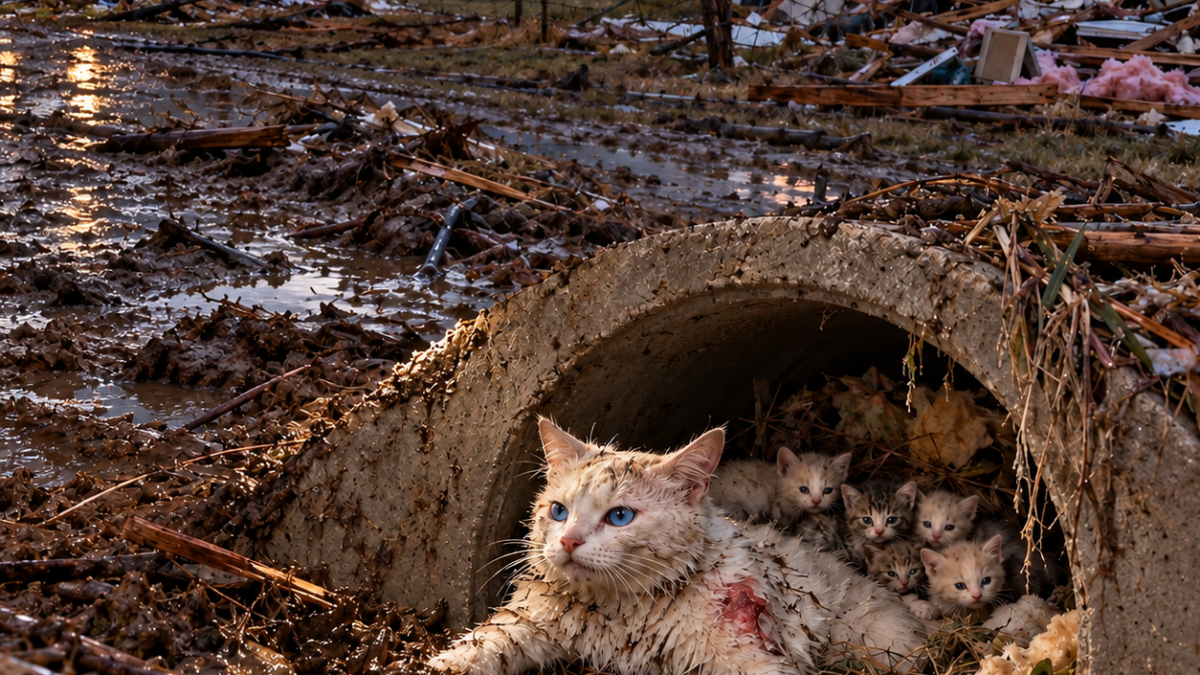
The white cat lay across the opening, coated in dirt and debris, her fur streaked brown and red. Her eyes were open. Her ears were upright. Her body stretched across the mouth of the pipe like she had been placed there by hand.
Everett knelt.
The flashlight shook.
Behind her, inside the culvert, five kittens lay piled together on a nest of grass and insulation.
Alive.
All five.
Sleeping.
Warm.
Untouched.
Everett made a sound then.
It was not speech.
It was not crying exactly.
It was the sound of a man whose whole house had vanished, whose life lay across a pasture in pieces, and who had found, in a concrete pipe under the road, proof that something in the world had chosen life with a bravery he could not comprehend.
The cat’s eyes tracked his face.
She did not move away.
Everett reached toward the shard in her hip.
His hands were shaking.
“Easy,” he whispered.
She could not hear him.
But she watched his mouth.
His eyes.
His hands.
She had always understood him that way.
He pulled the splinter free.
She flinched.
Her claws flexed against the dirt.
But she did not leave the opening.
She did not turn toward the kittens.
She remained across the pipe.
Everett took off his shirt and pressed it against the wound in her shoulder.
Blood soaked into the fabric.
She allowed it.
He sat there in the mud, shirtless, flashlight beside his knee, pressing cloth against a wounded deaf cat while rain fell through the dark and the ruins of his home lay scattered around him.
A neighbor arrived twenty minutes later.
Then another.
Then a sheriff’s deputy.
Then a volunteer firefighter.
Someone asked Everett if he was hurt.
He looked up as if the question belonged to someone else.
“No.”
Someone asked if anyone had been inside.
Everett looked at the culvert.
“Just them.”
The deputy shined his light inside.
“Good Lord,” he said softly.
Everett said, “She moved them.”
No one answered.
What could they say?
The firefighters tried to convince Everett to let them carry the cat and kittens to a truck.
He refused at first.
“She won’t understand,” he said.
“She’s hurt,” one firefighter said gently.
“I know she’s hurt.”
“We need to get her checked.”
“I know.”
But he did not know how to move her without betraying what she had done. She had chosen that opening. She had placed herself there. Every line of her injured body said she was still on duty.
Finally, Everett did the only thing he could think to do.
He tapped the ground three times beside her.
Not with his boot.
With his knuckles.
Hard enough that the vibration passed through the wet soil.
Thud.
Thud.
Thud.
Her eyes shifted to his hand.
He tapped again, softer.
Then he reached for the kittens.
One by one, he brought them forward and placed them in a padded cardboard box the firefighter had found in his truck. The mother watched every movement. When the fifth kitten was in, Everett lifted the whole box and set it close to her face.
She smelled them.
Only then did she try to stand.
Her legs trembled.
She nearly fell.
Everett slid both hands under her and lifted her against his bare chest.
She was lighter than he expected.
Too light.
Her blood warmed his skin.
The deputy drove them to the emergency veterinary clinic because Everett’s truck had a damaged tire from debris and because someone said he should not be driving anyway.
Everett sat in the back seat holding the cat in a towel.
The kittens rode in the box beside him.
The cat kept her head lifted, eyes fixed on the box.
Even bleeding, even exhausted, even half-collapsed, she watched them.
At the clinic, the staff took one look and moved fast.
The veterinarian on duty was Dr. Hannah Reed, thirty-six, tired from twelve hours of storm injuries, and already on her third cup of coffee. She had treated a dog cut by glass, two horses with fence wounds, and a terrified parrot found three miles from home.
Then Everett walked in shirtless, muddy, carrying a white cat wrapped in a bloody towel, with five kittens in a box behind him.
Dr. Reed asked, “What happened?”
Everett looked at the cat.
“Tornado.”
That was all he could say.
They took the cat back.
Everett tried to follow.
A technician stopped him gently.
“We need room.”
“She’s deaf,” he said.
“We understand.”
“No,” he said, and his voice cracked. “You don’t. She watches faces. She doesn’t hear you. Move slow.”
The technician looked at him differently then.
“We’ll move slow.”
Everett sat in the waiting room beside the box of kittens.
He had no shirt.
Someone brought him a scrub top.
He did not put it on for ten minutes.
He just sat there with his hands hanging between his knees, staring at the floor while storm victims came and went.
At 2:14 a.m., Dr. Reed came out.
Everett stood.
“She’s alive,” the veterinarian said.
He sat back down too fast, as if his knees had quit.
“She has a ten-centimeter laceration on her right shoulder. We cleaned it and placed nine sutures. She had a wooden splinter embedded in her left hip. You removed most of it in the field. We cleaned the wound. No tendon or bone damage. She has bruising across her back and left side, likely from debris impact. She is dehydrated, underweight, and exhausted.”
Everett swallowed.
“But?”
Dr. Reed’s expression softened.
“But she is stable.”
He closed his eyes.
“And the kittens?”
“Fine. All five. No injuries. Strong heart rates. Warm. Fed.”
Everett looked toward the box.
“I don’t understand how she did it.”
Dr. Reed sat beside him.
“Tell me exactly where you found them.”
So he did.
The mobile home.
The nest beneath it.
The culvert.
The distance.
The tornado.
The cat across the opening.
The nest rebuilt inside.
Dr. Reed listened without interrupting.
Then she went very quiet.
“She carried the nest too?” she asked.
“Part of it. Same grass. Same insulation.”
“And the culvert was forty-five meters away?”
“About that.”
“How long between warning and impact?”
“There was no warning.”
“I mean from when she might have sensed it.”
Everett shook his head.
“I don’t know.”
The next day, after weather reports confirmed the tornado’s path and timing, Dr. Reed made the calculation.
If the cat had begun moving the kittens only when the tornado was ninety seconds away, the task would have been almost impossible.
Five kittens.
Forty-five meters each way.
Back and forth.
More than four hundred meters of travel.
Carrying newborns.
In rising wind.
With no hearing.
No siren.
No human instruction.
The more likely explanation was stranger and more remarkable.
She had sensed the storm long before humans recognized the threat.
Through the ground.
Through pressure.
Through vibration.
Through the only language the world had ever given her.
She had begun moving them early.
Trip after trip.
Kitten after kitten.
Nest piece after nest piece.
She had listened with her body.
And when the tornado finally came, she had already chosen the only safe structure within reach.
Two days later, Everett visited the clinic.
He was wearing a borrowed flannel shirt and boots still stained with mud. He had spent the previous day dealing with insurance calls, county officials, utility crews, and neighbors who kept asking what he needed when he had no idea how to answer.
His home was gone.
He was sleeping in a neighbor’s camper.
Most of his possessions were ruined.
But when he walked into the exam room and saw the white cat nursing her kittens under a heat lamp, something in his face changed.
The cat lifted her head.
Dr. Reed watched carefully.
Everett did not call her.
He did not clap.
He bent slightly and tapped the metal exam table three times.
Thud.
Thud.
Thud.
The vibration traveled through the surface.
The cat’s eyes fixed on him.
Then, despite the sutures, despite the bruising, despite the exhaustion, she began to purr.
Everett could not hear it at first.
It was too soft.
But Dr. Reed placed two fingers gently against the cat’s throat and smiled.
“She knows you.”
Everett stood there with one hand over his mouth.
Dr. Reed gave him privacy by pretending to check the chart.
After a while, she said, “Does she have a name?”
Everett kept his eyes on the cat.
“No.”
“You’ll need one for the records.”
He nodded.
“What should we put?”
He was silent for a long time.
Then he said a name.
Quietly.
So quietly Dr. Reed almost did not hear.
She wrote it down.
Later, when reporters asked, she would refuse to reveal it.
Everett refused too.
A neighbor eventually asked him, “What’d you name that cat?”
Everett looked toward the mobile home site, where a new foundation crew was setting blocks.
He said, “That’s between her and me.”
The story got out because stories like that cannot stay buried long.
A volunteer firefighter told his wife.
His wife told her sister.
Her sister worked at the local paper.
At first, the article was small.
DEAF CAT SAVES FIVE KITTENS DURING TORNADO.
Then a regional station picked it up.
Then a national animal page.
Then millions of strangers knew about the white cat who had never heard a sound but felt a tornado coming through the ground.
People sent money.
Food.
Blankets.
Cat toys.
Letters addressed simply to:
The Tornado Cat
Miller County
Somehow, several reached Everett.
He did not know what to do with the attention.
He hated cameras.
He hated being called a hero.
“I wasn’t even home,” he told one reporter.
The reporter asked, “But you saved her afterward.”
Everett looked at him.
“She saved them before anyone knew there was anything to save.”
That line made it into every version of the story.
The insurance company covered a replacement mobile home, though not quickly enough to feel like help. For six weeks, Everett lived in the borrowed camper near the barn while crews cleared debris and prepared the site.
The white cat and her kittens stayed at the clinic for ten days, then with a foster volunteer for another month while Everett rebuilt enough of his life to bring them back.
He visited every other day.
Each time, he tapped three times.
Each time, she came.
The kittens grew fat and loud.
They could hear.
All of them.
The black one squeaked when hungry.
The orange one yelled at everything.
The gray tabby hissed at a toy mouse.
The white one with the cream smudge slept upside down and startled at every door.
The mother startled at nothing.
But she saw everything.
She watched hands.
Faces.
Footsteps.
Light under doors.
Vibration through floors.
When Everett finally brought them home, the new mobile home was not finished.
Not really.
The walls were up.
Power worked.
Water ran.
But there were no porch steps yet.
No skirting.
No proper walkway.
There were still piles of lumber and insulation around the site.
The first thing Everett built was not a porch.
It was not steps.
It was not a storage shed.
It was a ramp.
A straight wooden ramp from the front door down toward the old concrete culvert forty-five meters away.
People thought it was strange.
The contractor asked, “You want the ramp before the deck?”
“Yes.”
“To the ditch?”
“To the culvert.”
“Why?”
Everett looked at him as if the answer was obvious.
“So she knows the way.”
The contractor stopped asking.
The ramp was simple.
Strong.
Wide enough for Everett to walk.
Low enough for kittens.
It ran straight across the cleared ground, from the home to the culvert that had become something between a shelter, a shrine, and a second address.
Everett kept the culvert open.
Clean.
Dry.
He lined the inside with straw and a piece of outdoor carpet.
He built a small overhang at the entrance to keep rain out.
The white cat inspected it the first night home.
She walked from the new mobile home down the ramp, slow because her shoulder still pulled at the stitches and her hip remained sore.
Everett followed at a distance.
She entered the culvert.
Sniffed.
Turned around.
Lay across the entrance.
Everett stopped walking.
For a moment, he could not breathe.
She was not bleeding now.
The storm was gone.
The kittens were safe inside the new home.
Still, she lay across the opening.
Guarding the door that had once been the last line between life and everything trying to take it.
Everett sat on the ramp.
The evening was quiet.
Crickets moved in the grass.
The sky was clear.
He tapped the wood three times.
Thud.
Thud.
Thud.
The white cat opened her eyes.
After that, the rhythm of their life changed.
Everett no longer thought of the cat as a stray.
He no longer called her “the white one.”
He still did not tell anyone her name.
But he used it when no one was around.
He said it with his hands more than his voice.
Three stomps when he came home.
Two taps on the porch when he set down food.
A hand held low when he wanted her to come closer.
An open palm when he wanted her to wait.
A slow blink when words were useless.
The kittens were adopted, eventually, but not all at once.
Everett kept two longer than he intended.
Then one neighbor took the orange one.
Dr. Reed took the gray tabby.
A feed store clerk adopted the black kitten after it climbed into her jacket during a visit and refused to leave.
The white kitten with the cream smudge stayed with Everett.
So did the mother.
People told him he should keep them all.
People told him he should not keep any because tornado trauma was unpredictable.
People told him he should write a book.
People told him he should start a social media page.
People told him many things.
Everett did what he always did.
He listened politely.
Then he went home and fed the animals.
The white cat recovered, though scars remained beneath her fur. The shoulder healed with a line you could feel if you touched carefully. The hip left a slight hitch in her walk when mornings were cold. She gained weight. Her coat became clean and bright again.
But something about her remained at the culvert.
On warm nights, she slept at the entrance.
Not inside.
Across it.
Sometimes Everett would wake at two in the morning, look out the window, and see her white shape under the moonlight, stretched in front of the dark circle like a sentinel.
He never made her move.
He understood something about guarding what saved you.
The following spring, storm season returned.
Everett thought he was ready.
He had a weather radio now.
A new phone with alerts loud enough to shake the table, though the cat would never hear them.
A storm shelter installed behind the shed, paid for partly by donations he had tried to refuse until Martha Ingram told him refusing kindness was not humility, just stubbornness in church clothes.
He had carriers for the cats.
Emergency bags.
Flashlights.
Batteries.
Water.
Everything a man could prepare after learning preparation sometimes arrives too late.
But the first time the sky turned greenish-gray, none of that mattered as much as the white cat.
It was late afternoon.
Everett was fixing a gate latch when he saw her come out from under the porch.
She stood still.
Head low.
Body tense.
Ears forward.
The air felt heavy, but no alert had sounded.
Everett watched her.
She moved toward the culvert.
Then stopped.
Looked back at the house.
The white kitten with the cream smudge—now half-grown—was asleep on the porch.
The mother walked to him, nudged him hard, and then started toward the culvert again.
Everett set down the wrench.
He did not check his phone.
He did not look at radar.
He tapped the porch three times.
The cat looked at him.
Then moved faster.
Everett got the carriers.
Fifteen minutes later, the weather service issued a severe thunderstorm warning.
Twenty minutes after that, rotation was detected north of the county.
No tornado touched down near Everett that day.
But hail hammered the roof and wind took down two limbs near the barn.
Everett and the cats were already in the storm shelter.
Afterward, he told Mrs. Alvarez, the neighbor whose property bordered his north fence, “If she moves, I move.”
Mrs. Alvarez laughed at first.
Then she saw his face.
“You mean that.”
“Yes, ma’am.”
“You trust a cat over the weather service?”
Everett looked toward the white cat, who was grooming one paw in the sun as if she had not recently become the most important meteorological instrument on the property.
“I trust both,” he said. “But she usually knows first.”
By the second year, the white cat was no longer national news.
The world had moved on, as it always does.
New storms.
New disasters.
New miracles.
New arguments.
But in Miller County, people remembered.
The veterinary clinic kept a framed photo of her near the front desk. Not the dramatic one the newspaper had used, where she looked wounded and heroic. Dr. Reed chose a quieter photo: the white cat sitting on Everett’s new ramp at sunset, blue eyes calm, one paw slightly lifted, the culvert behind her.
Under it, Dr. Reed placed a small plaque.
SHE LISTENED WITH EVERYTHING SHE HAD.
Everett pretended the plaque embarrassed him.
It did.
It also made him stand there too long whenever he came in for checkups.
The white cat was two years old then.
Still deaf.
Still watchful.
Still unnamed to the public.
Her kittens were grown.
They came when called.
They startled at dropped pans.
They chased sounds.
They lived in the noisy world their mother had never known.
She remained apart from it.
Not lesser.
Different.
She did not hear the screen door.
She felt it.
She did not hear Everett’s truck.
She sensed the vibration through the dirt before tires reached the lane.
She did not hear thunder.
She felt pressure move through her bones.
On quiet evenings, Everett sat on the porch with coffee, and she sat near the ramp. Sometimes the white-and-cream kitten, grown now into a sleek young cat, curled beside her.
Everett would stomp three times.
Thud.
Thud.
Thud.
She would look up.
He would smile.
That was their conversation.
A neighbor once watched from the fence and said, “It’s like you talk through the ground.”
Everett nodded.
“She answers through it too.”
The neighbor leaned on the fence.
“You ever think about what would’ve happened if she hadn’t moved them?”
Everett did not answer right away.
The sun was dropping behind the pasture.
The new mobile home cast a long shadow over the place where the old one had vanished.
Finally he said, “Every day.”
The neighbor regretted asking.
Everett did not.
Some truths deserved to be spoken, even if they hurt.
“That tornado took everything I owned,” Everett said. “But it left me the only thing alive under that house. I figure I’m still ahead.”
Years later, when people told the story, they always focused on the impossible math.
Five kittens.
Forty-five meters.
Back and forth.
A tornado coming.
A deaf mother moving faster than fear.
They wondered whether she truly had ninety seconds or thirty minutes.
They debated whether animals sense pressure drops.
They argued in comment sections about instinct, vibration, maternal drive, and whether the story had grown larger in the telling.
Everett never argued.
He knew what he found.
He knew the nest had been moved.
He knew the kittens were untouched.
He knew the mother lay across the opening, bleeding into debris, still watching the storm’s path with ears that did not work and eyes that missed nothing.
That was enough.
One August evening, three years after the tornado, a young reporter came to the property.
She was making a documentary about rural storm survival and animal behavior. Everett almost said no, but Dr. Reed asked him to consider it because people might learn something.
The reporter was polite.
She did not step where she should not.
She asked before filming the culvert.
She sat with Everett on the porch and said, “What do you think people misunderstand about her?”
Everett looked at the white cat sleeping near the ramp.
“People call her broken.”
“Because she’s deaf?”
“Yes.”
“And you disagree?”
He rubbed his hands together.
They were older now.
More spotted.
Still strong.
“She ain’t missing the world,” he said. “She just knows a different one.”
The reporter went quiet.
Everett continued.
“I spent years thinking silence was empty. After my wife died, this place got so quiet I thought it had nothing left in it. Then that cat came along and showed me silence can be full of things if you know how to feel them.”
The reporter’s eyes filled.
Everett looked away, embarrassed by his own honesty.
The white cat woke, lifted her head, and stared toward the west.
Everett noticed immediately.
The reporter followed his gaze.
“What is it?”
Everett stood.
“Pressure’s dropping.”
The reporter looked at the sky.
It was blue.
Mostly.
A few clouds.
Nothing alarming.
Everett walked to the door and stomped three times.
The white cat stood.
The young cat stood too.
Everett said, “We’re done for now.”
The reporter did not argue.
Forty minutes later, a severe storm rolled over the county with winds strong enough to take down power lines.
No tornado.
No tragedy.
But the reporter included that moment in the documentary.
Not as magic.
As attention.
That was what the white cat had always been, more than miraculous, more than heroic.
Attentive.
To the ground.
To danger.
To kittens.
To a lonely man’s footsteps.
To a world that never spoke in sound but never stopped speaking.
On the fifth anniversary of the tornado, Everett planted an oak near the culvert.
A small one.
Barely taller than his knee.
Mrs. Alvarez brought a shovel.
Dr. Reed came.
Martha Ingram came with lemonade.
Even the firefighter who had found the cardboard box stopped by.
Everett did not want a ceremony.
He got one anyway because people who survive things do not always get full control over how others remember them.
They stood by the culvert while the white cat sat at the opening, older now but still bright-eyed.
Everett placed a flat stone beside the oak.
No long inscription.
No dramatic title.
Just six words.
SHE FELT THE STORM AND MOVED.
Dr. Reed wiped her eyes.
Mrs. Alvarez said, “That’s perfect.”
Everett shrugged, uncomfortable.
“It’s what happened.”
That was Everett.
That was also why the words mattered.
They did not exaggerate.
They did not decorate.
They left room for the truth to be large on its own.
That night, after everyone left, Everett sat alone on the porch.
The oak sapling moved gently in the warm wind.
The culvert was dark.
The white cat lay across its entrance.
Again.
Always.
He looked at her and thought about the man he had been before she arrived: a man feeding animals without naming them, fixing things without explaining why, living in a house full of silence and pretending silence meant he needed nothing.
Then came a deaf cat who could not hear him, and somehow she listened better than anyone had in years.
She listened to his footsteps.
To the earth.
To pressure.
To danger.
To life.
She had not saved only the kittens.
Everett understood that now, though he would never say it out loud to a reporter.
She had saved the part of him that still believed something small could matter enough to change what came next.
He stood slowly.
His knees hurt.
They always did when weather shifted.
He stepped onto the porch and stomped three times.
Thud.
Thud.
Thud.
The vibration passed through wood.
Through blocks.
Through soil.
The white cat lifted her head.
Her blue eyes found him in the dark.
Everett smiled.
“Come on, girl,” he said, though she could not hear him.
She rose from the culvert and walked up the ramp toward him.
Behind her, the round concrete opening waited, dark and empty, no longer only a drain, no longer only a shelter.
It was a doorway in their story.
The place where a mother had stood between the world ending and five tiny lives beginning.
The place where silence had become warning.
The place where instinct had outrun disaster.
The place where a man who thought he had lost everything found a living creature still guarding what love had saved.
The white cat reached the porch.
Everett bent down and touched her head.
She leaned into his hand.
Above them, the night was warm and still.
No siren.
No thunder.
No wind.
But if the earth changed, she would know.
If pressure dropped, she would know.
If danger began forming beyond the fields before any human machine understood it, she would feel it first through paws, bone, breath, and memory.
Everett knew that.
So did the neighbors.
So did Dr. Reed.
So did anyone who had ever stood near that culvert and imagined what it took for a deaf mother to carry five kittens through open ground while the sky prepared to tear a home apart.
Some heroes arrive with noise.
Sirens.
Engines.
Shouting.
Warnings.
She arrived in silence.
She saved in silence.
She bled in silence.
And years later, when storm clouds gather over Miller County and the air turns heavy enough to make people look twice at the horizon, Everett Cole does not wait for the first alert to tell him what matters.
He looks for the white cat.
Because she cannot hear the storm.
She never could.
But she can feel the earth preparing to receive it.
And sometimes the creature the world calls broken is the only one listening closely enough to save everyone before the warning ever makes a sound.