The Chief Surgeon Mocked the Quiet Nurse All Night—Then the Hospital Lost Power, 26 Casualties Poured In, and an Admiral Revealed She Was the Only One Who Passed Every Test.
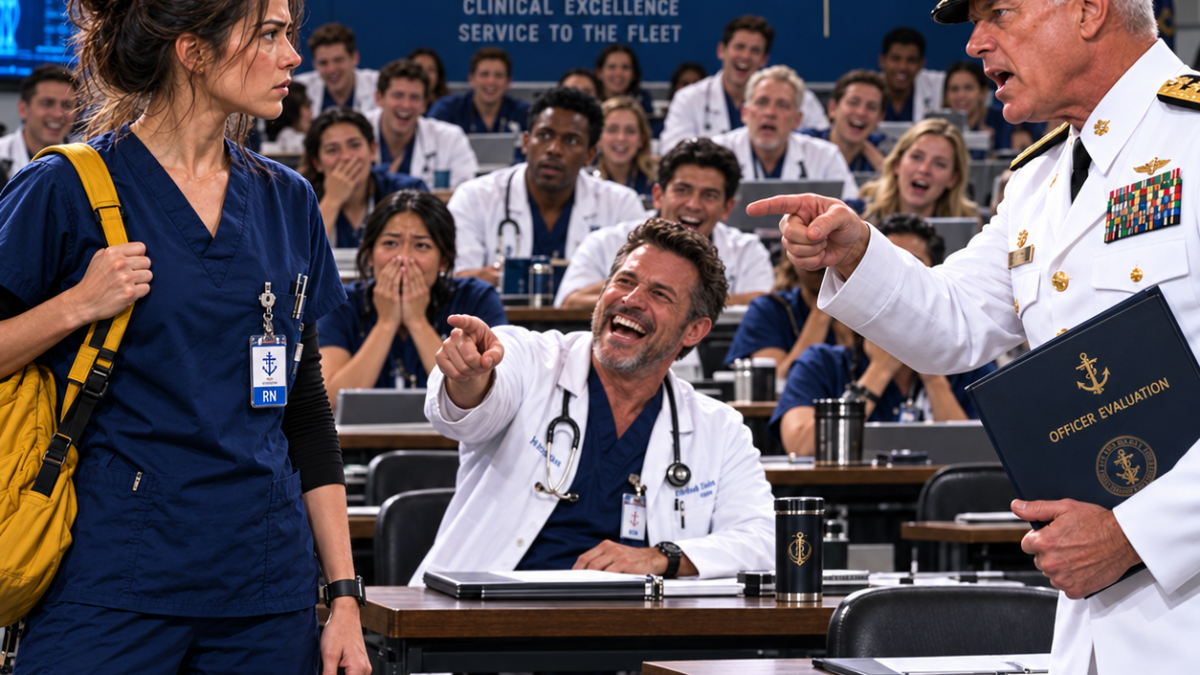
The Chief Surgeon Mocked the Quiet Nurse All Night—Then the Hospital Lost Power, 26 Casualties Poured In, and an Admiral Revealed She Was the Only One Who Passed Every Test.
At 2:47 in the morning, Chief Surgeon Richard Hail still thought Hannah Cole was an overly cautious night nurse who needed reminding to “stay in her lane,” even though she had already found an untested generator problem, quietly restocked trauma supplies, and noticed danger gathering over the harbor before anyone else did.
Less than twenty minutes later, an explosion flooded St. Gerard Regional Hospital with burned and bleeding dockworkers, the operating rooms began filling with the wrong patients, the main electrical grid collapsed, and Hannah stopped asking the chief surgeon for permission.
By sunrise, twenty-four of twenty-six casualties were alive, the gray-coated stranger who had watched her all night finally revealed himself as Rear Admiral Warren Doyle, and Dr. Hail learned that the quiet nurse he had publicly corrected was a Navy captain who had just been the only person in his entire hospital to meet every standard of a secret disaster-response evaluation.
My name is Hannah Cole.
For most of my adult life, I have preferred jobs where nobody expects a speech.
Give me a patient.
Give me a problem.
Give me a medication list, a bad set of vitals, a frightened family member, a broken process, or a room that feels wrong.
I can usually do something useful with that.
Give me a microphone and applause?
I’d rather start another twelve-hour shift.
That was part of why almost nobody at St. Gerard Regional Hospital knew much about me.
To them I was Nurse Cole.
Night shift.
Fourth floor.
Thirty-nine years old.
Dark hair usually twisted into a low knot by midnight.
No wedding ring.
No children mentioned.
Never late.
Rarely called in sick.
Frequently caught checking things other people assumed someone else had checked.
The sort of nurse who knew which oxygen regulator stuck in room 408, which patient in 417 became confused after sunset, and which vending machine on the ground floor sometimes returned two granola bars when you paid for one.
I had worked at St. Gerard for eleven months.
Long enough to become useful.
Not long enough to become important.
That suited me.
St. Gerard sat above the harbor on the edge of a working coastal city in Washington State.
Not a major academic medical center.
Not a Level I trauma giant.
Two hundred twenty beds.
Four operating rooms.
Modest intensive care unit.
PART2:
Emergency department built for twenty-four patients and routinely holding thirty.
Fishing injuries.
Construction falls.
Car accidents.
Respiratory emergencies.
Strokes.
The occasional industrial accident.
Enough to keep people competent.
Rarely enough to break the entire system at once.
That mattered.
Hospitals, like people, become confident about disasters they have not yet experienced.
There were binders.
Emergency plans.
Annual drills.
Color-coded command charts.
Evacuation maps.
People loved laminated instructions because laminated things look prepared.
Actual preparedness is less attractive.
It looks like checking whether the generator works.
Counting tourniquets.
PART3:
Knowing where flashlights are stored.
Asking how much blood is physically available at two in the morning instead of assuming “the blood bank” is a bottomless noun.
Those habits came from another life.
A life I kept separate from St. Gerard.
On the night everything changed, I began my shift at 7:00 p.m.
Nothing unusual.
An older man in 412 recovering from pneumonia.
A diabetic woman in 415 waiting for discharge placement.
A retired fisherman with early heart failure.
A twenty-three-year-old recovering from appendectomy.
At 2:15 a.m., the floor was unusually quiet.
That made me nervous.
Some people like quiet hospitals.
I do too.
But there are different kinds of quiet.
Restful quiet.
Exhausted quiet.
And the strange quiet that appears just before something changes.
I walked the fourth-floor corridor with a clipboard I didn’t need.
I already knew the bed numbers.
Room 412.
Mr. Everett Sloan.
Seventy-four.
Pneumonia improving.
Monitor looked fine.
Heart rhythm stable.
Oxygen acceptable.
But I did not like his breathing.
Too fast.
Too shallow.
The machine had not alarmed because machines recognize numbers, not stories.
I watched his chest.
Counted.
Listened.
Raised the head of his bed slightly.
Not dramatically.
Just enough.
Then called the resident.
By the time the resident arrived ten minutes later, Mr. Sloan was breathing easier.
Dr. Richard Hail saw the chart note.
That was enough to irritate him.
He sat at the central workstation in his white coat reading surgical consults.
Richard Hail was fifty-six.
Chief of Surgery.
Tall.
Handsome in the deliberate silver-haired way television casts senior physicians.
He had built a respected vascular surgery program.
Published.
Lectured.
Fundraised.
Saved lives.
All true.
He also possessed one weakness that competence can hide for decades.
He believed expertise in one room translated automatically into authority in every room.
“Nurse Cole.”
I stopped.
“You adjusted 412?”
“Yes.”
“Why?”
“Respirations were shallow.”
“You called the resident afterward?”
“Immediately.”
“That isn’t what I asked.”
Two nurses nearby became very interested in their screens.
I knew the ritual.
Public correction.
Small enough to deny.
Loud enough to establish hierarchy.
“I elevated him ten degrees and notified the resident.”
“Next time, ask first.”
I looked at him.
“For positioning?”
“We follow protocol here.”
“I did.”
“Not instinct.”
He tapped the chart.
“Protocol.”
I could have argued.
Could have shown the respiratory trend.
Could have explained that nursing judgment is not disobedience.
Instead I said:
“Understood.”
That annoyed one of the younger nurses later.
“You should have told him.”
“Told him what?”
“That you were right.”
“Mr. Sloan is breathing better.”
“That isn’t the point.”
I smiled.
“It is to Mr. Sloan.”
Long ago I learned that being right and being heard are different achievements.
If patient safety required the argument, I argued.
If ego required it, I saved energy.
Around 2:20, security logged a visitor.
Gray coat.
Gray hair.
Late fifties, maybe early sixties.
No obvious medical badge.
Small black notebook.
The security guard said:
“Hospital auditor.”
That made sense.
St. Gerard had been expecting a regional preparedness review sometime that month.
No one knew exactly when.
Administrators hated surprise reviews.
People who actually wanted to know whether systems worked tended to prefer them.
I noticed the auditor for another reason.
He stood with his back to a wall.
Could see both exits.
Did not check his phone.
Watched people, not signs.
Military habit.
Maybe law enforcement.
Maybe just paranoid.
I filed it away.
At 2:31, I checked the trauma supply room.
Not my assignment.
That was another thing Dr. Hail disliked.
I counted.
Eight tourniquets.
Six chest seals.
Four pressure dressings in the primary cabinet.
More downstairs.
Saline.
Burn sheets.
IV kits.
Blankets.
Not enough if the harbor ever produced what the harbor was capable of producing.
So I moved reserve stock from central storage to the emergency department.
Nothing heroic.
A cart.
Elevator.
Restocking.
Then I went to maintenance.
Night technician named Leo Alvarez looked up from a crossword.
“You lost?”
“Generator log.”
He pointed.
“Binder.”
Last full load test:
three months earlier.
Note:
PARTIAL CAPACITY UNDER HIGH LOAD. REVIEW PENDING.
No documented follow-up.
I read it twice.
“Leo?”
He looked over.
“This get fixed?”
He grimaced.
“Facilities has been waiting on a control board.”
“How much capacity?”
“Last test? Around sixty percent before one circuit started dropping.”
“Critical circuits?”
“Supposedly prioritized.”
“Supposedly?”
He shrugged.
“Welcome to budgeting.”
I wrote the date and capacity on a small piece of paper.
Folded it into my pocket.
When I returned upstairs, Dr. Hail saw the empty supply cart.
“Where were you?”
“Restocking ED trauma supplies.”
“Why?”
“They were low.”
“We have purchasing.”
“Purchasing isn’t here.”
“We have a charge nurse.”
“She was busy.”
He removed his glasses.
“Nurse Cole.”
“Yes?”
“Stay on your floor.”
I looked at him.
“Understood.”
“Good.”
Behind him, through the long windows facing the harbor, I noticed a thin gray line rising into the night.
Smoke.
Distant.
Could have been a boat exhaust plume.
Could have been nothing.
I watched five seconds too long.
Hail noticed.
“Something else?”
“No.”
“Then work.”
At the end of the hall, Dr. Amir Patel struggled with a bleeding patient’s dressing.
First-year resident.
Smart.
Nervous.
The patient had arrived from an industrial accident earlier.
Deep arm laceration.
Bleeding increased.
Patel pressed gauze.
Blood soaked through.
I stepped beside him.
“Higher pressure.”
He adjusted.
Still bleeding.
We used the appropriate hemorrhage-control equipment available to us and documented the time.
Fast.
Clean.
Patel stared at my hands afterward.
“Where did you learn that?”
“Nursing.”
He shook his head.
“That wasn’t nursing-school speed.”
“Check distal circulation.”
“Hannah.”
“Doctor.”
He understood I would not answer.
Then at 2:47 a.m., the windows rattled.
Not a bang.
At first.
A low pressure.
Something felt in sternum and teeth.
Glass shook once.
Lights flickered.
My body moved before thought finished.
Downstairs.
Emergency department.
Behind me Hail said:
“Nurse Cole?”
I did not stop.
The ED phone rang as I entered.
Charge nurse Melissa Grant answered.
Her face changed.
“What?”
She listened.
Then:
“How many?”
Pause.
“Oh God.”
She hung up.
“Explosion at the harbor.”
“What?”
“Fuel dock.”
“How many casualties?”
“They don’t know.”
I looked through the emergency doors.
Distant orange light pulsed against low clouds.
“Mass casualty protocol.”
Melissa hesitated.
“Administration hasn’t called it.”
“Call it.”
“Hannah—”
“Call the house supervisor.”
I began clearing hallways.
One stretcher moved.
Then another.
The first ambulance arrived four minutes later.
Doors opened.
The smell came first.
Diesel.
Burned fabric.
Metal.
Hair.
A dockworker with facial and arm burns.
Second patient.
Woman.
Shrapnel wound thigh.
Heavy bleeding.
Third.
Teenage boy.
Silent.
Chest movement wrong.
Second ambulance arrived before the first was empty.
Then third.
Then private pickup trucks started bringing injured workers before EMS could stop them.
Within ten minutes, St. Gerard changed species.
It stopped being a hospital having a busy night.
It became a system absorbing impact.
Twenty-six casualties would ultimately come through our doors.
At 2:58, Dr. Richard Hail entered the emergency department.
Fast walk.
White coat gone.
Surgical cap in his hand.
“Everybody listen.”
People stopped.
“I am taking medical command.”
Reasonable.
He was chief surgeon.
Senior physician present.
“Nothing moves without an order.”
His voice sounded strong.
I watched his hand.
Tiny tremor.
Fear.
Not weakness.
Everyone is afraid during a real disaster.
Anyone who tells you otherwise is either lying or not paying attention.
The injuries told me something important.
Burns.
Blunt trauma.
Shrapnel.
Crush injury.
Several casualties injured primarily from the same direction.
Fuel dock explosion.
Night shift.
Likely many more workers within blast radius.
This was the first wave.
Hail looked at arrival list.
“We move critical patients to OR in arrival order.”
I thought I misheard.
“Doctor?”
He looked toward me.
“First critical arrival first treated.”
It sounds fair.
Fairness is seductive during disasters.
But triage is not fairness.
It is survival under scarcity.
First patient moving toward OR had painful shoulder shrapnel.
Stable.
Second had forearm fracture.
Stable.
Third had burns.
Serious but no immediate airway compromise.
Meanwhile the teenage boy from the first ambulance was deteriorating in the hallway.
Gray lips.
Unequal chest movement.
I counted.
Four operating rooms.
More casualties incoming.
Arrival-order surgery would occupy resources before the most salvageable dying patients reached them.
I approached Hail quietly.
“Doctor.”
“What?”
“Arrival order is going to jam the rooms.”
His expression hardened.
“Explain.”
“Some early patients are stable enough to wait.”
“They were tagged critical.”
“Field triage happened before full assessment.”
“They were tagged critical.”
“Two later patients will die if they wait behind them.”
Heads turned.
Hail lowered his voice.
“I gave an instruction.”
“Yes.”
“You will follow it.”
I looked at him.
Could have argued.
Instead:
“Yes, Doctor.”
Then walked away.
Why?
Because I had put the concern on record.
The next step was preventing a preventable death.
The teenage boy’s condition was worsening.
Dr. Patel knelt beside him.
“Hannah?”
I checked.
Signs consistent with rapidly increasing intrathoracic pressure.
We did not have time for a philosophical discussion.
“Call trauma.”
“No one is available.”
“Then you need to intervene according to emergency protocol.”
Patel’s face went pale.
“I’ve only done this in simulation.”
“I know.”
He looked at me.
“Will you stay?”
“Yes.”
He performed the emergency procedure with direct physician authorization by phone and my assistance.
Air escaped.
The boy’s chest movement improved.
Color began returning.
Patel stared.
“That worked.”
“Keep reassessing him.”
I took a black marker.
Wrote a large number on the back of the boy’s hand.
Next patient.
Next.
Not arbitrary.
Priority.
Simple enough to see.
Simple enough to survive lost paperwork.
Melissa watched.
“What are you doing?”
“Second triage pass.”
“Hail said arrival order.”
“I know.”
“You’re changing his list.”
“I’m building a survivability list.”
She stared.
Then grabbed another marker.
“Tell me the categories.”
That was the moment the system began changing.
Not because I gave a speech.
Because one nurse followed.
Then another.
Dr. Patel.
A respiratory therapist.
Numbers appeared.
One.
Two.
Three.
Hold.
Reassess.
Fast visual language.
The gray-coated auditor stood at the end of the corridor.
Notebook open.
Writing.
At 3:18, the fourth ambulance arrived.
At 3:24, the emergency department exceeded its normal capacity.
At 3:31, room three became unusable because of an equipment malfunction.
At 3:38, the hospital lost main power.
Everything went black.
For three seconds, twenty-six injured people and dozens of staff existed only as breathing and sound.
Someone screamed.
A ventilator alarm wound down.
Emergency battery lights came on.
Then generator circuits caught.
Amber illumination.
Half the corridor.
Operating room one.
Operating room two.
Not three.
Not four.
Maintenance technician Leo ran in.
“Generator is holding sixty percent.”
I touched the folded paper in my pocket.
Exactly.
Hail turned.
“What?”
“Sixty percent.”
“Why?”
“Control problem.”
“When was this identified?”
Leo hesitated.
“Last test.”
“When?”
“Three months.”
Hail’s face changed.
I said nothing.
No satisfaction.
This was not the moment to enjoy being right.
Then another problem arrived.
Blood bank.
Temperature alarm.
Grid interruption had affected refrigeration and transfer systems.
Technicians protected most inventory, but safe immediately available supply fell to eleven units for the active emergency window.
Twenty-six casualties.
Two operating rooms.
Eleven units.
Incomplete power.
More ambulances might still come.
That was the real test.
Not technical skill.
Scarcity.
Scarcity reveals leadership.
Hail stood at the central workstation.
Everyone looked at him.
He opened his mouth.
No order came.
Five seconds.
Ten.
Too long.
I walked to him.
Not in front.
Beside.
“Doctor.”
He looked at me.
His face had gone pale.
I lowered my voice.
“I’ll carry triage.”
He said nothing.
“You keep surgical command.”
Still nothing.
“Your name stays on operative decisions.”
His eyes found mine.
I was giving him a way to remain useful without pretending he was managing everything.
That matters.
Humiliation destroys leadership faster than error.
He nodded once.
Barely.
Enough.
I turned.
“Listen up.”
My voice changed.
People later said they noticed.
No shouting.
Just projection.
“OR one and two take Priority One cases only.”
“Ventilators to west-wall emergency circuits.”
“Stable fracture patients move east corridor.”
“Burn patients without airway compromise hold in monitored secondary bay.”
“Reassess every five minutes.”
“No running.”
“Repeat orders back.”
People moved.
Closed-loop responses started.
“West-wall outlets.”
“Confirmed.”
“Priority One only.”
“Confirmed.”
“Blood release by patient number, not room.”
“Confirmed.”
Chaos became structure.
Not calm.
Structure.
Those are different.
At 3:52, another tremor shook the building.
Secondary harbor explosion.
Smaller.
No new wave immediately.
At 4:02, room two power began fluctuating.
At 4:07, maintenance isolated it.
One operating room remained.
Eleven units of blood had become eight.
Some used.
Some reserved.
At 4:12, I stood between two stretchers.
First patient:
Evan Mercado.
Twenty-three.
Dock worker.
Crushed abdomen.
Suspected internal bleeding.
Conscious.
Pale.
Blood pressure falling.
Good survival probability with surgery and blood.
Second:
Harbor Captain Daniel Reeves.
Sixty-seven.
Deep chest trauma.
Multiple injuries.
Failing circulation.
Lower probability despite equal resource need.
One room.
One surgical window before generator load risked worsening.
Dr. Patel whispered:
“Which one?”
He nearly called me Captain.
Stopped.
I heard it.
Ignored it.
I examined both.
Numbers.
Probability.
Resources.
Time.
I had made this kind of decision before.
Not in hospitals.
Different places.
Dust instead of tile.
No electricity to lose because there was none.
Names I still remembered.
Triage is sometimes described like mathematics.
It isn’t.
Math has no mother waiting outside.
No wedding ring.
No patient asking:
“Am I going to die?”
But if you let emotion erase the arithmetic during true scarcity, more people die.
That is the cruelty.
I said:
“Mercado goes.”
Patel closed his eyes for half a second.
Then nodded.
Captain Reeves had heard.
He opened his eyes.
Looked at me.
He understood.
Older men who have worked dangerous jobs often understand triage before doctors explain it.
I leaned near him.
“We’re not abandoning you.”
He gave the smallest nod.
I told the nurse:
“Keep him warm.”
“Pain control within pressure limits.”
“Do not leave him alone.”
Mercado’s stretcher moved.
“Ma’am?”
He was barely conscious.
“Yes?”
“My mother.”
“We’ll call her.”
“She’ll be mad.”
“Then you need to stay alive long enough to deal with that.”
A faint smile.
Good.
They moved him to surgery.
Captain Reeves survived longer than expected.
Long enough for surgical capacity to return.
But his injuries were too severe.
He became one of the two patients we lost that night.
I still remember his nod.
People sometimes praise leaders for saving twenty-four.
I remember the two.
Leadership is cruel that way.
At 4:21, part of the corridor ceiling loosened after vibration damage.
A tile and section of support material dropped.
I saw it.
A pediatric stretcher sat beneath.
Child from secondary blast debris.
I moved.
Took most of the falling material across my left shoulder and ribs.
Pain exploded.
I dropped to one knee.
Melissa shouted:
“Hannah!”
“I’m fine.”
I wasn’t.
Probably cracked rib.
Deep abrasion.
No time.
“Move the child.”
Blood spread beneath my scrub sleeve.
I pulled fabric down.
Kept working.
That is not heroic.
It is also not behavior I recommend.
Later Dr. Patel told me:
“You should have stopped.”
He was right.
During the event, however, pain stayed behind a door.
At 4:40, the emergency department found rhythm.
Numbers on hands.
Patients grouped by need.
One surgical room operating.
Respiratory support concentrated on powered circuits.
Blood tracked physically on a whiteboard because computers were unreliable.
Paper charts clipped to stretchers.
Runners moving messages.
Staff pairs assigned.
Hail stood at the center.
He had regained himself.
That should have been good.
Instead ego returned with him.
He walked past three patients.
Saw numbers.
Stopped.
“Who changed triage?”
Silence.
One nurse finally answered.
“Nurse Cole.”
He found me near the supply cart.
Left arm against my side.
“Nurse Cole.”
“Yes?”
“You overrode my order.”
“Yes.”
His face hardened.
“In front of my staff.”
“I changed prioritization after resources changed.”
“I said arrival order.”
“Yes.”
“And now my operating schedule has been replaced by marker numbers on patients’ hands.”
“Yes.”
“Return to original sequence.”
Nobody moved.
Hail turned.
“I said return to arrival order.”
Still nobody moved.
Not rebellion.
By then the staff could see the system working.
He raised his voice.
“Now.”
Then came another voice.
Calm.
Dry.
“Dr. Hail.”
The gray-coated auditor walked forward.
Closed his notebook.
Removed a credential wallet.
Opened it.
“Rear Admiral Warren Doyle.”
The corridor went silent.
“United States Navy.”
Hail stared.
Doyle continued:
“Regional Medical Readiness Command.”
“Tonight’s preparedness evaluation began at midnight.”
His eyes moved toward me.
“The harbor explosion was not part of it.”
That mattered.
No conspiracy.
No planted disaster.
The audit happened to intersect a real catastrophe.
Doyle looked back at Hail.
“But what followed became the most complete real-world disaster test this facility has experienced.”
Hail said:
“Admiral, I was—”
Doyle raised one hand.
“Later.”
Then:
“Captain Cole.”
Every face turned toward me.
There it was.
The title.
The one I had not used at St. Gerard.
Hail looked confused.
“Captain?”
Doyle faced me.
“Two operative rooms became one.”
“Twenty-six casualties.”
“Eleven usable blood units at the point of greatest scarcity.”
“Partial generator capacity.”
“Why did Mercado go before Captain Reeves?”
I lowered my hand from my injured side.
“Higher predicted survival with definitive intervention.”
“Resource demand?”
“Approximately equivalent.”
“Why not arrival order?”
“Because arrival time is not survivability.”
“Why write numbers on patients?”
“Paper charts were separating from stretchers.”
“Why west wall for ventilators?”
“Dedicated emergency circuit on the diagram.”
“Why had trauma supplies been moved before the explosion?”
“They were below the level I wanted for a harbor-adjacent facility.”
“Who ordered you to check?”
“No one.”
“Generator?”
“I reviewed the log.”
“When?”
“Before the explosion.”
Doyle nodded.
Hail looked at me.
Then at the folded slip visible in my pocket.
Then my bloodied sleeve.
Understanding came slowly.
Not all of it.
Enough to hurt.
Doyle asked:
“Why did you let Dr. Hail keep operative command after he froze?”
The question surprised everyone.
I answered:
“Because he is the best vascular surgeon in the building.”
Hail looked at me.
“He was useful in surgery.”
“Removing him from command completely would have created a second crisis.”
Doyle nodded again.
That answer mattered more to him than the triage mathematics.
Leadership is not winning control.
It is preserving the best use of every person available.
At 5:20, outside regional support arrived.
Generator truck.
Additional blood.
Transfer teams.
The hospital expanded again.
Scarcity eased.
At 5:47, the final critical patient left the emergency corridor.
At 6:20, daylight came gray over the harbor.
Smoke still hung across the water.
The emergency department looked destroyed.
Blood stains.
Used packaging.
Empty stretchers.
Coffee nobody had touched.
A handwritten survivor list taped above the central station.
Twenty-four alive.
Two dead.
No staff fatalities.
No secondary crush injuries.
No ventilator losses.
One operating room still functional.
I sat for the first time.
Dr. Patel looked at my side.
“You’re bleeding.”
“I noticed.”
“You said you were fine.”
“I was busy.”
“That is not what fine means.”
“I’m learning.”
Imaging showed no major fracture.
Deep bruising.
Two cracked ribs, depending on how one radiologist interpreted the film.
Shoulder laceration.
Painful.
Manageable.
Patel wrapped my ribs, though current practice made us avoid restricting breathing too much.
He handed me analgesia.
I declined initially.
He stared.
“Captain.”
“Don’t.”
“Take the medication.”
I did.
Rank apparently useful.
At 7:10, Doyle gathered the essential staff in a conference room.
Hail stood at the back.
No white coat.
No authority performance.
Just exhausted.
Doyle remained in his gray coat.
That amused me.
Admiral beneath auditor.
He placed the notebook on the table.
“I have reviewed forty-one hospitals in my career.”
Nobody moved.
“Our disaster readiness standard evaluates four things.”
“Recognition.”
“Resource control.”
“Triage under pressure.”
“Command resilience when systems fail.”
He paused.
“This facility has strengths.”
“Some excellent clinicians.”
“Some dangerous assumptions.”
Hail lowered his eyes.
Doyle continued.
“Before tonight’s explosion, several staff members failed portions of the readiness evaluation.”
“An unresolved generator limitation existed for three months.”
“Trauma supplies were below appropriate surge levels.”
“Emergency routing was overly dependent on electronic charting.”
“Disaster leadership authority was poorly distributed.”
Administrator looked ill.
Then Doyle said:
“One person identified all four before or during the event.”
Silence.
“Only one.”
He looked at me.
“Hannah Cole.”
Nobody clapped.
Thank God.
Doyle continued:
“Captain Hannah Cole, Navy Reserve Nurse Corps.”
There were whispers.
That was only half the truth.
“Former active-duty trauma nurse.”
“Prior assignment to Expeditionary Medical Unit Seven.”
“Mass-casualty operations in Afghanistan, Iraq, and humanitarian deployments in the Pacific.”
Hail stared at me.
I looked at the table.
I had not hidden those records illegally.
St. Gerard had my reserve status in HR.
It simply never mattered to daily work.
Doyle said:
“Captain Cole was not placed here as part of my audit.”
Important again.
“No one planted her.”
“She works here because she chose to.”
Then he held up the notebook.
“But in a disaster test no one knew they were taking…”
He looked around.
“She was the only person who aced every category.”
That became the headline later.
I hated it.
ONLY ONE WHO ACED IT.
Too clean.
Doyle asked:
“The command would like to recognize you formally.”
“Thank you, sir.”
“However—”
“Sir.”
He stopped.
“This was the work of the team.”
Doyle said:
“I know.”
“Then their names belong on the record.”
I started listing.
Melissa Grant.
Amir Patel.
Leo Alvarez.
Respiratory therapist Dana Bishop.
Blood-bank technician Grace Ng.
OR nurse Sam Everett.
Every person I could remember.
Doyle listened.
Then:
“As you wish.”
Only after that did Richard Hail step forward.
“Nurse Cole.”
Not Captain.
I appreciated that.
I was his nurse colleague in that building.
He looked terrible.
“May I speak with you?”
“You are.”
A faint wince.
Fair.
“I was wrong.”
I said nothing.
“About your judgment.”
“About the arrival order.”
“About the generator concern.”
He stopped.
Then forced himself farther.
“About you.”
That was harder.
“I interpreted initiative as insubordination.”
“Yes.”
“I confused control with leadership.”
“Yes.”
“I told you to stay in your lane.”
“You did.”
He looked toward the floor.
“I did it because I assumed I knew where your lane was.”
That was the first useful sentence.
I nodded.
“I’m sorry.”
Everyone watched.
I did not want theater.
So I gave him truth.
“You kept the operating rooms functioning.”
He looked surprised.
“That mattered.”
It wasn’t forgiveness.
It wasn’t absolution.
It was fact.
Then I added:
“But next time a nurse tells you the wrong patient is going to surgery, listen before you remind her who you are.”
His jaw tightened.
Then relaxed.
“Yes.”
I returned to fourth floor.
Room 412.
Mr. Sloan was awake.
He looked at my ribs.
“What happened to you?”
“Long night.”
“I heard explosion.”
“So did everybody.”
He breathed comfortably.
Head still elevated.
“Doctor said you were right about my breathing.”
I adjusted his blanket.
“Doctors say surprising things.”
He laughed.
At the door, Doyle appeared.
Still in gray coat.
He did not enter.
Raised his hand.
Small salute.
I returned it.
Then went back to work.
That should have been the end.
It wasn’t.
Disasters expose systems.
The dangerous thing is how quickly organizations try to convert exposure into memory instead of change.
For the first week, everyone at St. Gerard wanted to talk about heroes.
News vans came.
Administration drafted a press release.
They wanted a photograph of me standing with Rear Admiral Doyle.
I refused.
They wanted:
NAVY CAPTAIN NURSE SAVES HOSPITAL AFTER HARBOR BLAST.
I asked them to remove my name from the headline.
Communications director looked offended.
“But you led triage.”
“So did six other people.”
“You identified the generator issue.”
“Which had been documented three months earlier.”
That sentence was important.
I had not discovered the problem.
A technician discovered it.
The system ignored him.
That difference changed the investigation.
Leo Alvarez had written:
PARTIAL CAPACITY.
REVIEW PENDING.
Facilities submitted purchase request.
Finance delayed approval.
Administration deferred replacement until next quarter.
No villain.
That is the frightening part of many failures.
No one person decides:
Let’s create a disaster.
A technician writes a note.
A manager submits paperwork.
A budget committee delays.
Everybody is reasonable alone.
The system becomes dangerous together.
Doyle understood.
His report did not praise me for magically seeing the future.
It criticized St. Gerard for making safety depend on someone voluntarily reading a maintenance binder at 2:30 a.m.
That was correct.
Trauma supplies were another example.
I had moved stock.
Good.
But why could a nurse discover low surge inventory simply by opening a cabinet?
Because inventory thresholds were based on average demand, not mass-casualty surge.
Changed.
Blood bank emergency power?
Changed.
Manual triage backup?
Changed.
Operating-room prioritization?
Changed.
Command hierarchy?
That one caused war.
Dr. Hail initially resisted the proposed disaster-command redesign.
At a review meeting two weeks later, he said:
“You cannot have nurses overriding physicians during an emergency.”
I was sitting three seats away.
I asked:
“Did anyone propose that?”
“No.”
“Then what are we arguing about?”
He looked annoyed.
Doyle was on video conference.
Administrator shifted uncomfortably.
New protocol proposed multidisciplinary disaster command:
Medical lead.
Nursing operations lead.
Resource/logistics lead.
Facilities lead.
Independent triage authority.
No one person responsible for every decision.
Hail disliked distributed authority.
“You create conflicting orders.”
I said:
“You create checks.”
“You create hesitation.”
“You prevent one person’s blind spot from becoming hospital policy.”
Silence.
He looked at me.
“Are you suggesting my decision caused deaths?”
“No.”
That mattered.
Neither of the two deaths could reasonably be attributed solely to his arrival-order rule because intervention occurred before resource exhaustion fully played out.
“I am saying it could have.”
He leaned back.
“That’s easy to say after the fact.”
“Correct.”
I nodded.
“That is why we review disasters after the fact.”
Doyle almost smiled on screen.
The new model passed.
Then came my least favorite consequence.
People at St. Gerard began treating me differently.
Too differently.
Before the explosion:
“Nurse Cole.”
After:
“Captain.”
I hated it.
A resident stood when I entered a break room.
“Sit down.”
He sat immediately.
That was worse.
A young nurse apologized because she had once borrowed my pen and forgotten to return it.
I stared at her.
“What do you think the Navy does about stolen pens?”
She went pale.
I laughed.
She did not.
The problem with hidden-rank reveal stories is what happens afterward.
People decide respect was retroactively justified by status.
I did not want that.
One morning I addressed the nursing team.
“Please stop calling me Captain.”
Melissa raised her hand.
“No.”
“What?”
“You hid this for eleven months.”
“I didn’t hide it.”
“You absolutely did.”
“It was irrelevant.”
“You let Hail tell you to stay in your lane while you outranked half the building.”
“Military rank does not apply to civilian hospital hierarchy.”
“That is annoyingly correct.”
“Thank you.”
She smiled.
“We’re still making fun of you.”
“That I accept.”
Normalization returned slowly.
Good.
Hail changed more slowly.
For the first month, he avoided me unless necessary.
Then one evening, I entered the cafeteria at 11:40 p.m.
He sat alone.
Coffee.
No food.
I intended to leave.
“Hannah.”
First name.
I stopped.
“Doctor.”
“Sit?”
I almost said no.
Then sat.
He stirred coffee.
“You knew I froze.”
“Yes.”
His face tightened.
“Everybody did.”
“No.”
I shook my head.
“Most people were too busy.”
He looked at me.
“You came beside me.”
“Yes.”
“You told me you’d take triage and leave surgery under my name.”
“Yes.”
“Why?”
“We needed you functional.”
He winced.
“You make it sound mechanical.”
“It was.”
“You weren’t trying to protect me?”
“Not emotionally.”
That earned a small laugh.
Then he became serious.
“I have never frozen in an operating room.”
“I believe you.”
“I have handled ruptured aneurysms.”
“I know.”
“Massive hemorrhage.”
“Yes.”
“Children.”
“Yes.”
“Then twenty-six patients came through those doors and…”
He stared into the coffee.
“I could not decide.”
I knew exactly what that felt like.
Scarcity paralysis.
Too many needs.
No single technically correct answer.
“Operating rooms give you one patient.”
He looked up.
“Disasters give you populations.”
“Yes.”
“You had done it before.”
Not a question.
“Yes.”
He waited.
I could have stayed private.
Instead:
“Afghanistan.”
“How many?”
“Too many.”
“That night?”
“Which night?”
He understood.
There had been more than one.
I told him a little.
Not details.
Enough.
Field hospital.
Multiple casualties.
Limited blood.
Evacuation delayed.
Choosing one patient over another.
He listened.
“Did it get easier?”
“No.”
That surprised him.
“You looked…”
“What?”
“Certain.”
“No.”
I shook my head.
“I was decisive.”
“Different thing.”
“Yes.”
That became the beginning of Richard Hail changing.
Not my hidden rank.
Not Doyle embarrassing him.
Realizing decisiveness can coexist with uncertainty.
He had built identity around being certain.
Chief surgeon.
Expert.
Person others looked toward.
When catastrophe moved outside his expertise, certainty failed.
For months afterward he attended disaster exercises as a learner.
Voluntarily.
First session, he tried taking command.
Instructor stopped him.
“Doctor, you’re resource allocation today.”
He looked personally offended by the clipboard.
Later he told me:
“I hate this.”
“Good.”
“Why good?”
“You’re learning.”
He did.
Six months after the explosion, St. Gerard ran a full mass-casualty simulation.
Fifty simulated victims.
Power-loss component.
Blood-shortage component.
Communication failure.
This time Hail led surgical operations only.
Nursing controlled patient movement.
Independent triage officer prioritized.
Facilities sat inside command from minute one.
No hero.
No one person aced everything.
That was the goal.
Doyle attended.
Gray coat again.
I asked:
“Do you own another jacket?”
“No.”
“Admiral pension problem?”
“Government issue personality.”
Simulation went well.
Not perfect.
Better.
Afterward Doyle told the group:
“The first disaster was survived partly because one person compensated for multiple system failures.”
He paused.
“That is not success.”
Administrators shifted.
“Success is when nobody has to.”
Exactly.
The harbor investigation found the explosion began with a fuel-transfer failure compounded by neglected valve maintenance.
Seven workers ultimately died at the site.
Dozens injured.
St. Gerard received twenty-six.
Twenty-four survived.
Evan Mercado—the twenty-three-year-old dockworker I sent to surgery before Captain Reeves—spent six weeks in the hospital.
He lost part of his spleen.
Had multiple abdominal repairs.
Recovered.
His mother arrived twelve hours after surgery.
Five-foot-nothing Filipino woman named Rosa.
She marched into the unit and demanded:
“Who decided my son went to surgery?”
Everyone pointed at me.
Cowards.
Rosa hugged me so hard my ribs screamed.
Then slapped Evan lightly when he woke because he had apparently ignored her advice to leave dock work two years earlier.
He said:
“Mom, I almost died.”
She said:
“And still arguing.”
He survived his mother too.
Captain Daniel Reeves did not.
That remained with me.
Three months later his daughter contacted me.
I expected anger.
Instead she asked to meet.
Her name was Lauren.
Forty-two.
Teacher.
We sat in a hospital garden.
She said:
“Dad told the nurse beside him you picked the kid.”
My stomach tightened.
“Yes.”
“Why?”
I explained.
Probability.
Resources.
One room.
Blood.
She listened.
Then asked:
“Did you know my dad?”
“No.”
“Did that make it easier?”
I thought.
“No.”
She looked surprised.
“What did he say?”
“Nothing.”
I remembered the nod.
“He understood.”
Lauren cried.
Quietly.
“I wish you had picked him.”
I did not defend myself.
She deserved that sentence.
“I know.”
Then:
“But I know why you didn’t.”
Both can exist.
Grief does not owe triage approval.
She gave me his harbor cap.
I refused initially.
She insisted.
“He’d hate it sitting in a closet.”
I still have it.
Not as proof the decision was right.
As proof it cost someone something.
People who teach triage sometimes become too comfortable with colors.
Red.
Yellow.
Green.
Black.
Numbers.
Categories.
Those systems matter.
But categories contain daughters.
That should never disappear from training.
A year after the harbor explosion, Rear Admiral Doyle offered me a full-time position with Regional Medical Readiness Command.
“Training hospitals.”
“No.”
“You haven’t heard the salary.”
“No.”
“Better hours.”
“No.”
“Authority to terrorize administrators.”
I paused.
“Tempting.”
He smiled.
“Why stay?”
I looked through the ICU windows.
Nurses moving.
Call lights.
Ordinary medicine.
“Because disaster cannot become my entire identity again.”
Doyle understood immediately.
He had read my service record.
He knew why I left active duty.
People at St. Gerard did not.
Richard eventually asked.
We were walking after a preparedness meeting.
“Why did you leave active service?”
“My contract ended.”
“That is technically an answer.”
“Yes.”
“Not the answer.”
I considered telling him to mind his business.
Instead:
“Because I got too good at catastrophe.”
He stopped walking.
I continued.
“Normal patients started feeling slow.”
“Normal shifts felt unreal.”
“I slept better in field hospitals than at home.”
“That scared me.”
He nodded.
I had spent years in Navy medicine.
Expeditionary trauma.
Humanitarian disaster.
Forward support.
Every deployment reinforced the same version of me.
Fast.
Calm.
Useful.
Needed.
Then I returned stateside.
A patient wanted help finding a television channel and part of my brain resented it.
That was when I knew.
Not because the request was stupid.
Because I had lost respect for ordinary needs.
War had recalibrated urgency.
I needed to learn normal care again.
So I transferred reserve status.
Worked civilian nursing.
Small hospitals.
Quiet floors.
Learned that raising a pneumonia patient’s bed mattered.
That helping someone shower mattered.
That discharge planning mattered.
That you did not need twenty-six casualties to justify attention.
Richard listened.
“That night pulled you back.”
“Yes.”
“You were different.”
“I know.”
“Did you hate that?”
I thought.
“Afterward.”
During?
During it felt like breathing.
That was the dangerous part.
Therapy helped me understand that competence and belonging are not the same thing.
You can be exceptional at an environment that is terrible for you.
At St. Gerard I learned to be useful without needing crisis.
That mattered more than rank.
Two years passed.
Richard Hail became one of the hospital’s strongest supporters of multidisciplinary emergency leadership.
I would love to say he became humble.
Not entirely.
He remained Richard.
During surgery he still had opinions about how everyone held instruments.
He still sent emails with too many capital letters.
But he stopped saying:
Stay in your lane.
Instead he started asking:
“What are you seeing?”
That sentence saved someone once.
A nurse named Elena noticed a post-operative patient’s confusion before monitors changed.
She told Hail.
Old Richard might have dismissed it as medication.
Newer Richard asked:
“What are you seeing?”
She explained.
He ordered evaluation.
Internal bleeding identified early.
Patient survived.
Elena told me later:
“He listened.”
That was worth more than his apology to me.
Change is not what somebody says after being embarrassed.
Change is what they do when the audience disappears.
At three years, Regional Command returned for another evaluation.
Different auditor.
Doyle had been promoted and was nearing retirement.
St. Gerard scored near the top in disaster readiness.
Not perfect.
No hospital is.
Generator redundancy upgraded.
Fuel reserves increased.
Blood refrigeration on independent backup.
Manual charting kits.
Regular surge inventory.
Annual no-notice simulations.
Most importantly:
No single-person command dependency.
After the evaluation, administrator framed the score.
I asked them not to.
They did anyway.
Hospitals love frames.
Doyle retired the following spring.
At his ceremony, he introduced me to his wife.
She said:
“So you’re Hannah.”
“That sounds dangerous.”
“He talks about you.”
“I’m sorry.”
Doyle handed me the old black notebook.
“The one from the harbor?”
“Yes.”
I opened it.
Early pages.
2:19 — Cole adjusts patient positioning appropriately. Surgeon corrects publicly.
2:34 — Cole checks trauma stock without instruction.
2:39 — Generator record reviewed by Cole. No leadership follow-up.
2:47 — blast.
Then pages of notes.
At 3:06:
Hail chooses arrival-based prioritization. Cole identifies flaw. Objection dismissed.
At 3:39:
Power loss. Cole anticipated capacity risk.
At 3:44:
Cole assumes distributed control without humiliating primary physician.
That line made me pause.
“Why did you write that?”
Doyle said:
“Because I had seen officers destroy people just to prove they were in command.”
He looked at me.
“You gave Hail a job he could succeed at.”
“That kept patients alive.”
“Yes.”
“Then why make it sound noble?”
“Because good leadership often looks like logistics.”
Fair.
On the final page:
ONLY INDIVIDUAL TO MEET ALL EVALUATION DOMAINS.
Then beneath it:
SYSTEM FAILURE IF IT REQUIRES HER AGAIN.
I looked at him.
“That is better.”
“I thought you’d say that.”
He gave me the notebook.
I keep it beside Captain Reeves’s harbor cap.
Not because I aced anything.
Because of the second sentence.
System failure if it requires her again.
That became my philosophy.
A good nurse should not be irreplaceable.
Neither should a doctor.
Nor captain.
Nor admiral.
If everything collapses when one competent person leaves, you do not have excellence.
You have dependency.
At forty-five, I became St. Gerard’s Director of Clinical Readiness.
I resisted for six months.
Melissa finally said:
“You already do the job.”
“I don’t want meetings.”
“Nobody wants meetings.”
“They reproduce.”
“That is unfortunately true.”
I accepted on one condition.
Still one bedside shift every two weeks.
Administration hated the scheduling inconvenience.
I insisted.
Leaders who stop touching the work eventually begin believing spreadsheets over people.
I did not want that.
My first major project was not disaster response.
It was listening.
Monthly sessions.
Night nurses.
Housekeepers.
Maintenance.
Transport.
Lab.
Security.
Question:
“What are you worried about that nobody has fixed?”
First month, people barely spoke.
Then Leo from maintenance said:
“Elevator two fails to level correctly under heavy load.”
Fixed.
Housekeeper reported a fire door routinely propped open behind dietary.
Fixed.
Respiratory therapist said backup oxygen connectors in one wing did not match portable systems.
That one frightened me.
Fixed immediately.
A nursing assistant said staff did not know where emergency wheelchairs were during evacuation drills.
Fixed.
None of those discoveries required an admiral.
Only permission to speak.
Richard sometimes attended.
One meeting, a twenty-three-year-old nursing assistant contradicted him about evacuation traffic.
Everyone froze.
He stared at her.
Then said:
“Show me.”
She did.
He changed his recommendation.
Afterward I said:
“That was almost attractive.”
He looked horrified.
“Do not ever say that again.”
“Agreed.”
We became friends.
Strange ones.
He loved expensive wine.
I drink tea.
He believed steak should still have a pulse.
I disagree.
He talked constantly.
I often preferred silence.
Maybe that was why it worked.
At fifty-nine, Richard retired from surgery.
His final lecture was titled:
WHEN EXPERTISE BECOMES A BLIND SPOT.
He told the harbor story himself.
I sat in the back.
He did not reveal my military history until the end.
More importantly, he said:
“I was not wrong because Hannah Cole secretly outranked me in a separate institution.”
Good.
“I was wrong because a nurse gave me clinically relevant information, and I evaluated her status before I evaluated her evidence.”
Better.
He looked at the residents.
“Never require someone to be extraordinary before you respect what they see.”
That line traveled through St. Gerard for years.
I stole it.
He said theft was flattering.
By then, Evan Mercado had returned to work, though not at the fuel dock.
Safety inspector.
His mother approved.
Lauren Reeves created a scholarship in her father’s name for harbor workers pursuing emergency response certification.
She invited me to the first award ceremony.
I almost declined.
Then attended.
Her speech included:
“My father did not survive the harbor explosion.”
People became quiet.
“But the system that chose another patient before him was not cruel.”
She paused.
“It was trying to save the greatest number possible.”
I stared at my hands.
She continued:
“My family had to learn that understanding a decision does not make grief smaller.”
Exactly.
Afterward she hugged me.
“We’re okay.”
I whispered:
“Thank you.”
Not forgiveness.
Not required.
Just peace.
At fifty, I reduced reserve duties.
At fifty-two, retired from Navy Reserve entirely.
The ceremony was tiny by my request.
Doyle attended.
Richard.
Melissa.
Dr. Patel, now an emergency physician with far more confidence and still terrible handwriting.
My rank insignia went into a box.
People asked whether retirement felt strange.
No.
I had already learned rank was one tool.
Useful in some rooms.
Irrelevant in others.
Mr. Sloan in room 412 had never needed Captain Cole.
He needed a nurse who noticed his breathing.
That remained one of my favorite truths.
Years after the explosion, a documentary producer contacted St. Gerard.
They wanted to recreate the harbor night.
I refused interview.
Then changed my mind because they were going to tell it badly without us.
The producer’s first question:
“When did you know Dr. Hail had lost control?”
I said:
“Wrong question.”
“What should I ask?”
“When did the system stop supporting good decisions?”
He looked disappointed.
Less cinematic.
But more accurate.
The harbor night was not hero versus arrogant surgeon.
It was more dangerous.
Competent people trapped in a brittle system.
Richard’s ego mattered.
So did bad generator follow-up.
Poor surge planning.
Over-centralized command.
Electronic dependence.
Limited blood.
Hospital design.
People want villains because villains are fixable.
Systems are harder.
The documentary eventually reflected that.
Mostly.
Marketing still called me:
THE NURSE WHO TOOK COMMAND.
I rolled my eyes.
Melissa bought me a mug with it.
I broke it accidentally.
She remains suspicious.
At fifty-seven, I still wake some nights at 2:47.
Not every night.
Just occasionally.
I hear windows rattle in memory.
Smell diesel.
See Captain Reeves nod.
Then I remind myself:
That night ended.
Twenty-four people lived.
Two did not.
Both facts remain.
No amount of praise changes either.
I have stopped counting success as a number without remembering names.
That is another danger in disaster medicine.
Twenty-four of twenty-six sounds excellent.
Two families buried someone.
Statistics and grief can both be true.
A few months ago, a new nurse named Maya joined St. Gerard.
Twenty-four.
Very quiet.
One night she noticed a patient’s potassium result had jumped unexpectedly compared with every prior value.
Doctor said redraw later.
She felt something was wrong.
Came to me.
“Am I overthinking it?”
“Maybe.”
She looked frightened.
“That doesn’t help.”
“What did you notice?”
She explained.
Lab sample had likely been hemolyzed—but the patient’s medication profile and kidney status also increased real risk.
I asked:
“What do you want to do?”
“Repeat now.”
“Then say that.”
“To the doctor?”
“Yes.”
“He already said later.”
I smiled.
“Then make him hear why.”
She did.
Repeat confirmed serious abnormality.
Treatment started.
Later she asked:
“How do you know when to push?”
I thought about Richard.
About myself.
About all the times I stayed silent and all the times I spoke.
“You don’t always know.”
“That’s terrible advice.”
“It is honest advice.”
I continued.
“Ask yourself what happens if you’re right and nobody listens.”
She nodded.
“And if I’m wrong?”
“Then you learn.”
“People might think I’m difficult.”
“Yes.”
She frowned.
“That bothers you less than it bothers me.”
“Age.”
I smiled.
“Very useful.”
The truth is, speaking up still costs something.
Status.
Comfort.
Reputation.
The solution is not teaching every quiet person to become fearless.
The solution is building rooms where courage costs less.
That was what I wanted St. Gerard to become.
Not a place where every nurse acts like a captain.
A place where nobody needs to be one to be heard.
Richard taught me part of that by failing.
Doyle taught me by watching.
The harbor taught everybody brutally.
The lesson stayed.
If someone tells the story now, they usually begin with:
“The chief surgeon mocked a nurse.”
Fair.
Then:
“An admiral revealed she was secretly a captain.”
Also true.
Then:
“She was the only one who aced the test.”
Technically Doyle said I was the only person who met every evaluation domain during the real disaster.
But “aced the test” sounds better on a thumbnail.
What those summaries miss is the part I care about.
I did not save St. Gerard because I had rank.
I did not prioritize Mercado because I was a Navy captain.
I did not read the generator log because of medals.
I did not notice Mr. Sloan’s breathing because of deployments.
I did those things because attention had become a habit.
That is what nursing gave me.
Military medicine sharpened it.
Civilian nursing made it human again.
Dr. Richard Hail knew more surgery than I ever will.
On the harbor night, I knew more disaster triage than he did.
Both things were true.
Once we stopped competing over which truth mattered more, patients benefited.
That is what teamwork actually is.
Not everyone staying in a lane.
Everyone understanding when lanes intersect.
The last time Richard and I talked before he moved to Arizona, we stood outside St. Gerard at sunset.
Harbor calm.
Same water.
Different night.
He said:
“I still hear you saying ‘arrival time is not survivability.’”
“You should.”
“I hate that sentence.”
“Also good.”
He laughed.
Then:
“Do you know the thing I regret most?”
“Telling me to stay in my lane?”
“No.”
That surprised me.
“What?”
“Not asking why you were checking the generator.”
I looked at him.
“Why that?”
“Because I thought initiative outside assignment meant inefficiency.”
He watched a cargo ship move across the harbor.
“I wonder how many competent people I trained not to tell me things.”
That was honest.
Painfully.
“You cannot fix old rooms.”
“I know.”
“You changed the new ones.”
He nodded.
“Because you embarrassed me.”
“I did not.”
“The admiral did.”
“Accurate.”
He smiled.
Then offered his hand.
I shook it.
No dramatic embrace.
Some friendships do better with handshakes.
Today St. Gerard’s emergency command room has a small framed card above the disaster board.
Not my name.
Not Doyle’s.
Not Richard’s.
Five words:
WHAT ARE YOU SEEING THAT I’M NOT?
That is the only memorial I wanted.
Because every disaster begins with information distributed unevenly.
A nurse sees breathing change.
Maintenance knows the generator is weak.
A technician knows refrigeration is failing.
A surgeon knows which vessel can be repaired.
A respiratory therapist knows which circuit will carry ventilators.
A patient knows pain that no monitor shows.
The danger comes when hierarchy decides some observations are too small to matter.
At 2:15 on the night of the harbor explosion, I was just a nurse walking a quiet corridor.
At 2:47, the windows rattled.
At 3:38, the lights died.
At 4:12, one operating room remained.
At 6:20, twenty-four people were still alive.
And sometime between darkness and sunrise, Richard Hail finally stopped seeing the person correcting him as a nurse who needed to know her place.
He saw a colleague carrying information he did not have.
That was the change.
Not discovering I was secretly important.
I had been important before he knew.
So had Leo in maintenance.
Melissa at the charge desk.
Grace in the blood bank.
Patel with shaking hands beside the teenage boy.
Every person in that building carried one piece.
I happened to see enough pieces at once to organize them.
That is what Doyle rewarded.
But if you ask me what made the hospital stronger afterward, it wasn’t his praise.
It was Richard learning to ask one more question before giving an order.
It was administration replacing the generator control board before the next budget cycle.
It was nurses practicing manual triage until markers and paper no longer felt primitive.
It was maintenance sitting at disaster-command meetings.
It was young employees discovering that “I noticed something” could begin a conversation instead of end a career.
That is how you ace a disaster test.
Not by having one extraordinary person.
By building a place where ordinary competent people can hear each other.
I was the only one who met every category that night.
I hope St. Gerard never allows that to happen again.
Because the next time the windows shake, the lights fail, and people start coming through the doors faster than anyone can count them, the hospital should not need a hidden Navy captain.
It should only need its team.