Someone Chained a Cat to a Parking Meter With Food Just Beyond Her Reach—For Two Days, She Could See the Bowl but Couldn’t Touch a Single Bite.
PART3:
“No,” Claire said.
He looked uncomfortable.
“Maybe someone left it there for a minute.”
Claire looked at the raw neck.
“For two days?”
He frowned.
“How do you know two days?”
“I don’t. Look at her.”
The man glanced at the cat, then at his watch.
“I’d call someone.”
Then he walked away.
Claire stared after him.
Call someone.
As if that ended responsibility.
As if saying the right sentence counted as help.
She pulled out her phone with shaking hands and called animal control.
The dispatcher answered on the fifth ring.
“City Animal Services.”
“There’s a cat chained to a parking meter.”
A pause.
“I’m sorry?”
“A cat. Someone chained a cat to a parking meter downtown. Ninth and Mercer. There’s a lock around her neck. She’s hurt.”
The dispatcher’s voice changed.
“Is the animal aggressive?”
“No. She’s starving. There’s food, but it’s out of reach. She can’t get to it.”
Another pause.
“She’s chained?”
“Yes.”
“With a leash?”
“No. A chain. A metal chain with a padlock.”
“Stay with the animal if you can. We’re sending officers.”
“I’m not leaving.”
Claire hung up.
She texted her supervisor only one sentence.
Emergency. I’ll be late.
Then she sat on the cold sidewalk beside a parking meter at 7:38 on a Monday morning, one hand near the bowl, feeding a chained cat a few pieces of kibble at a time so she would not hurt herself swallowing too fast.
The cat ate as if food might vanish again.
Every few seconds, she lifted her head and looked at the bowl.
Not at Claire.
At the bowl.
Checking whether it was still there.
Whether it was still reachable.
Whether the world had changed its mind.
Claire felt tears run down her face before she realized she was crying.
She kept saying the same thing.
“It’s right here. It’s right here. You can have it. It’s right here.”
The cat did not understand the words.
But maybe she understood the bowl moving closer.
Maybe that was enough.
More people stopped.
A woman from the bakery came outside with a towel.
“What happened?” she asked.
“I don’t know,” Claire said. “Someone locked her here.”
The bakery woman looked at the chain, then at the bowl.
Her face changed.
“Who does that?”
Claire had no answer.
A jogger stopped and said he had seen the cat Sunday morning but thought she belonged to someone nearby.
A bartender from the corner bar came out after hearing the commotion and admitted he had noticed the bowl Saturday night when he closed, but not the cat.
“She was in the shadow,” he said, face pale. “I thought somebody was feeding strays.”
A man walking his dog said, “I thought it was a weird art protest.”
Claire turned on him.
“You thought a living animal chained to a parking meter was art?”
The man backed away.
“I didn’t get close.”
That was the whole city, Claire thought.
Nobody got close.
For two days, nobody got close enough to see the ring around her neck.
Nobody got close enough to notice the bowl was full because she could not reach it.
Nobody got close enough to understand that someone had not abandoned her by accident.
Someone had designed her suffering.
The animal control truck arrived at 8:04.
Two officers stepped out.
The older one was a broad woman named Officer Denise Hall, with gray at her temples and a face that had learned not to reveal too much too quickly.
The younger one, Officer Malik Reed, carried a bolt cutter.
Denise knelt near the cat.
Her face stayed professional for exactly three seconds.
Then her jaw tightened.
“Who found her?”
“I did,” Claire said.
“You move the bowl?”
“Yes. It was over there.” Claire pointed. “She couldn’t reach it.”
Denise looked at the original placement.
Then at the chain.
Then at the cat’s neck.
“Malik,” she said quietly.
“I see it.”
The younger officer’s voice was low and angry.
The cat kept eating tiny portions from Claire’s palm. She did not seem to understand that the people around her were there because of her. She only knew food was finally close enough.
Denise took photos first.
The parking meter.
The chain.
The padlock.
The raw neck.
The bowl’s position.
The untouched pile of kibble.
Evidence.
Claire hated that word in that moment, even though she understood it.
Evidence meant the cruelty had to be preserved before it could be removed.
“Can you cut it?” Claire asked.
“Yes,” Malik said.
He positioned the bolt cutters carefully.
Denise wrapped the towel around the cat’s body, not restraining too tightly, just enough to keep her from jerking when the metal snapped.
The cat tensed.
Claire held her breath.
Malik cut.
The chain broke with a sharp metallic crack.
The moment the tension disappeared, the cat collapsed.
Her legs simply gave out.
For two days, she had been standing, crouching, pulling, bracing her body against an impossible distance. When the resistance vanished, her muscles had nothing left.
She fell onto the sidewalk.
Claire gasped.
Denise scooped her immediately into the towel.
“She’s alive,” she said. “She’s conscious.”
The cat’s head rested against Denise’s wrist.
Her eyes stayed open.
She looked at the bowl again.
Claire picked it up.
“I’ll bring it.”
Denise looked at her.
“You don’t have to.”
“I’m bringing it.”
No one argued.
At the animal services clinic, the cat was examined by Dr. Hannah Ellis, a veterinarian who had treated neglect cases before but still had to stop for a breath when she saw the chain marks.
The cat weighed barely over five pounds.
She was dehydrated.
Her front claws were worn and scraped from bracing against concrete.
The skin around her neck was abraded in a full circle where the chain had rubbed under pressure.
Not a clean injury.
A dragged injury.
A wound made by trying again and again and again.
Dr. Ellis cleaned the area gently.
The cat flinched but did not fight.
“She’s exhausted,” the veterinarian said.
Claire stood behind the exam table, arms wrapped around herself.
“Will she be okay?”
Dr. Ellis looked at the cat’s neck.
“Physically, I think so. The wound is ugly, but not deep enough to damage the airway. She needs fluids, antibiotics, pain control, small meals, rest. Her body can heal.”
Claire heard what the veterinarian did not say.
“And the rest?”
Dr. Ellis touched the cat’s head with two fingers.
“The rest takes longer.”
The officers scanned for a microchip.
Nothing.
No collar.
No tag.
No report of a missing cat matching her description.
No camera directly facing the parking meter.
The nearest businesses had cameras, but one pointed toward the cash register, one toward the alley, one had not worked in months, and one recorded over itself every twenty-four hours.
The padlock was a cheap combination model sold in every hardware store in the city.
The chain was common.
The bowl was common.
The food was common.
The cruelty was specific.
That was what haunted Claire.
Someone had bought or gathered the items.
Someone had brought the cat downtown.
Someone had wrapped a chain around her neck and locked it to a parking meter.
Someone had measured the distance, whether with hands or eyes or pure instinct for suffering.
Someone had placed a full bowl of food just far enough away.
Not across the street.
Not hidden.
Not forgotten.
Close.
Visible.
Smellable.
Impossible.
That was not neglect.
That was calculation.
When Denise Hall filed her report, she used the words suspected intentional cruelty.
When Claire later heard that phrase, it sounded too small.
Too official.
Too clean.
It did not include the paw stretched toward the bowl.
It did not include the raw neck.
It did not include the full food she could not touch.
It did not include all the people walking by.
The photo spread by noon.
Not from animal control.
From Claire.
She hesitated before posting it.
She did not want to turn suffering into spectacle.
But she also could not stand the thought of the person who did this being protected by everyone else’s discomfort.
So she posted the photo with the address, the time, and a request for witnesses.
No drama.
No exaggeration.
No filter.
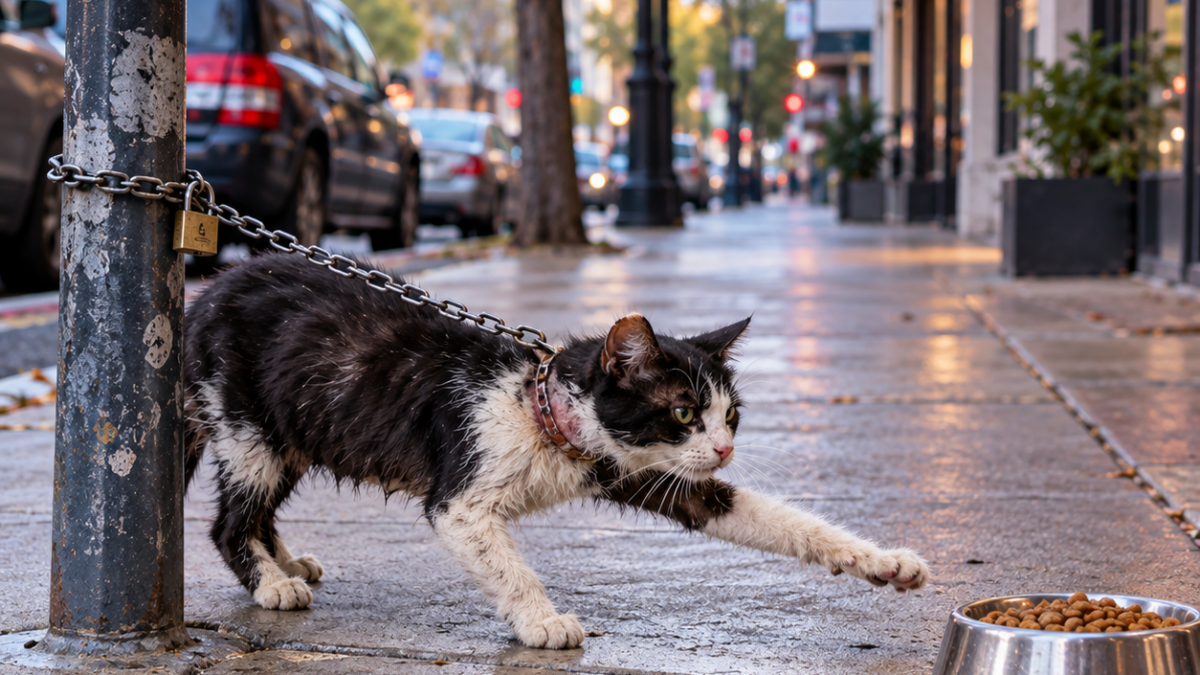
Just the small black-and-white cat chained to the meter, body stretched toward the bowl, one paw reaching, chain tight.
The caption was simple:
Someone did this downtown. If you saw anything between Saturday evening and Monday morning near Ninth and Mercer, please contact Animal Services. She is safe now. She was not safe when hundreds of us walked past.
The photo moved fast.
Too fast.
By the end of the day, it was everywhere.
People were horrified.
People were furious.
People asked how no one had stopped sooner.
Some defended themselves before anyone accused them.
I thought she belonged to someone.
I thought the owner was nearby.
I thought it was a rescue situation.
I thought it was staged.
I thought someone else had already called.
That sentence appeared again and again.
Someone else.
Someone else had probably noticed.
Someone else had probably called.
Someone else had probably handled it.
Hundreds of someone elses had walked past a cat chained to a parking meter with food inches beyond her reach.
Claire read the comments until her hands shook.
Then she put the phone down.
Her supervisor sent her home early.
“You look like you’re about to either cry or punch a printer,” he said.
“Both.”
“Go home.”
But Claire did not go home.
She went back to the animal services clinic.
The cat was in a quiet kennel, curled on a towel, an IV line delivering fluids. A shallow bowl of food sat inside the kennel.
Within reach.
The cat was not eating when Claire arrived.
She was staring at the bowl.
Dr. Ellis stood beside Claire.
“She does that,” the veterinarian said softly.
“What?”
“Looks at it first. Like she’s waiting for it to move.”
Claire covered her mouth.
“She can eat it?”
“Yes.”
“Does she know?”
“I think she’s learning.”
Claire crouched near the kennel.
The cat’s eyes shifted toward her.
“Hi,” Claire whispered.
The cat blinked once.
Dr. Ellis said, “We need a name for the chart.”
Claire looked at the black-and-white face.
The raw ring around the neck.
The bowl.
The little paw tucked under her chest.
“I don’t know.”
Officer Hall, who had come in behind them unnoticed, said, “Call her Mercy.”
Claire turned.
Denise shrugged.
“Because somebody finally showed her some.”
Dr. Ellis wrote it down.
Mercy.
The name fit in a way that hurt.
Mercy ate that evening.
Not much.
But she ate.
The clinic staff placed the bowl close to her front paws and then stepped away.
She startled when Dr. Ellis first set it down.
Her whole body jerked.
The bowl clinked against the kennel floor.
Mercy flinched like the sound meant loss.
Then she leaned forward and ate.
Small bites.
Fast at first.
Then slower.
When the bowl stayed where it was, she looked confused.
A technician named Paula cried in the hallway.
“I’m sorry,” she told Dr. Ellis. “I thought I was used to this.”
Dr. Ellis said, “Don’t get used to this.”
The next several days were careful.
Mercy received fluids, antibiotics, pain medication, and small meals throughout the day. Her neck had to be cleaned twice daily. The skin was raw and inflamed, a pink ring beneath the fur that made every person who saw it go quiet.
The wound began healing.
The swelling went down.
She gained a few ounces.
She slept deeply, sometimes so deeply that staff checked her breathing.
But every meal brought the same reaction.
The bowl appeared.
Mercy startled.
Then she stared.
Then she ate.
It happened each time.
Breakfast.
Lunch.
Dinner.
A snack.
Water.
Even when the bowl was placed directly in front of her, she reacted as if expecting someone to pull it away.
Or move it six inches beyond the limit of an invisible chain.
Her foster application process began immediately because the shelter environment was too loud, too busy, too full of metal doors and barking dogs. Mercy needed quiet.
Claire applied.
So did hundreds of strangers.
Animal Services chose Claire.
Not because she had found Mercy, though that mattered.
Because she lived alone in a calm apartment, worked a predictable schedule, had no other pets, and had already shown she could sit on a sidewalk beside suffering without making it about herself.
Claire was terrified when they called.
“I don’t know how to foster a cat,” she told Dr. Ellis.
“You know how to move a bowl closer,” the veterinarian said. “Start there.”
Mercy came home with Claire nine days after the rescue.
Claire had prepared the apartment like someone expecting a fragile guest from another planet.
Soft bed.
Litter box.
Water fountain.
Three shallow bowls.
A quiet room with low light.
No collar.
No closed crate.
No sudden movements.
She had read articles about traumatized cats until midnight every night and then forced herself to stop because every article made her more afraid of doing something wrong.
When she opened the carrier in the spare room, Mercy did not come out.
Claire sat on the floor six feet away.
For forty minutes, nothing happened.
Then Mercy’s nose appeared.
Then one paw.
Then her face.
She scanned the room.
Door.
Window.
Chair.
Claire.
Food bowl.
The bowl was two feet away from the carrier door.
Mercy stared at it.
Claire did not move.
Mercy stepped out.
Walked to the bowl.
Stopped.
Looked at Claire.
Claire whispered, “It’s yours.”
Mercy lowered her head and ate.
The bowl stayed.
That was the beginning of their arrangement.
For the first week, Mercy lived mostly under the bed in the spare room.
Claire did not force her out.
She sat on the floor and read emails aloud in a soft voice. She placed food in the same spot every time. She never moved the bowl while Mercy was looking. She refreshed the water often but slowly, narrating every movement as if Mercy understood.
Maybe she did not understand the words.
But she understood consistency.
On the third night, Claire woke at 2:14 a.m. to a sound in the hallway.
A tiny scrape.
Then silence.
She held still.
Another scrape.
She turned on the bedside lamp.
Mercy stood in the doorway of Claire’s bedroom.
Thin.
Alert.
Neck still shaved and healing.
Claire did not speak.
Mercy took one step in.
Then another.
Then turned around and walked back to the spare room.
A patrol.
Claire cried quietly into her pillow.
The next morning, Mercy’s food bowl was empty.
After two weeks, Mercy began sitting in the hallway while Claire worked from home.
After three, she accepted a chin scratch.
After four, she climbed onto the couch but sat at the far end, facing the room as if keeping watch.
After six, the wound around her neck had closed.
The fur began to grow back in uneven black-and-white patches, but a thin line remained visible where the chain had rubbed deepest. Dr. Ellis said it might never fully disappear.
Claire hoped it would.
Then, strangely, she hoped it would not.
Not because she wanted Mercy marked.
Because the world was too eager to forget what it had done once the wound stopped bleeding.
The line was proof.
Not of cruelty only.
Of survival.
Mercy’s bowl remained in the same place in Claire’s kitchen.
Always reachable.
Claire made sure of that with almost obsessive care.
She never set it on the counter and walked away.
Never placed it too far.
Never teased.
Never made Mercy wait while food was visible.
If she had to prepare food, she did it where Mercy could not see until it was ready.
Then she set it down close.
Every time, Mercy startled less.
But she still startled.
A tiny flinch.
A tightening of shoulders.
A half-step backward before hunger and trust pulled her forward.
Claire learned not to react.
The bowl stayed.
That was the lesson.
Not words.
Not comfort.
The bowl stays.
Weeks passed.
The investigation stalled.
No suspect came forward.
No witness remembered enough.
One person claimed to have seen a man near the meter late Saturday night, but could not describe him beyond “dark hoodie,” which described half the city after sunset.
The case remained open.
People online moved on.
New outrages came.
New photos.
New stories.
But Mercy stayed.
And Claire found that caring for an animal harmed by calculated cruelty changed the way she saw ordinary things.
A full bowl.
An open door.
A soft bed.
Distance.
Reach.
Trust.
She began noticing how often kindness was not a grand act but a measurement.
Six inches closer.
A hand slower.
A voice softer.
A door left open.
A bowl placed where paws could reach.
Mercy’s photo still circulated sometimes.
Whenever it did, strangers messaged Claire.
Is she okay?
Did they catch who did it?
Can I adopt her?
Claire answered less over time.
Not because she did not care.
Because Mercy deserved to become more than the worst picture ever taken of her.
But one message stayed with Claire.
It came from a woman named Andrea, who worked night shifts at a hospital downtown.
She wrote:
I passed that meter Sunday morning. I saw the bowl. I didn’t see the cat. I keep thinking if I had looked harder, maybe she would have been free a day sooner. I’m sorry.
Claire read the message three times.
Then she replied:
I passed many things before I learned to look harder. Look harder next time. That’s how we honor her.
Andrea wrote back a heart.
Claire did not know what else there was to say.
Two months after the rescue, Animal Services held a small press update.
Not a spectacle.
Officer Hall insisted on that.
Mercy would not attend.
Instead, Denise stood beside Dr. Ellis and Claire in front of the shelter building and spoke plainly.
“We still do not know who chained Mercy to that parking meter,” she said. “But we know this: someone saw her as an object. Someone placed food where she could not reach it. Someone left her to suffer in public. Our responsibility as a city is not only to find that person. It is to ask why it took so long for someone to stop.”
A reporter asked Claire, “What made you stop?”
Claire thought about the Monday morning sidewalk.
The bowl.
The paw.
The chain.
“It was the food,” she said.
“The food?”
Claire nodded.
“She wasn’t just abandoned. The bowl was full. It was placed carefully. Whoever did it wanted her to see what she couldn’t have.”
Her voice shook, but she kept going.
“I think that’s what cruelty does. It doesn’t only take things away. It makes sure you know what was taken.”
The clip spread.
For a day or two, Mercy’s story returned to public attention.
Then it faded again.
But not entirely.
A local hardware store stopped selling combination locks without a package notice about animal cruelty reporting.
A downtown business group installed two cameras facing the block where Mercy had been found.
Animal Services received more calls about animals in distress.
Some were false alarms.
Denise did not mind.
“I’d rather check ten bowls that are fine,” she said, “than miss one Mercy.”
Claire printed that sentence and taped it inside her kitchen cabinet.
Mercy became a foster fail in the most predictable way possible.
Claire lasted exactly seventy-three days before admitting she was not giving the cat back.
Dr. Ellis pretended to be surprised.
Officer Hall laughed.
Mercy, who had no interest in human legal arrangements, celebrated by sleeping in Claire’s laundry basket.
The adoption paperwork was signed on a rainy Thursday.
When Claire came home, she placed Mercy’s bowl in the kitchen as usual.
Mercy approached.
Stopped.
Looked at Claire.
Claire crouched.
“You live here now,” she said.
Mercy blinked.
Then ate.
The bowl stayed.
Winter came.
Mercy discovered radiators.
Then blankets.
Then that Claire’s laptop was warm and therefore belonged to her.
She gained weight.
Her coat grew glossy.
The scar around her neck faded beneath fur, but in certain light, when she stretched, Claire could still see the faint line.
Mercy did not like collars.
Claire never tried one.
She wore no chain, no tag, no ribbon, no proof of ownership around her neck.
She was microchipped.
She was loved.
That was enough.
On some nights, Mercy still woke suddenly and ran to the kitchen.
Claire would hear the soft rush of paws across the floor.
By the time she arrived, Mercy would be standing near the bowl, looking at it.
Checking.
Claire learned to keep a little food there at night.
Not too much.
Just enough.
The first time Mercy found food waiting and did not eat it immediately, Claire stood in the hallway and smiled.
Trust can look like leaving food behind.
It can look like believing it will still be there later.
One year after the rescue, Claire walked the same route downtown.
She had not avoided Ninth and Mercer exactly, but she had not lingered there either. That morning, she stopped at the parking meter.
It looked ordinary.
Silver pole.
Scratched paint.
Sticker half peeled.
People moved around her.
Coffee cups.
Phones.
Headphones.
Shoes tapping pavement.
No bowl.
No chain.
No cat.
Claire stood there for a long time.
Then she took a small laminated card from her bag and zip-tied it loosely to the pole.
It was not dramatic.
Just a photo of Mercy now—healthy, sitting in a square of sunlight on Claire’s kitchen floor—and a few words:
IF YOU SEE SUFFERING, DO NOT ASSUME SOMEONE ELSE HAS CALLED.
SOMEONE ELSE IS YOU.
By noon, someone had posted a picture of the card online.
By evening, the city had removed it because attaching things to parking meters was not allowed.
Claire was annoyed.
Officer Hall thought it was hilarious.
But for seven hours, people saw Mercy healthy.
That mattered.
Not as much as saving her.
But more than doing nothing.
Years later, when Claire tried to explain how Mercy changed her life, she always came back to the bowl.
Not the chain.
People expected the chain.
The chain was easy to understand as cruelty. Metal around a neck. A lock. A trapped animal.
But the bowl was the part that followed Claire into dreams.
Full.
Clean.
Close.
Too far.
A bowl placed with precision by someone who had measured not just distance, but suffering.
It taught Claire that cruelty was not always rage.
Sometimes cruelty was calm.
Organized.
Patient.
Cruelty could go to a store, buy a chain, buy a lock, buy food, pour a bowl, and place it six inches beyond hope.
That knowledge changed her.
But Mercy changed her more.
Because Mercy proved something else.
A bowl could also be moved closer.
A hand could choose differently.
A stranger could stop.
An officer could cut the chain.
A veterinarian could heal the wound.
A home could keep the food within reach every day until the body slowly believed the promise.
Mercy grew old in Claire’s apartment.
Not all at once.
No living thing does.
First she stopped jumping to the highest shelf.
Then she preferred the lower couch cushion.
Then the radiator became more important than the window.
Her face whitened around the muzzle.
Her scar vanished beneath soft fur, though Claire could still find it with gentle fingers if Mercy allowed it.
Every morning, Claire placed the bowl in the kitchen.
Every morning, Mercy came.
Slowly near the end.
Stiff-legged.
Still suspicious of change.
Still herself.
The bowl was always close.
On Mercy’s last morning, she did not eat.
Claire knew before the vet confirmed.
Old age had come gently, which was more mercy than many creatures receive.
Dr. Ellis, older now too, came to the apartment because Claire could not bear the thought of Mercy’s final moments being in a clinic.
Mercy lay on a blanket in the kitchen, near the same place where her bowl had always been.
Claire sat beside her.
Officer Hall came too, off duty, carrying a small bouquet of white flowers and looking like she might arrest grief if it got too loud.
Mercy’s breathing was shallow.
Her eyes half closed.
Claire placed the bowl near her.
Not because Mercy would eat.
Because it belonged there.
Within reach.
Always within reach.
Claire stroked her head.
“You don’t have to check anymore,” she whispered. “It’s right here.”
Mercy’s paw stretched once.
Not toward the food.
Toward Claire’s hand.
Claire took it gently between her fingers.
When Mercy passed, it was quiet.
No chain.
No sidewalk.
No crowd.
No bowl out of reach.
Only a warm kitchen, three women who remembered, and a life that had been given back piece by piece.
Later, Claire buried her ashes beneath a small flowering tree in a community garden that allowed memorial plantings for rescued animals.
At the base, she placed a stone.
It read:
MERCY
SHE TAUGHT US TO MOVE THE BOWL CLOSER
People sometimes asked about the phrase.
Claire would tell them the story if she had strength.
If not, she would simply say, “She was loved.”
Both were true.
The parking meter remained downtown for years.
People walked past it every day.
Most never knew.
The city changed.
Businesses closed.
New cafés opened.
The bar became a boutique.
The bakery expanded.
The sidewalk was repaired.
The parking meter was eventually replaced with a digital pay station.
But sometimes, someone who remembered Mercy would pass Ninth and Mercer and slow down.
They would look at the place where a bowl once sat full and useless.
They would look at the place where a cat once pulled until her neck bled.
And maybe they would look harder at the world around them.
At the dog tied too long outside a store.
At the bird trapped in netting.
At the child crying alone near a bus stop.
At the elderly man struggling with a fallen grocery bag.
At the small, quiet suffering people step around because they assume someone else has already seen it.
That was Mercy’s legacy.
Not just outrage.
Outrage burns fast.
Mercy left something slower.
Attention.
The kind that stops walking.
The kind that kneels.
The kind that makes a call and stays until help arrives.
The kind that understands a full bowl means nothing if it is placed beyond reach.
And in the end, that was the lesson Claire carried for the rest of her life.
Kindness is not kindness until it reaches.
Food is not food to the hungry if it stays six inches too far away.
Help is not help if it remains a thought in the mind of someone walking past.
For two days, Mercy saw what she needed and could not touch it.
For the rest of her life, Claire made sure that never happened again.
The bowl stayed close.
The water stayed full.
The doors stayed open.
The hands stayed gentle.
And every time Mercy startled when food was placed before her, every time she flinched and then leaned forward, every time she learned again that this bowl would not be moved away, Claire remembered the sidewalk and the chain and the terrible precision of cruelty.
Then she remembered the bolt cutters.
The towel.
The veterinarian’s hands.
The first safe meal.
The first night Mercy slept without watching the door.
The first time she left food in the bowl because she trusted it would still be there later.
That was healing.
Not forgetting.
Not erasing.
Not pretending the chain had never existed.
Healing was a bowl within reach, every single day, until fear slowly lost the argument.
Mercy had once been left in public by someone who wanted her to suffer where everyone could see.
But she did not die there.
A woman stopped.
An officer cut the chain.
A city looked harder.
And a little black-and-white cat who had spent two days reaching for food she could not touch lived long enough to learn that some hands do not move the bowl away.
Some hands bring it closer.
Some hands stay.