Security Removed the Old Farmer From the Ceremony — Then He Said “Ghost Five” and the General Froze
PART2:
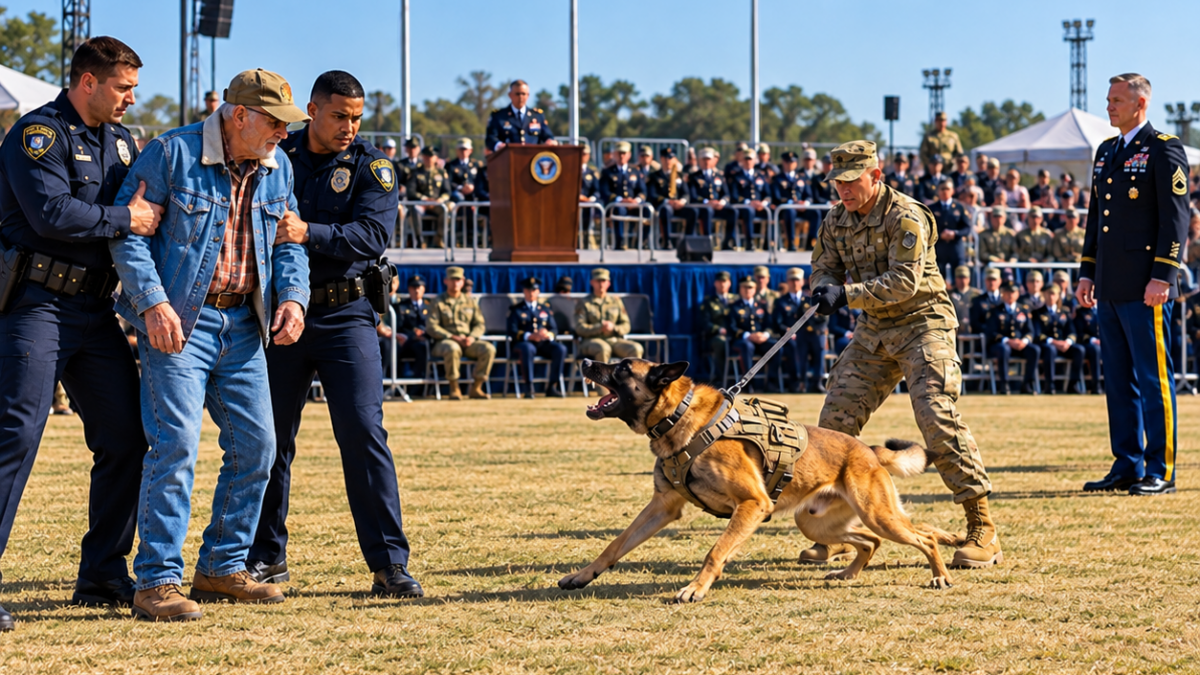
The man wore faded blue jeans, scuffed leather boots, and a denim jacket with frayed cuffs despite the oppressive heat. On his head sat a plain, sun-bleached baseball cap pulled low. His hands were clasped loosely in front of him, gnarled and thick, the knuckles like knots in old rope.
He looked like a farmer who had taken a wrong turn on his way to the feed store.
Dust clung to his boots.
Not city dust.
Real dust.
Red-brown, road shoulder, field-edge, tractor-floorboard dust.
He had a slight limp.
Left side.
Old injury.
Not theatrical.
Not weakness.
Managed damage.
Thorne watched him for a full three minutes.
The man did not fidget.
That was the first thing.
Most civilians at military ceremonies moved constantly. They shifted their weight, checked phones, wiped sweat, leaned to whisper, scanned the crowd for relatives, adjusted programs, tugged collars, crossed and uncrossed arms.
The old farmer did none of that.
He stood still.
Not stiff.
Still.
There was a difference.
The stillness was not fatigue. It was not confusion. It was not the empty stillness of an old man who had drifted out of place and forgotten what came next.
It was discipline.
A profound economy of motion.
His head did not swivel, but his eyes moved beneath the brim of the cap. Short arcs. Measured. Perimeter. Rooftops. Honor guard. Stage exits. Camera positions. Security gaps.
He was not watching the ceremony.
He was assessing the space.
The distinction landed in Thorne like a flare in the dark.
“Interesting,” he murmured.
The colonel beside him glanced over.
“What?”
“Nothing.”
Thorne kept watching.
A woman with a clipboard and a headset finally noticed the old man too. Her name badge read Janice Porter. Civilian event coordinator. Her expression carried the strained efficiency of someone paid to ensure the day went off without a hitch, and the old farmer was clearly a hitch.
She spoke into her mouthpiece.
A moment later, two private security guards detached themselves from a post near the main gate and began walking toward the old man.
They were young.
Large.
Built like college linebackers squeezed into black suits.
They moved with the unearned confidence of men who mistake muscle for authority.
Thorne felt a bitter taste in his mouth.
He knew what was about to happen.
The quiet removal.
The polite voice.
The hand on the elbow.
The condescension disguised as concern.
It played out everywhere in America, every day. People who looked expensive were assumed to have a reason to be somewhere. People who looked worn out had to prove they did.
The old farmer still did not move.
His attention had settled now on the stage.
There, near the podium, a Belgian Malinois named Ares sat with perfect military bearing beside his new handler.
Ares was being honored as part of the ceremony. His previous handler, Staff Sergeant Eli Ward, had been killed during an operation overseas. The official story spoke of bravery, explosive detection, and saving lives. The unofficial version, the one Thorne had heard in fragments, was uglier and more impressive.
Ward had died pushing three younger men into cover.
Ares had stayed on his body until forced away.
The dog was not receiving a medal, exactly.
Military working dogs did not care about medals.
But the command had arranged a commendation, a ceremonial acknowledgment, a way to honor the team that had been broken by the cost of the mission.
Ares looked calm.
Alert.
Composed.
Then the security guards moved within ten feet of the old farmer.
Ares’s head twitched.
It was tiny.
Almost nothing.
His ears shifted.
His gaze flickered from his handler to the old man by the fence.
Only for a second.
But Thorne saw it.
His brow tightened.
That was not right.
A dog like Ares did not break focus for nothing. Not during ceremony. Not while posted beside a handler. Not in a controlled environment full of people, sound, and expectation.
Ares had noticed something.
Not a threat.
Something else.
The first guard touched the old farmer’s elbow.
“Sir,” he said, voice low and practiced, “I’m afraid this area is restricted. Can I help you find your way?”
The old man did not startle.
He did not jerk away.
He did not even seem to register the touch as important.
He simply turned his head slowly, eyes leaving the stage and settling on the guard’s face.
From where Thorne stood, the brim of the cap hid most of the farmer’s expression.
“I’m where I need to be,” the old man said.
His voice was gravelly.
Quiet.
No defensiveness.
No apology.
Just fact.
“Well, see, sir,” the second guard said, adopting the patient tone some people use with children and old people, “this is a private ceremony. Invitation only. If you don’t have a pass, we’re going to have to ask you to leave the premises.”
The old man’s gaze moved to him.
Then back to the first guard.
He gave a nod so slight it barely existed.
“All right.”
That confused them.
They had prepared for argument.
For irritation.
For denial.
Maybe for a frail voice insisting, “I know somebody here.”
They had no script for calm surrender.
The first guard kept a hand on the old man’s elbow and began steering him away from the crowd toward the main road. The farmer moved with them. His dusty boots made no sound on the dry grass. His limp was more visible now, but his posture remained unnervingly straight.
Thorne watched them go.
A vague disappointment settled in him.
Maybe he had imagined it.
Maybe the old man was exactly what he appeared to be: a tired farmer, a little lost, a little stubborn, swallowed by a military machine that had no room for ambiguity.
The dog’s reaction could have been anything.
A scent on the wind.
A sound.
Coincidence.
Thorne turned his attention back toward the stage.
General Mark Madsen was approaching the podium.
Four stars.
A chest full of ribbons.
A face familiar to anyone who had spent time in special operations circles.
Madsen was one of the rare generals Thorne respected without reservation. He had not come up through the polished route. He had spent years in the quiet, dirty corners of military work, the kind of places where reports arrived with half the details missing and the rest buried under classifications.
He understood shadows.
Or at least, Thorne believed he did.
General Madsen tapped the microphone.
“Testing. One, two.”
His voice boomed across the parade ground.
Families shifted.
Cameras rose.
Aides froze into position.
The two guards continued escorting the old farmer along a path that would take them behind the main grandstand. Their route briefly intersected with the side of the stage, placing the farmer no more than twenty feet from Thorne.
Now Thorne could see the old man’s face more clearly.
It was a roadmap of hard years.
Deep lines around the eyes and mouth.
Weathered skin tanned like old leather.
But the eyes beneath the cap were what caught him.
Pale.
Washed-out blue.
Calm beyond reason.
They were not frightened.
Not embarrassed.
Not angry.
They were watching.
Still processing.
Still measuring.
General Madsen began.
“Today, we gather to honor heroes. We honor the men and women who stand on the wall, who do the hard work in the dark so that others may live in the light. We honor families who have given more than most can fathom.”
The old farmer kept walking.
“Thirty years ago,” Madsen continued, his voice dropping into a more somber register, “a concept was born. An idea that our finest operators could become something more. Whispers in the static. Shadows in the night.”
The old farmer slowed.
Thorne’s pulse changed.
The guards did not notice at first.
Madsen continued.
“An initiative founded on absolute deniability and unparalleled effectiveness. It was code-named Project Ghost.”
The old farmer stopped walking.
Not abruptly.
Not dramatically.
He simply ceased motion.
The guards were pulled up short.
The first one tightened his grip.
“Sir, we need to keep moving.”
The farmer ignored him.
His head tilted toward the stage.
Madsen was speaking the sanitized version now, the declassified skeleton of something that had once had blood and names and screams inside it.
“The men of Ghost were the tip of the spear. They did not exist in the traditional sense. They had no public files, no acknowledgment, no easily accessed records. They answered only to a select few, and their successes were buried in classified annexes most people will never read.”
The old farmer’s lips parted.
He said two words.
He did not shout them.
He did not raise his voice.
He spoke at a conversational volume, a low rasp that should have been swallowed by the amplified speech, wind, shuffling feet, and distant traffic.
“Ghost Five.”
To most people nearby, it was nothing.
A puff of sound.
To Thorne, it was a shaped charge detonating inside his skull.
Not because of the words alone.
Because of the cadence.
Flat.
Declarative.
Not a question.
Not a guess.
A key turning in a lock.
On the stage, General Mark Madsen froze.
It was not subtle.
He stopped mid-syllable.
His mouth remained slightly open.
The teleprompter continued scrolling.
His eyes were no longer reading.
They snapped from the crowd to the old farmer with magnetic precision.
The practiced warmth vanished from his face.
In its place came shock.
Profound.
Absolute.
Personal.
For three long seconds, no one moved.
The parade ground fell into a silence so complete that the flag ropes tapping lightly against poles sounded like knocks at a door.
The first guard, oblivious and irritated, tugged the old man’s arm.
“Sir, let’s go.”
The farmer did not budge.
His pale eyes stayed locked with the general’s.
An entire conversation seemed to pass between them.
Silent.
Impossible.
Thorne felt the hair on his arms rise.
His training screamed that he was witnessing something far outside normal procedure.
This was not a confused old man.
This was not a security issue.
This was history cracking open.
General Madsen lowered the microphone back into its stand.
Slowly.
Carefully.
As if any sudden movement might shatter the fragile moment.
An aide-de-camp started toward him.
Madsen gave one curt shake of his head.
The aide stopped.
Then, with a purpose that silenced the growing murmurs, General Madsen walked away from the podium, descended the short stage steps, and stepped onto the grass.
He did not run.
He walked.
Measured.
Deliberate.
Yet with every step he took toward the farmer, his formidable presence seemed to diminish.
The two security guards saw a four-star general heading directly toward them and their problematic old man. Their confidence collapsed instantly. They let go of the farmer’s arms as if his sleeves had turned red-hot.
The event coordinator, Janice, was speaking frantically into her headset.
The band sat frozen.
The crowd murmured.
Phones came up.
Children whispered.
Ares, the Belgian Malinois, stood.
His handler tightened the leash.
Thorne was no longer a passive observer.
He pulled out his secure tablet.
The one he used for mission planning and classified communications.
His thumbprint unlocked the screen.
He started typing.
Project Ghost.
Access restricted.
He entered his credentials.
The system hesitated.
Then opened a heavily redacted landing page.
Most of it was black lines.
But a few phrases remained visible.
Program architect.
Asset Zero.
Call sign: Ghost.
Not Ghost One.
Not Ghost Lead.
Just Ghost.
Madsen stopped three feet from the farmer.
The general who briefed presidents, commanded warriors, and carried the authority of a lifetime of violence restrained by discipline now stood before a man in a frayed denim jacket and looked almost small.
He came to a position that was not quite attention, but close enough to make everyone who understood military bearing feel the weight of it.
“Sir,” Madsen said.
His voice had changed.
Gone was the parade-ground boom.
Now it was quiet.
Stripped raw.
The voice of a subordinate addressing someone who had shaped the ground beneath his feet.
“Is it really you?”
The old farmer gave one of his barely-there nods.
“Hello, Mark.”
The use of the general’s first name hit the space harder than any explosion could have.
Madsen swallowed.
“You’ve done well with the place.”
Madsen looked as if he might laugh, cry, salute, or fall apart.
He did none of those things.
Instead, he turned his head toward the guards.
“Give us the room.”
The command was not loud.
It did not need to be.
The guards practically stumbled over themselves backing away.
The empty space around the old man widened.
Madsen turned back.
For a moment, he seemed unable to speak.
Finally, he did the only thing his life and training told him to do.
General Mark Madsen, commander of the Joint Special Operations Command, snapped to the most rigid position of attention Thorne had ever seen and rendered a slow, deliberate salute.
It was not ceremonial.
Not performative.
Not for cameras.
It was sacred.
The old farmer did not salute back.
He reached up with one gnarled hand and gently touched the general’s elbow.
Not dismissive.
Not disrespectful.
A gesture both accepting and ending the formality.
“At ease, son,” he said. “We’re not on the clock anymore.”
Thorne’s tablet chimed softly.
He had found a subfile buried three layers deep.
Personnel request.
Off-books assignment.
Name: Silas Cole.
Attached was a single grainy black-and-white photograph.
A younger man in his late twenties stared out from the file with a direct, unflinching gaze. Lean. Hard. Dark hair. Sharper jaw. No softness anywhere.
But the eyes were the same.
Pale.
Calm.
Utterly resolute.
Thorne’s breath caught.
Silas Cole.
The name belonged to whispers.
A myth passed between instructors in places where myths were usually just stories built over classified facts.
The man who wrote the book on unconventional warfare and then disappeared before anyone could ask him to sign it.
The architect of Project Ghost.
The original.
The man they called Ghost.
And he was standing thirty feet away looking like he had just come from fixing a tractor.
Thorne stared from the tablet to the old man.
The worn jacket was not poverty.
It was camouflage.
The dusty boots were not carelessness.
They were the choice of a man more comfortable on earth than marble.
The stillness was not age.
It was the practiced calm of a predator who knew he no longer needed to prove anything.
Every detail Thorne had first cataloged as weakness was actually evidence of strength beyond imagination.
He had looked at a lion and seen a stray cat.
The crowd had become a sea of confused faces.
Phones recorded.
Whispers spread.
“Who is he?”
“Why did the general salute him?”
“Is he a veteran?”
“Why was security removing him?”
Madsen spoke quietly to Silas.
Too quietly for most to hear.
Thorne could read posture if not words. He saw urgency in Madsen. Shock. Apology. Pleading, almost.
Silas listened with no visible change.
Occasionally, he nodded.
Then Silas said something that made Madsen look toward the stage.
Ares was whining now.
The Malinois’s entire body was focused on Silas. His handler was struggling to keep him seated.
Madsen spoke into his wrist communicator.
A moment later, a young sergeant took Ares’s leash and brought him down from the stage.
The dog moved with controlled intensity until he reached the empty circle around Silas and the general.
Then he stopped.
His body quivered.
Not aggression.
Not fear.
Recognition.
Silas lowered himself slowly to one knee, his bad leg protesting.
He did not reach out.
He did not crowd the dog.
He simply stayed there, quiet and still at the animal’s level.
“Ares,” he said.
The name came out as a soft rumble.
“Stand easy.”
The Malinois relaxed instantly.
His ears softened.
His mouth closed.
He sat, perfect posture, then released one small, aching whine.
Silas placed a rough hand on the dog’s head and scratched behind one ear.
Ares leaned into the touch.
His eyes closed.
For a moment, the entire ruined ceremony held its breath around a dog and an old man.
“He’s good stock,” Silas said to Madsen without looking up. “Good lines. You’re breeding them well.”
Madsen’s voice thickened.
“We used your protocols, sir. The ones from the original directive. The Echo program.”
Silas nodded.
“Good. It was a good program.”
He gave Ares one last pat, then rose carefully.
He looked around for the first time as if remembering that hundreds of people were watching him.
Annoyance crossed his face.
Not at them.
At the scene.
“I didn’t mean to make a mess of your ceremony, Mark.”
Madsen shook his head.
“You didn’t.”
“I just came to see the boy.”
“The boy?”
“My grandson,” Silas said.
Madsen stared.
Silas nodded toward the rows of seated soldiers.
“Specialist Miller. Samuel Miller. He’s getting a Bronze Star today.”
The general’s expression shifted into another layer of astonishment.
Specialist Samuel Miller.
A young E-4 from the 75th Ranger Regiment.
Cited for bravery during an ambush in Syria.
Madsen knew every award recipient by name.
He had read Miller’s citation.
Held position under fire.
Pulled a wounded teammate from an exposed vehicle.
Refused evacuation until the rest of the team was secure.
Madsen had thought the courage sounded familiar.
Now he knew why.
“He doesn’t know I’m here,” Silas said. “His mother would skin me if she found out. Said I wasn’t to meddle.”
Madsen almost smiled.
“Sir, we can bring him to you.”
“No.”
The word was soft.
Absolute.
Madsen stopped.
“You should be on that stage,” the general said. “You should be the one pinning that medal on him.”
Silas shook his head.
“That’s not my place.”
“With respect—”
“No.”
This time the word carried the old command tone.
Madsen fell silent.
Silas looked toward the seated soldiers.
“This is his day. His honor. Not mine.”
“He would want to know.”
“Maybe one day.”
“Sir—”
“I came to see that he was all right.”
Silas’s voice softened.
“That’s enough.”
Madsen said nothing.
Silas looked across the parade ground, over the flags, the uniforms, the stunned faces, the monuments, the cameras, and the handlers holding dogs who seemed to understand more than people.
“I’m just a farmer now,” he said.
Then, after a moment:
“It’s better that way.”
The finality in his tone ended the argument.
He turned to leave.
Madsen stepped forward.
“Sir, wait. Let me get you a vehicle, at least. An escort back to the gate.”
“My truck is fine,” Silas said. “It’s seen worse roads than this.”
He began walking toward the dusty overflow lot beyond the field, not toward VIP parking, not toward the stage, not toward applause or microphones or recognition.
Back to the edge.
Back to invisibility.
Back to the life he had chosen after a career defined by vanishing.
Thorne wanted to move.
To say something.
Thank you.
I know who you are.
I read the file.
You built all of this.
None of it sounded right even in his own head.
Men like Silas Cole did not operate on thanks. They operated on codes written in blood, silence, and work no one would ever publicly describe.
To approach him felt like trespass.
So Thorne stood still.
General Madsen did not follow.
He stood ramrod straight, watching Silas’s retreating back, his hand raised again in a salute he did not lower until the old man disappeared behind the bleachers.
The ceremony was ruined.
The schedule had collapsed.
The event coordinator looked like she might pass out.
No one cared.
Everyone on that field understood they had just witnessed something they could not fully name.
A ghost had walked among them in daylight.
And the world was different because of it.
The PA system crackled.
A flustered aide announced a brief fifteen-minute pause in the proceedings.
The band lowered instruments.
Families whispered.
Soldiers looked toward the path where Silas had vanished.
The young security guards stood near the fence, pale and silent.
Thorne lowered his tablet.
The file of Silas Cole remained open on the screen.
He looked at the grainy photograph one more time.
Young eyes.
Old eyes.
The same eyes.
Then he closed the file.
The screen went black.
The legend disappeared again.
A few minutes later, Thorne saw the truck.
A beat-up late-eighties Ford F-150, faded to a dull blue, rolled out of the overflow lot and kicked up a cloud of red Carolina dust. It rumbled toward the main gate at a steady, unhurried pace.
The guards stationed there—hastily replaced, if Thorne guessed correctly—waved it through with expressions somewhere between awe and terror.
The truck did not speed away.
It turned onto the main road, merged with civilian traffic, and became just another old vehicle on just another hot Tuesday.
Silas Cole was gone.
He had arrived quietly.
Been dismissed.
Said two words.
Stopped a general.
Changed the way every witness would think about strength for the rest of their lives.
Then left with no fanfare.
That was the point.
The truest service, Thorne realized, rarely asked for a spotlight.
It wore frayed denim and dusty boots.
It stood near fences instead of podiums.
It watched over a world it helped build and asked for nothing in return.
The ceremony resumed eventually.
It had to.
Ceremonies always do.
General Madsen returned to the podium, but something in him had changed. The speech in front of him was useless now. Everyone could feel it.
He looked down at the prepared pages.
Then he folded them.
Set them aside.
The aide nearest him looked alarmed.
Madsen looked at the crowd.
“We honor heroes today,” he said.
His voice was quieter than before.
No performance now.
No polish.
“But I want to make something clear. Sometimes the greatest service this nation has ever received came from men and women whose names most of us will never know.”
The parade ground went silent.
“They did not serve for applause. They did not serve for promotion photographs or newspaper headlines. They served because the work needed doing, because somebody had to go where no one could admit we had gone, because somebody had to carry burdens the rest of us would never see.”
His eyes moved briefly toward the road beyond the gate.
“Some of them come home and become farmers. Mechanics. Teachers. Grandparents. Quiet neighbors. People we pass in grocery stores without knowing they once stood between this country and things we will never be briefed on.”
Thorne looked toward Specialist Samuel Miller.
The young Ranger sat among the award recipients, unaware that the words were circling him in ways he could not yet understand.
Madsen continued.
“So when you see an old man in dusty boots, do not assume you know his story.”
The two security guards stared at the ground.
“When you see silence, do not mistake it for emptiness.”
Callaway was not there, but Thorne thought of every young guard he had ever seen make that mistake.
“When you see humility, do not confuse it with weakness.”
Madsen paused.
“And when you receive honor today, remember that you carry more than your own name. You carry the names of those who came before you, including some who will never step onto this stage.”
Then he resumed the ceremony.
Specialist Samuel Miller was called.
He rose from his seat.
He was young.
Twenty-three, maybe.
Lean, composed, still carrying the stiff discomfort of a soldier unused to being praised in public.
He walked to the stage as his citation was read.
During a hostile ambush outside a village in northern Syria, Specialist Miller exposed himself to enemy fire in order to extract a wounded teammate from a disabled vehicle. Despite sustaining injuries, he refused evacuation until the team was secure and communications restored.
Madsen pinned the Bronze Star to the young man’s chest.
Then, instead of immediately releasing him, the general leaned close and said something only Miller could hear.
The young soldier’s expression changed.
Only slightly.
But Thorne saw it.
Confusion.
Shock.
Then an effort to remain still.
Madsen stepped back.
Specialist Miller saluted.
Madsen returned it.
The crowd applauded.
Miller walked down from the stage looking as if the medal on his chest had suddenly doubled in weight.
Thorne wondered what Madsen had told him.
Not everything.
Surely not everything.
Maybe only this:
Your grandfather came.
Maybe that was enough.
Later, after the ceremony ended and families spilled across the field in clusters of pride and tears, Thorne saw Miller standing alone near the fence.
He had slipped away from the photographs.
Away from congratulations.
Away from the officers clapping him on the shoulder.
He stood near the spot where Silas had been.
His mother, a woman in a pale blue dress, approached him carefully.
She looked angry.
Then sad.
Then tired in a way that suggested this was not the first time Silas Cole had entered and exited a family moment like a weather system.
“He came?” Miller asked her.
The woman folded her arms.
“Yes.”
“You knew he might?”
“I told him not to.”
Miller almost laughed.
“That usually works?”
She looked toward the gate.
“No.”
He stared at the road.
“Why didn’t he stay?”
His mother’s face softened.
“Because he is who he is.”
Miller touched the Bronze Star on his chest.
“General Madsen said he was proud.”
His mother looked at him.
“Your grandfather?”
Miller nodded.
She looked away quickly.
That answered the question.
The young soldier swallowed hard.
“He never says that.”
“No,” she said.
“He doesn’t.”
For a long moment, mother and son stood in silence.
Then Specialist Miller did something no one around him understood.
He faced the main gate.
Straightened.
And saluted the empty road.
Far away, beyond the fence, beyond the base, beyond the ceremony and the flags, an old blue truck was already miles away, moving through North Carolina heat toward farmland, red dirt, and whatever quiet life remained to a man who had spent decades trying not to be remembered.
But Miller saluted anyway.
Thorne watched from a distance.
He did not record it.
Some moments did not belong to phones.
That evening, long after the ceremony, Thorne found himself in a secure office on base, staring at the closed file.
He had reopened it twice and closed it twice.
Silas Cole.
Asset Zero.
Ghost.
The record was mostly black ink.
Operations unnamed.
Locations redacted.
Awards classified.
Medical evaluations partially sealed.
A final line marked inactive.
Date: unknown.
Status: retired.
Thorne stared at the word.
Retired.
It felt absurd.
Men like Silas Cole did not retire.
They receded.
They became harder to find.
They traded rifles for fence posts, safe houses for barns, classified briefings for weather reports, and when the world forgot to look, they became invisible.
But invisibility was not the same as absence.
That was the lesson.
Thorne closed the file again.
He sat there for a long time.
Thinking about strength.
How often it arrived without decoration.
How often it wore old clothes.
How often it did not correct the people who misunderstood it.
He thought about the guards who had put hands on a legend because they saw denim and dust.
He thought about the general who froze at two words.
He thought about Ares, the dog who had known before most men did.
He thought about Specialist Miller, saluting an empty road.
And he thought about the old farmer who had come only to see the boy.
Not to claim recognition.
Not to reclaim a throne.
Not to stand on a stage and tell the world what it owed him.
Just to see that his bloodline had carried courage forward.
Just to stand in the back and watch.
The next morning, there was no official mention of Silas Cole in the ceremony report.
No public statement.
No media release.
No correction explaining why the ceremony had paused.
The viral clips online showed only fragments.
A general stopping mid-speech.
An old farmer being released by embarrassed security.
A dog calming under his hand.
A four-star salute.
Speculation exploded.
Some called Silas a Medal of Honor recipient.
He was not.
At least, not publicly.
Some said he had trained the general.
Not exactly.
Some said he was the general’s father.
Wrong.
Some said he was homeless.
Laughable.
The official response was brief:
A respected veteran attended the ceremony. Out of respect for privacy, no further comment will be made.
That was all.
By noon, the internet moved on.
By evening, another outrage had replaced it.
But inside certain circles, the story did not fade.
It sharpened.
Operators told it quietly.
Handlers told it to new K9 teams.
Young officers repeated it as a warning against arrogance.
At Fort Bragg, the two security guards involved in the removal requested transfers within a month.
One left private security entirely.
The other later wrote a letter of apology that may or may not have reached Silas Cole. No one knew for sure. Silas did not answer it, if he ever received it.
General Madsen kept a copy of the old Project Ghost photo in a locked drawer.
Not for nostalgia.
For correction.
Whenever command meetings drifted too far into politics, slides, metrics, and sterile language, he opened the drawer afterward and looked at the young man with old eyes.
Remember what this is for, he would tell himself.
Not careers.
Not applause.
Not ceremony.
The work.
The people.
The ones who never get named.
Specialist Miller tried to visit the farm two weeks later.
His mother warned him not to expect much.
“He doesn’t talk about the past,” she said.
“I’m not going to ask.”
“You will want to.”
“I know.”
Silas was repairing a fence when they arrived.
He wore the same cap.
The same kind of denim.
The same old boots.
He looked up when the truck stopped.
His daughter got out first.
Then Miller.
For a moment, three generations stood in a field edged by late-summer light.
No band.
No flags.
No general.
No crowd.
Just fence wire, dust, and the smell of cut grass.
Silas looked at the Bronze Star ribbon on Miller’s uniform.
Then at his face.
“You standing straight because of the medal or because your mother told you to?”
Miller blinked.
His mother closed her eyes.
“Dad.”
Silas’s mouth twitched.
Miller laughed before he could stop himself.
The tension broke.
Not completely.
But enough.
The young Ranger stepped forward.
“I heard you came.”
Silas returned to tightening the fence wire.
“Was in the neighborhood.”
“Fort Bragg is four hours away.”
“Long neighborhood.”
Miller smiled.
Then grew serious.
“General Madsen said you were proud of me.”
Silas’s hands stopped.
Only for half a second.
Then they resumed.
“General talks too much.”
Miller swallowed.
“Yes, sir.”
Silas tied off the wire.
Straightened slowly.
Looked at his grandson.
The old man’s pale eyes were steady.
“You did good.”
That was all.
Three words.
No embrace.
No speech.
No emotional confession.
But Miller’s face changed as if the words had gone straight through his ribs and found something he had not known was waiting.
“Thank you,” he said.
Silas nodded.
Then handed him a pair of work gloves.
“Fence won’t fix itself.”
Miller looked at the gloves.
Then at his mother.
She was smiling through tears.
He took them.
“Yes, sir.”
They worked until sunset.
Silas did not tell stories about Project Ghost.
Miller did not ask.
Not that day.
Some bonds are built better by shared labor than confession.
That evening, after dinner, when cicadas rose loud from the dark fields and the three of them sat on the porch with glasses of iced tea sweating in their hands, Ares’s name came up.
Miller mentioned the dog from the ceremony.
Silas looked toward the tree line.
“Good animal.”
“You knew him?”
“No.”
“But he knew you.”
Silas did not answer immediately.
In the dusk, he looked older than he had at Fort Bragg.
Or maybe more human.
“Dogs don’t care what people call you,” he said finally. “They don’t care what rank you held or what stories got buried. They read what’s left.”
Miller considered that.
“What did he read in you?”
Silas looked at his hands.
“Old ghosts.”
No one spoke after that.
But the silence was not empty.
Years later, when Specialist Samuel Miller became Captain Miller, then Major Miller, he would tell young soldiers a version of the story without naming his grandfather.
He would tell them about a ceremony.
An old farmer.
Two words.
A general freezing.
He would tell them how everyone had looked at dust and age and thought they understood what they were seeing.
Then he would say:
“The uniform matters. But never think it tells you everything. Some of the strongest people you will ever meet won’t be wearing one anymore.”
He never said Silas Cole.
Never said Project Ghost.
Never said Asset Zero.
He did not need to.
The lesson did not require the classified parts.
Only the human ones.
And somewhere on a farm far from podiums and polished brass, Silas Cole lived the rest of his life the way he wanted.
Quietly.
He rose before dawn.
Fed animals.
Mended fences.
Drove an old truck.
Ignored letters from men who wanted interviews, histories, confirmations, signatures, or closure.
He kept no medals on display.
No photographs in uniform.
No framed citations.
But in a locked drawer beneath seed catalogs and land deeds, he kept one grainy black-and-white photograph from 1983.
Five men stood in it.
Faces young.
Eyes old.
No insignia.
No smiles.
On the back, in faded pencil, someone had written:
Ghost team. Before the first night.
Four of those men were gone.
Silas was the last.
When he died, years later, the funeral was small because that was what he had requested.
Family.
Neighbors.
A few old men nobody recognized.
General Madsen came in civilian clothes.
Alex Thorne came too, standing far back beneath an oak tree.
Ares was there, older now, muzzle gray, retired from work but still alert enough to know the weight of the day.
Specialist Miller, no longer a specialist, stood beside the casket in dress uniform.
The flag was folded.
Words were spoken.
Not many.
Silas would have hated many words.
At the end, when the family began to step away, General Madsen approached the casket.
He leaned down and whispered something no one else heard.
Then he stood and saluted.
One by one, others followed.
Thorne.
Miller.
The old men without names.
Finally, Ares stepped forward.
No command.
No leash correction.
He placed one paw gently against the base of the casket and lowered his head.
Miller’s mother began to cry.
Thorne looked away.
Even Madsen had to blink hard.
No official record would say that a retired military working dog gave the final salute to the architect of Project Ghost.
No public history would include it.
But everyone there knew what they had seen.
The dog had recognized the ghost.
Just as he had on the parade ground.
And in that recognition, Silas Cole received the only honor he might have accepted.
Not applause.
Not fame.
Not a speech.
A quiet farewell from a faithful creature who judged men by what lived beneath the skin.
Long after that, the story remained.
Security removed the old farmer from the ceremony.
Then he said “Ghost Five.”
The general froze.
That was the version people liked because it was dramatic.
Because it had a twist.
Because it made arrogance look foolish and silence look powerful.
But Thorne always believed the real story was smaller and better.
An old man came to see his grandson receive a medal.
He stood in the back because he did not want to be seen.
He was removed because the world had forgotten how to recognize people like him.
He said two words not to reveal himself, not really, but because a memory had slipped past his guard.
And when the world finally saw him, he did not stay long enough to be worshipped.
He went home.
That was the part that mattered.
The leaving.
The refusal to turn service into spectacle.
The quiet return to dust, work, land, and silence.
Because some men are not made for stages.
Some men are not made for applause.
Some men spend their lives doing the kind of work that keeps others alive, and when it is over, they ask only to be left in peace.
But every now and then, history makes a mistake.
It lets one of them be seen.
Just for a moment.
Just long enough for a general to freeze, a dog to bow its head, a grandson to understand his bloodline, and a crowd of people to realize that greatness does not always arrive with polished shoes and a pass around its neck.
Sometimes it arrives in dusty boots.
Sometimes security tries to remove it.
Sometimes it says two words.
And sometimes, the whole world goes silent because a ghost has stepped back into the light.