One Hour Before a Retired K9 Was Put Down, an Old Farmer Whispered “Ranger”—Then the Shelter Learned Who He Really Was.
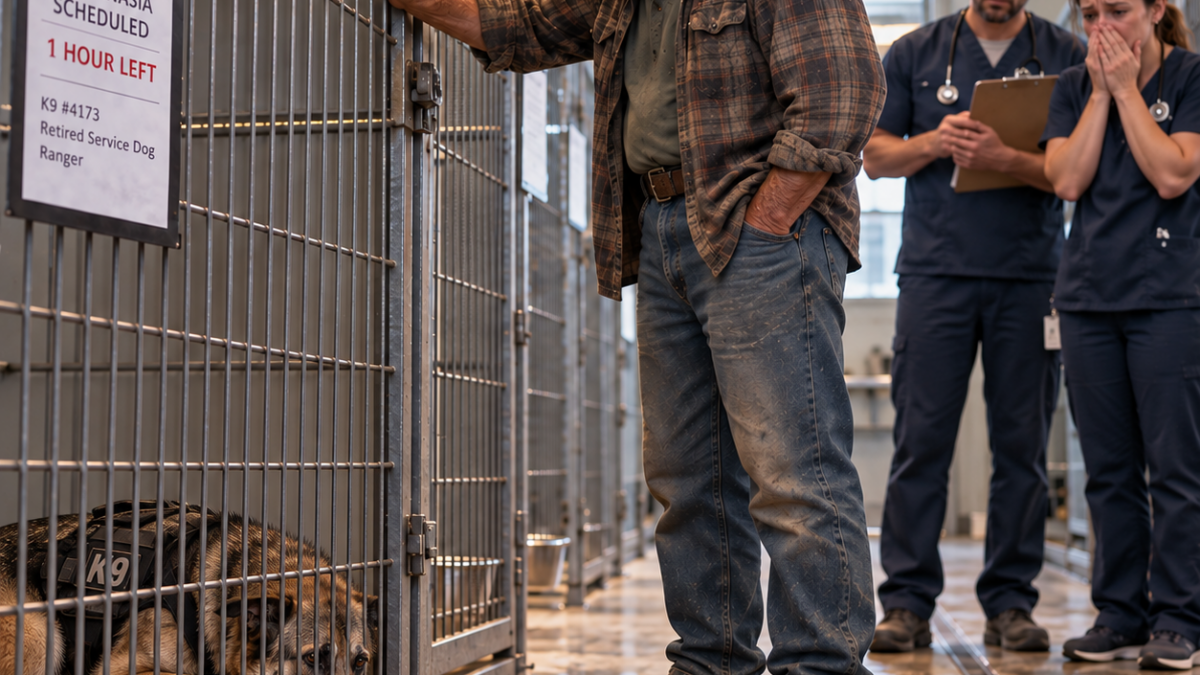
PART3:
Then at the old man sitting in it like he had grown there.
“You’ve been here before,” she said.
It was not a question.
Not really.
She already knew.
“Every Tuesday,” Lorenzo said. “Sometimes Wednesday if the truck’s giving me trouble.”
“Two months,” Bernie said.
“I checked the sign-in sheet after the second week. I thought maybe you were looking to adopt. Then I thought maybe you were lonely. Then I stopped trying to guess.”
Perry’s pen had gone quiet against the edge of the intake form.
Held loose in his hand.
Forgotten now that the room had turned toward something he did not understand.
“You’ve never once asked to take him,” Perry said. “Not once. I’d remember that.”
“No,” Lorenzo agreed. “I haven’t.”
The dog’s ears had come forward again at the sound of the chair creaking under Lorenzo’s weight.
That small shift he made when he settled his hips back and let his spine find the canvas.
The dog’s head lowered another inch.
Not a threat posture.
Something closer to listening.
Bernie remembered the lead line.
It had been early on, maybe the third or fourth week, before she had learned to expect him sitting there at nine like the shelter owed him the hour.
One of the outdoor runs had a frayed lead hanging off the gate post, chewed through by a hound two kennels down, and she had been about to throw it in the trash bin when Lorenzo asked if he could look at it.
She handed it over without thinking much of it.
He had not asked for tools.
He had just turned it over in his hands, found the good end, and tied something quick and small and impossibly neat.
Not a knot she recognized from any 4-H class or hardware store diagram.
Something older.
Cleaner.
A knot that looked like it had been taught to him by someone who needed rope to hold a man’s weight on a slope, not just a dog on a leash.
She had asked him where he learned it.
He had said, “Somewhere it mattered,” and handed the lead back like the conversation was finished.
She had not pushed.
There was something about the way Lorenzo closed a subject.
Not rudely.
Just completely.
The way a door closes when the latch is good.
“You fixed that lead,” Bernie said now. “Back in the fall. I kept it in the supply room. I didn’t want to use it. Didn’t want to untie what you’d done.”
Lorenzo’s mouth moved.
Not quite a smile.
“It’s just a knot, Bernie.”
“It’s not, though.”
She crossed her arms.
For once, since he had sat down, there was less procedure in her voice and more of something else.
Curiosity, maybe.
Or the beginning of respect.
“You come here every week. You sit outside this one kennel. You’ve never asked about any other dog in this building. Not the beagle mix. Not the shepherd pups by the front desk everybody fusses over. Only him.”
The dog was standing with his left foreleg held just off the concrete, curled like it cost him something to set it down flat.
Perry cleared his throat.
Too loud in the small room.
He glanced at the wall clock.
Then at the folder in his hand.
Then at Lorenzo, as if hoping the old man might rearrange himself to match the schedule.
“Mr. Hogan.”
He said the name carefully, like he had needed Bernie to give it to him a minute earlier and did not want to get it wrong twice.
“The procedure is scheduled for eleven. That’s forty minutes. County protocol requires the intake room cleared of civilian visitors thirty minutes prior. I need you to gather your things.”
“I’m not in anybody’s way over here.”
“It’s not about being in the way, sir. It’s about protocol.”
Perry tapped the folder against his palm.
A small nervous rhythm.
Like a man keeping time with a song only he could hear.
“I have a tech coming into prep. I have a form that needs three signatures before noon. I don’t have room in the schedule for—”
He stopped himself.
Chose a gentler word than the one he had started toward.
“For this.”
Lorenzo’s breathing did not change.
In.
Out.
The same count it had held since he sat down.
Like there was not a clock on the wall at all.
Like the room ran on some older measurement he alone still kept.
“You said thirty minutes,” Lorenzo said. “That gives us time to talk.”
“There’s nothing to talk about. The window closed. I told you that.”
“You told me a date. I’m asking you to look at the dog.”
Perry did look.
Briefly.
With the flat certainty of a man sizing up a problem he had already decided how to solve.
The dog had gone quiet again.
That low simmering hush.
Not calm so much as coiled.
Weight cocked back onto the hindquarters.
Head dropped just enough to track Perry’s hands without seeming to.
“I’ve looked at the dog every day for two weeks,” Perry said. “That’s my job. Bite history. Unpredictable aggression. Non-responsive to standard handling. Bernie’s notes are thorough. I trust her notes.”
“Her notes are thorough,” Lorenzo agreed. “They’re also wrong about what they’re describing.”
Bernie froze by the desk with the folder half raised, caught somewhere between her supervisor and the old man in the frayed coat.
“With respect,” Perry said, and his voice climbed half a register the way it did when the word respect meant the opposite, “I don’t have time this morning for a debate about temperament theory. I have a dog scheduled. I have a tech on the way. And I have a visitor who needs to clear the room in—”
He checked the clock again.
“Twenty-eight minutes.”
“Twenty-eight minutes is enough.”
“Enough for what?”
Lorenzo did not answer that.
He kept his eyes on the dog.
On the tremor working up through that curled foreleg like a current looking for ground.
And something in his face had gone past patient into something with more weight behind it.
Something Perry did not have.
“He hasn’t used up anything,” Lorenzo said. “You’ve used up your patience. That’s a different animal entirely.”
Perry’s pen stopped moving.
He looked up from the intake form like the words had come from somewhere other than the folding chair.
“Excuse me?”
“You said he’s used up his chances. That’s not true. Nobody’s given him a chance yet. Two months I’ve been sitting here, and not once has anybody in this building put a hand on that dog without a catchpole in the other one.”
Lorenzo said it without heat.
Flat.
Measured.
Like a man calling out numbers off an instrument.
“That’s not the dog’s failing.”
Bernie had gone quiet at the counter, her hands resting on the intake folder, empty of anything else now. Something in her face shifted from procedure to attention.
She was not looking at Perry anymore.
She was looking at the dog’s left ear, tipped forward under the fluorescent light, and at the pale notch cut into the cartilage. She had cataloged it a hundred times as scarring. Unremarkable. Consistent with prior injury.
Now she was not so sure.
“Mr. Hogan,” Perry said, strain under the courtesy now. “I understand you’ve formed an attachment. I do. But attachment isn’t a placement plan, and the county doesn’t process based on—”
“Wait.”
Bernie’s voice cut in.
Not loud.
But it stopped him mid-word the way a hand on the arm stops a swing already started.
She had pulled the folder closer and tilted it toward the light.
“This ear notch,” she said. “I logged it as laceration scarring when he came in. I never had it looked at close.”
She glanced up first at Perry, then longer at Lorenzo.
“There’s lettering in it. Or there was. It’s mostly grown over.”
Perry set the pen down with the particular irritation of a man whose schedule had just acquired a variable he did not budget for.
“It’s an ear. Dogs tear ears in kennels constantly.”
“That’s not—”
Bernie leaned closer.
“It’s not a tear pattern.”
She was already reaching for the folder’s back pocket.
The one nobody ever opened because nobody had needed the microchip history for a stray with no listed origin.
“This is placed even. Like it was done on purpose. And it’s just old enough that it healed strange.”
She looked at Lorenzo again.
This time the flatness had gone out of her voice completely, leaving something raw underneath it.
“You knew that was there before I said anything.”
Lorenzo did not answer right away.
He kept his eyes on the dog.
On the way the animal’s weight had come forward onto his front pasterns.
Ears no longer flat but canted.
Listening to the room the way dogs listen to weather before it arrives.
His breathing had not changed.
Low and even.
Diaphragm doing the work instead of the chest.
“I knew there’d be something there,” Lorenzo said finally. “Didn’t know if it survived the scarring.”
Perry looked between them.
The folder.
Bernie.
The old man in the chair.
The dog.
Bernie pulled the microchip wand from the cabinet.
She moved toward the kennel door slowly.
The way you move around something that might bite you for a reason nobody has written down yet.
The dog’s ears flattened.
His weight shifted back onto his haunches, not forward.
Lorenzo clocked it before she did.
He said nothing.
Just kept breathing slow and even.
The same four-count in.
Four-count out.
The wand chirped once.
A small, thin sound.
Almost apologetic.
“Got it,” Bernie said.
She pulled the little screen close to her face, squinting.
“Okay. Registered handler tag. Military intake. This is—this is old. Deployment codes are faded, but I can read the unit line. Hang on.”
“You don’t need to hang on,” Perry said.
He had the sedation authorization form in one hand now, pen already uncapped, already moving toward the signature line at the bottom, because the clock on the wall said 10:50 and the procedure was scheduled for eleven, and county policy did not care about a wand chirping in a crouched woman’s hand.
“Miss Vogle, I need that form back in the folder in the next five minutes or I have to call this in as a scheduling failure. And that goes on both our names.”
Bernie did not look at him.
“His call sign’s on here.”
Perry stopped.
“What?”
“Deployment tag reads… hold on. Kilo Seven. K-9 designation. Unit attached to a mountain recon element, and then there’s a call sign field. It’s mostly worn, but I can make out—”
“Ranger,” Lorenzo said.
He said it low.
He said it before she finished the sentence.
Before the last letters came up on the little cracked screen in her hand.
And the room went the particular kind of quiet that is not the absence of sound so much as everyone in it holding their breath at the same time.
Perry’s pen stopped an inch above the paper.
Bernie’s eyes came up off the wand and onto Lorenzo’s face like she was checking whether she had imagined it.
“That’s—”
She looked back down.
Read the rest.
Looked back up slower this time.
“That’s exactly what it says.”
“I know,” Lorenzo said.
Perry’s mouth remained open around whatever he had been about to say next.
Some line about the five-minute window.
About the folder.
About the clock on the wall that had, until four seconds ago, been the only authority in the room that mattered.
He closed it.
Opened it again.
“How?”
It was not procedure anymore.
Just a man standing in the middle of something he did not understand with a pen still uncapped in his hand.
“How does a—how do you know that? Nobody knows that. That’s not written on anything visible.”
“That chip record’s sealed to civilian because I trained the man who trained him.”
Lorenzo had not looked away from the dog.
Not once.
The dog had gone still too.
In a different way than before.
Ears no longer flat.
Head coming up an inch.
Nose working the air like it had caught something it had not smelled in a long time and was not sure yet whether to believe.
“Two months I’ve been sitting outside that kennel,” Lorenzo said, quieter now. His voice dropped into a register that was not for the room anymore. Not for Perry and his form or Bernie and her wand.
“And every week I told myself I’d say something. Every week I didn’t because saying it made it real. And I have had enough real for one lifetime already.”
Bernie’s hand, still holding the wand, had gone slack at her side.
Perry had not moved.
The pen hovered.
Forgotten.
Now Bernie looked down at the microchip record in her hand, the little screen still glowing with the number the wand had pulled off the back of the dog’s neck.
She cleared her throat.
She had done this hundreds of times.
Reading a chip number into a file.
Matching it to an owner.
Closing a loop.
This one had a deployment tag attached to it.
A string of letters and numbers she did not fully understand.
And beneath that, in smaller print, a call sign field that most civilian chips did not even carry.
“Registered handler unit,” she read slowly, sounding out the designation like a word in a language she had only seen written down. “Forward deployed. Working dog designation…”
“Ranger,” Lorenzo said again.
He said it before she got there.
Low.
Without looking at the screen.
Without looking at her at all.
He was looking at the dog.
Bernie checked the line.
The letters matched one for one.
The old man in the canvas coat had spoken them before she finished the sentence.
For a second, she said nothing.
The room had gone quiet in a different way than before.
Not the quiet of a policy standoff.
The quiet that comes when somebody in the room understands they have been standing next to something they did not have the eyes to see.
“That’s exactly what it says,” Bernie whispered.
Perry’s pen had not moved.
He looked at Lorenzo now with nothing left of the clock in his expression.
Nothing left of the 10:40 appointment.
Nothing left of the county form.
Nothing left of civilian visitors clearing the intake room.
He looked, for the first time since Lorenzo had walked in and unfolded his chair, like a man trying to recalculate something from the beginning.
“You knew that,” Perry said.
It was not a question so much as a man saying a fact out loud to make himself believe it.
“Before she read it, you already knew his name.”
Lorenzo did not answer directly.
He kept his eyes on the dog.
On the low set of the ears.
On the way Ranger’s weight had shifted off his back left leg the second the wand touched his neck.
A detail nobody else in the room had clocked because nobody else in the room had spent forty minutes twice a week for two months learning the specific geometry of how that animal held pain.
“He answers to it still,” Lorenzo said. “Watch him.”
He said the name again.
Not loud.
Not a command.
Just a word offered into the space between the chair and the kennel door the way you would offer a hand.
“Ranger.”
The dog’s ears came up.
Not both the same.
The left one did not move the way the right one did.
Some old scar tissue or nerve damage keeping it half set.
But both eyes came off Perry and onto Lorenzo.
The low sound in his chest, the one that had put everybody in the room on edge twenty minutes earlier, dropped away entirely.
Bernie looked at the record again.
Looked at Lorenzo.
Looked at the record.
“Mr. Hogan,” she said.
His last name in her mouth had a different weight to it now than when Perry had used it on the intake sheet.
“How do you know this dog’s call sign?”
It was the same question that had been sitting under the room since he unfolded that chair.
The question nobody had quite had the nerve to ask straight.
And now it hung there.
Perry’s pen still had not touched the page.
Lorenzo took a breath.
The same deep, even diaphragm breath he had been taking since he walked in.
The one that had not sped up once.
He reached down, not toward the dog, but toward the arm of the camp chair, running his thumb along the worn stitching where the canvas met the frame.
The same repair he had made a dozen times over.
He still did not answer Bernie’s question.
Behind him, near the far wall, the tech assigned to sedation had already pulled the pole syringe off its rack. She was young. Competent-looking. Moving with the brisk efficiency of someone who had done this before and did not want to do it again but would because the hour was the hour.
“He’s cleared for handling under restraint,” she said, mostly to Perry, already crossing toward the kennel gate. “I can get him sedated before the vet arrives. It’ll be easier on him.”
“Don’t open that gate.”
Lorenzo had not raised his voice.
He did not need to.
Something in the register of it, low and level, stopped her hand on the latch.
“He’s guarding his right shoulder,” Lorenzo said, still seated, still breathing the same unhurried breath. “Look at the weight. He’s not loading that leg at all. He’s carrying it high and rolled in like it costs him something every time he sets it down. That’s not a dog deciding to be dangerous. That’s a dog protecting a joint that never healed right.”
Perry’s pen was still in his hand.
“That’s not what the intake notes say. Notes say aggressive on approach, unhandleable, high bite risk.”
“Notes are describing what happens when somebody grabs him wrong.”
Lorenzo rose from the chair.
Unhurried.
Joints announcing themselves quietly the way old joints do.
He stepped toward the kennel with his hands open and low.
“Old harness rigging,” he said. “High-altitude work. The kind we used to run dogs in when the terrain didn’t leave room for a leash and a handler both. If the webbing sits wrong across the shoulder for months at a time, it pulls the joint out of alignment. Nobody catches it until the dog’s out of service and somebody finally tries to touch that spot without knowing it’s there.”
Ranger’s ears had come up.
Not aggressive.
Listening.
“Sir, I can’t let you—” Perry started.
“Watch,” Lorenzo said.
Not unkindly.
But it was not a request.
He crouched at the gate slowly.
No sudden angles.
He let Ranger see both hands before either one moved.
When he reached through the bars, it was not for the collar.
It was not for the leash clip.
It was two fingers, flat, finding the point just behind the shoulder blade where the muscle had knotted hard as a fist.
And he did not press it.
He cupped under it, lifting the weight of the leg without ever gripping the leg itself.
The way you would take pressure off a rigging strap before loosening the buckle.
Ranger’s growl caught in his throat.
And did not finish.
The dog’s whole body dropped an inch.
Ears came fully forward.
The rolled protective stance eased.
The leg came down flat and even.
And for the first time since Lorenzo had walked into that room, Ranger leaned his weight into a human hand instead of away from it.
“There,” Lorenzo said, quiet, mostly to the dog. “There it is.”
Nobody moved.
The tech lowered the pole syringe without seeming to notice she had done it.
“That’s a pressure relief hold,” Lorenzo said, straightening but keeping his hand where it was a moment longer before letting it go. “Taught it to handlers running dogs off pack straps on grades no vehicle could climb. You don’t fight the joint. You take the load off it. Any tech in this county could learn that hold in an afternoon and never need a sedation order on this dog again.”
Perry looked at the sedation syringe, still capped in the tech’s hand.
Then at Ranger, who had gone quiet under Lorenzo’s palm.
The low growl had been replaced by a long breath out through the nose.
Perry looked like a man recalculating everything he had been sure of ten minutes earlier.
“You said you taught handlers,” Perry said. “Which handlers?”
Bernie was still holding the microchip printout.
The deployment tag number circled in pen where she had copied it off the screen.
She had not finished reading it.
She did not need to now.
Lorenzo did not answer Perry.
He knelt instead.
Slowly.
The way a man kneels when his knees have opinions about it.
He put his other hand on the side of Ranger’s neck, thumb finding the place behind the ear where the dog’s service mark had faded to a gray shadow under the fur.
Ranger leaned into it.
Not much.
Enough.
“Sergeant First Class Wayne Prader,” Lorenzo said. “I ran the handler course. He came through third rotation. I trained good hands. Better instincts than most I had. I taught him how this dog reads terrain before he reads a compass. Taught him the hold I just showed your tech. Taught him what to do if the dog went down hurt on a slope with no vehicle within six hours.”
He paused.
His breathing had not changed.
It never did.
“I didn’t teach him what to do if he didn’t come back down himself.”
Bernie’s hand went still around the printout.
“He’s not in this file,” Lorenzo said, nodding at the papers in her hands without looking at them. “No next of kin. That’s why nobody claimed the dog when the unit rotated him stateside. That’s why he’s been sitting in intake for two years, getting passed between three counties. Nobody wanted a dog with a bad file and a bad hip and no name attached to sign for him.”
He looked at Ranger.
Not at Bernie.
Not at Perry.
“I’ve known where he was for two months. First day I walked in here, I knew him by the way he stood before I ever saw his ear.”
“Then why didn’t you—” Perry started.
He stopped himself.
Because he already understood the shape of the answer and did not want to make Lorenzo say the rest of it standing up.
Lorenzo said it anyway.
Kneeling.
One hand still on the dog.
“I asked the county twice. Both times I was told the adoption window on a flagged intake had already closed. That he’d been red-tagged for behavior before I ever got out here the first time. Paperwork does what paperwork does.”
He did not say it bitterly.
He said it like weather.
“So I came back anyway. Brought a chair. Sat outside his kennel every week. And didn’t sign anything because I didn’t know how to walk in here and tell you all what he was without also telling you what happened to the man who trained him.”
His hand shifted slightly on Ranger’s neck.
“And how I’m the one who taught that man to bring dogs like this one home alive off ground that wanted to kill both of them.”
The room had gone quiet enough that the fluorescent light overhead made its thin electric hum audible for the first time.
“I taught your handler how to bring you home,” Lorenzo said low to the dog.
He did not lift his eyes to the room.
“Nobody taught me how to bring mine.”
Nobody spoke.
Perry looked down at the sedation order still in his hand.
The clock on the wall read four minutes past the hour it had been scheduled to matter.
He set the paper down on the counter without signing it.
“Give me the adoption file,” Perry said to Bernie.
Quiet now.
None of the clipped procedure left in his voice.
“Whatever window we said was closed, I’m reopening it.”
Bernie moved immediately.
Not rushed.
Not frantic.
But with the sharp relief of someone whose hands had been waiting for permission to do the right thing.
She pulled the adoption folder from the bottom drawer.
The one that had been marked inactive.
The one that had been moved behind older transfers and unclaimed strays and bite reports.
The one nobody expected to touch again except to close it.
Perry removed the euthanasia form from the clipboard and laid it facedown.
That small motion changed the whole room.
The tech stepped back from the gate and returned the pole syringe to the rack.
The metal clip clicked into place.
Ranger’s eyes followed the sound.
His body tensed for half a second.
Lorenzo breathed in.
Four count.
Out.
Four count.
Ranger’s body eased again.
Bernie placed the adoption file in front of Lorenzo.
“There are still requirements,” Perry said.
His voice had changed.
Not weak.
Not embarrassed exactly.
But stripped down.
A man whose authority had just been forced to make room for responsibility.
“I’ll have to document why we’re overriding the behavior hold. There needs to be a medical evaluation. Shoulder radiographs if we can get them funded. A senior placement waiver. Liability forms. Follow-up checks.”
“Do them,” Lorenzo said.
“I will.”
Perry looked at Ranger.
Really looked.
Maybe for the first time.
“If he bites someone—”
“He won’t if they stop grabbing him where he hurts.”
“That is not a legal answer.”
“No.”
Lorenzo looked up at him.
“But it’s the true one.”
Perry held his gaze.
Then nodded once.
“I’ll write both.”
Bernie slid a pen across the counter.
Lorenzo reached into his coat.
Not for a wallet, as Bernie expected.
For a stub of pencil worn almost to nothing.
The kind of pencil a man keeps because it still writes.
He signed the line himself.
Lorenzo James Hogan.
The letters were steady.
Unhurried.
Bernie watched his hand move.
The same hand that had held the lead weeks before without a tremor.
The same hand that had taken pressure off a hurting shoulder through steel bars.
The same hand that had waited two months before asking for what he wanted.
“Do you have transport?” Perry asked.
“My truck.”
“A crate?”
“No.”
Perry hesitated.
Lorenzo looked back at Ranger.
“He won’t need one.”
Bernie almost smiled.
Perry did not.
Not because he disagreed.
Because the form in his head still wanted boxes checked.
“We need a leash at least.”
Bernie walked to the supply room and returned with the old frayed lead.
The one Lorenzo had fixed.
She had kept it folded on a shelf behind the towels, though she had never admitted to herself why.
She held it out.
“Use this.”
Lorenzo looked at the knot.
Then at her.
“You kept it.”
“I told you I did.”
“It’s just a knot.”
“No,” Bernie said softly. “It isn’t.”
Lorenzo took the lead.
He worked the leash clip free from the kennel gate.
The sound made Ranger tense again.
The old flinch.
The expectation of pressure, pole, restraint, hands too fast, humans too close.
Lorenzo did not reach for him.
He crouched again.
Let the lead hang open between both hands.
“Ranger.”
The dog’s eyes came to him.
Not all at once.
Not like magic.
Like memory trying to stand up on old legs.
Lorenzo breathed.
In.
Out.
He slipped the lead through the bars.
No pull.
No command.
Just an offering.
Ranger lowered his head.
Sniffed once.
Then stepped forward.
Slow.
Favoring the shoulder.
He leaned his weight into Lorenzo’s leg as the gate opened.
Not much.
Enough.
The room watched him come out.
The dog who had been “unhandleable.”
The dog who had been “high bite risk.”
The dog whose window had closed.
He came out like an old soldier crossing a line after the shooting stopped.
Careful.
Suspicious.
Hurting.
But not broken.
Bernie wiped at her face quickly and pretended she had not.
Perry pretended not to see.
The tech turned away to inventory the sedation rack with great seriousness.
Ranger stood beside Lorenzo’s knee.
His ribs moved under his coat.
In.
Out.
Matching the old man before anyone noticed they were doing it together.
Perry cleared his throat.
“I’ll need to schedule the vet exam before discharge.”
Lorenzo looked at the clock.
“Today?”
“If Dr. Madsen can come early.”
“Call him.”
Perry almost smiled at that.
“Sir, I’m still technically in charge here.”
“Then be in charge in the right direction.”
Bernie made a small sound that might have been a laugh if the room had been less heavy.
Perry picked up the phone.
Dr. Madsen came twenty-three minutes later.
He had gray eyebrows, tired hands, and a limp from an old horse kick he still blamed on youth instead of the horse.
He entered the intake room with a paper cup of gas-station coffee and the expression of a man already prepared to be annoyed.
“Perry, I was told we have an emergency re-evaluation on a red-tagged K9 with a bite history, a reopened adoption file, and an old man who apparently outranks county protocol.”
“That’s mostly accurate,” Perry said.
Dr. Madsen looked at Lorenzo.
Then at Ranger.
Then at the dog leaning against Lorenzo’s leg.
“Is that the same dog?”
“Yes,” Bernie said.
The vet set his coffee down.
“Well, I hate mornings that turn interesting.”
He examined Ranger the way good vets examine animals that expect pain.
Slowly.
Narrating nothing.
Watching everything.
He did not grab the shoulder.
He did not force the leg.
He let Lorenzo take the pressure hold first.
Then he palpated around it with two fingers.
Ranger’s lips lifted once.
Not a snarl.
A warning.
Dr. Madsen froze.
Lorenzo breathed.
The dog breathed.
The moment passed.
“Old shoulder injury,” the vet said.
“Chronic compensation. Likely nerve involvement. Possible arthritis in the hip. Pain response misread as aggression.”
Perry stared at the floor.
Dr. Madsen looked at him.
“I am not blaming you, Perry.”
Perry said nothing.
The vet continued.
“I am blaming the file.”
Perry looked up.
“I signed off on the file.”
“You signed off on what you saw. Now you are seeing more.”
That landed harder than blame would have.
Dr. Madsen recommended immediate pain management, imaging within the week, no restraint handling except medically necessary, and placement with a handler capable of supporting a retired working dog with chronic injury.
Then he looked at Lorenzo.
“You have livestock?”
“Cattle. Some sheep. Two useless donkeys.”
“Other dogs?”
“One old border collie who thinks he owns the weather.”
“Fenced?”
“Better than this place.”
Bernie almost laughed again.
The vet nodded.
“You understand this dog may never be normal.”
Lorenzo looked down at Ranger.
The dog’s head rested now against his thigh.
“I’m not looking for normal.”
“What are you looking for?”
“Home.”
Dr. Madsen studied him for a long moment.
Then signed the medical release.
The shelter changed around that signature.
Not visibly.
The same concrete floor.
Same kennels.
Same fluorescent lights.
Same old coffee smell in the staff room.
But something had shifted.
A thing everyone had been moving toward all morning had been turned aside.
Not erased.
Not made easy.
Just changed.
The dog scheduled to die at eleven was still breathing at noon.
Sometimes that is the whole miracle.
Paperwork took another hour.
There were forms Perry had to print because the adoption window had technically closed.
Forms Bernie had to annotate because the dog’s call sign and deployment history had never been properly attached to the intake record.
Forms Dr. Madsen had to amend because “aggressive” and “pain defensive” were not the same diagnosis, no matter how similar they looked when the wrong hands reached too fast.
Perry worked quietly.
He did not apologize immediately.
Some people apologize too fast because they want relief from guilt before they understand it.
Perry did not do that.
He sat with the discomfort.
That was better.
Bernie copied the chip data.
Then checked it again.
Then again.
At one point, she said, “His name was in the record the whole time.”
Nobody answered.
Because yes.
It had been.
Under codes nobody read.
Behind a file pocket nobody opened.
Beneath a behavior label that had become easier to trust than a suffering animal.
Ranger lay on the floor beside Lorenzo’s chair.
Not asleep.
Not exactly.
But closer to rest than anyone in that building had seen him.
Whenever footsteps passed too close, his eyes opened.
Whenever a kennel door clanged, his ears flattened.
Whenever Perry reached across the counter too quickly, his body tightened.
But Lorenzo would breathe.
And the dog would return.
Not all the way.
Enough.
Outside, clouds moved over the pale afternoon sun.
The light through the front windows went the color of weak tea.
Lorenzo folded the camp chair one joint at a time.
The canvas was soft from years of hands doing exactly this.
Ranger watched him.
When the chair collapsed into its flat shape, the dog’s ears came up.
That chair meant something to him now.
Maybe not the same thing it had meant during those two months of Tuesdays.
Maybe just that the man who sat in it was leaving, and he was leaving too.
Bernie clipped the repaired lead onto Ranger’s collar.
The dog stiffened.
Lorenzo said his name.
“Ranger.”
Not loud.
Not a correction.
Just a reminder.
The dog moved forward.
One step.
Then another.
His shoulder rolled wrong, but less than before.
Pain medication would help.
Time would help.
Being touched correctly would help.
Being believed would help most.
At the front desk, Perry came around from behind the counter.
He held out a folder.
“Medical records. Adoption paperwork. Follow-up schedule. My direct line is written on the inside.”
Lorenzo took it.
“Thank you.”
Perry swallowed.
“I’m sorry.”
The words were plain.
No decoration.
No excuse.
Lorenzo looked at him for a moment.
Then nodded.
“Don’t be sorry if it stops here.”
Perry understood.
He looked past Lorenzo into the kennel room.
At the doors.
The forms.
The red tags.
The easy words.
Aggressive.
Unmanageable.
Expired.
Closed.
“It won’t,” Perry said.
Lorenzo studied him.
Then nodded once more.
Outside, the shelter parking lot was half gravel, half potholes.
Lorenzo’s truck sat near the fence.
Old Ford.
Blue once.
Now mostly sun and dust.
The bed held feed sacks, a toolbox, two fence posts, and a folded tarp.
He lowered the tailgate.
Set the camp chair flat in the truck bed.
Ranger stood at the bumper and looked up.
For a second, Lorenzo thought he might have to lift him.
Then Ranger gathered himself and climbed in.
Slow.
Awkward.
Stubborn.
He turned once, then lay down with his head against the worn canvas seat like he had done it a hundred times before in some other truck for some other man.
Lorenzo stood at the tailgate for a moment.
One hand resting on the dog’s flank.
Breathing slow and even as ever.
Behind them, the shelter’s porch light clicked on though the afternoon had not yet darkened enough to need it.
Bernie stood in the doorway.
Perry stood behind her.
Neither spoke.
Ranger lifted his head once.
Looked back at the building.
Not at the kennel.
Not at the counter.
At the doorway.
Then he lowered his head again.
Lorenzo closed the tailgate carefully.
The drive to his farm took forty-two minutes.
He took back roads.
Not because they were faster.
Because they were quieter.
Ranger lay in the truck bed beneath the open topper window, the camp chair pressed against his side.
Every few miles, Lorenzo glanced in the rearview mirror.
The dog did not sleep.
But he did not panic either.
That was enough for the first ride.
The farm sat at the end of a county road that had more patched asphalt than original pavement.
Past a church with a leaning steeple.
Past an abandoned gas station where vines had swallowed the pumps.
Past three cattle pastures and one mailbox shaped like a fish.
Hogan Farm was sixty-two acres of uneven land, mostly pasture, with a low ridge on the north side and a creek that ran muddy after rain.
The house was white once.
Now it was the color of old paper.
The porch sagged in one corner but had not surrendered.
A red barn leaned slightly away from the prevailing wind.
Fence lines crossed the property like handwriting.
Some straight.
Some corrected.
Some showing generations of men fixing problems differently.
As Lorenzo turned into the drive, an old border collie rose from the porch.
Her name was Belle.
She had one blue eye, one brown, and the moral certainty of a church elder.
She watched the truck roll up.
Watched Lorenzo step out.
Watched the dog in the back.
Then looked at Lorenzo as if to say, You have brought me paperwork.
“Be polite,” Lorenzo told her.
Belle sneezed.
Ranger lifted his head.
For a long second, the two dogs stared at each other.
No barking.
No lunging.
Belle came down the steps slowly.
Ranger’s body stiffened.
Lorenzo touched his flank.
“Easy.”
Belle stopped ten feet from the truck.
Sniffed the air.
Then turned and walked back to the porch as if she had decided the newcomer could live for now.
“That’s permission,” Lorenzo said.
Ranger did not seem convinced.
“That’s as close as she gets.”
The first night was not easy.
Stories like to end at the tailgate.
Dog saved.
Old man redeemed.
Shelter workers crying.
Sunset soft.
But rescue is not the same as healing.
Rescue is a door opening.
Healing is deciding, day after day, not to run back through it.
Ranger would not enter the house.
He stopped at the porch threshold and froze.
Lorenzo did not pull him.
Did not coax with food.
Did not crowd him from behind.
He simply opened the door, set the camp chair inside the mudroom, and sat on the porch floor with his back against the wall.
Belle watched from her rug with deep disapproval.
Ranger stood at the threshold for sixteen minutes.
Lorenzo counted fence posts in his head.
Not because the number mattered.
Because patience needs somewhere to put itself.
At minute seventeen, Ranger stepped into the mudroom.
One paw.
Then another.
Then stopped.
Lorenzo did not celebrate.
Celebration can feel like pressure to a creature waiting for punishment.
He just breathed.
In.
Out.
Ranger lowered himself beside the camp chair.
Not on the blanket Lorenzo had laid out.
Not on the rug.
Beside the chair.
His head touched the worn canvas.
That was where he slept.
The first week, Ranger woke at every sound.
Truck on the road.
Barn door shifting.
Belle dreaming.
Coyotes in the lower pasture.
Lorenzo slept in the mudroom on a cot because the dog would not settle if he went upstairs.
His hip hated him for it.
His back sent written complaints.
He ignored both.
Every morning, he gave Ranger pain medication wrapped in sausage.
Every afternoon, he practiced the pressure relief hold.
Every evening, he opened the back door and let Ranger decide whether outside was safe.
At first, the dog only went as far as the steps.
Then the gravel.
Then the fence line.
On the ninth day, he followed Belle halfway to the barn.
On the twelfth, he barked once at a goat and looked surprised by his own voice.
Lorenzo laughed so hard he had to sit down.
Ranger stared at him.
Belle looked offended on behalf of the goat.
Progress came crooked.
Some days, Ranger leaned into touch.
Other days, a dropped pan sent him under the workbench for an hour.
Some days, he limped badly.
Other days, he forgot enough to trot three steps before pain reminded him.
Dr. Madsen confirmed what Lorenzo already knew.
Old shoulder injury.
Scar tissue.
Nerve damage.
Arthritis starting in the hip from compensation.
Not curable.
Manageable.
That word mattered.
Manageable meant not doomed.
Manageable meant there were things to learn, routines to build, pain to reduce, dignity to return.
Lorenzo built a ramp off the porch.
Then rebuilt it because the angle was wrong.
Then rebuilt it again because Belle refused to use it and Ranger followed Belle more than common sense.
Caleb from the neighboring farm came over one afternoon and said, “Mr. Hogan, you know you could have asked for help.”
Lorenzo held a drill between his teeth and ignored him.
Caleb helped anyway.
By the third week, Ranger used the ramp.
By the fourth, Belle allowed him to share the porch shade.
By the fifth, he followed Lorenzo to the lower pasture and stood watching cattle with the grave focus of a dog remembering that work existed.
He did not herd.
He did not chase.
He only watched.
Lorenzo stood beside him.
“Not every day needs a job,” he said.
Ranger’s ears moved.
Lorenzo was not sure whether he understood.
He hoped not.
Sometimes dogs deserved to forget the language of duty.
Bernie called every Tuesday.
At first officially.
Follow-up check.
Medication adherence.
Behavioral adjustment.
Appetite.
Mobility.
Incidents.
Then unofficially.
“How is he really?”
“He ate half my glove.”
“That’s bad.”
“It was the right glove.”
“Worse.”
“He brought it to Belle like tribute.”
“Did she accept?”
“She looked insulted.”
Bernie laughed.
The first time she laughed on the phone, Lorenzo almost hung up.
Not because it bothered him.
Because it reminded him there were people still living ordinary lives in ordinary rooms where laughter came easy.
He had not spent much time around that.
Perry called once.
Three weeks after the adoption.
Lorenzo saw the shelter number and considered not answering.
Then did.
“This is Perry Ibarra.”
“I know.”
“I wanted to update you.”
Lorenzo waited.
“We reviewed all red-tag protocols. Dr. Madsen is helping rewrite the pain assessment portion. Bernie’s training staff on defensive pain response versus aggression. We’re adding mandatory microchip history review before final behavior disposition.”
Lorenzo sat on the porch steps.
Ranger lay in the shade below him, chewing the remains of a rope toy with great seriousness.
“Good.”
There was silence on the line.
Then Perry said, “I almost killed him because the file made it easy.”
Lorenzo looked out at the pasture.
“No.”
Perry exhaled.
“I did.”
“The file didn’t make it easy. It made it official. Different problem.”
Perry was quiet a long time.
“That’s worse.”
“Yes.”
Another pause.
“I’m trying to fix that.”
“Then keep trying.”
“I will.”
Lorenzo believed him.
Not completely.
Belief, like trust, should be built with repeated evidence.
But he believed him enough to stay on the line.
A month after Ranger came home, Bernie drove out to the farm.
She arrived in an old green sedan with shelter stickers on the bumper and a bag of dog treats on the passenger seat.
Belle barked once.
Ranger stood on the porch.
Stiff.
Alert.
But not growling.
Lorenzo came out behind him.
“Don’t rush him.”
“I won’t.”
Bernie stood at the bottom of the steps with her hands visible.
“Hi, Ranger.”
The dog’s ears moved at the name.
She smiled.
Not too much.
People smile too wide at dogs they want to reassure. Dogs know when teeth are showing.
She did it right.
Small.
Soft.
Ranger took three steps down the ramp.
Stopped.
Looked at Lorenzo.
Lorenzo breathed.
The dog came the rest of the way.
He did not lean into Bernie.
Not then.
But he sniffed her hand.
For Bernie, that was enough to make her eyes shine.
“I’m sorry,” she whispered.
Ranger sniffed the treat bag.
Lorenzo said, “He accepts.”
Bernie laughed through tears.
They sat on the porch for an hour.
Bernie told Lorenzo that two other dogs had been pulled from final disposition after medical reassessment.
One had an untreated ear infection.
Another had a cracked tooth.
Both had been labeled aggressive.
Both were now on treatment plans.
“That’s because of him,” she said, nodding toward Ranger.
“No,” Lorenzo said. “That’s because you looked twice.”
“Because you made us.”
“Good.”
Bernie accepted that.
Before she left, she looked at the folded camp chair leaning beside the door.
“Do you still take that everywhere?”
“Mostly.”
“Why that chair?”
Lorenzo rubbed his thumb along the worn canvas seam.
For a moment, Bernie thought he would close the subject the way he had closed so many others.
Instead he said, “Wayne sat in it once.”
Bernie did not speak.
Lorenzo looked toward the pasture.
“Training course. Third rotation. Rain had turned the whole slope to soup. Everybody was tired. Dog teams were worse. Wayne came off the ridge with Ranger covered in mud, both of them limping, both of them too stubborn to admit it. I told him to sit before he fell down.”
He tapped the chair.
“He sat there. Dog put his head on the seat just like he does now. Wayne said, ‘Old man, if I die before this dog, don’t let some office lose him.’”
Lorenzo’s face did not change.
But his voice thinned.
“I told him not to talk stupid.”
Bernie swallowed.
“He knew?”
“No.”
Lorenzo shook his head.
“None of us know. We just say things sometimes, and later they become promises.”
Ranger had lifted his head at Wayne’s name.
Not fully.
Just enough.
Bernie saw it.
So did Lorenzo.
He placed a hand on the dog’s neck.
“I should’ve looked sooner,” he said.
Bernie’s voice was quiet.
“You found him.”
“Two years late.”
“But before eleven o’clock.”
That landed somewhere Lorenzo had not protected.
He looked at her.
Bernie looked back.
Neither said anything else about it.
After she left, Lorenzo sat on the porch until evening.
Ranger lay beside the chair.
Belle watched the lower pasture.
The sky went purple behind the ridge.
A barred owl called from the trees near the creek.
Lorenzo thought about promises.
The ones spoken clearly.
The ones hidden inside jokes.
The ones you made because you assumed there would be time to understand them later.
He had trained men to read dogs.
Read terrain.
Read weather.
Read silence.
He had taught them how to place a boot on shale.
How to wrap a paw.
How to lift a dog without hurting its pride.
How to sleep in shifts.
How to trust a living creature whose senses were better than yours and whose courage was not an invitation to waste it.
He had not taught himself how to answer the phone call that said one of those men had not come home.
Wayne Prader had been twenty-eight.
Too young to carry the kind of calm he carried.
He had come into handler course with a crooked smile and a stubborn streak that made instructors want to throw clipboards.
Ranger had chosen him by ignoring everyone else.
That was not how assignments were supposed to work.
Assignments were supposed to be based on evaluation.
Compatibility.
Performance.
Need.
But dogs had opinions.
Ranger refused three handlers.
Then Wayne walked past his kennel eating an apple, and the dog followed him with his eyes like the matter had been settled.
Lorenzo had watched it happen.
He had said, “Don’t look so pleased, Prader. He may just want the apple.”
Wayne had grinned.
“Then I’ll be useful.”
They became one of the best teams Lorenzo ever trained.
Not the flashiest.
Not the fastest.
The most observant.
Wayne trusted Ranger’s pauses.
That was rare.
Young handlers wanted motion.
Action.
Proof.
Wayne learned quickly that Ranger’s hesitation usually meant the dog knew something the men did not.
Loose snow over rock.
A bad crossing.
Air moving wrong.
A human scent where no human should be.
The last time Lorenzo saw them together, Wayne was loading gear. Ranger stood beside him, wearing that old mountain harness, shoulder straps adjusted perfectly because Lorenzo had yelled at Wayne enough times to make perfection muscle memory.
Wayne had lifted a hand.
“See you when we rotate back, old man.”
Lorenzo had said, “Bring my dog back in one piece.”
Wayne had laughed.
“Your dog?”
“All dogs are mine until they prove otherwise.”
Ranger had looked at Lorenzo once before getting into the truck.
That image stayed.
For years, it stayed.
Then the news came.
Not directly.
News like that travels through channels, fragments, mutual contacts, men who say, “Did you hear?” and then wish they had not asked.
Wayne gone.
Ranger injured.
Evacuated.
Transferred.
Lost in paperwork.
Lorenzo asked once.
Then twice.
Then ran into walls made of forms, privacy restrictions, unit transitions, retirement records, county transfers, shelter intake systems, and people who were not cruel but were finished caring before the question was finished being asked.
Then, two months before the euthanasia date, he saw a shelter posting online.
No name.
No story.
Just a grainy photo of a large old dog behind wire.
Flagged behavioral hold.
Working breed.
No children.
No other pets recommended.
Urgent.
Something in the way the dog held his front shoulder made Lorenzo put down his coffee.
The next Tuesday, he drove to the shelter.
He did not ask for the dog.
He did not say the call sign.
He just brought the chair.
Sat down.
And waited to see if the past would recognize him.
It did.
Not fully.
Not immediately.
Recognition in a hurt dog is not a movie scene.
There is no music.
No leap into arms.
No instant healing.
There is a shift of weight.
An ear moving half an inch.
A growl changing its shape.
A dog deciding not to look away.
That was enough to bring Lorenzo back the next week.
And the next.
And the next.
Until the clock said there was one hour left.
Now Ranger slept on his porch.
Wayne’s dog.
His dog.
Maybe both.
Maybe that was how promises worked when they came late.
They did not return what was lost.
They gave the living somewhere to put their hands.
Winter softened into spring.
Ranger gained weight.
Not much.
Enough.
His coat improved.
His eyes cleared.
He still carried the shoulder, but pain medication and careful work made the limp less sharp.
He and Belle developed a routine.
Belle did the real farm management.
Ranger supervised from shade.
If the donkeys approached the feed room, Belle barked.
Ranger stood.
The donkeys reconsidered.
This arrangement satisfied everyone except the donkeys.
Lorenzo began taking Ranger into town once a week.
Not into crowded places.
Not at first.
Just the feed store early in the morning when Earl opened and nobody else was there.
Earl was seventy-six and had opinions about everything from tractor oil to church parking.
He looked at Ranger the first morning.
“That the death-row dog?”
Lorenzo stared at him.
Earl shrugged.
“Small town.”
“Don’t call him that.”
“All right.”
Earl leaned on the counter.
“What do I call him?”
Lorenzo looked down.
Ranger stood beside him, nose working the air, cataloging grain dust, rubber boots, cat food, old wood, mouse trails, coffee, Earl.
“Ranger.”
Earl nodded once.
“Good name.”
Then he did the smartest thing he could have done.
He ignored the dog.
Ranger appreciated that.
By the fourth visit, Ranger sniffed Earl’s pant leg.
By the sixth, he accepted a biscuit.
By the eighth, Earl said, “That dog has better manners than half my customers.”
Lorenzo said, “He was trained by better men.”
Earl did not answer.
Some sentences tell you not to.
The shelter changed too.
Not perfectly.
Institutions do not transform because one old man says one name.
But Bernie kept pushing.
Perry kept his promise.
Dr. Madsen held training sessions.
The county updated review procedures.
Pain assessments became mandatory before behavioral euthanasia.
Microchip histories were checked completely.
Red tags required second review when medical uncertainty existed.
The words pain defensive entered the shelter’s vocabulary.
That mattered.
Labels guide hands.
If a dog is called vicious, hands arrive prepared for battle.
If a dog is called hurting, hands arrive prepared to listen.
Not always.
But more often than before.
Three months after Ranger’s adoption, Perry drove out to Hogan Farm.
He called first.
That mattered.
Lorenzo met him at the gate.
Ranger stood beside him, lead loose.
Perry stepped out of the county truck slowly.
No clipboard.
No forms.
Just a small cardboard box.
“I brought his old file,” Perry said. “Copies. Thought you should have them.”
Lorenzo took the box.
“Thank you.”
Perry looked at Ranger.
The dog watched him.
Wary but not growling.
“He looks better.”
“He feels better.”
Perry nodded.
“I wanted to tell you something.”
Lorenzo waited.
“We had another case last week. Pit mix. Red tag. Snapped at two techs. Under the old process, she would’ve been scheduled.”
“And?”
“Broken tooth. Abscess. We treated it.”
Perry looked embarrassed, but he kept going.
“She’s in foster now.”
Lorenzo looked at Ranger.
Then back at Perry.
“That’s good.”
“I thought you should know.”
“I’m glad I do.”
Perry’s eyes dropped to the dog.
“I still think about that morning.”
“You should.”
“I do.”
“Then it wasn’t wasted.”
Perry nodded.
Ranger took one step forward and sniffed the air near Perry’s knee.
Perry froze.
Lorenzo said, “Don’t make a ceremony out of it.”
Perry stood still.
Ranger sniffed once more.
Then stepped back.
Perry looked like he had just been given something he did not deserve and desperately wanted to keep.
“Thank you,” he whispered.
Lorenzo pretended not to hear.
That was kindness.
Summer came hot.
Ranger disliked heat.
Lorenzo adjusted.
Mornings only.
Shade by ten.
Cooling mats Bernie ordered after reading too many articles.
Belle stole one.
Ranger let her.
The useless donkeys stood in the pond and looked philosophical.
Life arranged itself around what the old dog needed without anyone making speeches about sacrifice.
That is what care looks like most of the time.
Small adjustments.
A ramp.
A pill hidden in sausage.
A hand placed correctly.
A schedule altered.
A chair unfolded in shade.
One evening in July, thunder rolled over the ridge.
Ranger startled hard.
Not at the thunder itself.
At the echo after.
His body dropped.
Ears flattened.
Shoulder tucked.
Breath fast.
Lorenzo had seen men do that.
He had done it himself in grocery aisles, at fireworks shows, once in the hardware store when a pallet dropped behind him and he came back to himself gripping a shelf so hard his fingers hurt.
He did not crowd the dog.
He sat in the camp chair.
The old one.
The shelter chair.
Wayne’s chair.
Ranger’s chair.
He set his forearms on his knees.
Breathed.
Four in.
Four out.
The dog’s eyes found him.
Another thunder roll.
Ranger shook.
Lorenzo did not speak over it.
You cannot argue a body out of memory.
You give it another rhythm.
After a while, Ranger crossed the porch and laid his head against the chair.
Lorenzo rested one hand on his neck.
“There,” he said.
Quiet.
Mostly to the dog.
“There it is.”
Months became a year.
The shelter invited Lorenzo to a fundraiser.
He refused.
Bernie called.
“Just come for twenty minutes.”
“No.”
“You don’t have to speak.”
“No.”
“People want to meet Ranger.”
“He doesn’t want to meet people.”
“Fair.”
She paused.
“What if we come there? Small group. Staff only. Training session. Pressure relief hold.”
Lorenzo almost said no.
Then looked at Ranger, sleeping in the doorway, one paw twitching.
“How small?”
“Four techs. Perry. Me. Dr. Madsen.”
“No reporters.”
“Absolutely not.”
“No speeches.”
“I can control myself.”
“No crying.”
“I cannot promise that.”
He agreed anyway.
They came on a Saturday morning.
Six people.
Two county vehicles.
One box of donuts.
Belle inspected everyone and found Dr. Madsen suspicious because he smelled like other dogs.
Ranger stayed beside Lorenzo at first.
Then, slowly, he allowed Bernie to demonstrate the hold under Lorenzo’s guidance.
Then one tech.
Then another.
Not for long.
Not perfectly.
But enough.
Lorenzo corrected hand placement.
“No. Don’t pinch. Cup.”
“Don’t chase the leg. Take the load.”
“Watch the ear.”
“Watch the breath.”
“Stop looking at his teeth and look at his feet.”
Perry took notes.
Lorenzo noticed.
“Planning to write another form?”
“Yes.”
“Make it useful.”
“I will.”
At the end, one young tech named Maya sat back on her heels with tears in her eyes.
“I thought dogs either trusted you or they didn’t.”
Lorenzo shook his head.
“Trust isn’t a switch.”
“What is it?”
“A place you arrive late and leave early if you’re careless.”
Maya wrote that down.
Perry looked annoyed because he wanted to write it down too but did not want to be obvious.
Bernie saw and smiled.
The story eventually got out.
Not the whole one.
Stories rarely travel whole.
A local paper wrote about a retired military dog saved an hour before euthanasia by the man who recognized his call sign.
The headline was too dramatic.
The photo was worse.
Lorenzo looked like someone had aimed a weapon at him instead of a camera.
Ranger looked noble, which annoyed Lorenzo because at the time of the photo he had been trying to steal a donut.
People called.
Reporters.
Veterans groups.
Dog rescues.
A podcast.
Lorenzo said no to all of them.
Bernie handled most of it.
Perry handled official statements.
The shelter received donations for medical review funds.
That was good.
Several working dogs with complicated histories found foster placements because people started asking better questions.
That was better.
Then one day, a letter arrived.
No return address he recognized.
Inside was a photograph.
Wayne Prader, younger than memory had preserved him, crouched beside Ranger on a rocky slope. Both of them muddy. Both grinning in their own species-specific ways.
On the back, handwriting.
My brother talked about you. Said you taught him how to listen to dogs instead of command them. I didn’t know Ranger was still alive until I saw the article. Thank you for keeping one more promise than anyone asked you to.
It was signed:
Mara Prader.
Lorenzo sat at the kitchen table for a long time after reading it.
Ranger lay beneath the table.
Belle slept by the stove.
Outside, wind moved through the pasture grass.
Lorenzo read the note again.
Then folded it carefully and placed it in the old coffee tin where he kept things he did not want to lose.
A photograph of his wife, who had died six years earlier.
A receipt from the day he bought Hogan Farm.
Wayne’s letter.
Mara’s letter.
Ranger’s adoption papers.
A pencil stub.
The one he had used to sign the line.
That winter, Ranger slowed.
Not suddenly.
Just clearly.
Cold settled into the old injuries.
The shoulder stiffened.
The hip complained.
His muzzle whitened.
He spent more time near the stove.
Lorenzo adjusted again.
Shorter walks.
More blankets.
Medication changes.
Warm compresses.
Belle, who had never admitted affection for anyone, began sleeping closer to him.
Not touching.
But close enough that denial became ridiculous.
Lorenzo did not count days.
He had learned not to.
Counting days makes you miss the one you are standing in.
On a cold morning in February, Ranger followed him to the barn.
Snow dusted the pasture.
Not deep.
Just enough to soften edges.
The dog moved slowly, but he wanted to go.
So they went.
At the fence line, Ranger stopped.
He looked out over the lower field.
Ears forward.
Nose working.
Body still.
For a moment, Lorenzo saw him as he must have been years before.
Not old.
Not injured.
Not red-tagged.
Not lost in a county file.
A working dog on a ridge, reading the world before the men caught up.
Lorenzo stood beside him.
“Good dog,” he said.
Ranger leaned against his leg.
Not much.
Enough.
Spring returned.
Then summer.
Then another fall.
Ranger made it farther than Dr. Madsen had predicted, which pleased Lorenzo because vets needed humility.
One evening, Bernie visited with Perry.
No official reason.
They brought stew.
Ranger came to the porch edge when they arrived.
He sniffed Bernie’s hand.
Then Perry’s.
Then returned to Lorenzo’s chair.
Perry watched him lie down.
“I still think about the form.”
Lorenzo knew which one.
The unsigned one.
“Good.”
“I kept a copy.”
“Why?”
Perry looked toward Ranger.
“To remember that a signature can be wrong before it’s written.”
Lorenzo considered that.
Then nodded.
“That’ll do.”
Bernie sat on the steps.
“Do you ever regret waiting two months?”
Lorenzo did not answer quickly.
The evening light lay gold across the yard.
Belle snored behind the screen door.
Ranger’s eyes were half closed.
“Yes,” he said finally.
Bernie looked down.
“Every day.”
“I’m sorry.”
“So am I.”
Then he added, “But regret is only useful if it teaches you where to stand next time.”
Bernie looked at him.
“And where is that?”
Lorenzo rested his hand on Ranger’s neck.
“Sooner.”
No one spoke for a while.
The farm settled around them.
Crickets began in the grass.
Somewhere in the barn, a cat knocked something over and pretended not to.
Ranger slept.
The years after that did not become easy.
But they became full.
Ranger was never the dog people imagined when they heard “retired K9 saved at the last minute.”
He did not become a therapy dog.
He did not visit schools.
He did not let strangers hug him.
He did not pose happily at fundraising events.
He limped.
He startled.
He stole one of Lorenzo’s gloves every month and hid it under the porch.
He disliked men in hats unless the man was Lorenzo, Earl, or eventually Perry.
He loved sausage too much.
He tolerated Belle.
Then adored Belle.
Then pretended he did not.
He was not a symbol to himself.
He was a dog.
That was enough.
And Lorenzo was not a hero to himself.
He was an old man who had waited too long, spoken just in time, and then spent every day afterward trying to be worthy of the second chance he had demanded on Ranger’s behalf.
That was enough too.
On the second anniversary of the adoption, Bernie sent a photo from the shelter.
A new sign hung above intake.
BEHAVIOR IS INFORMATION. PAIN IS PART OF THE FILE. LOOK TWICE.
Lorenzo read it.
Then showed Ranger.
The dog sniffed the phone.
Unimpressed.
“Fair,” Lorenzo said.
He texted Bernie back one word.
Good.
She replied:
He saved more than himself.
Lorenzo did not answer.
He set the phone down and looked at Ranger asleep beside the camp chair.
Maybe Bernie was right.
Maybe Ranger had saved the pit mix with the cracked tooth.
The shepherd with the untreated ear.
The hound whose fear had been mistaken for defiance.
Maybe he had saved Perry from becoming the kind of man who signed forms without seeing what stood behind them.
Maybe he had saved Bernie from trusting notes more than her eyes.
Maybe he had saved Lorenzo from finishing his life as a man who kept promises only in memory.
But Ranger did not know any of that.
He dreamed.
His paws moved once.
Not running.
Not quite.
Maybe walking some old slope in sleep.
Maybe following Wayne.
Maybe following Lorenzo.
Maybe both.
Lorenzo reached down and rested two fingers just behind the shoulder blade, not pressing, only there.
The dog relaxed.
Even asleep, he knew the hold.
Even asleep, he knew the hand.
The camp chair creaked as Lorenzo leaned back.
Sun went down behind the pasture.
Belle barked once at nothing.
The donkeys ignored everything.
The house smelled like coffee and old wood and dog.
For a long time, Lorenzo sat there without moving.
He thought of the shelter clock.
The unsigned form.
The wand chirping.
Bernie reading the record.
Perry’s pen frozen above the line.
One hour left.
Then forty minutes.
Then twenty-eight.
Then five.
Then no time at all.
How strange, he thought, that a life can be measured by paperwork until somebody says the right name.
Ranger.
The dog’s ear twitched.
Lorenzo smiled.
Not much.
Enough.
“You hear me,” he said.
The dog did not open his eyes.
He did not need to.
Some names are not commands.
Some names are keys.
And sometimes, if spoken before the last door closes, they bring the lost home.