Nobody Wanted the Blind Cat With the Shattered Face—Then Phoenix Survived the Impossible and Showed Everyone the Soul Behind His Scars.
PART3:
The back half of his body followed by inches.
Daniel crouched.
“Hey,” he said softly. “Hey, little one.”
The cat froze.
His ears twitched weakly.
He could hear.
That was something.
Behind Daniel, the passenger rolled down the window.
“Just leave it. It’s probably dying.”
Daniel turned his head slowly.
“Then it shouldn’t die alone.”
The passenger stared at him like he had said something unreasonable.
Maybe he had.
The world often treats mercy like a delay.
Daniel took off his jacket.
It was an old brown jacket, too thin for winter but good enough for driving. He moved slowly, speaking the whole time.
“It’s okay. I know. I know. I’m not going to hurt you.”
The cat tried to lift his head.
Couldn’t.
A sound came from him then.
Not a meow.
Something smaller.
A broken little breath that sounded almost embarrassed.
Daniel felt his throat tighten.
He had seen suffering before. Everyone who drove nights saw things. Drunk men crying at bus stops. Women running from houses without shoes. Kids sitting outside convenience stores pretending they were not afraid to go home. Once, a man in a suit had gotten into his taxi and wept silently all the way to the airport.
But this was different.
This was helplessness with no language.
Daniel wrapped the jacket around the cat as gently as he could.
The cat flinched.
Then went limp.
That scared him worse.
“No, no, no,” Daniel whispered. “Stay with me.”
The passenger got out of the taxi, slammed the door, and stood in the rain.
“You’re unbelievable,” he said. “I’m reporting this.”
Daniel gathered the cat into his arms.
The body weighed almost nothing.
Wet fur.
Bones.
Heat fading under the soaked skin.
“Report whatever you want,” Daniel said.
He opened the back door, set the cat on the floor mat, and used the jacket to make a loose nest around him. The passenger stepped backward.
“I’m not riding with that thing.”
Daniel looked at him.
“Then you’re walking.”
The young man swore, grabbed his bag, and disappeared down the street with his hood pulled up.
Daniel got back into the driver’s seat.
For three seconds, he did not move.
He had no idea where to go.
He knew one emergency vet across town, but it was far. Too far maybe. There was a small clinic near the east side, but it would be closed. He grabbed his phone with wet hands and searched animal emergency hospital.
The nearest one was twenty-three minutes away.
He looked back.
The cat’s body rose and fell faintly beneath the jacket.
Twenty-three minutes sounded like a lifetime.
Daniel put the taxi in drive.
“Hold on,” he said. “Please hold on.”
He ran two yellow lights and one red that he knew had a camera.
He did not care.
On the way, he called the hospital. The receptionist answered with the practiced calm of someone who had heard panic in every possible form.
“Riverbend Emergency Veterinary, how can I help?”
“I found a cat,” Daniel said. “Hit maybe. I don’t know. Bad face injury. Breathing, but barely. I’m coming.”
“Sir, are you able to bring the cat inside safely?”
“Yes.”
“Do you know if he’s owned?”
“No collar. No nothing.”
“How far are you?”
“Fifteen minutes.”
“We’ll be ready.”
Daniel almost cried from those three words.
We’ll be ready.
When he pulled into the hospital lot, two vet techs were already at the entrance with a stretcher and towels.
Daniel carried the cat inside.
The fluorescent lights made the injuries look worse.
Blood.
Swelling.
Matted fur.
Eyes that seemed ruined beyond saving.
One tech whispered, “Oh, sweetheart.”
Daniel stood there dripping rainwater onto the floor while they took the cat from his arms.
“What happens now?” he asked.
The older tech, a woman with tired eyes and steady hands, said, “Now we help him.”
“Will he live?”
She paused.
That pause told him everything.
“We’re going to try.”
They asked Daniel to fill out intake paperwork.
He sat in a plastic chair with his wet shirt clinging to his back and stared at the line that said animal name.
He did not know what to write.
Stray.
Unknown.
Male cat.
Victim.
Survivor.
His hand hovered over the pen.
Then, from somewhere behind the exam room door, came a small sound.
Weak.
Rough.
But alive.
Daniel wrote the first name that came to him.
Phoenix.
He did not know why.
Maybe because the cat looked like he had already burned through one life and was still reaching for another.
Maybe because Daniel needed to believe something could rise from that much ruin.
Maybe because sometimes a name is the first prayer.
The veterinarian came out forty minutes later.
Dr. Naomi Ellis was young enough that Daniel might have doubted her if not for her eyes. They had the focused sadness of someone who had learned early that medicine could not save everything but would still fight hard for what it could.
“Are you the one who found him?”
Daniel stood.
“Yes.”
“Thank you for bringing him in.”
“Is he alive?”
“Yes.”
The word hit his chest so hard he had to grip the chair.
“But he’s in critical condition,” she continued gently. “He has severe facial trauma, a fractured jaw, extensive infection, eye damage, dehydration, malnutrition, and likely nerve damage. We’re stabilizing him now.”
Daniel swallowed.
“Can he see?”
Dr. Ellis looked down.
“We don’t think so.”
The hallway seemed to tilt.
“Both eyes?”
“Most likely.”
Daniel pressed his wet cap between his hands.
“Is he suffering?”
“Yes,” she said honestly. “But he is also responding. His heart is stronger than I expected.”
“What do we do?”
She looked at him carefully.
That was when Daniel understood the question beneath the question.
This cat had no owner.
No insurance.
No guarantee.
No pretty face to make people reach for their wallets.
No easy future.
He was a stray with catastrophic injuries and a name written by a taxi driver who could barely afford brake repairs.
“What are the options?” he asked.
Dr. Ellis was kind enough not to soften the truth into a lie.
“We can continue emergency stabilization tonight. Pain control, fluids, antibiotics, imaging. After that, if he survives the night, he will need surgery. Possibly multiple surgeries. His jaw will need repair or stabilization. His damaged tissue will need treatment. His eyes may require removal if they become a source of pain or infection. His sense of smell may be permanently affected. He may need months of care.”
Daniel heard the numbers before she said them.
He heard them in the weight of each word.
Multiple surgeries.
Months.
Permanent.
He thought of his daughter’s tuition bill.
His wife’s prescription.
The brakes.
Then he thought of the cat dragging himself along wet pavement while cars passed.
“Start,” he said.
Dr. Ellis blinked.
“Mr. Reyes—”
“Start. Please.”
“This may become expensive.”
“I know.”
“Do you have a rescue group you work with?”
“No.”
“We can try to contact some.”
“Do that too. But start.”
She studied him for a moment.
Then nodded.
“I’ll start.”
Daniel signed the first estimate with a hand that shook.
He paid a deposit he could not afford.
Then he went home at two in the morning without his jacket.
His wife, Elena, was waiting at the kitchen table when he walked in.
She took one look at him and stood.
“What happened?”
He tried to answer.
Instead, he cried.
The whole story came out in pieces.
The rain.
The cat.
The passenger.
The clinic.
The name.
Phoenix.
Elena listened without interrupting. When he finished, she picked up the foil-wrapped plate from the stove and put it in the microwave.
“You did right,” she said.
“I spent the brake money.”
“We’ll figure out the brakes.”
“He might still die.”
“Then he won’t die in the gutter.”
Daniel sat down at the table and put his face in his hands.
Elena placed one hand on the back of his neck.
“Somebody had to stop,” she said. “Tonight it was you.”
Phoenix survived the night.
Dr. Ellis called at 7:12 the next morning.
Daniel was already awake, sitting on the edge of the bed, phone in his hand.
“He’s still critical,” she said. “But he made it through.”
Daniel closed his eyes.
“Can I see him?”
“Briefly.”
Phoenix did not look like a miracle when Daniel saw him.
He looked worse.
Tubes.
Bandages.
Swelling.
Medication.
His face distorted by injury and treatment.
His eyes clouded beyond use.
His breathing shallow but steady.
Daniel stood beside the cage and whispered, “Hey, Phoenix.”
One ear moved.
Dr. Ellis looked surprised.
“He knows your voice.”
Daniel leaned closer.
“You’re not alone, okay? You hear me? You’re not alone.”
Phoenix’s paw shifted slightly beneath the blanket.
That was all.
It was enough.
By noon, Riverbend had contacted three rescues.
Two said they were full.
One said they could not take a case that severe.
The fourth call went to a small special-needs rescue called Second Chance Haven, run by a woman named Grace Holloway.
Grace showed up at the clinic that afternoon wearing muddy boots, a denim jacket, and the expression of someone who had spent years being told “hopeless” by people who did not understand her definition of possible.
She looked at Phoenix through the glass.
She did not flinch.
That was the first thing Daniel noticed.
Almost everyone flinched.
Not intentionally.
Not cruelly.
But the damage to Phoenix’s face made people recoil before compassion caught up.
Grace did not.
She simply stood there, eyes soft, and said, “Oh, baby. What happened to you?”
Dr. Ellis explained.
Grace listened.
Asked questions.
Detailed ones.
Pain levels.
Eating possibility.
Surgical outlook.
Quality of life.
Blindness.
Infection.
Long-term care.
Then she turned to Daniel.
“You found him?”
“Yes.”
“You named him?”
“Yes.”
“Good name.”
“I don’t know what I’m doing.”
“No one does at first.”
“Can you help him?”
Grace looked back through the glass.
“We can try.”
That phrase had followed Phoenix from the beginning.
We can try.
Not a promise.
Not a guarantee.
A decision.
Second Chance Haven took official responsibility for Phoenix that evening.
Daniel expected that to mean he could step away.
He told himself he had done his part.
He had stopped.
He had paid the first bill.
He had gotten Phoenix to people who knew more than he did.
But he came back the next morning.
And the next.
And the next.
Sometimes only for ten minutes between shifts.
Sometimes with Elena.
Once with his daughter, Sofia, who stood outside Phoenix’s kennel crying silently into her sleeve.
“Papá,” she said afterward, “he looks so hurt.”
“I know.”
“Can he feel us there?”
“I think so.”
“Then we should keep coming.”
So they did.
Phoenix’s recovery was not beautiful at first.
It was not the kind of story people like to tell with soft music and quick transformations.
It was pain.
It was surgery.
It was swelling.
It was infection that improved, then worsened, then improved again.
It was a shattered jaw stabilized carefully by hands that knew how fragile hope can be.
It was damaged tissue cleaned and treated.
It was medication schedules.
It was Phoenix refusing food because he could not smell it properly.
It was learning how to offer meals close enough for him to find them.
It was watching him turn his head in confusion because the world had become sound, touch, vibration, and memory.
It was discovering that both eyes were beyond saving.
That was the decision that broke Grace.
Not because blindness meant Phoenix could not live.
Blind cats can live full, rich, ridiculous, happy lives.
Grace knew that better than anyone.
But removing his eyes meant accepting that sight was gone forever.
Not clouded.
Not healing.
Gone.
She stood in the clinic parking lot after the consultation, one hand on her car door, staring at nothing.
Daniel was beside her.
“He’ll still be him,” Grace said, but her voice trembled.
“Yes,” Daniel answered.
“I know that.”
“Yes.”
“I just hate that nobody helped him before this was the only kind option left.”
Daniel had no answer.
There was no answer big enough for that.
Phoenix came through surgery.
Again.
That was what he did.
He came through.
One brutal day after another, he kept choosing breath.
His face changed after the procedure.
People would later call it damaged.
Disfigured.
Hard to look at.
Those words were not untrue, exactly.
But they were incomplete.
Phoenix’s face was not what he had lost.
It was what he had survived.
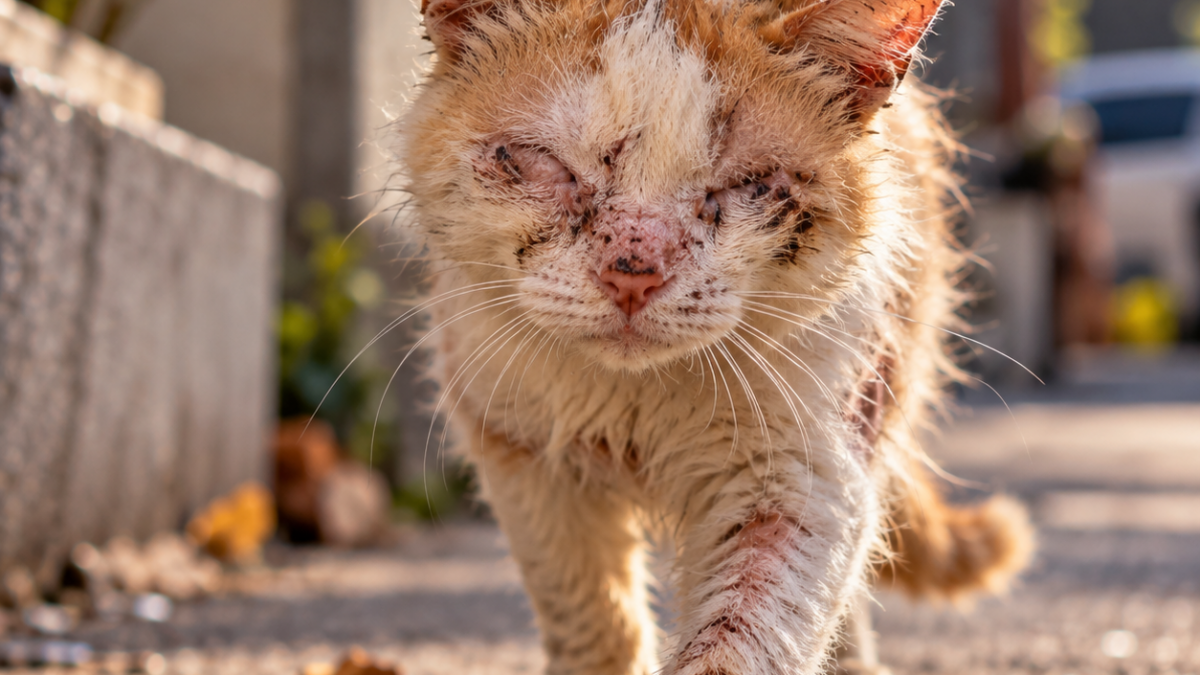
The scars curved along one side of his muzzle.
His jaw sat slightly uneven.
His empty eyes were closed forever beneath healing skin.
One ear remained ragged.
His nose had nerve damage, and he struggled with scent, which meant food had to be warmed sometimes so he could find it more easily.
He looked different from other cats.
That was the gentle way to say it.
Some people could not get past that.
The first time Grace posted his photo on the rescue’s page, the comments came fast.
Some were kind.
Poor baby.
Thank you for saving him.
He deserves love.
Others were not.
That cat should have been put down.
Who would want him?
He looks scary.
Is he suffering?
Why spend so much on one cat?
Grace deleted the cruelest comments before Daniel saw them.
But he saw enough.
He sat in his taxi outside the clinic reading one that said, Sometimes rescue people keep animals alive for themselves, not for the animal.
His hands tightened around the phone.
That evening, he asked Dr. Ellis the question directly.
“Is he suffering because we kept going?”
Dr. Ellis did not answer lightly.
She took him to the recovery room.
Phoenix was awake on a soft blanket. His head was bandaged. His body still thin. His face still healing.
When Daniel spoke, Phoenix lifted his head.
Then, slowly, carefully, he pushed himself up and turned toward the sound.
His paws searched the blanket.
One step.
Then another.
Unsteady.
Determined.
He reached the side of the enclosure and pressed his cheek against the bars closest to Daniel’s voice.
Dr. Ellis said, “That is not a cat asking to die.”
Daniel cried in front of her.
He stopped apologizing for it after the third time.
Weeks became months.
Phoenix moved from the emergency clinic to Grace’s rescue cottage, a small converted farmhouse on two acres where blind, senior, disabled, unwanted, and medically fragile animals were given the one thing most of them had never been offered before.
Time.
Grace set up a recovery room for him with soft mats, low bowls, padded corners, and gentle sound cues. A small tabletop fountain bubbled near his water station so he could find it. Wind chimes hung near the window. His bed had a textured blanket different from the rest of the floor so he could locate it by touch.
At first, Phoenix stayed in the corner.
Blindness had turned the world into a map he did not know how to read.
He bumped into soft barriers and froze.
He startled at footsteps.
He flinched at sudden touch.
But he never lashed out.
That amazed everyone.
After all that had happened to him, Phoenix remained gentle.
Cautious.
Wounded.
But gentle.
Grace would sit on the floor and talk to him.
Not baby talk.
Real talk.
“Well, sir, the laundry situation here is unacceptable, and I blame the kittens.”
Phoenix would tilt his head.
“Also, someone knocked over the treat bin. I’m not naming suspects, but three dogs look guilty.”
His ears would move.
Sometimes he would inch closer.
Daniel visited twice a week.
At first, Phoenix recognized only his voice.
Then his footsteps.
Then the faint smell of taxi vinyl and coffee that seemed to cling to Daniel no matter how many times Elena washed his jacket.
“Hey, Phoenix,” Daniel would say from the doorway.
And Phoenix would lift his head.
Eventually, he walked toward him.
The first time it happened, Grace nearly dropped a laundry basket.
Phoenix stepped slowly, nose low, whiskers forward, paws careful on the mat.
Daniel did not move.
He had learned not to rush miracles.
Phoenix reached his shoe.
Sniffed.
Pressed his scarred face against Daniel’s ankle.
Daniel covered his mouth with one hand.
Grace whispered, “Well, look at that.”
After that, Phoenix began changing.
Not dramatically.
Not overnight.
Healing rarely performs on command.
But slowly.
He learned the room.
Then the hallway.
Then the sunroom.
He learned where the wall ended and the rug began.
He learned Grace’s voice meant food, medicine, and occasionally being called handsome in a tone that suggested debate was not welcome.
He learned Daniel meant soft hands and quiet visits.
He learned Elena brought shredded chicken.
He learned Sofia wore bracelets that jingled, making her easy to locate.
He learned stairs were unnecessary nonsense and avoided them with dignity.
He learned toys that made noise.
The first toy Phoenix loved was a little blue ball with a bell inside.
Grace rolled it gently across the mat.
It jingled.
Phoenix froze.
Grace rolled it again.
Jingle.
His ears turned.
His paw lifted.
Missed.
Tried again.
Hit it.
The bell rang.
Phoenix jumped backward, startled by his own success.
Grace laughed.
Daniel laughed.
Phoenix swatted again.
This time harder.
The ball rolled.
He chased it three steps.
Then five.
Then across the room.
By the end of the week, he was playing.
Not surviving.
Playing.
There is a sacred difference.
Survival is the body saying, not yet.
Play is the soul saying, I’m still here.
Everyone at Second Chance Haven saw it.
The volunteers who had first cried at his wounds began laughing at his stubbornness.
Phoenix developed preferences.
He liked warm food, but not too warm.
He liked the blue bell ball, but ignored the red one, which was apparently inferior.
He liked Grace’s old sweater bed best.
He liked Daniel’s voice but disliked Daniel’s keys if they jingled too loudly.
He liked chin scratches only on the left side.
He hated being surprised but loved being spoken to before touch.
He learned the phrase “step up” when reaching the little ramp to the windowsill.
He learned the phrase “careful” before a new object.
He learned “treat” immediately and never forgot it.
The more he healed, the more people stopped whispering around him.
At first, everyone spoke softly because his injuries made them sad.
Later, they spoke softly because he listened so carefully that it felt rude to be careless.
Phoenix began sitting in sunbeams.
Grace cried the first time.
He had found the warm patch by the window and stretched out in it, scarred face lifted toward light he could not see but could still feel.
That image traveled far.
Grace posted it with a caption:
Phoenix cannot see the sun, but he still knows how to find warmth.
This time, the comments were different.
He is beautiful.
Look at him.
What a strong boy.
I love him.
I would adopt him if I could.
But wanting to love a cat online and choosing to take him home were different things.
That became the next heartbreak.
Once Phoenix was medically stable, Grace began searching for a permanent home.
She was careful.
He needed someone patient.
Someone who understood blind cats.
Someone not afraid of his medical history.
Someone who would keep his environment safe.
Someone who would see him before they saw his scars.
Applications came in.
Many disappeared after learning he was fully blind.
Some asked if his face would “look better eventually.”
Some asked if he would be expensive.
Some asked whether he was “normal.”
Grace began answering that one with less patience each time.
“What does normal mean to you?” she asked one woman.
The woman blinked.
“Well, you know.”
“I don’t.”
The woman did not adopt Phoenix.
Then came the visits.
Those were worse.
People arrived with kind expressions and left with excuses.
“He’s sweet, but I don’t know if my kids could handle the way he looks.”
“I’m worried my guests would be uncomfortable.”
“I was hoping for a cat that could play more normally.”
“I just don’t think I’m ready for special needs.”
“We’ll think about it.”
They did not think about it.
They walked away.
Phoenix did not understand rejection in human terms.
That was both mercy and pain.
He heard visitors.
Smelled them.
Let some touch his head.
Once, he climbed into a woman’s lap and purred.
She cried while holding him.
Then later emailed Grace:
I can’t stop thinking about his injuries. I don’t think I’m strong enough.
Grace read the email twice.
Then closed her laptop and went to Phoenix’s room.
He was on the windowsill, head turned toward the fountain.
“People are fools,” she told him.
Phoenix flicked one ear.
“I know, I know. Harsh but accurate.”
Daniel found her there that evening.
“Another no?”
Grace nodded.
He looked at Phoenix.
“He doesn’t know?”
“No.”
“That’s good.”
“It is and it isn’t.”
Daniel sat beside her.
“He just needs the right person.”
Grace looked tired.
“They all say they want resilience until resilience doesn’t look pretty.”
That sentence stayed with Daniel.
He thought about it during late shifts.
At red lights.
Waiting outside hotels.
Listening to strangers complain about traffic, prices, weather, spouses, bosses, sports teams, coffee temperature.
They all wanted inspirational stories.
As long as the scars stayed metaphorical.
Phoenix’s scars were not metaphorical.
They were right there.
On his face.
In the empty places where his eyes had been.
In the uneven jaw.
In the way he navigated by sound and memory.
He made people confront the cost of survival.
Not everyone wanted to.
One Saturday afternoon, Daniel brought Sofia to visit.
She had come many times by then, but something about that day felt different. She was nineteen, home from college, wearing a yellow sweater and carrying a backpack full of textbooks she had no intention of opening.
Phoenix knew her immediately by the bracelets.
Jingle.
His head lifted.
Sofia smiled.
“Hi, handsome.”
He walked toward her.
No hesitation.
She sat on the floor, and Phoenix climbed into her lap like it belonged to him.
Daniel watched from the doorway.
Sofia stroked the left side of Phoenix’s chin.
Exactly the way he liked.
He purred.
Loud now.
Not the tiny broken sound from the clinic.
A full, steady, rumbling purr.
Sofia looked up.
“Dad.”
He knew the tone.
“No.”
“You don’t know what I was going to say.”
“Yes, I do.”
Phoenix pressed his face against her hand.
Sofia looked down at him.
“He already knows us.”
Daniel leaned against the doorframe.
“Sofia.”
“He does.”
“We live in an apartment.”
“Blind cats can live in apartments.”
“I work long hours.”
“Mom is home in the mornings. I’m home during breaks. I can help pay.”
“You’re in college.”
“Which is why I need emotional support.”
“That is manipulative.”
“It’s also true.”
Daniel looked at Phoenix.
The cat had fallen asleep in her lap.
Completely relaxed.
Safe.
Daniel’s chest ached.
“I’m the one who found him,” he said quietly. “That doesn’t mean he’s ours.”
Sofia’s expression softened.
“No,” she said. “But maybe he found us too.”
That night, Daniel told Elena.
She did not answer right away.
She was chopping onions for dinner.
The knife slowed.
“You want to bring him here?”
“I didn’t say that.”
“You want to.”
“Sofia wants to.”
“Sofia is your daughter. She learned wanting from you.”
Daniel sat at the kitchen table.
“He needs special care.”
“Yes.”
“Our apartment is small.”
“Yes.”
“I’m working most nights.”
“Yes.”
“He may have future medical bills.”
“Yes.”
“I don’t know if we can do it.”
Elena put the knife down.
Then she turned.
“Daniel, when you found him, could we afford that first bill?”
“No.”
“Did you stop anyway?”
“That was different.”
“Was it?”
He looked down.
She came to the table and sat across from him.
“I am not saying yes because it is easy.”
“I know.”
“I am asking whether you think he belongs with us because you love him, or because you feel responsible for what happened after you stopped.”
Daniel did not answer quickly.
That was why Elena’s questions mattered.
They did not let him hide behind goodness.
He thought of Phoenix beside the gutter.
Phoenix in the clinic.
Phoenix pressing his face against his ankle.
Phoenix sleeping in Sofia’s lap.
“I think both,” he said.
Elena nodded.
“Then we talk to Grace.”
Grace did not say yes immediately.
That surprised them.
“You know us,” Daniel said.
“I do.”
“I found him.”
“Yes.”
“I’ve been here for months.”
“Yes.”
“You think we can’t do it?”
Grace folded her hands.
“I think love is not the same as readiness.”
Sofia straightened.
“We’re ready.”
Grace looked at her kindly.
“Then you won’t mind proving it.”
That was how the Reyes family entered Phoenix training.
Grace made them learn everything.
How to approach a blind cat.
How to speak before touching.
How to keep furniture stable.
How to block unsafe gaps.
How to use textured mats as location markers.
How to introduce rooms slowly.
How to monitor eating when smell is limited.
How to warm food.
How to watch for signs of pain.
How to handle strangers.
How to explain to guests not to grab him, startle him, or treat him like a tragedy.
They came three evenings a week.
Sofia took notes like she was preparing for a final exam.
Elena reorganized their apartment before Phoenix ever visited.
Daniel built a low window platform with rails.
Grace inspected it.
Then she inspected the apartment.
Then Phoenix visited for one hour.
Then three.
Then a day.
The first time Phoenix entered the apartment, he froze at the carrier door.
New smells.
New sounds.
Refrigerator hum.
Traffic outside.
Elena’s soft voice.
Sofia’s bracelets.
Daniel’s breath held too long.
Grace whispered, “Everyone relax. He can hear your anxiety.”
Daniel exhaled.
Phoenix stepped out.
His paws touched the textured mat Sofia had placed in front of the carrier.
He sniffed.
Listened.
Took one step.
Then another.
He found the couch by bumping it gently with his whiskers.
He found the water fountain by sound.
He found Daniel by the smell of coffee and taxi vinyl.
He found Sofia by the bracelet jingle.
He found Elena when she said, “Hola, mi amor,” and offered warm chicken on a spoon.
By the end of the visit, Phoenix had curled on the new window platform with sunlight across his scarred face.
Grace watched him for a long time.
Then she looked at Daniel.
“He seems comfortable.”
Daniel did not trust himself to speak.
The adoption became official two weeks later.
Grace cried.
Sofia cried.
Elena cried quietly, which made Daniel cry harder.
Phoenix wore no bow.
No costume.
Grace said he had dignity.
Sofia said he had dramatic old-man energy.
Both were true.
Daniel signed the papers with the same hand that had once signed the first emergency estimate.
This time, the line said adopter.
Not finder.
Not emergency contact.
Family.
When they brought Phoenix home for good, the apartment felt different immediately.
Not bigger.
Not easier.
Different.
As if a missing sound had entered the rooms.
Bell ball rolling.
Fountain bubbling.
Sofia’s bracelets.
Elena speaking softly in Spanish while preparing food.
Daniel saying, “Careful, step up,” as Phoenix learned the platform.
Phoenix adapted faster than anyone expected.
He memorized the apartment in days.
He walked from bed to bowl to fountain to window with increasing confidence.
He claimed Daniel’s chair.
He learned the sound of the taxi pulling into the lot and waited near the door.
The first time Daniel came home after a night shift and found Phoenix sitting there, blind face turned toward the hallway, he had to stop outside the door and collect himself.
Elena opened it from inside.
“Are you crying in the hallway?”
“No.”
“You are.”
“I’m tired.”
“You are loved.”
That was worse.
He came inside and crouched.
Phoenix walked to him, bumped his knee, and made a rusty little chirp.
Daniel picked him up carefully.
Phoenix tucked his head under Daniel’s chin.
The cat who had once been left in the rain now complained when his person came home late.
That is what healing looked like.
Not perfection.
Belonging.
Phoenix became famous in a small way.
Grace posted adoption updates, and people who had followed his recovery celebrated. Some apologized for earlier doubts. Some shared stories of their own disabled pets. Others said Phoenix had changed how they thought about beauty, suffering, and survival.
Daniel did not read every comment.
He had learned not to give strangers too much power over something sacred.
But one message stayed with him.
It came from a woman whose child had a facial difference after a burn injury.
She wrote:
My daughter saw Phoenix and said, “He looks different like me, but everybody loves him.” Thank you for showing her scars don’t mean a life is ruined.
Daniel read it three times.
Then showed Sofia.
She cried.
Elena printed it and placed it inside the folder with Phoenix’s adoption papers.
Phoenix himself remained unimpressed by his influence.
He cared about breakfast.
Sunlight.
Warm blankets.
The blue bell ball.
Chicken.
Daniel’s chair.
Sofia’s bracelets.
Elena’s voice.
He did not know people once called him unwanted.
He did not know visitors had turned away because his face made them uncomfortable.
He did not know strangers debated whether his life was worth saving.
Thank God.
All he knew was that hands were gentle now.
Food came every day.
His bed stayed in the same place.
His family announced themselves before touching him.
The world, though dark, had become predictable.
Safe.
Loved.
One year after the accident, Grace invited the Reyes family back to Second Chance Haven for a small fundraiser. Phoenix came too, carried in a soft-sided carrier with his blue blanket inside.
People gathered around carefully.
Some had followed his story from the first post.
Some had donated to his surgery.
Some had applied to adopt him and later admitted they had not been brave enough.
Daniel held the carrier close.
Sofia handled introductions like Phoenix had a security team.
“Please speak first.”
“Let him sniff.”
“Don’t touch his face unless he leans in.”
“He likes chin scratches on the left.”
“He does not like surprise hands.”
Phoenix handled the attention with regal tolerance.
Then a little boy approached.
He was maybe eight, with thick glasses and a shy posture. His mother hovered behind him.
The boy looked at Phoenix for a long time.
Then asked, “Does he know his face is different?”
The adults went quiet.
Sofia glanced at Daniel.
Daniel crouched so he was level with the boy.
“I don’t know,” he said honestly. “But I know he knows when people are kind.”
The boy thought about that.
Then whispered, “Hi, Phoenix. You’re a good cat.”
Phoenix turned his head toward the voice.
The boy smiled.
Not with pity.
With wonder.
Phoenix leaned forward and sniffed his fingers.
Then bumped them gently.
The boy’s face lit up.
That was the moment Daniel understood something.
Phoenix’s story was not powerful because he looked broken.
It was powerful because he was not.
People had mistaken damage for an ending.
Phoenix kept proving it was only part of the beginning.
Years from now, Daniel knew, Phoenix would be remembered by some people as the blind cat with the badly damaged face.
That description would always bother him.
Not because it was false.
Because it was too small.
Phoenix was also the cat who survived a rainy road.
The cat who made a tired taxi driver stop.
The cat who taught a family that love sometimes arrives bleeding and unrecognizable.
The cat who learned a dark apartment by heart.
The cat who played with a blue bell ball like joy was something he had invented himself.
The cat who could not see the sun but always found the warm spot.
The cat who was rejected by people looking for easy beauty and adopted by people who learned to see with something better.
That evening, after the fundraiser, Daniel brought Phoenix home.
The apartment was quiet.
Sofia had returned to campus.
Elena was reading in bed.
Daniel placed Phoenix on the floor, and the cat immediately walked to the window platform.
Step up.
Turn.
Settle.
Outside, traffic moved through the city in soft waves. Headlights passed across the ceiling. Somewhere below, a car horn sounded. A siren wailed faintly and faded.
Daniel sat beside the window.
Phoenix stretched one paw until it touched his knee.
Daniel placed his hand near it.
Phoenix rested his paw over Daniel’s fingers.
“Do you remember?” Daniel asked softly.
Phoenix did not move.
“Do you remember the rain?”
The cat’s ears flicked.
“I do.”
Daniel looked at the scarred face, the closed eyes, the uneven jaw, the body that had once seemed too damaged to imagine a future.
Then he looked at the warm bed, the safe room, the toy ball under the couch, the family photos on the wall, the adoption papers in the drawer, the cat sitting in the window like he owned the night.
Maybe Phoenix did not remember the road.
Maybe his body did.
Maybe some part of him always would.
But that was not where he lived anymore.
He lived here.
With them.
Loved.
Wanted.
Home.
Daniel thought about the passenger who had told him to leave the cat.
He thought about the people who had walked away from adoption visits.
He thought about the comments saying Phoenix should not have been saved.
He thought about the way the world sometimes confuses beauty with worth and comfort with mercy.
Then Phoenix began to purr.
Loud.
Steady.
Unashamed.
Daniel smiled.
There were people who had looked at Phoenix and seen only scars.
There were people who had looked at his blindness and imagined emptiness.
There were people who had looked at his damaged face and quietly decided his life would be too sad, too hard, too uncomfortable to love.
They were wrong.
Phoenix had lost his sight.
He had lost the face he was born with.
He had lost safety before he ever should have had to fight for it.
But he had not lost himself.
He had not lost tenderness.
He had not lost the ability to trust, even after pain gave him every reason not to.
He had not lost the desire to play, to lean into warm hands, to find sunbeams, to greet voices, to claim chairs, to ask for breakfast, to love and be loved.
That was resilience.
Not looking untouched.
Not pretending nothing hurt.
Not becoming inspirational so strangers could feel better.
Resilience was Phoenix, scarred and blind, stepping out of the carrier into a new home anyway.
It was learning the room.
It was finding the water.
It was trusting the hand.
It was chasing the bell.
It was choosing, again and again, to live as if life still had something good left to offer.
And in the end, the cat nobody wanted became the cat who taught everyone who met him one unforgettable truth.
A broken face does not mean a broken soul.
Sometimes the strongest hearts are hidden behind the scars people are too afraid to look at.
And sometimes the life the world nearly throws away rises anyway, not because it was untouched by fire, but because, like Phoenix, it was born to rise from it.