Nobody Could Touch the Terrified Blind-Sided Shelter Cat—Until One Woman Sat Beside Her for 20 Minutes Every Day
PART3:
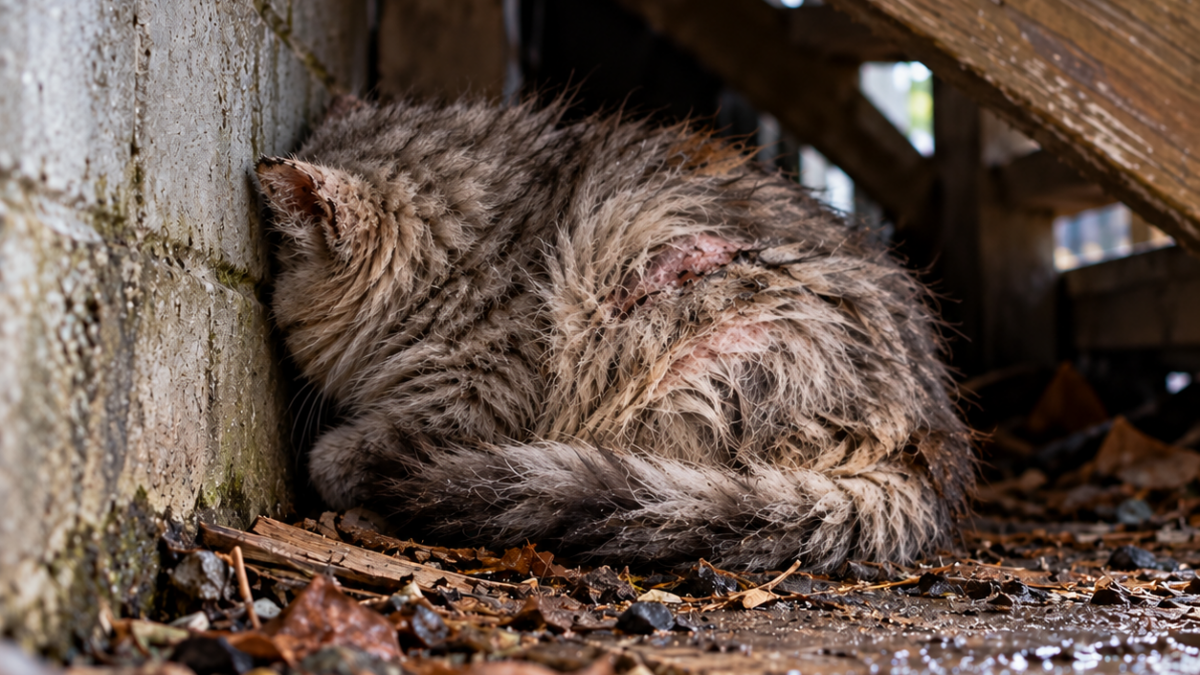
Same terrible attempt to become invisible.
Marcy set down a small plate of wet food.
The smell reached the cat immediately.
Her nose twitched.
Her body stayed frozen.
“It’s okay,” Marcy whispered. “Nobody’s going to hurt you.”
The cat did not believe her.
Why would she?
Words are easy.
Safety takes proof.
For nearly twenty minutes, Marcy sat on the wet pavement and said very little. She did not reach. She did not grab. She did not push the food closer. She simply waited.
The cat finally moved one paw.
Then stopped.
Moved another.
Stopped again.
Her eyes were open, but dull with exhaustion. Green eyes, clouded slightly with age and infection, watching everything without hope. She stretched her neck toward the food but kept her body pressed low, ready to shrink back if the world changed its mind.
Marcy held her breath.
The cat took one bite.
Then another.
Then turned her face away again, as if eating in front of humans was too dangerous.
“She’s older,” Marcy said softly.
Ray nodded.
“You think she’ll make it?”
Marcy did not answer right away.
That was never a good sign.
“We’ll try.”
They named her Luna that evening at the shelter.
Not because she was graceful.
Not because she looked magical.
Not because moonlight made her beautiful in some easy way.
They named her Luna because when Marcy lifted her from the carrier in the exam room, the cat’s silver-gray fur, beneath the dirt and mats and pain, reminded her of winter moonlight through clouds.
Faint.
Hidden.
Still there.
The veterinarian estimated Luna was eight or nine years old, maybe older. It was hard to know. Street life ages animals in uneven ways. Hunger can carve years into a body that has not lived them. Fear can make an animal look ancient before their time.
Her condition told a story no one could fully read.
Severe matting.
Flea dirt.
Small infected wounds.
A torn ear, likely from a fight or an old injury left untreated.
Dehydration.
Weight loss.
Dental disease.
Pain in her hips.
A cloudy left eye that might have been damaged long ago.
No microchip.
No collar.
No person calling to ask if anyone had found an older silver cat with a torn ear and fear buried so deep it had become her posture.
Physical injuries were one thing.
Those could be listed.
Cleaned.
Treated.
Medicated.
Monitored.
The fear was different.
The fear had no simple chart.
At the shelter, Luna did not act like other frightened cats.
She did not throw herself against the bars.
She did not hiss at hands.
She did not strike at people who came close.
She did not yowl through the night.
She did something that, in its own way, was worse.
She turned toward the back corner of her enclosure and stayed there.
For hours.
Then days.
Her body tucked tight.
Her face angled away.
Her tail wrapped close.
She made herself as small as possible, as if hoping the world would forget she was there.
Food would appear.
She waited until the room was empty to eat.
Water would be changed.
She did not look up.
A clean blanket would be placed inside.
She did not move toward it until everyone left.
Volunteers spoke gently.
She stayed facing the wall.
Staff tried soft voices, quiet treats, slow blinks, calming pheromones, warm bedding, covered spaces, and patience.
Still, Luna remained in the corner.
“She’s not aggressive,” Marcy told people.
But that did not mean she was okay.
Sometimes fear does not roar.
Sometimes it whispers, If I stay still enough, maybe nothing worse will happen.
That was Luna.
A cat who had survived by becoming quiet enough to be overlooked.
Elena Morales first saw Luna on a Wednesday afternoon in late November.
It was her third day volunteering at the shelter.
She had not planned to become a volunteer.
She had come to donate towels.
That was all.
A practical errand.
A simple act of kindness that would not require too much of her heart.
Elena was thirty-six, a librarian at a middle school, and quietly lonely in a way most people missed because she was kind, organized, and good at asking other people questions. Her life looked full from a distance. Work. Students. Books. A small apartment with plants along the windowsill. A younger brother who called on Sundays. Friends who invited her to dinner. A mother who worried she worked too much.
But Elena carried grief so neatly that people stopped seeing it.
Two years earlier, her husband, Mateo, had died unexpectedly from an aneurysm at forty-one.
There had been no long illness.
No warning.
No slow goodbye.
One ordinary morning, he kissed her forehead before leaving for work.
By evening, her world had split into before and after.
People said she was strong.
Elena hated that.
Strong had become a word people used when they were relieved you did not make your pain inconvenient for them.
She went back to work.
Paid bills.
Sent thank-you notes.
Packed his clothes slowly.
Kept his favorite mug.
Learned which side of the bed felt less impossible.
But something in her had become careful after Mateo died.
Careful with joy.
Careful with attachment.
Careful with any living thing that might leave.
That was why she had refused to adopt another animal after their old cat, Olive, passed away the year before Mateo. She told herself she was too busy. Then too sad. Then too tired.
The truth was simpler.
She could not bear one more empty space.
So she brought towels to the shelter and intended to leave.
Instead, the volunteer coordinator, Tasha, asked if she wanted a tour.
Elena said yes because saying no felt rude.
That was how she ended up walking past rows of cats, each one a small universe of longing.
Kittens climbing bars.
Young cats reaching paws through doors.
A huge orange tabby yelling like a man wrongfully imprisoned.
A black-and-white cat rolling onto his back for attention.
Then, at the end of the quieter room, one enclosure where nothing moved.
Tasha paused.
“That’s Luna.”
Elena leaned closer.
At first she saw only the curve of a back.
Silver-gray fur, clipped in places where mats had been shaved away.
A torn ear.
A body facing the wall.
“She’s new?” Elena asked.
“About a week.”
“Is she sick?”
“Recovering.”
Tasha lowered her voice.
“She’s very shut down.”
Luna did not turn.
Elena felt something tug in her chest.
Not pity exactly.
Recognition.
“What happened to her?”
“We don’t know. Found behind an abandoned storage building. Older girl. Rough shape. She’s not aggressive, just terrified.”
Elena kept looking.
Luna’s body was pressed so close to the corner it seemed she was trying to merge with it.
“Can people sit with her?”
Tasha gave a tired smile.
“They can. She won’t do much.”
“That’s okay.”
“Really. Don’t expect much from her.”
Elena nodded.
“I won’t.”
That was the first gift she gave Luna.
No expectations.
The next afternoon, Elena returned.
Not with grand plans.
Not with a fantasy of becoming the one person who magically healed the broken cat.
She came with a paperback novel, a chair, and twenty minutes.
She placed the chair beside Luna’s enclosure, just far enough away that Luna would not feel crowded.
Then she sat down.
She did not reach through the bars.
Did not say, “Come here.”
Did not make kissing sounds.
Did not try to coax Luna with treats.
She simply opened her book and read silently.
Luna faced the wall.
Elena stayed.
After twenty minutes, Elena closed the book and stood.
“I’ll come back tomorrow,” she said quietly.
Luna did not move.
The next day, Elena came back.
Same chair.
Same distance.
Same twenty minutes.
This time, she read aloud softly.
Not because she thought Luna understood the story.
Because voices can become part of a room.
Safe voices.
Predictable voices.
Voices that arrive and leave without demanding anything.
The book was about a lighthouse keeper on the coast of Maine. Elena had chosen it because Mateo had loved the ocean even though they lived nowhere near one.
She read a paragraph about foghorns and salt wind while Luna faced the corner.
On the third day, Elena talked instead.
“My students hid three rubber ducks in the library today,” she said. “I found two. The third one is apparently watching me from somewhere, which feels mildly threatening.”
Luna did not turn.
Elena continued.
“I suppose you wouldn’t be impressed by rubber ducks. You seem like a cat with mature priorities.”
Nothing.
“That’s fair.”
She stayed twenty minutes.
Then left.
For nearly two weeks, Luna barely acknowledged her.
Volunteers noticed Elena’s routine.
Some smiled kindly.
Some looked doubtful.
One whispered to another, not unkindly, “She’s going to break her own heart.”
Elena heard.
She did not respond.
Maybe they were right.
Maybe Luna would never turn around.
Maybe she would always prefer the wall because the wall had never hurt her.
Elena understood that too well to resent it.
Some days, she simply sat in silence.
The shelter made noise around them.
Dogs barking in distant rooms.
Laundry machines humming.
Phones ringing.
Metal bowls clattering.
People laughing.
People crying.
Cats meowing.
Doors opening and closing.
And in the middle of it, Elena sat beside the enclosure of a cat who refused to look at her.
She did not treat the silence as failure.
That mattered.
To Luna, maybe silence had always meant danger waiting.
Elena made silence mean company.
On the thirteenth day, something changed.
It was small enough that anyone else might have missed it.
Elena was reading softly when she felt it.
Not heard.
Felt.
The sense of being watched.
She kept her eyes on the book.
Did not turn her head.
Did not gasp.
Did not call for Tasha.
But her heart began beating harder.
In the corner of the enclosure, Luna had shifted.
Just slightly.
Her body still faced the wall, but her head had turned enough for one green eye to look back.
One eye.
Watching.
Elena kept reading.
Her voice almost broke on the sentence.
She steadied it.
The lighthouse keeper in the book was making tea during a storm.
Elena read the whole page.
Only when her twenty minutes ended did she close the book.
“I’ll see you tomorrow, Luna,” she said softly.
She stood.
Walked away.
Then cried in her car.
The next day, Luna did it again.
Turned just enough to watch.
The day after that, she turned sooner.
By the end of the week, she no longer waited ten minutes.
When Elena sat down, Luna’s ear moved first.
Then her head.
Then one green eye.
Elena pretended not to notice every time.
Trust, she knew, could be frightened away by celebration.
The first time Luna ate while Elena sat nearby, Tasha saw it from across the room and froze.
Elena was talking about a boy at school who had tried to return a library book with peanut butter on six pages.
Luna turned toward her food bowl.
Paused.
Looked toward Elena.
Elena kept talking.
Luna lowered her head and took one bite.
Then another.
Tasha pressed both hands to her mouth.
Elena did not move.
She spoke in the same calm voice until Luna finished half the bowl.
Afterward, Tasha whispered, “Do you know how big that was?”
Elena nodded.
But she did not look proud.
She looked humbled.
Because a terrified animal eating in your presence is not a performance.
It is permission.
Over the next month, Luna began unfolding by fractions.
She still hid when new people entered.
Still turned away from loud voices.
Still tucked herself small when a metal bowl fell or a dog barked too sharply from the next room.
But with Elena, she changed.
She watched.
Then ate.
Then faced forward.
Then sat with her paws beneath her instead of pressed flat in fear.
Then blinked slowly once.
Elena blinked back.
The first time Luna left the back corner while Elena was there, the entire cat room seemed to hold its breath.
Elena had placed her chair near the open enclosure door. Not inside. Not blocking. Just near.
Her hand rested loosely on her knee.
Luna stood.
Very slowly.
Her joints seemed stiff, her body careful, her shaved patches still growing back unevenly. She stepped forward once.
Stopped.
Elena looked down at her book.
Another step.
Stop.
A third.
Then Luna reached the front of the enclosure.
Her nose twitched.
Elena’s hand remained still.
Luna stretched her neck.
Sniffed Elena’s fingers.
For two seconds, nothing else happened.
Then Luna touched her nose to Elena’s hand.
Soft.
Brief.
Gone almost instantly.
She retreated to the back of the enclosure and faced sideways, as if embarrassed by her own bravery.
Elena stared at her hand.
Tasha, watching from the doorway, started crying.
Elena whispered, “Thank you.”
Not “good girl.”
Not “finally.”
Thank you.
Because Luna had given something enormous.
Two seconds of trust from an animal who had every reason to keep it locked away.
After that, progress became uneven.
That is how real healing works.
Not straight.
Not cinematic.
Not one brave moment followed by perfect recovery.
Some days Luna came forward.
Some days she returned to the wall.
Some days she allowed Elena to touch the top of her head with one finger.
Some days the same hand made her flinch.
Some days she purred so quietly Elena thought she imagined it.
Some days she would not eat until everyone left.
The shelter staff learned to stop calling the setbacks failures.
They were not failures.
They were old fear echoing.
Elena accepted each day as it came.
“That’s all right,” she would say when Luna turned away. “We can just sit.”
And they did.
Winter settled over the town.
The shelter windows fogged in the mornings.
Volunteers arrived wearing heavy coats and knit hats.
Luna’s fur grew back softer and cleaner, though some patches remained thin. Her torn ear healed with a notch near the edge. The wounds closed. Her body filled out slowly. Her eyes looked brighter.
But she remained an older cat with a complicated heart.
People noticed her sometimes.
Visitors would pause at her enclosure.
“Oh, she’s pretty.”
Then Luna would turn away.
“She’s shy?”
“Very,” Tasha would say.
“Does she like being held?”
“No.”
“Does she come when called?”
“Not usually.”
“Does she sit on laps?”
“Not yet.”
“Is she good with kids?”
“We don’t know.”
Most people moved on.
Not cruelly.
Just realistically.
They wanted a cat who would make adoption easy.
A kitten who tumbled into their hands.
A young cat who pressed against the bars.
A friendly tabby who promised instant love.
Luna promised nothing.
She only survived.
That made Elena angry sometimes, though she tried not to show it.
Not angry at the adopters exactly.
People had the right to choose the animal they could care for.
But it hurt watching them look past Luna because her love was not convenient.
One afternoon, a woman in a red coat stood near Luna’s enclosure and said, “It’s sad, but older cats like that are so much work. And if they’re scared, you never really know if they’ll bond.”
Elena was sitting nearby.
She looked up.
The woman did not realize she had been heard.
Luna faced the corner.
Elena closed her book.
“She bonds,” Elena said quietly.
The woman blinked.
“Oh. Are you staff?”
“No.”
“Sorry, I didn’t mean—”
“She bonds,” Elena repeated. “Just not on command.”
The woman left soon after.
Tasha raised an eyebrow at Elena.
Elena looked back at her book.
“What?”
“Nothing.”
But that evening, when Elena drove home, the woman’s words stayed with her.
Older cats like that.
Like that.
Too scared.
Too slow.
Too much.
Elena knew what it meant to feel like your grief made you difficult to love.
After Mateo died, people had been patient at first.
Then, gradually, they began waiting for her to become easier again.
Come out more.
Smile more.
Date again.
Move on.
Heal in a way that reassured everyone else.
Maybe that was why Luna’s quiet resistance mattered so much to her.
Luna was not performing recovery for anyone’s comfort.
She was simply surviving at the speed her heart allowed.
Elena respected that.
By January, Luna began allowing touch.
Only from Elena at first.
A gentle stroke between the ears.
Then along the cheek.
Never too much.
Never suddenly.
The first time Luna leaned into her hand, Elena forgot how to breathe.
“Hi,” she whispered.
Luna closed her eyes.
Just for a second.
Then opened them and looked startled, as if relaxation had snuck up on her.
Elena smiled.
“I know. It’s weird.”
Luna did not disagree.
In February, the shelter hosted an adoption weekend.
Balloons at the front desk.
Flyers.
Social media posts.
Discounted fees for long-term residents.
Elena hated the balloons.
Luna hated them more.
Every time one shifted in the air currents, Luna flattened herself.
Elena sat with her in the quiet room most of the day.
“You don’t have to impress anyone,” she whispered.
By late afternoon, seventeen animals had applications.
Luna had none.
Tasha looked disappointed.
Elena felt something inside her shift.
Not suddenly.
Not dramatically.
More like a truth that had been waiting patiently finally lifted its head.
That evening, after the shelter closed, Elena remained in the cat room.
Luna sat at the front of her enclosure now, not touching Elena, but close.
That alone would have seemed impossible two months earlier.
Elena looked at her.
“You know,” she said, “my apartment is quiet.”
Luna blinked.
“There’s a spare room. The afternoon sun is good there.”
Another blink.
“I have no balloons.”
Luna lowered her head and began washing one paw.
Elena laughed softly.
“Good point. Very important.”
She did not fill out the adoption application that night.
Instead, she went home and walked through her apartment as if seeing it through Luna’s fear.
Sharp corners.
Hiding places.
Windowsills.
Noisy heater.
Loose wires.
The spare room where she had stored boxes of Mateo’s things because grief had made her unable to finish sorting them.
She stood in the doorway of that room for a long time.
Mateo’s old winter coat hung over the back of a chair.
A box of books sat near the wall.
His guitar case leaned in the corner.
The room was not a shrine exactly.
But it was not living space either.
It was a held breath.
Elena turned on the light.
Then, slowly, she began to move things.
Not erase them.
Move them.
She folded the coat and placed it in a storage trunk.
Sorted the books.
Dusted the windowsill.
Vacuumed.
Cleared a corner for a cat bed.
By midnight, the room looked different.
Still carrying memory.
But open.
The next morning, she told Tasha.
“I want to adopt Luna.”
Tasha stared at her.
Then smiled so widely Elena nearly cried.
“I wondered how long it would take you.”
“You knew?”
“Everyone knew.”
“Luna didn’t.”
Tasha looked toward the enclosure.
“I think Luna knew before you did.”
The adoption was not rushed.
Elena and the shelter staff planned carefully.
Luna would start in the spare room.
No visitors.
No pressure.
Same blanket from the shelter.
Same food.
Same quiet voice.
Same twenty-minute rule, except now the chair would be beside her in Elena’s home.
The day Luna left the shelter, the staff gathered in the hallway.
Not a party.
Luna would have hated that.
Just quiet goodbyes.
Marcy, the rescuer who had first brought her in, knelt beside the carrier.
“You did it, moon girl,” she whispered.
Tasha wiped her eyes.
Even Ray, the maintenance worker who had found her, came by after his shift. He stood awkwardly near the door, holding his cap.
Luna was inside the carrier, silent.
Elena looked at Ray.
“Thank you for stopping.”
He shrugged, uncomfortable.
“Anybody would’ve.”
No one corrected him.
Everyone knew not anybody would have.
That was why it mattered.
At home, Luna did exactly what everyone expected.
She hid.
Under a small table in the spare room, behind the hanging edge of a blanket Elena had draped over one side to create a cave.
Elena placed food nearby.
Water.
Litter.
The shelter blanket.
Then she sat on the floor near the door and read aloud for twenty minutes.
Same as before.
Only now, when she finished, she said, “Welcome home, Luna.”
Luna did not come out.
That was okay.
The first week was slow.
Luna ate only at night.
Used the litter box when Elena was not in the room.
Stayed under the table.
Watched.
Always watched.
Elena kept the apartment quiet. She moved gently. She spoke before entering. She played soft music during the day so sudden sounds would not feel so sharp. She told Luna about school. About library books. About a student who insisted dinosaurs should have their own section separate from science because they were “too important.” About the neighbor upstairs who wore shoes like furniture being dropped. About Mateo, sometimes.
That surprised her.
The first time Mateo’s name came out, Elena stopped mid-sentence.
Luna’s ears moved.
Elena sat very still.
Then she continued.
“My husband would have liked you,” she said softly. “He was patient with shy things. Plants. Bread dough. Me.”
Luna stayed under the table.
But she listened.
By the second week, Luna came out while Elena was in the room.
Only a few steps.
Then back.
By the third, she explored the windowsill.
The afternoon sun found her there, turning her silver fur almost white.
Elena stood in the hallway and watched without moving.
Luna lifted her face toward the light.
Her torn ear glowed pink at the edge.
For the first time, she looked less like a cat recovering from something and more like a cat discovering something.
The hallway came next.
Luna approached it as if crossing into another country.
One paw.
Pause.
Another.
Retreat.
The next day, two paws.
Then half her body.
Then all of her.
Elena sat on the kitchen floor at the far end, pretending to read while Luna sniffed baseboards and chair legs.
The refrigerator kicked on.
Luna bolted back to the spare room.
Elena did not follow.
Five minutes later, Luna returned.
That was courage.
Not fearlessness.
Return.
The kitchen became part of her map.
Then the living room.
Then the sofa.
The first time Luna jumped onto it, she seemed shocked by her own decision.
Elena sat at the other end, barely breathing.
Luna sniffed the cushion.
Turned once.
Sat.
Not close.
But present.
Elena looked at the television, which was off.
“Good sofa,” she said casually.
Luna tucked her paws beneath her chest.
Elena smiled.
“Excellent choice.”
From then on, Luna had a place on the sofa.
No one assigned it.
She chose it.
The left cushion near the armrest.
Elena began leaving a soft blanket there.
Luna pretended not to notice.
Then slept on it every day.
Spring came slowly.
Rain washed salt from the streets.
The tree outside Elena’s window began showing tiny green leaves.
Luna’s coat grew fuller.
Her body softened.
The sharp fear in her eyes remained sometimes, but not always.
Some mornings, Elena woke to find Luna sitting in the bedroom doorway.
Not entering.
Just watching.
“You can come in,” Elena would whisper.
Luna would blink and walk away.
Cats are excellent at refusing dramatic timing.
Then, one winter morning before spring had fully won, Elena woke because something warm pressed against her legs.
For a moment, she did not move.
Her room was dim.
The heater hummed.
The world outside the window was pale with frost.
Slowly, carefully, she lifted her head.
Luna was on the bed.
Curled against her shins.
Asleep.
Not perched nervously.
Not ready to run.
Sleeping.
Deeply.
Peacefully.
The same cat who once could not look at a person.
The same cat who had pressed herself under a broken staircase.
The same cat who had spent weeks facing the shelter wall.
Now sleeping beside one.
Elena covered her mouth with both hands.
Tears slipped down her temples into her hair.
She did not touch Luna.
Not yet.
The gift was not permission to grab.
The gift was presence.
So Elena lay still and let Luna sleep.
When Luna finally woke, she lifted her head, saw Elena watching, and froze.
Elena whispered, “You’re okay.”
Luna stared.
Then, very slowly, she lowered her head again.
That was the moment Elena understood adoption had become belonging.
Not because Luna was suddenly fearless.
She wasn’t.
Not because every wound had vanished.
They hadn’t.
Not because love had transformed her into a different cat.
It hadn’t.
Healing had done something better.
It had given Luna enough safety to become herself again.
That self was quiet.
Careful.
Opinionated about breakfast.
Fond of sunbeams.
Suspicious of doorbells.
Deeply committed to the left sofa cushion.
Not interested in strangers.
Not cuddly on command.
Not a cat who greeted guests at the door or climbed into every lap.
And she did not have to be.
That was the lesson Elena wished more people understood.
Healing does not owe anyone a charming personality.
It does not have to look like confidence.
It does not have to become social, easy, convenient, or entertaining.
Sometimes healing is an old cat sleeping on the bed for the first time.
Sometimes it is eating while someone sits nearby.
Sometimes it is turning one green eye toward the person who kept showing up.
Sometimes it is touching a hand for two seconds.
Sometimes it is choosing the sofa.
Months passed.
Luna’s world grew, but only as much as she wanted.
She learned Elena’s routines.
Morning kettle.
Soft footsteps.
School bag zipper.
Keys.
Door.
Evening return.
At first, Luna hid whenever Elena left and reappeared only after she came home.
Eventually, she began waiting in the hallway.
Not at the door.
That was too bold.
Halfway down the hallway, where she could retreat if needed.
Elena would step inside and say, “Hello, moon girl.”
Luna would blink.
Sometimes she would chirp.
A tiny, rusty sound that seemed to surprise them both.
Elena lived for that sound.
She never hosted loud gatherings.
Never forced Luna to meet people.
When her mother visited, Elena explained the rules.
“Don’t reach for her. Let her decide.”
Her mother nodded solemnly, then sat on the sofa pretending not to be desperate.
Luna stayed under the table for forty minutes.
Then emerged.
Walked to the living room.
Looked at Elena’s mother.
Sniffed her shoe.
Left.
Elena’s mother whispered, “She chose my shoe.”
“That’s big.”
“I feel honored.”
“You should.”
Over time, Luna accepted a few people.
Elena’s mother.
Tasha, when she visited.
Ray, once, to everyone’s surprise.
He came by with a repaired bookshelf for Elena, because he had learned she needed one and apparently fixing things was how he expressed emotion. Luna heard his gravelly voice from the hallway and emerged slowly.
Ray crouched.
“Hey, staircase girl.”
Elena’s throat tightened.
Luna approached.
Sniffed his hand.
Touched her nose to his knuckle.
Two seconds.
Ray looked away fast.
“Dust in here,” he muttered.
Elena did not point out that the apartment was spotless.
Not all tenderness needs to be exposed.
On the anniversary of Luna’s rescue, Elena brought a small donation to the shelter.
Food.
Blankets.
Cleaning supplies.
And a framed photo of Luna sleeping on the blue sofa blanket, her silver body curled in sunlight, torn ear visible, green eyes half closed.
Tasha hung it near the front desk.
Under it, she placed a small card:
Luna. Adopted after 141 days. Healing takes time.
Elena stood there looking at it.
“Is that too sentimental?” Tasha asked.
“Yes,” Elena said.
“Should I take it down?”
“No.”
They laughed.
Then Elena walked through the cat rooms.
So many faces.
So many stories waiting for someone patient enough to learn them.
At the last enclosure, a young black cat hissed from inside a covered bed.
A volunteer nearby sighed.
“He’s impossible.”
Elena looked at the covered bed.
“No,” she said softly. “He’s scared.”
The volunteer blinked.
Elena smiled.
“Try sitting.”
That became part of Luna’s legacy too.
Not dramatic.
Not viral in any loud way.
Just a quiet change in how some people looked at the animals who did not perform friendliness on demand.
Elena began training new volunteers once a month.
She told them about fear.
About patience.
About not reaching.
About how silence can be kindness.
About how trust is not taken but offered.
She never made Luna into a fairy tale.
She told the truth.
“She did not become easy,” Elena would say. “She became safe.”
That sentence mattered.
Because safety is not the same as ease.
Safety is where healing begins.
Years later, Luna remained selective.
Older.
Slower.
Softer around the middle.
Still silver-gray, though more white had crept into her face.
Still torn-eared.
Still suspicious of loud shoes.
Still sleeping on Elena’s bed when she felt like it and ignoring expensive cat beds as a matter of principle.
She never became a cat who loved everyone.
She became a cat who loved her person.
Quietly.
Deeply.
On her own terms.
Every night, Elena sat on the sofa with a book, and Luna settled on the left cushion. Sometimes close enough to touch. Sometimes not. If Elena’s hand rested nearby, Luna might press her cheek against it.
Or she might not.
Elena accepted both.
One rainy evening, much like the day Luna had been found, thunder rolled softly beyond the windows.
Luna startled at the first rumble.
Her body tensed.
Her head lifted.
Elena closed her book.
“It’s okay,” she said.
Luna looked toward her.
Not toward a wall.
Not toward a hiding place.
Toward Elena.
Then she stood, crossed the cushion, and tucked herself against Elena’s side.
Elena rested one hand near her, waiting.
Luna leaned into it.
Outside, rain tapped the glass.
Inside, the apartment was warm.
There was food in the kitchen.
A blanket on the sofa.
A spare room that was no longer a held breath.
A woman who had learned that love could wait.
A cat who had learned that not every waiting silence meant danger.
Elena looked down at Luna and thought of the abandoned storage building.
The broken staircase.
The filthy fur.
The turned face.
The shelter corner.
The one green eye watching.
The first nose touch.
The first night on the bed.
All the tiny moments that would have looked like nothing to someone in a hurry.
But they were not nothing.
They were the steps of a soul coming back to itself.
“Thank you,” Elena whispered.
Luna purred.
Soft.
Uneven.
Real.
People sometimes asked Elena if she rescued Luna.
Elena never knew how to answer.
Yes, technically.
She adopted her.
Brought her home.
Fed her.
Protected her.
But rescue sounded too one-sided for what had happened.
Luna had given Elena something too.
Not in a dramatic way.
Not by fixing her grief or filling every empty place Mateo had left behind.
No one can do that.
But Luna taught Elena that love after loss does not have to arrive loudly.
It can come quietly.
On cautious paws.
It can sit in the same room for twenty minutes and ask for nothing.
It can turn one eye toward you after weeks of silence.
It can touch your hand for two seconds and change the entire shape of your day.
It can sleep beside your legs one winter morning and remind you that a home is not only the place where pain happened.
It is also the place where trust can return.
That was Luna’s gift.
Not instant affection.
Not easy comfort.
Trust.
Chosen slowly.
Given carefully.
More precious because it could never be forced.
The world had once taught Luna to hide beneath broken things.
Elena did not drag her out.
She sat nearby.
She waited.
She came back.
Again.
And again.
And again.
Until one day, Luna looked over her shoulder and saw not a threat, not a demand, not another hand reaching to hurt her, but a person who had been there all along.
Sometimes love is not the moment you hold an animal close.
Sometimes love is leaving enough space for them to decide closeness is safe.
Sometimes rescue is not pulling someone into the light.
Sometimes it is sitting patiently at the edge of their darkness until they are ready to step out on their own.
And when a creature who once believed the world was safest when she was invisible finally chooses to be seen by you, there may be no greater gift.