My Two Kittens Kept Bribing My Old Cat With Treats to Make Her Play—Then One Morning, They Realized She Was Getting Weak and Did Something That Made Me Cry.
PART3:
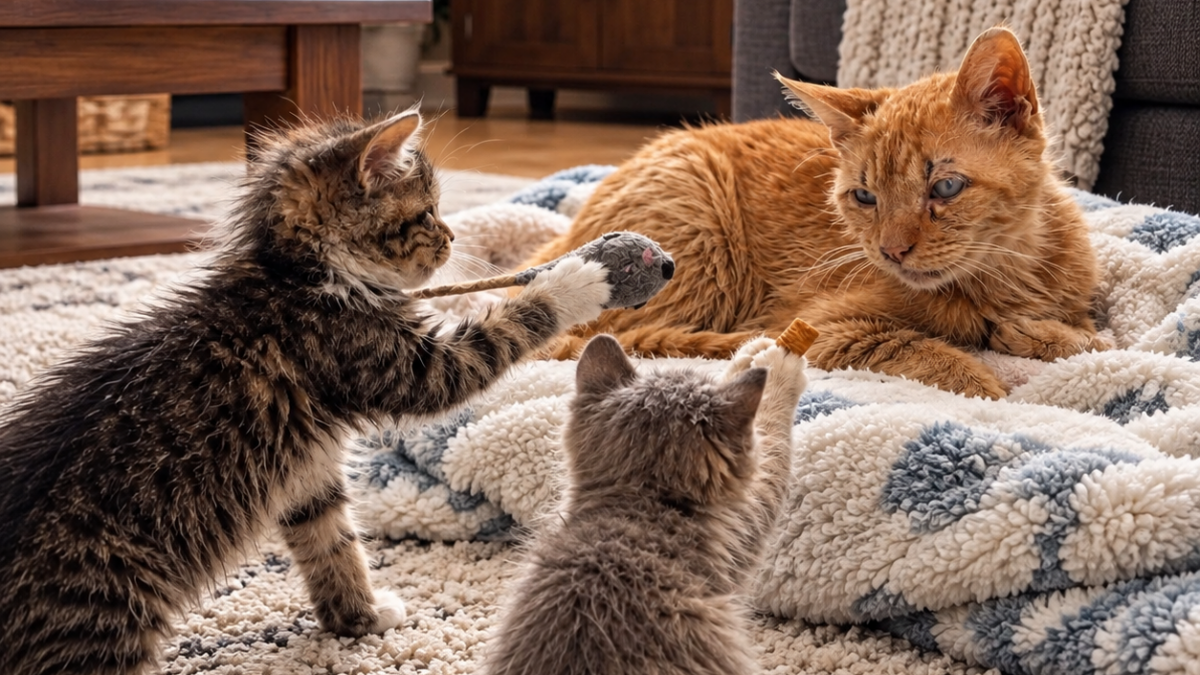
Bean once dragged an entire dish towel across the kitchen and deposited it at Maple’s feet like a royal tribute. Pip brought her a single piece of dry food from his bowl, placed it down carefully, and then looked offended when Maple did not rise with gratitude.
Sometimes Maple would tap the object once with her paw.
Just once.
Barely.
The kittens would lose their minds.
They would shoot across the apartment, ricochet off the couch, slide into the hallway, and return with the wild eyes of creatures who had just received divine approval.
So the bribery continued.
Every day, some new treasure appeared near Maple.
A fuzzy ball.
A feather wand.
A paper straw wrapper.
A treat they had absolutely stolen from the bag I kept on the shelf.
It was sweet.
It was exhausting.
It was also easier to laugh at than the truth.
Because Maple was getting old.
Not old in the cute way people mean when they say an animal is “a senior” and then put a little gray muzzle in a birthday hat online.
Old in the quiet way.
The real way.
She slept harder.
She moved slower.
Her jumps became calculations.
The windowsill she used to reach in one elegant motion became a place she stared at first, as if negotiating with her own body.
When I picked her up, she felt lighter.
That scared me more than I admitted.
There are fears you keep unnamed because naming them makes them real.
So I noticed things and did not notice them.
I told myself she was just tired.
Just having a lazy day.
Just enjoying the blanket.
Just being Maple.
The kittens did not understand any of that.
How could they?
To them, Maple was still Maple.
The center of the apartment.
The queen of the sunny patch.
The one whose smallest paw tap could turn their whole day into a celebration.
So they kept trying to pull her back into their noisy little world.
One afternoon, Maple was resting under the living room chair. It was one of her favorite places when she wanted to be near us but not involved with us, which described most of her philosophy toward life.
Bean bounced over with a plush mouse in his mouth.
Pip came behind him carrying a soft treat.
They dropped both in front of her.
Then Bean patted at her tail.
Pip chirped.
Maple did not hiss.
She did not swat.
She just looked tired.
Something in me snapped.
“Leave her alone,” I said.
Too loud.
Too sharp.
Too much fear wearing anger’s clothes.
The kittens froze.
Bean stepped back first, ears low.
Pip crouched closer to the floor.
The whole apartment went quiet in a way I hated immediately.
I was not angry at them.
Not really.
I was terrified.
Terrified of Maple’s slow walk.
Terrified of the way her bones felt beneath my hand.
Terrified that one day the sunny patch by the window would remain empty and I would still look for her there out of habit.
But Bean and Pip did not know that.
All they knew was that they had tried to love Maple and I had sounded like thunder.
That night, I sat on the floor beside Maple while she slept.
Bean and Pip watched me from across the room.
They did not come closer.
That made me feel worse.
“I’m sorry,” I whispered, though I was not sure whether I was saying it to the kittens, to Maple, or to the future I could not stop.
The next morning, something changed.
Bean brought Maple the plush mouse again.
He walked slowly this time.
Not bouncing.
Not chirping.
Not launching himself at her like affection was a sport.
He placed the toy near her blanket.
Then he backed away.
A little later, Pip carried over one of her favorite soft treats.
Same thing.
He set it down.
Then stepped back.
By the end of the day, Maple’s blanket looked like a tiny gift shop.
Toy mouse.
Bottle cap.
Feather.
Treat.
A sock dragged halfway from the bedroom.
The kittens had not stopped loving her.
They had simply learned a gentler way to do it.
That was the part that broke me.
For the next few days, Bean and Pip stayed close, but not too close.
If Maple slept, they curled nearby instead of on top of her.
If she walked to the water bowl, they watched but did not crowd.
If she moved to the window, they followed and settled a few feet away, like small guards who had no idea what they were guarding against.
One evening, I came into the living room and found all three of them together.
Maple was asleep in the middle of the blanket.
Bean stretched along one side.
Pip tucked himself along the other.
Between them lay their small pile of offerings, as if they had gathered everything they loved and placed it at her feet.
I sat down on the floor and cried.
Not because anything dramatic had happened.
No one had made a speech.
No miracle had arrived.
No swelling music played.
I cried because two wild kittens had learned something many grown people never do.
Love is not always noise.
It is not always pushing, fixing, demanding, cheering, or trying to pull someone back into the version of themselves you miss.
Sometimes love is bringing your whole heart to someone, setting it down gently, and letting them rest.
I thought that was the lesson.
I thought the story was about Bean and Pip learning softness.
I was wrong.
The real lesson began three weeks later, at 3:17 in the morning, when I woke to a sound I had never heard from Maple before.
It was not a cry.
Maple had never been dramatic a day in her life.
It was softer than that.
One low, rough sound from the foot of my bed, like pain had slipped out of her by accident.
I sat up so fast the room tilted.
Maple was on the rug.
Not on the chair blanket.
Not on the pillow by the heater.
Not in any of her normal places.
She was crouched low, looking smaller than I had ever seen her look.
Bean and Pip were already there.
Not playing.
Not pawing.
Not making their strange little kitten noises.
Just sitting a few inches away, watching her like the entire room had changed shape and they were waiting for someone to explain it.
“Maple?”
My voice came out thin.
She lifted her head.
I could see the effort it cost her.
I slid off the bed and knelt beside her.
When I touched her, she leaned into my hand, but not the way she used to.
Not for affection.
For balance.
That scared me more than anything.
There are moments your body understands before your mind catches up.
This was one of them.
I wrapped Maple in an old gray towel and held her against my chest.
Bean pressed against my leg.
Pip made a small chirping sound behind me, like he wanted to help and did not know how.
The vet clinic opened at eight.
I spent the next four hours on the floor with Maple.
Bean and Pip stayed with us the entire time.
Not once did they race through the hall.
Not once did they knock over the water glass on the side table.
Not once did they wrestle like tiny criminals with no respect for sleep.
It was like they knew.
Or maybe they did not know exactly.
Maybe they simply felt the fear in the room and chose to become smaller inside it.
I think people underestimate animals because it is easier than admitting how bad we are at listening.
At seven-thirty, I put Maple into the carrier.
Bean walked over with the toy mouse in his mouth and dropped it in front of the door.
Pip brought a bottle cap.
I had to sit down because the lump in my throat came so fast it hurt.
They were trying to send something with her.
A payment.
An offering.
A little piece of home.
The clinic waiting room smelled like disinfectant and wet umbrellas, even though it was dry outside.
A man with a beagle sat across from me reading forms he was clearly not processing.
A little girl in a pink jacket whispered to a rabbit inside a carrier lined with cartoon blankets.
I sat there with Maple on my lap, one finger hooked through the crate door so she could lean against it.
The vet was kind.
That almost made it worse.
She examined Maple gently. She spoke softly. She asked careful questions.
How long had Maple been moving slower?
Was she eating normally?
Any vomiting?
Any weight loss?
Any trouble reaching the litter box?
I answered as best I could.
Then I failed in the way I had been failing for months.
I said, “I don’t know,” about things I absolutely should have known.
Not because I did not care.
Because I had been afraid to look too closely.
The truth was that there had been signs.
Tiny ones.
The jump she stopped making.
The extra pause before she stood.
The way she seemed to think about the chair now before climbing into it.
The bowl not emptying quite as fast.
The naps that were heavier than sleep.
I had seen all of it.
I had named none of it.
Because naming a thing can make it real, and there are realities we think we can delay by pretending we have not met them yet.
The vet said Maple was old.
Not as dismissal.
Not as a sentence.
Just as truth.
Old.
Sore.
Tired.
Carrying the quiet math of time in places no one could see from across the room.
There were options.
Supportive care.
Medicine for comfort.
Changes at home.
Monitoring.
Patience.
No guarantees.
No bright speech where someone smiled and promised she would be fine.
Just honesty, delivered gently enough that it hurt even more.
I nodded through most of it.
Then I cried in the parking lot with Maple still in the carrier beside me.
Not pretty crying.
Not one brave tear.
The ugly kind.
Bent over the steering wheel.
Face hot.
Shoulders shaking.
The kind that comes when your body realizes it has been bracing for impact for a long time.
When we got home, Bean and Pip were waiting at the door.
They sniffed the carrier.
They sniffed me.
Bean stood on his hind legs and pressed one paw against the carrier as if knocking.
Pip walked beside me all the way to the living room, turning every few steps to make sure we were still coming.
I set Maple near her blanket.
She came out slowly.
Bean started forward, excited in that automatic young-cat way.
Pip touched his side with one paw.
Bean stopped.
Just like that.
He sat.
Maple curled into herself.
The kittens stayed back.
I watched them while I mixed medicine into a spoonful of soft food, and I had one of those absurd thoughts grief gives you.
No one taught them that.
No one made a chart.
No one held a family meeting.
No one said, your sister is fragile now, so love her softer.
They just learned.
And some people live their whole lives without doing that once.
The next few days settled into a rhythm I had not asked for and could not refuse.
Medicine in the morning.
Extra water bowls.
A low-sided litter box.
Blankets in every room so Maple would not have to choose between comfort and company.
I moved a dining chair near the couch and stacked two firm pillows beside it to make a ridiculous little staircase.
Maple sniffed it like it insulted her ancestors.
Then two hours later, I caught her using it.
I laughed so hard I scared Bean.
For a little while, that became our life.
Quiet adjustments.
Small wins.
Tiny mercies that felt enormous because of what they cost to need.
Maple did not get young again.
That was never on the table.
But some days she seemed less uncomfortable.
Some days she stood at the window for ten whole minutes and watched pigeons like she still had official opinions.
Some days she ate enough to make me feel ridiculous for worrying.
Those were the dangerous days.
The hopeful ones.
Hope can be beautiful, but it can also make you foolish.
It can make you think a pause is a reversal.
It can make you believe that if you love hard enough, organize the blankets correctly, and memorize every breath, you can negotiate with time.
You cannot.
But I tried.
Of course I tried.
At night, after Maple settled, I started reading things I should not have been reading.
Articles.
Forums.
Comment threads.
Strangers with usernames like PorchMama72 and BlueTruckDad telling stories that all ended with someone crying in a parking lot or on a kitchen floor.
Some people wrote with tenderness.
Others wrote with certainty.
Too much certainty.
Don’t let her suffer.
Don’t do too much.
Don’t do too little.
Cats hide pain.
Cats bounce back.
Old animals know when it’s time.
You’ll know.
You won’t know.
You’re keeping her alive for you.
You’re giving up too early.
It was a chorus of strangers singing different songs at the same volume.
I shut the laptop and stared at the wall.
That is one of the cruelest things about love in the modern world.
Everyone has advice.
Almost no one has to sit on the floor at two in the morning and wonder if the being they love is still comfortable.
Almost no one has to translate silence.
And yet the opinions never run out.
A few days later, my sister called.
She lives two states away and means well in the tidy, efficient way some people do.
She asks if I am eating.
She asks if the rent went up again.
She asks if I have thought about getting out more, as though loneliness is a package you can return if you keep the receipt.
I told her Maple was having a rough patch.
There was a pause.
Then she said, “She’s had a good long life.”
I know what she meant.
I do.
But something in me went hard anyway.
People say that when they are trying to sound wise.
Sometimes it is wise.
Sometimes it is just distance in nicer clothes.
“Yes,” I said. “She has.”
Then my sister said the part people always think is practical.
“You just don’t want the kittens making it harder. They’re young. They don’t understand. You may need to separate them some.”
I looked across the room.
Bean was asleep near Maple’s blanket, one paw stretched toward it but not touching.
Pip sat near the water bowl, watching Maple the way a guard watches a door.
“They understand enough,” I said.
My sister sighed the sigh people use when they think you are emotional and they are reasonable.
Reasonable is one of the most dangerous words in the English language.
Reasonable is what people call a choice when it costs them nothing.
Reasonable is what they use to cover their discomfort with tenderness.
Reasonable is what they say when someone old, sick, grieving, or tired starts taking up too much space.
I did not say all that.
I just said I had to go.
Then I hung up and sat on the floor beside Maple until Bean climbed into my lap and Pip rested his chin on my ankle.
I am not naive.
I know there is a line between care and cruelty.
I know love does not mean making someone stay because you are not ready.
I know mercy sometimes asks for more courage than hope.
But I also know we live in a culture that worships convenience so hard it has started mistaking inconvenience for suffering.
That is not wisdom.
That is impatience.
That is our inability to sit in helplessness without trying to clear the room.
Maple could not leap anymore.
She could not chase.
She did not entertain.
She did not “give” in the bright, active way young creatures do.
And yet, in that apartment, she was still the axis of everything.
The kittens knew it.
I knew it.
The only ones who seemed confused by that were people.
Bean and Pip changed again.
Their first lesson had been this:
Stop asking Maple to match your energy.
Their second became this:
Help without being asked.
Bean started escorting her to the food bowl.
Not touching.
Not crowding.
Just walking a few steps ahead, then stopping and looking back as if to say, still with me?
Pip began sleeping near the low-sided litter box, which would have been hilarious if it had not been so tender.
Every time Maple used it, Pip stood up and watched the room, solemn as a tiny bouncer outside a very sad club.
If Maple took too long getting back to her blanket, Bean would trot over and sit beside her until she settled.
The gifts continued too.
Only now they changed.
Less random.
More deliberate.
A soft toy instead of a loud one.
A treat instead of a bottle cap.
A folded scrap of paper instead of a plastic ring that might roll under the couch.
It felt insane to think about strategy in kittens.
And yet there it was.
They were trying to comfort her in the language they had.
That language happened to involve stolen objects and dramatic eye contact.
But still.
It was comfort.
One afternoon, Maple fell asleep by the window with sunlight on her back.
Bean sat on one side.
Pip on the other.
Neither moved for nearly an hour.
No wrestling.
No ambushes.
No launching themselves across the room for reasons known only to youth and chaos.
Just stillness.
When I posted a picture of them to a private group for animal lovers, most responses were kind.
Some made me laugh.
“Your kittens are more emotionally available than most people I dated.”
“That orange elder is running a tiny monastery.”
“Tell Bean and Pip I would die for them.”
Then came the others.
“They’re just copying your mood.”
“Animals don’t understand illness like that.”
“Be careful not to project human emotions.”
I stared at those comments longer than I should have.
Project.
It is one of those words people use when compassion embarrasses them.
Do I think Bean was having philosophical thoughts about mortality?
No.
Do I think Pip understood pain scales, kidney values, or the concept of borrowed time?
Of course not.
But I do think bodies know things before language does.
I think attachment changes behavior.
I think love, in any species, often looks like attention.
And I think people hide behind the word “projecting” because it feels smarter than admitting they are moved.
Because if two kittens can notice weakness and respond by becoming gentler, what exactly is our excuse?
That question sat in me for days.
It still does.
What is our excuse?
For the way we rush people who are grieving.
For the way we pressure tired people to perform cheerfulness.
For the way we call someone a burden when what we really mean is that their needs interrupt our schedule.
For the way we praise loyalty in theory and resent it in practice.
Everyone loves the idea of care until care gets repetitive.
Until it costs money.
Until it ruins sleep.
Until it smells weird.
Until it takes too long.
Until the one receiving it cannot say thank you in a way that feels satisfying.
Then suddenly the world gets very philosophical about letting go.
Again, I am not talking about every hard goodbye.
I am talking about the speed with which people move from this is difficult to this is inconvenient.
Those are not the same sentence.
One rainy afternoon, Maple refused breakfast.
That had happened once or twice before.
This time felt different.
She sniffed the food, turned her head, and tucked herself under the little side table near the couch.
Bean brought her a toy.
Pip brought a treat.
Neither was touched.
The apartment felt wrong.
Not loud wrong.
Quiet wrong.
The kind that creeps under your skin and sits there.
I called the clinic.
They told me what signs to watch for and what to do if things changed.
Then I sat on the rug and waited.
There is a special helplessness in loving a creature who cannot explain where it hurts.
You start bargaining with ordinary things.
Please drink.
Please shift your weight.
Please blink slower.
Please eat one bite.
Please let this be the bad morning, not the turning point.
Hours passed.
Rain slid down the window.
The radiator hissed.
Bean slept for ten minutes, woke up, and immediately checked under the table again.
Pip sat beside me and leaned his whole small body against my knee.
Around four, I warmed a little wet food and held it closer.
Maple opened her eyes.
She did not move.
Bean walked over carrying the same toy mouse from the morning.
He dropped it by her paw.
Then he sat.
That was all.
No chirp.
No patting.
No pushing.
Just an offering.
Maple stared at the toy for a long time.
Then, slowly, she lifted her head and licked the food from the spoon.
Once.
Twice.
Three times.
I cried into my sleeve so I would not startle her.
People love to mock small victories until they need one.
Then suddenly one lick of food is the moon landing.
One drink of water is a choir of angels.
One peaceful nap becomes an answered prayer.
That night, Maple ate half her dinner.
Bean and Pip celebrated by doing a very quiet, very restrained chase around the coffee table, which lasted all of thirty seconds before Bean remembered dignity and sat down.
We had more days after that.
Not easy days.
Not miraculous days.
Just days.
And when you are scared of losing someone, days become holy in a way they never were before.
Maple had one week where she seemed almost herself.
Not young.
Not healed.
Just present.
She used her pillow stairs.
She sat on the couch with me and watched dusk gather in the windows.
She even smacked Bean once when he forgot himself and investigated her tail too aggressively.
He looked delighted.
So did I.
I took too many pictures.
I watched her breathe while pretending to watch television.
I canceled plans I did not want to keep anyway.
I learned the exact sound of her paws on the hallway runner.
I also learned something uglier.
How fast other people get tired of hearing about a slow emergency.
The first time you say, “She had a rough night,” people are kind.
The third time, they are sympathetic.
By the tenth, they start talking to you like they are trying to move you through an airport.
“Any update?”
“Still hanging in there?”
“At least she’s comfortable, right?”
No one means harm.
That is what makes it hard to explain.
Sometimes exhaustion makes people efficient.
And efficiency can make even decent people sound like they are trying to close a ticket.
So I stopped talking much.
I stayed in the apartment more.
I watched the light move from room to room and followed Maple with bowls, blankets, medicine, and fear.
Bean and Pip adapted their whole wild little lives around hers.
If Maple moved, one of them noticed.
If she slept, they kept the room calmer.
If she drank, they waited nearby.
Every night, without fail, they brought their small pile of offerings.
A treat by the blanket.
A toy near the bed.
A bottle cap near the water bowl, because apparently Pip still believed in whimsy.
One evening, a friend stopped by with soup.
She meant well.
People usually do.
She stood in my kitchen while I reheated it, looking at Maple, then at the kittens, then at me.
“You look tired,” she said.
“I am tired.”
She nodded.
Then, gently, she said, “You know it doesn’t make you a bad person if you’re keeping her here because you’re not ready.”
I froze with the spoon in my hand.
I knew she was trying to be brave on my behalf.
I knew she thought she was offering permission.
But it landed like a slap because it named my worst fear.
Maybe I was.
Maybe love had made me selfish.
Maybe I had lost the ability to tell comfort from my own need.
Maybe every peaceful nap was something I had invented because I was not ready for the empty blanket.
“I’m not,” I said.
She softened immediately.
“I didn’t say you were.”
“I know.”
And I did know.
That was the problem.
Everyone says things like that from outside the moment.
From the clean side of the glass.
They do not hear the full night.
They do not see Maple still lift her face into my hand.
They do not watch her settle when the kittens lie nearby.
They do not feel the difference between a tired body and a suffering one in a room they have shared for thirteen years.
Sometimes care looks obvious from far away.
Up close, it is made of a thousand judgments no one else can make for you.
After my friend left, I sat beside Maple and apologized to her out loud.
For what, exactly, I still do not know.
For not knowing enough.
For knowing too much.
For being human and therefore late to every lesson that matters.
Bean climbed onto the couch beside Maple but kept his distance.
Pip curled at her feet.
The room felt like a chapel.
No music.
No candles.
Just reverence.
I think that is another thing we get wrong.
We act as though sacred moments have to be large.
They do not.
Sometimes the holiest thing in your life is a worn blanket, a dim lamp, and three cats breathing in the same small room.
The decline, when it came, was not one dramatic cliff.
It was a series of quiet thefts.
First the jump vanished for good.
Then the windowsill.
Then the appetite thinned again.
Then the long walks from room to room got shorter.
Then there were fewer opinions about birds.
That was the one that broke me.
Maple had always judged pigeons like she was on a committee.
When she stopped going to the window, the apartment felt less inhabited even while all of us were still inside it.
Bean reacted by bringing more gifts.
Pip reacted by becoming shadow-like.
He followed Maple with the seriousness of a nurse on an overnight shift.
Once, around midnight, I found Pip asleep with one paw resting lightly on the edge of Maple’s blanket.
Not on her.
Just there.
A promise without pressure.
I took a picture.
Then I put the phone down because suddenly it felt too much like stealing.
Some things should live in memory without being turned into proof.
The hard call came on a gray morning.
Not with thunder.
Not with dramatic music.
Not in a moment anyone would film.
Maple did not want breakfast.
She did not want water.
She did not want to move.
She did not even seem interested when Bean delivered a soft little felt ball to her blanket.
That was when fear changed shape.
That was when it became clarity.
I called the clinic.
My voice stayed calm in that strange way voices do when the rest of you has already fallen apart.
We talked.
I listened.
I asked the questions I had been dreading.
I received answers that were gentle and impossible.
Then I hung up and sat on the kitchen floor because my legs stopped being useful.
Bean came first.
Then Pip.
They did not climb on me.
They just sat there, one on each side, as if bracketing grief was also something they knew how to do.
I had one job that day.
Not to be brave.
Not to be noble.
Just to be honest.
With myself.
With Maple.
With the kind of love that puts the beloved before the ache of being left.
I carried Maple to the living room and laid every soft blanket we owned on the floor.
I turned off the overhead light.
I opened the curtain just enough to let in the pale afternoon.
I sat beside her.
Bean and Pip settled nearby.
The hours that followed were the strangest of my life.
Heavy and tender.
Awful and peaceful.
There was nothing left to fix, which meant all that remained was presence.
People think helplessness is the opposite of love.
Sometimes it is where love becomes purest.
No solutions.
No performance.
No pretending.
Just:
I am here.
I did not leave that spot except when necessary.
I stroked Maple’s head.
I told her ridiculous stories about the first day I met her.
How she had glared at me from the carrier like I was beneath discussion.
How she once stole turkey off my plate and then acted offended that I noticed.
How she used to sit in the sink and watch me brush my teeth as if I were doing it wrong.
Bean fell asleep with his chin on my calf.
Pip woke every time Maple shifted, then relaxed when she settled.
At one point, Bean stood up, walked to the toy basket, and brought over a feather wand almost as long as he was.
He dropped it beside Maple’s blanket and sat back.
Pip got up a few minutes later and placed a treat near her paw.
Then a bottle cap.
Then, because grief does not cancel personality, half of a paper receipt he had stolen from nowhere.
I laughed and cried at the same time.
The little pile grew.
An inventory of affection.
Everything they knew to give.
Everything they thought might matter.
I looked at Maple.
Her eyes were half open.
Tired.
Soft.
Still here.
Something in her face changed when she saw the kittens near her.
Not strength.
Not recovery.
Recognition.
I swear it.
People can argue if they want.
They can say I am romanticizing.
They can say I am reading too much into an old cat’s look.
I do not care.
I was there.
There are moments you do not need science to explain.
You need witness.
Toward evening, Maple stirred.
Very slowly, she stretched one paw out.
It landed on the feather wand.
Bean sat up so straight he looked carved from stone.
Then Maple moved her paw again.
Not toward the toy.
Toward Bean.
Barely.
Just enough that the back of her toes brushed his front leg.
Bean did not move.
Not one inch.
The whole apartment held its breath.
Then Pip shuffled closer and tucked himself against the edge of the blanket.
Maple closed her eyes.
That was it.
No grand miracle.
No sudden return.
Just one old cat reaching once, and two young cats understanding that the answer was stillness.
The clinic appointment was set for later that night.
I will not write the details like a spectacle.
Some things are not content.
Some things belong to the quiet.
What I will say is this.
She was not alone.
She was not rushed.
She was not treated like a problem to solve.
Her head was in my hand.
Bean and Pip were near.
The room was soft.
And when it was over, the silence did not feel empty right away.
It felt holy.
Then it felt unbearable.
I came home carrying an empty carrier and a blanket that still held her shape in a way that did not make sense.
Bean met me at the door.
He sniffed the carrier.
Then he looked behind me.
Then back at the carrier.
Pip came slower.
He stood in the hallway and let out the smallest sound I had ever heard from him.
It was not loud.
That made it worse.
I set the carrier down and sat on the floor and cried until my face hurt.
The kittens did not run from it.
They climbed into my lap in awkward pieces, paws and ribs and warmth.
That first night without Maple was chaos in the quietest possible way.
Bean searched everywhere.
Behind the shower curtain.
Under the bed.
Inside the closet where I kept winter coats.
Pip returned again and again to the living room blanket, circling it, sniffing it, lying down, getting back up.
I stayed awake and watched them grieve.
Yes.
Grieve.
Use whatever softer word you want if it makes you feel smarter.
I know what I saw.
Absence rearranged all three of us.
The next morning, Bean brought a toy mouse to Maple’s blanket.
He set it down.
Then waited.
Pip added a treat.
Then both of them sat there facing the empty spot in the sunlight where she used to sleep.
I had not known a heart could break in exactly the same place twice.
It can.
For days, they kept doing it.
An offering in the morning.
Another at night.
Sometimes one of Maple’s old toys, ones they had never cared much about before.
Sometimes random treasures from their own strange economy.
A crumpled receipt.
A string.
A sock dragged halfway across the apartment.
They were still loving her.
They just had nowhere to put it now.
That is grief in one sentence.
Love with nowhere to go.
If you have lived long enough, you know that is not an animal problem.
That is a human one too.
We lose someone and keep reaching.
We keep thinking of things to tell them.
We save the article.
We make the call in our head.
We turn toward the empty side of the bed.
We buy the sweater because they would have laughed at it.
Love does not stop because the body does.
It keeps arriving.
It keeps setting things down at the feet of absence.
Maybe that is why the kittens’ little offerings destroyed me.
Because they looked exactly like what people do with grief, only stripped of language.
No speeches.
No theories.
No pretending to be over it because the world prefers tidy pain.
Just return.
Place the heart down.
Wait.
A relative texted me three days later.
“At least you still have the kittens to keep you busy.”
Busy.
I stared at that word for a long time.
This is another thing I wish people would stop doing.
Treating grief like clutter that can be organized away by replacement.
As if love is a slot machine and you just pull the lever again.
As if because two young cats still needed breakfast, the loss of the old one had softened into an administrative inconvenience.
No.
Bean and Pip did not replace Maple.
They enlarged the silence by showing me who she had been to them.
The apartment did not feel less empty because they were there.
It felt more honest.
Because the loss was shared.
I think people panic around grief because it exposes how little control we have.
So they rush to patch it.
Get another cat.
Stay busy.
At least she lived a long life.
At least she is not suffering.
At least.
At least.
At least.
Sometimes “at least” is kindness.
A lot of the time, it is fear wearing a neat little hat.
It is what people say when they cannot tolerate standing in the wreckage with you.
Bean and Pip never said at least.
They sat with the empty blanket.
That was enough.
More than enough.
The week after Maple died, I left her blanket in place.
I know some people would have packed everything away immediately.
I could not.
Every time I tried, Pip sat on it.
Every time I folded it, Bean came over with a toy in his mouth and dropped it beside me.
So I left it.
Not forever.
Just long enough.
Long enough for the apartment to understand what had happened.
Long enough for the kittens to stop searching corners.
Long enough for me to stop listening for a slow walk that was not coming back.
One evening, nine days after, the sun hit the living room floor in that same square of late gold Maple used to love.
Pip walked into it first.
Then paused.
Then looked back.
Bean came over carrying the feather wand.
He set it down in the middle of the light.
And instead of waiting for Maple, he lay down there himself.
Pip curled beside him.
It was the first time they had used that spot since she was gone.
I sat on the couch and cried again.
But softer this time.
Because something had shifted.
Not into okay.
Grief does not turn into okay in a straight line.
But into permission.
Permission for the living to re-enter a place the dead once made sacred.
That matters.
I think a lot of us stay miserable longer than we need to because we mistake movement for betrayal.
We think if we laugh too soon, sleep too well, use the favorite mug, or step into the sun again, we are abandoning the one we lost.
Maybe some people move too fast.
But some of us do the opposite.
We build shrines out of guilt and call it loyalty.
Maple did not teach me that.
The kittens did.
Because they grieved her.
And then, slowly, they carried her lesson forward instead of freezing inside it.
Bean got loud again.
Pip started stealing paper from the kitchen counter like a tiny raccoon with no ethics.
They wrestled in the hallway.
They chased each other at midnight like rent was once again due in blood.
But some things stayed changed.
They still brought offerings.
Only now they brought them to me sometimes.
A toy mouse by my bed.
A bottle cap near my slippers.
One soft treat dropped onto the couch cushion beside my leg while I stared too long at nothing.
The first time Bean did that, I laughed through tears so sudden I had to cover my face.
Maybe he was just being weird.
Maybe Pip simply liked chaos.
Maybe none of it means what I think it means.
But love has always lived partly inside interpretation.
We are always reading each other.
The ones who claim they do not are usually just bad at it.
One night, a month after Maple was gone, I found Bean asleep on her old blanket and Pip curled in the crook of his stomach.
Between them sat a little pile of treasures.
The feather wand.
A mouse.
A bottle cap.
A scrap of paper.
And Maple’s old collar tag, which had fallen behind the bookshelf years ago and somehow resurfaced then, of all times, after Pip dug it out from under the baseboard like he had been sent on a mission.
I picked it up and sat on the floor holding it.
Then I looked at those kittens, not really kittens anymore, and understood something that had been trying to reach me for weeks.
They were not only mourning Maple.
They were continuing her.
The patience.
The quiet.
The way the house seemed to lower its voice around tenderness.
Maple had ruled this place once with one look.
Now, somehow, her gentleness had survived in two orange idiots who used to think love meant attacking ankles at top speed.
That is what we leave behind when we love well.
Not perfection.
Not control.
Not a dramatic legacy people brag about.
We leave changed behavior.
Softer hands.
More patient rooms.
People who know how to wait because we once waited with them.
Creatures who set their whole hearts down gently because someone taught them closeness without force.
That is not small.
That is the whole point.
We live in a world deeply confused about value.
We celebrate youth, speed, beauty, productivity, and people who know how to package themselves well.
Then we act shocked when everyone feels disposable the minute they get tired.
We say we care about compassion.
But the second someone gets slow, needy, sick, grieving, old, burned out, or no longer entertaining, a great deal of that compassion starts checking the clock.
That is not compassion.
That is preference.
Real love is not tested by how you feel toward someone dazzling.
It is tested by how you behave when they go quiet.
When they need more than they can give.
When they cannot match your pace.
When they stop being easy to post and start becoming hard to carry.
Anyone can love the bright version of a life.
The loud version.
The photogenic version.
The impressive version.
The question is what you do when the life in front of you becomes slow, tired, repetitive, fragile, or afraid.
Do you make them feel like a problem?
Or do you put down your offering and sit nearby?
My old cat did not die thinking she had been abandoned.
That matters to me more than almost anything.
My two young cats did not learn that care ends when play does.
That matters too.
And I, a person who spent too much of life thinking love meant fixing, learned something I wish someone had taught me earlier.
Presence is not passive.
Waiting is not weakness.
Gentleness is not doing less.
Sometimes it is the hardest work there is.
Because it asks you to stay without controlling.
To witness without rushing.
To love without demanding proof that your love is working.
Maple is gone.
I still miss her in stupid, specific ways.
The empty windowsill.
The absence of fur on one corner of the couch.
The way no one now judges me from the bathroom sink while I brush my teeth.
Grief, it turns out, is not only sadness.
It is also the daily surprise of a world slightly rearranged.
Bean and Pip still bring gifts.
Not every day now.
But often enough.
Sometimes to Maple’s old blanket, which I could never quite throw away.
Sometimes to me.
Sometimes to each other.
I watch them and think about how quickly we teach one another what love looks like.
Not with speeches.
With repetition.
With how we enter rooms.
With whether we make softness safe.
So if you have someone in your life right now who is tired, old, grieving, sick, burned out, or just quieter than they used to be, maybe do not ask for the old version of them back tonight.
Maybe do not pound on the door of their energy like the world has not already done enough of that.
Maybe do not confuse their slowness with a lack of worth.
Bring the offering.
Lower your voice.
Sit nearby.
Wait.
That is what my cats taught me.
That is what Maple left behind.
And in a time when everybody seems to be shouting for more, that feels almost radical.
I used to think love was measured by how tightly we held on.
Now I think sometimes it is measured by how gently we stay.
Bean is asleep beside me as I write this.
Pip is on the rug with one paw over a bottle cap like it is a legal document.
Maple’s blanket is folded on the chair now.
Not gone.
Just folded.
Which, I think, is its own kind of answer.
The house is louder than it used to be.
Younger.
Less dignified.
There are midnight crashes again.
There are shredded paper crimes, suspicious hallway zoomies, and the occasional flying sock.
Life came back in.
Not instead of love.
Because of it.
Every now and then, one of them drops a little treasure at my feet and sits back with bright, waiting eyes.
And every time, I feel the same ache rise in my throat.
Because I know what they are saying.
Not in words.
In the older language.
The truer one.
We’re here.
You can rest.
We can wait.