My Stepmother Abandoned Me Beside a Highway at Eight Years Old—Then 170 Bikers Stopped, and Their Leader Heard the Secret I’d Been Too Afraid to Tell My Dad.
PART2:
Dad had never broken a promise to me on purpose, but Mom had made promises too. She had promised she would fight. She had promised she would try to come home. She had promised she would see the lavender bloom again.
Children learn early that grown-ups can mean what they say and still disappear.
Dad would pull me into his chest and kiss my hair.
“I will always come back to you, Lily-bug.”
I believed him.
That was why I tried so hard when he married Vanessa.
I thought if Dad smiled again, maybe the house would stop feeling hollow.
Vanessa Hale became Vanessa Bennett on a windy Saturday in April, twenty-two months after Mom died. The wedding was at the county courthouse. Dad wore his best shirt. I wore a yellow dress I had outgrown a little at the sleeves because yellow had been Mom’s favorite color on me. Vanessa wore cream and carried a bouquet of white roses so perfect they looked fake.
She was beautiful in a way that made people lower their voices around her. Her hair was smooth and dark, her nails pale pink, her perfume sharp and expensive. She worked at a real estate office and spoke in clean, clipped sentences that made everything sound final.
The first time Dad introduced us, she crouched and smiled.
“You must be Lily,” she said. “Your dad talks about you all the time.”
I liked that.
I wanted to like her.
I wanted Dad not to look so lonely at the kitchen table. I wanted somebody to help him remember appointments and buy groceries and laugh at his bad jokes when he came home from long routes. I wanted our family to stop being a before-and-after picture.
So I made room.
I made my bed without wrinkles. I rinsed my cereal bowl. I ate whatever she cooked, even when the meatloaf was dry and the green beans squeaked against my teeth. I learned not to leave crayons on the table. I learned to wipe the bathroom sink after brushing my teeth. I learned to say thank you for things that did not feel like gifts.
Most of all, I learned her footsteps.
Dad’s footsteps were heavy and uneven, one boot always hitting harder because of an old knee injury. Vanessa’s were quiet. Controlled. Heel, pause, heel, pause. She never stomped. She did not need to. Her anger entered a room before she did, like cold air under a door.
She rarely yelled.
That made it worse.
When Dad was home, Vanessa was careful. Not sweet exactly, but careful. She brushed lint off his shirt. She reminded him to take antacids. She packed sandwiches for his road trips and wrote neat labels on freezer containers. She put her hand on his shoulder when neighbors came by and said things like, “We’re finding our rhythm.”
People believed her.
Dad believed her too, because he wanted to.
When he was gone, she became quieter.
Quiet enough that I started apologizing before I knew what I had done.
If I left a cup on the counter, she would stand there looking at it until my stomach hurt.
If I spoke about Mom, her face would become smooth and unreadable.
If I asked when Dad was calling, she would say, “Your father has responsibilities, Lily. He cannot spend every hour reassuring you.”
Once, I asked if we could make Mom’s pancake recipe on her birthday.
Vanessa closed the cabinet door slowly.
“This house needs to move forward,” she said.
I did not ask again.
Small things vanished first.
Mom’s blue scarf disappeared from the coat hook near the laundry room. Vanessa said she had put old things in storage, but I found the scarf later in a trash bag in the garage. I took it out and hid it under my pillow.
Then the framed photo of Mom and me at the county fair disappeared from the hallway.
“It made the space look cluttered,” Vanessa said.
Dad was on the road.
I put the photo in my dresser drawer and looked at it at night with the flashlight under my blanket.
Then Mom’s necklace vanished.
That was different.
The necklace was a little silver bird on a thin chain, wings stretched as if it had just decided to fly. Mom wore it almost every day. In the hospital, when her fingers were too weak to fix the clasp herself, Dad did it for her. Before she died, she held it in her palm and told Dad, “For Lily, when she’s old enough not to lose it.”
Dad gave it to me after the funeral.
I wore it under my shirt to school because I liked feeling it against my skin. It made me feel like something of Mom was still touching me.
One afternoon, while Dad was in Oregon, Vanessa saw the chain when I bent over to tie my shoe.
Her eyes narrowed.
“Where did you get that?”
“It was Mom’s.”
“I know what it was.”
I stood up, hand closing around the bird.
“Dad said I could wear it.”
“Your father lets guilt make too many decisions.”
I did not know what that meant, only that it felt ugly.
She held out her hand.
“Give it to me.”
“No.”
It was the first time I had said no to her.
Her expression did not change, but the room seemed to shrink.
“Lily,” she said softly.
I took one step back.
She moved faster than I expected. Her fingers closed around the chain. I grabbed the bird, terrified it would break. For one horrible second, we were both pulling on the last thing my mother had touched.
Then the clasp snapped open.
Vanessa had it.
I was left holding air.
“I will keep this safe,” she said.
“Please.”
“You need to learn that sentimental objects are not toys.”
“It’s mine.”
“It belonged to your mother,” she said. “And your mother is gone.”
I slapped her hand.
It was not hard. It was not brave. It was panic.
Vanessa looked at the pink mark blooming on her skin.
Then she smiled.
Not with happiness.
With satisfaction.
When Dad called that night, Vanessa stood in the kitchen doorway while I spoke.
“Everything okay, Lily-bug?” Dad asked through a crackling connection.
I looked at Vanessa.
She touched the little red mark on her hand.
“Everything’s okay,” I whispered.
That was the beginning of smaller stories.
Smaller stories were how I survived.
Vanessa forgot to unlock the back door once.
That sounded smaller than saying I had stood outside in the cold for almost an hour, knocking until Mrs. Parker from next door found me on the steps with blue lips and took me inside for hot chocolate.
Vanessa didn’t like clutter.
That sounded smaller than saying she threw away Mom’s recipe cards and told me memory was not an excuse for mess.
We didn’t get along.
That sounded smaller than saying I counted the hours until Dad came home, then counted the hours until he left again with dread sitting heavy in my throat.
She took Mom’s necklace for safekeeping.
That sounded smaller than saying I saw it around Vanessa’s neck two weeks later when she thought I was asleep on the couch.
The silver bird lay against her collarbone.
My mother’s bird.
I froze under the blanket.
Dad was in the shower. Vanessa stood in the hallway mirror, turning her head one way, then the other. Admiring it.
I did not move.
I barely breathed.
When she saw my eyes open in the mirror, she slipped the necklace under her blouse and said, “You must have been dreaming.”
After that, I stopped asking for it.
I stopped speaking Mom’s name unless Dad did first.
I stopped telling the truth in a size large enough to matter.
The morning she left me by the highway, Dad was in Wyoming.
He had called the night before from a truck stop where wind was shaking the phone connection. He told me he had a load going farther west than expected.
“Eleven days,” he said. “Maybe twelve.”
“You said nine.”
“I know, sweetheart. I’m sorry.”
Vanessa was in the living room, folding towels like each one had personally disappointed her.
I tried not to sound sad.
“It’s okay.”
Dad sighed. “I hate being gone this much.”
“Me too.”
“Vanessa taking care of you?”
The room went so still I could hear the dryer turning.
I looked at her.
She did not look up from the towels.
“Yes,” I said.
“Good. You be helpful, okay? She’s trying.”
“I’m trying too.”
“I know you are, Lily-bug.”
When we hung up, Vanessa stacked the towels with perfect edges and carried them past me without a word.
The next morning was Saturday. Rain pressed against the windows, soft at first. Vanessa had told me not to watch cartoons until my room was clean, so I cleaned it. Then she told me not to make noise because she had paperwork. So I took my crayons into the hallway, where the light was better.
I did not plan to draw on the wall.
I need people to understand that.
Children make mistakes quickly. Sometimes a crayon moves one inch past the paper. Sometimes imagination forgets boundaries adults care about. Sometimes grief slips out through your hand before you know it has nowhere else to go.
I was drawing Mom’s garden.
Marigolds first, orange and yellow circles with little green stems. Then roses, red with too many petals. Then the purple flowers whose name I could not remember. I drew them tall and wavy, bending in imaginary wind.
My paper filled up.
The purple flower at the edge looked lonely.
So I drew another beside it.
On the wall.
Just one.
Then another.
By the time I noticed, a little garden stretched above the baseboard. Not huge. Not across the whole house. Just a row of flowers in crayon, bright against the pale wall.
For a moment, I forgot to be afraid.
It looked like Mom had come back in color.
Then Vanessa stopped at the stairs.
I heard the silence before I saw her.
Heel, pause.
No next heel.
I turned.
She stood with one hand on the banister, looking at the wall.
“You drew on my wall.”
My mouth went dry.
“I’ll wash it,” I said quickly. “I’m sorry. I forgot. I didn’t mean—”
“What are those supposed to be?”
“Flowers. Mom used to—”
I stopped.
Mentioning Mom had become another thing I tried not to do.
Vanessa came down the last stair.
“What did I tell you about dragging the past all over this house?”
“I’m sorry.”
“You are always sorry after.”
“I can fix it.”
“No,” she said. “You can’t.”
Her voice was soft.
That was how I knew something bad was coming.
She walked to the closet, pulled out my rain jacket, and held it toward me.
“Put this on.”
I stared at it.
“Are we going to buy paint?”
“Put it on, Lily.”
My body obeyed before my mind could argue.
That was another thing I had learned from her. Obedience could become a reflex. A flinch wearing manners.
I put on the jacket. I slid my library book into my backpack because I had been planning to read it later. Vanessa took my wrist—not hard enough to bruise, but hard enough to tell me my choices were over—and led me to the garage.
Rain had started falling harder. It tapped against the roof of her car as she backed out of the driveway.
I sat in the back seat because Vanessa said children belonged in the back.
“Where are we going?” I asked.
She did not answer.
We drove past my school. Past Miller’s Grocery. Past the gas station where Dad bought me hot chocolate sometimes after picking me up from daycare. Past the last row of houses at the edge of town.
Fields opened on both sides.
My stomach began to twist.
“Vanessa?”
She kept her eyes on the road.
The windshield wipers beat back and forth.
I watched them because looking at her reflection in the mirror scared me.
Twenty minutes later, she pulled onto the shoulder of a rural highway near a closed diner with a faded sign that said RUBY’S in red letters. The windows were dark. The parking lot was empty except for puddles and weeds growing through cracks.
Vanessa put the car in park.
“Get out.”
I thought I had misheard.
“What?”
“Get out.”
Rain blurred the windows behind her.
“There’s nothing here.”
“Maybe time alone will help you think about respect.”
“I’ll clean the wall. I promise.”
She unbuckled her seat belt, turned, and reached into the back. I pressed myself against the seat.
“Please.”
She unbuckled mine.
The click sounded enormous.
“Out.”
I started crying then, small and quiet because crying loudly made her colder.
“I’m sorry. Please don’t. I won’t draw anymore. I won’t talk about Mom. I’ll be good.”
Something flickered across Vanessa’s face.
For one second, I thought it was regret.
Then she opened the door.
Cold air rushed in.
Rain hit my legs.
“Maybe your father needs to see what happens when you stop performing sweetness and start acting like your mother’s spoiled little ghost.”
I did not understand all the words.
I understood enough.
I climbed out because obeying her had become something my body did before my mind could argue.
My sneakers landed in gravel.
Vanessa leaned across the seat and tossed my backpack out after me. It hit the ground and fell open. A crayon rolled into a puddle.
“Vanessa, please.”
She looked at me through the open door.
“If you tell people stories, Lily, remember that stories can go both ways.”
Then she pulled the door shut.
For one heartbeat, I thought she would roll down the window and tell me to get back in. That this was the lesson. That she wanted me scared, not gone.
The car moved.
I ran after it.
Not far. My backpack banged against my leg. Gravel slipped under my shoes. Rain struck my face so hard I couldn’t see. Vanessa’s car pulled back onto the highway, tires hissing, red taillights glowing through the gray.
I stopped running.
I watched the car get smaller.
I waited for it to slow.
It didn’t.
I waited for brake lights.
They disappeared.
The world after that was rain.
At first, I stood exactly where she left me because I believed rules still existed. Adults did not leave children beside highways. Stepmothers did not drive away forever. Punishment had limits. Someone would realize the lesson had gone too far.
I counted to one hundred.
Then two hundred.
I did not know what number meant forever, so I kept counting until I lost track.
The rain came sideways. It soaked my hair, my jeans, my socks. My backpack got wet, and panic shot through me because the library book was inside. I pulled it out and tucked it beneath my jacket. The cover was damp at the corners. I wiped it with my sleeve.
“I’m sorry,” I whispered to the book.
Because I apologized to everything then.
To walls.
To adults.
To rain.
To books I could not keep dry.
I tried to remember Dad’s phone number. I knew it. He had made me memorize it like a song.
But knowing a number did not help when you had no phone.
I looked at Ruby’s Diner. The sign swung a little in the wind. The front door had a chain through the handles. A paper in the window said CLOSED FOR RENOVATIONS, though even at eight I could tell nobody was renovating anything. The awning stuck out over the entrance, but I was too scared to leave the shoulder. If Vanessa came back and I wasn’t exactly where she left me, she might say I had run away.
So I stayed.
The first car passed.
Then the second.
Then the third slowed and kept going.
After that, something inside me folded very small.
I sat on the gravel with my knees pulled up, the book under my jacket, rain dripping from my chin. I tried to decide how long somebody could punish you before it meant they weren’t coming back.
That was when I heard engines.
At first, I thought it was thunder.
Low. Rolling. Growing.
I lifted my head.
Headlights appeared around the bend, not one pair but many, shimmering through rain. Motorcycles. More than I could count. They came in a long line, staggered across the lane, engines rumbling like the road itself had woken up.
I froze.
Vanessa had told me men on motorcycles were trouble. Loud men. Dangerous men. Men who did not care about rules.
The front motorcycle was huge and black, with a windshield beaded in rain. The man riding it was even bigger, wearing a dark leather vest over a rain jacket, his gray beard pressed flat by water, his face hidden behind dark glasses.
As he came closer, his head turned.
He saw me.
I know he did, because the motorcycle slowed.
Behind him, another slowed.
Then another.
Then the entire line of bikes began to pull off the road into the wide gravel turnout near the diner. Engines rumbled down into idle. Tires crunched. Rain hissed against hot metal. Headlights filled the gray afternoon until the empty roadside glowed.
Later, I learned there had been 170 riders.
They were returning from a memorial ride for a firefighter named Samuel “Sammy” Mercer, a man who had died pulling two children from a burning trailer before going back in for their grandmother. Every year, riders from three states gathered to honor him and raise money for families of first responders. They had taken a different route that year because of road construction.
At eight, I did not know any of that.
At eight, I only knew that the road had finally stopped being empty.
The big man in front shut off his engine.
That one sound changed my life.
He swung his leg over the motorcycle and stepped down into the rain. He was the largest human being I had ever seen, broad as a doorway, with a gray beard, thick arms, and hands that looked like they could pick up a refrigerator. Patches covered his vest. One said BEAR.
He started toward me, then stopped several feet away and crouched.
That mattered.
He did not rush me.
He did not grab.
He did not stand over me and demand answers.
He crouched in the rain so his eyes were closer to mine.
“Hey, kiddo,” he said gently. “Are you okay?”
I meant to lie.
I meant to say yes because children like me learned that yes was safer. Yes made adults stop looking. Yes kept things small.
But I was cold, soaked, frightened, and too tired to be careful.
“No,” I said.
The truth simply came out.
Bear’s face changed.
Not shock exactly. Not pity either. Something steadier.
“All right,” he said. “My name’s Jack Mercer, but my friends call me Bear. What’s your name?”
“Lily.”
“Lily,” he repeated, as if he wanted me to hear that he had heard it. “How old are you?”
“Eight.”
Behind him, riders had begun spreading out. Nobody crowded me. A woman with a purple bandana put one hand over her mouth. A man in a denim vest swore softly and turned away like he couldn’t stand the sight of me sitting there. Another rider was already on the phone.
Bear kept his eyes on me.
“Where’s your family, Lily?”
“My stepmom left me,” I said. “Dad doesn’t know.”
The words hung there in the rain.
Bear looked over his shoulder.
A rider with silver hair and glasses lifted a phone immediately. “Calling 911.”
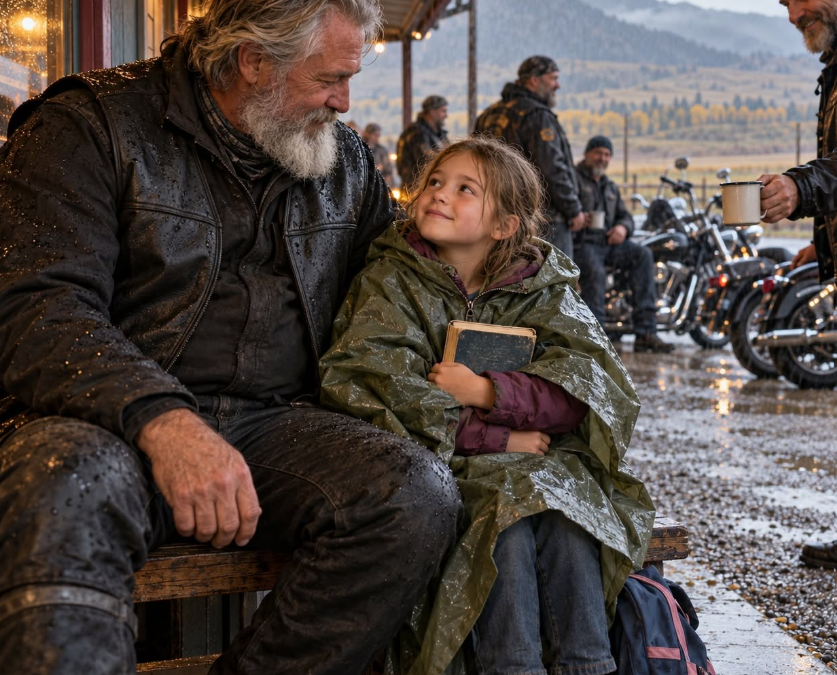
Another rider, a woman named Marcy, approached with a poncho.
“Can I bring this closer, sweetheart?” she asked.
I nodded.
She moved slowly and set it on the ground near Bear, then backed away a little. Bear picked it up.
“Would it be okay if we got you farther from the road?” he asked. “Just over there under the awning. You can walk yourself, or I can help, or Marcy can. Your choice.”
My choice.
I stared at him.
I had not had one in so long that I did not recognize the shape of it.
“I can walk,” I said.
“Okay.”
I stood. My wet sneakers made that squishing sound. Bear noticed me wince but did not comment. He held the poncho open without touching me, and I slipped into it. It swallowed me nearly to my ankles.
We walked to the diner awning. A few riders moved motorcycles to create a barrier between the turnout and the road. Others stood with their backs to the wind, blocking some of the rain. Their engines were off now. The sudden quiet made me hear my own teeth chatter.
Bear sat on the concrete beneath the awning, leaving space between us.
A man with a white beard and kind eyes crouched nearby.
“Name’s Gus,” he said. “I’ve got crackers. Sealed pack. You want some?”
I looked at Bear.
“You don’t have to eat,” Bear said. “But they’re there if you want.”
I took the crackers.
My hands shook so badly I couldn’t open them. Gus opened the pack halfway and handed it back without making a show of it.
A younger rider stood nearby with his hands in his pockets. Something silver peeked out.
“What’s that?” I asked because fear sometimes lets strange questions escape.
He looked down. “This?”
He pulled out a harmonica.
“My granddad’s,” he said. “I’m Pete.”
“Does it work?”
Pete glanced at Bear, who gave him a tiny nod.
So Pete played.
Softly at first, like he was afraid music might break something. A slow little tune rose under the awning while rain drummed overhead and bikers stood guard around a child they did not know. It was not a happy song exactly. But it was warm.
The knot in my chest loosened.
That was when the next truth slipped out.
“She took my mom’s necklace.”
Bear turned his head toward me.
Not fast. Not sharply. Just enough.
“The silver bird,” I said, staring at the wet cracker in my hand. “She said she threw it away, but I saw her wearing it.”
Bear’s eyes changed.
I was too young then to understand rage controlled by discipline, but that was what I saw. Something fierce moving behind his face, held back because he knew I did not need another adult’s anger filling the space.
“Who took it?” he asked.
“Vanessa. My stepmom.”
“Your mother’s necklace?”
I nodded.
“Dad said I could have it. Mom wanted me to. But Vanessa said he only gave it to me because he felt guilty.”
Bear did not speak.
So I kept going.
“She said Dad only keeps me because he feels guilty. Because Mom died. She said if I keep acting sad, he’ll get tired of me too.”
A sound moved through the riders. Not loud. Not words. A collective breath, angry and hurting.
Bear looked at them once, and they went still.
Then he looked back at me.
He did not ask what I had done to make Vanessa say that.
That was important.
So many adults begin with the child’s mistake because it makes the adult’s cruelty easier to hold.
Bear did not ask about the wall.
Not yet.
He only said, “Lily, I’m real sorry she said that to you. That was a lie.”
I wanted to believe him.
But children believe the voices they hear most, especially the quiet ones.
“She doesn’t yell,” I whispered.
Bear frowned.
“What do you mean?”
“She just gets quiet. Then I know I did something.”
He closed his eyes for half a second.
When he opened them, his voice was still gentle.
“You didn’t do anything that makes this okay.”
A sheriff’s cruiser arrived seventeen minutes after the 911 call.
I know because one of the riders, Owen, had kept checking the time. Owen was the man with silver hair and glasses. He had been a school principal once, I learned later, and he spoke to dispatchers with the calm firmness of someone used to making chaos line up.
The cruiser pulled in behind the motorcycles. Deputy Mark Nolan stepped out, hat low against the rain. He was young, maybe early thirties, with a careful face and mud on one boot.
His eyes moved over the scene: bikes, riders, closed diner, me under the awning in an oversized poncho, Bear sitting beside me like a wall made human.
Deputy Nolan approached slowly.
“Afternoon,” he said. “I’m Deputy Nolan.”
Bear stood but did not block me.
“This is Lily Bennett,” he said. “Eight years old. Says her stepmother left her here. We found her on the shoulder.”
Nolan crouched, just as Bear had.
“Hi, Lily.”
“Hi.”
“Are you hurt?”
“I’m cold.”
“We’ll fix that.” He glanced at Bear. “Ambulance is en route to check her out.”
“I don’t need a hospital,” I said quickly.
Adults heard hospital and bills. I had heard Dad worry about bills. I did not want to be expensive.
Nolan looked back at me.
“Maybe not. But when a kid’s been out in cold rain, we let medical folks make sure. That doesn’t mean you’re in trouble.”
In trouble.
Those two words were a room I had lived in.
I nodded.
He asked questions gently. My full name. Dad’s name. Vanessa’s name. Our address. Dad’s phone number. I recited it perfectly. Nolan wrote everything down.
Owen had already tried Dad. Voicemail.
“He loses signal sometimes,” I explained, as though I owed them an apology for that too. “He’s in Wyoming.”
Nolan’s mouth tightened.
“Do you know your stepmother’s number?”
I did.
I recited that too.
He walked toward his cruiser to call her.
The moment he moved away, my stomach twisted hard.
Bear noticed.
“What is it?”
“She’ll say I lied.”
He sat back down.
“Maybe.”
“She’ll say I got out by myself.”
“Maybe.”
“She’ll say I’m bad.”
Bear’s jaw moved.
“Lily, people can say a lot of things. Doesn’t make them true.”
“But grown-ups believe grown-ups.”
He looked at me for a long moment.
Then he said, “Some do. Some learn better.”
Deputy Nolan returned after several minutes with an expression I could not read.
Rain ran off the brim of his hat.
“Lily,” he said, “your stepmother says you got out of the car yourself and refused to get back in.”
My fingers tightened around Charlotte’s Web.
“She says you’ve been acting out,” Nolan continued carefully. “She says she pulled over because you were kicking the seat and screaming, and then you ran.”
I looked toward the road where Vanessa had left me.
For a second, I was not under the awning anymore. I was back in her car, hearing her voice say stories can go both ways.
“What if you believe her,” I whispered, “and put me back in her car?”
Bear shifted beside me, but he let Nolan answer.
The deputy’s face softened.
“You’re not getting into her car today.”
I stared at him.
He crouched lower so I could see his eyes.
“We’re arranging somewhere safe for you while we find your dad.”
Safe.
The word felt too big to trust.
I looked at Bear.
He nodded, but he did not smile like everything had suddenly become easy.
“You can tell him what happened,” Bear said. “You don’t have to make it smaller.”
For months, smaller had been the only way I knew to tell a story.
So I tried the truth at its real size.
I told Deputy Nolan about the back door.
How Vanessa had “forgotten” to unlock it after school in January. How I knocked and knocked until my hands hurt. How Mrs. Parker found me crying on the steps and took me home. How Vanessa later said I should have known she was in the shower and not made a scene.
Nolan wrote down Mrs. Parker’s name.
I told him about Mom’s necklace. The silver bird. The way Vanessa said she threw it away, then wore it under her blouse.
He wrote that down too.
I told him about the recipe cards in the trash.
About Vanessa telling me Dad only kept me because he felt guilty.
About how I had started listening for her footsteps.
About the flowers on the wall.
When I said that part, shame rushed up hot.
“I drew on the wall,” I whispered. “I wasn’t supposed to.”
Deputy Nolan’s pen paused.
He looked up.
“You drew on a wall?”
I nodded.
“What did you draw?”
“Flowers.”
His face changed.
Not because wall drawing was good. Not because children should never be corrected. But because a grown man with a badge heard the size of the mistake and the size of the punishment and understood they did not belong to the same world.
“We can clean walls,” Bear said quietly.
I looked at him.
He was staring out at the rain.
“We can clean walls,” he said again.
The ambulance came. The paramedics checked my temperature, wrapped a blanket around me under the poncho, and asked if anything hurt. My knees were scraped. My hands were cold. My chest hurt, but not in a way they could put a bandage on.
Owen tried Dad again.
No answer.
Then again.
No answer.
The riders did not leave.
They could have. They had homes waiting. Families. Jobs. A long ride ahead in miserable weather. They had already done more than the three cars that passed me.
But they stayed.
All 170 of them.
Some stood in rain. Some took turns warming their hands in their pockets. Some directed traffic around the turnout. The women riders quietly formed a loose half circle near the awning, not trapping me, just making the space feel less exposed. Gus found a dry towel in someone’s saddlebag. Marcy brought a clean sweatshirt that said BILLINGS FIRE MEMORIAL RIDE and asked if I wanted it over my clothes.
I did.
It hung to my knees.
Pete played the harmonica again when I asked.
The second song was brighter.
I almost smiled.
Then Owen shouted from near the cruiser, “I’ve got him.”
Everyone went still.
Bear stood.
Owen hurried over, phone pressed to his ear.
“Lily,” he said gently, “your dad’s on the line.”
My body moved before thought. I reached for the phone with both hands.
“Daddy?”
The word broke everything I had been holding together.
I cried so hard I could not explain where I was. I kept saying rain, highway, Vanessa, flowers, sorry. My words tangled and collapsed. Dad’s voice came through the phone, sharp with terror.
“Lily? Lily, slow down. Where are you? Are you hurt? Who’s with you?”
I couldn’t answer.
Bear crouched beside me.
“Do you want me to help?” he asked.
I nodded and handed him the phone.
Bear took it carefully, like he knew he was holding my whole world.
“Mr. Bennett? My name’s Jack Mercer. Folks call me Bear. I’m with your daughter. She’s safe right now. A deputy and paramedics are here. We found her off Highway 12 near the old Ruby’s Diner.”
Dad’s voice came loud enough that I heard it crack.
“What? What do you mean found her?”
Bear’s eyes closed briefly.
Then he told him.
Not all of it. Not yet. Just enough.
“She says her stepmother left her here. She’s wet and cold, but she’s talking. Deputy Nolan is arranging safe placement until you get home.”
There was a sound on the phone. A scrape. A horn. Dad swearing in a way I had never heard.
Bear’s voice turned firm.
“Sir, pull over.”
A pause.
“Pull over before you kill yourself trying to listen and drive.”
Another pause.
Then Dad said something quieter.
Bear handed me the phone back.
“Lily,” Dad said. His voice sounded different now. Shaking, but closer somehow. “I pulled over. Listen to me. Are you hurt?”
“I’m cold.”
“Okay. They’re helping you get warm. I’m coming home.”
“You’re supposed to be gone eleven days.”
“Not anymore.”
Rain dripped from the awning.
I wiped my nose on the blanket and whispered the thing that had sat like a stone inside me for months.
“She said you didn’t really want me.”
For a moment, I heard only his breathing.
Then Dad made a sound I had only heard once before, in the garage after Mom died.
“Lily Ann Bennett,” he said, and every word trembled, “that is not true. I want you. I love you. I have wanted you every second of your life. None of this is your fault.”
My hand shook around the phone.
“Say it again.”
“I want you,” he said. “I love you. None of this is your fault.”
“Again.”
“I want you. I love you. None of this is your fault.”
I asked him four times.
He said it every time.
Deputy Nolan arranged an emergency placement with a woman named Helen Brooks, who had fostered children on nights when homes stopped being safe. She lived twenty minutes away, in a yellow house with a porch light that stayed on even in daytime storms.
When Nolan told me I would go there until Dad arrived, panic rushed back.
“Will Vanessa know where?”
“No,” Nolan said. “Not tonight.”
“Will Bear come?”
Bear looked at me.
“If you want me there.”
“I do.”
He nodded once.
“Then I’ll be there.”
Nolan explained that Bear could not ride in the patrol car because of procedure, but he would follow with Owen. The other riders would continue once they knew I was settled. I looked out at them through the rain. So many faces. Beards, helmets, bandanas, leather vests, kind eyes, angry eyes, sad eyes.
I had been one little girl on a roadside.
They had become a town around me.
Before I got into the patrol car, Gus handed me a fresh pack of crackers.
Pete tucked the harmonica into his pocket and gave me a small salute.
Marcy adjusted the blanket around my shoulders and said, “You did real good, honey.”
I did not feel like I had done good.
I felt like I had survived long enough for other people to notice.
Owen held up his phone.
“Your dad can reach me if he loses the deputy,” he said.
Bear gave Deputy Nolan his number on a card. Then he leaned down.
“I’m going to follow behind,” he said. “You look back, you’ll see headlights. That’ll be us.”
I looked at the line of motorcycles.
“All of you?”
A tiny smile moved through his beard.
“Not all the way. We’d scare poor Helen to death.”
I almost laughed.
Almost.
As the patrol car pulled away, the riders stood in the rain and waved. Some lifted two fingers. Some placed hands over their hearts. Bear and Owen followed in a pickup someone from the ride had been driving as a support vehicle.
I turned around in the back seat.
Two headlights stayed behind us.
For the first time that day, someone who left my sight came back into it.
Helen Brooks opened her front door before Deputy Nolan knocked.
She was in her late fifties, with gray hair braided over one shoulder and a face that looked like it had held many emergencies without becoming hard. She wore jeans, a cardigan, and slippers shaped like bears.
I stared at them.
She noticed.
“They were a gift,” she said. “From a child with excellent taste.”
I did not know what to say.
Helen stepped aside.
“You can come in, Lily. No one here is angry with you.”
That sentence made my throat hurt.
The house smelled like soup, laundry detergent, and cinnamon. A small lamp glowed in the living room. There were quilts on the couch, children’s drawings on the refrigerator, and a basket of stuffed animals near the stairs.
Helen did not hug me.
She did not ask me to thank her.
She did not say everything happens for a reason, which I would later learn was one of the most useless things people say to children in pain.
She simply said, “Let’s get you warm.”
In the bathroom, I stood beside the tub holding my wet clothes after changing into clean pajamas she had left folded on the counter. They were soft and blue, with moons on them. Too big, but warm.
Helen knocked gently.
“May I come in?”
“Yes.”
She entered with a plastic bag for the wet things and a towel for my hair.
“You can leave your book on this towel here,” she said. “We’ll dry it carefully.”
I placed Charlotte’s Web on the towel like it was injured.
The cover had curled at the edges.
“I ruined it.”
“We’ll see what we can save.”
She said it as if books, like children, did not have to be perfect to be worth keeping.
After soup, Helen gave me a stuffed bear with a red ribbon around its neck.
“One of the riders dropped this off,” she said.
“Bear?”
“I’m not sure. A woman with purple on her helmet said it was from all of them.”
I held it carefully.
It was small enough to tuck under my chin.
Bear and Owen arrived after I had eaten half a bowl of soup. Bear had changed out of his soaked vest into a dry sweatshirt someone must have found, but his boots still left damp prints by the door until Helen pointed at a mat.
“Boots,” she said.
Bear looked startled.
Then he obeyed.
That made me like her.
He sat in the kitchen while Deputy Nolan spoke with Helen. Owen stood by the back door, talking quietly on the phone with Dad again, giving directions, repeating names, making sure someone knew every step.
I sat on the living room couch with the stuffed bear and listened.
My body was warm now, but warmth did not make me sleepy.
It made me feel how tired I was.
Near dawn, headlights crossed the bedroom wall.
I had not slept. Helen had sat with me until I pretended to, then left the door cracked. The stuffed bear was tucked under my arm. Charlotte’s Web lay open on a towel near the heater.
I heard a vehicle stop outside.
A door slammed.
Helen’s voice at the front door.
Then Dad said my name.
“Lily?”
I ran so fast I slipped in the hallway.
Dad caught me before I fell.
He smelled like diesel, cold air, and fear. His jacket was wet. His beard scratched my forehead. His arms closed around me so tightly I could barely breathe, and I did not care.
For a long time, he just held me.
He sank onto the hallway floor with me in his lap, one hand cupping the back of my head, the other pressed between my shoulders like he needed to feel me breathing.
“I’m sorry,” he kept saying. “I’m sorry. I’m so sorry.”
I cried into his shirt.
Not because I was afraid anymore.
Because I did not have to hold myself together.
Bear arrived after Helen called him from the kitchen. He did not interrupt. He stood in the doorway, huge and quiet, watching Dad hold me with a sadness I did not understand until years later. Bear had lost his younger brother Sammy, the firefighter they had ridden for, and he knew what it meant to arrive almost too late.
When Dad finally looked up, his eyes landed on Bear.
“You found her?”
Bear nodded.
Dad tried to stand while still holding me, failed, and ended up kneeling in front of him.
“Thank you,” he said.
Bear’s face tightened.
“You don’t have to kneel to me, Mr. Bennett.”
Dad looked like he might break in half.
“Yes,” he said. “I do.”
Bear reached down and pulled him up by the arm.
“No,” he said. “You need to stand for her now.”
Those words changed Dad.
I saw it happen.
His shoulders straightened. His face hardened, not at me, not with anger that scared me, but with purpose.
He looked down at me.
“Can you tell me?” he asked. “Not right now if you can’t. But when you can.”
I looked at Bear through the doorway.
He nodded.
You don’t have to make it smaller.
So I told Dad everything.
We sat at Helen’s kitchen table while dawn turned the windows pale. Helen made coffee. Deputy Nolan returned. Bear sat near the doorway, close enough that I could see him but far enough that the story belonged to us.
I told Dad about the necklace first.
His hand closed around his mug so hard Helen gently took it away before it broke.
I told him about the back door.
He closed his eyes.
I told him about Vanessa wearing Mom’s silver bird.
He pressed one hand over his mouth and turned away, shoulders shaking once.
I told him she said he only kept me because he felt guilty.
Dad pushed back from the table so fast the chair scraped.
“No,” he said. “No, no, no.”
I flinched.
He froze.
The whole room froze with him.
Dad lowered himself slowly back into the chair.
“I’m not mad at you,” he said, voice breaking. “I’m sorry. I’m mad that she said it. I’m mad I didn’t know. But I am not mad at you.”
I looked at my hands.
“I thought you’d be sad.”
“I am sad.”
My chest tightened.
“But you never have to keep yourself unsafe to protect my feelings,” he said. “Do you hear me? My sadness is mine to carry. Your safety is mine to protect.”
I had never heard love explained that way.
When I apologized about the wall, Dad looked as though I had hurt him without touching him.
“We can clean a wall, sweetheart.”
“I used purple.”
“We can clean purple.”
“And orange.”
“We can clean orange.”
“And red.”
“We can clean red.”
“I made a whole garden.”
His face crumpled.
Then, somehow, he smiled through tears.
“Then maybe we should look at it before we clean anything.”
The next weeks were not simple.
People like stories where rescue fixes everything. A child is found. A father arrives. The bad stepmother is exposed. The bikers ride away in triumph. Music swells. Fade to black.
Real life keeps going after the road.
Dad did not take me home that morning because home was not safe yet. Vanessa was there, and the law moved through steps even when everybody’s heart wanted to sprint. Deputy Nolan and a child welfare worker named Ms. Reyes explained protective orders, interviews, temporary custody arrangements, and investigations.
Dad listened like every word was a nail he intended to hammer into a new life.
He called his dispatcher from Helen’s porch and quit the Wyoming route before breakfast. Not the job entirely at first, because bills did not disappear when trauma arrived, but that route, that distance, that version of fatherhood where love came through spotty phone calls and promises from hundreds of miles away.
“I need local runs,” he said into the phone. “I don’t care if it pays less.”
A pause.
“Then I’ll find another company.”
He did.
Within two weeks, Dad had taken a local driving job hauling equipment across the county. It paid less. He sold his fishing boat, then his old motorcycle project, then a set of tools he loved but did not need. He worked out after-school care with Helen, Mrs. Parker, and eventually a small circle of people he trusted after background checks that made them laugh and then stop laughing when they saw his face.
Vanessa insisted I was dramatic.
She told Deputy Nolan she had only intended to scare me and had turned around within minutes, but I was gone. Then she changed the story and said I had jumped out at the diner and refused to return. Then she said I had been manipulative since my mother died and Dad refused to see it.
But Vanessa had not called 911.
She had not called Dad.
She had not searched the shoulder where she claimed I had run.
She had driven back home, changed clothes, and started cleaning the crayon flowers from the wall.
That detail came from Mrs. Parker, who saw her through the front window when she came over to return a mixing bowl.
“She was scrubbing the hallway,” Mrs. Parker told Deputy Nolan, crying. “I asked where Lily was, and she said visiting a friend. I should have known. I should have asked more.”
My teacher, Mrs. Alvarez, told investigators I had changed after Vanessa moved in. Quieter. Jumpier. Hungry sometimes, though never enough to prove anything. She described how I flinched when adults said my name sharply and how I had stopped drawing pictures of my mother after winter break.
Nobody had one magical piece of proof.
There was no hidden camera showing every quiet cruelty. No recording of Vanessa saying Dad didn’t want me. No video of the necklace being taken.
But there were people listening carefully now.
Checking details.
Putting together what I had been carrying alone.
Bear gave a statement. So did Owen, Marcy, Gus, Pete, and at least fifteen other riders who had seen me soaked through on the shoulder, too far from town for any version of Vanessa’s story to make sense. Deputy Nolan documented the weather, the distance, the time of calls, the condition of my clothing, and my temperature when paramedics arrived.
Dad filed for separation before the week ended.
A protective order kept Vanessa away from me while the cases proceeded. The divorce turned ugly. Vanessa wanted the house, half the savings, sympathy, and the right to say she had been misunderstood. She got less than she expected.
Months later, she pleaded guilty to an offense arising from leaving me beside the highway.
I did not attend that hearing.
People asked if I wanted to.
I didn’t.
I already knew what had happened. I did not need to sit in a courtroom and watch adults weigh my fear against her excuses to know the truth had weight.
That morning, I went to school.
I took a spelling test.
I got one word wrong.
It felt like victory.
My mother’s necklace came back in a padded envelope through the attorneys.
Dad brought it to my room after dinner. By then, we were back in our house, but it felt different. Vanessa’s furniture was gone. Her perfume no longer haunted the hallway. The wall where I had drawn flowers had not been repainted yet. Dad had taken photographs of every crayon stem and petal before anyone touched it.
He stood in my doorway holding the envelope.
“Something came,” he said.
I knew before he opened it.
The silver bird fell into his palm, duller than I remembered but whole.
My breath caught.
“She had it,” I said.
“Yes.”
“She lied.”
“Yes.”
I looked up at him.
“Are you angry?”
His eyes shone.
“I am.”
“Me too.”
He sat beside me on the bed and placed the necklace in my hand.
The bird was cold at first. Then it warmed against my skin.
“I thought if I told you,” I whispered, “you might look at me different.”
Dad looked destroyed by that.
“I’m the one who should’ve seen different,” he said. “I should’ve seen more.”
“You were working.”
“I was gone.”
“For us.”
“And while I was gone, you were unsafe.” He swallowed. “Both things can be true.”
I turned the little bird in my fingers.
“Do you hate yourself?”
He looked surprised.
Then he answered carefully, like my counselor had been teaching both of us to do.
“Some days I feel angry at myself. Some days I feel ashamed. But I’m trying not to turn those feelings into a place you have to live.”
I did not fully understand.
But I understood enough.
I handed him the chain.
“Can you put it on?”
His hands shook against the clasp.
When the bird settled against my chest, I pressed my palm over it and cried without hiding.
Counseling helped, though I hated it at first.
My counselor, Ms. Darla, had curly hair, bright scarves, and a bowl of peppermints on her desk. She did not make me talk about the highway on the first day. She asked about books. She asked about Mom’s garden. She asked what colors I liked.
“Yellow,” I said.
“Like sunshine?”
“Like my dress at Dad’s wedding.”
Then I cried because I had wanted that day to be good.
Ms. Darla taught me things I had not known children were allowed to do.
Disagree.
Ask questions.
Say something hurt without first explaining why the person who hurt you might have been tired.
Want privacy.
Say no to hugs.
Tell the truth even if someone else looked sad hearing it.
Getting safe did not make me stop being frightened overnight.
If Dad was ten minutes late, I watched the clock until my stomach hurt.
If someone offered a ride, I asked exactly where we were going, how long it would take, who would be there, and whether Dad knew.
Dad answered every time.
Even when he was tired.
Even when the questions came three times in a row.
Even when the answer seemed obvious.
Eventually, he began calling before leaving work.
“Heading home, Lily-bug.”
“Where are you?”
“Loading yard.”
“How long?”
“Twenty-two minutes if the light by Miller’s behaves.”
“Are you coming straight home?”
“Yes.”
“Promise?”
“Promise.”
Years later, when I was old enough to understand what patience costs, I asked him if that had been hard.
He said, “Yes.”
Then he added, “Not as hard as imagining you waiting beside that road.”
On my ninth birthday, I woke to motorcycle engines.
For half a second, terror shot through me.
Then Dad appeared in my doorway, smiling with tears in his eyes.
“Come see.”
I ran to the window.
Bear led the riders up our street.
Not all 170 could come, but so many had made the trip that Dad had arranged the party at the community hall instead of our house. Motorcycles lined the curb, shining in the spring sun. Leather vests, helmets, flags, laughter. Marcy waved from a blue bike. Gus lifted a thermos. Pete held up his harmonica.
I pressed both palms against the glass.
“They came.”
Dad stood behind me with his coffee.
“They did.”
“Did you know?”
“I had suspicions.”
I turned and threw my arms around him.
At the community hall, someone had decorated with yellow streamers and paper flowers. Not roses. Not fancy arrangements. Childlike flowers with crayon centers, taped along the walls like a garden that had been invited to stay.
I wore a yellow sweater and Mom’s necklace.
Bear knelt when he saw me, just as he had by the highway, but this time I ran into his arms.
He hugged carefully at first.
Then I squeezed his neck and felt his big shoulders shake.
“Happy birthday, kiddo,” he said.
“You came.”
“Told you I would if you wanted me.”
“I didn’t ask.”
“Some things don’t need asking every time.”
Gus gave me a card crowded with signatures. He had drawn a tiny thermos beside his name. Owen wrote, “Keep asking questions. The good adults will answer.” Marcy wrote, “Your voice matters.” Pete wrote, “For the girl who listened to rain and still heard music.”
I asked him to play.
He did.
This time, I did not need the harmonica to cover the sound of rain.
Before they left, Dad took a photograph outside the hall. I stood beside Bear, holding three of his fingers because my hand could not fit around his. The stuffed bear with the red ribbon was tucked under my other arm. Dad stood on my other side, one hand on my shoulder. Behind us were rows of bikers grinning like the world had done something right for once.
I was smiling without checking anyone else’s face first.
Dad hung that photograph in our hallway.
Near it, he hung framed prints of the crayon flowers I had drawn on the wall before repainting. At first, I thought that was strange.
“You’re not mad at them?” I asked.
He looked at the flowers.
“I’m mad at what happened after,” he said. “Not at the flowers.”
That spring, we replanted Mom’s garden using notes from her old notebook, which Dad found tucked inside a cookbook Vanessa had missed. The pages were wrinkled and stained, filled with Mom’s handwriting.
Marigolds by steps. Roses along fence. Lavender under window. Lily likes to water too much. Remind her roots need air.
I read that line over and over.
Lavender.
That was the name of the purple flowers.
Dad and I planted them beneath the kitchen window. My hands got muddy. For a moment, I felt Mom beside me so strongly that I turned my head expecting to see her.
Dad noticed.
“I miss her too,” he said.
We sat in the dirt for a while.
Neither of us made our grief smaller.
Years passed.
Bear called every birthday.
At first, the calls were short because I was shy on the phone.
“Happy birthday, kiddo.”
“Thank you.”
“You eat cake?”
“Yes.”
“What kind?”
“Chocolate.”
“Good choice.”
Then, as I got older, the calls grew longer. He asked about school, books, friends, driving lessons, college applications. He showed up for my high school graduation wearing a tie with tiny motorcycles on it. Dad cried. Bear cried. I pretended not to.
Owen wrote recommendation letters. Marcy taught me how to change a tire and warned me never to let a boyfriend act impressed by incompetence. Gus sent crackers in every birthday package as a joke. Pete mailed me a harmonica when I turned sixteen. I never learned to play it well, but I kept it.
Dad still told me when he got home, even after I moved to another state for college.
At first, it was a text.
Home.
Then later:
Made it in. Love you.
Then:
Long day. Home safe. The lavender looks good.
When I was twenty-six, married, and living two states away with a daughter of my own, he still did it.
Home from work. Don’t worry, kiddo.
I used to tell him he didn’t have to anymore.
He would answer, I know.
But he did.
Last summer, I visited him with my little girl, Emma.
She was four, all curls, questions, and fearless color. Dad had spread a huge sheet of paper across the hallway floor for her because he knew she liked drawing while adults cooked. I watched her lie on her stomach with crayons scattered around her, tongue caught between her teeth as she created a garden bigger than the page.
Dad stood in the kitchen making pancakes from Mom’s recipe.
The house smelled like syrup and lavender soap.
I wore Mom’s silver bird.
Emma drew tall purple flowers, though she called them “sleepy trees.” A green crayon slipped past the edge of the paper and marked the baseboard.
She froze.
I saw the change in her body before she spoke.
Small shoulders tightening.
Eyes lifting.
Fear testing the room.
“Mommy,” she whispered, “I made a mistake.”
For one second, I was eight again.
Rain.
Gravel.
Red taillights.
The closed diner.
My wet sneakers.
The book under my jacket.
Then Dad came out of the kitchen with a damp cloth.
He looked at the green mark, then at Emma.
“Happens,” he said.
Just that.
Happens.
No cold silence. No punishment disguised as a lesson. No love withdrawn until a child learned to disappear.
He crouched beside her and handed her the cloth.
“Want help?”
Emma nodded.
Together, they wiped the mark until it faded. Then Dad taped another piece of paper over the edge so she had more room.
“Gardens need space,” he said.
Emma went back to drawing.
I stood in the hallway with one hand over the silver bird and watched my daughter make the flowers taller than the people, completely unafraid of what might happen if she forgot to be careful.
Dad looked up at me.
His eyes were older now. Softer. Still carrying things. So were mine.
“You okay?” he asked.
I nodded.
“Yeah,” I said. “I think I am.”
That evening, after Emma fell asleep in my old room, Dad and I sat on the porch steps beside the lavender. The Montana sky stretched wide and pink over the houses. Somewhere down the street, a motorcycle passed, engine low and steady.
Neither of us flinched.
Dad looked at the garden.
“I still think about that day,” he said.
“I know.”
“I think about what could’ve happened.”
“I know.”
“I think about those cars that passed.”
“Me too.”
His jaw tightened.
“And then I think about Bear.”
I smiled.
“Me too.”
Dad rubbed his hands together the way he did when he was trying not to cry.
“I should have been there.”
I looked at him.
For years, that sentence had lived between us. Sometimes spoken. Sometimes not. It was true and not true in the complicated way painful things often are.
“You came,” I said.
“Too late.”
“You came when you knew.”
His eyes shone.
“That doesn’t erase—”
“I know,” I said. “It doesn’t. But it matters.”
He nodded, looking out at the lavender.
I leaned my shoulder against his.
For a while, we sat quietly.
Not the kind of quiet Vanessa used like a locked door.
The other kind.
The kind where nothing had to be hidden to be peaceful.
Bear died when I was thirty-one.
His heart, which had been too big in every way, finally gave out on a cold morning in November. I flew back for the funeral with Emma, who was nine by then and knew him as Uncle Bear. The service was packed with riders, firefighters, veterans, foster families, teachers, mechanics, and people whose lives he had entered at the exact moment they needed someone large enough to stand between them and the road.
I stood at the front and spoke.
My hands shook.
Dad sat in the first row. Owen, older and thinner, held a handkerchief. Marcy held Emma’s hand.
I told them about the rain.
About the closed diner.
About the way Bear crouched several feet away instead of rushing toward me.
About how he asked if I was okay and believed me when I said no.
Then I looked at the crowd of leather vests and wet eyes and said, “He did not save me by being fearless. He saved me by being careful. By listening. By staying. By understanding that a child telling the truth does not always sound brave. Sometimes she sounds confused. Sometimes she sounds guilty. Sometimes she apologizes for needing help. Bear knew that. He heard me anyway.”
After the funeral, riders escorted his ashes along the same highway where he had found me.
We stopped at the old Ruby’s Diner.
It had reopened years earlier under new owners. They kept flowers in barrels near the door now. Lavender grew under one window because Dad had secretly sent the owner a crate of plants after Bear’s seventieth birthday.
A small plaque stood near the gravel turnout.
Not dramatic.
Not polished.
Just bronze, bolted to stone.
For every child waiting to be believed.
Emma read it aloud.
Then she looked at me.
“Mom,” she said, “were you scared?”
I took her hand.
“Yes.”
“Did you think nobody was coming?”
I looked at the road. The same bend. The same fields. A different sky.
“Yes.”
She squeezed my fingers.
“But they came.”
I smiled through tears.
“They came.”
And I finally understood how far I had traveled from that road.
Not because I forgot it.
I never forgot it.
I still remember the red taillights disappearing. The gravel hurting my knees. The third car slowing just enough to teach me that hope could be cruel. The library book under my jacket. The rain. The cold. The terrible question of how long punishment had to last before it became abandonment.
But I also remember engines.
I remember 170 strangers deciding a child alone in the rain was everybody’s business.
I remember a huge man with a gray beard crouching low enough to make himself less frightening.
I remember Deputy Nolan saying I would not get back in her car.
I remember Dad’s voice breaking over the phone as he told me again and again that he wanted me.
I remember the first time my mother’s necklace came home.
I remember crayon flowers framed in the hallway.
And now, when my daughter makes a mistake, when a cup spills or a marker slips or grief appears in some unexpected color on a wall, I try to remember what saved me.
Not perfection.
Not punishment.
Not silence.
A question.
A choice.
A person willing to stop.
Because sometimes the difference between a child being lost and a child being found is not a miracle from the sky.
Sometimes it is a stranger shutting off his engine in the rain and asking, “Are you okay?”
And believing her when she says no.