My Neighbor Threatened to Call Animal Control Because I Fed a White Stray Cat—Then She Told Me to Bring Him Inside or “Let Him Starve.”
PART3:
I posted his picture in three local lost-pet groups. I wrote: Found or possibly stray white/cream cat near Hawthorne Court Apartments. Friendly but cautious. Has been seen here for several weeks or months. Please message if you recognize him.
No one did.
A few people commented with heart emojis. Someone suggested I trap him and take him to a shelter. Someone else warned me not to take him to the city shelter because “they euthanize immediately,” which wasn’t true, but it was enough to make my stomach twist. A woman forty miles away insisted he looked like her missing cat, Snowball, until she saw the close-up of his face and said no, Snowball had green eyes.
Each evening, he was there.
Sometimes he sat beneath the same first-floor window, staring up through the glass as if expecting it to open. Sometimes he slept behind the shrubs. Once, I saw him limp after jumping down from the low wall near the parking lot, but the limp faded after a few steps.
I bought a small bag of dry cat food on my lunch break.
I stood in the pet aisle for twenty minutes, paralyzed by choices that suddenly felt morally significant. Indoor formula. Outdoor formula. Grain-free. Sensitive stomach. Senior. Kitten. Hairball control. Chicken. Salmon. Turkey. I finally grabbed a small blue bag that promised “complete nutrition” and tried not to feel like I was crossing a line.
That evening, I waited until the side entrance was quiet. I poured a handful of food into a shallow plastic container and set down a bowl of water near the brick wall, not directly by the door, not in anyone’s way.
The cat watched from beneath the hedge.
“It’s okay,” I whispered. “I’m not going to bother you.”
I backed away and sat on the low retaining wall near the parking lot, pretending to look at my phone. After a full minute, he came out.
He moved cautiously, body low, ears alert. He sniffed the food, looked at me, sniffed again, then began to eat with small, controlled bites. Not frantic. Not greedy. But steady.
I don’t know why that hurt so much.
Maybe because hunger is quieter than people imagine. It doesn’t always look dramatic. Sometimes it looks like dignity trying not to ask.
When he finished, he drank water for a long time. Then he sat back, licked his paw, and looked at me as if we had entered into a fragile agreement.
I picked up the empty container before going inside. I rinsed it in our sink while Daniel watched me from the doorway.
“You fed him,” he said.
“I cleaned up.”
“That’s not what I said.”
“He was hungry.”
Daniel leaned against the doorframe. “Claire.”
“I know.”
“Do you?”
“I’m not adopting him.”
“That’s what you said about Jasper.”
“Jasper was dying behind a dumpster.”
“And this one?”
“This one is sitting outside our building waiting for someone who never comes.”
Daniel’s expression changed. Something softened, but worry remained underneath.
“We can’t do another heartbreak right now,” he said.
“I’m just feeding him while I figure out what to do.”
“That’s how heartbreak introduces itself.”
I turned away and washed the bowl longer than necessary.
For the next several days, I fed the cat quietly. Morning if I could, evening if I couldn’t. Always a little, never leaving food behind. I brought the bowl back upstairs, washed it, tucked it under the sink. I kept checking lost-pet pages. I called two rescues and left messages. One emailed back saying they were full but could lend me a humane trap in three weeks. Another said if I could get him into a carrier, they could scan for a microchip during limited intake hours.
Getting him into a carrier sounded impossible.
He was beginning to trust me, but only in the way broken trust returns by inches. He would walk toward me when I crouched. He would eat with me nearby. Once, he brushed against my knee so lightly I thought I had imagined it. But when I lifted my hand, he stepped back.
I started calling him Ghost.
Not because he was white, though that was part of it. Because he seemed to haunt the building.
He knew things about it. He knew which door clicked softly and which slammed. He knew when the school bus dropped off children. He knew that Mrs. Alvarez walked slowly and carried crackers in her coat pocket. He knew Patricia’s footsteps too.
The first confrontation happened on a Thursday.
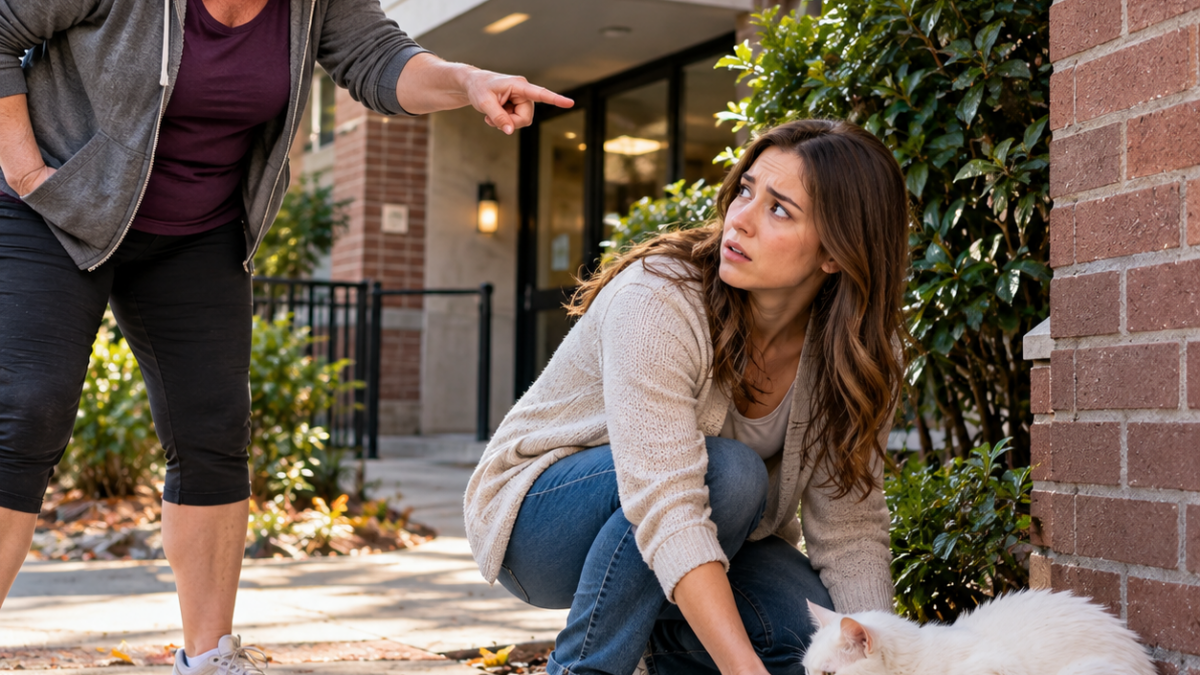
I had just set down his food near the brick wall when I heard a sharp voice behind me.
“What do you think you’re doing?”
I turned and saw Patricia Voss standing on the walkway in a camel-colored coat, her leather purse tucked in the crook of her arm, her mouth pinched like she had discovered vandalism.
I stood up too quickly. “Hi, Patricia.”
“Don’t ‘hi Patricia’ me. Are you feeding that animal?”
Ghost froze beside the bowl.
“I’m giving him a little food and water,” I said carefully. “I don’t leave anything out. I clean it up afterward.”
“That is not the point.”
“What is the point?”
“The point is that this is a shared residential property, not a barnyard. Feeding strays attracts more strays. It attracts raccoons. Rats. Fleas. Disease.”
“There’s no mess. I promise.”
“You promise?” She laughed once, without humor. “That’s very comforting, Claire. I’ll be sure to tell the property manager we have your promise when we’re overrun with feral animals.”
“He isn’t feral.”
“Of course he isn’t. I’m sure you two have had long conversations.”
The sarcasm embarrassed me even though no one else was there.
“I’ve been trying to find out if he belongs to anyone,” I said. “I posted online. I’m contacting rescues.”
“Then contact them faster. Or take him inside.”
“We’re not allowed to have another pet without paying—”
“Then you do understand the rules.”
Her eyes sharpened when she said it.
I breathed in slowly. “I understand rules. I also understand that he’s hungry.”
“He is not your responsibility.”
“Maybe not. But he’s still alive.”
Patricia’s face tightened.
That was the first time I saw what was beneath her neat, polished anger. Not just annoyance. Not just concern about cleanliness. Something colder. Something personal.
“Do not feed him again,” she said.
“I’m not trying to cause trouble.”
“Then stop causing it.”
Ghost had backed away from the bowl and was now crouched beneath the shrub, eyes wide. Patricia glanced at him with disgust.
“Animals learn where they’re welcome,” she said. “Make him unwelcome.”
I stared at her.
She turned and walked away, her heels clicking against the damp pavement.
That night, Daniel said I should pause until we had a plan.
“She threatened to report me,” I told him.
He sat on the edge of our bed, hands clasped. “To who?”
“The property manager. Animal control.”
“Animal control might actually help if they scan him.”
“Not if she makes him sound dangerous or diseased.”
“Is he dangerous?”
“No.”
“Then tell the truth.”
I looked at him, frustrated. “Truth doesn’t always win first, Daniel. Sometimes people with louder voices win long enough to hurt something.”
He had no answer for that.
The next day, a typed notice appeared on the community bulletin board near the mailboxes.
PLEASE DO NOT FEED STRAY ANIMALS ON THE PROPERTY.
Feeding stray animals creates health hazards, encourages pests, and violates community standards. Any resident observed leaving food outdoors may be subject to lease review.
It was unsigned, but everyone knew.
I stood in front of the notice with my mail in one hand, heat rising in my face. Two residents walked past, glanced at the paper, then at me. That was Patricia’s gift. She didn’t need to name you to make sure everyone knew your shame.
Mrs. Alvarez came up beside me, moving slowly with her cane.
“She put that there,” she said.
“I know.”
“She likes signs.”
I almost smiled. “She does.”
Mrs. Alvarez reached into her sweater pocket and pulled out a folded napkin. Inside were a few pieces of deli turkey.
“Sometimes,” she whispered, “I give him this. Don’t tell.”
My throat tightened.
“I won’t.”
“He used to sit by 1C,” she said.
I looked at her. “1C?”
She nodded toward the hallway. “Before they cleaned it out.”
“Who lived there?”
Her expression changed. “You don’t know?”
“We moved in two years ago.”
“Ah.” She looked toward the lobby doors, as if checking whether Patricia might appear. “Mrs. Whitcomb. Eleanor Whitcomb. Sweet lady. Very quiet. She had white hair, always wore lavender. She lived here a long time. Maybe fifteen years.”
“What happened to her?”
“She died last spring.”
I looked through the glass doors toward the side wall where Ghost often sat.
“She had a cat?”
Mrs. Alvarez pressed her lips together. “I thought so. I heard one sometimes. But Patricia said no. She said Mrs. Whitcomb’s son took everything.”
“Her son?”
“Michael. He came once or twice. Not often.” Mrs. Alvarez tucked the napkin back into her pocket. “After Mrs. Whitcomb died, Patricia helped clean the apartment.”
“Patricia did?”
“She had a key. For emergencies, she said. She was always helping Eleanor near the end. Groceries, mail, things like that.”
I had a sudden, uncomfortable thought.
“Do you think Ghost was Mrs. Whitcomb’s cat?”
Mrs. Alvarez’s eyes filled with sadness. “I don’t know, honey. But I know after Eleanor was gone, I started seeing that white cat outside.”
Before I could ask more, the lobby door opened and Patricia stepped in carrying a stack of envelopes. Mrs. Alvarez immediately straightened, her face going blank.
Patricia looked at us, then at the bulletin board.
“Good,” she said. “You’ve seen the reminder.”
I met her eyes. “Did management approve this notice?”
“I discussed the issue with them.”
“That’s not what I asked.”
Her smile was small and bright. “Careful, Claire. Tone matters.”
Mrs. Alvarez touched my sleeve lightly, a warning.
Patricia leaned closer, lowering her voice just enough to sound private while still being heard by anyone near the mailboxes.
“Some of us are trying to maintain standards. Not everyone wants to live in a place that smells like cat food and poor decisions.”
The words struck exactly where she aimed them.
I thought about our old car with the cracked bumper. The thrift-store bookshelf in our living room. Daniel’s worry over bills. My grocery coupons. The way people like Patricia could turn ordinary struggle into evidence of bad character.
“Kindness isn’t a poor decision,” I said.
“No,” she replied. “But sentimentality often is.”
Then she walked away.
That evening, I searched for Eleanor Whitcomb online.
I found an obituary from April. Eleanor Grace Whitcomb, seventy-nine, beloved mother of Michael, former librarian, volunteer reading tutor, lover of music, gardens, and animals. The photo showed a woman with soft white hair and kind eyes, wearing a lavender blouse.
There was no mention of a cat.
I stared at the obituary for a long time.
Daniel came up behind me. “Who’s that?”
“A woman who lived in 1C. She died last spring. Mrs. Alvarez thinks Ghost might have been hers.”
Daniel looked at the screen, then at me. “Might.”
“Yes. Might.”
“Claire—”
“I know that doesn’t prove anything. But what if he had a home? What if he’s been sitting outside the building for months because he doesn’t understand she’s gone?”
Daniel’s face folded with pain despite himself.
“That’s awful,” he said quietly.
“Exactly.”
He pulled out a chair and sat beside me. “What do you want to do?”
“I want to get him scanned. I want to know if he has a chip. I want to know his name.”
Daniel nodded slowly.
It wasn’t agreement yet. But it wasn’t resistance either.
Over the weekend, I borrowed a carrier from Tasha upstairs. It was pink and missing one latch, so Daniel fixed it with a zip tie. I put a towel inside and left it near the side wall while Ghost ate, hoping he would get used to it.
He sniffed it once and looked at me as if I had betrayed him.
“Fair,” I said. “It does look suspicious.”
On Sunday morning, I sat outside with him for nearly an hour. The air was cold enough that my fingers ached around my coffee cup. Ghost sat three feet away, paws tucked beneath him, watching birds hop along the fence.
“You have terrible timing,” I told him. “Do you know that? We were having a very normal life.”
He blinked slowly.
“You don’t care.”
He blinked again.
A car door slammed. Ghost flinched, but didn’t run.
I wondered what he had learned to fear. Loud sounds, quick hands, closed doors, being left.
I wondered if animals remembered abandonment as a moment or a weather they lived inside afterward.
That afternoon, I called the county animal services line and explained the situation. A tired-sounding woman named Denise listened while I stumbled through details.
“Friendly stray, possible former owner deceased, neighbor conflict, need microchip scan,” she repeated.
“Yes.”
“We can send an officer if there’s a complaint, but for a voluntary scan you can bring him to us or to most vet clinics.”
“I can’t catch him yet.”
“Do you have a humane trap?”
“Not yet.”
“We have a waiting list. Rescues may be faster.”
“What happens if my neighbor calls and says he’s a nuisance?”
Denise paused. “If he’s healthy and not aggressive, we assess. We don’t just come grab animals because someone dislikes them.”
The relief I felt was embarrassing.
“Thank you,” I said.
“But,” she added, “if residents are feeding outdoors, property management can make their own rules. That’s separate from us.”
“I understand.”
“Document everything. Photos, dates, who you contacted. And don’t escalate with the neighbor.”
Don’t escalate with the neighbor became impossible by Monday.
I came home from work to find my food bowl gone.
Not just empty. Gone.
It was the small blue ceramic dish I had used after deciding the plastic container looked too disposable. I found the water bowl overturned near the shrubs, muddy water spreading across the mulch.
Ghost was under the parked sedan closest to the wall, crouched low, staring at me.
“What happened?” I whispered.
He didn’t move.
I looked around and saw Patricia on her patio, pruning a plant that did not need pruning.
“Did you take my bowl?” I asked.
She didn’t look up. “If you left trash outside, maintenance may have removed it.”
“It wasn’t trash.”
“Outdoor feeding dishes are not permitted.”
“Did you take it?”
She clipped one leaf slowly. “You seem upset.”
“I’m asking a simple question.”
“And I’m telling you that shared spaces cannot become your personal rescue project.”
I stepped closer, trying to keep my voice even. “That bowl belonged to me.”
“It was abandoned property.”
“It was out there for ten minutes.”
“Long enough.”
Behind her sliding glass door, I noticed something I had never seen before. A stack of cardboard boxes. Several framed pictures leaning against the wall. A lavender-colored throw blanket folded over one box.
I looked back at Patricia.
“Were those Eleanor Whitcomb’s things?” I asked.
Her pruning shears stopped.
For one second, the air changed.
Then she smiled.
“Excuse me?”
“Mrs. Alvarez said you helped clean out 1C after Eleanor died.”
“What an odd thing to bring up.”
“I was just wondering if you knew whether she had a cat.”
Patricia set the shears down with exaggerated care. “Eleanor was very ill at the end. People imagine all sorts of things when someone dies. They attach stories to empty apartments. It’s unhealthy.”
“That’s not an answer.”
“It’s the only one you’re entitled to.”
Her voice had lost its polished edge. Something raw slipped through.
I should have walked away. I knew that. But Ghost was trembling under a car because someone had scared him, and my bowl was missing, and Patricia was standing there beside a dead woman’s lavender blanket telling me entitlement had limits.
“Did you put him outside?” I asked.
Patricia’s face hardened.
“You need to be very careful.”
“Why?”
“Because accusations can have consequences.”
“So can abandonment.”
She stepped off her patio and came close enough that I could smell her perfume, powdery and expensive.
“You have no idea what you’re talking about,” she said.
“Then explain it.”
“I don’t explain myself to women who create filth and drama because they need something to feel important.”
The words hit with such precision that for a moment I couldn’t speak.
Daniel and I had been through enough private disappointments to make that sentence crueler than she could have known. Two failed rounds of fertility treatments we barely talked about anymore. A nursery board on Pinterest I deleted at midnight and cried afterward like I had buried someone. The way people assumed childless women had endless emotional energy to spend on hobbies, causes, pets, anything to fill a space they didn’t understand.
Patricia saw my face change and smiled, because she thought she had won.
“You should focus on your own apartment,” she said. “Your own husband. Your own life. Leave the animal alone.”
I went upstairs shaking.
Daniel found me in the kitchen, standing over the sink with my hands braced on the counter.
“What happened?”
I told him.
By the time I finished, his jaw was tight in a way I rarely saw.
“She said what?”
I repeated the worst part.
Daniel grabbed his coat.
“Where are you going?”
“To ask her what the hell is wrong with her.”
I caught his arm. “No. Don’t.”
“Claire.”
“She wants that. She wants us to look unstable. She wants a scene.”
He looked toward the door, breathing hard.
“She doesn’t get to talk to you like that.”
“I know.”
“No. You don’t know. You absorb things and then call it dignity.”
That broke me a little.
I started crying, angry at myself for crying, angry at Patricia, angry at Daniel for being right, angry at the cat for needing help, angry at the world for making gentleness feel foolish.
Daniel pulled me into his arms.
“I’m sorry,” he said into my hair. “I’m sorry. I know you’re trying to do the right thing.”
“I don’t even know what the right thing is anymore.”
“The right thing is not letting Patricia Voss decide who deserves care.”
The next morning, Daniel went with me to feed Ghost.
He wore his work pants and a winter jacket over his shirt, and he carried the repaired carrier like a man going into battle with a plastic box.
Ghost appeared from behind the shrubs when he heard my voice, but stopped when he saw Daniel.
“It’s okay,” I said. “He’s with me.”
Daniel crouched, keeping his distance.
“Hey, buddy,” he said softly. “Sorry our species is so exhausting.”
Ghost stared at him.
Daniel poured the food that morning.
It was a small thing. But marriage is made of small things that mean more than they look like. A hand on your back in a room full of strangers. A text that says I picked up milk. A husband crouching in cold mulch before work because he understands that a white cat has become a question your heart can’t ignore.
We didn’t catch Ghost that day.
Or the next.
But Daniel stopped telling me to let it go.
Patricia escalated.
First came the emails.
All residents received a message from the property manager, a young man named Kyle Brenner who always looked like he had been promoted too early and slept too little.
Dear Residents,
We have received multiple concerns regarding residents feeding stray animals on the premises. Please refrain from leaving food, water, bedding, or other materials outside the building. These items can attract pests and create maintenance issues. Continued violation may result in further action.
Thank you for your cooperation.
Hawthorne Court Management
Multiple concerns.
I read those words three times.
There were not multiple concerns. There was Patricia.
Then came the whispers.
I entered the laundry room and two women stopped talking. A man from the second floor muttered “cat lady” under his breath when I passed the mailboxes. Someone moved the carrier I had left near the side wall and placed it upside down by the dumpster.
I began documenting everything.
Photos of Ghost. Screenshots of my lost-pet posts. Notes from calls to rescues. Dates and times Patricia confronted me. A picture of the overturned water bowl. A picture of the bulletin board notice.
Daniel created a folder on his laptop called Ghost.
“I thought you said naming him was dangerous,” I said.
“I’m not made of stone.”
A local rescue finally called me back. The woman’s name was Marcy, and her voice was brisk but kind. She ran a small volunteer group that specialized in abandoned pets.
“If he’s friendly but cautious, trapping may stress him, but it’s sometimes necessary,” she said. “Can you send photos?”
I emailed them.
Ten minutes later, she called back.
“That cat looks familiar.”
My heart kicked.
“Really?”
“Maybe. Don’t get excited yet. We help a lot of white cats. But there was a missing post last year or earlier this year. Older woman’s cat, maybe named Oliver? Or Oscar? I’m not sure.”
“An older woman from Hawthorne Court?”
“I don’t remember. Let me check our archives.”
I gripped the phone. “Please.”
“If you can get him scanned, that would tell us more.”
“I’m trying.”
“Does he have a tipped ear?”
“No.”
“Then he may be someone’s pet. Keep him safe if you can.”
Keep him safe if you can.
That sentence became a drumbeat.
That Friday, everything broke open in public.
It was just after five, the hour when Hawthorne Court became briefly alive. People came home from work. Kids dragged backpacks across the lobby floor. The mailboxes clanged. Someone’s DoorDash order sat steaming on the entry table.
I had stopped by the side wall with a small container of food, hoping to feed Ghost quickly before the evening rush. He was there, curled near the brick, looking more tired than usual. When he stood, I saw his limp again.
“Oh, buddy,” I whispered. “What happened?”
He came toward me, slow but trusting.
I crouched and set the food down.
The lobby door flew open behind me.
“There she is.”
Patricia’s voice carried like she had rehearsed it.
I turned and saw her standing on the walkway with Kyle, the property manager, beside her. Behind them were three residents, including the man who had muttered cat lady. Patricia held her phone up, recording.
My stomach dropped.
“Claire Dalton,” she said loudly, “you have been repeatedly warned.”
Kyle looked uncomfortable. “Mrs. Dalton, we’ve had complaints—”
“From her,” I said.
Patricia smiled for the camera. “This is exactly the hostility I’ve been reporting.”
“I’m feeding a hungry cat while trying to contact rescues. I have documentation.”
“You have excuses.”
Ghost had stopped eating. His body lowered, fear rippling through him.
“Please lower your voice,” I said. “You’re scaring him.”
“She’s scaring a stray cat,” Patricia announced to her little audience, as if I had said something ridiculous. “This is what I mean. Emotional instability.”
Kyle shifted. “Let’s all calm down.”
“No,” Patricia said. “We’ve been calm for months. This woman has ignored written policies, created a sanitation hazard, and encouraged a potentially diseased animal to remain on the property.”
“He’s not diseased.”
“Are you a veterinarian?”
“No. But—”
“Then don’t make claims you can’t support.”
I stood, my hands shaking. “Are you one?”
A couple of residents murmured.
Patricia’s eyes flashed.
Kyle cleared his throat. “Mrs. Dalton, the issue is that food cannot be left outside.”
“I don’t leave it. I pick it up.”
“I understand, but—”
“No, Kyle,” Patricia interrupted. “You don’t understand. You’re new here. Some of us have lived through what happens when standards slip. First it’s a bowl of cat food. Then it’s fleas in the carpet. Then it’s animals breeding under the building. Then rent drops and decent tenants leave.”
Decent tenants.
There it was again, that invisible line she kept drawing, always placing herself on one side and people like me on the other.
“Patricia,” I said quietly, “why do you hate him so much?”
The question changed her face.
For a second, she looked almost afraid.
Then she recovered.
“I don’t hate anything. I value order.”
“No. This is more than order. You’re angry every time you see him. Why?”
Her hand tightened around her phone.
“Because I’m not sentimental enough to confuse vermin with family.”
The word vermin landed like a slap.
Ghost bolted.
He darted past the shrubs toward the parking lot. A car turning into the driveway braked hard. Someone shouted. Ghost scrambled under a parked SUV, his limp worse now.
I moved without thinking.
“Ghost!”
Patricia laughed. Not loudly. Not dramatically. Just one sharp, amused sound.
That laugh did something to the people around us.
Even the man who had called me cat lady stopped smirking.
Daniel arrived at that exact moment, coming from the parking lot with his tie loosened, his work bag over one shoulder. He took in the scene: Patricia filming, Kyle pale, me crouched near an SUV, Ghost hiding underneath.
“What happened?” he asked.
“She scared him into traffic,” I said.
Patricia snapped, “That is defamatory.”
Daniel turned to her. His voice was calm, which was more frightening than yelling.
“Stop recording my wife.”
“This is a public common area.”
“It’s private property, and you are harassing her.”
Kyle raised both hands. “Everyone, please—”
A child began crying near the lobby doors. Tasha pulled her daughter close.
Ghost let out a low, pained sound from under the SUV.
That sound ended the argument.
I dropped to my knees on the pavement. “Baby, come here. Come on. It’s okay.”
He was pressed behind the tire, eyes huge, one front paw lifted.
Daniel crouched beside me.
“Is he hurt?”
“I think so.”
The owner of the SUV, a nurse named Priya, came running from the building with her keys. “Do you need me to move it?”
“No,” Daniel said. “He might run.”
I reached under slowly, palm up. Ghost hissed, then stopped when he recognized my voice.
“It’s me,” I whispered. “I’m sorry. I’m so sorry.”
It took twenty minutes.
Twenty minutes of cold pavement soaking through my work pants. Twenty minutes of residents slowly gathering despite Patricia telling them there was nothing to see. Twenty minutes of Daniel lying flat on his stomach, using the carrier door as a shield so Ghost couldn’t dart toward the driveway. Twenty minutes of me speaking softly until my throat hurt.
Finally, Ghost crawled toward me.
When my fingers touched his fur, he shuddered but did not run.
I wrapped him in the towel from the carrier, gently, carefully, expecting claws. He only pressed his face into the crook of my arm like he had run out of strength.
The whole walkway went quiet.
I held him against my chest. He was lighter than I expected.
Daniel opened the carrier, and this time Ghost went in.
Patricia lowered her phone.
Kyle stared at the cat, then at me. “You should take him to a vet.”
I looked at him, stunned by the obviousness of it.
“Yes,” I said. “That’s what I’ve been trying to do.”
Daniel drove.
I sat in the passenger seat with the carrier on my lap, one hand pressed against the door. Ghost was silent inside except for an occasional frightened breath. The emergency vet clinic was fifteen minutes away, but traffic made it feel like an hour.
Daniel kept glancing over.
“You okay?”
“No.”
“Is he okay?”
“I don’t know.”
“We’re doing the right thing.”
I looked down at the carrier. Ghost’s gold eyes looked back through the grate.
“Then why does it feel like everything is falling apart?”
Daniel’s hand found mine at a red light.
“Because sometimes doing the right thing just means you stop pretending the wrong thing is normal.”
At the clinic, a receptionist with purple glasses took one look at Ghost and said, “Stray?”
“Maybe,” I said. “Maybe abandoned. We don’t know.”
They brought us into an exam room that smelled like disinfectant and wet fur. A veterinary technician named Aaron scanned Ghost’s body with a microchip reader while I held my breath.
Nothing at first.
He moved the scanner over Ghost’s shoulders, down his side, back up again.
The reader beeped.
I started crying before I even knew what it meant.
Aaron looked at the screen. “He has a chip.”
Daniel exhaled hard.
“What does it say?” I asked.
“We’ll look it up.” Aaron scratched Ghost gently behind the ear. “Congratulations, mysterious little man. You have a history.”
A history.
Not a problem. Not vermin. Not an inconvenience.
A history.
The vet examined him next. No broken bones, thank God. A sprained front paw, mild dehydration, fleas, an old scar beneath his chin, and teeth that suggested he was older than we thought—maybe nine or ten.
“He’s been outside a while,” the vet said. “But someone cared for him before.”
That made me cry again.
While Ghost received fluids and flea treatment, the clinic contacted the microchip registry. Because of privacy rules, they couldn’t give us all the owner’s details immediately, but they could tell us his registered name.
Oliver.
Not Ghost.
Oliver.
The name struck me with strange tenderness. A real name. A name someone had chosen. A name he might have heard called from a kitchen, a couch, a bedroom doorway.
The registry listed his owner as Eleanor Whitcomb.
Daniel closed his eyes.
I gripped the edge of the exam table.
“Eleanor,” I whispered.
The vet tech’s expression softened. “You know her?”
“She lived in our building. She died in April.”
Aaron nodded slowly. “There’s also a secondary contact listed. Michael Whitcomb.”
“Her son,” I said.
“We’ll call him.”
Daniel and I waited in the lobby while the clinic tried the number.
I remember the television mounted in the corner playing a cooking show no one watched. I remember a golden retriever with a bandaged tail whining beside a teenage boy. I remember Daniel buying me a bottle of water from the vending machine and opening it because my hands were shaking too hard.
After twenty minutes, the receptionist called us back to the desk.
“We reached Mr. Whitcomb,” she said. “He was… surprised.”
“Is he coming?”
“He lives two hours away. He asked whether you would be willing to speak with him by phone.”
She handed me the receiver.
I pressed it to my ear. “Hello?”
For a second, all I heard was breathing.
Then a man’s voice said, “You found Oliver?”
The way he said the name told me everything. Not casual. Not indifferent. Wounded.
“Yes,” I said. “He’s safe. He’s at the emergency vet.”
“Oh my God.” His voice broke. “Oh my God.”
I looked at Daniel.
Michael Whitcomb tried to speak and couldn’t. When he finally did, the words came out rough.
“I thought he was dead.”
My chest tightened. “What happened?”
“My mother died in April,” he said. “I was in Colorado when she went into the hospital. I flew back as soon as I could, but by the time I got here, she was gone. I asked about Oliver. I asked everyone. Patricia told me he ran away before Mom died. She said Mom had been leaving the patio door open because of confusion, and he got out. She said they looked for him.”
I stopped breathing.
Patricia told me.
Michael continued, “I put up posts. I called shelters. I came back twice and walked around the property calling him. Patricia said I was upsetting the residents. She told me coyotes had been seen nearby and that I needed to accept what probably happened.”
Daniel’s face had gone white with anger.
“Mr. Whitcomb,” I said carefully, “Oliver has been outside our building for months.”
Silence.
“What?”
“He’s been living near the side wall. Mrs. Alvarez noticed him after your mother died. I started feeding him recently. He sits near 1C.”
Michael made a sound like someone had struck him.
“No,” he whispered. “No. I came back. I called him. Patricia said—”
He stopped.
I heard the moment understanding began to rearrange his grief.
“She said he was gone,” he said. “She said there was no point.”
“I’m so sorry.”
“Did he suffer?”
I looked toward the exam room where Oliver was being treated.
The truthful answer was yes, in some ways. Hunger. Cold. Fear. Waiting. But cruelty sometimes asks questions that kindness must answer carefully.
“He survived,” I said. “And he remembered where home was.”
Michael began to cry.
Not loudly. Not dramatically. Just a grown man breaking in a veterinary clinic phone line because the last living piece of his mother had been waiting outside her apartment while everyone told him to let go.
“I’m coming,” he said. “I’m leaving now.”
The next two hours changed everything.
While Michael drove, Marcy from the rescue called back. When I told her about the microchip, she dug through her archived posts and found the listing Michael had made in April.
Missing Cat: Oliver. White male cat, 9 years old, gold eyes, blue collar, microchipped. Beloved companion of my late mother. Last seen at Hawthorne Court Apartments.
The photo showed Oliver sitting on a floral armchair beside Eleanor Whitcomb, his body pressed against her hip while her hand rested on his back.
I stared at the image until it blurred.
The cat in the photo wore a blue collar with a small silver tag.
Oliver had no collar now.
Marcy sent me screenshots. Michael had posted for weeks. He had offered a reward. Several comments asked whether building management had checked storage areas. One comment from an account named P. Voss said: So sorry, Michael. Unfortunately outdoor predators are common here. Your mother would not want you torturing yourself.
I showed Daniel.
He said one word.
“Evil.”
By the time we returned to Hawthorne Court that night, Oliver remained at the vet for observation. Michael was on his way there. I was exhausted, emotionally scraped raw, and still wearing pavement-stained pants.
Patricia was waiting in the lobby.
Of course she was.
She stood near the mailboxes in a navy cardigan, arms folded, as if she were the injured party awaiting an apology. Kyle stood beside her, looking even more nervous than before.
“Well?” Patricia asked.
I didn’t answer.
Daniel stepped forward. “Move.”
Kyle swallowed. “Mrs. Dalton, Patricia told me there was an incident at the vet. Something about ownership?”
I laughed once, because the alternative was screaming.
“An incident?”
Patricia lifted her chin. “If that animal belongs to a deceased tenant, then it should have been handled through proper channels months ago.”
I stared at her.
“You knew,” I said.
Her face did not change.
“I knew Eleanor had a cat. I also knew the animal ran off.”
“No,” Daniel said. “You told her son he ran off. There’s a difference.”
Patricia’s gaze flicked to him. “Be careful.”
Daniel stepped closer, not threatening, just immovable. “You keep saying that to people. I’m starting to wonder what you’re afraid they’ll find out.”
Kyle looked between them. “Patricia?”
She turned on him. “Do not let these people manipulate you. They are trying to shift blame because Claire violated property rules.”
“Oliver was microchipped to Eleanor,” I said. “Her son is coming.”
The color drained from Patricia’s face so subtly that I might have missed it if I hadn’t been watching.
“Michael?” she asked.
“Yes.”
“He has no right to harass residents.”
“He has every right to ask why his mother’s cat was left outside for six months.”
“I did not leave him outside.”
The words came too fast.
No one had accused her that directly in that moment. Not yet.
Kyle noticed.
So did Daniel.
So did Mrs. Alvarez, who had opened her door at the sound of voices and now stood in the hall with one hand over her mouth.
Patricia saw her and snapped, “Go inside, Rosa.”
Mrs. Alvarez flinched.
That flinch told me Patricia’s power had never been about rules. It had been about making people smaller in public until they learned to shrink in private.
“No,” I said.
Patricia turned back to me.
I was tired. My clothes were dirty. My hair had come loose from its clip. My face was probably blotchy from crying. Patricia looked perfect, as always.
But for the first time, she looked less powerful than she did cornered.
“You don’t get to order her around,” I said.
“This is none of her business.”
“It became her business when you scared her into silence.”
Mrs. Alvarez’s eyes filled with tears.
Kyle said weakly, “Maybe we should continue this tomorrow.”
“No,” Daniel said. “You need to preserve camera footage from April.”
Patricia’s head snapped toward him.
“What?” Kyle asked.
“The building has cameras at the side entrance and lobby,” Daniel said. “If Oliver supposedly ran away before Eleanor died, footage might show that. Or it might show something else.”
Kyle rubbed his forehead. “I don’t know how long footage is stored.”
“Then find out.”
Patricia laughed, but there was panic in it now. “This is absurd. You think we keep security footage for six months? You watch too much television.”
“Maybe,” I said. “But we can ask residents. People saw things. People know things.”
“No,” Patricia said sharply.
It echoed.
Not loud, exactly. But sharp enough that everyone heard the fear in it.
Then she recovered.
“I mean no, we are not turning this building into a circus because Claire developed an attachment to a stray.”
“His name is Oliver,” Mrs. Alvarez said.
Her voice was small but steady.
Everyone looked at her.
Patricia’s mouth tightened. “Rosa.”
Mrs. Alvarez took one step into the hallway. She was wearing slippers and a pink cardigan, her silver hair pinned loosely back.
“His name is Oliver,” she said again. “Eleanor called him Ollie. I heard her. Through the wall sometimes. She sang to him.”
The hallway went silent.
I felt the hair rise on my arms.
Mrs. Alvarez looked at me, then at Kyle.
“After Eleanor died, I heard him crying in the apartment.”
Patricia’s face went rigid.
“When?” Kyle asked.
“The day after. Maybe two days. I knocked. Patricia said she had everything under control. She said Michael did not want the cat. I thought…” Her voice trembled. “I thought she took him somewhere safe.”
Patricia exploded.
“You thought? You thought? Rosa, you can barely remember whether you paid your electric bill.”
Mrs. Alvarez recoiled as if slapped.
Daniel’s voice cut through the hallway. “Don’t.”
But Patricia had lost control.
“She is confused,” Patricia said to Kyle. “She has been confused for years. Ask anyone. She hears things through walls. She feeds birds and talks to them. Now she’s inventing songs and crying cats.”
Mrs. Alvarez’s eyes dropped to the floor.
I moved beside her.
“She’s not confused,” I said. “She’s brave.”
Patricia looked at us, and I saw it then. The cruelty wasn’t sudden. It was a habit. She had been doing this for years, choosing people who doubted themselves and pressing until their own memories felt unreliable.
Kyle’s phone buzzed. He looked down, frowned, and answered.
“This is Kyle.”
He listened.
His face changed.
“Yes, Mr. Whitcomb… Yes, I understand… No, I wasn’t the manager then… Of course… Tomorrow morning.”
Patricia stared at him.
Kyle ended the call.
“Michael Whitcomb is coming to the office tomorrow,” he said. “With an attorney.”
The lobby seemed to contract around Patricia.
For one tiny second, I almost felt sorry for her.
Then she looked at Mrs. Alvarez with such hatred that the feeling vanished.
The next morning, I called out of work.
Daniel did too.
We met Michael Whitcomb in the leasing office at nine sharp. He was in his mid-forties, tall, with tired eyes and the kind of grief that made him look both older and younger. He wore jeans, a black coat, and a wedding ring he kept twisting. Beside him stood a woman named Lauren Ames, an attorney and old friend, according to Michael. Kyle sat behind the desk with a folder open in front of him, looking like he wanted to disappear.
Patricia arrived five minutes late.
She wore a cream blazer and carried a leather binder.
“I don’t appreciate being summoned,” she said.
Michael stood.
The room went quiet.
For a moment, he couldn’t speak.
When he did, his voice was controlled in a way that hurt to hear.
“Where is my mother’s cat?”
Patricia blinked. “Michael, I understand you’re emotional—”
“Where is my mother’s cat?”
“He was found, apparently.”
“He was found outside the building where my mother lived. Six months after you told me he was dead.”
“I never said dead. I said likely taken by predators.”
“You told me to stop looking.”
“I was trying to help you accept reality.”
“No,” Michael said. “You were trying to make me leave.”
Patricia placed a hand on her chest. “That is an outrageous accusation.”
Lauren opened a folder.
“Ms. Voss,” she said calmly, “we’re also here regarding Eleanor Whitcomb’s personal property.”
Patricia’s expression flickered.
“My mother’s jewelry box is missing,” Michael said. “So are two framed photographs, her grandmother’s quilt, and several first-edition books from her collection. You told me the movers packed everything in storage.”
“I helped coordinate during a difficult time.”
“You had a key.”
“As tenant committee chair, I had emergency access with Eleanor’s permission.”
“You had access after she died.”
Patricia looked at Kyle. “I don’t have to answer this.”
Lauren said, “No, you don’t. But you may want to, because we have already filed a police report regarding missing property, and animal abandonment may be added depending on what we learn.”
Kyle’s mouth opened slightly.
Patricia’s hands tightened around her binder.
“This is ridiculous,” she said. “Eleanor gave me some things.”
Michael’s face changed. “What things?”
“Sentimental items. Gifts.”
“My mother had dementia symptoms near the end.”
“She was lucid when she wanted to be.”
The cruelty of that sentence stunned even Kyle.
Michael took a step back, like he needed distance from her.
“My mother trusted you,” he said.
“She needed help.”
“And you helped yourself?”
Patricia’s cheeks flushed. “How dare you.”
Lauren slid a printed photo across the desk. It was from Patricia’s patio, taken through the glass, showing the lavender blanket and boxes I had noticed.
“Is this Eleanor’s quilt?”
Patricia turned toward me.
“You took pictures into my home?”
“No,” I said. “I noticed what you left visible while accusing me of causing trouble.”
“You’re a nasty little woman.”
Daniel stood. “Enough.”
Kyle cleared his throat. “Patricia, do you have Mrs. Whitcomb’s belongings?”
Patricia looked at him with disbelief. “You’re taking their side?”
“I’m asking a question.”
“I have given years to this building. Years. I keep this place from becoming chaos. I know every resident, every problem, every rule you people forget the second it becomes inconvenient. And now I am being attacked because of a cat?”
“Because of Oliver,” I said.
Her eyes cut to me. “You don’t know what Eleanor put me through.”
The room went still.
Michael stared at her. “What did you say?”
Patricia closed her mouth.
But the door had opened.
Lauren leaned forward slightly. “What did Eleanor put you through?”
Patricia looked around the room, saw no ally, and something bitter rose in her face.
“You all think she was sweet because she wore lavender and whispered. You didn’t see the rest. The confusion. The accusations. The mess. The bills. Her son nowhere to be found—”
“I was paying for her care,” Michael said, voice shaking. “I was flying back every month. You told me she wanted independence. You told me not to embarrass her.”
“She did want independence.”
“You told me not to hire help because strangers would upset her.”
“Because they would have.”
“Or because they would have seen what you were doing.”
Patricia’s face twisted.
“I did more for that woman than you ever did.”
The words rang through the leasing office.
There it was.
Not innocence. Resentment.
Michael looked destroyed.
“You resented her,” he said.
Patricia laughed, but tears had gathered in her eyes, angry tears, self-pitying tears. “I resented being used. I resented being expected to run errands and check on her and listen to her cry about that stupid cat while her own son sent checks and called it love.”
“I asked you if she needed assisted living,” Michael said. “You told me no.”
“Because she begged me not to let you move her.”
“And you used that.”
“I helped her!”
“You stole from her.”
“I took what she promised me.”
Lauren’s pen stopped moving.
Michael whispered, “What did she promise you?”
Patricia realized too late.
“She said I deserved something,” she said quickly. “For everything I did.”
“Where is Oliver’s collar?” I asked.
Everyone looked at me.
Patricia blinked. “What?”
“Oliver had a blue collar when Michael posted him missing. He didn’t have it when we found him. Where is it?”
“That’s absurd. Cats lose collars.”
“Not if someone takes them off before putting the cat outside.”
“I did not—”
“Where is it?”
Her lips pressed together.
Kyle said, “Patricia?”
“I don’t know.”
But she did.
We all felt it.
Michael sat down slowly, like his legs had gone weak.
Lauren closed the folder. “I think we should pause until police arrive.”
Patricia stood so quickly her chair hit the wall.
“Police?”
Michael did not look at her.
“Yes,” he said. “Police.”
The investigation did not unfold like it does in movies.
There was no dramatic handcuffing in the leasing office. No instant confession. No detective slamming evidence onto a table. Real justice moves slower, with paperwork and follow-up calls and people saying “alleged” even when everyone in the room knows what happened.
But it moved.
Police took statements from Michael, me, Daniel, Mrs. Alvarez, Kyle, and eventually others. The clinic provided microchip records. Marcy provided screenshots of the missing post and Patricia’s comment. Michael provided a list of missing property. Kyle discovered that while security footage from April was gone, maintenance logs showed Patricia had signed out the emergency key to 1C twice after Eleanor’s death, including once before Michael arrived to collect belongings.
Eric, the maintenance man, came forward quietly.
He found me by the mailboxes two days later, cap in his hands.
“I should’ve said something,” he told me.
“About what?”
He looked miserable.
“I saw Patricia carrying a pet carrier out of 1C. Back in April. Blue one. I asked if Mrs. Whitcomb’s cat was in there. She said Michael was allergic and asked her to take it to a shelter.”
My heart clenched. “Was Oliver inside?”
“I didn’t see. The carrier had a towel over it.” He swallowed. “Later that day, I saw the white cat by the side wall. No collar. I figured maybe it was a different cat. Or maybe he got loose. Patricia told me to mind my job if I wanted to keep it.”
“Eric.”
“I’ve got two kids. This job gives us insurance.”
“I understand.”
But he shook his head. “No. I let that cat sit outside all summer because Patricia scared me. That’s on me.”
It would have been easy to agree. Anger wanted somewhere to go. But the truth was more complicated.
Patricia had built a little kingdom out of fear, and everyone had paid taxes in silence.
“Tell the police,” I said.
“I will.”
He did.
Then Mrs. Alvarez found something.
She knocked on my door one evening, holding a small envelope in both hands. Daniel and I had just gotten back from visiting Oliver at the vet. He was improving, eating well, tolerating attention with the weary grace of an old gentleman.
Mrs. Alvarez stepped inside our apartment for the first time. She looked around nervously, as if Patricia might appear from behind our couch.
“I kept this,” she said.
Inside the envelope was a photograph.
Eleanor Whitcomb stood on her patio in spring sunlight, smiling down at Oliver, who sat in a blue harness attached to a leash. Behind them, Patricia was visible through the edge of the frame, standing near the sliding door with a tight expression.
On the back, in shaky handwriting, Eleanor had written: Ollie loves the sunshine. Patricia says he is too much trouble, but he is my joy.
I read it twice.
He is my joy.
Mrs. Alvarez wiped her eyes. “Eleanor gave it to me. She said if anything happened to her, I should remember Oliver liked tuna, not chicken.”
I laughed and cried at the same time.
“Why didn’t you say before?”
Mrs. Alvarez looked down. “Because Patricia told me Eleanor’s mind was gone. She told me not to repeat confused things. After a while, you wonder if maybe you are confused too.”
I hugged her carefully, feeling how small she was.
“You’re not confused,” I whispered.
She cried harder.
Michael came for Oliver the following Saturday.
The vet recommended a slow reintroduction because Oliver had been through stress and Michael lived two hours away, but when they brought Oliver into the visiting room and Michael knelt on the floor, the cat knew him.
Not immediately like a movie.
Real life is more tender than that.
Oliver came out of the carrier cautiously, sniffing the air, ears angled. Michael didn’t grab him. He just sat on the floor and whispered, “Hey, Ollie.”
Oliver froze.
His gold eyes fixed on Michael’s face.
Michael’s mouth trembled. “Hey, buddy. I’m sorry. I’m so sorry.”
Oliver took one step.
Then another.
Then he crossed the room and pressed his forehead against Michael’s knee.
Michael broke.
He folded over that cat like something inside him had finally been allowed to collapse. Oliver climbed awkwardly into his lap, front paw still tender, and Michael held him with both hands, sobbing into his fur.
Daniel turned away, wiping his eyes.
I stood in the corner with my arms wrapped around myself, feeling grief and joy move through the room like weather.
Michael looked up at me after a while.
“Thank you,” he said.
I shook my head, unable to speak.
“No,” he said. “You don’t understand. After Mom died, I kept thinking I failed her. Then Oliver disappeared, and I thought I failed him too. You gave me a piece of her back.”
I finally found my voice. “He waited for her.”
“I know.”
“He stayed by the building.”
Michael looked down at Oliver. “She always said he was loyal. I didn’t know a heart could hurt this much and still be grateful.”
Oliver went home with Michael that day.
I thought I would feel only relief.
Instead, when Daniel and I pulled back into Hawthorne Court and I saw the empty space by the brick wall, I cried so hard Daniel parked the car and held my hand until I could breathe.
“He’s safe,” Daniel said.
“I know.”
“You did what you set out to do.”
“I know.”
“Then why are you crying?”
“Because he shouldn’t have had to wait.”
Daniel leaned his head back against the seat.
“No,” he said softly. “He shouldn’t have.”
Patricia lasted another week.
Not because people forgave her. Because systems are slower than outrage.
But the building changed before she left.
The first change was the bulletin board.
Someone removed her notice about feeding strays. In its place, Tasha’s daughter taped up a crayon drawing of a white cat with angel wings and the words OLIVER IS SAFE in purple marker.
Patricia ripped it down within an hour.
By evening, there were six more.
One from Mrs. Alvarez that said, Kindness is not a violation.
One from Mr. Whitaker that said, Silence protects bullies.
One from Eric’s kids that showed a cat sitting in sunshine.
Daniel printed Michael’s original missing poster and placed it in the center.
Oliver. Beloved companion. Missing from Hawthorne Court.
No one took that one down.
The second change was the tenant meeting.
For years, Patricia had run those meetings like court hearings. That month, Kyle stood at the front of the small community room with a stack of papers and announced that the tenant committee would be dissolved and restructured under management oversight. No resident would have emergency key access. All welfare concerns would go through documented channels. Harassment complaints would be reviewed.
Patricia sat in the front row, jaw clenched.
When Kyle asked if anyone wanted to speak, Mrs. Alvarez raised her hand.
I felt every person in the room hold their breath.
She stood slowly.
“I want to say something about fear,” she began.
Her voice trembled, but she continued.
“I lived next to Eleanor. I heard her cat. I heard him cry after she died. I let someone convince me I did not know what I knew. I am sorry for that. I am sorry to Oliver. I am sorry to Eleanor’s son.”
Patricia stared straight ahead.
Mrs. Alvarez turned toward her.
“And I am sorry to myself, because I let you make me feel foolish for being kind.”
No one moved.
Then Mr. Whitaker began to clap.
One clap. Then another.
Soon the room filled with applause.
Mrs. Alvarez covered her mouth and cried.
Patricia stood abruptly. “This is a witch hunt.”
“No,” Tasha said from the back. “It’s accountability.”
Patricia pointed at me. “She started this.”
I stood, though my legs felt unsteady.
“No,” I said. “You did.”
Her eyes narrowed.
“You abandoned a grieving woman’s cat,” I said. “You lied to her son. You took things that weren’t yours. You bullied anyone who might question you. I didn’t start this, Patricia. I just stopped stepping over the evidence.”
Her face flushed deep red.
“You think you’re noble because you fed a cat?”
“No,” I said. “I think I’m human because I couldn’t watch him starve.”
The room went silent.
Patricia looked around, searching for the old fear.
She didn’t find enough of it.
The third change came in a police report and a moving truck.
Some of Eleanor’s belongings were recovered from Patricia’s apartment: the lavender quilt, three first-edition books, two framed photographs, a silver locket, and a small ceramic dish painted with blue flowers. Michael later told me that dish had been Oliver’s favorite water bowl.
They also found the blue collar.
It was in a drawer in Patricia’s hallway table, tucked beneath batteries and old keys.
A blue nylon collar with a silver tag.
OLIVER.
On the back: If I’m lost, call my mom, Eleanor.
When Michael told me, I had to sit down.
That collar changed everything emotionally, if not legally. Up to that point, Patricia had still tried to suggest Oliver escaped, that she had meant to help, that confusion and grief had made everyone unfair. But a removed collar in her drawer was not confusion. It was not misunderstanding.
It was a choice.
She had taken his name from him.
She had taken his way home.
And then she had watched him wait.
Patricia was charged with theft related to Eleanor’s property. The animal abandonment issue was handled separately, tangled in local ordinances and evidentiary limits, but she was cited and banned from holding any tenant committee role. More importantly to her, she was exposed.
People like Patricia can survive many punishments, but public truth is the one they fear most.
She moved out before the end of the month.
On her final morning, I saw her by the front entrance supervising movers. She wore sunglasses though the sky was cloudy. Her patio was stripped bare. No fake topiary. No Welcome-ish sign. Just square marks where things had been.
I was coming back from the laundry room with a basket on my hip.
For a moment, we stood facing each other.
I expected her to say something cruel. One last cut. One final attempt to make me smaller.
Instead, she said, “I did more for Eleanor than anyone.”
It was not an apology.
It was a plea to be seen as the victim in a story she had written with someone else’s suffering.
I looked at her for a long moment.
“Maybe you did help her once,” I said. “But help stops being kindness when you start keeping score.”
Her mouth tightened.
“She promised me things.”
“Then you should have waited for the truth to honor that. Not taken what you wanted and thrown away what she loved.”
For the first time since I had known her, Patricia had no answer.
A mover called her name. She turned away.
I watched her leave Hawthorne Court with two suitcases, a stolen reputation, and no one waving goodbye.
Winter came early that year.
The brick wall where Oliver had waited looked bare after the first snow. For weeks, I still glanced there every time I left for work. Habit, maybe. Or grief. Sometimes hope leaves a shadow in the places it used to stand.
Daniel noticed.
“You miss him,” he said one night as we washed dishes.
“I miss feeding him.”
“That sounds like the same thing.”
“It’s not. Feeding him was worry. Missing him is relief with nowhere to go.”
Daniel dried a plate and put it away. “That is the most Claire sentence you’ve ever said.”
I bumped him with my hip.
He smiled, then grew serious.
“I was wrong,” he said.
“About what?”
“About telling you to let it go.”
“You were trying to protect us.”
“I was trying to keep life manageable. That’s not always the same as protecting.”
I looked at him.
He leaned against the counter. “I saw how people looked at you when Patricia was humiliating you. And I hated it. But part of me understood why you kept going. You weren’t just feeding a cat. You were refusing to become the kind of person who walks past suffering because it’s inconvenient.”
My eyes burned.
“I didn’t feel brave.”
“Brave usually feels like nausea with better marketing.”
I laughed through tears.
He reached for my hand. “I don’t want to live scared of every responsibility. I don’t want us to become people who say no to love because loss is expensive.”
I knew what he was really talking about.
Not just Oliver.
Jasper.
The baby we never had.
The years we had spent guarding our hearts like a savings account that might run out.
“What are you saying?” I asked.
Daniel looked nervous, which made me love him more.
“I’m saying maybe someday, when we’re ready, we could foster. Not now if it’s too much. But someday. Cats, maybe. Older ones. The ones people overlook.”
I cried then, not because it solved everything, but because something in us had opened instead of closing.
“Someday,” I said.
He squeezed my hand. “Someday.”
Michael kept in touch.
At first, he sent updates every few days. Oliver sleeping on a heated blanket. Oliver refusing chicken but accepting tuna with royal dignity. Oliver sitting beside a framed photo of Eleanor as if guarding it. Oliver slowly gaining weight. Oliver’s paw healing.
Then, in December, he invited us to visit.
Daniel and I drove out on a Sunday afternoon with Mrs. Alvarez in the back seat, wearing her best coat and holding a tin of butter cookies. Michael lived in a small blue house near a lake, with a screened porch and bird feeders hanging from the eaves.
Oliver met us at the door.
He looked better than I had ever seen him. His fur was clean and full. His gold eyes were bright. He wore a new collar, soft blue, with a silver tag that read OLIVER WHITCOMB on one side and HOME on the other.
He approached me slowly.
I crouched.
“Hi, Ghost,” I whispered, then corrected myself. “Hi, Oliver.”
He sniffed my fingers.
Then he pressed his forehead into my palm.
I cried in Michael’s entryway like an idiot.
Mrs. Alvarez knelt with difficulty, and Oliver went to her too. She whispered something in Spanish and kissed the top of his head. Michael watched with tears in his eyes.
“I have something for you,” he said.
He led us into the living room, where Eleanor’s lavender quilt lay across the back of the couch. On the mantel were the recovered photographs, including one of Eleanor with Oliver in the sunshine.
Michael handed me a small envelope.
Inside was a copy of the photo Mrs. Alvarez had kept, the one with Eleanor’s handwriting on the back. But this copy had a new note beneath it, written by Michael.
Claire, thank you for seeing him when others looked away.
I couldn’t speak.
Michael cleared his throat.
“I also talked to the rescue,” he said. “Marcy told me they’re overwhelmed with senior cats. My mom left a small amount of money. Not much, but enough to do something good. I’m setting up a fund in her name to help older people’s pets when owners pass away. Temporary fostering, microchip checks, emergency boarding. Stuff like that.”
Daniel looked at me.
Mrs. Alvarez whispered, “Eleanor would love that.”
Michael nodded. “I think so.”
Oliver jumped onto the couch and settled on the lavender quilt, kneading it with his paws.
The room went quiet around him.
For a moment, it felt like Eleanor was there—not as a ghost, not exactly, but as the shape love leaves behind when someone honors it properly.
Spring returned slowly.
Hawthorne Court changed in small, practical ways. Kyle became a better manager, partly because guilt can mature into responsibility if someone lets it. Emergency key policies were rewritten. The tenant committee became a rotating volunteer group with actual notes and oversight. Mrs. Alvarez started a kindness shelf in the lobby where residents could leave extra pantry items, books, and pet supplies. Tasha organized a monthly coffee hour. Mr. Whitaker fixed the bulletin board frame.
The side wall became a place people noticed.
Not avoided. Not ignored.
One Saturday, Daniel and I helped install a small weatherproof community pet notice board near the mailboxes. Not for feeding random animals indefinitely, not to create chaos, but for lost-pet alerts, rescue contacts, microchip clinic dates, and clear instructions on what to do if an animal was found.
At the top, in simple letters, it said:
DO NOT LOOK AWAY.
Under it was a photo of Oliver.
Some residents thought it was too sentimental.
Nobody said so loudly.
In May, Michael held a small gathering at a local animal rescue to launch the Eleanor Whitcomb Companion Fund. He asked me to say a few words.
I told him no at first.
Public speaking terrified me. Also, I didn’t want to turn Oliver’s suffering into a performance. But Michael said, “You don’t have to perform. Just tell the truth.”
So I stood in a rescue courtyard on a windy Saturday morning, in front of maybe forty people, with Daniel in the front row and Mrs. Alvarez beside him, clutching tissues before I had even started.
Oliver was there too, in a stroller Michael had bought after deciding Oliver deserved dramatic entrances in his senior years.
I looked at the faces in front of me and thought about the first night I had seen him by the wall.
“I used to think kindness had to be big to matter,” I began. “A rescue. An adoption. A donation large enough to put your name on something. But a few months ago, a cat taught me that kindness is often much smaller and much more stubborn than that.”
My voice shook, but I kept going.
“It is a bowl of water picked up before it becomes a mess. It is a phone call to a rescue that might not call back. It is asking one more question when someone powerful tells you to be quiet. It is believing an elderly neighbor when she says she heard crying through a wall. It is scanning for a microchip before deciding an animal has no story.”
People were still.
“Oliver was not just a stray. He was loved. He was lost. And because people accepted someone else’s version of the truth, he waited outside the place he knew as home for months. That should break our hearts. But it should also wake us up.”
I looked down at Oliver. He was licking his paw, entirely unimpressed.
A soft laugh moved through the crowd.
“I’m not saying every person can take in every animal,” I said. “Most of us can’t. My husband and I couldn’t. We had bills, responsibilities, fear, old grief. But there is a difference between knowing your limits and using those limits as an excuse to feel nothing.”
Daniel wiped his eyes.
I looked at Mrs. Alvarez.
“And there is a difference between rules that protect a community and rules used to protect cruelty.”
That line landed.
I breathed.
“If you see something hungry, lost, frightened, or forgotten, you may not be able to fix everything. But you can refuse to be the person who makes suffering easier to ignore. Sometimes that refusal is where justice begins.”
Afterward, people came up to Michael with stories.
A woman whose father had gone into a nursing home and left behind two cats she didn’t know how to place. A man who wanted to volunteer as a temporary foster. A teenager who asked if microchips could be scanned for free. An elderly couple who donated a stack of blankets.
Marcy cried openly and said, “This is going to save lives.”
Michael looked overwhelmed.
Oliver fell asleep in his stroller.
That night, back at our apartment, Daniel and I found a small envelope under our door.
No name.
Inside was the blue ceramic bowl Patricia had taken from me months earlier.
It had been washed. Wrapped in newspaper. There was no note.
I stood in the hallway holding it, stunned.
Daniel looked over my shoulder. “Where did that come from?”
“I don’t know.”
We never found out.
Maybe Patricia had left it behind and someone found it. Maybe a resident who had stayed silent returned it out of guilt. Maybe Eric discovered it in storage. It didn’t matter as much as I thought it would.
I took it inside, washed it again, and placed it on the kitchen shelf.
Not because I planned to use it.
Because sometimes ordinary objects become witnesses too.
That summer, Daniel and I became emergency fosters for the rescue.
Our first foster was a sixteen-year-old tabby named Mabel whose owner had broken a hip. She stayed with us for three weeks and screamed every morning at 5:15 until Daniel learned to serve breakfast properly. Our second was a senior black cat named Beans, who hid behind our washing machine for two days and then decided Daniel was his emotional support human. Our third was a bonded pair whose owner had passed away; they slept curled together in Jasper’s old dog bed, the one I had never been able to donate.
Each time, I worried it would hurt too much.
Each time, it did hurt.
Then each time, it healed something too.
Daniel became the practical one who built feeding stations and labeled medication schedules. I became the one who sat on the floor and waited. We learned that fostering was not keeping. It was being a bridge. It was loving with an open hand. It was grief with purpose.
One evening in late August, Michael brought Oliver to visit Hawthorne Court.
It had been nearly a year since I first saw him.
Residents gathered outside like a celebrity had arrived. Tasha’s daughter wore a shirt with a white cat on it. Mrs. Alvarez brought tuna, which Michael politely rationed because Oliver was on a diet. Eric’s kids made a sign that said WELCOME HOME OLLIE, though Michael gently said, “He’s just visiting.”
Oliver stepped from his carrier onto the grass near the brick wall.
For a long moment, he stood completely still.
My chest tightened.
I wondered if it was cruel to bring him back. If memory would hurt him. If the wall still held the shape of waiting.
But Oliver sniffed the air, flicked his tail, and walked—not to the side entrance, not to the old window of 1C, but toward the circle of people who had gathered for him.
He moved slowly, older now but confident, accepting admiration as his due.
Mrs. Alvarez laughed through tears. “Look at him. He knows.”
Michael smiled. “He knows he has an audience.”
Daniel leaned close to me. “He’s milking it.”
“He deserves to.”
Oliver eventually came to the brick wall. The same place I had first seen him. He sniffed the ground, then sat in the sunshine.
Not waiting this time.
Just resting.
That was when I finally understood the difference.
Waiting is a body leaning toward absence.
Resting is a body that trusts it can leave when it wants and return where it belongs.
Oliver stayed there for maybe five minutes, eyes half-closed, sunlight warming his white fur. Then he stood, stretched, and walked back to Michael.
The whole building seemed to exhale.
A few weeks later, a letter arrived from Michael.
Inside was a copy of the final report from the companion fund’s first quarter. Twelve animals scanned. Seven reunited with family. Three placed in foster care after owners entered assisted living. Two senior cats adopted together by a retired couple who had originally come in for blankets.
At the bottom, Michael had handwritten:
Oliver waited because he believed someone would come back. Thank you for becoming that someone.
I put the letter on our fridge.
Sometimes I still read it when the world feels too hard.
People often ask why I didn’t just stop feeding him when Patricia threatened me. They ask it in different ways, some kind, some skeptical. Was it worth the conflict? The humiliation? The risk to our lease? The strain on my marriage? The nights I cried because doing one small good thing had somehow turned me into a public nuisance?
I understand the question.
But I think it begins from the wrong place.
The real question is not why I kept feeding a white cat outside my apartment building.
The real question is how many people had to be trained out of compassion before a hungry animal became invisible in plain sight.
Patricia did not abandon Oliver all by herself. She made the cruelest choice, yes. She removed his collar. She lied to Michael. She kept Eleanor’s things and told herself she deserved them. She turned her resentment into punishment and called it order.
But the rest of us made smaller choices too.
We noticed and moved on.
We wondered and stayed quiet.
We accepted confident lies because challenging them would make our lives uncomfortable.
I did it too, at first.
The first night I saw him, I went inside.
That truth keeps me humble.
Maybe kindness doesn’t start when you become brave. Maybe it starts earlier, in the uneasy moment when you realize you almost weren’t.
Oliver is an old cat now. Michael says he has become bossy, affectionate, and deeply committed to sleeping on clean laundry. He still dislikes chicken. He still loves tuna. He sits every morning beside Eleanor’s photograph, then moves to the window when the sun reaches the floor.
He is safe.
That is the sentence I return to.
He is safe.
Not because I adopted him. Not because I solved every problem. Not because I was fearless or perfect or even sure.
He is safe because one small act became a question, and that question became a record, and that record became proof, and proof became justice.
He is safe because Mrs. Alvarez found her voice.
Because Daniel changed his mind.
Because Michael refused to let grief be the end of the story.
Because a microchip smaller than a grain of rice held the truth when a powerful person tried to erase it.
And because a little white cat kept waiting by a brick wall long enough for someone to finally understand what waiting meant.
I still live at Hawthorne Court. Daniel and I are still tired sometimes. Bills still come. Life still refuses to become simple. We still argue gently over thermostat settings and whether fostering “just one more” senior cat is a reasonable sentence.
The brick wall is still there.
But it looks different to me now.
It no longer feels like the place where a cat was abandoned.
It feels like the place where a lie finally ran out of room.
And every time I pass it, I remember what Patricia told me that day.
Take him inside or stop feeding him.
As if those were the only choices.
As if love had to be all or nothing.
As if mercy counted only when it was permanent, convenient, and approved by people who cared more about appearances than life.
She was wrong.
Sometimes you cannot take every suffering creature home.
Sometimes you cannot fix the whole broken system.
Sometimes all you can do is kneel beside a brick wall with a bowl of water, a shaking hand, and a stubborn refusal to let cruelty write the rules.
And sometimes, that is enough to bring the truth home.