My Neighbor Built a Fence Eighty Feet Into My Pasture Overnight—Then We Dug Where He Begged Us Not To
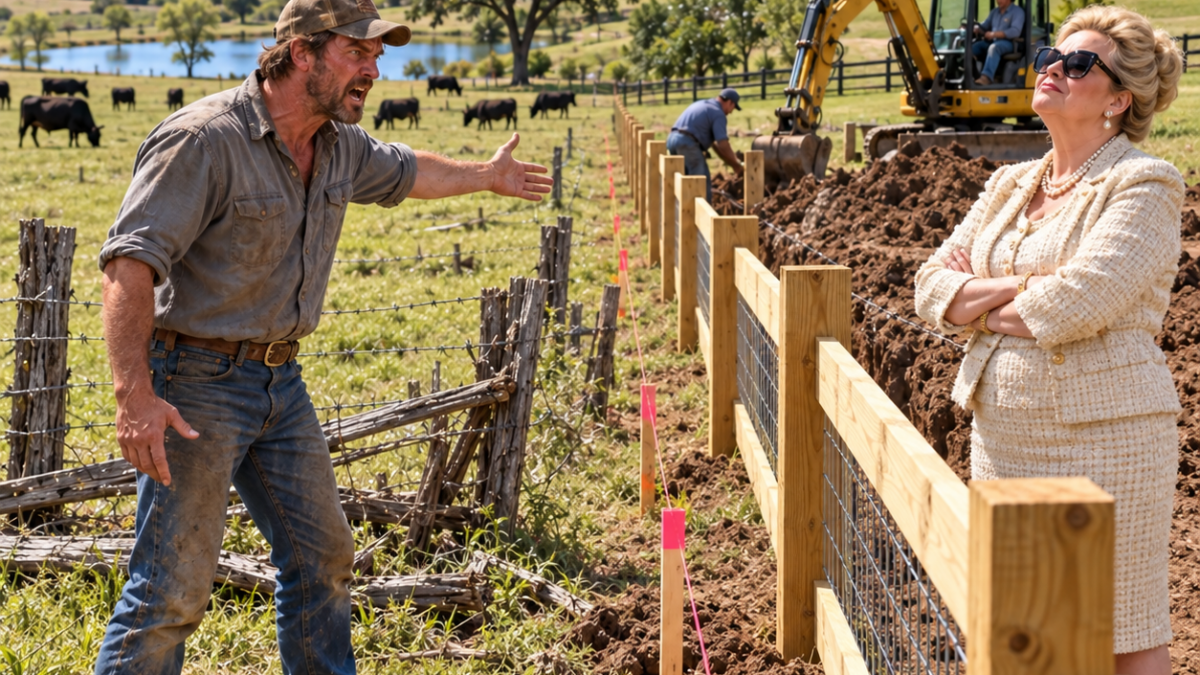
My Neighbor Built a Fence Eighty Feet Into My Pasture Overnight—Then We Dug Where He Begged Us Not To.
I went to bed owning twelve quiet acres and woke up to a brand-new cedar fence running eighty feet inside my pasture.
My neighbor kept pointing at bright orange survey stakes like their color made them legal, but the moment he tried to stop the county from digging near the old oak, I remembered the iron pin my father had shown me years earlier.
By sundown, the fight was no longer about where the boundary was—it was about what Richard Hale had done to make the real one disappear.
“That fence wasn’t there yesterday.”
I said it aloud even though nobody was standing beside me.
I was holding a mug of coffee on my back porch, still wearing the old boots I kept beside the mudroom door, staring across the lower pasture as the sun came up behind the cottonwoods.
For eighteen years, I had looked at that field almost every morning.
I knew its shape.
The shallow drainage ditch.
The old oak leaning slightly east.
The limestone outcrop near the northern end.
The low place where spring water collected after heavy rain.
I knew where my cattle used to push through the grass before I stopped keeping a full herd. I knew where my father had once sunk a tractor to the axle in mud and spent an entire Sunday pretending he had not been warned. I knew where the fence line had been respected by two families long before Richard Hale ever bought the place next door.
I knew that land the way a man knows the inside of his own house in the dark.
Which was why the new fence looked impossible.
Cedar posts.
Fresh wire.
Concrete still pale around the bases.
A straight line running from near the creek toward the northern tree line.
Not along the drainage ditch.
Not near the old oak.
Not even close to the boundary our families had recognized for decades.
Inside my pasture.
I set the coffee down.
Walked off the porch.
The farther I went, the worse it looked.
At the nearest post, someone had tied a strip of orange survey ribbon. Thirty feet farther north stood a bright steel stake with an orange plastic cap. Another beyond that. And another after that.
The new line was so straight it seemed almost arrogant.
My actual boundary had never been straight.
It followed old natural references established when the parcel was surveyed decades earlier.
The ditch.
The oak.
The rock.
This fence simply sliced through everything.
I heard a utility vehicle approaching from the east.
Richard Hale came across his field.
He stopped on the far side of the new fence and killed the engine.
“Morning, Jack.”
I pointed at the posts.
“What is this?”
He barely hesitated.
“Property line.”
“No.”
His expression did not change.
“It is now.”
I stared at him.
Richard and I had been neighbors for eleven years.
Not friends exactly.
Friendly enough.
We borrowed equipment. Helped each other after storms. His wife Karen brought food over when my father died. I helped Richard pull a calf from a ditch back when he still kept cattle. We had argued about runoff once, and about tree limbs another time.
Normal country-neighbor things.
Never anything serious.
That history made the fence more confusing.
“Who surveyed this?”
“Private company.”
“Which company?”
He climbed out of the UTV.
“Doesn’t matter.”
“It matters when their stakes are eighty feet onto my property.”
He gave me the kind of smile people use when they want to appear patient with someone unreasonable.
“Jack, we’ve had the line wrong for years.”
“No, we haven’t.”
“My deed gives me this strip.”
“My deed says the boundary follows the drainage course.”
“Your deed is wrong.”
That sentence irritated me more than the fence.
I stepped closer.
Behind Richard, a compact tractor sat near a stack of unused cedar posts. An auger attachment hung from the three-point hitch.
He was not finished.
“You planning to take this all the way to the road?”
“Yes.”
“Not today.”
His jaw tightened.
“What does that mean?”
PART2:
“It means nobody sets another post until I see the survey.”
“I don’t need your permission to fence my property.”
“You do if you’re fencing mine.”
His face changed.
Just slightly.
The polite part disappeared.
“Jack, there are survey markers right in front of you.”
He pointed.
Bright orange caps.
Clean steel.
Fresh dirt around them.
I looked.
Something about those stakes had bothered me from the moment I saw them.
Now I knew what.
They looked new because they were new.
Boundary monuments on old rural parcels do not usually look like they came off a hardware-store shelf yesterday. The soil around the first one was freshly disturbed. The cap had no visible surveyor identification.
No license number.
No company mark.
Nothing.
“Show me the survey.”
“I already told you. The surveyor will send it.”
“When?”
“Next week.”
“You built the fence before getting the paperwork?”
“I don’t need paperwork to use land I already own.”
I stared at him.
Then another vehicle approached.
His son Tyler.
Early thirties.
Good kid, as far as I knew.
He pulled up carrying additional cedar posts.
That told me Richard wasn’t interested in pausing.
Tyler looked between us.
“Everything okay?”
“No,” I said.
Richard answered at the same time.
“Fine.”
Tyler frowned.
PART3:
I pointed toward the tractor.
“Nobody installs another post.”
Richard stepped forward.
“Don’t interfere with my equipment.”
“Get your equipment off my pasture.”
“My pasture.”
We stood there staring at each other across grass both of us had walked for years.
Then Richard pointed toward the nearest orange stake.
“There is the marker. That’s the line.”
I looked down.
Clean metal.
Bright cap.
Fresh soil.
Then a memory came back.
My father.
Years ago.
Maybe twelve.
We had been replacing a drainage pipe near the ditch. I was digging with a shovel when the blade struck iron.
Clink.
I thought I had hit scrap.
Dad walked over.
Brushed dirt away with his boot.
A rusted rod sat several inches below grade.
He tapped it.
“Don’t ever pull that.”
“What is it?”
“Boundary pin.”
“That ugly thing?”
“That ugly thing tells you where taxes stop.”
He had laughed.
Then covered it again.
I looked toward the ditch now.
That pin wasn’t visible.
It never had been, really.
But I knew roughly where it should be.
Another had existed near the oak.
My father had shown me that one too.
I turned to Richard.
“Where are the old markers?”
Richard shrugged.
“What old markers?”
Too fast.
The answer came too fast.
I started toward the oak.
Richard followed.
“Jack, you’re wasting your time.”
“Maybe.”
The grass near the oak had been cut.
Not mowed.
Cut away in a rough square.
I crouched.
The soil underneath was loose.
Different color.
A shallow depression.
Shovel marks.
Recent.
Richard stopped a few feet behind me.
“Probably an animal.”
I looked over my shoulder.
“Animals using square shovels now?”
He said nothing.
I stood.
“Fence construction stops.”
“You don’t have authority to stop me.”
“No.”
I took a photograph of the disturbed soil.
“But the county does.”
Richard laughed.
“You’re really going to drag the county into a private boundary issue?”
“You put fifty cedar posts across my pasture overnight.”
“Because it’s mine.”
“Then you’ll have no problem proving it.”
I walked back toward the house.
Behind me, Richard called, “Jack.”
I turned.
He looked angry now.
“You don’t need to document everything.”
I held up my phone.
“When somebody moves a property line eighty feet, I do.”
Twenty minutes later, I was driving to the county offices with my deed, survey packet, and photographs on the passenger seat.
My name is Jack Cole.
At the time, I was fifty-nine.
I had owned those twelve acres for eighteen years. Before me, my father had owned them. He bought the property after retiring from a machine shop outside town and used to say land was one of the few things a man could argue about for fifty years and still find sitting exactly where it started.
That morning, I kept thinking about that.
Exactly where it started.
Richard seemed convinced three orange stakes had changed reality.
I remembered my father’s boot touching rusted iron under seven inches of soil.
If that old monument still existed, the land had not moved.
Someone had merely changed what people could see.
The county technician at the records counter was named Aaron Mills.
Mid-forties.
Glasses.
Plaid shirt under a county vest.
He looked almost cheerful until I showed him the first photograph.
He zoomed in on my phone.
“Who set these?”
“My neighbor says a private surveyor.”
“Which one?”
“He wouldn’t tell me.”
Aaron enlarged the cap.
His expression changed.
“No identification.”
“Is that illegal?”
“Not necessarily by itself.”
He handed the phone back.
“But professional monumentation is normally documented. Licensed surveyors don’t usually just hammer anonymous capped stakes into the ground and call it a day.”
I gave him my deed.
He entered the parcel number.
A county map appeared.
My parcel blue.
Richard’s yellow.
Boundary following the drainage course.
Exactly as I remembered.
I pointed.
“His fence is roughly here.”
Aaron leaned closer.
“That’s nowhere near the mapped line.”
“About eighty feet.”
He opened the recorded plat.
Same boundary.
Then another historical record.
Same.
He searched for adjustments.
Boundary-line agreement.
None.
Lot-line revision.
None.
Recorded transfer.
None.
Easement affecting ownership.
None.
He looked at me.
“Nothing here moves the boundary.”
“So he can’t move it by installing stakes.”
Aaron smiled.
“Property lines do not relocate because somebody installs new stakes.”
That was the first good sentence I’d heard all morning.
My phone rang.
Richard.
I answered.
“Where are you?”
“County office.”
Silence.
Then:
“You didn’t need to involve them.”
“You built a fence across my pasture.”
“I told you I had a survey.”
“Then tell me the surveyor.”
Pause.
“Langford.”
Aaron heard.
His eyebrows lifted.
“Langford Surveying?”
I repeated it into the phone.
“Langford Surveying?”
Richard hesitated.
“Yes.”
Aaron slowly shook his head.
I covered the phone.
“What?”
“Langford closed four years ago.”
I stared.
“The owner retired?”
“Robert Langford died two years ago.”
I uncovered the phone.
“Richard.”
“What?”
“Robert Langford has been dead two years.”
Nothing.
“His company closed four years ago.”
Still nothing.
Then Richard hung up.
Aaron leaned back.
“Well.”
“Yeah.”
“Now I’m interested.”
He called the county surveyor.
Her name was Maria Torres.
By noon, Aaron and Maria followed me home.
Richard’s tractor was gone.
The fence remained.
No Richard.
Maria started from the road.
She was in her fifties. Compact. Calm. The kind of person who seemed to move deliberately even when doing nothing more than opening a tripod.
She reviewed the recorded plat.
Checked road references.
Located established monuments on the opposite side.
Ran measurements.
Fifteen minutes later, Richard came out.
Fast.
“What are you doing?”
Maria did not look up.
“Reviewing a reported boundary-monument issue.”
“This is private property.”
“Yes.”
She finally looked at him.
“And we are working from Mr. Cole’s side while reviewing county records.”
Richard pointed toward the orange stakes.
“Those were professionally surveyed.”
“By whom?”
“Langford.”
“Full name.”
“Robert.”
Maria’s face went still.
“Robert Langford died two years ago.”
Richard went pale.
Not dramatically.
Just enough that if you were watching closely, you saw color leave around his mouth.
He recovered.
“The company did the work.”
“Which surveyor?”
“I don’t remember.”
“A licensed survey normally has a responsible surveyor.”
“I’ll get you the paperwork.”
“When?”
“Next week.”
Maria crouched beside the orange stake.
She photographed it.
Measured.
Checked coordinates.
Then stood.
“This point does not correspond with the recorded boundary.”
Richard folded his arms.
“Old maps can be wrong.”
“They can.”
His confidence returned.
Then Maria added, “That’s why original monuments matter.”
I looked toward the ditch.
“The old pins.”
Richard laughed.
“They’re gone.”
Maria turned.
“How do you know?”
He froze.
One second.
Maybe less.
But all three of us noticed.
“I mean, nobody’s seen them in years.”
I walked toward the oak.
Showed Maria the disturbed patch.
She crouched.
Brushed loose dirt aside.
“Recent excavation.”
Richard shook his head.
“You cannot prove anyone dug there.”
Nobody had accused him.
Maria simply took photographs.
Then Aaron called from the ditch.
“Maria.”
He held a handheld metal detector.
The tone sharpened over one patch of compacted ground.
Exactly where I remembered my father standing.
Not where Richard’s orange line was.
Eighty feet east.
Aaron swept again.
Strong signal.
He marked it.
Maria looked toward Richard.
“We need to expose what’s here.”
Richard immediately stepped forward.
“No.”
That word changed everything.
Not “why.”
Not “I object.”
No.
Maria straightened.
“Why not?”
“You are not digging there.”
“We’re on Jack’s parcel according to every document currently available.”
“The detector could be reading anything.”
“Correct.”
“So leave it.”
I looked at him.
“Why?”
He turned toward me.
“You don’t know what’s buried there.”
The sentence escaped before he could stop it.
Silence.
I felt my stomach tighten.
“What exactly do you think is buried there, Richard?”
His face shifted.
“That’s not what I meant.”
Maria took another photograph.
Then called the county office.
While we waited, Richard paced beside his UTV.
Tyler arrived.
“Dad?”
“Go home.”
Tyler looked at Maria’s equipment.
“What’s happening?”
“Nothing.”
“This doesn’t look like nothing.”
Richard pulled him aside.
Their voices dropped.
Tyler looked toward me.
Confused.
Not hostile.
That mattered.
Twenty minutes later, a county maintenance truck arrived with hand tools and a second detector.
Maria explained they would carefully expose the signal without disturbing the object’s position.
Richard began filming.
Maria nodded toward his phone.
“Good. Keep recording.”
He looked surprised.
Aaron removed soil by hand.
Two inches.
Four.
Six.
Metal detector screaming now.
At about seven inches, his trowel struck something.
Clink.
Nobody spoke.
He brushed away dirt.
Rust.
An iron rod.
Vertical.
Maria crouched.
“Do not move it.”
They exposed the top.
A weathered brass cap appeared.
Dark.
Mud packed around the edges.
But readable.
COUNTY SURVEY CONTROL.
I felt something in my chest tighten.
My father’s boot.
Don’t ever pull that.
That’s the corner.
Richard stared.
“That proves nothing.”
Maria looked up.
“It proves a permanent monument exists at a location consistent with the recorded survey.”
“Could’ve been put there later.”
“Possible.”
She stood.
“So we verify.”
Aaron was already walking toward the oak with the detector.
The second signal came almost exactly where I remembered.
Same careful excavation.
Another iron pin.
Seven inches down.
This one had a slab of broken concrete lying over it.
Maria photographed before anyone touched the surrounding soil.
Aaron pointed.
“Look.”
Scrape marks.
Narrow.
Recent.
The dirt immediately beside the monument had been disturbed.
Tyler walked closer.
“Dad.”
Richard snapped, “Stay out of this.”
Tyler looked at him.
“You told me there weren’t old pins.”
Richard’s face hardened.
“We relied on the corrected survey.”
“What survey?”
“Langford.”
Tyler frowned.
Then said, “That’s the map you printed.”
Everything stopped.
Richard turned.
“What?”
Tyler looked suddenly uncertain.
“The map in your office.”
Maria stepped closer.
“What map?”
Richard interrupted.
“Tyler, go home.”
Maria raised a hand.
“Don’t coach him.”
Richard flushed.
“This is ridiculous.”
Tyler looked between us.
“Dad had an old property map on his computer.”
Richard said his son’s name again.
Harder.
Tyler continued.
“He changed some lines because he said the county map was wrong.”
I felt my heartbeat increase.
Not because I knew what it meant yet.
Because Richard looked terrified.
Before anyone could continue, another truck pulled onto my driveway.
Evelyn Marsh.
She owned the property across the road.
Widowed.
Seventy-two.
Tougher than most men I had known.
She got out carrying a cardboard tube.
“I heard county survey was here.”
Richard closed his eyes briefly.
Evelyn walked directly to me.
“Jack.”
“What’ve you got?”
“Your father gave Harold this years ago when they replaced the creek culvert.”
She opened the tube.
Inside was an old survey drawing.
Heavy paper.
Fold lines.
Original signatures.
Measurements.
Handwritten notes.
Maria took it carefully.
Compared the plat number.
Then pointed toward two circles in faded pencil.
“Those reference the iron pins?”
Evelyn nodded.
“Your father and my husband found them together.”
Maria read the note beside them.
Set permanent pins below grade to prevent disturbance by farm machinery.
Below grade.
That explained why they were buried.
They had not vanished.
They had been intentionally protected.
Maria looked toward the exposed pins.
Then toward Richard’s new line.
“The original evidence is becoming very consistent.”
Richard backed toward his UTV.
“I’m calling my attorney.”
Maria nodded.
“That’s your right.”
He opened the rear door.
Aaron looked toward the cargo bed.
Then stopped.
“Maria.”
Inside Richard’s UTV sat a sledgehammer.
A post puller.
And three bright orange capped stakes identical to the ones marking the false boundary.
Tyler stared.
So did I.
Maria quietly photographed everything.
Richard slammed the tailgate.
Too late.
His attorney arrived before lunch.
Paul Mercer.
Mid-sixties.
Gray suit despite the pasture.
The first thing he did was tell Richard, “Stop talking.”
Smartest advice anyone had given him.
Paul reviewed the situation.
County plat.
Pins.
Old survey.
Fence.
Orange stakes.
He walked toward the new line.
“Who installed the fence?”
Richard answered before his attorney could stop him.
“I did.”
Paul closed his eyes.
“Based on what?”
“The corrected boundary.”
“What corrected boundary?”
Richard pointed toward the orange stakes.
“Those.”
Paul looked at Maria.
“Who placed those?”
Maria answered, “That is one of the questions we’re investigating.”
Then Tyler spoke.
Quietly.
“Dad did.”
Richard stared at him.
“What are you talking about?”
“You put them in last weekend.”
“They were reference stakes.”
“You told me they were temporary.”
“Yes.”
Tyler looked at the fence.
“Then why did we build on them?”
Paul stepped between father and son.
“Enough.”
Maria wrote something.
I didn’t need to say a word.
The story was changing on its own.
Then Aaron called from farther north.
“Got another signal.”
The historical records showed three monument points along the old boundary.
Two were verified.
The third should have been near the limestone outcrop.
Richard immediately objected.
“That area is on my side.”
Maria checked.
“According to the recorded plat, it is not.”
We walked north.
Metal detector chirped.
Then screamed.
Aaron marked the strongest point.
The soil there was visibly different.
Loose.
Recently replaced.
Maria photographed.
Aaron began uncovering carefully.
At five inches, metal.
But unlike the first two pins, this one was not upright.
It lay sideways.
Bent.
Two feet from where the historical notes placed it.
Maria’s expression changed.
“That is not natural movement.”
Aaron exposed the cap.
Same series.
Same type.
Original monument.
Richard’s attorney stepped closer.
Nobody spoke.
Tyler whispered, “Dad.”
Richard said nothing.
Paul looked at his client.
“Richard, I need to speak to you privately.”
Before they moved, Evelyn said, “I might have something else.”
She pulled out her phone.
Richard looked at her sharply.
“What?”
“Wildlife camera.”
Evelyn smiled without humor.
“Deer kept eating my garden.”
She scrolled.
Then turned the screen toward Maria.
Three nights earlier.
11:47 p.m.
Headlights.
A utility vehicle stopping near the limestone.
Two people getting out.
Richard.
Tyler.
Tyler holding a flashlight.
Richard carrying something long.
A post puller.
Tyler stared.
“I didn’t know what he was doing.”
Video continued.
Richard disappeared behind the rocks.
Returned carrying an object.
Kneeled near the ground.
Moved again.
Maria watched twice.
“Can you send this file?”
Paul immediately said, “We would like to review it.”
Evelyn looked at him.
“My camera.”
She sent it.
Richard lost control.
“This is insane.”
Nobody answered.
“That boundary has been wrong for decades!”
I looked directly at him.
“Then why didn’t you hire a real surveyor?”
“Because nobody listens unless you force the issue.”
Silence.
Even Paul stopped.
Maria said, “Did you remove that monument?”
Richard’s mouth opened.
Closed.
Then a sheriff’s cruiser turned into my drive.
Deputy Nolan Price got out.
He looked at the county trucks.
Fence.
Survey equipment.
Exposed pins.
Group of people.
“Okay.”
He adjusted his belt.
“Who wants to explain why I’m standing in a pasture?”
Richard immediately pointed at me.
“This is a civil boundary dispute.”
Nolan looked toward Maria.
She shook her head.
“It began that way.”
She pointed to the displaced monument.
“Now we have evidence a recorded survey monument was physically disturbed.”
Nolan did not question Richard first.
Good deputy.
He asked Maria to walk him through everything.
Maps.
New line.
Eighty-foot discrepancy.
Original monument one.
Original monument two.
Third bent and displaced.
Historical survey.
Photos.
Then Evelyn’s wildlife video.
Nolan watched.
Rewound.
Paused when Richard appeared carrying the post puller.
“Date?”
“Three nights ago.”
He looked toward Richard.
Paul stepped forward.
“My client will not be making a statement.”
Nolan nodded.
“Understood.”
Then Tyler raised his hand slightly.
“I will.”
Richard spun.
“No, you won’t.”
Nolan’s expression hardened.
“Mr. Hale.”
Richard stopped.
“Do not tell another adult whether he may speak to me.”
Tyler looked terrified.
But he kept going.
“Dad told me we were fixing the line.”
“What did that mean?” Nolan asked.
“He said the old markers were wrong.”
“Did you see him remove one?”
Tyler swallowed.
“Yes.”
Richard closed his eyes.
“He used the puller near the rocks.”
Tyler pointed.
“I held the flashlight.”
“What happened after he removed it?”
“He carried it over.”
“How far?”
“I don’t know.”
“Then?”
“He put it in the ground sideways and covered it.”
Paul muttered something under his breath.
Nolan wrote.
Then Tyler said, “There was another night.”
Richard’s head snapped up.
“What?”
Tyler looked at me.
“I’m sorry, Jack.”
“For what?”
“Last month.”
My stomach tightened.
“Before the fence?”
He nodded.
“We came out with a metal detector.”
Maria stepped closer.
“You were locating the old monuments?”
“Yes.”
“How many did you find?”
“Two.”
Richard exploded.
“He doesn’t know what he’s talking about.”
Tyler flinched.
Nolan stepped between them.
“Enough.”
Tyler kept going.
“We found two. Dad measured from them.”
“Then what?” Maria asked.
“He said the deed had to be wrong.”
“Why?”
Tyler looked toward Richard’s property.
“Because it put part of the equipment shed on Jack’s side.”
Everything suddenly made sense.
The shed.
Richard had built a large metal equipment building the previous summer.
Concrete slab.
Steel frame.
Enough room for tractors, attachments, feed, tools.
It sat near the disputed boundary.
I had never measured how near.
Maria opened the aerial parcel map.
“Show me.”
I pointed.
She zoomed.
From aerial imagery, the shed looked close.
Very close.
Aaron grabbed equipment.
They pulled measurements from the verified pins.
Ten minutes later, he looked at Maria.
“We have a problem.”
“How much?”
“Need a full survey.”
“Preliminary?”
He looked toward me.
“Concrete pad crosses the line.”
Richard went silent.
“By how much?” I asked.
“Looks like several feet.”
Tyler closed his eyes.
Evelyn said quietly, “That’s why.”
Richard had not discovered an eighty-foot boundary error.
He needed eighty feet to make his building comfortably legal.
Then another pickup arrived.
White.
Survey equipment.
A man stepped out wearing a professional vest.
“Samuel Reed.”
Licensed surveyor.
Paul visibly relaxed.
Finally, he probably thought.
Richard pointed.
“My surveyor.”
Samuel frowned.
“Your what?”
Everyone looked at Richard.
Samuel continued, “Mr. Hale called yesterday asking me to perform a boundary survey. I told him I could start next week.”
Maria pointed toward the orange stakes.
“Did you set those?”
Samuel walked over.
Examined one.
“No.”
“Anyone in your company?”
“Absolutely not.”
Richard looked ill.
Samuel turned.
“You told me there were no existing monuments.”
Maria pointed toward the exposed pins.
“We have three.”
Samuel stared.
Then at Richard.
“You knew these were here?”
No answer.
Nolan closed his notebook.
Silence does not prove everything.
But sometimes it explains enough.
The fence did not follow a professional survey.
The orange stakes were not official monuments.
The man Richard had finally hired was standing there learning the supposed surveyed boundary existed before anyone asked him to survey it.
Samuel pulled out his phone.
Called his office.
“Cancel the Hale job.”
Richard stared.
“You can’t.”
Samuel hung up.
“I can when a client materially misrepresents existing boundary evidence.”
“I hired you to establish the line.”
“You hired me yesterday.”
He pointed toward the cedar fence.
“That was already standing.”
Paul looked at Richard.
“Did you tell me Reed set the stakes?”
Richard said nothing.
Paul’s face changed.
Apparently Richard had lied to his own lawyer too.
Samuel agreed to inspect the exposed monuments as part of the county verification without accepting Richard’s private engagement.
He checked cap identifiers.
Compared Evelyn’s drawing.
Maria called the county records office.
Ten minutes later, her phone rang.
She listened.
Then said, “They found the archived field book.”
Aaron stepped closer.
“What year?”
“1978.”
Scanned pages appeared on Maria’s tablet.
Handwritten bearings.
Distances.
Reference trees.
Creek measurements.
Monument identification numbers.
Maria read the first number.
Samuel crouched at the creek pin.
“Match.”
Second.
“Match.”
Third.
The bent pin.
Samuel wiped dirt from the cap.
“Match.”
Nobody moved.
Then he set up his equipment.
Measured between pins.
Checked bearings.
Distances.
Again.
Then looked toward the bright orange stakes Richard had installed eighty feet inside my pasture.
“The original monumentation fits the recorded survey.”
Richard folded his arms.
“That doesn’t explain my deed.”
Samuel looked at him.
“Let me see it.”
Richard hesitated.
Paul said quietly, “Give him the deed.”
Richard retrieved a folder.
Samuel read.
Then asked for mine.
Compared the legal descriptions.
Walked toward the road.
Back.
Then stopped.
“Here’s your problem.”
Richard frowned.
“What?”
Samuel pointed to a bearing call.
“You read this backward.”
“No.”
“Yes.”
“No, that’s not what—”
“This call runs northeast from the creek monument toward your corner.”
Samuel traced the legal language.
“You interpreted it southwest from the road.”
Aaron checked.
“That would produce something close to the eighty-foot shift.”
“Exactly.”
Richard stared.
For half a second, I could almost imagine this had started as an honest mistake.
Then Maria said, “Except he found the original pins first.”
Everybody looked at Tyler.
Tyler nodded.
Samuel stared at Richard.
“So after the monuments contradicted your interpretation, you removed at least one and created a different line?”
Paul moved immediately.
“Do not answer.”
Richard didn’t have to.
Tyler had already spoken.
Evelyn’s camera existed.
The archived field book existed.
The pins existed.
Facts accumulate quietly.
Then Aaron called from the shed.
“Jack.”
I walked over.
He had stretched a temporary line between the verified monuments.
The fluorescent string ran beneath one corner of Richard’s concrete slab.
Samuel measured.
Nine feet four inches at the widest point.
Nine feet four.
Richard stared at his building.
“My permit was approved.”
Maria answered, “A building permit does not convey ownership of neighboring property.”
He looked at me.
For the first time since the fence appeared, he didn’t look superior.
He looked calculating.
“Jack.”
I waited.
“We can work something out.”
Yesterday my deed had been wrong.
This morning the orange stakes were all the proof he needed.
An hour earlier, he tried to stop the county from uncovering the pins.
Now he wanted compromise.
I looked at the fence.
“The fence comes down.”
Richard shook his head.
“I’m not agreeing to anything yet.”
Nolan looked at him.
“Fence location is a civil matter between you two.”
Then he pointed toward the displaced original monument.
“But that marker is a separate issue.”
Richard’s face tightened.
Nolan closed his notebook.
“I need a formal statement.”
“I have counsel.”
“Your counsel can come.”
Richard did not leave in handcuffs.
That mattered.
I did not want the story turned into something it wasn’t.
He left with Paul in the attorney’s car to answer questions regarding the disturbed monument.
The pasture became quiet.
Tyler stayed.
He looked at the fence.
“I’m sorry.”
“You believed him?”
“At first.”
I nodded.
“He’s your father.”
Tyler kicked at the grass.
“Then he started doing things at night.”
That sentence stayed with me.
Maria and Samuel spent the afternoon documenting every monument.
By four, they had a preliminary reconstructed boundary.
Fluorescent line.
Ditch.
Oak.
Limestone.
Exactly where my family had treated it for decades.
Richard’s cedar fence stood eighty feet west.
On my side.
Samuel pointed toward the shed.
“And that remains your second problem.”
The temporary line disappeared beneath the concrete pad.
I photographed everything.
Around five, Karen Hale walked over.
Richard’s wife.
I had known her years.
She looked exhausted.
“Jack.”
“Karen.”
“Can we talk?”
“Sure.”
Tyler walked away.
Karen stopped near the fence.
“Richard told me you were trying to take our property.”
“I haven’t moved anything.”
“I know.”
She looked toward the exposed pins.
“He said the county map was wrong.”
“He knew those markers were here.”
Her face tightened.
“I found something.”
She handed me an envelope.
Fencing contractor invoice.
Dated two months earlier.
ESTIMATE—RELOCATE EAST BOUNDARY FENCE.
Attached sketch.
The proposed line matched the new orange stakes almost exactly.
At the bottom:
OWNER TO PROVIDE SURVEY CONFIRMATION PRIOR TO INSTALLATION.
Below it, handwritten:
SELF-INSTALL. NO SURVEY NEEDED.
“Richard’s handwriting?”
Karen nodded.
Then she handed me another document.
Property appraisal.
Three months earlier.
Their house.
Land.
Improvements.
Equipment shed listed prominently.
Refinance.
I looked at her.
“He was refinancing?”
“Yes.”
Everything clicked.
If the equipment building crossed onto my land, the appraisal and refinance could become complicated.
Maybe expensive.
Certainly embarrassing.
Eighty feet solved the problem beautifully.
On paper, Richard could redraw enough acreage around the shed to make the building comfortably his.
My phone rang.
Nolan.
“Jack.”
“Yes.”
“Did Richard ever offer to buy land from you near the shed?”
I thought.
Then remembered.
“Last summer.”
Karen stared.
“He did?”
“Yes.”
Nolan asked, “When?”
“Before the slab was poured.”
Karen covered her mouth.
“Do you have messages?”
“Maybe.”
I searched.
There it was.
Eleven months earlier.
RICHARD: Would you consider selling 15–20 ft along our shared line? Planning a building and could use extra setback.
My response:
Not interested. We use that pasture and drainage corridor.
I sent Nolan the screenshot.
He went quiet.
“That helps.”
“Why?”
“Timeline.”
We ended the call.
Karen sat on one of the cedar rails.
“He told me the shed wasn’t anywhere near your property.”
I didn’t know what to say.
Samuel called from the oak.
“Jack.”
He was crouched beside the second monument.
“What?”
“Look.”
In the disturbed soil were small fragments of bright orange plastic.
Same color as Richard’s new marker caps.
Samuel picked one up with gloves.
“It looks like someone attempted to install a new capped stake almost beside the original monument.”
Maria photographed.
“Then moved the claimed line farther west.”
I stared across the pasture.
First locate true pins.
Then test replacement marker near one.
Then create new line eighty feet away.
Then fence quickly.
Step by step.
Not a sudden mistake.
A process.
My phone buzzed.
Nolan:
Do not disturb any fence materials or markers overnight. County investigator will be there at 8 a.m.
Maria read it.
“Good.”
I looked toward Richard’s house.
The argument about whether the old pins existed was over.
Now the question was intent.
I barely slept.
Not because I feared Richard.
Because anger finally arrived in full.
During the day, evidence had kept me focused.
At night, lying in bed, I remembered him standing beside those orange stakes.
Your deed is wrong.
I remembered all the years we had lived beside each other.
The favors.
Storm cleanup.
Shared equipment.
Karen bringing food when Dad died.
Richard had known my father.
He knew how seriously Dad treated the line.
And if Tyler’s statement was true, Richard had found the pins.
Then decided they were inconvenient.
There is something uniquely offensive about a person trying to replace reality with confidence.
Not misunderstanding.
Replacement.
At six, I got up.
Coffee.
Walked outside.
The false fence caught the sunrise.
For one night, it had looked permanent.
That was Richard’s strategy, I realized.
Build first.
Make the physical world support the claim.
Once cedar posts stand, once wire stretches, once people see a line every morning, doubt begins.
Maybe the old boundary was wrong.
Maybe I remembered badly.
Maybe Dad misunderstood.
Maybe county maps weren’t precise.
Confidence plus physical evidence can make lies feel settled.
That was what he was counting on.
At eight exactly, Dana Brooks arrived.
County investigator.
She did not start with Richard.
She started with the ground.
Smart.
Maria walked her through all three original monuments.
Creek.
Oak.
Limestone.
Three matching identifiers.
One bent.
One displaced.
Two surrounded by evidence of recent excavation.
Orange plastic fragments.
Archived 1978 field book.
Evelyn’s historical drawing.
Wildlife video.
Dana photographed everything herself.
Then looked at the false line.
“Eighty feet?”
Samuel nodded.
“Approximately.”
Richard returned at 8:40 with Paul.
He looked tired.
But arrogance had returned.
“Maria.”
She looked at him.
“My attorney says this remains a civil property dispute.”
Dana closed her evidence case.
“The location of your fence may be civil.”
Richard looked satisfied.
Dana continued.
“The possible removal and relocation of recognized survey monuments is not simply a private disagreement.”
Paul touched Richard’s arm.
“Do not respond.”
For once, Richard listened.
Samuel handed Dana the preliminary survey.
She read.
“The shed?”
“Nine feet four inches of slab encroachment at maximum.”
Richard looked at me.
“Jack, I’ll move the fence if we settle the building.”
There it was.
Not apology.
Trade.
I almost laughed.
“You’ll remove a fence you built eighty feet into my land if I sell you the land under your shed?”
“We can create an easement.”
“No.”
“Boundary adjustment.”
“No.”
“Listen to the offer first.”
“No.”
His face flushed.
“You’re going to force me to tear apart a building over nine feet?”
“You built it after asking to buy the strip.”
His face changed.
Karen had walked up behind him.
“What?”
Richard turned.
She carried another folder.
“What are you doing?”
“Ending this.”
She gave the folder to Paul.
He opened it.
Construction drawings.
Permit site plan.
Proposed shed.
Real property line clearly shown.
Six-foot setback.
Samuel looked toward the actual building.
“This isn’t where it was permitted.”
Karen nodded.
“No.”
Richard stepped forward.
“Those are preliminary drawings.”
Karen looked at him.
“You moved the building after permit.”
Silence.
She pointed toward the shed.
“He wanted more clearance between the building and our driveway.”
I stared.
“So he shifted it toward my property.”
Karen nodded.
“I told him to check the boundary.”
Richard’s face was white.
“He said Jack would never notice a few feet.”
Nobody spoke.
Paul closed the folder.
“Karen, you should consider separate legal counsel before making additional statements.”
She looked at him.
“I didn’t move anything.”
That ended his warning.
Dana requested copies.
Karen agreed.
Then county building inspector Mike Saunders arrived.
He compared approved site drawings to the actual building.
Measured.
Checked again.
Then attached a notice.
SITE LOCATION UNDER REVIEW.
NO FURTHER WORK / OCCUPANCY MODIFICATION PENDING REVIEW.
Richard finally lost control.
“This is my building!”
Mike remained calm.
“Part of the slab appears inconsistent with your approved plan and may extend beyond your parcel.”
“You approved the permit.”
“We approved the plan.”
Richard pointed at the shed.
“That’s the building.”
“No.”
Mike pointed to the paper.
“That is the approved building location.”
Richard looked at me.
“This is what you wanted.”
“No.”
I pointed toward the old pins.
“I wanted you to leave the boundary where it was.”
Then Tyler appeared carrying a cardboard box.
“Dad.”
Richard turned.
Tyler set the box on the grass.
Inside:
Orange caps.
Steel stakes.
Marking paint.
Old metal detector.
Richard’s shoulders dropped.
Dana crouched.
“May I photograph these?”
Tyler nodded.
Then pulled out a folded county parcel map.
A red line had been drawn across it.
Eighty feet inside my property.
Beside the line, in handwriting I recognized from Christmas cards Richard had once sent:
MOVE FENCE BEFORE APPRAISAL.
Karen covered her mouth.
Paul stared at his client.
Dana photographed.
Richard stopped arguing.
No explanation.
No claim of survey error.
No speech.
He simply looked toward the cedar fence.
By noon, Paul walked toward me alone.
“Mr. Cole.”
“Yes.”
“Richard will remove the fence.”
“All of it?”
“All.”
“And the orange stakes?”
“Under county supervision.”
“And the shed?”
He looked toward the notice.
“That will require separate resolution.”
“Fine.”
Behind him, Tyler had already begun removing wire.
Richard had spent two days insisting the new stakes settled everything.
Now the false line was coming apart one strand at a time.
The original iron pins stayed exactly where surveyors had placed them nearly fifty years earlier.
Underground.
Rusty.
Quiet.
Correct.
By Friday, every cedar post had been removed from my pasture.
Not shifted.
Removed.
Holes remained.
Circular patches of raw earth.
Wire rolls disappeared.
Orange stakes were cataloged and removed under county oversight.
Maria installed witness references so the original monuments could be located without excavation in the future.
Small markers.
Coordinates recorded.
No ambiguity.
I stood beside the creek while she finished.
“Your father remembered correctly.”
I looked toward the iron pin.
“He usually did.”
She smiled.
“Most landowners don’t know where their monuments are.”
“I didn’t know exactly.”
“You knew enough.”
That sentence stayed with me.
Sometimes enough is all you need to ask the next question.
The shed took longer.
A full licensed boundary survey confirmed Samuel’s preliminary work.
Nine feet four inches of Richard’s concrete slab sat on my parcel at the widest point. A corner of the metal structure itself also crossed.
Richard offered to buy the strip.
Through lawyers this time.
First offer reasonable.
Second higher.
Third surprisingly high.
I declined all three.
People later asked why.
Spite?
Maybe there was some.
I won’t pretend I was emotionally neutral.
But the real reason was drainage.
The disputed strip followed the natural low area carrying water across the pasture. Dad had protected it. I used it. Moving the boundary would complicate future drainage rights.
And more importantly, I did not want a fraudulent encroachment transformed into legitimate ownership simply because Richard finally offered enough money.
If he had approached me before building?
Maybe.
He had.
I said no.
Then he built anyway.
That mattered.
The county required him to correct the encroachment before finalizing the shed’s compliance.
Two months later, concrete saws arrived.
Miguel Ortega from the farm down the road called.
“You watching?”
“From the porch.”
“Good.”
Workers cut the slab.
Steel sparks.
Concrete dust.
Section by section, the part crossing my land came out.
The shed corner was modified.
It wasn’t dramatic.
Richard didn’t stand outside screaming.
No deputies.
No news.
Just construction correcting what should have been correct from the beginning.
Measurements finally respected.
Richard barely spoke to me after that.
Tyler did.
One afternoon, he stopped near my mailbox.
“I moved out.”
I wasn’t surprised.
“Your dad okay?”
“He’ll be okay.”
Tyler stared toward the pasture.
“I’m sorry.”
“You’ve said that.”
“I know.”
He swallowed.
“I should’ve asked questions sooner.”
I looked toward the ditch.
“We trust family longer than strangers.”
“Yeah.”
“Sometimes too long.”
He nodded.
“Dad always sounded certain.”
That sentence explained a lot.
Confidence can become evidence in families.
Children grow up believing certainty means knowledge.
Sometimes it does.
Sometimes certainty is only volume.
“You eventually told the truth.”
“After helping him.”
“Yes.”
He looked ashamed.
I continued.
“That doesn’t erase the first part.”
“I know.”
“But it matters.”
He nodded.
Then left.
Karen sent a handwritten note a few weeks later.
Three pages.
No excuses.
She apologized for believing Richard’s version.
For not checking.
For letting the dispute grow.
She explained he had become obsessed with the refinance.
The appraisal.
The shed.
He believed acknowledging the encroachment would destroy the financing package.
Then he convinced himself the deed could be interpreted differently.
From there, he began treating every contradictory fact as an obstacle instead of evidence.
That was the phrase she used.
Obstacle instead of evidence.
I kept the letter.
Not because I needed Karen to apologize.
Because it reminded me Richard’s choices had damaged both sides of the line.
Marriage.
Father and son.
Neighbors.
Trust.
Property disputes look like dirt on maps.
The real cost is usually human.
The county investigation eventually closed.
I was never given every detail.
I didn’t ask.
There were administrative consequences concerning the disturbed monuments and building compliance. Lawyers handled whatever remained.
I did not need Richard marched past my house in handcuffs to feel the outcome was real.
What mattered to me was permanent.
Original monuments verified.
Boundary recorded.
False markers documented.
Fence gone.
Shed corrected.
My pasture remained my pasture.
That fall, I repaired the ground.
Filled post holes.
Regraded disturbed patches.
Reseeded.
Cleaned the drainage edge.
By spring, most signs disappeared.
Grass doesn’t care about legal drama.
Give it rain and time and it covers almost everything.
Evelyn came over one morning.
She pointed toward the witness marker.
“Funny.”
“What?”
“Something that little caused all that.”
I shook my head.
“The pin didn’t cause anything.”
She smiled.
“Fair.”
Richard had treated the line like a problem he could redesign.
That was the cause.
The more I thought about his behavior, the more the sequence bothered me.
He asked to buy land.
I refused.
He built close to the boundary.
Actually over it.
Then found the original monuments.
They contradicted what he needed.
So he reinterpreted his deed.
The deed did not support him when read correctly.
Then one monument moved.
Orange stakes appeared.
A fence followed.
By the time I woke up, he wanted the physical world to look settled.
If I had doubted myself for one week, what then?
Maybe he would have finished to the road.
Maybe applied for appraisal using the new fence.
Maybe shown lenders the visible “boundary.”
Maybe hired a surveyor after the fact and pressured him with manufactured facts.
Samuel Reed’s reaction told me something important.
Professionals rely on client information at first.
If Richard had successfully hidden the original pins and presented a fence already standing, even a careful surveyor would need time to reconstruct everything.
Richard was not trying to change the law.
He was trying to change the starting point of everybody’s investigation.
That was clever.
And dangerous.
My father had accidentally protected me decades before.
Not by fighting Richard.
By showing me one rusty pin.
Don’t ever pull that.
That’s the corner.
That memory was enough.
After Dad died, I sometimes worried about how much small knowledge disappears when a parent goes.
Which shutoff controls which line.
Where the septic cleanout is.
Which tree marks the old drainage tile.
Who installed the barn wiring.
Where the boundary pins are.
Things never written because everyone assumes they’ll remember.
Then one day the person who remembers isn’t there.
The knowledge becomes fragile.
I got lucky.
Dad’s voice came back at exactly the right time.
Months after the dispute, I went through every property document I owned.
Scanned everything.
Survey.
Deed.
Old tax map.
Evelyn’s copy.
New certified boundary survey.
Photographs of each monument.
GPS references.
Witness markers.
I put originals in a fire safe.
Digital copies in two places.
Then I walked the line with my daughter, Rachel.
She lived two hours away and had no interest in farming.
That did not matter.
We started at the creek.
I showed her the witness marker.
“The real pin is below grade.”
She nodded.
Then the oak.
Then limestone.
She looked at me.
“Dad, are you expecting another land war?”
“No.”
“Then why do I need this?”
I smiled.
“Because someday someone might tell you I’m wrong.”
She rolled her eyes.
“That’s extremely specific.”
“So was the last problem.”
She took photographs.
Saved coordinates.
At the limestone outcrop, she looked toward Richard’s corrected shed.
“Did he really move one of these?”
“Yes.”
“That’s insane.”
“Yes.”
“Why didn’t he just move the shed?”
“Moving concrete feels expensive before you calculate the price of fraud.”
She looked at me.
“That’s annoyingly quotable.”
“Thank you.”
“Not a compliment.”
We walked back.
For the first time, I understood why Dad had shown me the pin.
It wasn’t only about his land.
It was transfer.
Memory.
He expected the boundary to outlive him.
He wanted somebody else to know.
Richard and I continued being neighbors.
Technically.
We stopped borrowing equipment.
Stopped talking across fields.
If we passed on the road, maybe a nod.
Maybe nothing.
At first, I hated that.
Eleven years of ordinary neighborliness erased.
Then I realized something.
The relationship had already been damaged before I woke up to the fence.
I just didn’t know.
By the time Richard hammered the first false stake, he had already made several decisions about me.
That I wouldn’t notice.
That I wouldn’t remember.
That I wouldn’t check.
That the refinance mattered more than our history.
That confidence could make me surrender.
The fence only made those decisions visible.
A year later, a storm dropped a cottonwood limb across the road between our properties.
Old habit took over.
I grabbed my chainsaw.
Richard came with his tractor.
We worked from opposite sides.
No conversation beyond what was necessary.
“Lift.”
“Hold.”
“Clear.”
Twenty minutes.
Road open.
As we finished, Richard shut off the tractor.
“Jack.”
I looked over.
“Yeah?”
He seemed like he wanted to say something.
Then:
“Your dad really showed you those pins?”
“Yes.”
“When?”
“Years ago.”
He nodded.
“I didn’t know.”
I waited.
That was all.
He started the tractor.
Drove home.
Maybe it was the closest he could come to saying:
I underestimated what you knew.
Not apology.
But something.
People asked whether I hated him.
No.
Hate takes maintenance.
I had fences to repair.
Grass to cut.
Family.
Work.
A creek that flooded whenever rain fell hard enough.
I didn’t want Richard occupying that much space in my head.
But trust never returned.
That was permanent.
Property can be restored more easily than trust.
The false fence vanished by spring.
Our relationship did not.
One afternoon, Samuel Reed stopped by.
He had completed another survey nearby.
Saw me outside.
“Boundary still behaving?”
“Hasn’t moved.”
“Good.”
I laughed.
He leaned against his truck.
“You know your case is being discussed at survey meetings.”
“That sounds embarrassing.”
“Not you.”
“The fake stakes?”
“The whole sequence.”
“What lesson?”
“Never assume visible occupation equals legal boundary.”
I looked at the pasture.
“Meaning fence.”
“Fence. Hedge. Road. Shed. Whatever.”
He continued.
“And never assume missing monuments are gone.”
“Buried seven inches.”
“Exactly.”
He smiled.
“Old surveyors did things like that intentionally.”
“Dad said farm equipment.”
“Smart.”
“He was.”
Samuel became serious.
“What Richard did was unusual.”
“I know.”
“But the ordinary version happens all the time.”
“What version?”
“People misunderstand deeds. Build where they shouldn’t. Treat a fence as proof because it has existed twenty years.”
“Then what?”
“Sometimes everyone agrees. Sometimes title gets complicated. Sometimes someone sells and the next owner discovers it.”
He pointed toward my witness marker.
“Documentation now saves your kids trouble later.”
That reinforced what I had already started doing.
I had the final survey recorded wherever appropriate.
Copies with title records.
My attorney reviewed the legal description.
No ambiguity.
I was done relying on memory alone.
Still, memory had saved me.
There is something satisfying about that.
Two years later, Rachel brought my grandson out.
He was nine.
We walked the pasture.
At the creek, he pointed to the little witness marker.
“What’s that?”
I looked at Rachel.
She smiled.
“Tell him.”
I crouched.
“There’s an iron pin underground.”
“Why?”
“It marks where our land stops.”
“Can I dig it up?”
“No.”
He frowned.
“Why not?”
I heard Dad.
Don’t ever pull that.
That’s the corner.
I said the same words.
My grandson looked unimpressed.
“That’s boring.”
“It gets interesting if somebody moves it.”
Rachel laughed.
“Do not tell him the whole story.”
Too late.
By lunch he wanted metal detectors.
Generational knowledge transferred.
Hopefully with less drama.
The strangest part of the entire experience was how ordinary the land remained.
The grass never knew there were lawyers.
The ditch never recognized Richard’s orange line.
Rain continued following gravity.
The oak kept growing where it had grown for decades.
The limestone outcrop did not move.
People can create enormously complicated stories above ground.
Ownership.
Appraisal.
Permit.
Refinance.
Fence.
Survey.
Below ground, the iron pin stayed simple.
Here.
Not there.
That simplicity is why the moment Aaron’s trowel hit metal stays with me.
Clink.
One sound.
Richard had arguments.
We had a pin.
Then another.
Then another.
Every one matched the archived field book.
Every measurement repeated.
There is a kind of relief in physical truth.
Not because evidence solves everything instantly.
But because it narrows the space where lies can survive.
After the dispute, people around town heard versions.
Small towns do that.
One version said Richard tried stealing eighty feet.
Another said he moved official county markers with a tractor.
Another had him arrested in my pasture, which never happened.
I corrected people when it mattered.
“He didn’t leave in cuffs.”
“County investigated.”
“The actual fence was eighty feet off.”
“Yes, the shed encroached.”
“No, I didn’t take his shed.”
“No, I didn’t get his land.”
Facts.
The real story was dramatic enough.
I did not need mythology.
Richard himself became quieter around town.
His refinance went through eventually after the property issues were corrected.
The shed remained, modified.
Life went on.
Karen stayed for a while.
Then I heard she and Richard separated.
I don’t know if the boundary dispute caused it.
Probably not alone.
Marriages rarely collapse because of one thing.
Tyler moved farther away.
He still sends Christmas cards.
That surprised me.
The first one contained only:
Hope you’re doing well. Still sorry. —Tyler.
I sent one back.
No lecture.
He had already learned enough.
Three years after the fence, I replaced the old drainage culvert.
The same place where Dad had shown me the first pin.
I hired a contractor.
Before digging, I walked him to the witness marker.
“Original monument below grade.”
He nodded.
“We’ll stay clear.”
“How clear?”
“Ten feet.”
“Good.”
He laughed.
“You’re that guy.”
“What guy?”
“The boundary guy.”
Apparently my reputation had spread.
“I hate this town.”
“No you don’t.”
He was right.
During excavation, I stood nearby.
Not because I distrusted him.
Because now I knew how easily one careless bucket could disturb something future generations might need.
The contractor finished.
No issue.
Before covering the area, I photographed the monument reference again.
When I got home, I uploaded it.
Rachel texted:
Are you seriously sending me boundary pin updates now?
I replied:
Yes.
Her answer:
Grandpa created a monster.
Maybe.
Dad would have enjoyed the entire affair, I think.
Not the conflict.
He hated lawyers.
But he would have liked being right.
Especially posthumously.
I could picture him at the oak.
Boot on iron.
Telling Richard:
Son, land does not care what you printed on your computer.
He would have said it more colorfully.
One evening, years later, I stood beside the original line with Evelyn.
She had finally removed the wildlife camera.
“Deer figured it out?”
“No. I surrendered.”
We looked toward the pasture.
She said, “You know what still bothers me?”
“What?”
“If my camera hadn’t caught him.”
I thought.
“Tyler still talked.”
“Eventually.”
“Pins still existed.”
“One was moved.”
“Field book.”
She nodded.
“True.”
“But your video helped.”
“Good.”
She looked at me.
“I nearly deleted those files.”
“Why?”
“Camera sends me too many raccoons.”
I laughed.
She continued.
“Funny, isn’t it?”
“What?”
“People think evidence arrives dramatically.”
“Usually it’s a raccoon camera.”
She smiled.
“Exactly.”
Evidence often exists because someone happened to save something.
An old drawing in a cardboard tube.
A message from eleven months earlier.
A contractor estimate in a drawer.
A camera meant for deer.
A father’s memory.
A county field book nobody had opened in years.
Richard tried creating a new story quickly.
Truth had been collecting for decades.
He never had a chance once people started looking.
That may be the lesson I carried longest.
False certainty needs speed.
It needs you to react before checking.
Believe the stake.
Believe the fence.
Believe the confident neighbor.
Believe the paperwork he says is coming next week.
Truth is slower.
Go to records.
Find the plat.
Locate monuments.
Read the deed carefully.
Talk to the old neighbor.
Look at photographs.
Measure.
Then measure again.
Richard wanted his physical line finished before that process could catch up.
For one night, he succeeded.
The fence stood.
The pasture looked divided.
If someone had driven past, they would have assumed the cedar posts marked ownership.
That’s what fences do psychologically.
They tell the eye:
This side mine.
That side yours.
But fences are only as honest as the person who puts them there.
The law does not emerge from cedar.
Neither does history.
Sometimes the most important boundary marker is underground where nobody can see it.
That irony never left me.
Richard moved the things everybody could see.
The original evidence stayed hidden.
Truth did not need to advertise itself.
After everything ended, I once asked Maria why the county had buried those monuments originally.
She corrected me.
“The county didn’t necessarily choose all of those placements. Surveyors working rural parcels often set protected monuments below grade where farm equipment could otherwise hit them.”
“So hiding them made them safer.”
“Yes.”
I laughed.
“What?”
“Nothing.”
It felt almost poetic.
The truth survived because it was buried.
I started calling the pasture Twelve Acres again.
During the fight, it had become “the disputed strip.”
“Richard’s fence.”
“the east boundary.”
Legal language can colonize land too.
Once the grass returned, I wanted ordinary names back.
The lower pasture.
The ditch.
The oak.
The rocks.
Places.
Not exhibits.
One autumn morning, I repaired wire on the south side.
My grandson followed.
He pointed toward Richard’s property.
“Is that the man who moved the pins?”
I looked at him.
“Your mother told you?”
“She said not to ask.”
“Excellent obedience.”
He grinned.
“Did he steal your land?”
“No.”
“But he tried?”
I considered.
“Yes.”
“How?”
“He wanted everyone to believe the line was somewhere else.”
“Why?”
“Because he built something too close.”
My grandson thought.
“That’s dumb.”
“Yes.”
“Why didn’t he move his building?”
“Because moving other people’s boundaries felt cheaper.”
He frowned.
“But it wasn’t.”
“No.”
He looked satisfied.
Children appreciate clean endings.
Adults know they are rarely clean.
I had my land.
Richard had consequences.
But nothing returned completely to before.
That is how boundaries work after violation.
Even when repaired, everyone remembers the crossing.
The small witness markers Maria installed are still there.
I barely notice them now.
Sometimes sunlight catches one.
Small metal post.
Number.
Nothing dramatic.
But when I see it, I remember that first morning.
Coffee.
Cedar fence.
Orange ribbon.
Richard across from me saying:
Property line.
As if saying it made it true.
I remember how close I came to doubting my own knowledge.
What if I had not remembered Dad?
What if I had let Richard finish?
What if I waited until “next week’s survey”?
What if I assumed the bright orange caps meant professionals had been there?
That last question matters.
Authority has a look.
Orange survey cap.
Security uniform.
Official letterhead.
Hard hat.
Clipboard.
People rely on symbols because most of the time the symbols are legitimate.
Richard understood that.
He used the appearance of surveying to manufacture certainty.
That was what made the orange stakes powerful.
Not metal.
Expectation.
The moment Aaron said they had no professional identification, that spell broke.
Questions entered.
Then records.
Then facts.
I kept one of the cedar post holes unfilled longer than the others.
Not intentionally.
I simply missed it.
For months, rain collected there.
Eventually grass grew around the edge.
One day I filled it.
That was probably the final physical trace of Richard’s false fence.
Afterward, nothing remained.
Except records.
And memory.
My attorney once suggested installing a permanent fence on the true boundary.
I considered it.
Then said no.
“Why not?”
“Don’t need one.”
“After all this?”
“Especially after all this.”
The monuments were verified.
Witness markers installed.
Survey recorded.
Everyone knew.
A fence would make it feel like I needed to defend the line physically from Richard every morning.
I didn’t.
The line existed whether he respected it or not.
That knowledge was enough.
I still walk the ditch every spring.
Check erosion.
Clear branches.
Sometimes I stop near the oak.
The original pin sits underground.
I don’t uncover it.
No need.
I know where it is.
Richard knows too.
One morning he was outside when I stopped there.
We looked at each other across the correct boundary.
No fence.
Just grass.
He lifted one hand.
I did the same.
Then continued walking.
Maybe that is what peace looks like after trust is gone.
Not forgiveness.
Not friendship.
Accuracy.
You stay on your side.
I stay on mine.
The creek keeps moving.
Years later, if someone asked me what actually defeated Richard’s plan, I wouldn’t say the sheriff.
Or county.
Or Tyler.
Or Evelyn’s camera.
Not even the original iron pins.
Those all mattered.
But the decisive thing happened earlier.
I asked him to show me the survey.
He couldn’t.
Everything after that came from refusing to accept confidence as proof.
People sometimes think standing your ground means being loud.
It doesn’t.
I never had to outshout Richard.
He was better at anger anyway.
I needed to ask simple questions.
Who surveyed this?
Where is the document?
Why are the new stakes unmarked?
Where are the old monuments?
Why was this soil disturbed?
Why don’t you want us digging here?
Why did you ask to buy land before constructing the shed?
Why does your own permit drawing show the true line?
Question by question, the false boundary collapsed.
The original pins had been underground nearly fifty years.
Seven inches of soil.
Dark brass.
Rust.
They did not need to move.
They did not need orange flags.
They did not need Richard’s permission.
They waited.
The county found them.
Measurements matched.
And the eighty feet Richard tried to take returned to being what it had always been.
Mine.
The spring after the grass fully recovered, I stood at the creek with Rachel.
She looked over the pasture.
“Can’t even tell where his fence was.”
“No.”
“Does that bother you?”
“What?”
“That there’s no mark.”
I thought about it.
“No.”
“Why?”
“Because the point wasn’t to leave a scar.”
She nodded.
I looked toward the oak.
“The point was to put things back where they belonged.”
That included more than land.
The fence gone.
The shed corrected.
The survey recorded.
The relationship with Tyler repaired as much as possible.
Karen out of the conflict.
Richard stripped of the story he invented.
Everything back in its proper place.
Not perfect.
Proper.
There is a difference.
Rachel slipped her hands into her jacket pockets.
“Grandpa would’ve loved being right.”
I laughed.
“More than anything.”
We started walking toward the house.
Behind us, the drainage ditch followed the same shallow path it had before Richard ever bought his place.
The witness marker stood near the creek.
The iron pin slept beneath it.
No orange ribbon.
No new fence.
No argument.
Just the boundary.
Where it had always been.
And that was the part Richard never understood.
You can move a stake.
You can move a fence.
You can move dirt.
You can even pull an iron pin from the ground and bury it somewhere else.
But if the deeds, measurements, field books, neighboring surveys, photographs, witnesses, and remaining monuments all point back to the same place, you haven’t moved the boundary.
You have only proved how far you were willing to go to deny it.