My Neighbor Built 11 Feet Into My Lakefront and Told Me to Sue Him—31 Days Later, Federal Inspectors Showed Up With Two Cranes, and He Finally Realized What His “Luxury Boathouse” Was About to Cost Him.
PART2:
Every summer, we worked on something.
Paint.
Roof.
Windows.
Dock.
Garden.
There was always another project.
I never minded.
The work became part of the life.
Then Carol got sick.
Cancer.
I will not pretend there was anything beautiful about that period.
There was not.
It was appointments.
Medications.
Long drives.
Waiting rooms.
Good news followed by worse news.
Hope followed by fear.
Then hope again.
She fought for years.
Five years before the boathouse incident, she died.
After that, the cabin changed.
Nothing physically changed.
That was the strange part.
Her chair was still on the porch.
Her coffee mug stayed in the cupboard for months because I could not bring myself to move it.
Her gardening gloves remained in a drawer beside seed packets she had labeled in her careful handwriting.
The wind still came through the pines.
Loons still called across the water before sunrise.
The dock still creaked under my boots.
But the entire place felt different because every room held memories that no longer had another person attached to them.
People asked whether I planned to sell.
I always said no.
Selling would have felt like losing her twice.
So I stayed.
My daughter, Emily, lived about two hours away.
She called every Thursday.
Visited when she could.
Worried about me more than necessary.
I spent my days fishing, fixing things that did not really need fixing, reading newspapers on the porch, and helping neighbors whenever somebody needed a second pair of hands.
I had no interest in conflict.
Then Derek Lawson bought the Miller place.
The Miller cabin sat directly south of mine, around the curve of the cove. For decades, it belonged to a retired school principal named Warren Miller and his sister Ruth. They kept a blue rowboat upside down near shore, planted marigolds in old coffee cans, and never once started a motor before eight in the morning.
After Ruth died, Warren held on for three more summers.
Then his knees failed.
His son sold the property before the first snow.
I heard the sale price from a neighbor and nearly dropped my coffee.
One point eight million dollars.
For the Miller place.
A two-bedroom cabin with a sagging porch and a septic system old enough to vote.
That was when I knew Pine Hollow had changed for good.
Derek Lawson arrived in May.
Not quietly.
Three trucks.
Two trailers.
A black Range Rover.
A white pickup with a contractor logo.
A woman in sunglasses who I later learned was his wife, Meredith.
And Derek himself, wearing a quilted vest over a golf shirt, boat shoes that had never been near an actual boat, and a smile that said the world generally moved aside when he approached it.
He was in his early forties, broad-faced, tanned, confident, and loud in the way men become when they have never had to wonder whether the room was listening.
He came over the first afternoon.
I was replacing a loose board on my dock.
“Raymond Ellis?”
I looked up.
“Depends who’s asking.”
He laughed like that was charming.
“Derek Lawson. Bought the Miller property.”
“I heard.”
“Beautiful spot.”
“It was.”
He missed the edge in my voice or chose to step over it.
“My wife and I are going to bring some life back to it. Full rebuild. Modern lake home. Guest house. Boat storage. Proper shoreline.”
“Proper shoreline?”
“You know what I mean. Clean it up. Make it usable.”
I looked toward the old Miller cabin, which had stood through storms, winters, mosquitoes, family cookouts, and sixty years of quiet weekends.
“It was usable.”
Derek smiled.
“Sure. In a rustic way.”
That was the first warning.
People who say rustic that way usually mean poor.
He stepped onto my dock without asking.
I noticed.
Old habits.
“Wanted to introduce myself,” he said. “We’ll have crews around. Surveyors. Equipment. Nothing too disruptive.”
“Good.”
“We’re also getting involved with the Pine Hollow Shores Association.”
“There isn’t one.”
“There will be.”
I set down the hammer.
He kept smiling.
“A few of the newer owners have been talking. This lake needs standards. Wake control, dock consistency, shoreline management, rentals, that kind of thing.”
“This lake has managed itself for a long time.”
“That’s exactly the problem.”
I stood slowly.
I was not as tall as I used to be, or maybe age had made everyone else look taller. But I was still six feet, and Derek finally noticed I was not impressed.
“My property is not joining any association,” I said.
He lifted both hands.
“Nobody is forcing anything.”
That was the second warning.
People who say nobody is forcing anything are usually building the mechanism.
The third warning came two weeks later when a survey crew appeared along the boundary between our lots.
I was trimming deadfall near the shore when I saw three men in orange vests moving through the brush with equipment.
I walked over.
“Morning.”
The youngest one looked startled.
The older surveyor nodded.
“Morning.”
“You with Derek?”
“Lawson Development hired us.”
“Development?”
“That’s the billing name.”
He tried to place a stake near the waterline, several feet north of where I knew the boundary ran.
I said, “That’s wrong.”
He looked at me politely.
“We’re working from county GIS and the preliminary site plan.”
“Then your plan is wrong.”
The surveyor gave me the tired look professionals give old men who believe memory outranks instruments.
I knew that look.
I had worn it myself.
So I went to my cabin, pulled out the certified boundary survey Carol and I had ordered fifteen years earlier after a dock dispute on the north side, and brought it back in a plastic sleeve.
The surveyor read it.
Then his expression changed.
He looked at the map.
Then at his instrument.
Then toward Derek’s property.
“Do you mind if I take a photo of this?”
“No.”
He photographed it.
The next morning, the survey crew was gone.
The stakes remained.
Three days later, a different crew arrived.
That was when I understood Derek did not want the correct line.
He wanted a line that helped him build.
By early June, demolition began.
The Miller cabin came down in two days.
I watched from my porch while an excavator tore through the front wall, and I thought of Warren Miller showing Carol how to smoke lake trout behind that same cabin in 1998.
Progress, people call it.
A useful word when nobody wants to say erasure.
By July, Derek had permits posted on a board near the road.
New residence.
Garage.
Guest suite.
Shoreline stabilization.
Accessory structure.
Boathouse repair.
That last one bothered me.
The Miller place had never had a boathouse.
It had a crooked dock and a blue rowboat.
Repairing a structure that never existed is a neat trick.
I called the county zoning office.
A woman named Paula answered.
I asked about the boathouse permit.
She put me on hold.
For eighteen minutes.
When she came back, she said, “The permit is for replacement and modernization of existing lake-access structure.”
“There was no boathouse.”
“The applicant submitted documentation.”
“What documentation?”
“Photographs and a contractor statement.”
“Of what?”
“A historic boat shelter.”
“There was a rowboat upside down on shore.”
She paused.
“Mr. Ellis, if you want to challenge a permit, you’ll need to submit written objection.”
“I’m telling you the application is false.”
“I understand your concern.”
That phrase.
I understand your concern.
It is the bureaucratic equivalent of patting a dog while closing the door.
I submitted the objection.
Certified mail.
With photographs.
I had decades of them.
Carol and I had taken pictures every summer from the same angle on the porch. The Miller shoreline appeared in the background of at least thirty of them.
No boathouse.
No covered slip.
No permanent structure.
Nothing.
I sent those too.
No response.
Meanwhile, construction intensified.
The new house rose fast.
Glass.
Stone.
Steel.
A roofline sharp enough to slice fog.
Derek’s crews worked long hours and weekends. Trucks tore up the road. Music played from job-site speakers. Portable lights shone across the cove after dark.
The older residents complained.
The newer ones praised the investment.
That was when Pine Hollow Shores Association was born.
It began with an email.
Dear Lake Neighbor,
As Pine Hollow continues evolving into one of northern Wisconsin’s premier private lake communities, several owners have formed the Pine Hollow Shores Association to preserve property values, promote responsible recreation, and establish common standards.
I read that sentence twice.
Private lake community.
Pine Hollow Lake had public boat access at the north end and old cabins older than half the people now calling it premier.
But Derek and his friends were not interested in what Pine Hollow had been.
They were interested in what it could become if everyone inconvenient left or obeyed.
The email invited owners to an informational meeting at Derek’s rented event tent.
I did not attend.
Then the letters came anyway.
Voluntary membership request.
Suggested dock standards.
Recommended shoreline appearance guidelines.
Community boating conduct.
Architectural harmony.
I ignored them until I received a “notice of nonalignment” because my dock lacked approved side lighting and my shoreline contained “unmanaged natural debris.”
Unmanaged natural debris meant fallen cedar branches where frogs lived.
I called the number on the letter.
A woman answered.
“Pine Hollow Shores Association office.”
“Office?”
“Yes, sir.”
“Where is this office?”
“Currently virtual.”
“That sounds about right.”
She asked for my name.
I gave it.
There was a pause.
“Oh. Mr. Ellis. Mr. Lawson has asked that all communication from you go through written channels.”
“Mr. Lawson doesn’t get to decide how I communicate about letters he sends to my property.”
“I understand your concern.”
There it was again.
I hung up.
The pile driver arrived on a Monday.
If you have never heard steel pilings hammered into a lakebed, imagine thunder learning to count.
Bang.
Pause.
Bang.
Pause.
Bang.
Each strike rolled across the water and hit my cabin windows.
I walked down to the shore and saw the barge.
A crew was positioned off Derek’s property line, driving permanent pilings for what the permit sign now called “boathouse replacement.”
The structure outline extended far into the cove.
Too far.
I knew it immediately.
Not guessed.
Knew.
Because I had spent my life measuring things that other people wanted to round in their favor.
I went inside, pulled the certified survey, grabbed my old inspection camera, rangefinder, notebook, and measuring tape, and walked to the boundary.
Derek stood near shore with a contractor in a hard hat.
He looked pleased.
Men like Derek always look pleased while machines do their bidding.
“Derek,” I called.
He turned.
His smile thinned.
“Raymond.”
“Your pilings are over the line.”
He looked out at the barge, then back at me.
“No, they’re not.”
“Yes, they are.”
He walked over slowly.
Behind him, the pile driver hammered again.
Bang.
I held out the survey.
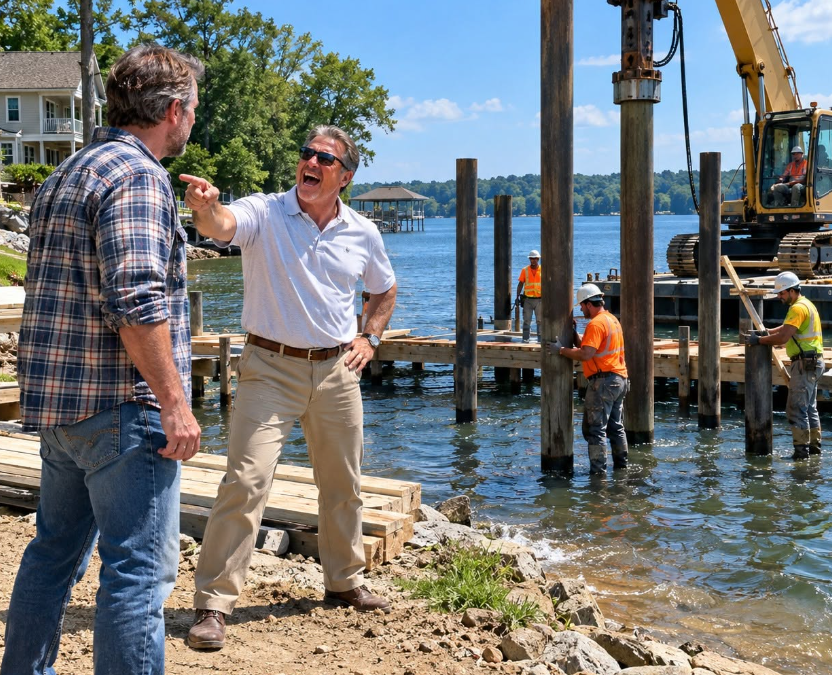
“This is the certified line. The riparian extension follows the lot line projection into the cove. Your crew is eleven feet, maybe twelve, inside water attached to my parcel.”
Derek glanced at the survey without taking it.
“Nobody owns the lake.”
“I own the lakebed interest and riparian rights attached to my frontage.”
“You own land. Water moves.”
“Boundaries don’t.”
He laughed.
Right in my face.
Not loud.
Worse.
Amused.
“Raymond, with respect, you’re operating from old-cabin mythology. The lake is navigable. Everyone uses it.”
“Navigation is not the right to build permanent structures inside my riparian zone.”
“Then sue me.”
The pile driver struck again.
Bang.
I looked past him at the crew.
“Stop work until this is resolved.”
Derek turned toward the contractor.
“Keep going.”
The hammer fell again.
Bang.
That sound did something to me.
It did not make me explode.
It made me calm.
The way I used to feel standing under a bridge with a flashlight, seeing a crack everyone above me wanted to ignore.
I took a photograph.
Then another.
Then video.
Derek smiled for the camera.
“Make sure you get my good side.”
I said nothing.
That bothered him more than an argument would have.
I went home and started a file.
Date.
Time.
Weather.
Water level.
Photographs.
Video.
Measured reference points.
Permit number.
Crew name.
Names visible on trucks.
Statements made.
I called my daughter Emily that night.
She listened quietly.
Then said, “Dad, don’t confront him alone again.”
“I didn’t confront him. I informed him.”
“That’s the retired inspector version of confronting him.”
“He told me to sue him.”
“Are you going to?”
“I’m going to document him first.”
Emily sighed.
That was her mother’s sigh.
It made my chest ache.
“Please be careful,” she said.
“I am.”
“No, Dad. You’re precise. That’s not always the same thing.”
She was right.
The next morning, I hired a surveyor.
Not the county.
Not someone Derek had used.
I hired Krueger Land Services out of Ashland, a firm I trusted because I had worked with them on bridge right-of-way disputes twenty years earlier.
Their senior surveyor, Martin Krueger, came out two days later.
He was seventy-two, bent slightly from age, and still capable of making younger crews look careless by breakfast.
Martin had known Carol.
He brought lemon bars his wife had made.
That almost undid me before any measuring began.
He reviewed my documents, set control points, took measurements from shore, then used a small survey boat to mark the projected riparian line.
By late afternoon, he stood on my dock, looking toward Derek’s pilings.
“You’re correct,” he said.
“How much?”
“Eleven feet four inches at the outer piling. Ten feet nine at the inner line. Structure footprint crosses into your riparian zone and interferes with your dock navigation corridor.”
I wrote it down.
Martin gave me a look.
“Ray, I’ll put it in the report.”
“I know.”
“You’re still writing it down?”
“Yes.”
He smiled sadly.
“Carol used to say you’d document a thunderstorm if it damaged a mailbox.”
“She was right.”
His report arrived three days later.
Stamped.
Certified.
Clear.
I sent it to Derek by certified mail.
I sent copies to the county zoning office, the Wisconsin DNR, and the U.S. Army Corps of Engineers district office because Pine Hollow Lake connected through Pine Creek to federally regulated waters, and permanent structures below the ordinary high-water mark required more than Derek’s confidence.
Then I waited.
Derek did not.
His crews worked faster.
Pilings.
Framing.
Roof trusses.
Electrical conduit.
Decking.
A boat lift.
Stone-faced support wall.
By the time the county acknowledged my objection, Derek’s boathouse looked half complete.
Paula from zoning finally called me.
“Mr. Ellis, we received your materials.”
“And?”
“We’re reviewing.”
“Work is continuing.”
“The permit remains active pending review.”
“The structure is over my line.”
“We are not authorized to adjudicate private property disputes.”
“You authorized the permit.”
“Based on submitted materials.”
“False materials.”
“I understand your concern.”
I closed my eyes.
“Paula, I spent thirty years writing inspection reports. I know the difference between concern and defect. This is a defect.”
She said nothing.
To her credit, she did not repeat the phrase.
The DNR responded with more interest.
An environmental enforcement officer named Greg Havel came out the following week. He wore field pants, a faded cap, and the expression of a man who had walked into too many shoreline fights between rich people and retired people with survey maps.
He listened.
He looked.
He measured.
He took photographs.
Then he asked, “Did Lawson obtain a DNR permit for the current footprint?”
“I don’t know.”
“I’ll check.”
He did.
Two days later, he called.
“There is a general permit filing for boathouse maintenance and replacement.”
“There was no boathouse.”
“I saw your photos.”
“And?”
“The filing describes replacement of a preexisting covered boat shelter. If your documentation is accurate, that is a problem.”
“How big a problem?”
“Potentially large.”
The Army Corps took longer.
Federal offices do not move like summer storms.
They move like glaciers with inboxes.
But when they finally moved, they moved with weight.
A regulatory project manager named Anita Brooks called me on a Thursday.
“Mr. Ellis, we received your complaint and the Krueger survey. Are you available Monday for a site visit?”
“Yes.”
“Please do not interfere with construction before then.”
“I haven’t.”
“Good. Continue not doing that.”
“I’m good at waiting.”
“We’ll see.”
I liked her immediately.
Before Monday arrived, Derek escalated.
He came over Saturday morning with two men I had never seen before.
One carried a tablet.
The other carried himself like security.
I was on the porch.
Derek stopped at the bottom steps.
“You need to withdraw your complaints.”
“No.”
He smiled through clenched teeth.
“You’re creating expensive delays.”
“I warned you before the expensive part.”
“You’re wrong about the law.”
“I’m not wrong about eleven feet four inches.”
The man with the tablet spoke.
“I’m Mr. Lawson’s counsel, Brent Carver. We believe your filings constitute tortious interference with permitted construction.”
“That sounds expensive.”
“It can be.”
I looked at Derek.
“You brought a lawyer to my porch to scare me?”
Derek said, “I brought a lawyer so you’d understand consequences.”
I stood.
The security-looking man shifted.
Not much.
Enough.
I noticed.
“Mr. Carver,” I said, “your client was shown a certified survey before continuing work. He proceeded anyway. He told me to sue him. He may get his wish. In the meantime, I have made accurate complaints to agencies with jurisdiction over shoreline construction. If you believe accuracy interferes with your project, take that up with the facts.”
Carver’s expression tightened.
Derek stepped closer.
“You lonely old men always think the past gives you rights over the future.”
That hit.
Not because of the insult.
Because he said lonely like he knew where to aim.
I thought of Carol’s chair behind me.
Her mug still in the cupboard.
The dock she loved.
My hands stayed still.
“Derek,” I said quietly, “you are standing on the only place in the world where my wife still feels close. Do not mistake grief for weakness.”
For a second, his face changed.
Not remorse.
Discomfort.
Then arrogance covered it.
“You have no idea who you’re fighting.”
I almost smiled.
“No. You don’t.”
They left.
I wrote everything down.
The Monday site visit began at 9 a.m.
Anita Brooks from the Corps arrived with another federal staffer, Greg Havel from DNR, Martin Krueger, and a county zoning representative who was not Paula.
Derek arrived at 9:20 in a black SUV with Brent Carver and a contractor named Shawn Evers.
By then, Anita had already reviewed the shore.
She did not waste words.
“Mr. Lawson, construction must stop pending review.”
Derek looked irritated but unsurprised.
“We have local permits.”
“You do not appear to have authorization for the current structure footprint below the ordinary high-water mark.”
“We filed under maintenance.”
Anita looked toward the new boathouse frame.
“This is not maintenance.”
Carver stepped in.
“The previous structure was deteriorated.”
I said, “There was no previous structure.”
Derek snapped, “There was a boat shelter.”
I handed Anita a folder.
Photographs.
Twenty-five years.
Summer after summer.
Same shoreline.
No shelter.
No boathouse.
No pilings.
No roof.
Just Warren Miller’s blue rowboat upside down on grass.
Anita reviewed them without expression.
Derek looked at the folder like it was an ambush.
It was not.
It was marriage.
Carol had loved photographing the lake.
He had not planned for a dead woman’s habit of saving summers.
Greg Havel walked the shoreline with Martin Krueger.
Measurements were taken.
Coordinates checked.
The ordinary high-water mark reviewed.
The riparian projection discussed.
The encroachment confirmed.
Derek kept trying to interrupt with phrases like established use, common lake access, navigable rights, and good faith reliance.
Anita let him talk.
Then she said, “Mr. Lawson, navigability does not authorize permanent private structures in a disputed riparian zone without proper approval.”
“My engineer said—”
“Your engineer is not here.”
“My contractor relied on the permit.”
“Your permit application appears to have described a replacement structure. We are reviewing whether that description was accurate.”
Carver said, “Let’s be careful with implications.”
Anita looked at him.
“I am always careful.”
I nearly laughed.
By noon, a stop-work order had been issued.
Derek’s crew packed up under protest.
The half-built boathouse stood there like arrogance with rafters.
For ten days, nothing moved.
Those ten days were the most peaceful I had experienced since Derek arrived.
Then the Pine Hollow Shores Association held an emergency meeting.
I did not attend.
Emily found the recording later because someone posted it in the community group.
Derek stood under the tent beside a screen showing maps of the lake.
He spoke in a tone designed to sound wounded and reasonable.
“Progress always creates resistance,” he said. “We’re seeing a pattern from older residents who do not want Pine Hollow to grow responsibly.”
Older residents.
That was me.
He continued.
“Certain individuals are misusing regulatory complaints to preserve outdated personal control over shared water.”
Shared water.
Then he displayed an aerial photograph of my dock with a red circle around it.
My daughter called me after watching.
“Dad,” she said, “he put your house on a screen.”
“I heard.”
“You need a lawyer.”
“I have agencies involved.”
“You need a lawyer too.”
She was right.
I hired Margaret Sloane the next day.
Margaret was a property and environmental attorney in Madison. She had white hair, black glasses, and the energy of a woman who considered nonsense a personal inconvenience.
She reviewed the file in silence for nearly forty minutes.
Then she looked up.
“Mr. Ellis, you are my favorite kind of client.”
“Old?”
“Documented.”
I liked her immediately.
She sent Derek’s counsel a letter that afternoon.
It was not long.
It did not need to be.
It identified the encroachment, the false permit basis, the certified survey, the regulatory complaints, the stop-work order, and our intent to pursue injunctive relief, damages, attorney fees, and removal if Derek did not voluntarily withdraw and restore the area.
Derek’s response came through Brent Carver.
They denied everything.
They claimed the boundary was unsettled.
They claimed historic use.
They claimed the boathouse footprint was substantially complete.
They claimed removal would create economic waste.
Economic waste.
That phrase made Margaret smile.
“Developers love that one,” she said.
“What does it mean?”
“It means they want the court to reward them for building fast enough to make correction expensive.”
“And will it?”
“Not if we can help it.”
While Margaret prepared the civil action, the federal review sharpened.
The Corps issued a formal notice of violation.
The DNR issued its own enforcement notice.
The county suspended the local permit pending investigation into misrepresentation.
Then Martin Krueger found the fourth nail in Derek’s coffin.
An old plat.
Not mine.
Warren Miller’s.
Recorded in 1972 when the Miller family purchased the property.
It contained a handwritten note from the county surveyor:
South riparian projection limited by Ellis line. No pier, boathouse, or permanent structure to extend north of bearing line without adjacent owner agreement.
Adjacent owner.
That meant me now.
Before me, it meant the man Carol and I bought from.
The warning had existed for fifty years.
Derek’s title company had it.
His surveyor should have seen it.
His attorney could have seen it.
His contractor would not have cared.
Margaret subpoenaed the title file after filing for injunction.
That was when the emails surfaced.
Derek had been warned.
Not vaguely.
Specifically.
His original surveyor, the one I had spoken with before he disappeared, had emailed Derek:
Existing title materials and adjacent Ellis survey indicate proposed boathouse alignment may encroach into Ellis riparian zone. Recommend redesign or written neighbor agreement before construction.
Derek replied:
Neighbor is elderly widower. Do not redesign yet. Proceed with alternate shoreline interpretation. I’ll handle Ellis.
I read that email in Margaret’s office.
For a moment, the words blurred.
Elderly widower.
That was what I was to him.
Not Raymond.
Not neighbor.
Not owner.
Not a man whose wife had planted lilies beside the dock he wanted to crowd.
Elderly widower.
A soft obstacle.
Margaret watched me carefully.
“Are you all right?”
“No.”
“Good. Don’t pretend.”
I folded the paper slowly.
“He knew.”
“Yes.”
“He knew before the pilings.”
“Yes.”
“He laughed anyway.”
Margaret’s voice softened.
“People laugh when they think consequences are theoretical.”
“They’re about to get practical?”
“Oh, Mr. Ellis,” she said. “They already are.”
The injunction hearing happened twelve days later.
The courtroom was full.
Not because lake boundary disputes usually draw crowds.
Because Derek had made it public.
Pine Hollow Shores members attended in linen shirts and expensive sandals.
Older residents came too, some out of support, some out of curiosity, some because they had hated that pile driver as much as I had.
Emily sat behind me.
She held my hand before the hearing began.
That embarrassed me for half a second.
Then I remembered I was too old to be embarrassed by being loved.
Derek sat across the aisle with Meredith beside him. She wore white and looked strained. I had spoken to her only twice. She had always seemed less cruel than Derek and more trapped by the velocity of his confidence.
Judge Anita Rosen presided.
She did not look impressed with anyone.
Margaret presented our case with the clean brutality of a good inspection report.
Survey.
Photos.
Historic plat.
Krueger report.
Agency stop-work orders.
Derek’s email.
The absence of a previous boathouse.
The false permit description.
The encroachment.
The ongoing harm.
Carver argued hardship.
He claimed boundary uncertainty.
He said Derek had acted in good faith.
Margaret stood and read the email aloud.
Neighbor is elderly widower. Do not redesign yet. Proceed with alternate shoreline interpretation. I’ll handle Ellis.
The courtroom changed.
You could feel it.
Some sentences have weight because everyone hears exactly who a person is inside them.
Judge Rosen looked at Derek.
For the first time, his face lost color.
The judge granted the preliminary injunction, ordering no further construction, no use of the structure, and preservation of all project records. She also found substantial likelihood that the boathouse violated property boundaries and regulatory requirements.
That was not final victory.
But it was the first time Derek stopped smiling.
Outside the courthouse, he approached me.
Emily stepped forward instinctively.
I touched her arm.
Derek stopped several feet away.
“You happy?” he asked.
“No.”
“You’re destroying a million-dollar project over eleven feet.”
“You built a million-dollar project eleven feet where it didn’t belong.”
Meredith whispered, “Derek, don’t.”
He ignored her.
“You could have been reasonable.”
“I showed you the survey.”
“You could have taken money.”
“You never offered.”
“I would have.”
“No,” I said. “You would have offered after stealing enough to make refusal look unreasonable.”
His jaw tightened.
“You think this is over?”
“No,” I said. “I think this is documented.”
That night, I dreamed of Carol.
Not sick Carol.
Lake Carol.
Summer Carol.
She was standing on the dock in one of my old flannel shirts, holding a coffee mug and looking toward Derek’s half-built boathouse.
She said, “You measured it, didn’t you?”
I woke up laughing and crying at the same time.
Grief does that.
It refuses to stay in one category.
The final federal order came eighteen days after the first site visit.
The Corps determined the boathouse and associated fill had been constructed without proper authorization in waters subject to federal jurisdiction and in conflict with unresolved riparian rights. The order required removal of unauthorized structures and restoration of impacted areas.
Derek appealed internally.
Denied.
He requested after-the-fact authorization.
Denied, based on misrepresentation, encroachment, and state objections.
He proposed modifying the structure.
Denied.
He offered mitigation.
Denied.
The order stood.
Removal had to be completed under supervision.
If Derek failed, the government could undertake removal and seek costs.
Derek failed.
Not officially.
He simply delayed.
His contractor became unavailable.
His engineer needed more time.
His attorney requested extensions.
The weather was changing.
The agencies did not blink.
On day thirty-one after Derek told me to sue him, two enormous cranes arrived at dawn.
Not literally owned by the federal government, as some neighbors later joked, but contracted under federal enforcement supervision, with U.S. Army Corps personnel, DNR officers, county officials, and sheriff’s deputies present to maintain the order.
To everyone watching, they were federal cranes.
That was enough.
I stood on my dock with black coffee in my hand.
Emily stood beside me in one of Carol’s old fleece jackets.
Martin Krueger came too, because surveyors enjoy seeing math vindicated.
Margaret stood on shore with her file bag.
Derek’s property was crowded.
His patio.
His lawn.
The new stone steps.
The shoreline he had paid a fortune to make look inevitable.
Neighbors gathered in boats, kayaks, and along the road.
Some Pine Hollow Shores people watched in stunned silence.
Older lake residents watched with expressions they pretended were neutral.
They were not neutral.
Derek stood near the contractor trailer, arguing with someone in a hard hat.
Meredith stood behind him, crying quietly.
I did feel sorry for her.
Not enough to regret anything.
But enough to remember that arrogance usually splashes onto people who did not swing the hammer.
The first crane lifted part of the roof assembly.
Workers had cut sections loose in advance under agency supervision.
The boathouse groaned as the roof rose.
For weeks, Derek’s structure had dominated the cove like a declaration.
Now it hung from cables, awkward and temporary, exposed for what it was.
Materials.
Fasteners.
Ego.
The roof section swung slowly over the barge and came down with a hollow crash.
A murmur moved across the water.
Emily touched my sleeve.
“You okay?”
I watched a crew unbolt the side framing.
“I don’t know.”
“That’s acceptable.”
“You sound like your mother.”
“Good.”
The cranes worked all morning.
Roof.
Walls.
Deck framing.
Boat lift.
Stone veneer.
Electrical components.
Pilings cut below the required level for extraction.
Each piece removed.
Photographed.
Loaded.
Documented.
Derek’s face changed as the hours passed.
At first, fury.
Then disbelief.
Then something like grief, though I doubted he recognized it.
People often think grief belongs only to noble losses.
It does not.
A man can grieve his own foolishness when it finally becomes visible.
Around noon, Derek walked to the property line.
Deputies followed at a distance.
He did not cross.
For once.
“Raymond,” he called.
I looked at him.
“You win.”
I set my coffee down.
“No.”
His mouth twisted.
“Don’t be humble.”
“I didn’t win. The line held.”
He stared at me.
Maybe he understood.
Probably not.
The last piling came out at 2:47 p.m.
I wrote that down.
Martin saw me and smiled.
By sunset, the boathouse was gone.
Not cleaned up.
Not restored.
But gone.
The cove opened again.
For the first time in months, I could stand on my dock and see the water the way Carol had loved it.
Broken, disturbed, muddy near Derek’s shore, but open.
That evening, older neighbors came by.
Not all at once.
Quietly.
Frank Bender brought smoked whitefish.
Martha Keene brought a pie.
Tom Arlen brought beer.
Nobody made a speech.
That was not how old Pine Hollow worked.
They just sat on the porch while the sunset turned the cove gold.
After a while, Frank said, “Hell of a day.”
I nodded.
Martha said, “Carol would have made lemonade.”
“She would have made Derek drink it too,” I said.
Everyone laughed.
Then we got quiet.
That was grief again.
But a gentler kind.
The legal aftermath lasted months.
Derek was ordered to pay removal costs, restoration expenses, regulatory penalties, and my legal fees connected to the injunction. His contractor was fined for proceeding after boundary notice. The permit consultant lost county preferred status. The county zoning office rewrote its review process for replacement boathouse claims.
Pine Hollow Shores Association collapsed before winter.
Not legally.
It still existed on paper.
But after members learned Derek had been warned and proceeded anyway, enthusiasm drained fast.
Nobody wanted dues going toward his fight.
Nobody wanted their names tied to the email calling me an elderly widower.
The virtual office vanished.
The “nonalignment” letters stopped.
Derek and Meredith listed their house the following spring.
The listing photos carefully avoided the shoreline where the boathouse had been.
It sold for less than he expected.
Much less, according to Frank, who pretended not to track such things while knowing every number.
Before Derek left, he came to my cabin one final time.
No lawyer.
No security.
No smile.
I met him at the porch steps.
He looked older.
Not kinder.
Just reduced.
“I wanted to say something,” he said.
I waited.
He looked toward the dock.
“I should have moved it when you showed me the survey.”
“Yes.”
He flinched.
Maybe he expected me to soften the answer.
I did not.
“I thought if I kept going, you’d take a check.”
“I know.”
“I was wrong.”
“Yes.”
He rubbed his face.
“I’m sorry.”
There it was.
An apology.
Late.
Small.
Not enough.
But real enough to stand on its own.
I nodded once.
“Thank you for saying it.”
“Do you forgive me?”
People ask that when they want the story to end in a way that makes them less uncomfortable.
I looked past him at the lake.
At the dock Carol had loved.
At the water where his pilings had been.
“I hope someday you understand that forgiveness is not a permit you can apply for after building wrong.”
His eyes lowered.
He nodded.
Then he left.
I never saw him again.
The restoration took time.
Disturbed lakebed does not heal because a judge signs paper.
Crews removed debris.
The DNR supervised shoreline stabilization.
Native plants were restored.
Sediment barriers stayed in place through spring runoff.
For a while, the cove looked scarred.
Then summer came.
Water cleared.
Frogs returned first.
Then minnows.
Then a blue heron began stalking the shallows near the exact place Derek’s outer piling had stood.
That felt appropriate.
Nature is not sentimental.
But sometimes it has timing.
Emily visited more that year.
She said it was because she liked the lake.
I knew it was because she had been scared by how close the fight came to consuming me.
One Thursday evening, she found me sanding a dock board.
“Dad,” she said, “do you ever think about leaving?”
“Selling?”
“Yes.”
I kept sanding.
“Sometimes.”
She went still.
I looked up.
“Not because of Derek.”
“Then why?”
“Because houses get heavy when only one person remembers everything.”
Her face softened.
“Mom is not only here.”
“I know.”
“She’s with me too.”
I stopped sanding.
The lake moved gently under the dock.
Emily sat beside me.
“She would be proud of you,” she said.
“For getting into a legal fight over eleven feet?”
“For standing up when someone counted on you being too tired.”
I looked toward the cove.
“She would have hated the noise.”
“She would have baked for the crane crew.”
That made me laugh because it was true.
The next summer, I finally replaced Carol’s chair on the porch.
Not threw it away.
Never that.
I moved it to the bedroom by the window and bought a new chair for the porch.
A person can keep memory without making a shrine of every object.
That took me years to learn.
On the anniversary of the crane removal, I invited neighbors over.
Old ones.
Some new ones too.
Even a few who had originally supported Pine Hollow Shores and later apologized.
We grilled fish.
Martha brought pie.
Frank told the story wrong three times, making the cranes larger each time.
By his version, the federal government had sent aircraft carriers.
I let him.
As the sun set, Martin Krueger raised a beer.
“To eleven feet four inches.”
Everyone laughed and drank.
I did too.
Later, after people left, I walked down to the dock alone.
The boards were cool under my bare feet.
Loons called from the far side of the lake.
A soft wind moved through the pines.
The cove was open.
Quiet.
Mine, not in the selfish sense Derek accused me of, but in the responsible sense.
The sense that says ownership is not merely having the right to exclude.
It is having the duty to protect what cannot speak in court.
A shoreline.
A boundary.
A memory.
A place where your wife once sat with her feet in the water and said, “Promise me we’ll never make this fancy.”
We never did.
Derek Lawson thought the lake belonged to nobody.
That was his excuse.
But what he really believed was worse.
He believed the parts of the world not actively defended belonged to whoever moved fastest.
He believed an old man’s silence meant weakness.
He believed a widow’s absence meant the history attached to her had lost its witness.
He believed a survey could be outshouted by a pile driver.
He believed money spent in the wrong place became too expensive to correct.
He was wrong about all of it.
The line held.
Not because lines enforce themselves.
They do not.
A boundary on paper is only ink until someone cares enough to stand beside it.
The survey mattered.
The photos mattered.
The old plat mattered.
The emails mattered.
The agencies mattered.
The law mattered.
But beneath all of that, what mattered most was the simple refusal to let someone laugh at the truth and keep hammering.
I still live at Pine Hollow.
The cabin is still small.
The dock still creaks.
Carol’s mug is still in the cupboard, though now I use it sometimes when Emily visits because grief, like a shoreline, changes shape if you let water move.
New people continue buying old cabins.
Some build too large.
Some play music too loud.
Some eventually learn.
Every so often, someone asks about the empty stretch on Derek’s former shoreline.
Frank usually answers before I can.
“Federal cranes,” he says, with enormous satisfaction.
Then he points at me.
“Ask Ray. He measured the whole damn thing.”
I usually shrug.
But the truth is, yes.
I measured it.
I documented it.
I wrote it down.
Because steel does not respond to arguments.
Concrete does not care about confidence.
Water may move, but boundaries still matter.
And if a man builds eleven feet into what is yours while laughing and telling you to sue him, make sure your facts are clean, your photos are dated, your survey is certified, and your coffee is ready.
Because when the cranes come, you will want to be awake enough to watch.