My Harley Died on a Rain-Soaked Highway—Then a Child’s Scream Led Me Into an Abandoned Farmhouse and Forced Me to Choose What Kind of Man I Still Wanted to Be.
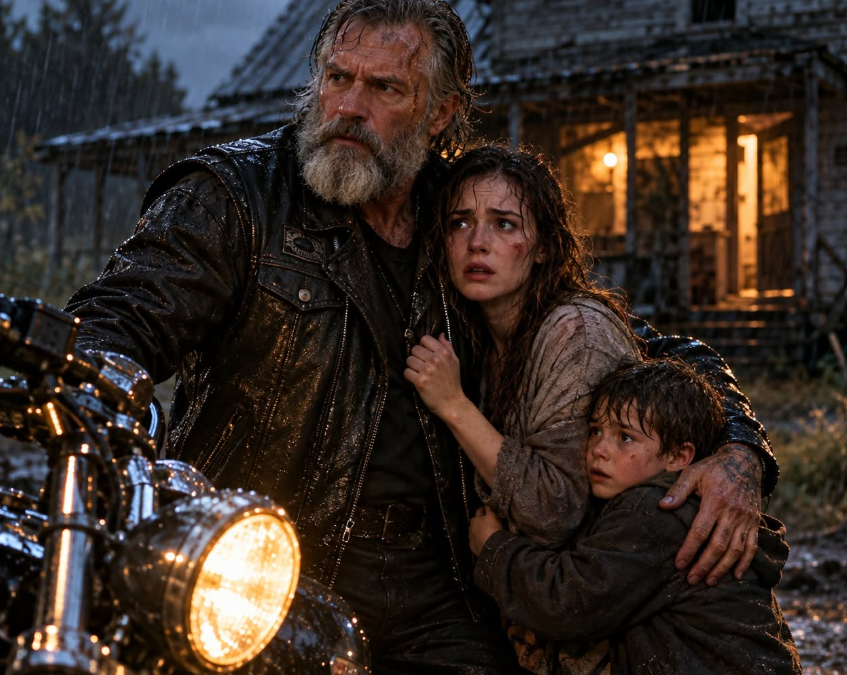
PART2:
Of a nine-year-old girl with tangled hair sitting on the back of my parked bike in our driveway, gripping the sissy bar and shouting, “Go faster, Dad!” while I made engine sounds because her mother had forbidden me from starting it with her on it.
I thought of promising that same little girl we would ride across the country when she turned eighteen.
I thought of the way she stopped asking me for things long before eighteen.
“My kid,” I said.
Virgil looked toward the window.
“Yeah.”
That was all.
Men like us did not say sorry often enough when it would have helped. Later, when apologies finally rose in our throats, they usually had nowhere useful to go.
I left before dark.
Virgil stood in the doorway with one hand on the frame, oxygen tube pulled crooked across his cheek.
“Ride careful,” he called.
“Since when?”
“Since we got old.”
I gave him the finger.
He laughed.
It was the last time I saw him alive.
I did not know that yet.
That is how life usually works.
The important moments rarely announce themselves in time.
By the time I hit Route 9, rain had settled over western Oregon like it planned to stay until spring. Not a storm exactly. No lightning. No drama. Just steady, cold, miserable rain that blurred the tree line and turned the highway shoulder into mud.
My Harley had been giving me trouble for weeks.
A weak start.
A flickering headlight.
A hesitation under throttle that told me the charging system was thinking about betraying me. I knew what it was. I had known for two weeks. A voltage regulator going bad, maybe stator trouble, maybe a wire rubbed raw from years of vibration. I kept telling myself I would fix it before the next long ride.
That was one of my lesser sins.
Ignoring things until they stranded me.
PART3:
Thirty miles from the nearest decent town, the bike coughed once.
Then twice.
Then shuddered under me like an animal trying to stay on its feet.
“Come on, sweetheart,” I muttered.
The headlight dimmed.
The engine died.
I coasted onto the muddy shoulder.
Rain hissed against the hot exhaust. Trucks passed in wet gusts, their tires throwing spray across my boots. The bike settled beneath me with the dead silence only a machine can have when it has decided your plans are stupid.
I sat there for a second.
Then laughed once.
Not because it was funny.
Because sometimes the universe tells a joke so mean you have to admire the timing.
“No cell signal,” I said after checking my phone.
Of course.
I looked around.
Oregon woods on both sides.
Dark firs.
Wet brush.
Road disappearing into gray.
No houses, no gas station, no barn with a light on.
Just one abandoned-looking farmhouse about fifty yards back from the road, half-hidden behind waist-high grass and a line of leaning fence posts.
The house had the tired posture of a place nobody had loved in years.
Sagging porch.
Broken windows.
Siding gone silver with weather.
Roofline bowed slightly near the back.
A black hole where a front window had been.
If there was a horror movie filming within a hundred miles, they had missed their perfect location.
I pulled my tool roll free and crouched beside the Harley.
Charging problem.
I knew it before I touched anything.
I peeled off a glove with my teeth, dug out a wrench, and started loosening the cover.
Rain ran down my neck.
My fingers hurt.
My knee complained.
I cursed the bike, myself, Virgil for living so far away, and God because He had broad shoulders and could take it.
I was halfway through loosening the cover when I heard something through the rain.
Sharp.
High.
Human.
I froze.
The wrench hung in my hand.
I listened.
Rain.
Wind through trees.
A passing truck fading away.
Nothing else.
I waited longer than I want to admit.
Then I shook my head.
“Not your problem, Cal.”
That sentence had carried me through a lot of years.
Not your problem.
Someone fighting outside a bar?
Keep walking.
Somebody getting arrested?
Don’t look.
A couple screaming at each other in a parking lot?
None of your business.
A man bleeding in an alley after a deal went bad?
Someone else would call.
A woman crying in a motel room two doors down?
Turn up the television.
Not your problem was not wisdom.
It was armor.
And like most armor, I had worn it so long that parts of me had grown around it.
I bent back toward the bike.
Then the sound came again.
“Please!”
One word.
Thin.
Terrified.
Cut in half by rain.
I stood.
The sound had come from the farmhouse.
Every instinct I trusted told me to stay away.
A man who looked like me did not wander into suspicious houses and later have productive conversations with deputies. If police found me near trouble, they usually started with my name and worked backward until they found something they disliked.
I had been clean a long time.
Mostly.
Clean enough.
But records do not care about mostly.
Neither do first impressions.
I looked at my dead Harley.
Then at the farmhouse.
A heavy thud came from somewhere inside.
Then crying.
Not an adult.
A child.
I closed my eyes.
For some reason, I saw Rachel at nine years old.
She used to climb onto the back of my motorcycle while it was parked in the driveway and pretend we were crossing deserts, mountains, oceans, whatever place she had learned about in school that week. She had a pink helmet with stickers she put on herself. Unicorns. Stars. One crooked skull I gave her because I thought it was funny and her mother did not.
“When I’m eighteen,” she would say, “we’re going all the way to New York.”
“Why New York?”
“Because it’s far.”
I had promised.
By the time she turned eighteen, she barely spoke to me.
“Damn it,” I whispered.
Then I stood.
I kept the big wrench in my hand, mostly because I didn’t know what I was walking toward and partly because I had learned too late in life that good intentions do not stop bad men.
The grass between the road and the house was waist-high and soaked. It slapped against my jeans as I crossed the ditch and climbed over what remained of a fence. Mud sucked at my boots. Rain crawled under my collar.
The closer I got, the worse the place looked.
Broken windows.
Sagging porch.
Gray boards stripped bare by twenty winters.
The smell hit me behind the house.
Chemicals.
Burned plastic.
Rot.
Something sickly sweet underneath it that made the back of my throat tighten.
I had been around enough bad places to recognize a house where people weren’t making good decisions.
Around back sat an old pickup, dark green maybe, though mud covered most of the paint. The rear plate was half-obscured with grime. One taillight broken. Fresh tracks chewed through the mud near the back steps.
That made me slow down.
Voices drifted through a dirty basement window.
I crouched beneath it.
Rainwater dripped from the roofline onto the back of my neck. I wiped a patch of grime from the glass with the heel of my hand.
Looked inside.
And everything in me went cold.
Two men were in the basement.
Both thin.
Restless.
The kind of thin that comes from bad chemicals, worse sleep, and food being something that happens when there is time. One paced in circles while gripping a metal bar. The other sat near a folding table, one leg bouncing, a firearm lying close to his hand.
But I hardly noticed them at first.
Against the far wall sat a young woman.
Maybe twenty.
Maybe not even.
Her wrists were restrained behind a pipe. Her face was bruised. One eye swollen. Wet hair stuck to her cheek. Her shirt was torn at the sleeve, and she held herself upright like doing so cost more than she wanted anyone to know.
Beside her was a boy, nine or ten at most, pressed tightly against her leg.
The pacing man stepped toward her.
She flinched.
The boy screamed.
I stayed there for maybe five seconds.
Long enough to understand that I had choices.
I could walk back to the highway.
Try to fix the bike.
Try to find a signal.
Walk until I found one.
Call the police.
Tell myself trained people would handle it.
Maybe they would.
Maybe in twenty minutes.
Maybe forty.
Maybe too late.
Inside, the man with the bar raised it again, not to strike her exactly, but to watch her recoil.
The other one laughed.
Something inside me settled.
Not anger, though anger was there.
Not courage, though maybe courage sometimes feels like being too tired to keep negotiating with your own cowardice.
It was something older.
A line.
I had crossed plenty of bad lines in my life.
This one I was not walking past.
I moved toward the back porch.
I wasn’t thinking about becoming a hero.
Men like me know better than to believe our own stories.
I was thinking about the kid.
About how long one minute probably felt inside that basement.
The rear door was old and warped.
I hit it hard enough with my shoulder to tear the damaged frame loose.
Pain tore through my collarbone.
The crash echoed through the house.
Voices erupted below.
“Who’s there?”
I stepped inside.
Dark hallway.
Rotten floor.
Yellow light leaking from a basement doorway near the kitchen.
The smell was worse inside.
Mold.
Damp wood.
Chemicals.
Fear.
Someone downstairs shouted again.
I reached the top of the stairs.
The man with the metal bar appeared first at the bottom.
He had stringy blond hair and a face that looked like it had been carved too close to the bone. The second man rose behind him and grabbed the firearm from the table.
Behind them, the young woman pulled the boy tighter against her.
All four stared up at me.
Rainwater ran from my beard onto my leather vest.
I knew exactly what they saw.
A large, gray-haired biker filling the stairwell.
Old scars.
Heavy boots.
A wrench hanging loosely from one hand.
The man below lifted the weapon.
“Who the hell are you?”
I took the first step down.
He raised it higher.
The young woman’s eyes widened.
The child buried his face against her.
And as I descended into that basement, I suddenly understood the strangest part of all.
The two people I had come to save were looking at me with exactly the same terror as the men holding them.
I stopped halfway down.
That mattered.
Because until that moment, I had only been thinking about the two men.
Now I saw myself through the young woman’s eyes.
I probably looked like the next nightmare coming through the door.
So I lowered the wrench slightly.
“Nobody touches them,” I said.
My voice sounded rough even to me.
The man holding the weapon laughed nervously.
“Get out.”
The other one stepped forward.
“Wrong house, old man.”
I looked at the woman.
Not long.
Just enough.
“Are they yours?” I asked.
The man with the firearm blinked.
“What?”
“The woman and the boy. They yours?”
His face twisted.
“None of your business.”
“That’s what I was afraid of.”
The pacing man raised the bar.
“Last warning.”
“Mine too.”
What happened over the next few seconds was messy and fast.
There was shouting.
Movement.
The man with the bar came first.
The one with the firearm shifted wrong, nervous, too close to his friend, too sure the weapon made him brave.
The blast came louder than anything should in a basement.
It slammed into the wall instead of a person, spraying plaster and dust across the room.
The boy screamed again.
I closed the distance before either man could regain control.
I’m not going to pretend it looked graceful.
At fifty-eight, nothing I did looked graceful anymore.
But thirty years of surviving stupid situations had taught me one useful lesson.
Commit to the decision you’ve already made.
When it ended, both men were on the floor.
Alive.
Hurting.
No longer controlling the room.
I stood there breathing hard.
My shoulder felt like someone had driven a railroad spike through it.
My ears rang from the blast.
The wrench was still in my hand.
Then I looked across the basement.
The woman and boy were staring at me.
The boy had both hands over his ears.
The woman’s whole body shook.
I immediately set the wrench on a wooden crate.
Then raised both hands.
“It’s over.”
She didn’t move.
I took one slow step backward.
“You’re safe.”
That word sounded strange coming from me.
Safe.
I had spent years being the person other people crossed the street to avoid.
I pointed toward her restraints.
“Can I cut those?”
She hesitated.
Then nodded.
I moved slowly.
Every motion deliberate.
I showed her the folding knife before opening it.
“Just the ties.”
Her eyes followed the blade.
“Okay,” she whispered.
I cut the plastic restraints without touching her skin.
The second her hands were free, she grabbed the boy and pulled him into her chest.
He started crying again.
Different tears this time.
Relief maybe.
Shock.
A body letting go because it had held fear too long.
I backed away.
“You got a name?”
The woman swallowed.
“Emily.”
She looked down at the boy.
“This is Noah. My brother.”
“Okay, Emily. Is there a phone upstairs?”
She nodded.
“Kitchen.”
“I saw it.”
She looked at the two men on the floor.
“They took us from a rest stop.”
Her voice cracked.
“We were driving to our aunt’s house. They said they needed help with their truck. Then—”
“You don’t have to tell me now.”
That surprised her.
Most people ask questions because curiosity feels like concern.
Sometimes it isn’t.
Sometimes the kindest thing you can do is let someone keep a horrible memory to themselves for another ten minutes.
“Can you walk?” I asked.
Emily nodded.
“Noah?”
The boy stared at me.
His face was pale. His lower lip trembled. One hand clutched the hem of Emily’s shirt like it was the last safe thing in the world.
I crouched, keeping distance.
“Hey, buddy.”
Nothing.
“I need you to do something for me.”
His eyes moved toward mine.
“Your sister needs you upstairs.”
Emily started crying silently.
“Can you stay with her?”
The kid nodded.
“Good man.”
I stood.
Emily looked toward the staircase.
“You’re coming with us, right?”
That was when reality returned.
Not the basement.
Not the danger.
The other reality.
Police.
Questions.
My history.
The club patch.
Two injured criminals.
A discharged weapon.
A kidnapped woman and child.
Even if every fact eventually worked in my favor, I knew exactly how the first twelve hours would look.
“No.”
Her face changed.
“What?”
“You two go upstairs. Lock yourselves in the kitchen if you can. Call 911. Tell them exactly where you are.”
“But you saved us.”
“That’s not the important part.”
“They need to know who you are.”
I almost laughed.
“Trust me. Nobody needs that tonight.”
I reached into my vest pocket.
There was an old silver coin inside.
Nothing valuable.
Just something an old friend had given me years earlier when we were both too young to know which mistakes would follow us forever. It had an eagle stamped on one side and a dent near the edge from a night I did not like remembering.
I held it out to Noah.
The kid hesitated.
Then took it.
“What’s this?”
“Luck.”
“Does it work?”
I looked around the basement.
“Results vary.”
For the first time, the boy almost smiled.
I pointed upstairs.
“Take care of your sister.”
Emily looked at me.
“What should we tell the police?”
I should have told her the truth.
My name.
Where to find me.
What happened.
Every clean detail.
Instead, I said, “Tell them a stranger came in and helped you.”
“That’s it?”
“That’s plenty.”
“Why are you doing this?”
That question stopped me.
Not why had I come inside.
Why was I leaving?
Maybe because the version of me who did one decent thing still didn’t trust the world to believe him.
Maybe because I didn’t trust myself to stand under fluorescent lights while someone called me brave.
Maybe because I knew one good choice didn’t erase thirty years of bad ones.
“I’m not the story, Emily.”
She stared at me.
“You are to us.”
I had no answer.
So I walked upstairs.
Outside, the rain had stopped.
The air smelled clean in the way it sometimes does after a storm, as if the world has briefly washed its hands and decided not to admit what it has touched.
For a minute, I stood in the yard and looked at the farmhouse.
Behind me, I heard Emily moving in the kitchen.
A drawer opening.
A phone being lifted.
Numbers being pressed.
Good.
I went back to my Harley.
Still dead.
Of course.
I pushed it behind tall weeds so it wouldn’t be obvious from the highway, covered the chrome as best I could with a piece of torn tarp I found near the ditch, and started walking south.
Thirty miles to the clubhouse.
Maybe twenty to the nearest truck stop.
My joints complained with every step.
My shoulder throbbed.
My hands stung.
My ears still rang.
Every few minutes, I looked back, expecting headlights or sirens or the past itself to come rolling up behind me.
After maybe two miles, the sirens came.
Not behind me.
Ahead, then behind, then everywhere.
Reflected faintly in the wet road.
Red and blue through trees.
I stepped off into the brush and waited.
Three cruisers flew past northbound, then an ambulance, then another unmarked vehicle.
I stood there soaked, hidden among firs, and listened until they faded.
Only then did I start walking again.
By dawn, I reached a highway diner lit by red neon.
The sign said MILLIE’S, though one of the Ls was burned out, making it look like MIIE’S, which felt about right.
I went inside looking like I’d been dug out of the ground.
Mud.
Bruised knuckles.
Wet leather.
Blood on one sleeve that wasn’t mine.
The waitress took one look at me and decided questions were above her pay grade.
“Coffee?” she asked.
“Black.”
“Food?”
“Eggs.”
“Toast?”
“Sure.”
She poured coffee into a chipped mug and slid it across the counter. I took it to a booth facing the entrance.
Old habit.
A television hung above the counter.
Local news.
Weather.
Traffic.
A cheerful anchor pretending morning existed for reasons other than survival.
Then the screen changed.
BREAKING NEWS.
I stopped lifting my cup.
A reporter stood outside the farmhouse.
Police cruisers crowded the road.
Yellow tape snapped in the wind.
The headline said two kidnapping victims had been rescued overnight.
A twenty-year-old woman and her ten-year-old brother.
Two suspects were in custody after being found injured inside the abandoned property.
Authorities were searching for an unidentified man who had apparently entered the house before police arrived.
I stared at the screen.
The sheriff appeared.
He looked uncomfortable.
“We’d like to speak with the individual who intervened,” he said. “At this time, we believe this person may have information critical to the investigation. We are asking him to come forward.”
I muttered, “No, you wouldn’t.”
The waitress looked over.
“You say something?”
“Coffee’s good.”
She raised one eyebrow, which told me she knew bad lies when she heard them, but she walked away.
Then Emily appeared on the television.
Blanket around her shoulders.
Noah beside her.
The coin hung from his fist.
A reporter asked what the rescuer looked like.
Emily glanced down at Noah.
Then back at the camera.
“Big guy,” she said.
She paused.
“Dark clothes.”
“Did you see his face?”
Another pause.
I leaned forward.
Emily said, “Not really.”
I closed my eyes.
Smart girl.
The reporter asked, “What would you call him?”
Emily thought for several seconds.
Then she said something I was absolutely not prepared for.
“An angel came out of the dark.”
I nearly choked on my coffee.
“Angel?”
A trucker two booths over glanced at me.
I laughed under my breath.
Of all the names people had called me in fifty-eight years, that was definitely new.
I left twenty dollars beneath the coffee cup.
More than breakfast cost.
Outside, dawn was spreading pale gray over the parking lot. Rain had started again, softer now. The kind of rain that seemed less angry and more tired.
I found a pay phone near the diesel pumps and called a friend named Rook to pick up my motorcycle.
Rook answered like a man waking from the bottom of a well.
“Who died?”
“Not my bike yet, but it’s considering it.”
“Where?”
I gave him directions.
He grunted.
“You sound like hell.”
“Accurate.”
“Trouble?”
“Not anymore.”
“Do I want details?”
“No.”
“Did you do something stupid?”
I watched trucks pull in and out under the gray morning.
“Maybe something decent.”
Silence.
Then Rook said, “That doesn’t sound like you.”
“Yeah.”
“Stay where you are.”
While I waited, I thought about Emily’s words.
An angel.
No.
Not even close.
I knew what I had done in my life.
Who I had hurt.
Who I had disappointed.
One rainy night didn’t wipe any of it clean.
And maybe that was the lesson.
People like clean categories.
Good men.
Bad men.
Heroes.
Criminals.
Victims.
Saviors.
Real people are messier.
I had spent years doing things I regretted.
That night, when I heard a kid crying inside a farmhouse, I made one decision I didn’t regret.
Rook arrived two hours later in an old flatbed truck with rust along the wheel wells and a cracked windshield he claimed gave the vehicle personality.
He pulled up, looked me over, and said, “You get hit by a train?”
“Basement.”
“Ah. Hate when that happens.”
We drove north and found the Harley still hidden where I’d left it. Police tape blocked the road near the farmhouse, but nobody was near the bike. Rook helped me load it onto the flatbed.
He sniffed the air.
“Something happened here.”
“Yeah.”
“You involved?”
I tightened a strap.
“Define involved.”
“Cal.”
I looked toward the farmhouse.
A deputy stood near the front porch, talking to another man in a rain jacket. Crime-scene tape fluttered. The windows looked black in the morning light.
“I heard something,” I said.
Rook stopped moving.
“What kind of something?”
“A kid.”
He said nothing.
Rook had known me twenty years. He knew when to stop pushing.
After a while, he said, “You call it in?”
“Emily did.”
“Emily?”
“One of the people inside.”
His face changed.
“How bad?”
“Bad enough.”
We finished securing the bike.
On the drive back, Rook kept the radio low. The story played twice. Each time, he looked at me from the corner of his eye and said nothing.
At the clubhouse garage, he unloaded the Harley while I sat on a stool and cleaned mud off my boots.
“You going to the cops?” he asked finally.
“No.”
“They might already know.”
“Maybe.”
“You got blood on your sleeve.”
“Not mine.”
“That answer doesn’t reassure like you think.”
“I didn’t kill anyone.”
“That’s good. Low bar, but good.”
I looked at him.
“They have enough. The two men are alive. Emily can tell them what happened.”
“Can she?”
“She can tell enough.”
Rook leaned against the bike lift.
“Man like you disappears after saving people, cops start wondering why.”
“Cops always wonder why when they see a man like me.”
“That doesn’t make them wrong.”
“No.”
Rook folded his arms.
“What are you really afraid of?”
I almost gave him the usual answers.
Police.
Records.
Questions.
The club.
But the truth had been walking beside me since the farmhouse.
“I’m afraid they’ll make it mean more than it does.”
Rook frowned.
“What?”
“One good thing.”
He stared.
I looked down at my hands.
“If they call me a hero, they’re wrong. If they drag up who I was, they’re also not wrong. I don’t want either version.”
Rook was quiet for a long time.
Then he said, “Maybe you don’t get to choose what it means to the kid.”
That annoyed me because it sounded like something Virgil would have said, and I had already had enough dying-old-man wisdom for one week.
I went home.
Home, for me, was a small rental cabin behind the garage property. One room, kitchenette, bathroom, couch I slept on more often than the bed because the bed felt too formal for the kind of life I lived. The walls held no photographs except one old picture of Rachel at thirteen, standing beside my bike with her arms crossed, pretending not to smile.
I showered until the hot water gave up.
Then I sat on the edge of the tub and looked at my bruised knuckles.
I did not sleep.
The news kept playing on my phone.
By afternoon, more details came out.
Emily Carter, twenty.
Noah Carter, ten.
Taken from a rest stop while traveling from Salem to their aunt’s house near Medford.
Their mother had died two years earlier. Their father was not in the picture. Emily had been raising Noah with help from an aunt.
The suspects had records.
The farmhouse belonged to a bank after a foreclosure and had sat empty for six years.
Police believed the suspects had been using it as a hideout.
Officials still wanted to speak with the unidentified man Emily called “an angel.”
Every time the anchor repeated it, I winced.
That evening, I received a text from a number I had not expected.
Rachel.
My daughter.
Saw news about the Oregon farmhouse. They said biker maybe involved. You okay?
I stared at the message.
She knew.
Not fully.
But enough.
Maybe all daughters of men like me develop a sixth sense for trouble.
I typed:
I’m okay.
Then erased it.
Too simple.
Too much like every lie I had used for years.
I typed again:
I’m alive. Not in jail. Bike broke. Long story.
Three dots appeared.
Disappeared.
Appeared again.
Then:
That is the most you message I’ve ever read.
I smiled despite myself.
Then she wrote:
Did you help those people?
I stared at the screen.
There are questions that divide your life into before-answer and after-answer.
I wrote:
Yes.
I expected more dots.
More questions.
Maybe anger.
Instead:
Good.
One word.
Good.
I put the phone down and sat very still.
Good.
Not “Why were you there?”
Not “What did you do?”
Not “Are you in trouble again?”
Good.
The next morning, Sheriff Daniel Moss came to the garage.
I saw his cruiser through the window and considered leaving through the back door like I was twenty-five and stupid.
Then I remembered I was fifty-eight and tired.
I stayed.
Moss walked in wearing a tan uniform jacket darkened at the shoulders by rain. He was in his early sixties, lean, gray-haired, with a face built for suspicion. I recognized him before he recognized me.
We had met once in 2009 after a fight outside a tavern in Eugene. He had been a deputy then. I had been bleeding from the eyebrow and lying about my name.
He looked around the garage.
“Cal Mercer.”
“Sheriff.”
“You remember me?”
“I remember your disappointment.”
His mouth twitched.
“I remember yours too.”
Rook disappeared into the office with the speed of a man who wanted no part of federal, state, or moral business.
Moss held up a photograph.
Security camera still from the diner.
Me in the booth.
Mud.
Wet vest.
Gray beard.
Subtle as a brick.
“You were near Route 9 yesterday morning.”
“Lots of people were.”
“You always eat breakfast covered in mud?”
“Depends on the eggs.”
He sighed.
“Mr. Mercer.”
That formal name told me he was trying.
I owed him the same.
“Yes.”
“Were you at the farmhouse?”
I looked at the Harley on the lift.
Then at him.
“Yes.”
“Were you the person who entered the basement before law enforcement arrived?”
“Yes.”
He exhaled slowly.
“Why didn’t you stay?”
“History.”
“Yours?”
“Yes.”
He nodded, as if that answer annoyed him by making sense.
“You understand we need a statement.”
“I figured.”
“You also understand two people are alive because you intervened.”
I shrugged.
“Maybe.”
“No maybe.”
I looked away.
Moss softened his voice, which somehow made me more uncomfortable.
“The girl gave a statement. So did the boy. Your account matters.”
“I didn’t want to scare them again.”
“By staying?”
“By being part of the official mess.”
Moss studied me.
“You think your presence would have made it worse?”
“I think men who look like me standing in basements with injured suspects and discharged weapons don’t get benefit of the doubt.”
He did not deny it.
That earned him some respect.
“Maybe not immediately,” he said. “But facts still matter.”
“They always say that after deciding which facts to trust.”
Moss looked at me for a long moment.
Then said, “You’re not wrong.”
That surprised me.
He tucked the photo away.
“But you still need to come in.”
I almost refused.
Old reflex.
Not your problem.
Don’t volunteer.
Don’t sit in rooms with recorders.
Then I thought of Emily saying, You are to us.
I thought of Noah holding the coin.
I thought of Rachel’s one-word text.
Good.
“Fine,” I said.
Moss blinked like he had expected more fight.
“Now?”
“Let’s get it over with.”
The statement took four hours.
Two detectives.
One recorder.
Coffee that tasted like regret.
They asked everything.
Where I was riding.
Why I stopped.
What I heard.
What I saw through the window.
How I entered.
What happened downstairs.
Whether I knew the suspects.
No.
Whether I had touched the firearm.
No.
Whether I used excessive force.
I looked at the detective who asked that and said, “Compared to what?”
Moss intervened.
We continued.
I told the truth.
Not all of my truth.
Nobody asked about Rachel.
Nobody asked about Virgil.
Nobody asked how many times I had ignored trouble before that night.
They asked about the basement.
So I told them.
When it was over, Moss turned off the recorder.
“You’re free to go.”
“That all?”
“For now.”
“For now,” I repeated.
He leaned back.
“The district attorney may have follow-up questions. But the physical evidence matches your statement. It matches Emily’s. It matches Noah’s. It matches the suspects’ injuries. It matches the recovered weapon.”
I stood.
Moss added, “You did a brave thing.”
I turned toward the door.
“No.”
“Mr. Mercer—”
“I did a necessary thing.”
He accepted that.
As I reached the hallway, he said, “The boy asked about you.”
I stopped.
“Noah?”
“Yes.”
I did not turn around.
“What’d he ask?”
“If the man from the dark was safe.”
Something in my chest tightened.
“What’d you tell him?”
“I told him I was working on it.”
I left before my face betrayed me.
Over the next few weeks, the story grew.
Stories do that when people need them.
The local paper called me “the mystery biker.”
A Portland station called me “the outlaw angel,” which made Rook laugh so hard he nearly dropped a carburetor.
People online invented versions of me.
Retired Marine.
Former detective.
Ex-con.
Secret millionaire.
Guardian angel.
Drifter.
One woman wrote a long post claiming she had seen me at a gas station in 1987 and I had healed her dog by touching it.
That one became Rook’s favorite.
“You holding back miracle dog powers?”
“Only for paying customers.”
The