My Elderly Neighbor Vanished—Then Her Cat Cried Outside Her Door Until the Whole Building Finally Woke Up
PART3:
The kind that makes you stand in front of your fridge and stare into it like dinner might introduce itself.
I was unlocking my apartment door when the sound came from upstairs.
Thin.
Sharp.
Constant.
Not loud enough to become an emergency.
Just sad enough to get under the skin and stay there.
I stood with my key in the lock.
The sound came again.
A cat.
I told myself not to get involved too quickly.
That is what people do in buildings like mine.
We tell ourselves to give things time.
Maybe the owner is in the shower.
Maybe the cat got stuck in the hall for a minute.
Maybe someone else already knows.
Maybe it isn’t my place.
I went inside.
I put my groceries on the counter.
I took off my shoes.
I washed my hands.
The crying continued.
Finally, I went upstairs.
The hallway on the fourth floor smelled like dust, old paint, and somebody’s overcooked soup. The fluorescent light near the stairwell flickered every few seconds, making the whole corridor look like it was remembering how to be abandoned.
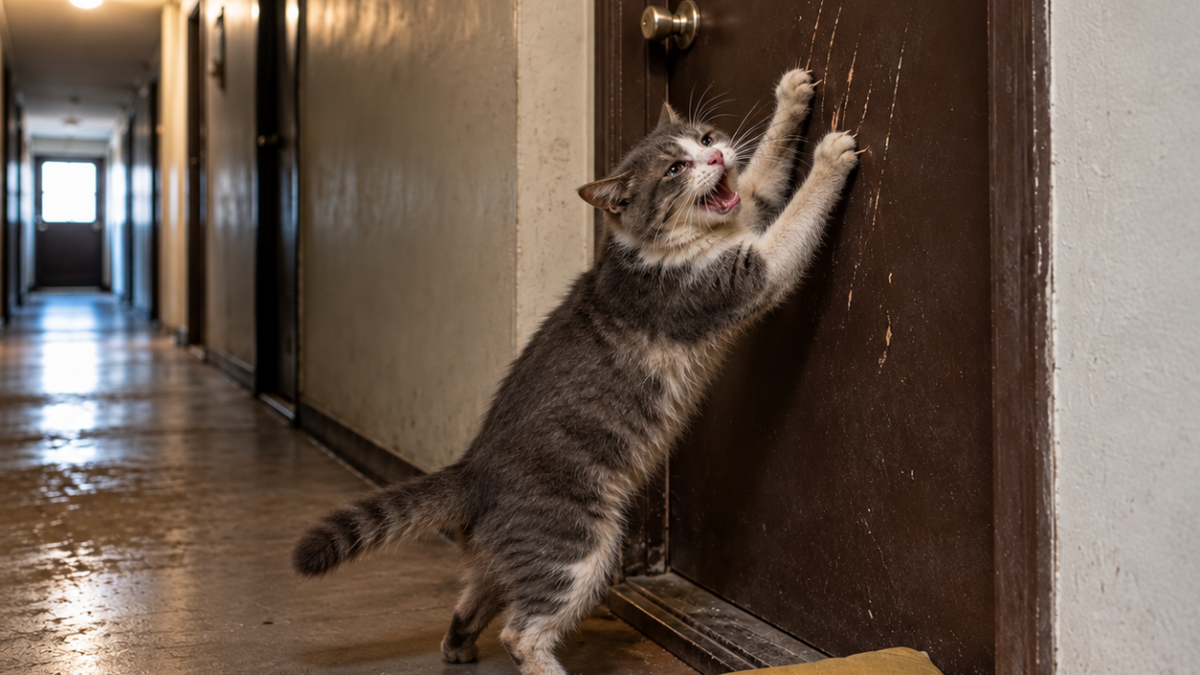
Mary’s cat sat outside 4B.
He was smaller than he looked from the window.
Gray and white.
Thin in a way that suggested he had always been delicate, but now there was something wrong beneath it.
He sat facing Mary’s door.
He looked at me once.
Then turned back.
Like I did not matter.
Like he was waiting for the only person in the world who did.
There was a little dish near the baseboard.
Empty.
I looked at the door.
No light under it.
No sound inside.
No answer.
“Hey,” I said softly.
The cat did not move.
I knocked.
Once.
Then again.
“Mary?”
Nothing.
I waited longer than I needed to.
Then I did what people do when they are uncomfortable and not yet brave enough.
I went back downstairs.
That night, I barely slept.
The crying stopped sometimes.
Then started again.
Each time it did, it seemed weaker.
In the dark, I lay on my back and stared at the ceiling where Mary’s footsteps used to be.
I told myself I would check in the morning.
Morning is the great hiding place of the guilty.
We put things there because we want courage to arrive with daylight.
The next day, the cat was still there.
Curled outside Mary’s door.
Same closed apartment.
Same empty dish.
Same small body.
Only now there was a yellow cushion beside him.
Mary’s window cushion.
I have no idea how it got into the hall.
Maybe someone had opened the apartment briefly and set it out.
Maybe the cat had dragged it somehow.
Maybe there was a practical explanation.
I never learned it.
All I know is that he was pressed against that faded yellow cushion so tightly it looked like he was trying to crawl back into a life that had already ended.
That was the part that broke me.
Not just the crying.
Not just the hunger.
The waiting.
He was not confused about being outside.
He was not simply scared.
He was waiting for a door to become a world again.
I crouched a few feet away.
“Come here,” I whispered.
He looked at me.
His eyes were dull with exhaustion.
“I don’t know where she is,” I said, as if he had asked.
He blinked once.
I reached out slowly.
He did not run.
He did not hiss.
He did not scratch.
When I lifted him, he barely felt like anything in my arms.
I carried him downstairs with his yellow cushion tucked awkwardly under one arm.
In my apartment, I set out water.
Then dry food.
Then a little dish of tuna because panic makes people offer whatever they have.
He touched nothing.
He walked behind my couch and disappeared into the shadow there.
For the rest of the night, I sat on the floor a few feet away and pretended not to watch him.
I spoke in a low voice about nothing.
The rain outside.
My bad coffee maker.
The neighbor downstairs who slammed his truck door like the truck owed him money.
Little useless things.
Things you say when silence feels too heavy but meaning would be too much.
“You don’t have to trust me,” I told him.
He did not answer.
“You can stay there.”
He remained behind the couch.
“I’m here.”
I said that a lot.
I’m here.
As if repetition could build a bridge.
The next morning, the food was untouched.
The tuna had dried at the edges.
The water level had barely changed.
The cat stayed behind the couch so long I had to kneel twice and check if he was breathing.
I called the property office.
A woman with a polite voice told me maintenance had been notified.
“Is Mary okay?” I asked.
There was a pause.
“I can’t share tenant information.”
“I’m her neighbor.”
“I understand.”
Her tone said she did not.
“Her cat was outside her door for two nights.”
Another pause.
“We were told family would handle the animal.”
The animal.
Not the cat.
Not Mary’s cat.
The animal.
The phrase irritated me before I knew why.
“Family didn’t,” I said.
“I’ll make a note.”
A note.
The whole world loves making notes while living things wait.
I hung up and looked toward the couch.
The cat did not come out.
I tried wet food that night.
Nothing.
Tuna again.
Nothing.
Chicken.
Nothing.
Then I moved Mary’s yellow cushion from near the door to beside the couch.
For two hours, he did not move.
Then, just before midnight, he slid out from the darkness and lay against it.
He pressed his face into the fabric and went still.
That was when I stopped thinking of him as scared.
He was grieving.
I know some people hate when animals are given words like that.
They prefer simpler language.
Stress.
Adjustment.
Behavioral response.
Instinct.
Fine.
Use whatever words make you feel safe.
I know what I saw.
That cat was grieving.
The next morning, I took him to the vet because I did not know what else to do.
He did not fight the carrier.
That frightened me more than if he had.
At the clinic, a young veterinarian checked him over with gentle hands. She listened to his heart, looked at his gums, pressed his belly, weighed him, and asked how long he had gone without eating.
“He’s weak,” she said. “Dehydrated. Underweight for his frame. But I’m not finding an obvious injury or illness that explains all of it.”
“So what do I do?”
She looked at him, then at me.
“Cats grieve quietly,” she said. “Sometimes so quietly people miss how bad it is.”
I sat with that sentence all the way home.
Cats grieve quietly.
Sometimes so quietly people miss how bad it is.
I thought about Mary.
I thought about how her whole life had been upstairs from mine.
How I had heard her kettle.
Her cough.
Her steps.
Her television.
How I had never knocked once just to ask if she needed anything.
Not once.
Because she seemed fine.
Because she smiled.
Because she said good evening.
Because she moved through the building with the kind of dignity that makes other people mistake isolation for independence.
I brought the cat home with appetite medicine, special food, instructions, and a bill I could not comfortably afford.
I also brought home a truth I did not want.
Medicine would help his body.
But not the part of him still sitting outside Mary’s door.
So I took a few days off work.
Not because I could afford to.
Because sometimes the thing you cannot afford is still cheaper than what happens if you do nothing.
I did not force him to be held.
I did not keep reaching under the couch.
I did not drag him into my lap and demand that he understand rescue on my timeline.
I just stayed.
Evenings on the floor.
Back against the wall.
Bowl nearby.
Yellow cushion between us.
I read grocery ads out loud.
I described the weather.
I complained about my neighbor’s truck door.
I told him I had no idea what I was doing.
“You don’t have to trust me yet,” I said.
His eyes were open in the dark under the couch.
“I’m here.”
Days passed.
For a while, nothing changed.
Then one afternoon, I walked across the living room and noticed his eyes following me.
That was all.
Just his eyes.
But after so much emptiness, it felt enormous.
The next morning, I sat on the floor with a little wet food on my finger.
I held it out.
He stared at me for a long time.
I did not move.
My arm began to ache.
Still, I waited.
Then he leaned forward and licked it once.
I cried so suddenly I startled myself.
Not because everything was fixed.
Not because I knew he would be okay.
Because for one tiny second, something inside him had chosen to keep going.
After that, change came slowly.
He ate a little from my finger.
Then from a spoon.
Then from the edge of the bowl while I sat nearby pretending the fate of my heart was not attached to every bite.
He stopped hiding all day.
He slept beside Mary’s yellow cushion.
Then beside the couch.
Then on the far end of the couch.
The first night he climbed up while I was watching television, I froze so completely I forgot to breathe.
He walked to the far cushion, turned three times, and lay down with his back facing me.
It was not affection yet.
It was proximity.
Sometimes proximity is the first draft of trust.
During a thunderstorm two weeks after I found him, he came closer.
Rain hit the windows.
Thunder rolled over the roof.
The cat lifted his head, looked toward the door, then toward me.
I held out my hand, palm up.
He waited.
Then he lowered his head and rested his chin on my fingers.
So lightly I barely felt it.
Like a question.
Like he wanted to know whether I meant it when I said I would stay.
That night, I named him Phoenix.
Because I had watched that little cat drag himself back from something food and medicine alone could not fix.
Because Jasper had belonged to Mary.
At the time, I did not know his real name.
Phoenix belonged to survival.
Sometimes he still sat by the front door and stared.
I let him.
I did not try to erase Mary.
Love does not work that way.
You do not replace a person by filling a bowl.
You do not heal grief by removing every reminder.
You make room beside the missing.
You let both truths exist.
Mary is gone.
You are here.
The trouble started ten days later.
Someone began pounding on Mary’s door like grief had a deadline.
Not knocking.
Pounding.
Hard, flat, impatient blows that rolled through the hallway and into my apartment like a warning.
Phoenix heard it before I did.
He had been asleep on the far end of the couch, one paw tucked under him, his head against the yellow cushion.
The first bang hit, and his whole body lifted.
Not scared.
Alert.
Hopeful.
That was the worst part.
He jumped down, almost slipped on the wood floor, and ran to my apartment door. He sat there staring up at the handle, ears forward, body trembling with a kind of desperate expectation I hated to see.
Another bang.
Then a voice.
“Unit 4B?”
A man.
“Hello? We’re here to open up.”
Phoenix made a sound I had never heard from him.
Not the thin hallway cry.
Not a hiss.
Something smaller.
Broken.
Full of recognition.
I opened my door and stepped into the hall.
Two people stood outside Mary’s apartment.
One was a maintenance man in a navy work shirt with a ring of keys at his hip.
The other was a woman in her fifties wearing jeans, a black sweater, and the face of someone holding herself together by force.
She carried a grocery-store bouquet wrapped in plastic.
The flowers looked too bright in that hallway.
The maintenance man glanced at me.
“You live here?”
“Under her,” I said.
The woman looked at me then.
Fast.
Sharp.
“You knew Mary?”
I almost said no.
Because what does knew mean?
I knew her smile.
Her cardigans.
Her slow steps.
The sound of her television.
The smell of tea.
The cat in her window.
I knew the outline of her life, not the inside of it.
“I was her neighbor,” I said.
Phoenix slipped halfway into the hall behind my legs.
The woman looked down.
Her face changed.
Not softer.
More tired.
“Oh,” she whispered. “The cat.”
The maintenance man shifted his keys.
“The office said there was an animal loose after the ambulance came. We assumed family had handled it.”
Family.
Phoenix sat in the middle of the hallway and stared at them.
The woman closed her eyes.
“I’m her daughter,” she said. “Elaine.”
That hit me harder than I expected.
Not because Mary had a daughter.
Older women are not born old and alone.
They come from somewhere.
They belong to someone, even when those people stop showing up.
It hit me because for two nights that cat had cried outside a locked door, and no daughter had been there.
No son.
No niece.
No friend.
Just a hallway.
Just me listening from downstairs and pretending one more night that maybe there was an explanation that would hurt less.
“I’m sorry,” I said.
It sounded too small.
Elaine nodded like she had heard the words so many times they no longer had anywhere to land.
“She passed four days ago,” she said.
Phoenix stayed still.
“Stroke,” she added. “They said she was conscious for a little while at the hospital. Then she wasn’t.”
The hallway went silent.
I had imagined a dozen endings.
A visit.
A fall.
A nursing home transfer.
A family emergency.
None felt as final as hearing it from Mary’s daughter while her cat sat between us waiting for a door to explain itself.
The maintenance man cleared his throat.
“We need to go through the unit. Office needs an inventory before turnover.”
Turnover.
There are words that should be illegal in certain moments.
A whole human life reduced to what happens before they paint the walls for whoever comes next.
Elaine flinched.
She placed the flowers on the floor near the door, then took out a key.
Her hand shook when she put it in the lock.
Phoenix stood.
I caught him before he could slip inside as the door opened.
The smell came out first.
Dust.
Tea.
Old fabric.
That dry stillness apartments get when somebody who kept a quiet life is no longer there to move the air.
Then I saw it.
A small lamp beside a recliner.
A folded blanket over the arm.
House shoes near the couch, placed side by side as if Mary might come back and step into them.
A half-finished crossword on a table.
A mug in the sink.
And near the window, the empty place where the yellow cushion used to be.
Elaine made a sound low in her throat and pressed the back of her hand to her mouth.
The maintenance man stepped back.
“I’ll give you a minute.”
He disappeared down the hall.
I should have gone downstairs.
I should have minded my own business.
People say that phrase like it is wisdom.
Most of the time, it is fear wearing good manners.
Elaine stood in the doorway like she had forgotten how bodies move.
Phoenix strained gently in my arms.
Not wild.
Not panicked.
Just reaching.
I said, “Do you want him to see it?”
Elaine looked at me.
“What?”
“The apartment.”
Her face tightened.
Then, very quietly, she said, “I don’t know.”
Neither did I.
There are no instructions for this part.
No handbook for what a grieving cat should be allowed to understand.
But I knew what I had seen in him.
He was not an object to be boxed up after the fact.
He had loved her.
That had to count.
So I set him down.
Phoenix walked in slowly.
Not like an animal exploring.
Like a person entering a church after missing the funeral.
He sniffed the rug.
The chair leg.
The corner of the kitchen where his bowls had been.
Then he jumped into the window and pressed his face into the fabric there.
His eyes half closed for one brief second, like he had found an echo.
Elaine started crying then.
Not pretty crying.
Not quiet.
The kind people do when they have been holding a wall up inside themselves and something finally breaks through it.
I stood uselessly near the doorway while Phoenix stayed in the window and grief settled beside him in a shape he recognized.
After a while, Elaine wiped her face.
“I hadn’t seen her in eight months,” she said.
She said it to the room.
Not to me.
Maybe confession is easier when it does not have to look directly into another pair of eyes.
I leaned against the doorframe.
Not forgiving.
Not accusing.
Just there.
“She stopped answering my calls,” Elaine continued. “Before that, it was every few days. Then once a week. Then voicemail. Then nothing.”
Phoenix hopped down and disappeared into the bedroom.
Elaine watched him go.
“I told myself she needed space. We had a fight last summer. About moving closer to me. About getting help. About her telling me she was fine when she clearly wasn’t.”
She laughed once.
Short.
Bitter.
“Everyone says adult kids should do more. Nobody talks about what it’s like trying to help someone who would rather fall alone than let you carry one grocery bag.”
There it was.
The thing ugly enough to be true.
Not the clean version people like to argue about online.
Not the simple story where the lonely old mother waits by the phone and the selfish daughter cannot be bothered.
Something harder.
Something with no easy villain.
I said nothing.
Elaine looked at me as though she expected judgment.
Maybe she deserved some.
Maybe she was already carrying enough.
“She told me if I tried to move her into assisted living, she’d die hating me,” Elaine said. “So I backed off. Then I hated myself anyway.”
I thought of Mary smiling by the mailboxes.
Kind.
Gentle.
Soft-voiced.
I thought about how little we know of the private weather inside other people’s homes.
The sweetest neighbor in a hallway can still be impossible to the people who tried to save her.
The coldest daughter in a hallway can still be carrying ten years of unanswered calls.
Phoenix came back with something in his mouth.
A sock.
Soft.
Gray.
Probably one of Mary’s house socks.
He carried it into the middle of the living room, laid it down carefully, and curled around it.
Elaine made that hurt sound again.
Then she crouched a few feet away.
Phoenix looked up but did not go to her.
That mattered more than either of us wanted it to.
“I can’t take him,” Elaine said.
I had known before she said it.
Still, hearing it out loud lit something hard in me.
“You’re her daughter.”
“Yes.”
“And you can’t take the one living thing she loved most?”
Her eyes flashed.
“You think I don’t know how that sounds?”
I did not answer.
Because I knew exactly how it sounded.
It sounded terrible.
It also sounded like real life.
“My husband is allergic,” she said. “Badly. We live in a rental that barely allows the dog we already have. My grandson has breathing issues. I’m gone half the week taking my sister to appointments. I am not saying he doesn’t matter. I’m saying I cannot take on one more life I might fail.”
The room had to sit with that.
I hated that part.
How reality can take a sharp moral line and smear it until everyone looks a little guilty and a little trapped.
Elaine looked around Mary’s apartment.
“Can you keep him until I figure something out?”
Phoenix pressed his face deeper into the sock.
I thought about the vet bill on my kitchen counter.
The pet clause in my lease.
The way my checking account looked comfortable for about twelve hours after payday and then began its slow collapse toward the next one.
“I don’t know,” I said honestly.
Elaine nodded like she had expected that.
The maintenance man came back.
Slower now.
Gentler.
“You folks okay?”
No.
But people ask that question when what they mean is: are you okay enough for the world to keep moving?
Elaine stood.
“We need boxes,” she said.
That was how I spent my Saturday.
Packing up the apartment of a woman I had only known in thin neighborly slices.
Cardigans.
Tea tins.
Three pairs of reading glasses in different rooms.
A drawer full of birthday candles saved because they still worked.
Half-finished crossword books.
Two Christmas cards from three years earlier kept on a shelf, maybe because when you get old enough, proof you were remembered once starts lasting longer.
There were photos too.
Mary younger.
Mary with dark hair.
Mary holding a little girl on her hip, probably Elaine.
Mary beside a man in a fishing hat.
Mary laughing in one picture so hard her whole face folded up, and I had to look away because it was unbearable to realize how many full lives a hallway smile can hide.
Phoenix followed us room to room.
Not underfoot.
Just near enough to keep watch.
Sometimes he sat in a doorway and looked at me.
Sometimes at Elaine.
Once, in the bedroom closet, I found a plastic bin full of labeled envelopes.
Utilities.
Medical.
Taxes.
Cat.
Inside Cat were vaccination records, an old adoption receipt, and a folded note in Mary’s handwriting.
The note said:
If something happens to me, his name is Jasper.
Please do not let him think I left him on purpose.
I sat down on the edge of the bed with the paper in my hand.
Elaine saw my face.
“What is it?”
I handed her the note.
She read it once.
Then again.
When she reached the line about not letting him think Mary had left on purpose, her mouth trembled.
“He waited outside the door?” she asked.
I nodded.
“For two nights.”
Elaine covered her eyes with one hand.
I think that was the moment Mary’s death became real to her in a new way.
Not hospital real.
Not paperwork real.
Not funeral-home real.
Love real.
The kind that leaves a living body in the hallway wearing itself down because nobody explained the ending.
“Jasper,” Elaine said softly.
The cat looked up from the closet doorway.
He did not come when she said it.
Not because he had forgotten.
Because too much had happened since that name last meant safety.
“He knows Phoenix now,” I said.
Elaine let out a wet laugh.
“Then maybe he needed both.”
That stayed with me.
Jasper for who he had been.
Phoenix for what he had survived.
By late afternoon, Mary’s apartment looked wrong.
Not empty.
Wounded.
Bare walls where pictures had been.
Dust outlines where small objects used to sit.
A silence that no longer felt lived in, only stripped.
There is something violent about how quickly the world clears away evidence that someone was here.
A person breathes in a space for twelve years.
Then one weekend, people with boxes turn her into memory.
When the maintenance man returned for a final walk-through, Phoenix hissed at him for the first time.
Not because the man was cruel.
Because he represented what was happening.
The practical end of someone beloved.
Clipboard.
Keys.
Next.
He glanced at the cat, then at me.
“Office is going to need to know what’s happening with the animal.”
There it was again.
Animal.
Never Jasper.
Never Phoenix.
Never the creature who had almost starved himself waiting.
“He’s with me for now,” I said.
The maintenance man nodded, but not in a way that reassured me.
That evening, Elaine helped me carry Mary’s yellow cushion back downstairs.
Phoenix jumped onto it the second we set it by my window.
Then he curled in the middle like something in his body had finally decided where home was.
Elaine stood in my living room, suddenly unsure of everything.
Grief makes strangers of people in different ways.
For me, it had made me tender.
For her, brittle.
For Phoenix, quiet.
She watched him for a long time.
“I can pay you back for food,” she said. “Vet bills. Whatever.”
I almost laughed.
Not because it was funny.
Because that is what people do when love gets too complicated.
They try to turn it into an invoice.
“It’s not like that,” I said.
She nodded, embarrassed.
“No. I know.”
She reached into her purse and pulled out another folded note.
“I found this in the kitchen drawer. I think it was meant for the office. Or whoever came first.”
She handed it to me.
The note said:
I know people live busy lives now.
If I am ever the old woman nobody notices for a while, please check on the cat before the paperwork.
That sentence knocked the air clean out of me.
Please check on the cat before the paperwork.
There are lines that tell you everything about a person’s fear.
That was one of them.
Not death.
Not pain.
Being processed before being cared for.
Being reduced to forms while something living still waited.
I looked up.
Elaine was watching me.
“She knew,” she said.
“What?”
“That she could disappear in there. She knew.”
I thought about the little sounds from above I had gotten used to.
The cough.
The TV.
The slow steps.
How quickly a person can become background until their absence has to scream before anyone admits they were there.
“She shouldn’t have had to know that,” I said.
Elaine’s laugh was tired.
“No,” she said. “But she did.”
After Elaine left, my apartment felt different.
Not because I was alone.
Because I wasn’t.
Phoenix jumped onto the couch and stared at the front door.
He did that often.
Some nights for two minutes.
Some nights for twenty.
I never stopped him.
Grief is not healed by being rushed out of the room.
Three days later, the notice came.
A white envelope slipped under my door.
Unauthorized pet.
Please remedy within five business days or additional action may follow.
I stood in my kitchen holding that paper while Phoenix ate a few feet away, and the urge to laugh rose in me so hard it nearly turned into something else.
Of course.
Of course kindness came with a fee.
Of course the world can tell you to do the right thing and then hand you a clause explaining why the right thing costs more than you have.
The pet deposit alone might as well have been a dare.
Then monthly pet rent.
Then follow-up vet visits.
Then food that did not upset his stomach.
I sat at the kitchen table and did the math.
Twice.
Then a third time, as if numbers might grow a conscience if stared at long enough.
They did not.
I worked full-time.
I skipped takeout.
I bought store-brand coffee.
I stretched leftovers.
I had been putting off new shoes because the soles were slick in rain.
Still, one grieving cat and one piece of paper from the property office were enough to make my chest tight.
That is another thing people love to argue about.
Whether pets are a luxury.
Whether people without extra money should keep them.
Whether love is irresponsible if your bank account cannot prove it.
The people making those speeches have usually never been the reason another living thing kept going.
I called Elaine.
She answered on the third ring.
“How’s he doing?”
“Better,” I said. “The office isn’t.”
I told her about the notice.
She sighed like she had expected something like this from the second she stepped into the building.
“I can send money for the deposit.”
I looked at Phoenix asleep on the yellow cushion.
“No.”
“Why not?”
Because pride is inherited in strange ways.
Because I did not want this cat to become a debt between us.
Because something stubborn in me already loved him enough to want the burden to count as mine.
Because accepting help can feel like admitting the world is allowed to price your compassion and call it reasonable.
“I’ll figure it out,” I said.
Elaine was quiet.
Then she said, “That sounds like her.”
I did not know whether to take that as praise or warning.
The next morning, Mrs. Alvarez from 2A caught me near the mailboxes.
She was tiny, always wore lipstick no matter the hour, and had lived in the building longer than most of the paint.
“I heard about Mary,” she said.
Her eyes flicked toward my apartment.
“And the cat.”
News travels fastest in buildings where people pretend not to know each other.
I nodded.
Mrs. Alvarez leaned closer.
“The office gave you trouble?”
I held up the notice.
She made a face like she had bitten a lemon.
“They charged me a fee for putting a chair on my own porch two summers ago,” she said. “A chair.”
It made me smile for the first time all day.
Then she looked at me carefully.
“You keeping him?”
“I’m trying.”
“Good.”
She dug in her purse, pulled out a folded twenty, and pushed it into my hand.
I stepped back.
“No.”
“Yes.”
“I can’t take your money.”
She straightened, offended in the way older women get when they have already decided something and you are foolish enough to resist.
“You can and you will,” she said. “That cat cried outside her door for two nights, and half this building heard it. You happened to be the one with enough heart to answer. Don’t insult me by acting like the rest of us don’t owe something too.”
I stared at the twenty.
It did not fix the numbers.
But it changed the shape of the day.
That evening, there was another envelope under my door.
Not from the office.
No name.
Inside was fifteen dollars and a note on lined paper.
For the yellow-cushion cat. From the girl in 1C with the headphones.
The next day, Reggie from downstairs knocked and handed me a half-full bag of cat food.
“My sister’s cat passed last month,” he said. “Figured this might help.”
Then, because people would rather wrestle an alligator than say something tender out loud, he scratched the back of his neck and added, “No point letting it go to waste.”
By the end of the week, there was an ugly little pile on my counter.
Cash.
Food.
A grocery gift card.
Two cans of fancy wet food from someone who clearly believed grief should be fed in gravy.
And one note written in shaky blue ink.
Please keep him by a window. Mary always said he liked watching the rain.
I sat there looking at those things and felt ashamed in a new way.
Not because I needed help.
Because all these people had been here the whole time.
Above and below.
Behind thin walls.
Passing each other with laundry baskets, apologies, and exhausted faces.
It took one dead woman and one grieving cat to make us act like neighbors.
That should bother us more than it does.
The office called me in the next Monday.
The woman behind the desk was not cruel.
That is what makes systems difficult to hate cleanly.
Cruel would be easier.
She was polite.
Professionally sympathetic.
The kind of person who says “I completely understand” while sliding a paper toward you that proves she does not have to.
“If you want to keep the cat,” she said, “we can add him to your lease once the deposit and monthly fee are paid.”
“Once.”
“Yes.”
“I took him in because your office let him sit outside a dead woman’s door for two nights.”
Her mouth tightened.
“We were told family would retrieve him.”
“But no one checked.”
A pause.
Then, “I understand this is emotional.”
There are few sentences more likely to make a person feel violent while technically remaining polite.
Emotional.
As if the problem were my feelings.
Not the hallway.
Not the empty dish.
Not the note asking someone to check on the cat before paperwork.
I looked at the framed slogans on the wall behind her.
Community.
Comfort.
Home.
Almost funny.
Almost.
“Here’s what’s emotional,” I said. “A cat not eating because the person he loved never came back. A woman writing a note asking people to check on him before paperwork. Me sitting here being told compassion requires a processing fee.”
The woman blinked.
Not offended.
Startled.
As if I had said the quiet part out loud in a room designed to prevent that.
Her voice softened.
“I don’t make the policies.”
I knew that.
Everybody is always standing in front of some rule they claim does not belong to them.
That is how whole systems stay clean while doing dirty things.
“I’m not asking you to make policy,” I said. “I’m asking whether anyone in this building has the authority to act like a human being for five minutes.”
The room went still.
Then she looked down at her keyboard.
“Let me talk to the regional manager.”
Regional manager.
Another phrase built to place the decision one floor higher than compassion can reach.
I left with nothing promised.
But something had shifted.
Maybe not in policy.
Maybe only in her.
Sometimes that is where change starts anyway.
That night, Elaine came by.
Not because I asked.
Because she wanted to see him.
Phoenix stayed under the coffee table when she arrived.
He watched her from there, body low but not terrified.
Elaine carried a cardboard box.
“Some things from Mom’s apartment,” she said. “I thought he might know them.”
Inside were Mary’s robe.
A little ceramic dish with blue flowers along the rim.
A framed photo of Mary sitting in her recliner with Jasper on her lap, both of them looking toward something outside the frame.
I set the photo on my bookshelf.
Elaine stared at it for a long time.
“She was younger there,” I said.
“She was,” Elaine answered.
“She looked happy.”
Elaine smiled, but it hurt.
“She loved that cat more openly than she loved most people.”
There it was again.
A sentence people could divide themselves over.
Some would hear it and decide Mary failed her family.
Others would understand that sometimes animals are easier to love because they do not keep score.
I poured two coffees.
Elaine sat at my tiny kitchen table with both hands around the mug.
“Can I tell you something awful?” she asked.
“At this point? Sure.”
She looked down.
“When the hospital called, the first thing I felt wasn’t sadness.”
I said nothing.
“It was relief,” she whispered.
Her mouth trembled.
“She had fallen twice before and refused help both times. Every phone call turned into a fight. Every visit ended with me driving home feeling like I was twelve years old again and somehow still disappointing her.”
Her eyes filled.
“So when they called, part of me thought, at least she can’t be alone and stubborn and unsafe anymore. What kind of daughter thinks that?”
“A tired one,” I said.
Elaine let out a breath that sounded like it had been trapped in her chest for months.
“You really think that?”
“I think people say family is everything until family gets complicated,” I said. “Then they disappear and leave whoever is inside it alone with the shame.”
That landed.
Maybe because it was true for her.
Maybe because it was true for me too, in ways I had not been naming.
Elaine nodded slowly.
“She loved me,” she said after a while. “I know she did. But sometimes love from a parent still leaves bruises nobody else can see.”
Phoenix came out then.
He walked in a slow half-circle around the kitchen.
Then, to both our surprise, he went to Elaine’s chair.
Not onto her lap.
Not even close enough to touch her hand.
He simply sat beside one leg of the chair and leaned his body against the wooden rung.
Elaine stopped breathing for a second.
Her hand trembled in the air.
“Can I?”
I nodded.
She reached down slowly and touched the top of his head with two fingers.
Phoenix closed his eyes.
Not for long.
Just a moment.
But it was enough to crack something open in both of us.
Elaine began crying again.
This time quietly.
“He remembers me,” she whispered.
Maybe he did.
Maybe he remembered her voice from old visits.
Maybe he remembered the smell of Mary on someone who had once belonged inside that apartment too.
Or maybe he was simply the first among us brave enough to stop punishing grief for being messy.
Over the next two weeks, my apartment became the place people knocked on when they wanted to say something human and did not know how.
Mrs. Alvarez brought soup and stayed to talk about the husband she lost nine years earlier.
The girl from 1C had a name.
Nia.
I learned that because she finally took one headphone out long enough to tell me.
She sat on my floor and cried into Phoenix’s fur because her mother lived two states away and kept saying she was “fine” in a voice Nia no longer trusted.
Reggie fixed my kitchen faucet without charging me.
“Mary used to give my kid peppermints when he was little,” he said from under the sink. “I forgot that until this week.”
Everybody had a Mary story.
That was the other punch to the heart.
She had not been unnoticed.
Not exactly.
She had been fragmented.
A peppermint to one person.
A mailbox smile to another.
A casserole after surgery.
A Christmas card.
A quiet hello.
Tiny pieces of kindness spread so thin across the building that nobody realized how much of the place she had been holding together until she was gone.
That is how some people live now.
Not loudly loved.
Quietly essential.
The kind whose absence does not make headlines.
It just makes the hallway colder.
One Friday afternoon, the office called.
The same woman asked if I could come down.
I took Phoenix’s file folder with me because grief had turned me into the kind of person who carried paperwork for a cat as if defending his right to exist.
When I arrived, the woman looked almost embarrassed.
“The pet deposit is being waived,” she said.
I stared.
“What?”
“The monthly pet fee will also be waived for the remainder of your current lease term.”
I did not sit down, although my legs wanted me to.
“Why?”
She looked at a paper in front of her.
“Resident hardship exception under special circumstances.”
That sounded too official to be real.
“What special circumstances?”
This time, against her better instincts maybe, she smiled.
“Several residents had strong feelings.”
Later, I learned what that meant.
Mrs. Alvarez had marched into the office with lipstick, cane, and the full moral authority of someone who had lived there fifteen years and never once requested anything.
She informed them that if they charged “that young man for saving the hallway cat,” she would spend the rest of her natural life making herself their administrative problem.
Reggie had threatened nothing, but he had asked calm questions in a voice big enough to suggest calm had limits.
Nia posted in the building forum, where people usually argued about laundry-room etiquette and parking spots, that if management could decorate the lobby with fake candles and talk about community, then it could prove it.
Elaine wrote a letter.
No one showed it to me.
The office woman only said it was “difficult to ignore.”
I walked back upstairs with my hands shaking.
Phoenix was sitting in the window when I opened the door.
He looked at me the way cats do, as if he had expected victory all along and did not understand why humans were emotional about basic facts.
I sat on the floor in front of him.
“You get to stay,” I said.
He blinked once.
Then he stepped onto my lap.
Not beside it.
Not one paw and then doubt.
My whole lap.
He curled in the middle.
For a long time, I sat there with my hand on his back, feeling the steady rise and fall of his breathing.
Some victories never look like victories from the outside.
No marching bands.
No dramatic music.
No headline.
Just a cat deciding your body is safe enough to sleep on.
Elaine came by that Sunday with one last box.
“Found this in storage,” she said.
Inside were notebooks.
Journals, sort of.
Not daily records.
Recipes.
Phone numbers.
Small observations.
Thoughts written in careful handwriting.
I should not have read them all.
I know that.
But Elaine opened one and handed it to me.
“She would have liked you,” she said.
That was enough permission for my conscience to step aside.
Mary wrote simply.
No fuss.
No poetry trying too hard.
Just sentences sharp enough to make you sit still.
One page made me stop.
People think loneliness is about having nobody.
That is not the worst kind.
The worst kind is when people are near enough to hear you drop something but not near enough to notice when the sound stops.
I closed the notebook.
Because yes.
Because that.
Because every apartment building in this country should have that sentence stamped over the front entrance in letters large enough to shame us all.
Elaine sat on my couch while I read.
Phoenix slept between us like a bridge neither of us had planned.
“She was always writing lines like that,” Elaine said. “Sharp little things that made you mad because they were true.”
I looked at Mary’s photo on the shelf.
“Did she know you loved her?”
Elaine took a long time to answer.
“I think she knew I needed her to be easier than she was,” she said finally. “And I think she hated that.”
It was such a brutally honest sentence that I almost did not know what to do with it.
But honest is where healing starts.
Especially when it is ugly.
We talked more after that.
Not every day.
Not in some movie-perfect way where tragedy turns strangers into family and everyone suddenly says exactly what they mean.
Real life is sloppier.
Some days Elaine called crying.
Some days I did not answer because I had nothing left in me.
Some days she sent old photos of herself as a child with Jasper-as-a-kitten beside Mary’s couch.
Some days there were no messages at all.
But the line stayed open.
That mattered.
So did Phoenix.
He got stronger.
Not all at once.
He still had spells where he sat by the front door and stared.
He still woke sometimes with a confused, searching look, as if grief had returned before memory did.
But he played again.
Badly.
With the dignity of an older cat who thought toys were beneath him until he forgot himself for six full seconds.
He followed me to the bathroom like privacy was a suspicious invention.
He learned the sound of my keys.
He yelled when dinner was three minutes late.
Little by little, life returned in rude, ordinary forms.
That is another reason healing is hard.
People expect a beautiful transformation.
What they get instead is appetite.
Routine.
Annoyance.
A body asking to keep going.
Three months after Mary died, we put a small shelf in the lobby.
Nothing official.
Just a wooden shelf Reggie found, sanded, and screwed into the wall near the mailboxes.
On it, we left things people might need.
A flashlight.
Batteries.
Soup cans.
A roll of stamps.
An extra phone charger.
A jar labeled:
IF YOU HEAR SOMEBODY CRYING, KNOCK.
Mrs. Alvarez thought the jar was dramatic.
Nia said that was exactly why people would remember it.
The office never approved the shelf.
They also never removed it.
Sometimes that is how good things survive in the world.
Not because someone powerful blesses them.
Because enough ordinary people decide to act first.
We also taped optional emergency contact cards inside everyone’s mailbox door.
Private.
Simple.
One person to call if something felt off.
Not if you died.
If something felt off.
That distinction mattered to me.
Too many people wait for proof of disaster before they allow themselves to interfere.
I have started to think “minding your own business” has become one of our favorite ways to abandon each other cleanly.
We call it respect.
Sometimes it is.
Sometimes it is cowardice with better branding.
People online would argue about that.
They argue about everything.
Whether adult children owe aging parents daily calls.
Whether parents who were hard to love deserve gentle endings.
Whether neighbors should get involved.
Whether pets are family.
Whether loneliness is a personal failure or a social one.
I have opinions.
Strong ones.
But the older I get, the less interested I become in clean villains.
Mary was not perfect.
Elaine was not absent because she did not care.
The office woman was not evil.
The maintenance man was not heartless.
I was not some saint.
I heard that first cry and went back downstairs.
That part belongs to me.
I almost let one more night pass because I wanted the problem to fix itself without requiring anything from me.
That is the truth.
Maybe that is why the whole thing lodged so deep inside me.
Because the line between good people and failing people is thinner than we want to admit.
Sometimes it is just one more night.
One more assumption.
One more “somebody else will handle it.”
Phoenix is asleep beside me as I write this.
His front paw is draped over my wrist like he thinks I might wander off if he does not keep part of me pinned down.
Mary’s yellow cushion sits in the window.
Still faded.
Still lumpy.
Still his favorite place when it rains.
Sometimes I call him Phoenix.
Sometimes Jasper.
Most of the time, he answers by ignoring both names equally.
Elaine visits once a month now.
The first few times, Phoenix kept his distance.
Then one afternoon she sat on my floor and told him a story about how Mary used to sing while washing dishes, badly and loudly, and Phoenix walked over and climbed into her lap.
Elaine cried into his fur for ten minutes.
He let her.
That felt important.
Not because it erased anything.
It did not.
Not the missed calls.
Not the hard years.
Not the hospital room she reached too late.
Not the fact that grief can sit beside relief and make a person hate herself for noticing.
It just made room.
That is what I learned from all of this.
Love is not always repair.
Sometimes it is room.
Room for truth.
Room for anger.
Room for the version of a person who hurt you and the version who taught a cat to love the rain.
Room for the fact that somebody can fail you and still be mourned honestly.
Room for the idea that family is not only blood and not only choice, but sometimes whoever finally answers the cry in the hallway.
I think that is the part people will argue with most.
Good.
Maybe they should.
Maybe we need more arguments about the right things.
Not the loud, useless kind designed to humiliate strangers.
The kind that forces us to ask ourselves uncomfortable questions.
Like this one:
What do we owe the people living ten feet from our own front door?
Not in theory.
Not in greeting-card language.
What do we actually owe them?
A nod by the mailbox?
A “let me know if you need anything” nobody intends to honor?
Or something riskier.
A knock.
An interruption.
A casserole.
A ride.
A willingness to be inconvenient for fifteen minutes before life turns tragic and everyone starts posting about kindness.
Because I have noticed something since Mary died.
People love stories about compassion as long as compassion costs nothing.
They love the rescued cat.
The yellow cushion.
The crying by the window.
The idea of staying.
But the second staying means extra rent, paperwork, awkward conversations, inherited grief, or getting involved in someone else’s mess, a lot of people start backing away and calling it boundaries.
And listen.
Boundaries matter.
Privacy matters.
People are tired.
Everybody is stretched thin.
I know that.
I live here too.
I know what it is to come home from work so drained you can barely decide what to eat, let alone whether to step into another person’s sorrow.
But I also know this.
The loneliest people are not always the ones with nobody.
Sometimes they are surrounded by exhausted, decent people who keep choosing not yet.
Not tonight.
Not my place.
Not unless it gets worse.
And by the time it gets worse, there is a dish in the hallway and a cat wearing himself down beside it.
So yes.
Keep your boundaries.
But maybe build a door in them.
One that opens when the crying starts.
One that opens before the paperwork.
One that opens while there is still something living left to save.
Phoenix just lifted his head and looked at the front door.
He still does that sometimes.
Less now.
But enough.
I let him.
Then, after a minute, he looked back at me.
That is grief too, I think.
Not forgetting.
Just learning there can be more than one direction to face.
Mary is gone.
That part stays true no matter how many bowls I fill, windows I open, or soft things I lay in sunspots for him.
But he is here.
Elaine is here.
Mrs. Alvarez is here.
Nia is here.
Reggie is here.
I am here.
For an old apartment building where people used to hear everything and know almost nothing, that feels like a beginning.
Not a perfect one.
A real one.
The kind built from soup, envelopes, awkward honesty, and a cat who refused to let a hallway stay anonymous.
I used to think being a good neighbor meant not causing trouble.
Now I think maybe it means noticing trouble before it becomes permanent.
Maybe it means asking one more question.
Maybe it means learning the names behind the footsteps overhead.
Maybe it means understanding that sometimes the most important cry in a building is the one people can explain away most easily.
A cat.
An old woman.
A little silence where sound used to be.
Small things.
Until they are not.
If you take anything from this story, let it be this.
Do not wait for certainty before you choose kindness.
Certainty comes late.
Sometimes too late.
Knock anyway.
Check anyway.
Ask anyway.
Feed the cat.
Call the mother.
Answer the neighbor.
Sit on the floor.
Stay longer than is convenient.
And if the world hands you paperwork before compassion, choose compassion first and let the paperwork catch up.
That is how Phoenix lived.
That is how something in me did too.
And maybe, if enough of us stop pretending other people’s sorrow is none of our business, that is how more of us will.