My Eight-Year-Old Daughter Stood Between Her Brother and Three Bullies—Then Three Bikers Asked the Question Our Town Had Been Avoiding
PART2:
Children of single parents become accountants before they become teenagers.
They learn which groceries are bought on payday and which are bought when the jar of change on the dryer gets heavy enough.
They learn the tone in your voice when you say, “Not this week.”
They learn to make themselves one less thing you have to fix.
That was what Noah had done.
He had turned his pain into something quiet so I would not have to carry it.
Lily was eight and had not learned that kind of quiet yet.
Thank God.
She was all sharp elbows, scraped knees, pink backpacks, and opinions. She believed every problem could be handled with either a snack, a hug, or an extremely direct conversation.
She loved Noah with the confidence of a child who did not understand the world had rules about fear.
Noah walked her to school every morning.
He tied her shoes when she was pretending she did not know how.
He checked her backpack for library books.
He saved the marshmallows from his cereal and gave them to her like stolen treasure.
If Lily had a nightmare, she went to Noah’s room before mine.
That embarrassed me at first.
Then I understood.
Noah was her safe place.
I did not know he needed one too.
That Friday, I met the kids at Bell’s Market after school.
I had picked up an extra cleaning job that morning and missed the school pickup line, so we agreed they would walk to the grocery store and meet me there. It was not far. Four blocks. Safe sidewalks. Familiar town.
That is what I told myself.
PART3:
I sent Noah and Lily around the side of the building toward the sidewalk while I paid for groceries.
Two bags.
Bread.
Eggs.
Off-brand cereal.
Peanut butter.
A small bag of apples Lily had begged for because one was shaped “like a potato with confidence.”
I was digging for quarters in the bottom of my purse when I heard Lily scream Noah’s name.
Not the scream she used when he teased her.
Not the dramatic one from spider sightings.
This was different.
This was terror.
I abandoned my cart at the register and ran.
The automatic doors opened too slowly.
Everything was too slow.
The cashier shouted something behind me, but I was already across the front of the store, past the vending machines, past the row of carts, toward the side wall where delivery trucks sometimes parked.
Then I saw them.
Noah was curled against the brick wall.
His notebooks lay open in the dirt.
A smashed sandwich sat beneath the heel of a boy named Travis Holt.
Travis was sixteen.
Tall.
Blond.
Broad-shouldered in the way boys get when adults begin mistaking size for maturity.
His father owned Holt Contracting and sponsored the school baseball team. People in town called Travis spirited when they meant cruel. They called him confident when they meant spoiled. They called him “a handful” when they meant nobody wanted to risk upsetting his father.
Two other boys stood with him.
Older than Noah.
Bigger than Noah.
Laughing like this was entertainment.
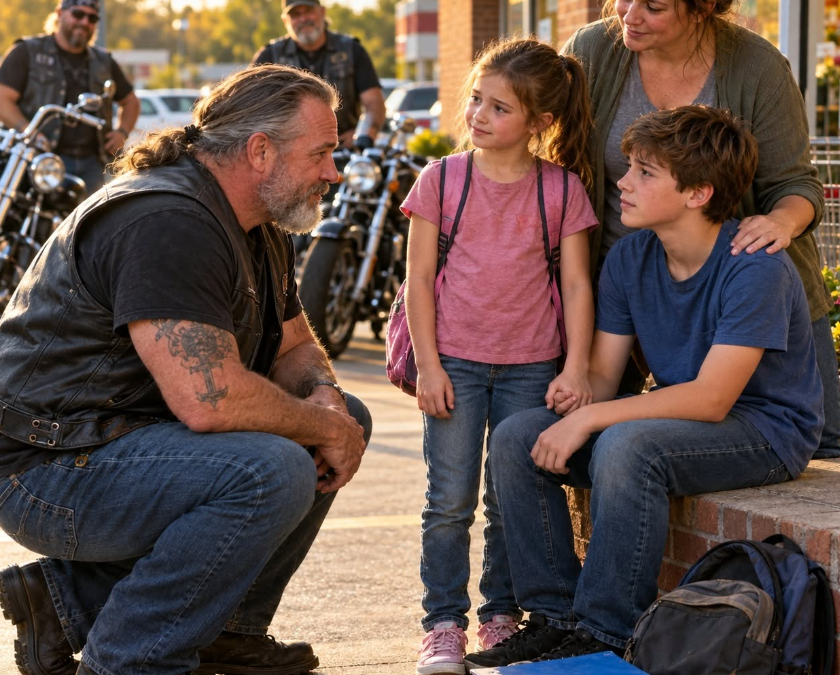
Lily stood between them and her brother, her pink backpack slipping off one shoulder, her little arms spread wide.
“He stole a knife,” one of the boys said when he saw me coming.
“Then call somebody,” Lily snapped. “You don’t get to do this.”
Travis caught her backpack strap and pulled.
She landed on one knee.
My whole body went cold and hot at once.
I shouted.
Noah tried to stand.
The third boy shoved him back against the wall.
That was when three motorcycles turned into the parking lot.
At any other time, I would have noticed them with the kind of nervous caution I had been taught to feel around men in leather vests and loud machines.
The riders parked near the curb.
The biggest man removed his helmet first.
Gray beard.
Weathered face.
A scar near his left eyebrow.
His leather vest carried the patch of a local riding club I had seen around town but never bothered to understand. I had always crossed streets to avoid them. It is strange how many stories we believe about people we have never spoken to.
He saw Lily get up.
Later, he told me that was why he stayed.
Not Noah on the ground.
Not the boys laughing.
Lily.
Bleeding from one palm.
Shaking.
Still putting herself between her brother and three boys twice her size.
The rider approached slowly.
“Everybody step back,” he said.
His voice was not loud.
That made it more powerful.
Travis laughed.
“Just messing around.”
“Then you can stop.”
I reached my children and dropped the grocery bag.
A can rolled beneath a parked truck.
“Noah. Look at me.”
He could not seem to get a full breath.
I touched his face.
His skin was clammy.
His eyes were too wide.
Lily had dirt on her knee and blood on her palm, but she was still angled toward Travis like a tiny guard dog in light-up sneakers.
The rider crouched several feet away, giving us space.
“My name’s Hank,” he said. “My friend is calling for help.”
“I don’t want trouble,” Noah whispered.
Travis heard him.
His smile returned.
That smile frightened me more than the shove.
Because it said this was not new.
It said Travis knew exactly how much fear he owned.
Lily pointed at him.
“They wait every Friday. They take his lunch money.”
“Lily,” Noah said sharply.
She turned to him.
Hurt flashed across her face.
“You said if I stayed quiet, they’d stop.”
Something inside me went cold.
“How long?” I asked.
Noah stared at the sandwich smashed into the dirt.
He did not answer.
“Since September,” Lily said.
It was April.
Seven months.
Seven months of missing lunch money.
Seven months of torn backpacks.
Seven months of excuses.
Seven months of my son making himself smaller so I would not have one more problem to solve.
I looked around the parking lot.
Six adults were close enough to see.
A man near a pickup.
A woman beside a blue sedan.
An older couple near the cart return.
Two people by the store entrance pretending they had not stopped.
The woman beside the blue sedan closed her trunk with exaggerated care.
I looked at her, waiting for outrage.
Help.
Anything.
She looked away.
Hank turned to one of his friends.
“Ask the manager to save the cameras.”
Travis took two steps toward the sidewalk.
Then he lifted his phone.
“Look at Noah,” he called. “Needs his little sister and his mommy.”
My son flinched.
“Put it down,” I said.
“Public place.”
His thumb moved across the screen.
Then he said the sentence that made the whole world narrow.
“Want everybody to see why you don’t change for gym anymore?”
Noah went so still I could hear his breathing.
Lily lunged for the phone.
Hank caught her gently around the shoulders before she reached Travis.
“No, sweetheart. Stay here.”
I put my hand on Noah’s face.
“What picture?”
His eyes filled.
For a moment, he looked five again, waiting for me to tell him nightmares could not follow him into daylight.
“Mom,” he whispered, “I already told someone at school.”
“Who?”
He swallowed.
“The principal.”
My stomach dropped.
“He said Travis’s dad does a lot for us.”
Noah’s voice broke.
“And I needed to think about what accusing him could cost.”
I stared at my son.
“Cost who?”
Noah’s mouth trembled.
“Everybody.”
The word came out so quietly I almost missed it.
Everybody.
Not Travis.
Not the boys.
Everybody.
My twelve-year-old had been told that telling the truth could hurt the town.
The baseball lights.
The donations.
The school.
The adults.
The people who mattered.
Everyone except the child being hurt.
Hank stood.
He did not curse.
He did not raise his voice.
He looked at Travis, then at the two boys behind him.
“The ambulance is coming,” he said. “Police too. Keep your phone.”
For the first time, Travis looked toward the store instead of at my children.
A cashier came outside with a paper towel and a bottle of water.
His hand shook as he offered them to Lily.
“I saw the first part,” he said. “I’ll tell them.”
The woman by the blue car stepped closer.
“I did too.”
I wanted to ask why seeing had taken so long to become doing.
Instead, I took the towel.
The police arrived.
Then the ambulance.
Then a manager from Bell’s Market, pale and sweating, saying the footage was being saved.
Hank’s friends stood near the edge of the crowd, not threatening anyone, just standing in a way that made it very difficult for people to pretend nothing had happened.
Noah rode to the emergency room with me beside him.
Lily stayed with Mrs. Walsh, our neighbor, who arrived after Hank called her from my phone.
Before the ambulance doors closed, Lily grabbed Noah’s sleeve.
“I’m not mad you told me to be quiet,” she said.
Noah could not answer.
He just held her hand until the paramedic needed room.
At the hospital, a doctor examined his chest and explained the tests.
No broken ribs.
Bad bruising.
A scraped cheek.
A swollen wrist.
Painful movement.
Fear worse than all of it.
When we were alone, I sat beside him.
The fluorescent light hummed above us.
A curtain divided our little room from someone coughing on the other side.
Noah picked at the blanket.
“You don’t have to tell me everything tonight,” I said.
His mouth tightened.
“They took a picture in the locker room.”
I kept my face steady because I could feel him watching it for proof he had become something shameful.
“I was changing,” he said. “They said they’d send it around if I told.”
I wanted to scream.
Not at him.
Not near him.
Somewhere far away from him where he would not have to carry the sound.
Instead, I reached for his hand.
“The shame belongs to the people who did that,” I said. “You hear me?”
He nodded without looking up.
“Noah.”
He looked at me.
“It belongs to them. Not you.”
His face broke then.
Not loudly.
He just folded forward like he had been holding himself upright for months and could finally stop.
I held him carefully because moving hurt.
“I thought you’d be mad,” he whispered.
“At you?”
“I should’ve told.”
“No.”
“But I should have.”
“Noah, listen to me. Adults failed you. That is not the same thing as you failing.”
He cried harder.
I said it again because some truths need repetition before they can get through shame.
“Adults failed you.”
When the officer came to take his statement, I asked for privacy. I asked that any image be handled through proper channels and that Noah not have to repeat the most humiliating part of the story to every adult who walked in.
Then I told the officer what Noah had said about the principal.
He wrote it down.
I had expected Hank to disappear once the immediate danger passed.
People like to help in the loud moment.
The sirens.
The parking lot.
The crowd.
Then they vanish when the work becomes paperwork.
Hank did not vanish.
He was outside the emergency room entrance with my dropped groceries in a fresh bag.
The eggs were gone.
The bread was dented.
The apples were somehow fine.
“Manager found the footage,” he said. “My friend got his name for the officer.”
I looked at this man I had spent years avoiding at gas stations because his motorcycle was loud and his vest made me nervous.
“Why are you doing all this?”
He glanced through the glass doors toward the hospital hallway.
“Your girl shouldn’t have been the first person to stand up.”
That was all.
Over the weekend, the story traveled through Ashford in pieces.
Pieces are dangerous.
Pieces let people choose the version that costs them least.
Someone said Noah started it.
Someone said the bikers threatened innocent teenagers.
Someone said Lily attacked Travis first.
Someone said my son had always been strange.
Someone said I was exaggerating because I needed money.
By Sunday morning, a clipped video appeared online showing Lily running toward Travis’s phone.
Everything before it had been removed.
No shove.
No smashed sandwich.
No backpack strap.
No Travis holding up the phone.
No Noah against the wall.
Just my little girl lunging forward and Hank catching her.
The caption said:
This is what they’re calling bullying now?
I watched it once.
Then closed it before Noah saw my face.
Hank called that afternoon.
“Don’t respond to it,” he said.
“I wasn’t going to.”
“You were thinking about it.”
“I was thinking about several things that would get me arrested.”
He made a low sound that might have been a laugh.
“Store footage is saved. Witnesses gave statements. Another parent saved messages her daughter got from those boys.”
I gripped the phone.
“What messages?”
“Threats. Screenshots. Names. Places.”
I closed my eyes.
“The whole thing exists,” Hank said. “They don’t get to choose the beginning.”
That sentence stayed with me.
They don’t get to choose the beginning.
Bullies count on choosing the beginning.
So do powerful parents.
So do quiet institutions.
They want the story to start when the victim reacts.
When the sister lunges.
When the mother yells.
When the biker steps forward.
They want the story to begin at the moment someone finally refuses to take it.
Because if they can choose the beginning, they can make defense look like aggression.
Monday morning, I kept both children home.
Noah stood in the hallway wearing his backpack, shoes tied, face pale.
“I can go,” he said.
His voice said the opposite.
“You’re staying home today.”
His shoulders dropped.
Relief looks a lot like shame when a child has learned to hide fear.
I went to the district office with copies of what I had reported.
The superintendent’s secretary looked at me like I was either brave or inconvenient.
Possibly both.
The superintendent arranged a meeting for Wednesday.
The principal would attend.
I nearly backed out when Noah asked whether Travis would know he had talked.
“Yes,” I said.
His whole face tightened.
“But adults are going to make a plan before you go back,” I continued. “You will not have to face him alone.”
I was careful with that promise.
I had already heard what careless promises could do.
That evening, Hank’s riding club set up a table near the courthouse square with permission from the town clerk.
I did not know bikers asked permission.
That was one of many things I was learning.
A sheet of butcher paper hung across the front.
In large black letters, it read:
WHO IS HURTING OUR KIDS?
Underneath, someone had written:
Private conversations welcome.
There were no names displayed.
No videos playing.
No children asked to perform their worst memories for a crowd.
Just chairs.
Paper.
Pens.
A coffee urn.
A box of tissues.
And adults ready to listen.
I brought Noah only after asking whether he wanted to go.
“I can leave?” he asked.
“Any time.”
“Even if people are talking to me?”
“Especially then.”
Lily held his hand as we crossed the square.
A girl from his school stood beside her grandmother.
Two brothers waited with their father.
A mother I recognized from the laundromat stared at the blank forms as though filling one out might change her whole life.
Maybe it could.
Noah took a pen.
He wrote slowly, shielding the page with his arm.
I looked away to give him privacy.
It is strange how much parenting becomes learning when not to look.
When he finished, he handed me the paper.
At the bottom, beneath the boys’ names and the places they cornered him, he had written one sentence.
I want to go to school without being afraid.
I had spent months asking whether he finished his homework.
I had not known that was what he needed help with.
Other stories came out that night.
Not loudly.
Not all at once.
A girl whose lunch had been thrown in the toilet twice.
A boy shoved into a locker while other kids filmed.
A seventh grader who stopped riding the bus because a high school student sat behind him and whispered threats.
A mother who had complained three times and been told her daughter was “sensitive.”
A father whose son begged to switch schools but would not say why until he saw Noah’s story online.
The town did not erupt.
That would have been easier.
Instead, it shifted.
Slowly.
Uncomfortably.
Like a person realizing the smell in the house is not outside after all.
Wednesday’s meeting began with the principal describing a “conflict between students.”
I placed photographs of Noah’s torn backpack on the table.
“Which part of this was mutual?” I asked.
He adjusted his glasses.
“We have to consider all perspectives.”
“Then consider his.”
Noah had chosen to come.
I had told him he did not have to.
He said, “I want them to hear me say it.”
So he sat beside me with both hands tucked beneath his thighs.
The superintendent asked about his earlier report.
The principal said he did not remember discouraging him.
Noah lifted his head.
“You told me the baseball lights were because of Mr. Holt.”
The principal stopped moving.
Noah’s voice shook, but he kept going.
“You said everybody would lose if I made trouble.”
No one interrupted him this time.
“You said I needed to think about what accusing Travis could cost,” Noah said. “I thought you meant it would be my fault.”
Silence can be a room finally listening.
The superintendent asked the principal to step outside while she spoke with us.
She wrote down the date Noah remembered and requested the original complaint records.
For the first time in seven months, I felt the weight in my chest shift.
Not lift.
Shift.
Things did not become easy after that meeting.
Stories like this do not end because one adult finally takes notes.
There were interviews.
Calls.
Statements.
Questions.
Mornings when Noah stood dressed in the hallway but could not make himself open the door.
The district separated him from the boys and gave him a named adult to go to immediately.
The principal was placed on leave during the review.
The police investigation continued beyond whatever the school decided.
Travis’s father showed up on television outside his business with a red face and a lawyer’s statement.
He called it “a misunderstanding.”
He called the boys “good kids.”
He called the attention “a witch hunt.”
People in town repeated those words because borrowed language is easier than original courage.
Then the full parking lot footage became part of the investigation.
Not online.
Not for entertainment.
But where it needed to be.
The beginning existed.
So did the middle.
So did the adults who had looked away.
The cashier told the truth when someone repeated the edited video’s story.
Mrs. Walsh helped with pickups.
Hank checked in, but never pushed.
A retired teacher offered to sit with Noah during the first school board meeting if he wanted support.
A mother from the square started a private group for parents whose children had reported bullying and been ignored.
Little things, done consistently, began to give my son back his ordinary days.
That is how healing usually happens.
Not in a grand speech.
Not all at once.
In rides to school.
In names written on plans.
In one adult walking a child to the office and saying, “I’m staying until someone helps.”
One night, Lily asked, “Was I stupid for getting in front of him?”
I pulled her into my lap.
She was getting too big for it and still too small for the world she had stepped into.
“No,” I said. “You were trying to help someone you love.”
“But?”
“But protecting you is our job. You can get an adult. You can yell. You can run for help. You can call 911. You do not have to let someone hurt you to prove you love your brother.”
She thought about that.
“Even if Noah needs me?”
“Especially then.”
Her bottom lip trembled.
“I was scared.”
“I know.”
“I thought if I moved, they’d hurt him more.”
I held her tighter.
That is the thing about brave children.
People praise the bravery and forget to mourn why it was needed.
“You should never have had to make that choice,” I told her.
She pressed her face into my shoulder.
From the doorway, Noah whispered, “I’m sorry.”
Lily turned.
“For what?”
“For telling you to be quiet.”
She climbed off my lap and walked to him.
“You were scared.”
He nodded.
She put both hands on her hips.
“Next time, we tell Mom.”
Noah looked at me.
The guilt in his eyes nearly broke me.
“Yes,” I said. “Next time, we tell me.”
Then I added, because it mattered, “And if I don’t listen right away, you tell me again. Loudly. Both of you.”
Lily nodded like I had given her a mission.
Noah almost smiled.
Almost was enough for that night.
The school board meeting was held two weeks later in the high school auditorium.
Ashford had not seen that many people in one room since the Christmas concert when the sound system failed and the kindergarteners kept singing anyway.
People filled the seats.
Parents stood along the walls.
Teachers sat in clusters.
The riding club stood in the back, helmets under their arms, quiet as furniture.
Hank nodded once when he saw us.
I nodded back.
I had stopped crossing streets to avoid him.
The superintendent spoke first.
Policies.
Review.
Commitment.
Safety.
Words that mattered, maybe, but sounded too clean for what had happened.
Then parents began to speak.
A mother from the laundromat stood with a folded paper in her hand.
“My daughter stopped eating breakfast before school,” she said. “I thought she was being picky. She was afraid she’d throw up on the bus from anxiety.”
A father said his son hid in the bathroom during lunch for three months.
A teacher admitted she had reported hallway harassment twice and been told to document more.
A grandmother said, “How much documentation does a child need before an adult opens their eyes?”
People clapped.
Then Hank walked to the microphone.
The room shifted.
Some people crossed their arms.
Some leaned forward.
He did not introduce himself beyond his name.
“My club set up that table,” he said. “Not because we are experts. We are not. Not because we want to run your schools. We do not. We set it up because an eight-year-old girl with a bleeding hand did what six grown adults in a parking lot did not.”
The room went silent.
Hank looked around.
“The question is not whether children are cruel sometimes. They are. The question is who taught them cruelty had room to work.”
No one moved.
He continued.
“Who taught them which families were too important to challenge? Who taught them that edited videos travel faster than truth? Who taught them that shame belongs to the kid being hurt instead of the kid doing harm?”
His voice stayed steady.
Then he asked the question that changed Ashford.
“Who is hurting our kids, and who has been looking away because it was easier than answering?”
No applause followed at first.
Just stillness.
Good stillness.
The kind that means words found somewhere to land.
Then one person clapped.
Then another.
Then the sound rose until it filled the auditorium.
I looked at Noah.
He was not clapping.
He was staring at the floor, breathing carefully.
I put my hand over his.
He turned his palm upward and held on.
After that meeting, change came awkwardly.
All real change does.
The district announced an anonymous reporting system, then had to revise it when parents pointed out that “anonymous” meant nothing if only three children knew the details.
Teachers received training, though some looked deeply annoyed by the implication that their good intentions had not been enough.
Hallway supervision changed.
Locker room phone rules became stricter.
The school created a process for documenting repeated behavior instead of treating every incident like a fresh surprise.
The principal did not return that semester.
Travis and the other boys faced consequences through the school and through the legal process. I will not write the details like a spectacle. They were minors too, and accountability should not become public entertainment just because the internet enjoys blood.
But I will say this:
For the first time, their fathers’ names did not make the room go quiet.
That mattered.
It did not fix Noah overnight.
Nothing did.
He still flinched when a phone came out too fast.
He still avoided the boys’ side of town.
He still wore his gym clothes under his school clothes for a while, just in case.
He still had days when anger came out sideways at me because I was the safe place and safe places often take the blast.
I learned not to take every sharp word personally.
I learned to say, “That sounded angry. Are you angry at me, or are you scared?”
Sometimes he said, “Both.”
That was fair.
I was angry too.
And scared.
And ashamed.
The shame was not his.
I had told him that.
But mine?
Some of it was.
Not for what Travis did.
Not for what the principal said.
For the signs I missed.
The hunger.
The drawings stopping.
The torn backpack.
The way he stood between Lily and the world but had nobody standing between him and the boys at school.
People told me not to blame myself.
I appreciated that.
I also think guilt has a purpose if you do not let it become a grave.
Mine became a question.
What will I notice now?
Six weeks later, I found Noah at the kitchen table drawing a house.
I stopped in the doorway so suddenly Lily bumped into me.
“What?” she whispered.
I pointed.
Noah bent over the paper, pencil moving carefully.
Lines.
Windows.
A roof.
A porch.
Lily slid past me and leaned over his shoulder.
“Where’s my room?”
“You have three rooms,” Noah said.
“I need four.”
“No.”
“I need a slide to the backyard.”
“You’ll land in the tomatoes.”
She gasped like he had insulted her professionally.
“I would never land in tomatoes.”
“You landed in laundry yesterday.”
“That was different.”
Noah laughed.
Not a polite laugh.
Not a careful one.
A real laugh that came from somewhere I had been afraid was locked.
I stayed in the doorway until my breathing settled.
There were still bills on the refrigerator.
Still meetings on the calendar.
Still court updates.
Still school emails.
His old backpack hung in the closet because he was not ready to throw it away.
Lily still checked his face sometimes when he got quiet.
I still looked too closely at every bruise.
We were not magically healed.
But on the paper before him, the windows were enormous again.
That night, after the kids went to bed, I sat on the porch with a cup of tea and watched headlights pass on our street.
A motorcycle slowed near the curb.
Hank lifted one hand from the handlebar.
Just a small wave.
I waved back.
Then he rode on.
I thought about the town.
About how many people had been close enough to see and still looked away.
I thought about myself, too.
About how I had looked away from signs inside my own home because I was tired, broke, and terrified of needing to fix one more thing.
It would be easy to make this a story about three cruel boys.
Or one cowardly principal.
Or a brave little girl.
Or three bikers who stopped.
But the truth is bigger and less comfortable.
Children suffer in the spaces adults leave unguarded.
Not always because adults are evil.
Sometimes because we are busy.
Sometimes because we are scared.
Sometimes because we do not want to offend the wrong family.
Sometimes because we confuse good reputation with good character.
Sometimes because a child says, “I’m fine,” and we are relieved enough to believe them.
That is what Ashford had done.
That is what I had done.
We believed the version that asked the least from us.
Noah’s pain asked more.
Lily’s scraped hand asked more.
Hank’s question asked more.
Who is hurting our kids?
And who has been looking away?
I do not think a town answers that question once.
I think it has to answer it every day.
At the school doors.
In locker rooms.
In parking lots.
At kitchen tables.
When a child stops drawing.
When lunch money disappears.
When a backpack tears.
When the same kid is always “involved in conflict.”
When adults say, “That family does a lot for us,” as if donations can purchase silence from children.
A few months after the incident, Noah asked if we could drive past Bell’s Market.
I almost said no.
Not because I did not want to.
Because I was afraid.
He sat in the passenger seat, taller than he had been in April, hands folded in his lap.
Lily was in the back, unusually quiet.
We parked near the front.
The side wall was still there.
The brick looked ordinary.
That offended me somehow.
Places where terrible things happen should look different afterward.
They rarely do.
Noah got out first.
I followed.
He walked to the wall and stood there.
Not touching it.
Just looking.
Lily slipped her hand into mine.
After a while, Noah turned around.
“I thought everyone saw,” he said.
I swallowed.
“They did.”
“Then why didn’t they help?”
I could have softened it.
I could have said they were scared.
I could have said people freeze.
I could have said adults make mistakes.
All of that would have been partly true.
But he was old enough for a harder truth.
“Because sometimes people wait for someone else to be brave first.”
Noah looked across the parking lot.
“Lily didn’t.”
“No,” I said. “She didn’t.”
From the back, Lily said, “I was scared too.”
Noah turned to her.
“I know.”
“I don’t want to do it again.”
“You won’t have to,” he said.
Then he looked at me.
I met his eyes.
“You won’t have to,” I repeated.
Again, careful with the promise.
Not because I could control the whole world.
I could not.
But because I could control whether my children faced it alone.
Before we left, Noah took out his sketchbook.
He sat on the curb near the grocery store and drew for ten minutes.
I did not ask what.
When he finished, he showed us.
It was a building.
Not a house this time.
A school.
But the walls were mostly glass, and every hallway had windows looking into it.
There were no hidden corners.
No blind locker rooms.
No places where cruelty could grow comfortably in the dark.
At the front entrance, he had drawn a bench.
On it sat a tiny figure with a backpack.
Beside the figure stood two adults.
Lily leaned closer.
“Where am I?”
Noah pointed to the roof.
“You’re up there.”
“Why am I on the roof?”
“You insisted on a lookout tower.”
She nodded.
“That sounds like me.”
I laughed.
Noah smiled down at the page.
Then he added one more thing.
Three motorcycles near the curb.
Not huge.
Not dramatic.
Just there.
Present.
Watching.
When people ask me now what changed Ashford, they expect one answer.
The bikers.
The video.
The school board meeting.
The superintendent.
The parents.
The police.
Lily.
Noah.
The truth is, it took all of it.
That is the part nobody likes.
We want one hero because one hero means the rest of us can stay seated.
But children do not need one hero.
They need a net.
A mother who listens.
A sister who shouts.
A stranger who stops.
A cashier who tells the truth.
A neighbor who picks up the younger child.
A superintendent who writes things down.
A teacher who notices.
A town that decides powerful names do not matter more than frightened children.
Noah still draws houses.
Lily still demands impossible rooms.
Last week, he drew one with a slide from her bedroom into a swimming pool shaped like a turtle. She said the turtle needed sunglasses. He said that was structurally unnecessary. She said he lacked vision.
They argued for twenty minutes.
It was beautiful.
Sometimes, ordinary noise is the sound of a family returning to itself.
There are still hard days.
There may always be.
But Noah eats lunch now.
He walks into school with his head higher than before.
Not always high.
Higher.
That is enough for now.
One afternoon, I found a note taped to our refrigerator beneath the bill calendar.
Noah had written it in small block letters.
I want to go to school without being afraid.
Under it, Lily had written:
AND COME HOME WITH SNACKS.
I stood there laughing and crying at the same time.
Then I took a magnet and placed the note beside the rent reminder, the electric bill, the grocery list, and my work schedule.
Because that belonged there too.
Not as a dream.
As a requirement.
Food.
Shelter.
Safety.
A child should not have to earn any of them through silence.
So yes, I still count money.
I still stretch groceries.
I still worry about bills.
But now I count other things too.
I count whether Noah drew this week.
I count whether Lily asked questions.
I count whether the school called back.
I count whether adults move when a child is hurt.
And whenever I pass Bell’s Market, I look toward that side wall.
Not to punish myself.
To remember.
A parking lot full of people once looked away while my daughter bled for her brother.
Then three bikers stopped.
And one of them asked the question everyone else had been avoiding.
Who is hurting our kids?
Ashford is still answering.
So am I.