Karen Sent Her Nephew to Cut One “Illegal” Cable on My Ranch—Less Than a Minute Later, 911 Screens Went Dark Across Three Counties.
PART2:
Tom was sixty-three, broad across the shoulders, and so unimpressed by authority theater that I once watched him ask a county commissioner whether his campaign sign was supposed to substitute for a personality.
I trusted him more than almost anyone alive.
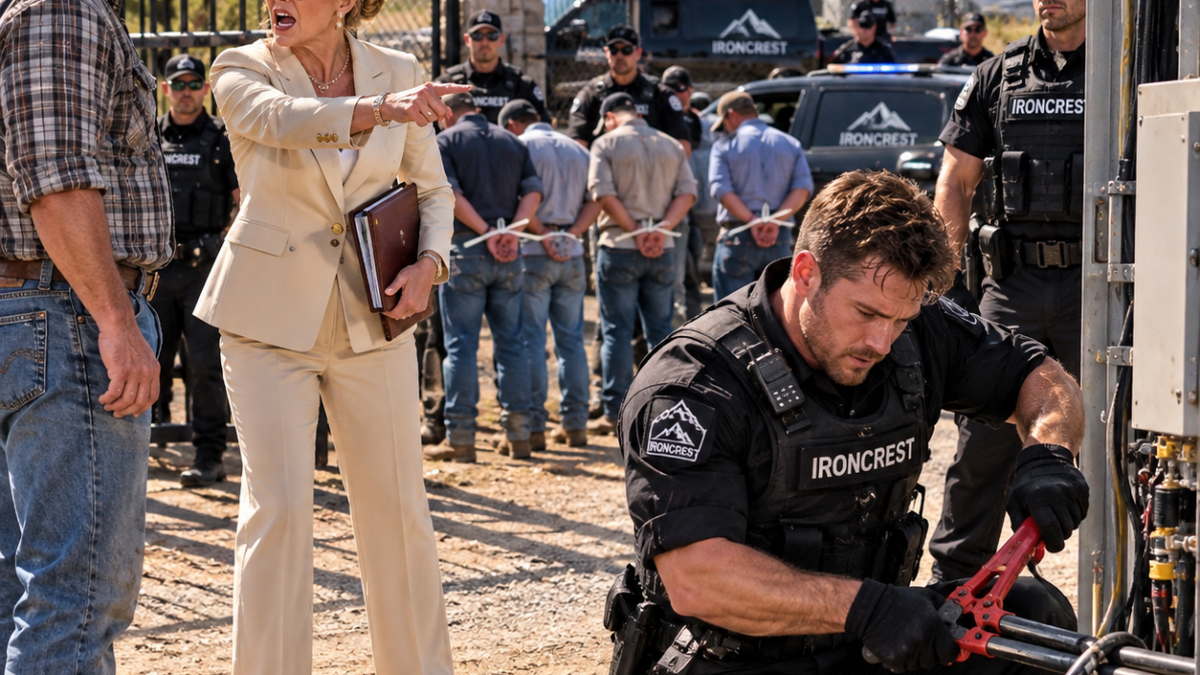
Karen stood near the front gate in a cream-colored suit that probably cost more than my first truck.
Leather binder against her chest.
That binder had become a prop over the previous year.
Whenever Karen wanted to invent authority, the binder appeared.
County meetings.
Boundary disputes.
Utility inspections.
Contractor visits.
Survey crews.
Once she brought it onto my property while arguing with a deputy sheriff.
The deputy had stared at her for several long seconds and asked:
“Ma’am, do you understand the difference between a homeowners association and the United States government?”
Apparently not.
Standing beside the lead security vehicle was Travis Whitmore.
Thirty-four.
Former nightclub bouncer.
Current Ironcrest operations supervisor.
Karen’s nephew.
PART3:
Travis had been around from the beginning.
The kind of man who became louder whenever someone questioned whether he actually possessed authority.
My cameras had caught him moving a survey stake at 2:14 in the morning.
Dragging it six feet east.
Badly.
Surveyors notice things like that.
Another camera caught him photographing the inside of my equipment shed through a fence.
Another showed him escorting a soil-testing crew across my property without permission.
For fourteen months, I had documented Travis committing one stupid act after another.
But what he was about to do was different.
Tom stepped toward Karen.
“Show me the court order.”
His voice came cleanly through the microphone.
Karen lifted her chin.
“You’ve already been served.”
“No. I’ve been handed HOA paperwork. I asked for a court order.”
“This property is under emergency community protection control.”
Tom looked toward my restrained employees.
“Under what court?”
Karen opened the binder.
Removed one sheet.
Cream paper.
Decorative border.
Seal in the corner.
I already knew what it was.
The so-called Emergency Community Protection Order.
We had obtained a copy three weeks earlier through a cooperating witness inside Ironcrest.
The document contained three paragraphs of aggressive legal language, Karen’s signature, and something called the “Ironwood Hills Community Compliance Tribunal.”
No judge.
No clerk.
No case number.
No state seal.
No court.
The tribunal did not exist.
It had exactly as much legal authority as a Chili’s menu.
Tom read it.
Then he gave Karen the worst possible response.
He laughed.
Not loudly.
One short, dry sound.
Karen’s expression changed.
For some people, being challenged creates doubt.
For Karen, it created rage.
“This isn’t funny.”
“No,” Tom said. “It really isn’t.”
He handed the paper back.
“Those men are restrained illegally.”
“They are being temporarily detained.”
“By private security.”
“They are interfering with an emergency enforcement action.”
“What emergency?”
Karen turned and pointed toward the western boundary.
My gate.
Beyond it:
Ranch road.
Then the hills.
Then, six miles farther west, the back boundary of Ironwood Reserve.
Ironwood Reserve was the development Karen treated like a sovereign nation.
Four hundred eighty-seven homes.
Clubhouse.
Golf course.
Artificial lake.
Private gym.
Stone entrance columns.
Strict landscaping rules.
A community newsletter that once used the phrase “approved seasonal flag dimensions.”
Karen had been its HOA president for six years.
The problem was not that she liked rules.
Communities can have rules.
The problem was that Karen had gradually stopped distinguishing between rules that applied inside Ironwood Reserve and laws that applied outside it.
My ranch was outside.
Very outside.
Mercer Ranch consisted of 612 acres my family had owned since 1948.
My grandfather bought the first 160.
My father added two neighboring parcels.
I added the last 92 after leaving the Air Force.
No HOA.
No covenants.
No common-interest declaration.
No architectural review.
No dues.
No Karen.
At least legally.
Geographically, Ironwood Reserve touched our southeastern boundary for roughly a mile and a half.
When the development opened, its residents had one paved entrance to the county road.
That was enough when the project consisted of 170 homes.
Then phases two and three came.
Then a planned fourth phase.
Another 220 homes.
A boutique hotel.
Event center.
Thirty-eight luxury villas.
That created a problem.
Emergency egress.
The county wanted a second access route before approving the final build-out.
The developer had two realistic options.
Buy expensive land to the south and build nearly three miles of road.
Or obtain a 1,900-foot easement across my ranch.
Guess which one Karen preferred.
She first approached me fourteen months earlier with muffins.
Blueberry.
Still warm.
That should have frightened me more than it did.
I opened my front door.
Karen smiled.
“Mr. Mercer.”
“Daniel.”
“I’m Karen Whitmore.”
“I know.”
She laughed like I’d complimented her.
“I was hoping we could discuss a mutually beneficial community matter.”
“Sounds expensive.”
Another laugh.
She entered after I invited her.
That was the last time she entered my house.
She placed a folder on my table.
Map.
Proposed road.
It crossed my east pasture, followed a drainage swale, then connected to my main ranch road.
“We’d compensate you generously.”
“How generously?”
“Seventy-five thousand.”
I stared.
“For permanent public access?”
“Emergency access.”
“How many residents?”
“Once fully developed, perhaps seven hundred homes.”
“No.”
Her smile stayed.
“You haven’t considered—”
“I have cattle crossing that corridor.”
“We can install gates.”
“It cuts through irrigation.”
“We’ll relocate.”
“It passes forty yards from my equipment yard.”
“Only emergency use.”
“No.”
Karen blinked.
People said no to her less often than healthy.
She tried again.
“This would materially improve wildfire safety.”
“Then build southern route.”
“That would cost the developer nearly eleven million dollars.”
“Sounds like a developer problem.”
Her smile disappeared.
“It affects your neighbors.”
“My neighbors bought homes with one road.”
“They were promised expansion.”
“By someone other than me.”
She left without taking muffins.
For the next month, I thought that was it.
I underestimated her.
Karen’s second move was persuasion.
Board members.
Residents.
County officials.
Emails.
Letters.
She told people I was obstructing public safety.
A “wealthy absentee ranch owner.”
I lived there.
A “developer speculator.”
We ran cattle, alfalfa, and contract hay.
A “non-cooperative landholder.”
That part was true.
Then came violation notices.
The first arrived by certified mail.
UNAUTHORIZED AGRICULTURAL EQUIPMENT VISIBLE FROM COMMUNITY VIEW CORRIDOR.
I called the number.
Karen answered.
“Why did your HOA send me this?”
“Your eastern parcel falls within our visual-impact overlay.”
“No, it doesn’t.”
“Our governing documents—”
“Do not apply to my land.”
“We disagree.”
“The county recorder doesn’t.”
Silence.
Then:
“We’ll be in touch.”
They were.
Mailbox color.
Fence material.
Exterior storage.
Dust control.
Livestock noise.
Night lighting.
Height of hay stacks.
One notice objected to a windmill my grandfather installed in 1962.
The HOA was incorporated in 2009.
I kept every letter.
Then fines.
$250.
$500.
$1,000.
$2,500.
I paid none.
Then Karen filed what she called an “association enforcement lien.”
My attorney had it removed in nine days.
She filed another.
Removed.
Another.
That one contained a notarized signature from a notary who later swore she had never met Karen.
That was when I stopped thinking of her as annoying.
Forgery changes temperature.
I contacted the county attorney.
They said civil dispute unless evidence proved intentional fraud.
We began collecting evidence.
Then Ironcrest appeared.
Initially traffic control during HOA events.
Then patrol vehicles near my boundary.
Then “community security checks.”
Then trespass.
Tom caught two guards on my property measuring the ranch road.
He asked them to leave.
They did.
Three days later they returned with Travis.
Tom called sheriff.
Deputy issued trespass warning.
Karen called it harassment.
Then one morning a grader arrived.
Operator claimed he had a work order to widen “HOA emergency lane.”
My lane.
Tom blocked him with a tractor.
Sheriff again.
Operator left.
Karen sent me a letter threatening “emergency acquisition.”
There is a legal process called eminent domain.
HOAs don’t possess it.
Karen apparently believed using similar words created similar power.
Then development financing became involved.
That was the part we discovered later.
Ironwood Reserve’s fourth phase was being built by Whitmore Development Holdings.
Not technically Karen’s company.
Her brother-in-law’s.
Karen owned no listed shares.
But federal investigators later found a consulting company registered to her receiving monthly payments.
$18,500.
Then $27,000.
Then one payment of $140,000 labeled:
COMMUNITY ACCESS STRATEGY
My ranch was worth millions.
The easement was worth far more than $75,000.
But money wasn’t the only issue.
The proposed road passed over something Karen didn’t know existed.
A buried public-safety communications corridor.
The story went back to my father.
In 1997, a wildfire came down from the Blue Mountains.
Two volunteer firefighters nearly died after radio repeaters failed.
A family on County Route 18 waited seventeen minutes longer than they should have for an ambulance because dispatch had lost its microwave link.
My father, Walter Mercer, was one of those irritating people who responded to tragedies by finding committees.
He joined a regional communications task force.
When Blue Mountain Regional Emergency Communications Authority later needed a fiber route between county dispatch centers, the cheapest path crossed our ranch.
Dad granted the easement.
For one dollar.
I asked him years later why.
He said:
“Because roads and phones shouldn’t fail on the same day.”
That was Dad.
The fiber was not mine.
I couldn’t move it.
Couldn’t tap it.
Couldn’t even open its maintenance vault without authorization.
Most of it ran underground.
Armored conduit.
Marker posts every few hundred yards.
Near our equipment yard, however, a maintenance enclosure held an above-ground splice cabinet and a short protected service run.
Black jacketed fiber.
About as thick as my thumb.
To a casual observer, cable.
To the Blue Mountain system, backbone.
By 2026, it carried far more than it did originally.
Regional 911 call-routing traffic.
Computer-aided dispatch data.
Interagency records traffic.
Some public-safety radio backhaul.
State emergency services connectivity.
A few federal public-safety circuits leased through the same fiber bundle.
Redundancy existed.
Normally, cutting one route should not silence three counties.
Normally.
The north redundant leg had been damaged by lightning five days earlier.
Crews had repaired most of it, but a scheduled splice that morning temporarily reduced the region to the Mercer route as its primary path.
That information was not public.
I didn’t know the exact maintenance window until federal investigators reconstructed events later.
Karen certainly didn’t.
She did know one thing.
There was a black cable near the equipment yard.
And because my cameras had continued recording every time Ironcrest tried disabling local power, she convinced herself that cable operated my security network.
Three weeks before the raid on my ranch, our cooperating witness sent investigators a photograph of Karen’s handwritten notes.
One line:
CUT BACKBONE FEED BEFORE ACCESS OPERATION. CAMERAS / GATE / REMOTE STORAGE? ASK TRAVIS.
That photograph was why the FBI became deeply interested.
Not because the cable was necessarily federal.
Because Karen was discussing intentionally disabling communications while conducting an illegal seizure.
My attorney had already turned over forged documents.
The county prosecutor had referred the case.
Ironcrest billing records suggested HOA funds were being used to finance actions outside HOA property.
A former Ironcrest supervisor reported Karen had directed employees to “detain trespassers” on land she did not own.
Then came payments.
Shell companies.
Developer money.
Pressure on surveyors.
One surveyor claimed Travis offered him $20,000 to move a boundary line twenty-eight feet.
That finally brought Special Agent Lena Morris into my life.
FBI.
Public corruption and interstate fraud task force.
Forty-two.
Short dark hair.
No patience for speeches.
Our first meeting lasted three hours.
At the end, she said:
“You understand we’re not your private police.”
“Yes.”
“We’re not solving HOA disagreements.”
“Good.”
“If this is merely two property owners fighting—”
“It isn’t.”
She looked at six binders on my attorney’s conference table.
“For your sake, I hope you’re wrong.”
I understood.
If I was wrong, I had an unpleasant neighbor.
If I was right, people were committing crimes.
There is no pleasant version.
For six weeks, investigators built quietly.
They subpoenaed accounts.
Interviewed surveyors.
Reviewed lien filings.
Tracked payments.
Obtained Ironcrest communications.
One employee, Mason Keel, agreed to cooperate.
Mason was twenty-nine.
Former Army mechanic.
Joined Ironcrest because he needed health insurance.
He thought he’d patrol neighborhoods.
Instead he found himself being told to stand on ranch property while Karen waved fake orders.
The breaking point came when Travis handed him plastic restraints during planning meeting.
Mason asked:
“For who?”
Travis said:
“Mercer’s guys if they interfere.”
Mason called state investigator the next day.
That was why cameras on my ranch weren’t the only ones recording that morning.
Federal investigators had installed two court-authorized remote observation points outside the main work area based on probable cause involving the ongoing conspiracy.
I was not at the ranch because Lena asked me not to be.
Too volatile.
Too personal.
We were heading toward a field office north of the interstate to review final warrant materials when my phone notified me that gate control had failed.
Then cameras showed Ironcrest.
Nine vehicles.
Eleven employees restrained.
Karen.
Travis.
Tom.
And that ridiculous binder.
Lena looked at my tablet once.
“Don’t call them.”
“I know.”
“Daniel.”
“I know.”
We had state police moving.
County sheriff had been notified only through command because investigators feared local leaks.
Federal team was roughly twenty minutes away.
Too far.
On the screen, Tom said:
“You have no right to hold my men.”
Karen replied:
“They’re interfering with lawful community enforcement.”
“Show me a judge’s signature.”
“I don’t need one.”
Tom’s eyebrows lifted.
Even after fourteen months, Karen could still surprise him.
“That sentence should probably bother you.”
She ignored.
“Where is Mercer?”
“None of your business.”
“He was ordered to make himself available.”
“By you?”
“By the association.”
“He’s not in your association.”
Karen turned toward Travis.
“Proceed.”
Travis walked toward the equipment yard.
Tom followed.
Two Ironcrest guards blocked him.
Tom raised hands.
“Don’t touch me.”
One guard said quietly:
“Sir, please stay back.”
I recognized voice.
Mason.
The cooperating witness.
He wasn’t restraining Tom.
He was positioning himself where his body camera could capture Karen.
Smart.
Tom looked at cable enclosure.
Then at Travis carrying a cordless hydraulic cutter.
His face changed.
“No.”
He stepped forward.
“Do not touch that.”
Karen smiled.
Finally.
A reaction she liked.
“So it does matter.”
Tom said:
“That line isn’t ours.”
Karen looked toward camera mounted on barn corner.
“Cut it.”
Tom moved.
Mason blocked gently.
“Tom.”
One word.
A warning.
Don’t get yourself hurt.
Tom understood.
He shouted instead:
“Travis! That is public infrastructure!”
Travis looked back.
Karen said:
“It’s an illegal surveillance cable crossing HOA-controlled land.”
Tom laughed again.
“You are standing on Daniel’s ranch!”
“This corridor is under emergency control.”
“No, it isn’t.”
Karen pointed.
“Cut it.”
Travis hesitated.
First time.
Maybe some survival instinct remained.
“What if it’s utility?”
Karen snapped:
“You heard me.”
He positioned cutter.
Tom shouted:
“Don’t!”
The jaws closed.
Black sheath compressed.
Then snapped.
The camera image did not disappear.
Karen’s face changed.
She had expected darkness.
Instead, nothing.
For maybe four seconds.
Then Lena’s federal radio came alive.
“Command, communications alert. Blue Mountain regional circuit lost.”
Another voice.
“Repeat, primary PSAP trunk just dropped.”
Lena’s head turned sharply.
I stared at tablet.
A red notification appeared on separate secure monitoring application agents had given me.
Not for 911.
For evidence-feed health.
But agency operations channel erupted.
“Cedar County dispatch reports CAD offline.”
“Pine County call-routing failure.”
“North Valley PSAP lost connectivity.”
Lena grabbed radio.
“Confirm scope.”
Static.
Then:
“Three counties affected. Failover in progress.”
I looked at her.
She looked at me.
“What did he cut?”
“I think the regional fiber.”
“You think?”
“That’s the communications easement.”
Lena’s jaw tightened.
“Jesus.”
She accelerated.
Not reckless.
Fast.
Radio:
“State emergency communications notified.”
“Backup PSAP routing being initiated.”
“Local radio still partially operational.”
“CAD terminals dark.”
“911 voice trunks failing over.”
Lena called command.
“This is Morris. Ranch target has damaged regional emergency communications infrastructure. Expedite state units. Suspects armed private security, eleven civilians restrained.”
Then to me:
“Seat belt.”
“I have one.”
“Make it tighter.”
We moved.
On the ranch camera, Karen stared at still-functioning surveillance feed.
“Why are the cameras still on?”
Travis looked at severed cable.
“I don’t know.”
Tom said:
“Because that wasn’t a camera line.”
Karen turned.
“What is it?”
Tom’s voice went quiet.
“You need to start praying nobody needs an ambulance.”
For first time that morning, Karen looked uncertain.
“What are you talking about?”
“That is regional emergency fiber.”
Travis stepped backward.
“No.”
Tom nodded toward orange utility marker ten feet away.
The one Travis had apparently ignored.
It read:
BMERCA COMMUNICATIONS CORRIDOR — DO NOT DISTURB — CALL BEFORE EXCAVATION
Karen stared.
She recovered quickly.
People like Karen often do.
“No. Mercer put that sign there.”
Tom looked almost impressed.
“You think Daniel made a fake regional emergency communications marker?”
“It’s part of his intimidation campaign.”
“Karen.”
Tom stepped closer.
“This is over.”
“No.”
She looked toward Travis.
“Restore it.”
Travis stared at severed fiber bundle.
Hundreds of hair-thin strands.
“You don’t splice this with electrical tape.”
“Then reconnect it.”
“I can’t.”
Her face tightened.
“You cut it. Fix it.”
“You told me to cut it.”
There.
Mason’s camera captured everything.
Karen looked at him.
“Don’t stand there. Call someone.”
Tom said:
“They already know.”
Karen’s eyes snapped toward him.
“How?”
“Because three counties just stopped talking.”
At the Blue Mountain Regional Dispatch Center, later logs showed normal operations disappeared in forty-three seconds.
Screens froze.
Maps stopped updating.
Call-taker positions displayed transport failures.
CAD sessions disconnected.
Automatic vehicle-location data vanished.
911 calls began rerouting through an alternate state emergency center nearly ninety miles away.
That backup system worked.
Mostly.
But “worked” in public safety is not binary.
Calls were answered.
Addresses were taken manually.
Then relayed back to local dispatch by surviving radio, cellular backup lines, and direct agency numbers.
Dispatchers switched to paper cards.
Police officers used tactical channels.
Volunteer fire departments monitored backup paging.
Ambulances were reached by cellular push-to-talk.
The entire normal regional network had gone silent.
People adapted.
Because that is what emergency professionals do when technology fails.
One dispatcher later described it to me:
“It felt like somebody turned 2026 into 1986 in thirty seconds.”
There were consequences.
A cardiac call in Cedar County took four minutes longer to assign than normal.
The patient survived.
A rollover on Route 12 was initially sent to the wrong volunteer fire district before a dispatcher corrected it by radio.
No one died.
That fact mattered to me more than anything.
No deaths.
No family answering a knock at their door because Karen wanted my road.
But nobody knew that yet.
Not in those first minutes.
Every second after Travis cut the cable carried possibility.
On my screen, Karen started issuing orders.
“Load the equipment.”
Not:
Release the workers.
Not:
Call 911.
Not:
Tell emergency services.
Load the equipment.
She was leaving.
Mason stepped forward.
“Ma’am, we need to stay.”
Karen stared.
“Excuse me?”
“If that’s emergency infrastructure, we need to report it.”
“We are not admitting anything.”
“It’s on camera.”
She looked toward ranch camera.
“Ironcrest has authority to seize recording systems.”
Mason almost smiled.
“Not that one.”
Karen’s expression hardened.
“Mason, remove it.”
“No.”
Silence.
Travis looked over.
Karen said:
“What?”
Mason removed his Ironcrest cap.
Dropped it on hood.
“I said no.”
Karen stepped toward him.
“You’re terminated.”
“I figured.”
He pulled phone from pocket.
“State police are coming.”
Karen’s face changed.
Travis whispered:
“What did you do?”
Mason answered:
“My job.”
Two Ironcrest guards exchanged looks.
One began cutting plastic restraints from my employees.
Karen shouted:
“Stop!”
He ignored.
Another joined him.
There is a point when borrowed authority collapses.
You can feel it.
One person stops pretending.
Then another.
Then everyone notices there was nothing behind curtain.
Tom rubbed wrists of assistant foreman.
“Everybody stay calm.”
Karen screamed:
“Those men are detained!”
Tom looked at her.
“By who?”
She had no answer.
First state police vehicles arrived six minutes later.
Unmarked SUVs behind.
County deputies.
Then federal vehicles.
I was still three minutes out when Lena’s team reached ranch.
She ordered me to remain in car when we arrived.
“You’re a witness.”
“It’s my property.”
“You can be both from inside vehicle.”
I stayed.
Not happily.
Agents approached.
Hands visible.
Clear commands.
Ironcrest personnel mostly complied.
Weapons remained holstered or were surrendered depending on licensing and instructions.
Karen did not.
Of course.
She walked toward Special Agent Morris holding binder.
“This is a private civil enforcement action.”
Lena stared at her.
“Ma’am, step away from the damaged utility enclosure.”
“You have no jurisdiction over an HOA matter.”
“This is not an HOA matter.”
Karen opened binder.
“Our emergency order—”
Lena said:
“Put the binder down.”
Karen blinked.
“Do you know who I am?”
Lena’s expression did not change.
“Yes.”
That answer landed.
Karen lowered binder slowly.
Travis stood near cut fiber.
Hands trembling.
State trooper approached.
“Sir, move away from tools.”
“I didn’t know.”
“Move.”
“My aunt told me—”
“Move now.”
He moved.
Tom saw my SUV.
Walked toward it.
An agent stopped him until Lena nodded.
I stepped out only after she allowed.
Tom met me halfway.
“You okay?”
I asked.
He looked offended.
“I’m fine.”
“The guys?”
“Embarrassed. Angry. One wrist bruised.”
“Anyone hurt?”
“No.”
Then his face changed.
“Daniel, that cable.”
“I know.”
He looked toward severed bundle.
“I tried.”
“I know.”
“Your dad—”
“I know.”
That hurt.
Dad had been dead six years.
Still, seeing his communications easement cut felt personal in a way I did not expect.
Not because fiber mattered emotionally.
Because he had granted that corridor after seeing emergency communications fail once.
Karen had turned his civic generosity into collateral damage for a land grab.
Repair crews arrived fast.
Blue Mountain Emergency Communications.
Telecom contractor.
State engineers.
They treated the area like surgery.
Photographs first.
Evidence preservation.
Then temporary splice.
Fiber repair is not twisting copper back together.
Each glass strand must be identified, prepared, aligned, fused, tested.
Hundreds.
Critical circuits prioritized.
Temporary mobile microwave equipment was brought in.
At 7:18 a.m., roughly twenty-eight minutes after the cut, emergency call routing was stabilized through backup systems.
At 8:03, major CAD connectivity returned on temporary path.
Full normal service took hours.
Three counties.
One cable.
One order.
Karen spent most of that time inside a state police SUV insisting she had been “misled.”
By whom varied.
Tom.
Me.
County officials.
The developer.
The cable marker.
Travis.
Mason.
She blamed everyone except woman captured on three different recordings saying:
Cut it.
My eleven employees gave statements.
Then went home with pay.
I told them take week if needed.
Seven came back next morning.
Ranch people.
Tom arrived at 5:22.
I said:
“You could take day.”
He poured coffee.
“So could you.”
Fair.
By afternoon, story was on local television.
Not national yet.
PRIVATE SECURITY OPERATION LINKED TO REGIONAL 911 OUTAGE
Then:
HOA PRESIDENT QUESTIONED AFTER COMMUNICATIONS LINE CUT
Then, predictably:
KAREN CUTS 911
Technically she did not.
Travis did.
Internet dislikes legal distinctions.
I did not speak to media.
Lena asked me not to.
My attorney begged me not to.
Tom enjoyed interviews enough for both of us until I banned him.
“You told Channel Eight their question was stupid.”
“It was.”
“You can’t say that.”
“Why?”
“Because I’m trying not to become viral.”
“You own cows. You’ll survive.”
The investigation exploded.
Until that morning, prosecutors had a complicated case.
Fraud.
Forged records.
Possible conspiracy.
Private-security overreach.
Financial pressure.
Potential extortion.
Lots of paper.
Lots of arguments.
Karen’s attorneys could call everything misunderstanding.
Civil dispute.
Aggressive negotiation.
Contract confusion.
After the cable?
There were eleven restrained witnesses.
Multiple video recordings.
A fake order.
Tools.
A deliberate command.
A severed emergency communications trunk.
And a measurable public consequence.
Complex stories become much easier when someone records themselves saying:
Cut it.
Search warrants executed that same day.
Karen’s HOA office.
Her home.
Ironcrest offices.
Travis’s truck.
Whitmore Development.
Agents seized computers, phones, binders, contracts, accounting files.
The cream-colored binder went into evidence.
Tom asked whether we could request it after trial.
“No.”
“Historic artifact.”
“No.”
“I’d mount it in the barn.”
“Tom.”
“Fine.”
The biggest surprise wasn’t found in Karen’s office.
It was in Travis’s phone.
Messages.
Months.
Karen rarely wrote direct criminal instructions.
She preferred phrases.
Apply pressure.
Create compliance.
Make access unavoidable.
But Travis was not subtle.
One message:
If Mercer crew resists, we hold them until road team gets through.
Karen replied:
Only as long as needed. Use community order.
Another:
What about cameras?
Karen:
Kill the feed before equipment enters.
Another:
Black line by utility cage?
Karen:
Likely his remote system. Cut it if necessary.
Then message three days before:
Goal is road established before county can interfere. Once access exists, emergency necessity becomes easier to argue.
That explained morning.
Karen planned a fait accompli.
Cut cameras.
Restrain workers.
Bring grading equipment.
Remove front gate.
Open corridor.
Lay gravel.
Then claim the route had been established as emergency access.
Legally absurd.
Politically useful.
Facts on ground can become leverage.
She needed photographs.
Vehicles driving through.
Maybe a fire truck later.
Then pressure county:
Road exists.
Residents need it.
Why close safety route?
But there was more.
Investigators found memorandum from Whitmore Development lender.
Final financing for phase four depended on verified secondary emergency egress by September 30.
Without it:
Loan draw suspended.
Project potentially insolvent.
Karen’s consulting agreement included success bonus.
$750,000.
Seven hundred fifty thousand dollars if she “secured community access solution.”
Suddenly fourteen months made sense.
The muffins.
Not neighborly.
Investment.
The fines.
The liens.
Survey tampering.
Security.
Fake order.
All leverage aimed at getting one thing:
My road.
Her attorney later argued Karen truly believed HOA possessed emergency powers.
That defense lasted until prosecutors introduced an email from her own association counsel dated eleven months earlier:
Karen, to be absolutely clear, the association has no jurisdiction over Mercer Ranch and no authority to enter, detain employees, alter utilities, remove gates, or create access without the owner’s consent or a valid court order. Do not represent otherwise.
Karen replied:
Understood.
Then continued anyway.
That’s the danger of arrogance.
It sometimes writes evidence against itself.
Travis was charged too.
He turned against Karen within six weeks.
I had mixed feelings.
He had cut line.
Moved survey stakes.
Intimidated employees.
But during interview, according to later court filings, he cried when investigators played dispatch outage recordings.
He had not understood what cable did.
Ignorance did not erase responsibility.
He still cut marked infrastructure after Tom warned him.
But motive matters during sentencing.
He pleaded guilty to several charges and agreed to testify.
Mason kept job?
Not at Ironcrest.
Ironcrest lost state license after investigation revealed systemic violations.
Mason eventually joined a legitimate industrial security company.
Before he left town, he came to ranch.
Tom walked him to office.
Mason looked nervous.
“I should’ve stopped them earlier.”
I said:
“You stopped them when it mattered.”
“Not before workers got restrained.”
“No.”
“I helped plan entry.”
“Yes.”
He looked down.
“I keep thinking if I had called sooner.”
That sentence.
If I had.
Human beings torture themselves with alternate timelines.
I told him:
“You called before the operation.”
“Not soon enough.”
“Maybe.”
He looked up.
I wasn’t going to lie.
“But you wore camera. You refused illegal order. You called state police. You testified.”
He nodded.
“That’s what you own now.”
He shook my hand.
Tom later said:
“You’re getting soft.”
“You offered him coffee.”
“That was manners.”
Civil lawsuits followed.
My employees sued Ironcrest and HOA.
So did I.
Not for emotional satisfaction.
For damage.
Security repairs.
Lost operations.
Legal expenses.
Trespass.
The HOA’s insurers denied parts of coverage because intentional misconduct was excluded.
Residents were furious.
They should have been.
Many had no idea Karen used their dues to fund Ironcrest actions.
Emergency assessments had been labeled:
COMMUNITY SAFETY RESERVE
Some paid thousands.
Karen told them money supported wildfire preparedness.
Part funded lawyers pursuing my property.
Part paid Ironcrest.
Part paid consultants tied to development.
Ironwood Reserve held emergency board meeting.
I did not attend.
Resident named Susan Palmer later sent me video.
More than two hundred homeowners in clubhouse.
Karen’s vice president attempted opening remarks.
Residents shouted.
An elderly man stood.
“I paid $1,800 because you said this was for fire safety!”
Another:
“Why were our dues paying men to handcuff ranch workers?”
Another:
“Did board know about fake court?”
Vice president cried.
Three board members resigned that night.
Temporary board voted to sever all contracts with Whitmore Development-affiliated consultants and cooperate with investigators.
I felt sorry for residents.
Some.
Not the ones who sent me letters calling me selfish.
But even they had been manipulated.
HOA institutions are not inherently evil.
They’re corporations run by humans.
Humans can be decent.
Humans can become Karen.
The criminal case took eleven months.
Longer than television teaches.
Motions.
Discovery.
Forensic accounting.
Experts.
Telecommunications analysis.
Defense arguments.
Venue questions.
Karen was initially released under strict conditions.
No contact with me.
No HOA governance.
No Ironcrest.
No approaching ranch.
The first time I saw her after arrest was federal courthouse hallway.
She looked smaller without binder.
Still polished.
Cream suit replaced navy.
Hair perfect.
She saw me.
Stopped.
Her attorney touched elbow.
“Karen.”
She ignored him.
“This was never supposed to happen.”
I looked at her.
“What part?”
Her mouth tightened.
“The network.”
“You mean 911?”
“I didn’t know.”
“Tom told you.”
“After.”
“He told Travis before he cut.”
“That wasn’t clear.”
“The sign was clear.”
“It looked private.”
“It said regional emergency communications.”
Her eyes flashed.
“You wanted this.”
That surprised me.
“What?”
“You waited.”
“You were working with federal agents.”
“Yes.”
“You let me walk into trap.”
I stared.
There was no answer that would satisfy her because Karen’s worldview required somebody else to be author of her actions.
“I said no fourteen months ago.”
She stiffened.
“That was all you had to do.”
“Daniel—”
Her lawyer pulled her away.
I watched.
For a second, I almost felt pity.
Then remembered eleven men against fence.
Dispatchers staring at dead screens.
Tom yelling not to cut cable.
Pity has limits.
Trial began the following spring.
Karen did not take plea.
Travis did.
Two Ironcrest supervisors did.
A Whitmore Development executive did.
Karen went to trial on conspiracy, fraud-related charges, unlawful restraint-related counts under state law, obstruction, and offenses tied to intentional destruction of protected communications infrastructure.
I testified two days.
Prosecutor asked about ranch ownership.
Boundary.
Easement.
Fourteen months.
Not feelings.
Facts.
Defense attorney tried painting me as vindictive.
“Mr. Mercer, you disliked Ms. Whitmore before June 18, correct?”
“I disliked what she was doing.”
“That wasn’t my question.”
“Yes.”
“You installed extensive surveillance.”
“After repeated trespass.”
“You communicated with federal law enforcement.”
“Yes.”
“You provided them access to your property.”
“Yes.”
“You wanted Ms. Whitmore prosecuted.”
“I wanted her to stop.”
“Yet you collected evidence for more than a year.”
“Because she didn’t stop.”
He showed jury one of my emails:
If she crosses onto ranch again, I want it documented.
“You wrote that?”
“Yes.”
“You were waiting for another incident.”
“I was preparing for one.”
“You didn’t warn her that cable was critical.”
I looked at him.
“There were warning markers.”
“But you personally didn’t tell her.”
“No.”
“Why?”
“Because she had no legal reason to touch any cable on my land.”
Silence.
He moved on.
Tom was better witness than I was.
Which irritated me.
Prosecutor:
“Mr. Bellamy, what did you say when Mr. Whitmore approached the cable?”
Tom:
“I told him don’t touch that.”
“Why?”
“Because you’re not supposed to cut utility cable.”
A few jurors smiled.
“Did you identify it?”
“I said public infrastructure.”
“Did Ms. Whitmore hear?”
“Yes.”
“What did she do?”
“Said cut it.”
“Did you believe she misunderstood?”
Tom shrugged.
“I can’t testify to what’s in somebody’s head.”
Perfect.
“What did she do after learning 911 may be affected?”
“She told everybody to load equipment and leave.”
That mattered perhaps most.
Mistake can happen.
Accident can happen.
Your behavior after discovery reveals things.
Travis testified fourth week.
He looked older.
Prosecutor displayed texts.
Asked:
“Who told you to cut the cable?”
“My aunt.”
“Did you know what it carried?”
“No.”
“Were there warning signs?”
“Yes.”
“Did Mr. Bellamy warn you?”
“Yes.”
“Why did you cut it?”
He looked toward Karen.
Then jury.
“Because every time I questioned her, she told me she had lawyers and county people behind her.”
“Did you verify that?”
“No.”
“Why not?”
“I wanted to believe her.”
Hard answer.
Human answer.
Karen did not look at him.
Then dispatch director testified.
Elaine Cho.
Twenty-seven years emergency communications.
She explained fiber failure without drama.
At 6:49:12, transport alarm.
6:49:25, Cedar CAD disconnect.
6:49:31, Pine call-routing failure.
6:49:40, North Valley loss.
Backup procedures initiated.
She showed dispatch center footage.
Operators moving from computers to printed emergency cards.
One woman writing addresses by hand.
Another using cellular phone to call fire station.
No screaming.
Professional.
More powerful because of that.
Prosecutor asked:
“What risk did outage create?”
Elaine answered:
“Delay.”
“How much?”
“Different for each incident.”
“Did anyone die?”
“No.”
Karen’s attorney seized.
“No deaths?”
“No.”
“No serious injury directly attributed?”
“Not that we established.”
“So system redundancy worked.”
Elaine looked at him.
“People worked.”
“What?”
“The redundancy did not fully work. Dispatchers did.”
That sentence stayed with me.
People worked.
The cardiac patient whose ambulance assignment was delayed testified briefly.
Mr. Harold Nguyen.
Seventy.
He did not blame Karen dramatically.
He said:
“My wife called 911. She heard operator, then they had trouble locating nearest ambulance. I’m alive. That’s what I know.”
Karen looked away.
Defense called experts.
One argued cable labeling insufficient.
Regional authority produced photographs of signs.
Another argued Karen had reasonable emergency-safety concerns.
County planning director testified she had no authority.
Former HOA counsel read warning email.
Then Karen testified.
Against advice, I suspect.
She presented herself as community protector.
Wildfire fears.
Congestion.
Emergency access.
I actually believed some concern was genuine.
That’s what made her dangerous.
People are rarely cartoon villains who wake wanting evil.
They decide their goal is righteous enough that process becomes obstacle.
Karen said:
“After Paradise and Lahaina and every wildfire tragedy, I refused to sit by while a stubborn ranch owner blocked evacuation access.”
My attorney whispered:
“She practiced that.”
Probably.
Prosecutor did not challenge sentiment.
Asked:
“Did you have court order?”
Karen paused.
“We had emergency authority.”
“From whom?”
“The association.”
“Did association control Mercer Ranch?”
“We disputed boundary.”
“County survey said?”
She avoided.
“Did it say ranch outside association?”
“Yes.”
“Your lawyer told you association had no jurisdiction?”
“He gave cautious advice.”
Prosecutor displayed email.
Karen read:
NO JURISDICTION.
“Cautious?”
She became angry.
That was mistake.
“You don’t understand what it was like dealing with him.”
“Mr. Mercer?”
“Yes.”
“He refused every reasonable compromise.”
“So you restrained his employees?”
“Temporarily.”
“You ordered gate taken?”
“For emergency access.”
“You ordered cable cut?”
“I believed it was private surveillance.”
“After ranch manager said public infrastructure?”
“He was trying to intimidate us.”
“After warning marker?”
“I believed Mercer placed it.”
“Why?”
“Because he manipulates.”
“Did you call utility number printed on marker?”
“No.”
“Did you call county?”
“No.”
“Did you call sheriff?”
“No.”
“Did you call your attorney?”
“No.”
“Did you have judge?”
“No.”
“Did you have warrant?”
“No.”
“Did you own property?”
Karen stared.
“No.”
The entire case was there.
No.
Verdict came after two and a half days.
Not guilty on two minor counts.
Guilty on the major conspiracy and fraud-related charges.
Guilty on multiple unlawful-restraint and infrastructure-interference counts under applicable state and federal law.
I won’t pretend I remember every count.
There were many.
Karen stood still.
No collapse.
No shouting.
Just one long exhale.
Sentencing months later.
Residents submitted statements.
So did my employees.
I did not.
Judge asked prosecutor whether I wanted.
No.
I had already testified.
Tom submitted three pages.
Mostly because he enjoyed writing.
Karen received significant prison sentence.
Not life.
Long enough.
Travis received much less because of plea and cooperation.
Ironcrest’s owner avoided prison but paid major penalties and lost licenses after arguing he did not know field supervisors were using fake authority.
Evidence suggested he knew enough.
Civil judgments crippled company.
Whitmore Development phase four collapsed.
Land sold to another developer eventually.
New owner built southern emergency road.
Cost millions.
Exactly what Karen had been trying to avoid.
Ironwood Reserve survived.
Of course.
Communities are bigger than their worst president.
New board sent me letter.
Not apology exactly.
Something better.
Acknowledgment.
The Association recognizes Mercer Ranch is not and has never been subject to Ironwood Reserve governing documents.
I framed that.
Tom wanted binder.
I gave him letter instead.
He said:
“Boring.”
“Legal.”
“Same thing.”
Regional communications authority rebuilt fiber corridor.
Not merely repaired.
New armored conduit.
Additional physical protection.
Redundant route fully separated geographically.
Automatic failover tested monthly.
They did not tell me all technical details.
Good.
I didn’t want responsibility.
Director Elaine Cho visited ranch once.
She stood beside my father’s old easement marker.
“I read original agreement.”
“Dollar.”
She smiled.
“One dollar.”
“Dad never understood negotiating.”
“Maybe he did.”
I looked at field.
“What do you mean?”
“He wasn’t selling.”
True.
She placed updated marker near fence.
No sensitive technical description.
Just utility easement warning.
“Your father did something good.”
“He liked infrastructure.”
“Strange hobby.”
“You didn’t know him.”
Elaine laughed.
Then:
“People keep calling you hero.”
“No.”
“Good.”
I looked at her.
She continued:
“You weren’t dispatching on paper.”
Exactly.
“Your people were.”
“Yes.”
“That’s who should get story.”
She nodded.
Dispatch center later received state commendation.
I attended ceremony.
Sat back.
Operators called by name.
Elaine spoke.
She never mentioned Karen.
I liked that.
Outage became lesson, not her legacy.
At ranch, life returned.
Cattle.
Irrigation.
Broken equipment.
Weather.
Real problems.
Gate replaced.
Stronger.
Not because I expected Karen.
Because Travis bent hinge with Ironcrest truck.
Tom installed a small sign inside office.
EMERGENCY COMMUNITY PROTECTION TRIBUNAL
Under it:
MEETINGS CANCELLED INDEFINITELY
I told him remove.
He refused.
It stayed.
My employees eventually joked.
Humor is how workplaces metabolize absurdity.
One worker called cable enclosure “Karen switch.”
I shut that down.
Not because humor.
Because I didn’t want people normalizing touching it.
“No jokes near fiber.”
Tom said:
“That’s your new ranch rule?”
“Yes.”
“Can I put it on sign?”
“No.”
He did anyway.
DON’T CUT ANYTHING YOU DON’T OWN.
Honestly, fair.
A year after trial, I was fixing fence near east pasture when a silver SUV stopped outside gate.
For a second my body reacted.
Not fear.
Old irritation.
Woman stepped out.
Susan Palmer.
Ironwood resident who sent board-meeting video.
She held pie.
That felt familiar enough to be dangerous.
“Mr. Mercer?”
“Daniel.”
She smiled.
“Peace offering.”
“What kind?”
“Apple.”
“Better than blueberry.”
She did not understand.
Fine.
She said new HOA board wanted discuss wildfire evacuation cooperation.
I stared.
She quickly added:
“Not easement.”
Good start.
“Annual emergency drill. Coordination with county. We want to know if ranch could serve as temporary livestock staging during evacuation, with your permission.”
With your permission.
Four magical words.
I opened gate.
“Come in.”
We talked.
County later created voluntary emergency agreement.
If wildfire threatens, certain pasture may be used temporarily for large-animal evacuation.
Written.
Limited.
Revocable.
Compensated for damage.
No permanent road.
No invented jurisdiction.
That’s what cooperation looks like.
Not one side winning everything.
Rules.
Consent.
Clarity.
Sometimes I think about how close Karen came to getting something if she had behaved like adult.
If she’d offered fair-market easement.
Independent appraisal.
Limited emergency use.
Insurance.
Fence crossings.
Infrastructure protection.
Maybe still no.
But conversation possible.
Instead she treated “no” as insult.
That was her real mistake.
Not cable.
Cable was consequence.
Her mistake began with belief other people’s boundaries were negotiations she could override with enough pressure.
Property boundaries.
Legal boundaries.
Professional boundaries.
Personal boundaries.
Every forged notice pushed.
Every fake fine.
Every security patrol.
Every lie.
By time she ordered Travis to cut that black line, she wasn’t making new decision.
She was repeating same one she had made a hundred times:
My goal matters more than your right to say no.
The scale changed.
Principle didn’t.
People ask why I didn’t sell easement after development changed hands.
Maybe someday.
Not currently.
Ranch road still dirt.
Oaks still there.
Dad’s fiber corridor deeper now.
Ironwood houses visible at night from eastern ridge.
Little squares of light.
Families.
Not enemies.
Important.
Karen wanted me to see development as her.
I refuse.
Hundreds of people live there.
Teachers.
Veterans.
Nurses.
Contractors.
Kids.
Most never asked her to handcuff ranch workers.
Many were horrified.
You should never make one bully representative of everyone near them.
That lesson goes both directions.
Tom retired two years later.
Last day, I gave him framed copy of fake Emergency Community Protection Order.
He laughed for full minute.
“Where’d you get this?”
“Discovery copy.”
“You said no binder.”
“You’re getting paper.”
He read signature.
“Karen Whitmore, President.”
Then:
“Should hang over toilet.”
“Please don’t tell me.”
At retirement barbecue, my eleven formerly restrained employees signed back.
One wrote:
STILL WAITING FOR MY COURT DATE.
Another:
HOA PRISONER #7.
Tom hung in garage.
I visited once.
There it was.
Above workbench.
Not toilet.
Progress.
Lena Morris moved to another field office.
We spoke occasionally.
When case closed fully, she mailed one note.
You were right to document and not retaliate. Most people make our job harder by trying to become their own investigator.
I called.
“Is that compliment?”
“Don’t get used to it.”
“What happened to cream binder?”
“Evidence storage.”
“Tom still wants it.”
“No.”
“Worth asking.”
“No.”
Federal agents have limited humor around evidence.
Years later, internet version of story changed.
Of course.
“HOA Karen Cuts Secret Military Cable.”
No.
“Rancher Tricks HOA President Into Destroying Federal Network.”
No.
“Woman Shuts Down 911 Across Entire State.”
Definitely no.
Truth is less neat.
More useful.
Karen did not know cable’s exact function.
She had been warned it was public infrastructure.
She cut anyway.
Normal system redundancy was temporarily degraded.
The cut caused a serious multi-county emergency communications outage.
Backup processes prevented catastrophe.
Dispatchers and first responders adapted.
Federal case already existed.
The cut did not magically create law enforcement.
It strengthened evidence.
She wasn’t arrested because HOA violated landscaping etiquette.
She was arrested after a pattern of forged documents, trespass, unlawful detention, fraud, conspiracy, and intentional infrastructure damage became impossible to dismiss as neighborhood dispute.
Truth has less clickbait.
I prefer it.
One autumn evening, I drove past communications marker with my granddaughter, Ellie.
She was seven.
My son’s kid.
She pointed.
“Dad says Aunt Karen broke that.”
Everyone becomes aunt on children’s understanding apparently.
“She wasn’t your aunt.”
“Lady Karen.”
“Also no.”
“The bad lady?”
I sighed.
“People are complicated.”
She frowned.
Seven-year-olds hate nuance.
“Did she cut it?”
“She told someone to.”
“Why?”
“She thought she had right to.”
“Did she?”
“No.”
“So bad lady.”
Fair.
We stopped near pasture.
Sun dropping behind hills.
She asked:
“What does cable do?”
“Helps people call for help.”
“All phones?”
“Some emergency systems.”
“Like 911?”
“Yes.”
She stared marker.
“Why would somebody cut that?”
Hard question.
“Because she didn’t know what it was.”
“But sign says don’t.”
“It does.”
“Then why?”
I looked at her.
“Sometimes people get so sure they’re right they stop checking.”
Ellie nodded like storing fact.
Then:
“Grandpa says that’s called being dumb.”
My son has simplified parenting.
“Sometimes.”
We drove on.
That sentence stayed.
Not knowing cable wasn’t Karen’s worst failure.
Everybody doesn’t know things.
I didn’t know exact circuits.
Tom didn’t know redundancy status.
Travis definitely didn’t know.
Ignorance is normal.
The dangerous part is certainty without verification.
Karen had marker.
Warning.
Tom.
Survey records.
Attorney letter.
County maps.
She had off-ramps everywhere.
At every one, she chose certainty.
Cut it.
Maybe that’s why moment still bothers me more than trial.
Watching cutter close.
For second, Travis paused.
He looked back.
Karen could have said:
Wait.
One word.
No.
She said:
Cut it.
Some lives turn on sentences that short.
By time regional dispatch screens went dark, Karen had finally touched system too large to bully.
911 doesn’t care about HOA politics.
Fiber doesn’t care who has expensive suit.
A glass strand doesn’t recognize fake seals.
It simply carries light until someone breaks it.
Then the light stops.
That morning, for forty-three seconds, alarms cascaded through three counties because one woman believed authority could be created by announcing it loudly enough.
But the system did not survive because federal agents arrived.
It survived because dispatchers pulled out paper.
Because firefighters monitored backup radios.
Because deputies used phones.
Because telecom technicians drove fast.
Because state operators accepted overflow calls.
Because Tom warned.
Because Mason recorded.
Because frightened Ironcrest guards finally cut restraints.
Because ordinary people kept doing jobs while someone else’s fantasy of control collapsed around them.
That’s the part I tell.
Not Karen.
Not me.
Them.
My father once said roads and phones shouldn’t fail on same day.
He was right.
But sometimes they do.
Then character is what happens next.
Karen tried to leave.
Dispatchers stayed.
Years after everything, I still wake before sunrise.
Habit.
I walk from house to equipment yard with coffee.
The old oak trees throw shadows across road.
Cattle move beyond fence.
Gate opens when it should.
Communications enclosure sits quiet behind protected barrier.
Most mornings I don’t think about it.
That’s victory too.
Infrastructure is supposed to be boring.
Courts too.
Property records.
Dispatch centers.
Rules.
We notice these systems mainly when someone breaks them.
Karen spent fourteen months telling everyone rules were obstacles.
The irony is that rules were what protected her too.
Search warrants.
Due process.
Trial.
Counsel.
Appeal.
She received every protection she denied my employees that morning.
I’m glad.
Not for her sake exactly.
For ours.
The point of law isn’t to treat good people fairly and bad people however we feel.
The point is restraint.
Something Karen never understood.
The last time I saw her was not dramatic.
Courthouse.
After sentencing.
Marshals preparing to move defendants.
Our eyes met.
No words.
For a moment I remembered muffins.
Blueberry.
A woman sitting at my kitchen table saying:
“Mutually beneficial.”
I wondered whether there had been some point where story could have been different.
Probably.
Most disasters have dozens.
Then she looked away.
So did I.
Outside, my attorney asked:
“Feel better?”
“No.”
“Disappointed?”
“No.”
“What then?”
I thought.
“Finished.”
That was closest.
Justice is not joy.
It is closure with paperwork.
We drove home.
Past Ironwood Reserve.
Past southern road construction.
Past county line.
Onto ranch.
New gate opened.
Tom—before retirement—was waiting near office.
He held coffee.
“Well?”
“Sentenced.”
“How long?”
I told him.
He whistled.
Then:
“Binder?”
“No.”
“Damn.”
I laughed.
First time that day.
We stood.
No speeches.
Then ranch radio crackled.
“Tom, pump three lost pressure.”
He sighed.
“Back to actual emergencies.”
He drove off.
I looked toward communications marker.
Then gate.
Then hills.
For fourteen months Karen tried to convince me protecting my property meant fighting her every day.
She was wrong.
Protecting something doesn’t mean making enemy center of your life.
It means documenting.
Setting boundaries.
Calling right people.
Letting law work slowly.
And continuing to live.
That became lesson.
Not:
Wait until Karen destroys 911.
Not:
Secret federal trap.
Not:
Rancher revenge.
Something quieter.
When somebody invents authority over your life, don’t surrender merely because their paper looks official.
Check.
Ask.
Document.
And when they become louder because you ask for proof, understand volume is not jurisdiction.
Karen had uniforms.
Badges.
Vehicles.
Binder.
A decorative seal.
Eleven restrained workers.
For several minutes, she looked powerful.
Tom had one question:
“Show me the court order.”
She couldn’t.
Everything after that was theater.
Until cutter closed.
Then theater touched reality.
Reality answered.
Three counties went dark.
Dispatchers switched to backup.
Police came.
Agents came.
Warrants came.
Court came.
And the woman who had spent fourteen months treating boundaries as something weaker people invented finally met one she could not move.
The law.
Today, if you stand beside eastern pasture just before sunrise, you can see Ironwood Reserve rooftops beyond fence.
You can hear cattle.
Wind.
Occasional truck on county road.
Nothing about place looks historic.
Good.
The black cable is underground where it belongs.
The gate works.
My employees work without private guards putting restraints on them.
911 calls travel through a network with stronger redundancy.
And near equipment yard there is still one sign Tom installed before retiring.
I told him twice it looked unprofessional.
He claimed ranches do not have branding departments.
White metal.
Black letters.
Simple.
IF IT ISN’T YOUR LAND, YOUR GATE, OR YOUR CABLE—DON’T TOUCH IT.
Underneath, in smaller letters:
AND IF TOM TELLS YOU NOT TO CUT IT, MAYBE LISTEN TO TOM.
I kept it.
Not because it is elegant.
Because sometimes the most expensive lesson in three counties can be written in twenty words.