I Went to the Shelter to Adopt Just One Cat—Then His Brother Wrapped Both Paws Around Him and Refused to Let Me Take Him Away.
PART3:
His fur felt rough near the shoulders, softer under the chin. When my fingers scratched gently behind his torn ear, he leaned into my hand once, very slightly, like he hated needing anything but could not help it.
That tiny movement got me.
“I think maybe this one,” I said.
The woman reached for a carrier.
I slipped one arm under Weston’s body and lifted him carefully.
That was when Louie moved.
He did not hiss.
Did not swat.
Did not run to the back of the cage.
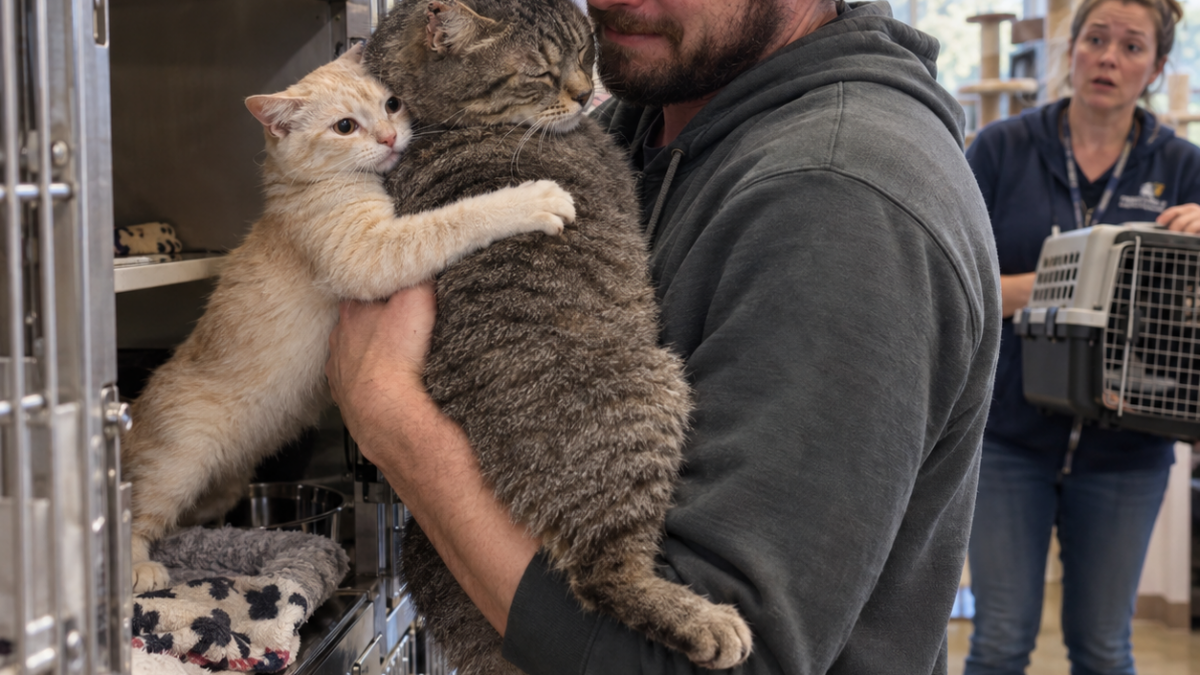
He stepped forward, stretched both front paws up, and grabbed Weston around the middle.
Not dramatic.
Not wild.
Desperate.
He wrapped himself around his brother like a child at an airport clinging to the last person who knew how to find the way home.
Weston, who had looked half annoyed by the entire world up to that point, turned his head and pressed his face into Louie’s neck.
I froze.
The volunteer said something soft behind me. Maybe an apology. Maybe a warning.
I barely heard her.
Because all at once, that cage did not feel like a cage anymore.
It felt like every room where somebody decides what stays and what goes.
Every kitchen conversation that ends too quietly.
Every box packed after midnight.
Every time life asks you to call something practical when it is really just another word for loss.
I had spent months telling myself survival meant cutting everything down to size.
Smaller grocery bill.
Smaller apartment.
Smaller expectations.
Smaller life.
Standing there with Weston in my arms and Louie hanging onto him for dear life, I realized how much damage can be done by separating what only knows how to stay together.
I set Weston back down.
Louie did not let go immediately.
Even after all four paws were on the blanket, he kept one paw on his brother’s side as if he needed proof.
I laughed once.
Then, to my own embarrassment, I had to wipe my eyes.
The woman watched me carefully.
“You okay?”
“Yeah,” I said, though my voice came out thin.
Then I looked at both cats.
“Nobody’s going home alone.”
So I took both.
The ride home was louder than I expected.
Weston cried exactly twice, deep and offended, like he was filing a formal complaint with management.
Louie made no sound at all.
When I parked outside my apartment building and carried them upstairs, nothing had changed.
Same narrow staircase.
Same faded hallway carpet.
Same chipped kitchen counter.
Same bills waiting on the table.
Same apartment I had left that morning.
And yet, when I set the carrier down and opened the door, everything was different.
Weston stepped out first.
Of course he did.
He surveyed the living room with visible disappointment, then walked under the coffee table as if checking structural integrity.
Louie stayed inside the carrier.
Only his eyes moved.
Weston disappeared behind the couch.
Louie watched him go.
Then, slowly, carefully, he followed.
That first night, Weston claimed the far end of the couch like an old man with opinions about public policy.
Louie hid for an hour, then crawled out and curled against his brother so tightly it made my chest ache.
Around midnight, I woke up because something in the apartment had changed.
Not a noise exactly.
A presence.
Louie slept near my legs.
Weston sat in the hallway facing my bedroom door, wide awake, like he had appointed himself head of security for a very low-budget government.
I lay there in the dark and listened.
Not to silence this time.
To breathing.
To shifting paws.
To the small ordinary sounds of not being alone.
The next morning, Weston woke me by standing on my ribs.
He stared down at me with the grave, disappointed face of a landlord doing a final inspection.
Louie was curled near my hip, tucked so neatly into the blankets that for one half-asleep second, I forgot I had ever lived alone.
Then I remembered I didn’t.
Not exactly.
I got out of bed quietly, trying not to disturb Louie, and both cats followed me into the kitchen.
I put down two bowls because that seemed like the decent thing to do.
Weston sniffed one, looked at me, then sat.
Louie did not touch his either.
They both stared.
I stood there in socks and a sleep-wrinkled T-shirt, half awake, being judged by two shelter cats who had already found a way to make me feel like the new one in the household.
“Eat,” I said.
Neither moved.
Weston gave me a long offended blink.
Louie glanced at him.
Then, very slowly, Weston stepped toward Louie’s bowl and ate one bite from it first.
Only after that did Louie lower his head and begin eating too.
I watched the whole exchange.
Then I laughed so suddenly I almost spilled my coffee.
That was my first lesson.
They were not two separate stories living under one roof.
They were one story with four paws too many for my original plan.
By the third day, I understood their system a little better.
Weston went first into every room.
Louie waited at thresholds until Weston crossed them.
If I opened the hall closet, Weston investigated. Louie peeked around his shoulder.
If a car door slammed outside, Louie flinched, but Weston turned toward the window like he intended to handle it personally.
At night, Louie slept folded against Weston.
In the morning, Weston sat outside the bathroom while I showered, because apparently my personal safety during shampooing required supervision.
It should have been ridiculous.
Instead, it felt holy in a small, ordinary way.
There is something about being watched over by a scarred gray shelter cat that makes a person stand a little straighter.
There is something about a frightened cream-colored cat choosing your bed, your couch, your lap, that makes your life feel less disposable.
I wish I could tell you it was all sweetness.
It wasn’t.
Two litter boxes meant two boxes of litter.
Two mouths meant I learned quickly how fast cat food disappears when actual cats are present to eat it.
There was fur in places I did not know fur could reach.
There were midnight crashes.
There were mysterious sounds from the kitchen that neither cat would admit to.
And there were bills.
The thing about loneliness is that it is expensive in secret ways.
But love is expensive out loud.
You see the food.
You see the litter.
You see the vet invoice.
You see the second scratching post because apparently the first one was an insult.
You see the cost right there on the receipt, and nobody lets you forget it.
A week after I brought them home, Carla from work called to check on me.
She was the one who had suggested the cat in the first place.
“A cat,” she said after I told her the full story. “Singular. That was my suggestion.”
“I know.”
“You really took both?”
“I did.”
There was a pause.
Not mean.
Just loaded.
Then she sighed and said, “Are you okay for that?”
The question was normal.
Kind, even.
But something in me stiffened anyway.
Because nobody asks that question when people spend money numbing themselves.
Nobody leans in with concern when someone buys junk they do not need because they are sad and it is Tuesday and they want to feel excited for eleven minutes.
But bring home two unwanted shelter cats who only have each other, and suddenly the world becomes very interested in your spreadsheet.
“I’m okay,” I said.
She was quiet.
“I didn’t mean it like that.”
“I know.”
And I did know.
But the thought stayed with me after we hung up.
That first month, people kept finding polite ways to say the same thing.
Two is a lot.
That’s a big commitment.
You have to be smart.
Maybe they would have adjusted apart.
People love saying that.
They’ll be fine.
Sometimes that sentence means hope.
A lot of the time it means, I would prefer not to think too hard about what this costs.
The shelter called after about ten days.
It was the same tired woman from the front desk.
She asked how the boys were doing, and something about the word boys nearly undid me.
Nobody had called anything in my apartment boys, babies, troublemakers, sweethearts, or anything tender in a long time.
“They’re good,” I said. “Attached at the spine.”
She laughed.
Then she got quiet.
“I’m glad you took both.”
Something in her voice made me sit up straighter.
“Were people not taking them?”
“We had interest in Weston,” she said carefully. “Older cat. Calm. Solid. Good face. People liked him.”
“And Louie?”
A pause.
“People worried he was too nervous.”
I looked across the room.
Louie was asleep with one paw touching Weston’s tail.
Weston was awake, staring at the window like he was on weather duty.
“Someone asked if we could separate them,” she said.
I said nothing.
“She said she only wanted one and didn’t think cats cared about siblings that much.”
My hand tightened around the phone.
The woman kept going, maybe because she heard the silence on my end.
“Some don’t. Some really don’t. But those two…” She exhaled. “We moved them apart once for cleaning, and Louie bloodied his nose trying to get back to Weston. Weston stopped eating that afternoon.”
I closed my eyes.
Not because it was shocking.
Because it wasn’t.
I could see it too clearly.
That small cream-colored body throwing itself against whatever had come between him and the one thing that made the world make sense.
That gray cat going still in the food corner, deciding food was not the most important thing missing.
“Why would someone separate them?” I asked, though I already knew.
The woman gave the only answer there ever is.
“Because one is easier.”
After we hung up, I sat at the kitchen table for a long time.
One is easier.
Of course it is.
One bowl.
One body.
One vet bill.
One animal to arrange your life around instead of two.
One grief at a time.
One half of the bond, because maybe the other half will adjust if you call the choice practical enough times.
One is easier.
So is leaving a room before the hard conversation starts.
So is telling someone not to be sensitive.
So is saying they’ll be okay when what you mean is I want this to stop inconveniencing me.
Around that same time, work cut my hours.
Not all of them.
Just enough to make the floor move under my feet.
Four hours gone one week.
Six the next.
Nobody made a speech about it.
Business was slow.
Numbers were numbers.
Everyone was expected to understand.
I went out to my car on break and sat there with the air off because I did not want to waste gas.
The steering wheel was hot beneath my palms.
I counted in my head.
Rent.
Food.
Power.
Phone.
Gas.
Cat food.
Litter.
The vet visit I still needed to schedule because both cats were due.
This is where some people stop reading with tenderness and start reading with judgment.
I know that.
There is always someone waiting at the edge of a story like this, ready to say the same thing.
If money was tight, you should not have taken them.
If life was unstable, you should have waited.
If you were lonely, you should have found a cheaper way to be human.
Maybe.
That is one way to look at it.
Another way is this:
There are people with plenty of money who make cold choices every day and nobody calls them irresponsible because the receipt looks clean.
There are people scraping by who love with their whole chest and get lectured for every soft thing they keep alive.
I am not romanticizing struggle.
I am saying the world is very comfortable letting lonely people stay lonely as long as the budget makes sense.
That afternoon, I went home and sat on the floor with Weston and Louie.
I did not even take my shoes off first.
Louie came over immediately and sniffed my jeans, maybe checking whether the outside world had done anything rude to me.
Weston stayed by the couch, watching.
“I might have made a dumb choice,” I told them.
Weston blinked once.
Louie climbed into my lap like a folded hand towel with trust issues.
I laughed, but not because it was funny.
Sometimes if you do not laugh in your own apartment, you start saying things out loud that sound too much like surrender.
I scheduled the vet appointment anyway.
The clinic sat in a low strip of buildings near the highway, between a tax office and a place that sold discount mattresses.
The waiting room smelled like disinfectant and wet fur.
Dogs panted across the room.
A man with a beard held a rabbit carrier on his knees like it contained state secrets.
Weston sat in his carrier with the expression of a man being publicly humiliated.
Louie flattened himself against the back corner of his own carrier until Weston reached through the bars and touched him once with a paw.
It happened so fast I almost thought I imagined it.
But I didn’t.
The veterinarian was kind in that steady way you trust immediately because it does not beg to be noticed.
She examined Weston first.
Then Louie.
Then she stood with a clipboard and gave me the sort of rundown people call manageable right before they tell you a number that does not feel manageable at all.
Weston needed dental work.
Sooner rather than later.
Inflammation.
One bad tooth.
Maybe more once they got a better look.
Louie was physically okay, but his anxiety was obvious, and the doctor asked if there had been any recent separation or major change.
I laughed once, short and dry.
“Just the whole world,” I said.
She smiled a little.
Then looked at her notes.
“When bonded cats lose their person, then lose their home, then go through a shelter environment, one often becomes the anchor for the other. If they stay together, that can help a lot.”
If they stay together.
The estimate sat in my hand like a threat.
Not impossible.
Just cruelly timed.
That night, I spread the paper on the kitchen table.
Weston jumped up beside it like he wanted input on the numbers.
Louie stayed on a chair, chin barely clearing the edge.
I read the estimate three times as if one of the lines might decide to forgive me.
It did not.
I made columns.
Urgent.
Not urgent.
Can wait.
Cannot wait.
There is a particular kind of despair that comes from reducing a life to categories.
Especially when that life is purring beside your elbow.
Weston eventually sat on the estimate.
Then he put one heavy paw over the corner like he was making the decision for me.
A few days later, my sister called.
She loved me in a practical way.
That sounds harsher than I mean it.
Some people hand you warmth.
Some hand you folded towels, a full tank of gas, and a reminder to lock your door.
She was the second kind.
I told her about the hours at work.
I told her about the cats.
I told her about the dental estimate and how I had started cutting my grocery list again.
She listened.
Then she said, “You could take one back.”
Not cruelly.
Not casually.
She said it softly, like she hated even bringing it up.
I stared at the sink while she spoke.
“Not because you don’t care,” she said. “Because you do. Sometimes caring means knowing what you can carry.”
That sentence sat between us.
I knew she loved me.
I knew she was not trying to hurt me.
But I also knew that phrase.
What you can carry.
It was the same phrase life had been feeding me for months, dressed up in different outfits.
Keep what fits.
Release what costs too much.
Do not let your heart write checks the rest of your life has to cash.
I looked over at the couch.
Weston was washing one paw with the concentration of a retired watchmaker.
Louie was pressed against his side so tightly he looked attached by stitching.
“I hear you,” I said.
“But?”
I swallowed.
“But I think people say that line a little too easily.”
My sister was quiet.
So I kept going.
“I think sometimes we call it maturity when we really mean cutting away the living parts until the numbers stop scaring us.”
She let out a breath.
“That is a very dramatic way to talk about two cats.”
“Is it?”
Another pause.
Then, because she was honest, she said, “Maybe not.”
That helped more than agreement would have.
Not certainty.
Just that.
Maybe not.
A week later, Weston stopped eating breakfast.
Not all of it.
Just enough to make my stomach drop.
He sniffed the bowl, walked away, came back later, ate a little, then sat in the hall like he was pretending not to have a mouthache.
Louie noticed before I did.
He kept circling Weston, brushing past him, touching his face lightly with his own.
The second morning it happened, I called the clinic.
The dental got moved up.
The hardest part was that Weston had to stay for the day.
Possible extraction.
Monitoring.
Several hours.
Maybe longer if recovery was slow.
I set the carrier on the counter.
Louie started crying the second the tech took Weston into the back.
It was the first time I had heard his real voice.
Not a little shelter sound.
Not a quiet complaint.
A full, broken cry.
Small and raw and human enough to make my throat close.
The tech looked at me with sympathy.
“We’ll take good care of him.”
I nodded.
But that was not the problem.
The problem was the other carrier.
Louie cried the whole ride home.
At every red light, he made that sound again.
By the time I got back to the apartment, my nerves felt like glass.
I set his carrier down in the living room and opened it.
He shot out, ran to the couch, stopped, ran to the bedroom, stopped, then came back to the kitchen like he had forgotten which place Weston ought to be in.
That was the longest day of my life in months.
Louie checked every room.
Every room.
The couch.
The bed.
The windowsill.
The crooked kitchen chair Weston liked for reasons known only to gray cats and God.
Then he came back to me and cried again.
I sat on the floor with him.
Rubbed his side.
Told him I knew.
Because I did.
I knew exactly what it was to walk through your own space and feel the outline of something missing before your brain had time to name it.
I knew what it was to keep expecting a familiar body in a doorway.
I knew what it was to hear every household sound and still feel like the room had lost its center of gravity.
That night, Louie would not eat unless I carried the bowl into the bedroom and sat on the floor beside him.
Even then, he kept lifting his head between bites.
Listening.
At midnight, he crawled into bed and pressed himself behind my knees.
Not because I was the best substitute.
Because I was the only warm thing left in the room.
I barely slept.
The clinic called a little after eight the next morning.
Weston was okay.
Two teeth out.
Groggy.
Sore.
Angry at the institution of medicine.
But okay.
I almost cried into the phone.
When I got there, they brought Weston out in a carrier lined with a fresh towel.
He looked drugged and deeply insulted.
I had never been so relieved by a bad mood.
The tech started going over instructions.
Soft food.
Medication.
Quiet space.
Watch his appetite.
I nodded along.
Then Louie, from the carrier at my feet, made a sound.
Not the cry from yesterday.
Just one short note.
Weston lifted his head immediately.
The whole room changed.
I do not know how else to say it.
Weston got up as much as he could inside the carrier and leaned toward the sound.
Louie shoved his face against the carrier bars hard enough to flatten one whisker.
The tech stopped mid-sentence.
Then she smiled in that involuntary way people do when they witness something pure enough to interrupt their training.
“Well,” she said softly. “There’s your recovery plan.”
The minute we got home, Louie stayed glued to Weston.
Not in the annoying hovering way people complain about.
In the watchful, gentle way of someone who knows the body beside him has been hurt.
He did not crowd him when Weston lay down.
He just stayed within reach.
If Weston moved, Louie moved.
If Weston drank water, Louie waited nearby like he was on standby in case drinking became emotionally difficult.
And Weston, for all his pride, allowed it.
That was the part that got me.
Proud creatures do not allow witness easily.
Pain has a way of revealing what matters.
By the end of that week, Weston was eating soft food and glaring at me with renewed strength.
Louie settled again.
The apartment breathed normally.
But I didn’t.
Something about that separation had cracked me open.
I kept thinking about the woman at the shelter.
One is easier.
I kept thinking about how quickly the world reaches for easier when the harder thing involves honoring attachment.
I kept thinking about all the places we do this.
With pets, obviously.
But also with elderly parents people call difficult because grief has made them repetitive.
With neighbors who cry too loudly through the wall.
With friendships that get messy when someone’s life collapses and suddenly they need more than a birthday text and one coffee every six weeks.
We live in a time that worships convenience and then acts shocked when everybody feels abandoned.
Maybe that sounds too big for a story about two shelter cats.
I don’t think it is.
Because what I was watching in my living room every day was simple enough to embarrass the rest of us.
Weston and Louie did not pretend independence was the highest form of character.
They did not perform detachment to seem evolved.
They did not act like needing each other made them weak.
They just needed each other.
Clearly.
Without apology.
And because of that, they were steadier than most people I knew.
A few nights later, I posted a picture of them.
Nothing fancy.
Weston on the couch after his dental, looking like a tired boxer after twelve rounds, with Louie pressed against him so tightly he seemed determined to heal him through proximity alone.
I wrote a few lines about going to adopt one cat and leaving with two because one had wrapped himself around his brother and refused to let go.
I wrote about the vet visit.
I wrote that some bonds are not optional just because they complicate the budget.
Then I put my phone down and made dinner.
By bedtime, the post had spread further than anything I had ever written.
Messages.
Shares.
Comments from people I had not spoken to since high school.
Photos of bonded pets.
Stories about siblings.
Stories about widowers.
Stories about an old woman who stopped eating after her husband died and only got her appetite back when her family moved her sister in.
And yes, the other kind of comments too.
The practical ones.
The ones that always arrive dressed as wisdom.
You should never adopt pets you can’t afford.
Animals adjust.
People project human emotions onto cats too much.
Feelings over facts.
Some people care more about animals than people.
That last one appeared often.
I read until my eyes hurt.
Then I put my phone face down and sat in the dark.
Weston slept on the couch.
Louie curled at his side.
I kept thinking about how quickly tenderness makes certain people angry.
Not all people.
But enough.
Enough that it tells you something.
It is strange, the things our culture permits.
A person can work themselves numb, answer messages at midnight, eat lunch from a vending machine, and call that discipline.
A person can cut every needy corner out of their life until they are spiritually living in a storage unit, and half the world will praise them for being realistic.
But say out loud that two cats loved each other and should stay together even if it made things less convenient, and suddenly people need a committee.
The next morning, there were more comments.
One woman wrote that she had worked in rescue for years and watched bonded animals fall apart after separation because adopters kept insisting love was sentimental nonsense.
A man wrote that his brother had moved in with him after a divorce and people called it failure, but what they really meant was that he had chosen not to be lonely on principle.
Someone else wrote:
This country teaches us to afford things before we deserve them, including comfort.
That line stayed with me all day.
Afford things before we deserve them.
Yes.
That was it.
As if love is a premium feature.
As if care should wait until your life becomes tidy enough to host it.
As if healing must wait for a better quarter.
That weekend, my sister came over.
She brought soup in a container I still have because she always buys practical containers with good lids.
Weston distrusted her immediately.
Louie hid for eleven minutes, then reappeared from behind the bedroom door.
She watched them circle the living room.
“So,” she said. “These are the famous brothers.”
“Apparently.”
She looked around the apartment.
The changes were small but visible.
A scratching post by the window.
A blanket over the chair because Weston liked to knead it like he had unresolved feelings about bread.
A basket of toys beside the television stand.
Two bowls drying next to my dishes.
Two living creatures moving around as if they had always belonged there.
The place looked lived in.
My sister noticed.
I could tell.
Halfway through lunch, a garbage truck banged outside.
Louie startled so hard he slipped on the floor.
Before I moved, Weston was there.
Not dramatic.
Not movie-style.
He just walked over and stood beside him.
Louie pressed against his shoulder.
That was all.
But my sister saw it.
She sat back in her chair and looked at them for a long second.
Then she looked at me.
“Oh,” she said quietly.
I knew what she meant.
Not agreement in theory.
Understanding in the body.
Oh.
That is different.
She left an hour later and hugged me at the door.
Before she walked out, she glanced back at the cats.
“I still worry about your budget.”
“I know.”
“But I was wrong to talk about them like groceries.”
That nearly took me out.
Not because it was dramatic.
Because it was rare.
Most people do not apologize when practicality fails them.
They reword it and come back stronger.
Months passed.
The cats learned the apartment like it was a map written for them.
Weston slept in the chair by the window in late afternoon, one eye half open in case any moral decline occurred outside.
Louie got brave enough to greet me at the door some nights, though only if Weston stood a few feet behind him like backup.
If I had a hard day, they knew.
I am aware how that sounds to people who like every sentence to arrive wearing data.
I do not care.
They knew.
On nights I walked in with my shoulders too tight, Weston stayed near.
Not cuddly.
Just available.
Louie, who still startled at dropped keys and raised voices on television, somehow never mistook sadness for danger.
He came closer when I was low.
Like he understood the difference between a loud world and a tired heart.
One Friday, I sat on the kitchen floor and cried over nothing impressive.
No tragedy.
No grand event.
Just accumulation.
A bill I had not expected.
A schedule still too thin.
A body too tired to pretend all of this was character-building.
I cried the way adults usually do.
Quietly.
With embarrassment.
As if apologizing to my own apartment for making moisture.
Weston walked over first.
He sat one foot from my knee.
Louie came next and put one paw on my leg.
I looked at them through the blur.
Then I laughed because there they were again.
One sturdy witness.
One gentle witness.
No advice.
No slogan.
No demand that I turn my pain into something inspirational before it could stay in the room.
Just company.
I think that is what so many people are starved for now.
Not fixing.
Not optimizing.
Not being told to journal, hydrate, detach, simplify, monetize, heal on a timeline, or turn grief into content with good lighting.
Just company.
A warm body saying, I am here while this is hard.
The cats did that for each other every day.
And because they did, they taught me how to receive it too.
Winter came hard that year.
Cold leaked around the apartment windows.
I stuffed towels along the worst draft and kept the heat lower than I wanted.
Money stayed tight.
I will not lie to make the story cleaner.
Some months I got through by being careful.
Some months I got through by being more careful than any adult should have to be just to buy decent coffee and keep the lights on.
But here is the part I want to say plainly.
Not once did I wish I had split them.
Not once.
I worried.
I recalculated.
I stood in grocery aisles holding one item and putting back another.
I muttered at bank balances, utility notices, and the rising cost of everything ordinary.
But I never looked at those brothers sleeping nose to nose on my couch and thought, This would have been better if I had made the easier choice.
Because by then I understood something I had been slow to learn in my own life.
An easier choice and a better choice are not the same thing.
Sometimes they are.
A lot of times, they are not even neighbors.
Near Christmas, my upstairs neighbor knocked on my door.
She was in her sixties and smelled like powder and peppermint. She held a small paper bag.
“I had extra ornaments,” she said. “Then I remembered I don’t know if you do a tree.”
“I don’t.”
“Well,” she said, lifting the bag, “now you have cat toys shaped like snowflakes, which feels close enough.”
It was the first holiday gift I had received in that apartment.
Louie loved the crinkly tissue paper.
Weston loved the bag.
My neighbor stood in the doorway while the cats investigated her boots.
Then she said, “I heard your story from my niece online.”
I stared at her.
“She sent it to me,” she said. “The cat brothers.”
My face warmed.
“Sorry about that.”
“Don’t be.”
She looked around the apartment the way older women sometimes do, taking inventory without cruelty.
Her eyes landed on the cats.
On the bowls.
On me.
“You look less ghostly than when you moved in,” she said.
There are compliments that sound prettier than that.
Not many land truer.
Less ghostly.
That got me more than any comment online.
Because it was true.
Before Weston and Louie, I had been living like a man haunting his own future.
I went to work.
I came home.
I reheated soup.
I answered no messages I did not have to answer.
I went to bed early or too late.
I treated my life like a waiting room with rent.
The cats ruined that.
Bless them.
They demanded present tense.
Feed us now.
Open the door now.
Sit down now because one of us has stretched across your entire lap and the law is the law.
There is no detached way to live with animals.
You have to participate.
You have to notice.
And once you start noticing, your own life becomes harder to ignore.
One icy night in January, the power went out for three hours.
The apartment went dark all at once.
No television hum.
No heater.
No refrigerator buzz.
Just silence and streetlight glow through the blinds.
Louie panicked at the first click.
He darted under the bed.
Weston went after him.
I found a flashlight, sat on the floor, and waited.
A few minutes later, Weston came out and sat near me.
Then he turned his head back toward the underside of the bed.
An invitation.
I lowered myself until I could see Louie’s eyes in the dark.
“It’s okay,” I said.
He did not believe me.
But Weston lay down halfway under the bed and halfway out, connecting the dark place to the room.
After a minute, Louie crawled forward until his face reached Weston’s shoulder.
Then he stopped.
Then he came the rest of the way.
That image stayed with me after the lights came back.
Not because it was dramatic.
Because it was exact.
That is what love had done for me too.
It had not dragged me into some dazzling new life.
It had simply laid itself down between my fear and the room, making a bridge small enough to cross.
You can build a whole life out of that kind of bridge.
A few weeks later, I went back to the shelter with a bag of food and some old blankets.
Not a heroic donation.
Just what I could spare.
The woman at the front desk recognized me immediately.
“How are my famous boys?”
“Still unionized,” I said.
She laughed.
I told her about the post.
The comments.
The arguments.
The messages.
She shook her head in that tired shelter-worker way that somehow holds both humor and grief.
“People really hate hearing that animals have emotional lives,” she said.
“Why?”
“Because then they have to admit convenience isn’t neutral.”
That sentence followed me home.
Convenience isn’t neutral.
No.
It favors the person with more power every time.
The person choosing.
The person leaving.
The person paying.
The person who gets to say, It’s just a cat, or It’s just easier this way, while somebody smaller absorbs the cost.
Again, maybe that sounds too big.
Spend one afternoon watching a bonded animal search for the body that steadied its world and tell me it is too big.
By spring, the apartment had become ours so completely that I could no longer remember how it sounded before them.
There were routines now.
Weston at the bedroom door at six-thirty.
Louie waiting by the kitchen mat, pretending not to.
The evening window watch.
The midnight patrol.
The way both cats stopped what they were doing whenever I sneezed, as if my respiratory system required oversight.
I had not become rich.
I had not become healed in a dramatic, movie-legal way.
I still had hard days.
I still had bills.
I still had moments in grocery aisles where I caught myself calculating with old fear.
But I was not hollow in the same way.
There were witnesses in my life now.
Small ones.
Furry ones.
Demanding ones with poor boundaries and strong opinions about canned food.
But witnesses all the same.
And that matters more than people admit.
We have built a culture that talks constantly about wellness while treating dependence like a moral failure.
We tell people to reach out, then flinch when reaching out costs time.
We praise resilience, but what we often mean is this:
Can you suffer in a way that does not interrupt my convenience?
Weston and Louie never asked that of each other.
Not once.
If one was afraid, the other showed up.
If one hurt, the other stayed close.
If one disappeared for a day, the other cried loud enough to make a waiting room full of strangers look up.
That is not weakness.
That is loyalty without branding.
That is care before theory.
That is the kind of thing the rest of us keep pretending is childish because admitting we need it would rearrange too much.
One evening, months after I brought them home, I was folding laundry on the couch.
Weston sat in his spot, supervising.
Louie had somehow fallen asleep inside a basket of socks.
The light through the window was soft and gold and ordinary.
The kind of evening that used to hurt because I had nobody to mention it to.
I looked at the two of them and thought about that first day in the shelter.
The torn ear.
The anxious eyes.
The desperate grip.
The one paw Louie left resting on Weston even after Weston was safely back on the blanket, like he needed proof his world had not ended.
I understood that gesture differently now.
It was not just fear.
It was testimony.
This matters.
This stays.
Do not take this from me and call it sensible.
I think a lot of us are living with our paw on something like that.
A brother.
A child.
A friend.
A dog.
A parent.
A cat with a torn ear and too much dignity.
A tiny routine that keeps the dark from swallowing the room.
And every day, some voice somewhere tells us to let go because it would be simpler.
Maybe sometimes we have to.
Life is not a fairy tale, and I will not insult anyone by pretending love always wins cleanly.
But I am saying this:
We should stop acting like separation is automatically the mature choice just because it is cheaper, tidier, or easier to explain.
Sometimes the most responsible thing in the room is the one thing that refuses to let go.
So yes.
I went to adopt one shelter cat.
I came home with two brothers and a grocery budget that had to learn new tricks.
I came home with one cat who looked at the world like it had disappointed him personally and another who trusted that disappointment less when his brother was nearby.
I came home with extra fur, extra cost, extra mess, extra softness.
And I came home to the deeply inconvenient truth that healing rarely arrives in the neat form we budgeted for.
It comes noisy.
It comes doubled.
It comes with a torn ear and a frightened heart and a stare from across the room that says, We’re all staying.
People can argue forever about whether I made the practical choice.
That’s fine.
Let them.
Here is what I know.
The apartment is still small.
The carpet is still tired.
The walls are still thin enough that I hear the upstairs toilet flush.
But at night now, I hear other things too.
Paws shifting on the blanket.
A sleepy chirp from the hallway.
The soft sound of one brother settling closer to the other.
And my own heartbeat, no longer sounding like the loneliest thing in the room.
I thought I rescued two cats because they refused to be separated.
The truth is harder.
And better.
They taught me that some bonds are not obstacles to a stable life.
Sometimes they are the only reason life becomes bearable enough to keep building.
And if that sounds too emotional for some people, I do not know what to tell them except this:
We already tried building a world around what was easiest.
Look how lonely it got.