I Watched a Starving White Cat Get Slapped Bloody for Taking One Step Toward a Bowl—Two Weeks Later, I Found Her Collapsed in the Rain…
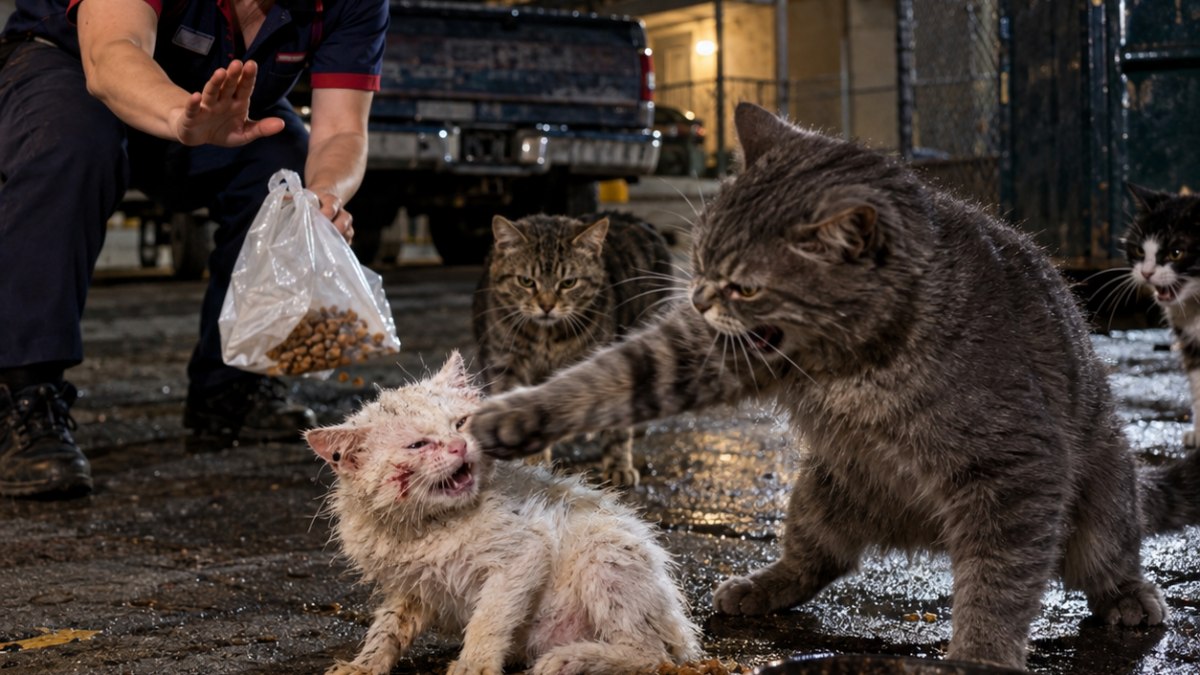
PART3:
Todd didn’t like being answered straight. He liked people who apologized before they spoke. He liked tenants who kept their eyes down, paid late fees without arguing, and thanked him when he fixed something six weeks after a complaint.
He stepped off the stairwell and came closer.
Snow tried to shrink beneath the truck.
Todd saw it.
That was the worst part.
He saw she was afraid, and it pleased him.
“You keep this up,” he said, “and this whole property turns into a shelter. Then come the fleas. Then the smell. Then the complaints. Then I have to spend money cleaning up after your little charity project.”
“There wouldn’t be so many cats if people stopped abandoning them.”
He laughed once. “People abandon things for a reason.”
I looked at him then.
Really looked.
He flicked ash onto the pavement right beside Snow’s bowl.
“She’s not a thing.”
“No,” he said. “She’s worse. A thing doesn’t breed, scratch cars, or make paying tenants think they live in a dump.”
I picked up the plate and moved it closer to the truck.
Snow’s eyes followed my hand.
Todd’s face changed.
Not much.
Just enough.
The smile disappeared, and underneath it was a kind of annoyance I’d seen too many times in too many men who liked power more than they liked being decent.
“Clara,” he said quietly, “you are one written warning away from being a problem.”
I stood up, holding the empty plastic bag so tight it crackled in my fist.
“I’m already a problem, Todd.”
For a second, he didn’t speak.
Then he stepped toward the truck, bent down, and slapped the side of the metal bed with his palm.
The sound cracked through the parking lot.
Snow flinched so hard she hit her head on the underside of the truck.
“Get!” Todd shouted.
She scrambled backward into the dark, knocking over the plate, food scattering across the oil stains.
My whole body went hot.
“What is wrong with you?”
Todd straightened slowly.
Behind him, a porch light clicked on.
Then another.
Mrs. Ellis from downstairs opened her door with her robe tied crooked and her gray hair wrapped in a scarf.
“What’s going on?” she called.
Todd turned instantly, his voice smoothing itself out.
“Nothing, Mrs. Ellis. Just handling a tenant issue.”
“A tenant issue at midnight?”
“She’s attracting strays again.”
Mrs. Ellis looked at me, then at the overturned food, then under the truck where Snow’s eyes glowed like two small moons.
She didn’t say anything at first.
Mrs. Ellis was sixty-eight, maybe seventy, though she lied about her age with the confidence of a woman who had earned the right to edit facts. She lived under me in apartment 1B, watched court shows at high volume, and complained about everything from mail delays to the price of bananas. But she had a sharpness that didn’t miss much.
Todd put his cigarette out beneath his boot.
“I’ll be sending notices tomorrow,” he said loudly enough for everyone listening behind curtains to hear. “No feeding animals on property. No unauthorized shelters. No bowls, no blankets, no mess.”
My throat tightened.
“That’s not in the lease.”
“It will be.”
“You can’t just change rules overnight.”
He smiled again.
“Watch me.”
Then he walked away, his keys swinging at his hip.
Mrs. Ellis stayed at her door.
“Honey,” she said after a moment, “you need to be careful with that man.”
“I know.”
“No,” she said. “You don’t. Men like that don’t just want to win. They want you embarrassed for trying.”
I looked back under the truck.
Snow was still there, trembling so hard I could see it.
Mrs. Ellis followed my gaze and shook her head.
“The weak ones don’t make it long outside.”
I knew she didn’t mean to be cruel.
But the words landed somewhere deep in me, somewhere old and bruised.
There had been years when I was the weak one.
Years when rent went up faster than my paycheck.
Years when I wore the same pair of shoes until cardboard held the soles together.
Years when I smiled at bosses who cut my hours, neighbors who judged my car, men who thought kindness was permission, and people who could smell poverty like smoke in your clothes.
I looked at Snow beneath that truck and thought, She already knows.
She knows what it feels like to wait until everyone else is full.
After that night, I changed my routine.
I fed the others first at the edge of the lot where Todd couldn’t see from his office window. Then I waited until they wandered off, and I brought a fresh bowl to the truck.
Snow still wouldn’t come out.
She stared at the bowl like it might explode.
For almost two weeks, I sat on the curb after work, tired and cold, talking to a cat who did not trust kindness.
“It’s yours,” I told her. “I’m not taking it back.”
She never believed me.
Todd noticed anyway.
The first notice came taped to my door on a Monday morning.
LEASE VIOLATION: UNSANITARY CONDUCT.
He had underlined “unsanitary” twice in red pen, like a schoolteacher who hated children.
The second notice came three days later.
TENANT IS CREATING A NUISANCE BY ATTRACTING FERAL ANIMALS.
The third came with a photograph of me sitting by the truck, my gas station uniform wrinkled, my hair tied up in a messy bun, a paper bowl in my hand. He had printed it from somewhere, maybe from his phone, maybe from the cheap security camera above the laundry room.
At the bottom, he wrote: FINAL WARNING.
I brought the notices to the rental office after my shift.
Todd sat behind the desk with his boots propped on an open drawer and a football game playing on his phone. Behind him hung a framed poster that said COMMUNITY BEGINS WITH RESPECT.
He looked up and smiled.
“Clara. What a surprise.”
“You’re harassing me.”
“I’m enforcing rules.”
“You’re making up rules.”
He took his boots off the drawer slowly.
“Do you have a lawyer?”
I hated the way my silence answered for me.
Todd leaned back.
“Didn’t think so.”
“My lease doesn’t say I can’t feed strays.”
“Your lease says you can’t create hazards or disturb the community.”
“Hungry cats eating behind the building are not a hazard.”
“They are when tenants complain.”
“Which tenants?”
“Confidential.”
“Because they don’t exist.”
His eyes hardened.
“You know, for somebody who can barely make rent on time, you have a lot of attitude.”
The humiliation hit fast.
I felt my face burn.
There it was.
The thing he’d been waiting to say.
Not about cats.
Not about rules.
About me.
About the fact that I lived one emergency away from losing everything, and we both knew it.
I folded the notices carefully and put them back in my purse.
“You don’t get to talk to me like that.”
Todd stood.
“I talk however I need to talk to keep this property from turning into a dump.”
I turned to leave.
His voice followed me.
“And Clara?”
I stopped but didn’t look back.
“If that white cat is still under that truck by the end of the week, animal control gets a call.”
I drove to work that evening with my hands shaking.
At the gas station, I stocked cigarettes, wiped coffee rings off the counter, counted change, and smiled at customers like something inside me wasn’t cracking open.
Around ten-thirty, a woman in scrubs bought a granola bar and asked if I was okay.
I almost lied.
Instead I said, “I’m tired.”
She nodded like that explained everything.
Maybe it did.
That Friday night, rain came hard.
Not soft rain.
Not movie rain.
Real rain.
Cold, slanted, mean.
The kind that bounces off pavement and soaks through your shoes in seconds.
The other cats came late, angry and wet. I fed them under the stairwell and waited until they scattered.
Snow wasn’t under the truck.
I checked the bushes.
The dumpster.
The laundry room.
The gap behind the fence.
Nothing.
I told myself not to panic over a stray cat.
Then I heard it.
A tiny sound from behind the laundry room vent.
Snow was curled against the brick, soaked all the way through. Her eyes were half-closed. One side of her cheek was swollen, and blood had dried into the fur around her mouth. Her back legs trembled when she tried to move.
“Oh, baby,” I whispered.
She tried to hiss, but the sound barely came out.
I took off my work sweater and wrapped it around her.
She was lighter than a bag of flour.
Mrs. Ellis opened her door just as I reached the stairs.
“You bringing that thing inside?”
I looked down at Snow’s little body in my arms.
“I guess I am.”
Mrs. Ellis stared at me.
“You can barely take care of yourself.”
She wasn’t wrong.
My apartment was small.
My checking account was smaller.
I had one couch with a torn cushion, a kitchen table from a yard sale, a microwave that sparked if you closed the door wrong, and bills stacked beside the bread box like a second job.
But Snow pressed her wet face into my sweater, and something in me settled.
“I don’t need much,” I said. “She needs one safe place.”
Mrs. Ellis opened her mouth, closed it, then stepped aside.
“Bathroom first,” she said. “Warm towels. I’ll get iodine.”
I blinked.
“You have iodine?”
“I have everything.”
She disappeared into her apartment and came back with a little plastic basket full of supplies like she’d been waiting her whole life for an emergency that involved a half-dead cat.
The first week was rough.
Snow hid behind the toilet.
Then under the couch.
Then inside an empty laundry basket.
I set food in the bathroom and left the door open. She only ate when I walked away. If I reached too fast, she flinched. If a car door slammed outside, she vanished. When I put medicine on the scratches around her face, she shook so badly I had to stop and sit on the floor beside her until both of us calmed down.
The small clinic near the highway gave me a discount when I brought her in wrapped in a towel.
The vet, Dr. Patel, was a quiet woman with silver streaks in her hair and kind hands.
“She’s underweight,” Dr. Patel said. “Dehydrated. Old injuries. New swelling along the cheek. No broken bones, thank goodness.”
“Will she make it?”
Dr. Patel looked at Snow, who was crouched in the back of the carrier trying to disappear.
“She wants to.”
That was enough.
I bought antibiotics with money meant for my electric bill.
I bought the cheapest soft blanket I could find and put it beside the heater.
For days, Snow acted like she expected someone to take everything back.
The food.
The warmth.
The quiet.
The right to sleep without one eye open.
On the eighth day, Todd knocked.
Not a neighbor knock.
Not a polite knock.
A property manager knock.
Three hard hits that made Snow shoot under the couch.
I opened the door only halfway.
Todd stood there holding a clipboard, wearing a navy jacket with the Cedar Row logo embroidered on it like he was managing a resort instead of a peeling brick complex where half the dryers didn’t work.
“I hear you’ve got an unauthorized animal.”
“You heard wrong.”
He looked past me.
“I can smell it.”
“No, you can’t.”
“I need to inspect.”
“You need to give twenty-four hours’ notice.”
His jaw tightened.
“You’ve been reading your lease?”
“Turns out I can.”
For a second, something dangerous flashed in his eyes.
Then he smiled, because men like Todd are always most dangerous when they smile.
“Fine,” he said. “Tomorrow.”
He handed me a paper.
NOTICE OF ENTRY.
Under reason for entry, he had written: SANITATION COMPLAINT.
The next afternoon, he showed up with another man I’d never seen before, broad-shouldered, red-faced, carrying a tablet. His name was Dwayne Phelps, Todd said, regional property supervisor.
That meant Todd wanted an audience.
I had cleaned my apartment until my back hurt. There was no smell. No mess. No bowls in the open except one water dish in the kitchen. Snow was tucked in the bathroom, curled on her blanket, terrified but safe.
Dwayne stepped inside and glanced around.
Todd began before the man had even cleared the doorway.
“As you can see, tenant has been engaging in unauthorized animal rescue activity, attracting pests, violating sanitation—”
“I see a clean apartment,” Dwayne said.
Todd blinked.
“So far.”
Dwayne inspected the kitchen.
The living room.
The bathroom.
Snow pressed herself flat against the wall behind the toilet, eyes huge.
Dwayne looked at her, and for the first time his face softened.
“That the cat?”
“Yes,” Todd said. “Feral.”
Snow trembled.
“She’s not feral,” I said. “She’s scared.”
Todd laughed.
“That’s what people always say when they want special treatment.”
Dwayne looked at him.
Then he looked at me.
“You have documentation from a vet?”
I handed him the clinic receipt and aftercare instructions.
He read them quietly.
Todd shifted.
“She still violated policy.”
“What policy?” I asked.
Todd snapped, “The no-pet policy.”
“My lease allows one indoor cat with a pet deposit.”
“You haven’t paid one.”
“I tried to yesterday. Your office was closed.”
Todd’s face reddened.
Dwayne looked at him again.
“Todd.”
“What?”
“Take the deposit.”
Todd’s mouth opened.
Then closed.
I almost smiled.
Almost.
Dwayne handed the papers back to me.
“Pay the deposit by Friday. Keep the cat indoors. Don’t feed animals in common areas.”
I wanted to argue the last part.
I didn’t.
Not then.
After they left, I sat on the bathroom floor beside Snow and cried before I could stop myself.
Not loud.
Just the tired kind of crying adults do when life has been heavy for too long.
I felt something touch my knee.
Snow stood there, thin and nervous, with her cloudy fur sticking up in every direction.
She looked at me for a long second.
Then climbed into my lap.
I didn’t move.
I barely breathed.
That cat, who had been beaten for reaching toward a bowl of food, had decided to reach for me.
Three months later, Snow looked like a different animal.
Her fur grew back soft. Her eyes brightened. The swelling in her cheek disappeared, leaving only a faint crookedness around her mouth that made her look permanently skeptical. She still startled easily, but she no longer ducked when I put her bowl down.
Mrs. Ellis came by one afternoon with an old folded quilt.
“Thought she might like this,” she said, not looking at me.
Snow walked over, sniffed the quilt, and sat right in the middle of it like a queen.
Mrs. Ellis laughed under her breath.
“Well,” she said, “look at her now.”
I did.
And I thought about all the people in this world who get pushed to the edge because they are quiet, poor, tired, different, gentle, or simply too worn down to fight back.
People love to say the weak don’t make it.
But sometimes they do.
Sometimes all they need is for one person to stand between them and the world long enough for them to remember they are worth feeding.
I thought bringing Snow inside was the end of the story.
It wasn’t.
It was only the part people could see.
The real story started six months later, on an ordinary Tuesday night, when I came home from work and found Snow sitting in the window staring at something outside.
Not looking.
Waiting.
The difference matters.
Cats look at birds, leaves, headlights, dust, shadows, whatever moves.
Waiting means someone matters.
I unlocked the apartment door and set my purse on the kitchen table.
Snow didn’t come greet me.
That alone was strange.
Usually she met me halfway down the hall and yelled at me with her scratchy little complaint that sounded like she had smoked cigarettes for twenty years.
But that night she stayed in the window.
Watching.
I walked over and looked outside.
At first, nothing.
Just the parking lot.
The dumpster.
The old pickup truck.
Todd’s office window glowing faintly across the courtyard.
“You see a ghost?” I asked.
Snow flicked her tail.
Then she made a tiny chirp.
The same sound she made whenever she saw another cat.
I looked again.
Still nothing.
Three nights later, she did it again.
Window.
Parking lot.
Waiting.
This time I stayed beside her longer.
Finally, I saw it.
A small orange shape moving near the fence behind the dumpster.
The cat disappeared almost immediately, but Snow remained frozen, watching the place where it had been.
For nearly twenty minutes.
I touched her back.
She didn’t move.
It felt strange.
Almost sad.
As though she recognized something.
Or remembered something.
The next week I started noticing more cats around the building.
Not the original group.
Most of them had drifted elsewhere after Todd started making noise and clapping his hands and throwing rocks near the dumpster when he thought no one was watching.
These were different.
A striped cat.
A black kitten.
A nervous orange female with amber eyes and one torn ear.
One evening Mrs. Ellis spotted me standing by the window.
“You’ve noticed them too?” she asked.
“The new cats?”
She nodded.
“Someone moved out of building C.”
“What happened?”
She glanced toward the office.
“Eviction.”
The word hung there.
“Families?” I asked.
“Mother and two kids. Maybe a boyfriend. Hard to tell who lived there and who just came around.”
My chest tightened.
“Pets?”
Mrs. Ellis’s mouth pressed into a thin line.
“I heard crying in there the morning Todd changed the locks.”
I looked down at Snow sleeping on the quilt.
For a moment I imagined someone closing a door.
Driving away.
Leaving food bowls behind.
Leaving eyes in the dark.
A week later I met the orange cat properly.
I was carrying groceries from my car when she slipped out from behind the dumpster.
Thin.
Smaller than Snow had been.
Ribs visible through her fur.
The second she saw me, she bolted.
Gone.
But later that night Snow sat at the window again.
Waiting.
The next evening, I brought a paper plate downstairs after dark.
Then another.
Then another.
I told myself I was only helping temporarily.
That was the lie.
The same lie I told before Snow came home.
The first night, no cats appeared.
The second night, the orange one showed up.
She ate three bites.
Then ran.
The third night, she stayed long enough to finish half the plate.
Snow watched the entire thing through the window.
I swear she looked proud.
By the second week, the orange cat knew my schedule.
The moment my car turned into the lot, she appeared.
Still nervous.
Still ready to run.
But hungry enough to stay.
I started calling her Amber.
Not because of her fur.
Because her eyes looked like little pieces of polished amber glass.
Bright.
Careful.
Always watching.
One night while Amber ate, I noticed movement under the old pickup.
A kitten.
Tiny.
Gray.
No bigger than a loaf of bread.
Then another appeared.
And another.
Three kittens.
All skinny.
All dirty.
Following Amber.
“Oh no,” I whispered.
Amber immediately gathered them closer.
Protective.
Alert.
Mother.
That explained everything.
The waiting.
The fear.
The endless hunger.
She wasn’t feeding herself.
She was feeding four mouths.
Her own included.
I sat on the curb for a long time after they disappeared.
When I finally went upstairs, Snow was waiting by the door.
I looked at her.
She looked at me.
“You knew.”
Snow blinked.
Which, in cat language, felt suspiciously like yes.
The following days became complicated.
Very complicated.
Because helping one starving cat is one thing.
Helping a family is another.
My paycheck had not magically improved.
The rent still existed.
The bills still waited by the microwave.
And winter was approaching.
Every evening I stretched the cat food farther.
Every evening Amber appeared with the kittens.
Every evening Snow watched from the window.
One Saturday morning, Mrs. Ellis knocked on my door carrying two grocery bags.
“I bought too much,” she announced.
The bags contained canned cat food, a blanket, two old towels, and a cardboard box.
I stared at her.
She shrugged.
“Don’t make it weird.”
“You like them.”
“I tolerate them.”
“You like them.”
She pointed a finger at me.
“Don’t push your luck.”
But she was smiling.
That afternoon, we carried the box behind the building. We tucked it beside a sheltered corner near the laundry room wall, protected from wind and rain. Mrs. Ellis carefully arranged the blanket, then pretended she hadn’t.
By evening, Amber had discovered it.
The kittens followed.
The sight nearly broke my heart.
Four little bodies curled together.
Sleeping safely.
Maybe for the first time in their lives.
Winter arrived early that year.
Cold enough to sting your face.
Cold enough to make the pavement sparkle before sunrise.
One evening, a storm rolled in with strong wind and heavy rain. The kind that rattled windows and made the whole building feel older than it already was.
Around midnight, I looked outside.
The cardboard shelter was still there.
Barely.
The wind had pushed it sideways, and rain was reaching inside.
I grabbed my coat.
Snow immediately sat up.
“No,” I told her.
She followed me to the door anyway.
I opened it.
She stared at me, then at the hallway, then back at me.
For a second, I thought she might actually try to come downstairs.
Instead, she sat beside the door until I returned.
Waiting.
The storm felt worse outside.
Water pooled across the pavement.
The shelter had partially collapsed.
My heart sank.
“Amber?”
Nothing.
Then I heard movement.
The family was squeezed beneath the pickup truck.
Wet.
Shivering.
Terrified.
I crouched nearby.
“You can’t stay out here.”
Amber’s eyes locked onto mine.
For one impossible moment, I remembered Snow.
The same fear.
The same distrust.
The same question.
Is this a trick?
I carried the box into the covered maintenance alcove near the building entrance and reinforced it with plastic storage bins someone had thrown away months earlier.
Nothing fancy.
Just dry.
Safe.
Sheltered.
Amber watched every second.
By the time I finished, I was drenched. My hands were numb. My shoes squished when I walked.
But before I left, Amber did something unexpected.
She stepped inside the shelter.
Then one by one, the kittens followed.
I smiled all the way upstairs.
Snow met me at the door, sniffed my wet pant leg, and head-butted my ankle.
Approval.
At least that’s what I chose to believe.
The next morning, Todd found the shelter.
I know because I heard him before I saw him.
“What the hell is this?”
I looked out my window.
He stood below in his navy jacket, staring at the plastic bins like I had installed a swimming pool.
Amber and the kittens were nowhere visible.
Mrs. Ellis opened her door downstairs.
“Morning, Todd.”
He spun around.
“Did you put this here?”
“Put what where?”
“That.”
Mrs. Ellis leaned out and squinted dramatically.
“My eyesight isn’t what it used to be.”
Todd kicked the side of the shelter.
It shifted.
My breath caught.
Mrs. Ellis’s voice changed.
“Don’t.”
Just one word.
Sharp enough to cut.
Todd looked up and saw me in the window.
His face lifted into a grin.
“Well,” he called. “There she is.”
By noon, every tenant had a notice taped to their door.
COMMUNITY MEETING REQUIRED.
Topic: Tenant misconduct, sanitation, and feral animal infestation.
I stood in the hallway reading it while neighbors whispered behind half-open doors.
Mrs. Ellis came up beside me.
“He’s doing it publicly.”
I swallowed.
“He wants them mad at me.”
“Yes,” she said. “He does.”
The meeting happened that Saturday in the laundry room because Cedar Row didn’t have a clubhouse, despite Todd calling the laundry room the “community facility” in rental listings.
Someone had dragged in folding chairs.
The dryers hummed behind us.
A toddler cried near the vending machine.
Todd stood at the front beside a corkboard covered in notices, looking pleased with himself.
I sat in the third row, hands folded in my lap.
Mrs. Ellis sat beside me like a bodyguard.
Todd began with a speech about cleanliness, property values, safety, and responsibility.
Then he put up photographs.
Me feeding cats.
Me sitting near the truck.
The shelter.
Bowls near the fence.
A blurry shot of Amber with her kittens.
People murmured.
I felt my face burn.
Todd held up one photo of me crouched in the rain, reaching toward the collapsed shelter.
“This,” he said, “is what happens when one tenant decides her feelings matter more than the community.”
Someone in the back whispered, “That’s Clara?”
Another voice said, “I thought she was just quiet.”
Todd nodded like he was sad about it.
“We have tried to handle this privately, but Ms. Wren has refused to comply. As a result, we now have an infestation. We’ve had reports of fleas, property damage, trash ripped open, scratches on vehicles—”
“Which vehicles?” Mrs. Ellis asked.
Todd’s smile flickered.
“Several.”
“Name one.”
“That information is confidential.”
Mrs. Ellis leaned back. “Convenient.”
A few people chuckled.
Todd’s eyes narrowed.
Then he turned to me.
“Ms. Wren, would you like to explain why you believe your hobby is more important than your neighbors’ health?”
Every face turned.
Public humiliation is a strange thing.
It makes the room larger and your body smaller.
For one second, I was not thirty-nine years old. I was seventeen again, standing in a school cafeteria with a split backpack and discount shoes while girls laughed at the food stamps in my mother’s purse.
My mouth went dry.
I could feel Todd enjoying it.
That was what steadied me.
I stood slowly.
“My hobby,” I said, “was feeding animals people left behind.”
Todd gave a little laugh.
“And there we have it.”
I kept going.
“The white cat I took in was injured. The orange cat outside has kittens. The shelter keeps them from freezing.”
“Touching,” Todd said. “But irrelevant.”
“No,” a voice said from the back.
Everyone turned.
A woman stood near the doorway with three children gathered around her. I recognized the children. They had been leaving little handfuls of food near the shelter, sitting several feet away while Amber ate.
The woman stepped forward.
“My name is Rachel Kline. I live in 2C. My kids saw those kittens last week. They’re not hurting anyone.”
Todd stiffened.
“Ms. Kline, this meeting is not—”
“My youngest son asked why they were outside in the cold,” Rachel said. “I didn’t have a good answer.”
The laundry room went quiet.
Todd cleared his throat.
“The answer is that feral animals belong with animal control.”
“Animal control is overloaded,” Rachel said. “And those kittens are adoptable if someone helps.”
Todd’s smile returned, colder now.
“Then perhaps you’d like to pay for them.”
Rachel didn’t flinch.
“Maybe I would.”
That was the moment something shifted.
Not dramatically.
Not like in movies where people rise all at once.
But one person spoke.
Then another.
A retired man named Frank Daley said his wife used to feed birds and nobody called that an infestation.
A young mother said her daughter had named one of the kittens Pebble.
Mrs. Ellis said, “The only thing attracting pests around here is the dumpster Todd refuses to repair.”
That got a bigger laugh.
Todd’s face flushed.
He slammed his clipboard on top of a washer.
“Enough.”
The sound silenced the room.
“These cats will be removed,” he said. “The shelter will be removed. Any tenant continuing to feed them will receive a lease violation. Three violations means eviction.”
He looked directly at me.
“And some of you are already at two.”
That night, I couldn’t sleep.
Snow curled on my chest, purring like an old engine.
Outside, Amber’s shelter sat under the weak glow of the parking lot light.
The kittens were inside.
Safe for the moment.
But Todd’s threat hung in the room like smoke.
The next morning, the shelter was gone.
So were Amber and the kittens.
I stood behind the building with my coat unzipped, my breath fogging in front of me, staring at the empty space beside the wall.
No bowls.
No blankets.
No plastic bins.
No Amber.
No kittens.
Just wet pavement and a dark smear where the shelter had been dragged away.
For a few seconds, my mind refused to understand.
Then Snow began crying from the upstairs window.
Not meowing.
Crying.
A low, broken sound that made every hair on my arms stand up.
Mrs. Ellis came out in slippers.
Rachel came running from building C with her children behind her.
Frank appeared with his cane and a coffee mug still in his hand.
“What happened?” Rachel asked.
I couldn’t answer.
Todd opened the office door across the courtyard.
He looked rested.
Almost cheerful.
“Looking for something?”
Mrs. Ellis stepped forward. “Where are they?”
Todd lifted both hands.
“I told everyone the property would be cleaned up.”
“What did you do with them?” I asked.
His eyes slid to me.
“I contacted the appropriate service.”
“Animal control?”
He shrugged.
“A removal service.”
Rachel’s face went pale.
“What does that mean?”
“It means the problem is handled.”
The smallest of Rachel’s children began to cry.
Todd glanced at him and rolled his eyes.
That tiny gesture did something to the adults standing there.
I saw it happen.
Rachel’s mouth tightened.
Frank’s hand clenched around his cane.
Mrs. Ellis looked at Todd like she was seeing him clearly for the first time.
“You better hope those cats are safe,” she said.
Todd laughed.
“Or what?”
Nobody answered.
But something had started.
We searched for hours.
Behind the dumpsters.
Under cars.
In the vacant lot.
Along the creek.
At the storage units.
Near the highway.
Rachel called shelters.
Frank called the county.
Mrs. Ellis called everyone she knew and half the people she didn’t.
I called animal control.
No record.
No pickup.
No cats.
By dark, the children were exhausted, Pumpkin was missing with the others, and Snow had scratched at the window frame until her paws were sore.
I sat on my kitchen floor with my phone in my hand and guilt pressing down on my chest.
“I brought them out,” I whispered. “I made them visible.”
Snow limped over from the couch, climbed into my lap, and pressed her head beneath my chin.
That was when my phone buzzed.
Unknown number.
The message contained a photo.
A strip of orange fur caught on a chain-link fence.
Below it, six words.
CHECK BEHIND MERCER STORAGE ON CEDAR.
My heart stopped.
Mercer Storage belonged to Todd’s cousin.
Everybody knew that. Todd bragged about it whenever someone needed a unit.
I called the number.
No answer.
I called again.
Nothing.
I showed the message to Mrs. Ellis, Rachel, and Frank.
Frank’s face changed.
“I know that place.”
“You do?”
“I used to rent a unit there after my wife passed. Back lot has old sheds behind the fence. No cameras back there unless they added them.”
Rachel grabbed her coat.
“We’re going.”
Mrs. Ellis said, “I’m coming too.”
“No,” I said. “It might not be safe.”
She looked offended.
“I survived two husbands, breast cancer, and thirty-three years teaching fifth grade. Todd Mercer does not scare me.”
So we went.
Mercer Storage sat half a mile from the apartments, behind a row of warehouses near Cedar Street. The front had bright lights and a keypad gate. The back was dark, bordered by weeds and a sagging chain-link fence.
Rain had turned the dirt to mud.
We parked down the road and walked with flashlights.
At first, there was nothing.
Just storage units, pallets, weeds, old tires.
Then we heard it.
A meow.
Faint.
Distant.
Rachel froze.
Again.
A higher sound.
A kitten.
We followed it around the back fence to a row of broken wooden sheds that looked like they should have been torn down years ago.
The smell hit first.
Damp wood.
Urine.
Fear.
I covered my mouth.
Frank shone his flashlight through a gap in the boards.
Inside were carriers.
Three of them.
Stacked badly.
Moving.
“Oh my God,” Rachel whispered.
Amber was in the largest carrier, pressed against the door, eyes blazing.
Beside her, the kittens were shoved into a smaller one, all tangled limbs and frightened faces.
In the third carrier was a black cat I had never seen before, silent except for the sound of her breathing.
A handwritten note was taped to the top.
NO NAME. NO OWNER. DISPOSE.
Rachel’s oldest daughter began sobbing.
Mrs. Ellis said a word I had never heard her say before.
Frank pulled at the shed door, but it was chained shut.
“Call the police,” he said.
I already had my phone out.
The dispatcher asked for the address.
I gave it.
She asked if any people were in danger.
I looked at the carriers.
“Yes,” I said. “Living creatures are in danger.”
The first officer arrived twelve minutes later.
Officer Mateo Cruz was young, calm, and careful in that way good police officers sometimes are when they know a situation could turn ugly if they handle it wrong.
He listened.
He looked through the boards.
Then he cut the chain.
The door opened with a groan.
Amber hissed, but it was not anger.
It was terror.
Rachel got the kittens out first.
All three alive.
Cold.
Hungry.
Shaking.
Amber came next.
She saw the kittens and nearly threw herself against the carrier door until we opened it in a controlled way. She pressed her body over them the moment she was free, covering them like she could make the whole world disappear.
The black cat did not move.
She sat in the back of her carrier with yellow eyes wide open.
Officer Cruz took photos of everything.
The carriers.
The note.
The shed.
The lock.
The tire tracks in the mud.
Then headlights swept across the yard.
Todd Mercer’s truck turned into the back lot.
For one stupid second, I thought maybe he would pretend surprise.
He didn’t.
He jumped out already angry.
“What the hell are you people doing here?”
Officer Cruz stepped forward.
“Sir, is this your property?”
Todd stopped.
His eyes moved from the officer to the open shed to us.
Something like fear crossed his face.
Then arrogance covered it.
“My cousin’s.”
“Do you have permission to be here?”
“I manage it sometimes.”
Officer Cruz nodded toward the animals.
“Did you place these cats here?”
Todd laughed.
“Cats? Seriously? You called police over cats?”
“You didn’t answer the question.”
Todd pointed at me.
“This is because of her. She’s been harassing me for months. Feeding strays. Creating infestations. Now she’s trespassing and dragging children into it.”
Rachel stepped forward.
“You locked kittens in a shed.”
Todd snapped, “I removed pests from private property.”
Officer Cruz’s expression did not change.
“Do you have a license for animal removal?”
Todd hesitated.
“You don’t need a license to move cats.”
“You do need to avoid cruelty, abandonment, and illegal dumping.”
Todd’s face reddened.
“They were going to be picked up.”
“By whom?”
Silence.
Officer Cruz waited.
Todd looked at the carriers again.
Then at me.
“You stupid woman,” he said softly.
Everyone heard it.
Even the officer.
Especially the officer.
“That white cat made you think you were some kind of hero,” Todd continued, his voice rising. “You live in a cheap apartment, work at a gas station, and suddenly you’re Mother Teresa with fleas. You think anyone cares? You think these people care? They’ll pat themselves on the back for a week and then leave you with the smell, the bills, and the mess.”
He turned toward the others.
“All of you will complain when rent goes up because of people like her.”
Mrs. Ellis stepped forward so sharply Frank caught her elbow.
“No,” she said. “Rent goes up because men like you see people as pockets.”
Todd laughed.
“You don’t know anything.”
“I know enough,” she said. “I know you changed locks on building C before the sheriff’s notice period ended.”
Todd’s face went still.
Rachel looked at Mrs. Ellis.
“What?”
Mrs. Ellis’s eyes never left Todd.
“I know because Hannah from 3A came to my door crying after you locked her mother’s medicine inside.”
Todd’s jaw tightened.
“That was a different matter.”
“And I know,” Mrs. Ellis continued, “that the white cat Clara took in used to sit outside apartment 2D every morning waiting for a woman named Lillian Price.”
Snow.
My throat closed.
Todd’s eyes snapped to Mrs. Ellis.
“Shut up.”
But Mrs. Ellis had waited too long to say it, and now nothing could stop her.
“Lillian was seventy-four,” she said. “She lived alone. Had a white cat she called Pearl. Fed half the strays because she couldn’t stand seeing anything hungry.”
Snow had gone still in my memory.
White fur.
Fearful eyes.
A cat waiting beneath a truck.
Mrs. Ellis looked at me, and something like apology passed through her face.
“I wasn’t sure at first,” she said. “Your Snow was so thin and hurt. But I thought maybe.”
“What happened to Lillian?” I whispered.
Mrs. Ellis looked back at Todd.
“He evicted her.”
Todd said, “She violated lease terms.”
“She fell behind because she was in the hospital.”
“She had unauthorized animals.”
“She had one cat.”
“She had complaints.”
Mrs. Ellis’s voice shook.
“You threw out her belongings before her daughter arrived from Kentucky. You put that cat outside and told everyone it ran away.”
The yard went silent.
Even Amber stopped moving.
I felt the world tilt.
Snow hadn’t been born under that truck.
She had been waiting there.
Waiting for a door to open.
Waiting for a woman who never came back.
Todd’s face hardened into something ugly.
“That old woman was a hoarder.”
“She was kind.”
“She was a liability.”
“She was a person.”
Officer Cruz turned his body slightly toward Todd.
“Mr. Mercer, I’m going to need you to step over here.”
Todd lifted his hands.
“For cats? You’re serious?”
“For several things,” Officer Cruz said.
The investigation did not end that night.
It began there.
Animal control came after all, but not the way Todd wanted. They checked the cats, documented their condition, scanned them for chips, and connected us with Dr. Patel’s clinic.
Amber and the kittens went back to Cedar Row under supervision, though they stayed in Rachel’s spare bathroom for the first week because none of us trusted Todd near them.
The black cat came home with me because she had no chip, no record, no name, and nowhere else to go.
I called her Midnight.
She hid behind my toilet for four days.
Snow sat outside the bathroom door the entire time, suspicious but patient, like she understood that fear needed space.
Todd was placed on administrative leave by the property company after Officer Cruz filed his report.
That should have made him quieter.
It didn’t.
Three days later, flyers appeared around Cedar Row.
STOP THE CAT LADY BEFORE SHE GETS US EVICTED.
There was a picture of me from the laundry room meeting.
My face looked tired and frightened.
Under it, someone had written:
CLARA WREN IS COSTING YOU MONEY.
By noon, people were staring.
By evening, someone had slipped one under my door.
I sat at my kitchen table looking at my own face on that ugly paper while Snow ate from her bowl beside me.
For a moment, shame tried to climb back into my body.
It knew the old routes.
My cheeks.
My throat.
My stomach.
Then Rachel knocked on my door.
She had one of the flyers in her hand.
Behind her stood Frank, Mrs. Ellis, two neighbors from building A, and Rachel’s three children.
The youngest boy looked furious.
Not sad.
Furious.
“This is mean,” he said.
“Yes,” I said. “It is.”
Rachel put the flyer on the table.
“We’re not letting him do this.”
“I don’t know how to stop him.”
Mrs. Ellis lifted her chin.
“We tell the truth louder.”
Rachel worked at the public library. That mattered more than I understood at first.
Librarians know how to find things.
Not gossip.
Not rumors.
Things.
Records.
Dates.
Notices.
Property transfers.
Court filings.
Within a week, Rachel had a folder.
Eviction notices filed improperly.
Maintenance complaints marked resolved though never fixed.
Receipts showing tenants charged pet removal fees after Todd dumped animals himself.
Photos from neighbors of him taking bowls, kicking shelters, and dragging carriers into his truck.
Frank found the receipt from Mercer Storage showing Todd had access to the back sheds.
Mrs. Ellis found Lillian Price’s daughter.
Her name was Margaret.
She drove from Kentucky on a rainy Thursday afternoon with a shoebox of photographs and a grief she carried like a coat she could not take off.
The moment she saw Snow, she covered her mouth.
“Oh,” she whispered. “Oh, Mama.”
Snow stood in the kitchen doorway, wary.
Margaret knelt slowly, tears running down her face.
“Pearl?”
Snow froze.
Her ears moved forward.
I stopped breathing.
Margaret held out a shaking hand.
“Pearl, baby?”
Snow did not run.
She took one step.
Then another.
Then she made a sound I had never heard from her before.
Small.
Broken.
Old.
She walked to Margaret and pressed her face into the woman’s palm.
Margaret sobbed so hard Rachel had to sit beside her.
I turned away, because watching that reunion felt too private and too holy for my eyes.
Lillian Price had died three months after being forced from Cedar Row.
Her daughter had been told the cat escaped during the move.
She had spent weeks looking.
Todd had lied.
Not carelessly.
Not by accident.
He had lied because telling the truth would have made him responsible for what he’d done.
Margaret showed us photos of Snow before.
Pearl before.
A plump white cat sitting on a crocheted blanket.
A white cat perched beside an elderly woman with kind eyes.
A white cat wearing a ridiculous red ribbon at Christmas, looking deeply offended.
The same cat.
A different life.
I waited for Margaret to ask for her back.
She didn’t.
Instead, she looked at Snow curled beside my chair and cried quietly.
“My mother would have loved you,” she said.
I couldn’t answer.
“She would have hated that Pearl suffered,” Margaret continued. “But she would have loved knowing someone found her.”
“She’s yours,” I whispered, though the words hurt.
Margaret shook her head.
“No. She was Mama’s. Then she was lost. Now she’s yours.”
Snow blinked at both of us like the matter had already been settled without our input.
The property company scheduled a public tenant meeting two weeks later.
Not in the laundry room.
At the community center downtown.
That was how we knew they were scared.
By then, Todd had tried to resign quietly.
Officer Cruz’s investigation had complicated that.
So had Rachel’s folder.
So had Margaret’s statement.
So had the photos.
So had the fact that local news got interested after one of Rachel’s library volunteers heard the story and knew a reporter.
I did not want cameras.
I did not want attention.
I wanted my life to go back to quiet.
But Mrs. Ellis said something the night before the meeting that stayed with me.
“Quiet is what men like Todd count on.”
So I went.
The room was packed.
Tenants from Cedar Row filled half the chairs. People from nearby streets came too. The reporter stood near the back. Todd sat at a table beside a company representative named Marlene Shaw, whose suit looked more expensive than my car.
He didn’t look at me.
Not at first.
Marlene Shaw began with corporate language.
Concerns.
Policies.
Review process.
Commitment.
Community standards.
Words that meant nothing until people forced meaning into them.
Then Officer Cruz spoke.
He was careful.
Factual.
He described the animals found locked in carriers at Mercer Storage. He explained that animal cruelty and illegal abandonment were under investigation. He confirmed that no official animal control request had been made by Cedar Row management.
The room shifted.
People murmured.
Todd stared at the table.
Then Rachel spoke.
She did not raise her voice.
She didn’t need to.
She laid out the timeline with the precision of someone returning overdue books and charging exact fines.
The notices.
The meeting.
The missing cats.
The anonymous text.
The storage shed.
The eviction records.
The false complaints.
The improper fees.
Then Margaret stood.
That was when Todd finally looked up.
Margaret held a photo of her mother and Snow.
“My mother lived at Cedar Row for nine years,” she said. “She was a retired school secretary. She paid rent on time until she got sick. When she fell behind, Mr. Mercer treated her like trash. When she went to the hospital, he locked her out. When I asked about her cat, he told me she ran off.”
Her voice cracked.
The room was so quiet I could hear the air conditioner.
“She didn’t run off. She was thrown out. She starved under a truck for months.”
Todd muttered, “That’s not proven.”
I stood before I knew I was going to.
Every eye turned.
My hands shook, but my voice didn’t.
“I found her under that truck,” I said. “She was scared of bowls. Scared of hands. Scared of footsteps. That doesn’t happen because a cat ran off from a good life. That happens because every safe thing she knew was taken from her.”
Todd’s chair scraped.
“This is ridiculous.”
Marlene said, “Mr. Mercer, sit down.”
He didn’t.
He pointed at me.
“She caused all of this. She created drama over stray cats because she doesn’t have anything better in her life.”
A sound moved through the room.
Not sympathy.
Disgust.
Todd heard it and grew louder.
“You people think she’s some hero? She’s a gas station clerk who couldn’t even pay rent on time last winter. Half of you wouldn’t let her watch your house, but now because she cries over cats, she gets to ruin my career?”
There it was.
The truth under the cruelty.
He didn’t hate the cats because they were dangerous.
He hated what they revealed.
That the people he looked down on had value.
That the creatures he discarded had witnesses.
That kindness could become evidence.
Mrs. Ellis stood.
She was small, but somehow the room made space for her.
“You ruined your career,” she said. “Clara just refused to look away.”
Then Frank stood.
Then Rachel.
Then Margaret.
Then half the room.
No one shouted.
No one had to.
The silence did what shouting couldn’t.
It left Todd standing alone with every ugly word he had said still hanging around him.
Marlene Shaw closed her folder.
“Mr. Mercer,” she said, “you are terminated effective immediately.”
Todd’s mouth opened.
“For cause,” she added.
The reporter wrote that down.
Todd turned red.
“You can’t do this.”
“We can,” Marlene said. “And we are.”
Officer Cruz stepped forward.
“And I’ll need you to come with me to answer some additional questions.”
Todd looked around the room, searching for one friendly face.
He found none.
Not one.
Justice rarely looks like lightning.
Sometimes it looks like a cruel man realizing the people he stepped on learned to stand together.
Todd was eventually charged with animal cruelty, illegal dumping, falsifying maintenance records, and improper disposal of tenant property connected to Lillian’s eviction. The legal process took months, because justice moves slower than pain. But it moved.
He took a plea.
Lost his job.
Paid fines.
Served probation.
Was banned from property management work involving vulnerable tenants for years.
Was it enough?
I don’t know.
Maybe nothing would have been enough for what happened to Lillian.
For what happened to Snow.
For Amber and her kittens locked in that shed.
But consequences came.
And sometimes consequences are the beginning of repair.
After Todd was gone, Cedar Row changed.
Not overnight.
The bricks were still cracked.
The dryers still broke.
The dumpster still needed a new lid.
But the air felt different.
People looked at each other.
Talked.
Checked in.
Rachel helped organize a small volunteer group for the cats, though she refused to call it an organization because, as Mrs. Ellis said, “Organizations have meetings, and I am retired from meetings.”
We called it the Bowl List.
It started as a handwritten schedule taped inside Rachel’s kitchen cabinet.
Monday: Clara.
Tuesday: Rachel and kids.
Wednesday: Frank.
Thursday: Mrs. Ellis, though she wrote “maybe” beside her name every week and showed up every time.
Friday: whoever had extra food.
Dr. Patel helped us trap, neuter, vaccinate, and return the adult cats who couldn’t live indoors. The kittens were socialized and adopted one by one.
Pebble, the tiny gray one, went home with Frank.
It happened by accident.
Frank came to visit the kittens one afternoon and sat on the curb with his cane across his knees. Pebble climbed into his lap, turned in a circle, and fell asleep.
Frank did not move for forty-three minutes.
“I forgot how much I missed this,” he whispered.
His wife had died two years earlier. His old cat had died six months after that. Since then, Frank said, his house had been clean, quiet, and dead.
Pebble changed that.
The retired school secretary from Maple Street adopted the second kitten.
A young couple adopted the third.
Amber stayed outside at first.
She trusted me enough to eat nearby, trusted Rachel’s children enough not to run, and trusted Frank enough to blink slowly at him when he brought treats. But doors frightened her. Walls frightened her. Anything that resembled being trapped made her body go low and stiff.
We didn’t force her.
Trust arrives in inches.
Not miles.
I learned that from Snow.
Then one rainy week in spring, Amber disappeared.
Pumpkin, the bold orange kitten Rachel’s children had begged us to keep around the property, came back alone.
Amber did not.
Snow cried at the window the same way she had cried when the shelter vanished.
This time, nobody told me I was overreacting.
By sunset, eleven people were searching.
By morning, there were flyers.
By the second day, a retired couple had checked the creek trail.
By the third day, Frank had walked farther than his knee wanted him to.
By the fourth day, Rachel got a call.
A woman near the warehouse district had seen an orange cat with a torn ear limping behind a loading dock.
We found Amber beneath a platform, dirty, dehydrated, and alive.
When I crouched down and whispered her name, she stared at me for a long time.
Then she rubbed her face against my hand.
The children gasped.
Frank cried openly and pretended the rain was responsible.
Dr. Patel said Amber had a strained leg and exhaustion, but nothing broken.
After that, Frank started visiting her every day.
He brought treats.
Read newspapers aloud.
Talked about baseball, tomatoes, old movies, the price of coffee, and his wife, Ellen, who had apparently made terrible meatloaf and perfect peach cobbler.
Amber listened.
Or ignored him.
With cats, it can be hard to tell.
One afternoon, she climbed into his lap.
Frank sat perfectly still, eyes wide, like God Himself had landed there.
“I think she chose you,” I said.
He whispered, “Don’t scare her.”
“I’m not talking to her. I’m talking to you.”
A few weeks later, Frank opened his front door, and Amber walked inside.
Not carried.
Not trapped.
Walked.
By herself.
She stayed ten minutes.
The next day, twenty.
Then an hour.
By summer, she had moved in with him and established full authority over his house.
Pumpkin stayed near Cedar Row because Pumpkin believed the parking lot was her kingdom.
Midnight, the black cat from the storage shed, became her own mystery.
She hid in my bathroom for two weeks before I named her. Snow tolerated her from a distance. Then tolerated her from a shorter distance. Then one morning I found them sleeping on opposite ends of the same couch, which for Snow was basically a marriage license.
Months later, a young woman named Hannah knocked on my door.
She had seen one of Rachel’s flyers at the library.
“Do you have a black cat?” she asked, her voice shaking.
Midnight had been hers.
Not abandoned.
Not unwanted.
Lost through someone else’s bad decision.
Hannah’s mother had become seriously ill. Their building changed ownership and banned pets. Hannah had begged a friend to help find Midnight a temporary safe place. The friend gave the cat to Todd, who promised he knew “a rescue lady.”
Instead, Midnight ended up in a carrier behind Mercer Storage with a note that said dispose.
When Midnight saw Hannah, she made a sound I had never heard before and ran straight into her arms.
Hannah cried.
Midnight cried in her own cat way.
Snow sat nearby and watched quietly, as if she understood that some reunions need witnesses.
Hannah couldn’t take Midnight back immediately. Her new apartment wouldn’t be ready for three months. So Midnight stayed with me, and Hannah visited every Sunday.
Sometimes the best solution isn’t perfect.
It is simply kind.
By the end of that year, the story had traveled farther than any of us expected.
Not because of me.
Because of Snow.
Rachel made a photo display for the library.
Before and after.
Snow beneath the truck, thin and filthy, eyes full of fear.
Snow on Mrs. Ellis’s quilt, rounder, brighter, offended by the camera.
Amber with her kittens.
Frank holding Pebble.
Hannah and Midnight.
Mrs. Ellis pretending not to smile while Pumpkin rubbed against her ankles.
People stopped in front of that display and stayed.
Some left donations.
Some offered blankets.
Some asked how to help.
A community foundation reached out and offered support for pet food, low-cost spay and neuter appointments, emergency boarding for tenants in crisis, and transportation to veterinary visits.
Rachel called me from the library, breathless.
“Clara, they want to help.”
“With what?”
“Everything.”
I laughed because it sounded impossible.
But it wasn’t.
It was practical.
Small.
Useful.
The kind of help that actually matters.
We never became a big organization.
We didn’t have a glossy website or matching shirts.
We had a supply closet at the library, a list of foster volunteers, a relationship with Dr. Patel’s clinic, and neighbors who knew who to call when someone was in trouble.
And people were in trouble more often than anyone wanted to admit.
A woman leaving a violent boyfriend needed someone to keep her two cats for three weeks.
A man going into the hospital needed food for his dog.
An elderly tenant on Maple Street had been skipping meals to buy litter.
We helped where we could.
Not perfectly.
Not always.
But more than before.
Snow grew older.
Her face became softer around the eyes.
Her naps got longer.
She still startled when someone knocked too hard, and she still ate every meal like part of her expected it to disappear.
But every night before bed, she walked to her bowl.
Ate slowly.
Calmly.
Then climbed onto the quilt Mrs. Ellis had given her.
No one took it away.
No one hurt her for being hungry.
One autumn evening, nearly two years after I first found Snow beneath that truck, I came home from work and found a handwritten letter under my door.
No return address.
Just my name.
Inside was a note.
You probably don’t remember me. Years ago, when things were difficult, someone helped me when I needed it most. Reading your story reminded me of that. Thank you for reminding people that kindness matters.
No signature.
Nothing else.
Just those words.
I sat at my kitchen table holding that note for a long time.
Long after the sun disappeared.
Long after Snow fell asleep beside me.
Because sometimes we never know what our actions touch.
Sometimes we never see the full picture.
Sometimes kindness travels farther than we realize.
And sometimes it comes back when we need it most.
I folded the note carefully and placed it inside the drawer beside my bills.
Then Snow suddenly jumped onto the windowsill.
Alert.
Focused.
Watching something outside.
I walked over.
At first, I saw nothing.
Then movement.
A tiny white kitten near the far edge of the parking lot, close to where the old pickup used to sit before the company finally towed it away.
The kitten couldn’t have been more than three months old.
Thin.
Dirty.
Scared.
For a long moment, neither Snow nor I moved.
The kitten stood in the same patch of pavement where Snow had once waited every night for a chance to eat.
My chest tightened.
“Oh no,” I whispered.
Snow made a small sound beside me.
Not a warning.
Something softer.
Almost familiar.
The kitten looked exactly like Snow had looked.
Not physically.
Emotionally.
Like life had already taught her not to expect much.
I grabbed a bowl of food and headed downstairs.
This time, Snow didn’t stay at the window.
She followed me to the door and sat in the hallway watching, like she wanted updates.
The kitten bolted the moment she saw me.
Straight into the bushes.
I laughed quietly.
“Yeah,” I said. “I’ve done this before.”
The next evening, she came back.
The evening after that too.
Then again.
And again.
I didn’t rush.
Food gets attention.
Trust takes time.
Weeks passed.
The kitten slowly stopped running.
Then she stopped hiding.
Then one evening, she sat three feet away while eating.
Progress.
Tiny.
Beautiful progress.
Rachel’s children named her Pearl, after Snow’s old name, though we all agreed Snow did not need to know she had inspired a legacy.
Mrs. Ellis claimed she was staying out of it.
Nobody believed her.
One afternoon, I found Mrs. Ellis sitting beside the shelter talking to Pearl.
When she noticed me watching, she pointed a finger.
“Not a word.”
I raised both hands.
“I didn’t say anything.”
“You were thinking it.”
She wasn’t wrong.
By then, Cedar Row looked different.
Not fancy.
Never fancy.
But cared for.
The dumpster had a working lid.
The laundry room had new lights.
The shelter area had fresh blankets, water bowls, and a little weatherproof feeding station Frank built with the confidence of a man who had watched one online video and decided he was a carpenter.
People checked on it every day.
Not because they had to.
Because they wanted to.
That realization hit me harder than I expected.
There was a time when nobody noticed the cats.
A time when Snow nearly disappeared without anyone caring.
A time when Amber struggled alone.
A time when Lillian Price died believing her beloved cat was lost forever.
Now things were different.
Not perfect.
But different.
One evening, after a long shift, I came home to a familiar scene.
Snow was asleep on my bed.
Frank was walking Amber down the sidewalk in a tiny harness she clearly despised but tolerated because Frank adored her.
Pumpkin was supervising absolutely nothing.
Rachel’s children were laughing near the parking lot.
Mrs. Ellis was pretending not to watch them.
Pearl sat beside the shelter.
Safe.
Fed.
Content.
I stood there for a long time.
Just looking.
Because sometimes happiness doesn’t arrive dramatically.
Sometimes it sneaks up on you.
Quietly.
In ordinary moments.
A bowl that stays full.
A neighbor who knocks.
A child who learns gentleness.
An old man who laughs again.
A frightened cat who finally sleeps with both eyes closed.
That winter, Snow turned another year older.
Her face was grayer.
Her steps were slower.
But every night, before I turned off the light, she still checked her bowl.
Every night, she ate without fear.
Like she finally believed it.
No one was taking it away.
One night, as she settled beside me, I thought about everything that had happened.
The frightened cat beneath the truck.
The kittens.
Amber.
Midnight.
Hannah.
Frank.
Rachel.
Mrs. Ellis.
Margaret.
Lillian.
Even Todd, in the way shadows prove the shape of light.
I used to think rescue meant saving someone.
Now I think it means standing close enough that they can remember how to save themselves.
Snow taught me that.
She had been called trash.
A nuisance.
A pest.
A problem.
But she had not been any of those things.
She had been a witness.
She had carried the truth in her fear, in her hunger, in the way she flinched at raised hands and cried at empty windows.
She had exposed a cruel man without speaking a word.
She had brought neighbors out from behind locked doors.
She had turned a parking lot into a community.
I reached down and scratched behind her ears.
She purred instantly.
Old habits.
Good habits.
Outside the window, Cedar Row was quiet.
The old pickup truck was gone.
Nothing remained of the place where Snow used to hide except memory.
And maybe that was okay.
Some things aren’t meant to stay.
They are meant to change.
Snow stretched, curled closer, and closed her eyes.
Safe.
Warm.
Home.
I turned off the light.
Before sleep found me, one final thought crossed my mind.
People love to say that one person can’t make much difference.
Maybe that is true.
Maybe one person can’t change the whole world.
But one person can change a single life.
And sometimes that single life changes another.
And another.
And another.
Until one frightened cat beneath a truck becomes a neighborhood full of people who know each other’s names.
A place where nobody has to beg for a meal.
A place where nobody has to face everything alone.
A place where kindness stays.
And in the end, that turned out to be enough.