I Was Supposed to Keep Three Kittens for One Night—Then My 12-Year-Old Dog Adopted Them, and Four Days Later I Couldn’t Bring Myself to Take Her Babies Away.
PART3:
My husband, Frank, had been gone almost four years by then.
People say “four years” as if grief follows calendars. As if the first year is terrible, the second is tender, the third is manageable, and the fourth means you are now a functioning citizen again.
That is not how it works.
Grief does not leave.
It changes rooms.
Some days it sits in your chest.
Some days it hides in a drawer.
Some days it appears because you find an old receipt from a hardware store and remember your husband standing in aisle seven arguing that he did not need reading glasses to buy the wrong screws.
After Frank died, the house slowly got quieter.
At first, people came often.
Casseroles.
Flowers.
Cards.
Neighbors stopping by with solemn faces and too many paper plates.
Then life did what life does.
It moved.
My daughter Claire had her own job, her own family, her own calendar full of appointments and errands and obligations.
My son Ben lived three hours away and called when he could, which was less often than either of us probably wanted.
Friends texted.
Church ladies waved.
People loved me in a distant, reasonable way.
But most evenings, it was just me, Daisy, the television, and one plate drying in the sink.
Quiet can feel peaceful.
But sometimes quiet is just loneliness with clean countertops.
Those three kittens changed everything.
They knocked over a laundry basket.
They slept in Daisy’s food bowl.
They chased one another under the couch like tiny criminals on the run.
They turned my robe belt into a snake.
They discovered the toilet paper and treated it like a lifelong enemy.
They screamed if a door closed.
They screamed if a door opened.
They screamed, sometimes, because they had remembered they could.
And Daisy changed too.
That was what I noticed before I admitted anything else.
She started eating better.
She followed them room to room.
Her tail wagged more than it had in years.
She still moved slowly, but she moved with purpose.
Purpose is different from energy.
Energy is young.
Purpose can belong to the old.
Daisy had purpose again.
Then the call came.
A local rescue had space for all three kittens.
“That’s wonderful,” I said.
And I meant it.
Mostly.
The woman on the phone sounded relieved. She said they had an experienced foster home ready. All three kittens could stay together. They would be examined, vaccinated, spayed or neutered when old enough, and adopted into good homes.
It was exactly what I had wanted the morning I found them.
Exactly.
So why did my stomach drop?
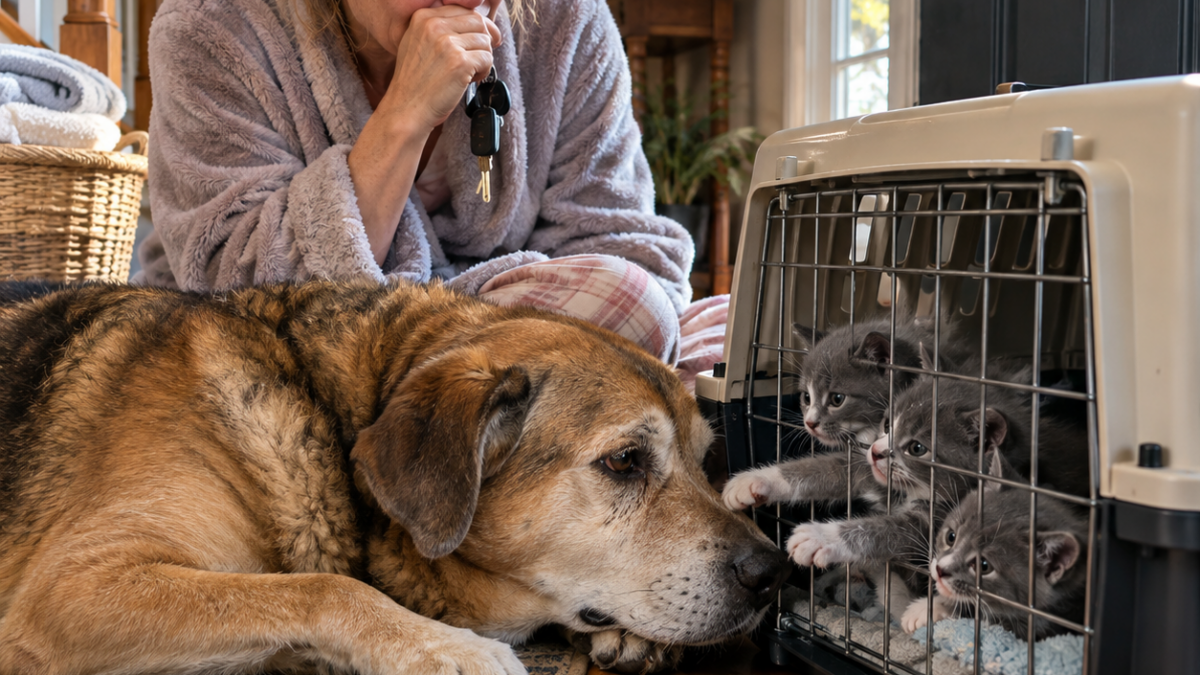
I set the carrier by the front door.
Daisy saw it and went still.
She did not bark.
She did not block me.
She did not growl or whine or cause a scene.
She simply walked over, lowered herself beside the carrier, and rested her gray muzzle against the bars.
The kittens pressed their little paws through the door toward her.
Mouse.
Bean.
Mabel.
I had named them by then.
I did not mean to.
Names are dangerous.
Names are little hooks in the heart.
The smallest one had big ears and a quiet stare, so I called her Mouse.
The roundest one had no fear and no plan, so he became Bean.
The third always looked like she had been woken from a nap she did not approve of, so of course she was Mabel.
I stood there with my keys in my hand, feeling like the worst person in America.
“Daisy,” I whispered. “They’ll have a good home.”
She looked up at me.
Not angry.
Just sad.
That old dog, who had never had puppies of her own, had somehow become a mother in four days.
And I, with my plans and excuses and clean floors, was about to take her babies away because it was sensible.
I sat down on the floor.
One kitten reached through the carrier and tapped Daisy on the nose.
Daisy closed her eyes.
That did it.
I called the rescue back and said, “I’m sorry. There’s been a family emergency.”
The woman sounded worried.
“Oh no. Is everything okay?”
I looked at Daisy, buried under three purring kittens.
“My dog became a mother,” I said.
There was a long pause.
Then the woman said, very carefully, “That is not usually the kind of emergency we plan for.”
“I know.”
“So you want to keep them?”
“For now,” I said.
“For now is how people get cats,” she replied.
She was not wrong.
I thought keeping the kittens was the big decision.
I was wrong.
The real trouble started when everyone else decided they knew what was best for Daisy.
At first, people loved the story.
Of course they did.
An old dog mothering abandoned kittens is exactly the sort of thing people want the internet to be, even though the internet spends most of its time being the opposite.
People commented with crying emojis.
Heart emojis.
“Keep them!”
“This is the sweetest thing I’ve ever seen!”
“Daisy was born for this!”
“Those are her babies now!”
I read the comments while drinking coffee, Daisy asleep at my feet, three kittens tucked against her belly like they had signed a lease.
I should have known sweetness never stays uncomplicated for long.
The next picture I posted changed everything.
Daisy was lying on her side, one paw stretched out, all three kittens curled against her. Mouse was under her chin. Bean was across her front leg. Mabel had somehow wedged herself between Daisy’s belly and the towel like she was claiming prime real estate.
The caption said:
Family meeting. I lost.
By lunch, the picture had spread past my cousins.
By dinner, strangers were fighting under it.
Half the people said, “Keep them.”
The other half said, “A dog is not a mother.”
One woman wrote:
This is selfish. Those kittens need a real home.
I stared at that comment longer than I should have.
Because the awful thing was, I knew she might be right.
Love does not always mean you are the best choice.
Sometimes love is only the loudest feeling in the room.
That night, I fed the kittens from tiny dishes while Daisy watched every move I made.
She still did not fully trust me.
If I picked one up, she lifted her head.
If I carried one across the room, she followed.
If I closed a door, she huffed at it like I had violated a treaty.
“You know,” I told her, “I am the one with thumbs.”
Daisy blinked.
She did not respect my argument.
The next morning, my daughter Claire called before seven.
Not texted.
Called.
That is how I knew I was in trouble.
“Mom,” she said, “please tell me you did not adopt three kittens because Daisy looked sad.”
I looked down.
Daisy was lying on my slipper.
Mouse was inside the slipper.
Bean was trying to climb Daisy’s ear.
Mabel was biting a dust bunny under the cabinet.
“It is more complicated than that,” I said.
Claire sighed.
It was the kind of sigh adult children use when they think their parents have become teenagers.
“Mom.”
“I know.”
“Do you?”
“I know they are a lot.”
“They are babies. They will grow up. They will need shots, food, litter, vet visits. You still have Daisy, and Daisy is old.”
Daisy opened one eye when she heard her name.
She looked offended by the truth.
“I am aware Daisy is old,” I said.
“I’m not trying to be mean.”
“I know.”
“I just don’t want you making a huge decision because the internet thinks it’s adorable.”
That stung.
Not because she was wrong.
Because she was close.
The internet had made the whole thing feel bigger.
Sweeter.
Like a sign.
But signs do not scoop litter boxes.
Signs do not pay vet bills.
Signs do not wake you up at two in the morning because one kitten has decided the curtains are a mountain.
“I haven’t made a final decision,” I said.
That was a lie.
Not a full lie.
But not clean truth either.
Claire got quiet.
Then she asked, softer, “Are you lonely, Mom?”
I hated that question.
Not because it was cruel.
Because it was gentle.
Because it opened a door I had been leaning against for a long time.
I looked around my kitchen.
One coffee cup.
One plate.
One chair pulled out from the table.
Three kittens wrestling with a dish towel.
One old dog watching them like she had been hired for security.
“I’m fine,” I said.
Another lie.
Claire heard it.
Daughters hear things sons step around.
“I’ll come by after work,” she said.
“You don’t have to.”
“I know.”
Which meant she would.
After we hung up, I sat with the phone in my lap for a long time.
Daisy pushed her nose under my hand.
Not hard.
Just enough.
I scratched behind her ear.
“You hear that?” I whispered. “They think we’re unstable.”
Daisy sighed.
Bean sneezed.
Mouse sneezed because Bean sneezed.
Mabel fell asleep in the food dish.
It was not a strong case for stability.
The rescue woman called back at nine.
Her name was Janice.
She had the tired voice of someone who had loved too many animals and slept too little because of it.
“I saw your update,” she said.
Of course she had.
Apparently, my little porch box had become local entertainment.
“I should have called you first,” I said.
“No judgment,” Janice said.
People who say no judgment often have a folder full of judgment ready.
But Janice was kind.
Careful.
She asked if the kittens were eating.
She asked if their eyes were clear.
She asked about warmth, litter, and whether Daisy had ever been around cats before.
“She has been around one cat,” I said. “My neighbor’s orange cat. He hated everyone equally.”
“How did Daisy do?”
“She avoided him like unpaid taxes.”
Janice laughed.
Then she got serious again.
“We do have a foster home that can take all three together.”
There it was.
A sensible solution.
A good solution.
A solution I would have begged for five days earlier.
I looked toward the laundry room.
Daisy was lying flat on her belly while Mouse patted her nose with both paws.
Daisy was letting it happen.
“Together?” I asked.
“All three,” Janice said. “Experienced foster. Quiet home. They’d be adopted when ready.”
“That sounds wonderful.”
“It is.”
I wanted to mean the next words.
I really did.
But they came out thin.
“I’ll think about it.”
Janice paused.
“Can I be honest with you?”
“I suppose that depends on how painful it is.”
She laughed gently.
“Sometimes people fall in love fast, especially when there’s a sweet story attached. But kittens are not a moment. They’re a commitment.”
“I know.”
“And Daisy is twelve.”
“I know that too.”
“If Daisy is already tired, three kittens may be a lot for her.”
That sentence landed in the middle of my chest.
Because I had been trying not to think it.
Daisy looked happier.
But she also slept hard.
When the kittens climbed on her, she tolerated it.
When they chased her tail, she endured it.
When they tried to nurse on her belly, she looked at me like she had joined a job with poor training.
Was I giving her purpose?
Or was I using her sweetness because I could not stand the quiet?
That was the question I did not want anyone to ask.
Janice asked it without saying it.
“I don’t want to hurt her,” I said.
“I can tell.”
“I just don’t know what the right thing is.”
“The right thing,” Janice said, “is usually the one you can still defend when the cute part wears off.”
I wrote that down later.
I did not like it.
But I wrote it down.
Claire arrived that evening with groceries I had not asked for and a face full of concern she was trying to hide.
She was thirty-eight, but when she walked into my kitchen, I still saw her at six years old with missing front teeth and marker on her hands.
That is the strange thing about grown children.
They become adults.
But your heart keeps old versions of them sitting in the front row.
She kissed my cheek.
Then she saw Daisy.
Daisy was in the living room, lying on an old quilt.
All three kittens were climbing over her like she was a warm hill.
Claire stopped.
“Oh,” she said.
Just one word.
That was all.
Because the scene did something.
It softened the edges of her argument.
Bean tumbled off Daisy’s side and landed on his back.
Daisy lifted her head and nudged him upright with her nose.
Claire pressed one hand to her mouth.
“Mom.”
“I know.”
“That is…”
“I know.”
Mouse waddled toward Claire.
Claire crouched down.
Mouse sniffed her shoe, decided she was acceptable, and climbed onto her ankle.
Claire’s face changed.
It was fast.
But I saw it.
Concern moved over.
Tenderness stepped in.
Still, Claire was Claire.
She could love something and still make a spreadsheet in her head about why it was a bad idea.
She sat at my kitchen table while I made tea.
She looked at the litter box.
Then the food bowls.
Then the towels.
Then Daisy, who had not taken her eyes off the kittens once.
“You need a plan,” Claire said.
“I have a plan.”
“What is it?”
I opened my mouth.
Nothing useful came out.
Claire raised one eyebrow.
“My plan,” I said, “is to become a better woman very quickly.”
“That’s not a plan.”
“It has ambition.”
“It has chaos.”
I sat across from her.
For a minute, neither of us spoke.
The house made little sounds around us.
Tiny paws on the floor.
A washer ticking as it cooled.
Daisy’s nails clicking when she shifted.
It was not quiet anymore.
Claire looked down at her tea.
“I don’t want to take joy from you,” she said.
That surprised me.
“I don’t,” she repeated. “I know it’s been hard since Dad passed.”
I looked away.
People stop saying a dead person’s name after the first year.
Not because they forget.
Because they think saying it will hurt you.
But the hurt is already there.
The name makes it less lonely.
Claire knew that.
She reached across the table and touched my hand.
“I know Daisy helped.”
“She did.”
“And maybe the kittens are helping too.”
“They are.”
“But Mom, help cannot be the only reason you keep them.”
That was fair.
Annoyingly fair.
The worst kind of fair.
“You sound like Janice,” I said.
“I like Janice already.”
“You would.”
Claire smiled.
Then she looked toward Daisy.
“Can she handle it?”
There it was again.
The question.
Daisy was licking Bean’s head with the grim dedication of a mother cleaning a child before church.
Bean’s fur stuck up in wet spikes.
He looked betrayed.
“I don’t know,” I said.
That was the first honest answer I had given all day.
The next morning, I made an appointment at a small animal clinic on the edge of town.
Not a fancy place.
Just a low brick building with faded chairs, a fish tank with no fish, and a receptionist who called everyone hon.
I loaded all three kittens into the carrier.
Daisy lost her mind.
Not barking.
Not howling.
Worse.
She stood by the front door and made one low, broken sound I had never heard from her before.
It was not loud.
It was not dramatic.
It was a question.
Where are they going?
I froze.
The kittens cried from inside the carrier.
Daisy pressed her muzzle against the door.
“Daisy,” I said, “I have to take them to the vet.”
She looked at me like every villain in every movie had probably started with that sentence.
So I did the only thing I could do.
I took Daisy too.
Getting one old dog and three kittens into my car should have qualified me for some kind of county award.
Daisy moved slow.
Bean escaped once.
Mabel got inside my robe sleeve.
Mouse sat in the carrier and watched the rest of us embarrass ourselves.
By the time we arrived, I was sweating.
Daisy was panting.
The kittens were silent.
The receptionist looked at us and said, “Well, there’s a story.”
“You have no idea,” I said.
The veterinarian was about my age, with silver hair cut short and glasses hanging from a cord.
Her name tag said Dr. Ellis.
She had calm hands.
I liked that immediately.
She checked each kitten.
Mouse first.
Then Bean.
Then Mabel.
A little underweight.
A little messy.
But bright.
“Somebody kept them warm,” Dr. Ellis said.
Daisy stood beside the exam table like she was waiting for a report card.
Dr. Ellis glanced at her.
“Is this the nanny?”
“The mother,” I said before I could stop myself.
Dr. Ellis smiled.
Daisy wagged once.
One professional woman to another, apparently.
Then Dr. Ellis examined Daisy.
She moved Daisy’s hips gently.
Listened to her heart.
Checked her teeth.
Daisy endured it with the expression of a woman renewing a driver’s license.
“She has arthritis,” Dr. Ellis said.
“I know.”
“She is a little overweight.”
Daisy looked personally wounded.
“We have discussed this privately,” I said.
Dr. Ellis laughed.
“Overall, for twelve, she’s doing okay.”
I exhaled.
“But,” Dr. Ellis said.
I hated but.
“But she needs rest. These kittens may be giving her a wonderful emotional boost. That happens. Purpose matters for animals too. But you cannot let them climb her all day and drain her.”
I nodded.
“She needs breaks,” Dr. Ellis said. “A quiet place. Short supervised time. You still have to be the human mother.”
Daisy looked at me.
I looked back.
“Apparently I have been promoted,” I said.
Dr. Ellis wrote things down.
Then she gave me the look.
The kind of look a doctor gives when she is about to say the plain thing.
“Are you keeping them?”
“I don’t know.”
“Do you want to?”
I laughed once.
A small, tired laugh.
“Yes.”
“Can you?”
That was the better question.
Not should you.
Not does it feel good.
Can you?
I looked at Daisy.
Then at Mouse, who had fallen asleep with her face in Dr. Ellis’s sleeve.
“I don’t know yet,” I said.
Dr. Ellis nodded like that was a respectable answer.
“Then don’t decide from guilt,” she said. “And don’t decide from fear either.”
I drove home with those words rattling around in my head.
Do not decide from guilt.
Do not decide from fear.
Nobody tells you how many decisions in life are made from one of those two places.
I had almost given the kittens away because I was afraid of being foolish.
I had almost kept them because I felt guilty making Daisy sad.
Neither was good enough.
So that afternoon, I created a schedule.
This may not sound dramatic.
But for a woman who had been letting three kittens run the house like tiny unpaid managers, it was a turning point.
Daisy got morning kitten time.
Then a nap alone in my bedroom with the door closed.
The kittens got playtime in the laundry room.
Then supervised living room time.
Then Daisy got them again after dinner.
The first time I closed Daisy in the bedroom for rest, she stood on the other side of the door and judged me through the wood.
I could feel it.
“Doctor’s orders,” I called.
She sneezed.
I took that as a rude word.
The kittens did not appreciate the new system either.
Bean tried to climb the baby gate.
Mabel screamed at a sock.
Mouse sat quietly in the middle of the laundry room and stared at the closed bedroom door.
That tiny stare nearly broke me.
But Daisy slept for two full hours.
When she came out, she stretched like an old lady after a good church nap.
Then she went straight to the kittens.
They swarmed her.
She sniffed each one.
One.
Two.
Three.
Only then did she relax.
That was when I started to understand.
Daisy did not need to be with them every second.
She needed to know they were still there.
Maybe I did too.
The comments online kept growing.
People had opinions.
So many opinions.
A few were sweet.
A few were funny.
A few made me want to turn my phone off and bury it in the yard.
“Don’t let anyone separate that family.”
“They are cats. The dog will forget.”
“Older people should not take on kittens.”
“That dog looks stressed.”
“That dog looks healed.”
“Give them to a young family.”
“Let the woman have joy.”
I read that last one three times.
Let the woman have joy.
It sounded simple.
But it made people angry.
Some heard it as love.
Others heard it as irresponsibility.
That became the fight under every update.
Is joy enough?
Is love enough?
Should a person keep an animal because it makes her lonely house feel full?
Or should every choice be based on what looks best on paper?
I did not have an answer.
I only had Daisy.
And Daisy was asleep with Mouse tucked under her chin.
Two days later, Janice came to the house.
She brought forms, a soft carrier, and the careful smile of a woman who had walked into emotional messes before.
Claire came too.
I had not asked her.
She said she was “just stopping by,” which meant she arrived with coffee and the face of a witness.
Janice took one step into the living room and stopped.
Daisy was lying on her quilt.
Mouse was asleep against her chest.
Bean was batting at Daisy’s tail.
Mabel sat between Daisy’s front paws like a tiny gray queen.
Janice did not speak for a long moment.
Then she said, “Well. That is inconveniently adorable.”
“I know,” Claire said.
I shot her a look.
Janice crouched down.
Daisy lifted her head.
Not aggressive.
Just alert.
Janice held out her hand.
Daisy sniffed it, then looked away like she had read Janice’s paperwork and disliked the ending.
“She knows I’m the bad guy,” Janice said.
“You’re not,” I said.
“I know. But animals do not care about our mission statements.”
No realer sentence had ever been spoken in my living room.
We sat at the table.
Janice explained the foster home again.
A retired couple.
No other pets.
Experience with kittens.
Quiet house.
They could take all three that day.
All three.
Together.
That was the part that hurt.
If she had said they would be split up, I could have dug in my heels and made myself the hero.
But no.
They had a good place.
Maybe a better place.
I hated that.
Janice looked at me kindly.
“I am not here to snatch them.”
“Thank you.”
“But I do need to ask hard questions.”
“Go ahead.”
“Can you afford three cats long term?”
I swallowed.
“Yes. Carefully, but yes.”
“Can you handle the daily care?”
“Yes.”
“What happens if you get sick?”
I glanced at Claire.
Claire glanced back.
We had not talked about that.
Janice kept her voice gentle.
“These are the questions people think are rude,” she said. “But they are not rude. They are love with shoes on.”
I hated how much I liked that.
Claire set down her cup.
“I could be backup,” she said.
I looked at her.
She looked surprised at herself.
“I mean,” she added quickly, “not because I think you should keep them. I’m saying if you did.”
Janice nodded.
“Good. Backup matters.”
Then Janice looked toward Daisy.
“What happens when Daisy is gone?”
The room changed.
Just like that.
Daisy was not gone.
She was ten feet away licking Bean’s back.
But the sentence put the future in the room with us.
Old dogs live with one paw in today and one paw in goodbye.
You try not to look at the goodbye paw.
But it is there.
Claire’s eyes softened.
Mine burned.
“I don’t know,” I said.
Janice did not apologize.
I respected that.
Some questions deserve silence after them.
Finally, Claire said, “The kittens would still have Mom.”
Janice nodded.
“And would Mom still want them when Daisy is not here?”
That one hurt differently.
Because the truth was yes.
By then, yes.
Not because of Daisy.
Not only because of Daisy.
Because Mouse had started sleeping in my sweater drawer.
Because Bean ran to the sound of my voice, even when he was running in the wrong direction first.
Because Mabel sat on the bathroom rug and yelled at me every morning like a tiny landlord.
Because my house no longer felt like a place where days went to disappear.
“Yes,” I said.
My voice shook.
But I said it.
“I would still want them.”
Claire looked at me.
Not as a daughter correcting her mother.
As a woman seeing another woman.
That was new.
And tender.
Janice folded her hands.
“There is another option,” she said.
My heart jumped.
“A trial foster,” she continued. “You keep them here for two more weeks under rescue guidance. We check in. You follow the vet schedule. Daisy gets breaks. Your daughter is backup. At the end, you decide whether to apply to adopt all three or transfer them to the foster home.”
Two weeks.
It sounded like mercy.
It also sounded like a test I might fail.
Claire said, “That seems reasonable.”
Daisy barked once from the living room.
All three kittens startled.
Janice smiled.
“I think Daisy has voted.”
So that was the plan.
Two weeks.
No promises.
No dramatic announcement.
No forever yet.
I posted a careful update that night.
We are doing a trial foster. Daisy loves them, but love also means being responsible. She gets rest. The kittens get care. I get supervised by everyone with more sense than me.
People loved that.
People hated that.
The comment section turned into a town meeting with no chairs.
Some people said I was doing the right thing.
Some said I was letting strangers bully me.
Some said I was selfish for not sending them to the experienced foster.
Some said my grown daughter needed to mind her own business.
Claire saw that one and texted me:
Tell them I bring coffee. I am essential.
I laughed so hard I scared Mabel.
The two weeks began.
And those two weeks nearly finished me.
Not in a bad way.
In a real way.
Kittens are not soft music and cute pictures.
Kittens are tiny disasters wearing fur.
They stepped in their food.
They knocked over water.
They learned to climb the couch before learning how to get down.
Bean got stuck behind the dryer.
Mabel discovered toilet paper.
Mouse, quiet little Mouse, turned out to be the mastermind.
She could open the loose cabinet under the sink.
She could hide inside a boot.
She could vanish in a room with no furniture and reappear inside a folded towel.
Daisy watched it all with deep concern.
She had not expected motherhood to involve this much criminal activity.
Every evening, I sent Janice a short update.
Eating well.
Litter improving.
Daisy rested from ten to noon.
Bean tried to fight a spoon.
Mabel screamed at her reflection.
Mouse may be a ghost.
Janice replied with advice.
Sometimes encouragement.
Sometimes just:
That sounds about right.
Claire came by every other day.
At first, she pretended it was to check on me.
Then I caught her sitting on the floor with Bean asleep in her lap.
“Traitor,” I said.
She whispered, “He chose me.”
“Everyone says that before they fall.”
“I am not falling.”
Bean rolled onto his back and stretched one paw onto her chin.
Claire closed her eyes.
“Oh no,” she said.
Daisy approved of Claire more after that.
Not fully.
Daisy was not reckless.
But enough.
Then came the night that changed everything.
It was raining hard.
Not pretty rain.
Loud, steady rain that slapped the windows and made the house feel smaller.
Daisy had been restless all evening.
She would not settle.
She kept walking from the living room to the laundry room and back again.
Her hips were stiff.
I could see it.
I gave her the soft bed in the corner.
I put the kittens in their gated area so she could rest.
She lay down.
Then stood back up.
Lay down again.
Stood again.
“Daisy,” I said, “baby, you have to rest.”
She ignored me.
Mouse sat on the other side of the gate, watching her.
Then Daisy made that low, broken sound again.
The same sound from the day I took the kittens to the vet.
I opened the gate.
I know.
The schedule said no.
The doctor said breaks.
Janice said boundaries.
Claire said be sensible.
But Daisy was asking for something.
And I had learned that not every need looks sensible from the outside.
Mouse walked out first.
Then Mabel.
Then Bean, who tripped over nothing and kept going.
They went straight to Daisy.
She lowered herself with a grunt.
The kittens curled against her.
And for the first time all evening, Daisy relaxed.
Her body softened.
Her breathing evened out.
Her eyes closed.
I sat on the floor beside them and cried without making much noise.
Because I understood then.
Daisy was not just mothering them.
They were mothering her back.
Maybe not in the way people use the word.
They could not bring her water.
They could not help her up.
They could not understand arthritis or time.
But they gave her a reason to keep looking toward the next room.
They gave her a reason to listen.
To lift her head.
To care about the small sounds in the house.
And maybe that is medicine too.
Not the only kind.
Not a replacement for real care.
But something.
The next morning, Claire found me asleep in the recliner with a blanket over my knees.
Daisy and the kittens were on the quilt.
All four of them were out cold.
Claire stood in the doorway.
She did not say, “Mom, you broke the schedule.”
She did not say, “This is exactly what I was afraid of.”
She just looked at Daisy.
Then at me.
Then at the kittens.
Finally, she whispered, “I get it.”
That was all.
But it felt like a door opening.
At the end of the first week, the approved foster family asked to meet the kittens.
Janice called me herself.
“You can say no,” she said.
But we both knew I should say yes.
If I was serious about doing right by the kittens, I had to be willing to see the other good option.
Not the bad option.
Not the cruel option.
The good one.
That is what makes some choices so hard.
It is easy to choose between love and neglect.
It is much harder to choose between two kinds of love.
They came on a Saturday morning.
A couple around my son’s age with two children.
The children were polite.
Painfully polite.
The kind of polite that made me feel guilty for wanting them to be annoying.
The mother brought a clean towel.
The father asked questions about feeding.
The little girl sat cross-legged on the floor and waited for the kittens to come to her.
She did not grab.
She did not squeal.
She waited.
Mouse went to her first.
Of course she did.
Mouse always understood the assignment.
The little girl’s face lit up.
Not loud.
Not showy.
Pure.
Bean climbed into the boy’s hoodie pocket.
The boy looked like he might explode from happiness.
Mabel batted at the father’s shoelace.
The mother laughed.
It was a good family.
That was the terrible part.
I wanted a reason to dislike them.
I got none.
Daisy lay beside my chair, watching.
She did not growl.
She did not bark.
But her head stayed up the whole time.
Her eyes moved from kitten to kitten.
Counting.
Always counting.
After half an hour, the little girl looked at me and asked, “Do they sleep with the dog?”
I nodded.
“Every night?”
“Most nights.”
She looked at Daisy.
Then at Mouse in her lap.
“That’s her mommy,” the girl said.
Her mother smiled gently.
“Well, kind of.”
The little girl shook her head.
“No. Really.”
Nobody knew what to say.
Children can be inconveniently accurate.
When the family left, the mother pulled me aside near the porch.
Her voice was kind.
“We would love them,” she said.
“I know.”
“We would keep them together.”
“I know.”
She looked through the screen door at Daisy.
Daisy had all three kittens near her again.
The mother’s face softened.
“But I don’t think they are waiting for us,” she said.
That nearly undid me.
“You don’t have to say that,” I told her.
“I mean it.”
Her eyes were damp.
“We came prepared to make room for three kittens,” she said. “I did not expect to meet a family already made.”
I stood on my porch after they left and held the railing.
The world smelled like cut grass and rain.
Inside, Daisy was probably counting kittens again.
I thought I would feel relieved.
I did not.
I felt heavier.
Because now I knew.
Keeping them was not only an emotional choice.
It meant taking them from people who would have loved them well.
That is where people online would split, if they knew.
Some would say I was selfish.
Some would say the family was gracious.
Some would say the kittens chose.
Some would say animals do not choose, people do.
And honestly?
Everybody would have a point.
That night, I told Claire about the visit.
She listened quietly.
Then she said, “What do you want me to say?”
“The truth.”
“The truth is, I think they would be okay either way.”
That bothered me.
I wanted her to tell me there was only one right choice.
One glowing path.
One sign.
But life is stingy with glowing paths.
Most of the time, you get two dim sidewalks and a tired heart.
Claire continued.
“I also think Daisy would grieve.”
I closed my eyes.
“And I think you would too,” she said.
“I am not trying to make this about me.”
“I know,” Claire said. “But you are part of the home. You count.”
You count.
Two small words.
Funny how grown children can give back things they do not know they took.
For years, I had tried not to be needy.
I did not want to be the mother who called too much.
The widow people worried about.
The empty house everyone had to check on.
So I became fine.
Fine is a costume older women learn to wear in public.
Fine means the yard is mowed.
Fine means the bills are paid.
Fine means you can eat cereal for dinner without anyone knowing.
Fine means nobody has to feel guilty.
But fine is not the same as living.
Those kittens had made my life less fine.
And more alive.
The second week went better.
Not easier.
Better.
Daisy accepted her rest breaks.
Mostly.
The kittens learned the sound of the food dish.
Bean stopped sleeping in the water bowl.
Mabel discovered sunbeams.
Mouse learned to climb onto Daisy’s back and sit there like a tiny gray saddle.
Daisy pretended to hate this.
She did not.
I ordered a second litter box.
Then a third.
I bought kitten toys that immediately lost value because the kittens preferred bottle caps and my bathrobe belt.
I moved breakable things higher.
Then higher again.
Then I accepted that nothing in my home was truly mine anymore.
Janice visited twice.
She checked the kittens.
She checked the setup.
She asked about my backup plan.
Claire agreed, out loud and in writing, to take the cats if something happened to me.
My son Ben, who lived three hours away and had mostly watched everything unfold through pictures, called and said, “I can be backup backup.”
“That is not a thing,” I said.
“It is now.”
“You don’t even like cats.”
“I didn’t like that old recliner either, but you kept it twenty years.”
“That recliner had loyalty.”
“So does the dog. And apparently the cats.”
I smiled into the phone.
Then Ben said, more quietly, “Mom, are you happy?”
I looked at Daisy.
She was asleep.
Mouse was tucked against her chest.
Bean and Mabel were wrestling under the coffee table.
There was litter on the floor.
A towel in the hallway.
A scratch on the table leg.
A strange smell I had not yet located.
“Yes,” I said.
It came out simple.
No defense.
No apology.
Just yes.
Ben was quiet for a second.
“Then I’m happy too,” he said.
The final decision came on a Thursday.
Janice arrived with the adoption forms in a blue folder.
She also brought a carrier.
Just in case.
That was fair.
I had asked for fair.
Claire came again.
Ben joined by video call from his kitchen, which was mostly ceiling because he never held the phone correctly.
Daisy sat beside my chair.
The kittens were in a pile at her feet.
Janice went through everything one more time.
Food.
Vet schedule.
Spay and neuter appointments later.
Emergency contacts.
Costs.
Time.
Daisy’s rest.
Long-term care.
She did not make it romantic.
I appreciated that.
Romance is nice.
Paperwork keeps animals safe.
Then she looked at me.
“Do you understand what adopting all three means?”
“Yes.”
“It means when Daisy has a bad day, they still need care.”
“Yes.”
“It means when they are not tiny and cute, they still need care.”
“Yes.”
“It means they may live a long time.”
“I hope they do.”
“It means you are not just saving a story. You are building a household.”
That one made me pause.
A household.
Not a moment.
Not a viral picture.
Not a cure for loneliness.
A household.
Mabel climbed onto Daisy’s paw and bit it gently.
Daisy looked down at her with deep disappointment.
Then she licked her anyway.
“I understand,” I said.
Janice slid the forms across the table.
My hand shook when I signed.
Not because I was unsure.
Because I understood.
There is a difference.
Claire cried first.
She will deny that.
But she did.
Ben said, “Is this the part where I become an uncle to cats?”
“You already were,” Claire said.
Daisy sneezed.
Janice stamped the papers and smiled.
“Congratulations,” she said. “You are officially outnumbered.”
I posted the update that evening.
Not right away.
I needed a few hours where it belonged only to us.
I took a picture of Daisy on her quilt.
Mouse under her chin.
Bean across her back.
Mabel between her paws.
Daisy looked annoyed.
Proud.
Tired.
Complete.
I wrote:
We did it responsibly. We asked the hard questions. We made a plan. Daisy’s babies are staying.
Then I added:
Love is not enough by itself. But love with responsibility can build a home.
The post went wild again.
Of course it did.
People cried.
People cheered.
People argued.
One man wrote, “Bad choice. A senior dog should not be used as a babysitter.”
A woman replied, “A senior dog is allowed to have joy.”
Another wrote, “Older people should not be judged for wanting life in their house.”
Someone else wrote, “Animals need stability, not sentiment.”
I read that one slowly.
Then I looked around.
At the extra litter boxes.
The feeding schedule on the fridge.
The vet dates written in thick marker.
The baby gate.
The backup contacts.
The old dog snoring under three kittens.
Stability can look strange from the outside.
Sometimes it has fur on the couch.
That night, Claire stayed for dinner.
We ate sandwiches at the kitchen table because cooking felt too ambitious.
Bean climbed up my pant leg twice.
Mabel fell asleep in Claire’s purse.
Mouse sat beside Daisy’s bowl like she was guarding the estate.
Claire looked around and shook her head.
“This house is ridiculous now.”
“I know.”
“I kind of love it.”
“I know that too.”
She smiled.
Then she grew quiet.
“I’m sorry I asked if you were lonely like it was a problem to solve.”
I looked at her.
She stared down at her plate.
“I think I got scared,” she said. “I saw the pictures and thought, Mom is filling the house because we are not there enough.”
That sentence hurt her to say.
I could tell.
“Oh, honey.”
“And maybe that is a little true.”
I did not answer too fast.
Because it was a little true.
Not in a blaming way.
Just in a life way.
Children grow up.
They should.
They build their own kitchens, their own calendars, their own tired evenings.
That is not betrayal.
That is life doing what life does.
“I miss you,” I said.
Claire’s eyes filled.
“But I do not want you to feel guilty for having your own life.”
She nodded.
“I know.”
“And I do not want to feel guilty for making mine fuller.”
She wiped her cheek.
“That sounds fair.”
“Fair and slightly covered in cat hair.”
She laughed.
Daisy lifted her head at the sound.
The kittens startled awake.
For one second, all four of them looked offended that joy had interrupted their nap.
Then Bean sneezed.
We laughed harder.
A month passed.
Then two.
The kittens grew from dusty little socks into long-legged trouble.
Mouse stayed small, but she ruled the house.
Bean grew round and cheerful and deeply confused by corners.
Mabel became beautiful in a grumpy way, like an old actress who did not tolerate poor lighting.
Daisy lost a little weight because she followed them around more.
Not too much.
Just enough that Dr. Ellis said, “Well, motherhood agrees with her.”
Daisy wagged like she understood every word.
We kept the schedule.
I became strict about Daisy’s rest.
The kittens learned that when Daisy went to her bed in my room, they did not follow.
At first, they complained.
Loudly.
Then they adapted.
They slept in a pile outside the door like tiny bodyguards.
When Daisy came out, they greeted her like she had returned from war.
Every single time.
No one in my life has ever been that excited to see me leave a bedroom.
Winter came early that year.
Cold mornings.
Dark afternoons.
The kind of season that used to make my house feel too big.
But that year, the house felt busy.
There were pawprints on the windowsill.
Toys under the stove.
A small gray face in every laundry basket.
Daisy had a new habit.
Every evening, around seven, she would stand in the hallway and bark once.
Just once.
The kittens came running.
Then she would walk, slow and stiff, to the living room quilt.
They followed her.
I called it roll call.
One night, Mouse did not come.
Daisy barked once.
Nothing.
She barked again.
Still nothing.
Daisy looked at me.
I stood up.
“Oh no.”
There are two words no pet owner wants to say while looking around the house.
“Where’s Mouse?”
Claire happened to be there.
We searched everywhere.
Under the couch.
Behind the washer.
Inside the pantry.
In every closet.
Bean followed us like an unhelpful detective.
Mabel sat on the stairs and screamed.
Daisy stood in the hallway trembling.
Not from weakness.
From worry.
My stomach dropped.
I checked the doors.
All closed.
Windows.
Closed.
Then I heard it.
A tiny, annoyed sound.
Not scared.
Annoyed.
Which was very Mouse.
It came from the linen closet.
I opened it.
Nothing.
Then Claire pointed.
A folded blanket moved.
Mouse had crawled inside a pillowcase and fallen asleep.
When I pulled her out, she blinked at us like we had interrupted private business.
Daisy pushed past me and sniffed her from nose to tail.
Then she gave Mouse one firm lick on the head.
Mouse accepted the correction.
For about three seconds.
Then she bit Daisy’s ear.
Daisy looked at me like, This is your side of the family.
That night, after Claire left, I sat with Daisy on the floor.
The kittens were asleep in a pile.
Daisy rested her head on my knee.
Her muzzle was grayer than ever.
Her breathing was slower.
Time was still moving.
Even in a full house, time moves.
I put my hand on her side.
“You did good,” I whispered.
Daisy sighed.
A soft sigh.
Not tired mother at the grocery store this time.
More like someone who had finished a long day and found everyone safe.
I thought about all the people who had argued under those posts.
The ones who said I had done too much.
The ones who said I had done exactly right.
The ones who said Daisy was just a dog.
The ones who said she was a mother.
Maybe the truth was not something strangers could vote on.
Maybe the truth was in the daily work.
The scooping.
The feeding.
The rest breaks.
The vet visits.
The backup plans.
The boring, faithful things nobody shares online.
Love gets attention when it is cute.
But love becomes real when it becomes routine.
That is what Daisy taught me.
Not by being sweet.
Though she was sweet, under protest.
She taught me by showing up.
Every day.
For three little creatures who arrived in a box and gave her nothing at first but noise, mess, and tiny claws.
She did not ask if they belonged to her.
She decided they needed her.
Then she became needed.
I think a lot of us are starving for that.
Not attention.
Not applause.
To be needed in a way that does not drain us empty.
To be useful without being used.
To have something wake up in us that we thought had gone quiet for good.
Daisy found that in three kittens.
I found it watching her.
By spring, the kittens were almost cats.
They still curled against Daisy, but they no longer fit neatly under her chin.
Bean spilled over one side.
Mabel refused to be arranged.
Mouse always found the warmest spot.
Daisy had learned to let them drape across her like badly folded laundry.
One afternoon, I found them all in a patch of sunlight near the back door.
Daisy was asleep.
Bean was on his back.
Mabel had one paw over Daisy’s nose.
Mouse was tucked against Daisy’s heart.
I took a picture.
Then I did not post it.
Not right away.
Some moments do not need witnesses.
Some moments are allowed to belong to the room.
Later, I sent it only to Claire and Ben.
Claire replied, Frame that.
Ben replied, Daisy looks like she regrets nothing and everything.
He was right.
A few weeks after that, Janice called.
For one scary second, I thought something was wrong.
But she said, “I have a strange question.”
“I now have three cats and a dog,” I said. “Strange is our native language.”
She laughed.
Then she told me about an older man across town.
His name was Walter.
He had lost his wife the year before.
He had an old dog who had stopped eating well.
A neighbor had found two abandoned kittens near a shed.
Janice was not asking me to take them.
Thank heaven.
She was asking if I would talk to him.
“He saw Daisy’s story,” she said. “He wants to know if he is crazy for thinking his dog perked up around the kittens.”
I looked over at Daisy.
She was watching Bean try to fit into a box half his size.
“No,” I said. “He is not crazy.”
“I thought you might say that.”
“But tell him to call the vet.”
“I already did.”
“And tell him to make a plan.”
“I knew you would say that too.”
I smiled.
There I was.
The woman who had once said absolutely not to a cardboard box.
Now giving practical advice about accidental interspecies families.
Life will humble you if you live long enough.
Sometimes it uses kittens.
I talked to Walter that night.
He cried once on the phone and apologized for it.
I told him not to.
Men from his generation often apologize for grief like it is a spill on someone else’s floor.
He told me his house had been so quiet after his wife died that he could hear the refrigerator at night and hate it.
I understood that.
He said his old dog had started sleeping by the kittens’ crate.
I understood that too.
Then he said, “I don’t know if I want them because they need me, or because I need them.”
I looked at Daisy.
At Mouse.
At Bean.
At Mabel.
“Yes,” I said.
He was quiet.
“That’s not an answer.”
“It is the truest one I have.”
Because sometimes need runs both ways.
That does not make it wrong.
It just means you have to be honest about it.
I told him what Janice told me.
Love is not enough by itself.
Make a plan.
Call the vet.
Accept help.
Ask what happens on the hard days.
And if, after all that, the house still feels like someone opened a window, maybe pay attention.
After I hung up, I realized something.
Daisy’s little family had reached farther than my living room.
Not because we were special.
Because so many people understood the ache under the story.
The ache of a quiet house.
The ache of getting older.
The ache of watching someone you love become slower.
The ache of wondering whether joy is allowed when it arrives late, messy, and inconvenient.
That was the real reason people argued.
It was never only about kittens.
It was about what we think people deserve when their lives are no longer young and tidy.
It was about whether older women are allowed to choose mess.
Whether grown children get a vote.
Whether responsibility means saying no to anything that might hurt later.
Whether love is still worth it when goodbye is somewhere down the road.
I still do not have perfect answers.
I have litter on my floor.
I have Daisy’s medicine on the counter.
I have three cats who believe every closed door is a personal insult.
I have a daughter who visits more because she wants to, not because she is worried.
I have a son who sends toys in the mail and pretends they were on sale.
I have a house that is not quiet.
And I have Daisy.
Still here.
Still grumpy.
Still counting to three.
One evening, almost a year after the box appeared, I opened the front door at 6:15 in the morning again.
Same porch.
Same old robe.
Same coffee I had not earned yet.
Daisy came slowly behind me.
The cats followed, because privacy had died in our home.
There was no box this time.
Thank goodness.
Just the morning.
The kind of ordinary morning I used to sleepwalk through.
Daisy stood beside me and sniffed the air.
Mouse wrapped around her front leg.
Bean sat on my foot.
Mabel stared at a leaf like it owed her an explanation.
I laughed.
Daisy looked up at me.
Her face was older.
So was mine.
But her eyes were bright.
That is what I wish people could have seen through the screen.
Not just the cute part.
Not just the dog with kittens.
But the choice after the cute part.
The work after the feeling.
The plan after the impulse.
The family after the accident.
I bent down and scratched Daisy under her chin.
“You know,” I told her, “this was supposed to be one night.”
Daisy blinked slowly.
Behind her, Bean knocked over the umbrella stand.
Mabel slapped him.
Mouse climbed into the empty cardboard recycling box by the door and made herself comfortable.
Daisy looked at them.
Then looked at me.
And I swear that old dog’s face said, Good thing I was in charge.
Maybe she was.
Maybe she always had been.
I thought three kittens showed up because they needed saving.
Then I thought Daisy saved them.
Then I thought they saved Daisy.
But the longer I live with them, the more I think rescue is not a straight line.
It is a circle.
One hand reaching.
One paw answering.
One tired heart waking another.
Sometimes family is born.
Sometimes family is chosen.
And sometimes family is delivered to your porch before sunrise in a cardboard box, sneezing, hungry, and completely unaware it is about to turn your whole life upside down.
Mine did.
If you ask Daisy, she will tell you I handled it poorly.
But she will also tell you this.
All three are still here.
And every night, before she closes her eyes, she counts them.
One.
Two.
Three.
Then she sleeps.