I Was Nine When I Stood in Front of 300 Bikers With My Dead Grandfather’s Stop Sign—Then the Lead Rider Saw It and Realized Who I Was.
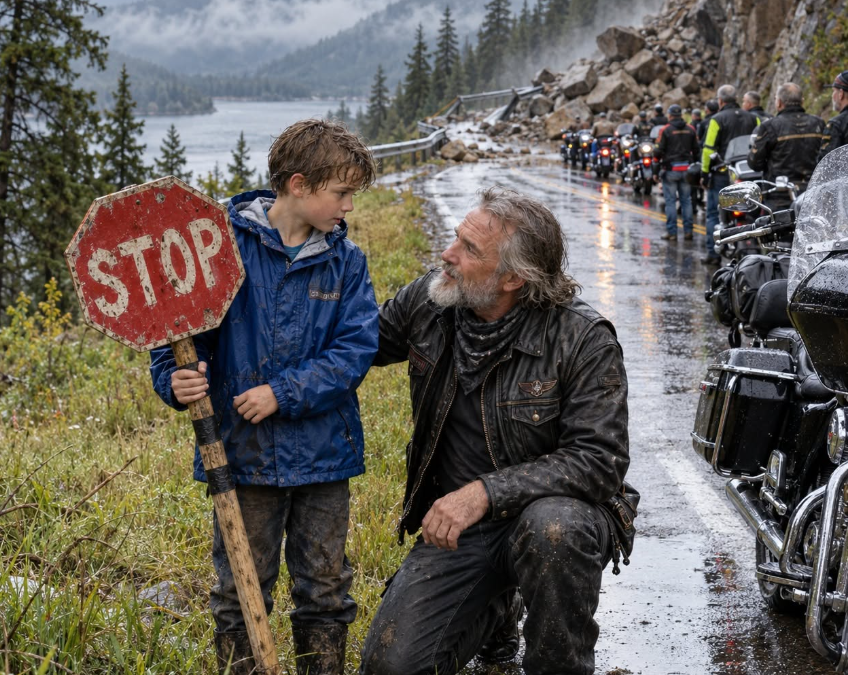
PART3:
I had seen him rub that notch with his thumb when he was thinking.
I took the sign before anyone could say I shouldn’t.
I wrapped it in Grandpa’s red flannel shirt and slid it under my bed.
At night, when Mom fell asleep, I would sometimes pull it out just far enough to touch the taped handle.
I knew it was strange.
I knew other kids probably kept baseball cards or action figures or secret candy under their beds.
I kept a stop sign.
But when I touched it, I could almost feel Grandpa’s hand over mine.
He had taught me to count sidewalk cracks whenever I was scared.
“Fear makes your head run too fast,” he said once, after I froze before a school play and told him I thought I would throw up. “Give it something simple to do.”
So I counted cracks.
One.
Two.
Three.
Breathe.
Four.
Five.
Keep going.
After he died, I counted everything.
Sidewalk cracks.
Ceiling tiles.
Forks in the diner drawer.
Seconds between Mom’s quiet sobs when she thought I was asleep.
We lived in Cedar Bend, a little Montana town wedged between a lake and a wall of pines. In summer, the lake brought tourists, and tourists brought money, and money made everybody pretend they liked strangers better than they did in February. In winter, the town belonged to locals again. The roads froze. The sky came down low. Smoke rose from chimneys, and everyone knew whose truck needed a new muffler because sound carried in the cold.
Mom worked the grill at the Willow Diner.
She had worked there since before I was born, back when Dad still thought staying in one town sounded possible. Dad left when I was seven. At first, he called every Sunday. Then every other Sunday. Then on birthdays. Then sometimes after birthdays.
Mom never said much about him.
Grandpa did once.
We were fishing below Miller’s Turn, where the road curved blind around a steep wall of rock before opening toward the lake. Grandpa had brought sandwiches wrapped in wax paper and a thermos of coffee for himself. I had asked why Dad did not come fishing anymore.
Grandpa looked across the water for a long time.
Then he said, “Some men love people but don’t know how to stand still beside them.”
I thought about that sentence for years.
I still do.
That Saturday in late August began like any other tourist-season weekend at the diner.
Busy.
Hot.
Greasy.
The bell over the door never stopped ringing.
Mrs. Harlow, the owner, stood behind the counter in a purple cardigan despite the heat, refilling coffee with one hand and judging customers with both eyes. She had owned the Willow Diner for thirty-two years and believed bikers, teenagers, city tourists, and men who ordered egg whites were all signs of social decline.
Mom worked the grill.
I cleared tables, stacked menus, refilled napkin holders, and tried not to drop things.
Everyone was talking about the motorcycle ride.
Cedar Bend had been chosen as one of the stops for a charity run raising money for a children’s burn center in Missoula. Nearly three hundred riders were expected by midafternoon. They would come down Route 9, circle through town, park at the ball field, eat barbecue, buy raffle tickets, and make enough noise to shake the windows.
Mrs. Harlow did not like it.
“Those leather vests make me nervous,” she told Mom while wiping the same patch of counter for the fourth time.
Mom flipped a pancake.
“Their money spends fine at the burn center.”
“That doesn’t mean I want two hundred motorcycles outside my diner.”
“Nearly three hundred,” said Pete Lowell from booth four.
Mrs. Harlow glared at him.
“Thank you, Pete. That improves nothing.”
Pete grinned into his coffee.
Everyone had an opinion.
Some people were excited.
Some complained about traffic.
Some wanted to know whether the riders would spend money in town.
Some worried about noise.
Some whispered about biker gangs as if saying the words too loudly might summon them through the front door.
I listened from behind the counter, carrying a tub of dirty plates.
I had seen bikers before, but only a few at a time. Big men in leather. Loud engines. Patches on their backs. Bandanas. Boots. Beards. They looked like people adults watched carefully.
Grandpa had never seemed afraid of them.
“Engines don’t tell you what kind of heart a man has,” he once told me after Mrs. Harlow complained about a biker who had left too small a tip.
Then he added, “But bad tipping does give you clues.”
That morning, Deputy Ellis came in for coffee before he was supposed to escort the ride.
He was young for a deputy, maybe thirty, with sandy hair, kind eyes, and a habit of making his belt creak when he sat down because he carried too much equipment on it. Grandpa liked him. Said he was a good kid who listened before talking, which in Grandpa’s world was the beginning of wisdom.
Deputy Ellis did not look relaxed that morning.
He came through the door dripping rain from his hat even though the storm had supposedly passed before sunrise.
Mom glanced up from the grill.
“You look cheerful.”
“Thunderstorm loosened rock above Miller’s Turn,” he said.
The diner quieted.
Not completely.
But enough.
Everyone knew Miller’s Turn.
Two miles outside town, where Route 9 cut along the ridge above the lake. A blind curve. A steep drop. Rock wall on one side, guardrail on the other. Beautiful in postcards. Mean in bad weather.
Grandpa had taken me fishing below it.
He had shown me where a car had gone through the rail years before.
“This road doesn’t forgive pride,” he told me.
Deputy Ellis set his radio on the counter.
“Road crew is on the way. Lightning knocked out the ridge repeater. Phones are spotty along the lake. Dispatch is trying to get word to the ride organizers to hold them at the start.”
Mom turned down the burner.
“Can you hold the riders yourself?”
“I’m supposed to escort from the south junction, but I got called to check the slide first.” He rubbed his forehead. “Then a power line came down across Lake Road, and they may pull me there before the crew reaches Miller’s.”
Mrs. Harlow folded her arms.
“So they’re sending three hundred motorcycles toward a blind curve with rock in the road?”
Deputy Ellis looked at his silent radio.
“No one is sending them. We’re trying to stop them.”
That distinction did not comfort anyone.
Near noon, three bikers arrived at the diner.
Every conversation bent toward them as they came through the door.
The leader was a broad man with a gray beard, weathered skin, and a presence that made the room seem smaller without him trying. His black leather vest carried patches I could not read from where I stood, but one thing caught my eye.
A tiny hard-hat pin on the left side of his vest.
Yellow.
Scratched.
Old.
The two men with him were younger. One tall and narrow with a shaved head. One heavyset with a red bandana tied around his wrist.
They did not look like the monsters Mrs. Harlow seemed to expect.
They looked wet, hungry, and worried.
The gray-bearded man approached the counter.
“You Deputy Ellis?”
Ellis stood.
“Yes.”
“Cal Rourke.” The man held out a hand. “Road captain for the ride.”
They shook.
Cal’s voice was rough but controlled.
“We heard there might be trouble near Miller’s Turn.”
Deputy Ellis nodded.
“Rockfall. Blind side. We haven’t seen the debris yet.”
“What’s the sight line?”
“Short.”
“How short?”
“Too short.”
Cal set his coffee down without drinking it.
“Then we will.”
Mrs. Harlow, who had been pretending not to listen, said, “You planning to ride into a landslide?”
Cal looked at her.
“No, ma’am. Planning to look at one before three hundred people find it the hard way.”
That shut her up, which impressed me.
Mom mentioned Grandpa then.
“Art Gray flagged the crew when they rebuilt the rail there years ago.”
Cal’s head snapped toward her.
“Art Gray?”
Mom looked surprised.
“You knew him?”
Cal touched the little hard-hat pin on his vest.
“He used to tie his hard hat on with a strip of blue cloth.”
I forgot the plates in my hands.
Blue cloth.
I had seen that cloth in Grandpa’s toolbox.
Folded small.
Kept inside an old metal tin with bolts, washers, and a pocketknife that no longer opened smoothly.
“You knew my grandpa?” I asked.
Cal looked down at me.
Something in his face changed.
“You’re Art’s?”
I nodded.
“Owen.”
He studied me for a second.
“Your grandpa once told me I had the patience of a lit match and half the sense.”
That sounded like Grandpa.
Before I could ask more, the younger biker at the door called, “Cal, weather’s moving again.”
Cal turned back to Ellis.
“We’ll check the curve.”
Deputy Ellis grabbed his hat.
“I’ll follow.”
But his radio came alive in a burst of static.
A dispatcher’s voice cracked through.
Power line down.
Lake Road.
Vehicle trapped.
Possible injuries.
Ellis closed his eyes.
“Damn.”
Cal already understood.
“Go. We’ll check Miller’s and send someone back.”
Ellis hesitated.
“You have radios?”
“Handhelds. Short range. We’ll do what we can.”
Cal looked at me once more before leaving.
“Art’s grandson,” he said quietly, almost to himself.
Then they rode out.
The diner seemed to hold its breath until they returned forty minutes later.
All three bikers came back looking different.
Paler.
Tighter.
Cal’s boots left muddy prints across Mrs. Harlow’s floor, and she did not complain.
“The guardrail’s torn out,” he said to Deputy Ellis, who had just radioed in again from somewhere near Lake Road. “Mud and stone across both lanes just beyond the blind turn. A truck might stop in time if it crawled. A motorcycle coming in a group won’t.”
Mom pressed one hand against the edge of the grill.
“How long until the main ride?”
Cal looked at the clock above the pie case.
“Soon.”
His road captain tried the riders’ radios.
Static.
Mom tried the diner phone.
Nothing.
Mrs. Harlow sent Pete Lowell north in his pickup to intercept the group before they reached Route 9, but he had to take the long way around because of the downed line.
The clock kept moving.
The rain began again.
Thin at first.
Then harder.
Everyone was doing something.
Calling.
Trying radios.
Looking out windows.
Talking over one another.
I stood near the end of the counter and thought of Grandpa’s sign under my bed.
Every school morning, he raised it early enough that drivers had room to stop.
He had made me practice once from the sidewalk.
“Don’t wait until the car is close,” he said. “By the time close feels close, it’s already too late.”
He showed me how far away a vehicle looked before it was suddenly there.
I thought of Miller’s Turn.
The straight stretch before the bend.
The place where the road ran between pines before curving around rock.
If someone stood there, riders might see them before the blind part.
Maybe.
If the rain wasn’t too heavy.
If the first rider trusted the sign.
If the others saw him brake.
If.
If.
If.
Mom was at the grill, trying to serve customers who had stopped caring about food. Cal and the other bikers were outside with maps spread across the hood of a pickup. Mrs. Harlow was arguing with the phone.
I walked to Mom.
“I’m going home for my rain jacket.”
She didn’t look up.
“Be quick.”
I almost told her.
I wanted to.
But I could already hear her answer.
No.
Absolutely not.
You are nine years old.
Stay here.
And she would have been right.
That is the terrible thing about some choices.
The people who would stop you are right to stop you.
And still, somebody has to move.
I ran home.
Our house was three blocks from the diner, small and white with blue shutters Grandpa had painted the summer before. I left muddy footprints on the porch, burst through the door, and went straight to my room.
The stop sign was under my bed, wrapped in Grandpa’s flannel.
My hands shook as I pulled it free.
The shirt smelled faintly of cedar chips and old aftershave, though maybe I imagined that.
For one second, I pressed my face into it.
“I need to borrow it,” I whispered.
Then I grabbed my rain jacket, wheeled my bicycle from the shed, tucked the sign across the handlebars, and rode toward Route 9.
The climb to Miller’s Turn burned my legs.
Rain hit my face.
The sign kept slipping sideways, and twice I had to stop and adjust it. A car passed me going toward town, and the driver slowed, probably wondering why a kid on a bike was carrying a stop sign in a storm.
I did not stop.
I counted pedal strokes.
One.
Two.
Three.
Breathe.
Four.
Five.
Keep going.
The road rose steadily out of Cedar Bend, past the last houses, past the old cemetery, past the turnout where Grandpa used to park when we went fishing. My lungs hurt. My thighs burned. My shoes slipped on the pedals.
By the time I reached the straight stretch before Miller’s Turn, I was crying without meaning to.
Not loud.
The rain hid it anyway.
I left my bicycle in the grass and dragged the sign onto the road.
The rockfall was farther ahead, hidden beyond the bend. From where I stood, I could see a long stretch of wet pavement between the pines. Far enough, I hoped, for someone to brake.
I walked to the middle of the road.
The yellow line ran beneath my shoes.
The sign felt huge.
The handle was slick.
I lifted it with both hands.
Rain struck the red face and ran down over the white letters.
STOP.
I tried to stand like Grandpa.
Feet planted.
Arms strong.
Eyes forward.
But I was nine.
The sign shook.
My arms hurt almost immediately.
Thunder mumbled somewhere behind the ridge.
For a moment, there was nothing but rain and my breathing.
Then I heard it.
At first, it was low.
A vibration under the storm.
Then louder.
Engines.
Many engines.
The sound moved through the pines before the headlights appeared. It was not like one motorcycle. It was like weather made of metal. A rolling thunder coming up the road, growing larger with every second.
I wanted to run.
Every part of me wanted to drop the sign, grab my bike, and dive into the ditch.
I counted cracks, but there were no sidewalk cracks on Route 9.
So I counted breaths.
One.
Two.
Three.
Grandpa, please.
The first headlight appeared between the pines.
Then another behind it.
Then more.
So many that I could not find the end.
The lead rider came fast.
Not reckless fast.
But highway fast.
Group fast.
Trusting-the-road fast.
His headlight shone straight into my eyes.
I lifted the sign higher.
My arms screamed.
Rain blurred everything.
The motorcycle grew larger.
Closer.
Too close.
The rider saw me.
His brake light flashed.
He thrust one arm down and out, a signal sharp enough that the riders behind him began repeating it like a wave.
Then his rear tire slid sideways across the wet yellow line, straight toward my feet.
I jumped for the shoulder.
The sign’s wooden handle caught against my sleeve, twisting me sideways. I stumbled into the grass as the motorcycle passed through the place I had been standing.
For one terrifying second, I thought he would go down.
The rider fought the bike with his whole body.
Boots scraping.
Rear tire fishtailing.
Engine roaring.
The motorcycle slid, corrected, slid again, and stopped a few yards beyond me.
Behind him, brakes squealed.
One after another.
Red lights bloomed through the rain.
The warning passed backward through the group, hand signals flashing, engines dropping, tires hissing across wet pavement.
The line wavered.
A rider near the front leaned too hard and nearly clipped the bike beside him.
Another put both boots down and skidded crooked.
Farther back, someone tipped over at walking speed and was immediately pulled up by two others.
But they stopped.
All of them.
The line of motorcycles stretched back between the pines farther than I could see.
Nobody hit the rocks.
Nobody reached the broken rail.
Nobody went over the edge.
For a moment, I heard nothing except rain ticking against Grandpa’s sign.
Then the lead rider killed his engine and turned toward me.
It was Cal Rourke.
He ran back through the rain, helmet still on, gray beard wet beneath it. He crouched in the grass where I had fallen.
“Are you hurt?”
I shook my head.
I was trying to hold the sign still, but my hands wouldn’t listen.
“There’s rock past the curve,” I said.
My voice sounded too small for what had happened.
“You can’t see it from here.”
“I know.” Cal’s voice was rough. “I saw it earlier.”
“Then why—”
“We couldn’t reach the group in time.” He looked back at the stopped line of bikes. “You gave us the distance we needed.”
His eyes dropped to the sign.
The chipped red paint.
The black tape around the handle.
The shallow notch near the edge.
His face changed.
“Where did you get that?”
“It was my grandpa’s.”
“Art’s?”
I nodded.
Cal took a breath like the rain had punched it out of him.
“Can I see it?”
I passed him the sign.
He turned it over and ran his thumb along the notch.
Not searching.
Remembering.
He knew exactly where to look.
“What?” I asked.
Cal did not answer immediately.
Behind him, riders began moving their bikes onto the broad shoulder farther up the straight. The younger road captain set warning triangles. Two men walked toward the bend to hold back approaching cars. Others spoke into handheld radios, trying again to reach dispatch.
The whole road had become motion.
But Cal stayed crouched in the wet grass with a nine-year-old boy and an old stop sign.
“Your grandpa made that notch on a curb,” he said finally.
“He told me.”
“I was there.”
I stared.
Cal looked toward the bend.
“Different storm. Different wreck waiting to happen.”
Before he could say more, Deputy Ellis arrived with lights flashing.
He got out expecting an accident. I could tell by the way he ran toward us.
Cal stood and waved him down.
“We’re stopped. No one went into the slide. The boy warned us.”
Deputy Ellis looked at me.
Then at the sign.
Then at the line of motorcycles.
Then at the curve.
“Owen,” he said slowly, “your mother knows you’re here?”
That was when I started to feel sick.
I shook my head.
Deputy Ellis closed his eyes for half a second.
Not angry exactly.
More like he had suddenly aged.
“Okay,” he said. “All right. We’ll handle that in a minute.”
He radioed for the road crew and backup once the repeater signal came through in bursts. Other deputies arrived. The road was shut down. Riders helped move warning markers farther back. A few walked to the bend and returned silent.
I did not want to see the rockfall again.
Not then.
Deputy Ellis drove me back to the diner.
Grandpa’s sign lay across my lap.
My clothes were soaked.
My knees had started shaking and would not stop.
I had imagined Mom would yell.
I almost wanted her to.
Yelling would have meant ordinary trouble.
Instead, when Deputy Ellis opened the diner door and I walked in, Mom came out from behind the counter so fast she nearly knocked over a chair.
“Owen.”
Her voice broke on my name.
She wrapped both arms around me, wet jacket and all, and held on so tightly I could barely breathe.
“I told you I was getting my jacket,” I said into her apron.
“I know what you told me.”
Her voice shook.
She drew back and held my face between her hands.
“You should have told me where you were going.”
“I thought somebody had to be there.”
“Somebody did.” Her eyes filled. “But you’re nine, Owen. You could have been killed.”
I could not answer.
On the road, I had only had time to think about the bikes.
Back in the diner, I could feel the tire sliding toward my feet again.
Mrs. Harlow stood behind the counter, one hand pressed to her mouth.
Pete Lowell whispered, “Lord.”
No one made jokes.
No one talked about leather vests.
No one complained about noise.
Deputy Ellis explained quickly.
Mom kept one hand on my shoulder the entire time, as if she thought I might disappear if she let go.
Cal arrived after the county crew cleared enough of the road to bring the riders down in small groups through the alternate shoulder path. He entered the diner without his helmet, rainwater still dripping from his beard.
The room went quiet again.
He looked at Mom.
“Ma’am.”
Mom straightened.
“Mr. Rourke.”
“Cal.”
He glanced at me.
“Can I sit?”
Mom nodded.
Mrs. Harlow brought three slices of pie, set them down, and walked away without mentioning the price.
That was how I knew she was shaken.
Cal sat across from us.
For a moment, no one spoke.
Then Mom said, “You knew my father.”
Cal looked at the sign lying beside me on the bench.
“Yes.”
“How?”
Cal touched the hard-hat pin on his vest.
“Before I rode full-time, I was a highway engineer.”
That surprised me.
I had thought bikers were only bikers.
It had not occurred to me they could have been other things first.
Cal saw my expression and almost smiled.
“People are allowed to have more than one chapter, kid.”
Mom did not smile.
Cal continued.
“Years ago, after a car went over the edge at Miller’s Turn, the county hired our firm to redesign the rail and drainage. I was the young engineer who came in with plans nobody wanted to pay for.”
“The ditch,” Mom said.
He nodded.
“The ditch. I argued the rail alone wasn’t enough. Rock and water needed somewhere to go. The slope needed catchment behind it. The project got delayed while I fought the county and the contractor.”
“Grandpa was on that crew,” I said.
“He was the flagger.” Cal’s eyes softened. “He stood out there every morning in the cold with that sign. Same sign, I think. Or close enough.”
I touched the handle.
“Everybody else was mad about the delay,” Cal said. “Drivers cussed. Contractors complained. The county wanted cheaper answers. Your grandpa brought me coffee every morning.”
Mom looked down.
“He did?”
Cal nodded.
“Black, terrible, and strong enough