I WAS FIFTEEN AND SLEEPING IN THE WOODS WHEN I FOUND A KIDNAPPED SIX-YEAR-OLD GIRL—THEN TWO HUNDRED BIKERS RODE INTO THE STORM, AND HER FATHER LEARNED WHY I WAS HIDING TOO
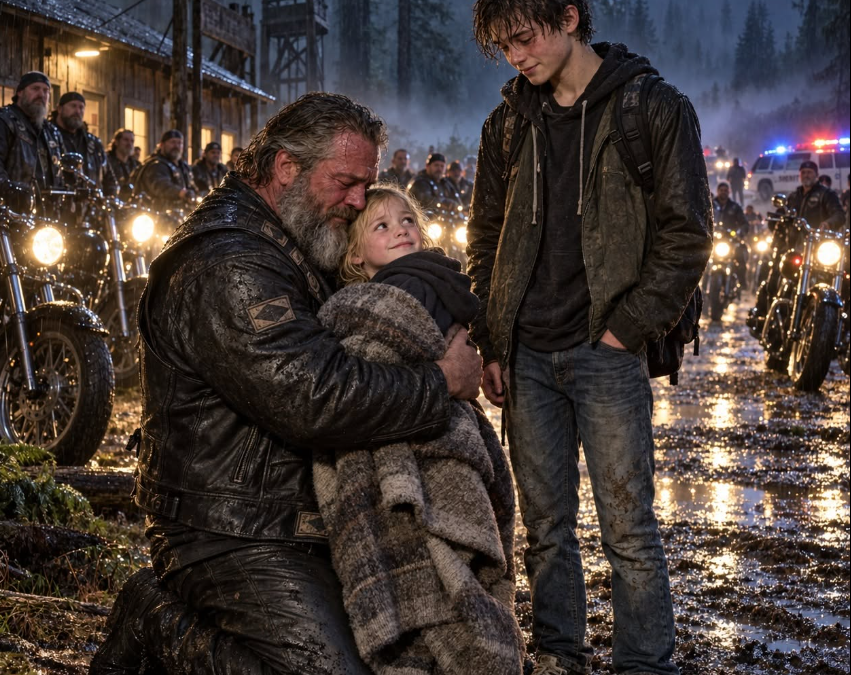
PART2:
One February morning, I woke because the apartment was too quiet.
I found her on the bathroom floor.
After that, I entered foster care.
The first home lasted three months.
Nice people.
Too many younger children.
I was withdrawn and angry and once punched a hole in a bedroom door after somebody moved my mother’s photograph.
They decided I needed “a more structured placement.”
The second lasted six weeks.
The foster mother cried when I left.
I felt guilty about that.
The third belonged to Earl Watkins.
Earl lived twenty miles outside Pine Crossing in a cedar-sided house surrounded by five acres of forest.
From the road, it looked perfect.
Wind chimes on the porch.
Vegetable garden.
Basketball hoop.
Framed photographs of former foster kids in the hallway.
Whenever my caseworker, Linda Shaw, visited, Earl made cookies.
Fresh ones.
Not from a package.
He would put one hand on my shoulder and say things like, “Mason’s had a difficult adjustment, but we’re making progress.”
Linda would smile.
Write something.
Ask me how school was.
I would say fine.
Then her county sedan would disappear around the bend.
Earl would close the front door.
PART3:
And the whole house would change.
He did not beat me every day.
That would have been easier to explain.
He was careful.
He took food away as punishment.
Locked me in the laundry room overnight if I talked back.
Made me stand outside without a coat for hours.
Told me nobody wanted difficult boys.
Told me the state paid him to tolerate me.
Told me if I complained, he would say I was violent.
He had paperwork proving I had punched a wall.
He reminded me of that often.
Once he grabbed the back of my neck hard enough to leave finger-shaped bruises.
The next morning, he made me wear a hoodie to school.
I told a counselor.
Not everything.
Enough.
She called someone.
Earl learned about it before anyone interviewed me alone.
That night he stood outside the laundry room after locking me inside.
“You want to go to a group home?”
I said nothing.
“You think anybody’s lining up for fifteen-year-old boys with anger issues?”
Silence.
“You’re lucky somebody took you.”
That sentence stayed.
You’re lucky somebody took you.
Three days later, I ran.
I did not make a plan.
Planning requires believing there is somewhere to go.
I put two shirts, socks, a bottle of water, a hunting knife with a broken tip, and my mother’s photograph into my school backpack.
Then I walked into the woods.
For seven months, I lived in the Cascade foothills north of Pine Crossing.
I learned which convenience stores threw out sandwiches at closing.
Which church had an outdoor spigot.
Which campground bathrooms stayed unlocked after tourist season.
I found an old camping filter in a dumpster and used it for creek water.
I built a shelter between two fallen cedar trunks.
Blue tarp over branches.
Pine boughs beneath me.
A plastic grocery bag over my shoes when rain became bad enough.
I stole.
Crackers.
Peanut butter.
One flashlight.
A pair of gloves.
I am not proud of that.
I was hungry.
Both can be true too.
Sometimes I went into town after dark.
Never two nights in a row.
I saw posters once.
MISSING JUVENILE.
My school picture.
MASON REED, AGE 15.
The photograph was nearly a year old.
I tore it down.
Not because I hated anybody enough to make them worry.
Because I knew what happened if they found me.
Earl.
Or another Earl.
Or some placement where everybody knew my file before they knew me.
So I developed a rule.
Stay invisible.
Invisible kids cannot be returned.
Invisible kids cannot be disappointed by adults.
Invisible kids survive.
Then October came.
Rain in Oregon is usually patient.
That storm was not.
It hammered the forest.
Wind bent trees until their trunks groaned.
Black Creek rose over its banks.
The trail near my shelter disappeared beneath brown water.
I spent most of the evening curled beneath my tarp with my backpack against my chest, listening for branches breaking.
Around nine, I heard something strange.
Crying.
At first I thought it was an animal.
Maybe a fawn.
Maybe an injured dog.
Then the wind dropped for half a second.
A tiny voice came through the rain.
“Daddy.”
Every instinct I had spent seven months developing told me to stay where I was.
Do not get involved.
Do not be seen.
Do not become somebody’s problem.
Then the voice came again.
“Daddy!”
I crawled out.
Rain hit my face immediately.
“Hello?”
Nothing.
I grabbed my flashlight.
The batteries were weak.
A yellow circle moved between the trees.
“Hey!”
Crying.
Farther downhill.
I followed.
Maybe half a mile.
Maybe less.
Distances become strange in a storm.
I crossed a drainage ditch.
Slid twice.
Nearly lost one shoe in mud.
Lightning flashed.
For one second the entire forest went white.
That was when I saw her.
A little girl beneath a cedar.
Blonde hair plastered to her cheeks.
Pink shoes covered in mud.
One knee bleeding.
Both arms wrapped around herself.
I moved closer.
“Hey.”
She screamed.
Crawled backward.
I stopped instantly.
Raised my hands.
“Okay.”
“Go away!”
“I’m not going to hurt you.”
“Don’t take me back.”
That sentence changed everything.
Not lost.
Running.
I stayed where I was.
“My name’s Mason.”
She stared.
“What’s yours?”
No answer.
“You don’t have to tell me.”
Her teeth were chattering.
Badly.
I took off my hoodie.
It was wet on the outside but warmer than nothing.
I stepped forward once.
She flinched.
So I placed it on the ground between us and backed away.
“You can take that.”
She looked at the hoodie.
Then me.
“I’m not coming closer.”
Slowly, she crawled toward it.
Put it around her shoulders.
It swallowed her.
“What happened?”
She shook her head.
“Did somebody hurt you?”
Tears.
“Men took me.”
My stomach tightened.
“What men?”
“Three.”
“Do you know them?”
“No.”
“They put you in a car?”
“A van.”
“Where?”
“At the picnic.”
“What picnic?”
“My daddy’s.”
She started crying.
I crouched lower.
“Okay. You’re okay.”
“No.”
“Right.”
Bad choice of words.
“You’re not okay.”
That seemed more honest.
“But I’m here.”
She stared.
“The van got stuck.”
“Where?”
“In mud.”
“They were yelling.”
“And you ran?”
She nodded.
“One opened the back.”
“Did he see you leave?”
“I don’t know.”
That meant yes eventually.
I looked around.
No lights.
No engines.
Only forest.
“What’s your name?”
“Ellie.”
“Okay, Ellie.”
That was when I noticed the leather vest.
Tiny.
Child-sized.
Black.
Under my hoodie.
On the back was a patch.
Silver mountain.
Black motorcycle wheel.
Words curved over both.
BLACK RIDGE RIDERS.
I knew the name.
Everybody around Pine Crossing did.
They had a clubhouse outside town, although they called it a lodge.
People said they were rough.
People said you did not start trouble with them.
People also said they delivered Christmas toys to half the county.
Repaired wheelchair ramps for veterans.
Paid funeral costs when military families could not.
The president was Cole Mercer.
Former Marine.
Motorcycle shop owner.
Big gray beard.
I had seen him once at a gas station.
He looked like somebody who could lift the gas station.
That afternoon, before the storm became violent, I had heard sirens.
Later, helicopters.
From a ridge above my shelter I saw search lights moving.
I had assumed somebody was missing.
Now I understood.
I looked at Ellie.
“You’re Cole Mercer’s daughter?”
Her face brightened slightly.
“You know Daddy?”
“No.”
Then fear returned.
“But I know who he is.”
“Can we go to him?”
“Yes.”
I said it without knowing how.
No phone.
Roads flooding.
Storm getting worse.
Ellie shaking.
Then a light appeared between trees.
Far uphill.
Another.
Voices.
“Ellie!”
I almost called back.
Then Ellie grabbed my wrist.
Her fingers were freezing.
“No.”
“What?”
“That’s them.”
The voice came again.
“ELLIE!”
Not panicked.
Angry.
A man cursed.
Another answered.
Three flashlights separated.
Searching methodically.
My stomach turned.
I switched my flashlight off.
“Can you walk?”
Ellie nodded too fast.
I took her hand.
We moved.
At first she walked.
Then stumbled.
Branches whipped our faces.
Mud sucked at my shoes.
Behind us, voices came closer.
“She has to be around here.”
“Check the creek.”
“They’ll kill us if—”
The rest disappeared under thunder.
I picked Ellie up.
She weighed maybe forty-five pounds.
Cold, wet forty-five pounds.
I carried her through brush.
I knew those woods better than anybody who wanted her.
That became our advantage.
I knew where an abandoned logging trail turned suddenly and dead-ended against a landslide.
Where ground looked solid but dropped into thigh-deep marsh.
Where a fallen Douglas fir had lifted its roots and created a hollow large enough to hide inside.
We crawled into that root hollow.
Ellie pressed against me.
I put one hand gently over the side of her head.
Not her mouth.
I did not want to frighten her more.
“Quiet.”
Flashlights moved outside.
One beam passed across the opening.
So close I could see water dripping from a man’s jeans.
Ellie shook.
I could feel every tremor.
The man stopped.
I stopped breathing.
Another voice called farther away.
“Anything?”
“No.”
His light moved.
Footsteps disappeared.
We stayed ten more minutes.
Maybe twenty.
Then Ellie whispered, “I’m cold.”
I touched her hands.
They were icy.
“We have to move.”
“Where?”
I knew one place.
An abandoned forestry dispatch station near Black Creek Road.
I had broken into it once during summer.
Not really broken.
Door latch barely worked.
Inside was an old desk.
Wood stove.
Wall maps.
And an emergency phone.
Yellow.
Hardwired.
When I found it months earlier, there had been a dial tone.
I prayed.
“We’re going to a building.”
“Is Daddy there?”
“No.”
“But there’s a phone.”
That gave her strength.
We moved for nearly an hour.
Sometimes I carried her.
Sometimes we walked.
Once I slipped on a slope and landed hard on my shoulder.
Ellie started crying.
“Are you hurt?”
“No.”
“You made a sound.”
“That’s because I’m dramatic.”
“What does dramatic mean?”
“Means I’m fine.”
She looked suspicious.
We kept moving.
The forestry station appeared after midnight.
One story.
Dark.
Two broken windows.
Metal roof partially peeled back.
It looked terrible.
To us, it was a castle.
I pushed inside.
Wind came through gaps, but less.
I found an old wool emergency blanket inside a cabinet.
Smelled like mice.
Did not matter.
Wrapped Ellie.
Then went to the phone.
Lifted receiver.
Dial tone.
A beautiful hum.
“Oh my God.”
Ellie looked up.
“Does it work?”
“I think.”
I dialed 911.
Nothing.
Clicked.
Tried again.
Nothing.
The dial tone returned.
Storm damage.
Maybe local exchange only.
I slammed the receiver down.
“Stupid.”
Ellie started crying.
“Hey.”
“I want Daddy.”
“I know.”
“He thinks I’m dead.”
“He doesn’t.”
“How do you know?”
“Because fathers don’t think that until somebody makes them.”
That sentence came from nowhere.
Maybe from the father I wished I had.
Maybe from the one I had never been.
Ellie reached inside her vest.
Pulled out a chain.
A small metal tag.
“My daddy made me wear this.”
One side had her name.
ELLIE MERCER.
The other had a phone number.
Underneath:
IF FOUND — CALL BLACK RIDGE.
I stared.
“You had this the whole time?”
“I forgot.”
“Kids.”
“What?”
“Nothing.”
I picked up the receiver.
Dialed.
One ring.
Two.
A deep male voice answered.
“Black Ridge.”
For several seconds I could not speak.
“Hello?”
“I have Ellie Mercer.”
Silence.
Not ordinary silence.
The kind that changes the air.
Then:
“Who is this?”
“My name’s Mason.”
A chair scraped on the other end.
“Where is she?”
“Here.”
“Where is here?”
“Old Forest Service dispatch station off Black Creek Road.”
“You hurt her?”
“No.”
“Put her on.”
I handed Ellie the receiver.
“Daddy?”
I heard a sound through the handset.
Not words.
A man breaking.
“Baby?”
“Daddy.”
“Are you hurt?”
“My knee.”
“Who are you with?”
“Mason.”
“Who’s Mason?”
She looked at me.
“He found me.”
On the other end, voices exploded.
Somebody shouted directions.
Engines.
Then Cole returned.
“Put Mason back on.”
I took the phone.
“Yeah?”
His voice had changed.
Still deep.
Now controlled.
“Kid, listen carefully.”
“Okay.”
“Are the men who took her near you?”
“Yes.”
“How many?”
“Three.”
“You see weapons?”
“No.”
“You sure?”
“No.”
“Good answer.”
I swallowed.
“How long?”
“Not long.”
“What does that mean?”
“It means lock the door.”
“The door barely works.”
“Move furniture.”
“There isn’t much.”
“Anything.”
I looked at Ellie.
“Stay with my daughter.”
“I will.”
“Mason.”
“Yeah?”
“You do not open that door unless you hear me say your name.”
Then the line went dead.
Ellie smiled.
“Daddy’s coming.”
I believed her.
For maybe thirty seconds.
Then a window exploded.
Glass sprayed across the room.
Ellie screamed.
A flashlight beam punched through the darkness.
“Well.”
A man’s face appeared beyond the broken frame.
“Look what we found.”
My blood froze.
“Ellie.”
She crawled behind the desk.
Three men stood outside.
One large.
One thin.
One wearing a red rain jacket.
The large one hit the door.
Bang.
Old wood shook.
“Open up, kid.”
I dragged a filing cabinet against the door.
It weighed almost as much as I did.
Another kick.
“Move away from her.”
I looked around.
Nothing.
Then I saw an old iron fireplace poker leaning near the wood stove.
Grabbed it.
My hands shook.
I was fifteen.
About five-nine.
Barely 130 pounds after seven months living hungry.
The man outside laughed.
“You going to fight us?”
No.
I was going to lose.
I knew that.
But Ellie was behind me.
Sometimes knowing you’re going to lose does not change where you stand.
Another kick.
One hinge cracked.
“Last chance.”
I raised the poker.
“Go to hell.”
He smiled.
Then the ground vibrated.
At first I thought thunder.
The men stopped.
Another vibration.
Long.
Low.
Growing.
The thin man looked toward the road.
“What the hell is that?”
I knew.
Engines.
Not one.
Many.
The sound rolled over the forest.
Deep exhaust.
Dozens.
Maybe hundreds.
Then headlights appeared through trees.
A river of white lights.
Motorcycles coming up Black Creek Road.
Behind them pickups.
SUVs.
Search-and-rescue rigs.
The three men froze.
The large one whispered:
“Oh God.”
The motorcycles kept coming.
He finished:
“Her father found us.”
The man in the red jacket ran.
He made maybe fifty yards.
Then red and blue lights appeared from the opposite end of the road.
Sheriff’s cruisers.
Deputies got out with weapons drawn.
“ON THE GROUND!”
The second man ran toward the trees.
Motorcycles blocked the path.
Nobody hit him.
That surprised me.
Riders simply dismounted and stood.
A wall of leather and helmets.
The man stopped.
Raised his hands.
The large kidnapper stayed by the station.
Maybe he understood there was nowhere left.
Within minutes the clearing filled with people.
Rain.
Lights.
Shouting.
Radios.
Engines.
Then the broken front door moved.
A man stepped inside.
Cole Mercer.
Bigger than I remembered from the gas station.
Gray beard soaked.
Black leather vest dark with rain.
Hands trembling.
That was the first thing I noticed.
Not anger.
Trembling.
He saw Ellie.
Nothing else mattered.
“Daddy!”
She ran.
He dropped.
She hit him hard enough they nearly tipped over.
Cole wrapped both arms around her.
His face disappeared in her wet hair.
I watched the most feared man in Pine Crossing sob like he had forgotten anybody else existed.
“Baby.”
“I knew you’d come.”
“Oh God.”
“You came.”
“Always.”
That word hurt somewhere inside me.
Always.
Cole pulled back.
Checked her face.
Arms.
Knee.
“You hurt?”
“My knee.”
“Anything else?”
“No.”
He kissed her forehead.
Then Ellie pointed.
“Mason.”
Every person in that room looked at me.
Suddenly I remembered myself.
Wet.
Dirty.
Too thin.
Hair down to my eyes.
Torn shoes.
Fireplace poker in my hand.
I dropped it.
It hit the floor with a metallic clang.
One of the kidnappers outside started shouting.
“HE WAS WITH US!”
My stomach dropped.
The large man.
Later I learned his name was Travis Kane.
“He set this up!”
I stared through the broken doorway.
“What?”
“He called us!”
“That’s a lie!”
Travis pointed.
“He wanted money! He had the girl when we found him!”
A deputy looked at me.
Then Cole.
Then Ellie.
My body reacted before my mind.
Run.
Window.
Back door.
Trees.
Invisible.
I took one step backward.
Ellie left her father’s arms.
“No.”
Everybody stopped.
She pointed at Travis.
“He took me.”
Travis shouted, “She’s confused!”
“I’m not!”
Her little voice became fierce.
“He put me in the van!”
Then she came to me.
Grabbed my hand.
“Mason found me.”
I could not move.
“He gave me his shirt.”
Cole looked at the oversized hoodie around his daughter.
“He carried me.”
Silence.
“He hid me.”
Her fingers tightened around mine.
“He didn’t let them take me.”
Cole stared at our hands.
Then at me.
Something changed in his face.
He stood.
Walked toward Travis.
Every Black Ridge Rider in the clearing watched.
I expected violence.
I think everybody did.
Cole stopped about six feet from him.
Travis looked terrified.
“You took my daughter.”
Travis said nothing.
Cole’s hands curled into fists.
Then he turned away.
Looked at Sheriff Daniel Ruiz.
“You heard Ellie.”
Ruiz nodded.
“I did.”
Cole pointed.
“Then take them.”
No beating.
No execution.
No biker revenge.
Handcuffs.
Evidence.
Witnesses.
Later, deputies found the van half sunk in mud on an abandoned logging spur.
Inside were zip ties.
Blankets.
Food.
A child’s broken hair clip.
A burner phone.
Maps.
Enough evidence that nobody needed to guess.
Travis Kane had once been loosely associated with Black Ridge.
Never a full patched member.
He had worked around their clubhouse.
Later he was caught stealing money from a fundraiser for a veteran’s family.
Cole banned him.
Kane blamed Cole for everything that fell apart afterward.
Job.
Friends.
Reputation.
Taking Ellie was revenge.
That explanation never made sense to me.
Hurting a six-year-old because you hate her father should not make sense.
I thought my part was over.
Then a detective said:
“Mason Reed?”
Hearing my whole name terrified me more than Kane had.
I backed away.
“How do you know my name?”
“You’re listed as a runaway.”
My lungs stopped working.
“No.”
“Mason.”
“No.”
“You need to come with us.”
“I’m not going back.”
Cole looked over.
“What?”
The detective answered.
“He’s a ward of the state.”
Cole stared at me.
“You’re in foster care?”
I said nothing.
Ellie did.
“He lives in the woods.”
Cole’s expression changed.
The detective stepped closer.
“Mason, nobody’s taking you anywhere right this second.”
“You don’t understand.”
“Then tell us.”
“I’m not going back to Earl.”
The detective’s face tightened.
“Earl who?”
“Watkins.”
Sheriff Ruiz turned immediately.
Something in his reaction made my stomach twist.
“You know him.”
Ruiz crouched so we were eye-level.
“What happened at Watkins’s house?”
“I’m not talking.”
“Mason.”
“No.”
Cole spoke.
Not loudly.
“Let the kid breathe.”
Ruiz nodded.
A paramedic came with a thermal blanket.
I flinched when she touched my shoulder.
She stopped.
“May I?”
Nobody had asked me that in months.
I nodded.
She wrapped it around me.
Ellie sat beside Cole.
Watching.
I looked at her.
This little girl had trusted me when she had every reason not to trust another stranger.
If I ran now, what exactly had I spent the night telling her?
So I spoke.
Not elegantly.
Not all at once.
Laundry room.
Food.
Cold.
Threats.
Bruises.
Caseworker visits.
The counselor.
Earl finding out.
The detective wrote.
Ruiz asked few questions.
Cole asked none.
When I finished, Sheriff Ruiz said to the detective:
“Check prior calls on Watkins.”
The detective walked outside.
Returned several minutes later.
His expression told me something before his words did.
“There are two previous complaints.”
I stared.
“What?”
“From former placements.”
I laughed.
Not because anything was funny.
The sound scared me.
“Two?”
“Mason—”
“Two?”
All those nights.
All those times Earl told me nobody would believe me.
Someone had already spoken.
Maybe two someones.
And adults had still sent me there.
I laughed until I could not.
Then it became crying.
Ugly.
Angry.
I shoved the blanket away.
“You knew.”
“No,” Ruiz said.
“Somebody knew!”
“Yes.”
“You put me there anyway!”
“I didn’t.”
“Somebody did!”
Cole stood beside me.
Not touching.
Just there.
I said, “They’ll send me back.”
“No,” Ruiz said.
“You don’t know.”
“I do.”
“How?”
“Because I’m telling you right now you’re not going back to that house.”
I stared.
“Promise?”
Ruiz paused.
Maybe he understood what that word meant to me.
“Yes.”
Cole spoke quietly.
“If somebody tries, they deal with me too.”
Ruiz looked at him.
“Cole.”
“What?”
“Don’t make my job harder.”
“I have a gift.”
Despite everything, a tiny laugh escaped me.
That was the first adult promise I believed in a long time.
The next days moved fast.
Hospital first.
Mild hypothermia.
Dehydration.
Scratches.
Bruised shoulder.
Weight below what doctors wanted for my age.
Ellie came to the same hospital.
She refused to let anybody examine her until Cole found me.
A nurse brought her wheelchair into my room.
She had a bandage over her knee.
Pink hospital socks.
My hoodie still around her shoulders.
“You can keep that,” I told her.
She shook her head.
“It’s yours.”
“It smells terrible.”
She sniffed it.
“You’re right.”
Cole laughed.
Then Ellie reached into her pocket.
Pulled out the metal tag.
“You called.”
“Yeah.”
“Daddy says you were brave.”
I looked at Cole.
He shrugged.
“She misquotes me.”
Ellie frowned.
“You said it.”
“I said he did a brave thing.”
“Same.”
Cole looked at me.
“No.”
His voice softened.
“It’s not.”
I understood later.
Calling somebody brave can become a cage too.
If people decide you are brave, they sometimes forget you are scared.
I was terrified.
Of kidnappers.
Police.
Social workers.
Hospitals.
Locked doors.
Every adult who said trust me.
The state placed me with an emergency foster family named Martin and Celia Alvarez.
I hated them immediately.
Not because they did anything wrong.
Because they had a house.
Rules.
Clean sheets.
A bedroom.
And I knew what came after adults seemed nice.
Celia put a plate of food in front of me the first night.
I ate half.
Wrapped the rest in a napkin.
Put it in my pocket.
She saw.
Said nothing.
The next morning, there was a plastic container beside my backpack.
Inside:
Two sandwiches.
Granola bars.
Apple.
Note.
You don’t have to hide food here, but you can keep this anyway. —Celia
I almost ran.
Kindness was harder than anger because I did not know where the trap was.
Cole visited the following Sunday.
I expected him to bring money.
People in movies always give the poor kid money.
Instead he brought a backpack.
Green.
Heavy.
“What’s this?”
“Open it.”
Socks.
Thermal underwear.
Winter coat.
Flashlight.
Portable charger.
Three books.
Prepaid phone.
I picked up the phone.
“What for?”
“So next time you decide to live in the forest for seven months, somebody can yell at you.”
I looked at him.
“You’re assuming there’ll be a next time.”
“There better not be.”
Ellie leaned around him.
“He’s bossy.”
“I’ve noticed.”
Cole sat at the Alvarezes’ kitchen table.
Did not ask me to tell the kidnapping story.
Did not ask about Earl.
Instead:
“You like motorcycles?”
“I don’t know.”
“You stared at mine for ten minutes in the hospital parking lot.”
“I was bored.”
“Come by the shop sometime.”
“I don’t have money.”
“Looking is currently free.”
I waited for the catch.
There wasn’t one.
The investigation into Earl Watkins began immediately.
Two former foster boys came forward.
Then a girl who had lived there three years earlier.
She said Earl forced her to sleep in a basement utility room as punishment.
Another boy described food deprivation.
Records showed school staff had documented unexplained bruising in one child.
One case note recommended further review.
The review had never happened.
Earl’s foster license was suspended.
Then revoked.
Criminal charges followed on several allegations.
Not every case was provable.
That frustrated me.
I had imagined telling the truth would create clean justice.
It did not.
Some records were old.
Some witnesses did not want to testify.
Some injuries had never been documented.
But enough existed.
Earl eventually pleaded guilty to charges involving unlawful imprisonment and child endangerment connected to multiple placements.
He went to prison.
Not forever.
Long enough.
More important to me, an official state review concluded multiple warning signs had been missed.
Those words appeared in a report.
Warning signs had been missed.
I read that line ten times.
It did not fix anything.
But it told me something I needed.
I had not failed to endure a safe home.
Adults had failed to recognize an unsafe one.
There is a difference.
The kidnapping case moved faster.
Kane and the other two men faced federal and state charges.
Ellie testified in a special recorded setting so she would not have to sit directly in front of them.
I testified in court.
That was worse than facing them in the forestry station.
At the station, I had a poker.
In court, I had memory.
Kane’s lawyer asked why I had run from foster care.
I looked at the prosecutor.
She nodded slightly.
So I answered.
Then he asked whether I stole food while living in the woods.
“Yes.”
“Broke into buildings?”
“I went into abandoned buildings.”
“Did you steal a flashlight?”
“Yes.”
“Then you would agree you’ve committed crimes.”
The prosecutor objected.
Judge sustained.
But the point was already in the room.
Runaway.
Thief.
Unreliable.
I saw it.
The old magic.
Make the unwanted kid look like a bad kid and suddenly adults feel more comfortable ignoring what happened to him.
Then Kane’s attorney asked:
“Mr. Reed, isn’t it possible you’re exaggerating your account because receiving public attention has benefited you?”
I stared.
“Benefited me how?”
“You’ve received donations.”
“No.”
“Gifts?”
“A backpack.”
A few people laughed.
The judge shut it down.
The lawyer continued.
“Mr. Mercer has taken an interest in you.”
“Yes.”
“You spend time at his motorcycle shop.”
“Yes.”
“So this event improved your circumstances.”
Something hot moved through me.
I leaned toward the microphone.
“Being kidnapped didn’t improve Ellie’s life.”
The room went quiet.
“Finding her changed mine.”
I looked at Kane.
“But I didn’t ask those men to take her so I could get a coat.”
The lawyer moved on.
That clip never went viral.
Thank God.
Not every painful moment needs to become content.
The men eventually accepted plea agreements.
Long prison terms.
Enough that Ellie would be an adult before any could seek release.
Cole did not celebrate.
The night the agreements became official, I was at his motorcycle shop.
He stood alone outside.
I joined him.
“You okay?”
“Yeah.”
“You don’t look okay.”
He looked toward the mountains.
“I wanted to kill him.”
I said nothing.
“When I came through that station door.”
His jaw tightened.
“I knew if Ellie hadn’t been standing there…”
He did not finish.
“What stopped you?”
“She was standing there.”
Simple.
Then he looked at me.
“And you.”
“Me?”
“You were fifteen holding a fireplace poker like you were ready to die.”
I looked down.
“I was.”
“I know.”
He exhaled.
“If I beat that man to death in front of you and Ellie, what exactly would I be teaching either of you?”
I had no answer.
Cole stared into the dark.
“Everybody thinks strength is what you can do when you’re angry.”
He shook his head.
“Most of the time it’s what you refuse to do.”
That became another sentence I carried.
I began spending Saturdays at Black Ridge Custom Cycle.
At first I swept.
I was good at sweeping.
Seven months living outdoors will make you appreciate floors.
Then an older mechanic called Red showed me how to change oil.
“How much do you know?”
“Nothing.”
“Best kind of student.”
Machines made sense.
A bolt was either tight or loose.
A circuit either had continuity or it didn’t.
A carburetor did not smile at your caseworker and lock you in a room later.
Broken parts showed you where they had failed.
No deception.
I loved that.
I went back to school.
Hated that.
The Alvarezes insisted.
Celia drove me the first week because I refused the bus.
Kids knew my story.
Some whispered.
One boy called me Forest Boy.
I punched him.
Not my finest moment.
Principal suspended me for three days.
Cole came to the meeting.
So did Celia.
The principal asked why I attacked another student.
“He called me something.”
“Mason, words don’t justify violence.”
I crossed my arms.
Cole said, “He’s right.”
I stared at him.
“Whose side are you on?”
“Yours.”
“Doesn’t sound like it.”
“Being on your side doesn’t mean telling you every stupid thing you do is smart.”
I hated him for about eight minutes.
Then he drove me to the shop and made me clean carburetors.
Celia asked if I wanted to talk.
I said no.
She said okay.
That mattered too.
Not every adult forced a confession.
Months passed.
I stopped sleeping in my shoes.
That was progress nobody knew to measure.
At first, every night at the Alvarezes’ house I put shoes beside the bed.
Backpack packed.
Phone charged.
Coat hanging over the chair.
Ready to run.
One morning I woke and realized my shoes were by the front door.
I had forgotten to prepare.
I sat on the bed staring at my socks.
Then cried.
Quietly.
Not because I wanted to leave.
Because some part of me had finally believed I might not have to.
A year after the kidnapping, Martin Alvarez got a job offer in Spokane.
They planned to move.
When Celia told me, I stopped hearing words after Spokane.
My stomach dropped.
Packing.
New caseworker.
New placement.
New adults.
New rules.
Everything inside me went back to the forest.
Celia noticed.
“Mason.”
“No.”
“Listen.”
“No.”
“Nobody has decided anything.”
“You’re leaving.”
“Yes.”
“So I’m leaving.”
“Maybe.”
I stood.
“No.”
“Mason.”
“I’m not starting over.”
I walked out.
Did not return for six hours.
Cole found me at the shop.
I was sitting behind the dumpster.
Very dignified.
He did not ask why.
Just sat on an overturned bucket.
After a while:
“Celia called.”
“Of course.”
“She worries.”
“Everybody worries after they decide something.”
“What do you want?”
Nobody had asked that.
Not seriously.
“What?”
“What do you want?”
“To stay.”
“In Pine Crossing?”
“Yes.”
“Why?”
I looked toward the shop.
School.
Ellie.
Black Ridge.
Celia and Martin too, even if they were leaving.
“My life is here.”
Cole nodded.
“Then tell your caseworker.”
“They don’t care.”
“You don’t know that.”
“I do.”
“No.”
His voice sharpened.
“You know what happened before.”
I looked away.
“That matters.”
He continued.
“But don’t use people who failed you as proof everybody will.”
Hard sentence.
I hated it.
Next week my caseworker asked me.
Actually asked.
“Mason, if staying in Pine Crossing is possible, is that what you want?”
“Yes.”
“Is there anyone here you feel safe with?”
Through her office window, Cole and Ellie sat in the lobby.
Ellie kicking her feet.
Cole pretending not to look nervous.
“Yes.”
That began six months of paperwork.
Cole did not simply take me home.
Real life is not that neat.
Background checks.
Fingerprinting.
Home study.
Interviews.
Foster-parent certification.
References.
Training classes.
Inspection.
Questions about his club.
Questions about firearms.
Questions about discipline.
Questions about why a single fifty-year-old widower with a six-year-old daughter wanted to foster a teenage boy.
Cole complained through all of it.
Attended everything.
One class covered trauma-informed parenting.
Afterward he looked at me.
“That instructor uses too many acronyms.”
“She hates you too.”
“Good.”
He passed.
The first night I moved into Cole’s house, my room was upstairs across from Ellie’s.
Bed.
Desk.
Closet.
Dark blue walls.
A framed motorcycle poster.
Nothing childish.
No attempt to pretend I had always belonged.
I placed my backpack on the floor.
Did not unpack.
Dinner.
Homework.
Ellie showed me every drawer in the bathroom for reasons nobody understood.
Cole said goodnight.
I closed my bedroom door.
Then froze.
There was no lock on the outside.
No slide bolt.
No chain.
Nothing.
I opened it.
Closed it.
Opened.
Closed.
At midnight, Cole knocked.
“You all right?”
“Yes.”
He started away.
“Cole?”
“Yeah?”
I wanted to tell him about Earl.
About the laundry room.
About how a door without an outside lock could feel like somebody had handed you air.
Instead:
“Thanks.”
Cole looked confused.
Then maybe understood.
“Get some sleep, kid.”
He walked away.
My backpack stayed packed for eleven days.
Then I removed one shirt.
Week later, second.
By Christmas, it was empty.
Ellie noticed.
She noticed everything.
“You’re staying.”
“I guess.”
“Good.”
That was all.
Two years after the night in the forest, Cole filed to adopt me.
I was seventeen.
I said no.
First time.
He did not argue.
Month later he asked why.
“Because I’m almost eighteen.”
“So?”
“What’s the point?”
Cole looked at me like I had asked why engines need oil.
“You think family expires at eighteen?”
I said nothing.
He continued.
“If you don’t want my last name, fine.”
“I didn’t say that.”
“If you don’t want adoption, fine.”
I stared.
“Then why ask?”
“Because you’re allowed to be wanted without owing yes.”
I had never heard anything like that.
He left the paperwork on the table.
Did not mention it again.
Three weeks later I picked it up.
“Still an option?”
Cole did not smile.
I could tell he wanted to.
“Yep.”
“Okay.”
“Okay what?”
“Don’t make it weird.”
His smile appeared.
“Wouldn’t dream of it.”
The adoption hearing happened in spring.
I wore a borrowed tie.
Ellie wore a dress she complained about for two hours.
Half the Black Ridge Riders filled the courthouse hallway.
They were not all allowed in.
The judge looked at me.
“Mr. Reed, do you understand the legal effect of adoption?”
“Yes.”
“Do you consent freely?”
I looked at Cole.
He looked more nervous than the night he found Ellie.
“Yes.”
The judge signed.
People clapped.
Tiny cried and denied it.
Ellie hugged me.
“My brother.”
She had been calling me that for almost two years already.
Now nobody could argue.
Cole walked toward me.
We did not know whether to hug.
That was our relationship.
Ellie solved it.
She shoved us together.
So I hugged him.
He whispered:
“You’re stuck now.”
I laughed into his shoulder.
“That sounds threatening.”
“It is.”
My last name became Mercer-Reed legally because I wanted to keep my mother’s name too.
Cole never asked me to erase where I came from.
That mattered.
People think being adopted means your first family disappears.
Mine did not.
My mother was still my mother.
She loved me badly sometimes.
She also sang to me.
Made pancakes shaped like animals.
Cried when I started kindergarten.
Addiction took pieces of her before it took her life.
I keep her picture.
Cole understands.
Years later, he helped me find her grave marker when I finally had the courage to visit.
He stood far enough away to give me privacy.
Close enough that I knew he was there.
That is family too.
I’m twenty-nine now.
Fourteen years since the storm.
I run service at Black Ridge Custom Cycle.
Red retired.
Tiny claims he’s retired but appears every morning anyway.
Cole’s beard is almost white.
He still rides.
His knees make noises he insists come from the floor.
Ellie is twenty.
College.
Studying social work.
Of course she is.
She wants to work with foster youth.
When she told me, I said:
“That sounds exhausting.”
She stared.
“You carried me through a freezing forest while kidnappers chased us.”
“Exactly. I’ve done my exhausting thing.”
“You don’t get a lifetime exemption.”
“Feels unfair.”
She smiled.
“You taught me.”
“What?”
“That scared kids don’t always look scared.”
That shut me up.
Every October, Black Ridge holds the charity barbecue where Ellie disappeared.
For years Cole wanted to cancel it.
Ellie refused.
“If we stop, they took that too.”
So it continued.
Half the proceeds now fund local foster youth and runaway services.
Not generic donations.
Specific things.
Emergency motel rooms.
Bus passes.
Prepaid phones.
Camping gear for outreach teams.
Food cards.
Legal advocacy.
Independent child interviews when abuse is alleged.
Black Ridge riders volunteer.
Some are terrible at it.
Tiny once handed a fourteen-year-old runaway eighty dollars and told him, “Don’t buy drugs.”
Our social worker nearly killed him.
We trained everybody after that.
There are emergency backpacks now.
One resembles the pack Cole brought me.
Inside:
Socks.
Food.
Water bottle.
Flashlight.
Power bank.
Prepaid phone.
Notebook.
Basic toiletries.
Card listing numbers a kid can call.
The volunteer sheet has one line at the top in huge letters:
BELIEVE THE KID FIRST. INVESTIGATE SECOND.
Cole wrote it after reading the report about Earl.
Sheriff Ruiz asked him to change it because technically investigators cannot presume every allegation true.
They compromised.
Now it reads:
LISTEN TO THE KID FIRST. INVESTIGATE WITH CARE.
Cole still complains his version was better.
Sheriff Ruiz retired three years ago.
He attends the barbecue.
Every year he finds me.
Every year he asks:
“Staying out of the woods?”
Every year I say:
“Mostly.”
The abandoned forestry station is gone.
A winter storm dropped a tree through the roof six years after the kidnapping.
County tore it down.
Before demolition, Ellie and I went there.
Cole came too.
The yellow emergency phone still hung on the wall.
Dead.
Dusty.
Ellie touched it.
“That thing saved me.”
“No.”
I looked at the phone.
“It got us through.”
She looked at me.
“You saved me.”
I shook my head.
“We’ve argued about this.”
“And you’re wrong every time.”
Cole leaned against the doorframe.
“For once, she’s right.”
“You’re both exhausting.”
Ellie smiled.
“We learned from you.”
We removed the metal number plate from the phone before demolition.
Sheriff said technically we were stealing county property.
Cole asked if he wanted to arrest us.
Ruiz declined.
The plate hangs in the Black Ridge clubhouse now.
Beside it, Ellie’s old identification tag.
Below both is a photograph from the following summer.
Cole.
Ellie.
Me.
I was too thin.
Hair badly cut.
Uncomfortable smile.
But I was there.
People still tell the story wrong.
They say two hundred bikers rode through a storm and rescued Cole Mercer’s daughter from kidnappers.
That happened.
There were 187 motorcycles according to Sheriff Ruiz’s report, plus trucks and search vehicles.
Two hundred sounds better.
People say Cole Mercer showed the kidnappers what happens when you mess with a biker’s family.
That is wrong.
He did not hit them.
He let the law take them.
That may be the most important part nobody remembers.
People say a homeless boy became part of a biker family after saving a little girl.
Also too simple.
I did not become family that night.
I became somebody they knew.
Then somebody they checked on.
Then somebody who swept floors.
Somebody Ellie trusted.
Somebody Cole argued with.
Somebody who failed algebra.
Somebody who got suspended for punching another kid.
Somebody who lied once about where he had been and got grounded.
Somebody who broke a customer’s mirror in the shop and had to pay for it.
Somebody who learned.
Stayed.
Was stayed for.
Family was not the motorcycle convoy.
Family was Cole attending six months of foster-parent classes while complaining about the chairs.
Family was Celia Alvarez packing sandwiches without asking why I hoarded food.
Family was Martin driving me three hours to testify against Earl.
Family was Ellie knocking on my bedroom door after nightmares even though I was the supposed hero.
Family was Cole telling me no.
Family was me discovering no did not mean go away.
That was new.
The night Ellie disappeared, I believed invisible was safe.
For seven months, invisibility had kept Earl from finding me.
It had also kept everybody else from finding me.
That distinction took years to understand.
You can become so good at protecting yourself from people who hurt you that you also become unreachable to people who might not.
Survival teaches useful things.
It can also teach lessons that expire.
Stay invisible saved me once.
If I had kept obeying it forever, it would have ruined me.
Sometimes people ask whether I would have stepped into the storm if I had known what was about to happen.
Kidnappers.
Police.
Court.
Foster investigations.
Public attention.
Cole.
Adoption.
Everything.
I always say yes.
That is a lie.
At fifteen?
If you showed me the entire road ahead, I might have crawled deeper beneath my tarp.
I was not brave because I knew how things would end.
I walked into the rain because I heard a child crying.
That was all.
Most important choices probably happen that way.
No music.
No prophecy.
No understanding that this will change your life.
You hear somebody say Daddy in the dark.
And you decide whether to stay warm or get up.
That’s it.
Sometimes getting up changes everything.
Ellie recently interviewed me for a college paper about foster youth.
She sat across from me at the shop with a recorder.
Very professional.
“Why did you trust Dad?”
“I didn’t.”
She frowned.
“Eventually.”
“Because he kept coming back.”
“What made the biggest difference?”
I thought.
“He didn’t ask me to be grateful.”
She stopped writing.
“What?”
“People who help kids like I was sometimes need you to appreciate them quickly.”
I wiped grease from my hand.
“Cole never needed that.”
I smiled.
“He needed plenty of other things.”
She laughed.
“But not gratitude.”
I continued.
“He let me be suspicious.”
“Angry?”
“Very.”
“Difficult?”
“Extremely.”
“You’re still difficult.”
“Interview over.”
She smiled.
Then became serious.
“What do you think adults misunderstand most about runaway kids?”
I did not have to think long.
“That running away and wanting somewhere safe aren’t opposites.”
Her pen stopped.
I continued.
“I didn’t want nobody.”
“I wanted nobody who could hurt me.”
She looked at me.
“There’s a difference.”
“Yeah.”
I thought about my blue tarp shelter.
“My mistake was thinking those were the only two options.”
She turned off the recorder.
Then asked:
“Did you ever think about Mom that night?”
She meant her mother, Caroline.
“No.”
“I did.”
That surprised me.
“I kept thinking if they killed me, she’d be waiting.”
“Ellie.”
“I was six.”
She looked down.
“I never told Dad that.”
“Why tell me?”
“Because you were there.”
Some memories belong only to the people who survived the same room.
I reached across.
Touched her hand.
“You knew your dad was coming.”
“Yeah.”
“You kept saying it.”
She smiled.
“Because he always did.”
There was that sentence again.
Always.
At fifteen it had hurt because I had never known an always.
Now I did.
Cole is not immortal.
None of them are.
Celia and Martin moved back to Oregon after retirement.
We still have dinner.
Sheriff Ruiz aged.
Red aged.
Tiny somehow appears exactly the same, which is suspicious.
Time takes everybody.
Always does not mean forever.
It means while I can, I come.
That definition is enough.
Last October, after the barbecue ended, rain started.
Not a violent storm.
Just Oregon rain.
Ellie and I stood beneath the Black Ridge awning.
Motorcycles lined the lot.
Cole was inside yelling because somebody had left chili on his good workbench.
Ellie looked toward the forest.
“Do you ever wonder what happened if you didn’t hear me?”
“Yes.”
“What do you think?”
“I don’t.”
“You just said yes.”
“I wonder.”
I pulled my jacket tighter.
“I don’t follow it.”
She nodded.
Then asked:
“Do you ever wish none of it happened?”
I knew what she meant.
Kidnapping.
Fear.
Not meeting.
Everything.
I answered carefully.
“I wish they never took you.”
She waited.
“I wish Earl never hurt me.”
Rain ran off the roof.
“I wish Mom didn’t die.”
I looked at her.
“But wishing the bad things away doesn’t mean I wish away every good thing that grew afterward.”
She leaned into my shoulder.
She had done that since she was little.
“You’re getting philosophical.”
“Old age.”
“You’re twenty-nine.”
“My back is forty-seven.”
She laughed.
Inside, Cole shouted:
“MASON!”
“What?”
“Tiny ate your pie!”
“I DID NOT!” Tiny yelled.
I looked at Ellie.
“Family.”
She nodded solemnly.
“Tragic.”
We went inside.
The old metal tag from the emergency phone hung on the wall.
Sometimes new members ask about it.
Cole usually points at me.
“Ask Forest Boy.”
I remind him I can put him in a nursing home someday.
He reminds me I will have to catch him first.
Ellie says she gets first choice of home.
Normal.
Ridiculous.
Beautiful.
There is a photograph in my office I never show people.
Not from the rescue.
Not court.
Not adoption.
It was taken by Celia Alvarez about four months after I moved in with Cole.
I am asleep on the couch.
One shoe on.
One off.
A textbook open on my chest.
Ellie is asleep beside me.
Her head on my shoulder.
Cole is sitting in a chair across the room.
Reading.
Nothing happening.
That is why I love it.
For most of my childhood, safety was something you noticed because danger had briefly stopped.
In that photograph, nobody was thinking about safety.
It was simply there.
Ordinary enough to sleep through.
That is the life I wanted without knowing its name.
Not motorcycles.
Not hundreds of people riding into a storm.
Not a dramatic rescue.
A couch.
Homework.
A child snoring against my shoulder.
A man reading across the room.
A door nobody is about to lock from the outside.
Sometimes the things that save you look disappointingly ordinary once you finally have them.
Good.
Ordinary is underrated.
I still have the blue tarp from my forest shelter.
Folded in a box at home.
Cole wanted to throw it away years ago.
I said no.
Not because I miss sleeping beneath it.
Because I need to remember the boy who thought that tarp was the safest home he would ever deserve.
He survived.
He stole crackers.
Made mistakes.
Ran from people who might have helped.
Distrusted almost everyone.
Still got up when he heard Ellie crying.
I used to be ashamed of him.
Now I’m proud.
Not because he was tough.
Because somewhere beneath all the survival rules, he still cared.
Earl had not beaten that out of him.
The system had not.
Hunger had not.
Fear had not.
That was the part worth saving.
People sometimes ask me what I would tell a kid sleeping rough now.
I would not say:
Trust adults.
Some adults do not deserve it.
I would not say:
Go back.
Back may be exactly where danger is.
I would say:
Find one safe person.
Then another.
Tell the truth until someone listens.
If one doesn’t, tell another.
Keep evidence if you can.
Know your numbers.
Keep a phone charged.
And understand that protecting yourself does not require disappearing forever.
There are people who will believe you.
Not everybody.
Enough.
That is why our youth program exists.
Not to drag kids home.
To find out why home became impossible.
Not to ask:
What’s wrong with you?
Ask:
What happened?
Then listen long enough for the answer.
That lesson came from a six-year-old girl in pink shoes.
She found me at my most invisible.
Cold.
Hungry.
Living beneath plastic.
To her, none of that mattered.
I was simply the person standing between her and three men she feared.
Later, when adults called me runaway, foster kid, thief, witness, victim, hero, adopted son—she kept calling me Mason.
Then brother.
Sometimes the simplest names are the ones that heal you.
The night she was kidnapped, hundreds of motorcycle headlights filled that forest.
People still describe that moment as the rescue.
I remember it differently.
My rescue took much longer.
It happened when Sheriff Ruiz believed me enough to investigate Earl.
When Celia left food where I could take it without shame.
When Cole came back every week.
When Red gave me a wrench and expected me to return it.
When my caseworker asked where I wanted to live.
When a judge asked if I wanted the adoption instead of assuming.
When my backpack finally stayed empty.
When I learned a closed bedroom door could mean privacy instead of imprisonment.
When somebody got angry with me and I discovered I still had a home the next morning.
Those were the rescues.
Quiet.
Unphotographed.
Repeated.
The motorcycles were only the beginning.
If you ask Cole, he says Ellie saved me.
If you ask Ellie, she says I saved her.
I think both are too simple.
A frightened little girl trusted a homeless boy.
That boy trusted a phone number.
A feared biker trusted the sheriff enough not to take revenge.
A sheriff listened when a runaway kid said he was afraid.
A foster family let that kid hide food until he learned nobody would take dinner away.
A caseworker eventually asked what he wanted.
Then a man with a gray beard kept showing up until staying stopped feeling dangerous.
Nobody saved anybody alone.
Maybe that is what family really is.
Not one person carrying you forever.
Enough people taking turns.
I was fifteen when I walked into that storm believing the safest thing a person could be was invisible.
Hours later, I stood inside a ruined forestry station while nearly two hundred motorcycle headlights burned through the rain.
For the first time in my life, everybody was looking.
That terrified me.
I thought being seen meant being caught.
I did not understand yet that sometimes being seen is the first step toward being protected.
Ellie understood something before I did.
When Cole held her that night, she pointed at me in front of deputies, bikers, paramedics, and the men who had taken her.
“He saved me.”
For years, I thought those were the words that changed my life.
They weren’t.
The words that changed my life came later.
After the police.
After court.
After the reporters stopped caring.
After the world had moved on to another story.
They came one night when I was seventeen.
Cole and I had argued.
Badly.
I do not even remember what about.
Probably curfew.
I shouted.
He shouted.
I went upstairs.
Packed my backpack.
Old reflex.
Socks.
Shirt.
Phone.
Flashlight.
I stood by the window.
Ready.
There was a knock.
I froze.
“Mason.”
Cole.
I said nothing.
He did not open the door.
“Mason, I’m still pissed.”
I almost laughed.
Silence.
Then:
“But this is still your home.”
My hand stopped on the zipper.
“You can be mad at me here.”
I sat on the bed.
Backpack in front of me.
Cole continued through the closed door.
“You don’t have to leave every place where somebody gets angry.”
I cried.
Did not let him see.
“Goodnight, kid.”
His footsteps disappeared.
I unpacked.
One thing at a time.
Socks.
Shirt.
Phone.
Flashlight.
Then I placed the empty backpack in the closet.
That was the night I finally came out of the woods.
Not when the motorcycles arrived.
Not when the kidnappers were arrested.
Not even when the court made me Cole Mercer’s son.
It happened when I learned conflict did not automatically mean exile.
When I learned somebody could be angry and stay.
When I learned I could make a mistake without becoming disposable.
When I learned home was not the place where nobody ever hurt or disappointed you.
Home was the place where love did not vanish the moment you became difficult.
I had spent fifteen years learning to run.
It took a six-year-old girl, a feared biker, a patient foster family, one honest sheriff, and a lot of stubborn people to teach me how to stay.
And every October, when the rain begins falling against the windows of Black Ridge Custom Cycle, I remember pink shoes beside a flooded creek.
Blue hands.
A tiny voice.
“Please don’t let them take me again.”
I remember raising my hands so she could see them.
“I won’t.”
At fifteen, I thought I was making one promise to one little girl.
I know better now.
Somewhere inside those words was another promise.
One I was not ready to make for myself yet.
I won’t let them convince me I deserve this forever.
I won’t disappear forever.
I won’t let the worst home I’ve known define every home that comes after.
I won’t stop asking for help just because somebody once punished me for needing it.
I won’t become invisible again.
Ellie gave me a reason to break my first survival rule.
Everything good in my life began after I did.