I Told My 7-Year-Old Daughter to Stay Away From 30 Bikers—Then She Saved One Rider’s Life, and By Nightfall They Were Guarding Our House.
PART2:
I looked back at the man. He bent lower, twisted something, and glanced again toward the porch.
Something was wrong. I knew it. I felt it in the same place I felt thunderstorms before the sky changed color.
But fear is a powerful editor. It can take what your eyes see and rewrite it into something easier to survive.
Maybe he worked there. Maybe he owned the bike. Maybe he had permission. Maybe I was about to embarrass myself in front of thirty men who already looked like they didn’t care what anyone thought.
“We can tell June once we’re inside,” I said.
“Then it might be too late.”
Her words landed with a force that made me angry, though not at her. Angry at the world for teaching my child urgency. Angry at myself for hearing truth from a seven-year-old and still measuring it against comfort.
“Ruby Bennett,” I said quietly, “stay with me.”
But her hand slipped out of mine.
She didn’t run. That would have been easier to stop. She walked with purpose, crossing the gravel lot toward the porch while my heart dropped so hard I nearly stumbled.
“Ruby.”
She kept going.
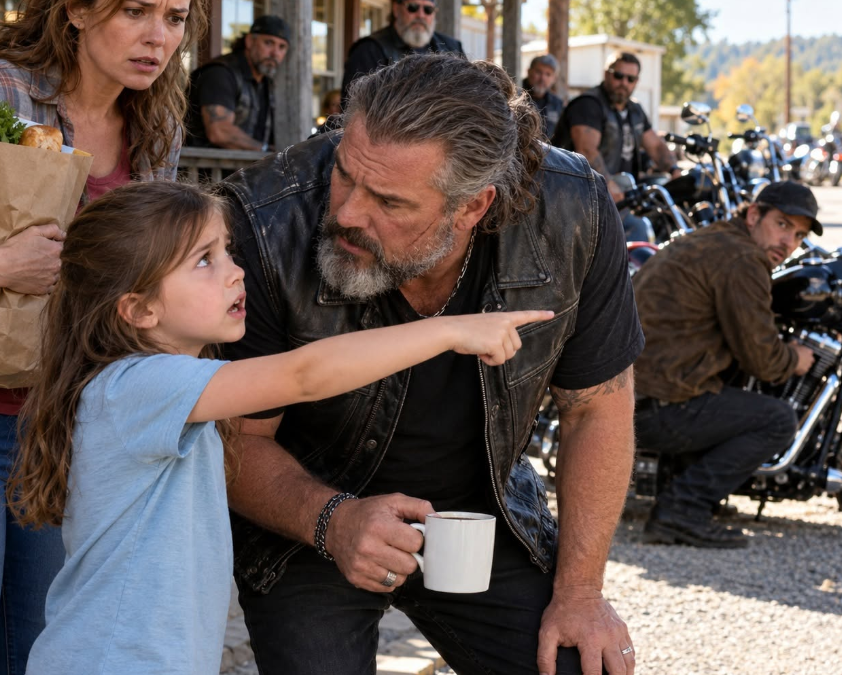
The men on the porch noticed her before I reached her. Conversations faded. Coffee cups paused halfway to mouths. A broad-shouldered man with a gray-streaked beard and a scar along his jaw turned his head as my daughter stepped right up to him.
I hurried after her, my grocery bag banging against my hip, already preparing an apology.
Ruby looked up at him. “Excuse me, sir.”
The biker stared at her for half a second. He had tired blue eyes, the kind that didn’t soften quickly. His beard was trimmed close, and his hands were big enough to make the coffee cup look like a toy.
“Yes, ma’am?” he said.
His voice surprised me. Low. Careful. Not sweet, exactly, but gentle enough that Ruby didn’t flinch.
“There’s a man touching the gas part of your motorcycle,” she said. “His hands are shaking, and I don’t think he’s supposed to.”
The man did not laugh.
PART3:
He did not call her cute or dramatic or tell her to run along.
He set his coffee down so slowly that the paper cup didn’t make a sound.
His eyes moved from Ruby to the east side of the lot. His whole face changed. Not into anger, not yet. Into focus.
“Cal,” he said.
An older man near the door looked over.
“East row,” the scarred man said.
The porch moved all at once, but not the way I expected. No one cursed. No one lunged. No one reached under a vest or shoved past Ruby. Several men stood with controlled speed, as if they had practiced responding to danger without making it bigger.
The man in the brown jacket looked up.
For one frozen second, everyone saw everyone.
Then he tried to stand.
“Step away from the motorcycle,” the scarred rider called.
The stranger raised both hands, but he didn’t move back. His fingers trembled in the sunlight.
“I was just checking something.”
“Step away,” the older man said.
That was Cal Morgan. I didn’t know it then, but nearly everyone in Hawthorne knew his name. Some said he had once commanded soldiers. Some said he had buried more friends than most men made in a lifetime. Some said if Cal Morgan told you to move, you moved because there was no drama in him, no performance, only decision.
The stranger stepped back.
I reached Ruby and pulled her against my side. “I’m sorry,” I whispered toward the scarred man. “She shouldn’t have—”
He looked at me, then at Ruby.
“She did right.”
Those three words stunned me into silence.
The older rider held up one hand to the others. “Nobody touch the bike. Nobody touch him. Somebody call Angela.”
A younger rider took out his phone and started taking pictures from different angles. Another stepped away and dialed. Two men positioned themselves near the edges of the lot, not trapping the stranger, exactly, but making it very clear he wouldn’t disappear before law enforcement arrived.
Law enforcement.
That word loosened something in me.
I had expected fists. I had expected shouting. I had expected the kind of chaos I told myself men like this created.
Instead, I watched thirty angry bikers preserve evidence.
The scarred rider came down the porch steps and stopped several feet from the stranger. His posture was rigid, his hands open at his sides.
“What’s your name?” he asked.
The stranger swallowed. “Martin.”
“Martin what?”
“Cole.”
A murmur moved through the porch.
The scarred man’s eyes narrowed. “From Cole’s Auto?”
Martin’s face flushed. “Used to be.”
“Used to be,” someone muttered bitterly.
Cal cut him a look, and the muttering stopped.
“What were you doing to Jonah’s bike?” Cal asked.
Jonah. That was the scarred one.
Martin stared at the gravel. “Nothing.”
Ruby leaned closer against me. I felt her small body shaking, but her eyes stayed fixed on the motorcycle.
Jonah glanced down at her. “Can you and your mama stand over by the porch, sweetheart?”
Ruby looked at me for permission.
I nodded, because my knees were suddenly weak and the porch railing seemed like the only thing in the world built to hold me up.
June appeared in the diner doorway with a dish towel in one hand. She was sixty-three, built like a woman who had carried entire restaurants through breakfast rushes by force of will, and she had known my mother before my mother got sick and forgot most names but mine.
“What in God’s name is happening out here?” June asked.
“Call came in,” one rider said. “Deputy’s on her way.”
June saw Ruby pressed against me and her expression changed. “Erin?”
“We’re okay,” I said, though I wasn’t sure that was true.
Ruby whispered, “He was touching the gas part.”
June’s eyes went to the black motorcycle.
Then to Martin Cole.
Her mouth tightened.
Martin must have felt every eye on him, because his excuses began spilling out before anyone questioned him properly.
“I didn’t do anything that would hurt anybody. I just loosened it. That’s all. I just wanted him to notice. I wanted them to know how it feels when somebody messes with your business.”
Jonah went very still.
Even Cal seemed to stop breathing.
“You loosened what?” Cal asked.
Martin’s jaw worked. “Fuel line. Just enough. It would sputter. Maybe leak a little. He’d pull over.”
Jonah’s voice dropped so low I could barely hear it. “You don’t get to decide how frightened somebody becomes when fuel hits a hot engine.”
Martin looked up then, and something ugly flashed through the fear in his eyes.
“You people put me out of business.”
“Nobody put you out of business,” one of the riders snapped. “You charged widows double and welded brake brackets like a drunk raccoon.”
“Enough,” Cal said.
Martin’s face twisted. “Everybody went to your garage because you undercut me.”
Jonah took one step forward, then stopped himself. I saw the effort it cost him. Saw it in the muscle jumping in his jaw, in the way his fingers curled and opened.
“You were going to let me ride that bike,” he said.
Martin didn’t answer.
“You knew I was leaving after breakfast.”
Martin looked toward the road.
Jonah’s voice hardened. “You knew my niece rides with me sometimes.”
That was when Martin’s gaze flicked to Ruby.
Not because she was his target.
Because for the first time, I think he understood what kind of person had noticed him.
A child.
A little girl with a grocery bag and pancake plans had seen the shape of his revenge more clearly than he had.
Martin sat down on the porch step like his legs had been cut out from under him. He put his face in his hands and started breathing through his fingers.
Deputy Angela Brooks arrived seven minutes later.
I knew Angela from town, though not well. She had gone to school with my husband’s older cousin. She was calm in the way women in uniform learn to be calm when men are waiting for them to prove they can’t be. Her patrol car rolled in without sirens, lights flashing blue across the diner windows.
She stepped out and took in the scene fast: bikers spread out, Martin on the step, me holding Ruby, Jonah standing near the motorcycle, Cal waiting with both hands visible.
“Cal,” she said.
“Deputy.”
“Anybody bleeding?”
“No.”
“Anybody touch anything?”
“No.”
Her eyes moved to me. “Erin?”
I hated that my voice shook. “Ruby saw him messing with the motorcycle.”
Angela crouched slightly so she was closer to Ruby’s height. “You saw something?”
Ruby nodded.
“Can you tell me what happened?”
I wanted to answer for her. I wanted to pull her behind me, shield her from every adult question in the world. But Ruby had stepped into the truth before I did. So I swallowed my fear and let her speak.
“He was by that motorcycle,” Ruby said. “His hand was under this part.” She pointed toward the tank. “He kept looking at the men, and his hands were shaking. I told that man.” She pointed at Jonah. “Because my mom said we didn’t know what he was doing, but I thought maybe somebody who knew motorcycles would know.”
Angela’s face softened for a moment.
Then she stood and became deputy again.
“Mr. Cole,” she said, “stand up for me.”
Martin looked like he wanted to run, but thirty motorcycles and one deputy made running seem foolish. He stood. Angela turned him gently but firmly, patted him down, and put him in handcuffs.
“I admitted it,” Martin said, voice cracking. “I said what I did.”
“Then you can admit it at the station too.”
His eyes found Jonah. “I wasn’t trying to kill you.”
Jonah stared at him. “That’s the problem with using machines to make a point. They don’t care what you meant.”
Angela placed Martin in the back of her patrol car, then called for a tow rig to take Jonah’s motorcycle to be inspected. She interviewed Ruby separately, with me right beside her. She interviewed me. She interviewed Jonah, Cal, June, and three other riders. She collected the photos taken before anyone moved closer.
Through it all, the Black Compass Riders did not behave the way I had been taught to expect.
They stood back.
They gave statements.
They corrected one another when someone guessed instead of saying what they actually saw.
When one younger rider cursed Martin under his breath, Cal said, “We do this clean.”
Clean.
That word stayed with me.
Inside the diner afterward, Ruby ordered hot chocolate with extra whipped cream because June said heroes ought to be spoiled once in a while. I sat across from her in a red vinyl booth while my hands shook so badly I had to wrap them around my coffee mug to hide it.
Ruby stirred her drink and looked out the window.
Jonah stood beside his motorcycle after the tow driver loaded it. He wasn’t talking to anybody. He had one hand resting on the strap securing the bike, like a person standing beside a hospital bed.
“He looks sad,” Ruby said.
“He almost got hurt,” I said.
“No,” she said. “Different sad.”
I followed her gaze.
I saw a large man in a leather vest with a scar on his jaw and grease under his fingernails. Ruby saw something else. She had always been better at that than me.
She slid out of the booth.
“Ruby,” I warned.
She pointed to the counter. “Can I ask Miss June for another hot chocolate?”
“For you?”
“For him.”
I looked at Jonah again. Every old instinct in me rose up. Keep away. Don’t invite attachment. Don’t teach your child to walk toward strange men with wounds you don’t understand.
But another voice rose too.
She did right.
I stood. “I’ll walk with you.”
June poured the second hot chocolate into a paper cup with a lid. She didn’t tease us. She just set it down and touched my hand once, like she knew something inside me was shifting and didn’t want to scare it away.
Ruby carried the cup outside with both hands.
Jonah noticed us coming and straightened, as if preparing for bad news.
Ruby held up the cup. “This is for you.”
Jonah blinked. “For me?”
“You looked cold.”
It was already warm outside, but he accepted the cup with grave seriousness.
“Thank you, ma’am.”
Ruby studied his face with the fearless curiosity of a child who hadn’t yet learned which questions adults hide behind manners.
“Does that still hurt?” she asked, pointing to the scar along his jaw.
“Ruby,” I said softly.
Jonah touched the scar. “Not anymore.”
“How did you get it?”
He looked at me, asking permission without words.
I gave the smallest nod.
“Road accident,” he said. “Long time ago.”
“Were you scared?”
Jonah glanced toward the tow truck pulling away with his motorcycle. “Yes.”
Ruby nodded like that answer made sense. “My dad was in the Army. He didn’t come home.”
The porch went quiet around us.
Jonah’s expression changed so quickly it made my chest ache. Not pity. Not the awkward panic some people got when Ruby mentioned Daniel. Recognition, maybe. Respect.
“I’m sorry,” he said.
“Me too,” Ruby answered.
Jonah looked at me then. “Army?”
“Staff Sergeant Daniel Bennett,” I said. “Killed outside Kandahar. Four years ago.”
Cal, who had been standing near the porch post, removed his sunglasses. The men around him lowered their eyes.
Jonah swallowed. “I’m sorry,” he said again, this time to me.
I had heard those words hundreds of times. From officers in dress uniforms. From neighbors holding casseroles. From bank clerks who saw the survivor benefits paperwork. From strangers who didn’t know what else to say.
But Jonah said them like he knew they were too small and offered them anyway because silence would be worse.
Ruby reached into the pocket of her denim jacket and pulled out a penny she had found that morning. “My dad used to say finding pennies meant someone in heaven was saying hello.”
Jonah looked down at the penny in her palm. His hand moved to his vest.
Pinned near the compass patch was a small silver charm, no bigger than a quarter, shaped like a compass rose. Its edges were worn smooth from years of touch.
He unclipped it.
“May I?” he asked me.
I hesitated.
“It’s all right,” Cal said quietly. “Road captain’s pin. Means something.”
“That’s why I’m asking,” Jonah said.
I nodded.
Jonah crouched in front of Ruby, making himself smaller, which somehow made him seem stronger.
“This is for helping us find the right way this morning,” he told her. “A compass is for when the road gets confusing. It doesn’t make the road safe. It just tells you where true is.”
Ruby accepted it with both hands.
“I don’t ride motorcycles,” she said.
Jonah almost smiled. “You don’t have to. Works anywhere.”
By lunchtime, I thought the danger was over.
It seems foolish now, looking back. Danger doesn’t always leave when the patrol car does. Sometimes it only changes clothes.
I took Ruby home to our small yellow house on Cottonwood Lane, the one Daniel and I had bought with a VA loan and stubborn optimism. It had a porch that sagged on one side, a kitchen window over the sink, and a maple tree in the front yard that turned red every October like it was trying to set the whole street on fire.
Ruby put the compass pin on her dresser beside a framed photo of Daniel in uniform holding her as a baby. Then she took it back down and carried it in her pocket instead.
“I don’t want it to be lonely,” she said.
I didn’t argue.
The afternoon passed in strange little pieces. I tried to work on pharmacy inventory reports at the kitchen table, but the numbers blurred. Ruby drew a picture of motorcycles with tiny flags and a man with a silver pin. I called my mother’s assisted living facility and listened to the nurse tell me Mom had eaten half her lunch and asked where my father was, even though Dad had been gone nine years.
Normal things.
Ordinary things.
That is how fear gets into a house. It waits for ordinary things so it can ruin them.
Around five, Ruby came into the kitchen carrying her library book.
“Mom,” she said. “That blue car keeps moving.”
I looked up from my laptop. “What blue car?”
“The one outside.”
I rose slowly.
Through the kitchen window, across the street and two houses down, sat a blue sedan I didn’t recognize. It was parked beneath the maple tree in front of Mrs. Delaney’s vacant rental. There was a man inside. He had one arm lifted.
At first, I thought he was smoking.
Then the late sun hit his windshield, and I saw his phone.
Pointed toward our house.
Pointed toward the kitchen window.
Pointed toward Ruby.
My body moved before my thoughts did. I grabbed Ruby by the shoulder and pulled her down so fast she dropped her book.
“Ow!”
“I’m sorry. Come here.”
“Did I do something?”
“No, baby. No. Come with me.”
I pulled her into the hallway, away from every window, and sat on the floor with my back against the wall. My heart was beating so hard I could hear it in my ears.
Ruby stared at me, frightened now because I was frightened.
“Mom?”
I forced my voice steady. “I need you to sit right here. Don’t go near the windows.”
“Is it because of the man?”
I didn’t answer.
I called Deputy Angela Brooks first.
She picked up on the second ring. “Brooks.”
“It’s Erin Bennett. From the diner.”
Her voice sharpened. “What’s wrong?”
“There’s a blue car outside my house. A man is taking pictures. I think he was filming Ruby through the kitchen window.”
“Where are you in the house?”
“Hallway. Away from windows.”
“Good. Stay there. Lock the doors. Don’t confront him. I’m on my way.”
After I hung up, I stared at the card Cal Morgan had given me before we left the diner.
Black Compass Garage. Cal Morgan. Jonah Reed. Two numbers written in black ink.
I had almost thrown it away.
I called the second number because Jonah had been the one who crouched to Ruby’s height, and fear doesn’t always choose logically. Sometimes it chooses the voice it thinks won’t waste time.
He answered on the first ring.
“This is Jonah.”
“It’s Erin. From the diner. There’s a man outside my house taking pictures. Deputy Brooks is coming. I’m trying not to scare Ruby.”
A pause.
Then Jonah said, “You don’t have to sound calm for me.”
That broke something.
My throat closed, and all the shaking I had been holding back rushed into my hands, my breath, my knees.
“I don’t know what’s happening,” I whispered.
“Tell me the car.”
“Blue sedan. Older. Maybe a Toyota. Parked near the vacant rental across the street.”
“Can you see the plate?”
“No. I’m in the hallway.”
“Stay there. Angela’s coming?”
“Yes.”
“Good. We’re close.”
My fear twisted. “Jonah, don’t come here and start something.”
“We’re coming to stand where people can see us. That’s all.”
“Why would someone be watching us?”
His silence lasted one second too long.
“Jonah.”
“Cal needs to explain that. But right now, stay away from the windows. Keep Ruby low. If the car leaves, don’t follow it. If somebody comes to the door, don’t open it unless it’s Angela.”
I looked at Ruby. She sat with her knees pulled to her chest, clutching the compass pin in one fist.
“Are they mad because I told?” she asked.
I covered the phone. “No, baby.”
But the lie tasted thin.
Motorcycles reached our street before the patrol car.
I heard them before I saw them. A low, rolling thunder that made dogs bark three houses away. Ruby stiffened. I leaned toward the living-room window, careful to stay back from the glass.
Jonah and Cal stopped near the curb in front of my house. Four other riders parked behind them. Not thirty. Not a mob. Just enough to be noticed.
The blue sedan’s driver lowered his phone.
He had been pretending, I realized. Pretending to text. Pretending to look at directions. Pretending our house was not the center of his attention.
The motorcycles stripped the pretend right off him.
Jonah did not approach the car. Cal didn’t either. They stood beside their bikes with their helmets in their hands, leaving the sedan a clear path to drive away.
It didn’t.
Deputy Brooks pulled in behind it two minutes later.
The man in the sedan opened his door before she reached him, both hands visible, face pale and irritated in the way of people who are scared but still think they deserve to be treated as important.
I watched from the hallway while Angela spoke with him. Jonah looked once toward my house. He did not wave. He did not smile. He just gave the smallest nod, as if to say: I see you. Stay put.
Ruby crawled beside me. “Is that the deputy?”
“Yes.”
“Are the bikers helping?”
I looked at the men I had told her to avoid standing between my house and the stranger who had filmed my child.
“Yes,” I said. “They are.”
The man from the car was named Eric Mason.
Angela told me that later, standing on my porch with Jonah beside her and Cal at the foot of the steps. Eric was a private investigator, though his license had lapsed the year before. He claimed he had been hired to observe “activity patterns” related to a property matter.
“What property matter?” I asked.
Angela’s mouth tightened. “That’s what I’m finding out.”
“Was he taking pictures of Ruby?”
“He had photos of the house. Some included the window. I made him delete nothing because that’s evidence now.”
My stomach turned.
Jonah looked like he wanted to say something, but he waited.
Angela noticed. “Tell her.”
Cal sighed.
That sound scared me more than the car had. It was the sound of a man who knew a story was about to become uglier.
“The garage and clubhouse sit on three acres off Mill Road,” Cal said. “Everett Shaw wants that land.”
I knew the name.
Everyone in Hawthorne knew Everett Shaw. He was the developer behind the new shopping plaza near the bypass, the one with brick facades that looked expensive until you touched them. He sponsored the high school scoreboard. He donated to the fall festival. His wife chaired charity luncheons. His picture showed up in the county paper twice a month, always smiling beside ribbon cuttings and oversized checks.
“What does that have to do with Ruby?” I asked.
“He’s been trying to get our permit challenged,” Cal said. “Noise complaints. Safety complaints. Claims we attract violent incidents. Claims our garage is a nuisance to redevelopment.”
Jonah’s voice was quieter. “Martin Cole may have been part of that.”
I looked at him. “Martin?”
“Deputy Brooks is investigating,” Cal said carefully. “But before he got taken to the station, Martin said someone paid him to cause a scene.”
“To damage your bike?”
“To create an incident,” Jonah said. “Best case for Shaw, I crash and the county calls the garage unsafe. Worst case, we catch Martin and beat him senseless in our own parking lot while witnesses film it.”
I thought of the porch. Thirty angry men. The restraint. Cal telling them to keep distance. Nobody touch anything.
“You knew,” I said.
Cal’s eyes held mine. “We suspected someone might try to provoke us. We didn’t know how.”
“And you didn’t warn anybody?”
The words came out sharper than I intended, but I didn’t apologize.
A man had been filming my child through our kitchen window. Sharp was all I had.
Cal accepted it. “That’s on me.”
Jonah looked at him. “On us.”
Angela stepped in. “Right now, the concern is that Ruby and Erin are witnesses. Ruby saw Martin before anyone else did. Erin can testify to how the club responded.”
“Testify?” I repeated.
“Maybe. Maybe not. But if Shaw is connected, he may want you scared enough to stay quiet.”
I gripped the porch railing. The paint flaked beneath my fingers.
“I’m a pharmacy tech,” I said, as if that mattered. “My daughter is seven.”
“I know,” Angela said.
“No, I don’t think you do. Her father is dead. My mother doesn’t remember what year it is. I have a mortgage that eats half my paycheck and a child who still asks if heaven has visiting hours. I cannot be part of some land war between bikers and a millionaire.”
Ruby stood just inside the screen door. I hadn’t realized she was close enough to hear until she spoke.
“Mom, I told because it was wrong.”
Everyone went quiet.
Her face was pale, but her chin was lifted.
I turned toward her. “Baby—”
“If I don’t say it now, then I only said it when it was easy.”
I closed my eyes.
Daniel.
I heard him so clearly for one impossible second that I had to hold the railing harder. He used to say courage wasn’t loud. Courage was doing the next right thing while your knees tried to talk you out of it.
Our daughter had inherited the part of him I loved most and feared most.
Angela’s voice softened. “Erin, do you have family you can stay with for a few days?”
“My sister Claire is in Lexington.”
“That would be a good idea while I sort out what Eric knows and what Shaw’s people are doing.”
I looked at Jonah. “Is this going to follow us?”
His honesty hurt before he even spoke.
“I don’t know.”
Cal removed a folded paper from his vest pocket. “Here are numbers for me, Jonah, Angela, and our attorney. You don’t owe us anything. But you’re not alone in it.”
That was the first time I understood something about fear.
Fear had convinced me that keeping people away was the same as keeping Ruby safe. But there are storms you cannot survive by locking the door. Sometimes safety is not distance. Sometimes safety is knowing who will stand on the porch when the storm arrives.
We packed in twenty minutes.
Ruby put three shirts, two stuffed animals, Daniel’s photo, and the compass pin into her backpack. She cried only once, when she realized her library book was still on the hallway floor where she had dropped it.
“I need it,” she said, voice breaking. “It’s due Friday.”
“We’ll get it later.”
“What if something happens to it?”
I almost laughed. Then I nearly cried.
Because I understood. When fear is too big, the heart searches for something small enough to hold. A library book. A dropped pencil. A pancake gone cold.
I picked up the book and slid it into her backpack.
“There,” I said. “Safe.”
Angela followed us until we reached the highway. Two riders trailed at a distance with my permission, peeling off only once we got to Claire’s exit in Lexington.
My sister opened the door before I knocked.
Claire was older than me by six years and had inherited all the family bluntness. She wore reading glasses on top of her head and held a wooden spoon like she was prepared to fight someone with it.
Ruby ran into her arms.
Claire looked over my shoulder at the two motorcycles idling near the curb.
“Are those bikers guarding you?”
I rubbed my forehead. “Apparently.”
“Is this a normal widow thing I missed in the handbook?”
I laughed then. Not because it was funny, but because if I didn’t laugh, I was going to fold in half on her porch.
Jonah waited until he saw us inside before he rode away.
That night, after Ruby finally fell asleep in Claire’s guest room, I sat at the kitchen table with a mug of tea I hadn’t touched. Claire listened as I told her everything from the diner to the blue car.
When I finished, she leaned back and stared at me.
“You told Ruby to stay away from the bikers.”
“Yes.”
“And she ignored you.”
“Yes.”
“And now the bikers may be the reason you weren’t alone when some man was filming your house.”
I closed my eyes. “Yes, Claire.”
She reached across the table and squeezed my hand. “I’m not judging you.”
“You sound like you are.”
“I’m judging the whole town. You just happened to be participating.”
That stung because it was true.
Hawthorne was good at stories. We told them about everyone. June was tough but kind. Angela Brooks was too serious but fair. Everett Shaw was rich but generous. The Black Compass Riders were dangerous but useful when somebody needed a flat fixed after hours or a veteran’s ramp built for free.
We liked people simple.
Simple people are easier to praise, easier to fear, easier to ignore.
Jonah called at nine-thirty.
Claire gave me privacy by loudly pretending to load the dishwasher.
“Ruby asleep?” Jonah asked.
“Finally.”
“How is she?”
“Mad about missing school tomorrow. Worried about her library book. Asking questions I don’t know how to answer.”
“That sounds like a kid handling fear better than most adults.”
I sat on the edge of the guest bed. “I told her to stay away from you.”
He was quiet.
“A lot of people do.”
“I thought I was protecting her.”
“You were trying to.”
His kindness made the confession harder.
“I’d heard things,” I said. “About the club.”
“I’m sure.”
“Some of them were probably unfair.”
“Some probably weren’t.”
That surprised me.
He exhaled. “We’re not saints, Erin. Men don’t join a club like ours because life has always gone smoothly. Some of us came home from war wrong. Some came home from prison trying to stay out. Some got sober. Some still fight with it. Some have tempers that cost them marriages. We’ve made mistakes.”
“Then why defend the reputation?”
“Because mistakes aren’t the same as being what Shaw says we are.”
I looked at Ruby asleep under a quilt, one hand tucked beneath her cheek.
“No,” I said. “I guess they’re not.”
The investigation unfolded in fragments.
Angela called me every few days, never promising what she couldn’t prove. Martin Cole had admitted to damaging Jonah’s fuel connection. At first, he insisted no one had paid him. Then, after a night in holding and a conversation with a public defender, his anger began turning toward the man who had used it.
Everett Shaw had found Martin at the exact moment men like Martin are easiest to find: broke, bitter, ashamed, and desperate to believe someone else had stolen the life he ruined himself.
Shaw had not walked into Martin’s shop with a villain’s smile and a bag of cash. He had approached him through another man, then another. A “consulting payment.” A promise that after the Black Compass garage lost its permit, Shaw would help Martin reopen in a new commercial space. A little money up front. More later. Nothing written plainly enough for a fool to understand, but enough for a desperate man to convince himself he was being hired, not handled.
Eric Mason, the man in the blue sedan, gave Angela copies of his instructions after she threatened charges related to stalking and harassment. He claimed Shaw’s assistant hired him to document “witness contact” and “patterns of influence.” That meant us. It meant Ruby. It meant a seven-year-old child had been turned into a line item in a rich man’s damage-control plan.
That knowledge changed something in me.
Fear was still there. It sat in the room with me every night. It followed me to work. It made me check my rearview mirror until my eyes hurt.
But under the fear, anger began to build.
Not the hot, reckless kind. A colder anger. Cleaner. The kind that wakes up early, organizes receipts, answers calls from investigators, and refuses to be embarrassed out of telling the truth.
Ruby and I stayed with Claire for six days.
During that time, Hawthorne did what small towns do when fed half a story. It chewed.
By Wednesday, someone had posted online that the Black Compass Riders had used a child to interfere with a private citizen. By Thursday, another person claimed the club had surrounded my home and threatened a man legally parked on a public street. By Friday, a blurry photo of Jonah outside my house had been shared with the caption: BIKER GANG INTIMIDATES WIDOW AND CHILD.
I saw it during my lunch break at the pharmacy.
My hands went cold.
There I was, reduced to somebody else’s prop. Widow and child. Intimidated. Threatened. Used.
None of the people commenting had asked me what happened. That didn’t slow them down.
Everett Shaw’s wife, Vanessa, commented beneath the post with a little praying hands emoji and wrote, This is why families deserve safe neighborhoods.
I stared at the words until they blurred.
Safe neighborhoods.
My daughter had been photographed through a kitchen window because she told the truth. But Vanessa Shaw, from behind a polished profile picture and a charity gala smile, had turned us into evidence against the only people who had actually shown up.
I walked to the stockroom and called Angela.
“Can I say something publicly?”
Angela was silent for a moment. “You can. I’d prefer you let me review it first so you don’t accidentally compromise the case.”
“I’m tired of people using my kid.”
“I know.”
“No,” I said, surprising myself with the steel in my voice. “They don’t get to do this. They don’t get to scare us and then claim they’re protecting us.”
Angela sighed. “Send me what you write.”
I drafted it in my car after work while rain tapped on the windshield.
I did not mention evidence Angela hadn’t released. I did not name Eric Mason. I did not accuse Shaw directly.
I wrote the truth I had seen.
My daughter noticed a man tampering with a motorcycle at June’s Diner. The Black Compass Riders did not threaten him, assault him, or hide what happened. They stepped back, preserved evidence, and called Deputy Brooks. Later, when someone watched my house, club members arrived before law enforcement but did not confront the man. They stood in public and waited. I was afraid of them before that day. I am not afraid to tell the truth now.
Angela approved it with two minor edits.
I posted it at 6:12 p.m.
By 6:30, my phone was buzzing so hard Claire put it in a mixing bowl and covered it with a towel.
June shared the post first. Then three teachers. Then a retired firefighter. Then a woman named Melissa Bishop, who taught second grade at Ruby’s school.
Melissa wrote, Some of these men repaired our playground fence last winter when the district delayed it. They refused payment. People should ask who benefits from making them look dangerous.
That comment mattered more than I understood at the time.
Because Melissa Bishop’s father was Paul Bishop.
And Paul Bishop was Everett Shaw’s attorney.
Paul Bishop had spent two years filing polished letters about nuisance violations, zoning concerns, traffic hazards, and safety risks related to the Black Compass property. He had attended county meetings with Shaw. He had repeated claims that seemed official because they came printed on letterhead. He had never stood in June’s parking lot and watched Cal Morgan keep thirty angry men calm while waiting for a deputy.
But his daughter had.
Not that morning. Earlier. In the ordinary ways people learn the truth about others.
Melissa knew the Black Compass Riders as the men who fixed the playground fence after three children got splinters from a broken rail. She knew Jonah as the man who helped jump-start her car in sleet and refused to let her stand outside while he worked. She knew Cal as the man who delivered donated coats every December and pretended not to notice when teachers cried.
Paul Bishop knew them as a client’s problem.
That difference began working on him.
I didn’t know any of this until later, after Paul had withdrawn from representing Shaw and turned over records through his own attorney. At the time, all I knew was that my post made Hawthorne split down the middle.
Some people apologized.
Some doubled down.
Some said the bikers must have staged the whole thing to look innocent.
Some said I had been manipulated because I was a vulnerable widow.
That one made me angrier than all the rest.
Vulnerable widow.
People loved that phrase. It made them feel compassionate while taking away my spine.
I had buried a husband at thirty-one. I had sat across from military officers while Ruby played with blocks in the next room. I had learned how to fix a leaking sink because the plumber charged more than I had. I had held my mother’s hand while she forgot my father’s death again and again and grieved him fresh every time.
I was vulnerable, yes.
I was also still standing.
Two days after my post, Everett Shaw requested a meeting with me.
The request came through my store manager at the pharmacy, which told me everything I needed to know.
I was restocking allergy medicine when Mr. Hanley called me into his office. He had the strained smile of a man about to do something cowardly while calling it practical.
“Erin, do you have a minute?”
I stepped inside. “Sure.”
He closed the door.
Everett Shaw sat in the guest chair wearing a navy suit and a face arranged into concern.
I stopped just inside the doorway.
“Mrs. Bennett,” he said, standing. “Thank you for speaking with me.”
“I didn’t agree to speak with you.”
Mr. Hanley cleared his throat. “Mr. Shaw is an important client of the pharmacy, and he wanted to address—”
“This has nothing to do with my job.”
Shaw lifted both hands. “You’re absolutely right. I apologize for the surprise. I only came because I’m worried this situation has gotten away from everyone.”
His voice was warm and practiced. The kind of voice people used at fundraisers and hospital board meetings. It carried money without mentioning it.
I looked at Mr. Hanley. “Am I required to be here?”
He shifted. “No, but—”
“Then I’m going back to work.”
Shaw’s smile thinned. “Please. Two minutes.”
I should have walked out.
But part of me wanted to see him up close. Wanted to understand the man who could aim fear at my child and then sit under fluorescent lights pretending to be reasonable.
“Two minutes,” I said.
Mr. Hanley moved toward the door.
“No,” I said. “You stay. Since you brought him into my workplace, you can witness what he says.”
A flicker crossed Shaw’s face.
Good.
He sat slowly. “Mrs. Bennett, I understand your daughter witnessed an unfortunate incident.”
“She witnessed a man you may have paid tampering with a motorcycle.”
His eyes sharpened. “That’s a very serious accusation.”
“Yes.”
“And very difficult to prove.”
“Then why are you here?”
Mr. Hanley looked like he wanted the floor to open.
Shaw leaned forward, elbows on his knees. “Because I believe you are being pulled into something dangerous by people who do not have your best interests at heart.”
“My daughter was filmed through my kitchen window.”
“I heard someone conducted surveillance. I don’t condone that.”
“Someone you hired?”
“I hire many contractors. I cannot personally supervise every overzealous decision.”
I stared at him.
There it was. The shape of him. Not a monster in the obvious way. Something worse. A man who built distance between his wishes and their consequences, then called that distance innocence.
He reached into his jacket and removed an envelope.
Mr. Hanley made a small choking sound.
Shaw placed it on the desk.
“I know legal matters can be stressful,” he said. “Especially for a single mother. I would hate for you to lose hours at work or pay for childcare because people are pressuring you to involve yourself in business disputes.”
I looked at the envelope.
“What is that?”
“A gesture of support.”
“How much?”
His smile returned, softer now. “Enough to help you step back.”
I felt strangely calm.
“Mr. Hanley,” I said, “are you seeing this?”
My manager had gone pale. “Mr. Shaw, I don’t think—”
I took out my phone