I Thought My Tiny Orange Kitten Would Die Before the Clinic Door Closed—Then a Scarred Old Cat Lay Beside Him, and One Photograph Made Me Question Everything I Thought I Knew.
PART3:
A young veterinary technician named Naomi saw my face through the glass and unlocked the door before I even knocked.
“What happened?”
“He won’t eat. He’s vomiting. He’s cold. He can’t stand.”
She took one look inside my sweatshirt.
“Come with me.”
Everything after that happened quickly.
A stainless-steel table.
Warm towels.
A thermometer.
Glucose.
Stethoscope.
Questions.
How old?
Vaccinated?
Any possible toxins?
Plants?
Human medications?
String?
Foreign objects?
Diet change?
The veterinarian came in still buttoning her white coat.
Dr. Elena Park.
Early forties.
Dark hair twisted into a bun.
No makeup except what looked like yesterday’s eyeliner.
She put her hands on Sunny with the calm urgency of someone who knew panic wasted time.
“He’s very dehydrated.”
“What does that mean?”
“It means we need to stabilize him.”
“Is he dying?”
She looked at me.
Really looked.
“I don’t know yet.”
That’s the answer medical people give when they’re being honest and you desperately want them to lie.
Sunny lay on the towel without lifting his head.
They started fluids.
Checked his blood sugar.
Ran tests.
His temperature was low.
His glucose was dangerously low.
He had severe gastrointestinal infection, probably worsened by parasites and dehydration.
Dr. Park explained things.
I heard maybe half.
My whole world had narrowed to Sunny’s chest.
Up.
Down.
Up.
Down.
Then something moved near the open treatment-room door.
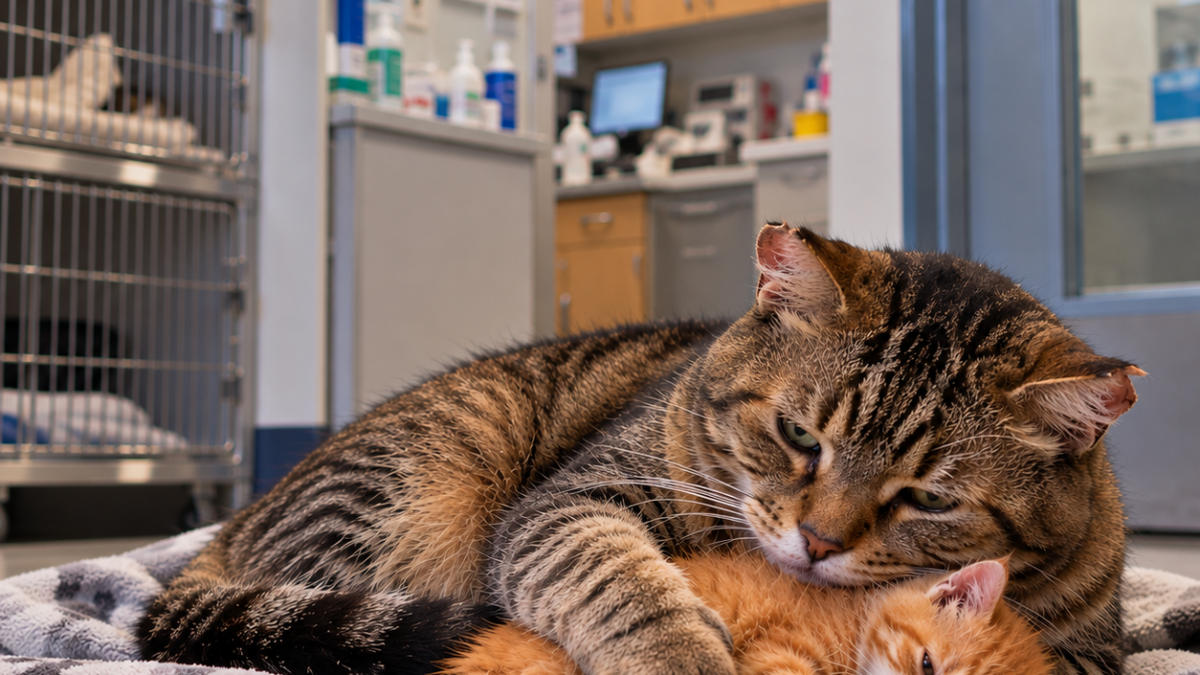
A cat.
A big one.
Brown tabby.
Broad face.
One ear folded at the tip.
Another marked by old scars.
Thick paws.
Gray beginning around the muzzle.
He walked with the slow confidence of an animal who believed every room belonged to him until proven otherwise.
“Moose,” Naomi said quietly.
The cat ignored her.
He looked at Sunny.
Stopped.
Then walked into the room.
“Is he allowed in here?” I asked.
Dr. Park glanced over.
“Usually he decides that.”
Under any other circumstances, I might have laughed.
Moose approached the table.
He wasn’t curious in the usual cat way.
No frantic sniffing.
No tail twitching.
He just looked.
Sunny didn’t move.
Moose rose onto his hind legs and put his front paws against the edge of the lower padded bench beneath the table.
Naomi lifted him.
“What are you doing, old man?”
Moose stepped directly onto the blanket beside Sunny.
He turned once.
Then lay down.
His whole body pressed against my kitten’s side.
Sunny looked tiny beside him.
Moose was probably fourteen pounds.
Sunny barely three.
The big tabby stretched one front leg across Sunny’s back.
Not forcefully.
Just enough to touch.
Then he rested his chin near Sunny’s head.
Nobody spoke.
I stood there with my hands against my mouth.
There was something unbearable about it.
Not because it looked cute.
It didn’t.
Sunny looked terribly sick.
Moose’s face was scarred.
The room smelled like disinfectant.
A machine beeped beside us.
Nothing about it belonged on a greeting card.
But Moose stayed.
Warm body against cold body.
Steady breath beside weak breath.
Like he had decided that whatever happened next, the little orange kitten would not face it alone.
Sunny moved.
Barely.
His nose turned toward Moose’s chest.
Then his paw shifted until it rested against the old cat’s leg.
I started crying.
Not loudly.
I didn’t even realize it at first.
Dr. Park handed me a tissue.
“He does this,” she said.
“What?”
“With certain patients.”
I wiped my face.
“How does he know?”
She smiled sadly.
“I stopped pretending I know what animals know a long time ago.”
Moose remained beside Sunny while we waited for test results.
Whenever someone needed access to Sunny, Naomi moved Moose gently.
He waited two feet away.
Then returned.
At one point Sunny began trembling.
Moose immediately lifted his head.
He licked Sunny once between the ears.
Then settled again.
It was so simple.
So completely without performance.
No speech.
No promise.
No demand for gratitude.
Just I’m here.
For a woman who had spent years learning how not to need anybody, it nearly destroyed me.
About forty minutes later, Naomi took Sunny to the treatment area for additional care.
I followed until they asked me to wait.
That was when I noticed a framed photograph on the wall.
Moose.
Only much younger.
Painfully younger.
He couldn’t have been more than five weeks old.
Skinny.
Half bald.
One eye swollen shut.
Wrapped in a faded green towel.
Beneath the picture, someone had handwritten:
MOOSE — FOUND FEBRUARY 2012, HYPOTHERMIC, SEVERE INFECTION, 1.1 LBS.
HE NEVER REALLY LEFT.
I read it twice.
Then a third time.
Dr. Park appeared beside me.
“That was him?”
She nodded.
“Hard to believe, isn’t it?”
“What happened?”
“Someone found him behind a grocery store during an ice storm. His mother and littermates were gone.”
“Did you treat him?”
“My mother did.”
I looked at her.
Dr. Park smiled.
“She founded this clinic.”
There was something in her face when she said it.
Love.
And grief.
“She brought Moose home every night for almost a month because she didn’t trust anyone else to manage his feeding schedule.”
“Did she keep him?”
“She tried.”
Dr. Park laughed quietly.
“He refused to live at her house.”
“What?”
“As soon as he was strong enough, he started screaming at the door every morning until she drove him back here.”
I looked at Moose sitting outside the treatment-room doorway.
“He chose the clinic?”
“Apparently.”
“Why?”
She shrugged.
“Maybe because this was where he first felt safe.”
Moose looked toward the room where Sunny had disappeared.
Dr. Park followed my gaze.
“My mother used to say he remembered what it felt like to be the sickest thing in the room.”
Something in my chest tightened.
I thought about all the times people had told me animals didn’t understand much.
That we projected.
Imagined.
Anthropomorphized.
Maybe we did sometimes.
But Moose didn’t need to understand disease.
He only needed to recognize fear.
And somehow he did.
Two hours later, Dr. Park returned with better news.
Sunny’s temperature was rising.
His blood glucose had stabilized.
The medication and fluids were helping.
He was still seriously ill.
Still needed observation.
Still not safe.
But he had responded.
“He’s fighting,” she said.
I laughed and cried at the same time.
“Of course he is.”
She smiled.
“He seems opinionated.”
“You have no idea.”
They kept him most of the day.
I sat in the waiting room because leaving felt impossible.
Moose wandered through occasionally.
Once he jumped onto the chair beside me.
Not my lap.
Just beside me.
I rested my hand near his paw.
He didn’t move away.
“Thank you,” I whispered.
He closed his eyes.
That was the beginning.
Sunny survived.
Not because Moose lay beside him.
I want to be clear about that.
Sunny survived because Dr. Park diagnosed him quickly.
Because Naomi warmed him.
Because fluids restored what his small body had lost.
Because medication treated infection.
Because veterinary medicine worked.
Because he had enough strength left to respond.
But medicine isn’t the whole experience of being afraid.
Moose couldn’t fix Sunny’s body.
He did something else.
He made the room feel less lonely.
And that mattered to me more than I knew how to explain.
The first week home was awful.
Sunny improved, but slowly.
He needed medication.
Special food.
Monitoring.
Every time he slept too deeply, I touched his side.
Every time he skipped two bites, my stomach dropped.
I kept a notebook.
8:05 — medication.
8:17 — three bites chicken.
9:40 — water.
10:12 — litter box.
11:35 — sleeping.
12:03 — still sleeping.
12:06 — Hannah needs therapy.
That last one made me laugh when I read it the next day.
Sunny didn’t care.
He slept inside the hood of my sweatshirt like a spoiled emperor.
Three days after leaving the clinic, he ate voluntarily.
Four bites.
Maybe five.
I sat on the kitchen floor and cried over a plate of wet cat food.
“You have no idea what you’re doing to me.”
Sunny looked up with food on his nose.
I wiped it away.
Then he bit my thumb.
Gently.
That was when I knew the real Sunny was still in there.
At our one-week follow-up, I carried him into Maple Street expecting to feel terrified.
Instead, something surprising happened.
I saw Moose.
And relaxed.
The old tabby came around the corner.
Sunny saw him through the carrier door and made a sound I’d never heard before.
A tiny chirp.
Moose walked over.
Sat beside the carrier.
Sunny pushed his nose against the metal grate.
Moose touched noses with him.
Two seconds.
Maybe less.
Naomi happened to be walking past.
“He remembers.”
I looked up.
“Do cats remember like that?”
She smiled.
“I’ve worked here eight years. I’ve stopped telling people what cats can’t do.”
Sunny’s examination went well.
Still underweight.
Still recovering.
But improving.
Dr. Park actually used the word “better.”
I carried that word home like fragile glass.
Over the next month, Sunny slowly became himself again.
He attacked socks.
Climbed curtains.
Knocked over my water twice.
At three in the morning one Thursday, he sprinted down the hallway sideways with his tail puffed for reasons known only to him and whatever invisible demons kittens fight after midnight.
I lay in bed laughing.
Really laughing.
Not at a television show.
Not politely at something a coworker said.
The kind of laugh that makes your chest hurt.
And I realized the apartment didn’t feel empty anymore.
Sunny had filled it with chaos.
But the clinic had done something too.
I started dropping by with supplies.
At first it was just two old blankets.
Then paper towels.
Then canned food.
One Saturday Naomi asked if I could help fold laundry because they were short-staffed.
I stayed three hours.
The following week I cleaned carriers.
Then I started coming once every Saturday.
Nobody called me a volunteer formally.
I just kept appearing until someone gave me a name tag.
Hannah — Volunteer.
Sunny became stronger.
I became useful.
Both things changed me.
And Moose?
Moose continued being Moose.
He belonged to no one person.
He slept in Dr. Park’s office when he felt like it.
Demanded food from Naomi.
Stole the receptionist’s chair.
Ignored people who called him cute.
But he had one habit that everyone knew.
He found the scared ones.
Not every sick animal.
Not the loud ones.
Not the dogs barking themselves hoarse.
The quiet ones.
The ones turned toward the back of carriers.
The ones too frightened to protest.
The ones whose owners sat in waiting-room chairs crying silently.
Moose appeared beside them.
Sometimes he simply sat nearby.
Sometimes he lay beside a kennel.
Sometimes he touched the carrier with one paw.
It became so common the staff barely commented.
I watched him sit beside a twelve-year-old black cat surrendered after his owner moved into assisted living.
The poor animal didn’t make a sound.
His daughter signed the paperwork and cried into both hands.
“He was Dad’s,” she kept saying. “I tried. I really tried.”
Moose sat beside the carrier until closing.
Another day, he stayed next to a pit bull recovering from emergency surgery.
He couldn’t enter the kennel, obviously.
So he slept outside it.
The dog stopped whining.
People began talking about him.
First locally.
Then much more widely.
The thing that changed everything was a photograph.
Six weeks after Sunny’s illness, I brought him to Maple Street for a final weight check.
He had gained almost two pounds.
His fur was bright.
His eyes were clear.
His tail stood straight up like an exclamation point.
After the appointment, I found Moose sleeping beside the recovery-room door.
Sunny sat next to him.
For once, Sunny was still.
The contrast caught me.
Moose looked like old wood.
Scarred.
Heavy.
Weathered.
Sunny looked like sunlight.
Young.
Bright.
Impossible to contain.
Their bodies weren’t touching.
They didn’t need to.
Something about the space between them said everything.
I took one photograph.
That night I posted it on my private social media account.
I wrote about the morning Sunny almost died.
About Moose lying beside him.
About discovering Moose had once nearly died in the same clinic.
About how watching one animal offer comfort to another had shaken something loose inside me.
I ended with one sentence.
Maybe being saved doesn’t always mean the story is over; sometimes it means one day you learn how to stay beside someone else.
I expected twenty likes.
Maybe thirty.
The next morning there were four thousand shares.
By lunch, seventeen thousand.
By evening, reporters were calling Maple Street.
The photograph traveled farther than anything in my life ever had.
People told stories.
A dog who refused to leave a hospital bed.
A cat who waited at the window after its owner died.
An old horse who stood beside a frightened rescue foal.
People wrote about grief.
Cancer.
Divorce.
Depression.
Loneliness.
Parents aging.
Children leaving home.
Men who had never met Moose admitted they were crying at work.
Women sent pictures of senior pets they’d adopted because nobody else wanted them.
And for a few days, it felt beautiful.
Then Dean Calder arrived.
Dean was Dr. Park’s older half-brother.
Their mother, Dr. Ruth Calder, had founded Maple Street thirty-two years earlier.
Dean was not a veterinarian.
He had an MBA.
That distinction mattered.
After Ruth died, the clinic ownership had been divided through a family trust.
Dr. Park managed medicine.
Dean handled business operations.
I’d seen him before.
Polished shoes.
Silver watch.
Tailored jackets.
A smile that appeared exactly when someone important entered the room.
He had always seemed mildly irritated by the clinic itself.
Too much fur.
Too many smells.
Too many people crying without appointments.
But the morning after Moose and Sunny went viral, Dean walked into the lobby looking delighted.
“Hannah!”
I nearly looked behind me.
We had never had a conversation longer than hello.
He shook my hand enthusiastically.
“That post is incredible.”
“Thanks.”
“Do you have the original photo?”
“On my phone.”
“High resolution?”
“I guess.”
His smile widened.
“This could be huge.”
I should have heard the warning in that sentence.
Instead, I thought he meant huge for the animals.
Donations.
Adoptions.
Supplies.
Maybe discounted care.
I was still naive enough to assume everyone standing inside a rescue-oriented clinic meant the same thing when they said help.
Within forty-eight hours, Dean had created a campaign.
MOOSE’S MERCY.
There were graphics.
Hashtags.
A professional photographer.
A donation page.
Someone printed shirts.
Moose’s face appeared beneath the words:
NO ONE SHOULD FACE FEAR ALONE.
At first, even Dr. Park seemed cautiously pleased.
The clinic needed money.
Everyone knew that.
They treated abandoned animals at reduced cost whenever possible.
They carried unpaid balances.
Equipment was aging.
The roof leaked near storage every heavy rain.
If Moose’s story could raise money, maybe something good could come from attention.
The donation page promised support for emergency care, senior animals, abandoned pets, and families experiencing financial hardship.
People gave.
Five dollars.
Twenty.
A hundred.
One anonymous donor gave ten thousand.
Boxes arrived every day.
Blankets.
Food.
Toys.
Heating pads.
Handwritten notes.
One envelope contained twenty dollars and a piece of notebook paper that said:
FOR THE OLD ONES NOBODY FIGHTS OVER.
I cried at the reception desk.
Naomi pretended not to notice.
Then Dean began asking for more.
Could Moose spend afternoons in the lobby?
Could people schedule photographs?
Could we arrange a “Meet Moose” day?
Could Sunny appear?
I laughed the first time.
“You mean like a celebrity?”
Dean didn’t laugh.
“Exactly.”
Sunny wasn’t clinic property.
I said no.
He kept asking.
Then came sponsorships.
A pet food company wanted Moose beside its senior formula.
A local bank offered money for a billboard.
Dean commissioned a new website section.
He ordered three hundred shirts without asking Dr. Park.
And Moose started hiding.
That was what bothered me first.
He had always moved freely.
Now strangers arrived calling his name.
People crouched over him with phones.
Children chased him because their parents said, “Go hug the famous cat!”
Moose stopped sleeping in the lobby.
He retreated to recovery.
Then Dr. Park’s office.
Then a supply shelf in the back.
One afternoon I found Dean carrying him toward the front.
Moose’s body was stiff.
“Where are you taking him?”
Dean looked at me like the answer was obvious.
“The photographer is here.”
“He doesn’t want to go.”
“He’s a cat.”
“Yes.”
Dean waited.
I waited too.
“He’ll survive five minutes,” he said.
“He shouldn’t have to survive the people who say they love him.”
His smile vanished.
“This clinic pays its bills with money, Hannah. Not feelings.”
I took Moose from his arms.
Dean didn’t resist.
But his face changed.
Something had been written down inside him.
Not on paper.
Something colder.
A week later, I learned Moose was sick.
I’d noticed he moved slower.
Everyone had.
But one morning Naomi found him vomiting beside the recovery room.
Dr. Park ran bloodwork.
Early kidney disease.
Arthritis.
A thyroid problem that needed monitoring.
Nothing unexpected for an elderly cat.
Nothing immediately catastrophic.
But he needed medication.
Adjustments.
Rest.
Dean’s reaction was not concern.
It was annoyance.
“How much?”
Dr. Park stared at him.
“How much what?”
“Monthly.”
“His treatment?”
“Yes.”
She named the estimate.
Dean leaned against the counter.
“For a clinic cat?”
“He’s our responsibility.”
“He’s fourteen.”
“Approximately.”
“And you’re going to spend that every month indefinitely?”
Dr. Park’s expression hardened.
“He’s stable and comfortable.”
Dean laughed without humor.
“That’s not what I asked.”
I was standing in the hallway folding towels.
I shouldn’t have been listening.
But by then I had learned that the most important truths in places like clinics were often spoken when people forgot volunteers existed.
Dr. Park lowered her voice.
“Dean, he lived here before you started managing the books.”
“And?”
“And Mom considered him part of this clinic.”
“Mom also kept three broken autoclaves because she thought they had sentimental value.”
“He’s alive.”
“So were half the problems she left us.”
The silence afterward was terrible.
Dr. Park said, “Get out of my treatment room.”
Dean left.
He saw me in the hallway.
For one second, neither of us moved.
Then he smiled.
Not warmly.
“How much did you hear?”
“Enough.”
“Be careful with context.”
“I heard the context.”
He stepped closer.
“You’ve been spending a lot of time here for someone who isn’t employed.”
“I volunteer.”
“Exactly.”
The word was soft.
But I understood.
Stay in your place.
I had heard versions of it my whole life.
At work.
In relationships.
From people who equated salary with authority and authority with worth.
I looked him in the eye.
“Moose isn’t a marketing tool.”
Dean’s smile hardened.
“And you aren’t a veterinarian or administrator.”
“No.”
“So maybe let the people responsible for keeping this building open decide how resources are used.”
He walked away.
That night I couldn’t sleep.
Sunny curled against my ribs.
My phone lit up with another comment under the viral post.
Not every weak thing needs saving.
I stared at it.
Then deleted the app.
Three days later, Dean announced a fundraising gala.
MOOSE’S MERCY COMMUNITY NIGHT.
He rented the banquet room at a downtown hotel.
Tickets started at one hundred dollars.
VIP tickets cost five hundred and included what the brochure called “an intimate photo opportunity with Moose.”
When Dr. Park saw that line, she went white.
“No.”
Dean barely looked up from his laptop.
“No what?”
“You will not take him to a hotel ballroom.”
“He’s the reason people are coming.”
“He’s an elderly cat with kidney disease.”
“He’ll be there forty minutes.”
“No.”
Dean closed the laptop.
“We need this event.”
“We need money. We don’t need to drag a stressed animal into a ballroom.”
“You’re being emotional.”
“I’m his veterinarian.”
“And I’m responsible for finances.”
I watched from the front desk.
The argument grew.
Dean reminded her the clinic had debt.
Dr. Park reminded him donations from Moose’s campaign were supposed to support care.
Dean said the fundraising numbers weren’t as strong as they looked after campaign expenses.
That stopped everyone.
Naomi looked up from the computer.
“What campaign expenses?”
Dean’s head snapped toward her.
“Marketing. Processing. Events. Materials.”
“How much?” Dr. Park asked.
“We can review financials later.”
“How much?”
Dean grabbed his laptop.
“This isn’t the time.”
Then he left.
The room stayed silent.
Naomi looked at Dr. Park.
Dr. Park looked sick.
That was the first crack.
The gala happened anyway.
Moose did not attend.
Dr. Park refused.
Dean retaliated by placing a life-size cardboard photograph of Moose beside the stage.
I almost laughed when I saw it.
Until I realized what the night really was.
Dean had turned compassion into branding.
The ballroom was covered in photographs of rescued animals.
Soft piano music.
Candles.
Videos.
Donor names projected onto a wall.
On every table sat a card explaining the mission of Moose’s Mercy.
SUPPORTING THE VULNERABLE WHEN THEY NEED US MOST.
I volunteered because Dr. Park asked me to.
Sunny stayed home.
Moose stayed at the clinic with Naomi.
For the first hour, things went smoothly.
People gave generously.
A retired teacher told me Moose’s story had inspired her to adopt a twelve-year-old cat.
A widower donated five hundred dollars in memory of his wife.
A teenage girl handed me an envelope containing eighty-three dollars she’d earned babysitting.
Then Dean stepped onto the stage.
He thanked everyone.
Told Moose’s story.
Told Sunny’s story.
Mostly correctly.
Then he began talking about the future.
Expansion.
Brand partnerships.
A media campaign.
A redesigned adoption center.
I looked at Dr. Park.
She looked confused.
Dean clicked to the next slide.
A rendering appeared.
Maple Street Pet Wellness Center.
Glass entrance.
Retail section.
Grooming suite.
Premium boarding.
Wellness subscriptions.
I felt my stomach tighten.
This was not what people had donated for.
Dean smiled at the audience.
“This is how compassion becomes sustainable.”
Someone applauded.
Then another slide appeared.
It showed projected costs.
Beside it, categories.
High-outcome care.
Low-outcome care.
I read the second category twice.
Low-outcome.
Senior animals.
Chronic illness.
Long-term rehabilitation.
Unowned emergency cases.
Dean continued.
“We all love inspiring stories. But responsible care means acknowledging that resources are finite.”
Dr. Park stood.
“Dean.”
He ignored her.
“We cannot save everything.”
That sentence was true.
That was what made what followed so ugly.
“We need to focus on cases with measurable long-term value.”
I felt the room change.
Dr. Park walked toward the stage.
“Stop.”
Dean smiled down at her.
“Elena, we’ll have questions afterward.”
“Those categories were never medically approved.”
Murmurs began.
Dean’s jaw tightened.
“This is a financial framework.”
“For medical cases.”
I don’t know why I stood.
Maybe because I’d been reading cruel comments for weeks.
Maybe because Moose was back at the clinic sleeping under a blanket while his face stood six feet tall beside a podium.
Maybe because Sunny had almost died and nobody in that room would have called his life a good investment that morning.
I raised my hand.
Dean saw me.
His expression hardened.
“Hannah, not now.”
“People donated to Moose’s Mercy for animals like the ones you’re calling low-outcome.”
The room went quiet.
Dean gave a small laugh.
“That’s not an accurate interpretation.”
“Then where did the money go?”
Dr. Park turned toward me.
So did half the room.
Dean’s eyes narrowed.
“You’re a volunteer.”
“I know.”
“Then perhaps you aren’t familiar with nonprofit operating expenses.”
“I’m an accounts receivable specialist.”
A few people laughed.
Dean didn’t.
“I know what restricted money means.”
His face changed.
Not much.
Enough.
Then he smiled.
“Hannah, your attachment to this story is understandable.”
I already hated where he was going.
“You were lonely. You found a sick kitten. You had an emotional experience at the clinic.”
My face went hot.
He continued.
“But we cannot run a medical facility based on one woman’s need to turn animals into substitutes for human relationships.”
The room disappeared.
For one second, all I could hear was my own heartbeat.
Someone near the back whispered, “Jesus.”
Dean kept going because cruel people often mistake silence for victory.
“There is a difference between compassion and projection.”
I looked toward Dr. Park.
She looked horrified.
My hands shook.
The old Hannah would have sat down.
She would have smiled like it didn’t hurt.
She would have gone home, turned on the television, and made herself smaller.
But Sunny had needed me.
Moose had taught me something.
Staying beside frightened things only matters if you’re willing to stay when the room becomes uncomfortable.
I stepped forward.
“You’re right about one thing.”
Dean waited.
“I was lonely.”
His mouth lifted.
I continued.
“I was lonely enough that a kitten changed my life.”
The smile faded.
“But that doesn’t make the kitten less real. It doesn’t make Moose’s pain less real. And it doesn’t make the donations imaginary.”
Applause started somewhere behind me.
Dean raised his voice.
“This isn’t about feelings.”
“No,” I said. “It’s about records.”
I hadn’t planned that line.
But once I said it, I saw Naomi near the ballroom entrance.
She had arrived late.
Her expression was strange.
She held a manila envelope.
Dean saw her too.
And for the first time that night, he looked afraid.
Naomi walked directly toward Dr. Park.
“I think you need this.”
Dean stepped off the stage.
“What is that?”
Naomi didn’t answer him.
She handed the envelope to Dr. Park.
“Elena, I found these when I was looking for Mom’s old clinic photos for the display.”
Dr. Park opened it.
Inside were photocopies.
Invoices.
Bank statements.
Old trust documents.
And a letter.
Her face changed as she read.
Dean reached for the papers.
She pulled them away.
“What did you do?”
“Elena—”
“What did you do?”
The ballroom went silent.
He lowered his voice.
“We are not doing this here.”
Dr. Park looked at the audience.
Then at the banner.
Moose’s face.
“No,” she said. “I think this is exactly where we’re doing it.”
That was the second crack.
The investigation that followed took months.
But the secret had begun years earlier.
After the gala, Dr. Park, Naomi, and I sat at the clinic until nearly three in the morning.
We read everything.
Some of it went back to Dr. Ruth Calder.
The founder.
Their mother.
Moose’s rescuer.
Or rather, the person who had saved him after he was brought in.
The oldest document was a handwritten letter attached to a trust amendment.
It had been created eleven years earlier.
Dr. Ruth had established a restricted charitable fund using part of the proceeds from selling land she’d inherited.
The purpose was painfully specific.
Emergency veterinary care for abandoned animals.
Medical support for elderly and chronically ill rescue animals.
Assistance for low-income owners facing urgent veterinary crises.
And one more category.
Comfort care for animals whose prognosis was poor but whose quality of life could still be protected.
At the bottom was a handwritten paragraph.
Dr. Park read it aloud.
“If this clinic ever begins deciding that comfort belongs only to animals with profitable futures, then it has stopped being the clinic I built.”
Nobody spoke.
She kept reading.
“Saving an animal is not always curing it. Sometimes saving means pain control. Sometimes warmth. Sometimes a meal. Sometimes giving an old dog one peaceful night. Sometimes making sure a frightened cat does not die alone.”
Dr. Park stopped.
Her hands trembled.
Naomi looked toward recovery.
Moose was asleep behind the glass door.
I felt tears burn my eyes.
Then Dr. Park read the final sentence.
“Do not confuse duration with value.”
Dean had known about the fund.
He had become trustee after Ruth’s death.
And over the previous three years, large portions of its annual distributions had been categorized as outreach and development costs.
Money intended for vulnerable animals had paid for advertising.
Consultants.
Brand development.
Photography.
The gala.
The shirts.
The huge cardboard Moose.
Worst of all, more than forty thousand dollars had gone to Calder Strategic Media.
A company registered to Dean’s wife.
I stared at the invoices.
“This can’t be real.”
Dr. Park looked sick.
Naomi whispered, “He used Moose’s fund to market Moose.”
Not exactly.
The fund hadn’t been named after Moose.
But Ruth’s letter made clear that animals like him were exactly why it existed.
The irony was so vicious I almost laughed.
Dean had called senior animals bad investments while using their money to build his business plan.
Dr. Park contacted an attorney the next morning.
Then the trust’s independent accountant.
Then the state veterinary charity regulator.
She did not accuse Dean publicly.
Not yet.
She preserved records.
Changed account access.
Suspended his administrative authority under the trust’s emergency provisions.
Dean threatened lawsuits.
He accused Naomi of stealing confidential documents.
He blamed me for manipulating staff.
He said Dr. Park was destroying the clinic over family resentment.
He sent three emails insisting the transfers were legitimate overhead.
Maybe he even believed some of what he said.
Greed rarely introduces itself as greed.
It calls itself efficiency.
Growth.
Strategy.
Sustainability.
It learns respectable words and wears them like a clean suit.
The accountants did not care about the suit.
They cared about numbers.
And numbers are stubborn.
Payments had been made.
Conflicts had not been disclosed properly.
Restricted purposes had been ignored.
Contracts involving Dean’s family had bypassed required review.
The investigation widened.
The planned corporate sale stopped.
So did the expansion.
Dean resigned before the board could formally remove him.
Then the trust removed him anyway.
He was ordered to repay funds through a settlement after independent review, and the clinic referred the relevant financial findings to state authorities.
His wife’s company lost every contract with Maple Street.
The gala video spread online.
Not the part Dean wanted.
Someone had recorded him humiliating me.
His words about lonely people replacing human relationships with animals became the clip everyone shared.
For two days, my face was everywhere.
I hated it.
Strangers called me brave.
Strangers called me pathetic.
Some said Dean was right.
Some said I was a crazy cat lady.
One man messaged me to say women like me were why civilization was collapsing.
I blocked him.
Then Sunny vomited on my rug, and civilization had to wait because I needed paper towels.
Life is useful that way.
It drags you back to scale.
But while the financial investigation unfolded, something more important was happening inside Maple Street.
Moose was getting older.
Fast.
He had spent years being the strongest calm thing in the room.
Now some mornings he needed help climbing onto Dr. Park’s chair.
His kidneys were stable but fragile.
Arthritis stiffened his hips.
He slept most afternoons.
The viral attention stopped.
Dr. Park banned unscheduled visitors seeking Moose.
No photography without permission.
No sponsored appearances.
No merchandise using animals without medical approval.
Nobody complained.
At least not twice.
One night in November, I stayed late cleaning donated carriers.
Rain hammered the windows.
Sunny was with me because my apartment building was spraying for insects, and Dr. Park had said he could spend the evening in an empty office.
Moose slept under a warming lamp in recovery.
Then the front door flew open.
A teenage boy stood there soaked through.
He couldn’t have been more than sixteen.
He carried something wrapped in a beach towel.
“Please.”
Naomi ran from the back.
“What happened?”
“I found her under our porch.”
He peeled back the towel.
An elderly tortoiseshell cat.
Tiny.
Wet.
Her whiskers white.
Her body dangerously cold.
“She won’t move.”
Dr. Park came immediately.
Everything shifted.
Warm towels.
Stethoscope.
Temperature.
Fluids.
Questions.
The boy stood in the doorway crying.
“I have seventy dollars.”
Dr. Park didn’t look up.
“We’ll talk later.”
“I can get more.”
“Honey, let us work.”
The old cat barely responded.
Her name became Maybell because the boy said his grandmother used to call every stubborn elderly woman Miss Maybell.
The name fit before the cat had even opened her eyes.
I looked toward Moose.
He was watching.
For years, this would have been his moment.
He would have stood.
Walked over.
Sat beside the frightened newcomer.
He tried.
His front legs shifted.
His body leaned forward.
Then stopped.
He lowered himself back onto the blanket.
Something broke inside me.
Not because he’d failed.
Because he hadn’t.
He was allowed to be tired.
Naomi stood beside me.
“He can’t be everybody’s brave thing forever.”
I nodded.
Then we heard a chirp.
Sunny.
He stood inside his carrier in the office doorway.
Eyes fixed on Maybell.
I moved closer.
“Sunny?”
He chirped again.
Same sound he’d once made for Moose.
Dr. Park glanced over.
Then at me.
I didn’t know what I expected.
Sunny was young.
Chaotic.
Ridiculous.
He had never shown Moose’s strange seriousness.
I opened the carrier.
He walked out.
Slowly.
No racing.
No sideways kitten run.
He approached the treatment table.
Stopped.
Smelled the air.
Then jumped onto the lower shelf.
Dr. Park watched but didn’t interfere.
Sunny climbed onto the edge of the towel near Maybell’s hind legs.
He turned once.
Then lay down.
His orange body pressed against her cold tortoiseshell side.
The entire room went silent.
Sunny stretched one paw across the edge of her blanket.
Maybell shivered.
Sunny stayed.
Across the room, Moose lifted his head.
He watched.
I looked from him to Sunny.
And there it was.
Not magic.
Not imitation exactly.
Something simpler.
Sunny had once been the weak one.
Someone had stayed beside him.
Now he knew what staying looked like.
Mercy taught mercy.
Comfort traveled.
The lesson moved without words.
I cried so hard Naomi handed me an entire box of tissues.
“Don’t make this weird,” she whispered.
“You’re crying too.”
“No, I’m not.”
“You absolutely are.”
“Shut up.”
Maybell survived the night.
Not because of Sunny.
Because of medicine.
Heat.
Fluids.
Dr. Park.
Naomi.
Hours of work.
And a small elderly body that still had some stubbornness left.
But Sunny stayed until they needed the space.
The teenage boy watched everything.
Before he left, he touched Sunny’s head.
“I didn’t know cats did that.”
Neither did I, once.
Maybell had kidney disease.
Bad teeth.
Severe arthritis.
No microchip.
Nobody claimed her.
She spent three weeks recovering at Maple Street.
By then, the internet had found her.
Someone posted Sunny lying beside her.
The photograph spread.
People recognized him.
“The kitten Moose saved.”
Except Moose hadn’t saved Sunny medically.
I corrected people every chance I got.
Still, the story mattered.
Sunny had once received comfort.
Now he had offered it.
A retired woman named Rose Donnelly came to meet Maybell after reading about her.
Rose was seventy-six.
Widowed.
Used a cane.
Wore red glasses.
She looked through Maybell’s medical chart and said, “She’s a mess.”
Naomi smiled carefully.
“Yes.”
Rose nodded.
“So am I.”
Three days later, Maybell went home with her.
The clinic covered her first medical follow-up through Ruth Calder’s restored compassion fund.
The same fund Dean had called unsustainable.
Rose paid what she could afterward.
She sent pictures.
Maybell sleeping in a basket.
Maybell screaming at the refrigerator.
Maybell glaring at Rose’s grandchildren.
Maybell under a Christmas tree wearing an expression suggesting she had survived many indignities but this might be the worst.
Every photograph felt like evidence.
Not that every old animal could be saved.
They couldn’t.
Not that money didn’t matter.
It did.
Not that hard decisions vanished when people were kind.
They didn’t.
The evidence was simpler.
Care didn’t become meaningless just because time was short.
In January, Maple Street’s board gathered staff and volunteers in the lobby.
No banquet hall.
No photographer.
No branded backdrop.
Just folding chairs and bad coffee.
Dr. Park stood beside Moose.
He sat on a heated pad near her feet.
His eyes half closed.
She announced that the clinic’s charitable program would be rebuilt under independent oversight.
Transparent accounting.
Medical decisions led by veterinary professionals.
Conflict-of-interest rules.
Published annual reports.
A fund specifically for emergency and senior-animal support.
She looked down at Moose.
Then smiled.
“My mother never gave this program an official name.”
She glanced at me.
“I think we should.”
Someone behind me whispered, “Moose’s Mercy?”
Dr. Park shook her head.
“No.”
She pulled a photocopy of Ruth’s handwritten letter from the podium.
“My mother wrote that saving does not always mean curing.”
Her voice softened.
“Sometimes it means making sure a frightened animal does not die alone.”
She looked around the room.
“So we’re calling it the Stay Fund.”
I started crying immediately.
Naomi elbowed me.
“You have a problem.”
“I know.”
The Stay Fund became bigger than any of us expected.
Not huge.
We weren’t opening hospitals across America.
We remained a neighborhood clinic with peeling paint in one hallway and a printer that only worked when threatened.
But local people trusted it.
Because they could see where money went.
A man donated fifty dollars every month in memory of his old Labrador.
A school organized a towel drive.
A retired nurse volunteered to transport elderly clients and their pets to appointments.
A mechanic offered free oil changes to staff twice a year.
Rose Donnelly gave ten dollars whenever she came in with Maybell and acted insulted if anyone suggested she keep it.
“I’m not dead yet,” she said. “Take the money.”
People helped differently when they felt included instead of marketed to.
I did too.
I reduced my hours at the plumbing company.
Eventually Maple Street hired me part time to help with billing and charitable-fund administration.
My accounting experience suddenly mattered in a place where I cared about the numbers.
For the first time in years, I didn’t spend Sunday evening dreading Monday.
Sunny came with me occasionally.
Never as a mascot.
Never on command.
If the clinic was calm and Dr. Park approved it, he visited.
He loved Moose.
That never changed.
He would find the old cat.
Chirp.
Sit nearby.
Sometimes Moose greeted him.
Sometimes he was too tired.
Sunny seemed to understand both.
Spring came.
Moose slowed.
There were good days.
He sat in the lobby sun.
Judged dogs.
Stole chicken from Naomi.
Once slapped a veterinary student who tried to trim his nail without introducing herself properly.
There were bad days too.
Nausea.
Weakness.
Poor appetite.
Dr. Park adjusted his treatment.
Monitored him.
Kept him comfortable.
Nobody talked about cost as if it were a verdict.
We talked about quality.
Pain.
Interest.
Mobility.
Appetite.
The things that actually mattered.
One afternoon, I found Dr. Park sitting on the recovery-room floor beside him.
She was crying.
I’d never seen that before.
I sat down.
For a minute, neither of us spoke.
Then she said, “My mother died in this building.”
I looked at her.
“What?”
“Not literally.”
She wiped her face.
“Cancer. She kept working until three weeks before the end.”
Moose slept between us.
“She used to nap in the office. He’d sleep on her chest.”
I pictured Ruth Calder from the old photographs.
Gray hair.
White coat.
Moose as a younger cat.
“When she went home on hospice, he looked for her every morning.”
Dr. Park stroked his back.
“For months.”
My throat tightened.
“So he lost her too.”
“Yes.”
“He stayed.”
“Yes.”
We sat quietly.
Dr. Park laughed through tears.
“That’s what he does.”
A month later, Moose stopped eating breakfast.
Naomi called me at work.
I knew before she finished the sentence.
I drove to Maple Street.
Sunny was already with me because he’d had a scheduled vaccine appointment that afternoon.
Moose lay on his blanket near the recovery-room window.
Smaller.
Tired.
His breathing steady but shallow.
Dr. Park had examined him.
His kidneys were failing.
The disease had progressed.
Treatment might buy a little time.
But not good time.
Not the kind Ruth’s letter would have called saving.
Dr. Park sat beside him.
Her hand rested near his paw.
“I think we’re close.”
The room felt impossible.
Moose had always been there.
Even when I wasn’t.
He had been part of Maple Street before Sunny was born.
Before I knew Naomi.
Before Dr. Park took over from her mother.
Before Dean ever understood there was money to be made from compassion.
He was the fixed point.
The scarred old thing who walked toward fear.
“What do you need?” I asked.
Dr. Park looked at him.
“Time.”
So we gave it.
The clinic closed early.
No announcement.
No social media.
No audience.
No viral goodbye.
The people who loved Moose came quietly.
Naomi sat beside him.
The receptionist brought the green towel from his kitten photograph.
Rose Donnelly came with Maybell in a carrier but left her in the car with her grandson because Moose had never liked crowds.
The teenage boy who found Maybell stopped outside after school and handed us a note.
I didn’t read it until later.
Sunny stayed with me.
For most of the afternoon, he sat about three feet from Moose.
No chirping.
No attempts to play.
Just there.
At four-thirty, Moose stood.
I don’t know where he found the strength.
He walked toward Sunny.
Slowly.
One paw.
Then another.
Sunny remained still.
Moose reached him.
Touched noses.
Then lay down.
Sunny curled beside him.
Not on top of him.
Not trying to hold him in place.
Just pressed against his side.
Exactly as Moose had done months earlier when Sunny was dying.
The circle was so complete it hurt to look at.
Naomi covered her face.
Dr. Park whispered, “Oh, Moose.”
Sunny laid one front leg across him.
Moose closed his eyes.
We waited.
When his breathing became more difficult later that evening, Dr. Park made the decision she had made for hundreds of families.
Only this time, her hands shook.
She gave him sedation first.
Moose relaxed.
Sunny stayed nearby.
I scratched behind Moose’s scarred ear.
Naomi told him he was a terrible coworker.
Dr. Park told him her mother was waiting.
Then she laughed at herself for saying something she couldn’t prove.
“Mom would hate me getting sentimental.”
Moose opened one eye.
For a second, he looked exactly like himself.
Annoyed.
Then he closed it.
Dr. Park whispered, “You don’t have to stay anymore.”
That sentence broke everyone.
Because staying had been his whole life.
Staying beside kittens.
Dogs.
Old cats.
Grieving people.
Staying after Ruth died.
Staying after the clinic changed.
Staying when strangers turned him into a symbol.
Staying until Sunny learned how.
Dr. Park administered the final medication.
Moose’s breathing slowed.
Sunny pressed closer.
Then the old cat became still.
No drama.
No struggle.
Just the quiet ending of a long life in the place he’d chosen.
For a while, nobody moved.
Then Sunny stood.
He sniffed Moose’s face.
Touched his forehead once with his nose.
And walked to the window.
I cried harder than I had when Sunny almost died.
Grief is strange that way.
Fear screams.
Grief often arrives quietly after the thing you’re afraid of has already happened.
We cremated Moose.
Dr. Park kept part of his ashes.
The rest went beneath a maple tree behind the clinic.
We placed a small stone there.
No photograph.
No QR code.
No sponsor.
No mention of virality.
Just:
MOOSE
HE STAYED.
The teenage boy who had found Maybell asked if he could add something.
He placed a smooth stone beside the marker.
On it, in black paint, he’d written:
SO OTHERS LEARNED TO.
That became the line everyone remembered.
Dean’s legal problems concluded later that summer.
The state investigation found enough financial mismanagement for civil penalties and a restitution agreement, though not every allegation resulted in charges.
I was glad the outcome stayed grounded in facts.
I didn’t need him destroyed.
I needed the money restored.
I needed him unable to use the clinic as his personal brand machine.
I needed the system changed so the next person couldn’t do what he did as easily.
Consequences aren’t revenge.
At their best, they protect the next vulnerable thing.
Dean sold his remaining interest under the trust agreement.
Maple Street reorganized.
Dr. Park became majority managing owner with a nonprofit charitable arm overseeing the Stay Fund independently.
She never put her face on a billboard.
She still forgot lunch twice a week.
Naomi became head technician.
I became operations coordinator for the charitable program.
Sunny grew.
Really grew.
Long legs.
Broad chest.
Orange tail like a feather duster.
He never became huge.
But he stopped looking fragile.
At home he was still ridiculous.
He stole socks.
Screamed at closed doors.
Once fell asleep with his head inside my shoe.
At the clinic, something changed.
Not every visit.
Not every animal.
He wasn’t Moose.
That mattered.
Nobody needed him to become Moose.
But sometimes a frightened patient arrived.
And Sunny noticed.
A kitten with pneumonia.
An elderly cat after an owner’s death.
A rabbit trembling after surgery.
Sunny would sit nearby.
Not always touch.
Not always approach.
Sometimes just stay close enough to be smelled.
Seen.
Known.
The first time I watched him do it after Moose died, I had to leave the room.
Not because I was sad.
Because I understood.
Legacy wasn’t a photograph.
It wasn’t a plaque.
It wasn’t a campaign.
Legacy was behavior repeated after the original teacher was gone.
A pattern.
A way of moving toward what everyone else was tempted to back away from.
One year after Sunny almost died, Maple Street held an open house.
We almost didn’t.
Everyone was nervous about public events after Dean.
But Dr. Park said hiding wasn’t the answer.
So we kept it small.
Coffee.
Cookies.
Adoption information.
Tours.
No staged animal encounters.
No VIP tickets.
No giant cardboard cats.
Near the front desk, we created a simple display.
Three photographs.
The first showed Moose as the sick five-week-old kitten Ruth Calder had saved.
The second showed him lying beside Sunny on the morning I thought I’d lose him.
The third showed Sunny beside Maybell.
Underneath were three sentences.
HE WAS HELD.
HE LEARNED TO HOLD.
HE TAUGHT ANOTHER.
People stopped there.
Some cried.
Most didn’t.
A little girl stood staring at Moose’s picture.
Maybe eight years old.
She had two braids and purple glasses.
She pointed at him.
“Is that the cat who stayed with sick animals?”
Her father nodded.
“That’s Moose.”
“Is he dead?”
Her father hesitated.
“Yes.”
She looked at the picture again.
Then at Sunny, who was sitting behind reception watching a fly.
“Is that his baby?”
I smiled.
“No.”
She frowned.
“But he taught him?”
“I think he did.”
She considered that with the seriousness children reserve for information adults would turn into philosophy.
Then she said, “So Moose is still doing his job.”
I couldn’t answer immediately.
Her father looked embarrassed.
“Sorry.”
“Don’t be.”
I crouched to her level.
“You know what? I think you’re right.”
She smiled.
Then ran toward the cookies.
I stayed beside the display.
So Moose was still doing his job.
Through Sunny.
Through Maybell.
Through the Stay Fund.
Through Rose.
Through Dr. Park.
Through Naomi.
Through me.
That realization followed me home.
My apartment was still the same size.
Same refrigerator.
Same secondhand couch.
Same window facing the parking lot.
But my life wasn’t the same.
I stopped sleeping with the television on.
I didn’t need sound to prove the world still existed.
I called my sister.
At first, it was awkward.
Then easier.
We finally talked about the stupid argument that had helped create years of distance.
Neither of us remembered enough to justify the silence.
We started having dinner twice a month.
I invited coworkers over.
Actual people.
Into my apartment.
Sunny behaved terribly.
Everyone loved him.
One evening, my sister looked around after dinner.
“You seem different.”
“How?”
“I don’t know.”
She watched Sunny attack a paper bag.
“More here.”
I knew exactly what she meant.
For years I’d made myself easy.
Low maintenance.
Independent.
I thought needing people made you vulnerable.
Maybe it does.
But never needing anyone had made me invisible.
Sunny taught me to show up for something.
Moose taught me staying could be strength.
The clinic taught me being useful didn’t require being impressive.
And Dean, in his own ugly way, taught me what happens when efficiency becomes more important than mercy.
I don’t hate him anymore.
That surprises me.
I hated him for a while.
Especially after the gala.
After he used my loneliness as a weapon.
After he put animals into categories like numbers on a spreadsheet.
After we saw the invoices.
But hatred kept him too important.
Moose’s story was never supposed to belong to the man who exploited it.
It belonged to the animals who stayed.
Years later, people still occasionally come into Maple Street asking about Moose.
They see the old social media post.
They hear some version of the story.
Sometimes the facts get exaggerated.
People say Moose “healed” Sunny.
He didn’t.
People say Sunny “saved” Maybell.
He didn’t.
Medicine mattered.
Veterinary knowledge mattered.
Money mattered.
Timing mattered.
But facts don’t make the tenderness smaller.
Maybe they make it bigger.
Moose didn’t need supernatural power.
He only needed to notice fear and choose not to walk away.
Sunny didn’t need to cure Maybell.
He only needed to lie beside her while the people who could help did their work.
That is enough.
More than enough.
The world has plenty of stories about heroes who win battles.
Moose never won a battle.
He lost his mother.
Nearly froze to death.
Survived infection.
Lost Ruth.
Grew old.
Developed kidney disease.
Died.
That doesn’t sound heroic if you think heroism requires defeating everything.
But maybe some battles aren’t meant to be defeated.
Maybe some are meant to be faced without becoming cruel.
Moose suffered and stayed gentle.
That was his victory.
Sunny learned from it.
So did I.
Three years after Moose died, a box appeared outside Maple Street before opening.
It was February.
Bitter cold.
Naomi found it first.
Inside was a gray kitten.
Six weeks old.
Barely responsive.
No note.
No food.
Just a little body wrapped in a dirty towel.
Dr. Park started treatment immediately.
The kitten was hypothermic.
Dehydrated.
Sick.
We didn’t know whether she would survive.
I was at the front desk when Sunny arrived with my sister, who had taken him for the morning because my apartment heater was being repaired.
The moment his carrier touched the floor, Sunny became still.
He smelled something.
Looked toward treatment.
Then chirped.
My sister glanced at me.
“What?”
I already knew.
I opened his carrier after Dr. Park said it was safe.
Sunny walked to the recovery-room door.
The gray kitten lay inside a warmed kennel.
He couldn’t enter.
So he sat outside.
One foot from the glass.
Nothing dramatic.
No paw reaching through.
No magical reaction.
He simply sat.
And waited.
Hours later, the kitten lifted her head.
Sunny was still there.
I stood in the hallway and cried.
Naomi came beside me.
“You’re doing the thing again.”
“What thing?”
“The crying.”
“I have allergies.”
“In February?”
“Very aggressive allergies.”
She smiled.
We watched Sunny.
“You ever wonder why he does it?” she asked.
“Yes.”
“What do you think?”
I looked at him.
I thought about the morning he lay dying beneath Moose’s leg.
About warmth.
Smell.
Heartbeats.
A body saying you’re not alone before the brain understands language.
“I think somewhere in him, being scared and being comforted are connected.”
Naomi nodded.
“Maybe.”
The gray kitten survived.
We named her Ruth.
Dr. Park pretended she wasn’t emotional about the name.
Nobody believed her.
Ruth was adopted by a young couple two months later.
Before she left, we took one photograph.
Ruth inside her carrier.
Sunny beside it.
No campaign.
No viral caption.
We printed one copy and placed it in the clinic scrapbook.
That’s where it stayed.
Not every beautiful thing needs an audience.
Sometimes meaning gets stronger when nobody monetizes it.
The Stay Fund still exists.
Every year, the clinic publishes exactly where the money goes.
Emergency surgeries.
Medication.
Senior-cat care.
Comfort treatment.
Low-income support.
Some animals recover completely.
Some don’t.
Some live years.
Some live days.
We don’t pretend outcomes are equal.
We don’t pretend resources are infinite.
We still make painful choices.
That’s reality.
But there is a difference between acknowledging limits and deciding vulnerability makes something worthless.
Dean never understood that difference.
Moose did.
A scarred old cat understood what an educated businessman couldn’t.
Need does not erase worth.
Dependence does not erase dignity.
Age does not erase value.
Fear does not have to be useful before it deserves comfort.
And the length of tomorrow does not determine whether today matters.
Sunny is six now.
His face has broadened.
His orange has darkened.
He sleeps more than he used to.
Not much.
He’s still Sunny.
He still runs down the hallway at midnight.
Still steals my socks.
Still yells at closed doors.
But sometimes I catch a gray hair near his mouth.
It scares me.
I hate admitting that.
Because once you’ve almost lost something, part of you keeps counting backward from goodbye.
Then I remember Moose.
I remember what Dr. Park said.
The present tense matters.
Sunny is here now.
So I scratch his head now.
I refill the bowl now.
I laugh at the sock now.
I let him steal my pillow now.
Love can’t always make something stay.
But it can refuse to waste the time when it does.
I visit Moose’s tree sometimes.
Usually after work.
The maple is tall now.
Its leaves turn orange every fall.
That wasn’t planned.
Just chance.
But I like it.
Sunny doesn’t come outside there.
Too many cars.
Instead I bring photographs.
Once, I brought the first picture.
Moose beside Sunny.
Old patience beside new light.
I sat beneath the tree and thought about everything that came after.
The viral post.
Dean.
The humiliation.
The stolen funds.
The investigation.
Maybell.
The Stay Fund.
Ruth.
My sister.
My job.
My life.
All because one frightened morning, an old cat saw something weak and walked toward it.
Not away.
Toward.
People often ask what lesson I took from Moose.
I used to give complicated answers.
Compassion.
Community.
Healing.
Worth.
Now I think the answer is simpler.
Stay.
Stay when someone is afraid.
Stay when the result isn’t guaranteed.
Stay when helping becomes repetitive.
Stay when there isn’t applause.
Stay when something old stops being cute.
Stay when medicine can’t promise a miracle.
Stay when somebody’s dignity matters more than your convenience.
Stay long enough to learn what the frightened thing actually needs.
Sometimes it will need treatment.
Sometimes space.
Sometimes money.
Sometimes a ride.
Sometimes a meal.
Sometimes professional help you cannot provide yourself.
And sometimes all you can offer is your presence while someone more qualified does the saving.
Presence is not nothing.
I know that because I remember Maple Street on that gray morning.
I remember Sunny’s limp body.
My shaking hands.
The fluorescent light.
The smell of disinfectant.
The terrible certainty that I was about to walk back into my empty apartment alone.
Then Moose came around the corner.
Scarred.
Old.
Unhurried.
He looked at the weakest thing in the room.
And without asking what it would cost him, how long it would take, whether Sunny would survive, whether anyone would photograph it, or whether the moment would make him important, he lay down.
That was all.
He stayed.
Sunny lived.
Years passed.
And one day Moose became too tired to keep making his rounds.
So Sunny made one.
Then another.
Then another.
That is how kindness survives.
Not because one extraordinary creature lives forever.
Because something they gave becomes behavior in somebody else.
Moose didn’t become immortal.
He became a pattern.
And patterns can travel farther than lives.
I once thought saving Sunny meant getting him through that clinic door alive.
Now I know the story was larger.
Sunny survived medicine.
I survived isolation.
Maple Street survived greed.
Dr. Park survived believing she had failed her mother’s legacy.
Naomi survived years of exhaustion without becoming hard.
Maybell survived the cold long enough to spend two bossy years terrorizing Rose Donnelly’s household before dying peacefully in her favorite laundry basket.
Rose survived losing her too.
Ruth survived the February box.
And Moose?
Moose survived long enough to teach us what survival was for.
Not achievement.
Not recognition.
Not usefulness.
Connection.
One creature becoming safe enough to offer safety.
One frightened thing learning from another that fear does not have to be faced alone.
I used to think the opposite of cruelty was kindness.
I’m not sure anymore.
I think the opposite of cruelty might be attention.
Cruelty looks away.
Cruelty reduces.
Cruelty calculates without seeing.
Attention says, I see that you’re scared.
I see that you’re old.
I see that you’re difficult.
I see that helping you may not produce the ending I want.
I’m not going to pretend you don’t matter.
That was Moose.
Not saintly.
Not magical.
He scratched people.
Stole food.
Hated one specific delivery driver for reasons never discovered.
Bit Naomi once because she moved him during a nap.
He was a cat.
A complicated, stubborn, scarred old cat.
Maybe that makes what he did more meaningful.
He didn’t stay beside frightened animals because he was an angel.
He stayed because somehow, through whatever combination of instinct, memory, scent, experience, and personality makes one living creature different from another, he chose closeness when fear entered the room.
Sunny learned that choice.
So did I.
And whenever someone asks me whether all the money, effort, tears, medicine, and heartbreak were worth it for animals whose lives might still be short, I think of Dean standing beneath that giant image of Moose talking about measurable long-term value.
Then I think of the little girl at the open house.
“Is Moose still doing his job?”
Yes.
He is.
He is doing it every time Sunny sits near a frightened kennel.
Every time the Stay Fund pays for one night of pain medication for an elderly cat.
Every time Dr. Park tells an owner the truth gently.
Every time Naomi folds a warm towel around something shaking.
Every time I answer the phone and hear a person say, “I don’t have much money, but my animal needs help,” and instead of deciding what they’re worth, we ask what can be done.
Every time somebody gives twenty dollars for the old ones nobody fights over.
Every time someone chooses not to walk away simply because the outcome is uncertain.
That’s long-term value.
Longer than Dean ever understood.
Longer than any campaign.
Longer than a cat’s life.
I went to Moose’s tree last fall.
The leaves were almost impossibly orange.
One fell beside my shoe.
I picked it up.
Carried it home.
Sunny attacked it immediately.
Of course he did.
He knocked it under the couch and spent twenty minutes trying to retrieve it.
I laughed until I cried.
Then he climbed onto my chest.
Six years old.
Warm.
Heavy now.
Nothing like the fading kitten I’d carried into Maple Street.
He settled beneath my chin exactly the way he did when he was tiny.
I put one hand on his back.
His breathing rose beneath my palm.
Steady.
Alive.
Outside, traffic moved through the wet street.
Someone downstairs shut a door.
A television played in another apartment.
Ordinary sounds.
The sounds of people staying.
Sunny began to purr.
I closed my eyes.
And for one second I could almost feel another body there.
Large.
Scarred.
Patient.
An old cat beside a frightened kitten.
No applause.
No promise.
No guarantee.
Just warmth shared in the worst moment.
That was how the story began.
Not with a miracle.
With presence.
And after everything that came later—the cruelty, the money, the lies, the public humiliation, the investigation, the justice, the loss—that remained the part I trusted most.
The world did not become kinder because Moose went viral.
It became kinder in the small places where somebody copied what he did.
One animal.
One person.
One room.
Then another.
Then another.
Until the warmth traveled farther than anyone had planned.
Maybe some lives are saved for a reason.
I still believe that.
But I no longer think the reason has to be grand.
Sometimes a life is saved so it can become shelter.
Sometimes someone receives tenderness at their weakest moment so they recognize weakness later and move toward it instead of away.
Sometimes the creature you think you’re rescuing is teaching you how to remain human.
And sometimes the greatest thing you can become after surviving the dark is simply the one who stays when someone else is afraid.