I Spent My Last Night Rebuilding a Wrecked Motorcycle for a Terrified Kid Who Couldn’t Pay—The Next Afternoon Twenty Bikers Surrounded My Garage, and Their President Told Me Who That Broken Machine Had Really Belonged To
PART2:
I had a twelve-cup Mr. Coffee with a melted handle.
Apparently that was not competitive.
Linda used to tell me I needed to modernize.
“Get a website.”
“I have a sign.”
“A website, Frank.”
“Highway’s right there.”
“That is not the internet.”
“It gets traffic.”
She would stare at me.
Then I would lose the argument.
Usually.
Linda died four years before that summer.
Ovarian cancer.
People like neat sentences.
“She died of cancer.”
That sentence skips twelve months.
It skips the first doctor dismissing the pain.
It skips driving to Phoenix.
It skips insurance calls.
It skips the metal taste chemotherapy left in her mouth.
It skips her apologizing because she could no longer keep the shop books.
Imagine that.
A dying woman apologizing for failing to organize receipts while I stood there perfectly healthy and completely useless.
We never had children.
Tried.
Didn’t happen.
Linda once said maybe the motorcycles were enough children.
I told her children did not leak oil onto clean floors.
She said I had clearly never met children.
PART3:
After she died, the house became unbearable.
So I sold it.
Paid medical debt.
Moved into the tiny apartment behind the garage office.
That decision made sense at the time.
It also meant the shop became everything.
Workplace.
Home.
Memory.
Punishment.
When business got bad, I could not leave it at work.
I slept twenty feet from it.
By July, I was six months behind on the commercial note.
The bank had already extended me twice.
I could not blame them forever.
That was another thing I hated.
It is easier to fight injustice than mathematics.
The final deadline was Monday.
Six days.
If I could not bring the loan current, Desert Valley Community Bank would take possession.
Building.
Land.
Equipment used as collateral.
Everything.
A liquidation company had already called.
That is how I knew it was real.
“Mr. Sullivan, we’re only conducting preliminary inventory.”
Preliminary inventory.
A polite way of asking how much your life might bring at auction.
Tuesday evening I was washing grease from my hands when an old Ford F-150 backed into my dirt lot.
Blue once.
Now mostly primer and sun damage.
The tailgate rattled.
I glanced at the clock.
7:14.
We closed at six.
“We’re closed!”
The driver’s door opened.
A kid climbed out.
Maybe twenty-one.
Twenty-two.
Thin.
Dark hair.
Left cheek scraped raw.
One elbow bleeding through his shirt.
His jeans were torn at the knee.
He limped toward the rear of the truck.
“Please.”
I should have ignored him.
Instead I dried my hands.
“What happened to you?”
“You have to help me.”
“That sentence usually costs extra after six.”
He dropped the tailgate.
I stopped talking.
A motorcycle lay on its side in the truck bed.
Or what remained of one.
Black custom cruiser.
Long frame.
Big V-twin.
Hand-fabricated exhaust.
Old-school controls.
Beautiful machine beneath the destruction.
The front forks had folded backward.
Handlebars twisted.
Clutch lever snapped clean.
Left foot control bent.
Primary housing cracked.
Tank crushed along the right side.
Oil covered the truck bed.
Road rash scarred the pipes.
I climbed onto the bumper.
Looked closer.
“That thing needs a priest.”
The kid did not laugh.
“I need it running tomorrow.”
I turned.
“You need reality.”
“I can pay.”
That nearly made me laugh.
Then he reached into his pocket.
Pulled out a wad of crumpled cash.
Tens.
Twenties.
A few fives.
“One hundred eighty dollars.”
“Son, that won’t buy the fork seals.”
His mouth tightened.
He looked away.
That was when I saw the tears.
Not dramatic.
He was fighting them.
Hard.
The conversation changed.
“What happened?”
“I wrecked.”
“I gathered that.”
“A dog came into the road.”
“Your bike?”
Silence.
I looked at him.
“Your bike?”
“No.”
“Whose?”
“I borrowed it.”
“Did the owner know?”
Another silence.
“Then there’s another word for borrowing.”
“I know.”
“What word?”
“Stole.”
“Good. Just checking your vocabulary.”
He wiped his face with both hands.
“I didn’t mean to wreck it.”
“Nobody ever means to wreck something.”
“I just wanted to take my girlfriend out.”
“On somebody else’s custom motorcycle?”
“It was stupid.”
“Promising start.”
“I know.”
“Who owns it?”
He looked toward the highway.
That hesitation told me the answer mattered.
“Marcus Reed.”
I stopped.
“Marcus Reed?”
The kid nodded.
“Titan?”
Another nod.
Wonderful.
Every motorcycle mechanic in western Arizona knew Marcus “Titan” Reed.
President of the Black Mesa Riders.
Depending who you asked, they were either a motorcycle club, a veterans organization with loud exhaust pipes, a bunch of old troublemakers, or all three.
Their clubhouse was thirty miles south.
They had their own mechanic setup.
Their members rode custom machines worth more than my truck.
They organized veteran funerals.
Raised money for injured riders.
Delivered toys at Christmas.
They also had a reputation strong enough that bars occasionally became quieter when six of them walked inside.
I had repaired a few bikes belonging to individual members over the years.
Never dealt with Titan directly.
Never wanted to.
I looked at the wreck.
“That’s Titan’s bike?”
“Yes.”
“His personal bike?”
“Yes.”
“The black one?”
“Yes.”
“The handmade custom one people have been photographing at rallies for ten years?”
The kid looked miserable.
“Yes.”
I rubbed both hands down my face.
“What’s your name?”
“Evan.”
“Evan, I want you to understand something.”
He waited.
“You are currently the dumbest person I have met this year.”
“I know.”
“No, I don’t think you do.”
“I do.”
“Does he know?”
“No.”
“What time does he get back?”
“Tomorrow around noon.”
“From where?”
“Tucson.”
“You’ve got sixteen hours.”
“I know.”
“No. You have sixteen hours before a man called Titan discovers you stole and destroyed one of the most recognizable custom motorcycles in Arizona.”
Evan’s face went pale.
“I know.”
“Stop saying that.”
“Okay.”
“Are you related to him?”
“No.”
He swallowed.
“My uncle’s his road captain.”
“That does not improve your situation.”
“I know.”
I pointed.
“Stop.”
“Sorry.”
I walked around the pickup.
Behind the office window, the foreclosure notice sat on my desk.
FINAL OPPORTUNITY TO CURE DEFAULT.
Six days.
I needed money.
Desperately.
Evan had $180.
The motorcycle needed thousands.
Even if I somehow made it operational, I would lose money doing it.
Parts.
Materials.
Electricity.
Time.
Every rational answer pointed toward the highway.
Send him away.
Let Titan’s own people handle the consequences.
Maybe Evan needed consequences.
Stealing a motorcycle should have them.
But there are consequences.
And then there is obliteration.
I looked at the kid’s face.
Scraped cheek.
Shaking fingers.
Torn jeans.
He had already learned the mistake was real.
I remembered being twenty-two.
That was dangerous.
At twenty-two I married Linda.
At twenty-seven I opened the shop.
At twenty-three I once rebuilt a customer’s transmission incorrectly and nearly destroyed an engine because I was too proud to ask an older mechanic for help.
The man I worked for did not fire me.
He made me stay overnight repairing it for free.
“Learn the difference between a mistake and a habit,” he told me.
That sentence returned.
I pointed toward the loading ramp.
“Back the truck up.”
Evan stared.
“What?”
“Before I remember I have common sense.”
His mouth opened.
“You’ll do it?”
“I’ll attempt a miracle.”
“I can help.”
“You know tools?”
“A little.”
“That means no.”
“I can learn.”
I pointed at the truck.
“Back it up.”
We hauled six hundred pounds of wounded steel onto my main lift.
Under fluorescent lights, the damage looked worse.
Always does.
Sunset is forgiving.
Shop lights are honest.
The fork tubes were trash.
Triple tree looked salvageable.
Wheel bent slightly.
Brake rotor questionable.
Tank ugly but structurally safe once we verified no leak.
Primary cover had a long crack.
Internal drive components looked surprisingly intact.
Frame.
That was the question.
If the frame was bent badly, we were done.
I stripped enough bodywork to measure.
String lines.
Straight edges.
Reference points.
Evan hovered.
“Is it bad?”
“Yes.”
“Can you fix it?”
“Stop asking before I know.”
He sat.
For five minutes.
Then stood.
“Need anything?”
“Coffee.”
“I can get coffee.”
“My machine’s in there.”
He returned holding a mug.
I took one sip.
Cold.
“You turned it on?”
“You said coffee.”
“I assumed hot was implied.”
“Sorry.”
I pointed toward the ancient pot.
“Red switch.”
He found it.
While it brewed, I walked into the fenced yard behind the shop.
Rows of wrecked motorcycles sat beneath dusty tarps.
Some I had bought for parts.
Some belonged to customers who stopped paying storage.
Some were machines I intended to restore “someday.”
Someday is where mechanics store lies.
I searched with a flashlight.
Harley front end.
Wrong.
Metric cruiser.
Wrong diameter.
Old custom project.
Closer.
Then I found one.
An abandoned big cruiser from a totaled insurance bike I had purchased three years earlier.
Finish was wrong.
Chrome where Titan’s had been black.
Slightly different tree geometry.
But straight fork tubes.
Correct enough diameter and travel to fabricate the rest.
I dragged them out.
Evan helped.
“Those fit?”
“They will after I insult them long enough.”
By midnight we had the damaged front end stripped.
I had machined spacers.
Adjusted the donor setup.
Rebuilt the caliper mount.
Nothing I would have sold as permanent work.
Everything I was willing to trust long enough for a careful ride.
Evan stayed.
He cleaned.
Held lights.
Fetched tools.
Swept metal shavings.
Around one in the morning, I noticed blood soaking through his jeans.
“Pull the leg up.”
“I’m fine.”
“You’re limping.”
“I crashed a motorcycle. Of course I’m limping.”
I gave him a look.
“Sit.”
He sat.
The knee had a deep road scrape.
Not hospital-deep.
But ugly.
I cleaned it.
He hissed.
“You have peroxide?”
“No.”
“Why?”
“Because it’s not 1978.”
I used saline.
Antibiotic ointment.
Bandage.
He watched.
“You always this nice?”
“I’m actively considering charging you for the bandage.”
He smiled weakly.
Around two, we reached the cracked primary cover.
I removed it.
Cleaned it completely.
Ground the crack.
Prepared the aluminum.
TIG welder.
My hands shook slightly from fatigue.
Evan noticed.
“You can stop.”
“No.”
“Seriously.”
“I said no.”
“You’ve already done enough.”
I looked at him over my glasses.
“Never tell a mechanic something is impossible after he has become angry at it.”
He smiled.
I started welding.
The repaired line looked like a silver scar.
Not beautiful.
Strong.
At three thirty, Evan fell asleep sitting on the stool.
His head leaned against the parts cabinet.
I let him.
For a while, the only sounds were fluorescent lights, distant trucks on Highway 93, and the welder.
I found myself thinking of Linda.
She used to come out during late jobs.
Nightgown under one of my old shop jackets.
Hair messy.
Two mugs.
“You know other men your age sleep.”
“Other men aren’t diagnosing a 1984 shovelhead with electrical ghosts.”
“Other men might be smarter.”
She would sit on the office couch.
Read.
Wait.
Sometimes fall asleep.
I had not worked through the night since she died.
I had not realized how much I missed having somebody nearby.
Even an idiot kid who stole motorcycles.
Around five, Evan woke.
“You didn’t sleep?”
“No.”
“How long have you been awake?”
“Tuesday.”
“It’s Wednesday.”
“Exactly.”
We straightened the control.
Installed an ugly spare clutch lever from my parts drawer.
It had come from an old Japanese cruiser.
Wrong shape.
Wrong color.
Worked.
I replaced damaged lines.
Checked torque.
Aligned the front wheel.
Repaired wiring.
Tested brake pressure.
Rechecked the frame.
Then again.
At sunrise, the desert outside turned pale pink.
I filled fluids.
Installed a spare battery.
Evan stood beside me.
“What if it doesn’t start?”
“Then I blame you personally.”
“I mean—”
“I know.”
I turned the key.
Fuel.
Ignition.
Starter.
The engine spun.
Coughed.
Stopped.
Evan’s face collapsed.
I ignored him.
Adjusted.
Checked.
Tried again.
The big V-twin fired.
The entire garage shook.
Deep exhaust filled the bay.
Evan put both hands over his face.
I pretended not to see him crying.
“It’s ugly,” I shouted over the engine.
He laughed through tears.
I shut it down.
“The tank needs real bodywork. The fork setup is temporary. Primary cover should be replaced. Wheel eventually too. You’re going to tell Titan exactly what happened.”
His smile vanished.
“What?”
“You heard me.”
“I thought—”
“I fixed a motorcycle. I did not fix your lie.”
His face went pale again.
“He’ll kill me.”
“If he’s actually going to kill you, repairing the bike won’t save you.”
“Frank.”
“You stole it.”
“I know.”
“You crashed it.”
“I know.”
“You asked me to help.”
“Yes.”
“I’m helping.”
He looked toward the bike.
“Can’t I just put it back?”
“No.”
“Maybe he won’t notice.”
I stared at him.
“Wrong forks.”
He looked down.
“Mismatched clutch lever.”
Silence.
“Welded primary cover.”
He rubbed his face.
“He’s going to notice.”
“If he doesn’t, he has no business owning motorcycles.”
Evan reached into his pocket.
The same crumpled cash.
$180.
He held it out.
I shook my head.
“Take it.”
“I can’t.”
“You’re not paying me.”
“You worked all night.”
“I’m aware.”
“Parts.”
“Scrap.”
“Materials.”
“Keep it.”
“But the garage—”
My eyes narrowed.
“What about my garage?”
He froze.
“I saw the letters.”
I looked toward the office.
Foreclosure notice visible.
Embarrassment hit me harder than it should have.
“Not your concern.”
“Take the money.”
I closed his fingers over the bills.
“Go get your knee looked at.”
“I’ll pay you back.”
“Then become somebody worth collecting from.”
He stared.
“What does that mean?”
“Stop stealing motorcycles.”
The smallest smile.
“Okay.”
“And tell the truth.”
That smile disappeared.
“Yeah.”
I walked him through the temporary repairs.
Warning after warning.
No highway speed.
No hard cornering.
No passenger.
Ride directly back.
I wanted the pickup.
The truck belonged to his girlfriend’s brother and was already gone.
Of course.
So Evan rode.
Slowly.
I stood in the dirt lot as the motorcycle disappeared north.
The exhaust note faded.
I looked at my hands.
One knuckle split.
Burn on my wrist.
Grease embedded everywhere.
Thirty hours for no money.
Six days from foreclosure.
“Brilliant, Frank.”
I went inside.
Collapsed on the office couch where Linda used to sleep during late jobs.
I dreamed she was there.
I do not remember what she said.
When I woke, the clock read 2:17 in the afternoon.
For one disorienting second I forgot everything.
Then my back reminded me.
I sat up.
The garage looked like a bomb had gone off in a motorcycle factory.
Old fork tubes.
Damaged parts.
Oil absorbent.
Cut wire.
Coffee cups.
Tools everywhere.
I needed to clean.
Then box.
Inventory.
Prepare for the bank.
I found flattened cardboard boxes behind the office.
Wrote SOCKETS on one.
That nearly broke me.
A lifetime reduced to labels.
SOCKETS.
WRENCHES.
SPECIALTY TOOLS.
LINDA’S FILES.
I opened my top toolbox.
Thirty-four years of work.
Some tools older than the shop.
A Snap-on ratchet Linda gave me for our tenth anniversary because she said flowers were useless.
I placed it in the box.
Then felt something through my boots.
Vibration.
I stopped.
The shop windows rattled slightly.
At first I thought a heavy truck.
Then another vibration joined.
Then another.
The sound rose.
Motorcycles.
Many.
I walked outside.
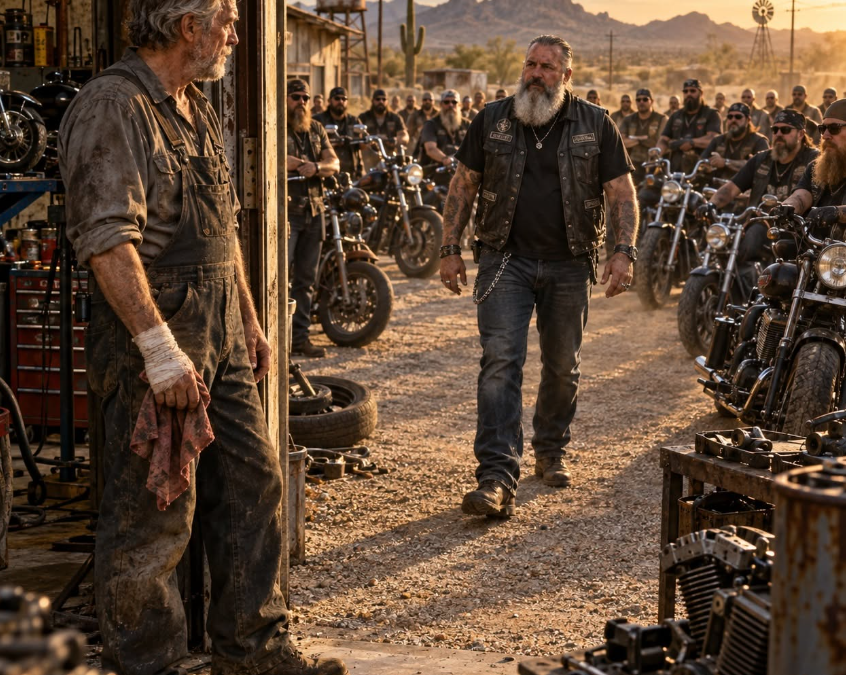
Twenty bikes came down Highway 93.
Maybe nineteen.
Maybe twenty-one.
At sixty-one, terror does not improve counting.
They signaled.
Turned together.
Rolled into my dirt lot.
Black Mesa Riders.
Black vests.
Black patches.
Engines idling.
They parked in a wide half-circle facing the shop.
Nobody spoke.
I looked toward the back gate.
Could probably climb it.
Not elegantly.
Then the biggest rider killed his engine.
Marcus “Titan” Reed stepped off.
Maybe six-foot-four.
Gray beard.
Broad shoulders.
His vest had:
BLACK MESA RIDERS.
PRESIDENT.
Titan walked straight toward me.
The others stayed near their bikes.
He stopped ten feet away.
Pale eyes.
Calm face.
Which was somehow worse than anger.
“You Frank Sullivan?”
“I am.”
He looked at my bandaged hand.
Then inside the shop.
Then back.
“This morning I pulled the cover off my motorcycle.”
My mouth went dry.
“I figured you would eventually.”
“I noticed the fork tubes.”
“Temporary.”
“The weld on the primary.”
“Temporary.”
“The clutch lever.”
I nodded.
Titan tilted his head.
“Looks like it came off a lawn tractor.”
“It was either that or vice grips.”
Behind him somebody laughed.
Titan did not.
“You worked on my bike.”
“Yes.”
“Without my permission.”
“Yes.”
There was no safe answer.
He took one slow step closer.
“Kid told me you stayed up all night.”
“Kid talks too much.”
“Thirty hours?”
“Something like that.”
“You refused his money.”
“He only had $180.”
“I know.”
Another step.
I stayed where I was.
“What did he tell you that bike belonged to?”
“You.”
“That all?”
“Your custom bike.”
Titan stared.
Then reached inside his vest.
Every muscle in my body tightened.
I wish I could say I bravely stood ready.
I did not.
My brain calculated the distance to the tire machine.
Then Titan pulled out a thick white envelope.
He tossed it onto an oil drum.
“Open it.”
I stared.
“What is it?”
“Open it, Frank.”
Twenty riders watched.
I picked up the envelope.
Heavy.
Inside were hundred-dollar bills.
Stacks.
I stared.
“How much?”
“Twenty-two thousand.”
I looked up.
“For what?”
Titan’s eyes moved past me toward the empty lift.
“For putting my brother’s motorcycle back together.”
Something shifted.
“Brother?”
He nodded.
“Anthony.”
His voice changed.
Barely.
“He built that machine.”
I said nothing.
“Frame up.”
That explained things.
The handmade battery tray.
Custom brackets.
Old-fashioned routing.
Wiring that was too personal to have come from a shop manual.
Initials beneath the saddle.
A.M.
I had seen them around four in the morning.
Hadn’t thought about them.
“He a fabricator?”
“Was.”
Titan looked toward the highway.
“He died four years ago.”
The same year as Linda.
“I’m sorry.”
Titan nodded.
“Cancer.”
Of course.
I almost laughed at the cruelty of coincidence.
Instead:
“Linda too.”
“Your wife?”
“Yes.”
He nodded once.
Neither of us said the useless things.
Sorry for your loss.
At least they’re not suffering.
Everything happens for a reason.
Men our age have heard enough bad comfort.
Titan looked toward the motorcycle bay.
“Anthony was twelve years younger than me.”
“He build many bikes?”
“Plenty.”
“But that one?”
“Only one he built for himself from bare frame.”
I understood.
That bike was not transportation.
It was handwriting.
Memory.
A dead man’s fingerprints turned into steel.
I looked at the money.
“Evan know?”
“Not all of it.”
“He told me he was your road captain’s nephew.”
“Ray’s sister’s kid.”
Titan’s jaw tightened.
“Ray wanted to put him through a wall.”
“Understandable.”
“I wanted to bury him.”
“That seems administratively complicated.”
A few riders laughed.
Titan’s mouth almost moved.
“He confessed before I saw the bike.”
That surprised me.
“He did?”
“At six forty this morning.”
I looked toward the highway.
Maybe he listened.
“He told me everything.”
Titan nodded toward my hand.
“Said an old mechanic stayed awake rebuilding the bike, cut himself open, scavenged parts from his own yard, then wouldn’t take his money.”
“I’m not that old.”
The riders laughed again.
Titan ignored them.
“He said your garage was being taken.”
That annoyed me.
“Evan needs to work on confidentiality.”
“I asked around.”
“About me?”
“Yep.”
“Why?”
“Because nobody gives away thirty hours of labor when they’re six days from foreclosure unless they’re either stupid or dangerous.”
“Which did you decide?”
“Still evaluating.”
I looked at the envelope.
“I can’t take this.”
“Yes, you can.”
“No.”
Titan folded his arms.
“Why?”
“Because twenty-two thousand dollars is not a motorcycle repair.”
“No.”
“Then what is it?”
“Payment.”
“For what?”
He started counting on his fingers.
“Used parts.”
“Scrap.”
“Still parts.”
“Labor.”
“I didn’t charge.”
“You do now.”
“I decide my rate.”
“Great.”
“Titan—”
“Back taxes?”
I stopped.
“How do you know about taxes?”
“Small town.”
“Loan arrears?”
I said nothing.
“Materials?”
“Titan.”
“And a deposit.”
I frowned.
“Deposit on what?”
He turned.
Twenty motorcycles sat behind him.
“Look.”
I looked.
“You see twenty perfect machines?”
“I see at least four leaking oil.”
Five riders immediately looked down.
One said, “Traitor.”
I pointed.
“That red Road King has a rear tire past safe wear.”
The owner looked offended.
Titan nodded.
“What else?”
“The blue Street Glide sounds lean.”
Its owner frowned.
“You heard that from here?”
“Yes.”
Titan finally smiled.
“That’s the deposit.”
“You have your own mechanic.”
“Had.”
“What happened?”
“Moved to Colorado.”
“Didn’t tell me.”
“Why would he?”
“Exactly.”
Titan stepped closer.
“Black Mesa needs a shop.”
“I don’t want club politics.”
“Good.”
“I don’t hide things.”
“Nobody asked.”
“No stolen parts.”
“Absolutely not.”
“No mystery packages.”
“No.”
“No bikes with scratched VINs.”
“No.”
“I invoice everything.”
“Please.”
“I report income.”
Titan smiled wider.
“Frank, I’m not inviting you into organized crime.”
“That sounds exactly like what organized crime would say.”
The lot erupted in laughter.
Even Titan laughed then.
A real one.
It changed his entire face.
He tapped the envelope.
“Monday we bring five bikes.”
“I charge full rate.”
“Good.”
“If there are jobs ahead of yours, you wait.”
“Better.”
“I don’t bump customers because your vest says president.”
“Perfect.”
“I don’t work for you.”
Titan’s expression settled.
“No.”
He nodded toward the garage.
“You work for yourself.”
That sentence nearly got me.
I looked away.
Toward the faded sign.
Linda’s lettering.
Toward the office.
Boxes.
Foreclosure notice.
The envelope felt heavy in my hand.
“How do I know this doesn’t come with strings?”
“It does.”
I looked back.
“What strings?”
“You do good work.”
“That’s it?”
“And improve the coffee.”
A rider shouted, “THANK GOD.”
Another said, “Evan said it tastes like differential fluid.”
“Transmission fluid,” I corrected.
“See?” Titan said. “He knows.”
I laughed.
I had not laughed inside that yard in months.
Titan put on his sunglasses.
“Bank opens nine Monday?”
“Yes.”
“Pay them.”
“I haven’t agreed.”
He looked toward the half-filled boxes inside.
“Then return the deposit after you finish twenty bikes.”
“That could take months.”
“Fine.”
He started toward his motorcycle.
“Titan.”
He stopped.
“Why?”
He turned.
I held up the envelope.
“Why do this?”
For several seconds he said nothing.
Then:
“Because Evan said when he tried to pay you, you told him not to let one stupid choice become a habit.”
My chest tightened.
Titan continued.
“Anthony told me something similar thirty years ago.”
He looked at the garage.
“Maybe some things come back around.”
Then he mounted his bike.
Twenty engines started.
My windows shook.
They rode away one by one.
I stood alone in the dirt holding enough money to stop the bank from taking the shop.
For years, silence after motorcycles left my lot sounded like business disappearing.
That afternoon, it sounded like something starting.
I did not deposit the money immediately.
That would have been sensible.
Instead I put it inside my office safe and spent Sunday arguing with a dead woman.
Linda’s photograph sat on my desk.
She was forty-seven in the picture.
At Lake Havasu.
Wind messing up her hair.
Sunglasses.
Smile.
“You’d tell me to take it.”
The photograph remained smug.
“It’s too much.”
No answer.
“He’s a biker.”
Nothing.
“Twenty bikers.”
Still nothing.
“You always hated when I judged people by their clothes.”
Linda had once made me apologize to a man I threw out because he looked homeless.
Turned out he owned three towing companies.
She mentioned that story for seventeen years.
I leaned back.
“What if this blows up?”
Silence.
I imagined her answer anyway.
Frank, the garage is already blowing up.
Monday at eight fifty-two, I walked into Desert Valley Community Bank wearing the only button-down shirt I owned.
Steven Brooks, branch manager, had called me seventeen times in three months.
He came out of his office.
“Frank.”
“Steven.”
“I wasn’t expecting you.”
“That makes two of us.”
He gestured me inside.
I placed the deposit slip and certified funds from the cash I had converted that morning through my business account.
Steven looked at the number.
Then me.
“Where did this come from?”
“A customer.”
“A customer paid you twenty-two thousand dollars?”
“Yes.”
His expression changed.
Bank face.
Professional suspicion.
“What kind of work?”
“Motorcycles.”
“Frank.”
“You asked.”
He tapped the papers.
“This amount triggers reporting requirements.”
“Then report it.”
“I’m not accusing you.”
“Good.”
“I just need documentation.”
“You’ll have invoices.”
He stared.
Then began typing.
After several minutes:
“This brings the note current.”
My throat tightened.
“And?”
“And stops the scheduled enforcement.”
“Say it normally.”
Steven looked up.
“The bank is not taking the garage Monday.”
I closed my eyes.
One second.
That was all I allowed.
“Print that.”
“Frank.”
“Print it.”
He printed confirmation.
I folded the page.
Put it inside my shirt pocket.
When I stepped outside, Arizona sunlight nearly blinded me.
The shop was still mine.
For now.
I stood beside my truck.
Hands shaking.
Not fear.
Relief.
I had forgotten how physical relief could be.
My knees nearly weakened.
At nine twenty-seven, five Black Mesa motorcycles arrived.
Titan was not with them.
Good.
I did not want a ceremony.
Ray Ortega, the road captain and Evan’s uncle, came first.
Late forties.
Black mustache.
The expression of a man who had not stopped being angry in days.
He dismounted.
“Frank?”
“Yeah.”
He handed me five keys.
Then:
“Where’s Evan?”
I frowned.
“Why would I know?”
“He hasn’t been home since Saturday.”
My stomach tightened.
“What?”
“He thinks everybody hates him.”
“He stole Titan’s motorcycle.”
“I am aware.”
Ray rubbed his face.
“I yelled.”
“How much?”
“A lot.”
“Hit him?”
“No.”
“Threatened?”
Ray hesitated.
“Not exactly.”
“What does that mean?”
“I said if Titan killed him, I’d help dig.”
I stared.
“Excellent uncle work.”
“I was angry.”
“He believed you.”
Ray’s expression fell.
“Yeah.”
I took off my glasses.
“Find him.”
“We’re looking.”
“Then why are you here?”
“Titan said keep the appointment.”
I looked at the bikes.
Then at Ray.
“Go find the kid.”
“Frank—”
“The oil leak will still be leaking.”
Ray left.
Two hours later, Evan appeared.
On foot.
Same torn jeans.
Clean bandage on his knee.
He stood at the edge of the lot.
I looked at him.
“You make a habit of causing adult men problems?”
His face crumpled.
“I’m sorry.”
“For what?”
“All of it.”
“Too broad.”
“I took the bike.”
“Yes.”
“I lied.”
“Yes.”
“I messed everything up.”
“Yes.”
He looked down.
“Uncle Ray hates me.”
“Probably not.”
“Titan does.”
“No.”
That made him look up.
“How do you know?”
“He paid your bill.”
“What?”
I pointed toward the shop.
“Apparently you also told twenty bikers my financial business.”
Evan went pale.
“I didn’t mean—”
“Relax.”
He stared.
“Why would Titan—”
“Because the motorcycle belonged to Anthony.”
Evan froze.
“You know?”
“Yes.”
His face twisted.
“I didn’t.”
“I figured.”
“He never told me.”
“Would knowing have changed whether stealing it was stupid?”
Evan shook his head.
“No.”
“Good.”
Tears came.
“I ruined Anthony’s bike.”
“You damaged it.”
“Same thing.”
“No.”
I looked directly at him.
“Listen carefully.”
He waited.
“Broken is not the same as ruined.”
That sentence came out before I understood it.
The garage.
Motorcycle.
Evan.
Me.
Linda.
Everything.
Evan wiped his face.
“I don’t know what to do.”
“Start with your uncle.”
“He’s going to yell.”
“Probably.”
“Titan?”
“Probably won’t.”
“That’s worse.”
“Usually.”
“What do I say?”
“The truth.”
“All of it?”
“That is generally how truth works.”
He nodded.
Then looked at the open bay.
“Can I work?”
“You know motorcycles?”
“No.”
“Fantastic.”
I handed him a broom.
“Start with floors.”
Ray arrived twenty minutes later.
Saw Evan sweeping.
Stopped.
For a moment neither spoke.
Then Ray walked over.
I stayed out of it.
Almost.
“You disappearing like that again?” Ray asked.
“No.”
“You understand what you did?”
“Yes.”
“You understand why I lost my mind?”
“Yes.”
Ray’s voice cracked.
“That doesn’t mean I meant what I said.”
Evan looked down.
“I know.”
“No, you don’t.”
Ray grabbed him.
Hugged him.
Hard.
Evan started crying.
I immediately became extremely interested in a carburetor.
Nobody needed an audience.
Titan kept his word.
The Black Mesa Riders filled my schedule.
Then friends of riders.
Then coworkers.
Truck drivers.
Ranchers.
Travelers.
People saw motorcycles waiting outside and assumed somebody trusted me.
Trust attracts trust.
By the end of the month, I had enough work to hire part-time help.
I hired Evan.
Minimum wage.
Not charity.
He showed up every morning at seven forty-five.
Swept.
Changed oil under supervision.
Cleaned carburetors.
Learned tire machines.
Asked too many questions.
Broke a bolt and looked like he expected execution.
I handed him an extractor.
“Congratulations.”
“For what?”
“You broke your first bolt.”
“Are you mad?”
“I will be if you don’t remove it.”
He smiled.
Gradually the shop changed.
Someone brought an old recliner.
I said no.
They left it anyway.
Ray started keeping bottled water in my refrigerator.
Another rider named Wes replaced my broken microwave without asking.
Tiny, a Black Mesa member who was not small in any observable way, installed shelves.
I told him I did not need shelves.
He ignored me.
People stayed after repairs.
Talked.
Argued.
Drank terrible coffee.
The garage stopped sounding like an empty building.
That frightened me.
Loneliness can become familiar enough that company feels like trespassing.
Then the police arrived.
Detective Paul Mercer.
No relation to anyone important.
Plain tan sedan.
Cheap gray suit.
Badge.
He walked through the open bay one Thursday.
Looked at the Black Mesa motorcycles.
Then at me.
“Frank Sullivan?”
“Depends who’s asking.”
He showed the badge.
“Detective Mercer. Mohave County.”
“What broke?”
“Nothing.”
“Then you’re in the wrong place.”
He did not smile.
“I want to ask about a financial transaction.”
There it was.
Titan’s $22,000.
Mercer mentioned the near foreclosure.
Then sudden payment.
Then increasing Black Mesa business.
“Looks unusual.”
“It is.”
“Where did the money come from?”
“Customers.”
“One customer?”
“Initial deposit.”
“Marcus Reed?”
“Yes.”
“For motorcycle work?”
“Yes.”
“You have invoices?”
I pointed toward the office.
“Every dollar.”
Mercer glanced at the club bikes.
“You sure you know what you’re involved with?”
That annoyed me.
“I repair motorcycles.”
“These men have history.”
“So do most motorcycles.”
“I’m serious.”
“So am I.”
He lowered his voice.
“Money laundering.”
I stopped.
“Evidence?”
“I’m asking.”
“No. You’re suggesting.”
Mercer’s jaw tightened.
“Frank, I’m trying to make sure an older business owner in financial distress hasn’t been pulled into something.”
There are polite ways to call someone desperate and stupid.
That was one.
“Do you have a warrant?”
“No.”
“Then you’re standing in my light.”
He handed me a card.
“Call if anything feels wrong.”
I placed it on the bench.
“Things feel wrong constantly. I’m sixty-one.”
He left.
Titan arrived that evening.
I told him everything.
Not because I was scared.
Because I refused secrets.
Titan listened.
Then asked:
“What did you tell him?”
“Truth.”
“Good.”
“No cash work without invoice from now on.”
“Fine.”
“Nothing stored here except repair bikes.”
“Fine.”
“No club packages.”
“Wasn’t planning it.”
“If police arrive with paperwork, they get cooperation.”
Titan stared.
“You think I’d argue?”
“I don’t know.”
He smiled faintly.
“That’s why I like you.”
A week later, officers arrived with a subpoena for business records.
Not a raid.
Not dramatic.
Still humiliating.
Customers watched.
One asked if I was being arrested.
“No.”
Another canceled an appointment.
Word spread.
Sullivan shop tied to biker money investigation.
The local online page posted photographs.
Comments came.
“Always knew those clubs were dirty.”
“Old guy probably got desperate.”
“Wonder what he’s hiding.”
I nearly threw my computer into the parking lot.
Evan read the comments.
“I’m sorry.”
“For what?”
“This started with me.”
“No.”
“Yes.”
“No.”
I pointed at the computer.
“Other people’s assumptions are not your debt.”
I realized Linda would have liked that sentence.
Detective Mercer returned twice.
Each time I handed over records.
Invoices.
Parts receipts.
Bank statements.
Customer names where legally required.
Nothing hidden.
Titan’s $22,000 was documented as prepaid service credit and immediate labor/material reimbursement associated with the emergency repair.
Every subsequent job had work orders.
Taxes.
Receipts.
Boring.
Legitimate.
The investigation turned.
Not toward me.
Toward the person who had reported me.
Steven Brooks.
The bank manager.
That surprised me.
He had filed a suspicious-activity referral, which was his right.
But Mercer discovered something else.
Steven had also shared confidential details of my foreclosure timeline with a commercial developer named Kent Rawlings.
Rawlings owned the truck plaza across the highway.
He had been trying to buy my property for two years.
I always refused.
The garage sat on six acres of highway frontage.
Worth more to a developer than to an old mechanic.
Emails eventually showed Steven had told Rawlings the bank expected possession Monday and that the property might become available quickly.
That did not make the original bank reporting illegal.
But sharing private borrower information with a potential buyer was something else.
Suddenly Steven Brooks was no longer smiling behind his desk.
The bank opened an internal investigation.
Their attorney called me.
Then another.
They used words like privacy, employee misconduct, remediation.
I hired a lawyer.
First lawyer I had paid in twenty-five years.
Her name was Maria Sandoval.
She was five-foot-three and terrified everyone.
Good.
She reviewed everything.
Then said:
“The police investigation into your customers appears legitimate.”
“I know.”
“The bank employee leaking your loan status appears very much not.”
“I know.”
“You may have claims.”
“I don’t want to own a bank.”
“That is unfortunate. I was hoping for excitement.”
I liked her.
The truth became public because Steven resigned.
The bank issued an apology without describing details.
Rawlings stopped calling.
Detective Mercer came to the garage after the case closed.
No suit.
Jeans.
Polo.
He stood near the bay.
“You were clean.”
“I know.”
He nodded.
“I should say I’m sorry.”
“For investigating?”
“No.”
He looked around.
“For the way I spoke to you the first time.”
I waited.
“I assumed desperation made you easy to use.”
“That was insulting.”
“Yes.”
“Anything else?”
He smiled faintly.
“Your coffee is terrible.”
“Get out.”
He laughed.
Then handed me his motorcycle key.
“What?”
“Front brake feels soft.”
I stared.
“You’re hiring me?”
“Apparently.”
“Full rate.”
“I’ve heard.”
Mercer became a customer.
That is how Arizona works sometimes.
Enemies become customers if you can fix brakes.
Three months after the night Evan wrecked Titan’s motorcycle, an enclosed trailer appeared in my lot.
Titan arrived alone.
He lowered the ramp.
Inside sat Anthony’s bike.
My emergency repair still on it.
Mismatched forks.
Silver weld scar.
Ugly lever.
Beside the motorcycle were boxes.
A lot of boxes.
New suspension.
Custom-machined controls.
Primary housing.
Wheel.
Brake components.
Wiring harness.
Performance engine parts.
Hand-fabricated pieces built from drawings.
Titan watched me looking.
“You want it restored?”
“No.”
“Then what?”
He walked into the trailer.
Touched the dented tank.
“I want you to finish it.”
“Finish what?”
“Anthony never considered it finished.”
I looked at him.
“He always changed things.”
Titan nodded.
“I found drawings.”
He handed me a folder.
Sketches.
Measurements.
Notes.
Anthony’s handwriting.
Alternate bracket designs.
Revised exhaust routing.
Engine modifications.
A new tank concept.
I flipped pages slowly.
“You want this exactly?”
“No.”
Titan surprised me.
“Why not?”
“Because Anthony changed his mind every six minutes.”
“That does sound like a fabricator.”
Titan smiled.
“I want you to build what he was trying to get to.”
That was different.
Restoration preserves.
Completion interprets.
Dangerous responsibility.
“You sure?”
“Yes.”
“I never met him.”
“No.”
“Someone who did might be better.”
“He would’ve liked you.”
“You don’t know that.”
“He hated polished mechanics.”
I looked around my filthy garage.
“Strong endorsement.”
Titan sat in the ridiculous recliner.
“Do it.”
For three weeks, that motorcycle owned me.
I studied Anthony’s notes.
Old photographs.
Measurements.
Marks on the frame.
I removed my emergency repair and replaced everything properly.
I kept the primary cover.
Titan wanted it replaced.
I stared at the silver weld.
“No.”
He raised an eyebrow.
“It’s repaired.”
“It’s ugly.”
“It tells the truth.”
Titan looked at it.
Then nodded.
We kept it.
Not because my weld was better.
Because the crack had become part of the bike’s life.
That was something I understood.
The dented fuel tank was another question.
A painter could make it perfect.
I asked Titan.
He ran his fingers across the dent.
“Evan did that.”
“Yes.”
“Can you remove it?”
“Mostly.”
He thought.
“Leave a little.”
So we did.
The machine would never pretend the wreck had not happened.
During those weeks Titan came almost every evening.
Sometimes talked.
Mostly sat.
Black coffee.
No sugar.
One night he brought old photographs.
Anthony at twenty.
Thirty.
Holding welding helmet.
Laughing.
Standing beside Titan.
I looked at one.
“You were skinny.”
Titan looked offended.
“I was athletic.”
“You were skinny.”
He took the photograph back.
“Linda?”
I pulled out my wallet.
Her photograph had been there so long the corners were white.
Titan looked.
“Pretty.”
“Yeah.”
“How long married?”
“Thirty years.”
“Anthony ever marry?”
“No.”
“Kids?”
“No.”
Titan looked toward the motorcycle.
“Machines were his family.”
I tightened a fitting.
“You ever think that makes grief worse?”
“What?”
“When nobody else misses somebody in the exact same role.”
Titan looked at me.
I continued.
“When Linda died, everybody said they missed her.”
“Sure.”
“Her sister lost a sister. Friends lost a friend.”
I stared at the engine.
“But nobody else lost my wife.”
Titan became quiet.
“You lost the only person who knew Anthony as your little brother.”
He nodded.
“That’s different.”
We worked in silence.
Later he said:
“I was supposed to keep him safe.”
I knew that kind of guilt.
“From cancer?”
“From everything.”
“That wasn’t your job.”
“I was older.”
“Still wasn’t your job.”
He looked angry.
“Easy for you to say.”
“No.”
I set down the wrench.
“Not easy.”
He waited.
“I spent three years believing I killed Linda because I didn’t push the first doctor hard enough.”
Titan said nothing.
“She complained about pain.”
My throat tightened even after four years.
“Doctor said digestive issue.”
“She trusted him?”
“We both did.”
“Then?”
“Three months later, another doctor found it.”
I looked away.
“Advanced.”
Titan’s expression softened.
“I kept thinking if I’d made noise sooner…”
“Would’ve changed it?”
“Maybe.”
He nodded.
“That maybe is a bastard.”
“Yep.”
We sat.
Then I said:
“Sometimes fixing a machine is the only problem in front of you that has an answer.”
Titan looked at the bike.
“Yeah.”
That was the longest personal conversation we ever had.
Until the day the bike was finished.
Friday.
Late afternoon.
Sun coming through the front windows.
Black paint.
Smoke-gray ghosting along the tank.
Polished engine.
Anthony’s handmade pieces preserved.
New components built around them.
Silver weld still visible.
Small remnant of the crash dent.
A.M. initials beneath the saddle.
I had added nothing with my own name.
Did not belong there.
Titan arrived.
He stepped inside.
Stopped.
For a long time he said nothing.
Walked around the motorcycle slowly.
Touched the tank.
Primary.
Seat.
Then noticed the weld.
“You kept it.”
“Yeah.”
“Why?”
“Because repaired doesn’t mean erased.”
His eyes stayed on the silver line.
Then the small dent.
“Evan’s crash too?”
“Little bit.”
Titan nodded.
“Good.”
He sat on the motorcycle.
Turned the key.
I held my breath.
Starter.
The big engine came alive.
Deep.
Clean.
Strong.
The whole garage filled with sound.
Titan closed his eyes.
For several seconds, the president patch meant nothing.
He was not Titan.
Not the man twenty riders followed.
Just Marcus Reed listening to his dead brother speak through an engine.
He shut it off.
Silence.
I waited.
He looked down.
Then said quietly:
“Anthony would’ve complained about the exhaust.”
“That was his design.”
“He complained about his own work most.”
“Then I nailed it.”
Titan laughed.
Then wiped one eye with his thumb like dust had entered the building.
I pretended to inspect my toolbox.
Men my age respect certain lies.
Eventually he said:
“Invoice?”
I handed it over.
He looked.
“You undercharged.”
“No.”
“You did.”
“My shop.”
“Frank.”
“Marcus.”
His eyebrows rose.
I rarely called him Marcus.
“Pay what’s printed.”
He did.
No argument.
Then:
“Sunday.”
“What?”
“Clubhouse barbecue.”
“I don’t do clubhouses.”
“You do brisket?”
I considered.
“Yes.”
“Then you’re coming.”
I looked around.
Roof no longer leaking.
Schedule board full.
Toolboxes not being auctioned.
Evan in the back rebuilding a carburetor under Ray’s supervision.
Coffee cup on Linda’s old desk left by somebody who planned to return Monday.
For four years I had believed keeping the garage alive meant keeping it exactly as it had been when Linda was there.
Empty after closing.
Her chair untouched.
Her bookkeeping cabinet locked.
Her coffee mug hanging above the sink.
I thought changing anything betrayed her.
Then nearly losing the place taught me something ugly.
A shrine is not the same as a life.
“I’ll come.”
Sunday, I rode to the Black Mesa clubhouse in my old pickup.
I still owned motorcycles.
Three, technically.
None running.
Mechanic’s curse.
The clubhouse was an old ranch building surrounded by bikes.
Families everywhere.
Kids.
Women.
Old veterans.
Dogs.
Not the criminal empire television had prepared me for.
Evan was there.
He looked nervous when Titan walked toward him.
Their relationship had been cold since the crash.
Titan stopped.
Held out a key.
Evan stared.
“What’s that?”
“The bike.”
Evan went pale.
“No.”
Titan’s mouth twitched.
“Not yours.”
“Good.”
“Take it around the lot.”
Evan looked horrified.
“I am never touching that motorcycle again.”
Several riders laughed.
Titan didn’t.
“Good.”
Then he handed Evan a different key.
A beat-up old Honda stood nearby.
Ugly brown.
Faded seat.
“What’s that?”
“Yours.”
Evan stared.
“What?”
“You work?”
“Yes.”
“You been paying Ray rent?”
“Yes.”
“You still have the $180?”
Evan reached for his wallet automatically.
Titan smiled.
“Keep it.”
“Then why—”
“Bike doesn’t run.”
Evan looked at me.
I immediately understood.
Titan pointed.
“Frank says you’re learning.”
Evan’s eyes filled.
“You fix it.”
“I don’t know enough.”
“Then learn.”
“What if I screw it up?”
Titan looked at Anthony’s motorcycle parked nearby.
Then back.
“You probably will.”
Everyone laughed.
Titan continued:
“Then fix it again.”
Evan swallowed.
“Why are you giving me this?”
Titan’s expression hardened slightly.
“I’m not.”
“You just said—”
“You earn it.”
“How?”
“Two hundred hours at Sullivan Motor Works.”
I almost choked on brisket.
“What?”
Titan smiled.
“Thought you’d like that.”
“You volunteered my shop?”
“Community service.”
“I am not the community.”
Ray laughed.
I pointed at Titan.
“You’re paying his wages.”
“Yes.”
“Full wage.”
“Yes.”
“Insurance.”
Ray said, “I’ll handle it.”
“No free labor.”
Titan lifted both hands.
“Frank.”
“What?”
“That’s why I picked you.”
Evan worked those two hundred hours.
Then kept working.
At twenty-three, he enrolled in community college automotive technology.
Motorcycle specialization was limited, but electrical diagnostics helped.
He learned computers.
I hated them.
He loved them.
Eventually that became useful.
The shop needed both.
My old knowledge.
His new knowledge.
One afternoon he connected a diagnostic scanner to a modern touring bike.
I watched suspiciously.
“You trust that thing?”
“It tells us live sensor data.”
“My ears tell me live sensor data.”
“Your ears don’t read throttle-position voltage.”
“My ears are analog.”
He laughed.
Within two years, the sign changed.
Not the name.
Never.
SULLIVAN MOTOR WORKS.
Underneath, Evan added:
CLASSIC & MODERN MOTORCYCLE SERVICE.
I objected.
Linda would have approved.
So it stayed.
The garage survived.
Not magically.
I still had bills.
Slow months.
Insurance increases.
Equipment costs.
Titan’s riders did not create endless wealth.
That would be fantasy.
What they gave me was a customer base strong enough to buy time.
Time let me modernize.
Evan created a website.
Against my will.
We posted photographs.
Before-and-after jobs.
Restorations.
Maintenance tips.
He wanted me in videos.
“No.”
“People like you.”
“They don’t know me.”
“Exactly.”
“That makes no sense.”
The first video was called:
OLD MECHANIC EXPLAINS WHY YOUR BATTERY ISN’T THE PROBLEM.
It got 38,000 views.
I hated everything.
Customers came from Phoenix.
Vegas.
California.
One man drove from Colorado after seeing me complain about aftermarket wiring online.
YouTube.
The thing I blamed for killing the shop helped keep it alive.
Linda would have been unbearable about that.
I visited her grave afterward.
Took flowers.
Sat.
“You win.”
Wind.
“You hear me?”
Nothing.
“You were right about the internet.”
A bird landed nearby.
I pointed at it.
“Don’t get smug.”
Losing Linda never stopped hurting.
But the hurt changed.
For years, grief occupied the entire garage.
Eventually it became one room.
Still there.
I could visit.
Could leave.
Marcus—Titan—understood.
On Anthony’s birthday each year, he brought the black motorcycle.
Never a formal event.
No speeches.
We changed oil.
Checked it.
Sometimes rode.
The first year he asked me to ride it.
I refused.
Second year too.
Third year:
“You scared?”
“No.”
“You’re scared.”
“I’m respectful.”
“Same thing with better vocabulary.”
I took it around the highway.
The motorcycle felt alive.
Not supernatural.
No ghosts.
Just balanced.
Strong.
Handmade.
When I returned, Titan asked:
“Well?”
“Your brother knew what he was doing.”
Titan smiled.
“Yeah.”
The $180 stayed part of the story.
Evan kept it in a frame.
Not kidding.
He framed the bills.
All crumpled.
Hung them in the shop office.
Below:
THE MOST EXPENSIVE $180 I NEVER SPENT.
I told him it was stupid.
Customers loved it.
One day a teenage boy came in.
Seventeen.
Old dirt bike in pickup.
Engine seized.
He had $220.
Needed transportation to work.
I quoted what the repair would cost.
His face fell.
I looked toward the framed $180.
Evan noticed.
He shook his head.
“No.”
“What?”
“We are not doing thirty free hours.”
“I didn’t say anything.”
“You made the face.”
“What face?”
“The stupid kindness face.”
Titan happened to be sitting in the recliner.
He started laughing.
I glared at both.
In the end, we found a used engine.
Kid paid what he could.
A local rider covered parts anonymously.
We charged labor at half rate.
Nobody destroyed the business.
That was another lesson.
Kindness does not have to be reckless to count.
The night I helped Evan, I had no room for careful generosity.
It was stupid.
I admit that.
Stupid decisions sometimes end well.
That does not make them smart.
What mattered afterward was learning how to build something sustainable around the impulse.
A community repair fund started later.
No big charity branding.
Customers could round up invoices.
Black Mesa donated.
We helped riders who needed motorcycles for jobs.
Veterans.
Young workers.
People escaping bad situations.
Nobody got custom paint for free.
Nobody got performance upgrades.
Safety and transportation.
That was enough.
We called it Linda’s Bench.
I did not choose the name.
Evan did.
I almost strangled him.
Then I saw the little plaque.
LINDA’S BENCH — KEEP PEOPLE MOVING.
That had been one of her sayings.
Whenever I complained about some struggling customer:
“Frank, if you can keep people moving without sinking yourself, do it.”
I had forgotten.
Or buried it.
I left the plaque.
Sullivan Motor Works turned forty years old last spring.
I am sixty-seven now.
Still working.
Less.
Evan runs most day-to-day operations.
He is twenty-eight.
Owns half the business.
That was my decision.
Titan said I sold too cheap.
I told him presidents do not get opinions on my company.
Marcus says he is stepping down from Black Mesa leadership next year.
Nobody believes him.
Ray’s mustache is gray.
Tiny remains approximately the size of municipal infrastructure.
Detective Mercer still comes for brake work.
Steven Brooks moved out of Arizona after the bank investigation.
I never saw him again.
Desert Valley settled my privacy claim.
Not millions.
Enough to finish paying down the property.
The deed is mine now.
Fully.
No bank.
First thing I did after the final payment was make a photocopy.
Then another.
Then put one beside Linda’s photograph.
“You see that?”
The picture said nothing.
“I finally own the place.”
Silence.
“Try not to look surprised.”
Sometimes I still arrive before sunrise.
Unlock.
Turn on fluorescents.
Coffee.
Walk the bays.
The garage no longer feels like a mausoleum.
That might be the biggest change.
There are photographs now.
Linda.
Anthony’s motorcycle.
Black Mesa charity ride.
Evan receiving his certification.
A picture of Titan wearing reading glasses that he insists must never leave the office.
Naturally, three copies exist.
And on the wall is the cracked primary cover.
The one I welded that first night.
Eventually we replaced it during an engine refresh.
Titan wanted to throw it away.
I did not.
The silver scar crosses the aluminum.
Ugly.
Honest.
Customers sometimes ask what happened.
If I’m busy, I say:
“Long story.”
If I’m not, sometimes I tell it.
Not the version people around Kingman prefer.
Their version is:
Old mechanic facing foreclosure helps terrified kid.
Turns out motorcycle belongs to powerful biker president.
Biker president saves garage.
Nice.
Clean.
Almost fairy-tale.
I hate that version.
Marcus did not save my garage.
He gave me business.
I still had to repair the motorcycles.
Still had to pay taxes.
Still had to modernize.
Still had to build trust.
Still had to wake up every day after Linda died and decide whether I cared enough to keep the doors open.
And I did not save Evan.
I repaired one motorcycle.
Then gave him a broom.
He saved himself with two hundred hours.
Then two thousand.
Then years.
Showing up.
Learning.
Telling the truth after mistakes.
Paying back damage.
Changing habits.
That is less exciting than saying redemption.
It is also more true.
And Anthony’s motorcycle?
I didn’t save that either.
Machines do not care.
We care for them because they hold things we cannot touch anymore.
A dead brother’s weld.
A dead wife’s handwriting on a shop sign.
A father’s old truck.
A mother’s sewing machine.
Objects become containers.
That is why people cry when somebody dents a motorcycle.
Not always because of metal.
Sometimes the metal is carrying someone.
The night Evan arrived, none of us knew what we were really looking at.
He saw the motorcycle as evidence of the worst mistake of his life.
I saw thirty hours of impossible work I could not afford.
Titan saw the last machine his brother had built.
Later, I saw something else.
A cracked primary cover.
Bent forks.
Damaged tank.
Wrong lever.
Still repairable.
That became embarrassingly symbolic.
I normally hate symbolism.
Mechanics prefer torque specifications.
But some truths insist.
Broken does not mean ruined.
That applies to machines.
Sometimes.
People too.
Sometimes.
Not always.
Some damage cannot be undone.
Linda is still dead.
Anthony is still dead.
I lost four years inside grief.
Evan cannot make the crash unhappen.
I cannot recover customers who disappeared when the shop nearly failed.
We do not reset.
We repair.
Repair is different.
A repaired thing remembers.
Weld.
Scar.
Replacement piece.
Slight difference in paint.
A story beneath the finish.
I used to believe good repair meant hiding the damage so completely nobody could tell.
Age changed my mind.
Sometimes the strongest repair is the one you can see.
A few months ago, a customer walked into Sullivan Motor Works carrying one of those online videos on his phone.
“Are you Frank?”
“Depends.”
He showed me the screen.
It was footage from our fortieth anniversary.
Titan talking.
I groaned.
“What did he say?”
The customer smiled.
“He said you saved the Black Mesa Riders.”
I looked across the shop.
Marcus sat in the recliner pretending not to listen.
“Marcus.”
He grinned.
I told the customer:
“Don’t believe him.”
“Why?”
“Club existed before me.”
The customer laughed.
“Then what happened?”
I thought about it.
Twenty bikes in a half-circle.
White envelope.
Bank notice.
Thirty hours.
Evan crying when the engine fired.
Linda’s empty chair.
Anthony’s initials.
“What happened,” I said, “is we became customers.”
Marcus called across the shop:
“Friends, you miserable bastard.”
I looked at him.
“Customers pay faster.”
Everyone laughed.
Maybe he was right.
Friends.
Family, even.
A strange version.
Not the kind I expected.
I had no children.
Then somehow I ended up teaching Evan to rebuild transmissions.
Arguing with riders about preventive maintenance.
Attending weddings.
Funerals.
Graduations.
Hospital visits.
Thanksgiving at Ray’s.
Christmas toy runs.
Linda once worried I would become completely alone if she died first.
She said it during treatment.
I got angry.
“Don’t talk like that.”
“Frank.”
“No.”
“Listen.”
“I’m not listening.”
She took my hand.
“You hide in work.”
“So?”
“If I go first, don’t make the shop your coffin.”
I hated her for saying it.
For about five minutes.
Then cancer gave us other things to hate.
After she died, I did exactly what she feared.
Turned the shop into a coffin.
I just kept working inside it.
I thought preserving everything was loyalty.
Her mug.
Chair.
Files.
Sign.
Silence.
Then Evan drove a wrecked motorcycle into my life.
People followed.
Noise returned.
At first I resented every coffee cup left on a bench.
Every rider sitting too long.
Every person opening Linda’s refrigerator.
Eventually I understood.
She did not build Sullivan Motor Works with me so I could die alone inside it.
The shop was supposed to move.
Change.
Get louder.
Outlive us if it could.
That realization took longer than rebuilding Titan’s motorcycle.
Some repairs do.
Last month, Evan asked whether I planned to retire.
“Absolutely.”
“When?”
“Eventually.”
“You said that last year.”
“Still true.”
He leaned against my toolbox.
“You know you don’t have to die here.”
I stared.
“That your sales pitch?”
“Linda said something like that, didn’t she?”
My eyes narrowed.
“How do you know?”
He looked guilty.
“What did you do?”
“Found one of her old notebooks.”
“You read Linda’s notebook?”
“It was shop notes.”
“Still.”
“There was a list.”
“What list?”
He pulled folded paper from his pocket.
Photocopy.
Linda’s handwriting.
Things Frank must learn before he becomes an impossible old man:
- Charge enough.
- Throw away broken extension cords.
- Hire help.
- Learn computers.
- Take a vacation that does not involve a motorcycle swap meet.
- Let people help him.
I read it.
Then again.
Evan was trying not to smile.
“She missed impossible by about twenty years,” he said.
“Get back to work.”
He laughed.
I kept the copy.
Number six bothered me most.
Let people help him.
I had spent decades thinking independence meant nobody could do anything for me.
That nearly cost me everything.
The truth is more complicated.
You need boundaries.
Invoices.
Records.
Common sense.
You need to know whether help is help or control.
Whether generosity creates debt.
Whether somebody wants something you cannot see.
But refusing every hand because one might come with strings?
That is another way to sink.
Titan’s envelope had strings.
He told me that.
Do good work.
Charge properly.
Make better coffee.
I could live with those.
The original $22,000 is long gone.
Bank.
Parts.
Roof.
Materials.
It did not make me rich.
It did something more important.
Bought time.
Time is what second chances usually require.
Not miracles.
Time.
Enough days for business to recover.
Enough jobs for reputation to spread.
Enough mornings for Evan to learn.
Enough evenings for Marcus to talk about Anthony.
Enough years for a garage to stop feeling like a grave.
People always focus on the twenty bikers.
I understand.
Twenty motorcycles arriving together makes a better picture.
But when I think about the night everything changed, I remember quieter things.
Evan asleep against the parts cabinet.
The silver weld cooling.
Sunrise coming through dirty glass.
My hand closing around his $180 and pushing it back.
I did not know what would happen next.
I expected foreclosure.
Maybe I expected to regret helping him.
That is important.
Kindness is only kindness if you can survive not being rewarded.
Had Titan never arrived, would fixing the motorcycle still have been right?
I ask myself that sometimes.
Financially?
Absolutely not.
It was idiotic.
But morally?
A terrified young man came to me after making a terrible decision.
I could repair the machine without helping him hide the truth.
So I did.
That’s enough.
The reward does not travel backward and justify the choice.
Good outcomes don’t make reckless actions wise.
Bad outcomes don’t automatically make decent actions wrong.
Life refuses that simplicity.
I tell Evan that now when he wants to give labor away.
He complains I am hypocritical.
He is correct.
That is one of the privileges of age.
A nineteen-year-old came in recently.
Destroyed clutch.
No money.
Needed bike for work.
Evan looked at me.
I knew the face.
“Don’t.”
“What?”
“You’re about to mention 180 dollars.”
“I said nothing.”
“Your eyebrows did.”
We helped the kid.
Carefully.
Payment plan.
Parts fund.
Documented.
Sustainable.
Linda’s Bench covered half.
He covered the rest over four months.
That felt better.
Not as dramatic.
Better.
At closing that night, Evan asked:
“If Titan hadn’t shown up, would you still have helped me?”
I looked at him.
“Unfortunately.”
He smiled.
“Why?”
“I told you.”
“No.”
He sat on the workbench.
“You told me I looked scared.”
“You did.”
“Lots of people are scared.”
I cleaned my hands.
I had never really answered.
Maybe I did not know until then.
“When you were standing in the lot…”
I looked toward the highway.
“I remembered the last year Linda was alive.”
Evan became still.
“She was scared?”
“Yes.”
“She didn’t look it.”
“You never met her.”
“I’ve seen pictures.”
I nodded.
“She was terrified.”
I dried my hands.
“And I couldn’t fix the thing she was scared of.”
The shop became quiet.
“So when you rolled in with something broken I actually knew how to repair…”
I shrugged.
“I guess I needed it too.”
Evan looked at the cracked primary cover hanging on the wall.
“Fixing me?”
“No.”
I looked at him.
“The bike.”
He laughed.
Then I added:
“You did the rest.”
That is the truth.
Nobody rebuilt Evan in thirty hours.
Nobody rebuilt me either.
We just got one engine running.
Everything else took years.
Marcus tells the story differently.
At barbecues, he says:
“My idiot nephew wrecked my dead brother’s motorcycle and accidentally saved Frank’s garage.”
Ray always corrects:
“Evan is my nephew.”
Marcus says:
“Same genetic disaster.”
Evan tells people:
“Frank gave away thirty hours because he’s terrible at business.”
Also true.
My version?
A nearly broke mechanic opened his garage after hours.
A frightened kid made one honest decision after a dishonest one.
A grieving man paid for work because the object mattered more than money.
Then everyone kept showing up.
That’s all.
Maybe most lives change that way.
Not one huge moment.
A series of people deciding not to leave yet.
Another hour.
Another repair.
Another paycheck.
Another cup of terrible coffee.
Another Monday.
Marcus still owns Anthony’s motorcycle.
He rides it three times a year.
Anthony’s birthday.
The anniversary of his death.
And the Black Mesa memorial ride.
Never in rain.
He says that’s superstition.
I call it common sense.
Before every ride he brings it to the shop.
I check everything.
He complains when I charge him.
I charge him anyway.
Last October, after I finished the inspection, Marcus stood beside the bike.
He touched the little dent we left in the tank.
“Think Anthony would be mad we kept that?”
“Yes.”
Marcus laughed.
“Yeah.”
Then:
“He’d probably be mad we kept your weld too.”
“Yes.”
We stood quietly.
After a minute Marcus said:
“You know, when I first rode into your lot, you looked like you thought I was going to shoot you.”
“I considered possibilities.”
He laughed.
“What would you have done?”
“Thrown a wrench.”
“At twenty men?”
“Big wrench.”
He laughed harder.
Then became serious.
“I almost didn’t bring the money.”
“Why?”
“Pride.”
That surprised me.
“You?”
“Imagine.”
He looked toward the old office.
“I thought paying you would make it feel transactional.”
I nodded.
“Then Ray said if we didn’t pay the broke mechanic who rebuilt Anthony’s bike, Anthony would come back just to beat me stupid.”
I smiled.
“Smart brother.”
“The smartest.”
Marcus put his helmet on.
Then stopped.
“Frank?”
“Yeah?”
“Thanks.”
All these years later.
Still.
I nodded.
“Pay your invoice.”
He laughed.
Started the bike.
Rode away.
The exhaust faded toward the desert.
I remained beneath Linda’s old sign.
SULLIVAN MOTOR WORKS.
Paint sun-faded.
Letters imperfect.
Still there.
I once thought that sign represented everything I was about to lose.
Now it reminds me of something else.
Things survive because someone maintains them.
Buildings.
Machines.
Businesses.
Friendships.
Recovery.
Love.
Second chances.
None of them stay alive because they mattered once.
You have to keep working on them.
Tighten things.
Replace what wears out.
Accept new parts.
Keep some scars.
Throw away what is dangerous.
Know what cannot be repaired.
Ask for help before the engine seizes.
And when something broken rolls into your shop at closing time, maybe do not decide its worth by how terrible it looks in the truck bed.
Sometimes it is ruined.
Sometimes it needs a funeral.
But sometimes—
if the frame is still straight,
if the heart of the machine survived,
if somebody is willing to stay up through the night—
it can run again.
The motorcycle taught me that.
Evan did too.
So did the garage.
So did I.
And if Linda were here, she would probably point out that she had been telling me the same thing for thirty years.
Which is why I am very glad the dead cannot say, “I told you so.”
At least not out loud.