I Shut Off My Ranch Well for One Day to Replace a Filter—Then HOA Karen Called 911 When Her Entire Street Lost Water and Learned They’d Been Using My Well All Along.
PART2:
Before that, I had spent a decade in Austin working as a civil engineer specializing in municipal water infrastructure, pressure systems, flow dynamics, leak detection, and contamination tracing. It was the kind of work where you spent your days making sure half a million people could flush their toilets, fill their coffee pots, shower their kids, and never once think about how much engineering stood between them and thirst.
I was good at it.
Too good, maybe.
Good enough that I had built a life around systems instead of people.
Then cancer took Dad in fourteen months.
It started as a cough.
Then scans.
Then surgery.
Then chemo.
Then oxygen beside his recliner.
Then a hospital bed in the living room where he could still see the pasture through the front window.
On his last good day, he asked me to drive him to the pump house.
He was too weak to walk there alone, so I helped him into my truck and drove the sixty feet like it was a journey across the state.
He sat in the passenger seat, thin hands folded over his belt buckle, staring at the old steel cap his father had welded.
“You know where everything is?” he asked.
“I know.”
“The west line loses pressure after long freezes. Don’t trust the upper valve. It sticks.”
“I know, Dad.”
“And keep the paper maps. Computers die when you need them.”
“I know.”
He turned and looked at me then.
Not like my boss.
Not like the man who taught me to drive fence posts and change oil and shut up when lightning got close.
Like a father who was leaving something heavier than land behind.
“Don’t let anybody make you feel small for staying,” he said.
I did not understand why he said it then.
I understood later.
Two weeks after he died, I buried him beside Mom under the live oaks, drove back to Austin, packed the rest of my apartment, resigned from a job people told me I would regret leaving, and came home.
The ranch needed me.
The mornings smelled like cedar smoke and wet limestone. The evenings tasted like dust and diesel from the old tractor Dad had refused to replace. One hundred eighty head of Hereford cattle needed feed, fencing, medicine, shade, patience, and someone stubborn enough to keep doing work nobody applauded.
And Grandpa’s well needed someone who understood what sixty years of mineral deposits, shifting aquifer pressure, and Hill Country summers could do to a pump system if you ignored it.
Ridgecrest Estates appeared nine years before I came home.
Sixty-two houses built across four hundred acres of what used to be the Dawson Ranch next door.
The developer, Glenn Caldwell, bought the land, bulldozed the mesquite, scraped away the cactus, carved private streets into the limestone, and dropped cookie-cutter homes onto half-acre lots with HOA fees, a clubhouse, a fitness room, decorative entrance fountains, and a community pool shaped like the state of Texas.
The brochures promised “Hill Country living with modern convenience.”
What they did not mention was where the water came from.
I first met Linda Caldwell on a Wednesday afternoon in March, three weeks after I moved back.
She pulled up my gravel drive in a white Cadillac Escalade so clean it looked like it had never touched a Texas road. She stepped out wearing a linen sundress, Gucci sunglasses pushed into platinum-blonde hair, and heels that had no business being within a mile of cattle.
She was beautiful the way a coral snake is beautiful.
The kind of pretty that makes you stop and look right before it reminds you bright colors can be a warning.
Linda carried a leather portfolio with the Ridgecrest Estates HOA logo embossed in gold. She smiled like we were old friends.
Then she opened her mouth.
“Mr. Whitfield, your cattle operation is producing odors that are affecting our residents’ quality of life. I’m here to discuss solutions.”
She said the word solutions the way a surgeon says options.
Polite.
Clinical.
Loaded with the implication that only one choice involved survival.
I wiped my hands on my jeans.
“My family has been ranching this land since 1958,” I said. “The cattle aren’t going anywhere.”
“I understand completely.”
She did not.
People like Linda often say they understand when what they mean is they have already decided.
“The issue,” she continued, “is that Ridgecrest residents invested in a particular lifestyle.”
“So did my grandfather.”
Her smile tightened.
“We are not trying to interfere with your livelihood.”
“That’s good.”
“We simply want to discuss mitigation.”
“Mitigation of cows?”
“Odor. Dust. Noise. Visual impact.”
I glanced toward the pasture where four Herefords stood in the shade looking guilty of absolutely nothing.
“Ma’am, you built a subdivision next to a ranch.”
“I did not build it.”
“Your husband did.”
Her eyes sharpened.
Just a little.
Enough.
Glenn Caldwell’s name had weight in Ridgecrest. Developer. Founder. Visionary. The man whose bronze plaque sat beside the entrance fountains. Linda liked being married to a visionary. She liked standing near the plaque when new families moved in, pointing out native landscaping and architectural guidelines as if she had personally invented the concept of taste.
I had no use for Glenn.
Men like him turned land into brochures, then acted wounded when the old land still existed around the edges.
Linda closed her portfolio.
“I see this conversation may require more structure.”
“Conversations usually require listening.”
She stared at me.
Then she clicked her heels back toward the Escalade, climbed inside, and drove away in a cloud of limestone dust that settled across her spotless windshield like a warning she did not bother to read.
The letters started the following week.
Official Ridgecrest Estates HOA stationery.
Cream-colored.
Watermarked.
Printed in a serif font that practically screamed, We retained a graphic designer before we retained a plumber.
The first informed me that my perimeter fence was inconsistent with the aesthetic standards of the surrounding community.
My fence was barbed wire on cedar posts.
It had been there since 1974.
Ridgecrest had been there since 2015.
But Linda Caldwell operated on the principle that whoever printed the letterhead made the rules.
The second letter complained about dust.
According to Ridgecrest, my cattle walking across dry pasture created airborne particulate matter that was “degrading the respiratory environment of Ridgecrest residents.”
I read that sentence three times and still could not decide whether it was a health complaint or a graduate thesis on the dangers of living next to dirt.
The third letter was my favorite.
It stated that my livestock were engaging in “aggressive visual trespass.”
Apparently, my Herefords had been standing near the fence line and staring into Ridgecrest backyards in a manner several residents found intimidating and unsettling.
I walked out to the pasture and looked.
Fourteen-hundred-pound cows were chewing cud and blinking at the horizon with the emotional intensity of a stuffed animal.
If that was aggression, my entire herd deserved an Oscar for subtlety.
Linda did not stop at letters.
She called Blanco County Animal Control and reported my cattle as dangerous and uncontained.
An inspector named Phil drove out, walked the fence line, watched my cows eat grass for about four minutes, and said he had seen more threat in a church parking lot.
He drove away without issuing a single citation.
I watched his truck disappear down the caliche road and felt the familiar weight of dealing with someone who treated petty complaints like artillery shells.
Two weeks later, Linda launched a full petition to the county zoning board requesting a livestock-density limit on all properties adjacent to Ridgecrest Estates.
She wanted my herd capped at twenty head on 1,200 acres.
That was one cow per sixty acres.
A ratio so absurd the animal would die of loneliness before it found a blade of grass worth chewing.
She got thirty-four signatures.
Linda got them by going door-to-door in Ridgecrest carrying a bottle of wine in one hand and her leather portfolio in the other, wearing a smile that could charm a rattlesnake out of its skin.
Most people signed because it was easier than arguing with a beautiful woman holding Cabernet and a clipboard.
A few signed because they genuinely believed cow odor was a constitutional issue.
Almost nobody signed because they had read the actual text.
But old Hank Morrison read it.
Hank was my neighbor to the north, sixty-one years old, born on his ranch, still running cattle the way his granddaddy taught him. He brought me a copy one afternoon and tapped signature number nineteen with a calloused finger.
Gerald Faulkner.
A Ridgecrest resident who had been dead for two years.
Heart attack in his kitchen.
His widow still lived in the house.
His handwriting did not still sign petitions.
“She forged a dead man’s name,” Hank said, leaning against my truck with coffee in one hand and sixty years of patience in the other. “That woman could sell ice to a polar bear and make him feel guilty for not buying more.”
I filed the forgery with the county clerk.
Nothing came of it.
The petition itself died at the zoning board because they had no authority over agricultural land that predated the subdivision by four decades.
Linda’s response was a fifth letter.
This one requested that I replace my ranch gate with something “more welcoming to the community aesthetic.”
My gate was a steel frame my father welded in 1991.
His initials were stamped on the crossbar.
I hung her letter on the refrigerator next to a photo of him and went back to feeding cattle.
But something about the whole campaign bothered me beyond ordinary irritation.
Not the forgery.
That was just Linda being Linda, a woman so devoted to control she had apparently drafted the deceased into her voter rolls.
What nagged at me was the intensity.
She was spending real time, real effort, and real social capital on a fight she could not win.
Nobody works that hard to complain about cow smell unless they are protecting something they cannot afford to lose.
I did not know what it was yet.
But I started paying attention.
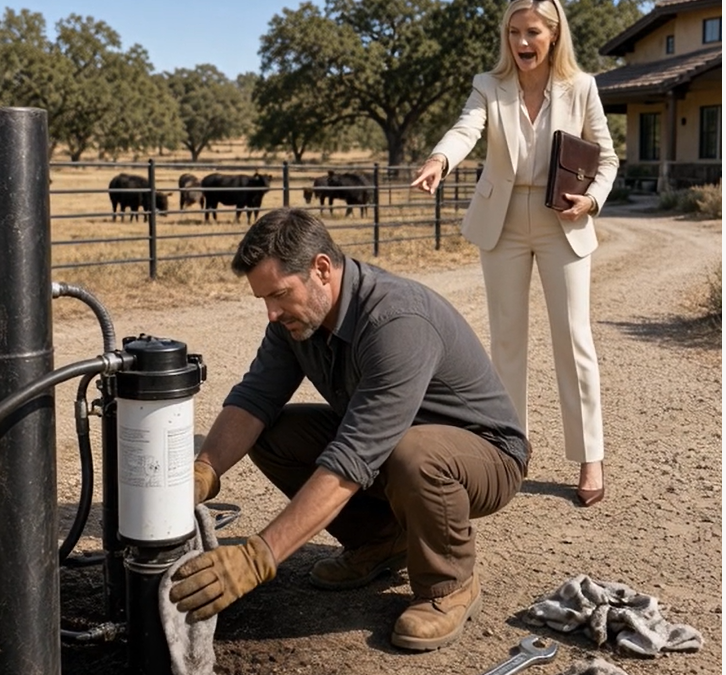
The first Tuesday in October, I shut down the pump.
Same thing I did every year.
Same thing Dad did before me.
If you operate a well in the Hill Country, you maintain it. You inspect the filter housing, flush sediment from the lines, check pressure controls, test the motor, inspect the check valves, and make sure decades of mineral buildup have not started turning routine maintenance into an emergency.
The process took about eight hours.
During those eight hours, no water moved through the main line.
The cattle drank from stock tanks I had filled the night before.
The house ran from the cistern.
Everything was planned.
Everything was routine.
What happened at the other end of my pipe was not routine.
By noon, my phone started buzzing with calls from numbers I did not recognize.
I let them go to voicemail.
The first message came from a woman I had never met asking if I knew why her kitchen faucet had stopped working.
The second came from a man demanding to know whether there was construction on the main line.
The third was Linda Caldwell.
She was not asking.
“Mr. Whitfield, I don’t know what you are doing out there, but sixty-two families have no running water. Fix it now.”
I stared at my phone for a long time.
My ranch.
My well.
My pump.
And sixty-two families I had never agreed to supply were calling because their faucets had gone dry during the same hour I shut off my own equipment.
At 12:47 p.m., Linda called 911.
I know the exact time because I requested the recording later.
It was a masterpiece of suburban emergency theater.
Linda began with tears, the kind of perfectly timed crying that sounds almost rehearsed once you hear it more than once. She told the dispatcher that children had no drinking water, elderly residents could not flush toilets, and the situation constituted a public-health emergency requiring immediate intervention.
The dispatcher asked whether she had contacted Ridgecrest’s water provider.
Linda paused.
The pause lasted four seconds.
Four seconds is an eternity on a 911 recording.
Then she said, “We don’t have a water provider. The water just comes.”
I played that sentence three times when I finally heard the recording.
The water just comes.
Linda had spent years as HOA president.
She collected dues.
Enforced fence colors.
Policed landscaping.
Cited people for trash cans.
Sent reminders about approved mailbox finishes.
Apparently cared about the angle of people’s porch lights.
Yet she could not identify the source supplying drinking water to sixty-two homes.
It just came.
Like magic.
Like divine entitlement.
Like the universe owed her plumbing.
Sheriff Tom Avery arrived at my ranch at 1:15 in a county cruiser. He stepped out with the deliberate patience of a man who had spent twenty years in law enforcement and learned that most emergencies were not actually emergencies.
Tom was fifty-five, lean, sun-browned, and built like a fence post. He had a voice that made you feel like you were already in trouble even when you were not.
“Whitfield,” he said, looking at the open pump house, “you know anything about Ridgecrest losing water?”
I told him exactly what I had done.
I had shut down my own pump, on my own property, to perform annual maintenance on a private well my grandfather drilled before Ridgecrest was anything but pasture.
Tom nodded slowly.
It was the kind of nod lawmen make when the math does not add up but the law clearly does.
“So why would your pump affect their water?”
“That,” I said, “is exactly what I’d like to know.”
He drove to Ridgecrest.
He spoke with several residents.
About forty minutes later, Tom returned and told me Linda had demanded that he arrest me for sabotaging community infrastructure.
He delivered the sentence with a perfectly straight face.
I respected that.
I could not have done it.
I completed the maintenance around six that evening. I replaced the filter cartridge, flushed accumulated sediment, checked the pressure controls, and restarted the pump.
Within twenty minutes, Ridgecrest Estates had water again.
I did not need a degree in hydrology to understand what that meant.
But I had one anyway.
That night, I pulled Dad’s pipe maps from the fireproof cabinet. I spread the old graph paper across the kitchen table and traced the six-inch main line from south to north, pasture to pasture.
Then I walked to the pump house and checked the gauge.
Before Ridgecrest existed, that well operated at approximately fifty-eight PSI year-round.
Steady as a heartbeat.
The gauge now read forty-one.
Seventeen pounds of pressure gone.
That was not wear.
That was not age.
That was demand.
Somebody was pulling water I had not authorized, in volumes I had not accounted for, through a connection I had never seen.
I sat on the pump-house step and listened to the night.
The low hum of the motor.
Cicadas grinding through their endless shift.
Cattle settling down in distant pastures.
I had spent ten years tracing leaks in city systems.
I had located unauthorized taps, tracked unexplained pressure losses, found connections buried where they were never supposed to exist.
I never imagined I would use those same skills on my own ranch.
But somewhere between Grandpa’s well and Linda Caldwell’s perfect subdivision, there was a pipe that did not belong.
And I was going to find it.
I did not sleep well.
That gauge reading kept repeating behind my eyelids.
Seventeen PSI.
Seventeen pounds of pressure that Dad’s system had never been designed to lose.
The following morning, I called Daryl Voss.
Daryl was an independent hydrological engineer from San Marcos. Fifty-five years old. Sun-weathered like a catcher’s mitt. One of the few people in Central Texas who could look at pressure behavior and tell you what was happening hundreds of feet down a buried line.
He had consulted on water-theft cases for three counties.
He had testified in federal court twice.
If someone had tapped my line, Daryl would find it faster than a bloodhound following bacon.
He arrived Thursday in a dented white truck packed with equipment.
Digital flow meters.
Acoustic detection equipment.
Pressure transducers.
A GPS unit accurate within inches.
We started at the wellhead and worked south along the main line.
Every fifty feet, we took another reading.
The numbers told the story before we ever saw the pipe.
At the wellhead, outbound pressure ran around fifty-seven pounds per square inch. Exactly where it should have been for that pump.
At the first branch feeding the north-pasture troughs, fifty-five.
Normal pressure loss over distance.
At the second branch, fifty-three.
Then, near a stretch of pasture by the old Dawson fence line, pressure dropped to thirty-nine.
Daryl squatted beside the pipe marker and looked toward Ridgecrest Estates.
“Well,” he said softly, “there she is.”
We were standing under a live oak about three hundred yards from the Ridgecrest boundary. The land dipped there into a shallow drainage basin where spring rain had carved channels through the caliche. It was the kind of place where a trench could be cut, filled, and forgotten once the grass grew back.
Daryl walked slowly, eyes down, listening through a ground microphone.
Water moving under pressure has a voice.
Through soil.
Through pipe.
Through limestone.
It sings in vibrations most people never notice.
Daryl noticed.
He stopped twenty paces from the fence.
“Here.”
I drove a survey flag into the ground.
Then another.
Then another.
By noon, the flags formed a line.
Not toward my troughs.
Not toward my pastures.
Toward Ridgecrest.
My stomach turned cold.
Daryl kept working, marking the suspected route until we reached the property boundary. There, half-hidden behind cedar scrub, was a buried valve box.
Not mine.
I knew every valve on that ranch.
Dad had taught me as a boy to walk the lines after hard freezes, after floods, after lightning storms. He used to tell me, “A rancher who doesn’t know where his water runs doesn’t own land. He’s just renting trouble.”
I knelt and scraped dirt from the lid.
The cover was green plastic, the cheap kind used in residential irrigation systems.
Daryl lifted it.
Inside sat a two-inch PVC line tied into my six-inch main with a saddle connection.
No meter.
No backflow preventer.
No pressure regulator.
No valve tag.
No county seal.
Just a clean theft hidden under dirt.
For a few seconds, I could not speak.
Anger is supposed to feel hot.
That is what people say.
Burning anger.
Red anger.
Fire in your chest.
Mine felt cold.
Cold enough to steady my hands.
Daryl looked at me carefully.
“You okay?”
“My father walked this line,” I said.
“I know.”
“He would have noticed this.”
“Depends when they put it in.”
That question sat between us.
When.
Because if Ridgecrest had been using my well since the day the subdivision opened, somebody had not merely stolen water.
They had built sixty-two homes around a lie.
Daryl photographed everything.
The connection.
The valve.
GPS coordinates.
Pressure readings.
Flow data.
The direction of the line.
The absence of required safeguards.
Then he said the words I already knew were coming.
“Don’t touch it.”
“I know.”
“I mean it, Whitfield. Don’t cap it. Don’t cut it. Don’t damage it. Not yet.”
“I know.”
“If this goes legal, evidence matters.”
I stood and looked over the fence at Ridgecrest Estates.
From that distance, it looked peaceful. Red-tile roofs. Beige stucco. Manicured lawns too green for October. Decorative fountains at the entrance throwing stolen water into the air like celebration.
One of those fountains had a bronze plaque in front of it.
Dedicated to Glenn Caldwell, Visionary Founder.
Linda’s husband.
That evening, I opened every box Dad had left in the office.
Receipts.
Permits.
Land surveys.
Easement agreements.
Old photographs.
Weather logs.
Cattle records going back to the seventies.
Dad kept everything because he came from a generation that believed paper was armor.
Near midnight, I found the first piece.
A letter dated April 2014.
It was from Caldwell Development Group to Earl Whitfield.
Dear Mr. Whitfield,
As discussed, we are exploring temporary construction water access during early infrastructure development at Ridgecrest Estates. We understand your private well system is not available for subdivision service. However, we would appreciate the opportunity to purchase limited metered water for dust suppression and concrete work during Phase One construction.
The letter was signed by Glenn Caldwell.
Dad had written his response in pencil at the bottom.
No permanent service. Temporary metered construction use only. Must be disconnected before first occupancy. Earl W.
Attached was a short-term agreement.
Six months.
Construction only.
Metered.
Disconnect required before the first home certificate of occupancy.
My hands tightened around the paper.
There had been a legal connection once.
Temporary.
Limited.
Paid.
And then, somehow, temporary had become permanent.
Limited had become sixty-two houses.
Paid had become stolen.
I found the invoice records next. Dad had billed Caldwell Development for construction water across five months in 2014.
Then the invoices stopped.
After that, nothing.
No renewal.
No permanent contract.
No easement.
No water-service agreement.
No letter authorizing Ridgecrest residents to draw a single gallon from Whitfield Ranch.
I sat at Dad’s desk until nearly two in the morning, staring at his pencil marks.
No permanent service.
He had known enough to protect us.
But someone had ignored him.
No.
Worse.
Someone had waited until ignoring him became convenient.
I found another folder marked Caldwell, Glenn.
Inside was a handwritten note from Dad to himself.
Pressure drop again. Called Caldwell. Claims subdivision on county water. Says temporary line removed. Need verify after south fence repair.
The note was dated May 2016.
A month later, Dad fell off the hay trailer and shattered his hip.
Three months after that, Mom’s heart failure worsened.
Life swallowed the question.
The theft continued.
I leaned back in Dad’s chair and felt grief hit me in a shape I had not known before. Not just missing him. Not just missing Mom. But realizing that while my father was carrying pain, doctors, bills, cattle, and a wife he loved more than sleep, someone had been draining the inheritance he spent his life protecting.
The next morning, Linda came back.
She did not come alone.
Two HOA board members followed in separate vehicles. One was a retired banker named Preston Hale, thin and nervous in a golf shirt. The other was a woman named Marcy Dell, who ran the HOA social committee and looked at my barn as if tetanus might leap across the driveway.
Linda stepped out holding a manila envelope.
I was feeding calves near the barn.
“You need to sign this,” she called.
I did not move toward her.
“Good morning to you too.”
“This is not a social visit.”
“Your visits rarely are.”
She marched across the gravel, heels sinking slightly with every step. Preston stayed near his Mercedes. Marcy looked like she regretted volunteering for whatever this was.
Linda shoved the envelope toward me.
I did not take it.
“What is it?”
“A cease-and-desist notice.”
“From whom?”
“The Ridgecrest Estates HOA.”
“You can cease and desist yourself right back to your car.”
Her nostrils flared.
“You intentionally shut off water to our community.”
“I shut off my private pump.”
“You created a dangerous situation.”
“No. Whoever connected your community to my private pump created a dangerous situation.”
Preston’s head snapped up.
Marcy whispered, “Linda?”
Linda ignored her.
“You don’t know what you’re talking about.”
“I know exactly what I’m talking about.”
“No, you don’t.” She stepped closer and lowered her voice. “You are one man on a failing ranch. I know you think this land makes you important, but it doesn’t. Ridgecrest has attorneys, money, influence, and sixty-two families who will testify that you threatened their health and safety.”
I looked past her at Preston and Marcy.
“Did she tell you there is an illegal tap into my main line?”
Preston went pale.
Marcy said, “Illegal?”
Linda spun toward them. “Do not engage with him.”
That told me everything.
I smiled then.
Not because I was amused.
Because my father always said a person who cannot answer a simple question has already confessed.
“I’m filing a report with the county,” I said.
Linda’s face changed.
For the first time, I saw fear.
Then rage covered it.
“You listen to me,” she hissed. “People in Ridgecrest paid for their homes. They pay dues. They pay taxes. They deserve water.”
“They do,” I said. “Legal water.”
“Don’t be stupid. You shut this off, and families suffer.”
“I didn’t build homes without a water provider.”
“That’s not their fault.”
“No,” I said. “It isn’t.”
For one second, the words softened something between us.
Because the truth was, most Ridgecrest residents were not my enemy. They had bought homes in good faith. Raised children there. Planted gardens. Paid mortgages. Filled baby bottles. Washed dishes. Trusted that when they turned a faucet, what came out had been properly permitted, treated, monitored, and paid for.
But Linda did not care about them.
Not really.
If she had, she would have told them the truth.
She would have helped fix it.
Instead, she weaponized them.
Linda stepped back, lifted the envelope, and dropped it at my feet.
“You’ll regret this.”
I looked down at the paper in the dust.
“No,” I said. “I think you will.”
I filed the report that afternoon.
Sheriff Avery took the evidence seriously.
So did the county water authority.
So did the state regulators once Daryl sent his preliminary findings.
A private well unlawfully supplying sixty-two homes was not a neighbor dispute.
It was a public-health issue.
It was a regulatory issue.
It was possible fraud.
And it was theft.
Within seventy-two hours, two county inspectors arrived with clipboards, sealed sample bottles, and expressions that suggested nobody had slept enough since receiving my complaint. Daryl met them at the site. Sheriff Avery came too, not because it was required, but because Linda had already called his office nine times accusing me of harassment, water terrorism, intimidation, agricultural negligence, and emotional extortion.
The first inspector, a woman named Rosa Medina, wore steel-toed boots and no patience.
She examined the illegal connection without speaking for a full minute.
Then she stood and said, “Who installed this?”
“That’s what I’d like to know,” I replied.
She looked at Daryl.
He handed her his report.
Rosa read three pages right there in the pasture.
“This line enters Ridgecrest property?”
“Yes,” Daryl said.
“Metered?”
“No.”
“Backflow prevention?”
“No.”
“Chlorination or treatment?”
“No.”
“Licensed operator?”
“No evidence of one.”
Rosa exhaled through her nose.
The second inspector, a younger man named Elliot, whispered, “Jesus.”
Rosa turned toward him.
“Not in the report.”
“Yes, ma’am.”
They traced the line to the Ridgecrest side. It disappeared under a landscaped berm near the entrance, then tied into a utility vault hidden behind decorative shrubs. The vault contained distribution piping feeding the subdivision’s internal network.
No provider label.
No master meter.
No operational log.
No required testing records.
Just buried pipes carrying my family’s water into homes sold as luxury Hill Country living.
By noon, county vehicles were parked outside the Ridgecrest clubhouse.
By one, Linda was there with her attorney.
By two, the residents knew something was wrong.
I did not attend the first meeting. I was not invited, and if I had been, I would not have gone. But Hank Morrison had a nephew living in Ridgecrest, and news traveled across ranchland faster than lightning when it involved lawyers, water, or somebody finally getting what they deserved.
According to Hank’s nephew, the clubhouse filled with residents who thought they were attending an informational update about “temporary water disruptions caused by neighboring agricultural interference.”
That was Linda’s phrase.
Neighboring agricultural interference.
She stood at the front of the room with a microphone, her husband Glenn beside her in a navy blazer, his silver hair combed neatly back. Glenn Caldwell had the smooth face of a man who learned early that money could polish almost anything except character.
Linda began by blaming me.
She told residents I had “weaponized a technicality.” She said I was attempting to “extract financial concessions” from the community. She called my complaint “retaliation” for the HOA’s reasonable attempts to address livestock nuisance issues.
Then Rosa Medina stood up.
She had not been given the microphone.
She did not need it.
“Mrs. Caldwell,” Rosa said, “are you stating publicly that Ridgecrest Estates has a lawful water-service agreement with Whitfield Ranch?”
The room went silent.
Linda blinked.
Her attorney leaned toward her, whispering urgently.
Glenn put a hand on her arm.
Rosa waited.
Linda smiled a brittle smile.
“This is not the appropriate forum for technical questions.”
A man in the second row stood.
His name, I later learned, was Daniel Price. He had two daughters and a mortgage that ate half his paycheck.
“It’s appropriate to me,” he said. “I bought a house here. Who provides our water?”
Linda looked at Glenn.
Glenn looked at the floor.
That was the moment the first crack opened.
People can tolerate arrogance when it protects comfort.
They can even admire it.
But when arrogance threatens their children’s drinking water, admiration turns quickly.
Another resident stood.
Then another.
A woman asked why their monthly HOA dues included a “community infrastructure fee” if there was no contracted water provider.
An elderly man asked whether their water had been tested.
A mother asked whether baby formula mixed with that water was safe.
Linda tried to regain control.
“Please, everyone, there is no need for panic.”
Rosa cut in.
“There is need for accurate information.”
The room erupted.
By sundown, Ridgecrest was no longer one neighborhood.
It was sixty-two households calculating how much trust had cost them.
The next morning, I found a note taped to my gate.
Not a legal notice.
Not HOA stationery.
A handwritten note on yellow paper.
Mr. Whitfield,
We are the family at 18 Winding Star Lane. We did not know. We are sorry. Our youngest has medical issues and needs water for her equipment. We are scared. Please understand most of us had no idea what was happening.
The note was signed Claire, Daniel, Sophie, and Grace Price.
I stood at the gate a long time holding that paper.
Anger is easier when everyone on the other side looks guilty.
It gets harder when you see innocent people standing behind the guilty ones, holding children, medicine, bills, and fear.
I drove to Ridgecrest that afternoon.
The entrance fountains were turned off.
For the first time since I had known the place existed, the stone sign looked honest.
Dry.
Silent.
Decorative without pretending to be alive.
I parked in front of 18 Winding Star Lane.
Daniel Price opened the door before I knocked. He looked younger than I expected, maybe thirty-seven, with tired eyes and sawdust on his jeans. Behind him, a little girl sat on the couch connected to a portable oxygen concentrator. Her older sister watched me with solemn distrust from the hallway.
A woman came from the kitchen wiping her hands on a towel.
“I’m Claire,” she said softly.
“I’m Mason Whitfield.”
No one asked me in right away.
I did not blame them.
Finally Daniel stepped aside.
Their house was neat but not fancy. Toys in a basket. School papers on the fridge. A stack of medical bills on the counter, half-hidden under a grocery flyer. The kind of home where people were doing their best and still losing sleep.
Claire poured coffee she did not drink.
“I swear we didn’t know,” she said.
“I believe you.”
She closed her eyes briefly, relief and shame passing over her face together.
Daniel leaned against the counter.
“When we bought, Caldwell Development said the community had independent water infrastructure. It was in the sales packet. We paid connection fees at closing. We pay the HOA every month.”
“How much?”
“Four hundred and eighty dollars.”
“A month?”
He nodded.
“For what?”
“Maintenance. Roads. Pool. Landscaping. Infrastructure.”
“Infrastructure,” I repeated.
Daniel’s jaw tightened.
“Yeah.”
Claire looked toward the living room, where the younger girl’s machine hummed gently.
“Grace needs distilled water for some things, but we still use tap water for cleaning equipment, bathing, laundry. If the water gets shut off suddenly…” Her voice broke. “We can’t just wait around for lawyers.”
I looked at Grace.
She was maybe six, pale and sharp-eyed, wearing purple socks and holding a stuffed horse.
She stared back.
“Are you the cow man?” she asked.
Her mother flushed.
“Grace.”
I smiled.
“I am.”
“Your cows look sad.”
“They’re not sad. That’s just their faces.”
Grace considered this.
“My dad looks like that before bills.”
Daniel laughed once, surprised and weary.
I looked at him.
“I’m not going to shut off the water without notice. Not unless there is an immediate safety reason.”
Claire pressed a hand over her mouth.
“But this can’t continue the way it is,” I said. “The connection is illegal. It could contaminate my system and yours. It’s unmetered. It’s unmanaged. It puts everyone at risk.”
Daniel nodded.
“What happens now?”
“County will issue orders. Ridgecrest will need emergency service, storage tanks, maybe a temporary legal connection if approved. Long-term, you need your own permitted well system or a contract with a utility.”
“And the cost?”
I did not answer immediately.
Because we all knew.
The cost would be ugly.
Daniel looked down.
Claire whispered, “We put everything into this house.”
“I know,” I said.
That was the worst part.
Linda and Glenn Caldwell had not stolen only from me.
They had stolen certainty from everyone.
Over the next two weeks, the investigation widened.
County records showed Ridgecrest Estates had filed preliminary infrastructure documents during development, claiming water service would be provided by a “private community well system.” But no completed well permit existed. No licensed operator was registered. No annual testing logs were filed. No approved public water system number was issued.
The “community well” shown in early marketing materials was never drilled.
There had been estimates.
Site plans.
A proposed treatment shed.
A budget line.
Then nothing.
Instead, sometime after Dad’s temporary construction-water agreement expired, Caldwell Development quietly left the connection in place and built the entire subdivision around my line.
The most damning document came from a former Caldwell employee named Mark Ellison.
He was a project manager during Phase One.
I had never heard of him until he called me on a Sunday night.
His voice shook.
“Mr. Whitfield, I need to tell you something, but I need to know if this call is recorded.”
“It isn’t.”
“I worked for Glenn Caldwell.”
I sat up straighter in Dad’s chair.
“Go on.”
“I installed that connection.”
The room seemed to drop away.
“Under whose instruction?”
He was silent for a moment.
“Glenn’s. But Linda knew.”
I closed my eyes.
Mark breathed unevenly on the other end.
“The temporary line was supposed to be capped. Your father kept asking about it. Glenn told us to leave it until the subdivision well was finished. Then the well bids came in higher than expected. Treatment requirements were going to cost more. Glenn was overleveraged, and presales were already closing.”
“So he kept using our water.”
“Yes.”
“For eight years.”
“I left after Phase Two. I should have reported it. I know that. But I had a newborn, and Glenn threatened to ruin me. He said your father had agreed verbally.”
“My father did not agree verbally.”
“I know that now.”
“Did you know it then?”
Mark did not answer.
That was answer enough.
He agreed to speak to Sheriff Avery.
Three days later, he gave a sworn statement.
In it, Mark described a meeting held in Caldwell Development’s temporary construction trailer in August 2015. Glenn Caldwell, Linda Caldwell, Mark Ellison, and a contractor named Beau Riggs were present. According to Mark, Glenn said drilling and permitting a community well system would “kill the margin” and delay closings.
Linda allegedly said, “The ranch line works. Buyers don’t care where water comes from as long as it comes.”
Mark wrote that he objected.
Glenn replied, “Then don’t put your name on it.”
Beau Riggs was harder to find.
He had left Texas years earlier after a string of unpaid subcontractors took him to court. Sheriff Avery located him in Oklahoma running heavy equipment under a different company name. At first Beau denied everything.
Then Mark’s statement was read to him.
Then he remembered.
Funny how memory improves when prison becomes a possibility.
Beau admitted his crew buried the permanent tie-in under Glenn Caldwell’s direct supervision. He said Linda visited the site twice and asked whether the line was “invisible from Whitfield’s side.” He also said Glenn paid the final invoice in cash.
Cash.
No paper trail.
No accounting.
No problem.
Until a rancher shut off a pump for one day.
While investigators worked, Ridgecrest residents turned on each other.
Some blamed Linda and Glenn immediately.
Others blamed me because blaming me was easier than admitting they had been fooled. A few sent cruel messages. One said my “greed” was endangering children. Another called me a bitter ranch hick clinging to land I could not manage.
Someone left a dead snake in my mailbox with a note that read, Hope your cows get thirsty.
Sheriff Avery increased patrols.
Hank Morrison started driving by my place twice a day with a shotgun in the rack and gospel music loud enough to scare coyotes.
I told him he did not have to.
He said, “I know.”
That was Hank.
Linda filed for a temporary restraining order, claiming I had threatened to terminate Ridgecrest’s water access out of malice. Her petition described me as unstable, hostile, and financially desperate. It included photographs of my cattle, my barn, my rusted tractor, and a close-up of my muddy boots from the day she called 911.
The implication was clear.
Look at him.
Look at where he lives.
Look at what he is.
The hearing was scheduled for a Thursday morning at the county courthouse.
I wore my father’s belt buckle and my grandfather’s watch.
Not because they matched.
Because I needed both.
The courtroom smelled like old wood, floor polish, and nervous people. Ridgecrest residents filled three rows. Linda sat at the front with Glenn and two attorneys from Austin. She wore a cream suit and pearls, her hair smooth, her posture perfect.
She looked like a woman who had never been denied anything permanently.
I sat with my attorney, Rachel Kim, a compact woman with sharp eyes and a voice so calm it made opponents underestimate her right up until she removed their knees.
Rachel had been recommended by Daryl.
“She eats fraud cases for breakfast,” he told me.
He was not wrong.
Linda’s attorney opened by painting me as a reckless landowner using essential water access to punish a residential community. He spoke of children, sanitation, elderly residents, public health. He used the word humanitarian three times.
Then Rachel stood.
“Your Honor,” she said, “my client is not a utility provider. He is not contracted with Ridgecrest Estates. He has never received payment from Ridgecrest Estates. He has never authorized residential water service to Ridgecrest Estates. The petitioners are asking this court to compel a private citizen to continue supplying stolen water through an illegal, unmetered connection installed without his knowledge.”
The courtroom changed.
It was subtle.
People leaned forward.
Linda’s attorney objected to the word stolen.
Rachel lifted a document.
“I will gladly use unauthorized until the criminal investigation concludes.”
The judge, a tired-looking man named Benton, adjusted his glasses.
“Proceed.”
Rachel did.
She entered Dad’s temporary construction-water agreement.
The expiration date.
The invoices.
The absence of renewal.
Daryl’s pressure report.
Photographs of the illegal connection.
The county’s preliminary violation notice.
Mark Ellison’s sworn statement.
Linda’s face grew paler with each exhibit.
Then Rachel played the 911 call.
The dispatcher’s voice filled the courtroom.
“Who is your water provider, ma’am?”
Linda’s recorded pause filled the room like a held breath.
Then her voice:
“We don’t have a water provider. The water just comes.”
No one moved.
I did not look at Linda.
I looked at the Ridgecrest residents.
Claire Price was in the second row. Daniel sat beside her. His hand covered hers.
Behind them, I saw anger changing direction.
Rachel stopped the recording.
“Mrs. Caldwell has represented herself as HOA president responsible for community infrastructure. Yet when asked during an emergency who supplied water to the neighborhood, she could not name a provider because there was none. The water did not ‘just come.’ It came from my client’s private well.”
Linda’s attorney requested a recess.
Judge Benton denied it.
Then Linda testified.
I will give her this.
She was good at first.
She spoke softly. She said Ridgecrest families were victims of a misunderstanding. She claimed Glenn had managed development infrastructure and that she, as HOA president, had relied on assurances that everything was proper. She said her only concern was residents’ safety.
Rachel waited patiently.
Then she approached the witness stand with one sheet of paper.
“Mrs. Caldwell, did you send this letter to Mason Whitfield in March?”
Linda glanced at it.
“I sent many letters.”
“Please answer.”
“Yes.”
Rachel read aloud.
“Your cattle operation is creating odor and visual disturbance inconsistent with the quality of life expected by Ridgecrest residents. Failure to mitigate may result in legal and regulatory escalation.”
She looked up.
“What regulatory authority does the Ridgecrest HOA have over Whitfield Ranch?”
Linda shifted.
“We were seeking cooperation.”
“That was not my question.”
“No direct authority.”
Rachel nodded.
She showed another letter.
“And this one, alleging aggressive visual trespass by livestock?”
A low murmur moved through the courtroom.
Linda’s cheeks reddened.
Rachel continued.
“Mrs. Caldwell, in the months before my client discovered the illegal water connection, did you repeatedly attempt to pressure him into reducing or removing cattle from the boundary area near the hidden tap?”
Linda’s attorney objected.
Judge Benton allowed the question.
Linda swallowed.
“I objected to nuisance conditions.”
“Did you know the illegal tap was near that boundary?”
“No.”
Rachel picked up another document.
“This is a text message from your husband to you, recovered through a cooperating witness who was copied on the original thread. It is dated June 14, 2015. Glenn Caldwell wrote: ‘Once tie-in is buried, keep Whitfield cattle/fence activity away from west edge. Last thing we need is Earl poking around.’ You replied: ‘I can manage neighbors better than you manage contractors.’ Did you send that text?”
The courtroom exploded.
Judge Benton pounded his gavel.
Linda stared at the paper as if it had crawled up from hell and bitten her.
“Mrs. Caldwell,” Rachel said, “did you send that text?”
Linda’s mouth opened.
No sound came out.
Glenn stood abruptly.
His attorney grabbed his sleeve and pulled him down.
Rachel’s voice remained calm.
“Did you send it?”
Linda whispered, “I don’t recall.”
Rachel looked at the judge.
“No further questions.”
The restraining order was denied.
But that hearing did something far bigger.
It publicly broke Linda Caldwell’s story.
By the time we walked out of the courthouse, reporters from two local stations were waiting on the steps. I had not called them. Someone from Ridgecrest had.
Linda tried to cover her face with a folder.
Glenn shoved past a camera and snapped, “This is private property business.”
A reporter asked, “Did you sell homes without legal water service?”
Glenn kept walking.
Linda turned back.
That was her mistake.
“This is being exaggerated by a disgruntled ranch owner,” she said.
The reporter asked, “Is it true the subdivision’s water came from Mr. Whitfield’s private well?”
Linda’s face hardened.
“Mr. Whitfield has benefited from community growth for years while refusing to modernize his land. Ridgecrest brought value to that area.”
I was three steps behind her.
I stopped.
So did everyone else.
There are moments when dignity requires silence.
And there are moments when silence lets a lie dress itself as truth.
I turned to the cameras.
“My grandfather drilled that well in 1962,” I said. “My father protected it his entire life. Ridgecrest Estates took water from it without a contract, without a meter, and without my knowledge. I don’t blame families who bought homes believing their developer told the truth. But I will not apologize for discovering my family’s water was stolen.”
Linda laughed under her breath.
Unfortunately for her, a microphone caught it.
By evening, the story was everywhere locally.
The Water That “Just Comes.”
HOA President Accused of Hiding Illegal Water Tap.
Ranch Well Supplied Luxury Subdivision for Years, Records Show.
The internet did what the internet does.
Some people made jokes about “aggressive visual trespass cows.” Someone created a picture of a Hereford wearing sunglasses with the caption, I Saw The Water Theft. The entrance fountain plaque became a target. People drove by taking photos until the sheriff put up temporary signs warning against blocking traffic.
But inside Ridgecrest, it was not funny.
Property values froze overnight.
Two pending home sales collapsed.
The HOA board called an emergency meeting, removed Linda as president, and appointed Preston Hale as interim chair. Linda tried to challenge the vote, but even her loyal friends would not look at her.
Preston came to my ranch two days later.
He stood at the gate, hat in hand, looking ten years older than he had during Linda’s cease-and-desist visit.
“Mr. Whitfield,” he said, “I owe you an apology.”
I opened the gate.
He stepped through but did not come far.
“I should have asked more questions,” he said. “I was treasurer for three years. Linda and Glenn handled infrastructure fees through Caldwell Management before funds moved to the HOA operating account. I didn’t push. I trusted the reports.”
“That trust cost people.”
“I know.”
His voice broke on the second word.
For the first time, I felt sorry for him.
Not enough to excuse him.
But enough to see the man beneath the mistake.
“County says we need an emergency plan,” he said. “Temporary tanks, hauled water, usage restrictions. They also said a temporary legal connection to your well may be possible while we secure independent water service, but only if you agree.”
I looked toward the pasture.
My cattle grazed under the same sky as Ridgecrest’s children.
Water had become a weapon because Glenn and Linda made it one.
I did not want to do the same.
“I’ll consider a temporary emergency agreement,” I said. “Metered. Paid. Permitted. Inspected. Backflow protection installed. Strict volume caps. No irrigation. No pool. No fountains. Human household use only.”
Preston nodded quickly.
“Of course.”
“And Ridgecrest pays for an independent review of my entire water system. If your illegal connection damaged my pump, lines, aquifer access, or livestock operations, you cover it.”
“Yes.”
“And Linda and Glenn have no control over a penny of it.”
His jaw tightened.
“They’re done,” he said.
“They’re not done until they’re accountable.”
He looked at me then, and I saw the difference between embarrassment and resolve.
“You’re right.”
For the next month, Ridgecrest lived under restrictions.
No lawn watering.
No car washing.
No pool.
No fountains.
Temporary tanks sat behind the clubhouse. Water trucks came twice a day. Children watched from sidewalks as men in reflective vests connected hoses to storage systems where decorative landscaping used to be.
The community changed.
Lawns browned.
The pool stayed covered.
The entrance fountains remained dry.
And for the first time, residents began to understand the difference between appearance and infrastructure.
One evening, I found Claire Price at my gate.
She carried a casserole dish covered in foil.
“I know this is awkward,” she said.
“Most honest things are.”
She smiled faintly.
“I made chicken spaghetti. It’s probably too much cheese, but Daniel says that’s not a real problem.”
I took the dish.
“Thank you.”
She lingered.
“Grace wanted me to ask if she can see the cows sometime.”
I looked toward the pasture.
“She can.”
Claire’s eyes filled quickly, like she had been holding too much back for too long.
“I hated you for about twelve hours,” she admitted.
“I figured.”
“I thought you were this cruel ranch man who didn’t care if my daughter suffered.”
“I care.”
“I know that now.”
The wind moved through the cedar trees.
Claire wrapped her arms around herself.
“Linda used us,” she said. “She kept telling everyone you were threatening our homes because you hated Ridgecrest. She said ranch people resent progress. She said you wanted a payout.”
“She said many things.”
“I believed some of them.”
“At least you stopped.”
Claire looked at me.
“How do you stay so calm?”
I almost laughed.
“I don’t. I just learned not to hand my anger to people who would use it against me.”
She nodded like that sentence cost more than it sounded.
Grace visited the next Saturday.
Daniel carried her across the rough ground while Sophie, her older sister, walked beside them pretending not to be excited. I introduced them to a gentle old cow named Mabel who had survived drought, hail, coyotes, and one unfortunate incident involving a feed bucket stuck on her head.
Grace touched Mabel’s forehead with two fingers.
“She’s warm,” Grace whispered.
“Most living things are.”
“Does she know people stole her water?”
Daniel closed his eyes.
Sophie said, “Grace.”
But I crouched beside her.
“I think she knows something was wrong.”
“Is she mad?”
“Mabel doesn’t waste much energy on mad. She just remembers where the good grass is.”
Grace considered that deeply.
“I want to be like Mabel.”
“So do I,” Daniel said.
I did not realize until later how much that day mattered.
Not because children petting cows fixes fraud.
It does not.
But because healing rarely arrives as one grand event. Sometimes it begins with a sick little girl touching a cow’s forehead and learning the person her neighborhood blamed is not a villain.
Meanwhile, the case against Glenn and Linda grew teeth.
Financial records showed Ridgecrest homeowners had paid over $1.2 million in infrastructure and water-related fees across eight years. Some of that money went to maintenance and landscaping, but hundreds of thousands flowed through Caldwell-linked management entities with vague descriptions like systems administration, resource access, and service continuity.
There were no payments to Whitfield Ranch.
No payments to a licensed water provider.
No drilling invoices for the promised community well.
No treatment-system installation.
The money had gone somewhere.
Investigators found where.
A lake house in Horseshoe Bay.
A renovation on the Caldwell home.
Luxury vehicles leased through business accounts.
Private-school tuition categorized as executive community relations.
Linda’s designer wardrobe had apparently been purchased, in part, through something called resident-facing brand presentation.
When Rachel told me that, I had to sit down.
“Resident-facing brand presentation,” I repeated.
“She bought handbags with water fees,” Rachel said.
“That sounds less elegant.”
“Fraud usually does.”
The civil lawsuits came first.
Ridgecrest homeowners sued Caldwell Development Group, Glenn Caldwell, Linda Caldwell, and affiliated management companies. Their claims included fraud, negligent misrepresentation, breach of fiduciary duty, unjust enrichment, and violations related to real-estate disclosures.
Then came criminal charges.
Glenn was charged with theft of service, fraud, tampering with public records, and conspiracy.
Linda was charged with fraud, conspiracy, and making false statements connected to HOA financial reporting.
Beau Riggs took a deal.
Mark Ellison cooperated fully.
The day Linda was booked, she wore sunglasses into the courthouse garage even though it was overcast. Cameras caught her pushing past a reporter with the same cold mouth she had worn at my pump house.
“Mrs. Caldwell, do you have anything to say to Ridgecrest residents?”
She stopped.
For one strange second, I thought she might apologize.
Instead, she said, “They should be grateful we built them a community worth fighting over.”
That clip ran for three days.
If any Ridgecrest resident still felt sorry for her, that ended it.
But justice, real justice, does not move at the speed of public outrage.
It drags.
It files motions.
It delays hearings.
It requests extensions.
It makes victims repeat pain in rooms with fluorescent lights.
Winter came.
Ridgecrest secured a temporary permitted water arrangement using hauled water and a limited metered connection from my well under county supervision. I agreed to it because families needed time. The agreement was strict, expensive, and temporary. Every gallon was measured. Every test was logged. Every valve was inspected.
For the first time in eight years, the water leaving my ranch had a number attached to it.
When I saw the monthly usage report, I had to sit down again.
Ridgecrest had been drawing far more than I imagined.
Not just household water.
Irrigation.
Pool refills.
Fountains.
Common-area landscaping.
Pressure washing.
All from my grandfather’s well.
Daryl estimated the added load had shortened the life of my pump and strained the aquifer draw around my property. My cattle troughs had likely suffered reduced pressure during summer peaks for years.
I remembered dry troughs Dad blamed on valves.
I remembered him limping after his hip surgery, frustrated because he could not trace every problem himself.
I remembered the note.
Pressure drop again.
Called Caldwell.
Claims subdivision on county water.
Says temporary line removed.
Need verify after south fence repair.
I kept that note in my wallet.
Not because it helped the case.
Because it reminded me this was not only my fight.
It was Dad’s unfinished question.
In February, Glenn Caldwell’s attorneys offered settlement.
The number was large enough to make Rachel raise her eyebrows.
It included compensation for stolen water, system damage, legal fees, and confidentiality.
Confidentiality.
That one word almost made me laugh.
Glenn wanted to buy silence with the same arrogance he had used to steal water.
Rachel slid the offer across her desk.
“You don’t have to decide today.”
“I’ve decided.”
She smiled slightly.
“I thought you might say that.”
“No confidentiality.”
“They’ll increase the number.”
“No.”
“Mason, I need to make sure you understand. This could fund repairs, ranch operations, future security, everything.”
“I understand.”
“Then tell me why.”
I looked out her office window at the courthouse square.
“Because if this disappears behind a settlement, Glenn and Linda get to call it a misunderstanding forever. Ridgecrest residents deserve the truth on record. My father deserves the truth on record.”
Rachel nodded.
“No confidentiality,” she said.
The case moved forward.
Spring came green and bright, the kind of Hill Country spring that makes even tired land look forgiven. Bluebonnets spread along the fence lines. Calves bucked in the pasture like joy had entered their legs without permission. Ridgecrest lawns remained patchy, but residents had started replacing thirsty landscaping with native plants.
Someone painted over the entrance plaque.
Visionary Founder disappeared under primer.
In its place, for a while, there was only blank stone.
I liked it better.
Then one morning, I received a letter.
The handwriting was shaky.
Mr. Whitfield,
My name is Margaret Faulkner. My late husband Gerald’s name was used on that petition against your ranch. I did not know until someone showed me the copy. Gerald loved cattle. He grew up on a dairy farm. He used to say your cows made Ridgecrest feel less fake.
I am ashamed his name was used to hurt you.
I am enclosing something he kept from when the subdivision was built. I do not know if it matters, but I think you should have it.
Inside was a photograph.
It showed Ridgecrest during construction, before homes covered the land. In the background stood a trench, open and raw, running toward the Whitfield fence line. Two men were visible near the trench. One was Glenn Caldwell. The other was Beau Riggs.
On the back, Gerald had written:
Told Margaret that looks like a water line to Whitfield side. Glenn says temporary. Don’t trust him.
I sat at the kitchen table holding that photograph and cried harder than I had cried in months.
Not because it was the strongest evidence.
It was not.
I cried because Gerald Faulkner, a dead man whose name Linda had forged, had noticed the truth years before anyone listened.
He had seen the line.
He had not trusted Glenn.
And then his name had been used to attack me.
Some cruelties are so layered that when you finally understand them, anger is not enough.
You need grief too.
I drove to Margaret’s house that afternoon.
She was eighty, small, and sharp-eyed, with white hair pinned neatly at the back of her head. Her living room was full of framed photographs: Gerald in uniform, Gerald holding a baby, Gerald beside a tractor, Gerald laughing over a birthday cake.
She made tea.
“I should have spoken up when Linda brought that petition,” she said.
“You didn’t sign it.”
“No, but I knew she was trouble. Gerald did too. After he died, she became very attentive. Too attentive. Always checking whether I needed help with HOA matters. I thought she was being kind.”
“Predators often practice kindness first.”
Margaret looked at me for a long moment.
“You’ve had to learn that.”
“Yes, ma’am.”
She touched the edge of Gerald’s photograph.
“He would have liked you.”
“I think I would have liked him.”
“He hated fake people.”
“Then he would have been busy in Ridgecrest.”
Margaret laughed, and for a second the room felt lighter.
Before I left, she took my hand.
“Don’t let them make you hard, dear.”
I did not know what to say.
She squeezed my fingers.
“Strong is not the same as hard.”
That sentence stayed with me.
The final hearing in the civil case happened in August, almost ten months after I shut down the pump.
By then, Ridgecrest had approved a plan for its own legal water infrastructure: a properly permitted well field, treatment system, storage tank, licensed operator, and emergency interconnection plan. It would take time and money. Special assessments hit every household, though the court later ordered Caldwell assets to cover a significant portion.
Some residents had to sell.
That hurt to watch.
The Prices almost did. A fundraiser organized by Ridgecrest neighbors helped them stay. Not a glossy HOA event with catered wine and speeches, but real neighbors showing up with checks, casseroles, babysitting, and hands willing to repair what arrogance had broken.
Ridgecrest was becoming a community only after losing the illusion of one.
At the courthouse, Glenn looked smaller.
Not humble.
Just cornered.
Linda looked immaculate as ever, but something in her brightness had gone brittle. Her hair was perfect. Her cream dress was perfect. Her pearl earrings were perfect.
Her eyes were ruined.
Not by remorse.
By fury that consequences had found her.
The settlement was read into the record without confidentiality. Caldwell Development and related entities agreed to substantial damages to Whitfield Ranch and Ridgecrest homeowners. Assets were liquidated. The lake house, vehicles, and several accounts were frozen or surrendered. Glenn later pled guilty to reduced criminal charges in exchange for restitution and cooperation on the remaining financial tracing.
Linda refused a plea at first.
She claimed she was being scapegoated.
She claimed Glenn controlled everything.
Then prosecutors produced the text messages, financial approvals, forged petition evidence, and meeting notes from Caldwell Management showing her involvement in fee allocation.
She took a deal the week before trial.
At sentencing, Ridgecrest residents were allowed to speak.
Daniel Price stood first.
He held a folded paper, but when he looked at Linda, he put it down.
“My daughter Grace asked me why the water stopped,” he said. “I told her adults made selfish choices. That was the gentlest truth I could give a six-year-old. But the fuller truth is this: you let families build lives on top of your lie. You smiled at block parties. You held Christmas drives. You complimented our children. And the whole time, you knew the thing we depended on most had been stolen from a neighbor you taught us to hate.”
Linda stared straight ahead.
Daniel’s voice shook.
“You didn’t just steal water. You poisoned trust.”
Claire cried silently behind him.
Margaret Faulkner spoke next.
She walked slowly to the front with a cane.
“My husband’s name was forged on a petition against Mr. Whitfield,” she said. “Gerald believed a person’s name was the last piece of property nobody could take unless you let them. Mrs. Caldwell took his. I want the court to know that.”
Linda looked down then.
Not long.
But she looked down.
When it was my turn, I carried Dad’s note.
My hands were steady.
I faced the judge, not Linda.
“My family’s well was drilled before Ridgecrest existed,” I said. “My grandfather built it for survival. My father maintained it with pride. For eight years, water was taken from our land without consent, payment, safety oversight, or honesty. That theft damaged equipment, endangered livestock, misled homeowners, and turned neighbors against one another.”
I unfolded Dad’s note.
“My father noticed pressure loss before he got sick. He asked questions. He was lied to. He died not knowing someone had been stealing from the system he built.”
My voice caught there.
I let it.
Then I continued.
“I am not asking the court to punish success, development, or change. I am asking the court to punish the belief that people with money can take from people with land and call it progress. I am asking the court to recognize that rural families are not obstacles. We are not scenery. We are not backward because our wealth is measured in soil, water, cattle, and work.”
The courtroom was silent.
I finally looked at Linda.
“You called my ranch sad. But there was nothing sad about that well until you turned it into a secret.”
Linda’s mouth trembled.
For one second, I thought she might finally break into something human.
She did not.
But Judge Benton had heard enough.
Glenn received probation tied to restitution, community service, and a suspended sentence that would become prison time if payments failed. Some people thought he deserved worse. Maybe he did. But the restitution structure saved Ridgecrest families from bearing more of the cost, and I had learned justice is sometimes less about satisfying anger than repairing damage.
Linda received probation, fines, a ban from HOA or fiduciary roles, and six months in county jail after the judge determined her conduct toward residents and me showed repeated deception rather than passive involvement.
When deputies led her away, she did not look at Glenn.
She looked at me.
There was hatred there still.
But underneath it was something else.
Not remorse.
Defeat.
I expected to feel triumph.
I did not.
I felt tired.
Then I walked outside and saw half of Ridgecrest standing on the courthouse lawn.
Claire was there with Daniel, Sophie, and Grace. Margaret stood beside Preston. Hank leaned against his truck with his hat low and a grin hidden under his mustache.
Grace came toward me holding a folded drawing.
Her oxygen tube curved across her cheeks. Purple socks again. Same stuffed horse tucked under her arm.
“I made you something,” she said.
The drawing showed a cow, a well, a house, and a man in muddy boots. Blue lines ran from the well to the cow and to the house, but not secretly. Big arrows labeled WATER went everywhere.
At the top, in careful crooked letters, she had written:
GOOD WATER SHOULD NOT BE STOLEN.
I had managed court without crying.
That drawing nearly finished me.
“Thank you,” I whispered.
Grace nodded seriously.
“Mabel helped.”
“I’m sure she did.”
Daniel reached out and shook my hand.
“I know this doesn’t fix everything,” he said. “But thank you for not letting us become your enemy.”
I looked at the Ridgecrest residents gathered there.
Some had blamed me.
Some had doubted me.
Some had stayed silent too long.
But they were standing there now, humbled and changed.
“My father used to say water finds the truth eventually,” I said.
Hank snorted.
“Earl never said that.”
I smiled.
“He would have if he’d thought of it.”
Hank laughed, and the sound loosened something in all of us.
A year after the pump shutdown, Ridgecrest’s new water system went online.
There was no ribbon-cutting with champagne.
No glossy speeches about vision.
No bronze plaque for Glenn Caldwell.
Instead, residents gathered at the entrance on a Saturday morning and unveiled a simple stone marker beside the now-dry fountain basin, which they had converted into a native flower garden.
The marker read:
RIDGECREST WATER SYSTEM
BUILT WITH ACCOUNTABILITY, SUSTAINED BY TRUTH
DEDICATED TO THE NEIGHBORS WHO CHOSE HONESTY OVER APPEARANCE
Underneath, smaller letters said:
In recognition of Whitfield Ranch, whose well reminded this community that water is never “just” water.
I stood at the back of the crowd with Hank.
“You knew about this?” I asked him.
“Nope.”
“You’re lying.”
“Yep.”
Claire waved me forward.
I did not want to go.
Then Margaret took my arm with surprising strength.
“Strong, not hard,” she whispered.
So I went.
Preston, no longer HOA president after overseeing the transition, handed me a small brass valve wheel mounted on reclaimed cedar.
“This came from the illegal connection,” he said. “After county released it from evidence. We thought you should have it.”
I stared at the thing.
For so long, that valve had represented theft.
Hidden entitlement.
The arrogance of people who believed no one would ever dig deep enough to find the truth.
Now it was mounted on cedar from my own fence line, cleaned and sealed, transformed into a reminder.
I took it.
“Thank you.”
Preston cleared his throat.
“I also wanted to say publicly that I failed as treasurer. I trusted when I should have verified. I deferred when I should have questioned. I am sorry.”
The apology was not polished.
That made it better.
I looked at him.
“Do better next time.”
“I will.”
Grace tugged my sleeve.
“Mabel couldn’t come?”
“Not unless y’all wanted a real HOA violation.”
People laughed.
Not cruelly.
Freely.
That was new.
Later that evening, back at the ranch, I walked to the well alone.
The sun was dropping behind the ridge, turning the sky copper and rose. The pump hummed softly inside the house Dad built around it. The steel cap Grandpa welded was still there, weathered and strong.
I rested my hand on it.
For years, water had moved beneath us carrying a lie.
Through limestone.
Through pipe.
Through silence.
It had fed lawns that should not have been green, fountains that should not have flowed, and a false story powerful people told because they assumed nobody in muddy boots would know how to prove them wrong.
But truth is a lot like water.
Block it, and it pressures the weak places.
Bury it, and it keeps moving underground.
Steal it, and sooner or later someone notices the level dropping.
I thought about Dad limping along the fence, wondering why his system was losing pressure. I thought about Grandpa drilling into stone and believing good water would outlast everything. I thought about Linda standing in my drive, laughing at my ranch like land and legacy were embarrassing things.
Then I thought about Grace’s drawing taped to my refrigerator.
Good water should not be stolen.
No, it should not.
Neither should trust.
Neither should dignity.
Neither should the names of the dead, the labor of the living, or the future of families who simply believed what they were sold.
The ranch did not become easier after that.
Ranches do not reward justice with fewer broken fences.
The cattle still needed feeding. Pumps still needed maintenance. Drought still came. Bills still arrived. Some mornings still started before dawn with mud, sweat, and something leaking where nothing should leak.
But the gauge at the pump house read fifty-eight PSI again.
Steady as a heartbeat.
And every October, when I shut the pump down for maintenance, nobody calls 911 anymore.
Ridgecrest sends a notice to its residents two weeks in advance. The county logs the temporary isolation. My cattle drink from full tanks. Their homes draw from their own legal system. The entrance garden blooms with sage, lantana, and black-eyed Susans where stolen fountains once threw my family’s water into the air.
Sometimes Grace visits Mabel.
Sometimes Claire brings chicken spaghetti with too much cheese.
Sometimes Daniel helps Hank mend fence, badly but with enthusiasm.
And sometimes, near sunset, I see Ridgecrest residents walking along their side of the boundary, not glaring at my cattle, not complaining about dust, not pretending the ranch is an eyesore.
Just looking.
Remembering.
Understanding, maybe, that land has a memory, water has a cost, and the people who seem easiest to dismiss are sometimes the ones who know exactly where every buried line runs.
Linda Caldwell once told me nobody cared about my sad little ranch.
She was wrong.
The ranch was never sad.
It was patient.
It waited through arrogance, theft, forged names, courtroom lies, and public humiliation. It held its ground while powerful people built a beautiful neighborhood on an ugly secret. It kept giving water until one ordinary maintenance day exposed everything.
And when the truth finally rose to the surface, it did what good water always does.
It washed the lies clean away.