I Shut Down My Private Solar Array for One Day—Then HOA Karen Discovered Her Entire Neighborhood Had Been Depending on My Electricity Without My Permission.
PART2:
She would laugh then, and I would pretend to be offended while secretly loving the sound of it.
Laura died three years before the solar project.
Breast cancer.
It began as a small lump, then became appointments, scans, a language neither of us wanted to learn, and a calendar full of days measured by lab results instead of seasons. She fought hard. Not in the clean inspirational way people write on cards, but in the real way. Angry some mornings. Exhausted others. Brave because she had no other choice.
When she was gone, the house became too quiet.
People said the silence would get easier.
They were wrong.
It got familiar.
There is a difference.
The solar array gave me something technical to focus on. Not grief therapy. Not a fresh start. Just work.
Measure voltage.
Check load.
Optimize charging.
Adjust schedules.
Concrete things.
Things that answered when I asked a question.
I spent almost ninety-six thousand dollars between the array, batteries, trenching, electrical work, and controls. It was a lot of money, more than I had ever spent on anything that did not have a roof over it. But it was mine. I paid for it from savings, Laura’s life insurance, and a consulting job I took for six miserable months because I needed the cash more than I needed sleep.
The system sat entirely on my property.
Forty-eight high-efficiency ground-mounted panels in the lower south field behind my workshop. Two hybrid inverters. A battery bank inside a ventilated equipment room. Automatic transfer equipment. Production monitoring. A protected critical-load panel for the well, refrigeration, internet, office equipment, and selected household circuits.
The design also allowed normal utility interconnection under the local utility’s approved net-metering arrangement.
When the grid was up, my house could use solar first and export excess within the limits of the approved interconnection.
When the grid went down, certified anti-islanding controls disconnected my system from the utility side so the batteries could safely operate selected private loads without energizing public lines.
That part mattered.
A private solar system cannot simply continue backfeeding a dead utility circuit during an outage.
That can injure or kill line workers.
So everything was engineered around automatic separation.
Licensed contractor.
Stamped drawings.
Utility approval.
County permit.
Inspection.
Commissioning report.
I had a folder containing every page.
Naturally.
Cedar Hollow’s HOA president disagreed with only one part.
The fact that she could see some of it.
Her name was Karen Whitmore.
She was fifty-nine, a former interior designer, and a full-time volunteer authority enthusiast.
Karen had been HOA president for four years when I installed the array. She had a particular gift for converting personal preference into administrative vocabulary.
She never said, “I don’t like your panels.”
She said, “The installation creates visual inconsistency.”
She never said, “Your workshop bothers me.”
She said, “The structure does not align with Cedar Hollow’s architectural character.”
She never said, “I want control.”
She said, “The association has a duty to preserve community standards.”
Karen was not evil.
That is important.
Stories become stupid when everyone who disagrees gets turned into a cartoon villain. Karen believed very strongly that Cedar Hollow worked because someone protected it from individual homeowners making decisions that could affect everyone else.
The problem was that Karen almost always believed that someone should be Karen.
The first time she objected to the solar array, construction had not even started.
She arrived while stakes were still marking the trench.
“What is this?”
She stood beside my driveway wearing white pants completely unsuitable for a construction site, a tan sun hat, gold bracelets, and the expression of a woman who had just found a refrigerator on the front lawn.
“Solar,” I said.
“I can see the panels on the delivery truck.”
“Then why ask?”
She ignored that.
“How many?”
“Forty-eight.”
Her sunglasses lowered.
“Forty-eight?”
“Yes.”
“Thomas, this isn’t a power station.”
“No.”
“It’s a residential property.”
“I know. I pay the taxes.”
She pointed toward the south field. “That entire slope will be visible from Ridge Lane.”
“No, it won’t. The array is behind the workshop and below the natural grade. It’ll be screened from most angles.”
“Most?”
“Nothing is invisible from every point on earth.”
Karen crossed her arms.
“The architectural committee has not approved this.”
“They don’t need to approve the electrical system.”
“The ground structure still counts as an exterior installation.”
“I submitted the site plan three weeks ago.”
“You never received approval.”
“I received no response within your review deadline.”
She disliked that answer.
Especially because it was true.
The HOA documents had an automatic-decision provision for certain applications if the architectural committee failed to respond within a specified period after a complete submission. My attorney had pointed it out. I had waited. Then proceeded after confirming with counsel.
Karen said, “We’ll revisit that.”
“Feel free.”
She did.
For months.
Violation letters. Requests for landscaping changes. Questions about glare. Claims the panels might interfere with nearby views. One letter suggested the array could “alter the electrical character of the neighborhood.”
I remember laughing at that phrase.
Electrical character.
I asked my lawyer what it meant.
He said, “Nothing.”
Then billed me one hundred eighty dollars for the email.
The actual system went live in September.
It worked beautifully.
My average utility draw dropped dramatically. The batteries carried my critical circuits through two winter outages. The well pump remained available. My office stayed online. The furnace controls kept working.
During one four-hour outage, I barely noticed until neighbors began texting.
That should have been my first clue.
At the time, I thought they were simply commenting because they saw my lights.
One neighbor, Frank Ellis, wrote: Lucky guy. Whole street is out and yours looks normal.
I answered: Battery system.
He sent a thumbs-up.
Nothing strange.
The system ran for nearly two years.
Then Karen arrived one Tuesday morning before I finished breakfast.
I was standing at the kitchen counter with scrambled eggs and coffee when I saw her white SUV come up the driveway.
No appointment.
No call.
No shame.
She parked too close to the porch, stepped out in a cream cardigan and dark jeans, and started walking before I had even set my fork down.
I opened the door before she knocked.
“Morning, Karen.”
“We need to talk about your solar installation.”
“Good morning to you too.”
She looked past me into the house, as if she expected to catch the panels misbehaving in my living room.
“The board has received new complaints.”
“About glare?”
“About visibility, glare, property values, and general incompatibility.”
“General incompatibility with what?”
“With Cedar Hollow’s established aesthetic.”
“Karen, the panels have been there almost two years.”
“Yes, and they remain a concern.”
I leaned against the doorframe. “To whom?”
“Residents.”
“Which residents?”
“I am not required to identify complainants.”
“Then I am not required to pretend they exist.”
Her mouth tightened.
“Thomas, I have tried to be reasonable.”
“No, you’ve tried to be persistent. Those are not the same thing.”
She took a breath, the kind people take when they are about to say something rehearsed.
“The board is considering fines if you do not install additional screening.”
“There is already screening.”
“Insufficient screening.”
“The junipers are twelve feet tall.”
“Seasonal visibility remains.”
“They’re evergreens.”
She blinked.
For one small, wonderful second, Karen had no answer.
Then she recovered.
“The point is not the botanical classification of your shrubs. The point is compliance.”
I set my coffee on the porch rail.
“Karen, listen carefully. My solar array was properly submitted, legally permitted, utility-approved, county-inspected, and installed on my property. The HOA missed its own review deadline. You can dislike the panels. You can write letters about the panels. You can hold candlelight vigils about the panels. But you cannot make me remove a legal private energy system because you don’t like seeing evidence that electricity comes from somewhere.”
Her face flushed.
“You always make this personal.”
“You came to my house before breakfast.”
“This affects the whole community.”
“No,” I said. “It affects your view of a hillside if you stand in exactly the wrong place and squint.”
She pointed toward the south field.
“One day you will understand that individual choices have consequences beyond the individual.”
That sentence came back to me later.
Not because she was wrong.
Because she had no idea how right she was.
The routine update happened three weeks after that.
My inverter manufacturer released a firmware update to improve battery management and grid export reporting. Nothing dramatic. The sort of update most homeowners would click through without thinking. I did not click through without thinking.
I read the release notes.
I downloaded logs.
I checked current settings.
Then I scheduled the update for 9:00 a.m. on a mild Thursday, when my loads were low and the weather forecast was clear.
Because I am the kind of person who plans a software update as if it might require evacuation routes.
At 8:45, I walked to the equipment room behind the workshop. The room smelled faintly of warm electronics, dust, and the cedar shelving I had installed myself. Green status lights blinked across the inverters. The battery display showed eighty-seven percent state of charge. Solar production was rising with the morning sun.
Everything looked normal.
At 8:58, I disabled export.
At 9:00, I initiated the update.
The inverters clicked offline.
The battery contactors opened.
My monitoring dashboard showed the system entering maintenance mode.
Normal.
At 9:04, my house transferred fully to utility power.
Normal.
At 9:07, my phone rang.
I ignored it because I was watching the update progress bar.
At 9:09, it rang again.
Frank Ellis.
I answered on speaker.
“Hey, Frank.”
“Tom, did something just happen with your power?”
“My system’s offline for a firmware update.”
There was a pause.
“Your system?”
“Yes.”
“How long?”
“Maybe twenty minutes.”
Another pause.
“You know half the neighborhood just went out?”
I looked at the dashboard.
My house was fine.
Utility feed was active.
“What do you mean, went out?”
“I mean no lights. Garage doors dead. Internet down. My wife was drying her hair and now she’s yelling at me like I personally offended the grid.”
“That sounds like a utility outage.”
“It’s not the utility. Ridge Lane has power. Mesa Court has power. The front gate works. But our side is dark. Started right when you did whatever you just did.”
I stood very still.
“Which houses?”
“Mine. The Jensens. The Millers. Karen’s house. Maybe fifteen or twenty. I’m outside now. Generators are kicking on up the hill.”
I ended the call and pulled up the inverter logs.
The update had paused at thirty-two percent.
A warning had appeared.
Unexpected downstream load detected during grid-isolation test.
I stared at it.
That was impossible.
Downstream meant connected to my protected side. My private side. My critical-load side.
There should have been no neighborhood load downstream of my system.
None.
At 9:13, Karen Whitmore called.
I let it ring once.
Then twice.
Then answered.
“Thomas, what did you do?”
“Good morning, Karen.”
“Do not good-morning me. My house has no power.”
“Call the utility.”
“This is not a utility outage.”
“Then call an electrician.”
“You turned something off.”
“I turned off my private solar equipment for a software update.”
“Turn it back on.”
“No.”
The word came out automatically.
Not angry.
Not loud.
Just clear.
There was silence.
“What did you say?”
“I said no.”
“Thomas, people are without electricity.”
“That shouldn’t have anything to do with my solar system.”
“But it does.”
“Then we have a serious problem.”
“You are the problem.”
“No, Karen. If shutting down my private solar system killed power to your house, then something is connected to my system that should not be connected.”
“I don’t care about your technical excuses. Turn it back on.”
“I’m not energizing unknown circuits.”
“You are creating an emergency.”
“Someone else created it. I just found it.”
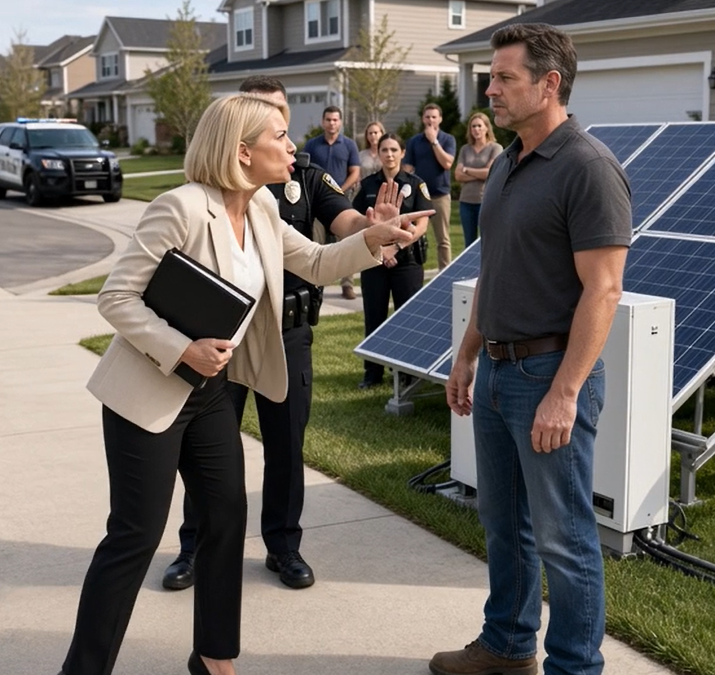
By 9:22, Karen was at my door.
This time, she did not look polished.
Her hair was pulled back too quickly. She wore sneakers with no socks, a navy sweater, and the stunned expression of someone whose invisible control panel had stopped responding.
Behind her, two other residents had pulled into the drive. Frank Ellis and a younger man I barely knew named Miles Jensen. Both looked nervous, not angry.
Karen did the anger for everyone.
“Turn it back on. Now.”
I stepped onto the porch.
“Karen, my system is in maintenance mode.”
“Then take it out.”
“No.”
She looked like I had cursed at her.
“My refrigerator is off. My security system is down. The Millers have two small children. Mrs. Albright uses a medical recliner. You cannot just shut off power to people.”
“I did not shut off power to people. I shut off my own equipment.”
Frank raised one hand slightly.
“Tom, I’m not blaming you, but my house really is out.”
“I believe you.”
Karen snapped, “Then fix it.”
I looked at her.
“Why would your house depend on my equipment?”
Her mouth opened.
No answer came.
Miles Jensen shifted beside his truck.
“Our electrician always said the lower loop had a backup feed.”
My eyes moved to him.
“What lower loop?”
He looked immediately sorry he had spoken.
Karen turned on him. “Miles.”
“No,” I said. “Let him talk.”
Miles swallowed. “When we bought, there was something about community resilience. Like backup capacity from distributed energy assets.”
“Distributed energy assets?” I repeated.
Frank frowned. “I never heard that.”
Miles looked at Karen.
Karen’s face had gone tight.
I knew that look. I had seen it in factories when someone realized the alarm was not a false alarm.
“I need everyone off my property,” I said.
Karen stepped closer. “Absolutely not.”
“Karen, unknown electrical connections can kill people. I am not touching anything until I know what is tied into my system.”
“You are being dramatic.”
“I am being alive.”
Her voice rose. “People need power!”
“Then call the utility.”
“We pay for power.”
“Not to me.”
That stopped her.
Frank looked between us.
“What does that mean?”
“It means my private system appears to be feeding houses it was never designed, permitted, or contracted to feed.”
Frank’s face changed.
Miles whispered, “Oh man.”
Karen pointed at me.
“You don’t know that.”
“No,” I said. “But I know enough not to turn it back on while you stand here yelling.”
She pulled out her phone.
“Fine. I’m calling 911.”
“Tell them it’s an electrical safety issue.”
“I’m telling them you cut power to the neighborhood.”
“You do that.”
She did.
And for the second time in my adult life, I stood on my own land while someone tried to turn my private property into a public crime scene because their comfort had been interrupted.
The sheriff’s deputy arrived first.
Deputy Elena Marquez was in her late thirties, compact, alert, and familiar with HOA disputes in the same weary way doctors are familiar with seasonal flu. She had been to Cedar Hollow before. Usually for gate arguments, noise complaints, or the time someone called law enforcement because a neighbor’s outdoor pizza oven allegedly resembled “an industrial smokestack.”
She stepped out of her cruiser and looked at the gathering crowd.
By then, six residents had shown up.
Karen stood at the center, arms folded, performing emergency leadership for an audience.
Deputy Marquez walked toward me.
“Mr. Reed?”
“Yes, ma’am.”
“We received a report that you intentionally disrupted electrical service.”
“I shut down my private solar system for a scheduled firmware update. Some houses lost power. That should not be possible.”
Her eyes narrowed slightly.
“Not possible how?”
“My solar system is private. Utility-approved. Anti-islanding. It should not be feeding neighborhood circuits. If those houses went dark when I shut down my equipment, there may be an unauthorized connection.”
Karen cut in. “He is using jargon to avoid responsibility.”
Deputy Marquez turned to her.
“Mrs. Whitmore, please let me ask the questions.”
Karen’s lips pressed together.
I invited the deputy to the equipment room, but I did not let anyone else enter. Frank stayed outside. Miles paced near his truck. Karen tried to follow until Marquez stopped her with one look.
Inside, I showed the deputy the system status, the update log, the warning message, the permits, the interconnection agreement, and the critical-load panel diagram mounted on the wall.
I kept copies of everything in a binder beside the equipment rack.
Laura would have loved that.
Deputy Marquez read the warning twice.
Unexpected downstream load detected during grid-isolation test.
“Explain that in plain English,” she said.
“My system tested its ability to separate from the grid. When it did, it detected electrical load on the side that should only belong to my property.”
“So something else is connected?”
“Likely, yes.”
“Dangerous?”
“Potentially extremely.”
She looked at the inverters.
“And you won’t turn it back on?”
“Not until a licensed electrician and the utility determine what’s connected.”
“That seems reasonable.”
Outside, Karen was pacing now.
The utility arrived forty minutes later.
Two trucks.
Three workers.
One supervisor.
The supervisor was a broad-shouldered man named Luis Ortega, wearing a hard hat, safety glasses, and the expression of a professional who had already decided this day was about to become paperwork.
I knew Luis.
He had been present during my original commissioning.
“Tom,” he said, stepping out of the truck. “Please tell me this is less weird than dispatch made it sound.”
“It’s weirder.”
He sighed.
“Of course it is.”
I gave him the short version.
He did not laugh.
Good electricians and utility workers do not laugh when private generation behaves strangely. They get quiet.
Luis walked the meter, checked the service disconnect, opened the utility-side cabinet, and verified that my approved interconnection looked untouched. Then he examined the critical-load output from my system.
After twenty minutes, he said, “This is not coming through the approved utility intertie.”
“I know.”
He looked toward the south field.
“Where’s your buried conduit route?”
I showed him.
The original route ran from the array to the equipment room, then to my house and workshop. Nothing left my property. Nothing crossed toward Cedar Hollow’s lower loop.
On paper.
Reality had other plans.
Luis used a tracer.
At first, the signal followed the expected conduit.
Then, near the old utility easement at the edge of my workshop pad, it branched.
It should not have branched.
Luis stopped walking.
I stopped too.
We both looked down.
Karen called from the driveway. “What is happening?”
Luis ignored her.
He followed the tracer east, across my gravel turnaround, past a row of chamisa bushes, and toward the old access road that ran along the boundary between my parcel and the rest of Cedar Hollow.
The signal continued.
Buried.
Deliberate.
Not accidental.
It disappeared beneath a landscaped berm that the HOA maintained.
Luis stood there, jaw tight.
“Tom,” he said, “you need a lawyer.”
“I have one.”
“You need him today.”
Karen crossed the driveway despite Deputy Marquez telling her to stay back.
“Mr. Ortega, when will power be restored?”
Luis looked at her.
“Not until we know what this is.”
“What what is?”
He pointed toward the ground.
“This unauthorized branch.”
Karen glanced down, then back up.
“That’s common-area infrastructure.”
“No,” Luis said. “It appears to be connected to Mr. Reed’s private generation equipment.”
“It’s part of Cedar Hollow’s resilience system.”
There it was.
The sentence hit the air like a dropped wrench.
Luis looked at me.
I looked at Karen.
Frank said, “Our what?”
Karen froze.
Deputy Marquez noticed.
So did everyone else.
“Mrs. Whitmore,” the deputy said carefully, “what resilience system?”
Karen’s face changed in stages.
First annoyance.
Then calculation.
Then something close to fear.
“It was installed years ago,” she said.
“By whom?” I asked.
“The developer.”
“What developer?”
She hesitated.
Cedar Hollow had been developed by a company called Sandstone Communities, but that company had dissolved after the final lots sold. The founder, a man named Richard Vale, still lived in Albuquerque and occasionally appeared at HOA events like a retired king visiting former territory.
Karen said, “I don’t have those records in front of me.”
I almost smiled.
Karen had records for porch colors going back twelve years.
She could identify which homeowner installed a mailbox post half an inch too tall in 2018.
But suddenly, she did not have records for a system that had apparently tied half the neighborhood to my private solar array.
Luis spoke before I could.
“I’m disconnecting nothing until we inspect. Nobody energizes this circuit.”
Karen snapped, “You don’t have authority over HOA infrastructure.”
Luis stared at her.
“Ma’am, I work for the utility. If there is an unauthorized connection involving distributed generation, grid safety, and customer service equipment, I absolutely have authority to make sure nobody dies today.”
That quieted her.
For about six seconds.
Then she turned to me.
“You will be responsible for damages if residents suffer losses.”
“No,” I said. “Whoever connected them to my system will.”
The residents heard that.
I watched the words move through them.
Connected them to my system.
Not outage.
Not inconvenience.
Not software update.
Theft had a different sound when you finally named it.
By noon, Cedar Hollow’s lower loop looked like a small disaster site.
Utility trucks lined the gravel road. Residents stood in clusters, holding phones, asking questions nobody wanted to answer. Some houses ran on portable generators. Others sat quiet, garage doors stuck shut, refrigerators warming, internet routers dead.
Karen moved from group to group, speaking in low urgent tones.
I saw her pointing toward my house more than once.
I also saw fewer people nodding as the day went on.
At 1:30, my attorney arrived.
His name was Paul Dennison. He wore a gray suit, brown boots, and the permanently tired eyes of a man who had spent twenty years explaining documents to people who preferred feelings. He had helped me fight Karen’s solar complaints. He knew the HOA covenants better than most board members.
He parked beside my truck, looked at the utility crews, then at me.
“You have a gift,” he said.
“For what?”
“Finding expensive problems.”
“I prefer solving them.”
“We’ll see.”
I walked him through everything.
He listened without interrupting.
When I finished, he looked toward the berm where Luis’s crew had marked the underground branch with orange flags.
“Do not restart the system.”
“I wasn’t going to.”
“Do not agree to provide emergency power.”
“I wasn’t going to.”
“Do not let Karen frame this as a community-service dispute.”
“I’m trying not to.”
“And do not underestimate how fast scared homeowners will look for someone solvent to blame.”
I glanced toward the neighborhood.
“I didn’t do this.”
“I believe you. That’s not the same as being protected.”
Paul requested HOA records immediately.
Karen refused.
Then Deputy Marquez requested preservation of any records related to electrical infrastructure, backup power, resilience systems, common-area circuits, emergency power, developer-installed conduits, utility easements, and communications involving my solar installation.
Karen asked whether that was a warrant.
Deputy Marquez said, “Not yet.”
That phrase did more work than a warrant would have.
By late afternoon, the utility had isolated the unauthorized branch without reenergizing it. They restored standard grid power to most affected houses through utility-side reconfiguration, but several common-area systems remained offline: landscape well controls, two neighborhood security cameras, the lower-loop internet booster cabinet, and the emergency lighting at the south gate.
That should have been impossible too.
My system had never been designed to support common-area equipment.
Yet when my inverters went into maintenance mode, those systems died.
I stood in the equipment room after everyone left and stared at the warning log again.
Unexpected downstream load detected.
For almost two years, my panels had produced power.
My batteries had charged and discharged.
My monitoring dashboard had shown consumption patterns that sometimes seemed odd, but not wildly impossible. I had dismissed them as well pump cycling, battery-management losses, inverter overhead, and seasonal variations.
Now every unexplained spike had a shadow.
Somebody had been taking power.
Not enough to empty the batteries every day.
Not enough to trip protections.
Just enough to hide inside the margins.
Like a thief who understands the house schedule.
That night, I opened every folder I had.
Permits.
Plans.
HOA correspondence.
Utility documents.
Emails from the contractor.
Invoices.
Inspection reports.
I went back through two years of production and consumption logs. Hour by hour. Then fifteen-minute intervals. Then event data.
By 2:00 a.m., the pattern began to emerge.
There were recurring nighttime draws that did not match my household behavior. Short bursts between 1:00 and 3:00 a.m. Weekly spikes around common-area irrigation schedules. Higher draw during gate malfunctions I had heard neighbors complain about. Winter storm events when my batteries discharged faster than expected even though my house load remained stable.
I had blamed myself.
That is one of the quietest damages theft causes.
Before you suspect someone else, you suspect your own understanding.
I thought my assumptions were wrong.
I thought the well pump was cycling too often.
I thought battery efficiency was lower than advertised.
I thought maybe I had miscalculated.
But the math had not been wrong.
The system had been feeding loads I did not own.
At 3:17 a.m., I found the first email that made my hands go cold.
It was not in my inbox.
It was attached to an old HOA packet Karen had sent during one of her attempts to challenge the solar array. She had included several documents trying to prove the board had authority over exterior energy systems. Most were irrelevant. I had skimmed them at the time, sent them to Paul, and forgotten about them.
Buried in the packet was a 2016 “Community Resilience Enhancement Summary.”
I read it once.
Then again.
Then a third time with my pulse in my throat.
The document described a proposed backup network for selected Cedar Hollow common-area systems and lower-loop homes vulnerable to outages due to “topographical service limitations.” It referred to “future distributed generation opportunities on the Reed parcel,” though I had not owned solar panels in 2016. I had not even considered them then.
At the bottom was a handwritten note scanned into the file.
Reed parcel best solar exposure. Preserve conduit opportunity if owner upgrades. Do not disclose until agreement secured.
No signature.
But the initials beside it were R.V.
Richard Vale.
The developer.
I sat back in my chair as dawn moved gray across the windows.
Laura’s empty chair sat across from me.
For a moment, I heard her voice in my head.
You found the loose wire, Tom.
She always said that when I got quiet around a problem.
Find the loose wire.
There was always one.
The next morning, Paul filed an emergency demand for records.
The HOA had forty-eight hours to produce documents. Karen responded with a three-sentence letter stating that the association had no record of any unauthorized electrical connection and that my accusations were “reckless, defamatory, and hostile to community stability.”
Paul read it over the phone.
Then he said, “That means they have records.”
“How do you know?”
“People with nothing to hide say, ‘We’ll check.’ People with something to hide say, ‘How dare you.’”
The county electrical inspector arrived that afternoon.
His name was Ramon Chaves. He was short, blunt, and looked at electrical panels the way old priests look at sin.
He brought a second inspector, two utility representatives, and a private forensic electrician Paul had hired named Sheila Grant.
Sheila was in her sixties, silver-haired, and had the calm confidence of someone who had spent decades making electricity confess.
Karen arrived ten minutes later with two HOA board members.
Frank Ellis came too, not as a board member, just as a homeowner whose freezer had thawed enough meat to make him emotionally invested.
The inspection began at my equipment room.
Ramon reviewed the permitted drawings and actual installation.
“Private residential generation,” he said.
“Yes,” I replied.
“Approved interconnection.”
“Yes.”
“No permitted community feed.”
“No.”
“No HOA load schedule.”
“No.”
“No easement.”
“No.”
He looked over his glasses at Karen.
“Mrs. Whitmore, does the HOA have any documentation authorizing connection to Mr. Reed’s system?”
Karen folded her hands in front of her.
“As I have stated, the association is not aware of any improper connection.”
“That wasn’t the question.”
Her smile tightened.
“I would need to review historical files.”
Paul said, “We requested them.”
Karen looked at him like she wished he could be fined.
Sheila traced the branch from my property toward the berm. The crew excavated carefully by hand around the marked route. First came dry soil. Then sand bedding. Then conduit.
Gray PVC.
Buried deep enough to show intent.
Not temporary.
Not accidental.
Not some handyman mistake.
The conduit left my property through an old utility corridor that had been reserved decades earlier when the ranch parcel was subdivided. According to my deed, the easement allowed utility service to my property, not from my property.
That distinction would become very expensive for other people.
The conduit continued under common HOA land, then entered a utility cabinet disguised behind a stucco wall near the lower-loop mailbox cluster.
The cabinet had a lock.
Karen said she did not have the key.
Frank said, “Karen, you opened that cabinet last winter when the cameras went down.”
She shot him a look.
“I don’t recall that.”
Frank stared at her.
“I was standing right there.”
Ramon turned to Deputy Marquez, who had returned for the inspection.
“Can we open it?”
Karen said, “That is HOA property.”
Deputy Marquez said, “Then the HOA may provide the key.”
Silence.
Luis Ortega took bolt cutters from his truck.
Karen said, “This is outrageous.”
Ramon replied, “So is mystery wiring.”
The lock snapped.
The cabinet opened.
Inside was a panel.
Not utility-labeled.
Not permitted.
Not inspected.
A transfer relay.
A step-down transformer.
Breakers feeding labeled circuits.
Lower Gate Aux.
Camera Pole 3.
Irrigation Control South.
Booster Cabinet.
Lots 31-43 Backup.
My mouth went dry.
Lots 31 through 43.
Thirteen homes.
The same cluster Frank had described.
Sheila photographed every label.
Then she looked at me.
“Mr. Reed, this was built to draw from your system.”
Karen said, “That is speculation.”
Sheila pointed at the conduit.
“No. Speculation is what I do before opening the cabinet. This is evidence.”
Frank stepped closer, reading the labels through the open door.
“Lots 31 to 43 backup,” he said slowly. “Karen, what is this?”
“I don’t know.”
His voice sharpened.
“You’re the HOA president.”
“This predates me.”
“But you knew about it.”
“I knew there was backup infrastructure. I did not know it was connected improperly.”
The word improperly did not help her.
Everyone heard it.
Frank turned toward me.
“Tom, I swear to God, I didn’t know my house was tied to your system.”
“I believe you,” I said.
And I did.
Frank was annoying sometimes, mostly about leaf blowers and college football, but he was not a thief. Most people are not. Most people benefit from hidden wrongdoing without knowing it because somebody in charge decided ignorance was easier to manage than honesty.
Karen looked at the open cabinet like it had betrayed her personally.
Then Ramon found the second loose wire.
A small data module mounted inside the cabinet.
It connected to a cellular modem.
Sheila removed the cover and read the manufacturer label.
“This monitors power draw,” she said.
“Whose account?” Paul asked.
Ramon found a service tag inside.
Cedar Hollow HOA.
Karen closed her eyes.
Only for a second.
But I saw it.
So did Paul.
“You monitored it,” I said.
Karen opened her eyes.
“I monitored common-area systems.”
“You monitored power coming from my equipment.”
“I monitored community resilience infrastructure.”
“Stop calling theft resilience.”
Her face flushed.
Frank said quietly, “Karen.”
She turned on him.
“Do you think I built this? Do you think I crawled into the ground and pulled wire myself?”
“No,” he said. “I think you found out and didn’t tell us.”
That hit harder than anything I had said.
Because Frank was one of hers.
He had supported her on landscaping rules. Voted with her on road assessments. Defended her when people complained she was too strict.
Now he looked at her like she had stepped out from behind a curtain and shown him the wrong face.
Karen’s voice dropped.
“I kept this neighborhood functioning.”
“No,” I said. “You kept a secret functioning.”
The investigation became formal after that.
County.
Utility.
State electrical board.
Insurance companies.
Attorneys.
The sort of crowd that gathers when hidden infrastructure becomes visible and everyone wants to know who will pay.
The first public HOA meeting happened five days later in the Cedar Hollow clubhouse.
I did not want to go.
Paul told me I should.
“Not to argue,” he said. “To listen.”
The clubhouse sat near the entrance, all exposed beams, smooth plaster walls, southwestern rugs, and carefully rustic light fixtures that probably cost more than my first truck. Every chair was full. Residents stood along the walls. People who had waved politely for years now stared at one another with suspicion.
Karen sat at the front table with the board.
Frank sat two seats away from her, looking miserable.
The treasurer, a soft-spoken retired accountant named Nina Patel, had a stack of folders in front of her and the expression of someone who had not slept.
Karen called the meeting to order.
Her voice was steady.
I will give her that.
“Recent events have caused confusion and concern,” she began.
A man in the back said, “Confusion?”
Karen continued. “The board is cooperating with all appropriate inquiries.”
Nina’s eyes flicked toward her.
That was when I knew cooperation had been debated.
Karen said, “It appears historical developer-installed infrastructure may have been improperly documented.”
Frank stood.
“No.”
Everyone turned.
Karen looked stunned.
“Frank, please sit down.”
“No,” he said. “We’re not doing that.”
The room changed.
Frank was not dramatic. He was not confrontational. He was the kind of guy who apologized when his dog barked once. Seeing him stand against Karen unsettled people more than shouting would have.
“We are not calling this improperly documented,” he said. “Some of our homes lost power when Tom shut down his private solar system. The inspection found labeled circuits tied to his property. The HOA had a monitoring account. We need the truth.”
Karen’s jaw tightened.
“The truth is complex.”
“No,” Nina Patel said softly.
Karen turned to her.
Nina opened the folder in front of her.
“I found invoices.”
A murmur moved through the room.
Karen said, “Nina.”
But Nina had already crossed the line.
“There are payments from HOA operating funds to Vale Community Systems beginning eighteen months ago. The description says ‘resilience network monitoring and maintenance.’ I asked you about them last year, Karen. You told me they were for gate and camera backup.”
“They were.”
Nina’s voice shook, but she kept reading.
“There are also payments to Southwest Energy Controls for emergency transfer inspections. And an email from you to Richard Vale discussing the Reed array’s production capacity.”
The room erupted.
Karen slammed her palm on the table.
“Enough.”
Nobody quieted.
A woman shouted, “You told us Tom’s panels were dangerous!”
Another said, “My house was connected to them?”
A man near the door yelled, “Did we pay him? Did anyone pay him?”
All eyes turned toward me.
I stood in the back with Paul beside me.
“No,” I said. “No one paid me. No one asked me. No one told me.”
The room fell into a silence that felt heavier than shouting.
Then Nina read the email.
Her voice was not loud, but the room carried every word.
Karen,
Lower-loop draw remains within tolerable range during normal conditions if Reed system stays online. Avoid formalizing unless necessary. If Reed challenges, emphasize community dependency and optics. No court wants to be seen cutting power to families.
R.V.
Nina lowered the paper.
The silence broke differently this time.
Not confusion.
Not fear.
Shame.
Karen’s face was pale.
Frank whispered, “You knew.”
Karen stood slowly.
“You all enjoy the benefits of a stable community and then act shocked that stability requires difficult decisions.”
A mother in the front row said, “My son’s nebulizer was on that circuit.”
Karen looked at her.
“Which is exactly why I worked to preserve backup power.”
The mother’s mouth opened in disbelief.
“From a neighbor who didn’t know?”
Karen pointed toward me.
“Mr. Reed built a system capable of supporting more than his own house.”
I almost laughed.
“Karen, a pickup truck is capable of driving through your living room. That doesn’t make it yours.”
A few people made sounds that might have been laughter if the room had not been so angry.
Karen’s composure cracked.
“You have no idea what I inherited. Vale left half this neighborhood patched together with promises and handshake agreements. The gate system failed. The lower loop lost power every storm. Residents threatened lawsuits. Insurance rates were rising. I kept things running.”
“By hiding the problem,” Frank said.
“By preventing panic.”
“No,” Nina said. “By using Tom.”
Karen looked at Nina like betrayal was something only other people could commit.
“I did what I thought was necessary.”
I stepped forward then.
That was probably a mistake, but I had listened long enough.
“Did you know before or after you tried to force me to screen the panels?”
Karen did not answer.
I kept walking until I stood near the center aisle.
“Did you know when you sent me violation letters? When you claimed my system hurt property values? When you called it visually incompatible? Did you know then that part of this neighborhood was depending on the same panels you wanted hidden?”
Her lips pressed together.
“Thomas, this is not productive.”
“It’s very productive. People are learning who you are.”
Her eyes flashed.
“You think you are innocent because you did not understand your own system.”
That landed.
She knew it would.
Because part of me had been thinking the same thing.
I was an engineer.
I lived by verification.
And I had not seen the theft.
For nearly two years, power had left my system through an illegal branch, and I had explained away the signs.
Karen saw the hit and pressed.
“You installed a massive energy system tied into a community with known infrastructure complexity, and you never once considered that your actions affected others.”
Paul touched my arm lightly, warning me.
But I did not need warning.
I needed breath.
Then Nina Patel stood again.
“No, Karen. Don’t you dare.”
Karen turned.
Nina’s voice grew stronger.
“You don’t get to blame him for trusting the permitted drawings. You don’t get to blame him for not discovering an illegal connection you hid. You don’t get to blame him because your secret finally failed.”
The room erupted again.
This time, Karen could not control it.
The board voted that night to remove her as president pending investigation. It was not smooth. It was not elegant. It involved shouting, procedural arguments, and one elderly man loudly asking whether anyone had thought to bring snacks because “this corruption meeting is running long.”
But it happened.
Karen sat through the vote with a frozen face.
When it passed, she gathered her papers, stood, and walked out.
At the door, she turned back.
“You will regret humiliating me.”
No one spoke.
She looked at me when she said it.
I believed her.
People like Karen can tolerate being wrong privately.
Public humiliation is different.
Two days later, a story appeared on a local news site.
HOMEOWNER’S SOLAR SHUTDOWN LEAVES NEIGHBORS WITHOUT POWER AMID HOA DISPUTE.
It was not entirely false.
That made it more dangerous.
The article quoted “a former HOA official familiar with the matter” who claimed I had “abruptly disabled a power resource serving vulnerable residents” and was “refusing reasonable emergency cooperation.”
My name was spelled correctly.
Unfortunately.
By noon, I had emails calling me selfish, greedy, reckless, anti-community, and a few things less creative but more aggressive.
Someone left a note in my mailbox.
People could die because of you.
That one sat on my kitchen table for an hour.
Then I folded it and put it in a folder.
Evidence.
Laura used to say I handled emotional pain like a man organizing tax receipts.
She was not wrong.
But that note hurt.
Because people could have died.
Not because I shut down my system.
Because someone had tied unknown loads into it without permission, without safety documentation, without disclosure, without inspection, and without backup planning.
That was the part bad headlines did not capture.
Paul contacted the news site with documentation. Within twenty-four hours, the story was updated. Then a larger paper picked it up with a very different headline.
PRIVATE SOLAR ARRAY SECRETLY USED TO POWER HOA SYSTEMS, RECORDS SHOW.
After that, the floodgates opened.
Reporters called.
Energy bloggers called.
Law firms called.
One podcast host wanted me to explain “solar theft in the age of suburban collapse,” which sounded like a phrase designed by someone who spent too much time online.
I refused almost all interviews.
Not because I wanted privacy, though I did.
Because the story was no longer just mine.
Thirteen households had to confront the possibility that their backup power had been built on trespass. Forty-three households had to confront that their HOA fees had maintained a hidden system. And one neighborhood had to decide whether it wanted truth or comfort.
The full story came out in pieces.
Richard Vale, the developer, had planned Cedar Hollow’s lower loop poorly. The terrain made utility service less reliable during storms, especially near the south slope. Rather than pay for a proper redundant feed, he installed conduit “for future backup integration” along an easement bordering my parcel.
At that time, my property belonged to an older man named Stanley Reed.
My father.
He had bought the six acres after retiring from the Air Force, years before I moved there to help care for him. Dad died before Laura and I took full ownership. He never installed solar. He barely trusted automatic garage doors.
But Vale knew the parcel had the best solar exposure in Cedar Hollow.
His internal notes described it as “ideal for future distributed generation.” He apparently assumed that someday, someone would install a system. When I did, the buried conduit opportunity was waiting like a trap with dust on it.
The original illegal connection had not been activated when my system was first installed. That would have been harder to hide during commissioning.
Instead, investigators found evidence that a contractor tied into my critical-load output six months later during what the HOA described as “camera repairs.” The contractor, Southwest Energy Controls, claimed the work order came from Vale Community Systems, Richard Vale’s post-development consulting company.
The work order said: Integrate lower resilience circuit to available distributed generation source per existing easement design.
No one used my name.
No one got my signature.
No one notified the utility.
No one obtained a permit.
And Karen?
Karen became HOA president after the connection existed.
That part was true.
She had not created the original trap.
But emails showed she discovered it eight months into her presidency when the lower-loop monitoring account flagged a power-quality issue. Instead of reporting it, she contacted Richard Vale.
Vale told her disclosure would “create unnecessary legal exposure” and advised her to “manage optics while pursuing long-term normalization.”
Long-term normalization.
That was the phrase they used for stealing electricity until everyone got used to it.
Karen then approved payments for monitoring and occasional maintenance through vague budget lines. She also began pressuring me about screening the panels. Not to remove them. Not really.
To make them less visible.
Less discussed.
Less likely to draw questions.
Her complaints had not been about aesthetics.
They had been about concealment.
When Paul explained that to me, I felt a strange kind of sadness beneath the anger.
Because Karen had stood on my porch acting offended by what she was secretly depending on.
She had called my solar array incompatible while using it to stabilize the neighborhood she claimed to protect.
The hypocrisy was almost too clean.
Real life is usually messier.
But then, greed and fear have a way of simplifying people.
The civil case began with a demand letter.
Compensation for unauthorized energy use.
Damage to equipment.
System degradation.
Legal fees.
Inspection costs.
Emotional distress was not my style, but Paul included it anyway because attorneys like full toolboxes.
The HOA’s insurance company denied coverage at first.
Then partially accepted defense under reservation of rights.
Then sued everyone else.
Richard Vale denied involvement.
Southwest Energy Controls blamed Vale.
Vale blamed the HOA.
Karen blamed both.
The HOA blamed “historic ambiguity.”
That phrase became my favorite.
Historic ambiguity is apparently what rich people call a buried wire when poor people would call it theft.
Meanwhile, Cedar Hollow had to operate without the illegal backup system.
For the first time, the lower loop experienced outages like everyone else on the grid.
Generators appeared.
Battery installers got busy.
Neighbors who had once complained about my panels asked me for contractor recommendations with the awkward humility of people eating words they had seasoned for years.
I gave them names.
Not because I had forgotten.
Because practical help is not the same as forgiveness.
Frank Ellis came by one Saturday morning carrying two coffees and a box of donuts.
He found me tightening bolts on the array frame after a windstorm.
“I owe you an apology,” he said.
“You brought donuts. That’s a good start.”
He smiled weakly.
“I supported Karen too long.”
“A lot of people did.”
“I thought she was annoying but effective.”
“She was effective.”
“That’s the problem, isn’t it?”
I stood and stretched my back.
Frank looked out over the panels.
“You know, I used to think these were ugly.”
“I know.”
“Still not sure they’re beautiful.”
“They’re not art.”
“No. But they make sense.”
That was the closest thing to poetry Frank Ellis had ever said.
He handed me coffee.
“My wife wants panels now.”
“Tell her to get three quotes and read the interconnection agreement.”
“She told me to ask if you’d look at the proposals.”
I looked at him.
He lifted the donut box slightly.
“I come in peace.”
I took a maple bar.
“I’ll look.”
That became a strange pattern.
Neighbors came by.
Quietly at first.
Apologizing.
Asking questions.
Bringing things.
Banana bread. Green chile stew. A bottle of bourbon. One elderly woman, Mrs. Albright, brought a handwritten note on floral stationery.
Dear Mr. Reed,
I was told your solar panels were selfish and disruptive. Now I understand they were yours, and what was selfish was taking from them without asking. I am sorry I believed the wrong person.
She had included twenty dollars.
For electricity, she wrote.
I mailed it back with a note that said she owed me nothing.
The next week she sent cookies instead.
I kept those.
Not everyone was kind.
Some residents resented me because my complaint meant special assessments, legal fees, and the death of a comfortable lie. One man told me at the mailbox cluster that I should have “worked it out quietly.”
I asked him how quietly he preferred being robbed.
He did not answer.
Karen moved through the neighborhood like a ghost that refused to leave.
She remained in her house, though she had resigned from the board. Her husband, David, was rarely seen. He was a quiet man, a retired dentist who had never seemed interested in HOA politics beyond carrying boxes during events and standing beside Karen in Christmas photos.
One evening in late November, David came to my door alone.
He looked older than I remembered.
He held a folder.
“Mr. Reed,” he said, “may I speak with you?”
I almost said no.
Then I saw his hands shaking.
I let him in.
He sat at my kitchen table, the same table where Laura had once paid bills, planned trips we never took, and made lists of things to fix around the house.
David placed the folder between us.
“I found these in Karen’s home office.”
I did not touch it.
“Does she know you’re here?”
“No.”
“That could be a problem.”
He nodded.
“Most of my marriage is a problem right now.”
I waited.
David looked around the kitchen, at the copper pots Laura had loved, at the framed photo of her beside the window, at the small signs of a life that had been built by two people and continued by one.
“I knew Karen was difficult,” he said. “I told myself it came from caring too much. Her father was military. Very strict. Everything in its place. Appearances mattered. Mistakes were weakness. She learned control before she learned kindness.”
“That explains behavior. It doesn’t excuse it.”
“No,” he said. “It doesn’t.”
He pushed the folder toward me.
“I did not know about the connection. Not until recently. But once I knew, I asked her to tell the truth. She said truth would destroy the neighborhood.”
His mouth tightened.
“I think she meant it would destroy her place in it.”
Inside the folder were printed emails.
Not all new.
But one mattered more than the others.
It was from Karen to Richard Vale, dated two weeks after she first visited my property during construction.
Subject: Reed Solar Exposure
Richard,
He is proceeding despite architectural concerns. System appears substantial. If the existing resilience conduit can be integrated, we need to ensure no visible work draws attention. I do not want Reed emboldened. He is already difficult and overly technical. Advise whether activation can be completed under the camera maintenance scope.
K.
I read it twice.
David looked down.
“I’m sorry,” he said.
Those words were too small for what sat between us.
But sometimes small words are all people have.
I gave the folder to Paul the next morning.
That email changed the case.
Karen had not merely discovered the connection after the fact.
She had helped activate it.
The county district attorney filed charges in January.
Not dramatic ones at first.
Criminal trespass related to utility infrastructure.
Theft of services.
Conspiracy.
Falsifying HOA records.
Violations involving unpermitted electrical work.
Richard Vale was charged too.
So was the owner of Southwest Energy Controls.
Karen surrendered herself on a Wednesday morning wearing a navy blazer and pearls.
The booking photo made local news.
I did not celebrate.
I thought I would.
Instead, I sat in the equipment room and listened to the soft hum of my system running exactly the way it was supposed to.
Private load.
Known circuits.
Measured output.
No hidden branch.
Justice did not make the hum sweeter.
It just made it less haunted.
The preliminary hearing was held in March.
The courtroom was full.
Cedar Hollow residents sat behind me and behind Karen, though the division was not as simple as support and opposition. Some came for answers. Some came for closure. Some came because humans are drawn to the wreckage of authority when it finally hits the ground.
Karen sat beside her attorney, posture straight, face composed.
Richard Vale sat two tables away from her. He looked expensive and irritated, as if criminal court were a scheduling inconvenience. He had the polished ease of a man who had spent decades turning risk into other people’s problem.
When the prosecutor presented the email David had found, Karen’s face did not change.
Vale’s did.
Only slightly.
But enough.
His attorney leaned toward him. Vale whispered something. For the first time, I saw Karen look at him with fear.
There is no loyalty among people who build lies together.
Only shared exposure.
The prosecutor called Luis Ortega, Ramon Chaves, Sheila Grant, Nina Patel, Frank Ellis, and me.
When I took the stand, Karen looked straight ahead.
The prosecutor asked me to explain my system.
So I did.
Not emotionally.
Technically.
Private residential generation. Approved interconnection. Critical-load panel. Anti-islanding. Maintenance mode. Unexpected downstream load. Unauthorized branch. Hidden cabinet. Labeled circuits. Monitoring account.
The defense tried to make me sound arrogant.
“Mr. Reed, you consider yourself an expert in electrical systems?”
“No. I consider myself experienced in automation and controls. Licensed electricians handled the electrical installation.”
“But you are technical.”
“Yes.”
“You are detail-oriented.”
“Yes.”
“You keep extensive records.”
“Yes.”
“You knew your system was large.”
“Yes.”
“And yet you failed to notice for nearly two years that it was allegedly powering parts of the neighborhood.”
The courtroom went still.
There it was.
The shame Karen had thrown at me in the clubhouse, dressed now in legal clothing.
I looked at the defense attorney.
“That is correct.”
“You missed it?”
“I trusted permitted drawings, inspected equipment, and approved utility documentation.”
“But you missed it.”
“Yes.”
He stepped closer.
“So why should this court trust your interpretation now?”
The prosecutor objected.
The judge allowed me to answer.
I leaned slightly toward the microphone.
“Because I stopped trusting assumptions and followed the wire.”
No one spoke.
The defense attorney looked down at his notes.
He did not ask much after that.
Nina Patel’s testimony hurt Karen more than mine did.
Nina described the vague invoices, the questions she asked, the answers Karen gave, and the email she discovered. She cried once, quietly, when she admitted she had signed financial reports without understanding what they concealed.
Karen watched her without expression.
Frank testified about the outage, the cabinet, and the HOA meeting.
Then David testified.
That was the moment Karen finally cracked.
Not dramatically.
No sobbing.
No confession shouted across the courtroom.
Just a small break in her face when her husband took the stand and told the truth.
He spoke softly. He admitted he had found the folder. He admitted Karen had told him disclosure would ruin everything. He admitted he had waited two weeks before coming to me because he was ashamed of his own silence.
Karen looked at him then.
Not angry.
Wounded.
For the first time, I saw the person beneath the president. A woman who had built herself around control and was watching even her marriage step outside the fence she had constructed.
It did not absolve her.
But it made her human.
That is the hard part about real justice.
You want monsters because monsters are easy to punish.
People are harder.
The judge allowed the case to proceed.
A trial date was set.
But trials are expensive, and truth has a way of becoming heavier the longer people carry it.
Richard Vale took a plea first.
He admitted to directing the installation of the original conduit pathway during development, then later coordinating with Karen and Southwest Energy Controls to activate the unauthorized backup feed after my solar system came online. He claimed Karen pressured him to “solve the lower-loop reliability issue without triggering homeowner panic.”
Karen’s attorney called that self-serving.
It was.
It was also partly true.
Karen took her own plea three weeks later.
She did not admit everything publicly, but she admitted enough.
The civil settlement came soon after.
The HOA, its insurers, Vale, Southwest Energy Controls, and Karen’s personal umbrella policy all contributed. The settlement paid for inspection, removal of illegal infrastructure, equipment evaluation, legal fees, compensation for unauthorized energy use, and a separate fund to help affected homeowners install legal backup solutions.
I refused confidentiality.
Paul advised me to consider it.
I said no.
He did not argue long.
By then he knew me.
The final HOA meeting was held in June.
New board.
New rules.
New transparency requirements.
All infrastructure contracts had to be published to residents. Any common-area electrical work required licensed documentation and board approval in open session. Emergency systems had to be inspected annually by third parties. No more vague “resilience” budget lines.
The illegal cabinet was removed.
The berm was dug up.
The conduit was capped and filled.
The lower loop installed its own permitted battery backup for common-area systems, paid through the settlement. Individual homes made their own choices. Some installed batteries. Some installed generators. Some did nothing and learned where they kept their flashlights.
Cedar Hollow became less perfect-looking that year.
More rooftop panels appeared.
A few ground arrays too.
Generator pads.
Battery cabinets.
Utility flags.
Trenches.
The neighborhood looked, for a while, like it had stopped pretending infrastructure was invisible.
I liked it better that way.
One evening near sunset, Karen came to my driveway.
I saw her walking before she reached the house.
No SUV.
No clipboard.
No sunglasses.
Just Karen in jeans, a gray sweater, and shoes dusty from the gravel road.
I stepped onto the porch.
For a long moment, neither of us spoke.
The solar panels behind the workshop caught the low sun, dark glass reflecting orange sky.
Finally she said, “I’m moving.”
I nodded.
“I heard.”
David had filed for separation. Their house was listed the week before.
Karen looked smaller without a role to stand inside.
“I wanted to say something before I left.”
I waited.
She clasped her hands.
“I thought I was protecting Cedar Hollow.”
“I know.”
Her eyes sharpened, old defensiveness flickering.
“That doesn’t make what I did right.”
“No,” I said. “It doesn’t.”
She looked toward the south field.
“I hated those panels.”
“I noticed.”
A faint, sad smile crossed her face.
“I hated what they represented.”
“What did they represent?”
“That you didn’t need permission.”
That answer surprised me.
Not because it was shocking.
Because it was honest.
Karen swallowed.
“I spent years believing communities fall apart when people do whatever they want. Maybe because my father did whatever he wanted and called it leadership. Maybe because I married quiet and mistook silence for agreement. Maybe because I was good at rules, and being good at rules made me feel useful.”
The desert wind moved softly through the chamisa.
She continued.
“Then you built something I couldn’t control. And instead of admitting the neighborhood had a problem, I used you to hide it.”
She looked at me.
“I am sorry.”
I wanted to say something clean.
Something wise.
Something Laura would have approved of.
But forgiveness is not a switch, and I was tired of people expecting victims to perform healing on command.
So I said the truth.
“I believe you’re sorry.”
Her eyes lowered.
“That’s all?”
“That’s what I have.”
She nodded.
It hurt her.
But she accepted it.
That was the first decent thing I had seen her do without an audience.
She turned to leave, then stopped.
“Thomas?”
“Yes?”
“Your wife would have liked the array.”
I went still.
Karen looked back at me.
“She told me once, years ago, before she got sick, that you were happiest when you were building something complicated that made life simpler.”
My throat tightened.
I had forgotten Karen knew Laura from neighborhood events. Not well. But enough.
“She said that?”
Karen nodded.
“At a holiday open house. You were explaining thermostats to someone who clearly regretted asking.”
Despite myself, I laughed once.
That sounded like me.
Karen’s voice softened.
“I should have remembered she loved that about you before I treated it like a threat.”
Then she walked away.
I watched her until she disappeared down the gravel road.
I did not forgive her that day.
Maybe I never fully would.
But I stopped needing her to be only the villain.
That felt like putting down a heavy tool after the work was done.
A year after the shutdown, Cedar Hollow held a community meeting outside instead of in the clubhouse.
No podium.
No polished speeches.
Just folding chairs near the entry sign, kids running between piñon trees, neighbors eating food from crockpots and paper plates.
The new board unveiled a small plaque on the common-area battery cabinet.
It read:
CEDAR HOLLOW RESILIENCE SYSTEM
PERMITTED, INSPECTED, AND COMMUNITY OWNED
BUILT IN RECOGNITION THAT TRUST IS INFRASTRUCTURE TOO
I stood at the back with Frank.
He looked at the plaque and shook his head.
“Trust is infrastructure too,” he said. “Sounds expensive.”
“It is.”
“Worth it?”
“Usually.”
He handed me a paper plate with enchiladas.
“My wife says your proposal comments saved us eight thousand dollars.”
“She picked the better inverter.”
“She says you picked it.”
“I suggested it.”
“That means you picked it.”
I accepted the plate.
Mrs. Albright waved from a chair near the front. Nina Patel, now HOA president, stood beside the new battery system explaining maintenance schedules to three residents who were actually listening. That alone would have been unimaginable two years earlier.
Near the end of the evening, a little boy asked if the cabinet powered the whole neighborhood.
Nina smiled.
“No. It powers what it is designed to power. That is the point.”
I looked toward my hill.
From the common area, you could see the top edge of my solar array if you knew where to look. Forty-eight panels lined in quiet rows, catching the last light.
Still visible.
Still incompatible with Karen’s old idea of Cedar Hollow.
Still mine.
When I got home, I walked down to the equipment room. The system display glowed in the dusk.
Solar production was tapering.
Battery state of charge: ninety-two percent.
House load: normal.
No unexpected downstream load.
No mystery draw.
No hidden branch.
Just my property breathing through a system I understood again.
I stood there longer than necessary.
That was something grief had taught me.
Some silences deserve to be visited, not avoided.
Laura’s photo sat on the shelf beside the monitoring screen. In it, she was laughing at something I no longer remembered, wearing an old denim jacket and holding a mug with both hands. I had placed the photo there during commissioning, partly as a joke, partly because every system needs a witness.
“You were right,” I told her.
About what, I could not have said.
Maybe the binders.
Maybe the panels.
Maybe the idea that building something useful is one way to keep living when the life you expected has gone dark.
Outside, the desert cooled.
Lights came on across Cedar Hollow one by one.
This time, they were not mine.
That mattered.
People talk about independence like it means not needing anybody. I do not believe that anymore. Real independence means knowing the truth about what you depend on. It means agreements written clearly. Wires labeled honestly. Costs paid by the people receiving the benefit. Help offered freely, not stolen quietly.
For two years, Cedar Hollow had depended on my electricity without my knowledge.
For longer than that, Karen had depended on control to feel safe.
And I had depended on systems because systems made more sense than grief.
In the end, all of us had to learn the same hard lesson.
Anything hidden inside the walls eventually becomes part of the house.
A secret wire.
A quiet lie.
A pain no one wants to name.
You can paint over it. Landscape around it. Call it resilience, stability, community standards, or whatever soft phrase makes theft sound like leadership.
But the current still runs.
The load still shows up somewhere.
And one day, when someone finally shuts the system down to see what is real, everything connected to the lie goes dark.
That was the day Cedar Hollow learned my solar panels were never the problem.
The problem was what people had been willing to take from them.
And when the truth came back online, it lit more than houses.
It lit the wires under the whole beautiful neighborhood.
It lit the contracts nobody had read, the invoices nobody questioned, the authority nobody challenged, and the quiet dignity of one private man who only wanted enough power to keep his own home running after loss had already taken too much.
Karen once told me individual choices have consequences beyond the individual.
She was right.
My choice to shut down my system for one routine update exposed a theft.
Her choice to hide that theft exposed a neighborhood.
And Cedar Hollow’s choice afterward—to tell the truth, pay the cost, and rebuild honestly—saved it from becoming just another pretty place powered by a lie.
Now, every time the sun rises over the south field and those panels wake in silence, I think about what Laura said.
Complicated things can make life simpler.
But only when every wire goes where it says it goes.
Only when nobody steals what they are too proud to ask for.
Only when power, like trust, flows with permission.