I Found My Old Cat Dead in the Kitchen Drawer I Had Closed—Then My Family Called Me Unfit to Live Alone, Until My Late Wife’s Hidden Letter Exposed What They Were Really After
PART3:
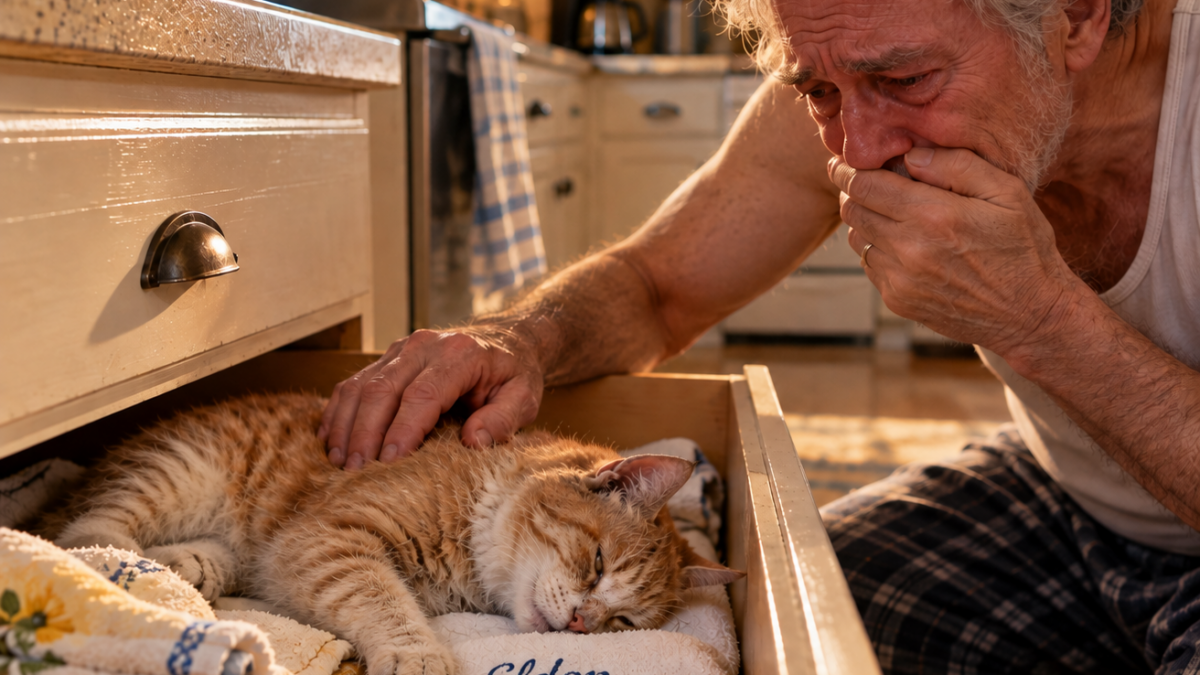
Her little torn ear lay flat.
“Oh, baby.”
My voice cracked.
“No.”
I slid my hand beneath her cheek.
“No, no, no.”
Her eyes opened.
And this is the part that saved me from going mad.
She was not afraid.
If she had looked terrified, I think I would have carried that expression into my grave.
But she looked tired.
Ancient.
Finished.
Her eyes found mine.
Then one front paw lifted.
Barely an inch.
She placed it across my wrist.
The same way she had done for ten years whenever I sat too long at the table after Cora died.
Stay here.
I am here.
At 5:13, Clover stopped breathing.
I remained on the floor beside the drawer until the stove clock said 6:00.
I kept one hand against her fur.
Waiting for warmth to mean something it no longer meant.
Then I noticed the gap.
The drawer had not been completely shut.
There was perhaps two inches between the drawer front and the cabinet frame.
Clover had become thin.
She could have pushed through it.
I tested it.
The drawer slid easily.
She had not been trapped.
Not the way I believed.
She had climbed into her favorite drawer.
The drawer where Cora stored the towels she stitched.
The drawer that smelled like cedar paper, old cotton, and a life that used to include two people drinking coffee in the morning.
She had chosen my towel.
Maybe because it smelled like me.
Maybe because it smelled like Cora.
Maybe because an old cat nearing the end of sixteen years did not care about explanations.
She wanted soft.
Warm.
Familiar.
I carried her outside after sunrise.
The cherry tree stood behind the shed.
Cora had planted it during our second year in that house.
Forty-three years earlier.
She had been twenty-seven.
I had been twenty-nine and convinced I knew how to dig a hole better than she did.
She proved me wrong loudly.
Cora’s ashes were beneath a flat stone near the roots.
I dug beside them.
My knees hurt.
My back hurt.
I had to stop twice because my hands would not behave.
Before I lowered Clover into the earth, I wrapped her in the towel with my name.
Then I placed the little white towel embroidered with a green clover beneath her paws.
That towel was how she got her name.
Cora had found her ten years earlier.
My sixty-second birthday.
A cardboard box appeared on our kitchen table.
Air holes punched through the sides.
Something inside was screaming.
I stared at Cora.
“No.”
“You have not even opened it.”
“I know what cat sounds like.”
“You need one.”
“We absolutely do not.”
Cora lifted the lid.
A skinny orange face appeared.
One torn ear.
Huge eyes.
The kitten hissed at me.
Cora smiled.
“She likes you.”
“She threatened me.”
“She has excellent judgment.”
Six months later, Cora was dead.
That is the clean sentence.
The ugly truth is that one day there were two coffee cups beside the sink.
Then there was one.
After the funeral, people filled our house.
Casseroles.
Flowers.
Paper plates.
Church women whispering.
Men touching my shoulder because they did not know what else to do.
Then everyone went home.
The phone rang every day for two weeks.
Then every few days.
Then Sundays.
Then birthdays.
Life is not cruel for moving forward.
But if you are the one left sitting still, other people’s forward motion can sound like abandonment.
Clover stayed.
For three weeks, she slept on Cora’s side of the bed.
Then one night she crossed the blanket.
Stepped onto my chest.
Put one paw under my chin.
And remained there until morning.
So before I covered her beneath that cherry tree, I whispered, “You did your job, little girl.”
My voice broke.
“You stayed until I learned how to breathe without her.”
Then I cried.
Not the quiet tears I had allowed myself at Cora’s funeral.
I cried like an old man whose last witness had disappeared.
I cried until I had to sit in the damp grass.
That was where Mrs. Hanley saw me.
She lived two houses down.
Seventy-eight years old.
Red glasses.
Thin as a broom handle.
A voice capable of crossing property lines without permission.
She came through the back gate carrying a cardigan over her nightgown.
“Eldon?”
I wiped my face.
“What?”
Her eyes went to the fresh dirt.
“Oh.”
I looked away.
“She went this morning.”
Mrs. Hanley came closer.
She did not ask whether Clover was “just a cat.”
She did not say sixteen was a good long life.
She did not tell me everything happens for a reason.
God bless her for that.
She just said, “I am sorry.”
I nodded.
Then she stood beside me until I could get back up.
By eight fifteen, the phone rang.
My nephew Travis.
Forty-three.
My sister Elaine’s younger son.
Good man, mostly.
Good job.
Nice house.
Two kids.
Too busy in the way middle-aged people become without noticing.
“Uncle Eldon.”
“I’m here.”
“I heard about the cat.”
I looked at Clover’s empty bowl.
“Her name was Clover.”
A pause.
“Yes. Clover. I’m sorry.”
I knew he meant it.
I also knew he was driving somewhere because I could hear his turn signal.
“How did you hear?”
“Mrs. Hanley called Mom.”
“Of course she did.”
“Mom called me.”
“Of course she did.”
Another pause.
Then Travis used the sentence every person should fear.
“I don’t want you to take this the wrong way.”
I sat down.
“That has never been followed by anything pleasant.”
He exhaled.
“I think maybe this is a sign.”
“What kind?”
“That living alone is becoming too much.”
The refrigerator hummed.
I stared at the drawer.
“I buried my cat thirty minutes ago.”
“I know.”
“No, I don’t think you do.”
“I’m not saying we need to decide anything today.”
“Then don’t decide anything today.”
“Uncle Eldon—”
“I have lived here forty-six years.”
“I know.”
“Cora planted that tree.”
“I know.”
“Your mother broke her wrist in my backyard when she was nineteen because she insisted she could jump the fence.”
Travis almost laughed.
“Okay.”
“Your grandmother died in that front bedroom.”
“I remember.”
“No, you remember being told.”
Silence.
I hated myself the second I said it.
He had been a child.
But grief does not always make you fair.
Travis lowered his voice.
“I’m worried.”
“About what?”
“You shut Clover in a drawer.”
There it was.
The clean sentence.
I gripped the table.
“She wasn’t trapped.”
“What?”
“There was a gap.”
“Uncle Eldon—”
“She could get out.”
“You don’t know that.”
“Yes, I do.”
“How?”
“Because I checked.”
He sighed.
“And maybe you’re right. But you didn’t know she was in there.”
“No.”
“That scares me.”
Then he said it.
The sentence he would spend weeks regretting.
“She was just a cat.”
The kitchen went silent.
I looked at Clover’s bowl.
The tiny piece of food still stuck along the edge.
“Say that again.”
He did not.
“She was the last living thing in this house that remembered Cora’s voice.”
Nothing from Travis.
I continued.
“You may think grief over an animal is foolish.”
“I didn’t say—”
“You said enough.”
“I didn’t mean it like that.”
“I know.”
And I did.
That was what made it hurt.
Travis was not trying to be cruel.
He was trying to be practical.
Practical people can cut you open without ever raising their voices.
He said Elaine wanted to visit.
“Not today.”
“She worries about you.”
“I was alone yesterday too.”
That silenced him.
After we hung up, I washed my hands.
Then I stood over Clover’s half-finished dish for ten minutes because I could not decide whether throwing out the food counted as accepting death.
Finally I sat down again.
The drawer remained open.
I could not close it.
Around ten, Elaine called.
I did not answer.
Eleven, again.
Did not answer.
At eleven twenty, the back door opened.
Elaine has never respected a locked door if she believes family is inside.
She entered with chicken and noodles.
She was seventy-five, silver-haired, sharp-eyed, and still capable of making me feel thirteen.
“You look terrible.”
“Good morning.”
She placed the dish on the counter.
“You did not answer.”
“I noticed.”
“I brought food.”
“I don’t want food.”
“I did not bring want.”
She saw the drawer.
Her face softened.
Then she saw the towels I had begun removing.
Cora.
Eldon.
Little green clover.
“Oh, brother.”
“Don’t.”
“I wasn’t going to say anything.”
“You were going to make that face.”
“What face?”
“That soft one.”
She pulled out a chair.
“You hate kindness.”
“I tolerate it poorly.”
She touched the towel.
“Clover loved this drawer.”
“She died there.”
“I know.”
“It was my fault.”
Elaine looked at me.
“Was the drawer locked?”
“No.”
“Was she crushed?”
“No.”
“Was she bleeding?”
“No.”
“Did you poison her?”
“Elaine.”
“Then stop trying to become important enough to have killed old age.”
I stared at her.
Only a sister can insult you into sanity.
She folded her hands.
“Sixteen is old.”
“She was fine yesterday.”
“No. She was alive yesterday.”
Those are not the same thing.
I hated that sentence.
I also knew it was true.
Elaine helped me remove the towels.
In the back of the drawer was a layer of orange hair.
I ran my fingers through it.
“Leave it,” I said.
Elaine nodded.
Then beneath the old paper liner, something moved.
A corner of yellowed paper.
I reached down.
There was an envelope.
My name on the front.
Eldon.
Cora’s handwriting.
I could not breathe.
Elaine saw it.
“Oh my God.”
I sat down.
For a full minute, I held the envelope without opening it.
Cora had hidden notes during the last months of her illness.
Inside my winter coat.
Behind flour canisters.
In my toolbox.
Most were jokes.
Do not eat cereal for supper three nights running.
Water the plant.
Comb your hair before church.
I thought I had found them all.
Apparently Cora had expected me to clean the kitchen drawer eventually.
She overestimated me.
Inside was a folded sheet from a notebook.
The writing shook.
Near the end, her hands did that.
I read silently at first.
Then aloud because Elaine asked.
“Dear stubborn man,
“If you found this, you finally cleaned the drawer. That alone qualifies as a medical miracle.
“Do not throw away the towel with your name. I made yours first because loving you was the first home that ever felt like mine.
“If the cat is still alive, give her something good and tell her I said thank you.
“If she is not, bury her close. She always did like being near us.
“And Eldon, listen.
“The house is not your punishment.
“It is only a house.
“Stay if staying keeps you alive.
“Leave if leaving helps you live.
“But do not confuse loneliness with loyalty.
“I am not in the silence.
“I am in every good thing you still let yourself receive.
“Love,
Cora.”
Elaine removed her glasses.
Neither of us spoke.
Then she whispered, “That woman always knew where to stick the knife.”
“She wasn’t cutting.”
“Oh yes, she was.”
I laughed.
A small sound.
Then it collapsed into crying.
Elaine reached across the table.
This time I did not move my hand away.
That afternoon my family began making decisions about me.
I did not know it yet.
Later, I would learn that Travis had called his older brother Wade after speaking to me.
Wade was forty-seven.
Elaine’s eldest.
Where Travis rushed emotionally, Wade organized.
Where Travis apologized too much, Wade rarely believed he owed one.
He sold real estate.
Drove a black SUV.
Wore shoes that looked uncomfortable and expensive.
He had been telling Elaine for two years that my property was “too much house” for one old man.
He used phrases like equity.
Market timing.
Downsizing.
Safety.
The words were not wrong.
That was what made Wade dangerous when he decided he was right.
By four that afternoon, he had called an assisted-living residence.
By five, he had called a realtor friend.
By six, there was a family group text titled ELDON PLAN.
Nobody included Eldon.
Elaine discovered it when her phone started vibrating during dinner.
She called me immediately.
“Did Wade speak to you?”
“No.”
“Has Travis?”
“No.”
“Do not sign anything.”
I sat straighter.
“What?”
“Nothing. Just—”
“Elaine.”
She exhaled.
“They are worried.”
“About my signature?”
“Wade thinks we should have options.”
“What options?”
“A senior apartment.”
“No.”
“He says just looking—”
“No.”
“A home health evaluation.”
“No.”
“He thinks the cat incident could mean—”
“The cat incident?”
“I don’t agree with how he’s saying it.”
“How is he saying it?”
Elaine became quiet.
That told me.
“He says I killed Clover.”
“He says you may not be safe living alone.”
Something cold settled behind my ribs.
“Because my sixteen-year-old cat died?”
“Because you didn’t know she was inside a drawer.”
I stood.
“Tell Wade he can come say that to my face.”
He did.
The following morning.
Eight thirty.
Wade arrived carrying coffee and a folder.
I hated the folder immediately.
Travis came ten minutes later.
Elaine twenty minutes after that because she did not trust any of us unsupervised.
Mrs. Hanley watched from her porch.
Naturally.
Wade sat at my yellow table as if he were chairing a corporate meeting.
“Uncle Eldon, nobody is attacking you.”
“Then that folder should feel very embarrassed.”
Travis stared at his coffee.
Wade opened it.
“I’ve gathered information.”
“Congratulations.”
“There is a very good senior community fifteen minutes from Mom.”
“No.”
“You haven’t seen it.”
“I have seen the word no.”
“Could you listen?”
“I listened to your brother yesterday. Apparently my cat dying made all of you real estate professionals.”
Wade’s jaw tightened.
“This is not about inheritance.”
I had not said inheritance.
Everyone noticed.
Elaine’s eyes narrowed.
Wade continued too quickly.
“It’s about safety.”
“What specifically is unsafe?”
“You fell last winter.”
“On ice.”
“You take medication.”
“So do you.”
“You’ve had breathing issues.”
“I have a doctor.”
“You shut an animal in a drawer overnight.”
Travis looked up.
“Wade—”
“No. We’re pretending this isn’t serious because we don’t want to upset him.”
I leaned back.
“Upset me.”
Wade looked directly at me.
“Clover died because you weren’t paying attention.”
The kitchen became still.
Elaine said, “Enough.”
I raised one hand.
“No.”
I looked at Wade.
“Finish.”
He did.
“Maybe she would have died anyway. Maybe not. But you didn’t know where she was for seven hours. What happens when you leave a burner on? What happens when you forget medication? What happens when you fall and nobody finds you?”
Each question landed because none was impossible.
That is how humiliation works best.
Mix cruelty with just enough truth.
Wade pushed a brochure toward me.
“We can do this before there’s an emergency.”
I looked at the glossy photograph.
Smiling gray-haired couple.
Garden.
Dining room.
People pretending bingo had saved them from mortality.
“No.”
He exhaled.
“You’re being stubborn.”
“Yes.”
“This isn’t only your decision anymore.”
My eyes lifted.
“Excuse me?”
Travis whispered, “Wade.”
But Wade had already stepped over the line.
“If you become unable to manage safely, family has a responsibility.”
“I am able.”
“According to you.”
Elaine stood.
“Get out.”
“Mom—”
“I said get out.”
Wade stared at her.
“We all know he’s declining.”
I rose slowly.
My knees hurt.
I hated that they hurt in that moment.
“I buried my cat yesterday.”
Wade’s face softened slightly.
Too late.
“I know.”
“You came into my kitchen less than twenty-four hours later with a brochure and a realtor’s business card.”
His eyes flicked to the folder.
There.
A business card.
I reached over.
Took it.
Daniel Cross Realty.
I looked at Wade.
“Why do I need this?”
“Eventually the house would need—”
“You already called him?”
He did not answer.
Travis turned.
“You contacted Dan?”
“Only to ask what the property might be worth.”
“You did what?”
Wade’s expression hardened.
“We need information.”
Elaine slapped her palm against the table.
“It is not your house.”
Nobody spoke.
Wade gathered his papers.
“This is exactly what I mean. Nobody wants to have the adult conversation.”
I pointed to the door.
“The adult who owns the house has finished the conversation.”
He left.
Travis stayed.
His face looked sick.
“I didn’t know he called the realtor.”
“I believe you.”
“I shouldn’t have called him.”
“No.”
“I was worried.”
“I know.”
“That doesn’t excuse it.”
“No.”
He rubbed his face.
Then looked toward Clover’s bowl.
“I’m sorry about what I said.”
I did not rescue him from the discomfort.
Good apologies need room.
“She wasn’t just a cat,” he said.
“No.”
He swallowed.
“I knew that. I think I just… made her smaller because I was scared.”
“Scared of what?”
“You.”
I stared.
“Losing you.”
That answer surprised me.
He continued.
“Mom said you were sitting in the yard crying. Then she said Clover died in a drawer. I thought—”
“That I’d lost my mind?”
“I thought something was happening and I hadn’t noticed.”
His voice broke slightly.
“And I realized I don’t know how you’re doing because I don’t come around enough.”
That was the first honest thing any of us had said.
“You could have asked.”
“I know.”
“Instead you tried to solve me.”
“I know.”
We sat quietly.
Finally, I slid Cora’s letter toward him.
He read it.
When he reached the line about confusing loneliness with loyalty, he stopped.
Read it again.
Then looked around the kitchen.
The empty chair.
The single coffee mug.
Clover’s dish.
“I’m sorry,” he whispered.
This time, I believed all of it.
I thought the family meeting was the worst of the humiliation.
I was wrong.
Three days later, Mrs. Hanley knocked on my back door holding her phone.
She looked furious.
“What?”
She handed it to me.
“I thought you should know.”
A post was open on a local community page.
Wade had written it.
No names.
But enough details that anyone in town could identify me.
It said:
When do you step in when an elderly relative refuses help?
Then he described “an older widower living alone in an aging home.”
A recent fall.
Medication.
Breathing problems.
An elderly cat “accidentally shut overnight inside a cabinet and found dead the following morning.”
He asked whether family had a moral responsibility to intervene before “the next accident involves a stove, a vehicle, or the person himself.”
There were hundreds of comments.
Some compassionate.
Some thoughtful.
Some vicious.
Take his keys now.
This is elder neglect if the family does nothing.
Poor cat.
People care more about independence than safety.
My father fought us too. We had to force him.
Call Adult Protective Services.
Then one person wrote:
If he killed his pet by forgetting where he put it, he should not be responsible for himself.
I handed the phone back.
My fingers were shaking.
Mrs. Hanley said, “Want me to comment?”
“No.”
“I can be mean.”
“I know.”
“I’ve been practicing since 1957.”
I almost smiled.
But shame had already crawled under my skin.
By that afternoon, two people from church called Elaine asking whether I was “all right.”
A former coworker called me.
Then my pharmacist asked whether someone should start picking up my prescriptions for me.
No one meant harm.
That was the horror of it.
I had become a community concern.
Not Eldon.
Not Cora’s husband.
Not Clover’s person.
A problem.
By Friday, someone did call county adult services.
A woman named Mariah Benton came to my house.
Early forties.
Brown coat.
Clipboard.
I almost refused to open the door.
Then Cora’s letter flashed through my mind.
Stay if staying keeps you alive.
I opened it.
Mariah did not treat me like a child.
That helped.
She asked whether she could come inside.
I said yes.
She checked smoke detectors.
The stove.
Medications.
Food.
Bathroom.
Stairs.
She asked whether I drove.
Whether I had fallen recently.
Whether anyone controlled my finances.
That question caught my attention.
“No.”
“Anyone asking to?”
“My nephew thinks I should sell.”
“Does he have power of attorney?”
“No.”
“Has he asked for it?”
“Not yet.”
She wrote something.
Then she sat at my kitchen table.
I hated that everyone kept sitting where Cora used to sit.
“Tell me about the cat.”
So I did.
All of it.
The drawer.
The gap.
Sixteen years old.
The paw.
The burial.
When I finished, Mariah was quiet.
Then she asked, “Do you have a veterinarian?”
I gave her the clinic name.
“Would you mind if we confirm Clover’s medical history?”
“Please.”
That surprised her.
I continued.
“Actually, I want to know too.”
Because beneath my anger, the guilt still lived.
What if Wade was right?
What if the drawer had killed her?
Two days later, Dr. Harris called.
Clover had been his patient for fourteen years.
He reviewed her records.
Sixteen years old.
Heart murmur.
Early kidney disease.
Weight loss.
An episode of weakness six weeks earlier.
“She was nearing the end, Eldon.”
My throat tightened.
“Would the drawer have—”
“She had air.”
“Yes.”
“Could she move?”
“Yes.”
“Any signs she struggled?”
“No.”
He became quiet.
Then said, “Cats often choose enclosed familiar spaces when they are dying.”
I covered my eyes.
“Why my towel?”
“I can’t answer that.”
“I can.”
My voice broke.
Dr. Harris waited.
“She loved my wife.”
After the call, I sat alone for a long time.
For the first time since Clover died, I allowed myself to say the words out loud.
“I did not kill you.”
The kitchen did not answer.
But something inside my chest loosened.
Adult services closed the safety review with recommendations, not removal.
Grab bar in the bathroom.
Medical alert device.
Regular check-ins.
A medication organizer.
No finding that I lacked capacity.
No finding that my house was unsafe.
Mariah looked at me before leaving.
“Accepting precautions isn’t surrendering independence.”
“I know.”
“And being independent doesn’t mean refusing every form of help.”
“I know.”
She smiled.
“You say that like someone already told you.”
I tapped Cora’s letter.
“Someone did.”
That should have ended Wade’s campaign.
Instead, it escalated.
A week later, I received a certified envelope.
He had contacted an attorney about petitioning for temporary guardianship if I continued “refusing necessary placement.”
I read the papers twice.
Then drove myself to Elaine’s house.
Wade was there.
So was Travis.
Jenna, Travis’s wife, stood near the kitchen counter.
I threw the envelope onto the table.
Elaine picked it up.
Her face went white.
“Wade.”
He stood.
“This is a precaution.”
I laughed.
A sound with no humor.
“You are trying to have me declared incapable.”
“No. I asked what our options were.”
“You gave a lawyer information.”
“Because you won’t listen.”
“I listened.”
“You’re emotionally compromised.”
“Because my cat died?”
“Because Cora died and you never recovered.”
The room went silent.
Elaine whispered, “Get out.”
Wade looked at her.
“Mom, someone has to say it.”
“No.”
I raised my hand.
Again.
“Let him.”
Wade turned back.
“You have kept that house frozen for ten years.”
My jaw tightened.
“You eat alone. You barely see people. You talk to a dead woman. You buried the cat next to her ashes and then started writing stories online about grief.”
“Who showed you the writing?”
He looked at Travis.
Travis went pale.
“I didn’t.”
Wade said, “It’s public now.”
I stared.
“What?”
Travis whispered, “Uncle Eldon—”
“What is public?”
He showed me his phone.
The piece I had written about Clover had been posted.
Not by me.
By Travis.
My words.
The drawer.
The towel.
The paw.
The cherry tree.
He had shared it with a local grief group after asking? No.
He had mentioned showing it to others, but I had never said yes.
My face burned.
“You posted my writing?”
Travis stood.
“I’m sorry.”
“You posted my dead cat?”
“I thought—”
“You thought people would be kind?”
His eyes filled.
“Yes.”
That hurt because his motive had not been cruel.
But violation does not become harmless because the hand was gentle.
The story had spread.
Thousands of people had read it.
Most comments were compassionate.
Some were not.
One called me “unstable.”
One said an old man who slept beside a dead wife’s robe for ten years needed psychiatric help.
One asked why nobody in my family had stepped in sooner.
Wade had collected screenshots.
He planned to use them.
My grief.
Against me.
That was the moment the whole thing changed.
Not because I stopped loving my family.
Because I stopped assuming good intentions were enough.
I hired a lawyer.
Her name was Rachel Kim.
Fifty-two.
Short black hair.
Voice like a door locking.
She specialized in elder law and guardianship disputes.
She read Wade’s papers.
Read the adult-services report.
Read Dr. Harris’s statement.
Read Cora’s letter because I chose to show her.
Then she looked at me.
“Do you know what Wade does for a living?”
“Real estate.”
“Has he discussed selling your property?”
“Yes.”
“Would he receive a commission?”
I stopped.
“I don’t know.”
She nodded.
“We’re going to find out.”
Rachel did not build a dramatic conspiracy.
She built a timeline.
That is what good investigations look like most of the time.
Boring facts arranged until the truth has nowhere to hide.
The day Clover died.
Travis’s call.
Wade’s call to assisted living.
Wade’s contact with realtor Daniel Cross.
The online post.
The guardianship inquiry.
Then Rachel found an email Wade had sent Daniel the day after Clover’s death.
The subject:
Potential off-market opportunity — Maple Street property
I read it in Rachel’s office.
My stomach went cold.
Wade had described my house.
Corner lot.
Large backyard.
Older structure needing renovation.
“Owner elderly and likely transitioning to care.”
Likely.
Before he ever asked me.
Before any doctor evaluated me.
Before adult services visited.
Before he sat at my yellow table pretending he only wanted information.
Daniel replied that one of his investors would “move fast” if the family could secure authority.
Family.
Authority.
My house had become an opportunity before Clover’s grave had settled.
There was another email.
Wade wrote:
If he resists, we may need to establish incapacity. Recent pet incident helps.
Recent pet incident.
Clover.
I put the pages down.
Rachel waited.
I thought I would explode.
Instead, I became very calm.
“He used her.”
“Yes.”
“He used Clover dying.”
“Yes.”
“To sell my house.”
“It appears he saw it as leverage.”
That word was worse.
Leverage.
My cat’s last breath turned into leverage.
Rachel asked, “Do you want to fight the guardianship?”
I looked at her.
“I want him to explain this in front of everyone.”
The hearing was not dramatic.
No packed courtroom.
No television cameras.
Just a quiet county room with wood-paneled walls and fluorescent lights.
Wade wore a suit.
Travis sat behind Elaine.
Jenna beside him.
Rachel sat with me.
Wade’s attorney argued concern.
Age.
Isolation.
The drawer.
The fall.
My grief.
Then Rachel presented evidence.
Adult services found me competent.
My physician found no cognitive impairment.
My medication records were current.
Smoke alarms functional.
Bills paid.
Taxes paid.
No driving incidents.
No wandering.
No dangerous neglect.
Then she introduced the emails.
Wade’s face changed.
His attorney asked for a moment.
The judge read.
Asked Wade whether he had contacted a realtor before speaking to me.
“Yes.”
Whether he expected compensation if he handled the sale.
“Possibly.”
Whether he told the realtor I was “likely transitioning to care.”
“Yes.”
“Had any medical professional recommended that?”
“No.”
“Had Mr. Harper?”
That is my last name.
“Had Mr. Harper authorized you to sell his home?”
“No.”
“Then why did you describe the property as a potential off-market opportunity?”
Wade tried.
He said planning.
Concern.
Market conditions.
Future costs.
He said someone had to think practically.
There was that word again.
Finally the judge said, “Practical concern does not create legal authority over another competent adult.”
My eyes filled.
Not because I had won.
Because someone had finally said the thing my family kept forgetting.
Adult.
My petition—his petition—was dismissed.
Completely.
The judge also warned Wade that future attempts unsupported by medical evidence could be viewed as harassment or abuse of process.
Outside the courtroom, Wade approached.
Elaine stepped between us.
He looked destroyed.
“Uncle Eldon.”
I held up one hand.
“No.”
He stopped.
“You made a mistake,” I said.
His eyes dropped.
“No. Listen. Calling the realtor early could have been a mistake. Worrying could have been a mistake.”
I lifted the email.
“This was a decision.”
He swallowed.
“I thought I was helping.”
“No.”
My voice shook.
“You thought you knew what my life was worth better than I did.”
He looked at me.
“And maybe part of you loved me while doing it.”
His face crumpled slightly.
“That is the part you need to understand.”
I continued.
“Love does not excuse taking someone’s choices away.”
Elaine was crying.
Travis stared at the sidewalk.
Wade whispered, “I’m sorry.”
I believed he felt sorry.
I did not forgive him that day.
Those are different things.
Justice did not mean Wade went to jail.
He had committed no dramatic crime.
It meant he lost the authority he had assumed he deserved.
Elaine removed him as backup agent from her own financial documents.
I updated my will, health proxy, and power of attorney with Rachel.
Travis became my emergency contact only after we had a very long conversation about boundaries.
Jenna became alternate because she was the only person practical enough to say no when guilt wanted to say yes.
I installed grab bars.
Bought the medical alert device.
Allowed Travis a spare key.
Because being right did not mean I had to reject every concern.
That was another lesson Wade nearly ruined.
Help is not control.
Control is not help.
Sometimes they wear the same coat.
You have to look at who is holding the buttons.
As for the online humiliation, I surprised everyone.
I decided to answer it.
Not Wade.
Not individually.
I wrote something.
Myself.
Travis sat beside me but did not touch the keyboard.
That was part of his apology.
He helped only when I asked.
I wrote:
“Some people said I should not live alone because my old cat died in a kitchen drawer.
“She was sixteen.
“She was not trapped.
“She chose the drawer where my late wife’s handmade towels were stored.
“A veterinarian believes she was already dying.
“My family was right about one thing: I had become too isolated.
“They were wrong about what isolation gives them permission to do.
“Check on the old people in your life.
“Visit before there is a crisis.
“Sit down without fixing anything.
“Ask about the pet.
“Ask about the person.
“Do not wait until a grave appears under a tree to discover someone has been eating dinner alone.
“And if you think Clover was ‘just a cat,’ then you were fortunate enough never to need one that badly.”
I posted it.
This time by choice.
That mattered.
The response was enormous.
Widows.
Widowers.
Adult children.
Nurses.
Shelter workers.
People who had lost dogs, birds, horses, rabbits.
A man told me his father cried harder when his mule died than when his brother died, and he judged him until he became old enough to understand grief does not line up by social importance.
A woman said her mother’s cat was the only reason she opened her blinds every morning.
A nurse wrote that she had watched dying patients remain conscious until someone brought their dog into the room.
Then one message arrived from a woman named June.
Her father was eighty-one.
He had a twelve-year-old dog.
She had spent months telling him he needed to “be realistic.”
After reading my post, she realized every call she made to him had become a checklist.
Medication?
Doctor?
Groceries?
Bills?
She had not called just to talk in three weeks.
She called him that night.
Asked about his dog.
Her father cried.
I read that message three times.
Then I walked outside to the cherry tree.
“Look what you started,” I told Clover.
The wind moved through the branches.
No answer.
Cats rarely accept responsibility.
A cardboard box appeared on my porch two days later.
Inside were cans of senior cat food.
A knitted blanket.
A note.
For the next old soul who needs you.
I nearly threw the box away.
I did not want another old soul.
I wanted Clover.
People are forever trying to give you tomorrow when you are still holding yesterday with both hands.
Elaine saw the box.
“No.”
“I didn’t say anything.”
“I am not getting another cat.”
“Fine.”
“I mean it.”
“I heard you.”
“No animal deserves to be a replacement.”
“That is true.”
“I am too old.”
“That may be true too.”
I glared.
She smiled.
“You have become unbearable since winning in court.”
“I was unbearable before.”
“Fair.”
For several days, the box remained on the chair.
Then Mrs. Hanley started.
“There is an old cat at the shelter.”
“No.”
“I did not say you should adopt him.”
“You breathed in that direction.”
“His name is Walter.”
“No.”
“Seventeen.”
“Stop.”
“Gray.”
“Mrs. Hanley.”
“Mean-looking.”
That almost interested me.
I refused.
Then Travis mentioned Walter.
I refused harder.
“He’s been there four months.”
“No.”
“Okay.”
“He probably needs somebody younger.”
“Probably.”
“I could die first.”
“You could.”
I looked at him.
“You were supposed to argue.”
“You asked me not to solve you.”
I hated that he was learning.
The truth was simpler than every excuse.
I was afraid.
Not of feeding another cat.
Not of litter.
Not of veterinary bills.
I was afraid of another body.
Another goodbye.
Another cold morning on a kitchen floor.
“I cannot do it,” I told Travis one evening.
He nodded.
“I understand.”
“No. You don’t.”
He waited.
“I cannot wake up and find another dead animal.”
His eyes softened.
“I cannot count medications.”
He stayed quiet.
“I cannot watch something get weaker.”
Still quiet.
“I cannot bury another one.”
Then the truth came out.
“I am afraid I would love him.”
Travis looked down.
“That makes sense.”
No inspirational speech.
No pressure.
That was exactly what I needed.
Three days later, I called the shelter.
“I am calling about Walter.”
The young woman who answered said, “Are you interested in adopting?”
“No.”
Too fast.
I cleared my throat.
“I mean, I don’t know.”
“That is okay.”
“I only want to meet him.”
“That is all it has to be.”
Travis drove.
The shelter smelled like disinfectant, dog food, and nervous animals.
A volunteer named Nora led me to a small visiting room.
Walter sat in the far corner.
He had once been large.
You could see it.
Now he was ribs, gray fur, long whiskers, and resentment.
One ear was notched.
His green eyes looked at me as if he had already reviewed my application and found several deficiencies.
“He doesn’t warm up fast,” Nora said.
“Neither do I.”
She smiled.
“You may be ideal.”
She left.
For ten minutes, Walter and I ignored one another.
It was the most honest interaction I had experienced in weeks.
Finally I said, “I had a cat.”
Walter washed one paw.
“She died.”
He continued.
“In a drawer.”
He paused.
Looked at me.
“Exactly.”
I leaned back.
“I am not looking for a replacement.”
Walter turned away.
“Good.”
The second visit, he stayed in the corner.
Third, he sniffed my shoes.
Fourth, he bit my finger because I held a treat too slowly.
Fifth, he stole my chair when I stood.
Sixth, he climbed onto my lap.
No music.
No miracle.
One old gray cat.
One old man.
His back legs shook.
His claw went through my pants.
He turned three times.
Then collapsed against my stomach with a sigh.
I placed one hand on his back.
“You are not Clover.”
Walter purred.
Low.
Broken.
Enough.
I went home.
The drawer was still open.
Cora’s letter still on the table.
Clover’s dish still near the wall.
I thought about love replacing love.
It doesn’t.
That is not what happens.
Your heart is not a motel where the new guest requires the previous room emptied.
Old love stays.
New love builds around it.
But before I brought Walter home, I did something my younger self would have hated.
I made a plan.
With Travis.
With Jenna.
With Elaine.
If I became ill, Walter would go to Travis and Jenna.
They agreed only after discussing it privately.
Jenna insisted we put veterinary money aside.
I did.
Travis got a spare key.
Mrs. Hanley became unofficial backup because she would enter my house whether authorized or not.
I added Walter to the emergency card near the refrigerator.
Rachel updated documents.
That conversation bruised my pride.
It also gave me peace.
Because love without planning can become someone else’s emergency.
And planning without respect can become control.
I was learning the difference.
Walter came home on a Thursday.
He hissed at the refrigerator.
Hid beneath the couch for six hours.
Rejected the expensive bed.
Slept in a shoebox.
Knocked over water.
Ate half his dinner.
Insulted me with his eyes.
Perfect.
At 2:40 that morning, I woke to a thump.
My whole body went rigid.
Kitchen.
I moved too quickly.
Nearly fell.
Reached the doorway.
Walter was inside the bottom drawer.
On Clover’s little towel.
My breath disappeared.
“No.”
Walter stared at me.
I stepped closer.
The drawer was wide open.
He had climbed in willingly.
Still, panic rose.
“No, no.”
I reached toward him.
Walter swatted me.
Not hard.
Enough.
Then tucked his paws under his chest.
Closed his eyes.
I sat on the floor.
For hours.
Seventy-two years old.
Undershirt.
Bare feet.
Watching an old gray cat sleep in the place where my orange cat died.
At dawn, Travis entered with coffee.
He saw me.
Then Walter.
He put the cups down.
“Uncle Eldon?”
“I’m fine.”
“You are sitting on the kitchen floor.”
“I remain aware.”
He sat beside me.
No lecture.
That mattered.
After several minutes, I said, “Clover died there.”
“I know.”
“He chose it.”
“I see.”
“I wanted to drag him out.”
“Why didn’t you?”
“He looked comfortable.”
Travis nodded.
Then said the thing that finally freed me.
“Maybe the drawer isn’t only where Clover died.”
I looked at him.
“Maybe it’s where she felt safe.”
Morning light entered through the curtains.
I stared at Walter.
At Cora’s towels.
At that open drawer I had spent weeks treating like a courtroom.
Maybe Clover had never seen a coffin.
Maybe only I did.
To her it had been soft.
Warm.
Cora.
Me.
Home.
I started crying.
Not because Travis had solved grief.
Because he had finally sat with me long enough to see what I saw.
I closed the drawer later.
Not completely.
Never completely.
I cleaned it.
Folded Cora’s towel on the left.
Mine on the right.
Clover’s in the middle.
Then left space.
For whoever needed it.
Walter has lived with me eleven months now.
He is eighteen.
Or seventeen.
Shelter paperwork disagrees.
At that age, accuracy becomes vanity.
He is nothing like Clover.
Clover moved quietly.
Walter enters every room as if serving a warrant.
Clover touched my wrist.
Walter steps directly on my kidneys at five thirty in the morning.
Clover watched me like I mattered.
Walter watches me like I owe him money.
I love him.
Not the same.
Never the same.
That is important.
New love does not replace old love.
It proves old love did not turn you into stone.
Travis comes every Tuesday.
Not because I need something fixed.
Sometimes we sit.
That took practice.
The first few visits he wandered around tightening handles and checking bulbs.
Finally I told him, “You do not have to earn the chair.”
He stared.
Then sat.
Jenna brings the children twice a month.
The youngest girl asks questions nobody else is brave enough to ask.
One Sunday, she stood beneath the cherry tree.
“Did Clover know she was loved?”
I had to look away.
“Yes.”
“How?”
I looked toward the kitchen window.
At Walter’s gray face watching us.
At the drawer inside.
“Because she came home to die.”
The child thought.
Then nodded.
Simple.
Maybe children understand some things better because they have not yet learned to argue with them.
Elaine still tells me I should move eventually.
The difference is she asks what I want.
I tell her maybe someday.
Cora gave me permission for both.
Stay if staying keeps you alive.
Leave if leaving helps you live.
Wade did not visit for six months.
Then he came one afternoon.
No folder.
No coffee.
No plan.
He stood at the back door.
“I wanted to apologize.”
I almost said no.
Then I remembered all the ways people confuse punishment with healing.
I let him in.
Walter hissed.
Excellent instincts.
Wade sat at the kitchen table.
Looked at the drawer.
Then at Cora’s letter beneath the glass frame I had placed it in.
“I was wrong.”
I waited.
“I convinced myself you were already gone.”
My chest tightened.
He continued.
“You were old. Alone. Grieving.”
His eyes filled.
“I started planning your life after you instead of talking to you while you were still in it.”
That was the sentence.
Not the realtor.
Not the petition.
The real betrayal.
I nodded.
“Yes.”
“I’m sorry.”
“I believe you.”
He looked hopeful.
I added, “That does not mean I trust you yet.”
Hope faded.
But he nodded.
“I understand.”
Good.
Forgiveness without changed behavior is just permission with prettier language.
Wade comes occasionally now.
He does not handle my money.
He does not have a key.
He does not ask about the house value.
He brings doughnuts.
Walter steals pieces when nobody watches.
That is the current arrangement.
As for the post about Clover, it still travels.
People write to me.
I have learned enough technology to answer some.
Not all.
A woman wrote that she moved her father into care and threw away his old dog’s blanket because it smelled bad.
She said she understood only afterward why he cried.
A man told me his mother talks to her dead husband every night and he used to think it was unhealthy.
Now he sits with her sometimes and asks what his father would have said.
A shelter worker told me senior-pet adoptions increased after our local paper eventually wrote about Walter.
I refused the first reporter.
Then I agreed to one interview with conditions.
No photograph of Clover’s grave.
No photograph of the inside of my house.
No calling me inspirational.
I am not inspirational.
I am an old man who made mistakes and got lucky enough to keep learning after some people assumed my learning days were over.
The animal shelter eventually started a program pairing senior pets with older adopters who had backup-care plans.
Not because old people need pity.
Because old pets need homes and old people are not finished loving.
They call it Second Hearth.
I told them the name sounded like a fireplace company.
They used it anyway.
Mrs. Hanley volunteers.
This concerns everyone.
Walter has become something of a local celebrity against his wishes.
He hates photographs.
Likes chicken.
Despises dogs.
Loves the drawer.
Every morning I make coffee.
One cup.
Still one.
Cora is not coming back.
That sentence used to destroy me.
Now it simply hurts.
There is a difference.
I open the blinds.
Feed Walter.
Take my medication.
Check the weather.
Sometimes call Travis before he calls me.
That shocked him the first time.
Sometimes Elaine comes over and cooks in my kitchen.
She still opens the wrong cabinet first.
Sometimes the house becomes quiet.
But not the old quiet.
Not the kind that sat on my chest.
Peace can be quiet too.
I had forgotten.
Last Tuesday was Clover’s one-year anniversary.
I did not tell anyone.
I made coffee.
Carried it outside.
Stood beneath the cherry tree.
The flowers I planted there in spring were dying back.
Orange daylilies.
Mrs. Hanley’s suggestion.
“Something that comes back,” she said.
I looked at the flat stone.
“Been a year, little girl.”
My throat tightened.
“I still check before I close the drawer.”
Wind moved through the tree.
Behind me, the back door scraped.
Walter appeared.
He moved slowly down the step.
Old hips.
Gray face.
One suspicious green eye aimed at the world.
He came halfway across the yard.
Stopped.
Apparently decided affection was undignified.
Sat ten feet away.
I smiled.
“You don’t have to pretend you’re here for me.”
Walter looked toward a bird.
I drank my coffee.
After a while, Travis arrived.
He did not know the date.
That made his visit better somehow.
“Morning.”
“Morning.”
He looked at the tree.
Then at me.
Realized.
“Oh.”
I nodded.
He sat on the porch step.
No speech.
That boy had learned.
After several minutes, he asked, “You okay?”
I thought about the question.
People ask it carelessly.
We answer carelessly.
This time I considered the truth.
“No.”
He looked at me.
“Also yes.”
He nodded.
That was enough.
Walter eventually walked toward us.
Passed Travis.
Passed me.
Went directly inside.
We heard the kitchen drawer slide.
Travis smiled.
“He’s in it again.”
“I know.”
“You going to check?”
“No.”
That surprised both of us.
I looked through the window.
Walter’s gray ears barely showed above the drawer.
Safe.
Warm.
Free to leave.
I thought of Clover.
For a year, I had returned to one sentence.
I should have looked before I pushed it closed.
Now another sentence finally stood beside it.
She knew where she was.
She chose the warm place.
Maybe we never completely stop blaming ourselves for the dead.
We replay the phone call we did not make.
The doctor appointment we delayed.
The last impatient words.
The drawer we closed.
Guilt feels powerful because it gives us the illusion that if we had been better, death might have negotiated.
But death does not negotiate.
Love is what remains available to us.
Not control.
Love.
Cora knew that.
She wrote it before I did.
I am not in the silence.
I am in every good thing you still let yourself receive.
For years, I thought loyalty meant keeping everything unchanged.
Her robe.
Her mug.
Her chair.
Her towels.
The house.
My routines.
My loneliness.
Then Clover died on a towel carrying my name.
And somehow that tiny animal forced open everything I had been keeping shut.
My family discovered I needed more company.
I discovered concern can become cruelty when it stops asking permission.
Travis learned that being busy is not the same as being absent without consequence.
Wade learned that good intentions do not erase greed.
Elaine learned I might occasionally be right.
Do not tell her I said that.
I learned the hardest thing.
You can miss what is gone and still open the door to what comes next.
Those are not opposing loyalties.
Walter is not a replacement.
Travis is not Cora.
A crowded kitchen is not the kitchen I lost.
Nothing returns in its old shape.
But life is not asking us to recreate yesterday.
It is asking whether there is any chair left at the table for tomorrow.
Tonight I made dinner.
One bowl.
One fork.
Then I opened the cabinet and took out a smaller dish.
Walter watched.
I put food on it.
He sniffed.
Ate half.
Walked away as if my cooking had insulted generations of his ancestors.
I laughed.
Out loud.
The sound startled me.
Walter looked back.
Offended.
For one second the kitchen was not empty.
Not full.
Not like before.
Never like before.
But not empty.
That is enough.
People still ask whether I am afraid of what comes next.
Of course.
I am seventy-three now.
Walter is ancient.
My knees complain.
My lungs complain.
My sister complains professionally.
Time is not subtle anymore.
But fear is not a reason to make your life smaller before life does it for you.
Clover taught me that without meaning to.
Cora taught me that deliberately.
Walter teaches me every morning by screaming for breakfast before sunrise.
The drawer is closed tonight.
Not locked.
Never locked.
Inside are three towels.
Cora’s.
Mine.
Clover’s.
Sometimes Walter sleeps there.
Sometimes he chooses the couch.
Sometimes my bed.
Sometimes a cardboard box despite owning three expensive cat beds.
I no longer measure healing by whether I cry when I open the drawer.
Some days I do.
Some days I don’t.
Tears are not proof that you are failing to move on.
They are simply water left behind by something that mattered.
Clover left me on a towel with my name.
Cora left me a letter beneath it.
My family nearly turned both into evidence that my life was already over.
They were wrong.
I was lonely.
I was grieving.
I needed help.
None of those things made me incompetent.
None made me finished.
And that may be the part I hope people remember after the cat, the drawer, the court papers, the ugly comments, and all the rest fade away.
Old people do not disappear in one dramatic moment.
Sometimes the world begins erasing them politely.
Someone takes over the driving.
Then the money.
Then the choices.
Then the story.
Everyone says they are helping.
Sometimes they are.
Sometimes they have simply stopped asking the old person whether he is still in the room.
So ask.
Sit down.
Listen.
Do not only call when there is a bill, a medical appointment, a loose railing, a legal form, or a problem to solve.
Ask what they ate.
Ask whether the tomatoes came in.
Ask what the cat did.
Ask what they miss.
Ask what still makes them laugh.
Let them answer slowly.
And if there is an old animal beside them, do not assume that creature is some sad substitute for human love.
Sometimes that animal is the witness.
The routine.
The warm body that makes morning necessary.
The reason the blinds open.
The reason food gets bought.
The reason somebody gets out of bed.
Clover never cured my grief.
Walter has not cured it either.
Animals are not medicine.
They are not miracles.
They do not owe us salvation.
But sometimes, if we are very lucky, they sit beside us while we save ourselves.
Clover did that for ten years.
Then she chose the softest place she knew.
A drawer that smelled like my wife.
A towel with my name.
A kitchen where she had spent a decade making sure one stubborn old man kept waking up.
For months I thought her final act accused me.
Now I believe it was the opposite.
She trusted that place enough to stop fighting.
She trusted me enough to leave.
And the last thing she ever did was place her paw on my wrist.
Not fear.
Not blame.
Just one familiar touch.
You are here.
I know.
That is what I carry now.
Not the drawer closing.
The paw.
The warmth.
The trust.
Nothing warm stays forever.
Cora taught me that.
Clover proved it.
Walter will prove it again someday, and I already know it will hurt.
But Cora’s letter was right about something else too.
She is not in the silence.
Clover is not in the silence either.
They are in every good thing I still allow myself to receive.
Travis laughing at my table.
Elaine bossing me around.
Mrs. Hanley shouting over the fence.
Walter sleeping where Clover once slept.
Orange flowers returning beneath the cherry tree.
Coffee at sunrise.
A drawer left open just enough.
And an old man who everyone thought needed to be removed from his life learning instead how to live inside it again.
Still making coffee.
Still opening the blinds.
Still answering the phone.
Still standing beneath the cherry tree.
Still feeding the living while missing the dead.
Still here.
And for now, that is more than enough.