I Found a Newborn Kitten in a Bamboo Basket—Then the Woman Who Abandoned Him Came Back to Claim Him
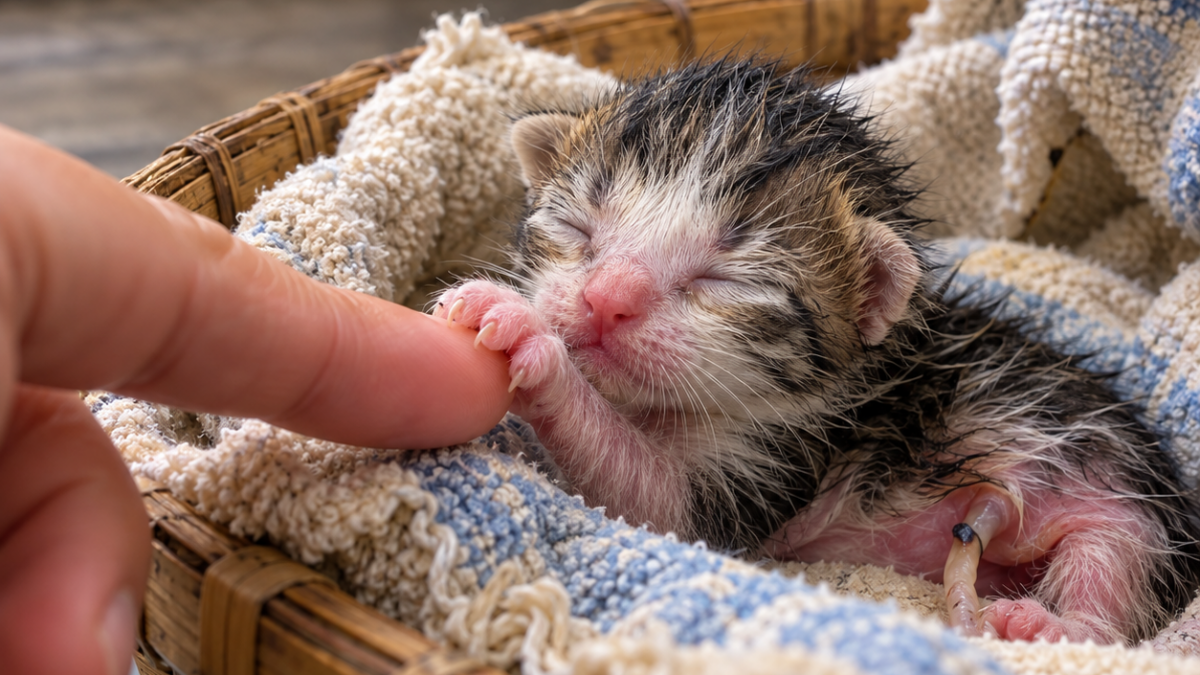
I Found a Newborn Kitten in a Bamboo Basket—Then the Woman Who Abandoned Him Came Back to Claim Him.
I found him on a Wednesday morning in front of the office, inside an old bamboo basket everyone else had stepped around like trash.
He was still damp, his eyes sealed shut, a thin cord still attached to his belly, and when a woman behind me whispered, “Leave him, honey. He’s not going to make it,” I almost believed her.
Then his cold little nose bumped my finger, and somehow that helpless touch ruined every excuse I had.
At first, I thought the basket was garbage.
It sat crooked beside the front steps of the office building, half tucked behind a planter, faded towel hanging over one side, the kind of thing people glance at once and decide not to make their problem.
Cars rolled by.
Someone’s coffee cup hit the bottom of a trash can nearby.
A delivery truck hissed at the curb.
The whole morning felt ordinary in the cruel way mornings can feel ordinary right before something changes you.
Then I heard it.
Not a cry exactly.
More like a wet little breath.
I stopped with one foot on the bottom step.
I had a meeting in twenty minutes, a stack of bills on my kitchen counter, and a car making a sound I could not afford to identify. I was forty-six years old, tired in places sleep did not fix, and barely keeping my own life together.
I did not need another emergency.
That was the truth.
Then I heard the sound again.
Small.
Broken.
Alive.
I leaned down and pulled back the corner of the towel.
Inside was a kitten so tiny he did not look real.
His body trembled without strength behind it. His eyes were sealed shut. His skin showed pink through wet gray fur. A thin cord still clung to his belly, and his head wobbled like the effort of breathing had already used everything he had.
For a second, I froze.
A woman from the second floor stopped behind me and looked over my shoulder.
“Oh, honey,” she said softly. “Leave him. He’s not going to make it.”
I knew she was not trying to be cruel.
She was being practical.
That is what people call it when they do not want hope to hurt too much.
I stared at that tiny body in the basket.
I thought of my meeting.
My bills.
My empty apartment.
My gas tank hovering near the red line.
My life, already stretched thin enough to tear.
Then the kitten moved.
Just a little.
His cold nose bumped the side of my finger.
That was all.
No big miracle.
No dramatic sign.
Just a helpless little nose against my skin.
And somehow, that was enough.
I picked up the towel, basket and all, and carried him to my car.
PART2:
The nearest animal clinic was six minutes away.
I drove like every red light had personally insulted me, one hand resting near the basket, whispering things I was not sure either of us believed.
“Stay with me, little guy.”
He made that wet breathing sound again.
“I know,” I said, though I did not know anything. “I know. Just stay.”
At the clinic, a young vet tech took one look inside the basket and got quiet.
That kind of quiet tells you plenty.
She disappeared through the back doors with him in her hands, and I stood in the lobby holding the empty basket like a woman who had already failed.
The vet came out fifteen minutes later.
She was gentle.
That scared me.
Gentle voices often come before terrible information.
“He’s probably less than twelve hours old,” she said. “No mother. Very cold. Very weak.”
I nodded like I understood.
I did not.
She explained what it would take if I wanted to try.
Warmth.
Feedings every two hours.
A syringe.
Milk replacer.
Stimulation with a warm cotton pad, like his mother would have done.
Round-the-clock care.
No promises.
That part came last.
No promises.
I had never raised a newborn kitten.
I had trouble keeping houseplants alive.
PART3:
I worked full-time in an office that barely tolerated personal phone calls longer than three minutes. My bank account lived one surprise expense away from collapse. My apartment was quiet because I had arranged my life to avoid needing anyone and being needed by anyone.
But when the vet asked what I wanted to do, I heard myself say, “Show me how to try.”
I named him Button because he was barely bigger than one.
That first day, I brought him home in a cardboard box lined with an old sweatshirt.
I filled a sock with rice, warmed it carefully, wrapped it in a towel, and placed it beside him. Then I checked the temperature ten times because I was afraid of doing everything wrong.
Every two hours, my phone alarm screamed.
I warmed milk replacer.
Touched the syringe to his mouth.
Most of it dribbled down his chin.
I wiped him clean with the corner of a washcloth.
I begged.
“Come on, Button. Just one drop.”
At two in the morning, I sat at my kitchen table with the lights low and my hair falling out of its clip, watching his tiny ribs rise and fall.
I had not prayed in years.
That night, I prayed badly.
Not with pretty words.
Just, “Please. Please. Please.”
The next morning, I took him to work.
I had no choice.
I put his box under my desk with a heating pad on low and a towel folded over the top. Every break, every lunch minute, every spare second, I checked on him.
I thought I was being sneaky.
I was not.
Around three in the afternoon, Marlene, the cleaning lady, stood in my doorway holding a trash bag.
She was in her late sixties, small but sturdy, with silver hair pinned back and hands that looked like they had worked hard for a long time.
Her eyes went straight to the box.
“What you got in there?” she asked.
I opened my mouth to lie.
Then Button made his tiny broken sound.
Marlene set the trash bag down.
I lifted the towel.
She looked inside and covered her mouth.
For one awful moment, I thought she was going to tell someone. Tell me I could not keep an animal in the office. Tell me I was foolish. Tell me what the woman on the steps had already said.
He was not going to make it.
Instead, Marlene came back ten minutes later with a soft blue hand towel from her supply cart.
“This one’s clean,” she said. “Softer than what you’ve got.”
I stared at her.
She shrugged.
“I raised my grandson from two pounds and a prayer,” she said. “Sometimes little things live because somebody refuses to walk away.”
I almost cried right there at my desk.
That evening, Button got worse.
He would not take the syringe.
His body felt too still in my palm. The little fight I had imagined in him seemed to be slipping away, one shallow breath at a time.
I sat on the kitchen floor because I could not make it to a chair.
The box was beside me.
The bottle was warm.
The towel was ready.
None of it mattered if he would not swallow.
I remember thinking how strange grief is.
You can meet something in the morning and be broken by it before dark.
I called Marlene because I did not know who else to call.
She answered on the second ring.
“Put him against your chest,” she said.
“What?”
“Under your sweater. Let him hear you.”
“Marlene—”
“Let him feel warmth that doesn’t leave.”
So I did.
I pressed him lightly against my chest, tucked under my sweater, and sat there on the kitchen floor.
No television.
No noise.
Just my heartbeat and his tiny body.
Minutes passed.
Then more.
I felt ridiculous.
Then I felt desperate.
Then I felt him move.
One paw stretched against my skin.
His head shifted.
I put a drop of warm milk on my fingertip and touched it to his mouth.
He licked it.
Once.
Then again.
I held my breath so hard my chest hurt.
He took another drop from the syringe.
Then another.
Not much.
But enough.
Later that night, curled in the hollow of my hand, Button made a sound I will never forget.
A faint, shaky purr.
So small I almost missed it.
But it was there.
Life, answering back.
By morning, I looked like a wreck.
Button looked like a wrinkled mouse with attitude.
But he was alive.
When I walked into the office, Marlene was waiting near the front steps.
I opened the box.
Button moved under the towel.
Marlene turned her face away fast, but not before I saw her eyes fill.
“Well,” she said, clearing her throat. “Guess nobody told him he was supposed to quit.”
Weeks passed.
His eyes opened.
His ears unfolded.
His belly got round.
He learned to yell for milk like a tiny unpaid supervisor.
The same people who had stepped around the basket started stopping by my desk to ask about him.
“Is the baby here today?”
“How much does he weigh now?”
“Did he open his eyes?”
“Can I see him for just one second?”
I used to walk into the office invisible.
Now I walked in carrying a cardboard carrier and half the building turned their heads.
Marlene was the worst of them.
And by worst, I mean the best.
She appointed herself Button’s unofficial grandmother and took the job more seriously than any job description she had ever been handed.
Every afternoon, she appeared at my office door with a towel folded over one arm.
“Report,” she would say.
I would tell her his weight.
She would nod like she was reviewing hospital records.
When he gained half an ounce, she praised him like he had graduated college.
When he refused a feeding, she frowned at him.
“You listen here, little man,” she told him once, leaning over his box. “Women are out here losing sleep over you. Act grateful.”
Button yawned in her face.
Marlene said, “That’s disrespectful.”
But she smiled the whole time.
For a while, it felt like the whole office had softened around him.
The receptionist started keeping a small bottle warmer in the break room.
A man from payroll brought old flannel shirts for bedding.
One of the interns made a tiny sign that said BUTTON’S OFFICE HOURS and taped it to my cubicle wall.
Even my boss, Mr. Hanley, pretended not to know.
He was a square-shouldered man with a tired face and a voice that always sounded like he was trying not to cough. He ran the office with rules, forms, and silent disappointment.
But one morning, he stood in my doorway and watched Button crawl over my wrist.
“He looks stronger,” he said.
“He is.”
Mr. Hanley nodded.
Then he pointed at the coffee stain on my sleeve.
“You look worse.”
“I am.”
He almost smiled.
That was the closest thing to emotional support I had ever received from him.
Then he said, “Just keep it quiet.”
I did.
As much as a kitten could be kept quiet.
Which is to say, not at all.
Button had opinions.
He did not enjoy being weighed.
He did not enjoy being cleaned.
He did not enjoy waiting.
He did not enjoy my phone calls.
If I spoke to a client too long, he started yelling from under my desk with the outrage of a tiny man denied service at a restaurant.
People laughed.
I laughed too.
But underneath all of it, I was tired.
The kind of tired that lives behind your eyes.
The kind that makes you forget simple words.
The kind that makes you stand in a grocery aisle holding a can of soup and wonder why you came there.
My bills did not pause because Button needed me.
My car still made that ugly knocking sound.
My rent still came due.
The clinic visits were not free.
Formula was not free.
The heating pad, towels, syringes, scale, carrier, and emergency checkups were not free.
Love, it turns out, is free.
Keeping something alive rarely is.
I did not tell people that part.
I did not tell them I had started skipping lunch to cover vet costs.
I did not tell them I paid one bill late and stared at the red notice on my counter like it was judging me.
I did not tell them I sometimes sat in my parked car before work and cried for three minutes because I was so tired I could not imagine walking inside.
People love rescue stories when they are sweet.
They love the tiny animal wrapped in a towel.
They love the purr.
They love the before and after.
They do not always love the middle.
The middle smells like formula and fear.
The middle looks like no sleep.
The middle costs money you do not have.
The middle asks you, every single day, whether your compassion was real or just a beautiful feeling you had one morning.
I found out mine was real.
I also found out real compassion can wear you down to the bone.
Then one Thursday afternoon, everything changed.
Button was asleep in the pocket of my cardigan.
He liked it there.
I had started wearing that ugly old cardigan every day because the front pocket was just deep enough to hold him, and because he calmed down when his nose was tucked against my shirt.
I was entering numbers into a spreadsheet when Tanya from compliance appeared at my desk.
Tanya had worked two cubicles over from me for four years. She wore sharp glasses, kept her files color-coded, and smelled faintly like peppermint gum.
She was not cruel.
She was careful.
There is a difference.
She looked at my cardigan pocket.
The pocket moved.
Tanya closed her eyes for one second.
“You still have the cat here.”
I put one hand over Button.
“He’s sleeping.”
“That is not the point.”
“I know.”
“I don’t think you do.”
She lowered her voice, which somehow made it worse.
“People are talking.”
“People have been talking since the day he opened his eyes.”
“No,” she said. “Not cute talking. Policy talking.”
My stomach tightened.
Tanya glanced toward the hallway.
“There are allergy concerns. Liability concerns. Cleanliness concerns. Someone said if one person can bring an animal, everyone can.”
“He’s not exactly an animal,” I said.
Tanya looked at me.
I heard myself.
“He is an animal,” I admitted. “He’s a baby.”
“He’s still an animal.”
I did not like her for saying it.
I also knew she was not wrong.
That was what made me angry.
The easiest people to hate are the ones who are completely wrong.
Tanya was not completely wrong.
She leaned closer.
“I know you care about him. I do. But some of us need this job to be stable. We need rules to mean something.”
That sentence hit harder than I wanted it to.
Because I needed the job too.
Desperately.
Tanya was divorced. She had two kids in middle school. Her mother lived with her. She was not some cold woman who hated kittens.
She was a woman holding her own life together with both hands, and Button had become one more thing she could not control.
“I’m not trying to make trouble,” I said.
“But you are making trouble,” she answered.
Not loudly.
Not meanly.
Just honestly.
That was when Mr. Hanley called me into his office.
He had a paper on his desk.
Company letterhead.
My heart sank.
“I tried to give this some room,” he said.
“I know.”
“I appreciate what you did.”
“I know.”
“But this cannot continue.”
I stared at my hands.
Button shifted in my cardigan pocket and made a sleepy sound.
“There was a complaint,” Mr. Hanley said.
“I figured.”
“More than one.”
That surprised me.
Then it hurt.
“People complained about a kitten?”
“People complained about an animal in the workplace.”
“He’s barely two pounds.”
“Rules do not have weight limits.”
I almost laughed.
I almost cried.
Somehow, I did neither.
Mr. Hanley took off his glasses and rubbed the bridge of his nose.
“You have until Monday to make other arrangements.”
Monday.
It was Thursday.
The room tilted a little.
“Mr. Hanley, he still needs monitoring.”
“I understand.”
“He can’t be left alone all day.”
“I understand.”
“If he crashes—”
“I understand.”
He said it softly that time.
And I believed he did.
That made it worse.
Understanding did not change the paper on his desk.
“I am not firing you,” he said. “I am not punishing you. But I cannot run this office by feelings.”
There it was.
The sentence everybody says when feelings become inconvenient.
I nodded.
Button’s tiny paw pushed against the edge of my pocket.
He opened his mouth in a silent little yawn, then blinked up at me like the world had never done him wrong.
I wanted to tell him the world was trying.
Instead, I tucked him closer.
“I’ll figure it out,” I said.
I hated how often adults say that when they have absolutely no idea what to do.
By lunch, everyone knew.
Of course they did.
Offices run on coffee and things people were not supposed to repeat.
Some people came by with sympathy.
Some came by with advice.
Some came by because drama is cheaper than television.
“You could take vacation.”
“I don’t have vacation left.”
“You could work from home.”
“My position isn’t approved for that.”
“You could find a sitter.”
“For a medically fragile kitten every day?”
“My cousin’s neighbor fosters cats.”
“Does your cousin’s neighbor know how to feed a kitten with no warning signs before he fades?”
That shut them up.
For about four minutes.
Then Tanya came by.
I expected more policy talk.
Instead, she placed a small envelope on my desk.
“What’s this?”
“Don’t make it weird,” she said.
So naturally, I made it weird.
“Tanya.”
“Don’t.”
“Tanya, what is this?”
She sighed.
“It’s forty dollars. For the vet or whatever.”
I stared at her.
“But you complained.”
Her face tightened.
“I made a complaint about the office. Not about him living.”
I did not know what to say.
She looked embarrassed.
“I can think something doesn’t belong at work and still hope it survives.”
That stayed with me.
It still does.
Because we like people simple.
We want heroes and villains.
We want the woman who complains to be heartless.
We want the woman who saves the kitten to be noble.
But most of us are just tired people making choices from whatever corner we are standing in.
That evening, I called every foster contact the clinic gave me.
No openings.
No one available during work hours.
No one comfortable with his history.
No one close enough.
One woman said, “I can take him, but if I take him, I keep him until adoption.”
Adoption.
The word felt like a hand around my throat.
“I’m not giving him up,” I said too quickly.
The woman was silent for a moment.
Then she said, “Honey, sometimes love means knowing your limits.”
I thanked her and hung up before I said something I could not take back.
That was the first night I wondered whether I was being selfish.
I sat on the floor beside Button’s playpen while he wrestled a stuffed sock.
He bit it with great drama.
Kicked it with both back feet.
Then lost his balance and rolled onto his side.
I laughed.
Then I cried.
Button stopped playing and stared at me.
His ears tilted forward.
He took one wobbly step toward the bars of the playpen.
Then another.
Then he pressed his tiny face between them and squeaked.
I reached in and picked him up.
He climbed under my chin.
“I don’t know what to do,” I whispered.
He purred like that answered everything.
The next morning, Marlene found me in the break room.
I was rinsing a syringe in the sink.
I had not slept much.
My hair looked like I had fought a ceiling fan.
Marlene took one look at me and said, “Sit.”
“I’m fine.”
“Women who say ‘I’m fine’ in that voice are usually one spoon away from crying into pudding. Sit.”
I sat.
She poured me coffee.
It was terrible coffee.
I drank it anyway.
I told her everything.
The complaints.
The Monday deadline.
The foster calls.
The money.
The guilt.
Marlene listened without interrupting.
When I finished, she folded her hands on the table.
“I can take him during the day.”
I looked up.
“What?”
“I clean evenings. I’m home most mornings and afternoons. You drop him off before work, pick him up after.”
“Marlene, no.”
“Yes.”
“He’s a lot.”
“I raised three children, two nephews, one grandson, and a husband who believed laundry happened by magic. A kitten does not scare me.”
“But his feedings—”
“You write it down.”
“His temperature—”
“I have hands.”
“What if something happens?”
“Then something happens with someone holding him.”
That was exactly what I wanted.
It was also too much to ask.
“You already do so much,” I said.
Marlene’s face changed.
Not sadness exactly.
Something older.
“People say that when they want to keep you at a polite distance.”
“I don’t.”
“You do.”
I opened my mouth.
Then closed it.
She was right.
I had let her help in small ways.
Towels.
Advice.
A phone call at midnight.
But letting someone really help meant admitting I could not do it alone.
I hated that.
Not because I was proud.
Because every time I had needed someone badly in my life, I had learned to need less.
Marlene reached across the table and tapped my hand.
“Let people help before the world teaches you to call exhaustion strength.”
That almost broke me.
So that became the arrangement.
On Monday morning, I drove Button to Marlene’s apartment before work.
She lived on the second floor of a brick building with flowerpots on the fire escape and a hallway that smelled like lemon cleaner and old wood.
Her apartment was small, warm, and spotless.
Family photos on the wall.
A crochet blanket on the couch.
A ceramic rooster in the kitchen that looked judgmental.
Button approved immediately.
He sniffed the air.
Sneezed.
Then tried to climb Marlene’s sleeve.
“See?” she said. “He knows quality care.”
I left written instructions.
Then added more instructions.
Then explained the instructions.
Then explained where I had explained them.
Marlene finally took the paper from my hand.
“Go to work.”
“I’ll call at ten.”
“You’ll call at ten-thirty.”
“Ten-fifteen.”
“Ten-thirty.”
“Fine.”
I made it to my car before crying.
Not because I did not trust her.
Because I did.
And trusting someone with what you love is terrifying in a completely different way.
For two weeks, the arrangement worked.
I dropped Button off each morning.
Marlene sent updates in short messages.
He ate.
He yelled.
He pooped.
He attacked my slipper.
He is asleep.
He is awake and accusing me.
At lunch, I sat in my car and looked at the blurry photos she sent.
Button in a towel.
Button biting a blanket.
Button asleep against Marlene’s wrist.
Button standing in a food bowl like a tiny fool.
The office got quieter without him.
People stopped visiting my desk.
I got more work done.
I also felt lonelier than I expected.
Tanya seemed relieved.
Mr. Hanley seemed grateful.
Marlene seemed happier.
Button seemed fine.
So why did I feel like something had been taken from me?
Maybe because survival had given me a routine.
And routine had given me a reason.
When Button was with me every second, I did not have time to ask what my life had become.
Without him under my desk, the silence came back.
The bills.
The tiredness.
The apartment I went home to alone.
The little places inside me I had ignored because a kitten needed feeding.
I started to understand something uncomfortable.
Saving Button had made me feel needed.
And needed can feel a lot like loved when you have gone long enough without the real thing.
That scared me.
Because Button was not responsible for fixing my loneliness.
He was not medicine.
He was not a reward for my suffering.
He was a living creature.
And loving him meant I had to be honest about that.
Then the woman showed up.
It was a Tuesday.
I remember because Tuesdays had become clinic weigh-in days.
I had picked Button up from Marlene and brought him to Cedar Hill Animal Clinic after work.
He weighed just under two pounds.
The vet tech cheered.
I nearly clapped.
Button attempted to bite the scale.
That was when I heard a voice behind me.
“Is that him?”
I turned.
A woman stood near the front desk, gripping a little girl’s hand.
The woman looked about thirty, maybe younger, but exhaustion had added years around her eyes. Her hair was pulled back badly. Her coat was too thin for the air outside.
The little girl beside her had big brown eyes and a stuffed cat tucked under one arm.
They were both staring at Button.
My body knew before my mind did.
I pulled the carrier closer.
“Can I help you?”
The woman swallowed.
“My name is Leah.”
I said nothing.
She looked at Button again.
“I think that kitten came from my house.”
The clinic went quiet around us.
Not completely.
Phones still rang.
A dog barked somewhere in the back.
A printer hummed.
But around me, everything narrowed.
Leah took a breath.
“We saw a picture. Someone from your office posted about him on the neighborhood board. My daughter recognized the towel.”
The towel.
The faded towel from the basket.
My fingers tightened around the carrier handle.
The little girl whispered, “His name was Bean.”
Button was chewing on the edge of his blanket.
He did not know his life had just split open.
I looked at Leah.
“You left him in a basket.”
Her face flushed.
The little girl looked down.
Leah’s grip tightened around her daughter’s hand.
“I know.”
“No mother. Cord still attached. Cold.”
“I know.”
“He was dying.”
“I know.”
Each answer made me angrier.
Because she did know.
And because she looked like knowing had been eating her alive.
Leah crouched beside her daughter.
“Nora, sit over there for a minute, okay?”
The little girl hesitated.
“I want to see him.”
“Just a minute.”
Nora walked to the chairs by the window and sat down, clutching her stuffed cat like a shield.
Leah turned back to me.
Her eyes were wet.
“Our cat had kittens under the porch,” she said. “We didn’t even know she was pregnant. There were four. Three were already gone when we found them. He was the only one moving.”
My throat tightened despite myself.
“My daughter found him first. She wanted to keep him. I tried to warm him. I called around. Nobody answered. I didn’t have a car that morning.”
She wiped her cheek fast.
“My mother was having one of her bad days. My shift started at eight. I panicked.”
“So you left him outside an office?”
“I left him where people would find him.”
“That is not the same as helping him.”
“No,” she said. “It isn’t.”
That stopped me.
I had expected excuses.
She gave me the truth.
Ugly truth is harder to fight with.
Leah looked at the carrier.
“I have thought about that basket every day.”
I wanted to say good.
I wanted to say you should.
I wanted to make her feel exactly as awful as I had felt that first night when Button would not swallow.
But Nora was watching from the chairs.
And Leah already looked like a woman who had been dragged behind her own choices for weeks.
“What do you want?” I asked.
Leah took a breath.
“My daughter wants him back.”
There it was.
Back.
As if Button had gone on vacation.
As if he had not become my alarms, my towels, my missed sleep, my pocket, my grocery sacrifices, my whispered prayers.
I laughed once.
It came out sharp.
Leah flinched.
“He was never yours to ask for back,” I said.
Her face tightened.
“I know how it looks.”
“How it looks?”
“I know what I did was wrong.”
“Then why are you here?”
“Because Nora has cried every night since she saw that picture.”
Nora looked away quickly when I glanced at her.
Leah lowered her voice.
“She thought he died. Then she saw him alive. She thinks it means she gets a second chance too.”
The words hit somewhere tender.
A second chance.
That was dangerous language around me.
Button pressed his paw against the carrier door.
Leah looked at him like she was starving.
“I’m not asking to take him this second,” she said. “But can she hold him? Please?”
Everything in me said no.
No, because he was fragile.
No, because I did not trust them.
No, because I was angry.
No, because I was afraid that if Nora held him, I would see a child loving him and my certainty would fall apart.
So I said the easiest no.
“He just had a checkup. He’s tired.”
Leah nodded.
She looked like she had expected it.
Nora did not.
Her face crumpled.
Not loudly.
Not dramatically.
Just a little silent collapse that made her look younger than she was.
Leah put a hand on her shoulder.
“I’m sorry, baby.”
Nora whispered, “But he knows me.”
Button did not know her.
That was the cruelest part.
Or maybe the kindest.
I carried him out of the clinic with my heart pounding.
In the parking lot, Marlene was waiting beside my car.
I had called her from the hallway.
One look at my face and she said, “Oh, Lord. What now?”
I told her.
All of it.
The woman.
The daughter.
The towel.
The name Bean.
The request.
Marlene listened with her lips pressed tight.
When I finished, she looked through the carrier at Button.
He blinked at her.
“So,” she said. “The past came knocking.”
“I’m not giving him back.”
“I didn’t say you were.”
“I won’t.”
“I heard you.”
“She left him.”
“She did.”
“He would have died.”
“He might have.”
“No. He would have.”
Marlene looked at me.
“Yes.”
I waited for her to agree harder.
To say Leah had no right.
To say that was the end of it.
Instead, Marlene asked, “And the child?”
I looked away.
“What about her?”
“She didn’t leave him.”
“No. But she can’t care for him.”
“Most children can’t. Adults are supposed to.”
“Exactly.”
Marlene sighed.
“I am not telling you to hand him over.”
“Good.”
“I am telling you this is bigger than anger.”
I hated that.
Anger had been the only thing holding me upright.
“You have to decide what is best for Button,” she said. “Not what punishes Leah. Not what comforts Nora. Not what rewards you. Button.”
I looked at the carrier.
Button had fallen asleep with one paw over his nose.
Button.
Not Bean.
Not a lesson.
Not a trophy.
Not proof that I was good.
Just Button.
The drive home felt longer than usual.
That night, I did not sleep.
Button did.
Of course he did.
He curled on my chest and purred like nothing in the world was complicated.
I stared at the ceiling.
At midnight, I checked my phone.
There was a message from an unknown number.
Leah.
I almost deleted it.
Then I read it.
I’m sorry for showing up like that. I know I scared you. I know I don’t deserve anything from you. Nora asked if Button has a blanket. She wants to give him the one she picked for him before everything happened. You don’t have to answer.
I stared at the message until the screen went dark.
Then turned it back on and stared some more.
A blanket.
Such a small thing.
Such an impossible thing.
The next morning, the whole office knew.
Again.
Someone had seen Leah at the clinic.
Someone had told someone.
By ten o’clock, the story had grown legs.
By lunch, it had opinions.
“She abandoned him. End of discussion.”
“But what if she was desperate?”
“Desperate people still have responsibility.”
“Maybe the kid should get him.”
“The kid didn’t keep him alive.”
“Money doesn’t make you a better pet owner.”
“Love doesn’t either.”
That one came from Tanya.
The break room went quiet.
I felt my face get hot.
“What does that mean?”
Tanya did not back down.
“It means loving Button doesn’t automatically mean you’re the only right home.”
I stood.
Marlene, who had been wiping the counter, turned slowly.
Tanya noticed but kept going.
“I’m not saying give him to them. I’m saying everyone is acting like the answer is obvious because it feels good to make one woman the villain.”
“She left a newborn kitten in a basket.”
“Yes. And you brought a medically fragile animal into an office full of people who did not agree to that. You were desperate too. Your choice was better, but it still affected people.”
The room went very still.
I wanted to hate her again.
I really did.
But underneath the sting, there was a piece of truth.
That was Tanya’s gift.
She could deliver truth like a paper cut.
Small.
Clean.
Annoying.
Hard to ignore.
Marlene set down her towel.
“Careful, Tanya.”
“I am being careful.”
“No,” Marlene said. “You’re being neat. Life is not neat.”
Tanya’s jaw tightened.
“I’m just saying the kitten should go where he’ll have the most stable care.”
“And who decides stable?” Marlene asked.
“The person who can afford it. The person who can be home. The person who doesn’t need to smuggle him around.”
That hit too close.
I picked up my coffee cup even though it was empty.
Marlene looked ready to breathe fire.
But I spoke first.
“You’re not wrong to ask the question,” I said.
My voice shook.
“But don’t talk like I haven’t been asking it every day.”
Tanya’s face changed.
Just a little.
“I know.”
“No. You don’t.”
I walked out before I said more.
That afternoon, Button had his first real setback in weeks.
He refused breakfast.
Then lunch.
By three, Marlene called me.
“He’s not himself.”
I left work early.
Mr. Hanley did not stop me.
At Marlene’s apartment, Button lay in his blanket, too quiet.
My whole body went cold.
Not again.
Not after everything.
At the clinic, they took him to the back.
I sat in the exam room with Marlene beside me and my hands clenched so tightly my fingers hurt.
The vet came in twenty minutes later.
Not the young vet from that first day.
This one was older, with kind eyes and gray at her temples.
Dr. Vale.
She said Button had likely picked up a mild infection.
Common in fragile kittens.
Treatable.
But he needed fluids, medication, monitoring, maybe overnight care.
My ears started ringing.
“How much?” I asked.
She hesitated.
That hesitation told me plenty.
When she gave me the estimate, I felt the blood drain from my face.
It was not an impossible number for some people.
It was impossible for me that week.
Maybe that month.
Marlene looked at the paper.
Then at me.
“We’ll figure it out,” she said.
There was that sentence again.
I was beginning to hate it.
Dr. Vale gave us a moment.
The room smelled like disinfectant and fear.
Button was in the back.
A dog whined somewhere down the hall.
Marlene opened her purse.
“No,” I said immediately.
“Don’t start.”
“No, Marlene.”
“I have some savings.”
“Absolutely not.”
“Pride is expensive.”
“So is being seventy and giving your savings to a kitten that isn’t yours.”
Her eyes flashed.
“He is not nothing to me.”
“I know that.”
“Then don’t say it like that.”
“I’m sorry.”
She softened.
So did I.
But the number stayed on the paper.
That was when my phone buzzed.
Leah again.
I almost ignored it.
Then I saw the message preview.
Nora wanted to bring the blanket. We are near the clinic. Is that okay?
I stared.
Marlene saw my face.
“What?”
I showed her.
She read it.
Then looked toward the back where Button was.
“Maybe let the child bring the blanket.”
“I can’t do this right now.”
“Maybe right now is exactly when you should.”
I wanted to argue.
I did not have the energy.
Leah and Nora arrived fifteen minutes later.
Nora held a small yellow blanket in both hands.
It had tiny stars on it.
She looked nervous.
Leah looked worse.
Then she saw my face.
“What happened?”
I should not have told her.
It was none of her business.
But exhaustion makes your mouth honest.
“He’s sick.”
Nora clutched the blanket.
Leah went pale.
“Is he going to die?”
“I don’t know.”
I hated saying that in front of Nora.
Dr. Vale came back in and explained gently.
Treatable.
Needs care.
Needs monitoring.
Needs action soon.
Then Leah asked the question.
“How much?”
No one answered at first.
Then I handed her the estimate.
She looked at it.
Her expression shifted in a way I could not read.
“I can pay it,” she said.
The room froze.
Marlene looked at her.
I looked at her.
Nora looked at Button’s empty carrier.
Leah swallowed.
“My tax refund came. I was saving it for rent cushion, but I can pay this.”
My throat closed.
Then she added the sentence that split me in two.
“If I pay, will you let us take him home when he’s better?”
There are moments in life when you hear a sentence and know everyone who hears the story later will choose a side.
Some will say I should have said yes immediately.
Because Button needed care.
Because money mattered.
Because love without resources can become suffering.
Some will say I should have said no immediately.
Because money should not buy forgiveness.
Because Leah had already made her choice.
Because Button was not a thing to be purchased with a vet bill.
In that room, with a sick kitten in the back and a child holding a yellow blanket, there was no answer that did not hurt somebody.
I looked at Leah.
“You’re offering to pay for him if I give him to you?”
She flinched.
“No. I mean—”
“That is what you said.”
“I didn’t mean it like that.”
“How did you mean it?”
She pressed her lips together.
Nora started crying quietly.
Marlene stood.
“Everybody breathe.”
“No,” I said. “I want to hear this.”
Leah’s eyes filled.
“I meant I can give him things you’re struggling to give him.”
The words landed hard because they were true.
Not completely.
But enough.
“I can be home more,” she said. “My mother is staying with my sister now. I switched shifts. Nora loves him.”
“You love the idea of him.”
Leah recoiled.
Nora looked up.
I regretted it immediately.
But I did not take it back.
Leah whispered, “That’s not fair.”
“No,” I said. “Leaving him in a basket wasn’t fair.”
The room went silent.
Even Button, wherever he was, seemed absent from the sound.
Dr. Vale stepped in then.
Her voice was calm.
“I need to be clear about something. Button’s immediate care decision cannot be tied to ownership.”
Leah wiped her face.
Dr. Vale continued.
“If someone wants to contribute, that is generous. But Button is not a bill with fur. He is a patient.”
I will remember that sentence for the rest of my life.
Button is not a bill with fur.
Dr. Vale looked at me.
“Legally, I cannot decide who he belongs to.”
Then she looked at Leah.
“And emotionally, none of you should try to solve that in a crisis.”
Marlene nodded.
“That woman has sense.”
Dr. Vale gave the smallest smile.
“Occasionally.”
Leah looked down at the estimate.
“I’ll still pay half,” she said.
I stared at her.
She shook her head, crying now.
“No condition. I said it wrong. I’m sorry. I just panicked.”
Nora held out the blanket with both hands.
“Can he still have it?”
That undid me.
Not Leah’s apology.
Not the money.
The blanket.
Because children have a way of walking into adult mess with something simple in their hands.
A blanket.
A drawing.
A question.
A love that has not learned how to protect itself yet.
I took the blanket.
“Yes,” I said.
Nora’s face trembled.
“Can you tell him I’m sorry?”
I knelt in front of her.
For one second, I saw myself at eight or nine years old, wanting adults to fix things they had broken.
Believing love should be enough if you held it carefully.
“He doesn’t need you to be sorry for something you didn’t do,” I said.
Nora looked at her mother.
Leah covered her mouth.
That was not a perfect moment.
Perfect moments do not happen under fluorescent lights with vet estimates on a counter.
But it was a real one.
Dr. Vale admitted Button for the night.
Leah paid half.
Marlene paid a little, despite my protests.
Tanya sent money later through the receptionist and told me not to mention it.
Mr. Hanley quietly marked my early departure as personal time, not unpaid time.
The payroll man left an envelope in my drawer with no name.
By the next evening, Button was stronger.
Not all better.
But stronger.
When Dr. Vale brought him out, wrapped in Nora’s yellow blanket, he looked offended by the entire medical profession.
That was a good sign.
He squeaked at me.
I took him in my hands.
He smelled like medicine and kitten breath.
I pressed him to my chest and felt his tiny purr start up like an old engine that had no business still running.
Leah and Nora came too.
I had agreed to it after a long talk with Dr. Vale and Marlene.
Not to decide anything.
Just to let Nora see Button was alive.
Nora stood a few feet away.
She did not rush him.
I respected that.
“Hi, Bean,” she whispered.
Button turned his head at the sound.
Not because he knew the name.
Because he knew voices.
Warmth.
Hands.
People.
Nora smiled through tears.
“That’s him.”
I almost corrected her.
Button.
His name is Button.
But I stopped.
Because before he was Button to me, he had been Bean to a little girl who found him under a porch and believed he could live.
Love does not begin only when it succeeds.
Sometimes people love badly.
Sometimes they love too weakly.
Sometimes they love and still fail the thing they love.
That is a painful truth.
It is also human.
I let Nora touch one finger gently to his head.
Button sniffed her.
Then he sneezed.
Nora laughed.
Leah cried.
Marlene pretended not to.
I definitely did.
For the next two weeks, Button recovered at Marlene’s during the day and with me at night.
Leah did not ask to take him again.
Not directly.
But the question lived between us.
She brought supplies.
Formula.
Cotton pads.
A soft bed.
A little toy mouse Button immediately ignored in favor of a paper receipt.
She never came empty-handed.
She also never came demanding.
That made things harder.
Villains are convenient.
Leah refused to be one.
One Saturday morning, she asked if we could talk.
Just the adults.
Nora was sitting on Marlene’s couch, letting Button attack the string on her hoodie while Marlene watched like a security guard.
Leah and I stood in the kitchen.
The ceramic rooster judged us both.
Leah wrapped her hands around a mug of tea.
“I need to say something,” she began.
I waited.
“I came here thinking if I explained enough, you would understand and maybe give him back.”
My shoulders tightened.
“But I don’t think that anymore,” she said.
I looked at her.
She stared into the tea.
“I think I wanted him because Nora was hurting and I wanted to undo one thing. Just one. I wanted to prove I wasn’t the kind of mother who leaves helpless things behind.”
Her voice cracked.
“But taking him from the person he knows would not fix what I did. It would just make me feel forgiven faster.”
I did not speak.
I was afraid any sound would break the honesty in the room.
Leah wiped under one eye.
“Nora loves him. But she loves him like a child loves something she thought she lost. You love him like the person who got up every two hours and kept choosing him.”
Then she looked at me.
“I don’t think those are the same.”
Something inside me loosened.
Not all the way.
But enough to breathe.
“I have been angry at you,” I said.
“I know.”
“I still am.”
“I know.”
“But I also know panic.”
Leah nodded.
“I know being one bad morning away from doing something you will regret.”
Her face folded.
“I should have knocked on the office door.”
“Yes.”
“I should have stayed.”
“Yes.”
“I should have asked for help.”
“Yes.”
She swallowed.
“I didn’t know how.”
That sentence sat between us.
I wanted to tell her knowing how was not the point.
I wanted to tell her adults do what needs doing.
I wanted to tell her there were no excuses for leaving a newborn kitten in a basket.
All of that was true.
And still, another truth stood beside it.
A lot of people do not know how to ask for help until after they have already made the mistake help might have prevented.
“I didn’t either,” I said finally.
Leah looked up.
I thought of Marlene.
The envelopes.
Tanya’s forty dollars.
The payroll man.
Mr. Hanley’s quiet kindness.
All the hands that had held up a life I kept pretending I alone had saved.
“I’m learning,” I said.
Leah nodded.
“So am I.”
That afternoon, we made an agreement.
Button would stay with me.
Not because I won.
Not because Leah lost.
Not because Nora did not matter.
Because Button was bonded, fragile, and finally stable.
Because his home needed to be chosen around him.
Not around guilt.
Not around money.
Not around who had the sadder story.
Around him.
Leah would visit with Nora once a month, if Button tolerated it.
She would not call him Bean in front of me.
I would not snap if Nora slipped.
Leah would help with some supplies, but not as payment.
Nora could make him toys.
Marlene would remain his grandmother, because no one was brave enough to tell her otherwise.
When we told Nora, she cried.
Of course she did.
She was a child.
Children are allowed to grieve what adults decide.
But then she asked, “Can I still send him birthday cards?”
I said yes.
Button did not know what a birthday card was.
He tried to eat the first one.
Nora was thrilled.
Life settled again.
Not the same way as before.
Better, maybe.
Messier, definitely.
Button grew.
His baby blue eyes turned green.
His legs got longer.
His tail became ridiculous.
He developed a habit of sitting in the bathroom sink like he paid taxes there.
He learned to climb curtains.
He learned to open the lower cabinet.
He learned that if he knocked one pen off my desk, I would pick it up, but if he knocked seven pens off my desk, I would question my place in the universe.
He was not grateful in any visible way.
That is another thing rescue stories get wrong.
Animals do not spend their lives thanking you.
They live.
That is the thank-you.
Button lived loudly.
On windowsills.
In laundry baskets.
Inside paper bags.
By stealing the warm spot on my pillow.
By biting my toes at dawn.
By becoming exactly what he was supposed to become.
Not a symbol.
Not a miracle.
A cat.
A strange, demanding, soft-bellied, green-eyed cat with no respect for personal space.
And I loved him more for that.
At work, things changed too.
Not all at once.
Mr. Hanley called a staff meeting.
I expected something stiff about workplace policy.
Instead, he stood at the front of the conference room looking deeply uncomfortable.
“I have reviewed our emergency accommodation policies,” he said.
Tanya sat up straighter.
So did I.
Mr. Hanley coughed.
“This office cannot become an animal care facility.”
A few people glanced at me.
“But,” he continued, “we can do better at responding when employees face temporary emergencies.”
He looked at no one in particular.
“We will be creating a process for short-term flexibility requests. Human emergencies. Family emergencies. Situations that require compassion and structure.”
Compassion and structure.
Tanya looked down at her notes.
Marlene, who had no reason to be in that meeting but had found a reason anyway, smiled into her coffee.
Mr. Hanley cleared his throat again.
“I am not naming this after the cat.”
Someone whispered, “The Button Policy.”
Mr. Hanley closed his eyes.
The whole room laughed.
Even Tanya.
Especially Tanya.
After the meeting, she walked over to me.
“I’m glad he’s okay,” she said.
“Thank you.”
“And for the record, I still think animals shouldn’t be in the office.”
“I know.”
“And I still think you did the right thing that morning.”
I looked at her.
Both things.
That was the part people online would hate.
They want one clean opinion.
Tanya never gave clean when complicated was available.
“I think both can be true,” she said.
I smiled.
“Careful. That sounds like growth.”
She made a face.
“Don’t tell anyone.”
Marlene retired six months later.
Not because she wanted to.
Because her knees had started arguing with the stairs and winning.
The office threw her a small party in the break room.
Sheet cake from a local bakery.
Paper plates.
Flowers.
Mr. Hanley gave a speech that lasted ninety seconds and somehow still sounded too long.
Marlene cried before anyone else did, then blamed allergies.
I brought Button in a carrier for ten minutes.
Officially, he was not allowed.
Unofficially, Mr. Hanley stood in front of the door like a tired bouncer and said, “Make it quick.”
Button had become handsome by then.
Not elegant.
Never elegant.
But handsome in a scrappy little way.
One ear sat slightly lower than the other.
His tail had a kink near the tip.
His walk had a tiny wobble when he was tired.
Dr. Vale said he might always have it.
I loved that wobble.
It reminded me he had fought for every step.
When I opened the carrier, Button walked straight to Marlene.
Not to the cake.
Not to me.
To her.
He climbed into her lap like he had always known she was one of his safe places.
Marlene covered her mouth.
The room went quiet.
Button pressed his forehead against her wrist.
Marlene whispered, “Well, look at you.”
He purred.
Loudly.
Like an engine.
Like a promise.
Like life, answering back again.
After the party, Marlene pulled me aside.
“I need to tell you something.”
My stomach dropped.
That sentence never brings coupons.
“What?”
She looked embarrassed.
“I put my name on a waiting list.”
“For what?”
“A pet-friendly senior apartment.”
I blinked.
She rushed on.
“Not for Button. Don’t look at me like that. I’m not stealing your child.”
I laughed.
She smiled.
“I just realized I’ve been making my world too small.”
I did not trust my voice.
She looked toward the carrier.
“That little thing came in a basket half dead and caused all this trouble.”
“He did.”
“He got you asking for help. Got Leah asking for forgiveness. Got Tanya admitting she has feelings. Got Hanley creating a policy. Got me thinking maybe I don’t have to spend my evenings talking to a ceramic rooster.”
“The rooster seems like a good listener.”
“The rooster is judgmental.”
“He is.”
Marlene squeezed my hand.
“Sometimes God sends rescue in ugly packaging.”
I thought of the bamboo basket.
The towel.
The wet little breath.
The cold nose against my finger.
Ugly packaging.
Yes.
A month later, Leah invited me and Marlene to Nora’s school presentation.
Nora had written about Button for a class project.
I was nervous.
I almost did not go.
I worried the story would make me angry again.
I worried I would hear the basket part and feel that old sharp heat.
But Marlene said, “Healing does not mean you never revisit the room. It means you can stand in it without burning down the house.”
So we went.
The classroom smelled like crayons, pencil shavings, and floor cleaner.
Nora stood at the front holding poster board covered in drawings.
There was a basket.
A tiny kitten.
A woman with wild hair who I hoped was not supposed to be me but absolutely was.
A silver-haired woman with a towel.
A yellow blanket.
And at the bottom, in careful handwriting, Nora had written:
A second chance means doing better after someone tells you the truth.
That sentence nearly took me out.
Nora read her report in a small but steady voice.
She did not make herself the hero.
She did not make her mother the villain.
She said they had made a mistake.
She said someone else had helped when they did not know how.
She said Button lived because many people chose to care.
Then she looked right at me and said, “And now he has one mom, one grandma, and one friend who sends cards.”
The class clapped.
Leah cried.
Marlene cried.
I cried.
Button was not there, because he had tried to eat the carrier tag that morning and lost visiting privileges.
But somehow, he filled the room anyway.
On the drive home, I thought about how close I had come to letting anger decide everything.
Anger feels powerful.
It gives you clean lines.
Good person.
Bad person.
Mine.
Not yours.
Deserved.
Undeserved.
But love is not clean.
Mercy is not clean.
Responsibility is not clean.
A kitten in a basket is not clean.
Life comes to us messy, cold, inconvenient, and badly timed.
Then it asks what kind of person we are going to be before we have a chance to prepare an answer.
I did not become a different person overnight.
No one does.
I still got tired.
I still worried about money.
I still let dishes sit in the sink.
I still snapped at people when I was overwhelmed.
But something in me had shifted.
I stopped pretending needing help made me weak.
I started saying yes when people offered.
When a neighbor asked if I wanted her extra groceries, I said yes.
When Tanya offered to review a report so I could leave early for Button’s appointment, I said yes.
When Marlene invited me over for dinner, I said yes, even though I had planned to sit alone eating crackers over the sink.
That dinner became a Thursday habit.
Marlene cooked too much.
I brought dessert badly.
Button came in his carrier and strutted around her apartment like he owned three properties and a boat.
Sometimes Leah and Nora joined us.
Not often.
Enough.
At first, it was awkward.
Then less awkward.
Then normal in the way strange chosen things become normal if everyone keeps showing up gently.
Nora would sit on the floor with Button and read to him.
He would listen for about thirty seconds.
Then bite the book corner.
Nora called that participation.
Leah helped Marlene with errands sometimes.
I helped Nora with a school fundraiser flyer once.
Tanya came to one Thursday dinner after insisting she did not do emotional community gatherings.
She brought napkins.
Then she held Button for eleven full minutes and pretended not to enjoy it.
We did not become some perfect little family.
That would be too sweet.
We became something better.
People who knew the worst part of the story and stayed anyway.
A year after I found Button, I took him back to the front steps of the office.
It was a Wednesday morning.
I did not plan it that way.
Or maybe I did without admitting it.
The bamboo basket was long gone.
The planter had been replaced.
The sidewalk had been pressure-washed.
People hurried past with coffee and bags and phones.
The morning looked ordinary again.
Button sat in his carrier, wearing a tiny harness he hated with the passion of a wronged king.
Marlene stood beside me.
She had moved into her new apartment by then.
Pet-friendly.
Second floor.
Good sunlight.
No ceramic rooster.
She had adopted an elderly orange cat named Walter, who looked like he had seen every bad decision humans had ever made and was tired of our species.
Leah and Nora came too.
Nora had made Button a little paper crown.
He refused to wear it.
Reasonable.
Tanya stepped outside during her break.
Mr. Hanley came out pretending he needed to check the mail.
Nobody believed him.
We all stood there by the front steps.
A strange little group gathered around the spot where one small life had almost ended before it began.
I looked down at Button.
He blinked slowly.
Then he reached one paw through the carrier door and hooked it around my finger.
Just like that first morning.
Not his nose this time.
His paw.
Warm.
Strong.
Alive.
I felt the year fold in on itself.
The basket.
The towel.
The warning.
Leave him. He’s not going to make it.
The syringe.
The prayers.
The office complaints.
The clinic bill.
Leah’s face.
Nora’s blanket.
Marlene’s hands.
Tanya’s envelope.
Mr. Hanley’s awkward kindness.
All of it.
Every messy piece.
I used to think rescue was a straight line.
Someone helpless.
Someone helping.
A life saved.
End of story.
But it is not a straight line.
It is a circle.
You reach down for something small and broken, and before you know it, hands are reaching for you too.
Some are gentle.
Some are clumsy.
Some are late.
Some come with apologies.
Some come with rules.
Some come with towels from a cleaning cart.
And somehow, if you let them, they all become part of the saving.
Marlene nudged me.
“You okay?”
I nodded.
“I think so.”
Tanya crossed her arms.
“For the record, we are not making this an annual ceremony.”
Mr. Hanley said, “Agreed.”
Nora said, “We should.”
Leah smiled.
Marlene said, “I vote yes.”
Button sneezed.
I said, “Motion passes.”
Tanya sighed like we were all impossible.
But she was smiling.
That night, after everyone went home, I sat on my couch with Button asleep against my leg.
He was too big for my hand now.
Too heavy for my cardigan pocket.
Too alive to ever fit inside the small sad story he came from.
His body rose and fell with steady breath.
His paw twitched in a dream.
I touched the kink in his tail.
He opened one eye, decided I was not worth moving for, and went back to sleep.
I thought about Leah.
How some people would never forgive her.
I understood that.
I thought about Tanya.
How some people would call her cold.
I understood that too.
I thought about myself.
How some people would say I should have given Button to the home with more money, more time, more space.
Maybe they would be sure.
People are often sure from a distance.
But I was the one holding him when he forgot how to swallow.
I was the one who felt his first purr.
I was also the one who almost broke trying to do everything alone.
So here is what I know now.
Saving something does not make you its owner.
Money does not make you its savior.
Need does not make you entitled.
Regret does not erase harm.
And love, real love, is not proved by how tightly you hold on.
It is proved by whether you can put the life in front of your ego.
For Button, that meant staying with me.
For Leah, it meant letting him.
For Nora, it meant loving him without owning him.
For Marlene, it meant opening her door again.
For Tanya, it meant caring without pretending the rules did not matter.
For Mr. Hanley, it meant learning that a workplace could have structure and still have a pulse.
And for me, it meant admitting I had not saved Button by myself.
I had only been the first person who refused to step around the basket.
That matters.
But it is not the whole miracle.
The whole miracle came after.
When tired people, practical people, guilty people, careful people, lonely people, and frightened people all chose, in their own imperfect ways, to stay.
Button stretched in his sleep.
His paw landed on my hand.
I smiled.
A year earlier, that tiny touch had ruined every excuse I had.
It still does.
Whenever I am tempted to look away from something painful because I am tired, because I am busy, because I cannot fix all of it, I think of that cold little nose against my finger.
I think of the wet breath in the basket.
I think of Marlene saying, “Sometimes little things live because somebody refuses to walk away.”
And I think maybe that is the best any of us can do.
Not save the whole world.
Not solve every hurt.
Not become saints.
Just refuse to walk away from the small life placed in front of us.
One towel.
One ride.
One dollar.
One apology.
One honest conversation.
One more try.
Button woke then, as if he knew I was getting sentimental and wanted no part of it.
He stood, stretched, stepped directly onto my stomach, and yelled in my face.
Dinner was apparently late.
By four minutes.
I laughed so hard he looked offended.
Then I got up and fed him.
Because miracles still need dinner.
And sometimes, the life you save grows up, takes over your couch, judges your timing, and reminds you every day that hope is not soft.
Hope has claws.
Hope makes noise.
Hope costs something.
Hope asks inconvenient things from tired people.
And if you are lucky, hope curls up beside you afterward, warm and breathing, like it knew all along that you needed saving too.