I Brought Home One Frightened Shelter Cat, but Within Ten Minutes She Was Screaming at My Laundry Room Door—Then One Phone Call Made Me Realize She Hadn’t Come Home Alone in Her Heart.
PART3:
I told myself I was doing something useful.
Nothing emotional.
Nothing permanent.
I signed forms.
Natalie gave me food.
A litter pan.
A blanket.
A page of instructions.
The shelter’s executive director, Marianne Vale, happened to be walking through the lobby while Natalie helped load the carrier.
She was in her early fifties, maybe, with perfectly smooth blond hair, expensive glasses, and the polished confidence of a woman who always appeared ready to speak at a podium.
I knew her face from the shelter’s fundraising mailers.
She stopped.
“Fostering Juniper?”
“Yes.”
“Wonderful.”
Her smile looked professional enough to have a warranty.
“She should be easy.”
That word again.
Easy.
“She’s very independent.”
I remember that now.
Independent.
The shelter had separated her from everything she knew and then called her independent because she had gone quiet.
Marianne squeezed my arm.
“Older cats are grateful for whatever they get.”
Something about the sentence bothered me.
I didn’t know why yet.
I thanked her anyway.
Then I took Juniper home.
The moment I placed the carrier in my laundry room and opened it, Juniper retreated beneath the wire shelf.
I sat on the floor.
“It’s okay, sweetheart.”
She shook.
I pushed the cardboard box closer.
Put food nearby.
Moved the water dish.
“You don’t have to like me.”
Her eyes stayed fixed on me.
“You don’t even have to come out.”
I understood that kind of bargain.
I had been making it with people for years.
You don’t have to fix me.
Just stop asking me to pretend.
I left her alone for ten minutes.
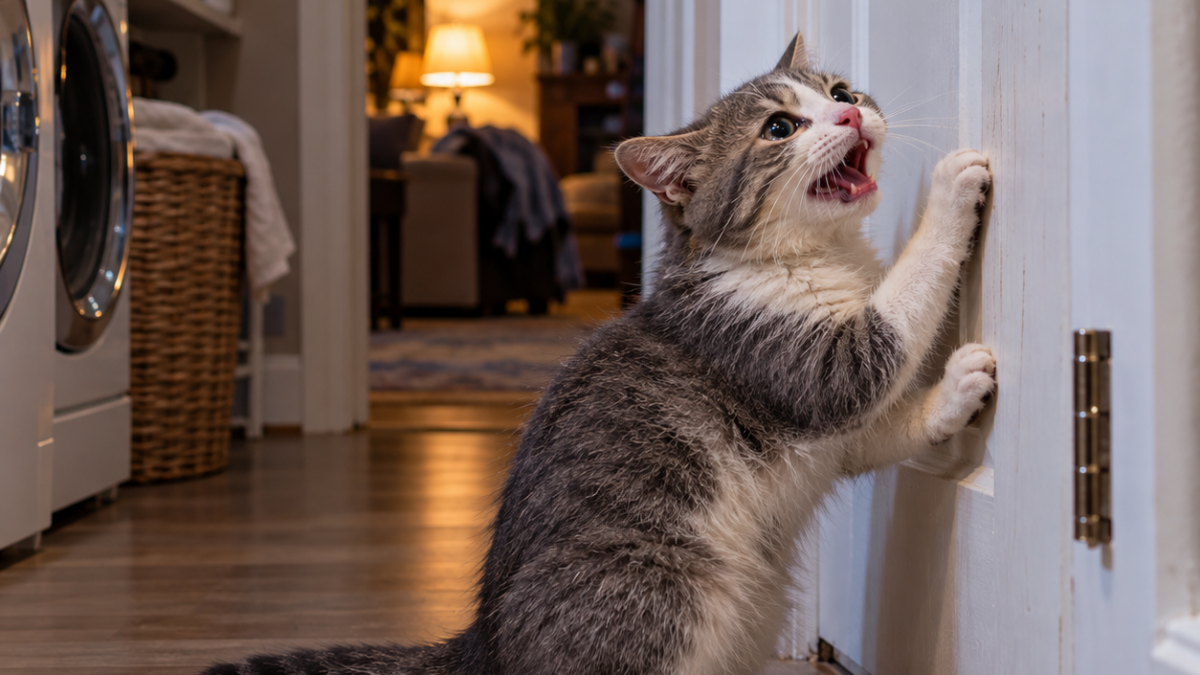
When I returned, Juniper was standing at the closed laundry room door.
Her body pressed against it.
At first, she scratched softly.
Then harder.
Then she screamed.
I stopped in the hallway.
There are sounds animals make that you can dismiss because they are unfamiliar.
That wasn’t one of them.
I knew grief when I heard it.
Juniper’s cry was raw.
Sharp.
Broken.
The sound of something calling for an answer that wasn’t coming.
I opened the laundry room door.
She shot into the hallway.
I expected her to run.
She didn’t.
She stopped.
Looked left.
Looked right.
Then stared up at me.
“Okay.”
My heart was pounding.
“You wanted out.”
She ran toward the living room.
Behind the couch.
Under the coffee table.
Into the dining room.
She sniffed beneath David’s old recliner.
She stood on her back feet at the coat closet and scratched the door.
I opened it.
Nothing.
She ran toward the bedrooms.
Checked beneath the guest bed.
Returned to the living room.
Cried again.
And suddenly I understood.
Juniper was not exploring.
She was searching.
“For who?”
She stared at me.
“Who are you looking for?”
She cried again.
That first night lasted forever.
Juniper returned to the laundry room, but she would not settle.
She sat against the closed door with one front paw pushed beneath the gap.
Every few minutes she cried.
By midnight, her voice was hoarse.
At one in the morning, I sat beside the door on the hallway floor.
At two, I brought my pillow.
At three, I stopped pretending I would sleep.
I rested my back against the wall while Juniper sat on the other side of the door.
Two grieving females separated by one inch of cheap hollow-core wood.
“Who did they take from you?”
I whispered it into the dark.
She answered with a rasping cry.
The shelter opened at eight.
I called at eight-oh-one.
Natalie answered.
“Willow Creek Animal Shelter.”
“This is Eleanor Alden. I took Juniper yesterday.”
“Oh! How’s she doing?”
I didn’t answer immediately.
That changed Natalie’s voice.
“Mrs. Alden?”
“Did Juniper come in with another animal?”
Silence.
Not long.
Two seconds.
Maybe three.
Long enough.
“Natalie?”
“Yes.”
I sat down at my kitchen table.
“Who?”
“Her brother.”
My stomach dropped.
“What’s his name?”
“Cricket.”
I looked toward the hallway.
Juniper sat just outside the kitchen.
Watching me.
“They’ve lived together almost six years,” Natalie said.
“Since kittens?”
“As far as we know.”
“And you separated them?”
Natalie went quiet again.
My voice came out harsher than I intended.
“Why?”
“We were trying to place them.”
“That doesn’t answer me.”
“They were surrendered after their owner passed. We’re beyond capacity. Bonded pairs can be difficult to place, especially adult pairs.”
“So you split them.”
“It wasn’t my decision.”
There it was.
Not my decision.
Three words that explain more cruelty in the world than anyone wants to admit.
“Where is Cricket?”
“In another foster home.”
“How is he?”
Natalie hesitated.
“Not great.”
I closed my eyes.
“What does that mean?”
“He’s hiding.”
“Eating?”
“Not much.”
“How much?”
“I’d have to check.”
“Please check.”
“I will.”
I lowered my voice.
“Juniper screamed all night.”
Natalie exhaled.
“I’m sorry.”
“She searched every room.”
“I’m sorry.”
“She pushed her paw under the laundry room door for hours.”
“I know.”
“No, you don’t.”
The words came out before I could stop them.
Then I felt guilty.
Natalie sounded young.
Tired.
Not cruel.
“I’m sorry,” I said.
“No.”
Her voice shook.
“You’re right.”
That surprised me.
“We told Marianne they should stay together.”
I sat straighter.
“Who’s Marianne?”
“Our executive director.”
The polished blond woman.
Older cats are grateful for whatever they get.
Natalie continued carefully.
“The intake notes said they were very attached. But we’ve had bonded pairs sit for months. Marianne said separate placement gave them a better chance.”
“A better chance at what?”
“Adoption.”
I looked at Juniper.
She had curled beside one of my slippers.
Her eyes remained open.
There is a particular kind of exhausted vigilance you only recognize once you have lived it.
David had looked like that during his final months.
Sleeping without ever fully surrendering.
I swallowed.
“Call me after you check Cricket.”
Natalie did.
At four-thirty.
“Mrs. Alden?”
“Yes?”
“Cricket didn’t eat today.”
My heart sank.
“He’s under a dresser. His foster says he barely moved.”
“Can I get him?”
There was silence.
“Mrs. Alden—”
“I have Juniper.”
“I know.”
“Bring him here.”
“I need approval.”
“From Marianne?”
“Yes.”
“How long?”
“I’m trying.”
Juniper was on the couch now.
Curled so tightly she looked smaller than yesterday.
“Put the phone near Cricket.”
“What?”
“If you can. Let me hear him.”
“That’s probably not—”
Then I heard movement.
A door.
Muffled voices.
Natalie returned.
“I’m at his foster home.”
I hadn’t realized she had gone there.
“Can you put me on speaker?”
A few seconds passed.
Then I heard a low sound.
One lonely, broken meow.
Juniper’s head snapped up.
She ran across the living room so fast she slid on the hardwood.
“Cricket?”
I put my phone on the floor.
Juniper cried.
On the other end of the call, something moved.
Natalie gasped.
“He came out.”
Juniper cried again.
A second cat answered.
My whole body went cold.
The two of them called to each other through my phone.
One in my living room.
One twenty minutes away.
They did not understand cell phones.
Did not understand foster systems.
Capacity.
Adoption metrics.
Housing costs.
They understood a voice.
Their voice.
Each other.
I wiped my face.
“I’m coming.”
“Mrs. Alden, I still don’t have authorization.”
“You can tell Marianne I’m fostering two.”
“She may not approve.”
“I’m leaving now.”
“Mrs. Alden—”
“Send me the address.”
She did.
It took me nineteen minutes.
I remember because I watched the dashboard clock like I could punish time.
Cricket’s foster home belonged to a middle-aged teacher named Melissa.
She met me at the door holding the carrier.
“I’m so sorry.”
She looked exhausted.
“He’s sweet. He’s just… gone.”
I crouched.
Inside was a pale orange cat.
Smaller than Juniper.
Bent left ear.
Gold eyes.
He didn’t hiss.
Didn’t retreat.
He looked at me once.
Then lowered his head.
I whispered, “Your sister’s home.”
One ear twitched.
That was all.
Natalie stood beside me.
“I told Marianne what was happening.”
“And?”
“She said we should give them forty-eight more hours to acclimate separately.”
I stared at her.
“Did you tell her Cricket hasn’t eaten?”
“Yes.”
“Did you tell her Juniper screamed all night?”
“Yes.”
“What did she say?”
Natalie looked ashamed.
“She said animals adjust.”
I picked up Cricket’s carrier.
“So do people.”
I looked directly at Natalie.
“That doesn’t mean forcing it is kind.”
Melissa opened the door for me.
Natalie whispered, “I agree.”
I drove Cricket home.
The entire way, he made one low cry every few minutes.
“I know.”
Another cry.
“We’re going.”
Another.
“She’s there.”
When I opened my front door, Juniper was in the hallway.
Waiting.
I still don’t know how she knew.
Maybe she heard the car.
Maybe smelled him through the door.
Maybe she had simply been waiting since the moment they were separated.
I placed the carrier on the floor.
Juniper froze.
Cricket didn’t move.
Then Juniper made one tiny chirp.
Not the scream from the night before.
Not panic.
Recognition.
Cricket lifted his head.
Their eyes met through the carrier door.
I opened it.
Cricket took one step.
Juniper rushed forward.
Her paws slipped.
She nearly fell.
Then they collided.
Faces pressed together.
Foreheads bumping.
Juniper washing Cricket’s ears so fast she looked frantic.
Cricket pushed his whole head beneath her chin.
His eyes closed.
Juniper made sounds so soft I barely heard them.
Not cries.
Little breathy murmurs.
Cricket collapsed against her.
She curled around him.
I sat on the hallway floor.
And cried.
Not because it was sad.
Because it was so simple.
Everything people had debated, measured, justified, and complicated came down to this.
Two small animals pressed together on my floor.
Relieved.
That night Cricket ate.
Not much.
Six bites.
I counted.
Juniper stood beside him.
Then she ate too.
Afterward, they squeezed into the same cat bed even though I had placed two identical beds side by side.
Cricket laid one paw across Juniper’s shoulder.
Both fell asleep.
Deeply.
The kind of sleep Juniper had not managed the night before.
I sat in David’s recliner until midnight watching them breathe.
“Some hearts,” I whispered, “aren’t supposed to prove how independent they are.”
The house was quiet.
But for the first time in nearly three years, the quiet did not feel empty.
It felt occupied.
Alive.
Held.
The next morning, Marianne Vale called me.
“Mrs. Alden.”
Professional.
Calm.
I knew immediately Natalie had been in trouble.
“I understand there was some confusion yesterday.”
“No confusion.”
“You collected Cricket without completing the second foster authorization.”
“I was told he wasn’t eating.”
“We were monitoring the situation.”
“From another house.”
“We rely on experienced foster volunteers.”
“I’m sure you do.”
She paused.
“I appreciate your concern. However, there are procedures.”
“And there are animals.”
Her voice cooled.
“Those are not mutually exclusive.”
“They became mutually exclusive when you decided a six-year bond was inconvenient.”
Silence.
Then a little laugh.
“Mrs. Alden, I understand this is emotional for you.”
I hated that sentence immediately.
This is emotional for you.
A polite way of telling a woman her facts are hormones wearing shoes.
“You’re right,” I said. “It is emotional.”
She seemed surprised.
“Juniper screamed all night. Cricket stopped eating. Yes, I found that emotional.”
“Animals experience transitional stress.”
“They stopped when they were reunited.”
“It has been less than twenty-four hours.”
“They’re asleep together.”
Marianne exhaled.
“This arrangement is temporary.”
“No.”
“Excuse me?”
“I’m adopting both.”
Another silence.
Then, “Mrs. Alden, you initially applied to foster one cat.”
“I was asked to foster one because nobody told me there were two.”
“I understand.”
“No, you don’t.”
I stared at Juniper and Cricket curled in David’s chair.
“You left out the most important fact.”
Marianne’s tone sharpened.
“We did not leave anything out. The shelter determines placement based on capacity, behavior, and adoptability.”
“Juniper wasn’t independent.”
“I never said—”
“You did.”
I remembered her hand on my arm.
Older cats are grateful for whatever they get.
“You told me she was independent.”
“She had been assessed as capable of separate placement.”
“By whom?”
Silence.
“By whom, Marianne?”
“Our team.”
“Natalie disagreed.”
“That is an internal matter.”
“I’m adopting them.”
“Mrs. Alden, you cannot unilaterally—”
“Send me the paperwork.”
Then I hung up.
My hands shook afterward.
Not from fear exactly.
From surprise.
I had not hung up on anyone in years.
David used to say I apologized to telemarketers.
Juniper looked at me from the chair.
“Well,” I told her. “Apparently we’re criminals now.”
Cricket yawned.
Three days later, the adoption papers arrived.
Marianne approved them.
I assumed that meant the fight was over.
I was wrong.
For one week, my house changed in small, ridiculous ways.
Juniper discovered the sunny square by the front window.
Cricket discovered that the rug in the hallway could be folded if he ran beneath it at full speed.
I discovered two cats produced approximately forty-seven cats’ worth of fur.
I moved David’s recliner six inches toward the window because both cats liked it.
I began opening curtains.
That sounds small.
It wasn’t.
For almost three years, I kept several curtains half closed.
I told myself it protected the furniture.
Really, I had stopped needing daylight.
Daylight made time visible.
Morning.
Afternoon.
Evening.
When you are grieving, sometimes you prefer one long gray day.
Juniper liked sunlight.
So I opened the curtains.
Cricket liked birds.
So I filled the feeder.
Juniper yelled at me every morning at 6:40.
Cricket leaned against my ankle while I made coffee.
I stopped drinking it standing over the sink.
I sat at the table.
Two bowls on the kitchen floor.
One mug on the table.
Then, gradually, my plate too.
I started speaking aloud again.
“Juniper, that is not your toast.”
“Cricket, please remove your entire body from the newspaper.”
“No, neither of you need butter.”
“Your sister is not stealing the sun.”
My own voice sounded strange in the rooms at first.
Then normal.
The cats didn’t erase David.
Nothing could.
They simply made grief share the house with something else.
A few days after the adoption, the shelter called.
Natalie.
She sounded uncomfortable.
“There’s a family here who saw Cricket’s intake photo before we marked him adopted.”
I looked at Cricket.
He sat in the window chattering at a squirrel.
“And?”
“They’re major shelter supporters.”
There it was.
I felt something tighten.
“They have a daughter. Nine years old. She really connected with his picture.”
“Cricket is adopted.”
“I told them.”
“Then what are we discussing?”
Natalie lowered her voice.
“Marianne asked me to call.”
Of course she did.
“What does Marianne want?”
“The family wants to meet Cricket.”
“Why?”
“They’re hoping you might consider… reconsidering.”
I stared at Juniper.
She was asleep on the back of the couch.
“Reconsidering what?”
“The pair placement.”
“Say it plainly.”
Natalie sighed.
“They want Cricket.”
“Just Cricket.”
“Yes.”
“No.”
“I know.”
“No.”
“I know, Mrs. Alden.”
“You saw what happened when they were separated.”
“I know.”
“He stopped eating.”
“I know.”
“Juniper screamed until she lost her voice.”
“I know.”
I could hear people in the shelter behind Natalie.
A child.
A woman.
Then Marianne’s voice.
Muffled but recognizable.
“The orange one photographs beautifully.”
My stomach turned.
The orange one.
Not Cricket.
Not Juniper’s brother.
Not the animal who had buried his face beneath his sister’s chin after days of panic.
The orange one.
A product description.
“No.”
Natalie whispered, “I’m sorry.”
“You don’t need to apologize.”
“I do.”
“No. The person who made you call does.”
That evening, my daughter Claire called.
She lived in Pennsylvania with her husband, two teenagers, and a dog that looked like it had been assembled from spare parts.
“Mom?”
“Yes?”
“Why did Aunt Marla send me a screenshot of you adopting two cats?”
I closed my eyes.
My sister-in-law had always believed information was a perishable item that must be distributed immediately.
“I adopted two cats.”
“Two?”
“They’re bonded.”
“How old?”
“Six.”
“That’s not old.”
“Tell the shelter.”
A pause.
“Mom.”
I knew that tone.
Adult children develop it when their parents cross sixty-five.
Gentle.
Careful.
Infuriating.
“Are you sure this is a good idea?”
“Yes.”
“Two animals is a lot.”
“They weigh twelve pounds together.”
“You know what I mean.”
“I do.”
Claire exhaled.
“You’re alone.”
The words hit harder than she intended.
I knew because she immediately added, “I don’t mean helpless.”
But once a word lands, the apology does not change where it lands.
“You’re alone.”
As if I didn’t wake with that fact.
As if I didn’t buy one banana at a time because four turned brown before I could eat them.
As if I hadn’t stopped cooking spaghetti because every recipe seemed designed for families.
“I manage my own house.”
“I know.”
“I pay my own bills.”
“I know.”
“I drove to Pennsylvania last Christmas.”
“Mom, I know.”
“Then what are you saying?”
“I’m asking what happens to them if something happens to you.”
I went quiet.
Across the room, Cricket slept half on top of Juniper.
His paw moved in a dream.
Claire’s question hurt because it was fair.
And fair questions are sometimes the hardest ones to forgive.
“I don’t know,” I said.
“That’s all I’m asking.”
After we hung up, I sat at my kitchen table.
For a while, I felt angry.
Then ashamed.
Then old.
Then angry about feeling ashamed for being old.
Juniper jumped onto the table and sat on the adoption papers.
Cricket batted my pen onto the floor.
“Very helpful.”
He batted it again.
I picked it up.
Then I began making a plan.
Claire.
My son, Michael.
Tessa across the street.
The veterinarian.
The shelter, although I wrote the shelter’s name with more pressure than necessary.
I listed food.
Medication.
Behavior.
Juniper hides when strangers enter.
Cricket sometimes refuses food when stressed.
Juniper likes being brushed but hates having her feet touched.
Cricket will steal toast.
Then, in capital letters:
DO NOT SEPARATE THEM.
I taped one copy inside a kitchen cabinet.
One by the back door.
One in my purse.
Then I emailed another to Claire.
Five minutes later, she called.
“I got it.”
“Good.”
“I’ll be their backup.”
“You have enough responsibilities.”
“I know.”
“You don’t have to.”
“I know that too.”
My throat tightened.
There is something strange about being offered help after years of making sure nobody feels obligated to give it.
“Thank you.”
Claire was quiet.
Then, “Also, send pictures.”
I laughed.
The following morning, I took a photograph of Juniper and Cricket sleeping in David’s recliner.
Juniper curled in the seat.
Cricket sprawled across her like a blanket.
One orange paw around her shoulder.
I posted it in a local pet group.
No strategy.
No intention of starting anything.
I wrote:
“I brought home one foster cat. She cried all night for the brother she had been separated from. He stopped eating in his foster home. I brought him home the next day. They are adopted now. Please, when possible, keep bonded animals together. Convenience should not be louder than grief.”
Then I made tea.
By morning, the post had been shared more than seven thousand times.
By lunch, twenty thousand.
Messages arrived from people I had never met.
Some beautiful.
Some painful.
Some cruel.
People told me about senior dogs separated after an owner died.
Cats grieving companions.
Animals waiting beside doors.
A man wrote that his father entered assisted living and the hardest thing had been separating him from the dog that slept beside his bed for thirteen years.
A woman said she had adopted two elderly cats because of my post.
Then came the others.
“They’re just animals.”
“Shelters can’t afford sentimentality.”
“Two cats take the space of two other animals.”
“Old people shouldn’t adopt pets they might outlive.”
That one stopped me.
Old people shouldn’t adopt pets they might outlive.
I read it three times.
At sixty-seven, I had apparently become a mortality problem instead of a person.
Juniper jumped onto the table.
Cricket sat beside my elbow.
I wanted to respond with anger.
I had plenty.
Then I thought of David.
He used to say anger was excellent for starting engines and terrible for steering cars.
So I waited.
Made coffee.
Fed the cats.
Opened the curtains.
Then I wrote:
“You are right that not everyone can afford two animals. You are right that shelters are overcrowded. You are right that housing, money, allergies, age, and crisis are real.
But realism is not pretending grief disappears because it is inconvenient.
A bonded pair is not a cute marketing label. It means one animal has learned the sound, smell, routine, and presence of another so deeply that sudden separation can cause genuine distress.
If you cannot take two, that does not make you cruel.
But if you can take both and choose only one because one is prettier, younger, easier, or photographs better, then maybe the animal is not the one who needs training.”
I hovered over the final sentence.
Then Cricket shoved his entire face beneath Juniper’s chin.
I posted it.
The argument got worse.
Then better.
Then worse again.
That is how the internet works.
People bring their whole lives into comment sections and pretend they are discussing cats.
Two days later, Willow Creek shared my first post.
I had not given permission.
My photograph appeared on their official page.
Beneath it:
A HEARTWARMING WILLOW CREEK SUCCESS STORY!
The shelter described how its “innovative foster network” had helped two cats transition into a loving home.
No mention that they had been separated deliberately.
No mention that both stopped functioning.
No mention that I had collected Cricket over Marianne’s objection.
They made the reunion sound like part of the plan.
I called Natalie.
“I’m sorry.”
She said it before I spoke.
“Did you post it?”
“No.”
“Marianne?”
“Yes.”
I closed my eyes.
“She turned their pain into advertising.”
“I know.”
“Take it down.”
“I don’t have access.”
“Tell her I said take it down.”
Marianne called me herself.
“Mrs. Alden, I understand you’re upset.”
“You used my photograph.”
“It was posted publicly.”
“That doesn’t make it yours.”
“It relates directly to animals placed through our organization.”
“You also changed the story.”
“We summarized.”
“You lied.”
Her voice cooled.
“That is a serious accusation.”
“You made it sound like reuniting them was shelter policy.”
“We ultimately approved the adoption.”
“After I refused to separate them.”
Silence.
Then Marianne said, “I think your personal grief may be coloring how you see this.”
I went cold.
Not angry yet.
Cold.
“My grief?”
“You’ve been very open online about being widowed.”
I hadn’t.
Not much.
A sentence here.
A reference there.
She had been reading.
“You’re receiving a lot of attention,” she continued. “That can be overwhelming.”
I understood what she was doing.
Not disagreeing.
Reframing.
If I objected, I wasn’t right.
I was emotional.
Lonely.
Old.
Confused by attention.
“Take my photograph down.”
“We can discuss—”
“Take it down.”
I hung up.
The post disappeared three hours later.
Then the emails started.
People claiming I had harmed the shelter.
People saying my criticism would reduce donations.
One woman wrote:
“Animals will die because you wanted attention.”
That sentence kept me awake.
Not because I believed it.
Because there was just enough cruelty wrapped around a real fear to make it hurt.
Shelters did need money.
Animals did need homes.
What if I was making the work harder?
The next Saturday, I went to Willow Creek with towels.
Partly to help.
Partly to remind myself the building contained more than Marianne Vale.
Natalie hugged me.
“You caused a mess.”
“Sorry.”
“I didn’t say a bad mess.”
She led me through the kennels.
Full.
Of course.
Cats in glass-front rooms.
Dogs behind gates.
Kittens climbing each other.
A white cat facing the wall.
Then two old black cats caught my attention.
Separate beds.
Same enclosure.
Looking at each other.
“They came together?”
“Twelve years.”
“Sisters?”
“Yes.”
“Bonded?”
“We believe so.”
Their names were Biscuit and Mabel.
Twelve years old.
One had white whiskers.
The other had a gray thumbprint patch on her chest.
“They’ve had three adoption inquiries,” Natalie said.
“That sounds good.”
“Every person wanted one.”
I looked at her.
“What did Marianne say?”
Natalie’s face answered before she did.
“She says we can’t hold two cats indefinitely waiting for a unicorn adopter.”
“Are they eating?”
“If they’re together.”
My stomach tightened.
“Does she know?”
“Yes.”
“And?”
Natalie looked toward the hallway.
“She wants us to stop using the word bonded on listings unless there’s documented clinical distress.”
“Juniper and Cricket had clinical distress.”
“I know.”
“Did their listing say bonded?”
“No.”
I turned.
“What?”
Natalie went pale.
Then she looked as if she had decided something.
“Come with me.”
She took me into a staff break room.
Closed the door.
Opened a cabinet.
Pulled out photocopies.
“Juniper and Cricket’s intake sheet.”
At the top were their names.
Age.
Sex.
Medical history.
Former owner: Aveline Ward, deceased.
Under behavior notes, I read:
LIFELONG PAIR. SLEEP TOGETHER. GROOM EACH OTHER. CRICKET DISTRESSED WHEN JUNIPER REMOVED FROM ROOM. PLACE TOGETHER IF AT ALL POSSIBLE.
My heart pounded.
Then I noticed another line.
Red pen.
“Pair requirement removed—M.V.”
I looked up.
“Marianne.”
Natalie nodded.
“She changed the placement category.”
“Why?”
“She says bonded designations kill adoption rates.”
“Kill.”
“That’s her word.”
Natalie sat down.
“We have a county grant.”
“What kind?”
“Performance-based. Adoption numbers. Average length of stay. Live release. Capacity.”
I understood enough.
“Two animals adopted separately count as two placements.”
“Yes.”
“Faster.”
“Usually.”
I looked at the paper again.
“Did anyone object?”
“I did.”
“What happened?”
“She told me compassion without capacity was just hoarding with a mission statement.”
The sentence was clever.
That made me hate it more.
“What about Biscuit and Mabel?”
Natalie looked down.
“She wants them separated Monday.”
I stared through the small break-room window.
Two old black cats.
Twelve years together.
About to become two statistics.
“I’ll take pictures.”
Natalie looked at me.
“What?”
“I can’t adopt them.”
I thought of Claire.
My emergency plan.
Honest limits.
“But I can help people see them.”
The next afternoon, with permission from the shelter’s animal-care manager—not Marianne—I sat on the floor with Biscuit and Mabel.
It took forty minutes before Biscuit approached.
Mabel followed.
Eventually they leaned against each other on a blanket.
Nothing dramatic.
No theatrical embrace.
Just contact.
Old, familiar, necessary.
I took one picture.
Then I wrote:
“These sisters are twelve.
That means they know how to love quietly.
They have lost their person, their house, their routine, and every familiar room they knew.
Please do not make them lose each other because two beds are harder to place than one.”
The post exploded.
By evening, a retired school secretary named Elaine Morris applied for both.
By Monday, Biscuit and Mabel left together.
Marianne was furious.
Not publicly.
Not yet.
She called me Monday afternoon.
“You interfered with an active placement case.”
“I posted with staff approval.”
“Staff do not control external communications.”
“I didn’t post on your page.”
“You are creating expectations we cannot guarantee.”
“That bonded animals stay together?”
“That every emotionally connected animal must remain paired regardless of operational reality.”
“You’re using very big words to describe separating frightened animals.”
Her voice sharpened.
“Mrs. Alden, you do not work in animal welfare.”
“You’re right.”
“You do not see what we see.”
“You’re right.”
“You do not understand capacity management.”
“Probably not.”
She hesitated.
I continued.
“But I understand a cat refusing food.”
Silence.
“I understand a cat screaming for her brother.”
“Emotion isn’t data.”
“No.”
I looked at Cricket sleeping with his paw on Juniper.
“But when emotion changes eating, sleeping, hiding, and physical behavior, I’m pretty sure it becomes data.”
Marianne hung up.
The next week, Willow Creek announced a fundraising luncheon.
The annual Hope for Homes event.
Marianne invited me.
That surprised me.
The email said they wanted to honor “community advocates whose stories had elevated senior-pet adoption.”
Tessa said it was a trap.
Claire said it was probably damage control.
I almost declined.
Then Natalie texted:
PLEASE COME.
Something’s happening.
I went.
The luncheon was held at the Hawthorne Country Club.
I owned exactly one dress appropriate for the place.
Navy blue.
Bought for David’s retirement dinner eight years earlier.
I nearly changed three times.
Then Juniper sat on the dress while it was on my bed and left gray fur across the skirt.
“Perfect.”
I wore it anyway.
The country club ballroom had white tablecloths, flower arrangements, projected shelter photos, and a silent auction.
Gift baskets.
Wine.
Spa packages.
A weekend cabin rental.
At the front of the room stood a large screen.
Marianne moved between donors like she had been born in the space between a handshake and a tax deduction.
She spotted me.
“Eleanor.”
First name now.
Never a good sign.
“Thank you for coming.”
“Natalie said I should.”
Her smile tightened.
“Wonderful.”
A family stood beside her.
Mother.
Father.
Little girl.
I recognized them from nothing except instinct.
“The family who wanted Cricket,” I said.
Marianne’s expression changed.
The mother looked embarrassed.
The girl looked at me.
“You have the orange cat.”
Not rude.
Nine years old.
Just direct.
“I have Cricket and his sister.”
“Can I see him?”
“Pictures.”
She smiled.
Her mother touched her shoulder.
“Sweetheart, go look at the puppies with Dad.”
They walked away.
The mother stayed.
“I’m sorry if this has been uncomfortable.”
“Thank you.”
“She fell in love with his picture.”
“I understand.”
“We didn’t know about the sister at first.”
I looked at Marianne.
The mother followed my gaze.
Something in her face shifted.
Marianne stepped in.
“We’re all here to celebrate successful outcomes.”
Then the program began.
Marianne spoke for twenty minutes.
Capacity.
Community.
Compassion.
Efficiency.
Every word true in isolation.
Dangerous in combination.
Then my cats appeared on the screen.
Juniper.
Cricket.
My photograph.
Again.
I froze.
Marianne smiled at the audience.
“Many of you saw the emotional story of Juniper and Cricket.”
Applause.
My stomach sank.
“As touching as that story was, it has also fueled a difficult conversation about how shelters balance emotional narratives with practical responsibility.”
I looked toward Natalie.
She stood near the back wall.
White-faced.
Marianne continued.
“Some community members have suggested that bonded animals should never be separated.”
I had never said that.
“This sounds compassionate. But blanket policies can increase length of stay, reduce placement opportunities, and ultimately cost lives.”
All reasonable points.
Presented around a lie.
Then the screen changed.
My Facebook post.
A quote highlighted.
Convenience should not be louder than grief.
Marianne laughed gently.
“Beautiful sentiment.”
The room laughed with her.
Not cruelly.
They didn’t know.
“But shelters cannot be run on sentiment.”
My face burned.
Marianne looked directly at me.
“And well-meaning individuals—particularly those processing personal loss—may sometimes project human grief onto animals in ways that complicate responsible placement.”
There it was.
Public.
Polished.
Humiliation wrapped in concern.
The room went quiet.
I felt every year of my age.
Every gray hair.
Every night I had eaten standing at the sink.
Every person who called me strong because they didn’t know what else to do with my loneliness.
Marianne smiled sympathetically.
“Mrs. Alden’s experience is deeply moving. But good policy requires professional distance.”
I stood.
My knees shook.
Tessa, beside me, whispered, “Eleanor.”
I don’t know whether she meant sit down or keep going.
I kept going.
“You’re right.”
Marianne paused.
“I’m not a shelter professional.”
She relaxed slightly.
“I’m a widow.”
Several people shifted.
“I know exactly what it means to project human grief because I have human grief.”
A small nervous laugh moved through the room.
I looked at the screen.
Juniper and Cricket sleeping together.
“But I didn’t tell Cricket to stop eating.”
Silence.
“I didn’t teach Juniper to scream until her voice went hoarse.”
Marianne’s face tightened.
“I didn’t tell them to sleep pressed together the first night they were reunited.”
“Mrs. Alden—”
“And I didn’t write their intake notes.”
That stopped her.
Natalie closed her eyes.
Marianne said slowly, “I’m not sure what you’re implying.”
I looked at the donors.
“The shelter documented that Juniper and Cricket were a lifelong pair and that Cricket became distressed when separated from Juniper.”
Murmurs.
Marianne’s voice hardened.
“Internal behavior notes are complex and easily misunderstood.”
“Then explain them.”
“This is neither the time nor place.”
“You put my grief on a projector.”
Someone clapped.
Once.
Then stopped.
Marianne’s mouth tightened.
“This event is raising money for homeless animals.”
“Then maybe they deserve the truth about how placement decisions are made.”
Her smile disappeared.
“What truth?”
I almost answered.
Then another voice did.
“Maybe start with Aveline Ward.”
Everyone turned.
An elderly woman stood near the ballroom entrance.
Silver hair.
Green coat.
She carried a manila envelope.
I had never seen her before.
Marianne had.
That was obvious.
The color left her face.
The woman walked forward.
“My name is Ruth Bell.”
She held up the envelope.
“I was Aveline Ward’s neighbor for twenty-three years.”
My pulse jumped.
Aveline.
Juniper and Cricket’s first person.
Ruth looked at me.
“You’re Eleanor?”
“Yes.”
Her face softened.
“Thank you for keeping them together.”
Marianne stepped toward her.
“Ms. Bell, perhaps we can speak privately.”
“No.”
Ruth’s voice was not loud.
It didn’t need to be.
“I’ve been trying to speak privately with you for four months.”
The room went still.
Ruth opened the envelope.
Pulled out a photograph.
Juniper and Cricket.
Younger.
Curled together on a green quilt beside an older woman with soft white hair.
Aveline.
I knew before Ruth said it.
“She loved those cats.”
My throat closed.
“She had no children. Her husband died years ago. Those two were her family.”
Ruth looked toward Marianne.
“And she knew she was dying.”
Marianne whispered, “This is inappropriate.”
Ruth ignored her.
“Aveline made arrangements.”
She pulled out a letter.
“Her attorney sent this shelter a copy.”
Marianne looked as if she might leave.
Two board members at the front table stood instead.
One said, “What letter?”
Ruth faced him.
“Aveline left Willow Creek twenty-five thousand dollars.”
The ballroom erupted in whispers.
“For care and placement of her animals.”
Ruth unfolded the paper.
“She wrote one condition in plain English.”
Then she read.
“Juniper and Cricket have lived together since they were found as kittens. They are not to be separated for adoption except temporarily for medical necessity. They came as two, and I ask that they leave as two.”
I stopped breathing.
The world narrowed.
Juniper crying at my laundry room door.
Cricket under a dresser.
Forty-eight more hours to acclimate.
Animals adjust.
Emotion isn’t data.
Marianne spoke quickly.
“I have never seen that document.”
Ruth turned toward her.
“Yes, you have.”
Marianne went still.
Ruth pulled out another page.
“Because you signed for the estate packet.”
One of the board members walked forward.
“May I see that?”
Ruth handed it over.
The board member read.
His face changed.
“Marianne.”
She straightened.
“This is being misrepresented.”
“Did the shelter receive this bequest?”
“Yes, but—”
“Twenty-five thousand?”
“The estate donation became part of general operations.”
Ruth snapped, “It was restricted.”
“It was not legally structured as a restricted trust.”
“You accepted it after acknowledging the instructions.”
Marianne looked toward the donors.
“This is a complicated probate matter, and I will not litigate it at a luncheon.”
The board member asked, “Were the cats separated after you received this?”
Marianne’s face hardened.
“We made placement decisions based on current capacity.”
“With knowledge of the owner’s written request?”
Silence.
“Marianne?”
She looked at me.
And then she made the mistake cruel people make when their authority starts slipping.
She stopped pretending.
“This shelter had one hundred and eighty-seven animals in care.”
Her voice rose.
“We were sleeping dogs in offices. We had cats doubled in kennels. We had four fosters quit in one week.”
Nobody spoke.
“You people want a villain because two cats cried.”
Her eyes swept the room.
“Do you know how many animals cry here?”
Natalie flinched.
Marianne pointed toward the screen.
“Do you know how many die because people insist on perfect emotional solutions?”
Her voice cracked.
Not with guilt.
With fury.
“Aveline Ward was dead. Her cats needed homes. I had two adoption slots, not one fantasy family waiting to take a matched set.”
I felt the room recoil.
Marianne didn’t notice.
Or didn’t care anymore.
“I made a practical decision.”
Ruth stared at her.
“You used Aveline’s money.”
“To operate the shelter.”
“And ignored her only request.”
“I saved animals with that money.”
Then the board treasurer spoke.
A quiet man named Harold Stern.
“Did you?”
Marianne turned.
“What?”
He held his phone.
“I’m looking at last year’s audited summary.”
His expression had changed.
“Where is the Ward bequest listed?”
Marianne said nothing.
Harold continued.
“I don’t see it under restricted gifts.”
“It was booked as unrestricted.”
“Why?”
“Because the wording—”
Ruth interrupted.
“The attorney classified it as restricted.”
Harold looked up.
“Then we have a larger problem.”
That was the moment the story changed.
Not from cats to money.
From heartbreak to evidence.
The luncheon ended early.
Marianne disappeared into a side room with three board members.
Ruth sat with me.
I held the photograph of Aveline.
Juniper had the same worried eyes.
Cricket’s bent ear was already bent.
Aveline’s hand rested over both of them.
“She talked about them constantly,” Ruth said.
“What happened to her?”
“Pancreatic cancer.”
I closed my eyes.
“Fast?”
“Too fast.”
Ruth looked at the photograph.
“She was terrified they’d be separated.”
My eyes filled.
“She knew.”
“She knew them.”
That was the difference.
Not prophecy.
Knowing.
“She told me Cricket acts brave when Juniper is around. Without her, he stops eating.”
My hands began to shake.
“That was in the intake notes.”
“I told them myself.”
Ruth pulled another document from the envelope.
A veterinary letter.
Eight months before Aveline died, Cricket had undergone dental surgery.
Juniper remained at home.
Within hours, Cricket refused food and became frantic in the clinic.
Juniper had been brought in.
Cricket settled immediately.
The veterinarian wrote:
“Strong pair attachment. Recommend joint placement in event of owner incapacity.”
It was not sentiment.
It was documented.
Clinical.
Data.
The word Marianne liked.
I cried.
Ruth touched my hand.
“I’m sorry you were humiliated.”
I shook my head.
“I’m glad you came.”
“I almost didn’t.”
“Why did you?”
She smiled sadly.
“Aveline hated unfairness.”
The investigation began Monday.
The board suspended Marianne with pay.
Then without pay.
An outside accountant reviewed estate gifts and restricted donations.
The board attorney reviewed intake records.
Staff were interviewed.
Natalie called me one evening.
“You need to know something.”
“What?”
“Juniper and Cricket weren’t the only pair.”
My stomach sank.
“How many?”
“At least fourteen over two years.”
Pairs flagged bonded or strongly attached.
Annotations changed.
Listings separated.
Records reclassified.
Not every separation had caused obvious harm.
That mattered.
Some animals adjusted.
Some may never have been truly bonded.
Rescue is complicated.
But several cases looked bad.
Two elderly beagles placed separately despite owner instructions.
One developed severe separation anxiety.
Two cats surrendered after their owner entered memory care.
Separated.
One returned twice.
A rabbit pair separated after Marianne said paired adoption made them “unmarketable.”
The deeper issue was not that every pair must always remain together.
It was that professional observations had been overridden to improve numbers.
And then there was the money.
Aveline’s twenty-five thousand dollars had not disappeared exactly.
That would have been simpler.
It had been absorbed.
Reclassified.
Used for operating expenses Marianne considered legitimate.
Some of those expenses were.
Food.
Utilities.
Medical supplies.
Others were harder to defend.
Marketing consultants.
A new donor database.
Photography.
The Hope for Homes luncheon.
A three-thousand-dollar branding package built around “fast placement success.”
The irony was almost too sharp.
Money Aveline left to protect her cats had helped pay for a fundraising philosophy used to justify separating them.
Marianne defended every expense.
Her attorney argued the estate language did not create a legally enforceable restricted trust.
The board’s attorney disagreed.
The estate attorney produced emails.
One of them ended the argument.
Marianne herself had written:
“We accept Mrs. Ward’s gift and will honor her requested joint placement for Juniper and Cricket.”
Date.
Timestamp.
Signature.
Three months before I took Juniper home.
She knew.
She had promised.
Then capacity numbers worsened.
County grant reviews approached.
The shelter’s average length of stay climbed.
Marianne changed the record.
The board fired her.
Not dramatically.
No police marched her from the shelter.
No handcuffs.
No movie ending.
She was terminated for violating internal policy, failing to disclose restricted-use concerns to the board, altering placement classifications without appropriate behavioral review, and misrepresenting donor instructions.
The shelter repaid the Ward estate restriction from unrestricted reserves into a newly created bonded-animal and crisis-placement fund.
The county reviewed the shelter’s reporting.
A charitable oversight complaint triggered additional financial review.
Marianne later settled the civil employment dispute quietly.
I heard she moved to another city.
For a while, part of me wanted worse.
I wanted a punishment equal to Juniper’s scream.
There isn’t one.
Justice rarely recreates pain in reverse.
Good justice prevents repetition.
That mattered more.
Natalie stayed.
The animal-care manager stayed.
Three board members resigned.
Two new ones came from veterinary and rescue backgrounds.
Willow Creek changed its bonded-pair policy.
Not “never separate.”
That would have been dishonest.
Instead:
Document the bond.
Assess behavior.
Consult veterinary guidance when distress is present.
Make joint placement the priority when evidence supports it.
If separation becomes necessary for welfare, medical, or unavoidable placement reasons, record why.
No executive could override a documented bonded designation alone.
It sounded bureaucratic.
I loved every word.
Sometimes compassion needs paperwork.
The story went public after the board released its findings.
Local news covered it.
Then regional news.
Then larger pages picked it up.
My photograph of Juniper and Cricket spread again.
Only now Aveline’s photograph appeared beside it.
Before.
After.
Two homes.
Two women.
Same cats.
A reporter asked to interview me.
I said no twice.
Then Claire said, “Mom, you’ve already survived the country-club speech.”
So I agreed.
The reporter came to my house.
Juniper hid for forty minutes.
Cricket sat on the reporter’s purse.
Perfect representation of both personalities.
She asked what made me fight the shelter.
“I didn’t think I was fighting.”
“What did you think you were doing?”
“Keeping two cats together.”
She smiled.
“Did you see yourself as an advocate?”
“No.”
“What do you see yourself as?”
I looked toward David’s chair.
Juniper had finally appeared.
Cricket sat beside her.
“A person who believed what they were showing me.”
That quote became the headline.
Believe What They Show You.
I liked it better than anything about heroes.
I was not a hero.
Neither was Natalie.
Neither was Ruth.
We were people who finally stopped treating pain as inconvenient information.
The strangest part came two weeks later.
The family who had wanted Cricket asked to meet me.
My first answer was no.
Then Natalie said, “Please.”
So I went.
The little girl stood in the shelter lobby holding a drawing.
Two cats.
One orange.
One purple.
Children are unconcerned with realism.
Her mother approached me.
“We owe you an apology.”
“You don’t.”
“I do.”
I waited.
“When we first saw Cricket, we didn’t know about Juniper.”
“I understand.”
“When we learned, I still thought maybe you were being selfish.”
At least she was honest.
“I thought, you already had one cat. My daughter wanted this one.”
She looked embarrassed.
“That sounds terrible now.”
“It sounds human.”
She looked at me.
“I read your post.”
The girl held up the drawing.
“We got brothers.”
Her mother smiled.
“Eight-year-old tabbies. We had planned on one.”
“Are they bonded?”
“Very.”
The girl interrupted.
“One snores.”
“Does he?”
“And one steals cheese.”
“That sounds serious.”
She nodded.
I crouched.
“Which one is purple?”
She looked offended by the question.
“Henry.”
Of course.
When I drove home, I cried.
I had become very good at crying in cars.
Not all tears are sadness.
Some are the body finding another exit when feeling becomes too large.
That family’s story taught me something.
Saying no to them had not taken love away.
It redirected it.
Protecting Cricket had not deprived that child.
It had helped two other cats go home.
There is a kind of cruelty disguised as abundance that says every closed door is selfish.
Sometimes a closed door protects what is already inside.
Sometimes it points someone toward the right one.
After the publicity faded, I kept volunteering.
Not because I wanted attention.
I hated attention.
I liked the floor.
The quiet rooms.
The animals who needed time.
Every couple of weeks, Natalie called.
“Pair.”
That was all she needed to say.
I photographed them.
Wrote about them.
No fairy tales.
No guilt.
Just the truth.
Two senior beagles who shared one blanket.
Two gray cats who had slept together for ten years.
A pair of tiny dogs who screamed when separated by a veterinary wall but acted indifferent in public.
One rabbit pair who spent every photograph facing opposite directions yet panicked if one left the room.
The internet loved them.
Sometimes.
Other times it argued.
Always.
I learned not to confuse reach with impact.
Ten thousand shares meant less to me than one photo sent afterward.
Two cats asleep on a couch.
Two dogs sharing a bed.
A message:
“We planned for one.”
Or:
“My mother died in June. I took both.”
Or:
“I thought senior pairs were too sad. Turns out they’re the funniest things in my house.”
One message came from a man named Ronan.
He attended a small shelter event where I spoke about Juniper and Cricket.
I had almost refused to speak.
Public humiliation leaves residue.
A microphone looked different after Marianne.
But Natalie asked.
So did Ruth.
I stood before fifteen people in a side room with bad coffee and crooked flyers.
“I used to think loneliness was quiet,” I began.
My hands shook.
“I thought it was an empty room. One coffee cup. One chair nobody uses.”
I thought of Juniper screaming at the laundry room door.
“Then I learned loneliness can become very loud when someone finally stops pretending.”
A woman in the front wiped her eyes.
“I am not here to tell anyone they have to adopt two animals.”
The man in work boots at the back looked relieved.
“Money is real. Housing is real. Health is real. Age is real. Limits are real.”
I took a breath.
“But please do not call grief inconvenient simply because it belongs to something small.”
The room went still.
“Juniper lost her person. Then she lost Cricket. Cricket lost the same person. Then he lost Juniper.”
My voice broke.
“I recognized their relief when they found each other because part of me was still waiting for somebody to come home too.”
I didn’t apologize for crying.
That was progress.
“I couldn’t bring back my husband. I couldn’t bring back Aveline. But I could refuse one unnecessary goodbye.”
Afterward, the man in work boots approached me.
Ronan.
“I came for one cat.”
“Good.”
He frowned.
“Good?”
“You should adopt what you can responsibly care for.”
“There are two brothers in the back.”
“That sounds dangerous.”
“One has half a tail.”
“Very dangerous.”
“The other looks angry all the time.”
“Potentially criminal.”
He laughed.
Then grew serious.
“My apartment is small.”
“So is mine.”
“I work all day.”
“They’d have each other.”
He rubbed his neck.
“I don’t know.”
“Then don’t do it because of a speech.”
That surprised him.
“Think.”
He did.
An hour later, he left with two carriers.
Three days after that, Natalie sent me a photograph.
Both cats asleep in a laundry basket.
Ronan’s message:
“I guess I have a whole situation.”
I printed it.
Put it on my fridge.
Beside the emergency plan.
Beside Aveline’s picture.
Beside the little girl’s drawing of the purple cat.
Life began sticking to my refrigerator again.
That sounds ridiculous until you have lived in a house where nothing new gets taped up.
For years, the refrigerator held one calendar.
A pharmacy magnet.
An old photograph of David grilling.
That was all.
Now it was messy.
Pictures.
Notes.
Veterinary reminders.
Grandchildren’s drawings.
The list of bonded pairs placed together.
Biscuit and Mabel.
Henry and George—the little girl’s cats.
Ronan’s terrible-looking brothers.
The beagles.
The gray cats.
Each name changed nothing globally.
But twenty-two animals not being separated changed twenty-two worlds.
I started letting go of David’s things too.
Slowly.
Not because the cats healed me.
I dislike stories where an animal arrives and grief politely leaves through the back door.
Grief does not leave.
It changes furniture.
Some days it sits somewhere else.
One Saturday, I opened David’s dresser.
His flannel shirts were still there.
Three years.
Folded exactly as he left them.
I picked up the blue one.
Pressed it against my face.
It didn’t smell like him anymore.
That hurt worse than if it had.
Cricket jumped into the donation box.
“Of course.”
He reached one paw over the edge.
Hooked the blue sleeve.
I looked at him.
“You want that?”
He blinked.
I put the shirt in their cat bed.
Juniper stepped on it.
Turned twice.
Cricket curled beside her.
They slept there all afternoon.
I do not believe David became a cat bed.
I do not need pretty explanations.
Grief is sacred enough without making it supernatural.
But love does change shape when it has nowhere else to go.
Sometimes it becomes a shirt in a cat bed.
Sometimes towels donated to a shelter.
Sometimes an emergency plan taped inside a cabinet.
Sometimes calling your daughter and admitting you want her to call more.
That happened because of the cats too.
Claire called one Sunday evening.
We talked about Juniper.
Cricket.
The shelter reforms.
Then she said, “I’m glad you have them.”
“Are you?”
“Yes.”
A pause.
“I was afraid.”
“I know.”
“You were so quiet after Dad.”
I stared at my kitchen table.
“I thought quiet meant I was doing well.”
“I thought that too.”
We both sat with that.
Then I said something I had wanted to say for two years.
“You don’t call enough.”
Silence.
Old Eleanor immediately wanted to take it back.
You’re busy.
I understand.
Don’t worry about me.
But Juniper had taught me something.
Need is not accusation.
Sometimes it is information.
Claire finally said, “No, I don’t.”
I waited.
“I’ll do better.”
Three words.
Not dramatic.
Real.
“I’d like that.”
Cricket chose that moment to knock my glass over.
Claire heard me swear.
“Was that one of the cats?”
“Yes.”
“They sound terrible.”
“They are.”
“You love them.”
“I do.”
My son Michael called more too.
At first because Claire apparently held a family meeting without informing me.
Then because he wanted to.
He visited in spring.
Fixed the loose railing David had promised to fix for nine years.
Repaired the dripping kitchen faucet.
Installed a better latch on the screen door because Juniper had begun studying it with criminal intent.
He sat in David’s chair.
Cricket climbed into his lap.
Michael froze.
“He likes you.”
“I’m allergic.”
“You’re not allergic.”
“I could develop it.”
Cricket fell asleep.
Michael did not move for forty minutes.
Before he left, he added his number to the cats’ emergency sheet.
“Backup number two.”
My throat tightened.
“Thank you.”
He shrugged because Michael preferred performing emotion through hardware repairs.
“Somebody has to deal with these monsters when you become impossible.”
“Become?”
He smiled.
The first anniversary of the country-club confrontation came and went.
Willow Creek held the Hope for Homes luncheon again.
Different venue.
Community center.
No luxury flowers.
No giant screens featuring grieving widows without consent.
The new director, Dr. Lena Brooks, had spent fifteen years in shelter medicine.
She invited me.
I almost declined.
Then Ruth said she would go if I went.
We sat together.
Natalie spoke about foster support.
The board treasurer presented transparent financial reports.
On one slide:
THE AVELINE WARD COMPANION PLACEMENT FUND.
Twenty-five thousand restored principal.
Additional community donations.
Used for medical evaluation, foster support, and joint-placement assistance for documented bonded animals.
I covered my mouth.
Ruth squeezed my hand.
“She’d like that.”
“You think?”
“She’d complain about the font.”
I laughed.
“So would David.”
The fund did not guarantee pairs would never be separated.
Life remained complicated.
Sometimes one animal had medical needs requiring different placement.
Sometimes one bond turned out to be proximity, not dependence.
Sometimes no home could take both despite months of trying.
Sometimes the kindest outcome was not the perfect one.
That mattered.
I had become suspicious of moral stories too neat to survive real life.
Compassion without honesty becomes another kind of vanity.
The new policy required assessment, not mythology.
Evidence.
Behavior.
History.
Medical guidance.
And when separation was necessary, the shelter supported gradual transitions when possible.
That was enough.
More than we had before.
After the luncheon, a young woman approached me.
Early twenties.
Exhausted.
She carried a phone filled with photographs of an elderly cat named Nola.
“My grandmother died.”
Immediately, I knew the rest would hurt.
“Nola won’t eat.”
“Any other pets?”
“There was another cat. He died last year.”
The young woman lived in a no-pet apartment.
Had been hiding Nola for four days.
“I promised Grandma I would keep her.”
Her voice broke.
“I can’t.”
The old version of internet morality would have called her heartless.
I knew better now.
Promises can become too heavy when circumstances change.
Love does not make rent disappear.
Does not cure allergies.
Does not turn a prohibited lease into permission.
“I can’t take her,” I said.
She nodded quickly.
“I know. I didn’t come for that.”
“What do you need?”
“I don’t know.”
That was honest.
So we sat.
Called Natalie.
Found a temporary foster.
Quiet house.
No animals.
Screened porch.
Nola began eating three days later.
The young woman texted me:
“I still feel like I failed.”
I answered:
“Feeling terrible is not proof you failed. Sometimes it is proof you cared and had limits.”
I believed that.
I had to.
Because if advocacy becomes punishment, people hide until crises become disasters.
The answer to “they’re just animals” cannot be “humans must be limitless.”
Neither is true.
Animals matter.
Humans have limits.
Community is what belongs in the space between those truths.
Juniper and Cricket turned seven.
Then eight.
They settled into my life so completely I stopped remembering which routines were mine first.
Juniper yelled at bathroom doors.
Cricket slept against my ankles.
Every morning, Cricket waited until Juniper began eating before touching his bowl.
Still.
Years later.
The first time I noticed, I sat on the kitchen floor and watched.
Juniper took a bite.
Cricket started.
I thought of Marianne telling me animals adjust.
They do.
That doesn’t mean nothing happened.
Scars are adjustment too.
One morning I accidentally shut Cricket inside the linen closet.
Nine minutes.
Nine.
Juniper lost her mind.
She screamed in the hallway.
Scratched the door.
Ran to me.
Back to the closet.
Cried again.
I panicked because her sound brought the first night back in one violent wave.
Then I heard a sneeze.
Inside the closet.
I opened it.
Cricket sat on the second shelf behind towels looking perfectly pleased with himself.
Juniper shoved past me.
Jumped up.
Washed his entire face with furious tenderness.
Cricket accepted this as if returning from war.
I sat on the hallway floor and laughed.
Then cried.
Because nine minutes.
Nine minutes had frightened her that badly.
What had a full day done?
A night?
A strange house?
The absence of every familiar smell?
What had humans called “transitional stress” that Juniper’s body had called emergency?
I posted one photograph.
Cricket in the closet.
Juniper pressed against him.
Caption:
“She lost him for nine minutes and screamed. Please believe animals when they show you what love means.”
It became my most shared post.
More than the original.
More than Aveline’s letter.
Maybe because it was funny.
Maybe because it hurt.
The things people remember often do both.
Years passed.
Willow Creek improved.
Not perfectly.
No institution becomes pure because one bad leader leaves.
Budgets remained difficult.
Staff burned out.
Adopters changed their minds.
Animals were surrendered.
Hard choices continued.
But people could question decisions without being told emotion disqualified them from reason.
Natalie became foster coordinator.
She called me one afternoon.
“Remember Marianne?”
I almost dropped my coffee.
“That sounds ominous.”
“She applied for a position at another rescue.”
My stomach tightened.
“What happened?”
“They called us for reference verification.”
“And?”
“We gave factual records.”
I waited.
“They did not hire her.”
I felt relief.
Then something else.
Sadness, maybe.
Not for Marianne exactly.
For the waste.
She had been intelligent.
Driven.
Capable of raising money.
Maybe she had once cared deeply.
Maybe constant scarcity had changed her.
Or maybe power had only revealed what was already there.
I never learned.
Eventually, I stopped needing to.
She was not the center of the story.
Juniper was.
Cricket was.
Aveline.
Natalie.
Ruth.
The adopters who changed their minds.
The staff who spoke.
The board members who admitted they had failed oversight.
My children.
Me.
Cruel people take up too much room if you let them own the ending.
I did not want Marianne to own mine.
On the fourth anniversary of David’s death, I woke before sunrise.
The date still hurt.
The body remembers anniversaries before the mind sometimes.
My chest felt heavy.
I made coffee.
Sat in David’s chair.
It wasn’t really David’s anymore.
The upholstery had claw marks.
One corner was covered in gray fur.
Cricket had vomited on it twice.
David would have been horrified.
Then secretly delighted by the cats.
Juniper climbed into my lap.
Cricket followed.
He stepped directly on my stomach with the delicacy of dropped luggage.
I groaned.
“Thank you.”
They settled badly.
One paw in my ribs.
A tail across my mouth.
I said David’s name aloud.
Juniper purred.
Cricket slept.
I cried into Juniper’s head.
Then laughed because her fur stuck to my wet cheeks.
That was my memorial.
No cemetery speech.
No perfect quote.
Just missing.
Warmth.
And the strange mercy of being needed.
Claire called at eight.
Michael at nine-thirty.
They remembered without prompting.
Later, Claire told me:
“You know, Mom, those cats didn’t replace Dad.”
“I know.”
“They brought you back.”
I thought about that.
“I think maybe they annoyed me back.”
She laughed.
“That too.”
By then, Willow Creek had placed thirty-one documented bonded pairs together since changing policy.
Sixty-two animals.
I kept a smaller list now.
The refrigerator had become too crowded.
Life everywhere.
Grandchildren.
Cats.
Dinner invitations.
Veterinary appointments.
A postcard from Ronan with two miserable-looking tabbies on a beach blanket.
Elaine with Biscuit and Mabel.
Ruth standing beside Aveline’s memorial rose bush.
The little girl—older now—with Henry and George.
One orange.
Neither purple.
The house was not clean anymore.
Not the old way.
There was fur under the couch.
Cat toys in the hallway.
Mail on the table.
A casserole dish Claire left after visiting.
A sweater Michael forgot.
Flowers on the windowsill.
I started planting geraniums again.
Red.
David liked red.
One spring afternoon, Ruth visited.
She was eighty-one by then.
Moved slower.
Carried Aveline’s green quilt folded in her arms.
“I found this in a cedar chest.”
My breath caught.
The quilt.
The one from the photograph.
“You should have it.”
“No.”
“Yes.”
“It belonged to Aveline.”
“That’s why.”
She placed it in my hands.
Juniper came immediately.
Sniffed.
Stopped.
Cricket approached.
For a long moment, both cats stood still.
Maybe scent remained.
Maybe it didn’t.
The quilt had been stored for years.
Maybe they simply liked fabric.
I had reached an age where I no longer needed every meaningful moment proven in court.
Juniper stepped onto it.
Turned once.
Lay down.
Cricket curled beside her.
Ruth sat in David’s chair.
We watched.
“Do you think they remember?” I asked.
She smiled.
“I think memory has more forms than we understand.”
We sat quietly.
Then Ruth said, “Aveline was afraid they’d think she abandoned them.”
My heart broke all over again.
“She didn’t.”
“I know.”
“Do you think they know?”
Ruth looked at the cats.
“I think they knew she loved them while she was alive.”
Sometimes that has to be enough.
That night, Juniper and Cricket slept on Aveline’s quilt.
Beside David’s blue flannel.
Two lost people in fabric.
Two living animals between them.
Me watching from the doorway.
I did not think any of us had replaced anyone.
That word belongs to machinery.
Not love.
Love does not replace.
It makes room.
Aveline’s love remained.
David’s remained.
Mine arrived beside both.
Juniper and Cricket carried theirs from house to house.
Nothing erased.
Only widened.
When Juniper turned ten, she developed kidney disease.
Early.
Manageable.
Still, the diagnosis hit me like betrayal.
The veterinarian explained diet.
Bloodwork.
Monitoring.
Hydration.
I nodded.
Took notes.
Paid the bill.
Drove home.
Then sat in the car for fifteen minutes.
Old fear.
What happens if something happens to you?
Only now the question had reversed.
What happens if something happens to her?
Cricket knew something changed before I accepted it.
He stayed near Juniper more.
Followed her to the water bowl.
Waited outside the carrier after veterinary visits.
Juniper remained Juniper.
Bossy.
Talkative.
Insulted by prescription food.
I called Claire.
“She’s sick.”
“How sick?”
“Not terribly.”
“Okay.”
“I’m scared.”
Silence.
Then:
“I know.”
Not “don’t be.”
Not “she’ll be fine.”
Just:
“I know.”
That was exactly what I needed.
Juniper responded well to treatment.
Months passed.
Then another year.
Cricket aged too.
The orange around his muzzle lightened.
His bent ear folded a little more.
He still waited for Juniper to eat first.
Always.
I watched them and understood something Aveline had understood before me.
Keeping them together had never meant protecting them from loss forever.
Impossible.
One would eventually lose the other.
Every love contains that risk.
Keeping them together meant not creating loss before life required it.
That difference mattered.
It still does.
When Juniper declined seriously at eleven, Cricket slept beside her every night.
The veterinarian came to my house near the end.
I could not bear making Juniper’s last ride a carrier.
Claire drove down.
Michael too.
Tessa came.
Ruth could no longer travel but called.
Juniper lay on Aveline’s quilt.
David’s blue flannel beneath her front paws.
Cricket pressed against her back.
The veterinarian examined her.
Then looked at me.
It was time.
There are no words large enough for small deaths.
People think size determines grief.
It doesn’t.
Juniper weighed eight pounds.
When she died, the house felt like it had lost a wall.
Cricket stayed beside her afterward.
Sniffed her face.
Touched her ear.
Then sat.
I did not rush him.
Nobody did.
Afterward, he searched.
Not like that first separation.
Older now.
Slower.
But he checked the laundry room.
David’s chair.
The bedroom.
The hallway.
Then returned to Aveline’s quilt.
He cried once.
One low sound.
I sat beside him.
“I know.”
For the first time, I truly did.
He slept against me that night.
Cricket had never been my lap cat.
Juniper had been his safe place.
Now I became what was left.
For weeks, I arranged his bowls where Juniper’s had been.
Kept the quilt out.
Did not wash it.
He ate poorly at first.
The veterinarian monitored him.
Claire called daily.
Natalie came by.
The whole system we had built around “what happens if something happens” suddenly held us.
That is what plans are for.
Not pessimism.
Love with paperwork.
Cricket slowly adjusted.
Not by forgetting.
By surviving.
I knew something about that too.
Sometimes “adjusted” is a word outsiders use for the long work of carrying an absence without letting it kill you.
Cricket turned twelve.
Then thirteen.
He became very old in the face.
Slept most afternoons.
Still stole toast if given an opportunity.
Still leaned against my ankle.
One morning I found him on Aveline’s quilt beside Juniper’s urn.
Sunlight across his orange back.
I took no picture.
Some things do not need audiences.
I sat beside him.
Thought of the first night.
Juniper screaming.
Cricket under a dresser.
Marianne’s forty-eight hours.
Ruth walking into a ballroom with an envelope.
Aveline’s letter.
The fund.
The reforms.
Sixty-two animals.
Then more.
Families.
Children.
Emergency plans.
My own refrigerator full of life.
All because one small gray-and-white cat refused to suffer quietly.
That may be the thing I admire most about Juniper.
She did not make her grief convenient.
She screamed.
Scratched.
Searched.
Told the truth with her whole body.
And because she did, I had to listen.
Listening changed Cricket’s life.
Then mine.
Then perhaps a few others.
We spend too much time praising silent strength.
The person who never asks.
The widow who “handles it beautifully.”
The old man who says he is fine.
The animal that curls in the back of a cage and causes no trouble.
Quiet pain is easier for everyone except the one carrying it.
Juniper was not easy.
Thank God.
If she had been easy, I might have returned her after the week.
Cricket might have gone somewhere else.
Aveline’s letter might never have surfaced.
Willow Creek might never have changed.
I might still have been eating over the sink in a house so clean nobody could tell I had stopped living loudly.
Sometimes the difficult thing is the honest thing.
Sometimes a scream is information.
Sometimes a closed door needs scratching.
Cricket died at fourteen.
Peacefully.
At home.
On Aveline’s quilt.
His head on David’s flannel.
My hand on his back.
Claire on one side of me.
Michael on the other.
He had outlived Juniper by almost three years.
Long enough to learn my routines without her.
Long enough to become mine in a different way.
Long enough to prove that keeping them together had never made him incapable of living after loss.
It had simply spared him from being forced through it before his time.
Afterward, the house was quiet.
Truly quiet.
For the first time in more than eight years, no paws.
No bowls.
No fur.
No yelling.
I stood at the kitchen sink the next morning with one coffee cup.
Old life returning.
I almost panicked.
Then the phone rang.
Natalie.
She was director of Willow Creek by then.
“Don’t hang up.”
I laughed through tears.
“That sounds dangerous.”
“It is not an adoption pitch.”
“Good.”
“Mostly.”
“Natalie.”
“There are two cats.”
I closed my eyes.
“No.”
“I know.”
“I am seventy-five.”
“I know.”
“I just buried Cricket yesterday.”
“I know.”
Silence.
Then she said:
“They’re not for you.”
I exhaled.
“Thank you.”
“They need someone to sit with them for an hour.”
I looked around my house.
Too quiet.
“Why?”
“Their owner died.”
Of course.
“Bonded?”
“Extremely.”
“Names?”
“Arthur and Rose.”
I laughed.
Then cried.
“I’ll come.”
Willow Creek looked different from the shelter where I first met Juniper.
Same building.
Different feeling.
A framed photograph hung in the lobby.
Aveline with Juniper and Cricket.
Below it:
THE AVELINE WARD COMPANION PLACEMENT FUND
Some hearts arrive together.
When evidence shows they need each other, we listen.
Beside it was another photograph.
Juniper and Cricket in David’s chair.
Cricket’s paw around her.
I touched the frame.
Then Natalie led me to the meet-and-greet room.
Two cats huddled beneath a chair.
One white.
One brown.
Old.
Terrified.
I sat on the floor.
Did not reach.
Did not call.
Just sat.
After twenty minutes, the brown one looked at me.
After thirty, the white one crept forward.
Forty-five minutes in, both lay on the blanket near my shoe.
I felt something inside me loosen.
Not healed.
Never that word.
Opened.
Natalie watched through the window.
When I came out, she handed me my coat.
“No pressure.”
“Good.”
“We have a foster home.”
“Together?”
“Together.”
I smiled.
“Then everything important is handled.”
As I drove home, my house did not feel like a museum waiting for me.
It felt like a house.
One that had held David.
Juniper.
Cricket.
Me.
Grief.
Laughter.
Claw marks.
Emergency plans.
Arguments.
Visitors.
Life.
Some rooms were empty now.
Empty is not the same as dead.
It took me years to learn that.
That evening I sat in David’s chair.
The upholstery was ruined beyond saving.
I had kept it anyway.
On the mantel were four photographs.
David holding a fish much smaller than he claimed.
Aveline with two young cats on a green quilt.
Juniper and Cricket asleep together.
And the ridiculous drawing of two orange cats, one purple.
My refrigerator remained covered.
The old emergency sheet was still inside the cabinet.
DO NOT SEPARATE THEM.
I left it there.
Not because anyone needed it.
Because it was part of the story.
People still occasionally sent me messages.
Some asking about bonded pairs.
Some about grief.
Some about elderly adopters.
Some accusing me of being sentimental.
At seventy-five, that accusation had lost its sting.
Yes.
I am sentimental.
I am also practical.
I have wills.
Veterinary instructions.
Emergency contacts.
Budgets.
Backup plans.
I know love costs money.
I know shelters cannot solve everything.
I know some bonds cannot be preserved.
I know good people surrender animals.
I know old people die.
I know animals die.
I know every door cannot stay open.
But practicality without tenderness becomes a machine.
And tenderness without practicality can become harm.
The work is holding both.
A heart and a plan.
A promise and a backup.
Compassion and truth.
That was what Juniper and Cricket eventually taught all of us.
Not that every pair must remain together at any cost.
Not that shelters are villains.
Not that adopters who can take only one are selfish.
Not that older people should adopt without thinking about tomorrow.
The lesson was smaller.
Listen.
Before deciding what a living thing can tolerate, look at what it is telling you.
Before calling grief inconvenient, make sure convenience is not the only thing being protected.
Before treating an old person’s love like a liability, help them make a plan instead of telling them not to love.
Before separating what has survived together, ask whether the separation is truly necessary or merely easier.
And when someone cries at a closed door, do not always tell them to adjust.
Sometimes open it.
Juniper screamed at my laundry room door because she had lost the last living creature who remembered the same home she did.
Cricket stopped eating because the world had removed his sister after already taking his person.
I brought them together because I could.
Nothing more heroic than that.
Then they brought parts of me together too.
The mother.
The widow.
The woman who missed her husband.
The woman embarrassed to need her children.
The woman who had mistaken silence for strength.
The woman who still had enough room in her heart to be inconvenienced.
I thought I rescued two cats.
That is the tidy version.
The truth is messier.
Juniper rescued Cricket by refusing to stop calling.
Cricket rescued Juniper by answering.
Natalie rescued both of them by telling me the truth.
Ruth rescued Aveline’s promise by keeping the letter.
The board rescued the shelter from its own worst habits by admitting what it had allowed.
My children rescued me from the performance of being endlessly fine.
And those two small animals rescued my house from becoming a place where nothing new happened.
That is what I remember most.
Not the viral posts.
Not Marianne.
Not the country club.
Not the investigation.
The house.
Curtains open.
Two bowls.
Fur on David’s chair.
Juniper yelling.
Cricket stealing toast.
My phone ringing because my daughter remembered to call.
A new picture on the refrigerator.
A table where I finally sat down to eat.
Life did not come back to me clean.
It came back shedding.
It knocked pens onto the floor.
It scratched the furniture.
It woke me too early.
It cost money.
It frightened me because I knew I could lose it.
And I loved it anyway.
That is the bargain.
Maybe that has always been the bargain.
Aveline understood it.
David understood it.
Juniper and Cricket never needed it explained.
To love anything is to accept that one day a room may become quieter.
But that does not mean we should make the room quiet before its time.
It does not mean separation is strength.
It does not mean needing someone is failure.
It does not mean grief should behave itself so everyone else can remain comfortable.
Sometimes love sounds like a purr.
Sometimes laughter.
Sometimes a phone call.
Sometimes a cat screaming at a laundry room door until one lonely widow finally understands what she is being asked to do.
Open it.