I Almost Drove Past Two Starving Cats—Then I Saw the Way He Was Shielding Her Belly
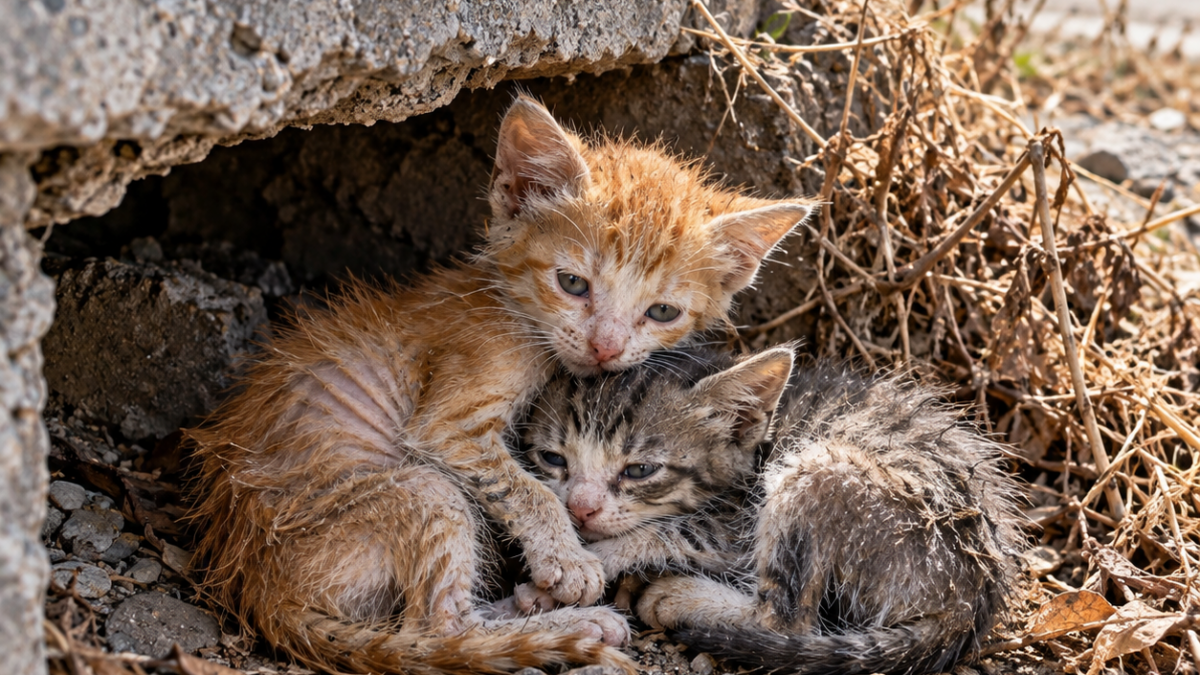
The orange cat’s eyes were amber, bright against his dirty face. He looked young, maybe not even fully grown, but exhaustion had aged him. His fur should have been the color of warm pumpkin, but dust and grease had dulled it. One ear had a nick near the tip. His whiskers were bent.
The gray cat lifted her head slightly.
Her eyes were pale green and frightened.
She looked smaller than him, finer-boned, with a white patch under her chin and a faint stripe down her nose. When she tried to stand, her back legs shook.
The orange cat moved in front of her.
Not aggressively.
Protectively.
He stared at me as if he had already decided that if danger came, it would have to pass through him first.
That small gesture broke my heart in a way I was not prepared for.
I had seen sad animals before.
Everyone has, if they have lived long enough and paid attention.
But this was different.
This was not just hunger.
This was loyalty.
This was two little creatures who had clearly been through something together and had somehow decided that survival only counted if they both made it.
“I’m not going to hurt you,” I said.
The orange cat blinked.
A car roared past behind me.
The gray cat pressed herself low to the grass.
The orange one turned his head toward her, touched his nose briefly to her forehead, then looked back at me.
I swallowed.
“Please don’t run into the road.”
That was my biggest fear.
I had no carrier. No blanket. No gloves. Nothing but a purse, half a granola bar, and a back seat full of old receipts and reusable grocery bags.
I opened the back door of my car.
The orange cat looked at it.
Then at me.
Then at the gray cat.
I expected him to bolt.
Instead, he took one step toward the car.
Then another.
He stopped beside the open door and sniffed the edge of the seat.
The gray cat watched him with complete trust.
He climbed in first.
Slowly.
Awkwardly.
Like his body hurt.
He stepped onto the floorboard, turned in a circle, then looked back at her.
The gray cat got up.
She moved toward him without looking at me, as if the decision had already been made the moment he entered.
Wherever he went, she would go.
She climbed into my back seat and pressed herself against him.
He curled around her immediately.
I closed the door with my hand shaking.
Then I stood outside my car on the shoulder of Bayshore Road, already late for work, staring at two starving cats in my back seat and realizing my entire day had just become something else.
I called the dental office.
My supervisor, Dana, answered.
“Anna, where are you?”
“I’m sorry,” I said. “I had to pull over.”
“Are you okay?”
I looked through the car window.
The orange cat was watching me.
The gray cat had her face tucked beneath his neck.
“I found two cats on the road.”
There was silence.
Then Dana said, “Anna.”
“I know.”
“We open in twenty minutes.”
“I know.”
“You’re the only front desk person this morning.”
“I know.”
Another pause.
“Are they injured?”
“I don’t know. They’re starving. I couldn’t leave them.”
Dana sighed the way people do when they are annoyed but still human.
“Can you bring them to a shelter?”
“I don’t know if they’ll take them. I don’t even have a carrier.”
“Do what you need to do,” she said finally. “But get here when you can.”
“Thank you.”
“And Anna?”
“Yes?”
“Do not bring road cats into the waiting room.”
Despite everything, I laughed.
“I won’t.”
I drove home instead of to work.
Every red light felt too long.
Every turn felt too sharp.
I kept glancing in the rearview mirror, afraid they might panic, afraid one might climb under the seat, afraid the gray cat might stop breathing just because she looked so tired.
But they stayed together.
Shoulder to shoulder.
The orange cat kept his head lifted most of the ride, eyes moving from window to window. The gray cat lay against him, barely moving except when the car hit a bump. Each time that happened, he leaned over and pressed his face against hers.
I lived on the second floor of a small apartment complex called Mariner’s Cove, though there was no marina and the only cove nearby was a retention pond with two aggressive ducks and a shopping cart in it. My apartment was one bedroom, one bathroom, a tiny kitchen, and a living room that could barely hold a couch without looking crowded.
It was not a place meant for a family.
Animal or otherwise.
I parked near the stairs and sat for a moment.
“Okay,” I said again.
The orange cat stared at me.
“I’m going to open the door. Please don’t make me regret every life choice that brought us here.”
He blinked.
I opened the back door.
He did not move.
The gray cat looked up.
I grabbed the reusable grocery bags from the floor, dumped out the receipts and a forgotten umbrella, and used one bag like a soft barrier while I reached in. The orange cat allowed me to touch him, though every muscle in his body tightened. When I slid one hand under his chest, I felt every rib.
He was lighter than he should have been.
Too light.
I carried him against me.
He smelled like dust, road grime, and hunger.
The gray cat immediately tried to follow, so I set him inside the apartment door and ran back down for her. She did not resist when I lifted her. She simply folded into my hands, exhausted beyond fear.
In my bathroom, I made them a temporary shelter.
Fresh water in a mixing bowl.
A towel on the floor.
Another towel folded in the bathtub.
A shallow dish with the emergency can of tuna I found in the pantry because I had no cat food.
I knew tuna was not a balanced diet.
I knew nothing about this situation was ideal.
But hunger does not wait for perfect knowledge.
The orange cat reached the food first.
Then he stopped.
He looked back at the gray cat.
She came forward slowly.
Only when her face reached the plate did he begin to eat.
They ate side by side, shoulders touching.
Not pushing.
Not fighting.
Not even making noise.
Just eating with the desperate concentration of animals who had gone too long without being certain another meal would come.
I sat on the closed toilet lid and cried.
Quietly at first.
Then not quietly.
Because I was tired.
Because I was late.
Because my rent was due in nine days.
Because I had no idea what I was doing.
Because something about the way he had waited for her before eating made me feel both broken and ashamed of every time I had ever looked away from suffering because I was busy.
When they finished, the gray cat stepped into the bathtub and curled on the folded towel.
The orange cat climbed in after her.
She tucked her face beneath his neck.
He curled his thin body around her like a question answered.
I took a photo.
Not because I wanted attention.
Because I needed proof that I had not imagined it.
Two starving cats.
One orange.
One gray.
Holding on to each other like the world had taken everything else.
I went to work an hour and forty minutes late.
Dana did not yell.
She looked at my face, handed me a bottle of water, and said, “Road cats?”
“In my bathroom.”
“Alive?”
“Yes.”
“Then answer line two.”
That was Dana’s version of mercy.
All day, between phone calls and insurance forms, I checked my phone. The bathroom camera I used when maintenance came into my apartment was now pointed at the bathtub. The cats barely moved. They slept tangled together. Occasionally, the orange one lifted his head and looked toward the door.
At lunch, I called three shelters.
One was full.
One said intake appointments were backed up for two weeks.
One told me to bring them in for scanning but warned that if they were feral and space was unavailable, options were limited.
I hated the word options.
It sounded clean.
It was rarely clean.
After work, I stopped at a pet store and spent money I did not have.
Cat food.
Litter.
A cheap litter box.
Two bowls.
A soft blanket.
Flea comb.
Disposable gloves.
A cardboard scratcher because apparently emotional decisions come with accessories.
The cashier smiled at the pile.
“New cat?”
I looked at everything.
“Possibly several problems in the shape of cats.”
She laughed.
I did not.
When I got home, the orange cat was standing by the bathroom door.
He meowed when he saw me.
One small, raspy sound.
The gray cat was still in the tub.
I put food down.
Again, he waited for her.
That was when I named him Sunny.
Not because he looked bright.
He did not.
Not yet.
But because his orange fur seemed like it wanted to be bright again if life gave it half a chance.
The gray cat took longer.
She watched me with tired green eyes, cautious but not sharp. There was gentleness in her, buried beneath exhaustion. When she lowered her head to eat, Sunny pressed his shoulder against hers.
“Misty,” I said softly.
The gray cat glanced up.
“Because you look like morning fog and sadness.”
Sunny sneezed into the food.
“Very elegant family,” I muttered.
That night, I slept badly.
Every sound from the bathroom woke me.
Every silence woke me harder.
At two in the morning, I opened the door and found them curled together in the bathtub, both breathing, both alive.
Misty’s head rested over Sunny’s front leg.
Sunny opened one eye.
“Sorry,” I whispered. “Just checking.”
He closed his eye again.
As if he had already decided I was ridiculous but acceptable.
The next morning, I posted their photos online.
Found near Bayshore Road and Old Mill. Orange male and gray female. Very thin, very bonded. Safe with me for now. Please message if they belong to you.
I posted in lost-pet groups.
Neighborhood groups.
Rescue pages.
I called animal services and filed a found report.
I took them to a vet clinic that accepted walk-ins because I could not wait two weeks.
That first appointment was chaos.
Sunny did not want to leave Misty.
Misty did not want to leave Sunny.
The vet tech, a kind woman named Brianna with paw-print earrings, looked at them in the carrier and said, “Oh, they’re bonded bonded.”
“What does that mean?”
“It means separating them would be cruel unless absolutely necessary.”
Sunny hissed when the carrier door opened, then immediately stepped over Misty as if shielding her from the entire veterinary profession.
Brianna’s face softened.
“Look at him.”
The veterinarian, Dr. Patel, examined Sunny first because he insisted on being in front. He was underweight, dehydrated, loaded with fleas, and had a small healing wound near his shoulder. No microchip. Young adult. Unneutered.
Then came Misty.
She trembled on the exam table but did not fight.
Dr. Patel ran careful hands along her sides.
Her expression changed.
I noticed.
“What?” I asked.
Dr. Patel glanced at Brianna.
Then back at me.
“Has her belly always looked this round?”
“I thought maybe from finally eating.”
“It could be part of it.”
She examined further.
Then she said, “I’d like to do an ultrasound.”
My heart dropped.
“Is something wrong?”
“Not wrong, necessarily.”
Ten minutes later, I stood in a dim little exam room watching fuzzy shapes flicker on a screen while Misty lay very still beneath Brianna’s gentle hands.
Dr. Patel pointed.
“There.”
I stared.
At first, I saw nothing.
Then something moved.
A tiny pulse.
Then another.
And another.
I stopped breathing.
“She’s pregnant,” Dr. Patel said softly.
The room tilted a little.
“Pregnant.”
“Yes.”
“How many?”
“Hard to say this early without more imaging, but I can see at least four.”
I looked at Misty.
She looked exhausted.
Too young.
Too thin.
Too fragile to be carrying anything except her own survival.
Sunny was in the carrier on the floor, meowing constantly because Misty was out of his sight.
Dr. Patel looked at me.
“She needs nutrition. Rest. Monitoring. She’s underweight, and pregnancy after starvation can be risky.”
I swallowed.
“What do I do?”
The question came out smaller than I meant it to.
Dr. Patel’s voice softened.
“You already did the first important thing. You stopped.”
I cried again.
Right there in the vet clinic.
I hated that about myself, how easily the tears came when I was overwhelmed, but Dr. Patel did not seem bothered. Brianna handed me tissues like she had done it a thousand times.
Sunny kept meowing.
Misty lifted her head toward the sound.
“Can he be the father?” I asked.
“It’s possible.”
I looked at the carrier.
Sunny shoved his orange face against the bars, desperate to see her.
“Would he know?”
Dr. Patel smiled gently.
“Not the way humans know. But he clearly knows she matters.”
The bill was more than I could afford.
I paid it anyway.
That night, I sat on the bathroom floor with the estimate sheet, care instructions, and a credit card balance that made my stomach hurt.
Sunny and Misty slept beside me on the new blanket.
I had planned to stop for one minute.
Now I was looking at prenatal cat care, flea treatment schedules, kitten supplies, emergency vet funds, and the possibility of becoming the least prepared maternity ward in Florida.
“I can’t do this,” I whispered.
Sunny opened his eyes.
Misty shifted closer to him.
“I mean, obviously I have to,” I said. “But I can’t.”
Sunny yawned.
That was the full extent of his sympathy.
The next two weeks became a blur of routine and worry.
Work.
Home.
Feed cats.
Clean litter.
Check Misty.
Check lost-pet groups.
Answer messages from people who thought every orange cat was theirs until they saw Sunny’s torn ear.
Buy kitten food.
Cry over money.
Apologize to my landlord in advance inside my own head.
Repeat.
Nobody claimed them.
A woman messaged saying the orange cat looked like one she had seen near an abandoned duplex by Old Mill. A man sent a blurry photo of two cats near a dumpster behind a closed diner. A teenager said she had seen them crossing the road together three nights before I found them.
Always together.
Always hungry.
Always moving.
I drove to the abandoned duplex one Saturday.
I do not know why.
Maybe I wanted answers.
Maybe I wanted to understand how two animals ended up clinging to each other on the side of the road.
The duplex sat behind waist-high weeds, windows boarded, porch sagging. In the dirt near the back steps, I found an empty food bowl cracked in half. Beside it lay a torn piece of cardboard darkened by rain.
There were paw prints in the mud.
Small ones.
I stood there longer than I should have.
Someone had fed them once.
Or tried to.
Someone had left.
Or been forced to leave.
Maybe Sunny and Misty had belonged to somebody who lost their housing.
Maybe they were born outside and found shelter there.
Maybe someone had dumped them near the road because a pregnant cat and an unneutered male were too much trouble.
I would probably never know.
That was one of the hardest parts.
Rescue often begins in the middle of a story.
You do not get the first chapters.
You only get the moment when suffering crosses your path and asks what kind of person you are going to be.
By the third week, Misty began to change.
Her coat grew softer.
Her eyes brightened.
She gained weight in the careful way Dr. Patel wanted.
She started leaving the bathroom when I let them explore in the evenings, moving cautiously through the apartment like every doorway required permission.
Sunny, on the other hand, adapted with shameless speed.
He discovered the couch.
Then the windowsill.
Then the kitchen counter, which led to our first serious disagreement.
“No,” I said, lifting him down.
He jumped back up.
“No.”
He blinked.
I lifted him down again.
He jumped back up.
Misty watched from the hallway as if embarrassed by him.
“You’re going to be a father,” I told him. “Act responsible.”
He knocked a spoon off the counter.
But for all his mischief, Sunny remained gentle with Misty.
He groomed her face.
Waited while she ate.
Slept beside her belly.
If she moved rooms, he followed.
If she cried, he came.
One evening, I found them on the bathroom rug, Sunny’s head resting lightly against Misty’s rounded side.
A tiny movement rippled beneath her fur.
Sunny lifted his head.
His ears went forward.
He stared at her belly like the universe had just tapped him on the nose.
I laughed so hard I startled both of them.
“Oh, buddy,” I said. “You have no idea.”
Maybe he did.
Maybe not.
But from then on, he spent more time near her belly, curled around it, guarding it, listening.
I prepared a nesting box in the bedroom closet because it was the quietest place in the apartment. I lined it with soft towels and the blanket they loved. I bought a heating pad designed for pets, extra food, disposable pads, a small kitchen scale, and more supplies than any sane person with my bank account should have purchased.
Dana at work noticed the dark circles under my eyes.
“How are the road cats?”
“Pregnant.”
She stared.
“The orange one?”
“The gray one.”
“Right. Obviously. Sorry.”
“She’s due soon.”
Dana leaned against the counter.
“Anna, do you need help?”
I almost said no.
It was automatic.
No, I’m fine.
No, I’ve got it.
No, I can handle this impossible thing alone because admitting need makes me feel like I am failing at adulthood.
Instead, I surprised myself.
“Yes.”
Dana nodded.
“Good. I was hoping you’d say that.”
The next day, she brought canned kitten food and a stack of old towels.
Brianna from the vet clinic connected me with a small rescue called Harbor Paws, which agreed to help with adoption screening once the kittens were old enough.
My neighbor Mrs. Klein lent me a playpen.
The cashier from the pet store slipped extra sample cans into my bag and said, “Don’t tell my manager.”
Slowly, the impossible became a little less impossible.
Not easy.
Never easy.
But shared.
That mattered.
Then, one night, Misty went into labor.
It was just after midnight.
I had fallen asleep on the couch with the television on low when Sunny woke me by jumping onto my chest.
Hard.
I opened my eyes to his orange face two inches from mine.
“What?”
He meowed.
Not his usual dramatic complaint.
This was different.
Urgent.
He jumped down, ran toward the bedroom, then turned to look back.
My heart started pounding.
“Misty?”
I followed him.
Misty was in the closet nesting box, sides tightening, eyes wide. Her breathing was fast. She looked at me, then at Sunny.
Sunny climbed halfway into the box.
I gently moved him back.
“I know. Give her space.”
He paced outside the closet like an expectant father in a hospital hallway.
I called the emergency vet line, just as Dr. Patel had instructed.
Brianna answered because apparently angels sometimes work night shifts.
“She’s contracting,” I said. “She’s scared. I’m scared. Sunny is losing his mind.”
“Okay,” Brianna said calmly. “Take a breath. Is there discharge?”
I answered her questions.
She talked me through what to watch for, when to worry, when to wait.
“Most cats know what to do,” she said.
“I don’t.”
“That’s okay. Your job is to stay calm, keep the space quiet, and call if something seems wrong.”
I sat on the floor near the closet.
Misty cried once.
Sunny stopped pacing.
He lay down at the closet entrance, body tense, eyes fixed on her.
At 1:12 a.m., the first kitten was born.
Orange.
Tiny.
Wet.
Moving.
Misty turned immediately and began cleaning him with fierce, exhausted focus. The kitten squeaked, and Sunny lifted his head so fast he nearly bumped the closet door.
I pressed a hand to my mouth.
“Oh my God.”
The second kitten came forty minutes later.
Also orange.
The third came just before three.
Gray.
Smaller than the others, but loud.
So loud.
The fourth came as dawn began turning the window pale.
Orange again.
Four kittens.
Three orange.
One gray.
Misty curled around them, trembling and tired, while they rooted blindly for milk.
Sunny stayed at the edge of the closet.
Every time a kitten squeaked, his ears perked.
He did not enter.
He did not interfere.
He simply watched.
Quiet.
Alert.
A little confused.
Completely devoted.
I sat on the floor with tears running down my face.
I thought about the side of the road.
The dead grass.
The heat.
The cars.
Misty pressed into Sunny’s side.
Sunny stepping in front of her with nothing but bones and courage.
I thought about how easily I could have driven past.
How close I had come.
Four tiny lives moved against Misty’s belly.
Four lives that would never know the ditch.
Never sleep under a broken porch.
Never wonder whether hunger was normal.
Never learn the sound of cars passing too close while their mother trembled beside the road.
Because one late morning, I stopped.
For a while, the apartment became a newborn nursery.
Misty surprised me with her calmness. She was young and tired, but motherhood seemed to steady her. She cleaned the babies constantly, rearranged them with gentle paws, and watched me carefully whenever I changed bedding.
Sunny became the guardian of the room.
At first, Dr. Patel warned me to monitor him closely because male cats could be unpredictable around kittens. I did.
But Sunny never showed aggression.
He seemed almost reverent.
He slept outside the closet.
He escorted Misty to the food bowl and back.
If a kitten squeaked while Misty ate, Sunny meowed until she returned, as if filing a formal report.
One morning, I found him lying beside the nesting box with one orange kitten pressed against his paw. Misty watched from inside the box, unconcerned.
“Well,” I whispered. “I guess you’re approved.”
I named the kittens Maple, Rusty, Clover, and Ash.
Maple was the largest orange kitten, round and bossy.
Rusty had white toes and a habit of falling asleep mid-crawl.
Clover was the gray one, tiny but fierce.
Ash was pale orange and quiet, always tucked under Misty’s chin.
Their little personalities unfolded day by day.
Eyes opened.
Ears lifted.
Legs began working badly, then better.
They tumbled over one another like fuzzy marbles.
My apartment, once quiet and carefully arranged, became a landscape of kitten blankets, laundry baskets, food bowls, toys, and cardboard boxes with doorways cut into them.
My life did not become easier.
That is important.
People like to imagine rescue stories as if kindness unlocks a magical second life where money stretches, time expands, and everything glows softly in morning light.
That is not how it happened.
I was still tired.
I still worked full-time.
I still worried about rent.
I still paid the vet bill in pieces.
I still cried one night in the kitchen because the car needed repairs and Misty needed a follow-up appointment and my paycheck was not made of miracles.
But every time I felt myself tipping toward panic, I would find Sunny and Misty curled together beside the nesting box.
Not because everything was easy.
Because they were together.
They had survived the road that way.
Maybe I could survive the bills the same way.
Not alone.
That was the lesson I resisted the longest.
Help came in small forms.
Dana covered my lunch break so I could run home and check on the kittens.
Mrs. Klein cleaned the playpen.
Brianna texted feeding advice.
Harbor Paws posted a donation link for the kittens’ care.
A stranger sent a bag of litter.
Someone else sent kitten toys.
A retired woman named Paula mailed a note with twenty dollars inside.
For the babies, she wrote.
I taped that note to my fridge.
Not because twenty dollars solved everything.
Because it reminded me people could still be good in specific, practical ways.
When the kittens were six weeks old, Harbor Paws sent a volunteer named June to take adoption photos.
June was in her seventies, wore bright blue glasses, and had the energy of a woman who had decided retirement was for people with less important things to do.
She sat on my living room floor with a camera while kittens attacked her shoelaces.
“They’re beautiful,” she said.
“Misty did all the work.”
“And you.”
“I mostly panicked nearby.”
“That counts.”
Sunny sat on the couch watching the photo session with grave suspicion.
June lifted her camera toward him.
“And who is this handsome man?”
“That’s Sunny.”
“The protector?”
I looked at him.
“Yes.”
June took his photo too.
“He should be adopted with Misty.”
I had been avoiding that thought.
“Do you think people will take two adults?”
“The right people will.”
I nodded, but something in my chest tightened.
The right people.
The phrase sounded hopeful and impossible.
By then, I knew I could not keep all of them.
My apartment was too small.
My budget too thin.
My lease too limited.
But every time I imagined separating Sunny and Misty, I saw the roadside again.
Her pressed against him.
Him standing in front.
Two starving animals choosing each other before they trusted anyone else.
No.
Whatever happened, they would stay together.
The kittens began receiving applications quickly.
Kittens always do.
Everyone wants the beginning of a story.
Fewer people want the survivors who made that beginning possible.
Harbor Paws screened carefully.
Maple and Rusty were adopted together by a family with two gentle children and a screened-in porch.
Clover went to a veterinary assistant who had fallen in love with her tiny gray face.
Ash went to Paula, the woman who had mailed the twenty dollars, because when she met him, he climbed into her lap and went to sleep as if he had been expected.
Each goodbye hurt.
Even the happy ones.
Misty searched after the first two left.
Sunny walked beside her while she checked behind the couch, under the chair, near the playpen. He bumped his head gently against her shoulder when she paused.
I sat on the floor and cried after every adoption.
Misty did not understand why the babies left.
Or maybe she understood better than I did.
They were safe.
That had been the goal.
Still, the apartment felt quieter after Ash left.
Too quiet.
Sunny and Misty curled together on the blanket in the bathroom, the same way they had on the first day.
I sat beside them.
“You two are next,” I whispered.
Sunny opened one eye.
Misty tucked her face under his chin.
My throat tightened.
“I’m going to find you the best home.”
The best home turned out to be a woman named Evelyn Hart.
She was fifty-eight, widowed, and lived in a small house twenty minutes outside town. She had adopted bonded pairs before. Her last two cats had died within six months of each other at seventeen and eighteen years old.
“I don’t want kittens,” she told me during the meet-and-greet. “I love them, but I’m not looking for chaos. I want someone who needs quiet.”
Sunny approached her first.
Of course he did.
He sniffed her hand, then inspected her purse.
Misty stayed near the hallway.
Evelyn did not reach for her.
She simply sat on the floor, cross-legged, and spoke softly about her old cats, about the screened porch, about how grief made houses sound too large.
Misty listened.
After fifteen minutes, she walked to Sunny.
Sunny touched his nose to hers.
Then Misty stepped forward and sniffed Evelyn’s hand.
Evelyn’s eyes filled with tears.
“Oh,” she whispered. “Hello, sweetheart.”
Misty rubbed her cheek against Evelyn’s fingers.
Sunny climbed into Evelyn’s lap as if he had personally approved the adoption paperwork.
I looked away.
June from Harbor Paws put a hand on my shoulder.
“They chose well,” she said.
The adoption was finalized three days later.
I packed their things slowly.
Their blanket.
Favorite toy.
Vet records.
A bag of food.
The towel they had slept on the first night.
I told myself I was happy.
I was.
I told myself this was the point.
It was.
I told myself love sometimes means handing the carrier to someone else.
It does.
But when Evelyn carried them out together, Sunny in front, Misty pressed behind him, I closed the door and slid down against it.
The apartment was silent.
No tiny paws.
No bowls clinking.
No Sunny meows.
No Misty watching from the bathroom rug.
I cried until my head hurt.
Then I slept for eleven hours.
The next morning, I woke up before my alarm.
For the first time in months, nobody needed feeding.
Nobody needed medicine.
Nobody needed bedding changed.
Nobody needed weighing.
My apartment was clean.
Orderly.
Mine again.
And somehow it felt less alive.
I made coffee and sat on the couch.
The empty bathroom door was open.
Sunlight fell across the tile where Sunny and Misty had slept curled together after that first terrifying ride home.
My phone buzzed.
A photo from Evelyn.
Sunny and Misty lay on a screened porch in a patch of morning light.
Misty was stretched on her side, relaxed and soft.
Sunny was curled around her back, chin resting over her shoulder.
They were still touching.
Always touching.
Under the photo, Evelyn had written:
They slept like this all night. I think they know they’re home.
I pressed the phone against my chest and cried again.
But this time, the tears did not feel like loss only.
They felt like completion.
Weeks passed.
Then months.
Updates came from all four kittens.
Maple stealing socks.
Rusty sleeping in a child’s doll bed.
Clover sitting on a vet clinic counter like she owned the practice.
Ash watching birds from Paula’s window.
Sunny and Misty remained inseparable.
Evelyn sent videos.
Sunny grooming Misty.
Misty kneading a blanket beside him.
Both of them watching rain from the porch, calm and round and healthy.
Their coats became beautiful.
Sunny turned bright orange, the color I had imagined the day I named him.
Misty’s gray fur became soft and silver, her white chin clean, her eyes peaceful.
One video showed them curled together in a wicker chair.
Evelyn’s voice came softly from behind the camera.
“They still hold on to each other.”
I watched that video more times than I admitted.
Life returned to normal.
Mostly.
I was still late sometimes, though never for the same reason.
Dana eventually put a framed photo of Sunny and Misty behind the front desk with a caption that read: VALID EXCUSE.
Patients asked about it.
I told the short version.
“Found them by the road. She was pregnant. They’re safe now.”
Some people smiled.
Some said, “I could never do that.”
I always wanted to tell them they probably could.
Not perfectly.
Not easily.
Not without fear.
But kindness rarely arrives when you feel ready.
It usually appears on a morning when you are late, broke, tired, and absolutely not in the mood for your life to become more complicated.
Then it waits to see whether you will stop.
A year after I found them, Evelyn invited me to visit.
I almost said no.
Not because I did not want to see them.
Because I was afraid they would not remember me.
That sounds selfish, but it is true.
For months, I had been the bridge between their suffering and their safety. But bridges are not destinations. Animals move on because they are wise enough not to build shrines to pain.
Still, I went.
Evelyn’s house sat beneath two oak trees on a quiet street. Wind chimes moved near the porch. A bowl of water sat by the front door for neighborhood dogs on walks.
Evelyn hugged me before I could become awkward.
“They’re on the porch,” she said.
My heart thudded.
The screened porch was warm and bright.
Sunny saw me first.
He lifted his head from a cushion.
For one second, nothing happened.
Then he stood.
Misty, curled beside him, looked up.
Sunny walked toward me slowly.
Healthy now.
Solid.
Bright.
No longer skin and bones.
I crouched.
“Hi, buddy.”
He sniffed my hand.
Then he pressed his forehead hard against my palm.
I broke.
Completely.
Misty came next.
She stepped around Sunny, sniffed me, then rubbed her cheek against my wrist.
Evelyn stood behind me crying too.
“Well,” she said, voice shaking, “I guess they remember.”
I sat on the porch floor, and Sunny climbed into my lap like no time had passed. Misty settled beside my leg, one paw resting on his tail.
They were safe.
They were loved.
They were still together.
That was all I had wanted.
Evelyn brought tea, and we sat for an hour talking while the cats moved between us. She told me Sunny slept near the door every night until Misty settled, then joined her. Misty still startled at loud trucks, but Sunny always went to her. If one left the room, the other followed. They had become, Evelyn said, the heart of the house.
“I needed them,” she admitted.
I looked at her.
“I think they needed you too.”
She smiled.
“Maybe we all arrive late to each other.”
That sentence stayed with me.
On the drive home, I passed the spot where I had found them.
The dead grass had grown back.
The drainage ditch looked ordinary.
Cars rushed past without slowing.
If I had not known, I would never have guessed six lives had once balanced there on the edge of being forgotten.
I pulled over.
Just for a minute.
I stood beside the road and remembered.
The heat.
The honk behind me.
Sunny stepping in front.
Misty following him into the car.
The fear.
The bills.
The births.
The goodbyes.
The porch where they now slept in sunlight.
I thought about how small the decision had felt at first.
Brake.
Pull over.
Open door.
Crouch down.
Speak softly.
Tiny actions.
Nothing heroic.
Nothing planned.
But life had turned on them anyway.
Four kittens were alive because of that stop.
Sunny and Misty had a home because of that stop.
Evelyn’s quiet house had a heartbeat again because of that stop.
And I had learned something about myself I had badly needed to know.
That I was not too busy to care.
Not too broke to try.
Not too tired to become the person two frightened animals needed for one morning.
I got back into my car.
This time, I was not late.
There was nowhere urgent to be.
At home, my apartment felt quiet but not empty anymore. I had photos on the fridge. Maple. Rusty. Clover. Ash. Sunny and Misty on Evelyn’s porch.
A little family that had passed through my small rooms and changed the shape of them forever.
I still keep the first photo I took.
The one in my bathroom.
Sunny and Misty curled together on the towel, filthy, starving, exhausted, but holding on.
Whenever life makes me feel helpless, I look at it.
It reminds me that love does not always arrive soft and pretty.
Sometimes it is thin.
Dirty.
Terrified.
Standing on the side of the road with cars flying past.
Sometimes love is an orange cat stepping in front of a gray one even though he barely has strength to stand.
Sometimes it is a pregnant mother following the only friend she trusts into a stranger’s car.
Sometimes it is a woman already late for work deciding that being late matters less than being kind.
I thought I was rescuing two cats that morning.
But that was not the whole truth.
I rescued a mother.
A protector.
Four unborn kittens.
A lonely widow who needed them later.
And some quiet, buried part of myself that had started believing ordinary people could not make much difference.
We can.
Not always in ways the world notices.
Not always in ways that are easy to afford.
Not always without fear, inconvenience, or tears on the bathroom floor.
But we can.
One stop.
One open door.
One bowl of food.
One safe room.
One decision not to drive past.
That is how lives change sometimes.
Not with a grand plan.
Not with perfect timing.
But with two frightened animals holding on to each other beside a road, and one imperfect person choosing to hold on too.