I Adopted an Old Cat Who Fell Asleep Against My Leg the First Night—Days Later, I Learned He Had Spent Three Years Trying to Find His Way Home.
PART3:
Keep food and water nearby.
Keep noise low.
Let him decompress.
But reading instructions is one thing.
Sitting across from a creature who looks like the world has taught him not to trust kindness is something else entirely.
I felt clumsy.
Too large.
Too human.
I wanted to help him and had no idea how to make him understand that help was not another form of danger.
I stayed there for forty minutes.
My leg fell asleep.
The apartment grew darker outside the bathroom door.
Rain began tapping against the window in the living room.
Finally, he moved.
One paw first.
Then another.
He emerged from the carrier slowly, carefully, his body low to the floor. He sniffed the air, the tile, the edge of the towel. Every sound made him freeze. The pipes in the wall. A car passing outside. My neighbor opening a cabinet on the other side of the wall.
When he reached the food bowl, he stopped.
The shelter had given me a small bag of the food he had been eating, plus a few cans of wet food because his teeth were not great. I had warmed the wet food slightly with a spoonful of water. It smelled awful. He seemed interested.
But before he ate, he looked at me.
Then around the room.
Then back at the bowl.
It was almost as if he needed permission.
“You can eat,” I said softly. “It’s yours.”
He lowered his head and took one bite.
Then looked up.
Another bite.
Then a pause.
Another scan of the room.
Another bite.
I had to look away.
There was something unbearable about watching hunger move cautiously.
A hungry animal should eat with relief.
He ate as if someone might suddenly take the bowl away.
That night, I expected him to hide under the sink cabinet or behind the toilet or inside the carrier until morning.
Instead, after a few slow bites and a cautious drink of water, he walked toward the bathroom door and looked up at me.
I should have kept him in the small room.
That was what the packet said.
But there was something in the way he stood there, not demanding, just waiting, that made me open the door.
My apartment was quiet.
No television.
No music.
Just rain at the windows and the low hum of the refrigerator.
He stepped into the hallway.
Slowly.
Carefully.
He explored like a survivor entering a building after disaster, staying close to the walls, sniffing corners, pausing at doorways, testing each room with one paw before entering fully.
Living room.
Kitchen.
Bedroom.
Back to the hallway.
Every few seconds, he looked at me.
Not affectionately.
Not yet.
More like he was checking whether I had changed.
Whether the rules had changed.
Whether safety was still true.
I sat on the sofa and let him inspect.
The sofa was old, dark blue, the first decent piece of furniture I had bought after college. One cushion sagged. The left arm had a stain from coffee I spilled during a work call and never fully cleaned. It had held me through flu, grief, late nights, bad dates, better books, and too many microwaved dinners.
I did not expect him to come near it.
He did.
He stopped beside the sofa and stared at the cushion.
Then he looked at me.
“You want up?”
He did not answer.
I patted the cushion gently.
He gathered himself.
It took effort.
His back legs were weak, and the jump was less of a jump than a climb with hope attached. He got his front paws up, struggled, then heaved himself onto the cushion with a small grunt that sounded painfully old.
He landed heavily.
For a moment, he stood there, breathing hard.
Then he turned in a tight circle.
Once.
Twice.
He looked at my leg.
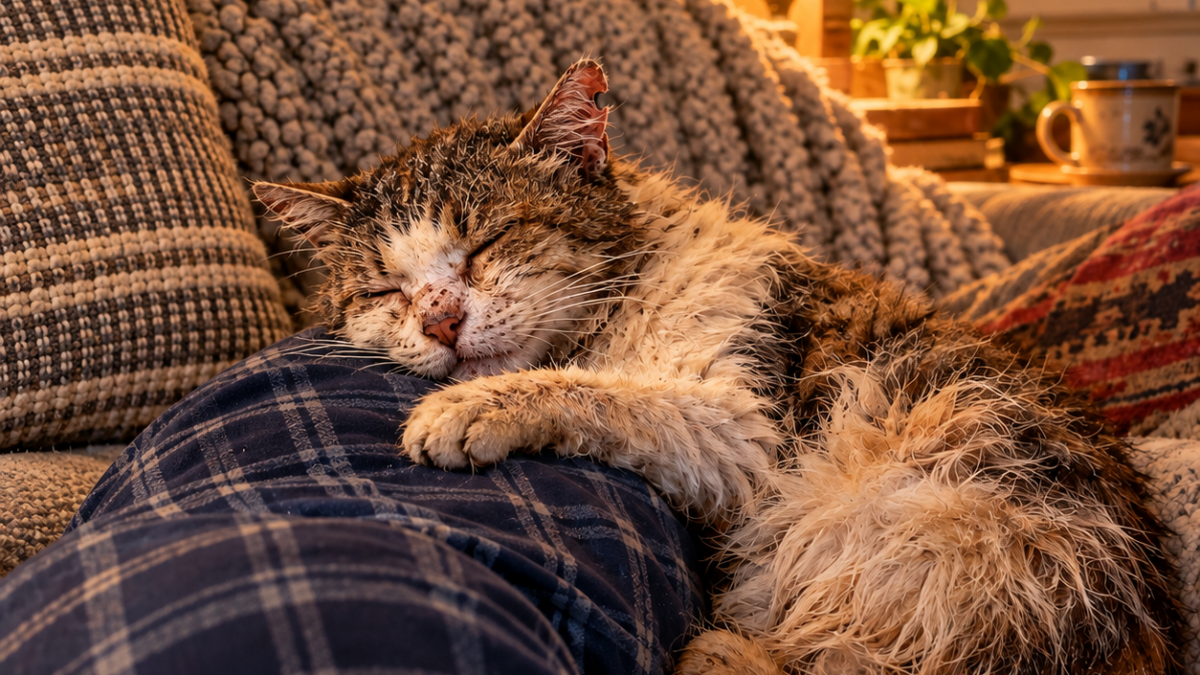
Then he lowered himself directly against it.
Not near me.
Not close enough to be polite.
Against me.
His spine pressed along my thigh. His shoulder leaned into my knee. His tail wrapped loosely over my ankle.
I did not move.
His body was still tense.
Every sound from the hallway made his ears twitch. The elevator cables groaned. Someone laughed two apartments down. A door closed on the first floor. Each noise passed through him like a warning.
Then, little by little, something changed.
His breathing slowed.
The tightness in his shoulders eased.
One paw stretched forward and rested on my thigh.
His head tilted sideways.
His chin touched the cushion.
And then he fell asleep.
Deeply.
Completely.
It was not the kind of sleep where a cat wakes at every small sound.
It was not a cautious nap.
It was not the light doze of an animal ready to bolt.
It was the kind of sleep that comes when exhaustion finally meets safety and the body, after years of staying alert, simply cannot hold the fear anymore.
I sat there in the darkness, afraid to move.
The rain softened against the window.
The apartment dimmed around us.
My leg went numb.
I did not care.
All I could think about was him sleeping under cars, behind dumpsters, under stairwells, in bushes, beneath balconies, in cold rain, on hot pavement, always half-awake because something might chase him, hit him, starve him, trap him, or forget him again.
How many nights had he spent like that?
How long had it been since he had truly felt safe?
The old cat breathed against my leg.
A slow inhale.
A soft exhale.
Again.
Again.
At some point, I realized I was crying.
Not loudly.
Not dramatically.
Just tears slipping down my face in an apartment where no one had seen me cry in years.
I had thought I was bringing home a cat who needed saving.
But sitting there, unable to move because a tired animal trusted my leg more than the whole world, I understood something uncomfortable.
I had been waiting too.
For what, I did not know exactly.
For something to choose me.
For something to make the apartment feel less like a place where time collected dust.
For someone, even a half-starved old cat with tangled fur, to need me in a way that did not ask me to explain my loneliness first.
That night, something changed.
For him.
And somehow, for me too.
I woke just before dawn with my neck stiff and my mouth dry.
The lamp was still on.
The living room was gray with early light.
For one terrible second, I looked down and thought he was gone.
Not gone from the sofa.
Gone from life.
His body was too still.
His breathing too quiet.
My heart lurched.
Then I felt warmth.
A small rise and fall against my thigh.
His paw was stretched across my leg as if sometime during the night he had decided I belonged there too.
“Hey,” I whispered.
His ear flicked.
He did not open his eyes.
I smiled for the first time in what felt like weeks.
The shelter had told me senior cats sometimes took months to adjust.
Rusty took one night to claim the sofa and three days to learn my routine.
By Friday evening, he knew the sound of my laptop closing meant I was done working.
By Saturday morning, he knew the cabinet where I kept his food.
By Sunday, he followed me into the kitchen and sat three feet away while I made coffee, watching as if he could not quite believe a person would move around him without threatening him.
He waited outside the bathroom.
He slept near the kitchen when I cooked.
He sat in the hallway during my work calls and stared at me like my coworkers were wasting his time.
Every evening, after dinner, he climbed onto the sofa with that same awkward effort and settled against my leg.
Always my right leg.
Always pressed firmly enough that I could feel the warmth of him through my jeans.
I tried calling him Rusty.
He responded sometimes.
Not consistently.
The name felt temporary, like a label taped to a box in storage.
I wondered if he had ever had another name.
Then I told myself not to invent a tragic story.
Old strays do not need humans to turn every scar into a novel.
But he had habits that made it hard not to wonder.
He startled at the sound of keys.
Not all metal sounds.
Keys.
The first time I set mine on the counter, he bolted behind the sofa so fast I heard his claws scrape the floor.
He disliked men’s boots in the hallway but ignored women’s voices.
He knew what a refrigerator was.
He knew the sound of a can opening.
He used the litter box perfectly from the first night.
He did not jump onto counters.
He never scratched furniture.
He waited near doors but never tried to rush through them.
Those were not the habits of a cat born completely wild.
Somewhere, sometime, someone had taught him a home.
Or he had learned one by living inside it.
That thought bothered me more than I expected.
Because if he had known a home, then he had also lost one.
On Monday afternoon, I noticed the window thing.
My desk faced the living room, and during work hours Rusty usually slept on a folded blanket beside the radiator. Around 3:30, while I was explaining a login error to a clinic manager in Ohio, he suddenly lifted his head.
His ears pointed forward.
His body stiffened.
He stared toward the front window.
The curtains were partly closed.
Nothing unusual was happening outside as far as I could tell. A delivery truck idled near the curb. A cyclist passed. A woman walked a golden retriever on the opposite sidewalk.
Rusty stood, walked to the window, and placed both front paws on the sill.
Then he made a sound I had not heard from him before.
Not a meow.
Not a cry.
A small, low trill.
Soft.
Almost questioning.
I muted my headset.
“What is it?”
He did not look at me.
He stayed there until the delivery truck left.
Then he returned to the blanket and lay down.
The next day, it happened again.
3:26 p.m.
Window.
Ears forward.
Quiet sound.
The day after that, the same.
I began watching for patterns.
Was it the mail truck?
The school bus?
A person?
A sound?
A smell?
On Thursday, I opened the curtain fully when he went alert.
He stared at the street below, body still, eyes fixed not on the sidewalk, but somewhere farther down the block.
Toward the north.
Toward the older part of town.
The place where the shelter had found him.
That evening, while he slept against my leg, I noticed the scar.
It sat beneath the fur around his neck, low enough that I had missed it before. A thin line in the skin, hidden where a collar might rest. Not a cut exactly. More like an old pressure mark, a rubbed place that had healed long ago.
I gently parted the fur.
He woke instantly.
Not afraid.
Just awake.
“Sorry,” I whispered.
He blinked at me.
I looked again.
The mark circled partway around his neck.
Something had once been there.
A collar.
Maybe a tag.
I called the shelter the next morning.
The woman who answered remembered him.
“Rusty? Senior orange male? Found near Ashford Apartments?”
“Yes.”
“How’s he doing?”
“Better, I think. He’s eating. Sleeping. He’s… very attached.”
“That’s wonderful.”
“I noticed a scar around his neck. Like he used to wear a collar.”
There was a pause.
“He didn’t have one when he came in.”
“Do you know anything else about where he was found?”
“He was brought in by one of our volunteers. Let me check the intake notes.”
I listened to keyboard clicks.
“He had been seen repeatedly around the apartment complex for a few months. A maintenance worker called us because he looked thin and was sleeping near the dumpsters.”
“A few months?”
“At least. Maybe longer.”
“Was he staying in one area?”
More typing.
“Building 14.”
The number hit me strangely.
“Building 14?”
“Yes. The note says he kept returning to the front entrance and the small courtyard behind that building. The volunteer tried trapping him for a while, but he kept avoiding the trap until he got too weak.”
I looked toward the sofa.
Rusty was asleep on the cushion, paws tucked beneath him.
Building 14.
“Did anyone there claim him?”
“We asked around. Nobody did. We posted found notices. No response.”
“How long was he at the shelter?”
“Three weeks before you adopted him.”
“And before that, he had been at the apartments for months.”
“That’s what the notes say.”
I thanked her and hung up.
For the rest of the day, I could not focus.
Building 14 sat in my head like a locked door.
I told myself there were reasonable explanations.
Maybe people there fed him.
Maybe he liked the shelter near that entrance.
Maybe there were mice.
Maybe someone had owned him and moved away.
Maybe nobody wanted him.
Maybe I should leave the past alone.
But that afternoon, at 3:31, he went to the window again.
Same posture.
Same direction.
Same soft, broken sound.
And suddenly the question changed.
It was not, What if I find something?
It was, What if I don’t look and there was something to find?
Saturday morning, I put his carrier on the floor.
He saw it and retreated three steps.
“I know,” I said. “I know. I’m sorry.”
I lined it with the blanket he liked from the sofa and placed a few treats inside. He ignored the treats. He stared at me with the wounded suspicion of someone who had begun to believe in safety and now saw a door closing again.
I felt awful.
“This might matter,” I told him.
He did not believe me.
Getting him inside took twenty minutes and two scratches, neither serious. He did not fight hard, but he went stiff with fear once the door closed.
In the car, he sat silently.
That silence again.
I kept one hand near the carrier.
“We’re just going to look,” I said. “If there’s nothing, we come home.”
Home.
The word came out before I thought about it.
His home?
My home?
Our home?
I did not know anymore.
Ashford Apartments sat fifteen minutes north, a cluster of older brick buildings arranged around small parking lots and courtyards. The place was not terrible, just tired. Peeling railings. Patchy grass. Laundry room windows fogged from inside. A playground with one swing missing.
I found Building 14 near the back.
Three stories.
Brown brick.
Green doors.
A narrow sidewalk leading to the entrance.
A small courtyard with two benches, a leafless tree, and a row of shrubs along the wall.
I parked near the curb and sat for a minute with the engine off.
Rusty was very still inside the carrier.
“This is it,” I said quietly.
His eyes were fixed through the metal door.
I carried him to the courtyard.
No one was outside.
A plastic grocery bag blew across the parking lot.
Somewhere, a dog barked from another building.
I set the carrier down on the sidewalk and opened the door.
For a moment, he did not move.
Then he stepped out.
Slowly.
His body low, but different from the first night in my apartment.
Not just fear.
Recognition.
He sniffed the pavement.
Turned toward the shrubs.
Walked a few steps.
Stopped.
Looked at the entrance.
My chest tightened.
He moved across the courtyard as if following a path written in scent and memory. He paused near the bench. Sniffed the base of the tree. Walked toward the green entrance door of Building 14.
Then he sat down.
And stared.
I stood behind him, holding the empty carrier, feeling suddenly like an intruder in a story that had begun before me.
A few moments later, the door opened.
An elderly woman stepped out carrying a small trash bag.
She had silver hair pulled back in a loose bun, a blue cardigan buttoned over a floral blouse, and slippers that looked too soft for the concrete walkway. She was thin, careful in her movements, maybe late seventies.
She saw me first.
Then the carrier.
Then the cat.
The trash bag slipped from her hand.
Her other hand went to her mouth.
She whispered one word.
“Charlie?”
The old cat turned toward her.
And I saw something I had not seen since bringing him home.
Not caution.
Not hunger.
Not exhaustion.
Recognition.
His whole body changed.
His ears lifted.
His eyes widened.
For one suspended second, he remained still.
Then he walked toward her.
Slow at first.
Then faster.
The woman dropped to her knees on the concrete.
“Charlie,” she said again, and this time the word broke in half.
The cat reached her and pressed his head into her hands.
She began to cry.
Not polite tears.
Not surprise.
Grief.
Relief.
The kind that comes when a hope you buried without permission suddenly walks back to you on four tired legs.
“Oh, Charlie,” she sobbed. “Oh, my sweet boy. Where have you been?”
He pushed against her chest, awkward and weak, purring so loudly I could hear it from several feet away.
I stood frozen with the carrier in my hand.
My first feeling should have been joy.
Part of it was.
But another part of me cracked quietly open.
Rusty was Charlie.
And Charlie was not mine.
The woman’s name was Margaret Ward.
She invited me inside with one hand still resting on the cat’s back, as if afraid he might vanish if she let go.
Her apartment was on the first floor.
Small.
Warm.
Crowded with memories.
Framed photographs lined the hallway. A younger Margaret with a tall man in a fishing hat. Margaret and the same man in front of a Christmas tree. A younger orange cat stretched across a recliner. The same cat sleeping on a man’s chest. The same cat sitting in a kitchen window.
Charlie.
Not Rusty.
Charlie.
The apartment smelled faintly of tea, lavender soap, and old books. A recliner sat near the window with a folded plaid blanket across one arm. Beside it was a small wooden table with a lamp, reading glasses, and a framed photo of the man from the hallway.
Margaret noticed me looking.
“My husband,” she said. “Henry.”
Charlie had already climbed onto the recliner.
Not easily.
But with certainty.
He turned once and settled on the plaid blanket like he had left it yesterday.
Margaret covered her mouth again.
“That was his chair,” she whispered.
I could not speak.
She made tea because people who have lived long enough to survive grief often make tea when the world becomes too large. Her hands shook as she set the mugs down.
Charlie watched her from the chair.
Every few seconds, she looked back at him.
“He belonged to Henry,” she said finally. “Though I suppose that’s not right. Henry belonged to him.”
I smiled faintly.
“My husband found him as a kitten behind the maintenance shed. Tiny little thing. Orange as a pumpkin then. He used to ride on Henry’s shoulder when he was small enough. Followed him everywhere.”
She looked at the recliner.
“Henry had lung disease near the end. He spent most days in that chair. Charlie stayed with him. Slept right there on his lap. If Henry coughed too hard, Charlie would stand up and put one paw on his chest like he was scolding him.”
Her eyes filled.
“After Henry passed, Charlie wouldn’t leave the chair for weeks.”
“When was that?” I asked gently.
“Three years ago in April.”
The room went quiet.
“Charlie disappeared two months later,” she said.
She wrapped both hands around her tea but did not drink.
“I had opened the door for a grocery delivery. He never ran out before. Never. But there was a loud noise in the hallway. Someone dropped a box, I think. He bolted.”
She closed her eyes.
“I went after him, but he was gone. I searched all day. Then all week. I put up flyers. Called shelters. Posted online. Walked the complex every morning and evening until my knees couldn’t take it. People helped at first. Then they stopped. You know how people are. They don’t mean to be cruel. They just move on.”
I looked at Charlie.
He was watching Margaret with sleepy eyes.
“I never completely stopped,” she said. “Every time I opened the door, I looked. Every orange cat I saw, I hoped. But after three years…”
She did not finish.
She did not need to.
I told her about the shelter.
The apartment complex.
The dumpsters.
Building 14.
The scar beneath his neck.
The way he ate as if food might be taken.
The way he slept against my leg the first night.
Margaret wept quietly when I told her that part.
“He always slept against Henry’s leg,” she said.
Something in my chest twisted.
Of course he did.
He had not chosen my leg randomly.
He had recognized a shape of safety he had once known.
A seated person.
A quiet room.
A warm body beside him.
For a few nights, I had been a place his memory could rest.
Margaret stood and went to a small desk in the corner. She returned with a worn leather collar.
“This was his,” she said.
The collar was cracked with age, the little metal tag scratched but readable.
CHARLIE
If found, call Margaret & Henry
The phone number was faded.
“I found it in the hallway two days after he disappeared,” she said. “It must have caught on something and slipped off.”
She ran her thumb over the tag.
“I kept it because I couldn’t throw it away.”
I looked at the collar.
Then at the scar on Charlie’s neck.
The missing piece of him had been sitting in a drawer, waiting.
Margaret sat beside the recliner and held the collar near him.
Charlie sniffed it.
Then he pressed his face against it.
I had to look away.
There are moments when happiness arrives with a knife in its hand.
I was glad.
I truly was.
The old cat had not been abandoned.
He had been loved.
Someone had searched.
Someone had waited.
Someone had grieved him while he wandered only a few buildings away, close enough to return but unable to bridge whatever fear, confusion, illness, or instinct kept him outside.
But I had also let myself love him.
In less than a week.
Quietly, perhaps foolishly, but deeply.
He had made my apartment feel inhabited.
He had turned my sofa from a place where I sat alone into a place where someone chose to sleep against me.
And now I understood that my role in his life had never been ownership.
It had been shelter.
A pause.
A safe room on the way back to where he truly belonged.
Margaret seemed to know.
She reached across the table and touched my hand.
“Thank you,” she said.
I shook my head.
“I didn’t do much.”
“You gave him somewhere safe to sleep while he was looking for me.”
That broke something in me.
Because suddenly I understood that rescue is not always keeping.
Sometimes rescue is holding something gently long enough for it to find its way back to the person who has been calling for it in silence.
I looked at Charlie.
He had fallen asleep in Henry’s chair.
His body was not tense.
His paws were tucked.
His head rested against the plaid blanket.
Home had found him.
Or he had found home.
Maybe both.
Margaret asked if I wanted to visit.
I said yes too quickly, then felt embarrassed.
She smiled.
“I think he’d like that.”
Before I left, I knelt beside the chair.
Charlie opened one eye.
“Hey, buddy,” I whispered.
He blinked slowly.
That cat blink people talk about, the one that feels like trust.
I touched the arm of the chair near him but did not touch him.
“You did it,” I said. “You found her.”
He closed his eye again.
I drove home with the empty carrier on the passenger seat.
The apartment felt unbearable when I opened the door.
His food bowl was still in the kitchen.
His blanket still on the sofa.
A few orange hairs clung to my jeans.
The quiet came rushing back all at once.
For the first time in years, I did not pretend it was peaceful.
I sat on the sofa where he had slept against my leg and cried like someone who had been left, even though I knew he had gone exactly where he needed to go.
That night, my leg felt strangely cold.
I slept badly.
Around 3:30 in the afternoon the next day, I looked toward the window automatically.
No one was there.
I almost called Margaret twice and stopped myself both times.
Then, at six, my phone rang.
Unknown number.
“Jonah?” Margaret’s voice said.
“Yes.”
“I hope this isn’t too soon. Charlie has been sitting by the door since lunch.”
My throat tightened.
“Oh.”
“I told him you couldn’t come every day.”
I laughed, then wiped my face.
“Did he believe you?”
“No.”
There was a pause.
“Would you like to come for tea?”
I was already reaching for my keys.
After that, visiting became part of our lives.
At first, once a week.
Then twice.
Then whenever Margaret called and said, “Your friend is being dramatic.”
Charlie remembered me.
Not as his person the way Margaret was.
Not as Henry.
But as someone safe.
When I arrived, he would lift his head from the recliner, consider whether I deserved effort, then slowly climb down and walk toward me. Sometimes he pressed his head against my shin. Sometimes he ignored me for twenty minutes just to keep the hierarchy clear.
Margaret and I became friends in the way lonely people sometimes do when they share responsibility for loving the same creature.
She told me about Henry.
I told her about my mother.
She told me Charlie used to steal chicken from Henry’s plate.
I told her he had once hissed at my printer.
She made tea every visit.
I fixed her Wi-Fi.
Then her lamp.
Then her kitchen drawer.
Then, without either of us discussing it, I started bringing groceries when the weather was bad.
Charlie moved between us like a small old bridge.
Sometimes Margaret would look at him and say, “You brought him back to me.”
I would answer, “He did most of the work.”
And that was true.
He had survived.
For years.
Through heat, cold, hunger, fear, sickness, traffic, people, dogs, loneliness, and the slow erasure that happens to lost animals in cities full of windows and closed doors.
He had stayed near Building 14.
Near home.
Maybe he did not know how to enter.
Maybe he had been too frightened.
Maybe every time he came close, a noise or person scared him off.
Maybe aging and weakness finally made him visible enough to be rescued.
But some part of him had kept returning.
That mattered.
Love, I learned, does not always look like finding the door.
Sometimes it looks like circling the building for years because somewhere inside is the last place you felt whole.
Three months later, Margaret had a bad fall.
She slipped in the bathroom and fractured her wrist. The hospital kept her overnight because she was older and lived alone. I took Charlie to my apartment while she recovered.
The moment I opened the carrier, he walked out like a man checking into a familiar hotel.
He sniffed the sofa.
Jumped up with effort.
Turned once.
Pressed himself against my leg.
I laughed through tears.
“Really?”
He closed his eyes.
That night, he slept the way he had slept the first night.
Deeply.
Completely.
But this time, I understood.
It was not because he had nowhere else.
It was because he knew this was also safe.
Not home in the way Margaret was home.
Not Henry’s chair.
Not the apartment where he had been loved first.
But safe.
There is a difference.
And there is grace in being someone’s safe place, even if you are not their final destination.
Margaret recovered well, though she hated the wrist brace and complained that it made her look “like a clumsy pirate.” During those weeks, I visited daily. Sometimes Charlie stayed with me. Sometimes he stayed with her. Eventually, we stopped treating the arrangement as temporary.
“He has two homes now,” Margaret said one afternoon.
Charlie sat between us on the sofa in her apartment, pretending not to listen.
“He deserves that,” I said.
“So do you,” she answered.
I looked at her.
She smiled gently.
“You know that, don’t you?”
I did not answer.
She did not push.
That was her kindness.
Time changed us.
Charlie gained weight.
Not much, but enough that his spine no longer felt like a row of beads under fur. His coat softened. The watery eye improved. He still moved stiffly, still disliked sudden hallway noises, still ate in small cautious intervals, but he no longer looked over his shoulder between every bite.
Margaret began walking farther again, first to the mailbox, then around the courtyard, then to the bench near the entrance of Building 14 where Charlie had sat and waited that first day I brought him back.
Sometimes I walked with her.
Sometimes Charlie watched from the window.
The building residents learned the story.
The maintenance worker who had first called the shelter apologized to Margaret for not realizing.
She hugged him and said, “You got him help. That was enough.”
A little girl from the second floor drew a picture of Charlie wearing a crown and taped it to Margaret’s door.
Someone left a bag of senior cat food outside.
Someone else brought a new plaid blanket for Henry’s chair.
Margaret cried over that one.
“It looks almost the same,” she said.
Charlie accepted it immediately, which felt like approval from a difficult judge.
I began sleeping better.
Not all at once.
Not magically.
But slowly.
Because my apartment was no longer only quiet.
Sometimes it held Charlie.
Sometimes it held the memory of him.
Sometimes it held plans—tea with Margaret, a vet appointment, a grocery run, fixing the loose hinge on her cabinet, bringing Charlie back Sunday night because Margaret had a doctor visit Monday morning.
Loneliness hates routine that includes other people.
It weakens under shared responsibility.
One evening, almost a year after I first brought Charlie home from the shelter, Margaret asked me to take down a box from her closet.
Inside were Henry’s things.
Not everything.
She had already sorted some after his death.
But this box held the items she had not been able to touch.
A fishing hat.
A watch.
Old letters.
A pair of reading glasses.
Photos.
And a small framed picture of Henry in the recliner, asleep, with a younger Charlie stretched against his leg.
Orange.
Healthy.
Soft.
Trusting.
I stared at it for a long time.
Margaret stood beside me.
“That was his favorite place,” she said.
I thought of the first night in my apartment.
Charlie pressing against my leg.
The deep sleep.
The trust I had mistaken as new.
It had not been new.
It had been remembered.
“He was trying to find that again,” I said.
“Yes,” Margaret whispered. “I think he was.”
Charlie, older and grayer now, sat in the doorway watching us.
Margaret picked up Henry’s fishing hat and held it to her chest.
“I used to think grief meant losing someone once,” she said. “But it doesn’t. You lose them in pieces. Every morning. Every chair. Every cup. Every habit. And then sometimes, if you are lucky, something comes back. Not the same. Never the same. But enough to remind you love didn’t disappear just because the person did.”
I looked at Charlie.
He yawned.
The wisdom of cats is often badly timed.
Margaret laughed.
And because she laughed, I did too.
Charlie lived three more years.
That sounds like a simple sentence.
It was not simple.
It was three years of vet visits, kidney numbers, heated beds, special food, medication hidden in treats he sometimes accepted and sometimes spat out with theatrical betrayal.
Three years of him splitting time between Margaret’s apartment and mine, though everyone knew Margaret was his true center.
Three years of him sleeping against my leg on stormy nights, in Henry’s chair on sunny mornings, beside Margaret whenever she had tea.
Three years of watching him soften.
Three years of learning that old animals do not need long futures to change a life.
They only need time that is finally kind.
Near the end, Charlie slept more.
His body grew thin again, but differently this time. Not from hunger. From age. From a life reaching its natural closing after too many unnatural detours.
He stopped jumping onto the sofa, so I bought pet stairs.
He ignored them for four days.
Then used them when he thought I was not watching.
Margaret’s hands shook more in those years. Mine steadied around her needs. We became family without naming it too loudly.
On Charlie’s last week, he stopped wanting to travel between apartments.
So I came to him.
Every evening after work, I went to Building 14.
Margaret made tea.
Charlie lay on Henry’s chair, on the plaid blanket, thinner but peaceful.
Sometimes he lifted his head when I came in.
Sometimes only his eyes moved.
On the last night, rain tapped the window the way it had the night I first brought him home.
Margaret sat in Henry’s chair with Charlie on her lap, something he had not allowed often because his body had become too tender. I sat on the floor beside them, one hand resting near his paw.
His breathing was slow.
Not frightened.
Not strained.
Just slow.
Margaret stroked his head.
“You found me,” she whispered.
Charlie’s eyes half-opened.
“And you found Jonah too,” she said.
I looked down.
Charlie’s paw shifted.
It touched my hand.
Lightly.
Barely.
But enough.
I did not move.
I had learned that from him.
When someone trusts you with their sleep, with their tired body, with the last quiet part of themselves, you do not move unless you must.
He died before dawn.
Peacefully.
In Henry’s chair.
With Margaret’s hand on his back and my fingers touching his paw.
Afterward, the apartment felt impossibly still.
Margaret cried softly.
I cried harder than I expected, though I should have known by then that love never asks how long it has known you before deciding what it will cost.
We buried Charlie’s ashes in a large planter by Margaret’s window, beneath a small orange marigold plant because Henry had once grown them on the balcony. The little girl from the second floor made another drawing. This one showed Charlie sleeping in a chair between two people.
At the bottom, she wrote:
CHARLIE FOUND EVERYBODY.
She was right.
I still live in the same apartment.
The sofa is older now.
The right cushion sags more because that was where he always leaned.
For a long time after he died, I could not sit there without feeling the shape of his absence against my leg.
Then one afternoon, Margaret came over for tea.
She was slower now, leaning on a cane, but still sharp enough to criticize my terrible mugs.
We sat on the sofa.
Her on one end.
Me on the other.
The space between us stayed empty.
After a while, she reached over and patted the cushion.
“He’d be offended we left his spot open.”
I laughed.
Then I cried.
Then she cried.
Then we both laughed because Charlie would have hated all the noise.
A month later, we went back to the shelter.
Not to replace him.
Nothing could.
But because love, once reopened, needs somewhere to go or it turns inward and aches.
We adopted two cats that day.
A shy tabby for Margaret.
A three-legged black cat for me.
The tabby hid under Margaret’s bed for a week before emerging to claim Henry’s chair with startling confidence.
The three-legged cat, whom I named Milo, inspected my apartment like a building code official, then slept in the laundry basket.
He does not sleep against my leg.
Not usually.
He prefers my chest, inconveniently, at 2 a.m.
But sometimes, during storms, he presses against my side, and I remember the first night Charlie slept against me.
I remember the way I sat there afraid to move.
I remember thinking I had brought home a forgotten cat.
I was wrong.
He had not been forgotten.
He had been loved.
He had been lost.
And for years, through hunger, age, fear, and weather, he had kept returning to the place where love had last made sense.
I think about that often.
How many people and animals are walking around with stories hidden beneath their fur, their skin, their silence?
How many are mistaken for strays when they are actually lost?
How many are called difficult when they are afraid?
How many are called lonely when they are really waiting for someone who may never come?
Charlie taught me that rescue is not always dramatic.
Sometimes it is a warm room.
A full bowl.
A sofa.
A numb leg.
A drive to an old apartment building because a scar and a window stare do not let you sleep.
Sometimes it is returning what you love because love is not ownership.
Sometimes it is being brave enough to become attached even when you know attachment may ask you to let go.
I still visit Margaret every week.
We drink tea.
We complain about the weather.
We talk about Henry, my mother, Charlie, and all the strange ways grief rearranges people until they accidentally become family.
On her wall is the photo of Henry asleep with young Charlie against his leg.
Beside it is a photo Margaret took one evening without telling me.
Me on my sofa.
Charlie old and gray, asleep against my leg.
My hand resting lightly above him, not quite touching, as if even in sleep he was something sacred.
The two photos hang side by side.
A man who lost his cat.
A cat who lost his man.
A woman who waited.
A stranger who became part of the road home.
Every once in a while, when I look at those pictures, I understand the story differently.
At first, I thought Charlie came to me because he needed rest.
Then I thought he came to me because he needed help finding Margaret.
Now I think maybe both are true, but incomplete.
Maybe Charlie, in that mysterious way animals move through our lives, found the people who needed each other before we knew how to look.
He found me when my apartment had become too quiet.
He found Margaret when hope had almost become a habit of pain.
He brought us together with his tired paws, his scarred neck, his cautious bites, his window stare, and that first deep sleep against my leg.
He did not know he was extraordinary.
He was just an old cat trying to find home.
But maybe that is extraordinary enough.
Because for a few days, I gave him somewhere safe to rest while he was still searching.
And for the rest of his life, he gave me proof that being lost does not mean being unloved.
Sometimes it only means the road home is longer than anyone expected.
And sometimes, if grace is kind, someone leaves the door open long enough for you to find it again.