HOA President Stormed Into My $74 Million Lake Estate and Gave Me 30 Minutes to Leave—Then the Deputies She Called Checked the Deed and Handcuffed Her Instead.
PART2:
Then a younger woman carrying a clipboard.
The woman in front walked toward me without introducing herself.
I found out later that this was Vanessa Whitmore.
President of the Cedar Hollow Homeowners Association.
She had held the position for nearly a decade. By then, she had apparently convinced a lot of people that there was almost no difference between being HOA president and being the final authority on anything that happened within sight of the lake.
She stopped at the bottom of my porch steps.
Looked at my truck.
Looked at my clothes.
Then looked at me.
Her expression changed.
Not confusion.
Contempt.
“You have thirty minutes to remove yourself from this property.”
I stared at her.
For a second, I honestly thought I had heard incorrectly.
“What?”
“You heard me.”
The two people behind her stood slightly apart.
A man I later learned was Harold Briggs.
A woman named Diane Foster.
Both board members.
The younger woman with the clipboard was Linda, Vanessa’s assistant.
Vanessa continued, “The homeowners association governs this shoreline, and this neighborhood is not meant for people in your position.”
There are sentences so ridiculous that anger does not arrive immediately.
First comes curiosity.
I set the box I had been carrying on the porch.
“What position would that be?”
Vanessa’s eyes flicked toward my truck again.
“Contract labor. Temporary staff. Unauthorized workers. Whatever title your employer is using.”
“My employer?”
“The new owner has not submitted occupancy documentation to the association. No owner representative is allowed to take possession until the board completes access review.”
I looked at the other two board members.
Harold avoided my eyes.
Diane looked uncomfortable but not surprised.
I turned back to Vanessa.
“And you decided to enter through my gate because of access review?”
“Your gate was open.”
“That is not permission.”
“It is within association oversight.”
“No,” I said. “It is trespassing.”
Vanessa smiled then.
Not warmly.
The way people smile when they think the argument is over because they have already decided the ending.
“You clearly do not understand where you are.”
“I understand perfectly.”
“Do you?”
She took one step closer.
“This estate sits within Cedar Hollow’s lakeside district.”
“It sits beside Cedar Hollow.”
“It is historically integrated with the community.”
“That sounds like a phrase someone invented because the deed disagrees with them.”
Her mouth tightened.
Linda, the assistant, looked down at her clipboard.
Vanessa said, “I am going to be generous because you may simply be following instructions. Call whoever sent you here. Tell them the association requires formal introduction of all new ownership before any occupation, renovation, staff placement, or use of shoreline facilities.”
“Vanessa,” Harold said quietly, “maybe we should—”
She lifted one finger without looking at him.
He stopped talking.
That told me more about the HOA than any document could have.
I crossed my arms.
“No.”
Vanessa blinked.
“No?”
“No.”
“You are refusing to leave?”
“I am refusing to be ordered off my own property by a stranger who drove through my gate without permission.”
Her face changed.
Not much.
Just enough.
“Your property?”
“Yes.”
“Do not lie to me.”
That was the first time the morning turned from absurd to dangerous.
Because contempt can be ignored.
A person calling you a liar on your own porch is something else.
“I’m not lying.”
“You expect me to believe you own Cedar Hollow Estate?”
“I expect you to leave.”
Diane shifted.
“Vanessa, if he says he’s the owner, maybe we should verify—”
“We will verify,” Vanessa snapped. “With law enforcement.”
She pulled out her phone.
“You are making a mistake,” I said.
“No,” she replied, already dialing. “The mistake was thinking you could wander into a private lake community and squat inside a property worth more than you will earn in ten lifetimes.”
That line landed differently.
Not because it hurt.
Because it revealed her.
She did not know my name.
She had not asked for identification.
She had not looked at a deed.
She saw an old pickup, a flannel shirt, work boots, and hands marked by cardboard dust and engine grease.
That was enough.
In Vanessa Whitmore’s world, ownership had a costume.
And I had failed her dress code.
She called the sheriff.
Her voice changed the moment dispatch answered.
It softened.
Shook slightly.
Performed urgency.
“Yes, this is Vanessa Whitmore, president of Cedar Hollow HOA. I need deputies at the old Cedar Hollow estate immediately. We have an unauthorized male on the property claiming ownership. He is refusing to leave and becoming confrontational.”
I laughed once.
I should not have.
Her eyes flashed.
“No,” she continued into the phone. “We do not know if he is armed. He appears to be a transient worker or possibly a squatter. We have board members present. I am concerned for our safety.”
I stopped laughing.
“Do not say I threatened you.”
She covered the phone and looked at me.
“Then leave.”
I pulled my own phone from my pocket and started recording.
“State your name again, please.”
Her chin lifted.
“Vanessa Whitmore.”
“And you are currently on property you do not own, after being told to leave.”
“I am acting in my official capacity.”
“As HOA president?”
“Yes.”
“This property is not part of your HOA.”
“That has not been determined.”
“It was determined by the county recorder when the deed was filed.”
For the first time, Linda looked up.
Vanessa noticed.
“Stop recording,” she said.
“No.”
“I do not consent.”
“You are standing on my porch after calling the sheriff to remove me from my land. Consent is not your strongest argument right now.”
Harold muttered, “This is getting out of hand.”
“It was out of hand when you drove through the gate,” I said.
Vanessa stepped back from the porch, but not toward the vehicles.
Toward the driveway.
She wanted to be visible when deputies arrived.
She wanted the stage.
People like Vanessa do not merely enforce rules.
They perform enforcement.
Within ten minutes, neighbors began gathering near the road.
Word had spread fast.
A woman in tennis clothes stood beside the gate with her hand over her mouth.
A man in a golf cart parked halfway in the ditch.
Two teenage boys on bikes whispered to each other and pointed.
Someone had already begun filming.
That was Cedar Hollow.
Private, exclusive, discreet.
Until drama showed up.
Then everybody found a reason to check the mail.
I remained on the porch.
Vanessa stood beside her SUV.
Harold and Diane stayed near the second vehicle like hostages with better shoes.
Linda kept looking from me to Vanessa, then to the house, then back to her clipboard.
She knew something was wrong.
She did not yet know whether she was allowed to say it.
The first sheriff’s cruiser arrived nineteen minutes after the call.
Then a second.
Deputy Marcus Bell stepped out first.
Mid-forties.
Calm face.
Careful eyes.
The kind of deputy who had been called to enough wealthy-neighborhood disputes to know the most expensive clothing did not always belong to the most reasonable person.
Deputy Erin Hale came from the second cruiser.
Younger.
Alert.
Hand near her belt but not on it.
Vanessa walked toward them before they had fully closed their doors.
“Deputies, thank you. I’m Vanessa Whitmore, Cedar Hollow HOA president. This individual is refusing to vacate a restricted estate property.”
Deputy Bell looked past her at me.
Then at the house.
Then at the gate.
“Ma’am, who owns the property?”
“The estate is in transition.”
“That’s not what I asked.”
Vanessa’s smile tightened.
“The association has shoreline governance rights, and the new ownership has not been recognized.”
Deputy Hale glanced at Bell.
I saw the look.
Police hear certain phrases and know they are entering fog.
Deputy Bell approached the porch.
“Sir, your name?”
“Elliot Mercer.”
Vanessa’s mouth twitched as if the name meant nothing to her.
That was fine.
I preferred it that way.
“Mr. Mercer,” Bell said, “do you have identification?”
“Yes.”
I took out my wallet slowly.
No sudden movements.
No attitude.
No performance.
I handed him my driver’s license.
He read it.
Then looked up.
“This address is not local.”
“I closed on the property yesterday.”
Vanessa made a sharp sound.
“That is impossible.”
Deputy Bell did not look at her.
“Do you have documentation?”
“Yes.”
“In the house?”
“And on my phone.”
“May I see it?”
“Of course.”
I pulled up the digital closing packet first.
Recorded deed.
Settlement statement.
Title insurance binder.
Wire confirmation.
Property transfer receipt.
County filing number.
Bell read silently.
His eyebrows moved slightly.
That was the first small shift.
Deputy Hale joined him.
I handed over the printed folder I had left on the entry table because my attorney, Nora Whitcomb, had told me to keep the documents close during the first week.
I had thought she was being overly cautious.
I would later send her flowers.
Deputy Hale read the deed.
Then looked toward Vanessa.
“Ma’am, do you have a court order?”
Vanessa blinked.
“A court order?”
“To remove Mr. Mercer from this property.”
“The association has authority.”
“That is not a court order.”
Vanessa opened her leather folder.
Of course she had one.
Inside were HOA maps, covenants, old shoreline guidelines, photographs of the estate gate, and a document titled:
CEDAR HOLLOW ESTATE TRANSITION PROTOCOL
Deputy Bell looked at it.
“Who drafted this?”
“The board adopted it.”
“When?”
“Last month.”
“Was the owner notified?”
“There was no recognized owner.”
I said, “The selling trust had legal representatives. Did you notify them?”
Vanessa ignored me.
Bell continued reading.
“This says the HOA may restrict occupancy until new ownership is reviewed and approved.”
“Yes.”
He looked up.
“Does the HOA own this property?”
“No, but—”
“Does the property deed make it subject to the HOA declaration?”
“The estate has always been part of the broader Cedar Hollow community.”
“That is also not what I asked.”
Vanessa’s face hardened.
“You are oversimplifying a complex legal matter.”
Deputy Bell handed the folder back.
“No, ma’am. Right now I’m determining whether I have authority to remove a man from a property where he has produced a recorded deed showing ownership.”
Diane Foster whispered, “Vanessa.”
Vanessa turned on her.
“Not now.”
Deputy Hale stepped away to radio dispatch.
I heard fragments.
County recorder.
Parcel number.
Owner name.
Recent transfer.
HOA status.
Vanessa must have realized what was happening because her confidence began to change shape.
It did not disappear.
It sharpened.
“Deputy, I need to remind you that this estate affects forty-two homes along the lake,” she said. “The association cannot allow unknown individuals to occupy sensitive shoreline without review.”
I almost smiled.
Unknown individuals.
I had been upgraded from transient worker to unknown individual.
Progress.
Bell said, “Mr. Mercer is not unknown. He provided ID.”
“He has not provided association credentials.”
“That is not a law enforcement issue.”
“He entered through an open gate.”
“I entered through my gate,” I said.
Vanessa pointed at me.
“He admitted he left the gate open. That creates security exposure for the entire neighborhood.”
Deputy Bell looked tired for the first time.
“Ma’am.”
There are many ways a law enforcement officer can say ma’am.
This was not one of the pleasant ones.
Before he could continue, dispatch came back.
Deputy Hale listened, wrote something down, then walked over to Bell and spoke quietly.
Bell nodded.
Then he turned to Vanessa.
“County records show the Cedar Hollow estate parcel transferred yesterday to Elliot Mercer through Mercer Holdings Residential Trust. The deed does not show the property as part of Cedar Hollow HOA.”
A silence fell so hard I could hear lake water moving below the hill.
Neighbors at the road stopped whispering.
Harold closed his eyes.
Linda’s clipboard lowered slowly.
Vanessa stared at Deputy Bell as though he had betrayed the natural order.
“That cannot be complete,” she said.
“It is what the county records show.”
“The HOA has lakefront governance.”
“Not over this parcel.”
“The estate is inside Cedar Hollow.”
“It is at the end of Lakeshore Drive,” Bell said. “That is not the same thing.”
Vanessa’s hand tightened around her folder.
“You are making a serious mistake.”
Bell’s expression cooled.
“No, ma’am. You called law enforcement to remove a lawful property owner. You entered private property after being told to leave. You made statements to dispatch suggesting he was possibly dangerous without evidence. I need you and your party to leave now.”
For one second, I thought it would end there.
It should have.
Vanessa could have backed down.
Apologized.
Claimed misunderstanding.
Driven away in shame and fought me later with lawyers like a normal rich-neighborhood tyrant.
Instead, she made the decision that ruined her.
She turned toward Linda.
“Give me the access affidavit.”
Linda froze.
“Vanessa—”
“Now.”
The assistant’s face went pale.
Deputy Bell noticed.
So did I.
Linda slowly opened her clipboard folder and removed a notarized document.
Vanessa snatched it and handed it to Bell.
“This affidavit establishes association custodial authority during ownership transitions.”
Deputy Bell read the page.
Then read it again.
His expression changed.
Not confusion.
Concern.
“Mr. Mercer,” he said, “do you know a Graham Ellis?”
“Yes,” I said. “He was trustee for the selling family trust.”
“This document appears to contain his signature authorizing Cedar Hollow HOA to control access until HOA review.”
“That’s impossible.”
Vanessa smiled.
There it was.
The smile of a woman who thought she had finally produced the card that mattered.
“Apparently not.”
I kept my eyes on Bell.
“Deputy, call Mr. Ellis. His number is in my closing packet. He was at closing yesterday. He specifically warned me that the HOA had been attempting to interfere with the sale.”
Vanessa’s smile faded.
Deputy Hale had already taken the packet from Bell and found the number.
She made the call on speaker.
It rang twice.
A man answered.
“Graham Ellis.”
“This is Deputy Erin Hale with Millbrook County Sheriff’s Office. I’m at the Cedar Hollow estate with Mr. Elliot Mercer and representatives of Cedar Hollow HOA. I need to verify a document bearing your signature.”
A pause.
Then Graham’s voice changed.
“What document?”
Bell described it.
The line went silent.
Then Graham said, very clearly, “I signed no such affidavit.”
Vanessa’s face emptied.
Not slowly.
All at once.
Graham continued, “The trust granted no access authority to the HOA. We rejected their requests repeatedly. If they have a document with my signature authorizing control, it is fraudulent.”
Deputy Hale looked at Bell.
Bell looked at Vanessa.
Linda whispered, “Oh my God.”
Vanessa stepped backward.
“That is a misunderstanding.”
Bell said, “Ma’am, do not move away.”
“I received that document from counsel.”
“Which counsel?”
“Our association counsel.”
“Name?”
Vanessa said nothing.
Harold Briggs spoke for the first time with real fear in his voice.
“Vanessa, you said Graham signed it.”
She whipped toward him.
“Harold, be quiet.”
He was not quiet.
“You told the board the trust agreed to transition review.”
Diane added, “You said the sale couldn’t close without HOA acknowledgment.”
Vanessa’s head turned sharply.
“Both of you need to stop talking.”
Deputy Bell took the affidavit from her hand.
“Did you present this document as valid to law enforcement?”
“I presented association records.”
“Did you know Mr. Ellis disputed it?”
“No.”
Linda’s voice broke.
“Yes, you did.”
Everything stopped.
Vanessa turned toward her assistant.
Linda looked like she might faint, but once words begin escaping fear, they often bring friends.
“You emailed him three times,” Linda said. “He said no. He said the HOA had no authority. You told me to format the affidavit anyway.”
Vanessa’s voice dropped.
“Linda.”
“I didn’t forge it,” Linda said quickly, looking at the deputies. “I prepared the template because she told me counsel approved it. I didn’t sign his name. I didn’t notarize it. I swear.”
Deputy Hale stepped closer.
“Who notarized it?”
Linda swallowed.
“Marsha Bellamy.”
Diane gasped.
Harold said, “Your cousin?”
Vanessa’s eyes flashed pure hatred at him.
The neighbors at the road were completely silent now.
No one wanted to miss a word.
Deputy Bell looked at Vanessa.
“Mrs. Whitmore, at this point you are being detained while we sort this out.”
She drew herself up.
“You have no idea who I am.”
Bell’s face did not change.
“I do.”
He reached for her wrist.
She pulled back.
That was another mistake.
Not dramatic.
Not violent.
But enough.
Deputy Hale moved in from the other side.
“Turn around, ma’am.”
“This is outrageous.”
“Turn around.”
“You are embarrassing yourself.”
“No, ma’am,” Bell said. “You did that.”
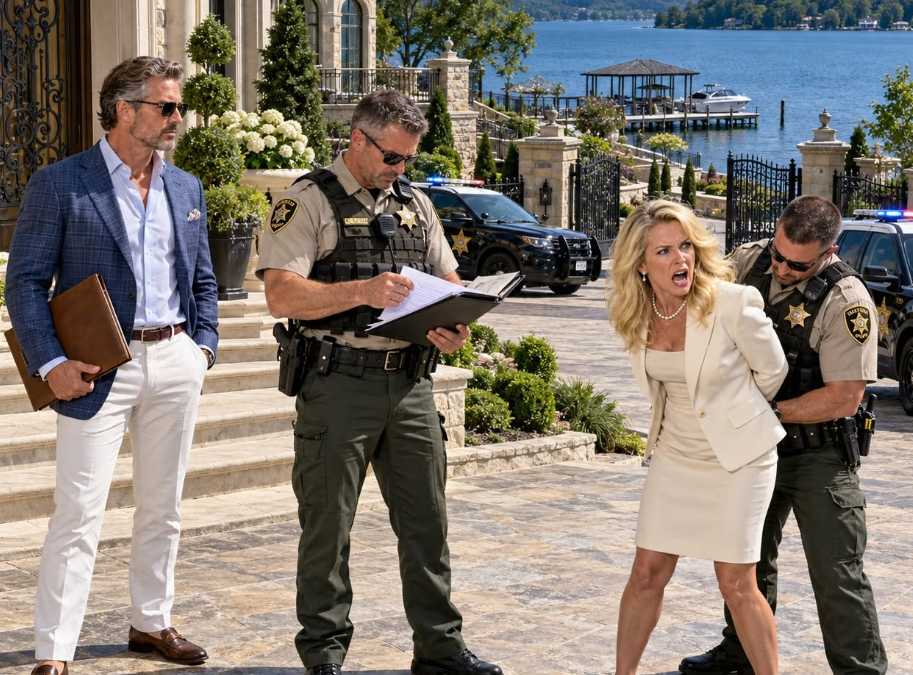
The handcuffs clicked around her wrists at 9:17 in the morning.
The sound carried across the driveway.
Across the porch.
Across the watching board members.
Across the neighbors standing by the road.
Vanessa Whitmore, president of Cedar Hollow HOA, the woman who had driven through my gate to order me out of my own home, stood in front of my porch in a tailored blazer with her hands cuffed behind her back.
For the first time since she arrived, she had nothing to say.
That was how my first morning at Cedar Hollow began.
But Vanessa’s arrest was not the end.
It was the first thread pulled from a very expensive, very rotten piece of fabric.
To understand why she walked onto my property with a forged affidavit and the confidence of someone who believed she could make deputies do her bidding, you have to understand Cedar Hollow.
The neighborhood had not always been the kind of place where an HOA president could mistake herself for law.
Forty years earlier, it had been a modest lake community.
Small cabins.
Fishing docks.
Families from the city.
Teachers, dentists, small-business owners, retirees.
People who came on weekends, left canoes upside down in the grass, and knew which neighbor had a spare key under a fake turtle by the back door.
Then money found the lake.
It came slowly at first.
A renovated cabin sold for twice what anyone expected.
A hedge fund manager bought three lots and combined them.
A builder tore down two old cottages and replaced them with glass and stone.
Restaurants opened in town.
A boutique hotel appeared near the marina.
Within fifteen years, Cedar Hollow became the kind of place where people used words like legacy property, architectural cohesion, and shoreline integrity while arguing about who could keep a paddleboard rack visible from the road.
The HOA grew with the money.
At first, it handled basic things.
Road maintenance.
Common dock repairs.
Gate codes.
Landscaping at the entrance.
Then it expanded.
Architectural review.
Exterior colors.
Dock lighting.
Guest parking.
Quiet hours.
Short-term rental restrictions.
Tree removal approvals.
Holiday decoration windows.
By the time Vanessa became president, the HOA had become less like a neighborhood association and more like a private government with better stationery and less accountability.
Vanessa thrived there.
She was not born wealthy.
That mattered to her more than she admitted.
She had married into money, divorced well, invested wisely, and learned how rich people talk when they want control to sound like taste.
She bought one of the largest homes inside the HOA proper, a slate-roofed lakefront place with a wine cellar and a dock wide enough to host a wedding.
Then she began volunteering.
Committee first.
Then treasurer.
Then vice president.
Then president.
People voted for her because she got results.
The entrance landscaping improved.
Road assessments were collected.
A contractor who had been overbilling the pool maintenance account was fired.
Architectural applications moved faster.
Cedar Hollow started looking more polished.
More uniform.
More expensive.
People liked that.
They did not ask what it cost.
Not in money.
In power.
Vanessa learned quickly that homeowners would tolerate almost anything if property values rose.
She fined a widow for having the wrong shade of blue on her shutters.
People shrugged.
She forced a retired teacher to remove a vegetable garden from a side yard because it was “visually inconsistent.”
People said rules were rules.
She made a family take down a wheelchair ramp and rebuild it in approved cedar because aluminum was “aesthetically disruptive.”
People called it unfortunate.
Every time the neighborhood looked away, Vanessa grew taller.
Not physically.
In her own mind.
Cedar Hollow Estate was the one thing she could never touch.
The estate sat beyond the HOA boundary, but it occupied the most coveted shoreline on the lake. Thirty-two acres. Deepwater marina. Old-growth trees. Stone boathouse. Long private point stretching into the best sunset view in the county.
It made the rest of Cedar Hollow feel smaller.
That bothered Vanessa.
More practically, it blocked her long-term plan.
For years, she had pushed an idea called the Cedar Hollow Shoreline Enhancement Initiative. The name sounded harmless. It included trail connectivity, emergency lake access, conservation signage, common-area kayak storage, and “expanded community waterfront engagement.”
In plain English, Vanessa wanted access to the estate’s marina.
Not because the HOA needed it.
Because it would transform Cedar Hollow’s status.
A private community marina on the old estate shoreline would make every home inside the HOA more valuable. It would also make Vanessa the president who delivered it.
The old owners had refused.
They were the Abernathy family, though almost no one dealt with them directly. The estate had been held in a trust after Eleanor Abernathy moved to Switzerland to live near her daughter. Maintenance crews came and went. Attorneys handled taxes. The gates stayed closed.
Vanessa wrote letters.
The trust ignored most of them.
She proposed shared security arrangements.
Rejected.
Emergency shoreline access.
Rejected.
Temporary community dock rights.
Rejected.
Conservation partnership.
Rejected.
Then Eleanor Abernathy died, and the estate quietly went up for private sale.
That was when Vanessa panicked.
A sale meant uncertainty.
If the wrong buyer purchased the estate—someone private, stubborn, or informed—the HOA might lose its last chance to pressure the trust.
So Vanessa started manufacturing urgency.
She told the board the estate’s transition posed “community risk.”
She said unknown buyers could alter shoreline ecology.
She said helicopter traffic might increase.
She said outside investors could turn the estate into an event venue.
She said the HOA had to assert review authority before the sale closed or risk permanent loss of control.
Harold Briggs believed her because Harold believed anyone who spoke in complete paragraphs with a binder.
Diane Foster had doubts but disliked conflict.
Linda, the assistant, did what she was told because her paycheck depended on Vanessa, and fear can make obedience feel like survival.
The board adopted the Cedar Hollow Estate Transition Protocol in a closed executive session.
It was nonsense.
But nonsense becomes dangerous when printed on letterhead and placed in a folder.
My attorney, Nora Whitcomb, had warned me about Vanessa before closing.
Nora was sixty-one, silver-haired, expensive, and exacting. She had spent thirty years handling high-value property transactions, easement disputes, and trust litigation. She had the kind of calm voice that made people mistake her for gentle until they found themselves being dismantled clause by clause.
During due diligence, she noticed repeated letters from Cedar Hollow HOA in the seller’s file.
She called me the same afternoon.
“Elliot,” she said, “there is an HOA president sniffing around this estate like a fox outside a chicken coop.”
“Is the property in the HOA?”
“No.”
“Any covenant?”
“No.”
“Any shared shoreline agreement?”
“No.”
“Any easements I should know about?”
“Utility easement near the road. Emergency services access. Nothing granting the HOA control.”
“Then what does she want?”
“The marina, the shoreline, and the ability to say she matters.”
That was Nora.
Efficient with bullets.
She told me to keep printed closing documents at the house during move-in because Vanessa had been demanding recognition rights from the trust.
I thought that sounded paranoid.
I was wrong.
After deputies placed Vanessa in the cruiser, the morning did not become peaceful.
It became procedural.
Deputy Bell took statements.
Deputy Hale photographed the forged affidavit.
Graham Ellis, the trustee, emailed a sworn statement within the hour denying his signature. He also sent copies of prior correspondence where he had explicitly told Vanessa the HOA had no authority over the sale, access, possession, transition, occupancy, shoreline, marina, or grounds.
Nora arrived at 10:05 in a black sedan, stepped out wearing a gray suit and flats, looked at Vanessa in the cruiser, then looked at me.
“You made friends quickly.”
“I was unloading boxes.”
“Dangerous hobby.”
She walked straight to Deputy Bell, introduced herself, and handed him a clean packet containing the deed, title policy, survey, county parcel map, HOA boundary map, and correspondence history.
Then she turned toward Harold and Diane.
“Which of you approved the protocol?”
Harold swallowed.
Diane said, “We were told counsel reviewed it.”
Nora looked at Linda.
“Did counsel review it?”
Linda’s eyes filled.
“I don’t know.”
That meant no.
Or worse, she knew but was not ready to say.
Vanessa, from inside the cruiser, saw Nora speaking to her board members and began kicking the conversation through the window.
“Do not answer her. Harold. Diane. Do not answer anything without association counsel.”
Nora glanced toward the cruiser.
“Excellent advice. About three months late, but excellent.”
Deputy Bell had to hide a smile.
By noon, Vanessa was gone.
Taken to the sheriff’s office for questioning regarding criminal trespass, false report, and possession of a suspected forged instrument.
The board SUVs left next.
Harold drove like a man trying to disappear into his own steering wheel.
Diane cried before getting into her vehicle.
Linda stayed behind.
She stood near the driveway holding her clipboard against her chest like it might keep her upright.
“I’m sorry,” she said.
I looked at her.
She was maybe twenty-six.
Too young to have already learned that powerful people love using assistants as shock absorbers.
“Did you know the affidavit was forged?”
“No. Not at first.”
“At first?”
She wiped her cheek quickly.
“Vanessa kept saying Graham Ellis was being difficult but would sign once he understood community obligations. Then she told me to prepare a signature page. I thought it was for review. Later she gave it back notarized.”
“By her cousin?”
Linda nodded.
“Marsha is a notary?”
“Yes.”
“Did Marsha witness Graham sign?”
“I don’t know. I don’t think so.”
Nora spoke gently.
“Linda, you need your own attorney.”
Linda’s face crumpled.
“I can’t afford one.”
Nora handed her a card.
“Call legal aid. Then call the sheriff’s office back and tell the truth before someone decides you are more useful as a scapegoat.”
Linda took the card.
“Is she going to blame me?”
“Yes,” Nora said.
No hesitation.
Linda looked at me.
“I really am sorry. When she said you were a squatter, I believed her for a minute. Then you sounded too calm. Squatters don’t usually ask about county filing numbers.”
Despite everything, I laughed.
“Some might.”
“Not in Cedar Hollow.”
She left in a rideshare twenty minutes later.
For the first time that morning, the estate became quiet again.
Not peaceful.
Quiet.
Those are not always the same.
I walked down to the marina alone.
The property sloped gently from the house through red oak, cedar, and pine. Stone steps led to the boathouse. The lake stretched wide and silver under the afternoon sun, with expensive homes visible along the opposite shore like jewelry set into trees.
The marina was old but solid.
Weathered cedar posts.
Steel cleats.
Two empty slips.
A covered lift.
A small office with a desk, a radio, and a wall of hooks where keys probably hung decades ago.
I stood there looking at the water and wondered if I had made a mistake.
Not buying the estate.
Buying the illusion that I could simply step out of one life and into another without bringing conflict with me.
Money attracts attention.
Privacy requires defense.
Quiet, I was beginning to understand, had maintenance costs too.
My phone rang.
Nora.
I answered.
“Do not talk to neighbors,” she said.
“Hello to you too.”
“Do not talk to reporters.”
“Are there reporters?”
“Not yet. There will be.”
“Why?”
“Because a seventy-four-million-dollar estate owner had an HOA president arrested on his first morning.”
“When you say it like that, it sounds dramatic.”
“It is dramatic.”
“I was hoping for quiet.”
“You bought lakefront property in a wealthy neighborhood with an HOA monarch next door. Quiet was optimistic.”
I looked at the boathouse.
“What happens now?”
“Now we make sure the record is clean. We send notice to Cedar Hollow HOA. We demand preservation of documents. We notify the title insurer, the seller’s trust, and county officials. We make clear that any further entry will be treated as trespass.”
“And Vanessa?”
“She has bigger problems than you.”
That turned out to be an understatement.
The forged affidavit cracked open Cedar Hollow like a dropped vase.
At first, the HOA tried to treat Vanessa’s arrest as an unfortunate misunderstanding.
An email went out that evening.
Dear Cedar Hollow Residents,
This morning, members of the board attempted to conduct a routine transition review at the Cedar Hollow Estate parcel. A disagreement occurred concerning documentation and law enforcement involvement. The board is cooperating fully and requests that residents avoid speculation while facts are reviewed.
Routine transition review.
That was how they described four SUVs entering my property and their president leaving in handcuffs.
By then, half the neighborhood had video.
Speculation did not need encouragement.
It had footage.
Someone posted a clip of Deputy Bell saying, “County records show the parcel transferred yesterday to Elliot Mercer.”
Someone else posted Vanessa saying, “You have thirty minutes to remove yourself.”
A teenager posted the handcuff moment with no caption at all.
It did not need one.
By the next morning, Cedar Hollow’s private forum had become a war zone.
Some residents defended Vanessa.
They said she was protecting the community.
They said nobody knew who I was.
They said the estate’s ownership affected everyone.
They said law enforcement overreacted.
Others were furious.
They wanted to know why the board had created a transition protocol in executive session.
They wanted to know who authorized use of HOA vehicles.
They wanted to know whether association funds paid for legal documents.
They wanted to know whether the affidavit was forged.
And, most importantly, they wanted to know what else Vanessa had done while everyone assumed competence was the same as integrity.
That question changed everything.
Because once people began looking, they found a pattern.
Vanessa had used Cedar Hollow as her private kingdom for years.
Not all at once.
Not in dramatic theft.
In small expansions of authority.
A discretionary enforcement fund no one understood.
Architectural review fees routed through consultants connected to her friends.
Security upgrades approved without competitive bids.
Shoreline compliance inspections charged to homeowners who challenged her.
A legal reserve that kept growing because Vanessa loved threatening lawsuits more than resolving disputes.
The HOA had money.
A lot of money.
But it also had secrets.
The estate had been Vanessa’s obsession because it promised to justify all of it.
If she could secure some form of HOA control over Cedar Hollow Estate, even symbolic control, she would become untouchable. Property values would rise. The marina could become a managed amenity. The board could claim years of legal spending had been strategic. The transition protocol would look visionary instead of delusional.
My quiet closing ruined her timeline.
My old pickup ruined her assumptions.
Her forged affidavit ruined everything else.
Three days after the arrest, Nora received a letter from Cedar Hollow HOA’s law firm.
It was careful.
Very careful.
The association denied wrongdoing, claimed Vanessa may have exceeded authority, and requested “a cooperative path forward regarding the estate’s relationship with the broader lake community.”
Nora read it aloud in my kitchen.
Then she said, “Translation: please don’t sue us until we figure out how much trouble we’re in.”
“Are we suing?”
“We are starting with a demand.”
“For what?”
“Formal acknowledgment that the estate is not subject to HOA authority. Written apology. Reimbursement for any costs. Agreement to no entry. Preservation of documents. Disclosure of all estate-related board actions. Removal of any HOA claims from internal maps or policies.”
“And if they refuse?”
She smiled slightly.
“Then we become less polite.”
The demand went out that afternoon.
Cedar Hollow had ten days to respond.
Vanessa responded first.
Not through the HOA.
Through her own attorney.
The letter accused me of orchestrating a “public humiliation event” to intimidate Cedar Hollow leadership. It claimed I had “presented myself ambiguously” and failed to identify ownership promptly. It suggested the forged affidavit issue was “under investigation” and warned against defamatory statements.
Nora loved that one.
“Presented yourself ambiguously,” she said. “That is lawyer poetry for wearing flannel while rich.”
I kept that phrase.
The criminal investigation moved slowly but steadily.
Marsha Bellamy, Vanessa’s cousin and the notary, admitted she notarized the affidavit without Graham Ellis present. At first she claimed Vanessa assured her Graham had signed electronically and would ratify later. Then investigators showed her email records.
She cried.
People often cry when metadata arrives.
The signature on the affidavit had been copied from a prior letter Graham sent the HOA months earlier. Someone had lifted it, pasted it, adjusted the contrast, printed the document, and notarized it as if signed in person.
Vanessa denied doing it.
Then Linda produced the draft files.
Not because she wanted revenge.
Because Nora’s advice had frightened her into telling the truth early.
The draft files showed the affidavit template on Vanessa’s laptop.
Version history showed edits.
Email records showed Vanessa sent Marsha the signature page with the message:
Need this finalized before Mercer occupancy. Treat as in-person acknowledgment from Ellis. We can clean up formalities later.
Clean up formalities later.
That sentence became famous in Cedar Hollow.
Residents quoted it at meetings.
Someone put it on a coffee mug.
I did not buy one.
But I understood the impulse.
The HOA called an emergency meeting the following week.
I did not plan to attend.
Then Nora told me I should.
“They need to see you as a person, not a headline.”
“I don’t care what they think of me.”
“You will if they keep trespassing.”
That was fair.
The meeting took place in the Cedar Hollow clubhouse, a stone-and-glass building with a lake view and the kind of lighting that made everyone look wealthier and less honest.
The room was packed.
Homeowners stood along the walls.
Some turned when I entered.
Whispers moved through the space.
That’s him.
That’s the estate guy.
That’s Mercer.
He doesn’t look like seventy-four million dollars.
I wore a navy jacket this time.
Not because I owed them costume compliance.
Because Nora asked me to reduce distractions.
Vanessa was not there.
Her attorney had advised against it.
Harold Briggs sat at the front table looking like he had aged ten years.
Diane Foster sat beside him with red eyes.
The remaining board members looked trapped between fear of residents and fear of discovery.
Harold called the meeting to order.
His voice shook.
“We are here to address recent events concerning Cedar Hollow Estate and the association’s governance procedures.”
A man in the front row stood immediately.
“Did Vanessa forge a document?”
The room erupted.
Harold banged a gavel.
Nobody cared.
A woman shouted, “Why did we have a transition protocol for property we don’t own?”
Another said, “How much did we spend on this?”
Someone else yelled, “Did our dues pay for forged paperwork?”
Harold kept saying, “Please, one at a time,” which has never worked in the history of angry rooms.
Then Diane stood.
Not dramatically.
Quietly.
But something in her face made people settle.
“I need to say something,” she said.
Harold looked alarmed.
“Diane—”
“No. I should have said it months ago.”
The room quieted further.
Diane gripped the edge of the table.
“Vanessa told the board that the estate sale presented a legal emergency. She said if the association did not assert transition control before closing, we would lose all leverage over shoreline access forever. She said counsel supported the protocol. I did not personally verify that. I should have.”
She looked toward me.
“I am sorry, Mr. Mercer.”
Every eye turned.
I gave a small nod.
Diane continued.
“The board was told Graham Ellis had agreed in principle to temporary access review. I never saw him sign anything. When the affidavit appeared, Vanessa said it was handled.”
A resident asked, “Did you vote to enter the estate?”
“No,” Diane said. “We voted to authorize a transition review visit if lawful access was confirmed.”
Harold closed his eyes.
That distinction did not save them.
But it mattered.
The board had been careless.
Vanessa had been deliberate.
Then Linda entered through the side door.
She was not on the agenda.
She looked terrified.
But she walked to the front anyway.
“I worked for Vanessa for four years,” she said. “I helped prepare board packets. I sent letters. I scheduled enforcement inspections. I believed she was strict but protecting the neighborhood.”
Her voice shook.
“But over time, I saw her change documents after meetings. I saw her remove attorney cautions from summaries. I saw her tell vendors the board approved things before votes happened. I kept telling myself it was not my place.”
She looked at the residents.
“That was wrong.”
No one interrupted.
Linda opened a folder.
“I turned documents over to investigators. I also gave copies to the interim board. Residents deserve to know that the estate was not the only issue.”
Harold whispered, “Oh God.”
He was right.
The estate was not the only issue.
It was the doorway.
Through it came everything else.
Vanessa had quietly signed a side agreement with a security contractor run by her former brother-in-law.
She had approved shoreline inspection fees paid to a consulting company owned by Diane’s campaign donor, though Diane swore she had not known.
She had used HOA legal funds to research forced easements over the estate, then described those costs as “common access planning.”
She had maintained an internal map labeling my marina as “future community facility.”
Future.
That one word almost made me leave the room.
Because it told me she had never seen the estate as someone else’s home.
Only as a delayed acquisition.
The residents turned fully after that.
Not kindly.
Not gracefully.
But completely.
A recall petition began before the meeting ended.
Harold resigned as acting president.
Diane resigned from the board entirely.
An interim committee formed to cooperate with investigators and negotiate with me.
Nora leaned toward me and whispered, “That went better than expected.”
I looked at the room full of shouting millionaires.
“This is better?”
“No one threw a chair.”
“High standard.”
“HOA work lowers expectations.”
The next morning, Vanessa’s house went quiet.
No visitors.
No board members.
No assistant.
No stream of landscapers, consultants, inspectors, and loyal neighbors.
Just a large lakefront home with closed curtains.
For years, people had gone there to ask permission.
Now they drove past slowly and pretended not to look.
Vanessa was not done, though.
People like her rarely disappear at first consequence.
She filed a civil claim against the HOA, arguing the board had authorized her actions and owed her legal defense. She filed a complaint against the sheriff’s office alleging wrongful arrest. She threatened Linda. She accused Diane of defamation. She sent a letter to Nora claiming I was using “wealth influence” to silence community governance.
Nora read that letter in my library.
“Wealth influence,” she said. “From the woman who tried to steal a marina with a forged affidavit.”
The library was one of the reasons I had bought the estate. Two stories. Walnut shelves. Rolling ladder. Tall windows facing the lake. It smelled like old paper and cedar.
I had imagined reading there.
Instead, I spent the first month using the long table as a litigation command center.
Nora’s associate, Ben, created binders.
Parcel history.
HOA boundary.
Affidavit fraud.
Board minutes.
Security footage.
Witness statements.
I admired the organization and hated every second of needing it.
One afternoon, Graham Ellis came by.
He was seventy, white-haired, and carried himself like a man who had spent his career protecting families from exactly this kind of mess.
He stood on the porch and looked out over the lake.
“Eleanor Abernathy loved this place,” he said.
“I never met her.”
“She would have liked that you came in a pickup.”
“Why?”
“She distrusted men who arrived too polished.”
“Smart woman.”
He smiled faintly.
Then his face grew serious.
“Vanessa pursued the estate for years. Eleanor refused to engage. She said the woman wanted a crown more than a dock.”
“That sounds accurate.”
“I should have warned you more forcefully.”
“Nora warned me.”
“Not enough.”
I looked at him.
“Did Vanessa ever have any legitimate claim?”
“No.”
“Any ambiguity?”
“None.”
“Then why did she keep pushing?”
Graham looked toward the marina.
“Because rich communities often confuse access with entitlement. They see something beautiful beside them and begin to feel insulted that it has a gate.”
I thought about that for a long time.
The gate became the symbol of everything.
To me, it was privacy.
To Vanessa, it was defiance.
To Cedar Hollow, it became a mirror.
Some residents saw the estate and thought, That is not ours.
Others thought, Why not?
The criminal case took four months to reach preliminary hearing.
By then, Vanessa had lost the presidency, the board, most of her allies, and the ability to walk through Cedar Hollow without people pretending to check their phones.
She arrived at court wearing a cream suit and pearls.
Not navy.
That interested me.
Navy had been her HOA armor.
Cream was her defendant costume.
Soft.
Composed.
Misunderstood.
Her attorney argued that the affidavit was an administrative document, not an attempt to defraud. He claimed Vanessa believed she had oral authorization from Graham Ellis. He claimed the notary issue was a clerical mistake. He claimed her 911 call reflected genuine concern about an unidentified person entering a sensitive property.
The prosecutor played my phone recording.
Vanessa’s voice filled the courtroom.
“You have thirty minutes to remove yourself from this property.”
Then:
“This neighborhood is not meant for people in your position.”
Then dispatch audio:
“He appears to be a transient worker or possibly a squatter. We have board members present. I am concerned for our safety.”
I watched the judge’s face.
Judges hear lies all day.
But some lies have a tone.
The tone tells you whether the speaker feared danger or wanted power.
Then prosecutors introduced the affidavit.
Graham testified.
Marsha testified.
Linda testified.
The email appeared on the screen.
Need this finalized before Mercer occupancy. Treat as in-person acknowledgment from Ellis. We can clean up formalities later.
Vanessa stared straight ahead.
Not at the screen.
Not at Linda.
Not at me.
Straight ahead.
Her composure was impressive.
It was also useless.
The judge found probable cause to proceed on charges including forgery-related conduct, criminal trespass, false reporting, and attempted unlawful interference with real property.
Vanessa posted bond.
The trial date was set.
Outside the courthouse, a reporter asked her if she regretted entering the estate.
Vanessa stopped.
Her attorney touched her arm.
She spoke anyway.
“I regret that Cedar Hollow residents are being punished for expecting orderly governance.”
That was all.
No apology.
No accountability.
Still the queen, even with a court date.
The clip circulated for days.
Cedar Hollow residents who had once defended her began deleting old posts.
That is one of the petty modern rituals of shame.
People try to erase the record of having believed the wrong person.
But screenshots are patient.
While the criminal case moved forward, Nora and I negotiated with the interim HOA board.
The new acting president was a retired judge named Samuel Price.
He had lived in Cedar Hollow for twelve years and had somehow avoided HOA leadership until crisis made competence impossible to refuse.
He came to the estate alone.
No SUVs.
No assistant.
No clipboard.
Just a man in khakis standing respectfully outside the gate and calling my phone instead of driving through.
That alone put him ahead of the previous administration.
I met him at the gate.
“Mr. Mercer,” he said. “I appreciate you seeing me.”
“I appreciate you not trespassing.”
His mouth twitched.
“Low bar, but a necessary one.”
We walked to the porch.
He did not ask to see the marina.
He did not angle for a tour.
He sat where I offered and accepted coffee.
“I am here to apologize on behalf of the association,” he said.
“Are you authorized to do that?”
“Yes. Publicly and privately.”
“That’s new.”
“It needs to be.”
He opened a folder, but did not push it toward me.
“The board is prepared to acknowledge in writing that Cedar Hollow Estate is not subject to HOA authority, that the transition protocol was invalid, that the affidavit was unauthorized, and that no association representative may enter your property without written permission except in genuine emergency circumstances recognized by law.”
“That should have been obvious.”
“Yes.”
He did not defend.
I respected that.
He continued.
“We are also prepared to reimburse costs, cooperate fully with investigators, and produce all estate-related records.”
“Nora will review.”
“Of course.”
He looked toward the lake.
“Many residents are embarrassed.”
“They should be.”
“Yes.”
Again, no defense.
Samuel Price was good at silence.
After a while, he said, “I served twenty-three years on the bench. I saw many people misuse power. What embarrasses me most is that I watched Vanessa misuse smaller power here and told myself it was neighborhood politics.”
“What changed?”
“She tried to do to you loudly what she had done to others quietly.”
That sentence stayed with me.
Because it was true.
I had money.
Lawyers.
Documents.
A recorded deed.
A public spectacle.
Others had been alone.
The widow with the shutters.
The retired teacher with the garden.
The family with the wheelchair ramp.
People Vanessa had worn down before she reached my gate.
I asked Samuel for their names.
He looked surprised.
Then he gave them.
Over the next month, I met them.
Not all at once.
Not formally.
Quietly.
Mrs. Alden, the widow, had repainted her shutters three times because Vanessa kept changing the approved palette. She cried when telling me how her late husband had chosen the original blue.
Mr. Flores, the retired teacher, had grown tomatoes because his grandchildren liked picking them. He removed the garden after six violation letters and a threat of legal fees.
The Mason family had rebuilt the wheelchair ramp for their son at a cost of $18,000 because Vanessa said aluminum lowered architectural continuity.
Their son, Tyler, rolled onto my porch in a chair with red wheel rims and said, “Nice place.”
I liked him immediately.
“Thanks,” I said. “It came with a lot of paperwork.”
He grinned.
“So did I.”
His mother laughed, but her eyes were tired.
That visit changed what I wanted.
At first, I wanted the HOA to stay away.
Then I wanted reimbursement.
Then I wanted Vanessa held accountable.
But after hearing those stories, I wanted something broader.
Not revenge.
Correction.
Nora and I added terms to the settlement.
Independent audit of past enforcement actions.
Refunds for improper fines.
Architectural review reform.
Disability accommodation review by outside counsel.
Limits on executive session.
Resident access to legal opinions.
A formal boundary map distributed annually.
No more secret protocols.
No more “future community facility” fantasies.
The HOA pushed back.
Nora expected that.
Then I offered to waive part of my reimbursement if the money went into a restitution fund for residents harmed by improper enforcement.
That changed the room.
Some people thought it was generous.
It was not entirely.
I could afford to do it.
They could not afford to ignore what it revealed.
The settlement was approved at a packed meeting.
Vanessa’s remaining supporters called it surrender.
Samuel Price called it repair.
Tyler Mason called it “finally.”
That was my favorite.
Vanessa’s criminal case ended before trial.
She took a plea.
Not to everything.
People rarely do.
But enough.
Forgery-related misdemeanor reduced from the original charge.
False report.
Criminal trespass.
She received probation, fines, community service, and a ban from serving in any HOA or nonprofit board role during probation. Marsha Bellamy lost her notary commission and received her own penalties. Linda was not charged after cooperating.
At sentencing, I was allowed to speak.
I almost declined.
Then I thought about Mrs. Alden’s shutters.
Mr. Flores’s tomatoes.
Tyler’s ramp.
The marina map labeled future community facility.
So I stood.
The courtroom was smaller than I expected.
Vanessa sat at the defense table in another cream suit.
Her hair was perfect.
Her hands were folded.
She did not look at me.
I faced the judge.
“Your Honor, what happened at my property was not a misunderstanding. Mrs. Whitmore did not ask who I was. She did not verify ownership. She did not respect the gate, the deed, or the truth once it was presented to her. She decided I did not look like the owner, then tried to use law enforcement to make her assumption real.”
I paused.
The room was silent.
“But this case is larger than my first morning at Cedar Hollow. Mrs. Whitmore spent years turning neighborhood rules into personal authority. She used paperwork to intimidate people who did not have the resources to fight back. She treated private property as community property when she wanted it, and treated community governance as personal power when residents questioned her.”
Vanessa’s jaw tightened.
Good.
“An HOA president is not a sheriff. Not a judge. Not a county clerk. Not a property owner by proximity. The deed mattered. The gate mattered. The truth mattered. And I hope this court’s sentence reminds every private association in this county that authority has limits even when it wears a blazer and carries a binder.”
The judge looked at Vanessa for a long moment before imposing sentence.
No jail.
Some people were disappointed.
I was not surprised.
But the conviction mattered.
The public record mattered.
The ban mattered.
The restitution mattered.
And her apology, though brief and clearly painful, mattered in one specific way.
Not because I needed it.
Because Cedar Hollow needed to hear her say the words.
“I was wrong to enter Mr. Mercer’s property,” she said. “I was wrong to rely on a document that was not properly authorized. I was wrong to assume authority I did not have.”
It was not warm.
It was not full.
It did not mention my clothes, my truck, or the contempt in her eyes.
But it was on record.
Sometimes that is the closest truth gets to dignity.
Vanessa sold her house six months later.
Quietly.
No dramatic moving day.
No farewell gathering.
No board resolution thanking her for years of service.
A moving truck came at dawn.
By noon, she was gone.
I watched from my side of the lake through binoculars, which was petty.
I admit that.
Nora called while I was doing it.
“Are you spying?”
“No.”
“Elliot.”
“Lightly.”
“Enjoy yourself for five minutes, then stop.”
I did.
Mostly.
Life at the estate slowly became what I had wanted.
Not right away.
At first, every unknown vehicle on Lakeshore Drive made me look up. Every email from Nora made my stomach tighten. Every knock at the gate felt like another battle arriving in dress shoes.
But time passed.
The gate stayed closed.
The HOA stayed away.
The marina remained private.
The old cedar boathouse got a new roof.
I repaired the greenhouse glass pane by pane, badly at first, then better.
I hired a small grounds crew but kept the work I liked.
Fence posts.
Boat engines.
Wood stacking.
Dock boards.
I did not become some simple man of the land.
That would be a lie.
I still owned companies.
I still took calls.
I still flew out for meetings when necessary.
But Cedar Hollow became the place where my day could begin without a boardroom.
One morning, months after Vanessa left, Tyler Mason came by with his father.
They had called first.
That mattered.
Tyler wanted to see the marina because he loved boats. I showed him the lift, the old Chris-Craft I had bought with foolish optimism, and the workbench where I was rebuilding a carburetor.
He watched me struggle with a stuck screw.
“You’re rich enough to pay someone,” he said.
“I know.”
“So why are you doing it?”
“Because the screw doesn’t care how much money I have.”
He thought about that.
“Respect.”
His father laughed.
So did I.
Later that summer, I hosted a small cookout on the estate lawn.
Not for the HOA.
Not for Cedar Hollow society.
For the people Vanessa had pushed around and the people who had helped correct it.
Mrs. Alden came wearing a blue scarf the exact shade of her original shutters.
Mr. Flores brought tomatoes from his restored garden.
The Mason family came with Tyler, who immediately asked if the estate had accessible fishing spots and then told me exactly where I should build one.
Samuel Price came with his wife.
Linda came too, nervous at first, then relieved when no one treated her like Vanessa’s shadow. She had found a new job with a small accounting firm and looked ten years younger.
Nora arrived late, carrying wine she claimed was not a billable expense.
We ate under string lights near the water.
No speeches.
No ribbon cutting.
No symbolic nonsense.
Just food, laughter, mosquitoes, and lake air.
At one point, Mrs. Alden stood beside me looking across the lawn.
“You know,” she said, “for years I thought that gate meant the people inside believed they were better than us.”
I looked toward the iron gate far up the drive.
“What do you think now?”
“I think sometimes gates keep the wrong people out. Sometimes they keep the right people from seeing each other.”
“That sounds complicated.”
“Most true things are.”
She patted my arm and went to get another tomato tart.
The estate did not become community property.
It never would.
But it became less mythological.
That was better.
I learned names.
People learned mine.
Not everyone liked me.
That was fine.
Privacy is not the same as secrecy, and boundaries are not the same as hostility.
The new HOA board learned that too.
At the next annual meeting, they adopted a plain-language boundary document. Every property owner received a map showing HOA land, private land, easements, common areas, and parcels outside association control.
At the bottom, in bold, it said:
THE ASSOCIATION HAS NO AUTHORITY OVER PROPERTY OUTSIDE ITS RECORDED DECLARATION.
Simple.
Obvious.
Apparently revolutionary.
They also created an owner rights committee, chaired by Tyler Mason’s mother, which amused me because Vanessa would have hated every syllable of that phrase.
The restitution fund repaid improper fines and helped cover the Mason ramp. Mr. Flores got money back for his garden dispute. Mrs. Alden repainted her shutters the original blue, and nobody fined her.
I sent flowers when I saw them.
She sent back tomatoes.
Fair trade.
One year after my first morning at Cedar Hollow, I found myself standing on the porch at sunrise with coffee in one hand and a wrench in the other.
The same porch where Vanessa had ordered me out.
The lake was still.
Mist hovered above the water.
Somewhere across the cove, a loon called.
My old white pickup sat in the drive, still dented, still dusty, still apparently confusing to people with narrow imaginations.
Nora had once asked why I kept it.
“You could drive anything,” she said.
“I do drive anything,” I told her. “This is anything.”
The truth was simpler.
That truck reminded me who I was before people started calculating my worth in headlines.
Before venture capital.
Before acquisitions.
Before private deals and quiet closings and property values with too many zeros.
My father had taught me to drive in a truck like that.
He had been a mechanic.
A good one.
He died before I made real money.
Sometimes I wondered what he would think of the estate.
I hoped he would like the boathouse.
I knew he would hate the helicopter pad.
I was thinking about him when Samuel Price’s car appeared at the gate.
He had called ahead.
Of course.
I let him in.
He drove up slowly, parked by the turnaround, and stepped out holding an envelope.
“Morning,” he said.
“Please tell me the HOA has not created a porch transition protocol.”
He smiled.
“No. We are trying sobriety.”
“Good policy.”
He handed me the envelope.
Inside was a copy of the new boundary map and a short letter signed by the board.
Mr. Mercer,
One year ago, Cedar Hollow failed to respect a boundary that should never have been questioned. The association acknowledges that Cedar Hollow Estate is private property outside HOA control. We appreciate your role in forcing reforms that were overdue. We hope future interactions can be governed by clarity, respect, and written permission.
I read it twice.
Then I looked at Samuel.
“Written permission,” I said.
“We thought you’d appreciate that.”
“I do.”
He glanced toward the lake.
“Vanessa used to say the estate was the missing piece of Cedar Hollow.”
“And now?”
“Now I think maybe it was the mirror.”
I folded the letter.
“Mirrors are not always flattering.”
“No,” he said. “But they are useful.”
After he left, I walked down to the marina.
The old cedar boards creaked beneath my boots. A heron lifted from the far reeds. The water lapped against the posts with the soft patience of something that had seen too many human arguments to be impressed by any of them.
I thought about Vanessa standing on my driveway, certain that I could not be the owner because I did not match the picture in her head.
I thought about the deputies reading the deed.
I thought about the handcuffs.
I thought about Linda finding the courage to tell the truth.
I thought about everyone who had lived under Vanessa’s authority before I arrived with enough money, enough paperwork, and enough stubbornness to stop her.
That part still bothered me.
Justice should not depend on whether the victim can afford Nora Whitcomb.
But sometimes a loud case opens a door for quieter corrections.
That does not make the unfairness noble.
It just gives you work to do afterward.
Owning Cedar Hollow Estate taught me that property is not protected by price.
A seventy-four-million-dollar deed can still be challenged by a woman with a clipboard if everyone around her has been trained to obey the clipboard.
A gate can be crossed.
A signature can be forged.
A false call can be made.
A neighborhood can mistake confidence for authority.
And a man in work boots can be treated like an intruder on land he bought, simply because arrogance has always believed ownership should look a certain way.
But truth has its own wardrobe.
Sometimes it wears a suit in court.
Sometimes it wears a deputy’s badge.
Sometimes it looks like a county filing number on a screen.
Sometimes it is a nervous assistant finally saying, “Yes, you did.”
And sometimes it is just a quiet man on his own porch saying no.
Vanessa Whitmore thought she could decide who belonged at Cedar Hollow.
She thought the lake, the road, the marina, the estate, the board, the deputies, and even the truth itself would arrange around her will because they always had before.
She was wrong.
The deed did not care about her title.
The gate did not care about her protocol.
The law did not care about her blazer.
And I did not care that she expected me to apologize for owning what she wanted to control.
My first morning at Cedar Hollow was supposed to be quiet.
It was not.
But in the year that followed, the quiet became better than what I had imagined.
Not because conflict never came.
Because boundaries finally meant something.
Because the estate was no longer a myth or a prize or a future HOA facility on Vanessa’s secret map.
It was a home.
My home.
And every time I drive through that iron gate in my old white pickup, past the oaks, toward the lake, I remember the moment Vanessa stood at the bottom of my porch and told me I had thirty minutes to leave.
She had no idea she was right about one thing.
Somebody did need to leave that morning.
It just was not me.