HOA President Sent Three 40-Ton Cement Trucks Across My Family’s Farm After I Warned Her to Stay Out—Then the Lead Driver Reached the Orange Stakes She’d Chosen to Ignore.
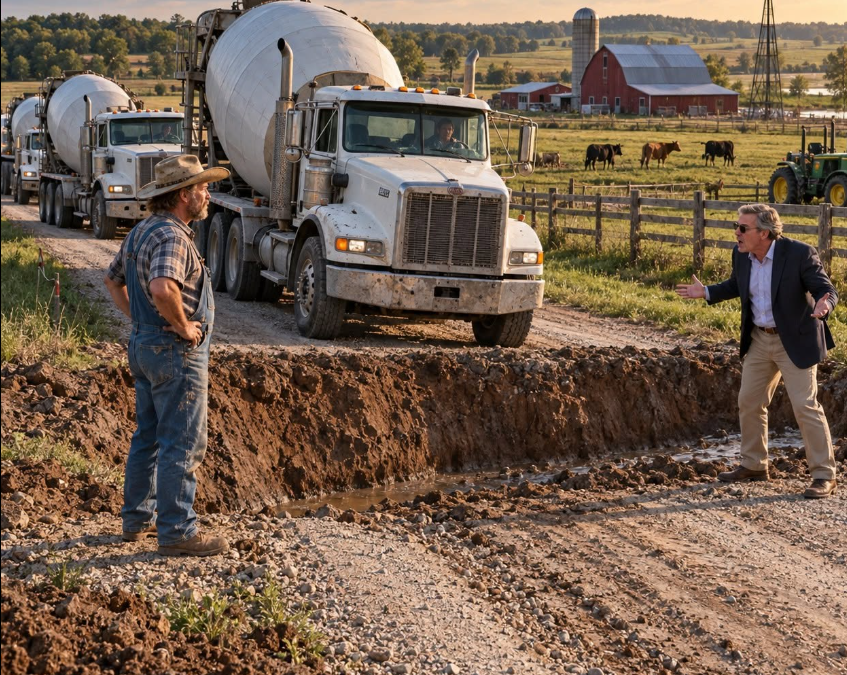
HOA President Sent Three 40-Ton Cement Trucks Across My Family’s Farm After I Warned Her to Stay Out—Then the Lead Driver Reached the Orange Stakes She’d Chosen to Ignore.
Barbara Stowe thought a clipboard, a fake easement, and three loaded cement trucks were enough to turn my farm into her private construction road.
She never asked why the orange stakes were planted five feet apart across my field, and by the time the first truck dropped nose-first into my legal drainage trench, every neighbor watching knew she had ignored more than a warning.
What came out afterward was not just a stuck cement mixer—it was a buried paper trail of threats, forged access claims, hidden drainage violations, and the truth about why Maplewood Ridge needed my land so badly.
The first cement truck turned off Route 9 at 11:47 on a Monday morning.
I heard it before I saw it.
A loaded mixer has a particular sound when it leaves pavement and starts climbing onto dirt. It is not like a pickup, or a tractor, or a delivery van bumping along a gravel lane. A loaded mixer carries its weight in its voice. Low diesel growl. Metal strain. Drum churning slow and steady behind the cab. The kind of sound that reaches your bones before it reaches your eyes.
I was sixty-three years old, sitting on my back porch with a cup of coffee, when that sound rolled across forty acres of my eastern field.
Then came the second truck.
Then the third.
Three fully loaded cement mixers.
Close to forty tons each.
All headed toward a gate they had no legal right to cross.
At the gate stood Barbara Stowe, president of the Maplewood Ridge Homeowners Association, holding a clipboard under one arm and a handheld radio in the other.
She looked satisfied.
Not worried.
Not uncertain.
Satisfied.
She had spent three weeks telling me the HOA possessed a recorded easement across my farm.
She had threatened a fifty-thousand-dollar lien if I blocked her project.
She had called county planning.
She had called the sheriff.
She had demanded that my lawful excavation permit be revoked.
She had been shown a county letter confirming that her easement belonged to another parcel.
She had been told by a deputy that the parcel numbers did not match.
And after all of that, Barbara had decided that being president of a homeowners association somehow gave her the right to overrule a county plat.
So there she stood, waving forty-ton trucks through my gate.
What she had never bothered to ask was what the orange stakes crossing my field meant.
There were dozens of them.
Five feet apart.
Bright enough to see from the road.
They surrounded an eight-foot-deep drainage trench I had legally permitted six weeks earlier.
The trench ran east to west across the lowest part of my basin.
Barbara’s proposed truck route ran north to south.
The two lines crossed.
Exactly once.
Right in the softest section of the field.
The lead driver radioed, “Which way through?”
Barbara lifted her radio.
“Straight north. Follow the flat ground.”
I set my coffee down.
The driver eased forward.
Five miles an hour.
Maybe less.
PART2:
But forty tons at five miles an hour is still forty tons.
The front tires sank slightly into the damp basin soil.
The driver kept going.
He approached the first orange marker.
Slowed.
Then continued.
I stood.
Eight neighbors were lined along the roadside now.
Marge Ellison.
Tom Reader.
The Hendersons.
Patrice Bell from the third house inside Maplewood Ridge.
Others I barely knew.
Nobody spoke.
The mixer passed the first marker.
Then the ground disappeared under its front axle.
The sound was deeper than I expected.
Not a crash exactly.
More like the earth exhaling all at once.
The front wheels broke through the lip of the trench.
The cab pitched forward.
Thirty degrees.
Maybe more.
The driver slammed the brakes.
Too late.
The truck’s weight carried it down until the front axle settled hard into the cut.
The drum kept turning.
For one awful second, the whole truck rocked forward like it might roll.
The driver threw the door open and braced himself against the frame, face pale beneath his hard hat.
Behind him, the second cement truck stopped so hard its brakes screamed.
The third swerved onto the field shoulder and sank to its rear wheels in wet ground.
And Barbara Stowe, who had spent three weeks treating my farm like an inconvenience, stared at the nose-down mixer in my trench as if the land itself had betrayed her.
I walked down from the porch.
Not fast.
Not slow.
Just steady.
At my age, you learn not to run toward foolishness unless someone is bleeding.
The driver climbed out of the tilted cab with help from two workers who had come running from the second truck. He was shaken but upright. One of the men asked if he was hurt. He said no, then said maybe, then sat down hard on the grass and put both hands on his knees.
I reached the fence line as Barbara turned on me.
“You did this,” she said.
That was the first thing out of her mouth.
Not, Is the driver okay?
Not, Why is there a trench?
Not, Did I just send a loaded cement truck into a marked excavation?
Just:
“You did this.”
I looked past her toward the driver.
“You all right?”
He nodded once, still breathing hard. “Yeah. I think. Scared the hell out of me.”
“You hit your head?”
“No.”
“Stay sitting anyway.”
Barbara stepped between us like she owned the air.
“Mr. Whitaker, you intentionally created a hazard across a lawful access route.”
My name is Samuel Whitaker, though most folks in Millstone County call me Sam.
I looked at Barbara’s clipboard.
Then at the truck.
Then at the row of orange stakes standing on both sides of the collapsed trench edge.
“No, Barbara,” I said. “I legally excavated a drainage trench on my farm. You drove a cement truck into it.”
Her face tightened.
“This is an HOA easement.”
“No, it isn’t.”
“We have recorded access.”
“No, you don’t.”
“You were notified.”
“So were you.”
The second driver climbed down from his truck and shouted, “Lady, you said this field was cleared.”
Barbara spun toward him. “It was.”
He pointed at the orange stakes. “That doesn’t look cleared to me.”
“They’re marking drainage work.”
He stared at her. “Exactly.”
Marge Ellison, who lived across Route 9 and had witnessed more county foolishness in seventy-two years than any courtroom ever could, called from the roadside, “Barbara, those stakes have been there for a month.”
Barbara ignored her.
Of course she did.
People like Barbara only hear the public when the public agrees.
I took out my phone and called 911.
Barbara’s eyes widened.
“What are you doing?”
“Reporting a construction accident.”
“This is not an accident. This is sabotage.”
“Then you’ll want witnesses.”
She stepped closer, lowering her voice.
“Sam, you are making a very serious mistake.”
I looked at the stuck mixer.
“Seems like you already did.”
The first deputy arrived twelve minutes later.
Deputy Cole Ramsey was thirty years younger than me and carried himself with the exhausted patience of a man who had been called to too many neighbor disputes that began with the words property line. He had been out here twice already because Barbara kept calling the sheriff’s office claiming I was obstructing an HOA easement. Both times, he had looked at the plat, looked at the parcel records, looked at Barbara, and told her the same thing.
This easement does not cross Mr. Whitaker’s farm.
Now he pulled his cruiser beside the gate, stepped out, and froze when he saw the cement truck pitched into the trench.
For a moment, he said nothing.
Then he took off his sunglasses and looked directly at Barbara.
“Mrs. Stowe.”
She lifted her chin.
“Deputy Ramsey, Mr. Whitaker has created a dangerous obstruction across our recorded access route.”
He stared at her.
“You brought trucks through after I told you this was not your access route?”
“This is an emergency construction situation.”
“Concrete pour isn’t an emergency.”
“It is when forms are set and contractors are scheduled.”
“That is a scheduling problem.”
“It is a contractual obligation.”
“That is also not an emergency.”
I almost smiled.
Barbara did not.
The fire department came next, then county EMS, then a heavy recovery company because nobody was pulling forty tons of cement and steel out of an eight-foot trench with a farm tractor. The driver, whose name was Luis Alvarez, was taken to the clinic with a possible wrist sprain and back strain. Before he left, he looked at me and said, “Sir, I’m sorry. We were told this was approved.”
“I know,” I said.
He glanced toward Barbara, then back at me.
“We were told you were just being difficult.”
“That too.”
He looked embarrassed.
“Should’ve stopped at the stakes.”
“Yes,” I said. “You should have.”
There was no anger in it.
The man had followed bad instructions. That didn’t make him innocent of judgment, but it made him human.
Barbara, on the other hand, was still standing by the gate with her clipboard clutched against her chest as if paper could protect her from gravity.
By then, more Maplewood Ridge residents had arrived. Some came in golf carts. Some walked down from the development road. A few had children with them, pulled back behind the sheriff’s tape once the fire chief saw them creeping closer.
They had been waiting for the concrete pour.
I knew that because Barbara had made sure everyone knew it.
For months, the Maplewood Ridge newsletter had been announcing progress on the new community pavilion and pool deck expansion. A $3.2 million “amenity modernization initiative,” funded by special assessment, bank financing, and what Barbara called “strategic access optimization.”
That last phrase meant my field.
What she wanted was simple: a shortcut.
The legal construction entrance to Maplewood Ridge came off Ridgeview Lane, a narrow paved road with a small county bridge rated below the loaded weight of cement mixers. To use that entrance, the HOA needed a temporary construction bridge reinforcement, county traffic control, and a haul-route permit. It would cost money and delay the pour.
My farm, sitting west of the development, offered a flatter path from Route 9 straight to the pavilion site.
The only problem was that my farm was not theirs.
So Barbara solved that problem the way people like her solve many problems.
She pretended it did not exist.
It began with a letter.
Three weeks earlier, I had found it clipped to my front gate in a plastic sleeve, as though my farm were a community bulletin board.
NOTICE OF EASEMENT ACTIVATION.
Dear Mr. Whitaker,
Pursuant to recorded access rights benefiting Maplewood Ridge Homeowners Association, contractors will begin temporary construction access across the east field of Whitaker Farm beginning Monday, May 8. Please ensure all livestock, equipment, fencing, and obstructions are removed from the easement path.
Failure to comply may result in enforcement action, including costs, fines, lien assessment, and recovery of damages caused by obstruction.
Sincerely,
Barbara Stowe
President, Maplewood Ridge HOA
I read it twice.
Then I laughed so hard my dog, Roscoe, barked at me.
Not because it was funny.
Because absurdity sometimes lands too big for anger.
I had lived on Whitaker Farm my whole life except for four years in the Navy and six years working construction out west before my father’s heart went bad and I came home. My grandfather bought the first eighty acres in 1949. My father added the eastern field in 1978. I inherited the place with three barns, two ponds, one stubborn tractor, and an old farmhouse that still settled at night like it was thinking.
There was no Maplewood Ridge easement across my farm.
There had never been.
I knew that because I had spent the past year dealing with water.
That was the whole reason the orange stakes were there.
Maplewood Ridge sat on a slope above my eastern basin. When it was first built twenty years earlier, it was a modest development with thirty homes, decent drainage, and a retention pond that emptied slowly into a county ditch. Then the second phase came. Then the third. Then Barbara’s board approved hardscape expansions, new roofs, wider driveways, and a clubhouse parking lot that shed stormwater like a tin roof.
Every year, more runoff came down toward my farm.
At first, it was just a nuisance. Then it became damage.
My east hayfield started holding water for days after storms. Two summers ago, I lost half a cutting. Last spring, a rain event washed sediment through my lower pasture and left a fan of gravel against my fence. When I complained, Barbara sent me a letter saying Maplewood Ridge was “not responsible for natural downhill flow.”
Natural.
There was nothing natural about six acres of asphalt, gutter downspouts, and engineered swales aimed at one farm basin.
So I did what reasonable people do before they become unreasonable.
I hired an engineer.
His name was Dev Patel, a quiet man with rolled-up sleeves and a hatred of sloppy drainage plans. He walked the field with me after a storm, took elevations, reviewed county stormwater filings, and spent two weeks pulling records.
His conclusion was simple.
Maplewood Ridge had exceeded the capacity of its original stormwater plan.
The county should have required updated retention.
The HOA’s modifications had increased peak discharge.
And my field was becoming the unpaid detention basin.
“Can I sue?” I asked him.
“You can always sue,” Dev said. “The better question is whether you want to spend three years paying lawyers while your field gets wetter.”
“What do you recommend?”
“Intercept drainage on your side. Legal, permitted, engineered. Then document everything.”
So I did.
We designed a basin trench and controlled drainage channel across the lowest section of my field, east to west, tying into an existing agricultural outlet that had served the farm since the 1960s. Eight feet deep at the crossing point. Sloped properly. Staked. Marked. Approved by county soil and water. Excavation permit issued. Utility clearance obtained.
Everything lawful.
Everything visible.
Everything Barbara knew about because she had tried to stop it.
She said my trench would “weaponize drainage” against Maplewood Ridge.
Dev said that phrase was not engineering.
The county agreed with Dev.
Barbara did not take that well.
A week after my excavation began, she appeared at my gate in white pants, polished boots, and a blue blazer that looked like it had never touched weather.
“Sam,” she said, smiling the way people smile when they have already decided you are beneath the conversation. “We need to discuss your ditch.”
“It’s a drainage trench.”
“It is a hostile alteration.”
“It’s permitted.”
“It interferes with our community access.”
“You don’t have community access.”
“We do.”
She handed me a copy of an easement document.
I recognized it immediately because I had seen it before when Maplewood Ridge fought with the Miller family fifteen years earlier.
The easement granted Maplewood Ridge emergency access across Parcel 17C.
My farm was Parcel 17A.
Parcel 17C lay half a mile south, across what used to be the old Bell orchard. Different owner. Different frontage. Different legal description. Different world.
“Wrong parcel,” I said.
Her smile remained.
“It connects to your field historically.”
“No, it doesn’t.”
“The subdivision plat references agricultural access.”
“To Parcel 17C.”
“Sam, I understand you may not be familiar with development documents.”
I looked at her for a long second.
“Barbara, my father taught me to read deeds before he let me drive a tractor.”
Her eyes cooled.
“Then you understand recorded rights survive ownership changes.”
“I also understand numbers.”
“Excuse me?”
“Seventeen C is not seventeen A.”
She took the paper back.
“We will let county planning clarify.”
“They already will. I filed copies with my drainage permit.”
Her jaw tightened.
That was the first time I saw it.
The little crack in Barbara Stowe’s confidence.
It lasted half a second.
Then she said, “This is going to become expensive for you.”
I leaned on the gate.
“It already has. That’s why I dug the trench.”
Over the next three weeks, Barbara escalated.
She called county planning.
They sent a letter confirming my permit and clarifying that the Maplewood Ridge easement did not cross my parcel.
She called soil and water.
They confirmed the trench was approved.
She called the sheriff.
Deputy Ramsey came out, looked at the documents, and told her it was a civil matter but that she had no right to cross my land without permission.
She sent me another letter threatening a $50,000 lien for obstruction.
My attorney, Nora Vale, sent back a letter saying the HOA had no authority to lien non-HOA property and that any attempt would result in claims for slander of title and abuse of process.
Barbara responded by leaving a voicemail saying, “You are putting yourself in a very poor position with this community.”
I saved it.
Then came the trucks.
Now the first one sat nose-down in my trench while the whole community watched.
The recovery crew arrived with two wreckers heavy enough to make my field tremble. Before they could begin, the fire chief ordered the remaining cement trucks off the soft ground. The third truck was stuck badly enough that it had to be pulled backward by a tow rig before it sank deeper.
The second truck managed to reverse out, leaving ruts six inches deep.
Concrete has a clock.
A loaded mixer cannot sit indefinitely while adults argue about arrogance and parcel numbers. The contractor knew that. The drivers knew that. Darren Holt, the concrete company’s operations manager, knew it too. He arrived in a pickup at 12:39 with a face like thunder.
He went first to Luis, then to his drivers, then to the stuck mixer, then finally to Barbara.
“Who authorized this route?”
Barbara lifted her clipboard.
“Maplewood Ridge HOA did.”
“I asked who cleared the field.”
“Our easement rights are recorded.”
Darren pointed at the trench.
“Did your recorded rights include that?”
“The landowner created that obstruction after notice.”
Darren stared at her.
“You sent us across an active excavation?”
“It was supposed to be passable.”
“According to who?”
She looked toward me.
“Mr. Whitaker intentionally failed to disclose the hazard.”
I laughed once.
Darren turned to me.
“Did you tell her about the trench?”
“She tried to get the permit revoked.”
His eyes went back to Barbara.
“You knew.”
“It was not supposed to be in the access path.”
I pointed at the orange stakes.
“The access path exists only in your imagination.”
Marge Ellison called from the roadside, “And apparently imagination needs better tires.”
A few people laughed before they could stop themselves.
Barbara shot her a look sharp enough to cut wire.
Darren rubbed both hands over his face.
“We’re losing the load.”
Barbara blinked.
“What?”
“The concrete. We can’t keep three mixers sitting here all afternoon.”
“You need to deliver it.”
“To where? Through a trench? Across disputed property? With one driver already hurt?”
“We have forms ready.”
“That is not my problem.”
“It will be if you breach contract.”
Darren’s face hardened.
“Mrs. Stowe, you represented in writing that this route was permitted, cleared, compacted, and approved for loaded mixers.”
“It was.”
He looked down at his boots sinking into my damp field.
“No, ma’am. It was not.”
That was the first real fracture.
Not the truck dropping.
Not the sheriff arriving.
Darren saying ma’am like a door closing.
By two o’clock, the county inspector had arrived.
His name was Alan Keene, and he looked like every county inspector I had ever known: sunburned, skeptical, and dressed as if paperwork had personally wronged him.
He walked the site with Dev Patel, whom I had called as soon as Barbara started blaming the trench. Dev brought my permit packet, drainage plans, and survey.
Alan inspected the stakes, trench, permit placard, and erosion controls.
Then he looked at Barbara.
“The trench is legal.”
Barbara’s face tightened.
“It cuts across our access.”
“You don’t have access here.”
She held up the easement.
Alan sighed.
“That’s Parcel 17C.”
“It historically served this corridor.”
“No. It historically served Parcel 17C.”
“The subdivision has relied on this route.”
“The subdivision has not legally used this field for construction access.”
“We have aerial photographs showing farm tracks.”
Alan looked at me.
I said, “Those are my hay tracks.”
He looked back at Barbara.
“Farm tracks on a farm are not an HOA road.”
The Hendersons laughed openly at that.
Barbara’s expression turned glacial.
“Inspector Keene, I would be careful about making determinations in the field without reviewing the complete file.”
Alan stared at her.
“I reviewed the complete file after you called my office seven times.”
That shut her up for almost three seconds.
The recovery took six hours.
The first mixer had to be stabilized before they could pull it out. The trench wall had collapsed around the front axle. Fresh concrete was dumped into a temporary containment area to prevent it from hardening in the drum. My field was torn up by wreckers, tire ruts, foot traffic, and Barbara’s bad decision.
I documented everything.
Photos.
Video.
Names.
Times.
Statements.
Nora had taught me that when powerful people create chaos, the calm person with records wins later.
Barbara stood by her vehicle most of the afternoon making calls.
I heard pieces.
“Hostile landowner.”
“Intentional obstruction.”
“Emergency injunction.”
“Construction sabotage.”
“Community damages.”
At one point, she told someone, “He dug the trench deliberately across our route.”
I walked over.
“No,” I said. “You invented a route across my trench.”
She lowered the phone.
“You are going to regret this.”
I looked at the sun dropping behind the ridge, at the torn field, at the driver’s blood pressure cuff lying abandoned in the grass, at the orange stakes bent around the collapsed trench lip.
“I already do.”
That seemed to surprise her.
“Do not pretend you are the victim here.”
“I’m not pretending anything.”
“You humiliated an entire community.”
“No, Barbara. I watched you risk a man’s life to save a construction delay.”
Her face changed.
Not guilt.
Anger.
“Luis is fine.”
“You didn’t know that when your first words were ‘You did this.’”
Her jaw tightened.
For the first time, a few Maplewood Ridge residents looked at her differently.
People can ignore a lot until one sentence reveals the order of someone’s priorities.
By sundown, the trucks were gone.
The field looked like a battlefield.
One trench edge collapsed.
Ruts everywhere.
Concrete spill contained but ugly.
The gate bent.
My drainage control fabric torn.
Barbara left without apologizing.
Of course she did.
The next morning, Maplewood Ridge sent an email to all residents.
Dear Homeowners,
Yesterday’s concrete delivery was disrupted when a neighboring property owner’s unmarked excavation caused a truck to become disabled along the HOA’s recorded access route. The board is evaluating legal remedies to recover costs and prevent further obstruction of the community’s amenity project.
The driver received precautionary medical evaluation and was released.
We appreciate your patience as we address this matter responsibly.
Barbara Stowe
HOA President
Unmarked.
Recorded access route.
Responsibly.
I read the email three times, then forwarded it to Nora.
She called me five minutes later.
“She put it in writing,” she said.
“She lies like breathing.”
“Yes, but breathing is rarely this useful.”
By noon, Nora had sent a preservation letter to the HOA, its management company, the concrete contractor, the engineering firm, the county, and every board member.
By one, Darren Holt sent me an email.
Mr. Whitaker,
I want to confirm for the record that my company, Holt Ready-Mix, was provided written route instructions by Maplewood Ridge HOA identifying your eastern field as approved access. We were not informed of any active excavation, disputed easement, or county warning. Our drivers observed stakes but relied on the HOA site representative’s direction to proceed.
Our driver Luis Alvarez was treated and released. He has bruising and a sprained wrist. We are cooperating with county authorities.
Respectfully,
Darren Holt
I read that email twice.
Then I called him.
“Thank you,” I said.
He sounded tired.
“My driver could’ve rolled.”
“I know.”
“I should’ve sent a scout truck.”
“Yes.”
He accepted that without argument.
“I’ve been doing this twenty-eight years. Never had an HOA president wave mixers into a trench.”
“First time for everything.”
He gave a humorless laugh.
“Not a record I wanted.”
After we hung up, I walked the damaged field with Dev.
He measured the collapsed trench edge, took soil samples, documented rut depth, and photographed where the truck had crossed the orange markers.
“This is going to cost,” he said.
“I know.”
“Not just repair. Reinspection. Recompaction. Erosion controls. Maybe redesign the crossing point.”
“There wasn’t supposed to be a crossing point.”
“There is now. At least in the damage report.”
I looked toward Maplewood Ridge.
The pavilion forms sat unfinished beyond the trees.
“Why was she so desperate to use my field?”
Dev did not answer right away.
That was when I knew he had been wondering the same thing.
“Concrete access from Ridgeview Lane is difficult,” he said.
“Difficult isn’t impossible.”
“No.”
“Expensive?”
“Yes.”
“How expensive?”
“Bridge reinforcement. Road protection. Traffic control. Maybe crane pumping if they can’t get trucks close enough. A few hundred thousand, maybe more if the county requires full road remediation.”
I looked at him.
“She risked all this to save a few hundred thousand?”
Dev’s face darkened.
“Maybe not just to save it.”
That was the sentence that opened the next door.
Because until then, I thought Barbara’s arrogance had caused a construction accident.
I did not yet know it had exposed a scheme.
The first clue came from Patrice Bell.
She was the Maplewood Ridge resident from the third house inside the gate, a woman in her forties with short dark hair, a nervous voice, and a husband who apparently told her not to get involved.
She came to my farm two days after the accident.
I found her standing outside the gate with a folder tucked under her arm and the uneasy posture of someone about to betray the wrong people for the right reasons.
“Mr. Whitaker?”
“Sam is fine.”
“I’m Patrice Bell. I live in Maplewood Ridge.”
“I know.”
She glanced back toward the road.
“Could we talk somewhere not visible?”
That was how she ended up at my kitchen table with a cup of coffee she didn’t drink.
My farmhouse kitchen had seen a lot of uncomfortable conversations over the years. Bankers. Veterinarians. Family arguments. Once a county tax man who tried to tell my father the hay barn had been assessed wrong and left with a pie because my mother believed even fools should eat.
Patrice opened her folder.
“I’m on the finance committee,” she said.
“HOA?”
“Yes. Well, unofficially. Barbara doesn’t like committees with authority.”
“That sounds like Barbara.”
She gave a tight smile.
“The amenity project was supposed to include construction access improvements from Ridgeview Lane. It was in the original budget.”
“How much?”
“Four hundred eighty thousand.”
I sat back.
“That’s a lot of access.”
“It included bridge reinforcement, temporary road mats, traffic control, and restoration.”
“What happened to it?”
“That’s the thing.” She slid a budget page across the table. “It disappeared.”
I looked at the document.
Maplewood Ridge Amenity Modernization Initiative
Approved Budget: $3,200,000
Line items ran down the page.
Pavilion foundation.
Pool deck expansion.
Retaining walls.
Electrical.
Landscaping.
Access improvements: $480,000.
Then she handed me a revised budget dated six weeks later.
Same total project number.
Access improvements reduced to $62,000.
Contingency increased.
Consulting services increased.
Owner’s representative fee added.
I looked up.
“Who is the owner’s representative?”
Patrice swallowed.
“Stowe Development Services.”
I stared at her.
“Barbara?”
“Her husband’s LLC. She said it was for project administration and saved the HOA money because he understood construction.”
“How much?”
“Two hundred seventy-five thousand.”
I let out a slow breath.
Patrice’s hands tightened around the folder.
“There’s more. The board told residents the county approved the farm route and that the access savings would prevent a second special assessment. People were grateful. Barbara made it sound like she negotiated a miracle.”
“And the legal access route?”
“She said Ridgeview was no longer needed because of the recorded easement across your field.”
“Wrong parcel.”
“I know that now.”
“Did she know?”
Patrice slid another paper across the table.
An email.
From Barbara Stowe to the Maplewood Ridge board.
Subject: Access Strategy
The parcel issue is a technical mismatch that Whitaker will likely attempt to exploit. The practical historical route remains the east farm path. If we present the route as established and proceed under HOA authority, any dispute can be addressed after the pour. Once concrete is placed, injunctive leverage shifts in our favor.
I read the last sentence again.
Once concrete is placed, injunctive leverage shifts in our favor.
There it was.
Not confusion.
Not misunderstanding.
Strategy.
Barbara had intended to get the concrete poured first and fight later.
The trucks weren’t just delivering cement.
They were delivering leverage.
Patrice wiped her eyes.
“I didn’t see that email until after the accident. One board member forwarded it to me because she was scared.”
“Who?”
“I promised not to say yet.”
“That’s all right.”
“I voted for the project,” she said. “I thought it would help property values. I thought the fees were high but justified. I didn’t know she was sending trucks onto your land.”
I looked at the budget documents.
“Somebody did.”
She nodded.
“That’s why I’m here.”
By the end of the week, Nora had copies.
By the end of the next week, the story was no longer about one stuck cement truck.
It was about fraud.
Maplewood Ridge had assessed homeowners for a lawful construction route, then redirected that money into insider consulting fees while planning to trespass across my field. Barbara had misrepresented the easement. The board had been warned about the parcel mismatch. County letters had been buried. Contractors had been told the route was approved. Residents had been told I was obstructing community progress.
And my drainage trench, the thing Barbara called sabotage, had simply stopped her plan before the concrete made the lie harder to remove.
The first Maplewood Ridge board meeting after the accident was held in the clubhouse because the pavilion site was still shut down.
Nora told me not to go.
Then she told me to go.
Then she sighed and said, “You are going to go regardless, aren’t you?”
“Yes.”
“Then don’t speak unless I tell you.”
“I’m sixty-three, not twelve.”
“I have met sixty-three-year-old men. Twelve is generous.”
So I went and stood in the back with Marge Ellison and Tom Reader, neither of whom lived in Maplewood Ridge but both of whom came because, as Marge said, “I enjoy watching arrogance discover minutes.”
The room was packed.
Homeowners filled every chair. Some stood against the walls. A few held printed copies of Barbara’s email, already circulating through the neighborhood like contraband.
Barbara sat at the front table with four board members, a property manager, and an attorney who looked like he regretted law school.
She opened the meeting with a prepared statement.
“The incident on Monday has been mischaracterized by individuals hostile to Maplewood Ridge. The board acted in good faith based on recorded documents, historical usage, and professional guidance. Unfortunately, Mr. Whitaker’s aggressive excavation activity created a dangerous condition—”
A man in the second row stood.
“Did you know the easement was for Parcel 17C?”
Barbara paused.
“As I said, the documents are complex.”
“Yes or no.”
“This is not a courtroom.”
“It might become one.”
People murmured.
Barbara’s smile hardened.
“We will not conduct a trial by shouting.”
Patrice Bell stood next.
“Why was the Ridgeview access budget reduced from $480,000 to $62,000?”
Barbara turned slowly.
“Patrice, budget reallocations are normal in major projects.”
“Why did $275,000 go to your husband’s LLC?”
The room detonated.
People shouted.
The attorney leaned toward Barbara, whispering urgently.
Barbara raised the gavel and struck it against the table.
“Order!”
No one gave her any.
A woman near the front yelled, “My assessment went up eight thousand dollars!”
Another shouted, “You told us the farm route was approved!”
Someone else: “Did you hide the county letter?”
Barbara slammed the gavel again.
“If this continues, I will adjourn.”
Marge cupped her hands around her mouth and called, “That’s one way to avoid minutes.”
The room turned to look at her.
She smiled sweetly.
Barbara’s face reddened.
Then she made the mistake that ended her.
She pointed toward me.
“This is exactly what Mr. Whitaker wanted. Division. Distrust. He has resented this community since it was built, and now he is using one unfortunate construction mishap to attack your board, your homes, and your property values.”
There it was again.
Property values.
The holy phrase of people who think money converts wrong into necessary.
I felt every eye turn toward me.
Nora was not there to kick my ankle under a table.
So I spoke.
Quietly.
“Barbara, I did not send those trucks.”
The room fell silent.
“I did not write your budget. I did not move money to your husband’s company. I did not tell residents the wrong parcel number was a technical mismatch. I did not tell a driver to go straight north through orange stakes.”
Her mouth tightened.
“You created the trench.”
“Yes. Legally. To stop your runoff from flooding my field.”
“That is your claim.”
“That is my permit.”
I held up a copy.
“You knew about it because you tried to revoke it. You knew about the parcel mismatch because the county told you. You knew about the driver risk because the stakes were visible from the road. And you knew if you got concrete poured before anyone stopped you, the rest of us would spend years arguing around something permanent.”
No one moved.
I looked around the room.
“I’m not your enemy. I’m the person whose land she tried to use before you could ask where your money went.”
That landed.
Not like applause.
Not like victory.
Like a stone dropped into deep water.
Barbara stood.
“This meeting is adjourned.”
The room erupted again.
But the authority had gone out of her voice.
Everyone heard it.
Within ten days, three Maplewood Ridge board members resigned.
Barbara refused.
That lasted until Holt Ready-Mix filed suit.
Then the concrete driver, Luis Alvarez, filed a personal injury claim.
Then my attorney filed claims for trespass, property damage, slander of title, and civil conspiracy.
Then Maplewood Ridge homeowners filed a derivative action demanding financial records.
Then the county suspended the pavilion permit pending investigation into access representations.
Then the bank financing the project froze the construction draw.
And finally, Barbara Stowe resigned as HOA president in a three-sentence email that used the word distraction twice and apology not at all.
But resignation is not justice.
It is only retreat.
Justice took longer.
It came through depositions, subpoenas, bank records, contractor statements, county files, and the quiet courage of people who admitted they had stayed silent too long.
The board member who had forwarded Patrice the email was named Anne Larkin. She was a retired nurse, widowed, soft-spoken, and apparently tired of being afraid of Barbara.
In her deposition, Anne cried when asked why she didn’t speak up earlier.
“Barbara made you feel like if you questioned her, you were hurting the neighborhood,” she said. “She would say, ‘Do you want to be responsible for killing this project?’ or ‘Do you understand what delays do to home values?’ After a while, you stop asking because everyone looks at you like you’re the problem.”
“Did she know the easement was for the wrong parcel?” Nora asked.
“Yes.”
“How do you know?”
“Because I was in the room when Deputy Ramsey told her.”
“Did she acknowledge it?”
Anne nodded.
“What did she say?”
Anne wiped her face.
“She said, ‘He won’t be able to stop us fast enough.’”
Nora let the silence sit.
That was one of her talents.
She never rushed the ugly parts.
Then came Barbara’s husband, Warren Stowe.
Stowe Development Services was his company on paper, but under questioning, he admitted he had no employees, no active contractor license, and no meaningful project administration experience. The $275,000 fee had been approved by Barbara and described as cost savings.
“What services did you perform?” Nora asked.
“I attended meetings.”
“How many?”
“I don’t recall.”
“Did you prepare reports?”
“Some.”
“Produce them.”
His attorney objected.
Nora smiled.
By the time the records came in, Stowe Development Services had produced three one-page “progress summaries,” all copied largely from contractor emails, and one invoice template reused seven times.
The money had gone toward home renovations, a leased SUV, credit card payments, and a lake vacation Barbara had described in HOA minutes as a “vendor site visit.”
Marge read that part in the newspaper and laughed so hard she had to sit down.
The criminal investigation followed the money.
The civil cases followed the damage.
My field had to be repaired under Dev’s supervision. The trench had to be re-cut, compacted, stabilized, and inspected. The gate was replaced. The soil rutting was corrected. The concrete containment area removed. The drainage project delayed long enough that one summer storm flooded the basin again and cost me another hay cutting.
Barbara’s attorney tried to argue I had failed to mitigate damage by not standing physically in front of the trucks.
I told Nora I would have liked to see him stand in front of forty tons of concrete.
Nora told me not to say that in court.
When Barbara was finally deposed, she wore a gray suit and the expression of someone offended by consequences.
Nora began with the easement.
“Mrs. Stowe, when did you first learn that the recorded easement referenced Parcel 17C rather than Mr. Whitaker’s Parcel 17A?”
Barbara folded her hands.
“I do not accept your characterization.”
“Let me rephrase. When did you first learn the parcel number in the easement did not match Mr. Whitaker’s property?”
“The parcel structure in that area is historically complex.”
“It is a one-letter difference.”
“Parcel lettering does not always reflect use patterns.”
“Mrs. Stowe, did Deputy Ramsey tell you the easement did not cross Mr. Whitaker’s land?”
“He offered an opinion.”
“Did the county planning office send you a letter saying the easement did not cross Mr. Whitaker’s land?”
“The letter lacked full historical context.”
“Did Inspector Keene tell you the trench was permitted?”
“After the incident.”
“Did you know before the incident that Mr. Whitaker had an excavation permit?”
“I knew he claimed to.”
Nora slid a document forward.
“Is this an email from you to county planning dated April 18 demanding revocation of Mr. Whitaker’s excavation permit?”
Barbara’s lips tightened.
“It appears so.”
“So you knew the permit existed.”
“I knew he had obtained something.”
Nora nodded.
“Let’s talk about the orange stakes.”
Barbara’s attorney shifted.
Nora continued.
“Were orange stakes visible in Mr. Whitaker’s field on the morning you directed cement trucks through his gate?”
“I did not direct them.”
Nora placed a printed still from a homeowner video on the table.
Barbara holding a radio.
Truck at the gate.
Orange stakes in the field.
Nora asked, “Is that you?”
“Yes.”
“Is that your radio?”
“Yes.”
“Did the driver ask which way through?”
“I don’t recall.”
Nora played the audio.
Which way through?
Straight north. Follow the flat ground.
The room was silent.
Nora stopped the recording.
“Was that your voice?”
Barbara looked at the table.
“Yes.”
“Did you warn the driver about the trench?”
“I believed the route was passable.”
“Based on what?”
“Historical use.”
“Had a forty-ton cement mixer historically crossed that route?”
No answer.
“Had any loaded cement mixer historically crossed that route?”
No answer.
“Had you hired an engineer to verify soil bearing capacity?”
“No.”
“Had you obtained Mr. Whitaker’s permission?”
“No.”
“Had you obtained a court order?”
“No.”
“Had you obtained county approval for the haul route?”
Barbara’s attorney said, “Objection.”
Nora waited.
Barbara answered anyway.
“No.”
That was the deposition in which Barbara stopped looking like a president and started looking like what she was: a woman who gambled other people’s safety against her own pride.
The public hearing came in October.
The county held it because Maplewood Ridge applied to reinstate the pavilion permit under new board leadership, and residents demanded an open review of how the original access plan had been approved.
I almost skipped it.
By then, I was tired of folding chairs, microphones, and people saying community as if it were a shield.
But Luis Alvarez asked me to come.
He had healed, mostly. His wrist still bothered him in cold weather, and he had not returned to driving mixers yet. He called me one evening and said, “Mr. Whitaker, I’m speaking at the hearing.”
“You don’t have to.”
“I know. That’s why I am.”
So I went.
The hearing room was packed.
Luis stood at the microphone in a clean shirt, his wife sitting behind him with their little boy asleep against her shoulder.
He looked nervous.
Then he looked at Barbara, who sat two rows from the front beside her attorney.
“I drove the first truck,” he said.
No one moved.
“I have been a driver sixteen years. I should have stopped. I saw the stakes. I asked for direction. I trusted the site representative because that is what drivers do when we are sent to a job. We trust the people who tell us the route is safe.”
His voice shook.
“When the ground dropped, I thought the truck was going over. I thought about my wife. I thought about my son. I thought, this is how stupid men die, following instructions they know feel wrong.”
His wife wiped her eyes.
Luis continued.
“I am responsible for not stopping. I live with that. But I want the county to know that we were lied to. This was not a mishap. This was pressure. Schedule pressure. Money pressure. Authority pressure. And pressure can kill people if nobody says no.”
The room was silent.
Then Marge Ellison stood.
Not at the microphone. Just stood in the back and started clapping.
One clap.
Then another.
Then the whole room joined.
Luis covered his face with one hand.
Barbara stared straight ahead.
When it was my turn, I brought the orange stake.
One of the bent ones from the edge of the collapsed trench.
I set it on the podium.
“This stake was not subtle,” I said.
A few people smiled.
“It was five feet from another stake just like it, and five feet from another after that. It marked a legal excavation, permitted because Maplewood Ridge’s runoff was damaging my farm.”
I looked toward the county commissioners.
“I am not opposed to neighborhoods. I am not opposed to pools, pavilions, sidewalks, or children having places to play. But development that depends on pretending neighboring land is free to use is not community. It is taking.”
Barbara shifted.
I kept going.
“Every person in this room understands a boundary when it protects what belongs to them. A locked door. A fence. A bank account. A child’s bedroom. But too often, when the boundary belongs to a farm, a field, a ditch, or an old man with less political influence, people call it an obstacle.”
I held up the stake.
“This was a boundary too. A warning. A bright orange chance to stop and ask one honest question before forty tons of concrete met eight feet of air.”
I paused.
“Barbara Stowe did not ask that question. The county should have. The board should have. The contractor should have. I should not have had to defend my farm against people who knew the parcel number was wrong.”
I looked back at Luis.
“I am grateful no one died learning that lesson.”
The commissioners reinstated Maplewood Ridge’s permit only under strict conditions.
No access across Whitaker Farm.
Full financial audit.
Independent project management.
County-approved haul route.
Bridge reinforcement.
Traffic control.
Stormwater upgrades.
And reimbursement to me for drainage damage before any pavilion work resumed.
Maplewood Ridge homeowners groaned when the new costs were announced.
I understood.
Nobody likes paying twice because a leader lied once.
But some of them came to me afterward.
Patrice Bell hugged me without asking, then apologized for hugging me without asking. Anne Larkin brought a folder of additional board notes. Tom Reader shook my hand and said, “Sam, I thought this was just neighbor drama. I was wrong.”
Marge said, “I knew it was drama. I simply underestimated the budget.”
That was Marge.
Barbara did not speak to me.
She didn’t need to.
Her silence had finally become smaller than the truth.
The criminal charges came in winter.
Barbara Stowe and Warren Stowe were charged with fraud, misappropriation of HOA funds, falsifying records, and reckless endangerment connected to the construction route. The charges related to the accident itself were complicated, but the money trail was not. Once investigators got into the accounts, they found enough to keep prosecutors busy.
Barbara pleaded not guilty at first.
She called herself a scapegoat.
She said the board had approved everything.
She said the parcel issue was a legal gray area.
She said the project would have improved everyone’s property values.
Property values again.
Always property values.
As if a house price could baptize a lie.
Then Warren took a plea deal.
That changed everything.
He admitted the owner’s representative contract was a sham. He admitted Barbara knew the easement did not cross my property. He admitted they discussed pushing the pour through before I could get an injunction. He admitted they used part of the access budget for personal expenses.
Barbara changed her plea two weeks later.
At sentencing, Luis gave a victim statement.
So did I.
Barbara sat at the defense table, smaller now, her hair less perfect, her shoulders stiff. She did not look at Luis when he spoke. She did not look at Patrice. She did not look at the homeowners who had paid assessments while she siphoned money into her husband’s LLC.
When I stood, I had a whole speech prepared.
Nora helped me write it.
It was organized.
Clear.
Strong.
Then I looked at Barbara and thought about the first words she said after Luis’s truck dropped into the trench.
You did this.
I folded the paper.
“Your Honor,” I said, “I’m a farmer. I understand mistakes. Weather humbles you. Machinery breaks. Plans fail. Good people make bad calls under pressure.”
I looked at Barbara.
“But this was not one bad call. This was a series of chances to stop.”
The courtroom was silent.
“The county letter was a chance. Deputy Ramsey was a chance. My attorney’s letter was a chance. The orange stakes were a chance. The driver asking which way through was a chance. At every point, Mrs. Stowe chose momentum over truth.”
Barbara stared at the table.
“My farm can be repaired. The trench was re-dug. The gate was replaced. The field will recover. But Mr. Alvarez will remember that cab dropping for the rest of his life. The homeowners will remember being lied to with their own money. And I will remember standing in my field listening to a woman blame me for the danger she created.”
I took a breath.
“I don’t ask the court for revenge. I ask the court to recognize that leadership without humility becomes a weapon.”
Barbara received prison time, restitution, and a permanent prohibition from serving in any fiduciary role for an HOA, nonprofit board, or community association.
Warren received probation, restitution, and the lasting humiliation of becoming the man who helped his wife steal from neighbors and still somehow looked surprised when they stopped inviting him to cookouts.
Maplewood Ridge eventually finished its pavilion.
Not that year.
Not the next spring.
Eventually.
The concrete trucks came through Ridgeview Lane after the bridge was reinforced, the county posted traffic control, and the road was protected with mats. It cost more than Barbara had wanted to admit. The homeowners grumbled, but they paid because that was the lawful route.
No truck crossed my farm.
The pavilion was smaller than originally designed.
The pool deck expansion was delayed.
The fancy stone outdoor kitchen was removed from the plan.
The new HOA board sent me a formal apology, which Nora said was legally useful and emotionally insufficient.
Marge said it was better than a fruit basket.
Patrice Bell became HOA president the following year after resisting the nomination for three months. Her first official act was to create a rule that any easement claim had to be reviewed by independent counsel and mailed to affected landowners before action.
Her second official act was to invite me to the pavilion opening.
I told her no.
She said, “I understand.”
Then she mailed me an invitation anyway.
I did not go to the ribbon cutting.
But later that evening, after the cars had left and the music stopped, I walked to the edge of my field and looked across the fence.
The pavilion lights glowed through the trees. Children were laughing somewhere near the pool. The new retaining wall curved along the hillside. It looked nice.
That annoyed me.
Then it made me laugh.
Because truth does not require ugliness to win.
A thing can be beautiful and lawful.
That was all Barbara never understood.
The drainage trench works now.
After heavy rain, water flows east to west the way Dev designed it, carrying runoff through the basin without drowning my hayfield. The orange stakes are gone, replaced by permanent markers and a fenced buffer. I had a small sign made and installed near the crossing point.
AUTHORIZED FARM ACCESS ONLY
ACTIVE DRAINAGE STRUCTURE
NO VEHICLES BEYOND THIS POINT
Marge said I should add:
ESPECIALLY BARBARA
I did not.
Tempting, though.
Luis came by the following spring.
He brought his son, Mateo, who was six and fascinated by tractors. I let him sit in my old John Deere while Luis stood beside the fence line looking at the repaired field.
“Looks good,” he said.
“Getting there.”
“My wrist still aches when it rains.”
“I’m sorry.”
He shook his head.
“I know.”
We stood quietly for a while.
Then he said, “I drive again now.”
“Mixers?”
“Not yet. Dump truck. Easier routes.”
“Good.”
He looked toward the spot where the truck had dropped.
“I still hear it sometimes.”
“So do I.”
He nodded.
“I wanted to thank you.”
“For what?”
“For asking if I was okay before arguing with her.”
That caught me off guard.
I looked at him.
He shrugged.
“Sounds small. Wasn’t.”
After he left, I sat on the porch a long time.
My wife, Ellen, had died six years before all of this. Cancer. Fast at the end, slow before that. She had loved that porch. Loved watching storms roll over the east field. Loved the way the basin filled with mist in October. She used to say land was honest if you didn’t ask it to pretend.
I thought about how she would have handled Barbara.
Better than me, probably.
Ellen had a gift for making cruel people explain themselves until they heard their own ugliness out loud.
When I told her once that I didn’t have patience for people who ignored fences, she said, “Sam, fences are easy. The hard part is knowing when to open a gate.”
I didn’t understand that then.
I understand it more now.
Because after Barbara, I could have hated every house on Maplewood Ridge.
Some days I wanted to.
It would have been easy to look at their stone entrances and manicured lawns and see only entitlement. Easy to see every homeowner as a person who benefited from the pressure put on my land. Easy to keep the gate locked not just against trucks, but against apology.
But then Patrice came with documents.
Anne told the truth.
Luis came back with his son.
Even Darren Holt sent his drivers to a safety training built around one photograph: a cement mixer nose-down in a marked trench, with the caption, STOP MEANS STOP EVEN WHEN THE CLIENT WAVES YOU THROUGH.
People can be wrong and still become useful to the truth.
Not everyone.
Barbara never did.
But enough.
The farm is quiet again.
Mostly.
Route 9 still carries more traffic than it used to. Maplewood Ridge still has board meetings and landscaping disputes and residents who think rural silence is something they purchased with their closing costs. My field still floods a little in the biggest storms because land is land and engineers are not magicians.
But the trench holds.
The fence stands.
The gate locks.
And no one from Maplewood Ridge has waved a truck onto my farm since.
Sometimes people ask whether I knew the mixer would fall in.
They ask it carefully, as if there is a version of the story where I sat on my porch waiting for a forty-ton lesson to teach itself.
The answer is no.
I knew the trench was there.
I knew it was marked.
I knew Barbara had been warned.
But I did not believe even she would send loaded cement trucks across soft basin soil through orange stakes after being told the easement was wrong.
That was my mistake.
I underestimated arrogance.
The land did not.
The land simply received the weight and answered honestly.
That is the thing about farms.
They do not care about titles, board votes, newsletters, liens, or phrases like strategic access optimization. They do not care that a woman has a clipboard or that a contractor has a schedule or that a community wants its pavilion poured before summer.
Soft ground remains soft.
A trench remains a trench.
A wrong parcel remains wrong.
And forty tons remains forty tons.
Barbara Stowe believed authority could turn my field into her road.
She believed momentum could outrun the law.
She believed concrete, once poured, would make truth negotiate.
But she never asked what those orange stakes meant.
She never asked why a farmer would dig eight feet down across the lowest part of his own basin.
She never asked whether the man she dismissed as difficult might have permits, maps, witnesses, and enough patience to let her expose herself.
In the end, I didn’t stop Barbara.
The county letter didn’t stop her.
The deputy didn’t stop her.
The contractor didn’t stop her.
The orange stakes didn’t stop her.
The ground did.
And when that first cement truck dropped into the trench, it did more than break a construction schedule.
It cracked open the lie that power gets to decide where other people’s boundaries are.
That is what I remember most from that Monday morning.
Not the diesel.
Not the shouting.
Not even the truck hanging nose-down in the field.
I remember the silence after the engine shut off.
The silence of neighbors realizing the farmer had not been exaggerating.
The silence of a driver realizing trust had nearly killed him.
The silence of Barbara Stowe staring at the hole she had been warned about and still trying to blame the man who marked it.
And beneath all of it, deeper than anger, deeper than embarrassment, deeper than the trench itself, the old farm telling the truth in the only language some people understand:
You can ignore a boundary.
But you still have to meet it.