HOA Patrol Locked Me Out of My Own 640-Acre Ranch at 6:20 A.M. and Filmed Me for “Evidence”—So I Cut Their Lock Off on Camera and Let the Recording Become Their Biggest Mistake.
PART3:
Nothing had magically changed overnight.
I asked, “Who authorized you to lock me out of my property?”
Marissa lifted a sheet of paper.
“Access Control Resolution 24B.”
“That’s not what I asked.”
She smiled faintly.
“It gives the association authority.”
“Who gave the association authority?”
“The board.”
“The board gave itself authority over my ranch?”
“You are oversimplifying.”
“No.”
I pointed toward the lock.
“I’m looking at a lock on my gate.”
She moved the paper closer.
“Silvercrest has determined this road is necessary for emergency access and infrastructure management.”
I took the document.
HOA logo.
Bold title.
ACCESS CONTROL RESOLUTION 24B.
Several paragraphs of legal-sounding language.
No county seal.
No parcel number.
No recording number.
No signature from me.
No reference to a deed.
No easement instrument.
I looked at Marissa.
“Did the county approve this?”
“They weren’t required to.”
“So no.”
“The board has authority to manage access affecting Silvercrest.”
“Inside Silvercrest.”
“This road affects Silvercrest.”
“It sits on High Mesa Ranch.”
She sighed.
“Mr. Whitmore, I’m not going to argue property law at six in the morning.”
“Good.”
I handed the paper back.
“Then unlock my gate.”
She laughed.
Not loudly.
Just enough.
That little laugh stayed with me.
“I can’t do that.”
“You put your lock on my chain.”
“Correct.”
“Take it off.”
“No.”
I looked at her phone.
Still recording.
“Why are you filming?”
“For documentation.”
“Of what?”
She smiled.
“For when you commit a crime.”
One of the younger patrol officers shifted slightly.
I looked at him.
He looked away.
Marissa continued.
“If you damage association property or force entry into a restricted access area, law enforcement will be contacted.”
I glanced toward my truck.
Then back at her.
“This is your final position?”
“Yes.”
“You’re telling me I cannot open my own gate?”
“Not without authorization.”
“From who?”
“Silvercrest.”
There are moments when anger feels hot.
Immediate.
Physical.
This was not like that.
What I felt was cold.
Very cold.
Because the more confidently she spoke, the clearer it became that she expected me to react badly.
Maybe shout.
Maybe shove somebody.
Maybe ram the gate.
Maybe rip the sign down.
Something dramatic.
Something useful on video.
Instead, I turned around.
Walked to the rear of my truck.
Opened the tailgate.
Marissa raised her voice.
“Mr. Whitmore.”
I ignored her.
I kept tools back there for fence work.
Wire.
Chain.
Come-along.
Post driver attachments.
And a battery-powered cutter.
I picked it up.
Marissa’s voice sharpened.
“If you damage that lock, I’m calling the police.”
I turned.
She stepped closer, phone still raised.
“Do you understand me?”
“Perfectly.”
“That lock is HOA property.”
“On my gate.”
“Do not touch it.”
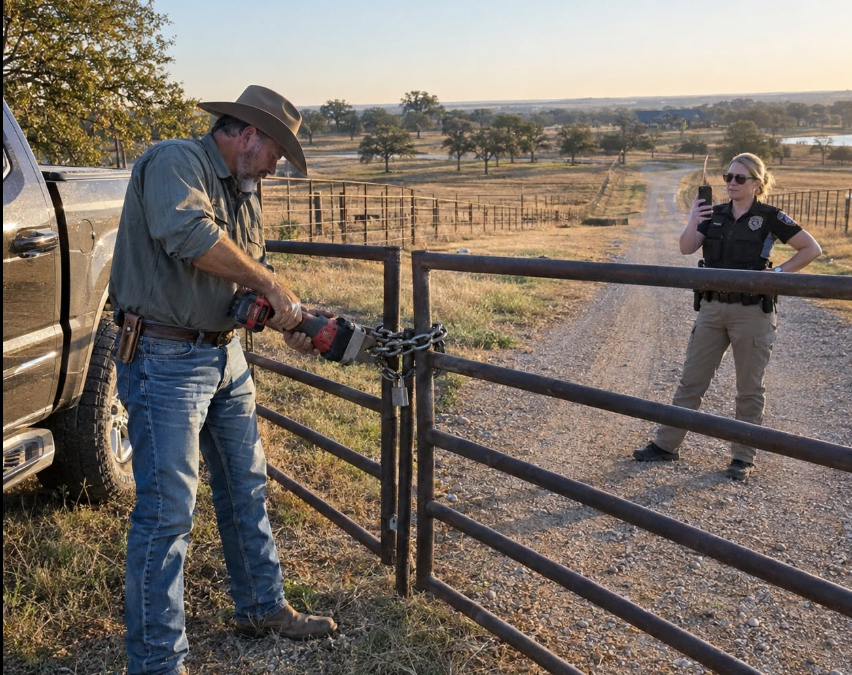
I walked toward the chain.
“Mr. Whitmore.”
I positioned the jaws against the lock.
“If you cut that, you will be committing destruction of association property and unlawful entry.”
I looked straight at her phone camera.
Then squeezed the trigger.
The cutter motor whined.
Metal resisted.
Then snapped.
The lock fell into the dirt.
For one second, nobody moved.
I shut the cutter off.
Set it down.
Unwrapped my chain.
Opened my gate.
Slowly.
No yelling.
No gesture.
Nothing dramatic.
Just my gate swinging across my road.
Marissa lowered the phone.
Her expression almost looked pleased.
Like she believed I had just given her exactly what she wanted.
She immediately called 911.
I could hear her.
“Yes, we need law enforcement.”
Pause.
“A man just destroyed HOA property.”
I folded my arms.
She continued.
“He forced his way into a restricted access corridor.”
One of the younger patrol officers photographed my license plate.
The other photographed the broken lock.
Marissa motioned toward her SUV.
“Block the entrance.”
The driver moved the vehicle sideways across the road.
I stared.
“You really want to do that?”
Marissa covered the phone.
“You are not entering until law enforcement arrives.”
“I wasn’t planning to run you over.”
She smirked.
“Good.”
I put the cutter back in the truck bed.
Closed the tailgate.
Then waited.
The morning sun rose higher.
Dust moved in the light.
Somewhere behind us, cattle called from the pasture.
Marissa paced near the gate.
I leaned against my truck.
Twenty minutes later, a sheriff’s vehicle came up the road.
Then a second.
Sheriff Nolan Mercer stepped out of the first.
I had known Nolan casually for years.
Not a friend exactly.
But in a county like ours, ranchers and sheriffs eventually cross paths.
Livestock on roads.
Storm damage.
Wildfires.
Trespassers.
He looked from me to Marissa.
Then the gate.
Then the HOA Patrol SUVs.
Marissa moved before he had fully shut his door.
“Sheriff, thank God.”
Nolan stopped.
She continued.
“This man attacked an association checkpoint.”
I raised my eyebrows.
Nolan glanced at me.
I did not say anything.
Marissa pointed toward the broken lock.
“He destroyed HOA property, forced entry, and refuses to acknowledge our legal control of this road.”
Nolan looked at the gate.
Then at Marissa.
“Whose gate is it?”
She paused.
“The HOA controls it.”
“Didn’t ask who controls it.”
He pointed.
“Who owns it?”
Marissa’s expression tightened.
“The road serves Silvercrest.”
Nolan looked at me.
“Caleb?”
“Mine.”
“The gate?”
“Mine.”
“The land?”
“Mine.”
“The road?”
“Mine.”
“Proof?”
“Behind my seat.”
I retrieved the folder I kept in the truck.
Deed.
Parcel map.
Old survey copy.
Nolan looked through it.
Marissa shifted impatiently.
“This is about access rights, not simple title ownership.”
Nolan turned.
“Okay.”
She handed him Resolution 24B.
He read it.
Ten seconds.
Maybe fifteen.
Then handed it back.
“This is an internal HOA resolution.”
“It carries legal force.”
“For association property.”
“It creates access authority.”
Nolan shook his head.
“Not by itself.”
Marissa’s face reddened slightly.
“The board adopted it.”
Nolan asked, “Is Mr. Whitmore a member of Silvercrest HOA?”
Silence.
He repeated, “Is he?”
“No.”
There it was.
High Mesa Ranch had never been annexed.
Never joined.
Never signed.
Never agreed.
Silvercrest had been built decades later.
Nolan gestured toward the resolution.
“Then your board cannot pass a resolution and magically bind his ranch.”
Marissa shifted again.
“There’s a prescriptive easement.”
I almost laughed.
That argument had apparently been waiting in reserve.
Nolan looked at me.
“You know anything about that?”
“Silvercrest started using this road around eight months ago.”
Marissa interrupted.
“Residents have used it for years.”
“No.”
I looked directly at her.
“Eight months.”
“That’s not accurate.”
“I sent objections the first week.”
Nolan looked at me.
“In writing?”
“Certified.”
“Copies?”
“Yes.”
Marissa folded her arms.
“Prescriptive rights don’t require permission.”
I said, “They require more than eight months.”
Nolan nodded.
“He’s right.”
She looked at him.
“This is a civil matter.”
“Then why did you call me asking for cuffs?”
Silence.
The younger patrol officers looked uncomfortable.
Nolan continued.
“I’m not arresting a landowner for opening his own gate when you can’t show me a valid easement.”
Marissa’s jaw tightened.
I could see the humiliation building.
Not because Nolan insulted her.
He did not.
Because her entire plan had depended on authority.
Camera.
Uniform.
Lock.
Sheriff.
And the sheriff had looked at the paperwork instead of the costume.
She stepped toward her SUV.
Before getting in, she looked at me.
“A new lock will be here tomorrow.”
I looked toward her camera.
“Bring as many as you want.”
Her eyes narrowed.
She got in.
The HOA vehicles left.
Nolan waited until they were out of sight.
Then he walked over.
“Caleb.”
“Yeah?”
“There’s something you need to know.”
His tone changed.
“What?”
“For about three months, dispatch records have shown Silvercrest claiming this road falls under their jurisdiction.”
I stared.
“What does that mean?”
“It means this didn’t start this morning.”
He leaned against his cruiser.
“Somebody’s been telling county emergency systems that Silvercrest controls access.”
“Can they just do that?”
“Not legally if it’s false.”
I looked down the road.
“Why would they?”
Nolan shrugged.
“I don’t know.”
Then he said, “But HOAs usually don’t back down after a public confrontation.”
I looked at him.
“Because?”
“Because admitting they were wrong can cost leadership politically.”
He nodded toward the road where Marissa had disappeared.
“Sometimes they double down hoping you get tired first.”
That turned out to be exactly what happened.
After Nolan left, I spent the morning walking the road.
One point eight miles.
Fence.
Culverts.
Drainage ditches.
Pump access.
Pasture crossings.
Old boundary posts.
Nothing about it looked disputed.
Because until Silvercrest needed it, it had not been.
I stopped beside one of the original fence posts my grandfather set.
Weathered.
Crooked.
Still standing.
That post had been there longer than half the houses in Silvercrest.
Yet somewhere inside a boardroom, somebody had decided a document printed last week could outweigh forty years of ownership.
That afternoon, I met Meredith Pike.
Real estate attorney.
Twenty years working with ranch families, easements, land-use fights, right-of-way disputes.
She read Resolution 24B.
Then my deed.
Then my notes.
Then the sheriff report.
She asked, “Why does Silvercrest want your road?”
“They say emergency access.”
“That’s what they say.”
I looked at her.
“What are you asking?”
She opened a county planning map.
“Silvercrest is expanding.”
I knew that.
Dozens of new lots.
Expensive homes planned along the western edge.
Meredith traced the route.
Their current entrance connected to a narrow county road.
Construction traffic already had problems.
Emergency access requirements would become more difficult as occupancy grew.
Then she traced another line.
High Mesa Road.
My road.
“If they use this,” she said, “they avoid almost eleven miles of detour.”
I stared at the map.
She continued.
“No new bridge.”
“No new expensive road alignment.”
“Emergency response looks better.”
“Construction access gets easier.”
“Lots become more attractive.”
I leaned back.
“So the lock was about the expansion.”
“Possibly.”
Then she showed me something worse.
Silvercrest sales materials.
Glossy maps.
WESTERN ACCESS.
The road drawn through High Mesa Ranch.
I stared.
“Where did you get this?”
“Prospective buyer packet.”
“They’re advertising my road?”
“Yes.”
“I never approved this.”
“I know.”
She pointed at the label.
“They’re acting like access already exists.”
The more we investigated, the worse it looked.
Landscapers used the road.
Maintenance crews.
Construction trucks.
Silvercrest contractors.
They had started gradually.
At first, I assumed some drivers were simply taking wrong turns.
Then frequency increased.
I objected.
They kept coming.
Now Meredith saw the pattern.
“They may be trying to manufacture history.”
“What does that mean?”
“Make use look old.”
I frowned.
“Eight months isn’t old.”
“No.”
“But if buyers, contractors, patrol, and maintenance all treat the road like normal Silvercrest access, it becomes easier for them to tell a story later.”
“What story?”
“Everyone has always used it.”
I thought about Marissa saying the same thing.
“Everyone already drives through here.”
Meredith nodded.
“Exactly.”
I asked, “So I cut every lock they put on?”
She smiled.
“No.”
“Why not?”
“Because the goal isn’t to win a lock competition.”
“What is?”
“Evidence.”
She leaned forward.
“They’re documenting themselves.”
“How?”
“Marissa filmed you.”
“I noticed.”
“Good.”
“Let her film more.”
I stared.
Meredith continued.
“If they truly believe they have authority, they’ll say it. If they intend to establish control, they’ll say that too.”
“You want me to let them keep doing it?”
“For a while.”
“I don’t like that.”
“I don’t need you to like it.”
She smiled faintly.
“I need you to win.”
That evening, I installed a new lock.
My lock.
I mounted a weatherproof camera facing the gate.
Then another angled toward the road.
I put up a sign:
HIGH MESA RANCH
PRIVATE PROPERTY
NO HOA EASEMENT
ACCESS BY OWNER PERMISSION ONLY
Two days later, Marissa returned.
She did not bring a lock.
She brought a locksmith.
I was already there.
My camera was running.
Her patrol vehicles arrived.
Locksmith van.
Marissa stepped out.
“Mr. Whitmore.”
“Marissa.”
She looked at my sign.
Then the camera.
“I see you’re documenting.”
“Learning from you.”
She smiled.
The locksmith approached my chain.
I said, “Before you touch that, are you aware this is private property?”
He stopped.
Marissa said, “He has authorization.”
The man looked at me.
“Do you?”
“No.”
He looked back at Marissa.
She handed him paperwork.
“Association control resolution.”
He studied it.
I could see uncertainty.
Marissa spoke louder.
“Proceed.”
I called Meredith.
She answered.
“They’re here.”
“Camera?”
“Running.”
“Do not interfere.”
“I hate this.”
“I know.”
The locksmith cut my lock.
Marissa filmed.
Then she said something that changed the case.
She was not talking to me.
She was speaking into her own phone.
“Once the association controls the gate long enough, Whitmore won’t be able to take the road back.”
I looked at her.
She had no idea what she had just admitted.
Physical control.
Time.
Ownership.
Intent.
The locksmith installed a new HOA lock.
I stood fifty feet away.
Did not stop him.
Did not argue.
Did not cut it.
Not that day.
Meredith called later.
“Did you get the audio?”
“Yes.”
“Back it up.”
“Already did.”
“Good.”
That sentence would follow Marissa all the way into court.
Over the next several weeks, we stopped fighting publicly.
Everything became documentation.
When a lock changed.
Which patrol vehicle arrived.
Which contractor entered.
Which sales map still labeled my road Western Access.
Copies of every certified objection letter.
Emails.
Photos.
Video.
Repair invoices.
Then a construction truck damaged the road.
It was hauling materials for Silvercrest.
Too heavy.
The culvert beneath one section of High Mesa Road collapsed.
I arrived to find one wheel sunk and water diverted into the shoulder.
Repair estimate eventually exceeded thirty-eight thousand dollars.
I emailed Silvercrest.
Marissa responded.
Silvercrest cannot be held liable for damage occurring on a route under Silvercrest management.
I read it.
Then called Meredith.
“You need to see this.”
She read it twice.
Then laughed.
“What?”
“She admitted it.”
“Admitted what?”
“Management.”
I understood.
In trying to avoid paying for damage, Marissa had put into official correspondence that Silvercrest considered itself manager of a road it did not own.
Meredith saved it.
Of course.
Next came the survey.
Everett Sloan.
County surveyor.
More than thirty years tracing property boundaries.
He walked High Mesa Road with old plats and modern equipment.
Found monuments.
Compared deed descriptions.
Checked county records.
Final conclusion:
Gate entirely mine.
Road entirely mine.
Drainage ditches entirely mine.
No Silvercrest easement.
No public dedication.
No annexation.
No transfer.
Nothing.
Then Everett found something disturbing.
Silvercrest’s expansion paperwork contained a map.
A dotted line through my property.
Label:
EXISTING ACCESS EASEMENT.
Everett stared at it.
“Where’s the instrument?”
“What instrument?”
“The easement document.”
He tapped the map.
“Somebody can’t just draw this.”
Meredith searched.
No deed.
No recorded easement.
No agreement.
Nothing.
The line had no legal document behind it.
But somebody signed the planning submission.
HOA President Loretta Vance.
Until that moment, most of the visible conflict had been Marissa.
Loretta stayed behind the board.
Quiet.
Professional.
Controlled.
That changed when we requested a formal meeting.
Loretta entered carrying a leather folder.
No raised voice.
No theatrics.
In some ways, that made her more unsettling.
Marissa intimidated physically.
Loretta spoke like she had already decided the outcome.
She sat across from me.
“Mr. Whitmore.”
“Loretta.”
She looked at Meredith.
Then the survey.
Then me.
“The association has invested substantial resources maintaining High Mesa Road.”
“I didn’t ask you to.”
“That maintenance benefits the property.”
“Didn’t ask.”
“It creates an equitable interest.”
I almost laughed.
“You trespass, perform work I didn’t authorize, then claim the work gives you rights?”
She kept her expression flat.
“You allowed maintenance to occur.”
“No.”
“You did not physically stop our crews.”
Meredith opened a folder.
“January.”
Certified letter.
“February.”
Another.
“March.”
Another.
“April.”
Another.
Each signed for by Silvercrest.
Loretta looked down.
Meredith said, “My client objected continuously.”
Loretta remained silent.
Then she changed strategy.
“Seventy-five thousand dollars.”
I blinked.
“For what?”
“Easement.”
“No.”
“One hundred fifty thousand.”
“No.”
She looked directly at me.
“Two hundred fifty thousand.”
“No.”
Her composure cracked.
“You’re refusing a quarter million dollars?”
“Yes.”
“Why?”
“Because the road runs through the middle of my ranch operations.”
“We can manage traffic.”
“I don’t want traffic.”
“This access is too important for one person to control.”
There it was.
I looked at her.
“Then you should’ve thought about that before building a development that depends on somebody else’s land.”
Loretta struck the table.
Not hard.
But enough.
“We will continue using the road until a court tells us otherwise.”
I stood.
“Understood.”
Meredith stood too.
We left.
What Loretta did not know was that Meredith had already drafted the request.
Temporary restraining order.
Filed that afternoon.
Signed before the next morning.
The language was clear.
Silvercrest must stop using High Mesa Road.
No lock changes.
No patrol vehicles.
No contractors.
No gate control.
No interference.
I rebuilt my gate.
New chain.
New lock.
Laminated court order in a waterproof case beside it.
Camera running.
For three days, nothing.
I almost relaxed.
Fourth morning.
HOA Patrol.
Three vehicles.
Marissa stepped out.
She walked to the gate.
Read the court order.
Out loud.
Her officers heard it.
Camera recorded.
Then she said, “This applies to the HOA board.”
One young officer said, “Supervisor, doesn’t it say employees and agents?”
Marissa ignored him.
“Patrol is performing separate security duties.”
I watched from a distance.
Meredith had told me not to approach.
Sheriff Nolan had already been notified.
Marissa pulled out bolt cutters.
One officer looked visibly uncomfortable.
“Ma’am.”
“Stand back.”
She cut my lock.
Opened the gate.
Drove in.
Two patrol SUVs followed.
Half a mile down High Mesa Road, Sheriff Nolan Mercer was waiting.
Two cruisers.
Engines running.
Marissa stopped.
Nolan stepped out.
He held the court order.
“Did you read this?”
Marissa opened her door.
“You don’t understand the scope.”
“I understand a judge’s signature.”
“This is civil.”
“Not anymore.”
Her face tightened.
“I’m acting under independent security authority.”
“Show me.”
She had nothing.
Nolan pointed back toward the gate.
“Turn around.”
“You cannot remove us from an HOA access corridor.”
Nolan said, “You are on private ranch property in direct violation of a court order.”
The younger officers did not wait for Marissa.
They started turning their vehicles.
Marissa stood beside hers.
Angry.
Humiliated.
Still convinced Loretta would protect her.
Nolan collected the severed lock as evidence.
Report documented the vehicles.
Times.
Order.
Violation.
Marissa left.
Loretta stopped taking her calls.
That was the beginning of Silvercrest turning on itself.
Discovery opened everything.
Emails.
Internal messages.
Board documents.
Planning materials.
One email from Loretta:
If Whitmore tolerates our lock long enough, our negotiating position becomes considerably stronger.
Another from Marissa:
Patrol can establish physical control immediately.
Another board member warned:
We have no recorded easement.
Loretta replied:
We need to create a reality on the ground first before anyone asks too many questions about paperwork.
That sentence destroyed the “misunderstanding” defense.
There was no misunderstanding.
They knew.
No easement.
No permission.
No ownership.
Create reality first.
Paperwork later.
Meredith read the emails at her desk.
Then looked at me.
“They planned occupation.”
“That’s what it sounds like.”
“No.”
She tapped the page.
“That’s what they wrote.”
Meeting timestamps revealed something else.
Every escalation occurred shortly after Silvercrest board meetings about the western expansion.
First lock.
Locksmith.
Court order violation.
All within roughly forty-eight hours of expansion discussions.
Not random.
Coordinated.
Then we found the assessments.
Silvercrest homeowners had been charged a road infrastructure assessment.
Money earmarked for maintenance of the “Western Access Route.”
My road.
They were collecting money from their own homeowners to maintain property they did not own.
Residents exploded.
Special meeting.
Packed.
Loretta tried to blame Marissa.
“Patrol exceeded its authority.”
Marissa stood.
“That’s not true.”
Loretta glared.
Marissa held up printed emails.
“You told me to establish control.”
The room erupted.
Loretta said, “Those messages are being taken out of context.”
Marissa laughed.
“Which context makes ‘create a reality on the ground’ better?”
For the first time, they were fighting each other.
Then insurance counsel warned the board.
Intentional acts might not be covered.
Personal exposure possible.
That changed everything.
Board members who had been silent suddenly wanted objections entered into minutes.
Two resigned.
Publicly, personal reasons.
Privately, everybody knew why.
Nobody wanted their house tied to Loretta’s land grab.
Marissa lost access to leadership meetings.
Loretta became isolated.
The formal hearing came months after the first lock.
I sat beside Meredith.
Across the room, Loretta looked composed.
Marissa less so.
Silvercrest’s attorney argued public safety.
Community benefit.
Emergency access.
Development need.
Meredith stood.
“Convenience is not ownership.”
Simple.
Then Everett Sloan testified.
Deed.
Historical plats.
Survey monuments.
County records.
No easement.
Nothing.
Then video.
First clip.
Marissa filming me.
Warning me about arrest.
Me cutting the lock.
Her saying Silvercrest controlled the road.
Second clip.
Locksmith.
Marissa’s voice:
“Once the association controls the gate long enough, Whitmore won’t be able to take the road back.”
Third.
Restraining order.
Marissa reading it.
Then cutting my lock anyway.
The judge watched without expression.
Then emails.
Loretta’s negotiating position.
Marissa’s physical control.
Create reality on the ground.
By the third email, Silvercrest’s attorney asked for a recess.
When we returned, his questions were shorter.
Marissa testified.
Meredith asked, “You read the restraining order?”
“Yes.”
“You understood Silvercrest had been ordered to stop using High Mesa Road?”
“I believed patrol duties were separate.”
“Who told you that?”
“I interpreted it.”
“Did an attorney tell you?”
“No.”
“Did the HOA’s counsel tell you?”
“No.”
“Did a judge?”
“No.”
“Did Sheriff Mercer?”
“No.”
“What did Sheriff Mercer tell you?”
Marissa looked down.
“To leave.”
“And before entering the ranch, did one of your own officers question whether the order applied to patrol?”
Pause.
“Yes.”
“And you entered anyway?”
“Yes.”
That admission landed harder than any speech Meredith could have made.
The judge issued the preliminary ruling.
High Mesa Road belonged entirely to me.
Silvercrest had no right to control the gate.
No right to distribute keys.
No right to send patrol vehicles.
No right to advertise the road.
No right to call it Western Access.
Every map had to be corrected before additional western lots could legally be sold.
Then damages.
Meredith brought the binder.
Thick.
Invoices.
Estimates.
Expert reports.
Daily ranch logs.
Culvert.
Thirty-eight thousand plus.
Gate hardware.
Locks.
Road surface damage.
Survey costs.
Operational losses.
Restoration.
Attorney fees allowed by the court.
Then the largest issue.
Marketing benefit.
An appraiser analyzed western lots sold or marketed with a second access route.
Silvercrest had increased their value by advertising a convenience it had no legal right to provide.
The judge asked Meredith to explain every category.
Line by line.
She did.
No theatrical number.
No revenge figure.
Evidence.
Final judgment:
Approximately four hundred eighty-six thousand dollars.
I did not smile.
Loretta did not move.
Marissa looked stunned.
The morning she filmed me cutting one lock, she probably thought she was documenting a fifty-dollar vandalism claim.
That footage had become part of a case costing the association nearly half a million dollars.
But money was not the most important part.
Silvercrest had to remove every HOA sign.
Delete High Mesa Road from maps.
Correct sales materials.
Notify contractors.
Refund disputed road assessment money under court supervision.
Pay recognized repair costs.
No lock.
No camera.
No checkpoint.
Ever.
Loretta was removed as HOA president within weeks.
Audit opened.
Marissa lost supervisory authority.
Patrol contract restructured.
Residents demanded accountability.
Then Meredith asked me, “Anything else?”
“Permanent injunction.”
She smiled.
“Already drafted.”
We requested language requiring written permission from High Mesa Ranch before any Silvercrest employee, contractor, or patrol officer crossed the gate unless an independent government authority legally authorized entry.
Granted.
The same gate Marissa once claimed to control was now protected by a signed court order.
Weeks later, I was repairing fence near the entrance.
An HOA vehicle slowed.
Stopped.
Different supervisor.
She got out.
Stayed outside the boundary.
“Mr. Whitmore?”
“Yeah?”
“One of our contractors made a wrong turn.”
She pointed down the road.
“Would you mind if he pulls just inside the gate to turn around?”
I looked at the lock.
My lock.
My key.
Then her.
“Sure.”
I opened it.
The contractor pulled in.
Turned.
Left.
I closed the gate.
Locked it.
No threats.
No resolution.
No camera in my face.
They asked.
I answered.
That is what should have happened from the beginning.
I kept Marissa’s original black lock.
Not as a trophy.
As a reminder.
Confidence does not create ownership.
A uniform does not create ownership.
A logo does not create ownership.
A board vote does not create ownership over somebody else’s land.
Neither does repetition.
Neither does convenience.
Neither does money.
Silvercrest had believed if it acted like High Mesa Road belonged to the association long enough, legal rights would somehow grow around the behavior.
They were wrong.
Meredith later took two similar cases.
Other ranch families found “existing access easement” language on planning maps.
No real recorded documents behind it.
Both associations settled quickly after she cited what happened in my case.
One day, Meredith asked, “You’re keeping that old gate?”
“Yep.”
“It’s scarred.”
“I know.”
“New one would look better.”
“I don’t care.”
She touched one of the cutter marks.
“Why keep it?”
“Because people ask what happened.”
“And?”
“The story matters.”
That gate tells the story better than I ever could.
My cutter mark.
Marissa’s cutter mark.
Scratches from locksmith work.
Damage from chains.
Every scar represents somebody trying to control something that did not belong to them.
I still close it the same way.
Chain.
Lock.
Key.
Only now nobody from Silvercrest touches it.
Patrol stops at the line.
Contractors call first.
New leadership checks deeds before claiming easements.
High Mesa Road disappeared from their promotional materials.
The western expansion had to live with reality.
My ranch remained what it had always been.
Private property.
Months after everything ended, I drove home before sunrise again.
Same road.
Same tired feeling.
Same ridge.
The gate appeared ahead.
This time nothing looked wrong.
No SUV.
No patrol.
No camera.
No sign.
No strange lock.
I stopped anyway.
Got out.
Walked to the gate.
Ran my hand across the damaged metal.
I remembered Marissa’s first warning.
“If you cut that lock, I’m calling the police.”
She had sounded so certain.
Certain the camera was protecting her.
Certain the lock proved control.
Certain the sheriff would arrest me.
Certain Silvercrest could pass a resolution and convert confidence into title.
That was the real mistake.
Not the lock.
The certainty.
The belief that if she spoke like authority, I would treat her like authority.
I opened the gate.
Drove through.
Closed it behind me.
My lock clicked.
The key turned.
Then I went back to work.
Because in the end, that was what I had been trying to protect all along.
Not pride.
Not victory.
Not the satisfaction of beating an HOA in court.
My ability to run my own land without asking permission from people who had never owned one inch of it.
Silvercrest had needed my road.
That was understandable.
They could have asked.
They could have negotiated.
They could have offered money.
They did eventually.
But by then the problem was no longer price.
Because before offering two hundred fifty thousand dollars, they had already tried to create control.
Before asking the court for legitimacy, they had already acted as though legitimacy existed.
Before requesting access, they had advertised it to buyers.
That sequence mattered.
A lot.
Maybe if Loretta had come to me before the expansion maps were printed and said, “Caleb, we need a second route. What would it take?” maybe there would have been a conversation.
Probably still no.
The road ran through active grazing land and past equipment I depended on.
But at least the conversation would have been honest.
Instead, Silvercrest chose pressure.
Then occupation.
Then paperwork designed to make occupation look normal.
Then a lock.
That first lock was not really about security.
It was a statement.
This is ours now.
That is why cutting it mattered.
Not because I enjoyed breaking something.
Because if I accepted it silently, Silvercrest would have had one more day of footage showing association control.
One more day of contractors treating my road as theirs.
One more day of residents seeing an HOA lock hanging on a ranch gate and assuming there had to be a legal reason.
There was not.
The sheriff understood that in minutes.
The court understood it eventually.
The strange part is that Silvercrest’s own evidence became stronger than mine.
Marissa filmed the first incident because she thought I would incriminate myself.
Instead, she recorded herself claiming authority she could not prove.
She brought the locksmith.
She spoke openly about keeping control long enough that I could not get the road back.
She emailed that the road was under Silvercrest management.
She cut my lock after reading a judge’s order.
Loretta wrote about strengthening negotiating position.
She wrote about creating a reality before anybody asked about paperwork.
None of them had been forced to write those things.
They believed them.
That confidence made documentation easy.
In court, Meredith barely needed adjectives.
No words like theft.
Takeover.
Land grab.
She just played their videos and read their emails.
That was enough.
One day, months later, Nolan stopped by the ranch.
He was driving past.
I was near the gate.
He pulled over.
“Still got the same gate?”
“Yep.”
“Ugly thing.”
“Thanks.”
He grinned.
“Remember that morning?”
“Unfortunately.”
“Marissa wanted you in cuffs.”
“I remember.”
Nolan leaned against his cruiser.
“You handled it better than most.”
“I cut their lock.”
“On your property.”
“Still felt good.”
He laughed.
“That’s the part you’re supposed to keep to yourself.”
“Too late.”
He looked toward the road.
“Silvercrest finally fixed dispatch records.”
“Good.”
“High Mesa listed private now.”
“It always was.”
“I know.”
That sentence felt better than I expected.
It always was.
The lawsuit did not create my ownership.
The court did not give me the road.
The sheriff did not give me the road.
They confirmed what already existed.
That is an important difference.
Property rights are not prizes judges hand out because you behaved better.
My family already owned High Mesa Road.
Silvercrest simply forced me to prove it.
That proof cost everybody time.
Money.
Trust.
And nearly half a million dollars on Silvercrest’s side.
Homeowners who had nothing to do with the original scheme were angry.
I understood that.
They paid assessments.
They expected leadership to protect community finances.
Instead, leadership spent resources trying to control land outside the association.
That is why the refund order mattered.
Silvercrest had collected a “road infrastructure assessment” tied to a route it never owned.
Residents deserved that corrected.
The internal audit uncovered enough questionable decision-making that later boards became dramatically more cautious.
Every land claim required title review.
Every easement referenced a recorded instrument.
No more lines drawn on sales maps because somebody thought they could fix the paperwork later.
Good.
That is how it should be.
Some residents blamed me at first.
One man approached outside a county meeting.
“You could’ve just sold the easement.”
I asked, “Would you sell your backyard because my ranch expansion needed it?”
“Not the same.”
“Why?”
“Your ranch isn’t a subdivision.”
“So ownership depends on project size?”
He did not answer.
Another resident apologized.
“We didn’t know.”
“I know.”
“Loretta told us the road was already HOA access.”
“I know.”
“We paid for maintenance.”
“I know.”
He looked embarrassed.
“That doesn’t make sense now.”
“It probably sounded official.”
He nodded.
That is how these things happen.
Most people are not land attorneys.
They see a map.
A labeled route.
An assessment.
Patrol vehicles driving through.
They assume somebody checked.
Nobody had.
Or worse, people had checked and chose to ignore the answer.
The word “existing” on that map did a lot of work.
Existing access easement.
It looked settled.
Historic.
Boring.
Nobody asks hard questions about boring things.
That is why Everett Sloan’s reaction mattered.
“Show me the instrument.”
Simple.
Where is the recorded document?
There was not one.
A line on a map is not an easement.
A board resolution is not an easement.
A patrol lock is not an easement.
Use is not automatically an easement.
And eight months of disputed use certainly was not the decades-old access right Marissa tried to imply.
Silvercrest wanted reality to flow backward.
Use first.
Right later.
Control first.
Permission later.
Sale first.
Paperwork later.
Courts generally dislike that kind of creativity.
Meredith once told me, “The biggest problem with bad land claims is they often look legitimate until somebody asks one boring question.”
“What question?”
“Where’s the recorded instrument?”
That became a joke between us.
Every time Silvercrest produced another theory, I would ask, “Recorded instrument?”
She would smile.
“Nope.”
I kept the survey rolled inside my ranch office.
Original deed in a fireproof safe.
Certified copies in another location.
Camera footage backed up.
Maybe excessive.
I do not care.
Once someone has tried to tell you their HOA resolution outranks your deed, your tolerance for over-documenting improves dramatically.
High Mesa stayed quiet after the injunction.
Construction vehicles took the long route.
Eleven extra miles.
Silvercrest eventually adjusted.
The world did not end.
Emergency services still functioned.
The expansion changed.
Some costs rose.
Some plans changed.
That is what should have happened from the beginning.
You design around the rights you have.
Not the rights you wish somebody else would surrender.
One morning I found a handwritten note taped near the gate.
For a second, my stomach tightened.
Old instinct.
I removed it.
It was from a Silvercrest contractor.
SORRY ABOUT YESTERDAY. GPS TRIED TO SEND US DOWN HIGH MESA. WE TURNED AROUND AT THE SIGN.
I laughed.
Progress.
The new signs were simple.
HIGH MESA RANCH
PRIVATE PROPERTY
NO HOA ACCESS
No threats.
No giant legal language.
Did not need it anymore.
The permanent injunction did the heavy lifting.
Years later, the original black HOA lock still sits in a drawer.
Sometimes I take it out.
Heavy.
Industrial.
Overkill for a ranch gate.
Marissa wanted it to look permanent.
That is obvious.
She did not bring a cheap padlock.
She brought something meant to make a statement.
I sometimes wonder what she felt when the court ruling came down.
Whether she remembered filming me.
Whether she realized how confident she had been.
Whether she understood the irony.
The video she thought would prove I committed a crime became one of the clearest pieces of evidence proving Silvercrest’s initial claim of control.
Her own camera.
Her own voice.
Her own lock.
I never needed to tell the story better than she recorded it.
That is probably the biggest lesson.
When someone overreaches, do not always interrupt them.
Sometimes people will explain exactly what they are doing if you let them speak.
Marissa did.
Loretta did.
Email after email.
Video after video.
They built Meredith’s case for her.
All we did was preserve it.
If I had gotten into a shouting match the first morning, the story might have become muddier.
If I had rammed the SUV, worse.
If I had threatened Marissa, she would have had something real to use.
Instead, I cut one lock.
Then waited.
The slow part was harder.
Watching locksmiths change my lock.
Watching contractors use the road.
Documenting culvert damage.
Paying Meredith.
Waiting for hearings.
Watching Silvercrest market western lots while the fight continued.
Every instinct wanted immediate correction.
But Meredith kept telling me, “Patience is evidence.”
I hated that sentence.
She was right.
Intent matters.
Pattern matters.
Timing matters.
One isolated lock could be explained away.
Bad supervisor.
Miscommunication.
Overzealous patrol.
But multiple locks.
Locksmith.
Sales maps.
Dispatch changes.
Board emails.
Assessments.
Court order violation.
That became a system.
And systems are harder to call mistakes.
The four-hundred-eighty-six-thousand-dollar judgment was not one giant punishment number.
That is important.
Meredith documented categories.
Culvert.
Road damage.
Survey.
Hardware.
Operational time.
Legal expenses allowed.
Marketing benefit.
Every number connected to something.
That is why it survived scrutiny.
The judge asked questions.
Meredith answered.
Silvercrest argued.
Evidence won.
People hear nearly half a million dollars and imagine a dramatic punitive award.
It was not that simple.
Much of it reflected actual costs and financial consequences created by Silvercrest’s own decisions.
The most satisfying order, for me, had no dollar sign.
Never place a lock, camera, or checkpoint on my property again.
That sentence mattered more than the judgment.
Money repairs damage.
Injunctions prevent repetition.
I wanted both.
Meredith understood that.
After the case, she told me, “You know, most clients would’ve taken two hundred fifty thousand.”
“Maybe.”
“You never hesitated.”
“No.”
“Why?”
I looked down High Mesa Road.
“Because I would’ve had to live with the traffic.”
“That’s the practical answer.”
“What’s the other one?”
She smiled.
“You tell me.”
I thought about Loretta hitting the table.
Too important to be controlled by one man’s decision.
That sentence still bothered me.
Not because she was completely wrong about importance.
The road was important.
Maybe extremely important.
But importance does not erase ownership.
If something is important enough, you negotiate earlier.
Design differently.
Use eminent authority where lawful government procedures genuinely apply.
Build another route.
Pay actual market value if somebody wants to sell.
You do not simply decide your need is morally superior to the owner’s refusal.
So I told Meredith, “I didn’t like being told that my answer didn’t count.”
She nodded.
“That’s the real answer.”
Probably.
The case changed how Silvercrest operated.
Not because they suddenly loved ranchers.
Because consequences teach institutional habits.
New leadership became cautious.
Patrol reduced.
Contractors received clear maps.
Residents demanded financial transparency.
The phrase “western access” disappeared.
Good.
High Mesa Ranch returned to being boring.
Also good.
Most days I do not think about Marissa.
Or Loretta.
Or court.
There is too much actual work.
Fence.
Water.
Cattle.
Road grading.
Equipment.
Weather.
But every time I close that gate, I notice the scars.
I leave them.
Meredith once offered to get me a quote for replacement.
I refused.
The gate works.
The scars do not weaken it.
They tell the truth.
One long mark from my cutter.
Another from Marissa’s.
Smaller scratches from the locksmith.
Each one a chapter.
Someday somebody else may own this ranch.
Maybe family.
Maybe not.
Whoever it is, I hope they ask why the gate looks like that.
And I hope somebody tells them.
Not because I need to be remembered.
Because land disputes rarely begin with somebody saying, “I’m taking your property.”
They begin with softer language.
Emergency access.
Community need.
Shared use.
Maintenance.
Existing route.
Temporary control.
Safety.
Convenience.
The words sound reasonable.
Sometimes they are.
But the question underneath remains simple.
Who owns it?
Who granted permission?
Where’s the recorded instrument?
That question saved High Mesa Road.
Marissa believed the uniform mattered.
Loretta believed the board mattered.
Silvercrest believed the expansion mattered.
The court cared about title.
Survey.
Documents.
Conduct.
That is the difference between perceived authority and actual authority.
One can lock a gate.
The other decides whether the lock belongs there.
The final time I saw Marissa was months after she lost her supervisory position.
I was in town.
Hardware store parking lot.
She recognized me.
I recognized her.
For a second, I thought she would walk away.
Instead, she approached.
“Caleb.”
“Marissa.”
She looked different without the patrol uniform.
Less imposing.
More ordinary.
“I heard you kept the gate.”
“I did.”
She nodded.
“Figures.”
I waited.
She said, “I thought Loretta had legal backing.”
“At first?”
Marissa looked away.
“At first.”
“And later?”
Silence.
She knew.
That was enough.
Finally she said, “I shouldn’t have cut the lock after the order.”
“No.”
“I thought the association would protect me.”
“I know.”
“Didn’t.”
“No.”
She gave a small, bitter laugh.
“No.”
I was not interested in humiliating her.
What would that accomplish?
She had already lost the job.
Already testified.
Already watched emails come out.
I said, “You had chances.”
“I know.”
“Several.”
“I know.”
Then she looked at me.
“I really thought you cutting that first lock was the stupidest thing I’d ever seen.”
I almost smiled.
“How’d that work out?”
She laughed once.
“Not great.”
That was our entire conversation.
She walked away.
I loaded fence staples into my truck.
Life continued.
Years later, what stays with me is not the judgment.
Not really.
The number was useful.
Necessary.
But numbers fade.
What stays is that first morning.
Marissa’s phone.
The black lock.
The sign.
Her calm voice.
“The association has taken over control.”
The absolute confidence.
She believed she was filming my defeat.
That is the part I remember.
Because the entire conflict existed inside that one scene.
An organization trying to create ownership by acting like ownership already existed.
A landowner being told his deed mattered less than a board resolution.
A camera recording everything.
A lock hanging where it never belonged.
Then the cutter.
Short burst.
Metal breaking.
Lock in the dirt.
Gate open.
Nothing about ownership changed when I cut it.
That is the irony.
Silvercrest claimed I was taking control.
I was not.
I already had control legally.
I was simply removing something placed there without permission.
The months afterward proved it.
Sheriff.
Surveyor.
Attorney.
Court.
Judge.
Permanent injunction.
Every layer pointed back to the same fact.
High Mesa Road had always been part of High Mesa Ranch.
The HOA never had it.
They only acted like they did.
And in the end, acting confident was not enough.
The last contractor who accidentally approached the road stopped at the gate.
Called the number on the sign.
Asked permission.
I answered.
He said, “GPS says this connects to Silvercrest.”
“It doesn’t.”
“Understood.”
No argument.
He turned around.
That thirty-second phone call represented more progress than months of HOA meetings.
Ask.
Respect the answer.
Move on.
Simple.
Silvercrest learned that lesson the expensive way.
Approximately four hundred eighty-six thousand dollars expensive.
Two leadership careers expensive.
A board restructuring expensive.
A court injunction expensive.
All because someone decided that instead of negotiating for access, it would be easier to place a lock on another man’s gate and dare him to object.
I objected.
Quietly at first.
Then legally.
And once their own paperwork began speaking, I barely needed to say anything at all.
That black lock is still in my drawer.
The gate is still scarred.
The road is still mine.
And nobody from Silvercrest has ever put another lock on it again.