HOA Karen Turned My Dead Wife’s Fence Into a Clothesline—So I Rebuilt One Section With Legal Razor Wire
PART2:
She straightened the lapels of her pink bathrobe, though it was already tied tight enough to cut off circulation.
Brenda was in her late fifties, blond hair sprayed into place even at seven in the morning, makeup applied with the discipline of a news anchor, and posture so straight it made other people feel accused of slouching. She had been president of the Piney Hollow Estates HOA for five years, though our house was not technically inside Piney Hollow.
That detail mattered.
It mattered legally.
It mattered morally.
It mattered to everyone except Brenda.
My property sat on the original county road, built in the 1970s before Piney Hollow was carved out of timberland behind us. When developers built the subdivision, they wrapped their streets around two sides of my back property but never included us in the association. My wife and I bought the house because it was close enough to town for work, close enough to the school for Lily, and outside the HOA.
Elaine had said, “I’m not letting strangers vote on our mailbox.”
I had loved her extra that day.
But Piney Hollow residents still acted like our yard was part of their view, our fence was part of their aesthetic, and our choices were community concerns.
Brenda believed this most deeply.
She had mailed me courtesy notices about grass height, though I was not subject to their rules.
She had complained about my truck being visible from a subdivision walking trail, though the truck was in my driveway.
She had asked me to paint my shed “a more harmonious neutral.”
I sent back a picture of the shed with a caption: It’s brown.
She stopped sending written notes for a while after that.
But she never stopped looking over the fence.
Now she folded her arms and gave me the tone she used at HOA meetings.
“Cole, that fence borders community green space.”
“No, it borders my yard and a drainage strip.”
“It visually serves both properties.”
“It physically belongs to me.”
“You built it facing outward.”
“I built it with the good side out because my wife believed in being decent to neighbors.”
“Well, then Elaine would probably appreciate neighbors using it in a friendly way.”
The world went quiet.
Not silent.
Quiet.
The way it does when one sentence steps somewhere it has no right to step.
I put my travel mug down on the porch rail.
“Do not use my wife’s name to justify trespassing.”
Brenda’s face changed for a fraction of a second.
Then she did what people like her do when they realize they have gone too far but are too proud to back up.
She attacked harder.
“I am not trespassing. I am standing on HOA common land.”
“You’re leaning over my fence and hanging wet bedding on my property.”
“It’s a fence, Cole.”
“It’s mine.”
“It’s wood.”
“It’s mine.”
Her eyes narrowed.
“You know, this is exactly the kind of hostility people talk about.”
“Who talks about?”
“The neighborhood.”
“I’m not in your neighborhood.”
“You live adjacent to it. That means your behavior affects us.”
“My fence isn’t your clothesline.”
She sighed like I was a difficult student.
“Fine. I’ll take them down today. But you really should think about how community works.”
I walked toward the fence.
“No. You’ll take them down now.”
Her mouth opened.
I stopped two feet from the comforter.
“Now, Brenda.”
For the first time that morning, she looked uncertain.
Then angry.
She yanked the clothespins off with theatrical force, snapping one in half. The comforter dragged across the top rail as she pulled it down, leaving a dark wet streak along the cedar. When she reached the bath mat near the corner post, I moved faster than I meant to.
“Careful.”
She froze.
I pointed.
“Those initials.”
She glanced down.
E.A.P.
The letters were still visible beneath the stain, small and crooked near the corner.
For one second, I thought even Brenda Chiswick might understand.
Instead, she said, “You can barely see them.”
The next thing I knew, my hand was on the fence rail hard enough that my knuckles hurt.
“You need to leave.”
She gathered the wet bedding in her arms, face red now.
“This isn’t over.”
“It is on my fence.”
She walked away through the narrow drainage strip toward the Piney Hollow walking path, wet sheets dragging behind her like surrender flags.
But I knew better.
With people like Brenda, humiliation never ends a conflict.
It fertilizes it.
That evening, Lily noticed the wet streak.
She was twelve then. Tall for her age, all elbows and guarded expressions, old enough to understand too much and young enough to still sleep with one of Elaine’s scarves under her pillow on hard nights. She stood by the fence after dinner, fingers touching the top rail where the comforter had rubbed away a little stain.
“What happened?”
“Neighbor hung something over it.”
“What neighbor?”
“Brenda Chiswick.”
Lily’s face hardened.
“She’s the one who said our Christmas lights were ‘emotionally excessive.’”
“That was her.”
“We had one strand.”
“It blinked.”
“It was Christmas.”
“She wrote a paragraph.”
Lily looked at the initials.
“Did she mess up Mom’s letters?”
“No.”
“But she was near them.”
“Yes.”
Lily’s shoulders went tight.
I wanted to tell her it didn’t matter. That it was just wood. That grief did not live in letters scratched into cedar. That nobody could touch her mother by touching a fence.
But parents lie to children too easily when they are trying to protect them.
So I told the truth.
“I stopped her.”
Lily nodded.
Then she said, “Don’t let her do it again.”
I wish I could say I did.
I wish I could say one clear boundary was enough.
It wasn’t.
The second time, it was beach towels.
Six of them.
All bright striped, hanging across the middle section like a county fair banner.
This time I found them after work.
I came home from East Texas Iron Works tired, covered in grinding dust, shoulders aching from lifting a warped trailer hitch into position. I wanted a shower, dinner, and maybe twenty minutes of silence before helping Lily with a science project involving baking soda, vinegar, and what she called “controlled educational foam.”
Instead, I found my fence dressed in someone else’s towels.
I pulled them down myself.
Not roughly.
Not dramatically.
I folded them, walked around to the Piney Hollow trail, and placed them on the bench near the dog waste station.
Then I took pictures.
The third time, there were rugs.
Small bathroom rugs.
Heavy enough to bend the top rail slightly.
I took pictures.
Removed them.
Emailed Brenda.
Brenda,
Do not hang laundry, bedding, rugs, or any other personal items from my fence. The fence is entirely on my property. You do not have permission to use it. Further use will be treated as trespass and property damage.
Cole Pruitt
She replied twenty-three minutes later.
Cole,
The fence borders a shared visual corridor used by Piney Hollow residents. Temporary placement of household linens for drying does not constitute damage. Your aggressive position is disappointing and contrary to neighborly values.
Brenda Chiswick
President, Piney Hollow Estates HOA
I read that email three times.
Temporary placement of household linens.
It was amazing how people could dress disrespect in language so clean it sounded freshly laundered.
I forwarded the email to my attorney.
Her name was Marisol Vega.
She had helped Elaine and me with our wills after the diagnosis. Calm woman. Sharp eyes. No patience for nonsense disguised as procedure.
She called me the next morning.
“Cole, is the fence on your survey?”
“Yes.”
“How far inside?”
“Two feet.”
“Good. Send me the survey, photos, and her email.”
“You think it’s worth a letter?”
“I think people who say ‘shared visual corridor’ need letters.”
Marisol sent Brenda and the HOA management company a formal notice.
The fence was private property.
Our lot was not subject to Piney Hollow covenants.
No easement existed.
No HOA use rights existed.
Any continued use would be considered trespass, nuisance, and damage.
For nine days, nothing happened.
Then Brenda escalated from laundry to policy.
A Piney Hollow newsletter went out titled:
COMMUNITY COURTESY AND SHARED BOUNDARY FEATURES
I knew before opening it.
Dear Residents,
Recent questions have arisen regarding the appropriate use of boundary-adjacent structures in shared community corridors. Piney Hollow Estates encourages respectful, temporary, non-damaging use of fence lines and rails where such use supports household needs and does not obstruct pathways. Please remain considerate and avoid confrontation with adjacent property owners.
The board is reviewing long-term solutions to ensure fair access to community-facing amenities.
Community-facing amenities.
My dead wife’s fence had become an amenity.
I stood in my kitchen reading the newsletter while Lily poured cereal.
“What?” she asked.
“Nothing.”
She narrowed her eyes.
“You have your angry forehead.”
“I do not have an angry forehead.”
“You absolutely do.”
I handed her the phone.
She read fast.
Her face went blank in a way that hurt more than tears.
“They mean Mom’s fence.”
“Yes.”
“Can they do that?”
“No.”
“But they’re saying people can use it.”
“They can say the moon belongs to the HOA. Doesn’t make it true.”
She pushed the cereal bowl away.
“I hate her.”
I wanted to say don’t hate.
Instead, I said, “I know.”
Because sometimes children deserve one honest emotion before adults start sanding it down into acceptable shapes.
The following Saturday morning, Piney Hollow turned my fence into a clothesline.
Not Brenda alone this time.
A group.
I counted twelve items when I first stepped outside.
Sheets.
Towels.
Two quilts.
A pair of jeans.
Someone’s dog bed cover.
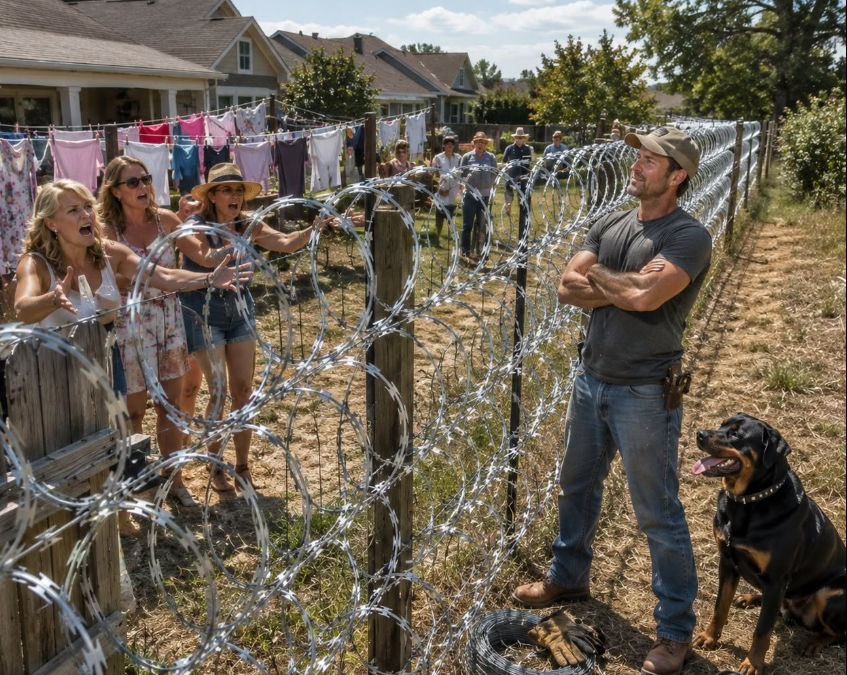
They hung across nearly the entire back run of cedar, clipped, draped, tied, and weighted. Three residents stood on the walking trail chatting like this was a community event. Brenda stood among them in white capris and a straw hat, holding a travel cup and looking triumphant.
It was 8:15.
I had been awake since six, working on a steel gate frame in my garage. Sparks still clung to the smell of my shirt. Lily was inside making pancakes from a box because Saturday pancakes had been Elaine’s thing and we were still trying to keep some version of it alive.
I walked to the fence.
“Take it down.”
The chatting stopped.
Brenda turned.
“Good morning, Cole.”
“Take it down.”
She smiled at the others.
“This is exactly the confrontational behavior I mentioned.”
A man I recognized as Ted Wallace from the HOA board crossed his arms.
“We’re not damaging anything.”
“You are trespassing.”
“We’re on HOA land.”
“My fence is not.”
Brenda lifted one finger.
“Cole, the board has reviewed the matter. The fence functions as a shared boundary feature.”
“It functions as a fence.”
“Your attorney’s letter was received.”
“Good.”
“And under review.”
“That doesn’t give you permission.”
“You are welcome to attend the next board meeting.”
“I don’t belong to your HOA.”
“That is part of the challenge.”
I looked at the laundry.
The quilt nearest me was damp, heavy, and pulling down the rail near the initials.
My jaw tightened.
“Anything still on this fence in five minutes goes in my trash.”
A woman gasped.
Brenda’s smile vanished.
“You wouldn’t dare.”
I looked at her.
That was apparently enough.
Some residents started removing their things, embarrassed now that the confrontation had become direct. Ted hesitated, then took down his towels. Brenda did not move.
The dog bed cover remained.
A floral sheet remained.
One quilt remained.
She stood there watching me.
Four minutes passed.
At five, I took out my pocketknife, cut the plastic clothespins holding the dog bed cover, and let it drop onto the HOA side of the grass.
Brenda shouted, “That is private property!”
I stared at her.
The irony was so large it deserved its own address.
“You’re learning,” I said.
That was the moment she decided to ruin me.
At least, that was what she tried to do.
On Monday, I received a certified letter from the Piney Hollow Estates HOA.
NOTICE OF VIOLATION AND DEMAND FOR CORRECTIVE ACTION
It accused me of creating a “hostile boundary condition,” interfering with “shared community use,” damaging “resident textiles,” and maintaining an “unapproved structure visible from HOA common areas.”
It demanded I either remove the fence or grant the HOA a written shared-use agreement.
It warned that failure to comply could result in “legal remedies, cost recovery, and referral to code enforcement.”
I took it to Marisol.
She read it, leaned back in her chair, and removed her glasses.
“Cole.”
“I know.”
“No, I need you to hear me. This is nonsense.”
“I figured.”
“But nonsense can become expensive when the person pushing it has time, money, and a group willing to believe her.”
“What do we do?”
“We respond. Firmly. We also check whether she has actually filed anything.”
“She can’t lien my property, right?”
“No. But she can cloud things if she files garbage and forces you to clear it.”
I thought of Lily.
Of the fence.
Of Elaine’s initials.
“Stop her.”
Marisol nodded.
“That’s the plan. But you also need to stop talking to Brenda directly.”
“That’s harder.”
“Do it anyway.”
For two weeks, all communication went through attorneys.
Then the vandalism started.
At first, small things.
A smear of mud on the fence.
A broken clothespin left on the gate.
A note taped to the rail:
LEARN TO SHARE.
Then someone scratched a long line across three pickets.
Not deep.
But deliberate.
I installed cameras that night.
Two days later, the cameras caught a teenager from Piney Hollow throwing a wet towel over the fence at 11:43 p.m., laughing with another kid. I sent the footage to Marisol. She sent it to the HOA’s attorney.
Brenda responded with an email accusing me of “surveillance aggression.”
Surveillance aggression.
That phrase became a running joke at the iron works for a week after I told my friend Hector.
Hector Morales had worked beside me for twelve years and could weld aluminum so clean it looked machine-made. He was fifty, built like a refrigerator, and had three daughters, which meant he understood household drama better than most diplomats.
“You have surveillance aggression?” he asked over lunch.
“Apparently.”
“Is there medication?”
“Probably a board meeting.”
He laughed, then grew serious.
“Man, why she want that fence so bad?”
“She wants control.”
“No. People want control over noise, weeds, parking. Laundry on a fence? That’s weird.”
I looked at him.
He was right.
Brenda could have bought clotheslines.
The HOA could have installed drying racks near the pool.
Residents could have used dryers like everyone else with electricity.
Why my fence?
That question sat with me all afternoon.
That evening, I walked the property line slowly.
Piney Hollow’s common strip ran behind my fence, about fifteen feet wide, connecting two cul-de-sacs to a small pond. On paper, it was a walking trail and drainage easement. In practice, it was a narrow patch of grass residents used to cut through the neighborhood.
My fence blocked the view into my backyard.
Before I built it, Piney Hollow residents could see my patio, Elaine’s garden, Lily’s swing set, my grill, and the old oak where we hung lanterns on summer nights. After the fence, my yard became mine.
Brenda hated that.
But there was more.
Near the worst section—the one they kept using most—I noticed something I had ignored before.
A low spot on the HOA side.
Water pooling after sprinklers ran.
A faint smell.
Not sewage exactly.
Stagnant water.
I knelt.
The grass along the common strip was unusually soft.
On my side, the fence post nearest the initials had dark staining at the base.
My stomach tightened.
I got a shovel.
Just a small hand trowel at first.
The topsoil near the post came up wet.
Too wet.
I dug deeper and found a buried black corrugated drainpipe running from the Piney Hollow side toward my fence line.
Cut off.
Not connected to anything on my property.
Just ending near the post, dumping water into the soil.
I stared at it.
Then I looked down the fence line.
More staining.
More soft ground.
The fence was not only being damaged by laundry.
It was being undermined by drainage.
The next morning, I called Devlin Parks, a civil engineer I had worked with on a fabrication job for a county bridge project. He came out Saturday with a level, probes, and a small camera scope.
By noon, he had found five illegal drain outlets along the common strip, all directing runoff toward or under my fence.
“Who installed these?” I asked.
“Hard to know without records.”
“Recent?”
“Within a few years. Pipe isn’t old.”
“How bad?”
He looked at the cedar posts.
“Your fence is holding now, but the soil at the base of this section is staying saturated. Combine that with wet fabric hanging over the rails, weight, movement, and sun exposure, and you’re accelerating rot and structural stress.”
I looked at Elaine’s initials.
“So they’re damaging it from both sides.”
“Pretty much.”
That was when the fence stopped being a neighbor dispute and became evidence.
Marisol subpoenaed HOA maintenance records after Piney Hollow filed a formal complaint with code enforcement claiming my fence was unsafe. Brenda had overplayed her hand.
The complaint said:
The boundary fence adjacent to Piney Hollow common area is deteriorating and presents a risk to residents using the corridor. The owner has refused cooperative maintenance and has created an adversarial environment regarding reasonable community use.
Unsafe.
Deteriorating.
After they soaked it, weighted it, scratched it, and encouraged residents to hang wet textiles over it.
Code enforcement sent an inspector named Raymond Bell.
He was a big man with calm eyes, a tape measure clipped to his belt, and the blessed habit of reading paperwork before speaking.
Brenda arrived with him.
Of course she did.
She wore navy slacks, a white blouse, and the expression of a woman expecting government to confirm her importance.
“Mr. Bell,” she said, gesturing toward my fence, “as you can see, we’re concerned about deterioration along this shared corridor.”
Raymond looked at the fence.
Then at me.
“Mr. Pruitt, may I inspect from your side?”
“Yes.”
Brenda stepped forward. “I’d like to accompany.”
“No,” I said.
Her eyes widened.
Raymond said, “If it’s his property, I need his permission.”
“She’s not coming into my yard.”
Brenda smiled tightly. “Cole continues to be difficult.”
Raymond wrote something on his clipboard.
I liked him immediately.
He inspected the fence carefully. Checked posts. Leaned gently. Looked at the rails. Took photos of the scratches and water stains. Then I showed him the drainage outlets.
His face changed.
“Who installed these?”
“That’s what I’d like to know.”
Brenda called from the other side, “Those are part of common area drainage.”
Raymond stood.
“They discharge toward a private fence.”
“They manage runoff from the trail.”
“They appear to be causing saturation at the property line.”
“That is speculative.”
Devlin, who had joined us, said, “No, it’s measurable.”
Brenda glared through the fence gaps.
Raymond walked back to the HOA side and looked at the exposed pipe ends.
“Mrs. Chiswick, do you have permits for these drains?”
She blinked.
“They’re minor landscape improvements.”
“That’s not what I asked.”
“They predate my involvement.”
That would become important later.
Because they did not.
Records showed the drainage work had been done eighteen months earlier under a maintenance contract approved by Brenda.
The contractor was called Chiswick Property Solutions.
Her son’s company.
The same company had been paid $38,000 for “common corridor improvements,” which included drainage correction, soil stabilization, and trail beautification.
They installed illegal drains that dumped water toward my fence.
Then Brenda declared my fence deteriorated.
Then she encouraged residents to treat it as shared use.
Then she pushed for removal or a shared-use agreement.
Why?
Because the HOA had been quietly planning to widen the common strip into a formal amenity trail with benches, lighting, and a decorative “heritage fence feature” along my property.
A heritage fence feature.
My fence.
My wife’s initials.
Their grant application called it “existing rustic cedar boundary infrastructure suitable for adaptive integration.”
I found that phrase in a public parks partnership application Marisol dug up from the county website.
Adaptive integration.
I said it aloud in my kitchen and Lily, now old enough to weaponize sarcasm like her mother, said, “That sounds like stealing with a thesaurus.”
She was right.
Brenda wanted my fence because Piney Hollow had already promised it in a beautification grant application.
The HOA had applied for county matching funds to upgrade the common corridor into a “community wellness path.” The application included photos of my cedar fence as part of the proposed aesthetic. It described the fence as “shared boundary character fencing.” It budgeted money for repairs, interpretive signage, landscaping, and “resident use accommodations.”
Resident use accommodations apparently meant laundry.
Or at least that was how Brenda normalized contact with the fence.
First, residents used it casually.
Then the HOA described it as community-facing.
Then code enforcement complaints established a safety issue.
Then Brenda could argue the fence needed “cooperative management.”
Then the HOA could claim it was already part of their common corridor plan.
It was not just entitlement.
It was strategy.
Bad strategy.
But strategy.
When Marisol laid it all out, I felt something worse than anger.
I felt foolish.
I had been arguing about sheets while Brenda was building paperwork around my grief.
Lily sat at the table as Marisol explained because I no longer hid the big things from her. Death had already taken the luxury of pretending adults could protect children from all ugliness.
Lily listened without speaking.
Then she asked, “Can they take it?”
Marisol turned to her gently.
“No. Not legally.”
“But they’re trying.”
“Yes.”
“Because of Mom’s fence?”
“Because they think your father will get tired.”
Lily looked at me.
“You’re not tired, right?”
I wanted to say no.
But I was.
I was tired of Brenda.
Tired of letters.
Tired of cameras.
Tired of seeing Elaine’s initials become Exhibit B.
Tired of living in a house where every memory had to be defended like property.
So I told Lily the kind of truth that does not scare a child but does not lie either.
“I’m tired,” I said. “But I’m not done.”
That night, after she went to bed, I sat in the garage staring at steel.
Twenty-foot lengths of square tubing leaned against the wall. Sheets of expanded metal rested on a rack. Leftover posts from a security gate project sat near my chop saw. Coils of barbed wire hung from a bracket.
And in a locked cage near the back, legally purchased concertina razor wire from a commercial security job we had finished earlier that year.
I did not touch it.
Not that night.
But I looked at it.
The thought came fully formed.
If Brenda wanted to turn my cedar into a community amenity, I would rebuild the worst section into something no one could mistake for shared.
The next morning, I called Marisol.
“I want to replace part of the fence.”
“With what?”
“Steel.”
“Good.”
“And secured razor wire.”
Silence.
Then: “Cole.”
“Legal if permitted and properly posted, right?”
“That depends on local code, height, location, setback, fencing type, signage, safety measures, and whether you are trying to make a point or build a lawsuit.”
“Both.”
“No.”
“Marisol—”
“No to the lawsuit part. Maybe to the fence part. We do this clean or not at all.”
So we did it clean.
Painfully clean.
I applied for a permit.
I submitted drawings.
I hired Devlin to document drainage damage.
I had the steel section designed as a secure barrier panel set entirely inside my property line, behind the original fence footprint, twenty feet long, six feet high with inward-facing secured razor coil mounted above a locked service panel, shielded from accidental contact on the HOA side by a smooth steel backing plate and clear warning signage.
No overhang onto HOA land.
No hidden hazard.
No traps.
No sharp material accessible from the walking path.
Everything visible.
Everything legal.
Everything inspected.
The county took one look and asked why a residential property needed such a barrier.
I attached Brenda’s newsletter, the HOA letters, photos of laundry, vandalism footage, code complaints, drainage outlets, and the grant application using my fence as a community feature.
The permit reviewer called me.
“Mr. Pruitt,” he said, “this is unusual.”
“So is a homeowners association turning my fence into a clothesline.”
He was quiet for a second.
“I’ll need additional safety details.”
“You’ll have them.”
Brenda found out about the permit before approval.
Of course she did.
She sent a blast email to residents.
URGENT: Adjacent Owner Proposes Dangerous Razor Wire Along Community Path
Dear Residents,
We have been informed that Cole Pruitt, adjacent property owner, has applied to install razor wire along the Piney Hollow common corridor. This extreme and hostile action threatens children, pets, and the character of our neighborhood. The board will oppose this dangerous escalation and defend our community against intimidation.
Please attend the county permit hearing Thursday.
Brenda Chiswick
President, Piney Hollow Estates HOA
That email brought half the neighborhood to the hearing.
It also brought reporters.
Small-town reporters, but still.
Apparently “HOA clothesline fight becomes razor wire hearing” was the kind of headline nobody could resist.
I stood before the county board in a clean work shirt, my hands folded, while Brenda spoke first.
She brought photos of children riding bikes on the trail. Dogs on leashes. Elderly residents walking. She described my proposed barrier as “militarized,” “retaliatory,” “psychologically harmful,” and “an attack on community values.”
She did not mention wet comforters.
She did not mention illegal drains.
She did not mention the grant application.
Then Marisol stood.
I had seen Marisol in court only twice before. She was not loud. She did not perform anger. She simply arranged facts in a line and let people walk into them.
“Members of the board,” she began, “Mr. Pruitt’s application is not about aesthetics. It is about protecting private property from repeated trespass, documented damage, HOA misrepresentation, and an attempted conversion of his fence into a public amenity.”
She projected the survey.
The fence two feet inside my line.
Photos of laundry.
Photos of scratches.
Camera stills of nighttime vandalism.
Drainage outlets.
Engineering report.
Brenda’s newsletter.
The grant application.
Adaptive integration.
By the time that phrase appeared on the screen, several board members were looking at Brenda instead of me.
Marisol continued.
“The proposed steel section is limited to the most damaged twenty feet, entirely inside Mr. Pruitt’s property. The razor wire is secured, elevated, inward-facing, shielded from the public side, posted with warnings, and inaccessible from the common path unless someone trespasses over a smooth steel panel. This is not a hidden hazard. This is a lawful security barrier made necessary by the HOA’s conduct.”
Brenda stood.
“That is outrageous.”
The board chair said, “Mrs. Chiswick, you’ll have a chance to respond.”
Marisol turned to the board.
“One more point. Piney Hollow Estates has represented to this county in a grant application that Mr. Pruitt’s private fence is part of a proposed community wellness path. Mr. Pruitt did not consent. The HOA did not disclose his refusal. Instead, it encouraged use, documented deterioration, and attempted to pressure him into shared management.”
The room murmured.
Brenda’s face had gone pale beneath her makeup.
The board chair looked at her.
“Mrs. Chiswick, did the HOA include Mr. Pruitt’s fence in a grant application?”
Brenda stood slowly.
“The fence is visually adjacent.”
“That is not what I asked.”
“Our proposal included corridor enhancements.”
“Did you represent his fence as part of the corridor?”
“It was shown as existing character infrastructure.”
I heard Lily whisper behind me, “Thesaurus theft.”
I almost smiled.
The permit was approved with conditions.
Signage.
Setback verification.
Final inspection.
No extension without further review.
No electrification.
No accessible sharp edge from the public path.
I had no intention of adding more.
Twenty feet was enough.
The next Saturday, I removed the damaged cedar section.
Not the whole fence.
Just the worst twenty feet near the corner post.
I carefully cut out the board with Elaine’s initials first.
Lily stood beside me while I did it.
“Are we losing it?” she asked.
“No.”
I wrapped the board in a moving blanket and carried it into the house.
Later, I mounted it in the hallway beneath a framed photo of Elaine laughing at some beach trip years before cancer. The initials looked smaller indoors. More fragile. But safer.
Lily touched them once.
“Mom would think this is insane,” she said.
“She married me.”
“Fair.”
The steel section took two days.
Hector helped.
So did two guys from the shop who claimed they came for moral support but mostly came because they wanted to see Brenda’s face.
We set steel posts in concrete on my side of the line. Welded a rectangular frame. Installed smooth backing on the HOA side. Mounted expanded security mesh facing inward. Attached the secured razor coil high enough and shielded enough to satisfy code. Posted signs.
PRIVATE PROPERTY
SECURITY BARRIER
DO NOT TOUCH OR CLIMB
The barrier was not pretty.
It was not meant to be.
It was clean, legal, professional, and unmistakably not a clothesline.
By Sunday evening, twenty feet of cedar warmth had become steel certainty.
Brenda arrived at 6:10 p.m. with three board members, two residents, and a face full of outrage.
She stood on the path staring at the steel panel.
“You actually did it.”
I was cleaning tools in the yard.
“Yes.”
“This is hideous.”
“It’s effective.”
“You’ve destroyed the character of the corridor.”
“You tried to steal the character of my yard.”
A board member named Wayne Porter said, “Cole, this is excessive.”
I pointed to the warning sign.
“Then don’t touch it.”
Brenda looked at the top.
“This will terrify children.”
“Your newsletter already did that.”
“You are punishing the whole community for a misunderstanding.”
“No. I’m protecting my property after a documented pattern of trespass and damage.”
Her eyes narrowed.
“You think this makes you look strong?”
“No, Brenda. It makes my fence unusable as a drying rack.”
One of the residents behind her snorted before pretending to cough.
Brenda turned on him.
He looked away.
That was the beginning of the end for her.
Not the barrier itself.
The laughter.
People like Brenda can survive anger.
They feed on it.
Laughter is different.
Laughter means fear is leaking out.
The steel barrier forced the neighborhood to ask why a man would go that far over laundry.
Then the documents answered.
Marisol filed suit the following week.
Trespass.
Property damage.
Nuisance.
Defamation related to HOA notices describing my lawful fence as unsafe.
Misrepresentation in the grant application.
Drainage damage.
Attempted interference with property rights.
The discovery process opened Piney Hollow like a rusted hinge.
Chiswick Property Solutions had been paid not only for the illegal drainage outlets but for “trail beautification preparation” tied to the wellness path grant.
The grant budget included money for fence enhancement that would have gone partly to Brenda’s son’s company.
The HOA had collected a “common corridor improvement assessment” from residents, claiming it covered trail upgrades, drainage, and shared boundary improvements.
Shared boundary improvements meant my fence.
Brenda had not told residents the HOA did not own or control it.
She had not told the county I refused permission.
She had not disclosed that her son’s company performed the drainage work that damaged the fence she later called unsafe.
She had not disclosed that the wellness path application used photographs taken over my fence without permission, including one showing Lily’s old swing set in the background.
That last one nearly made me lose control.
I saw the photo in Marisol’s office.
The swing set was faded and empty, but I recognized it immediately. Elaine had painted the seat yellow. Lily had outgrown it but would not let me take it down for years because her mother used to push her there.
The grant photo caption read:
Existing adjacent rustic residential context enhances family-friendly corridor atmosphere.
Family-friendly corridor atmosphere.
That was my dead wife’s backyard.
My daughter’s childhood.
Their atmosphere.
I stood so quickly my chair hit the wall.
Marisol said, “Cole.”
I couldn’t speak.
She softened her voice.
“I know.”
“No,” I said. “You don’t.”
Her eyes changed then.
Not offended.
Patient.
“You’re right. I don’t. But I know we use this.”
So we did.
At the next county grant review meeting, Brenda tried to maintain composure while Marisol presented the unauthorized photos, undisclosed conflicts, and legal objections. The county suspended Piney Hollow’s wellness path funding pending investigation.
Residents were furious.
Not at me this time.
At Brenda.
The “common corridor improvement assessment” had cost each household $1,850.
Some families paid from savings.
Some put it on credit cards.
Some believed they were funding drainage repair, safety lighting, benches for elderly walkers, and trail improvements for children.
Instead, a portion had gone to Brenda’s son’s company for work that damaged private property and advanced a grant application built partly on assets the HOA did not own.
The board meeting where it all came out was uglier than the permit hearing.
A young mother stood holding her toddler and said, “You told us Mr. Pruitt was dangerous. You didn’t tell us you were using his fence in the application.”
An older man yelled, “My wife wrote you a check for that assessment.”
Wayne Porter, the board member who had defended Brenda at my fence, asked to see the Chiswick Property Solutions contract.
Brenda refused.
He resigned that night.
Then the treasurer resigned.
Then the management company froze Piney Hollow’s discretionary spending.
Then Brenda accused everyone of being manipulated by “outside hostility.”
That phrase did not land the way she hoped.
Patrice from Maplewood Ridge would have recognized the pattern.
So would Barbara Stowe.
So would any person who has watched a petty ruler mistake exposure for betrayal.
Brenda lasted nine more days as HOA president.
Her resignation letter said she was stepping down due to “harassment, misinformation, and the community’s failure to appreciate volunteer leadership.”
No apology.
No accountability.
Just the usual costume change from bully to martyr.
But the lawsuit continued.
So did the county investigation.
So did the residents’ demand for a financial audit.
And then, quietly, Brenda’s son turned on her.
His name was Caleb Chiswick.
Thirty-one.
Owner of Chiswick Property Solutions.
Not a criminal mastermind.
Not even particularly good at drainage.
In his deposition, Caleb looked like a man who had spent his life being told by his mother that confidence could substitute for competence.
Marisol asked him who designed the drainage outlets.
“My crew installed per HOA request.”
“Who from the HOA?”
“My mother.”
“Did she provide engineering plans?”
“No.”
“Permits?”
“She said they weren’t needed.”
“Did you know the outlets discharged toward Mr. Pruitt’s fence?”
He swallowed.
“Yes.”
“Did you raise concerns?”
“I told her it might cause problems.”
“What did she say?”
He looked down.
“She said the fence wouldn’t be there long.”
The room went silent.
I felt Lily’s hand tighten around mine. She had insisted on attending that deposition by video from Marisol’s conference room. I had not wanted her to hear it. She said, “Dad, it’s my fence too.”
Marisol leaned forward.
“What did she mean?”
Caleb’s voice dropped.
“She said once the county grant was approved and the fence was declared deteriorated, the HOA could push for replacement or integration.”
“Integration into what?”
“The wellness path.”
“Did Mr. Pruitt consent?”
“No.”
“Did your mother know that?”
“Yes.”
That was the sentence that ended any argument about misunderstanding.
After that, settlement talks began.
Brenda’s insurance carrier wanted out.
The HOA wanted out.
Residents wanted their assessment money accounted for.
Caleb wanted to avoid fraud charges.
The county wanted its grant process clean.
I wanted the fence left alone.
Marisol wanted Brenda on record.
That was the hardest term.
Brenda would pay damages through insurance and personal contribution.
The HOA would remove the illegal drains, restore soil, abandon all claims to my fence, correct public statements, reimburse part of the resident assessment, and permanently exclude my property from the wellness path plan.
But I also demanded a written acknowledgment.
Brenda refused for weeks.
Then the county referred the grant application matter for criminal review, and suddenly her principles became negotiable.
The acknowledgment was read aloud at a Piney Hollow special meeting.
Brenda did not attend.
Her attorney did.
He read in a flat voice:
Piney Hollow Estates HOA acknowledges that the cedar fence owned by Cole Pruitt is private property, located entirely on the Pruitt parcel, and is not a shared community amenity, boundary feature, or HOA-controlled improvement. The HOA further acknowledges that residents were not authorized to hang laundry, bedding, rugs, or other items from the fence, and that prior communications suggesting shared use were inaccurate.
He paused, visibly uncomfortable.
“The HOA acknowledges that photographs and descriptions of Mr. Pruitt’s fence were included in a county grant application without his permission.”
The room was silent.
“The HOA regrets the resulting damage and distress.”
Lily sat beside me in the back.
When the attorney read regrets, she leaned over and whispered, “That’s lawyer for ‘we got caught.’”
I whispered back, “Pretty much.”
But when we got home, she went straight to the hallway and touched the cedar board with Elaine’s initials.
“Mom’s not an amenity,” she said.
“No.”
“Neither are we.”
“No.”
She nodded once, as if some internal door had shut properly at last.
The steel barrier stayed.
People asked about that.
Why keep it after the settlement?
Why not restore the cedar section?
Because boundaries are allowed to have scars.
The rest of the fence remained cedar. Warm, stained, cared for. Elaine’s initials lived safely inside the house now. Vines grew near the garden again. Lily painted the old swing seat fresh yellow that summer, even though she was too tall for it, because she said some things should look loved even after they are outgrown.
But the twenty feet of steel remained where Brenda had done the most damage.
Not because I wanted my yard to look hostile.
Because I wanted the truth visible.
That section said what years of polite letters had failed to say:
No.
Not yours.
Do not touch.
Do not rename.
Do not integrate.
Do not turn grief into a grant asset.
The new Piney Hollow board eventually redesigned the wellness path.
Shorter.
Cheaper.
On land they actually owned.
No “heritage fence feature.”
No shared boundary amenities.
No Chiswick Property Solutions.
They installed benches facing the pond, not my yard. They fixed drainage properly, with permits and engineers. They planted native shrubs along their side of the path, giving both sides more privacy.
One Saturday, the new board president, a retired teacher named Denise Harper, knocked on my front door.
She held a small envelope.
“I won’t take much of your time,” she said.
That alone distinguished her from Brenda.
Inside the envelope was a handwritten note signed by forty-two Piney Hollow residents.
Mr. Pruitt,
We are sorry for treating your private fence as community property and for believing stories that were not true. We are especially sorry for the disrespect shown to your wife’s memory and your daughter’s grief. We hope to be better neighbors from now on.
No legal language.
No regrets resulting from distress.
Just sorry.
I read it twice.
Denise waited quietly.
Finally, I said, “Thank you.”
She nodded.
“We’re also removing Brenda’s old newsletters from the HOA website.”
“Good.”
“And we wanted to ask—not for use, not for access—but would you object if we put up a small sign on our side of the path reminding residents to respect private property?”
I looked at her.
“What would it say?”
She handed me a draft.
GOOD NEIGHBORS RESPECT FENCES.
I almost laughed.
Then I surprised myself by saying, “Elaine would have liked that.”
Denise’s face softened.
“Your wife?”
“Yes.”
“Then we’ll use it.”
And they did.
A small wooden sign appeared two weeks later, facing the Piney Hollow path.
GOOD NEIGHBORS RESPECT FENCES.
Below it, in smaller letters:
Private property begins beyond this line.
No threats.
No legal citations.
No fake friendliness.
Just truth.
The first time I saw it, Lily stood beside me.
“That’s a good sign,” she said.
“Yes.”
“Better than razor wire.”
I looked at the steel section.
“Different message.”
She smiled.
“Mom would definitely roll her eyes at the razor wire.”
“She rolled her eyes at me a lot.”
“Because you earned it.”
I put an arm around her shoulders.
She leaned into me.
For a while, we just stood there.
The cedar smelled warm in the evening heat. Somewhere beyond the shrubs, children laughed on the path. A dog barked. A lawn mower started two streets over. Ordinary neighborhood sounds. Not threats. Not claims. Just life moving around a boundary it finally understood.
I thought about Elaine.
How she would have hated the conflict.
How she would have protected Lily.
How she would have stood at that fence in bare feet, arms folded, and said something so gentle and devastating that Brenda would not have known she was bleeding until later.
I missed her with a force that still surprised me.
Grief changes shape, but it does not leave.
It becomes part of the structures you build around it.
Sometimes cedar.
Sometimes steel.
Sometimes a board mounted in a hallway because the world could not be trusted to leave it alone.
Brenda sold her house six months after the settlement.
She did not move far, according to gossip. Just across town to a gated community with stricter rules and, apparently, no tolerance for outdoor laundry.
I heard she told people she had been targeted by an unstable widower with a razor-wire obsession.
Maybe she believed it.
People like Brenda often survive by editing themselves into victims.
I do not spend much time worrying about her anymore.
The audit found enough mismanagement to embarrass her permanently, but not enough to send her to prison. Caleb paid fines and lost his county vendor eligibility for several years. Piney Hollow’s insurance rates went up. Residents got partial refunds. The county tightened grant application requirements for private-property references.
Not perfect justice.
But real enough.
A year later, I replaced two more cedar posts.
Normal wear.
Nothing dramatic.
Lily helped me stain them.
She was thirteen then, taller, sharper, beginning to laugh more like herself and less like someone asking permission from sadness. She dipped the brush carefully and worked along the grain.
After a while, she said, “Dad?”
“Yeah?”
“When I move out someday, are you keeping this house?”
The question hit me harder than I expected.
“Probably.”
“Even with Piney Hollow?”
“Even with Piney Hollow.”
“Good.”
She brushed stain onto the new post.
“I like knowing Mom’s fence is still here.”
I looked toward the steel section.
“Most of it.”
She smiled.
“All of it. Even the scary part.”
“The scary part is not your mom’s style.”
“No. That part is yours.”
“Fair.”
She grew quiet.
Then she said, “Thank you for not letting them take it.”
I had to look away.
A father wants to be thanked for things he can do easily. Fixing sinks. Paying bills. Driving to school. Making pancakes badly enough that a child appreciates the effort.
Being thanked for defending grief is heavier.
“You’re welcome,” I said.
We worked until sunset.
The new stain blended into the old cedar. Not perfectly. It never does. Fresh repairs always show for a while. Over time, weather softens the difference.
That is true of wood.
Maybe people too.
Now, when I walk the fence line, I see the whole story.
The cedar rails I built when I did not know what else to do with my hands.
The post where Lily carved Elaine’s initials.
The faint scratches Brenda’s residents left before cameras and lawyers taught them manners.
The steel section, black and blunt, where softness had been mistaken for weakness.
The sign on the other side reminding people to respect what is not theirs.
I used to think a fence was only about separation.
A line between mine and yours.
A practical thing.
A structure.
But I know better now.
A fence can be a promise.
A memory.
A warning.
A refusal.
A way of saying love lived here, and you do not get to repurpose it.
Brenda Chiswick looked at my fence and saw convenience.
Then she saw opportunity.
Then she saw a grant feature, a shared amenity, a community-facing asset, a way to move money through her son’s company, a way to make my private grief serve her public image.
What she never saw was the truth.
That fence had already been claimed.
Not by an HOA.
Not by a county grant.
Not by a newsletter full of polished lies.
It had been claimed by a nine-year-old girl dragging her finger through wet stain because she needed her mother to remain somewhere she could touch.
It had been claimed by a widower who could not save his wife, so he built one straight line in a world that had gone crooked.
It had been claimed by love.
And love, when pushed far enough, can learn to weld steel.
So yes, I rebuilt one section with twenty feet of legally permitted razor wire.
People still whisper about that part.
They say it was extreme.
Maybe it was.
But nobody hangs laundry there anymore.
Nobody calls it shared.
Nobody clips wet sheets over Elaine’s initials.
Nobody stands in a pink bathrobe on the other side of my grief and tells me my wife would have wanted her comforter to dry in the morning sun.
The cedar remains.
The steel remains.
The boundary remains.
And every time the evening light hits that fence—warm across the wood, sharp across the metal—I think about what Elaine once told me after a storm knocked down half our old wire fence.
We were younger then. Lily was a toddler. The yard was full of broken branches. I was tired and cursing at a leaning post when Elaine brought me lemonade and said, “Cole, a fence doesn’t have to be mean to be strong.”
She was right.
But sometimes, when people refuse to understand strong, you have to make it impossible to misunderstand.