HOA Karen Towed My Truck Over a Rule She Made Up and Threw My Veteran Permit in the Trash—So I Parked 30 Tons of World War II Steel Where Her Entire Street Could See It.
PART3:
“Clearly, it is being used to haul materials.”
“For my garage shelves.”
“Commercial appearance matters.”
“Commercial appearance is not what the rule says.”
Her smile flattened.
“Perhaps you should reread the documents you signed.”
“I did.”
“You have forty-eight hours to resolve this.”
She turned to leave.
I called after her.
“Carl Henderson has an F-150 three houses down.”
She paused but did not turn.
“Excuse me?”
“White F-150. Same age. Same size. Same driveway parking. Is that a commercial vehicle?”
“Mr. Henderson’s property has never raised concerns.”
“What makes mine different?”
She turned then.
For a split second, the mask slipped.
Then she smiled again.
“Community standards involve context.”
And there it was.
Context.
The word people use when the rule does not say what they want, but their bias does.
Carmen was in the kitchen when I came back inside. She had just gotten off a night shift and still wore her scrubs, her hair pulled into a tired bun.
“That woman smells like a candle factory explosion,” she said.
“She says my truck is commercial.”
Carmen looked through the window.
“That truck?”
“No, the imaginary one she sees when she looks at me.”
Carmen’s face changed.
She had seen that look on me before.
“Marcus.”
“I know.”
“Document. Don’t detonate.”
“I’m retired, not stupid.”
“You’re both when you’re angry.”
That was unfair.
Not inaccurate, but unfair.
I pulled out the HOA binder that afternoon. The previous owners had left it in a kitchen drawer beside appliance manuals, old paint codes, and a coupon for a pizza place that had closed eight years earlier.
Section 4.7 was short.
No commercial vehicles primarily used for business purposes shall be parked on any residential property or street within the community.
Primarily used for business purposes.
That was the phrase.
Not pickup trucks.
Not old vehicles.
Not dark blue trucks owned by Hispanic veterans who made the HOA president uncomfortable.
I photographed my registration.
My insurance.
My driveway.
Carl Henderson’s truck.
Two other pickups on the street.
A Jeep with a ladder strapped to the top.
A contractor van parked overnight in front of a white homeowner’s house with no notice taped to it.
Old habits took over.
Date.
Time.
Location.
Photo.
Description.
Possible violation.
Pattern.
You do not survive twenty-three years in uniform by assuming a problem is isolated.
You build a file.
Thursday morning, I woke to diesel engines and backup beepers.
At first, half asleep, I thought I was on base again.
Then Carmen sat up.
“Marcus.”
I crossed to the bedroom window.
A tow truck was in my driveway.
The driver was hooking chains to my Ridgeline while Brenda stood on the sidewalk with her arms crossed, supervising like a general watching a battle she had already won.
I threw on pants and ran outside barefoot at first, then doubled back for shoes because some part of military training never stops insisting that combat requires proper footwear.
“Hey!” I shouted. “What the hell are you doing?”
The tow driver looked tired and apologetic.
“Sorry, buddy. Work order says commercial vehicle removal.”
“From my driveway?”
He shrugged.
“HOA authorization.”
I turned to Brenda.
“You gave me one warning two days ago.”
She smiled.
“Actually, the first warning was implied when you moved into our community.”
“Implied?”
“Surely someone with your background understands the importance of following orders.”
That sentence hit harder than it should have.
Not because it was clever.
Because she wanted it to hit.
She looked at a veteran and thought obedience was the leash.
“My background,” I said slowly, “also taught me unlawful orders do not become lawful because someone says them confidently.”
Her smile did not move.
“Take it up with the board.”
The tow truck pulled away with my Ridgeline bouncing behind it.
Sophia came out in pajamas, hair wild, phone in hand.
“Dad, are they stealing our truck?”
Brenda looked at my daughter and made another mistake.
“Your father is learning community responsibility.”
Carmen stepped onto the porch in her scrubs.
Her voice was quiet enough to be dangerous.
“Do not speak to my child.”
Brenda looked Carmen up and down.
Then smiled again.
“Have a good day.”
The impound lot charged me four hundred thirty-six dollars.
Four hundred thirty-six dollars because Brenda Harwick looked at my personal truck and saw something she wanted removed.
The clerk behind the counter did not even pretend surprise.
“HOA tow?”
“Yeah.”
“Always expensive.”
“Always?”
He slid the receipt toward me.
“Some neighborhoods use towing like landscaping.”
On the drive home, something settled in my chest.
I had been annoyed before.
Now I was engaged.
In the Army Corps, when a structure fails, you do not yell at the rubble. You identify cause. Foundation. Load. Materials. Stressors. Bad design. Bad maintenance. Bad actors. Then you decide whether to repair the structure or condemn it.
Brenda was about to learn which option I preferred.
The next week, I delivered a formal response letter to the HOA mailbox.
Professional.
Respectful.
Annoyingly precise.
I cited Section 4.7. I attached my registration and insurance. I included photographs showing comparable pickup trucks belonging to white homeowners with no enforcement actions. I requested all inspection records, towing authorizations, vehicle complaints, board votes, enforcement logs, and communications related to my property.
Carmen read the letter before I sent it.
“This is very polite.”
“That bothers you?”
“It scares me. Your polite is usually pre-artillery.”
“I’m asking for records.”
“You’re loading artillery.”
She kissed my cheek anyway.
Brenda responded with lavender-scented stationery two days later.
Mr. Rodriguez,
Your recent correspondence demonstrates a fundamental misunderstanding of community standards and proper authority channels. The board has voted to implement enhanced vehicle monitoring for your property due to ongoing compliance issues.
Enhanced vehicle monitoring.
Like I was running a chop shop instead of parking a Honda in a driveway.
The Daily Brenda Show began the next morning.
Every day at 8:15, her white Lexus SUV crawled past my house. Sometimes she stopped. Sometimes she photographed my truck. Sometimes she stepped onto the edge of my driveway with a little digital camera. Once she crouched near the front bumper and took pictures of the VIN through the windshield.
My favorite moment came when she got down on her hands and knees to photograph the undercarriage.
There she was, HOA president, real estate queen, woman of standards, army-crawling in driveway gravel while Mrs. Cecilia’s orange tabby rubbed against her designer yoga pants.
I watched from the kitchen window with coffee cooling in my hand.
Carmen walked in, saw Brenda halfway under the truck, and stopped.
“Is she stuck?”
“No.”
“Should we help?”
“No.”
“Should we record?”
“Already am.”
I installed a discrete security system that Thursday.
Nothing dramatic.
Doorbell camera.
Two eave cameras.
One garage angle.
One driveway angle.
Cloud backup.
Timestamps.
Audio where legal.
Motion alerts.
Enough to document every inspection, every photograph, every slow drive-by, every toe Brenda placed where it did not belong.
Within a week, I had hours of footage.
Then came the second tow notice.
This one claimed my truck was abandoned and improperly parked in violation of community aesthetic standards.
Abandoned.
I drove it every other day.
I called the towing company before they could touch it.
The dispatcher sounded like a man who had seen too much nonsense and was not paid enough to pretend otherwise.
“Yeah, we got a call,” he said. “Lady claimed it hadn’t moved in over two weeks.”
“It was at the grocery store yesterday.”
“Our driver said the engine was warm when he checked it this morning. Fresh tire tracks too.”
“So why issue the notice?”
“Valid HOA work order.”
“Valid based on a lie.”
He sighed.
“I don’t write the songs, sir. I just work the radio.”
The fee schedule had also changed.
Four hundred twenty-five dollars plus storage if they removed it again.
“Why higher?” I asked.
“HOA priority response.”
That got my attention.
“My dues pay extra so she can harass me faster?”
The dispatcher went quiet.
“I probably should not answer that.”
“No need. You already did.”
That night, I called Jake Morrison.
Jake and I served together. He left the Army, went to law school, and developed a professional specialty in civil rights cases, housing discrimination, and what he called pattern harassment by people who think a private rulebook beats federal law.
I sent him the documents, photos, towing receipts, and videos.
He called back ninety minutes later.
“Marcus, this is not just HOA stupidity.”
“Good evening to you too.”
“I’m serious. This looks like targeted enforcement with racial overtones.”
“I thought so.”
“Do not understate it. Patterns matter. If comparable white homeowners are not being cited, and you are, we need records.”
“I requested them.”
“Good. Request more. City records, HOA enforcement logs, towing contracts, complaint histories, board minutes, all of it.”
“How big can this get?”
“Depends how stupid she is.”
“She crawled under my truck in yoga pants.”
“Then we may need additional storage.”
The city records request took three weeks.
What came back looked like evidence wearing a bow.
Twenty-three vehicle violations issued in Willowbrook Heights over two years.
Twenty-two went to non-white residents.
One went to a white homeowner.
That one ended with a warning letter.
No tow.
No fine.
No enhanced monitoring.
I spread the records across the kitchen table while Carmen stress-baked cinnamon cookies like she was preparing dessert for a deposition.
Sophia looked over the papers.
“So she’s racist racist?”
Carmen gave her a look.
“What? There’s regular racist and HOA spreadsheet racist. This is the second one.”
I almost laughed.
Almost.
Because my daughter should not have had to learn the difference from our driveway.
The emergency HOA meeting notice came the next Wednesday.
URGENT ENHANCED COMMUNITY STANDARDS AMENDMENT.
Mandatory attendance requested.
I showed up Thursday evening with a folder and my phone fully charged.
The community center was packed.
The air conditioning fought for its life against body heat, perfume, cologne, nervous sweat, and the faint smell of carpet that had survived too many potlucks. Brenda stood at the podium wearing a white blazer and a smile sharp enough to cut laminate.
Behind her, a PowerPoint read:
PRESERVING PROPERTY VALUES THROUGH PROACTIVE VEHICLE MANAGEMENT.
She had laminated her notes.
That told me everything.
“Ladies and gentlemen,” she began, “we are facing an unprecedented threat to our community standards.”
I sat in the back and hit record.
“Certain residents have been flagrantly violating our vehicle covenants,” she continued. “Immediate action is necessary to preserve the character of Willowbrook Heights.”
Her slides were petty bureaucracy at its finest.
Pickup trucks from Google Images labeled as violations.
Property value statistics with no source.
A bullet list of commercial vehicle red flags that described half the vehicles in America.
Then came the proposed amendment.
Effective immediately: no pickup trucks, no vehicles over ten years old, no vehicles with visible wear, no vehicles with commercial associations, retroactive enforcement for existing violations.
The room shifted.
People liked rules until rules threatened their garage.
During comment period, I stood.
“Mrs. Harwick, I have a question about enforcement statistics.”
Her smile froze.
“Of course, Mr. Rodriguez.”
“Can you explain why Carl Henderson’s white F-150 has never been cited while my Honda Ridgeline has been towed twice?”
I held up photos.
Same year range.
Same driveway parking.
Both pickups.
Both personal vehicles.
“What is the fundamental difference?”
The room went quiet except for the fluorescent hum.
Carl Henderson, to his credit, looked mortified.
Brenda’s face reddened under her foundation.
“Mr. Henderson’s vehicle does not present the same aesthetic concerns.”
“What concerns specifically?”
She blinked.
“They are not comparable.”
“They’re both personal pickup trucks.”
“Community character cannot always be reduced to technical similarities.”
Janet Walsh spoke up from the board table.
Janet was a retired teacher, and retired teachers have a tone that can make adults feel late with homework.
“Brenda, I drive past both houses regularly. Marcus is right. The trucks are essentially equivalent.”
Board member Tom Bradley shifted in his chair.
“Are we sure about the enforcement statistics? If there is a pattern, we need to know.”
I opened my folder.
“There is a pattern.”
All heads turned.
“I filed records requests for vehicle enforcement actions over the past two years. Twenty-three violations. Twenty-two against non-white homeowners. One against a white homeowner, resolved with a warning only.”
I let the numbers sit.
“That is not enforcement. That is discrimination.”
The murmur rolled through the room like distant thunder.
People reached for phones.
Brenda lost color, then gained too much.
“Mr. Rodriguez clearly does not understand that some vehicles simply do not fit our community character.”
Janet leaned forward.
“What does that mean?”
Brenda’s voice climbed.
“We have standards here. We have a certain demographic we are trying to maintain.”
Someone gasped.
Even the air seemed to stop.
Tom’s pen froze above his notepad.
Janet said, slowly, “Brenda, what exactly are you saying?”
“I am saying we invested in this community for a reason,” Brenda snapped. “We did not pay premium prices to live next to people who do not respect property values or understand community standards.”
And there it was.
On video.
In front of witnesses.
The sentence underneath every tow, every photograph, every lavender-scented violation notice.
Tom immediately called for an emergency vote to reject the new amendment.
Janet seconded.
The amendment failed four to one.
Only Brenda voted yes.
A no-confidence motion followed. It failed by one vote, but the damage was radioactive. The room did not look at her the same way after that.
Walking back to my truck, I felt the cold air hit my face and smiled for the first time in days.
In the military, we had a saying.
Never interrupt your enemy while they are making a mistake.
Brenda had just made hers into meeting minutes.
I thought that recording would slow her down.
It did not.
Cornered bullies do not become reasonable.
They become creative.
Her next campaign began online.
Anonymous posts appeared on Nextdoor and the Willowbrook Heights Facebook group. Concerned resident accounts talked about declining standards, cultural incompatibility, recent demographic changes, and residents who did not share our values.
The language was coded.
The message was not.
Screenshots started flowing to my phone from neighbors who recognized Brenda’s writing style. Too many capital letters. Too many exclamation points. A habit of saying beautiful community like it was a sacred object under attack.
One post read:
Does anyone else feel like our beautiful community is being invaded by people who do not respect what we built?
Another:
Some of us did not pay premium prices to live next to eyesore vehicles and people who refuse to assimilate into community expectations.
Carmen found the Facebook post that changed everything.
I was in the garage checking a shelf bracket when she called from the kitchen.
“Marcus, you need to see this racist dumpster fire.”
That is not a sentence a man ignores.
She had screenshots open on her laptop. Cinnamon cookies cooled beside her because stress baking had become tactical support.
One post had been made under Brenda’s real account.
Not anonymous.
Her name.
Her profile picture.
Her mistake.
I’m sick of pretending all residents are equal when some clearly don’t belong in a community like ours. The Hispanic family with the truck, the Indian family with their weird decorations, that Black nurse who thinks she can park wherever she wants. We all know what the problem is.
The post stayed up fourteen minutes.
Fourteen minutes is forever when neighbors have screenshot reflexes.
My phone exploded.
Texts from Maria Santos.
David Johnson.
Mrs. Cecilia.
People I had not met.
Then Sophia called from school crying because classmates had seen the post and asked whether we were the truck family.
That did it.
There are lines people cross that turn a dispute into a cause.
Targeting me was one thing.
Making my daughter carry it into school was another.
Saturday morning, my doorbell rang.
When I opened it, my front porch looked like a civil rights meeting had been organized by people who were done being polite.
David Johnson from Elm Street, a software engineer cited for a ten-year-old Civic with visible wear.
Mrs. and Mr. Patel from Oakwood Drive, fined for nonconforming cultural decorations during Diwali.
Maria Santos, a nurse who had been harassed monthly about her nephew’s Camaro.
The Cecilias, cited for inappropriate food odors from weekend barbecues.
Six other families I knew only by wave and mailbox.
All holding printouts.
All tired.
David spoke first.
“We need to talk.”
We gathered in my backyard under the oak tree. Carmen brought coffee. Sophia stayed near the back, listening with the expression of a kid learning adults had failed more often than she thought.
The stories came one by one.
The Patels had been told their Diwali lights were excessive visual clutter, while Christmas displays twice as bright won neighborhood awards.
Maria had been warned that her nephew’s car attracted the wrong energy.
David’s Civic was called deteriorating, though Carl’s son drove a rusted Jeep no one cited.
The Cecilias received letters about smoke and food odors when they grilled on weekends, while two houses over, a white family hosted monthly barbecues large enough to show up on weather radar.
Mrs. Cecilia, small, elegant, and angrier than anyone expected, said it best.
“She is not enforcing rules. She is enforcing who she thinks belongs.”
I pulled up Brenda’s deleted post.
“She gave us the federal case,” I said.
Silence.
I called Jake on speaker.
He listened as I read Brenda’s post word for word.
“Jesus Christ,” he said.
Carmen said, “Lawyer Jesus Christ or Army buddy Jesus Christ?”
“Both. She admitted systematic racial targeting in writing. This is no longer an HOA vehicle dispute. This is federal housing discrimination.”
He explained the next steps.
Preserve screenshots.
Collect enforcement letters.
Gather towing receipts.
Create declarations.
Request full HOA records.
Contact HUD.
File civil rights complaints.
Notify the state real estate licensing board because Brenda was not just HOA president. She was also a real estate agent.
That mattered.
If she used the same practices professionally, this was bigger than Willowbrook Heights.
“How long before she realizes what she did?” I asked.
Jake did not hesitate.
“People like Brenda realize they are in trouble only after trouble has introduced itself with credentials.”
That evening, after everyone left, I grilled burgers while Sophia played guitar on the porch and Carmen organized documents at the patio table. For the first time since the tow truck stole my truck, I felt pre-mission calm.
The kind that comes after fear but before movement.
Brenda thought she was fighting one veteran who did not understand HOA power.
What she had done was unite eleven families, create written evidence, expose a pattern, and hand a combat engineer a map of her weak points.
And I had not even found the big one yet.
That happened three weeks later at the county clerk’s office.
I was deep in the original Willowbrook Heights development file, following a reference from an old financing document, when a clause on page forty-seven made me drop my coffee cup hard enough to crack it on the linoleum.
Developer agrees to maintain fifteen percent affordable housing units in perpetuity to comply with HUD financing requirements.
I read it once.
Then again.
Then a third time, slower.
Fifteen percent.
Willowbrook Heights had two hundred homes.
That meant thirty units were supposed to remain designated for working families, veterans, and moderate-income residents.
Current affordable units in Willowbrook Heights?
Zero.
Not one.
Not a single damn unit.
My hands shook as I photocopied the documents.
The machine flashed white over evidence of what looked like a $2.8 million federal fraud scheme hiding under years of landscaping newsletters and mailbox regulations.
Then I found the lot list.
Lot 47.
My house.
Designated affordable housing unit number 12 under the original HUD-supported filing.
My VA loan had qualified under the program.
That meant my family was not accidentally in Willowbrook Heights.
We were exactly the kind of residents federal financing required the development to include.
I called Jake from the parking lot.
“Sit down.”
“I’m already sitting.”
“This entire development is built on HUD fraud.”
He went quiet.
I continued.
“They took federal affordable housing financing. Fifteen percent of the units were supposed to be maintained. There are zero. My house is listed as affordable unit twelve.”
The silence lasted so long I checked the call.
Then Jake said, very softly, “Marcus, are you telling me Brenda has been trying to harass you out of a federally protected affordable housing unit?”
“Yes.”
“Who handled original sales?”
I looked at the records.
“Brenda’s real estate company.”
Jake exhaled.
“Then she has known for years.”
The legal picture expanded fast.
HUD violations.
Wire fraud.
False certifications.
Conspiracy.
Systematic exclusion of protected residents.
Potential repayment of $2.8 million plus penalties.
Possible damages up to $15 million depending on the audit.
HOA participation through discriminatory enforcement.
Real estate licensing violations.
Insurance exclusions for intentional discrimination and fraud.
Brenda had been trying to remove the very people Willowbrook Heights had promised the federal government it would house.
Teachers.
Nurses.
Veterans.
Working families.
People like Carmen.
People like me.
People like several of the families sitting under my oak tree with folders full of violation notices.
That night, I sat on the porch listening to sprinklers hiss across perfect lawns and thought about irony.
If Brenda had ignored my truck, I would never have dug into Section 4.7.
If she had not towed me, I might never have requested records.
If she had not posted her racist rant, I might never have found the HUD clause.
Some people braid their own rope for years.
Then get angry when you notice the knots.
We filed the complaints.
HUD.
State civil rights division.
Real estate licensing board.
City attorney.
HOA board.
Jake prepared the legal packages with brutal precision. Carmen edited declarations after long shifts at the VA. Sophia built a spreadsheet tracking every targeted family, violation type, date, fine, and outcome. David Johnson created a secure folder. Maria coordinated witness statements. Mrs. Patel cross-checked the original sales records.
We called ourselves nothing at first.
Then Maria joked that we were the Willowbrook Liberation Front.
The name stuck, though Jake begged us not to put it in legal filings.
Federal investigations move slowly.
That was the problem.
Brenda’s world was now legally doomed, but doom has paperwork. Audits. Interviews. Subpoenas. Agency review. Thirty-day processing windows. Sixty-day notices. Deadlines that make sense to lawyers and feel like handcuffs to people still being harassed.
I needed something immediate.
Something lawful.
Something visual.
Something Brenda could not twist into a lavender-scented letter.
Jake mentioned his cousin almost by accident.
“Tommy Morrison runs military surplus outside Colorado Springs,” he said. “Real equipment. Legal. Demilitarized. Collectors, museums, veterans groups.”
“How real?”
“How weird is that tone?”
“Answer the question.”
“He has a Sherman.”
I sat up.
“A tank?”
“Demilitarized. Privately owned. Classified as a recreational vehicle under state rules if transported properly and parked legally.”
“How much does it weigh?”
“Thirty tons, give or take.”
I looked out at Maple Street.
Brenda had called my Ridgeline an eyesore.
A beautiful idea formed.
The next day, five of us drove to Jake’s Surplus and More, which sat on forty acres of organized military nostalgia outside Colorado Springs. Decommissioned Humvees. Old trailers. Ammunition crates turned into planters. Radios. Helmets. Generators. One helicopter body with no rotor that apparently served as a storage shed.
The air smelled like diesel, dust, old canvas, and gun oil.
Tommy “Tank” Morrison emerged from behind a stack of crates like Santa Claus had joined the motor pool.
“Marcus Rodriguez!” he boomed. “Jake told me you’ve got HOA trouble.”
“That obvious?”
“Any man asking about Sherman parking logistics has HOA trouble or a museum problem.”
He led us to a massive tarp.
Then he pulled it back.
Bertha sat underneath.
A 1943 Sherman tank.
Olive drab paint.
White star.
Demilitarized main gun.
Steel tracks.
Broad hull.
Thirty tons of American industrial attitude resting in the Colorado sun like history had decided to take a nap.
Nobody spoke for a few seconds.
Mrs. Patel finally said, “Oh, she is going to hate this.”
Tommy patted the hull.
“Completely legal for private ownership. Demilled main weapon. Fully operational drive system. State treats her as a recreational vehicle for transport and display with the proper permits.”
David had already researched statutes on his phone.
“Private military vehicles are legal if demilitarized and compliant with transport rules.”
Tommy grinned.
“Basically a very heavy RV with better stories.”
Maria walked around it slowly.
“How long would it take a tow truck to move this?”
Tommy laughed.
“Ma’am, there is not a tow truck in Colorado rated for this. You need specialized heavy recovery equipment, permits, and money that makes lawyers blush.”
The plan was simple.
Bertha would be delivered legally, with permits, to my property.
She would sit entirely on my lot, near the property line adjacent to the entrance of Brenda’s cul-de-sac.
Not blocking emergency access.
Not blocking public right-of-way.
Not touching HOA land.
Just visible enough that nobody could pretend not to understand the message.
A legally parked vehicle.
After months of Brenda claiming my personal pickup was a threat to property values, thirty tons of demilitarized tank would demonstrate the difference between actual spectacle and discriminatory enforcement.
The rental cost was not small.
Seven days for twenty thousand four hundred dollars including delivery and pickup.
Our group split it. Donations from fed-up residents helped. Veterans who heard the story chipped in before we even asked. Carmen said it was ridiculous. Then she wrote a check and told me to make sure the tank arrived after she got home from work because she wanted to see Brenda’s face.
Tommy gave one piece of tactical advice.
“Choose when and where they have to engage. Make them come to you on your terms. Then let them make the first mistake.”
I had heard versions of that in uniform.
It sounded better beside a Sherman.
News travels fast in suburbs.
News involving tanks travels faster.
By Monday morning, Brenda had found the HUD documents. I saw her car outside the county clerk’s office during my run. By the time I looped back, she stormed out clutching copies, face pale under makeup.
Tuesday brought an emergency HOA board meeting.
I was not invited.
David Johnson was, because he had recently been elected to the board after the first revolt over vehicle enforcement.
His texts arrived in real time.
She wants to fire the HOA lawyer.
Tom told her that sounds like obstruction.
She keeps saying “those people” are destroying everything.
Janet is taking minutes. Detailed minutes.
She just demanded we stop cooperating with federal investigators.
Tom said absolutely not.
She is screaming.
Bring popcorn.
By the end of the meeting, Brenda was removed as HOA president by a four-to-one vote.
Her response was to grab the HOA corporate checkbook and storm out, claiming she would take the matter to higher authorities who understood community standards.
By Wednesday, I learned what higher authorities meant.
Local news stations called.
Brenda had launched a media campaign claiming a dangerous military veteran was threatening Willowbrook Heights with combat equipment.
Her interviews were spectacular in the worst possible way.
There she stood on her perfect lawn, describing me as unstable, militarized, aggressive, and foreign in values, which was impressive considering I had served this country longer than she had served on the HOA board she had just lost.
“These people bring combat mentality into peaceful neighborhoods,” she told one reporter. “We have families to protect.”
One reporter asked whether the tank was operational as a weapon.
Brenda blinked.
“Well, it is a tank.”
The reporter repeated, “Is it weaponized?”
“It represents violence.”
That clip got shared widely by veterans groups, military history pages, civil rights advocates, and people who enjoy watching arrogance meet factual questioning.
Thursday morning, my doorbell rang.
On the porch stood a man in his seventies wearing a Vietnam Veterans Association cap and a grin that suggested retirement had not given him enough worthy mischief.
“Marcus Rodriguez?”
“Yes, sir.”
“Colonel Ray Hutchkins, retired.”
Behind him stood six more veterans, from Korea to Afghanistan, all looking like they had discovered a hobby.
“Son,” Colonel Hutchkins said, “we heard you are having some difficulties with civilian appreciation for military vehicle ownership rights.”
Carmen, from behind me, muttered, “Oh Lord.”
He smiled wider.
“We thought you could use moral support.”
What followed was the most surreal planning session of my life.
Seven veterans gathered around my kitchen table discussing optimal Sherman placement for legal visibility, symbolic impact, emergency access preservation, and camera angles. Colonel Hutchkins had worked with Shermans in Vietnam during advisory operations and spoke of Bertha with the affection of a man describing an old horse that could still kick.
“Position her where she can be seen from the main street,” he said. “But keep every inch on your property.”
“Already surveyed.”
“Good. Clear emergency lane?”
“Confirmed.”
“Permit paperwork?”
“Filed.”
“Documentation?”
“Multiple cameras.”
He nodded approvingly.
“Then let them come to you.”
Mrs. Cecilia organized a neighborhood barbecue for tank arrival day.
Red, white, and blue decorations.
Veterans groups.
Targeted families.
Reporters already interested because Brenda had fed them the story herself.
Sometimes your opponent handles publicity for you.
Then Brenda made one final desperate play before Bertha even arrived.
Sunday morning, Sophia burst into the garage holding her phone.
“Dad. You need to see this.”
Mrs. Cecilia’s security camera had recorded Brenda in my front yard at 5:47 a.m., dressed in black yoga pants and a dark hoodie like a suburban ninja with poor operational discipline.
She placed small metal objects under my truck tires.
Roofing nails.
Then, at 6:15, she called Murphy’s Towing claiming my truck was leaking oil and creating an environmental hazard.
Her plan was obvious.
Plant nails.
Pour motor oil.
Call tow company.
Create a fake hazardous vehicle violation.
Use it to argue that additional dangerous vehicles should be barred from my property before Bertha arrived.
But Brenda underestimated two things.
Mrs. Cecilia’s insomnia.
And tow truck drivers who were tired of being dragged into HOA nonsense.
The same driver who had hauled my truck twice before arrived, looked at the nails, looked at the oil, looked at my cold engine, and called his supervisor.
Twenty minutes later, two police officers stood in my driveway reviewing video footage.
Officers Martinez and Johnson.
Body cameras on.
Professional.
Unamused.
They knocked on Brenda’s door.
Her final mistake happened on camera.
“Officers,” she said, smiling too hard, “I am sure we can resolve this misunderstanding. I am prepared to make a substantial donation to your police benevolent fund in appreciation of your service.”
“How substantial?” Officer Martinez asked.
“Five thousand dollars cash.”
Felony bribery.
Right there in her foyer.
Even after handcuffs clicked on her wrists, she kept digging. From county jail, she called the mayor’s office and offered twenty thousand dollars in community improvement donations if he would intervene to stop the military vehicle situation.
That call was recorded under standard municipal policy.
By Sunday night, Brenda had added false reporting, criminal mischief, bribery, and attempted public corruption to a legal bonfire that was already visible from orbit.
Monday morning brought more news.
Her real estate license was suspended pending investigation.
Her brokerage came under federal scrutiny for steering minority buyers away from certain developments using phrases like community fit and cultural compatibility. The same discrimination she practiced in Willowbrook appeared to be part of her business model across three counties.
Tuesday, her insurance carriers began sending reservation and cancellation notices due to criminal activity exclusions.
Homeowner’s insurance.
Professional liability.
Legal defense coverage.
All gone or under review.
The woman who spent months trying to threaten my financial security had destroyed her own in less than a week.
Wednesday evening, Jake called while I sat on the porch watching sunset turn the mountains purple.
“You’re not going to believe this.”
“I have learned not to say that lately.”
“Brenda’s attorney wants settlement discussions.”
“We have not even filed the big lawsuit yet.”
“That is why he wants them now.”
“What is she offering?”
“Full restitution. Public apology. Withdrawal from the neighborhood. Cooperation on HUD compliance. Settlement with targeted families.”
I listened to the mockingbirds in the oak.
“She wants to settle before the tank arrives.”
“Yes.”
I smiled.
“Bertha is still coming.”
“I assumed you would say that.”
“She is no longer a weapon.”
“She never was.”
“She is a parade float now.”
Jake laughed.
“A thirty-ton exhibit in community education.”
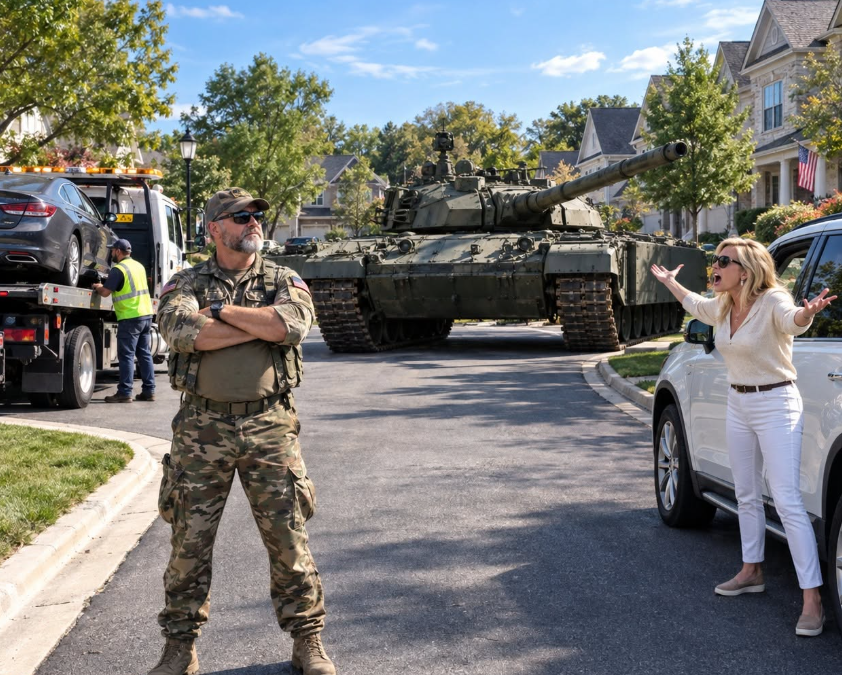
Thursday morning at nine sharp, Bertha rolled down Maple Street.
You heard her before you saw her.
A deep diesel rumble moved through your ribs and made curtains twitch all along the block. Then the heavy transport trailer appeared, escorted by Tommy Morrison’s truck, three veterans on motorcycles, and a line of vehicles flying American flags.
I stood in my driveway wearing my dress uniform for the first time since retirement.
It still fit.
Mostly.
Carmen cried when she saw me, then pretended she had allergies. Sophia took one photo, looked at it, and said, “Dad, you look terrifyingly patriotic.”
“Thank you?”
“It’s a compliment.”
Neighbors lined the street with phones raised. Kids on bicycles followed at a safe distance. Reporters from Channel 7, Channel 9, and two local papers set up along the sidewalk. Police cruisers arrived too, officers visibly trying not to grin.
Colonel Hutchkins stepped from his truck in full dress uniform.
“Permission to commence neighborhood education operations, sir?”
I laughed.
“Permission granted, Colonel.”
Tommy supervised the unloading like he was delivering the crown jewels.
The Sherman rolled off the trailer, olive drab paint gleaming, white star bright on the turret, tracks clanking with a sound that made every HOA covenant in a five-mile radius sit up straight.
Bertha came to rest exactly where planned.
Entirely on my property.
Visible from the main street.
Near Brenda’s cul-de-sac.
Not blocking emergency access.
Not violating a single rule.
A thirty-ton answer to a fake commercial vehicle complaint.
Then Brenda arrived.
She pulled up in her white Lexus, apparently out on bail and wearing yesterday’s designer clothes with today’s emotional collapse. She got out, saw Bertha, and stopped so suddenly the whole crowd seemed to lean forward.
Her face went through disbelief, rage, panic, and something close to grief.
Then she started marching across my lawn.
“This is illegal!”
Officer Martinez stepped forward.
The same officer she had tried to bribe three days earlier.
His body camera was on.
“Ma’am, the vehicle has proper permits and is legally parked on private property.”
“It is a military weapon!”
I held up the rental paperwork.
“Demilitarized recreational vehicle. Same category as an RV. Just heavier and historically significant.”
The tank’s engine idled behind me like a thirty-ton cat purring.
The crowd fell quiet.
Brenda pointed at me.
“You did this to intimidate us.”
“No, Brenda. You had my personal truck towed twice and called it an eyesore. I thought the community might benefit from seeing the difference.”
“You and your people are trying to turn this neighborhood into some kind of military compound.”
Mrs. Cecilia stepped forward.
She was five feet tall and had the presence of a woman who had raised children, buried a husband, crossed borders, and survived enough nonsense to identify it before breakfast.
“Mrs. Harwick,” she said, voice carrying across the lawn, “Marcus is the only person here who never tried to destroy anyone. You targeted families, filed false reports, and stole federal money. Do not blame a tank because your lies got heavy.”
The crowd murmured.
Phones kept recording.
Brenda’s public meltdown reached full power.
“I built this community!” she screamed. “I protected property values! I maintained standards!”
Janet Walsh, now acting HOA president, said, “You were removed from office.”
“I am the only reason this place had standards!”
David Johnson said, “You mean discrimination.”
Brenda spun toward him.
“You people always make everything about race.”
That sentence hit the crowd like a dropped plate.
Jake stepped out from behind the veterans.
“Mrs. Harwick, considering pending civil rights complaints and criminal charges, this may not be the ideal venue for further public statements.”
She turned toward the reporters instead, which told me panic had fully taken the wheel.
“This is America,” she declared. “I have rights. I have property values to protect. I should not have to live next to people who do not understand our way of life.”
Channel 7’s reporter, Jessica Martinez, stepped forward with her microphone.
“Mrs. Harwick, are you saying Mr. Rodriguez, a twenty-three-year Army veteran and homeowner, does not belong in this neighborhood because of his ethnicity?”
Brenda’s answer would replay online millions of times.
“I am saying some people do not fit community standards, and if you cannot see the obvious difference, you are part of the problem too.”
Silence.
Even Bertha seemed to idle softer.
Officer Martinez and Officer Johnson exchanged the look of men hearing evidence fall into place in real time.
Colonel Hutchkins stepped forward, dress uniform sharp, voice calm.
“Ma’am, that tank represents American values. Freedom. Service. Sacrifice. The right of every citizen to live peacefully without harassment.”
He paused.
“Maybe you should consider which one of you actually belongs in this neighborhood.”
The applause started slowly.
Then built.
Veterans clapped first.
Then the targeted families.
Then neighbors who had been silent for months.
Then people who had never spoken to me before but finally understood that neutrality had been helping the wrong side.
Brenda stood alone on my lawn with a tank behind me, cameras in front of her, police beside her, and every word she had tried to hide now spoken into microphones.
That was the moment she lost Willowbrook Heights.
Not legally.
That came later.
She lost it socially first.
Six months later, the neighborhood looked the same from the street.
Same lawns.
Same mailboxes.
Same oak tree over my driveway.
Same Honda Ridgeline parked where it belonged.
But everything important had changed.
Brenda Harwick pleaded guilty to federal fraud, state bribery charges, and civil rights violations. Her deal sent her to federal prison for eighteen months. Her real estate company paid $2.8 million in restitution tied to the HUD fraud and another $500,000 in civil rights settlements to families she had targeted.
Her brokerage did not survive the investigation.
Federal auditors expanded beyond Willowbrook Heights and uncovered discriminatory steering practices across three counties. Seventeen additional prosecutions followed. Brenda’s case became a training example for housing discrimination enforcement because, as Jake said, rarely does someone provide such a complete written, verbal, financial, and televised confession.
The HOA board was rebuilt.
Janet Walsh became president.
David Johnson became vice president.
Tom Bradley stayed on long enough to help clean records, then resigned with a public apology for not challenging Brenda sooner.
New bylaws required transparent enforcement reporting, independent review of violations, anti-discrimination training, conflict-of-interest disclosures, and a community ombudsman program Carmen helped design using patient advocacy models from the VA.
My house, along with twenty-nine others, was officially restored under the affordable-housing designation with federal oversight.
Teachers moved in.
A firefighter.
Two nurses.
A young veteran with a service dog.
A single mother who worked for the county library.
People Brenda would have called a bad fit, which meant they were exactly what Willowbrook needed.
Property values went up.
That annoyed the old Brenda loyalists more than anything.
The thing she claimed would destroy the neighborhood, fairness, made it stronger.
Mrs. Cecilia began hosting weekly coffee mornings where residents brought food from their families’ traditions and discussed neighborhood issues before they became lawsuits.
The Patel family’s Diwali celebration became a community event.
Maria Santos organized a neighborhood medical response team.
Carmen founded the Willowbrook Veterans Support Network to help military families navigate health care, disability paperwork, VA claims, transportation, and the strange loneliness that can hit after service ends.
Sophia wrote her college application essay about watching her father fight discrimination with legal strategy, community organizing, and one historically significant recreational vehicle.
She got into West Point.
When the acceptance letter arrived, I read it twice before I trusted my eyes. Carmen cried openly. Sophia pretended not to, then failed. I stood on the porch afterward looking at the Ridgeline and thinking about every place the Army had sent me, every bridge I had built, every road I had cleared, every time I wondered whether the sacrifice had meant anything my daughter could touch.
That letter felt like an answer.
As for Bertha, she became a legend.
She returned for Memorial Day, Veterans Day, and the first anniversary of Tank Day, which is what the kids named it before any adult could stop them. Eventually, Tommy donated her permanently to the local VFW post, where she became the centerpiece of a military history education program.
Channel 7’s original story won a regional award.
Jessica Martinez moved to a national network and began covering civil rights issues across the American West. She sent me a note later saying Brenda’s meltdown had changed her career.
I told her Brenda had done that for a lot of people, though probably not how she intended.
The Willowbrook Fairness Fund came from settlement money.
We built it to help families facing HOA discrimination anywhere in Colorado. By the second year, we had helped forty-three families fight bogus violations, prevented six illegal evictions, and forced twelve developments to comply with federal housing requirements they had quietly ignored.
We also created a scholarship for veterans pursuing engineering degrees.
The first recipient was a young woman from Afghanistan whose family had been targeted by an HOA over religious decorations and parking complaints. She wrote in her application that she wanted to design infrastructure for communities where people like her parents did not have to feel temporary.
I read that sentence three times.
Then I funded the second scholarship myself.
People ask whether the tank was necessary.
Legally, no.
The lawsuits were already coming. The HUD audit was already moving. Brenda had already bribed police on camera, filed false reports, exposed discriminatory practices, and lost her HOA position.
But communities are not changed only by legal filings.
Sometimes people need a symbol large enough to interrupt their excuses.
My Honda Ridgeline had never been the problem.
It was too ordinary for some people to see the truth.
Brenda could pretend it was about rules.
Appearance.
Parking.
Order.
Commercial use.
Community standards.
Bertha stripped the lie bare.
A tank on private property was absurd, dramatic, impossible to ignore, and completely legal.
That forced the real question.
Was the problem the vehicle?
Or the person who owned it?
Brenda answered that question herself, into three microphones and a dozen phones.
This morning, I stood on my porch with coffee in hand, listening to mockingbirds in the oak tree. Carmen’s herb garden has taken over the side fence despite her original claims of control. Sophia’s West Point prep materials are stacked in the living room. My American flag moves lightly above the porch, not as a warning, not as a performance, but as a reminder.
This country’s promises do not enforce themselves.
Sometimes you defend them with court filings.
Sometimes with public records.
Sometimes with neighbors who finally decide silence is not peace.
And sometimes, when an HOA Karen calls your personal truck an eyesore, has it towed from your own driveway, insults your service, targets your family, breaks federal housing law, and still thinks she owns the street, you defend them with thirty tons of educational steel.
Carl Henderson still parks his white F-150 three houses down.
I still park my dark blue Honda Ridgeline in my driveway.
Both trucks sit exactly where they belong.
Nobody measures them.
Nobody photographs them.
Nobody calls a tow company.
The street is quiet now, but not the old kind of quiet.
Not the kind built on people keeping their heads down while one woman decides who belongs.
This quiet is different.
It is the quiet after repairs.
The quiet after rot is cut out.
The quiet after a load-bearing lie finally fails and something stronger is built in its place.
Brenda thought towing my truck would teach me my place.
She was right.
It did.
My place was in my home, with my family, on my property, in a neighborhood that federal law said had room for people like us.
My place was standing on my driveway in uniform while a tank idled behind me and every camera in Colorado watched her explain exactly who she thought should disappear.
My place was not beneath her clipboard.
It never was.
She just needed thirty tons of help understanding that.