HOA Karen Tore Down My Court-Ordered Notices and Said “HOA Rules Come First”—Then the Judge Found Out Exactly What She Had Done.
PART2:
Lorraine’s letter described it as “inconsistent with the aesthetic continuity of the community.”
I sat at my kitchen table, read that sentence three times, and laughed so hard I had to put the paper down.
I thought it was some kind of prank from a neighbor.
It was not.
Two weeks later, I received a second notice because my recycling bin was visible from the street for forty minutes after pickup.
Then came a warning about the edging around my flower bed.
Then a complaint about the blue tarp covering my firewood stack.
Then a handwritten note about my porch light being “too industrial in tone.”
I did not even know light could have a tone.
At first, I tried to play along.
I repainted the mailbox.
Moved the bin.
Changed the flower bed edging.
Bought a brown tarp.
Replaced the porch bulb with something warmer because apparently my front porch needed to stop sounding like a warehouse.
But every time I complied, Lorraine seemed to take it as encouragement.
A month after the tarp incident, I found her standing at the edge of my driveway with her leather folder pressed against her chest.
“Michael,” she said.
She always used my first name like she was granting herself intimacy I had not offered.
“Morning, Lorraine.”
“I noticed your grass near the left side of the driveway is beginning to feather.”
I looked at the grass.
It was grass.
“What does feather mean?”
She gave me a tight smile.
“It means uneven growth at the edge.”
“Grass does that.”
“Not in Briarwood Estates.”
That should have told me everything.
But I was still trying to be a reasonable man in an unreasonable place, which is one of the quiet ways people lose ground.
I trimmed the grass.
Then I got a notice about my fence.
The fence was old, but it was sound. Six-foot cedar. Weathered gray. Built long before I bought the house. It ran along the back property line and separated my yard from a wooded strip that sloped down toward a drainage creek. The strip was not decorative. It was not a park. It was not a walking trail. It was brush, vines, wet clay, mosquitoes, poison ivy, and enough exposed roots to break an ankle if you were foolish enough to walk there at dusk.
According to Lorraine, however, my fence “interrupted the visual continuity of the rear common corridor.”
That phrase bothered me.
Rear common corridor.
I had never heard it before.
I pulled out the documents from closing.
The recorded plat showed my back boundary clearly. My fence was inside my property line by several inches. Behind it was a drainage easement held by the county, not the HOA. The easement existed so stormwater crews could access the creek if needed. It did not give Briarwood Estates the right to turn the back of my property into a community corridor.
I wrote a polite email to the HOA management company.
Please identify the recorded instrument establishing a rear common corridor behind my property.
The response came from Lorraine, not the manager.
Michael, the rear area has always been treated as part of Briarwood’s shared aesthetic environment. Please remove or replace the fence within thirty days to conform with current board expectations.
Board expectations.
Not deed.
Not plat.
Not easement.
Expectations.
That was the day I stopped laughing.
I wrote back.
Please provide the recorded covenant or amendment authorizing the HOA to require removal of an existing fence located on my property.
Lorraine did not reply by email.
She appeared at my door the next morning.
She wore a pale blue blouse, white slacks, oversized sunglasses, and the expression of someone who had practiced calm disappointment in a mirror.
“Michael,” she said, “you’re making this much harder than it needs to be.”
“I asked for the rule.”
“The board has broad authority over exterior appearances.”
“The board does not have broad authority over property it does not own.”
Her smile tightened.
“No one is questioning your ownership.”
“You just told me to remove my fence.”
“Because it affects the community.”
“So does your house color. I don’t get to repaint it.”
Her jaw flexed.
That was the first time I saw the real Lorraine.
Not the polished neighborhood matriarch.
Not the volunteer leader.
The controller.
“Briarwood works because people cooperate,” she said.
“Cooperation is not obedience.”
Her smile vanished.
“You are new here.”
“I own here.”
The silence after that sentence was sharp.
Lorraine stepped back.
“I hope you’ll reconsider your tone.”
“I hope you’ll send the rule.”
She left without another word.
The next violation notice arrived three days later.
Then another.
Then another.
The fence became her obsession.
It was unsightly.
It was nonconforming.
It obstructed maintenance visibility.
It created wildlife concealment.
It reduced rear corridor continuity.
It negatively affected neighboring enjoyment.
By the end of two months, the HOA claimed I owed $1,850 in fines.
I disputed every one.
Lorraine ignored every dispute.
Then the board sent a letter threatening to place a lien on my house.
That changed the argument.
A mailbox color is irritation.
A trash bin notice is nonsense.
A lien threat is war paperwork.
I hired an attorney named Sarah Donnelly.
Sarah had an office in Greenville, a quiet voice, and the unsettling habit of smiling only when she found something legally useful. She specialized in property disputes and homeowners associations, which meant she had spent years watching ordinary people discover how expensive petty power can become.
I brought her a folder thick enough to make her eyebrows rise.
“Is all of this about a fence?” she asked.
“It started with a mailbox.”
“Of course it did.”
I showed her the plat.
The deed.
The recorded covenants.
The HOA notices.
Lorraine’s emails.
The lien threat.
Sarah read silently for almost fifteen minutes.
Then she tapped the plat.
“Your fence is inside your property line.”
“Yes.”
“The area behind it is a county drainage easement.”
“Yes.”
“The HOA does not own it.”
“Correct.”
“And they’re calling it a common corridor?”
“Yes.”
Sarah leaned back.
“That is a very confident way to be wrong.”
For the first time in weeks, I felt my shoulders loosen.
“What do we do?”
“We ask them to withdraw the fines.”
“And if they don’t?”
“Then we ask a judge to explain property law to them.”
Sarah sent a demand letter.
It cited the deed, the plat, the county drainage easement, the actual recorded HOA covenants, and the absence of any authority requiring removal of my fence. It demanded cancellation of all fence-related fines and withdrawal of the lien threat.
Lorraine’s response came through the management company.
The board’s position remained unchanged.
But this time, they added something new.
If I did not remove the fence voluntarily, the HOA reserved the right to “access the rear corridor and correct the violation at owner expense.”
Correct the violation.
That meant tear down my fence and send me the bill.
Sarah read that line twice.
Then she smiled.
The kind of smile I had already learned to respect.
“They should not have written that.”
Three weeks later, Sarah filed a petition in county court seeking injunctive relief.
Carter v. Briarwood Estates Homeowners Association.
It felt strange seeing my name on a legal filing.
I had not wanted court.
I had wanted quiet.
But quiet is not the same as surrender.
At the first hearing, the HOA sent an attorney named Wallace Green, who looked tired before the judge even entered. Lorraine sat behind him in the gallery with her leather folder on her lap and a white scarf tied around her neck.
Judge Evelyn Mercer presided.
She was in her late fifties, with reading glasses low on her nose and the kind of calm that made people choose their words carefully.
Sarah presented the plat.
The deed.
The easement.
The notices.
The lien threat.
The letter threatening self-help removal.
Wallace Green argued that the HOA had a duty to preserve neighborhood appearance and that the rear fence line affected the visual character of Briarwood Estates.
Judge Mercer listened.
Then she asked a simple question.
“Counsel, where is the recorded authority allowing the association to enter Mr. Carter’s property and remove a fence?”
Wallace looked down at his papers.
“The association has broad enforcement powers.”
“That was not my question.”
Lorraine shifted in the gallery.
Wallace tried again.
“The covenants allow the association to enforce exterior standards.”
Judge Mercer looked over her glasses.
“On property within the scope of the covenants and according to the process those covenants provide. I am asking where the association obtained authority to enter this homeowner’s private property and physically remove an existing structure.”
Wallace had no answer.
That should have ended things.
It did not.
People like Lorraine rarely stop when corrected by ordinary logic.
They stop when consequences arrive.
Judge Mercer issued a temporary injunction.
The order prohibited the HOA, its agents, officers, board members, contractors, and anyone acting on its behalf from entering my property, removing, altering, damaging, or interfering with my fence until further order of the court.
It also required notice of the injunction to be posted along the disputed fence line.
That was where the orange stickers came in.
They were not ordinary stickers.
They were official court notices printed on bright orange weather-resistant paper, each bearing the case number, the court seal, and the words:
COURT ORDER IN EFFECT.
NO REMOVAL, ALTERATION, OR INTERFERENCE WITH THIS FENCE.
VIOLATION MAY RESULT IN CONTEMPT SANCTIONS.
The clerk prepared them.
The sheriff’s civil division posted them.
A deputy named Marcus Hale came to my house the next morning with a folder and a small staple gun.
He was friendly, professional, and very clear.
“Mr. Carter, I’ll place these at visible intervals along the fence. I’ll photograph each notice after posting.”
“Why so many?”
“To make it hard for anyone to claim they didn’t know.”
That sentence would matter later.
Deputy Hale posted twelve notices along the fence line.
One near the left corner.
One near the gate.
One beside the oak stump.
Others spaced along the back.
Each notice was photographed.
Each location was logged.
Deputy Hale gave me a copy of the posting certificate.
“Keep this,” he said.
“I will.”
He looked toward the houses beyond the cul-de-sac.
“HOA dispute?”
“How did you guess?”
He gave me a tired smile.
“Orange paper makes people lose their minds.”
Then he left.
For four days, nothing happened.
Neighbors walked by and looked.
Some asked questions.
Some nodded.
Some pretended not to notice, which in Briarwood meant they noticed very hard.
Lorraine drove slowly past my house twice.
On the second pass, she stopped just long enough to stare toward my backyard.
I watched from the kitchen window.
She did not see me.
Her face had no smile.
Only calculation.
On the fifth morning, I was standing on my patio with coffee when she appeared at the back fence.
She came through the wooded strip behind my property, stepping carefully in expensive sandals that were losing a fight against wet leaves. She wore a pressed linen shirt, tan slacks, oversized sunglasses, and the leather folder.
Always the folder.
“Lorraine,” I called.
She looked up.
“Michael.”
“You’re on county drainage easement land.”
“I’m inspecting a violation.”
“No, you’re standing behind a court-ordered notice.”
She walked to the fence and looked at the orange paper.
“This is ridiculous.”
“It’s a judge’s order.”
“It is an ugly display.”
“It’s a legal display.”
“It violates neighborhood sign rules.”
I almost laughed.
“Lorraine, those are court notices.”
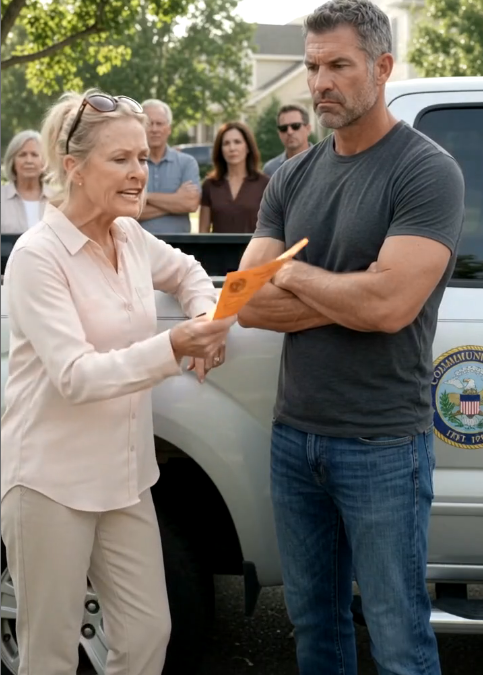
She pinched the corner of the first one.
“HOA rules come first around here.”
Then she peeled it off.
Slowly.
Deliberately.
I stood there holding my coffee, watching her commit contempt like she was tidying a bulletin board.
She crumpled the notice in her hand.
I set the coffee on the patio table.
“Do not touch another one.”
She moved to the next notice.
“Your attorney has created an eyesore.”
“That is not a lawn sign. That is a court notice.”
She tore the second one down.
“Briarwood has standards.”
I pulled out my phone.
“Lorraine, I’m recording.”
“Good.”
She ripped off the third notice.
“Record this. I am removing unauthorized signage from a protected common-view corridor.”
“Judge Mercer ordered those notices posted.”
“I don’t answer to Judge Mercer about HOA aesthetics.”
That sentence was so absurd that for a second, even I had nothing to say.
Then she tore down the fourth notice.
I opened the gate and stepped into the backyard.
“Lorraine, if you continue, I’m calling Sarah.”
“Call whoever you like.”
She pulled off the fifth notice.
The sixth.
The seventh.
By then, her crumpled fist was full of orange paper.
My backyard camera captured everything.
My phone captured everything.
And, as I would later learn, Mrs. Bell from the house behind mine had also seen everything from her breakfast nook and recorded Lorraine through the window because, in Mrs. Bell’s words, “I knew that woman was up to something.”
Lorraine reached the eighth notice before I said the sentence that finally made her pause.
“The sheriff’s office posted those.”
Her hand froze.
Just slightly.
Then she recovered.
“They can come pick up their litter.”
She tore the eighth notice down.
When she finished, ten of the twelve notices were gone.
Two remained at the far corner where the ground was too muddy for her sandals.
She stuffed the crumpled papers into her leather folder as if hiding them inside a nicer container made them less destroyed.
Then she looked at me.
“You should have accepted the board’s decision.”
She turned and walked back through the drainage strip.
I stood there for several seconds, listening to the creek beyond the trees.
Then I called Sarah.
She answered on the third ring.
“What happened?”
I did not ask how she knew something had happened.
“Lorraine Pickett just tore down ten court notices from my fence.”
There was silence.
Then Sarah said, very softly, “She did what?”
I told her.
Every detail.
When I finished, Sarah asked one question.
“Do you have video?”
“Yes.”
“Send it.”
I sent the phone video first.
Then I downloaded the backyard camera footage.
Then I scanned Deputy Hale’s posting certificate and sent that too.
Sarah called back twenty minutes later.
Her voice had changed.
Not louder.
Sharper.
“Do not contact Lorraine. Do not contact the HOA. Do not replace the notices yourself. I am filing a motion for contempt.”
“How serious is this?”
“Michael, she removed notices posted by the sheriff pursuant to a court order in an active injunction case.”
“So serious.”
“Very.”
By noon, Sarah had filed an emergency motion.
By three, Judge Mercer had scheduled a hearing for the following morning.
By five, the HOA’s attorney Wallace Green had emailed Sarah asking whether “the matter could be resolved informally.”
Sarah forwarded me the email.
Her note underneath said:
No.
The next morning, the courtroom was fuller than I expected.
Lorraine sat behind Wallace Green.
This time she wore a navy blazer and pearls.
No sunglasses.
No leather folder.
She looked less like a queen and more like a woman trying to remember the name of the country she had invaded.
Sarah sat beside me with a binder, a laptop, and the calm expression of someone who had brought receipts.
Judge Mercer entered at 9:00 sharp.
Everyone stood.
We sat.
The judge looked at the file.
“I understand there has been an alleged violation of the court’s temporary injunction.”
Sarah stood.
“Yes, Your Honor.”
Wallace stood too.
“Your Honor, if I may, the association believes this matter has been somewhat exaggerated. Mrs. Pickett acted under the sincere belief that the posted materials violated community signage restrictions and—”
Judge Mercer raised one hand.
He stopped.
“Mr. Green, before we discuss belief, I would like to establish what occurred.”
Sarah introduced the posting certificate.
Deputy Hale testified.
He described posting twelve notices along the fence pursuant to the court’s order. He confirmed the notices bore the court seal, case number, and warning against removal or interference. He confirmed he photographed each placement.
Sarah displayed the photographs.
Twelve orange notices appeared on the courtroom screen.
Then Sarah played my video.
Lorraine’s voice filled the courtroom.
“HOA rules come first around here.”
Then the image showed her tearing down the first notice.
The second.
The third.
Judge Mercer watched without moving.
The courtroom watched with her.
Then came the line.
“I don’t answer to Judge Mercer about HOA aesthetics.”
For the first time, Judge Mercer’s face changed.
Not dramatically.
Just enough.
She looked over her glasses at Lorraine.
Lorraine stared at the table.
Sarah stopped the video.
“Your Honor, Mrs. Pickett removed ten of the twelve court notices. She did so after Mr. Carter warned her they were court notices. She did so after being told they were posted pursuant to your order. She stated on video that HOA rules come first and that she did not answer to this court regarding HOA aesthetics.”
Wallace Green looked like a man wishing he had chosen a different profession.
Judge Mercer turned to him.
“Mr. Green?”
He stood slowly.
“Your Honor, Mrs. Pickett deeply regrets her choice of words.”
“That is not what I asked.”
He swallowed.
“The association does not dispute that she removed the notices.”
Lorraine’s head snapped toward him.
That was the first smart thing Wallace had done all morning.
Do not dispute video.
Judge Mercer looked at Lorraine.
“Mrs. Pickett, please stand.”
Lorraine stood.
For once, she did not look smug.
Judge Mercer spoke evenly.
“Did you remove the court notices?”
Lorraine’s voice was smaller than I had ever heard it.
“Yes, Your Honor.”
“Did you understand they related to this case?”
“I understood they were connected to the fence dispute.”
“Did you read them?”
Lorraine hesitated.
“I glanced at them.”
“Did they bear the court seal?”
“I suppose so.”
“That is not an answer.”
“Yes.”
“Did Mr. Carter tell you not to remove them?”
“Yes.”
“Did he tell you they were court notices?”
“Yes.”
“Did you remove them anyway?”
Lorraine’s jaw tightened.
“Yes.”
Judge Mercer leaned back.
“Why?”
Lorraine took a breath.
“Your Honor, Briarwood Estates has long-standing aesthetic standards. The notices were bright orange and visible from neighboring properties. They disrupted the uniform appearance of the rear corridor and created concern among residents that Mr. Carter was attempting to embarrass the association.”
For a moment, nobody breathed.
Judge Mercer stared at her.
“Mrs. Pickett, this court ordered those notices posted.”
Lorraine nodded quickly.
“I understand that now.”
“You understood it then.”
“I did not understand the seriousness.”
Judge Mercer’s voice cooled.
“You understood enough to say you did not answer to me about HOA aesthetics.”
Lorraine said nothing.
Then Sarah stood.
“Your Honor, we also have evidence that Mrs. Pickett emailed the board immediately after removing the notices.”
Wallace closed his eyes.
Sarah introduced the email, produced by one of the board members who apparently decided not to be dragged under the bus with Lorraine.
The email was sent at 9:14 a.m., twenty-three minutes after Lorraine left my fence.
Subject: Notices Removed.
Board,
I removed the orange signs from Carter’s rear fence. We cannot allow him to use court theatrics to damage the visual continuity of the neighborhood. If he reposts them, we should remove them again and consider fining him for unauthorized signage.
Lorraine.
Judge Mercer read the email twice.
Then she looked at Wallace.
“Mr. Green, is Mrs. Pickett currently an officer of the association?”
Wallace hesitated.
“She is not president, Your Honor, but she serves as chair of the architectural standards committee and acts as liaison to the board on covenant compliance.”
“In other words, she acts with association authority.”
“In certain contexts.”
“This was one of them?”
Wallace looked like he wanted the floor to open.
“She appears to have represented herself that way.”
Judge Mercer made a note.
That note sounded louder than a gavel.
Sarah then called Mrs. Bell.
Mrs. Bell was seventy-one, wore a floral blouse, and carried a purse large enough to contain emergency snacks, medication, and possibly a small legal library. She testified that she had seen Lorraine enter the rear drainage area, remove the notices, and place them in her folder.
“Why did you record?” Sarah asked.
Mrs. Bell adjusted her glasses.
“Because Lorraine is always doing things when she thinks people aren’t watching.”
A quiet laugh moved through the courtroom.
Judge Mercer did not smile, but I saw her mouth tighten.
Wallace declined to cross-examine Mrs. Bell.
That was wise.
Then Sarah presented the second issue.
The email Lorraine sent two days before tearing down the notices.
This one came from another board member named Thomas Harlan, who had apparently forwarded a whole chain to Sarah after realizing Lorraine had turned court contempt into a group project.
Lorraine had written:
If Carter gets away with posting court signs, every resident will think they can run to a judge instead of respecting our process. We need to make clear that Briarwood rules remain in force.
Thomas replied:
Court orders override HOA rules, Lorraine.
Lorraine answered:
Not on appearance matters.
Judge Mercer read that one even more slowly.
Then she removed her glasses.
That was when I knew Lorraine was in real trouble.
“Mrs. Pickett,” the judge said, “you appear to have received explicit notice from a board member that court orders override HOA rules.”
Lorraine’s face flushed.
“Thomas is not an attorney.”
“No, but he was correct.”
The room went silent.
Judge Mercer turned to Wallace.
“Mr. Green, I am trying to understand whether the association is merely careless or whether it has developed a practice of treating judicial authority as optional when inconvenient.”
Wallace stood.
“Your Honor, the association respects this court.”
Judge Mercer looked at the screen where Lorraine’s email still glowed.
“Apparently not unanimously.”
Sarah requested sanctions.
She asked for attorney’s fees associated with the contempt motion.
Costs of reposting notices.
A civil penalty.
An order prohibiting Lorraine from entering my property or the rear drainage strip near my fence.
An order requiring the HOA to notify all board members and committee chairs in writing that court orders supersede HOA rules.
And, most importantly, an expansion of the injunction preventing the HOA from enforcing any fines or actions related to the fence while the case remained pending.
Wallace argued that sanctions should be limited.
Lorraine had acted emotionally, he said.
The notices were visually disruptive.
She regretted her choice of words.
She had not intended to disrespect the court.
Judge Mercer listened.
Then she looked at Lorraine.
“Mrs. Pickett, when a court issues an order, parties do not get to decide whether compliance is aesthetically pleasing.”
Lorraine looked down.
“The notices were posted because this court had reason to believe interference might occur. Your actions proved the court’s concern justified.”
Nobody moved.
Judge Mercer continued.
“I find Mrs. Pickett in civil contempt of this court’s order. I find that her removal of the notices was willful. I further find that her conduct was undertaken while acting in connection with association enforcement activity.”
Lorraine’s face went pale.
Judge Mercer ordered Lorraine personally to pay $2,500 in sanctions.
She ordered the HOA jointly responsible for my attorney’s fees related to the emergency motion.
She ordered the notices reposted by the sheriff’s office at HOA expense.
She ordered Lorraine to stay at least fifty feet from my property line unless accompanied by counsel or law enforcement.
She prohibited the HOA from issuing any fine, notice, or enforcement communication regarding my fence without prior court approval.
Then she added one more thing.
“Mrs. Pickett will provide a written apology to Mr. Carter and to the court within seven days.”
Lorraine looked up sharply.
Judge Mercer’s expression did not change.
“And Mrs. Pickett will attend a continuing legal education session or comparable instruction concerning compliance with court orders, to be selected by counsel and approved by the court.”
Sarah leaned toward me and whispered, “That part is unusual.”
“Good unusual?”
“Very.”
The hearing ended.
Lorraine walked out without looking at me.
For the first time since I moved to Briarwood, no one followed behind her like she was leading a parade.
The orange notices went back up that afternoon.
This time, Deputy Hale brought another deputy.
He posted fourteen.
Not twelve.
Fourteen.
He photographed every one.
When he finished, he handed me the new certificate.
“Try not to collect any more neighborhood legends,” he said.
“I’ll do my best.”
The story spread through Briarwood faster than mold on wet drywall.
At first, people whispered.
Then they asked.
Then they started comparing notes.
That was what Lorraine had always feared most.
Not court.
Not fines.
Comparison.
People began realizing I was not the only one who had been treated strangely.
A retired teacher named Ellen Marsh told me Lorraine had threatened her over a birdbath that had supposedly violated “water feature proportions.”
A couple on Ashford Lane had paid $600 in fines over a fence stain color that did not appear anywhere in the covenants.
A widower named Glen Porter had been forced to remove a wheelchair ramp handrail because Lorraine said it disrupted porch symmetry.
That one made my blood boil.
When Sarah heard about it, her face changed.
“She did what?”
Glen still had the letter.
Sarah asked for a copy.
Then another neighbor brought over a notice about garden flags.
Another had emails about window curtains.
Another had paid fees after Lorraine threatened architectural proceedings over solar path lights.
The floodgates opened.
Because once one person stood up and survived, everyone else remembered they had legs.
Two weeks after the contempt hearing, Thomas Harlan resigned from the board and sent an email to every homeowner in Briarwood Estates.
The subject line was simple.
Records Matter.
In the email, Thomas apologized for remaining silent too long. He wrote that certain enforcement practices had become “informal, personality-driven, and legally unsupported.” He urged homeowners to review actual recorded covenants rather than relying on letters from committees.
Then he attached something.
A proposed board resolution from the previous year.
It was titled:
Rear Corridor Beautification and Access Enhancement Initiative.
My fence dispute suddenly made sense.
The initiative proposed transforming the wooded drainage strip behind my property and several neighboring lots into a “visual greenbelt corridor” with uniform fencing, trimmed underbrush, decorative gravel, and a walking path connecting Briarwood Court to the pond near the subdivision entrance.
The HOA did not own the drainage strip.
The county held an easement.
Homeowners owned the lots.
But the proposal referred to “cooperative rear boundary compliance” and “removal of obstructive nonconforming fencing.”
My fence was not an eyesore.
It was an obstacle.
I called Sarah.
She had already seen the email.
“This is why they wanted your fence gone,” she said.
“Can they build a path there?”
“Not without property rights they don’t appear to have.”
“There’s more, isn’t there?”
“There usually is.”
There was.
Sarah subpoenaed board records related to the initiative.
The documents showed Lorraine had been pushing the project for two years. She claimed it would raise property values and “restore neighborhood prestige.” She had obtained informal estimates from a landscaping contractor.
Pickett Outdoor Design.
Her nephew’s company.
The contract had not been approved yet.
But emails showed Lorraine expected it to be.
One message from Lorraine to her nephew said:
Once Carter’s fence issue is resolved, the corridor can move forward. He is the only serious obstruction.
I stared at that email for a long time.
The mailbox.
The grass.
The tarp.
The porch light.
The fines.
The lien threat.
The fence notices.
The court stickers.
All of it had been about control, yes.
But it had also been about a project.
A project that required my property to become less mine.
Sarah amended our court filing.
Now the fence dispute expanded beyond my backyard.
We asked the court to determine that the HOA had no right to enter, alter, clear, or improve homeowner-owned rear boundary areas without express written property rights. We sought cancellation of all fence-related fines. We sought attorney’s fees. We sought an order requiring the HOA to correct prior improper enforcement.
The next hearing drew more residents than the clubhouse annual meeting.
People stood along the back wall.
Lorraine was there, but she sat behind Wallace Green with her hands folded and her eyes forward. No pearls this time. No folder.
Judge Mercer had clearly read the new filings.
She began with a question for Wallace.
“Does the association contend it owns the rear drainage area?”
“No, Your Honor.”
“Does it hold an easement allowing construction of a walking path?”
“No, Your Honor.”
“Does it possess written consent from affected homeowners?”
“No, Your Honor.”
“Then why did association communications refer to removal of obstructive fences?”
Wallace looked down.
“The initiative was preliminary.”
Judge Mercer glanced at Sarah.
Sarah stood.
“Your Honor, the initiative may have been preliminary, but enforcement against Mr. Carter was not. He was fined, threatened with a lien, threatened with self-help removal, and forced to seek injunctive relief. The record shows his fence was targeted because it obstructed a project the association had no legal right to complete.”
Judge Mercer looked at Lorraine.
Lorraine did not move.
Sarah introduced the emails.
The proposal.
The contractor estimates.
The message to Lorraine’s nephew.
Once Carter’s fence issue is resolved, the corridor can move forward.
The courtroom shifted.
People understood.
This had never been about cedar boards.
It had never been about visual continuity.
It had been about clearing the way.
Judge Mercer issued her ruling two weeks later.
The order was devastating.
The court confirmed my fence was located on my property and protected by the temporary injunction.
It found the HOA had exceeded its authority by issuing fines and lien threats based on an unsupported “rear corridor” theory.
It voided all fence-related fines.
It barred the HOA from entering or altering any homeowner-owned rear boundary property without recorded rights or written consent.
It ordered the HOA to notify all homeowners that the proposed Rear Corridor Beautification and Access Enhancement Initiative had no legal effect and granted no access rights.
It awarded me attorney’s fees.
And it required Briarwood Estates to reimburse the sheriff’s costs for reposting the court notices Lorraine had destroyed.
Lorraine’s personal sanctions remained.
Her apology arrived one day before the deadline.
It was three paragraphs.
Stiff.
Legal.
Clearly edited by someone who wanted no adjectives left alive.
Dear Mr. Carter,
I apologize for removing the court notices from your fence on the morning of May 6. I acknowledge that the notices were posted pursuant to a court order and that I should not have removed them. I regret my conduct and any inconvenience it caused.
Sincerely,
Lorraine Pickett.
It was not heartfelt.
But it was signed.
I placed it in the file beside the photo of her ripping down the first notice.
Some documents belong together.
The HOA board changed rapidly after that.
Two members resigned.
Thomas Harlan ran for president and won because no one else wanted to sit in the chair after Lorraine had set it on fire.
The first thing the new board did was hire a new attorney.
The second thing it did was cancel the rear corridor project.
The third thing it did was send a letter to every homeowner explaining that committee preferences were not enforceable unless supported by recorded covenants, properly adopted rules, and lawful authority.
I read that letter twice.
Then I walked outside and looked at my fence.
The orange notices were still there, fluttering lightly in the humid South Carolina air.
Ugly as sin.
Beautiful as justice.
For several more weeks, they remained posted.
Neighbors slowed when they walked past.
Some waved.
Some apologized.
Some pretended they had always thought Lorraine was wrong.
That was fine.
People rewrite their courage after danger passes.
I did not need everyone to have been brave from the beginning.
I just needed them to stop pretending she was right.
One afternoon, Glen Porter came by with a folder under his arm.
He was the widower who had removed the wheelchair ramp handrail.
“My wife used that ramp her last year,” he told me.
His voice was quiet.
“Lorraine said the rail made the porch look institutional.”
I felt something hard settle in my chest.
“I’m sorry.”
“She made me replace it twice. Cost me almost nine hundred dollars.”
He handed me the folder.
“Sarah said she might want this.”
“She does.”
He looked toward my backyard.
“You know, when you first fought her, I thought you were making trouble.”
“I probably was.”
“No.” He shook his head. “You were making a record.”
That sentence stayed with me.
Because he was right.
Trouble is what powerful people call a record when they do not want one kept.
Eventually, the court case settled.
The HOA agreed to pay my attorney’s fees.
It reimbursed the invalid fines.
It corrected its records.
It adopted a written enforcement policy requiring citations to actual covenant provisions.
Lorraine was removed from every committee.
The settlement also required the HOA to send a correction letter acknowledging that the rear drainage area was not a common corridor and that no homeowner was required to remove a fence based on that theory.
Sarah made sure the wording was precise.
Lorraine did not attend the meeting where the board approved it.
I never asked why.
I saw her only once after everything ended.
It was a Saturday morning in early fall.
I was trimming azaleas near the porch when she walked by on the opposite side of the street.
No leather folder.
No sunglasses.
No inspection posture.
Just a woman walking quickly past a house she no longer controlled.
For a moment, I thought she might say something.
She did not.
She kept walking.
I watched her until she turned the corner.
Then I went back to trimming.
My fence is still there.
The cedar has weathered a little more.
A few boards need replacing.
The gate still sticks when the humidity rises.
But it stands exactly where it stood when Lorraine decided it offended the neighborhood.
Sometimes I sit on the back patio with coffee and look at the place where she tore down that first orange notice.
The stickers are gone now, of course.
The court allowed removal after the final order.
Deputy Hale came back one last time and took them down himself, because Sarah insisted everything end as properly as it began.
When the deputy removed the last notice, he handed it to me.
“Souvenir?”
I looked at the bright orange paper.
COURT ORDER IN EFFECT.
NO REMOVAL, ALTERATION, OR INTERFERENCE WITH THIS FENCE.
VIOLATION MAY RESULT IN CONTEMPT SANCTIONS.
I laughed.
“I think Lorraine already got the souvenir.”
He grinned.
I kept one copy anyway.
It sits in the same folder as the order, the sanctions ruling, the apology, and the final settlement.
Sometimes people ask why I kept it.
The answer is simple.
Because that ugly orange notice taught Briarwood Estates something years of polite complaints never could.
It taught them that rules have sources.
Authority has limits.
A title is not a throne.
A committee is not a court.
A leather folder is not a deed.
And HOA rules do not come first when a judge has already spoken.
Lorraine thought she was removing an eyesore.
What she really removed was the last illusion that her power was untouchable.
Every sticker she tore down made the record stronger.
Every crumpled notice became evidence.
Every smug sentence on that video helped explain exactly why the court order had been necessary in the first place.
That is the part I still find almost poetic.
She hated those notices because they were ugly.
She destroyed them because they embarrassed her.
But in the end, they did what court notices are supposed to do.
They warned everyone.
They warned me that Lorraine would not stop voluntarily.
They warned the judge that the HOA’s problem was deeper than one fence.
They warned the neighborhood that obedience without authority is just fear wearing a cardigan.
And they warned Lorraine Pickett, a little too late, that the courthouse does not care how things look from the cul-de-sac.
It cares what the record says.
And the record said she touched ten stickers she had no right to touch.
Ten small orange pieces of paper.
Ten acts of contempt.
Ten reasons the judge finally made her understand that Briarwood Estates was not her kingdom.
It was a neighborhood.
And my fence, ugly stickers and all, was still mine.