HOA Karen Torched My Family’s Sugarcane Field—Then the Fire Knocked Out Power to Her Entire Neighborhood and the Cameras Showed Who Started It.
PART3:
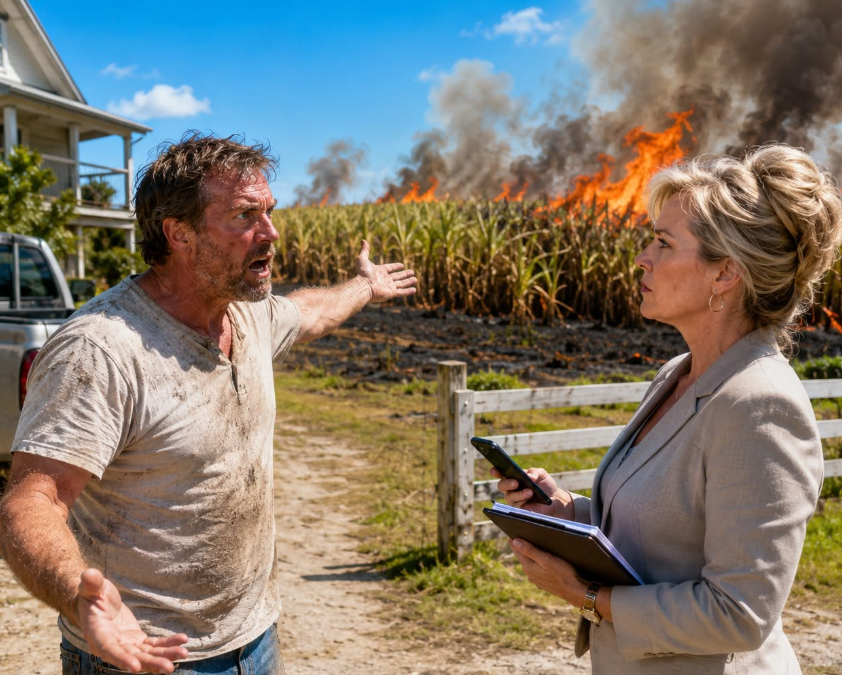
The first time Darlene came to my farm, she parked beside the equipment shed without asking and stepped out wearing white sneakers.
White sneakers.
In July.
In Louisiana.
On farm ground.
That told me almost everything I needed to know.
I was sharpening cane knives beneath the shed roof when she approached.
“Mr. Tullock?”
I looked up.
“Yes, ma’am.”
“I’m Darlene Whitlock.”
She paused as if the name should mean something.
It did not.
“President of the Cypress Terrace Homeowners Association.”
“Congratulations.”
She did not smile.
“I wanted to speak with you about your property’s presentation.”
That was the first sentence.
Not hello.
Not nice to meet you.
Not we’re neighbors now.
Your property’s presentation.
I set the file down.
“My property is a farm.”
“I understand that.”
She said it the way people say they understand a child is tired but still expect the child to stop crying.
“Our residents have expressed concerns.”
“About what?”
She turned slowly, surveying the rows beyond the shed.
“At certain times of year, the cane obstructs sightlines.”
“It’s sugarcane.”
“And when it matures, it becomes visually dense.”
“Most crops do.”
She opened a leather portfolio.
“We’re also receiving complaints about agricultural odors.”
I looked behind me.
Rhonda was at the shed desk entering diesel receipts into a spreadsheet.
She looked up.
Her face said, Don’t start.
So I didn’t.
Yet.
“What odors?” I asked.
“Mud.”
I waited.
Darlene waited too, as if mud were a complete indictment.
“Mud is not an odor complaint,” I said.
“It has an earthy smell.”
“This is earth.”
Her mouth tightened.
“There are also concerns about machinery noise.”
“Our work starts early.”
“How early?”
“Depends on weather.”
“We have residents who enjoy quiet mornings.”
“I have cane that enjoys being harvested before noon heat.”
She wrote something down.
I pointed at the portfolio.
“Is that for me?”
“It’s a record of discussion.”
“There’s no discussion. Your HOA has no authority here.”
She smiled then.
A thin, practiced smile.
“Authority can be more collaborative than you think.”
That was Darlene’s way.
She rarely said the direct thing first.
She circled it.
Dressed it in committee language.
Wrapped it in community language.
Then, if you did not move, she eventually revealed what she really wanted.
Two weeks later, I received a letter.
CYPRESS TERRACE HOMEOWNERS ASSOCIATION
NOTICE OF VISUAL IMPACT VIOLATION
My sugarcane exceeded “acceptable boundary height.”
I laughed so hard Rhonda came from the kitchen.
“What?”
I handed her the letter.
She read silently.
Then lowered the page.
“Acceptable boundary height?”
“For cane.”
“They have a cane-height rule?”
“They think they do.”
Rhonda read the fine print.
“They’re assessing you two hundred dollars per week until corrected.”
“I’m not paying.”
“Obviously.”
She turned the page.
“They spelled agricultural wrong.”
“Where?”
She pointed.
Aggricultural.
Two g’s.
I said, “That makes it more official.”
Rhonda did not laugh.
She was already thinking three steps ahead.
“Garrett.”
“What?”
“This woman isn’t funny.”
“She’s ridiculous.”
“Those are different things.”
I wanted to dismiss Darlene as another suburban busybody with a clipboard and too much time.
Rhonda did not.
That is one reason our marriage lasted.
When I saw a mosquito, she saw standing water.
When I saw smoke, she asked what was burning.
She told me to call an attorney before Darlene decided her fake fines had matured into real ones.
So I called Maribel Dupré.
Maribel had grown up around cane country. Her father had represented farmers in drainage disputes, land succession fights, and one legendary case involving a cattle gate, a parish councilman, and a bulldozer that nobody ever admitted operating.
Maribel had inherited his practice and his intolerance for nonsense.
I brought her the violation letter.
She read it once.
Then again.
Then removed her glasses.
“Is this real?”
“Yes.”
“She fined sugarcane for being tall.”
“That appears to be the allegation.”
“Aggricultural?”
“Rhonda noticed too.”
Maribel leaned back.
“Your deed is clean. No HOA covenants. No recorded obligations. No servitude except the old utility corridor on the western corner, and that predates Cypress Terrace by decades.”
“I know.”
“So this is trash.”
“Yes.”
“But trash with letterhead can still create trouble.”
“That’s what Rhonda said.”
“She’s right.”
Maribel drafted a response.
It was short.
Professional.
Cold.
It informed Cypress Terrace that my property was not subject to HOA jurisdiction, that no fines were owed, and that further attempts to impose HOA rules on agricultural land outside the subdivision would be treated as harassment and potential slander of title if they attempted to record anything.
For three weeks, nothing happened.
Then Darlene changed tactics.
A group of residents began stopping along the Cypress Terrace side of my fence, filming the field.
One man pointed his phone at me while I greased the harvester.
I waved.
He lowered it.
Another afternoon, a woman shouted that my burn pile smoke was “invading community airspace.”
There was no burn pile.
It was fog rising from the drainage ditch after a storm.
I began documenting.
Dates.
Times.
License plates.
Photos.
Rhonda created a digital folder labeled Darlene.
Then changed it to Darlene / Do Not Delete.
Our son Caleb installed two additional cameras facing the western fence.
One covered the north gate.
One covered the utility corridor.
He mounted them high enough that casual trespassers would not notice.
“They’ll see the warning signs,” I said.
“Sure.”
He tightened a bracket.
“But if they ignore the signs, the cameras need to see them.”
Caleb had inherited Rhonda’s caution and my stubbornness.
Useful combination.
Darlene escalated again in September.
She appeared at a parish planning meeting and gave a five-minute speech about “legacy agricultural parcels interfering with residential modernization.”
She did not say my name.
She did not have to.
There was only one legacy agricultural parcel touching Cypress Terrace.
She brought photographs.
My cane.
My equipment shed.
My drainage ditch.
A picture of my tractor taken through the fence.
She called it “industrial-scale equipment.”
It was a 1998 tractor with one fender held together by welded plate.
Maribel attended with me.
The planning commissioners listened politely.
Then Commissioner Boudreaux asked one question.
“Mrs. Whitlock, was Mr. Tullock’s farm there before your subdivision?”
Darlene’s jaw moved.
“Yes, but—”
“That’s all I needed.”
The commission took no action.
Afterward, Darlene approached me in the parking lot.
Maribel stepped slightly forward.
Darlene ignored her.
“You understand this isn’t sustainable.”
I took my hat off and wiped sweat from my forehead.
“What isn’t?”
“This kind of incompatibility.”
“My farm?”
“The interface between outdated agricultural activity and modern residential standards.”
Maribel said, “Careful.”
Darlene looked at her.
“I beg your pardon?”
“That sounded close to a threat against lawful agricultural use.”
Darlene smiled.
“I’m speaking conceptually.”
“You should conceptualize somewhere else.”
Darlene’s face hardened.
Then she looked back at me.
“People like you always think history gives you immunity.”
“No, ma’am.”
I put my hat back on.
“It gives me a deed.”
That was the first time I saw real hatred in her eyes.
Not annoyance.
Not frustration.
Hatred.
Because Darlene could handle disagreement.
She could not handle being dismissed.
The cane was nearly ready by then.
In south Louisiana, sugarcane has a way of filling the landscape until it feels like the land itself has stood up.
Tall stalks.
Long leaves.
Dense rows that hiss when wind passes through them.
My grandfather used to say a good field sounded alive.
That year, the cane looked strong.
Not perfect.
Farming never gives perfect.
But strong.
We had fought heavy spring rain, a dry stretch in June, and two equipment breakdowns in August. Still, the crop stood high and thick, carrying enough tonnage to make the season worthwhile.
Rhonda had already run projections.
If yields held, we could pay down the irrigation loan early.
Caleb had talked about replacing the harvester’s hydraulic pump before it failed completely.
Elise wanted us to fix the old farmhouse porch before Thanksgiving because she refused to let her children sit near “those death-trap boards.”
For the first time in years, I felt slightly ahead.
Farmers do not trust that feeling.
We know better.
But I felt it anyway.
Then Cypress Terrace announced its Fall Home Showcase.
That was when Darlene completely lost perspective.
The showcase was meant to attract buyers for the final phase of the subdivision. Builder tours. Open houses. Food trucks. Live music at the clubhouse. A ribbon-cutting for the renovated walking trail.
The trail ran along the eastern edge of Cypress Terrace.
Beside my fence.
Beside my cane.
Darlene sent a letter through her attorney.
Not Maribel.
Her own attorney.
A young man named Preston Vale who used four paragraphs where one sentence would have done.
The letter claimed that my field created a “negative visual and atmospheric condition” interfering with Cypress Terrace’s marketing event. It demanded that I reduce boundary vegetation, screen equipment, and suspend heavy machinery use during showcase weekend.
Maribel called me after reading it.
“Garrett.”
“Yes?”
“Are you sitting down?”
“I’m standing in a shed.”
“That’s fine.”
“Bad letter?”
“Stupid letter.”
“Different?”
“Sometimes worse.”
She summarized it.
I looked toward the cane.
“They want me to cut a crop early for their open house?”
“That is one interpretation.”
“What’s another?”
“They want you to believe they have power they do not possess.”
“Can you respond?”
“I already did.”
“What did you say?”
“Professional version?”
“Yes.”
“No.”
That should have ended it.
Darlene did not end things.
Two days before the showcase, she hired a landscaping crew to install temporary privacy screens along the Cypress Terrace side of the fence.
That was legal.
Ugly, but legal.
Tall beige mesh panels facing my field.
The problem came when the crew crossed onto my land to anchor support posts.
I drove over in the tractor.
Stopped twenty yards away.
Killed the engine.
Three workers froze.
One had a post driver.
Another held rebar.
A third looked like he wanted to evaporate.
“Who told you to cross this fence?”
The oldest worker lowered the post.
“Ma’am from HOA.”
“This is private land.”
“She said access was approved.”
“It wasn’t.”
He looked miserable.
I pointed toward the subdivision.
“Pull every stake and get back on that side.”
They did.
I did not yell.
No reason.
Workers usually go where someone with a check tells them to go.
I saved my anger for the person signing checks.
That evening, Darlene sent me an email.
Subject:
COOPERATION FAILURE
She accused me of sabotaging community beautification.
She wrote that Cypress Terrace had been “patient beyond expectation” with my “hostile refusal to modernize.”
She ended with:
When reasonable integration is refused, the community must consider alternative remedies.
Rhonda read it.
“Send it to Maribel.”
“I already did.”
“Good.”
She kept staring at the screen.
“What?”
“I don’t like ‘alternative remedies.’”
“She’s posturing.”
“Maybe.”
Rhonda looked toward the western field through the kitchen window.
The cane stood dark against the evening.
“Maybe not.”
That night, I checked the cameras twice.
Nothing.
The next day passed without incident.
Showcase signs went up near the subdivision entrance.
Food trucks arrived.
A temporary stage appeared near the clubhouse.
Darlene gave an interview to the local lifestyle paper about “protecting the character of residential living.”
I read three sentences and closed the article.
Saturday showcase started at ten.
By noon, cars filled Cypress Terrace.
People walked along the trail.
Some stopped near the beige screens and looked over at my cane through gaps.
A child waved.
I waved back.
Darlene saw me from the trail.
Her face stiffened.
I tipped my hat.
That probably did not help.
The showcase ended around six.
By eight, the neighborhood was quiet.
By ten, Rhonda and I were in bed.
At 4:17 the next morning, the smoke alarm in the equipment shed triggered an outdoor alert.
Not inside the shed.
Outdoor.
Western field camera.
Motion.
Heat bloom.
My phone screamed on the nightstand.
I was awake before I understood why.
Rhonda sat up.
“What?”
I grabbed the phone.
The screen showed orange.
For half a second, my mind refused to identify it.
Then the camera adjusted.
Fire.
Sugarcane burns differently from brush.
There is a crackling rush as dry leaves catch.
Then a deeper sound when rows begin to carry flame.
The field becomes a moving wall.
I threw on jeans and boots.
Rhonda was already calling 911.
“Western field,” I said.
“I know.”
I ran.
The night was pitch black beyond the yard lights.
Smoke hit first.
Sweet.
Sharp.
Wrong.
Burning cane has a smell any grower knows.
Part sugar.
Part grass.
Part money turning into air.
I reached the equipment shed and grabbed the extinguisher from the wall even though I already knew it would be useless.
Then I heard the fence rattle.
I turned.
Through the smoke, near the western corner, a figure moved toward Cypress Terrace.
A woman.
Light-colored jacket.
Hair tucked beneath a cap.
In her right hand, something pale swung low.
A fuel container.
For one irrational second, my brain tried to reject what my eyes were seeing.
Then the yard light caught her face.
Darlene Whitlock.
She slipped through a cut in my fence.
Not over.
Through.
Someone had cut the wire cleanly.
She looked back once toward the fire.
Not toward me.
Toward the fire.
Then she hurried toward the subdivision trail.
She did not know I had seen her.
She did not know the north camera covered that gap.
She did not know Caleb’s utility corridor camera had a clear angle of the fence.
She did not know Rhonda had insisted we pay for cloud backup.
People who believe they are smarter than everyone else often forget that other people prepare.
I wanted to run after her.
Every instinct said move.
Catch her.
Drag her back.
Make her stand there and watch what she had done.
But the fire was moving.
And fire does not wait for justice.
I turned toward the field.
Wind pushed from the southeast, harder than forecast.
Flames moved northwest through the cane.
Toward the utility corridor.
Toward the line of poles serving Cypress Terrace.
I called Rhonda.
“Tell them west field, near utility corridor, wind moving toward subdivision lines.”
“She’s already telling them.”
“Tell them Entergy needs to kill power.”
“Garrett—”
“Now.”
I could hear her relaying it before I hung up.
I got the tractor started.
Not the big one.
The smaller utility tractor with the disk attached.
If I could cut a break along the field edge, maybe I could slow the fire enough for crews.
Maybe.
The smoke thickened.
Embers lifted.
The cane popped and hissed.
I drove hard along the southern edge, dropping the disk into soil, carving black dirt through grass and stubble.
The heat hit my face.
My eyes watered.
At one point, a burning leaf landed on my sleeve and went out as I slapped it.
The whole sky seemed to pulse orange.
Then, twenty minutes after the first alarm, the fire reached the utility corridor.
I heard the transformer fail.
Not a small sound.
A violent electric crack.
A flash lit the smoke blue-white.
Then half the western horizon vanished.
Cypress Terrace went dark.
Porch lights.
Streetlights.
Clubhouse.
Security gate.
Everything.
The subdivision Darlene had promised to protect disappeared into the same darkness she had crossed to create.
I stopped the tractor at the edge of the break.
For one second, all I could hear was fire.
Then sirens.
Parish fire trucks came from the south.
Volunteer engines from Crestfield.
Sheriff’s units.
Utility trucks.
Men and women moved fast in smoke and flashing red light.
Chief Robichaux arrived in turnout gear with his helmet pushed back.
He had known my family since I was a boy.
“Garrett!”
“West fence was cut.”
“I see the line.”
“Wind took it to the utility corridor.”
“We’re on it. You hurt?”
“No.”
“You sure?”
“No.”
He looked at me.
I said, “Darlene Whitlock did this.”
For half a second, his face went still.
Then professional control returned.
“You saw her?”
“Yes.”
“Camera?”
“Yes.”
He looked toward one of the deputies.
“Get Sheriff Landry over here.”
By sunrise, three acres were gone.
Blackened cane stood in rows like burned matchsticks.
The ground steamed.
Water pooled in ruts.
Ash stuck to my boots.
The western fence sagged where it had been cut.
The utility crew worked near the damaged transformer.
Cypress Terrace remained without power.
Residents gathered along the trail in robes, sweatpants, and expensive slippers unsuited to wet ground. Some held phones. Some looked angry. Some looked scared.
Darlene was not among them.
Sheriff Landry arrived at 6:02.
He was a large man with tired eyes and a slow way of speaking that made impatient people underestimate him.
He walked the fence first.
Then the burn origin.
Then the utility corridor.
He did not ask for conclusions.
He asked for facts.
I gave them.
Time of alert.
Camera locations.
Where I saw Darlene.
What she carried.
Where the fence had been cut.
What direction the fire moved.
Rhonda came with the tablet.
She had already downloaded the clips.
Her hands were steady.
That told me how angry she was.
The first clip showed Darlene entering from the subdivision trail at 3:58 a.m.
Dark cap.
Light jacket.
Gloves.
Fuel container.
She paused near the fence.
Looked around.
Cut through.
Entered.
The second camera showed her inside my field seven minutes later.
The flame did not appear on camera directly because the cane blocked the lower view.
But the glow started behind her.
Then she retreated.
Fuel container empty now.
The third camera caught her face clearly when she passed near the utility corridor light.
Sheriff Landry watched all three clips without expression.
Then he said, “Send these to my evidence tech.”
Rhonda said, “Already preparing copies.”
He looked at her.
“Yes, ma’am.”
At 7:11, a deputy knocked on Darlene Whitlock’s door.
Cypress Terrace still had no power.
Her smart doorbell did not work.
That detail pleased me more than it should have.
She answered wearing a silk robe and the expression of a woman ready to complain about service interruption.
The deputy asked her to step outside.
She said something.
He said something back.
A second deputy approached.
Neighbors began filming.
By 7:19, Darlene was in handcuffs.
Not dragged.
Not shouted at.
Just turned around carefully on her own front porch while her powerless neighborhood watched.
That image traveled faster than the smoke.
By noon, everyone in Crestfield knew.
By two, the local television station had a camera outside Cypress Terrace.
By evening, the story had grown legs.
HOA PRESIDENT ARRESTED AFTER SUGARCANE FIRE CAUSES SUBDIVISION OUTAGE.
Darlene’s attorney released a statement calling the accusations “deeply premature.”
Maribel read it aloud in my kitchen.
Then snorted.
“Deeply premature. That’s lawyer for ‘the video is bad.’”
Rhonda sat across the table with insurance documents.
Caleb stood near the sink, arms crossed.
Elise had driven in from town and was pacing.
“They’re going to say it wasn’t her,” Elise said.
“They can say that,” Maribel replied.
“The camera shows her.”
“They’ll say she was investigating.”
“With a fuel can?”
“They’ll say it held water.”
Caleb laughed once.
No humor in it.
“She cut a fence at four in the morning to water cane?”
Maribel pointed at him.
“You joke, but never underestimate what desperate counsel will suggest if paid enough.”
The damage estimates began the next day.
Three acres burned.
Cane loss.
Stubble damage.
Fence repair.
Soil impacts.
Equipment costs.
Irrigation components damaged near the western edge.
Utility corridor cleanup.
Then Cypress Terrace’s claims.
Transformer replacement.
Emergency utility response.
Food spoilage complaints.
Gate failure.
Security system outage.
Clubhouse refrigeration loss.
A wedding brunch scheduled that morning had to relocate.
That one became neighborhood legend.
Darlene had set my field on fire to protect property values and accidentally knocked out the chocolate fountain at a Cypress Terrace brunch.
People remembered that.
Maybe too much.
Because the funny parts made it easier for outsiders to forget what I had stood in at sunrise.
Ash.
Burned cane.
My grandfather’s land blackened under my boots.
A cut fence.
Rows of work gone.
Rhonda found me that evening near the field edge.
I was standing where the fire had started.
The smell had settled into everything.
“You’ve been out here an hour.”
“I know.”
“You need to eat.”
“I’m not hungry.”
She came beside me.
For a while, neither of us spoke.
Then she said, “Elwood would be furious.”
I laughed once.
“Dad too.”
“Yes.”
“Granddad would’ve wanted her put under the jail.”
“Probably.”
The wind moved through the unburned cane.
A dry whisper.
Rhonda took my hand.
“But he would also tell you the land is still here.”
I looked at the black rows.
“It feels smaller.”
“It isn’t.”
I swallowed.
“Three acres.”
“I know.”
“Do you know how many years he fought for eight?”
“Yes.”
“She walked in here like it was nothing.”
Rhonda squeezed my hand.
“That’s why we make sure it costs her something.”
There was no trial drama at first.
Legal processes are mostly waiting.
Reports.
Statements.
Lab work.
Insurance adjusters.
Motions.
More waiting.
Darlene was charged with arson, criminal trespass, property damage, and related offenses. The exact charges shifted as prosecutors reviewed evidence and utility damages.
Her defense tried several angles.
She had been framed.
The video was unclear.
The fuel container was not proven to contain accelerant.
She had gone near the field because she saw suspicious activity.
The fence had already been cut.
The fire started from faulty equipment.
Lightning.
There had been no lightning.
An electrical fault.
The utility company rejected that immediately.
Then came the theory that farm operations caused the fire and Darlene merely happened to be nearby.
Maribel called that one “bold in the way a drunk raccoon is bold.”
The prosecution had video.
Audio.
Fence evidence.
Residue testing.
Phone location data.
Prior threats.
The email about “alternative remedies.”
The landscaping trespass incident.
The parish meeting speech.
The false violation letters.
Darlene had left a trail of motive written in her own polished phrases.
That became important.
People think big crimes arrive suddenly.
Sometimes they do.
More often, they announce themselves in smaller sentences.
This isn’t sustainable.
Alternative remedies.
Boundary impact.
Community protection.
Darlene had spent months telling everyone that my farm was a problem.
Then one morning, someone tried to burn the problem away.
The Cypress Terrace board moved quickly to save itself.
Three days after Darlene’s arrest, they held an emergency meeting.
I did not attend.
I was not a member.
Half the town heard about it anyway.
Darlene was suspended pending investigation.
Then removed.
The vice president, a quiet retired accountant named Melvin Price, became acting president.
His first official act was to send me a letter.
Not a legal threat.
Not a demand.
An apology.
It acknowledged that my property was outside Cypress Terrace jurisdiction. It withdrew all prior notices. It confirmed that no HOA representative was authorized to enter my land. It offered cooperation with law enforcement and utility investigators.
Rhonda read it twice.
“This is actually decent.”
“Melvin wrote it?”
“Looks like it.”
“Maybe the neighborhood has one adult.”
“Maybe several. They just weren’t loud.”
That turned out to be true.
Over the next week, several Cypress Terrace residents came by.
Not onto the property.
They stopped at the gate.
One brought a pie.
One brought a handwritten note.
One man named Trevor stood outside his truck with his hat in both hands and said, “I signed her petition.”
I leaned on the gate.
“What petition?”
“To pressure the parish about agricultural nuisance.”
I had not known there was a petition.
He looked ashamed.
“She told us you were refusing reasonable compromise.”
“I was refusing HOA control.”
“I know that now.”
“Do you?”
He nodded.
“My freezer went out. Lost about four hundred dollars of food.”
I said nothing.
“Then I saw the video on the news.”
“Not all of it.”
“Enough.”
He looked toward the burned field.
“She told us she was protecting the neighborhood.”
“She damaged your neighborhood.”
“Yeah.”
He swallowed.
“I’m sorry.”
I believed him.
That surprised me.
Not because apologies are rare.
Because sincere ones are.
“Thank you,” I said.
He left.
The pie was better than expected.
Insurance became complicated.
Farm loss.
Criminal act.
Subrogation.
Utility claims.
HOA liability.
Darlene’s personal coverage.
Board indemnity issues.
Words that made my eyes glaze over and made Rhonda sharpen pencils.
Rhonda became terrifying during those meetings.
An adjuster tried to depreciate the damaged irrigation pipe incorrectly.
She corrected him.
He tried again.
She opened a binder.
He stopped.
A utility claims representative suggested the transformer damage might not be directly attributable to the field fire.
Rhonda slid across the fire marshal’s report, the utility event log, the wind data, and a photo of the burn path.
He said, “We’ll review.”
She said, “You’ll reimburse.”
Maribel smiled at the ceiling.
I had loved Rhonda for forty years.
I had never loved her more than when she made three men in golf shirts afraid of a spreadsheet.
Meanwhile, Darlene’s public image collapsed.
People who had once followed her began producing stories.
She had fined residents for leaving garden hoses visible.
She had threatened a widow over a faded welcome mat.
She had demanded a teenager remove a basketball hoop because it created “unmanaged recreational optics.”
She had tried to ban crawfish boils because shells created “odors inconsistent with upscale living.”
Nobody had stopped her because each incident seemed small.
That phrase again.
Small.
Small is how unreasonable people build power.
One small rule.
One small fine.
One small humiliation.
One small exception.
One small silence from people who know better.
By the time something big happens, everyone acts shocked.
But big things are often made of small things stacked carefully.
The preliminary hearing was held six weeks after the fire.
The courtroom was full.
Farmers came.
Cypress Terrace residents came.
Reporters came.
Darlene arrived in a navy suit with her hair pinned back and her face composed.
She did not look at me.
That was wise.
The prosecutor presented enough evidence for the case to proceed.
The video did most of the work.
Even compressed for court display, it was clear.
Darlene at the fence.
Darlene with the container.
Darlene leaving.
Smoke behind her.
Her attorney argued context.
The judge asked one question.
“What lawful purpose did Mrs. Whitlock have on Mr. Tullock’s agricultural property at 4:00 a.m.?”
Her attorney began to answer.
Then stopped.
Because there wasn’t one.
The case moved forward.
Civil claims moved separately.
Maribel filed against Darlene personally and named other parties where evidence supported it. The HOA’s own exposure depended on what the board knew, what it ignored, and whether Darlene had acted under color of association authority.
Discovery produced emails.
Not enough to show the board ordered anything criminal.
But enough to show they had tolerated her campaign.
They knew about the fake violation letters.
They knew Maribel had warned them to stop.
They knew Darlene had discussed making my farm “financially uncomfortable.”
They knew residents had been encouraged to document farm activity.
Melvin, acting president, gave deposition testimony that helped us more than it hurt.
He admitted the board should have intervened.
He admitted the HOA had no authority over my property.
He admitted Darlene had blurred the line between personal vendetta and board action.
He admitted something else too.
“We were afraid of her.”
Maribel asked him to explain.
He removed his glasses.
“She made everything a loyalty test. If you questioned her, you were against the community. People got tired.”
That word again.
Tired.
Darlene understood fatigue.
She weaponized it.
The criminal case ended before trial.
Plea agreement.
No grand courtroom confession.
No dramatic collapse.
Darlene accepted responsibility for criminal trespass, property damage, and a reduced arson-related count. The exact wording satisfied lawyers more than farmers, but the sentence included restitution, probation terms, community service, and a prohibition against contacting me or coming within a defined distance of my property.
She also resigned permanently from any Cypress Terrace board or committee role.
I wanted prison.
I will not pretend otherwise.
When someone burns part of your family’s land, forgiveness does not bloom automatically because a judge uses formal language.
But Maribel explained the risks of trial.
The plea guaranteed conviction.
Guaranteed restitution order.
Guaranteed restrictions.
Guaranteed an official record.
Rhonda listened.
Then asked me one question.
“Do you want a clean result or a perfect one?”
“Perfect.”
“There isn’t one.”
She was right.
Again.
The civil settlement came later.
Between Darlene’s assets, insurance contributions, and HOA payments tied to governance failures, we recovered enough to cover crop loss, repairs, legal costs, increased security, and long-term field restoration.
Money helps.
It does not unburn cane.
It does not erase the image of orange light in a black sky.
It does not remove the smell from memory.
But it repairs what money can repair.
The field itself took work.
We cleared burned stalks.
Tested soil.
Repaired drainage.
Replaced irrigation.
Rebuilt the fence.
Caleb spent weekends helping.
Elise brought her students one afternoon after asking permission. She used the burned section as a lesson about plant recovery, soil ecology, and human stupidity.
She did not phrase it exactly that way on the worksheet.
But close.
New cane went in.
Seed cane from a neighboring farmer who refused payment for the first load.
I paid him anyway.
He refused the check.
Rhonda mailed it to his wife.
His wife cashed it.
That is how farm diplomacy works.
The next season, the burned field came back uneven.
Some rows strong.
Some thin.
Some stubborn gaps.
I understood that.
Recovery rarely returns in straight rows.
Cypress Terrace changed too.
The beige privacy screens disappeared.
The walking trail received new signs.
PRIVATE AGRICULTURAL PROPERTY BEYOND FENCE
DO NOT ENTER
NO HOA AUTHORITY BEYOND THIS POINT
I appreciated the clarity.
Melvin came by once with two board members.
They stopped at the gate and called.
That mattered.
I opened it.
They did not step through until I waved them in.
That mattered more.
Melvin handed me a folder.
“What’s this?”
“Revised boundary policy.”
“I’m not in your HOA.”
“I know.”
“Then why are you showing me?”
“Because part of it concerns our members interacting with your property.”
I opened it.
No filming through the fence for enforcement purposes.
No complaints submitted to parish agencies without factual basis.
No board member authorized to contact neighboring landowners except through designated written channels.
No claims of jurisdiction over agricultural parcels outside Cypress Terrace.
I looked at him.
“This is surprisingly sane.”
He smiled.
“That’s the nicest thing anyone has said about my committee work.”
One of the board members, a woman named Sheryl, looked toward the field.
“My son cried when the power went out.”
“I’m sorry.”
She shook her head.
“No. I mean he was scared. Then later he asked why Mrs. Whitlock burned the farm.”
“What did you tell him?”
“That some adults think wanting something makes it theirs.”
I nodded.
“Good answer.”
She wiped at one eye quickly, embarrassed.
“He wanted to bring you something.”
She handed me a paper drawing.
A field.
A fence.
A sun.
A stick figure farmer.
At the bottom, in uneven child handwriting:
SORRY ABOUT YOUR SUGR CANE.
Sugar was missing an A.
I kept that drawing.
It hangs in the equipment shed beside my grandfather’s old cane knife.
People expect the turning point of a story like this to be the arrest.
Or the power outage.
Or the courtroom.
For me, it was that drawing.
Because until then, Cypress Terrace had existed in my mind as Darlene’s neighborhood.
Her complaints.
Her fines.
Her residents staring through the fence.
Her board.
Her darkness after the transformer blew.
But children lived there.
Families.
People who had no idea how far she would go until smoke showed them.
Darlene had tried to make my farm the enemy of their community.
In the end, she made herself the wound between us.
After that, things became quieter.
Not perfect.
Never perfect.
Some residents still disliked the farm.
One man complained about harvest noise the next year.
Melvin replied by sending him a copy of the new boundary policy and a parish right-to-farm brochure.
I heard about it from Trevor.
Apparently, the man said, “So we just have to tolerate it?”
Melvin said, “Yes.”
I began to like Melvin.
The first full harvest after the fire was hard.
Not financially.
Emotionally.
When we reached the western field, I slowed the harvester.
Caleb was running support.
Rhonda stood near the shed.
Elise had brought the grandkids.
The cane was not as heavy as before.
But it stood.
Green.
Tall.
Alive.
I stopped at the edge of the section that had burned.
For a minute, I just sat in the cab.
My hands on the controls.
Engine vibration under me.
Dust on the glass.
I thought of my grandfather digging drainage channels by hand.
My father installing irrigation in August heat.
Rhonda balancing accounts late at night.
Caleb fixing machinery he did not own.
Elise teaching children how living things recover.
Three acres had burned.
But eight acres remained.
That mattered.
I started the row.
The harvester moved forward.
Cane fed in.
Cut clean.
Loaded high.
Ordinary work.
Sacred because it was ordinary.
That evening, after the trucks left, Rhonda and I sat on the porch.
The western sky turned pink over Cypress Terrace.
Their lights came on one by one.
The transformer had long since been replaced.
Backup systems upgraded.
Emergency plans revised.
Darlene’s house had sold.
A young family lived there now.
They waved sometimes.
I waved back.
Rhonda handed me sweet tea.
“You’re quiet.”
“Tired.”
“Good tired or bad tired?”
I thought about it.
“Old tired.”
She smiled.
“That sounds familiar.”
I looked toward the field.
“You think Granddad would be satisfied?”
“With what?”
“All of it.”
Rhonda leaned back.
“Elwood?”
“Yes.”
“He would say you should have built a taller fence.”
I laughed.
“Probably.”
“Then he would be proud.”
I swallowed.
The cane moved in the wind.
There is a particular sound a healthy cane field makes at night.
Not silence.
Never silence.
A layered whisper.
Leaves brushing leaves.
Stalks shifting.
Insects singing low.
Water moving somewhere in a ditch.
When I was young, I thought quiet meant the absence of sound.
Farming taught me better.
Quiet is the absence of threat.
That night, for the first time since the fire, the western field sounded quiet again.
Years have passed now.
People still bring up the story.
Sometimes with laughter.
“You’re the guy whose cane field took out that fancy neighborhood’s power.”
I always correct them.
“My cane field didn’t do anything.”
Then they laugh more.
I understand why.
There is poetry in it.
Darlene wanted my farm erased from her view.
Instead, the fire she set exposed every line she had crossed.
The cut fence.
The forged complaints.
The fake authority.
The board’s cowardice.
The neighborhood’s silence.
The utility corridor.
The cameras.
The wind.
Especially the wind.
People like Darlene plan as if the world is a conference room.
As if outcomes obey agendas.
As if land, weather, fire, and human beings will arrange themselves around her preferred narrative.
But Louisiana does not care about your agenda.
Fire does not stop at property-value concerns.
Wind does not read HOA bylaws.
A transformer does not fail politely because the wrong people might be inconvenienced.
She wanted to make my farm look like a threat.
Instead, she became one.
And when the lights went out across Cypress Terrace, every resident got twenty minutes of darkness to think about who had led them there.
I still keep the empty coffee tin my grandfather used for savings.
Dad found it among Elwood’s things after he died.
Dented.
Rust at the rim.
Metal lid slightly bent.
For years, I kept bolts in it.
Then after the fire, I cleaned it out and placed it on the shelf above my desk.
Inside are three things.
A copy of the deed.
The child’s drawing.
And a still image from the camera.
Darlene at the cut fence.
Fuel container in hand.
Smoke beginning behind her.
I do not keep it because I enjoy looking at it.
I rarely do.
I keep it because memory needs evidence when anger tries to simplify.
The image reminds me what happened.
But the deed reminds me what mattered first.
Ownership.
Not arrogance.
Not control.
Not dominion over other people.
Responsibility.
My grandfather understood that.
This side is mine to care for.
That side is yours to respect.
Darlene never understood the second half.
She believed her desires could cross any fence if she found the right words.
Community standards.
Visual impact.
Modernization.
Alternative remedies.
But a fence is not just wire.
A deed is not just paper.
A farm is not just land waiting for someone richer to decide its highest use.
And history is not a decoration you remove because it blocks a walking-trail view.
Eight acres may not look like much from the road.
Rows of cane.
Drainage ditches.
An old shed.
A farmhouse porch my daughter still says needs work.
But to my family, those eight acres are the distance between labor and ownership.
Between permission and choice.
Between being moved along and standing your ground.
Darlene tried to burn part of that away.
She failed.
The cane grew back.
The fence went back up.
The neighborhood got its power restored.
The HOA got new leadership.
And I got one more lesson from land that had already taught me most of what I know.
You can set fire to a field.
You can blacken it.
You can scar it.
You can make people stand at sunrise with ash on their boots and grief in their throat.
But if the roots hold, the land is not finished.
Neither are the people who belong to it.