HOA Karen Stole My Shipping Container From Private Ranchland—Then Military Police Arrived Asking Where Their Missing Gear Went.
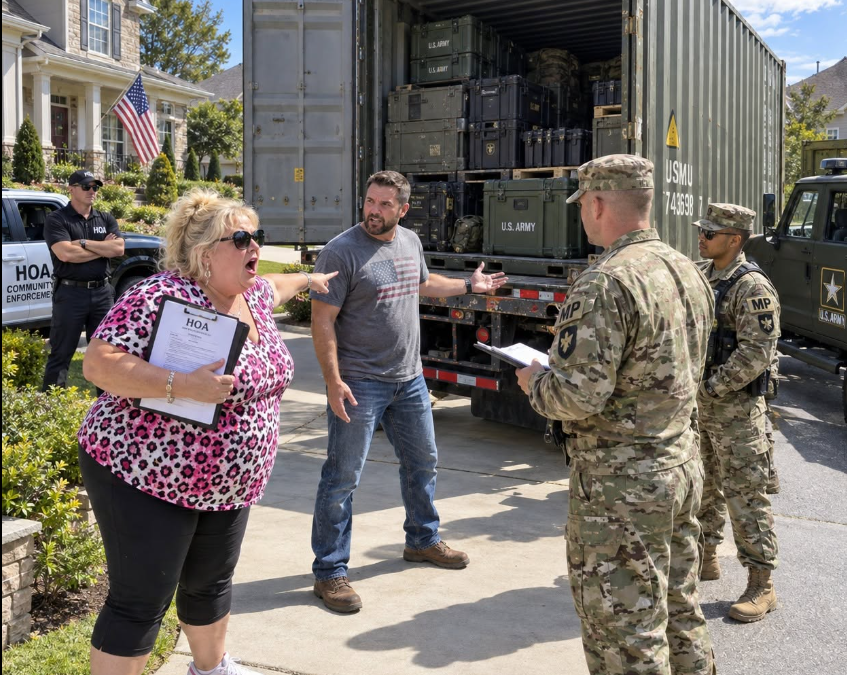
HOA Karen Stole My Shipping Container From Private Ranchland—Then Military Police Arrived Asking Where Their Missing Gear Went.
Karen Whitcomb thought she was removing an ugly container from her subdivision view, but she had actually dragged a retired Army logistics officer’s entire life off private Texas ranchland. She smiled while the tow truck driver chained up my property, certain her HOA rulebook outranked my deed, my fence, and the county line. Then the military police arrived asking one simple question: where did their government-marked case go?
My name is Mark Peterson, Chief Warrant Officer Four, retired.
For twenty-five years, I moved Army equipment across continents, deserts, mountains, ports, railheads, convoy routes, airfields, and the kind of temporary staging yards that look like chaos to civilians but make perfect sense if you understand logistics.
I had moved armored vehicles in sandstorms.
Generators through flooded roads.
Pallets of medical gear into forward operating bases.
Communications equipment through enough property-book inspections to make grown officers sweat through their uniforms.
If there is one thing the Army teaches you, it is this:
Property does not disappear.
Not if the right warrant officer is watching.
I thought retirement would be quieter.
That was the whole point.
I bought forty acres off County Road 3 in rural Texas with my life savings because I wanted sky, distance, and the right to drink coffee without hearing anyone argue about lawn height. The land was raw and honest. Mesquite. Grass. A shallow dry creek that filled during hard rain. A few old fence posts still leaning from whoever had run cattle there decades before.
No covenants.
No restrictions.
No architectural committee.
No mailbox paint chart.
Just land.
My land.
I was living in a temporary trailer while I finalized plans for a small house. Nothing grand. One bedroom, one office, a deep porch, a metal roof, a workshop, and enough room for a dog I had not yet admitted I wanted.
Most of what I owned sat inside a twenty-foot shipping container near the trailer.
That container was ugly.
I knew that.
It was dented, weather-faded, and military green under old dust. It had crossed oceans before I bought it surplus. The doors complained when opened. The steel sides held scratches from forklifts, chains, straps, and whatever miserable port had last abused it.
But inside was my life.
My father’s tools.
My mother’s photo albums.
My uniforms.
My medals.
Old field desks.
Books.
Records.
Furniture.
Boxes labeled with the obsessive precision of a man who had spent too long knowing missing inventory could ruin a career.
And tucked behind a secured false panel in the back, one hard case that did not belong to me.
That part mattered later.
On the morning Karen Whitcomb showed up, I was standing beside the trailer with coffee in one hand and a site plan in the other, trying to decide where the house foundation should sit. The morning air still held a little coolness before the heat arrived. I could smell dry grass, dust, and the faint metal scent of the container warming under the sun.
Then the tow truck came grinding up the road.
Yellow lights flashing.
Engine coughing.
Chains rattling.
Behind it came a white Lexus SUV that looked too clean to have ever made a wrong turn onto a county road.
A woman climbed out wearing a beige pantsuit, gold rings, heavy perfume, and the expression of someone who had already convicted me in a court that existed entirely inside her own head.
She planted herself just on my side of the old barbed-wire fence that marked the boundary between my forty acres and Whispering Pines, the subdivision next door.
Cookie-cutter houses.
Manicured lawns.
Decorative stone entrance.
A fountain that ran even during drought, because apparently water restrictions were for people without committees.
She lifted a laminated sheet from a folder.
“This unsightly industrial blight is a violation of Covenant 7.4B,” she announced. “And as president of the Whispering Pines Homeowners Association, I am having it removed from the community at your expense.”
For a few seconds, I just looked at her.
Then I looked at the tow truck driver.
Then at my container.
Then back at Karen.
“Ma’am,” I said, “you are standing on private ranchland.”
Her smile tightened.
“This parcel borders Whispering Pines and is subject to view corridor standards.”
“No, it isn’t.”
“Yes, it is.”
“No,” I said again, slower. “It is not.”
She held up the laminated sheet as if I might be intimidated by plastic.
“Covenant 7.4B prohibits storage containers, industrial trailers, and other nonresidential structures visible from association property.”
“That may apply inside Whispering Pines.”
“It applies to the view corridor.”
PART2:
“There is no view corridor on my deed.”
She gave a small laugh.
The kind people use when they think patience is a gift they are giving you.
“Mr. Peterson, we’ve tried to handle this politely.”
That was news to me.
“This is the first time I’ve ever seen you.”
“We sent notices.”
“No, you didn’t.”
“We sent them to the last mailing address on county record.”
“I bought this land six months ago. My mailing address is recorded.”
“That is not my responsibility.”
“It became your responsibility the moment you brought a tow truck onto my property.”
The driver shifted beside his truck.
He was a young man, maybe early thirties, sunburned neck, baseball cap, work boots, and the uncertain expression of someone realizing the job was not as simple as the dispatcher made it sound.
“Ma’am,” he said to Karen, “I thought you said this was HOA property.”
“It is association-controlled frontage.”
I looked at him.
“It is not.”
Karen ignored me.
“Proceed with removal.”
The driver looked at the container.
Then at me.
“Sir, is that yours?”
“Yes.”
“Do you have paperwork?”
I almost smiled.
“Son, I’m retired Army logistics. I have paperwork for paperwork.”
Karen rolled her eyes.
“The association has already authorized abatement.”
“Association doesn’t own this land,” I said.
She turned toward me.
“Mr. Peterson, this kind of obstruction affects property values. Our residents did not purchase homes in Whispering Pines to look at a military junk box.”
“Then they shouldn’t have bought homes next to rural land.”
Her face changed.
Not much.
Just enough.
People like Karen are used to disagreement, but only the kind they can label as ignorance. They are less prepared for a calm no.
She stepped closer.
“You have twenty-four hours to remove it voluntarily or we will proceed.”
I pointed toward the tow truck.
“You brought the truck now.”
“As a courtesy.”
“That’s not a courtesy. That’s trespass with hydraulic equipment.”
The driver looked increasingly uncomfortable.
Karen snapped her folder shut.
“Hook it.”
“No,” I said.
The driver froze.
Karen glared at him.
“You have a signed work order.”
He looked at the papers in his hand.
“It says Whispering Pines HOA requests removal of abandoned storage container.”
“It’s not abandoned,” I said. “It’s twenty yards from my trailer.”
He swallowed.
“Yeah, I see that.”
Karen’s voice sharpened.
“Mr. Dawson, your company accepted the contract. Remove the container.”
I pulled my phone from my pocket and started recording.
“For the record,” I said, “my name is Mark Peterson. This container is my property. It sits on my land. I am telling Karen Whitcomb, president of Whispering Pines HOA, and the tow operator not to remove it. You do not have permission to touch it.”
Karen gave the camera a bright smile.
“For the record, Whispering Pines HOA is enforcing Covenant 7.4B after repeated noncompliance.”
“You have been told this is not HOA property.”
“Your interpretation is noted.”
“Your trespass is being recorded.”
She looked at the driver.
“Proceed.”
The driver hesitated one more time.
That was the moment he could have saved himself.
He did not.
He backed the truck toward the container.
Chains rattled across the ground.
Dust rose around his boots.
I stood there filming while he crawled underneath the front corner and began attaching equipment.
Every instinct in my body wanted to stop him physically.
I did not.
I had spent enough years around soldiers, civilians, contractors, and angry officials to know that the first person to put hands on someone often loses control of the record. Karen wanted a confrontation. She wanted me shouting. She wanted me pushing the driver. She wanted me to become the unstable veteran with the ugly container.
So I did the one thing she did not expect.
I let her talk.
“You realize this is theft,” I said.
“It is enforcement.”
“You are removing personal property from land you do not own.”
“It is an abandoned industrial structure in violation of community standards.”
“My trailer is right there.”
“That does not change the violation.”
“You crossed a fence line.”
“View corridor access is permitted.”
“Show me that recorded easement.”
She looked at me with open contempt.
“Not everything needs to be recorded to be enforceable.”
I laughed once.
I could not help it.
“Ma’am, that sentence has ruined more people than whiskey.”
The tow truck engine roared.
The container groaned.
The driver winched it inch by inch onto the rollback system, steel scraping against gravel and caliche. One corner dragged hard, gouging a line in the ground. Something inside shifted with a dull thud.
My jaw tightened.
That container held my father’s tool chest.
The one he kept in his garage for forty years.
It held my mother’s photo albums in sealed tubs.
It held uniforms I had not worn since my retirement ceremony, awards I did not display but could not throw away, and the furniture I had planned to put inside the house that existed only as stakes and drawings.
And it held the hard case.
The one I had not opened.
The one I had reported.
The one Army property officials had told me to secure until pickup.
Two months earlier, during my retirement move, a sealed government-marked case had turned up in a pallet of personal property shipped from a storage annex near Fort Cavazos. It had been logged incorrectly during a unit reorganization, mixed with surplus furniture, and delivered with my household goods. I recognized the property tag immediately.
U.S. GOVERNMENT PROPERTY.
CONTROLLED EQUIPMENT.
DO NOT OPEN EXCEPT BY AUTHORIZED PERSONNEL.
The case contained no weapons.
No ammunition.
No dramatic classified movie nonsense.
But it did contain controlled communications support equipment tied to a unit property book, and in the Army, that is more than enough to make phones ring before breakfast.
I called my old unit the day I found it.
Then the property book officer.
Then the installation logistics office.
Then, because nothing in the Army can be simple, I spent three days proving I had not stolen something I had already reported.
Eventually, a captain named Leah Morales from the military police investigations office called me.
“Mr. Peterson, secure the case as found. Do not open it. Do not transport it. We’ll coordinate pickup once the inventory discrepancy is cleared.”
“I can bring it to post.”
“Negative. Leave it secured. We need chain-of-custody clean.”
So I secured it.
Behind a locked panel in my container.
And now Karen Whitcomb was having the entire container dragged off my land because the color offended her subdivision view.
I called the sheriff’s office while the truck was still loading.
Then I called Captain Morales.
She answered on the fourth ring.
“Morales.”
“Captain, this is Mark Peterson.”
“Yes, Mr. Peterson.”
“We have a problem.”
“What kind of problem?”
“The controlled case you told me to secure is inside my container.”
Silence.
Then her voice changed.
“Why is that a problem?”
“Because the HOA next door just hired a tow company to steal the container.”
Another silence.
This one was colder.
“Say that again.”
I looked at Karen, who was now photographing the container like she had personally captured a war trophy.
“A civilian HOA is removing the container from my private property without permission. The case is inside.”
“Are they still on scene?”
“Yes.”
“Do not interfere physically. Keep recording. Provide location.”
I gave it.
“Mr. Peterson,” she said, “where are they taking it?”
I turned toward the driver.
“Where are you taking my container?”
He looked away.
Karen answered for him.
“An authorized storage facility pending payment of removal and compliance fees.”
Captain Morales heard that through the phone.
Her voice became very calm.
That was not good for Karen.
“Mr. Peterson, stay available. We are notifying local law enforcement and command.”
The tow truck pulled away ten minutes later with my container chained to it.
Dust rose behind the tires.
Karen stood beside her Lexus watching it go.
She looked satisfied.
That was what I remember most.
Not anxious.
Not uncertain.
Satisfied.
She turned toward me.
“You’ll receive an invoice.”
I lowered the phone.
“You’ll receive visitors.”
She gave me that same polished smile.
“Threats will not help your situation.”
“No,” I said. “But federal property records might help yours get worse.”
Her smile faltered for the first time.
“What is that supposed to mean?”
“It means you just took something you should not have touched.”
“I removed an eyesore.”
“You removed a container holding government-marked property awaiting military pickup.”
For a second, the Texas wind seemed to stop.
Karen’s eyes narrowed.
“That is absurd.”
“You should hope so.”
She stared at me, then opened her car door.
“This is exactly the kind of intimidation Whispering Pines expected from you.”
She drove away.
I saved the video.
Then I walked the gouge marks where the container had been dragged across my land.
The ground looked wounded.
A rectangular patch of crushed grass remained where the container had sat. The site plan I had been holding earlier lay facedown near the trailer steps, blown there by the wind. My coffee had gone cold on the hood of my truck.
I picked up the cup and stood alone in the empty spot.
That was the first time anger really hit me.
Not the hot kind.
The steady kind.
The kind that does not shout because it has already started making a list.
At 10:42 a.m., Deputy Raul Martinez from the county sheriff’s office arrived.
He was broad-shouldered, calm-eyed, and moved like a man who had spent years learning not to rush into other people’s chaos.
He took my statement.
He watched the video.
He photographed the empty site, the gouge marks, the broken fence wire where the tow truck had crossed, and the tire tracks.
Then he asked one question.
“Did you tell them not to take it?”
I handed him the phone.
He watched the video again.
“Several times,” he said.
“Yes.”
He looked toward Whispering Pines.
“And she claimed HOA authority?”
“Yes.”
“Are you in the HOA?”
“No.”
He pulled up county property records on his tablet.
I gave him my parcel number.
He studied the screen.
Then looked at the fence line.
“This is your parcel.”
“Yes.”
“No subdivision restriction listed here.”
“Correct.”
“No Whispering Pines ownership interest.”
“Correct.”
He exhaled through his nose.
“That’s a problem.”
“For them?”
“For everybody until we find that container.”
At 11:18, Captain Morales called back.
“Mr. Peterson, we have military police coordinating with the sheriff’s office. A CID agent is also being notified because of the property-book issue. Do you know the tow company?”
“Dawson Towing.”
“Do you know the storage yard?”
“No.”
Deputy Martinez heard me say the name and radioed dispatch.
Within twenty minutes, dispatch confirmed Dawson Towing had delivered the container to a fenced impound yard twelve miles away.
By noon, the story had moved faster than Karen’s Lexus ever could.
The sheriff’s office called Dawson Towing.
Dawson Towing called its driver.
The driver called his boss.
His boss called Karen.
Karen called the HOA attorney.
The HOA attorney probably considered changing his phone number.
At 1:05 p.m., two military police vehicles rolled onto County Road 3.
They were followed by an unmarked government SUV.
Captain Leah Morales stepped out first.
She was in uniform, late thirties, composed, and had the kind of expression I had seen on supply sergeants who found missing night-vision equipment during inspection week.
Behind her was a civilian CID agent named Brooks.
He showed identification, shook my hand, and said, “Mr. Peterson, we need to account for the government-marked case.”
“I understand.”
Captain Morales looked at the empty patch where the container had been.
“You secured it here?”
“Yes.”
“Locked?”
“Yes.”
“Any access by you after our instruction?”
“No.”
“Any access by unauthorized parties before removal?”
“Not that I know of.”
She looked at the gouge marks.
“Let’s go find it.”
We formed a strange little convoy.
My truck.
Deputy Martinez’s cruiser.
Two military police vehicles.
The unmarked SUV.
By the time we reached Dawson Towing, the owner was standing outside the office looking like a man who had just discovered his business model was about to be audited by God.
His name was Roy Dawson.
He was in his late fifties, heavyset, sweating through a blue work shirt, and talking too fast before anyone even asked a question.
“Look, we were told it was authorized. We got a signed work order. HOA abatement. Happens all the time.”
Deputy Martinez said, “Not on land they don’t own.”
Roy wiped his face with a rag.
“We didn’t know that.”
Captain Morales stepped forward.
“Where is the container?”
Roy pointed toward the back lot.
“Still sealed. Nobody opened it.”
“Show me.”
The container sat near a chain-link fence, tilted slightly because one corner had been dropped on uneven gravel. The left side had a fresh dent. The locking bar was bent. The doors were still closed, but the padlock was scarred.
My chest tightened.
Captain Morales photographed the exterior.
Agent Brooks photographed the lock.
Deputy Martinez photographed the damage.
Roy Dawson kept saying, “Nobody opened it,” as if repetition could become a legal defense.
I unlocked the container under observation.
The doors groaned open.
The smell of dust, steel, cardboard, and old canvas came out.
My father’s tool chest had shifted and slammed into a stack of furniture blankets. Several boxes had fallen. One plastic tub had cracked, spilling old photographs across the floor.
For a moment, everyone disappeared from my awareness.
I stepped inside and knelt.
My mother’s photos were scattered beneath a field desk.
Black-and-white images.
Wedding pictures.
Christmas mornings.
My father standing beside a 1972 pickup.
My mother holding me as a baby on a porch in Missouri.
I picked one up carefully.
The edge was bent.
That was when Captain Morales’s voice softened.
“Mr. Peterson.”
I looked back.
“The case.”
I nodded.
Professional first.
Grief later.
I moved to the rear panel, opened the secured compartment, and showed them the hard case.
Still locked.
Still sealed.
Still tagged.
Captain Morales read the property number aloud.
Agent Brooks checked it against his paperwork.
“That’s it,” he said.
Captain Morales looked at Roy Dawson.
“This case is U.S. government property. It was under reported secure custody pending official recovery. Your company transported it without authorization.”
Roy’s face drained.
“We didn’t know.”
Agent Brooks said, “That is why people verify authority before removing property.”
The case was photographed, sealed into official custody, and removed from my container.
Captain Morales signed a temporary receipt.
Then she turned to me.
“Mr. Peterson, you did the right thing by reporting immediately.”
“I know.”
Her expression shifted, just slightly.
“I imagine that doesn’t make this feel better.”
“No, ma’am. It does not.”
Deputy Martinez stayed behind after the military vehicles left.
He looked at the damaged container.
“You want to file a theft report?”
“Yes.”
“Criminal mischief?”
“Yes.”
“Trespass?”
“Yes.”
“Anything else?”
I looked at Roy Dawson, who suddenly found the gravel fascinating.
“Whatever the law supports.”
Roy swallowed.
“Mr. Peterson, I’ll get it brought back today.”
I looked at him.
“You’ll bring it back. You’ll repair what your truck damaged. You’ll document every person who touched it. And you’ll give Deputy Martinez a copy of the work order Karen Whitcomb signed.”
Roy nodded quickly.
“Yes, sir.”
It took three hours to return the container.
This time, Dawson Towing sent two trucks, the owner, the original driver, and a man who seemed to exist solely to say “easy, easy” while equipment moved.
Karen did not appear.
But people from Whispering Pines did.
They stood along the subdivision fence line watching the convoy return like it was a parade they had not approved.
By sunset, the container was back on my property.
Not perfectly.
Not undamaged.
But back.
The next morning, I hired an independent appraiser and a contents restoration company.
Then I called an attorney.
Her name was Elena Marquez.
She practiced property and civil litigation in San Antonio and came recommended by a retired colonel who told me, “She smiles like a Sunday school teacher and drafts pleadings like artillery.”
That sounded useful.
I brought her everything.
The deed.
The survey.
The video.
The sheriff’s report.
Photos.
The tow work order.
The Dawson invoice.
Military receipt documentation showing the government case had been inside.
Damage estimates.
Inventory lists.
The HOA covenant Karen had cited.
Elena read quietly for almost an hour.
Then she looked up.
“Mr. Peterson, are you a member of Whispering Pines HOA?”
“No.”
“Is your parcel inside the subdivision plat?”
“No.”
“Is there any recorded view easement affecting your property?”
“No.”
“Did they enter your land after being told not to?”
“Yes.”
“Did they remove a container full of personal property?”
“Yes.”
“Did that container include U.S. government property under pending recovery?”
“Yes.”
She leaned back.
Then she smiled.
It was a very small smile.
I understood why the colonel had mentioned it.
“This is going to be uncomfortable for them.”
“How uncomfortable?”
“Depends how quickly they learn fear.”
The first letter went out that afternoon.
It went to Karen Whitcomb.
The Whispering Pines HOA board.
Dawson Towing.
The HOA management company.
Their attorney.
It demanded preservation of all records, emails, texts, work orders, board minutes, violation notices, photographs, invoices, and communications related to my property, the container, and Covenant 7.4B.
It demanded immediate written admission that Whispering Pines held no authority over my land.
It demanded reimbursement for damage.
It demanded compensation for lost use, restoration costs, trespass, conversion, emotional distress associated with personal effects, and attorney’s fees.
It also demanded the HOA notify its insurer.
That last line mattered.
Insurance companies dislike surprises.
They especially dislike surprises involving intentional trespass, unauthorized towing, and military investigators.
Karen responded first.
Not through counsel.
Personally.
She sent an email at 6:14 p.m.
Mr. Peterson,
Your threats are inappropriate and excessive. Whispering Pines acted within its authority to preserve community aesthetics and protect property values. Any military issue resulted from your improper storage of government property in an unsightly container. The HOA will not be intimidated by your background or aggressive tactics.
Karen Whitcomb
President, Whispering Pines HOA
I forwarded it to Elena.
She replied nine minutes later.
Do not respond. This is useful.
That became the theme of the next month.
Karen kept being useful.
She appeared on a neighborhood Facebook group and wrote that Whispering Pines had “successfully removed a noncompliant industrial structure” but was now being “harassed by an adjacent landowner attempting to militarize a civil covenant matter.”
Screenshots reached me within the hour.
She sent residents a newsletter claiming my land was part of an “aesthetic impact zone.”
Elena found no recorded document using that term.
Karen told a local real estate agent that my property was “under enforcement review.”
The agent sent me an apology after Elena called.
Every time Karen tried to control the story, she created another exhibit.
Meanwhile, the military did what the military does best when property goes sideways.
They documented.
Captain Morales called me three days after recovery.
“Mr. Peterson, the equipment case has been inspected. Chain-of-custody deviation is documented, but seals were intact.”
“Good.”
“The command may issue a letter confirming unauthorized civilian transport occurred.”
“That would help.”
“I assumed.”
A week later, Elena received the letter.
It was dry.
Formal.
Absolutely devastating.
It confirmed that the case contained U.S. government property, had been reported by me prior to removal, was awaiting official recovery, and had been transported from my property without authorization by a civilian towing company acting under direction of Whispering Pines HOA representatives.
No adjectives.
No outrage.
Just facts.
The best legal letters are often boring enough to kill a room.
Elena filed suit in county district court two weeks later.
Peterson v. Whispering Pines Homeowners Association, Karen Whitcomb, and Dawson Towing.
Claims included trespass, conversion, civil theft, negligence, damage to personal property, improper assertion of authority over non-HOA land, and declaratory judgment confirming Whispering Pines had no jurisdiction over my parcel.
The complaint attached the survey, deed, videos, photos, work order, sheriff’s report, military letter, and Karen’s own email.
Dawson Towing settled early.
Very early.
Roy Dawson’s attorney called Elena after reading the complaint and said, “We would like to be the least stupid defendant in this case.”
They paid for container repairs, property damage, restoration of personal items, and part of my attorney’s fees. In exchange, they remained in the case only long enough to testify truthfully about who hired them and what Karen represented.
That left Whispering Pines and Karen.
The HOA tried to distance itself from her.
That did not go well.
Discovery produced the emails.
The first was from Karen to the board three weeks before the towing.
Subject: Peterson Container Problem.
He is technically outside the platted lots, but the container is visible from Pine Needle Lane and undermines the premium image of our community. We need to treat this as an extension of our view corridor authority.
Technically outside.
That phrase was gold.
Another board member, David Lyle, replied:
Do we actually have authority over his parcel?
Karen answered:
Authority follows impact. If his property affects ours, we have a right to act.
I printed that one and stared at it for a long time.
Authority follows impact.
In twenty-five years of Army logistics, I had heard privates invent better legal theories while explaining missing fuel cans.
Another email showed Karen had obtained the tow estimate herself.
Another showed the management company warning her:
We do not recommend removal without confirmation of recorded enforcement authority.
Karen replied:
I am confirming it as HOA president.
Elena loved that one.
“She confused confidence with confirmation,” she said.
The HOA attorney tried to argue Karen acted outside the scope of her authority.
Then we found the meeting minutes.
The board had discussed “external visual nuisances” and authorized Karen to “take appropriate steps regarding the Peterson container.”
Appropriate steps.
That vague phrase became their problem.
Because Karen interpreted it as permission to enter my land and take my property.
And the board had never bothered to define what it meant.
The hearing for temporary relief happened in late spring.
The courtroom was cool, quiet, and full of Whispering Pines residents who had apparently come to see whether Karen could charm a judge the way she charmed committee luncheons.
Judge Samuel Ortiz presided.
He was compact, gray-haired, and had the patient expression of a man willing to let people talk themselves into consequences.
Elena presented first.
She did not dramatize.
She did not need to.
She showed the deed.
My forty acres outlined in yellow.
The Whispering Pines subdivision boundary outlined in blue.
Two separate parcels.
No overlap.
No recorded covenant.
No easement.
No view corridor.
Then she played the video.
Karen’s voice filled the courtroom.
“This unsightly industrial blight is a violation of Covenant 7.4B, and as president of the Whispering Pines Homeowners Association, I am having it removed from the community at your expense.”
Then my voice:
“You are standing on private ranchland.”
Then Karen:
“This parcel borders Whispering Pines and is subject to view corridor standards.”
Then me:
“Show me that recorded easement.”
Then Karen:
“Not everything needs to be recorded to be enforceable.”
Judge Ortiz made a note.
Elena paused the video.
“Your Honor, the defendant’s entire position is contained in that sentence. They believed they could enforce unrecorded preferences against land they did not own.”
The judge looked at the HOA attorney.
He looked unhappy.
Elena continued.
She introduced the tow footage.
The sheriff’s report.
The military letter.
The damage photos.
The email saying “technically outside.”
The management company warning.
The board minutes.
Then she called Roy Dawson.
Roy looked like he would rather be anywhere else.
“Who hired you?” Elena asked.
“Whispering Pines HOA, through Mrs. Whitcomb.”
“What were you told?”
“That the container was abandoned or noncompliant and authorized for removal.”
“Did Mrs. Whitcomb tell you the land belonged to Mr. Peterson?”
“No.”
“Did Mr. Peterson tell you not to remove it?”
“Yes.”
“Did you remove it anyway?”
“Yes.”
“Why?”
Roy swallowed.
“Mrs. Whitcomb said the HOA had authority.”
Elena let that sit.
Then Captain Morales testified.
She was precise.
Professional.
Terrible for Karen.
She confirmed that the government case had been under reported secure custody at my property. She confirmed it had been removed without authorization. She confirmed the seals remained intact after recovery, but the chain-of-custody disruption required documentation and command review.
The HOA attorney tried to ask whether the case contained anything dangerous.
Captain Morales looked at him.
“I am not here to describe the contents beyond what is appropriate. I am here to confirm it was U.S. government property and it was not authorized for civilian towing.”
That answer was enough.
Then Karen testified.
She wore beige again.
Not the same pantsuit, but close enough that it felt like a tactical error.
Her attorney guided her through phrases like community welfare, property values, good faith, visual impact, and reliance on association authority.
Then Elena stood.
“Mrs. Whitcomb, is Mr. Peterson’s land inside Whispering Pines?”
“It borders Whispering Pines.”
“That wasn’t my question.”
Karen hesitated.
“No.”
“Is his parcel shown on the Whispering Pines subdivision plat?”
“No.”
“Is he a member of the HOA?”
“No.”
“Did he sign the covenants?”
“No.”
“Does Whispering Pines hold a recorded easement over his land?”
“Not that I’m aware of.”
“Did your management company warn you not to remove the container without confirming recorded authority?”
Karen’s mouth tightened.
“They offered an opinion.”
Elena displayed the email.
“We do not recommend removal without confirmation of recorded enforcement authority. That is what they wrote?”
“Yes.”
“You replied, ‘I am confirming it as HOA president.’ Correct?”
“Yes.”
“What document were you relying on?”
“Covenant 7.4B.”
“Does Covenant 7.4B apply to nonmembers outside the subdivision?”
“It applies to visual nuisances affecting the community.”
“Please show the court where it says that.”
Karen looked down.
Her attorney shifted.
She did not answer.
Elena waited.
Judges notice waiting.
Finally Karen said, “It is implied.”
Elena turned slightly toward Judge Ortiz.
“Implied by whom?”
Karen’s face flushed.
“By the purpose of the covenant.”
“And the purpose gave you the right to enter private ranchland and remove a container?”
“I believed—”
“Did you ask a court?”
“No.”
“Did you call the sheriff before removal?”
“No.”
“Did you obtain written permission from Mr. Peterson?”
“No.”
“Did you continue after he told you not to touch it?”
Karen looked toward me.
Then away.
“Yes.”
Elena clicked to the next exhibit.
“After learning the container held U.S. government property, did you email Mr. Peterson accusing him of improper storage and aggressive tactics?”
Karen said nothing.
“Mrs. Whitcomb?”
“Yes.”
Elena read the email aloud.
The courtroom was silent.
Then came the final question.
“Mrs. Whitcomb, at any point before sending a tow truck onto Mr. Peterson’s land, did you ask yourself whether being HOA president gave you authority outside the HOA?”
Karen’s voice was barely audible.
“I believed I was protecting the community.”
Elena nodded.
“That was not my question.”
Karen did not answer.
Judge Ortiz ruled from the bench on part of the matter.
He granted a temporary injunction prohibiting Whispering Pines, its board, agents, contractors, or representatives from entering my property, attempting enforcement against my parcel, placing notices, contacting contractors about my land, or asserting HOA jurisdiction over my property.
Then he addressed the broader case.
“I am troubled,” he said, “by the association’s apparent belief that aesthetic preference can create property authority where no recorded instrument exists.”
Karen stared at the table.
“The court is further troubled by the removal of a container after the landowner expressly objected and by the subsequent discovery that the container held government property awaiting official recovery.”
The judge ordered the HOA to preserve all records.
He ordered them to notify their insurance carrier.
He ordered Karen not to contact me directly.
Then he said something I wrote down later from memory.
“Property lines do not become flexible because a view is inconvenient.”
That sentence became famous in Whispering Pines.
Not because I spread it.
Because the residents did.
After the hearing, the HOA changed.
Not morally.
Financially.
Insurance got involved.
The carrier reserved rights, which is insurance language for “we might not pay for this mess if you created it on purpose.”
Residents received notice of potential litigation exposure.
A special meeting was called.
For the first time, Whispering Pines homeowners began asking Karen questions she could not answer with perfume and posture.
Why had she acted against legal advice?
Why had she authorized towing outside the subdivision?
Why had she ignored the management company?
Why had she failed to confirm ownership?
Why was the HOA paying lawyers because she wanted a container gone?
One resident stood and said, “I don’t like looking at that container either, but I like not getting sued more.”
That seemed to summarize the community mood.
Karen tried to defend herself.
She talked about standards.
Investment protection.
Leadership.
Difficult decisions.
Then David Lyle read the email aloud.
He is technically outside the platted lots.
The room turned on that word.
Technically.
Because “technically outside” meant actually outside.
And everyone understood it.
Karen resigned as president that night.
She did not apologize.
People like Karen often mistake losing power for being wronged.
The civil case settled four months later.
Whispering Pines admitted, in writing, that it had no jurisdiction over my parcel.
The admission was recorded in county property records.
That was my requirement.
Elena thought I might be willing to accept money and move on.
I told her paper mattered more than the check.
She smiled.
“I suspected you’d say that.”
The settlement paid for repairs, restoration of damaged property, attorney’s fees, survey costs, loss of use, and a confidentiality-free statement correcting the HOA’s prior claims.
I refused confidentiality.
If an HOA steals a man’s shipping container off non-HOA land, the neighborhood should be allowed to learn from it.
Dawson Towing paid separately.
Roy Dawson came out personally when the repaired container was returned from a fabrication shop.
He stood beside it awkwardly.
“Mr. Peterson, I’m sorry.”
I looked at him for a moment.
He seemed sincere.
“You should have stopped when I said it was mine.”
“I know.”
“You should have checked the deed.”
“I know.”
“You should never let someone else’s confidence replace your own verification.”
He nodded.
“No, sir.”
That was enough.
I did not need to hate him.
He had learned more than he wanted to.
Karen, on the other hand, moved six months later.
Her house sold quickly.
Whispering Pines was still pretty.
Fountains still ran.
Lawns were still trimmed.
Mailboxes still matched.
But something had changed.
The HOA newsletter became shorter.
The board stopped using words like aesthetic impact zone.
A new policy required legal review before any enforcement action near external boundaries.
Residents started asking for recorded authority when the board made claims.
That was healthy.
Annoying for the board, probably.
But healthy.
As for me, I built the house.
Metal roof.
Deep porch.
Workshop.
One bedroom.
One office.
And, yes, eventually a dog.
A brown mutt from the county shelter who looked at my forty acres like he had personally liberated them. I named him Major, even though he had no discipline whatsoever.
The container stayed.
I cleaned it.
Repainted it.
Set it on a proper gravel pad behind the workshop where it was less visible from the road.
Not because Karen had been right.
Because I finally had time to do it the way I wanted.
I put a small sign on it.
PROPERTY OF MARK PETERSON
NOT ABANDONED
NOT HOA CONTROLLED
YES, THERE IS PAPERWORK
Most people laugh when they see it.
The military case was long gone by then, recovered properly, signed over properly, documented properly. Captain Morales called once more after everything closed.
“Mr. Peterson,” she said, “just wanted you to know the property issue is resolved.”
“Glad to hear it.”
“And for what it’s worth, your documentation was excellent.”
That meant more to me than it probably should have.
Old habits.
A year after the tow truck came, I stood on my porch at sunrise with coffee in my hand and watched Major chase grasshoppers through the yard.
The repaired container sat behind the workshop, dull green in the morning light.
The Texas sky opened wide over the land.
No fountain.
No committee.
No beige pantsuit.
Just wind, mesquite, dust, and quiet.
I thought about Karen’s first words to me.
“This unsightly industrial blight is a violation of Covenant 7.4B.”
She had been so certain.
That was the dangerous part.
Not the rulebook.
Not the tow truck.
Certainty.
The kind that convinces people they do not need to check boundaries.
The kind that turns preference into policy.
The kind that makes a person believe a laminated covenant can outrank a recorded deed.
Karen thought my container was ugly.
Maybe it was.
But ugly is not illegal.
Visible is not abandoned.
Neighboring is not consenting.
And private property does not become community property because someone in a clean SUV dislikes the view.
The Army taught me to track what matters.
Serial numbers.
Receipts.
Transfer forms.
Signatures.
Coordinates.
Custody.
The ranch taught me the same thing in a different language.
Fence lines.
Survey stakes.
County records.
Deeds.
Permission.
Karen had none of those.
She had a rulebook from a subdivision I did not belong to and the confidence to misuse it.
For a few hours, that was enough to steal my container.
But it was not enough to keep it.
Because eventually the sheriff asked for the deed.
The attorney asked for the easement.
The judge asked for the authority.
And the military asked where their gear went.
That was the question Karen could not answer.
Not with Covenant 7.4B.
Not with view corridors.
Not with property values.
Not with perfume, posture, or a white Lexus shining in Texas dust.
She had taken something that did not belong to her from land she did not control, and all the polished HOA language in the world could not make that simple fact disappear.
Sometimes I still see trucks slow down on County Road 3.
People glance toward the container.
Maybe they know the story.
Maybe they just wonder why a retired warrant officer keeps an old green box behind his workshop.
Either way, I drink my coffee and let them look.
The container can handle it.
So can I.
After all, it crossed oceans, survived ports, endured forklifts, weather, dust, and one very confused homeowners association.
It came back dented.
But it came back.
And so did the lesson Karen Whitcomb never wanted Whispering Pines to learn:
A rulebook is only powerful where it actually applies.
A signature only matters when signed by someone with authority.
And before you drag a man’s life away on a tow truck, you had better know exactly whose property you are touching.
Because sometimes the ugly green box by the trailer is not an eyesore.
Sometimes it is evidence.
Sometimes it is a chain of custody.
Sometimes it is the one thing that makes the military, the sheriff, the insurance company, the judge, and the entire subdivision ask the same question at the same time.
Who told Karen she had the right?