HOA Karen Spray-Painted My $40,000 Solar Panels Pink—Then Learned They Powered 17 Cameras That Had Recorded Months of Her Crimes.
PART3:
Nineteen forty-three.
I printed that bill and taped it inside the garage cabinet next to the inverter. Not because I was cheap. Because after years of medical statements arriving like threats, that little bill felt like proof that we were finally building something that gave back.
For a while, Willowbrook felt like the right decision.
The neighbors were mostly normal. A retired teacher named Mrs. Alvarez lived across the street and brought Emma homemade cookies shaped like stars. A young couple, Mark and Talia Reed, lived two doors down and had twins who treated our driveway like a public racetrack. At the corner was Owen Price, a widower with a bad knee and a habit of walking at dawn with a flashlight even in summer.
People waved.
Kids rode bikes.
Dogs escaped.
Packages got delivered to the wrong porch.
Ordinary life.
Then I met Victoria Ashworth.
Victoria was the president of the Willowbrook Estates Homeowners Association. She lived on Briar Lane in the largest house in the development, a stone-front place with black shutters, a circular driveway, and seasonal wreaths that looked professionally installed because they were.
Her husband, Preston, owned Ashworth Property Solutions, a company that handled landscaping, pressure washing, fence staining, roof cleaning, holiday lights, and, as I would later learn, several “preferred vendor” contracts with the HOA.
Victoria introduced herself three weeks after our solar panels went active.
She came to my door wearing white jeans, a navy blouse, gold bracelets, and a smile that had been sharpened before use.
“Mr. Blake,” she said. “Welcome to Willowbrook.”
“Thank you.”
“I’m Victoria Ashworth, HOA president.”
I knew.
Everybody knew. Her name appeared on more neighborhood emails than the trash pickup schedule.
She looked past me toward the roofline.
“I wanted to discuss the panels.”
I stepped outside and closed the door behind me because Sarah was resting on the couch.
“They’re permitted.”
Her smile held.
“I’m sure you believe that.”
“No. I know that.”
“The HOA has architectural standards.”
“I submitted the paperwork.”
“You submitted an informational notice.”
“No,” I said. “I submitted the required architectural modification application with county permits, contractor licenses, electrical diagrams, structural load documentation, and the state solar rights form.”
That made the smile flicker.
Only slightly.
“Solar rights form?”
“Yes.”
Victoria blinked once, then recovered.
“Our guidelines still require installations to maintain visual harmony.”
“Visual harmony is not a safety requirement.”
“It is a community standard.”
“The panels are black-on-black, low-profile, square to the roof plane, and not visible from most streets unless someone stands in my driveway and looks up.”
She did exactly that.
Stood in my driveway and looked up.
Then she sighed.
“Grant, may I call you Grant?”
“No.”
That was not the answer she expected.
Her eyes returned to me.
“I understand you may be proud of your little project,” she said. “But Willowbrook is a carefully maintained community. We cannot allow every homeowner to turn their roof into an industrial experiment.”
I remember the phrase because Emma repeated it later.
Industrial experiment.
That night at dinner, she asked, “Dad, is our roof an industrial experiment?”
Sarah nearly choked on her tea.
I said, “It is a sunlight jar with a hat.”
Emma considered that.
“Better.”
I thought Victoria would send a notice, maybe a fine, maybe a demand. She did all three.
The first letter said my solar array violated aesthetic guidelines because it was “overly reflective and visible from common areas.”
It was not reflective. The panels were anti-glare.
The second said battery storage required additional review.
It did not. The battery system was indoors, code-compliant, and permitted.
The third assessed a $500 fine for failure to obtain final HOA approval.
I responded with copies of everything.
County permit.
Final inspection.
Interconnection approval.
Architectural submission receipt.
State law limiting unreasonable HOA restrictions on solar installations.
That last piece mattered.
Victoria did not like it.
She replied through the HOA’s management company, claiming the board was “reviewing the applicable law” and expected me to “maintain cooperative posture.”
Cooperative posture.
I had spent years in the Army. I knew what posture meant when people used it instead of position.
It meant stand where we put you.
I ignored the fine.
Then came the security cameras.
They were not originally part of any grand plan.
The first camera was for my driveway. Packages had started disappearing from Willowbrook porches that spring. At first, it was one or two. Then more. Mark and Talia lost baby formula. Mrs. Alvarez lost prescription medication. Owen Price lost a replacement knee brace that somehow got marked delivered and vanished before he could limp to the porch.
The HOA sent an email reminding residents that “visible cameras must conform to exterior device guidelines.”
That was their solution.
A guideline reminder.
So I installed a small camera under my porch eave. Then another facing the side gate. Then one above the garage. They were discreet, legal, and positioned on my property.
One week later, the camera caught a man in a gray hoodie stealing a package from my porch at 3:11 a.m.
I sent the clip to the sheriff.
Then Mark asked if I could help install a camera for him.
Then Mrs. Alvarez asked.
Then Owen.
Then Talia asked whether cameras could cover the corner mailbox station because someone had been opening mailboxes.
Within two months, I had helped neighbors install seventeen cameras across three blocks. Not hidden. Not illegal. All on private homes with homeowner permission. All facing driveways, sidewalks, porches, or shared street views. All configured to respect privacy zones. No bedroom windows. No backyards without consent. No nonsense.
I built the network because I understood systems.
Each camera had local storage, but I also created a shared encrypted archive for clips related to vandalism, package theft, and suspicious activity. My solar battery system powered the central storage hub, wireless bridge, and backup router in my garage. If the grid went out, the network stayed alive.
The neighbors jokingly called it GrantNet.
Emma called it “the neighborhood robot eyes.”
Sarah called it “the thing that made you forget lunch for three days.”
The cameras worked.
Within a month, we caught the package thief. He was not a resident. He was a delivery subcontractor’s cousin borrowing a van and following routes. The sheriff handled it.
You would think the HOA would be grateful.
Victoria was not.
She sent a notice stating that “unapproved surveillance infrastructure” created privacy concerns and damaged the neighborhood’s welcoming character.
I responded that the cameras were individually owned by homeowners, lawfully installed, and not subject to blanket HOA removal.
That was when things became personal.
Victoria began inspecting my property weekly.
Trash can visible from street at 6:03 p.m.
Grass one-half inch above guideline.
Solar conduit visible from sidewalk.
Garage door left open for forty-two minutes.
Children’s chalk art on driveway not removed within twenty-four hours.
That one nearly made Sarah march to Victoria’s house in her slippers.
I appealed every fine.
I won some.
Lost some.
Ignored others.
But while Victoria was busy trying to make me miserable, the cameras kept recording.
They recorded more than package thieves.
They recorded Victoria’s car stopping in front of houses that later received violation notices for things not visible from the street.
They recorded Preston Ashworth’s company truck entering the HOA maintenance shed after midnight.
They recorded board member Russell Fane placing violation stickers on cars that belonged to residents who had complained about Ashworth Property Solutions invoices.
They recorded Victoria meeting with the management company representative outside the clubhouse and saying, very clearly, “Fine them until they stop showing up at meetings.”
They recorded selective enforcement.
They recorded retaliation.
They recorded late-night removal of opposition campaign signs before a board election.
They recorded Preston unloading mulch bags behind the clubhouse, then billing the HOA for “premium landscape installation” at three times retail cost.
They recorded everything.
At first, I did not even realize the value of what we had.
The cameras were there for safety.
Then one night in July, Owen Price came over with a thumb drive and a face like he had swallowed a nail.
“You need to see this,” he said.
It was footage from his side-yard camera, angled toward the service lane behind the clubhouse.
At 11:42 p.m., Victoria and Preston stood beside a golf cart, arguing.
The audio was not perfect, but it was enough.
Preston said, “If the audit committee gets those invoices, they’ll ask why my crews billed for three yards of mulch when we delivered one.”
Victoria replied, “Then make sure Russell delays the records request. I’ll keep them busy with the solar idiot.”
The solar idiot.
That was me.
Owen looked embarrassed when the phrase played.
I laughed once.
Not because it was funny.
Because it confirmed what I had suspected.
Victoria was not enforcing rules.
She was using them as smoke.
After that, I started preserving everything more carefully.
I created date-stamped backups. I documented camera owners and permissions. I wrote summaries but did not edit original footage. I contacted an attorney named Linda Carver, who had represented veterans in housing disputes and had the patience of a judge with the instincts of a bomb tech.
Linda watched several clips in silence.
Then she said, “Grant, do you understand what this is?”
“Evidence.”
“Yes. But also motive.”
“Motive for what?”
“For why she wants your cameras and solar system gone.”
That sentence stayed with me.
Victoria did not hate the solar panels only because they were visible.
She hated them because they powered the one thing she could not control.
Proof.
The board election was scheduled for October.
By August, opposition was forming.
Owen Price, Mrs. Alvarez, and Talia Reed began asking for financial records. Several residents questioned why Ashworth Property Solutions had received so many contracts without competitive bids. A homeowner named Devin Cole requested copies of all violation records to compare enforcement patterns.
Victoria responded by calling a special meeting about “community safety and privacy threats.”
That meeting became the first public battle.
The clubhouse was packed. Residents sat in folding chairs under fluorescent lights while Victoria stood at the front with a microphone, a projector, and a slide that said:
UNAUTHORIZED SURVEILLANCE AND ROOFTOP EQUIPMENT: PROTECTING WILLOWBROOK’S CHARACTER.
My solar panels were on the slide.
A photo of my roof.
A photo of my porch camera.
A photo of Mark and Talia’s camera.
A photo of Mrs. Alvarez’s camera.
She had taken pictures of private homes and assembled them like evidence in a trial.
“Willowbrook is becoming a monitored zone,” she said. “Residents have expressed concern about being recorded without consent.”
Owen stood.
“Which residents?”
Victoria smiled.
“We do not disclose complainants.”
Talia raised her hand. “My camera is on my porch. It records my driveway.”
Victoria said, “The issue is broader than individual intention.”
I stood then.
Everyone turned.
I hated public speaking unless it involved technical briefings. HOA politics felt like warfare conducted through folding chairs.
“Victoria,” I said, “every camera shown on that slide is installed with the homeowner’s permission on their own property. The footage is limited to lawful exterior views. If you have a specific legal concern, identify it.”
She looked at me as if she had been waiting.
“Mr. Blake, the board is aware you have created a centralized surveillance system powered by your unapproved solar installation.”
Murmurs filled the room.
“It is not a surveillance system,” I said. “It is a voluntary security archive.”
“Controlled by you.”
“Maintained by me.”
“Powered by equipment under active violation.”
“Equipment protected by state law and county permit.”
Her smile sharpened.
“That remains disputed.”
“No,” I said. “You keep saying that because you dislike the answer.”
The room went quiet.
Victoria’s eyes hardened.
“You should be careful, Mr. Blake. The board has remedies.”
I looked directly at her.
“So do homeowners.”
That clip, ironically, was recorded by three phones and one camera.
After that meeting, the harassment escalated.
Fines doubled.
Sarah’s garden trellis was cited as an unapproved structure.
Emma’s telescope was cited as “visible recreational equipment.”
My American flag bracket was cited for improper hardware.
A contractor from Ashworth Property Solutions showed up one morning claiming he had a work order to inspect my roofline. I refused him entry. He reported me for obstruction.
Victoria sent a final demand in September.
Remove or relocate solar panels and associated energy storage equipment from visible roof planes within thirty days.
Deactivate unauthorized camera hub and remove all shared recording infrastructure.
Pay outstanding fines totaling $8,750.
Failure to comply may result in further enforcement action.
Linda Carver read the letter and smiled without warmth.
“She’s panicking.”
“She sounds confident.”
“Panic often wears confidence when it has good shoes.”
Linda sent a formal response demanding preservation of all HOA records, board communications, vendor contracts, financial records, enforcement data, and correspondence concerning me, solar equipment, cameras, Ashworth Property Solutions, and selective enforcement.
She also notified the board that multiple homeowners were preparing legal action.
Victoria did not respond through counsel.
She responded through paint.
It was still dark at 5:47 a.m. on October 3rd when I opened the front door to get the newspaper I still subscribed to for reasons Sarah called “old-man cosplay.”
The air smelled sharp and chemical.
Not smoke.
Paint.
I stepped into the driveway barefoot, wearing sweatpants and an old Army PT shirt, and looked up.
For one second, my brain refused the image.
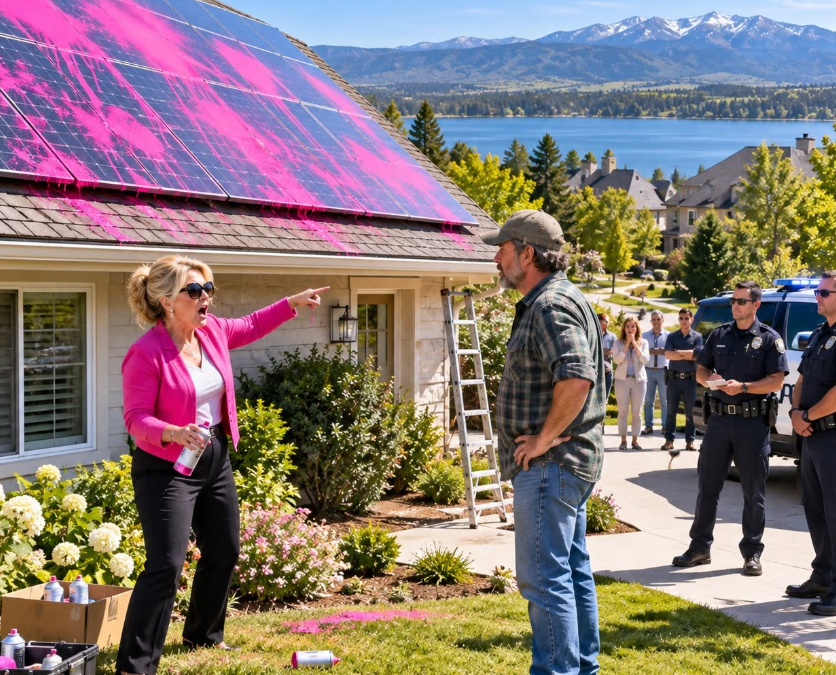
The lower row of solar panels above the garage was streaked hot pink. Not a little mark. Not a prank dot. Wide sweeping lines. Dripping paint. Wet trails running across black glass.
On the ladder leaned against my gutter stood Victoria Ashworth.
She had one hand braced against the roof edge and the other wrapped around a spray can.
Hot pink.
At the base of the ladder, Russell Fane held two more cans and a flashlight.
Victoria turned when she heard the door.
She did not climb down quickly.
She did not apologize.
She did not even look surprised.
She stepped down two rungs, lifted the can slightly, and said, “I’m making the neighborhood respectable again.”
I remember the exact sound of the morning after that.
A dog barking two houses away.
The soft hum of the inverter inside my garage.
A drip of paint hitting my driveway.
My own breath.
Russell whispered, “Victoria, we should go.”
She ignored him.
“You were ordered to remove the panels,” she said.
“No,” I replied. “I was ordered by you. That is not the same thing.”
Her eyes flashed.
“You think you’re untouchable because you have a lawyer and some cameras.”
I looked at the spray can in her hand.
Then at the camera above my garage, its small infrared light glowing red.
Then at the camera across the street on Mrs. Alvarez’s porch.
Then at Mark and Talia’s doorbell camera.
Then at Owen’s side camera, angled down the street.
“Victoria,” I said quietly, “please tell me you know you’re being recorded.”
For the first time, her face changed.
Only slightly.
Her hand tightened around the can.
Russell looked up at the garage camera.
Then at me.
Then at Victoria.
“Vick,” he said, “we need to leave.”
She stepped off the ladder onto the driveway.
“You have no right to record me.”
“You are standing in my driveway vandalizing my property.”
“I am enforcing HOA rules.”
“With spray paint?”
She looked toward the roof again.
Then back at me.
“You people always make this ugly.”
You people.
I did not ask what she meant.
I did not need to.
Sarah had opened the front door by then. She stood wrapped in her robe, pale from sleep, one hand gripping the frame.
Emma appeared behind her.
I wish she had not.
Her face changed when she saw the panels.
Those panels were not just equipment to her. They were six months of weekends. Stickers on wiring diagrams. Questions at dinner. The sunlight jar. The thing she had helped build when our family was trying to rebuild itself.
“Dad?” she whispered.
Victoria looked at her and, for one second, something like shame almost crossed her face.
Almost.
Then she said, “Maybe your father should have followed the rules.”
Sarah moved before I did.
Not toward Victoria.
Toward Emma.
She pulled our daughter back inside and shut the door.
That sound saved Victoria from the words I almost said.
Instead, I took out my phone.
Called the sheriff.
Reported vandalism in progress.
Then I called Linda.
Then I stood there and watched pink paint drip down forty thousand dollars of work while Victoria Ashworth folded her arms like the victim.
Deputy Miles Carter arrived at 6:09 a.m.
By then, three neighbors were outside.
Mrs. Alvarez in a bathrobe.
Mark Reed holding one twin on his hip.
Owen Price leaning on his cane.
Russell had tried to walk away twice. I told him both times he was on video and should probably wait.
To his credit, he waited.
Victoria talked first because people like Victoria believe the first story told becomes the truth.
“Deputy, this is an HOA compliance matter,” she said. “Mr. Blake has repeatedly refused lawful orders to remove non-compliant exterior installations.”
Deputy Carter looked at the pink panels.
Then at the spray can.
Then at me.
“Did you give permission for this?”
“No.”
He turned back to Victoria.
“Ma’am, did you spray paint those panels?”
“I marked them for removal.”
“That is not what I asked.”
“I acted under board authority.”
Deputy Carter looked tired.
It was too early for that level of nonsense.
“Do you have a court order?”
Victoria’s mouth tightened.
“The HOA has enforcement authority.”
“Do you have a court order authorizing you to enter his property and paint his solar panels?”
No answer.
Russell said, “I didn’t paint anything.”
Victoria shot him a look.
He looked at the ground.
Deputy Carter asked if there was video.
Everyone pointed in different directions.
For the first time that morning, Victoria looked around and understood the scale of her mistake.
There was my garage camera.
Mrs. Alvarez’s porch camera.
The Reeds’ doorbell.
Owen’s driveway camera.
A camera above my side gate.
A camera on the mailbox post at Mark’s house, installed after the mail thefts.
The little red lights were everywhere.
Not hidden.
Not secret.
Just ignored by a woman who had become so used to control that she forgot evidence does not ask permission to exist.
By 7:00 a.m., Linda Carver was in my kitchen with her laptop open. Sarah sat beside Emma on the couch, holding her. I could hear Emma crying quietly, and each small sound made it harder to remain calm.
Linda pulled the footage from the central archive.
Victoria and Russell arriving at 5:31.
Victoria carrying a canvas bag.
Russell setting the ladder.
Victoria climbing.
First spray at 5:39.
Clear angle of her face.
Clear audio at 5:47.
“I’m making the neighborhood respectable again.”
Then later:
“Maybe your father should have followed the rules.”
Linda paused the video.
Her jaw tightened.
“She said that in front of your daughter?”
“Yes.”
Linda closed her eyes for one second.
“Grant, this is no longer just vandalism.”
“What is it?”
“The final act in a documented pattern.”
We spent the next six hours assembling that pattern.
Every notice.
Every fine.
Every email.
Every permit.
Every legal response.
Every camera clip.
Victoria threatening me at the clubhouse meeting.
Preston’s midnight deliveries.
Russell placing violation stickers after homeowner complaints.
Victoria removing campaign signs.
Victoria saying, “Fine them until they stop showing up at meetings.”
Preston saying invoices would be questioned.
Victoria calling me the solar idiot.
The work orders to Ashworth Property Solutions.
The inflated invoices.
The selective enforcement spreadsheet Devin Cole had helped create, showing that residents who criticized Victoria received violation notices at four times the rate of residents who supported her.
By noon, Linda had prepared a preservation demand, civil complaint draft, and criminal evidence packet.
By 1:15, the sheriff’s office requested copies of the vandalism footage.
By 2:00, the county building inspector called about potential damage to the solar installation.
By 3:30, my solar contractor, Ben Harlow, stood in my driveway staring up at the pink panels.
Ben had installed the parts I could not legally do myself. He was a calm man generally, but this made him put both hands on his hips and swear under his breath for nearly a minute.
“Can they be cleaned?” I asked.
“Maybe. Maybe not without damaging coatings. Depends on paint type, cure time, solvents, and whether it got into the panel edges.”
“How bad?”
“Bad enough that no one touches them until insurance and manufacturer reps see this.”
Emma came outside then.
Sarah tried to stop her, but Emma slipped past.
She stood beside me, looking up.
“Can the sunlight jar still work?” she asked.
Ben looked down at her.
His expression softened.
“Some of it,” he said. “But we’re going to make sure it gets fixed right.”
Emma nodded like she was accepting a medical diagnosis.
Then she asked, “Why did the lady make them ugly?”
I did not answer right away.
How do you explain to an eight-year-old that some adults cannot stand what they cannot control?
Sarah answered for me.
“Because she forgot other people’s work matters.”
Emma looked at the roof.
Then said, “She should remember.”
She would.
That evening, Willowbrook exploded.
Not physically.
Socially.
Someone posted a photo of the pink panels on the neighborhood forum with the caption:
DID THE HOA DO THIS?
Victoria deleted it.
Someone posted the video.
Victoria deleted that too.
Then Owen posted it from his account with the title:
HOA PRESIDENT VANDALIZES SOLAR PANELS AT 5:47 A.M.
By then, enough residents had downloaded it.
The video spread through texts, emails, private chats, and finally to a local news page.
At 8:42 p.m., Victoria sent an official HOA email.
Residents,
Today’s incident at Lot 38 has been mischaracterized. The board has long attempted to resolve unauthorized exterior modifications through proper channels. Unfortunately, certain homeowners have chosen escalation, surveillance, and public misinformation over community cooperation. We ask residents to avoid sharing illegally obtained recordings.
Victoria Ashworth
President, Willowbrook Estates HOA
At 8:51, Linda sent her response to the board, the management company, and the HOA attorney.
It included the vandalism footage, the permit packet, the state solar rights notice, the selective enforcement summary, and a demand that Victoria and Russell preserve all devices and communications.
At 9:07, the HOA attorney replied only to Linda.
Please direct all further communication through this office.
At 9:10, Victoria posted on the forum:
As president, I will not be intimidated by people weaponizing technology against this community.
At 9:12, the HOA attorney deleted the post.
Too late.
Screenshots are modern fossils.
The emergency board meeting was called for Saturday morning.
Victoria tried to keep it closed.
Residents refused.
By 9:00 a.m., the clubhouse was packed. People stood against walls, in the hallway, and outside near the windows. The room buzzed with anger, shock, and the particular energy of people realizing their dues may have been used against them.
I did not want to attend.
Sarah told me to go.
“Do not let her tell the story without you in the room,” she said.
Emma wanted to come.
We said no.
She argued.
We still said no.
Some fights are adult fights, and children deserve at least one door closed between them and the ugliness.
Victoria sat at the front table with Russell Fane, two other board members, and an HOA attorney named Peter Latham, who looked like he had aged overnight.
Preston Ashworth stood in the back, arms crossed.
He was a tall man with silver hair and a contractor’s tan, wearing a company polo with his own logo over the chest. He had the expression of someone trying to decide whether to be angry or invisible.
Owen sat beside me.
Mrs. Alvarez sat on my other side and patted my hand like I was one of her former students.
Victoria struck the gavel.
“This emergency meeting has been called to address recent misinformation and violations of community privacy.”
The room erupted.
“Did you paint his panels?”
“Why was Russell there?”
“Are our dues paying Preston?”
“What about the invoices?”
“Why did you delete the video?”
Victoria raised her voice.
“Order.”
Nobody gave it to her.
Finally, Peter Latham leaned toward the microphone.
“Residents, please. There are active legal concerns. The board will make a brief statement.”
Victoria took the microphone back.
She should not have.
But Victoria had spent years believing control belonged to whoever spoke last.
“Willowbrook Estates has standards,” she said. “For months, Mr. Blake has refused to comply with lawful architectural requirements, installed surveillance devices that record residents without consent, and encouraged harassment of this board.”
Talia Reed stood.
“You painted his roof.”
Victoria ignored her.
“The incident yesterday morning was an attempt to visually identify noncompliant equipment pending removal.”
Mark Reed shouted, “With pink spray paint?”
Someone laughed.
Victoria’s face tightened.
Owen stood slowly, leaning on his cane.
“I move that we play the footage.”
Peter Latham said, “That would be inappropriate.”
Mrs. Alvarez stood too.
“I second it.”
The room roared.
Victoria banged the gavel.
“No unauthorized recordings will be played in this meeting.”
I stood.
“They were recorded from private property, on cameras installed with homeowner consent, facing exterior areas where there is no expectation of privacy.”
Peter looked at me.
Then at Linda Carver, who had just entered the back of the room carrying a folder.
Linda smiled politely.
Peter looked down.
He knew.
Victoria did not.
She pointed at me.
“This is exactly the problem. You built a private surveillance network to intimidate this board.”
“No,” I said. “I built it because packages were being stolen and the HOA told people to check camera guidelines.”
People murmured.
I continued.
“You hated it because it recorded what you were doing.”
Victoria laughed once.
“What I was doing?”
Linda walked to the front and placed a flash drive on the table.
“Victoria, I recommend you let your attorney speak for you now.”
Victoria stared at her.
“And you are?”
“Linda Carver. Counsel for Grant Blake and several Willowbrook homeowners.”
That changed the air.
Linda turned to the room.
“My clients have preserved evidence of vandalism, selective enforcement, retaliation, financial self-dealing, and possible misuse of association funds. This morning, I am providing notice that all HOA records, board communications, vendor contracts, violation logs, surveillance complaints, and communications involving Ashworth Property Solutions must be preserved.”
Preston pushed off the back wall.
“This is ridiculous.”
Linda looked at him.
“Mr. Ashworth, you may want your own counsel.”
He stopped.
That was the first smart thing he did.
Russell Fane stood abruptly.
“I’m resigning.”
Victoria turned. “Sit down.”
“No.”
The room went silent.
Russell looked at her, then at everyone else.
“I didn’t know she was going to spray paint the panels.”
Victoria’s face went white with anger.
“You held the cans,” someone shouted.
Russell swallowed.
“She told me we were posting a violation marker.”
The room exploded again.
Linda’s eyes narrowed.
“Mr. Fane, did Victoria ask you to accompany her to Grant Blake’s property before sunrise?”
Russell looked at Peter Latham.
Peter closed his eyes.
Russell said, “Yes.”
“Did she say why?”
“She said she had to make the panels unusable enough that he’d take them down.”
A sound moved through the room.
Not a gasp exactly.
Something lower.
Disgust.
Victoria whispered, “You coward.”
Russell stepped away from the table.
“No. I’m done.”
That was the moment her presidency cracked.
Not ended.
Cracked.
The collapse came in discovery.
Civil litigation began within two weeks. Criminal charges came later, but the civil case moved first because Linda had built the file before Victoria picked up the spray can.
We sued Victoria personally, the HOA, Russell Fane, and Ashworth Property Solutions. Claims included vandalism, trespass, property damage, harassment, retaliation, selective enforcement, breach of fiduciary duty, and misuse of HOA authority.
My solar insurer sent its own investigators.
The manufacturer determined several panels had coating damage and warranty contamination. The cleanup required specialized work. Some panels had to be replaced. The battery system and inverters were fine, but the system had to be shut down, tested, cleaned, reinspected, and recommissioned.
The total damage estimate came to just over twenty-three thousand dollars.
Not counting legal fees.
Not counting lost production.
Not counting the emotional damage of watching Emma avoid the driveway for two weeks because she did not want to see “the hurt panels.”
That phrase did more to harden my resolve than any invoice.
The HOA tried to distance itself from Victoria.
Victoria tried to claim she acted under board enforcement authority.
Russell cooperated.
Preston denied everything.
Then the camera footage expanded the case.
There was Victoria at 10:18 p.m. on June 4th, telling Russell to remove Devin Cole’s board campaign sign because “he missed the placement deadline,” even though the deadline had not passed.
There was Preston at 12:06 a.m. unloading cheap mulch behind the clubhouse, followed three days later by an invoice for premium hardwood mulch.
There was Victoria outside the management office, saying, “If Talia keeps asking about invoices, cite her fence.”
There was an Ashworth Property Solutions crew pressure washing the clubhouse for two hours and billing eight.
There was Victoria telling the management company representative, “Grant’s system is the hub. If we get his solar shut down, the cameras become someone else’s hobby.”
Linda paused that clip when she showed it to me.
“Now we have intent.”
I stared at the screen.
I had suspected.
Hearing it was different.
She had known.
She had known the solar powered the hub.
She had known taking out the panels could take out the evidence network.
She had not attacked an eyesore.
She had attacked the witness.
The most damaging evidence came from Victoria herself.
Her phone records, obtained through subpoena, showed messages between her and Preston.
Preston: If Grant keeps recording service lane, invoices become a problem.
Victoria: I’m handling Grant.
Preston: Cameras run off his garage setup?
Victoria: Solar/battery. He brags about it enough.
Preston: Then make the panels the issue.
Victoria: Already did.
Another thread, sent the night before the vandalism:
Victoria: Tomorrow morning. Before people are out.
Russell: Are we authorized to mark them?
Victoria: I am the authorization.
I am the authorization.
Linda printed that one in large type for mediation.
Mediation happened in February.
The room was too warm, the coffee was bad, and Victoria arrived wearing a cream blazer as if wardrobe could soften evidence.
She did not look at me.
Preston did.
He looked angry in the way people look when consequences still feel like insults.
The HOA’s insurance attorney tried first.
He described Victoria’s actions as “an unauthorized personal deviation from board policy.”
Linda placed the HOA meeting minutes on the table.
Three prior votes authorizing escalating enforcement against my solar panels.
Vendor discussions involving Ashworth Property Solutions.
Violation notices sent under board letterhead.
A board-approved legal budget to “address Blake surveillance infrastructure.”
Then she placed the vandalism still image on top.
Victoria with the spray can.
Linda said, “This is not deviation. This is escalation.”
Victoria’s attorney tried next.
He argued emotional distress, neighborhood tension, unclear authority, and frustration after months of noncompliance.
Linda played the clip.
“I’m making the neighborhood respectable again.”
Then the clip with Emma.
“Maybe your father should have followed the rules.”
Nobody spoke for a while after that.
I had not watched that part since the morning it happened.
Hearing Victoria say it again made my hands curl under the table.
Sarah, who had insisted on attending mediation, placed her hand over mine.
Linda asked for full damages, attorney fees, replacement costs, lost energy production, civil penalties, settlement of the selective enforcement claims, reimbursement of improper vendor payments, removal of Victoria and Preston’s company from all HOA contracts, independent financial audit, and recorded policy protections for solar and homeowner security systems.
The HOA attorney said, “That is excessive.”
Linda replied, “Then let a jury watch the child clip.”
The settlement came six weeks later.
The HOA paid for the solar replacement, cleanup, inspection, lost production, legal fees, and a separate damages amount. Victoria and Russell personally contributed. Ashworth Property Solutions returned improperly billed funds and lost all HOA contracts. Preston’s company was barred from bidding on Willowbrook work for ten years. The HOA had to fund an independent audit and mail a corrective disclosure to every homeowner.
Victoria resigned as president before the recall vote removed her.
She claimed health reasons.
No one believed her.
Russell resigned too.
The management company terminated its contract, then tried to look noble while leaving before the audit finished.
The audit found inflated invoices, related-party contracts without disclosure, improper fine targeting, and missing competitive bids. The dollar amount was ugly. Not enormous enough to bankrupt the HOA, but large enough to make every homeowner understand that pink paint had exposed a much bigger stain.
Criminal charges followed after the sheriff and county attorney reviewed the vandalism footage and related messages.
Victoria pleaded to vandalism, trespass, and a reduced fraud-related charge tied to HOA records. Preston settled separately in the civil matter and faced his own business investigation. Russell avoided the worst charges by cooperating early, though he paid for that cooperation with public humiliation and a permanent reputation as the man who held the paint cans.
Through all of it, Emma watched more than I wanted her to.
Not the legal filings.
Not the worst clips.
But children feel stress moving through a house the way animals feel storms.
One Saturday after the new panels were installed, she stood beside me in the driveway and looked up at the roof.
The replacement panels were perfect.
Black.
Clean.
Aligned.
Working.
The sunlight jar was full again.
“Are they better?” she asked.
“They’re new.”
“That’s not what I asked.”
I looked down at her.
She had Sarah’s eyes. Clear and serious and far too good at finding the place where adults hid answers.
“They work,” I said. “But they’re not the same ones we installed.”
She nodded.
“I miss the old ones.”
“I do too.”
“Even though they were just panels?”
I thought about that.
“They weren’t just panels,” I said. “They were something we built when things were hard.”
Emma leaned against my side.
“Did the mean lady win a little because she broke them?”
I hated that question.
I hated it because the honest answer was complicated.
Victoria had broken something.
Not just equipment.
She had broken Emma’s trust that adults in charge knew how to behave. She had broken our sense of safety for a while. She had turned a roof project into a courtroom file. She had made my daughter cry in the doorway before breakfast.
But winning is not the same as causing damage.
So I crouched beside Emma.
“No,” I said. “Breaking something is not winning. Fixing it, telling the truth, and not becoming like the person who broke it—that’s closer.”
Emma considered this.
Then she asked, “Can we put a sticker inside the battery cabinet?”
“What kind?”
“A pink one.”
I stared at her.
She shrugged.
“So the panels remember they survived.”
That nearly broke me.
We put a small pink sun sticker inside the battery cabinet door.
Not where anyone could see it.
Just us.
A reminder that some colors belong to whoever chooses them, not whoever uses them to cause harm.
The new HOA board was elected in April.
Owen Price became president because he was the only nominee who began his speech with, “I do not want this job,” which immediately made people trust him. Talia Reed became treasurer. Mrs. Alvarez joined the architectural committee and began every review with the sentence, “Have we checked the law before we send nonsense?”
Willowbrook changed slowly.
Solar guidelines were rewritten to comply with state law and common sense. Security camera rules were clarified around privacy instead of control. Vendor contracts required disclosure of conflicts. Fines required documentation. Board meetings were recorded and posted. Homeowners could request enforcement data.
The camera network stayed.
Not because I controlled it.
Because homeowners wanted it.
We moved the central archive into a more formal neighborhood-owned structure with written consent, privacy policies, and rotating oversight. My solar system still provided backup power for the hub during outages, but only under a documented agreement approved by homeowners.
I insisted on that.
No more informal dependence.
No more hidden systems.
No more “Grant will handle it” without paperwork.
At the first board meeting after the reforms, Owen looked at me and said, “You’ve made us allergic to verbal arrangements.”
“Good.”
The room laughed.
I did too.
That summer, the neighborhood held a block party.
Not an HOA gala.
Not a sponsor event.
A block party.
Folding tables.
Coolers.
Kids on bikes.
Someone’s uncle burning hot dogs.
Mrs. Alvarez handing out cookies shaped like suns because she thought she was subtle.
My roof panels caught the late-afternoon light overhead.
Nobody called them an eyesore.
Nobody called them industrial.
A little boy pointed up and asked Emma, “Are those yours?”
Emma said, “I helped.”
He asked, “Do they shoot lasers?”
She looked at me.
I shook my head.
She turned back to him.
“Only at bad guys.”
I let that one go.
Near sunset, Sarah and I sat together on folding chairs near the driveway. She looked stronger than she had in years. Color in her face. Hair grown back soft around her shoulders. Laughing at something Talia said.
For a moment, I saw the life we had been trying to build when we moved there.
Not the fight.
Not the invoices.
Not the court dates.
Just neighbors, light, and the hum of a system doing quiet work above us.
Owen walked over with two paper plates and sat heavily in the grass.
“You know,” he said, “for what it’s worth, I hated those panels at first.”
Sarah raised an eyebrow.
Owen held up both hands.
“I was wrong.”
“That’s worth something,” I said.
“I thought they looked too modern. Then they caught a thief, exposed corruption, and kept my fridge running during the May outage. I’ve adjusted my aesthetic standards.”
I laughed.
That was the thing about Willowbrook after Victoria.
People learned that beauty is not always what preserves property values.
Sometimes the most valuable thing on a street is the ugly practical thing that works when everything else fails.
A battery.
A camera.
A neighbor who keeps records.
A law nobody bothered to read until someone tried to break it.
Victoria sold her house in August.
I saw her one last time while the moving truck loaded.
She stood in her driveway wearing sunglasses, arms folded. Preston was not there. Rumor said they were separating. I did not know if that was true, and I did not want to care.
She looked toward my roof.
I was standing in my driveway, tightening a bracket on Emma’s telescope stand.
For a moment, our eyes met.
She did not wave.
Neither did I.
Then she looked away first.
That was enough.
The new owners moved in two weeks later.
A quiet couple with a rescue dog and no interest in running anything.
The first time they met me, the wife pointed at my roof and said, “We’re thinking about solar too. Would you mind telling us who installed yours?”
I looked up at the panels.
Black glass.
Clean lines.
No paint.
No shame.
“No problem,” I said. “I know a little about it.”
Emma, standing beside me, whispered, “He has the engineer face.”
Sarah burst out laughing from the porch.
I did help the new neighbors with their solar plan.
Proper permits.
Proper forms.
Proper HOA submission.
The new architectural committee approved it in twelve days with Mrs. Alvarez writing “Looks sunny” in the margin, which was not official language but was allowed to remain because Willowbrook had survived worse.
A year after the pink paint, I opened the battery cabinet to check a firmware update.
The small pink sun sticker was still there.
A little faded.
Still bright enough.
Emma had drawn a tiny face on it with a black marker.
I stood there longer than necessary.
The inverter hummed softly.
The monitoring screen showed full production.
The cameras were online.
The house was running mostly on sunlight.
And somewhere in the cloud archive, carefully preserved in dated folders, was every second of the morning Victoria Ashworth mistook vandalism for authority.
I did not watch those clips anymore.
I did not need to.
The truth had already done its work.
But I kept them.
Not because I was bitter.
Because evidence is what protects quiet people from loud lies.
Victoria thought power meant a title, a gavel, a polo shirt, and the confidence to press a violation notice into someone’s chest.
She was wrong.
Power was the sunlight Emma helped me capture.
Power was Sarah standing in the doorway after everything we had survived and refusing to let another bully take our peace.
Power was neighbors deciding they had seen enough.
Power was a camera that kept recording when the person committing the crime forgot she was not the only one allowed to watch.
And sometimes, power is just a father looking at a ruined roof, taking a breath, saving the footage, calling his lawyer, and teaching his daughter that broken things can be repaired without letting the person who broke them write the ending.
The panels work beautifully now.
The cameras still record.
The sunlight jar still fills.
And every time the sun hits that roof, I think about Victoria standing in my driveway with a dripping can of hot pink paint, certain she was making the neighborhood respectable again.
In a way, she did.
Just not the way she meant.